André Maury History: A Timeline of Key Corporate and Technical Events
André Maury built his reputation in the shadow of better-known Parisian constructeurs like Alex Singer and René Herse, working first from the 15th Arrondissement and later under the corporate banner of S.E.C.T.A.M. His fillet-brazed frames and quiet technical innovations, including a 1948 threadless stem decades ahead of its time, mark this timeline of French cyclotouring's golden age.
André Maury built his reputation in the shadow of better-known Parisian constructeurs like Alex Singer and René Herse, operating first from 13 Boulevard Pasteur in the 15th Arrondissement and later, under the corporate banner of S.E.C.T.A.M., from 25 Rue Asseline in the 14th. His fillet-brazed frames and technical innovations, including the 1938 “Speedy” cantilever brake and a 1948 threadless stem that predated the modern Aheadset by four decades, made him a quiet but consequential figure in the golden age of French cyclotouring.
Here is a chronological timeline of key corporate and technical events at André Maury, spanning from around 1902 to the present day, based on the sources used for an accompanying Ebykr article on its history, “André Maury: Bicycle Constructeur d’Élégance et d’Excellence.”
18 of 18 events
c. 1902
Company Founding
A bicycle retailer, operated by Gaudinat, is recorded as operating by 13 Boulevard Pasteur in the 15th Arrondissement of Paris since at least this year. This address would later become the foundational atelier of André Maury.
c. 1920
Corporate Reorganization
The business at 13 Boulevard Pasteur transitions to Emeriau Cycles, tied to Maurice Emeriau.
1926
Acquisition
Historical directories suggest André Maury purchases the bicycle manufacturing business assets of Emeriau Cycles.
1929
Company Founding
Maury establishes his foundational atelier at 13 Boulevard Pasteur in the 15th Arrondissement, a location he would occupy until 1947.
early 1930s
Strategic Pivot
Maury transforms from a merchant of parts into a builder of repute, producing his first extra-light frames and tandems. For a brief period his shop is listed as A. Maury et Emeriau, reflecting his debated ties to the earlier business.
c. 1932
Product Diversification
Maury shifts from selling components to making them himself, beginning with house-made handlebars before expanding into custom frames and forks.
1933
Brand Identity
In a letter to Emeriau, Maury asserts his own independent voice, writing that he does “everything to the client’s request” and takes “perfect care” in his construction.
1934
Racing Victory
Maury enters his first technical cycling competition, where his machines claim second and third place overall, establishing his reputation as a builder worthy of the highest ranks.
1938
Product Innovation
Maury’s workshop introduces the “Speedy” centerpull cantilever brake, a minimalist and lightweight design praised for its smoothness compared to the weak feel of period calipers.
1946
Market Dominance
Mass-produced MAFAC brakes arrive on the market eight years after Speedy, offering a less artisanal alternative to Maury’s hand-finished design.
1948
Design Innovation
Maury introduces a threadless stem, clamped between the upper cup and locknut, predating the modern “Aheadset” system by nearly 40 years.
1949
Corporate Reorganization
Maury reorganizes his business under the corporate banner of S.E.C.T.A.M. (Société d’Etude de Construction de Tubes et Appareils Mécaniques) and relocates to 25 Rue Asseline in the 14th Arrondissement, a workshop he would occupy until 1956. The same year, Maury introduces internal routing for shifter cables and lighting wires, along with a multi-tasking combined brake and dynamo lever, sometimes topped with a bell, produced through 1951.
late 1940s
Technical Milestone
A Maury touring bicycle built with a 650B frameset, integrated lighting and 38mm tires weighs approximately 12 kilograms (26.5 pounds), remarkably light for its era.
1951
Product Innovation
Maury introduces integrated racks and tire wipers, turning his machines into practical companions for randonneurs at events like Paris-Brest-Paris.
c. 1956
Production Milestone
A known S.E.C.T.A.M.-era Maury frame, serial #2154, is later discovered rebadged as a Ducheron, raising the possibility that other artisanal framesets of the period hid Maury’s craftsmanship beneath another maker’s name.
1950s
Brand Storytelling
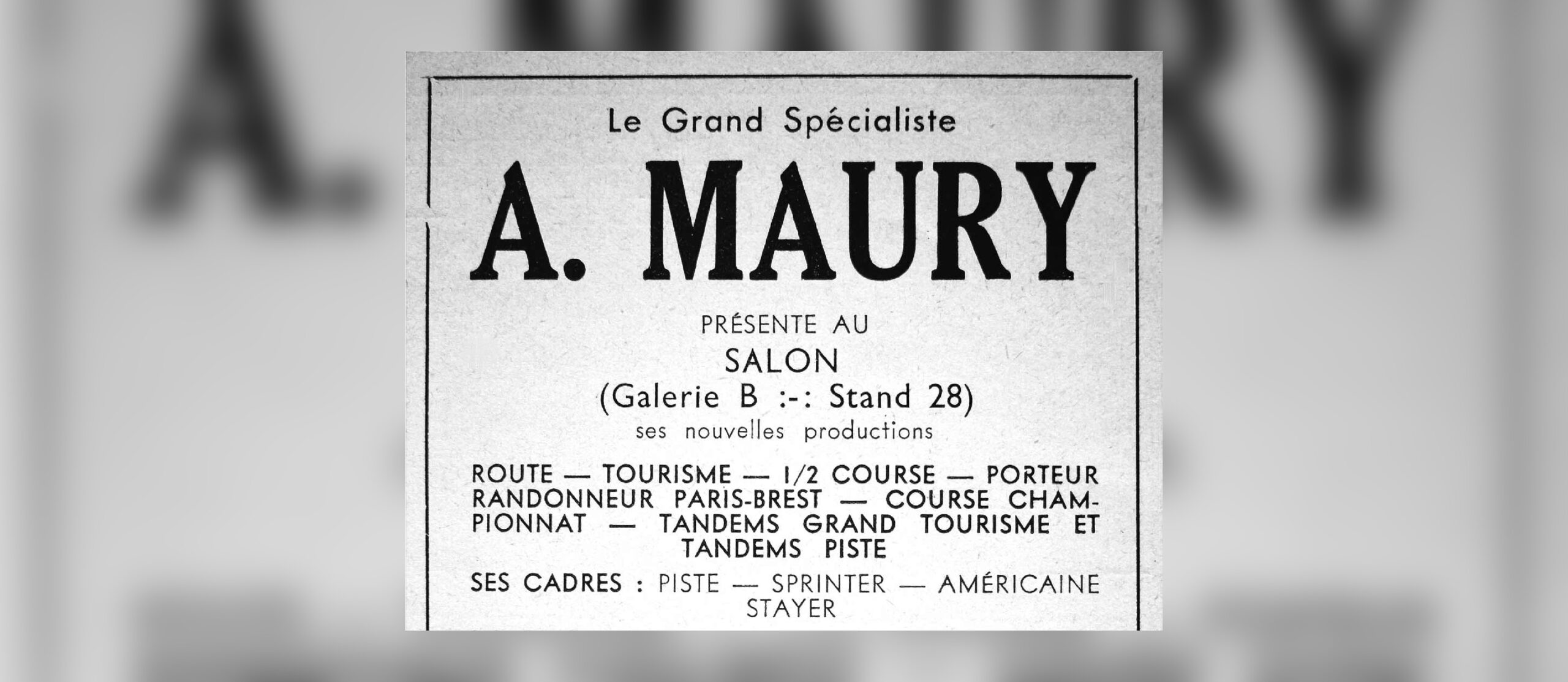
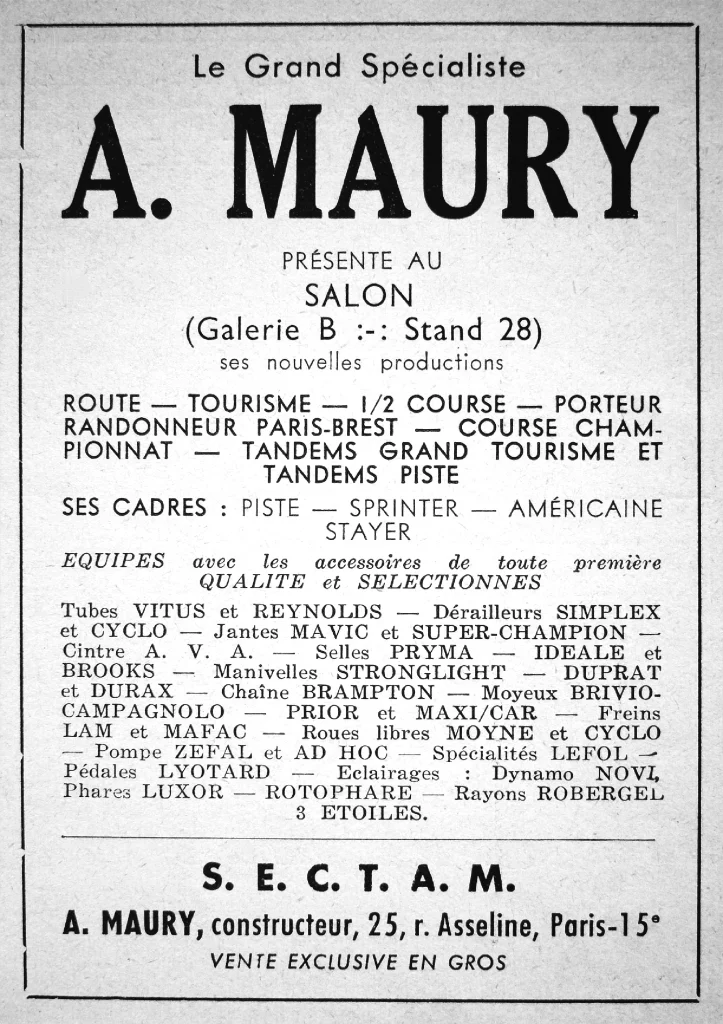
Maury’s Salon du Cycle advertisements bill him as “Le Grand Specialiste,” offering everything from Grand Tourisme tandems to aggressive Stayer (pace following) frames, alongside road, track, sprinter, porteur and touring models.
undated
Cultural Touchstone
Simone Rebour, wife of illustrator Daniel Rebour, is photographed atop a Maury during her ascents of the Galibier, an image remembered as capturing the peak of French cycling culture.
today
Enduring Rarity
Surviving examples of André Maury bicycles are rare, with total production estimated in the hundreds to very low thousands, each a remaining fragment of a vanished Parisian world of bespoke, couturier bicycle craft.
Join the André Maury Heritage Discussion!
From the Boulevard Pasteur atelier to the S.E.C.T.A.M. years, André Maury’s fillet-brazed frames remain a quiet cornerstone of Parisian constructeur history. Share your finds, serial numbers and dating questions with the community.


 Maury
Maury