Repair Workshop Wheels and tires Lacing a wheel

Repair · Wheels and tires

Lace and Build a Wheel

How three period sources built a wheel from a bare hub, a rim and a bundle of spokes: the rim’s holes set out, the first spokes laced through the flange, the rest filled in on both sides, and the nipples run on all alike before the wheel is trued. Henry (1913) and Cassell (1916) lay out wheels of 32 and 40 spokes; a Canadian catalog of 1918 lays out one of 36. Every instruction is from the Ebykr archive; the drawing is Ebykr’s own.

DifficultyHardPatience, and a count kept without a slip (Ebykr’s estimate)
StepsSixFrom three sources
You will needFour tools, five partsThe list, in the sources’ terms
SourceHenry 1913, Cassell 1916, C.C.M. 1918Records 94435, 94257 and 90949

Before you start

This page shows how period sources laced a wheel, step by step, in their words and figures. It does not test or guarantee any wheel. A wheel is a safety part: one built with a spoke on the wrong side or unequal tension can collapse under you. The sources give no tension and no spoke length. Have a bicycle shop check a wheel you have built before you ride it.

On this page The drawing Tools and parts The steps in words What goes wrong Another way Sources

Escape also leaves this view.
    Drawing key
    Workbench view: one step at a time in large type, for a phone or tablet on the bench.

    Tools and parts

    In the sources’ own terms; every item is named in them. Tick each one off as you gather it.

    Tools

    • A nipple key or a ratchet screwdriver For every nipple (Henry, 1913)
    • Dividers and a piece of string To set out the holes, if the rim is not drilled (Henry, 1913)
    • A marking gauge and a center punch Only if you drill the rim (Henry, 1913)
    • A straightedge or thin string To test the dish (Cassell, 1916)

    The sources give gauges and hole counts but no spoke length: take it from the hub and rim you have, or from a dealer.

    Parts and materials

    • A hub with drilled flanges Countersunk alternately on each side (Henry, 1913)
    • A rim Drilled 32, 36 or 40 (Henry, Holdsworthy)
    • Spokes Cut and threaded; double-butted No. 15 and 18, or plain No. 16 (Henry, 1913)
    • Nipples and washers One of each to every spoke (Henry, C.C.M.)
    • Gum paper To number the holes (Henry, 1913)

    The steps in words

    The whole job, readable and printable without the drawing. Each step says what it rests on, and can take you back up to its drawing.

    Choose double-butted spokes and a drilled rim

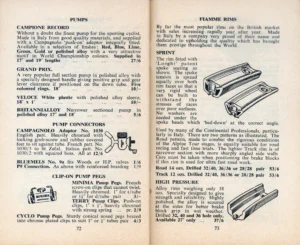
    Henry says the wheels are built on the tangent principle and advises double-butted spokes, whose slightly stouter ends make the threaded end as strong as the stem; the plain kind is weakest at the thread. He gives No. 15 gauge at the ends and No. 18 at the stem, or No. 16 for a plain spoke, and tells the amateur to buy the spokes cut and threaded and the rim drilled, since special tools would not pay for a few wheels. Rims of the period came drilled 32, 36 or 40: the Holdsworthy catalogs of the 1960s list rims drilled 32, 40 and 36 hole.

    What this step rests on
    • exact The tangent principle; double-butted spokes advised, the ends stouter than the stems; No. 15 gauge at the ends and No. 18 at the stem, or No. 16 if plain; the spokes bought cut and threaded; the rims bought drilled: Henry 1913, pages 31 and 32.
    • exact Alloy rims drilled 32, 40 and 36 hole: Holdsworthy 1967-68, rims page.
    • not stated Neither source gives a spoke length for a given hub and rim, or a gauge for a 36-spoke wheel.

    Set out the holes round the rim

    If the rim is not drilled, Henry measures the inside of the rim with a piece of string, divides the length by 32 for a front wheel or 40 for a back wheel, and steps round with dividers set to that distance, marking each point with chalk. The simpler way is to lay the rim on a built wheel and mark it from that. The holes are not on a single center line but alternately on each side of it, never more than 1/16 in. either way, so he scratches two lines about 1/8 in. apart with a marking gauge and center punches each hole on a padded surface. The valve hole goes centrally between two spoke holes, and the holes are filed afterward. For spoking he sticks small pieces of gum paper against the holes and numbers them.

    What this step rests on
    • exact The string round the inside of the rim, its length divided by 32 or 40 and stepped with dividers; or a built wheel used as a guide; the holes alternately either side of a center line, not more than 1/16 in. each way; two lines about 1/8 in. apart, center punched on a padded surface, drilled best in a lathe; the valve hole central between two spoke holes; the holes filed; the holes numbered with gum paper: Henry 1913, pages 32 and 33.
    • not stated The book does not give a drill size or a lathe speed.

    Lace the first spokes through the flange

    Henry starts a 32-spoke front wheel by dropping a spoke through a hole in the flange so that its head rests in the countersunk hole, passing it to a rim hole, then fitting a washer and screwing on a nipple; the next spoke goes through the next flange hole on the other side of the flange and is crossed over the first, with nine rim holes left between them. Spokes C and D follow the same way, and four more go in on the opposite side, with the nipples just taut. Cassell begins the 40-spoke back wheel with a pair of spokes through adjoining flange holes, crossed, and brought to rim holes fifteen apart, then a second pair opposite, and the same on the other side: eight spokes, finger tight, with no tension yet. The front wheel of 32 is laced eleven apart. Henry’s hole counts are hard to follow without his drawing, which is at the page linked below.

    What this step rests on
    • exact The 32-spoke front wheel: a spoke through a top hole in the flange, its head resting in the countersunk hole, to a rim hole, a washer and a nipple; the next spoke in the next hole on the other side, crossed over the first with nine holes between; spokes C and D likewise, then four more on the opposite side with the nipples just taut: Henry 1913, pages 33 to 35.
    • exact The 40-spoke back wheel: a pair through adjoining flange holes, crossed, to rim holes fifteen apart with thirteen between; a second pair opposite with five vacant holes between; the same on the other side; the front wheel the same, but laced eleven apart, with nine vacant holes between the first pairs; the first eight spokes of one dead length, the nipples screwed down an equal distance, no tension: Cassell 1916, pages 90 and 91 and Cassell 1916, pages 91 and 92.
    • not stated Both sources count holes; neither names a pattern such as two-cross or three-cross.

    Fill in the other spokes, both sides

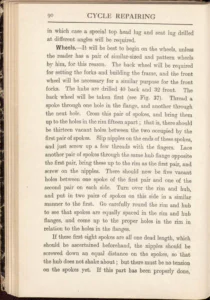
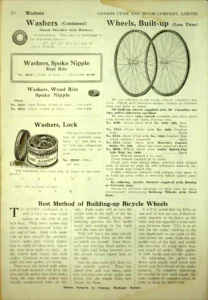
    Cassell says that once the first eight spokes are in and the rim runs roughly true, the rest is simple: each spoke laced through the flange shows at a glance the rim hole it should go to, and each gets a washer and a nipple. Henry fills in a 40-spoke wheel the same way, spoke by spoke, with three rim holes between each spoke and its predecessor and each crossing the spoke before, then turns the wheel and puts a spoke straight through a flange hole, which points between two spokes already laced; the one fitted from the inside of the flange is the guide for the rest. The Canada Cycle and Motor Company’s catalog of 1918 sets out 36 spokes in four groups of nine: the nine inside spokes of one side first, then the nine outside spokes of that side, each crossing three spokes and entering the second vacant nipple hole to the right, then the same on the other end. The catalog does not state the total. It adds that the holes on one end of the hub are drilled opposite a point midway between those on the other, so that one length of spoke serves for all.

    What this step rests on
    • exact The remainder simple once the first eight are right; a washer and nipple on each spoke as inserted, first screwed on with the fingers: Cassell 1916, page 91.
    • exact The 40-spoke wheel: three rim holes between each spoke and its predecessor; the crossing checked and any wrong spoke undone; a spoke put straight through a flange hole on the other end to point between two spokes, the one from the inside of the flange as the guide; nine spokes then the last ten: Henry 1913, pages 35 and 36 and Henry 1913, pages 36 to 38.
    • exact The nine inside spokes of one end laced first, then the nine outside spokes, each crossing three spokes to the right into the second vacant nipple hole; the other end the same; the flange holes drilled opposite a midpoint so that one length of spoke serves: Canada Cycle and Motor Co. 1918, page 70.
    • not stated The C.C.M. catalog says nothing of the rim hole count. Henry’s counts are hard to follow without Fig. 20, which shows only eight spokes.

    Check every spoke, then run the nipples on alike

    Before any tension goes on, Cassell goes over both wheels carefully to be sure every spoke is in its proper place, or the rim may be badly pulled out of truth. Then each nipple is run down alike: Henry tightens them in turn with a nipple key or a ratchet screwdriver until the thread is just visible, so that the spokes are fairly taut and the wheel is ready for the final truing, taking care that the rim is not pulled out of shape; the C.C.M. catalog runs each nipple down until only the last thread of the spoke shows, and then gives each nipple the same number of complete turns.

    What this step rests on
    • exact Both wheels examined to be sure every spoke is in its proper place before any tension is put on, or the rim may get badly pulled out of truth: Cassell 1916, page 92.
    • exact The nipples tightened in turn with a nipple key or a ratchet screwdriver until the thread is just visible; the spokes then fairly taut: Henry 1913, page 38.
    • exact Each nipple run down until only the last thread is exposed, then the same number of complete turns to each to keep the wheel true: Canada Cycle and Motor Co. 1918, page 70.
    • not stated No tension, no figure for a turn and no tool torque is given.

    True it and test the dish

    Cassell trues the wheel in the forks, first by the eight spokes inserted first and marked, then screwing up all the other nipples in turn so that there is no slack but no tension yet; if the rim goes out of truth where a spoke is too tight, he slackens it a little and tries again. He warns that the wheel must not be dished, that is pulled over more to one side than the other, and says the amateur should test this with a straightedge or a piece of thin string; with plated rims, whiting shows better than chalk. How tight the spokes finally are, he says, can only be found by experience. The steps for truing a wheel are on their own page.

    What this step rests on
    • exact The wheel trued in the forks by the first eight spokes marked when put in, then all the other nipples screwed up in turn with no slack but no tension; a spoke too tight slackened a little; the wheel not to be dished, tested with a straightedge or thin string; whiting better than chalk on plated rims; sufficient tension found only by experience: Cassell 1916, page 92 and Cassell 1916, pages 11 and 12.
    • not stated No tension and no figure for dish are given.

    What goes wrong

    Each of these is a source’s own warning, except the last, which is what the sources leave out.

    • A spoke on the wrong side The heads must rest in the countersunk holes, so insert each from the correct side (Henry).
    • Tension before the check Go over every spoke before any tension goes on, or the rim may be pulled out of truth (Cassell).
    • Spokes of different lengths The first eight should be one dead length (Cassell), and the C.C.M. layout serves with one length of spoke.
    • Unequal turns Give each nipple the same number of complete turns (C.C.M.).
    • A wrong crossing Unscrew the nipple and put it right (Henry).
    • A dished wheel Pulled over more to one side than the other: test with a straightedge or string (Cassell).

    Spoke length, tension and the pattern None of the three sources gives a spoke length, a tension or a number of turns beyond “alike”. They name no pattern such as two-cross or three-cross, and none covers a rear wheel dished for gears, a derailleur freewheel or any rim after about 1960. Henry’s counts of holes are hard to follow without his drawings. The page supplies none of these.

    Related pages

    Truing the wheel

    The steps after the lacing: True a Wheel.

    The hub

    Taking the hub apart: Take Apart and Rebuild a Hub.

    Sources

    Every record opens in the Ebykr archive. Each step above names the page it rests on.
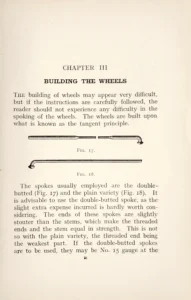
    Record 94435, pages 31 to 38Peter Henry, Cycle Building and Repairing, 1913Chapter III, Building the Wheels: the spokes, the rim set out, a 32-spoke front wheel and a 40-spoke back wheel laced, the nipples run on.
    Record 94257, pages 90 to 92Cassell, Cycle Repairing and Adjusting, 1916 reprintBuilding a cycle: a 40-spoke back wheel and a 32-spoke front wheel laced, every spoke checked before tension, and the new wheel trued.
    Record 90949, page 70Canada Cycle and Motor Co., wholesale catalog, 1918The best method of building up bicycle wheels: nine spokes at a time, each crossing three, and the nipples run down alike.
    Record 78574, page 38Holdsworthy catalog, 1967-68Alloy rims drilled 32, 40 and 36 hole.

    Henry’s book is the Library of Congress copy on the Internet Archive; Cassell’s is DTU Library’s copy; the Canadian catalog is a wholesale catalog of 1918 and the Holdsworthy one a retail catalog of the 1960s, all in the Ebykr archive. The sources span fifty years, so each step names its own. None is a full workshop manual, and the page quotes nothing at length.

    Exact, derived and schematic

    • exactThe tangent principle, the spoke gauges, the rim set out with dividers, the 32-spoke front wheel in Henry, the 40-spoke wheel in Henry and Cassell, the 36-spoke layout in the C.C.M. catalog, the nipples run on alike and the dish tested.
    • schematicThe drawing: the spokes, the rim and the hub flange, drawn with 32 holes and 16 spokes to a flange. The crossings are Ebykr’s own and are not any one source’s hole counts.
    • not statedA spoke length, a tension, a pattern name, and any wheel after about 1960.