How two handbooks of 1913 took a wheel hub apart and put it together again: catch the balls, clean and examine every part, count the balls back in and set the cone. Every instruction is from the Ebykr archive; the drawings are Ebykr’s own.
DifficultyModeratePatience, a clean bench and a box for the balls (Ebykr’s estimate)
StepsSevenFrom Henry, 1913, and Cassell, 1916
You will needThree tools, four materialsThe list, in the sources’ terms
SourceHenry 1913 and Cassell 1916Records 94435 and 94257
Before you start
This page shows how period sources took a plain wheel hub apart and put it together again, step by step, in their own words and figures. It does not test or guarantee any repair. A wheel is a safety part: if you are not sure of the adjustment, ask a bicycle shop to check it before you ride.
Your system asks for reduced motion, so each step is a still drawing. Play moves from still to still.
Drawing key Workbench view: one step at a time in large type, for a phone or tablet on the bench.
Tools and parts
In the sources’ own terms; every item is named in them. Tick each one off as you gather it.
Tools
A box or an eggcup To keep the balls in (Henry)
Rag Soaked in paraffin, to clean the shell, cones, spindle and balls (Henry)
Cone spanners Neither book names them; Holdsworth listed thin hub cone spanners (see Check and Adjust Hub Cones)
A cone or cup that is bad or unevenly worn is replaced, not repaired (Henry, Cassell).
Parts and materials
Paraffin For the rag (Henry)
Vaseline Smeared on the cups to hold the balls (Henry)
New balls, if one is damaged The same diameter as the old: take a sample to the shop (Henry, Cassell)
Good oil Pure sperm oil is named (Cassell)
The steps in words
The whole job, readable and printable without the drawing. Each step says what it rests on, and can take you back up to its drawing.
Listen for the click
Spin the wheel and listen. The sound of the balls dropping on one another as they run is as it should be. A click is not: it means a broken or chipped ball, or a bad place in a cone or cup, and that bearing has to come out and be examined. Henry adds that it is of no use guessing the cause of a noise in a wheel.
What this step rests on
exact A click as a broken or chipped ball or a bad place in the cone or cup, the bearing then taken out to be examined; the balls dropping on one another as the right sound: Cassell 1916, pages 27 and 28.
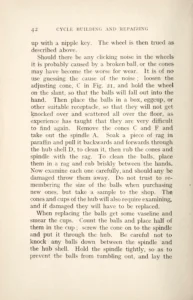
exact A clicking noise probably a broken ball, or cones the worse for wear; no use guessing the cause: Henry 1913, page 42.
not stated Taking the wheel out of the forks: neither book describes it in the passages this page uses.
Loosen the cone, catch the balls, take everything out
Loosen the adjusting cone and hold the wheel on the slant, so that the balls fall out into your hand. Put them straight into a box, an eggcup or some other receptacle, so that they cannot be knocked over and scattered over the floor: Henry says they are very difficult to find again. Then take off the cones and draw the spindle out of the hub shell.
What this step rests on
exact Loosen the adjusting cone; the wheel held on the slant, the balls into the hand and then a box or an eggcup; remove the cones and take out the spindle: Henry 1913, page 42.
derived The lock nut released before the cone is loosened: the figure shows lock nuts beside the cone, but the sentence says only to loosen the adjusting cone.
Clean the shell, the cones, the spindle and the balls
Soak a piece of rag in paraffin and pull it backwards and forwards through the hub shell. Rub the cones and the spindle with the rag. To clean the balls, put them in a rag and rub them briskly between your hands. Every part must be wiped quite clean before it is looked at.
What this step rests on
exact A rag soaked in paraffin pulled through the hub shell; the cones and spindle rubbed with the rag; the balls rubbed in a rag between the hands: Henry 1913, page 42.
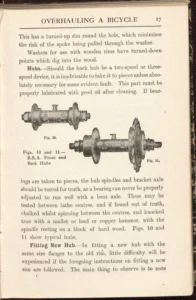
Look at each ball in turn and throw away any that is damaged. Do not trust your memory of the size when you buy new ones: take a sample to the shop. A new ball must be the same diameter. Look over the cones and cups as well, and if one is bad or unevenly worn, get a new one. Cassell adds that a spindle should be tested for truth when the bearings are taken to pieces, since a bearing can never be properly adjusted to run well on a bent spindle.
What this step rests on
exact Each ball examined and a damaged one thrown away; a sample taken to the shop; the cones and cups examined and replaced if damaged: Henry 1913, page 42.
exact A chipped, rough or broken ball replaced by a new one of the same diameter; a bad or unevenly worn cone or cup replaced: Cassell 1916, pages 27 and 28.
exact The spindle tested for truth when a bearing is taken to pieces, because a bent spindle cannot be adjusted to run well: Cassell 1916, page 17.
not stated What a worn cone looks like: the books say only damaged, bad or unevenly worn. Cassell tests a spindle between lathe centres and knocks it true with a mallet; this page does not give that.
Grease the cups, count the balls and put it together
Smear the cups with vaseline. Count the balls and put half of them in the cup. Screw a cone on to the spindle and put the spindle through the hub, taking care not to knock any balls down between the spindle and the hub shell. Hold the spindle tightly so that the balls cannot tumble out, then lay the wheel carefully over on its side and put in the rest of the balls.
What this step rests on
exact Vaseline on the cups; the balls counted and half placed in the cup; the cone screwed on to the spindle and the spindle put through the hub; the spindle held tightly; the wheel laid on its side for the remaining balls: Henry 1913, pages 42 and 43.
not stated How many balls a hub takes: Henry says only to count the ones that came out.
Set the cone and lock it
Screw the adjusting cone up tight, then slacken it back half a turn, so that there is just enough play. Cassell says the same in a different range: tighten the cone home and slack it back a quarter or a half turn, and see that all the lock nuts are tight. Then hold the wheel by the spindle and give the spokes a sharp flick with your thumb: if the cone is right, the wheel turns freely.
What this step rests on
exact The adjusting cone screwed up tight and slackened back half a turn so that there is just sufficient play; the spokes given a sharp twist with the thumb, the wheel to revolve freely: Henry 1913, page 43.
exact The cone tightened home and slackened a quarter or a half revolution; all lock nuts securely tightened: Cassell 1916, pages 28 and 29. Tightened rather too tight, then slackened a trifle until the wheel turns without any perceptible side shake: Cassell 1916, page 27.
not stated Which way to turn the cone, and the spanner for it: neither book says. Holdsworth listed thin hub cone spanners.
Oil it, and listen again
Oil every bearing with a good oil. Cassell names pure sperm oil as good as anything, and warns that some oils sold in tins under fancy names are mostly paraffin, which is no good whatever as a lubricant. Keep the oil off the tires: mineral oil is not good for rubber. Then spin the wheel and listen again: the click should be gone.
What this step rests on
exact All bearings lubricated with good oil after cleaning; pure sperm oil named; tinned oils that are mostly paraffin no good; mineral oil not good for rubber: Cassell 1916, pages 27 and 28 and Cassell 1916, page 29.
derived Listening again for the click: the same test as step 1, repeated.
What goes wrong
Each of these is a source’s own warning, except the last, which is what the sources leave out.
Balls lost Knocked over and scattered over the floor, they are very difficult to find again (Henry): keep them in a box.
The wrong ball Do not trust your memory of the size; take a sample to the shop, and match the diameter (Henry, Cassell).
A ball knocked down A ball that falls between the spindle and the hub shell: take care not to (Henry).
A bent spindle A bearing can never be properly adjusted to run well on one (Cassell).
A click that stays A bad place in a cone or cup, or a chipped ball: renew it (Cassell).
A gear or brake hub Cassell advises against taking a two-speed or three-speed back hub to pieces unless it must be, and gives the New Departure coaster hub its own lubrication on pages 29 and 30. This page covers the plain hub only.
Another way
Clean it without taking it apart
Cassell fills an oil can having a fine point with paraffin and swills the bearing out by squirting it through the lubricators, turning the bearing round again and again until the paraffin runs out quite clean, with the wheel and frame laid on their side so that it drains. If the wheel is still in the machine, rags are tied round any part where oil might run out onto the tires. Cassell 1916, page 27 and Cassell 1916, page 29.
A hub with gears
Cassell says that a back hub which is a two-speed or three-speed device should not be taken to pieces unless it must be for some evident fault, and that it must be well lubricated with good oil after cleaning. This page does not cover one. Cassell 1916, page 17.
Sources
Every record opens in the Ebykr archive. Each step above names the page it rests on.
Record 94435, pages 42 and 43Peter Henry, Cycle Building and Repairing, 1913A clicking hub taken apart: the balls caught, the cones and spindle out, every part cleaned and examined, then rebuilt and the adjusting cone slackened back.
Record 94257, pages 17, 27, 28 and 29Cassell, Cycle Repairing and Adjusting, 1916 reprintCleaning and examining bearings, the ball, cone or cup to renew, the spindle tested for truth, the cone slackened back, and the oil.
Record 78574, page 44Holdsworth 1967-68: toolsHub cone spanners, and the No. 712 spanner for head lock nuts and bracket lock rings.
Henry’s book is the Library of Congress copy on the Internet Archive; Cassell’s is DTU Library’s copy (Danmarks Tekniske Kulturarv). Both are public domain, and the archive carries their page images in full with Ebykr’s own reading of the print. This page puts the sources in Ebykr’s own words and quotes nothing at length.
Exact, derived and schematic
exactThe click and the right sound of the balls; the cone loosened and the balls caught in a box; the cones and spindle out; the rag and paraffin; each ball examined, a sample taken to the shop; the cups smeared with vaseline, the balls counted and half put in; the cone tightened up and slackened back half a turn (Henry) or a quarter to a half turn (Cassell); the lock nuts tight; the thumb test; good oil.
derivedThe lock nut released before the cone is loosened, and the click test repeated at the end.
schematicThe drawing: the hub’s parts, the bench and all motion, and the number of balls drawn. Ebykr’s own drawing.
not statedTaking the wheel out of the forks, which way the cone turns, the spanner for it, what a worn cone looks like, and any gear or brake hub.