Repair Workshop Wheels and tires Tread band and plug

Repair · Wheels and tires

Fit a Tread Band and a Repair Plug

How two handbooks of 1913 and 1916 gave a worn tire cover another season: a rubber band solutioned to the tread, the surface roughened and marked, two coats left to get tacky, the band unrolled round the wheel and pressed from the center out, and a small cut stopped with a screw plug. Every instruction is from the Ebykr archive; the drawing is Ebykr’s own.

DifficultyModeratePatience with the solution (Ebykr’s estimate)
StepsSixFrom Cassell, 1916, and Henry, 1913
You will needSix tools, five materialsThe list, in the sources’ terms
SourceCassell 1916 and Henry 1913Records 94257 and 94435

Before you start

This page shows how period sources fitted a band to a tire cover and plugged a small cut, step by step, in their own words and figures. It does not test or guarantee any repair. Henry says a band stuck on with solution is liable to come apart after a little riding, and a tire that fails at speed can throw you, so check the repair before you rely on it. Petrol, benzine and solution are fire risks and their fumes are harmful: work outdoors or with the windows open, away from any flame. If you are not sure, ask a bicycle shop.

On this page The drawing Tools and parts The steps in words What goes wrong Another way Sources

Escape also leaves this view.
    Drawing key
    Workbench view: one step at a time in large type, for a phone or tablet on the bench.

    Tools and parts

    In the sources’ own terms; every item is named in them. Tick each one off as you gather it.

    Tools

    • A stiff brush For the dirt, and a small brush for the solution (Henry, Cassell)
    • A file or coarse glass paper No. 3 glass paper; or a rasp (Henry, Cassell)
    • An indelible pencil For the two guide lines (Henry)
    • A rag To wipe the cover, or dipped in petrol (Henry, Cassell)
    • A long plank or a table To lay the band out flat on (Henry)
    • A file To notch the wire of a plug (Henry)

    A spare tube and a tire lever for taking the cover off to fit a plug (Henry).

    Parts and materials

    • A band A plain strip or an endless band (Henry, Cassell)
    • Solution A half-pound tin does two bands (Henry)
    • Petrol To clean the cover and the band (Cassell)
    • French chalk Over the inside of a lining (Henry)
    • A repair plug Fourpence in 1913 (Henry)

    The steps in words

    The whole job, readable and printable without the drawing. Each step says what it rests on, and can take you back up to its drawing.

    Decide whether a band will do

    Cassell says the life of a cover may be greatly prolonged by fixing a rubber band or tread, either to a new cover that is likely to get hard wear or to one that has worn thin on the tread but has a sound casing. Henry says the same of a worn tread on a good lining. Bands come cheaply, in the endless form or in a length to be joined up on the cover. The two books choose differently: Cassell finds the endless band the most satisfactory when on, though harder to fit, while Henry picks the plain strip because it is much easier to fix.

    What this step rests on
    • exact A band or tread to prolong a cover’s life, on a new cover likely to get hard wear or a cover worn thin on the tread with a sound casing; bands cheap, endless or in a length to be joined; the endless most satisfactory when on but harder to fit: Cassell 1916, pages 51 and 52.
    • exact A cover whose tread is worn but whose lining is good renewed with a rubber band; two kinds, the endless and the plain strip, and the plain strip the easier to fix: Henry 1913, pages 67 and 68.
    • not stated Henry says the only satisfactory way of fixing these bands is vulcanizing, which the amateur cannot do, and that a band stuck on with solution is liable to come apart after a little riding. Cassell says nothing of this. Neither says how long a band lasts.

    Brush, rough up and mark the tread

    Henry turns the machine upside down and inflates the tire very hard, brushes the cover with a stiff brush to remove all dirt, roughens the tread with a file or very coarse glass paper (No. 3), wipes it round with a rag and draws two indelible pencil lines round the cover to guide the band. Cassell cleans the cover with a rag dipped in petrol and roughens it with a file, rasp or wire brush, working with the tire on the wheel fully inflated; if the cover has a prominent pattern on the tread Cassell rasps it off for the width of the band, and cleans the under surface of an endless band with petrol and roughens that too.

    What this step rests on
    • exact The machine upside down, the tire inflated very hard, the cover brushed with a stiff brush, the tread roughened with a file or very coarse glass paper No. 3, wiped round with a rag and two indelible pencil lines drawn round the cover as guides: Henry 1913, page 68.
    • exact The dirt and mud brushed off with a stiff brush, a rag dipped in petrol rubbed round the cover, the tread roughened with a file or rasp; an endless band cleaned with petrol and roughened, a prominent pattern rasped off for the width of the band, the tire on the wheel fully inflated: Cassell 1916, pages 52 and 53.

    Give the tread and the band two coats

    Both books give two coats to the tread and to the band, put on with a small brush, which Henry finds better than the fingers and cleaner for the hands. The second coat goes on lightly so as not to disturb the first, and the edges of the band get extra care. Henry lays the band out flat on a long plank or the kitchen table, over newspapers, cleans it and cuts one end on the slant. Then comes the part Henry says amateurs get wrong: give the solution plenty of time to get tacky, an hour or two. Cassell gives the band a third coat and leaves it about an hour.

    What this step rests on
    • exact A good coat of solution on the tread with a small brush, the band laid flat on a long plank or table, cleaned, one end cut on the slant, its edges solutioned with extreme care, the second coat very light, and plenty of time left for the solution to get tacky, an hour or two: Henry 1913, pages 68 and 69.
    • exact The first coat rubbed in with a small brush, the band cleaned and solutioned, taking special care round the edges, a second coat rubbed on lighter, the band given another coat and left about an hour to dry: Cassell 1916, page 53.
    • not stated Neither book names a brand of solution; Henry says a half-pound tin is enough for two bands.

    Unroll it round the tread, then make the joint

    For a plain strip, roll the band up and lay its end on the tread between the pencil lines, then unroll it slowly, a few inches at a time (Cassell says 3 in. or 4 in.), pressing from the center to the edges so that no air bubbles remain. When about 6 in. of the tread is left, Henry checks how the ends will meet: if the band is too long, cut it to length, cut the edge on the slant (reversing the cut this time), solution it, and press the joint together. Turn the wheel round and press down any place that has lifted. For an endless band, Cassell tries it in place first to see how far it stretches and takes care never to exceed that stretch in any one part. Cassell turns it inside out, gives the band and the cover two good coats, lays half on, reverses it and fixes the other half, pressing only the center until the whole band is in position and the edges only when the solution is almost dry. The wheel is held in the forks so it can be turned as the work goes on.

    What this step rests on
    • exact The band rolled up and its end laid on the tread between the pencil marks, unrolled gradually and pressed from the center to the edges so that no air bubbles appear; when about 6 in. remain the fit of the joint noted, the band cut to length on a reversed slant, solutioned and pressed together, the wheel turned round and any lifting places pressed down: Henry 1913, page 69.
    • exact A roll band unrolled 3 in. or 4 in. at a time, cut so as to make a neat joint and pressed from the center to the edges; an endless band tried in place for its stretch, turned inside out, two good coats on band and cover, half laid on, then reversed and the other half fixed, the center only pressed and the edges not pressed until the solution is almost dry, the wheel held firmly in the forks: Cassell 1916, pages 52 and 53.

    Leave it a day or two

    Henry says that when the machine is not urgently needed it is better to let it stand for a day or two, so that the solution can properly set. Cassell says the same of every cover repair but the smallest, and the page on that job gives the passage: Mend a Cut or Burst in a Tire Cover.

    What this step rests on
    • exact When the machine is not urgently needed, better to let it stand for a day or two to enable the solution to get properly set: Henry 1913, page 69.
    • not stated Cassell does not say how long to leave a band in particular, so this step rests on Henry alone.

    Stop a small cut with a screw plug

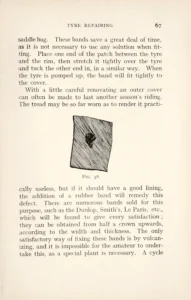
    For a small cut in the cover Henry describes a Sampson repair plug, which Henry says can be fitted and the tire put back in a few minutes. Unscrew the washer from the plug, take the cover off, push the plug through the hole from the inside and screw the washer down tightly against the cover. Put the cover back and inflate the tube; the washer is then tightened further by turning the wire to the left until it is embedded in the tread. Notch the wire with a file as close to the cover as possible and bend it backward and forward until it snaps. The makers claimed that it made a neat and permanent repair equal to vulcanizing, and Henry reports that the plugs cost fourpence each from cycle agents.

    What this step rests on
    • exact A Sampson outer cover repair plug for small cuts: the washer unscrewed, the cover removed, the plug inserted from the inside through the hole, the washer screwed tight against the cover, the cover replaced and the tube inflated, the wire turned to the left until the washer is embedded in the tread, the wire notched with a file close to the cover and bent to and fro until it snaps: Henry 1913, pages 71 and 72.
    • not stated The claim that the plug makes a repair equal to vulcanizing is the makers’ (Brown Brothers, Ltd.), reported by Henry, not tested by Henry. Cassell does not describe a plug. No modern equivalent is named in either book.

    What goes wrong

    Each of these is a source’s own warning, except the last, which is what the sources leave out.

    • Fitting a band to a soft tire Both books work with the tire inflated, Henry very hard.
    • A heavy second coat It disturbs the first (Henry, Cassell).
    • Not waiting for the solution to get tacky The mistake Henry says amateurs usually make.
    • Pressing the edges down early Cassell leaves them until the solution is almost dry.
    • Stretching the band unevenly A surplus is left that cannot be got rid of except by cutting the band or starting again (Cassell).
    • Riding on it the same day Henry would let it stand a day or two.

    Whether a solution band will last Henry says only vulcanizing is a satisfactory way to fix a band and a solutioned one is liable to come apart after a little riding. Cassell describes the solution method without that caveat. Neither says what a band lasts or how to remove one.

    Related jobs

    A cut or burst in the cover

    A cover mended rather than banded: Mend a Cut or Burst in a Tire Cover.

    A wire against flints

    Henry fixes a pair of brake clips to the front forks and the back stays and stretches a wire from one to the other, about an eighth of an inch from the tread, so that it removes the puncturing materials as the wheel turns. Henry 1913, page 70.

    Sources

    Every record opens in the Ebykr archive. Each step above names the page it rests on.
    Record 94257, pages 51 to 53Cassell, Cycle Repairing and Adjusting, 1916 reprintEndless bands and roll bands fixed to a cover: cleaned, roughened, two coats of solution, and pressed down from the center.
    Record 94435, pages 67 to 72Peter Henry, Cycle Building and Repairing, 1913A rubber band solutioned to a worn tread, a wire against flints, and the Sampson repair plug screwed through a small cut.

    Henry’s book is the Library of Congress copy on the Internet Archive; Cassell’s is DTU Library’s copy (Danmarks Tekniske Kulturarv). Both are public domain, and the archive carries their page images in full with Ebykr’s own reading of the print. The two agree on the method of fitting a band and differ on which band is best and on whether solution holds; the plug and the days to set rest on Henry alone, and the page says so. This page puts the sources in Ebykr’s own words and quotes nothing at length.

    Exact, derived and schematic

    • exactA band or tread fixed to a worn cover; the tread brushed, roughened and marked; two coats on the tread and the band; the band unrolled and pressed from the center out; a day or two to set; a screw plug through a small cut.
    • schematicThe drawing: the tire, the tread, the bands, the brush, the clock, the days, the plug and its washer and wire. Ebykr’s own drawing.
    • not statedHow long a band lasts, how to take one off, a modern vulcanizing service, a modern plug, and every tubeless or clincher tire.

    The Ebykr Digest

    A monthly letter on classic lightweight bicycles

    New articles, timelines, catalog finds and registry activity — assembled from the archive once a month. Your address is never shared.

    Double opt-in. One email per month. Unsubscribe at any time with one click.