About Ebykr
Ebykr celebrates classic and vintage lightweight bicycles through provocative imagery and opinion. Ride along with us.
About Ebykr
Ebykr celebrates classic and vintage lightweight bicycles through provocative imagery and opinion. Ride along with us.

How two handbooks of 1913 and 1916 mended the cover of a tire rather than its tube: a surface cut cleaned and filled, a deep cut patched with canvas from the inside, a burst patched with a piece of fabric wider than the cover, a loose tread stuck down, and the repair left a day or two to set. Every instruction is from the Ebykr archive; the drawings are Ebykr’s own.
This page shows how period sources mended the cover of a tire, step by step, in their own words and figures. It does not test or guarantee any repair. A tire is a safety part, and a cover that has burst or is bulging is the likeliest to fail again at speed: Henry says a large cut needs a firm that specializes in tire repair, and Cassell that a burst is inevitable if a cut is neglected. The petrol, benzolene and naphtha these sources use to clean a cover are flammable: keep any flame away. If you are not sure, ask a bicycle shop to check it before you ride.
On this page The drawing Tools and parts The steps in words What goes wrong Another way Sources
Your system asks for reduced motion, so each step is a still drawing. Play moves from still to still.
In the sources’ own terms; every item is named in them. Tick each one off as you gather it.
Cassell also names gaiter patches and relining with prepared canvas; those belong to the related jobs.
The whole job, readable and printable without the drawing. Each step says what it rests on, and can take you back up to its drawing.
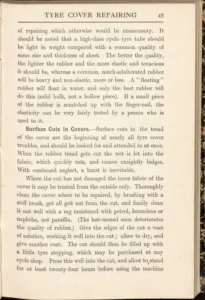
Cassell says surface cuts in the tread are the beginning of nearly all tire cover troubles and should be looked for and attended to at once: once the rubber is cut the wet gets into the fabric, which quickly rots and causes unsightly bulges, and with continued neglect a burst is inevitable. Henry examines the cover for flints embedded in the tread, takes them out and fills the holes with a tire stopping.
Where the cut has not damaged the inner fabric it can be treated from the outside only. Clean the cover where it is to be mended by brushing with a stiff brush, get all the grit out of the cut, and clean it out well with a rag moistened with petrol, benzolene or naphtha, not paraffin, which soon spoils the rubber. Put a coat of solution on the edges of the cut, working it well into the cut, let it dry and give another coat. Then fill the cut with a little tire stopping, which any cycle shop sells, and press it well in. Cassell says the cut must be perfectly clean before it is solutioned and that roughening the edges with a small rasp or file makes the solution stick better. A substitute is cotton wool mixed with solution, pressed in with a match stick, which Henry also uses; or a stopping made by powdering a piece of leather with a rasp and mixing it with solution. For very small cuts Henry squeezes in a little solution and presses the edges together.
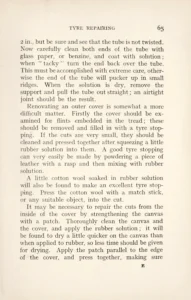
A cut that has gone deep enough to hurt the fabric is not mended by plugging the outer cut alone: unless the canvas is attended to quickly a bulge and a burst follow. Take the cover off the rim and mend the inside first. If the cut is small, clean and recent, it may be enough to take the cover off only where the cut is. Patch it with a piece of proofed canvas, cut amply large, cleaned with a rag dipped in petrol, with two good coats of solution on the place and on the proofed side of the canvas, the first allowed to dry before the second. When nearly dry press the patch on and rub it well down so that it sticks firmly. Then treat the cut on the outside as before, sprinkle French chalk over the parts and put the tire back. Henry puts the patch parallel to the edge of the cover, presses it so that the edges stick and powders it, and says solution dries a little quicker on canvas than on rubber, so less time is wanted.
Where the fabric has given way, an ordinary patch just larger than the hole is useless, since it has to bear the whole strain. Cassell cuts a patch of fabric 2 in. or 3 in. longer than the burst or weak place and about 1 in. wider than the cover when flattened, so that its edges come over the beads or wires: when the tire is pumped up the tube holds the edges of the patch against the rim and takes much of the strain off the solution. The beads or wired edges need very good cleaning and solutioning. Turn the cover inside out for the work; the tread outside can be done on or off the rim, according to the damage. After mending, put the tire on, partly inflate it, bind tape tightly round the repaired place and then fully inflate, leaving the tape on until the solution is quite dry. Henry puts canvas right over the damaged fabric, cuts a rubber piece the size of the hole in the tread, solutions it and lets it get tacky while the frayed edges are cleaned and solutioned, then sets it in place; or cuts a piece out of an old cover, 4 in. will do for a hole the size of a halfpenny, and peels it with a penknife and benzine to a thin patch.
A tread that has come away from the fabric without other damage will let grit and dirt in through a cut and form a large lump if neglected. Cut a place in the rubber large enough to work the grit and dirt out, and clean the two surfaces thoroughly with a rag soaked in petrol on a piece of stick, but do not begin cleaning until every particle of dirt is out. Work a good coat of solution in through the cut with a small brush. Keep the two solutioned surfaces apart until the solution is almost dry, and then press them together. Put the tire back on the rim, partly inflate it, bind it with tape and leave it to set and dry.
In this, as in all repairs to the cover other than the smallest, Cassell says the machine should not be used for at least a day after finishing, and if left another day so much the better. A filled surface cut should stand at least 24 hours before the machine is used on the road. Cassell says the longer a repair is left before use, the better the chance of a permanent one.
Each of these is a source’s own warning, except the last, which is what the sources leave out.
When to stop mending Neither book says how to judge when a cover is past repair, how many repairs a cover can carry, or what pressure a repaired cover can bear. Henry sends a large cut to a repairer.
Cassell says a weak place or burst can be repaired with a gaiter patch, a piece of fabric wide enough to go right across the cover and lap round the beads to the center underneath, with a thin covering of rubber on the tread, sold in various pattern treads. The cover must be carefully cleaned and roughened with a tire rasp, given two or three good coats of solution, and taped after the tire is on the rim and inflated; choose one long enough to cover the weak place well, or it will bulge each side of it. Cassell 1916, page 49.
Where a cover has numerous weak places Cassell would re-line it with rolls of prepared canvas rather than patch it many times: the cover turned inside out and hung on a piece of wood, the canvas lapped 4 in. to 6 in. with diagonal ends, solutioned two or three coats, started squarely and pressed down from the center out so that no air is trapped, and the cover left a day or two. Cassell 1916, pages 48 and 49.
Henry fits a plug of the Sampson pattern through a small cut from the inside with a washer screwed down against the cover, carries a repair band that needs no solution, and says a rubber band fixed to a worn tread can only be properly done by vulcanizing, which the amateur cannot do. Cassell fixes bands to covers with solution, endless or roll. Henry 1913, pages 65 to 67.
Every record opens in the Ebykr archive. Each step above names the page it rests on.
Henry’s book is the Library of Congress copy on the Internet Archive; Cassell’s is DTU Library’s copy (Danmarks Tekniske Kulturarv). Both are public domain, and the archive carries their page images in full with Ebykr’s own reading of the print. The two agree that a cut cover is cleaned, filled with a stopping and, if the fabric is damaged, patched with canvas from the inside; Cassell gives the fuller account and alone describes the loose tread and the days of setting. This page puts the sources in Ebykr’s own words and quotes nothing at length.
The Ebykr Digest
New articles, timelines, catalog finds and registry activity — assembled from the archive once a month. Your address is never shared.
Double opt-in. One email per month. Unsubscribe at any time with one click.