About Ebykr
Ebykr celebrates classic and vintage lightweight bicycles through provocative imagery and opinion. Ride along with us.
About Ebykr
Ebykr celebrates classic and vintage lightweight bicycles through provocative imagery and opinion. Ride along with us.

How two handbooks of 1913 and 1916 looked after a chain: taken off at its bolt, soaked in paraffin and drained, lubricated with graphite or tallow, its loose rivets hammered tight, shortened by filing the pins and punching them out, and put back with a little slack. Every instruction is from the Ebykr archive; the drawings are Ebykr’s own.
This page shows how period sources cleaned, shortened and set a chain, step by step, in their own words and figures. It does not test or guarantee any repair. A chain that comes apart under load is a safety hazard: Henry warns that a chain bolt that works out on a hill can cause a nasty accident, above all with a back-pedaling brake, and Cassell says the nut should be examined from time to time. The paraffin (kerosene) and the melted tallow these sources use are flammable, and Henry says so of the tallow: keep any flame away. If you are not sure of the work, ask a bicycle shop to check it before you ride.
On this page The drawing Tools and parts The steps in words What goes wrong Another way Sources
Your system asks for reduced motion, so each step is a still drawing. Play moves from still to still.
In the sources’ own terms; every item is named in them. Tick each one off as you gather it.
Henry also names two small pieces of wood under the coil and an old rag; neither is a tool for the job itself.
The whole job, readable and printable without the drawing. Each step says what it rests on, and can take you back up to its drawing.
Put the machine on a stand or hang it by a rope from a hook. Take the chain off by removing the chain nut and bolt (Cassell calls the bolt the pin), and put them back in one end of the chain or into a box or tray where they cannot be lost. A chain cannot be cleaned thoroughly while it is on the machine, Cassell says.
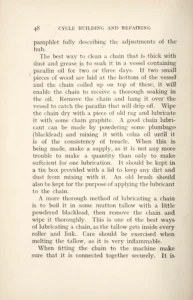
Coil the chain in a shallow dish or tray of paraffin (kerosene). Henry lays two small pieces of wood at the bottom of the vessel and coils the chain on top of them, so that the oil soaks the chain thoroughly. Cassell leaves it about 24 hours; Henry two or three days for a chain thick with dust and grease. Then lift it out and hang it over the dish to catch the paraffin that drips off. Henry wipes it dry with a piece of old rag.
Henry brushes the chain with chain graphite, or with a lubricant made from powdered graphite (blacklead) mixed with colza oil to the thickness of treacle, kept in a tin with a lid and put on with an old brush. Both books call tallow the more thorough way, because it finds its way into every link and roller. Henry boils the chain in mutton tallow with a little powdered blacklead and wipes it thoroughly. Cassell coils the chain in a shallow tin just covered with melted Russian tallow, stands the tin on a stove or in a warm oven for an hour or so, hangs the chain up while it is still warm to drain and wipes it with a cloth. Cassell’s other way is about half a pound of cut-up mutton suet in an oven for three or four hours, then wiped and dusted with graphite. Cassell brushes graphite on the outside as well if there is no gear case. If there is an oil-bath gear case, empty the old oil out, clean the case with paraffin and put in fresh oil.
After a chain has been in use for some time the rivets may work loose; Cassell says this happens even with the best chains, especially after hard riding or when the chain is old and worn. Look carefully at every rivet. To tighten a loose one, lay the chain on its side on a piece of iron or steel (Cassell says a 14-lb. weight will do) and hammer the loose rivets with a heavy hammer until the heads are burred over and fit tightly in the side plates.
First find out how many links can come out by trying the chain on the machine. Cassell takes the back wheel right into the slots by unscrewing the draw bolts and sees whether the chain can be joined with two links to spare; it is easier for an amateur, Cassell says, to take out two links than one. Put the chain on its side in a vise so that the burred heads of the pins can be filed down, and hold the file flat so that the side plates are not damaged. Then punch the pins out and the links come away; Cassell files the rivet head flush with the side plate, prises the plate clear and twists it round until the link slides off. Do not take a link off at the end of the chain where the bolt fits, and look at the bolt to see that it fits well, since a poor one should be renewed. Join the chain again with a chain bolt and nut. To lengthen a chain, Henry says, special links can be bought.
Try the chain in position, then join it with the nut and bolt; Henry does this on the chain wheel, where more pressure can be put on the screwdriver. To set the slack, with the back wheel in the slots, tighten the spindle nut on the side away from the chain, then the chain adjuster on the chain side until the chain is just slack. Hold the rim in the center of the frame with one hand and tighten the spindle nut with the other. Then loosen the other spindle nut and tighten the adjuster on that side by the same amount, make sure the rim is still in the center and screw the nut up tight. Cassell wants the back wheel quite true in the forks, top and bottom, and the chain with a slight sag at both the top and the bottom. Look at the chain bolt nut every now and again and tighten it with a screwdriver, since it often works loose with the jolting of the machine.
Each of these is a source’s own warning, except the last, which is what the sources leave out.
Slack in figures, and a worn chain Neither book gives the slack in inches or says when a chain is worn out. Both write for the block chains and roller chains of 1913; nothing here covers a derailleur chain.
Cassell gives a sum for a chain of 1 in. pitch: twice the distance between the centers of the bracket axle and the back axle, plus half the teeth of the two chain wheels together. With centers 19 in. apart and 24 and 8 teeth: (19 × 2) + (24 + 8)/2 = 54 in. Cassell adds a rule for a ½ in. pitch chain, not to halve the teeth, but gives no worked sum, and Ebykr could not make it agree with the 1 in. sum, so it is not repeated here. Cassell 1916, page 23.
Cassell lists the advantages of a roller chain over the old block chain: less friction on the chain-wheel teeth, quieter running, and no stiffening in wet or dirty weather so that it mounts the teeth. The ½ in. pitch roller chain was the one most in favor, but it will not fit a chain wheel made for a 1 in. block chain, which needs a 1 in. pitch twin-roller chain. Cassell 1916, pages 23 and 24.
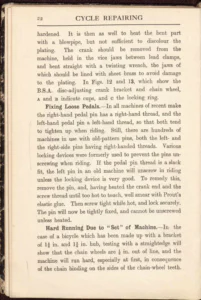
Cassell says a bracket of 1⅝ in. with a 1¾ in. hub leaves the chain wheels ⅛ in. out of line, as a straightedge shows, and the machine runs hard at first; the other way round does not matter much, and some makers set the hub wheel &frac116; in. off on purpose. Cassell 1916, pages 22 and 23.
Cassell melts Russian tallow, stirs in powdered graphite until it is the thickness wanted, and pours it into molds made of pieces of steel cycle tube; the stick is pushed out when set. It lubricates the outside of the chain only, not the interior. Cassell also gives plumbago and vaseline for the outside. Cassell 1916, pages 26 and 27.
Every record opens in the Ebykr archive. Each step above names the page it rests on.
Henry’s book is the Library of Congress copy on the Internet Archive; Cassell’s is DTU Library’s copy (Danmarks Tekniske Kulturarv). Both are public domain, and the archive carries their page images in full with Ebykr’s own reading of the print. The two agree on soaking in paraffin, on tallow or graphite, on hammering loose rivets and on shortening by filing and punching, and differ on the time to soak and on how the lubricant is made. Cassell alone says how to take the chain off. This page puts the sources in Ebykr’s own words and quotes nothing at length.
The Ebykr Digest
New articles, timelines, catalog finds and registry activity — assembled from the archive once a month. Your address is never shared.
Double opt-in. One email per month. Unsubscribe at any time with one click.