About Ebykr
Ebykr celebrates classic and vintage lightweight bicycles through provocative imagery and opinion. Ride along with us.
About Ebykr
Ebykr celebrates classic and vintage lightweight bicycles through provocative imagery and opinion. Ride along with us.

Source: Bicycling!, March 1976, pages 28–29. The scan was posted on Bike Forums by SpeedofLite, 29 March 2020.
| Marque | Reynolds |
|---|---|
| Type | Review |
| Year | 1976 |
| Publisher | Bicycling! |
| Country | United States |
| Language | English |
| Pages | 2 |
| Source | Bicycling!, March 1976, pages 28–29. The scan was posted on Bike Forums by SpeedofLite, 29 March 2020. |
| Credit | Ebykr archive |
| Identifier | Permalink https://www.bikeforums.net/classic-vintage/1196869-frames-framebuilding-1970-1979-reynolds-753-a.html |
| Transcription | Headings and specifications transcribed; article text summarized |
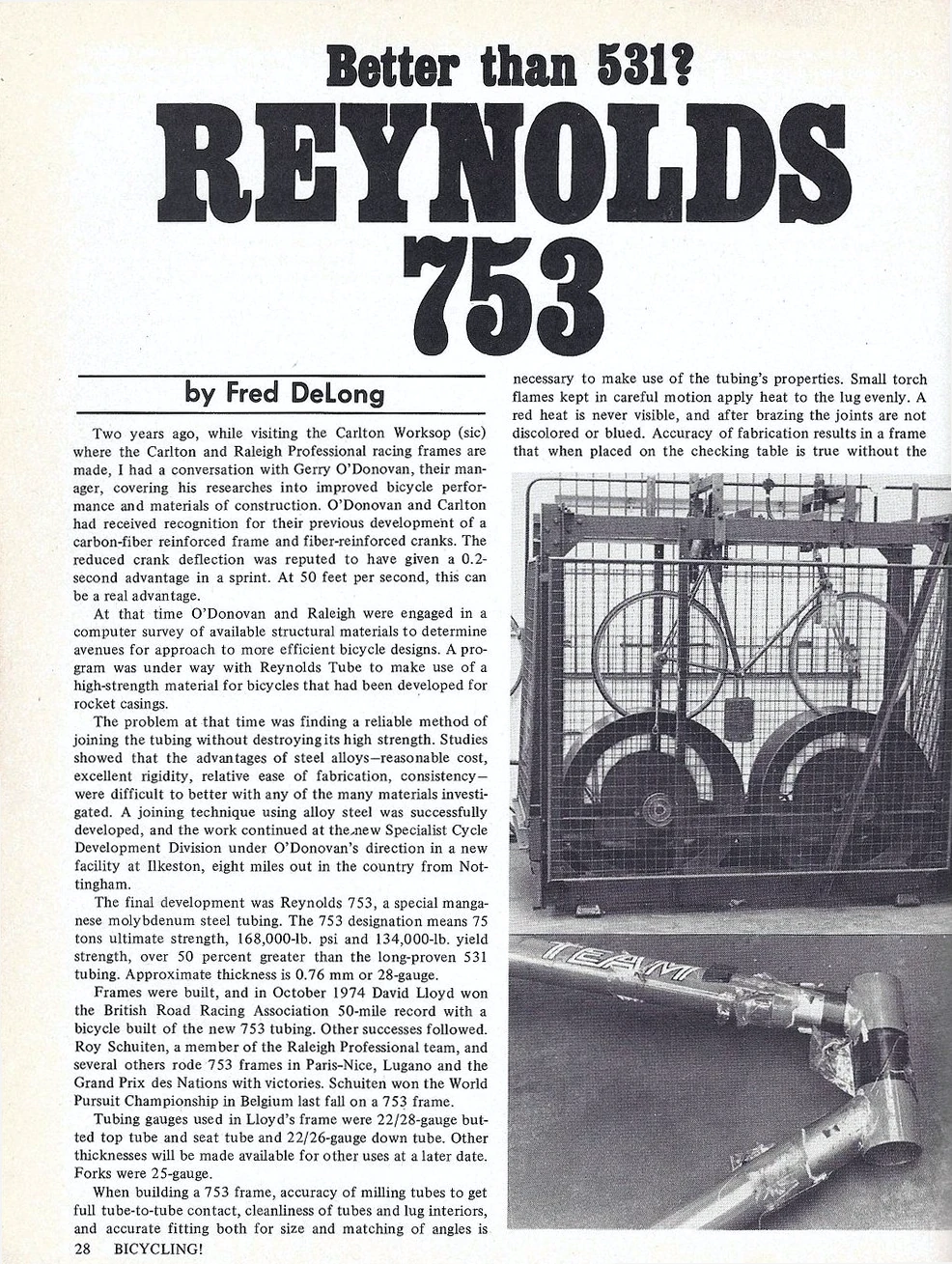
Better than 531? REYNOLDS 753 by Fred DeLong 28 BICYCLING! MARCH '76 29
This is a magazine article, so its running text is summarized here rather than reproduced; the headline, byline, specifications and scores are transcribed as printed.
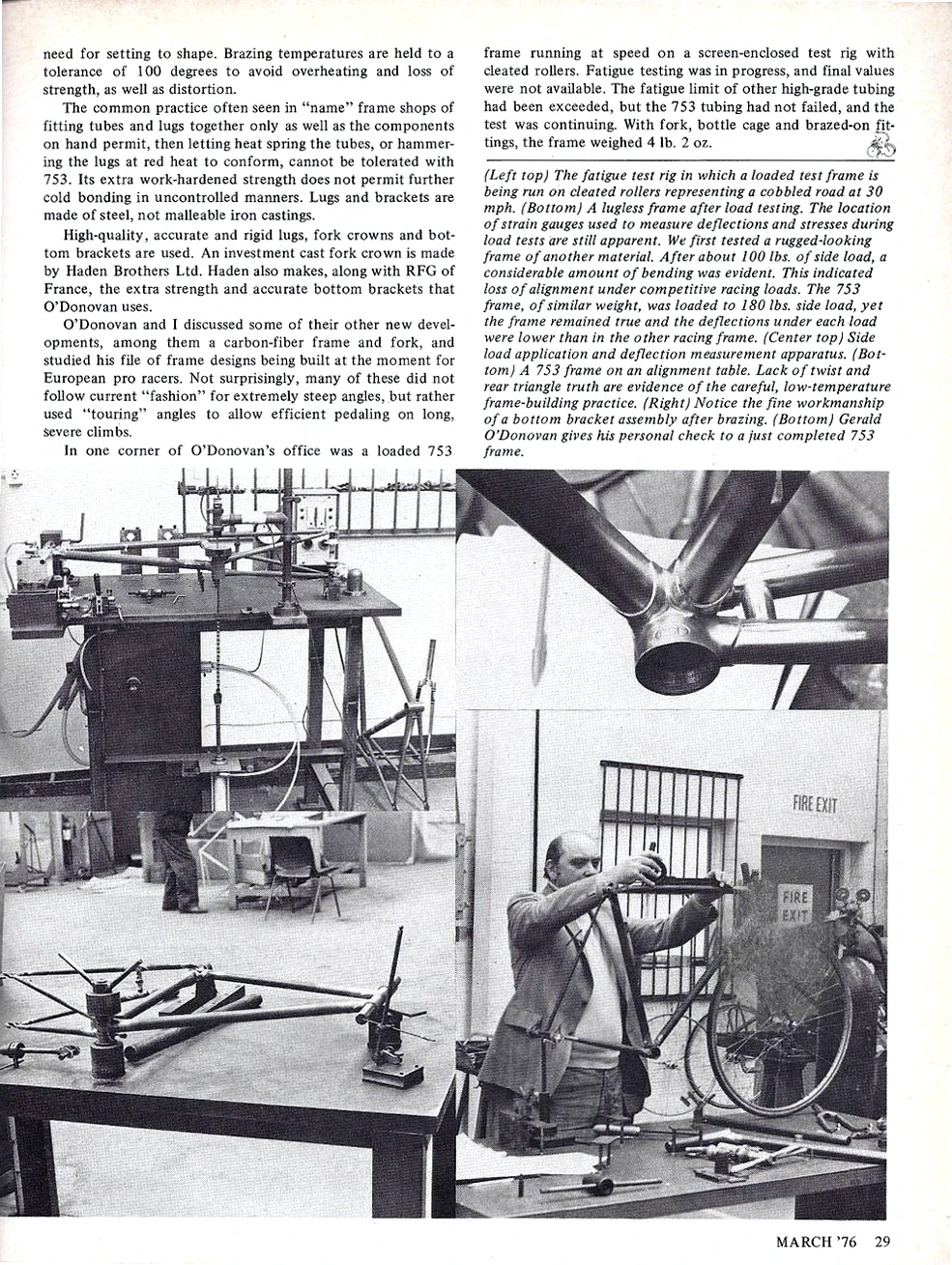
Fred DeLong’s article “Better than 531? Reynolds 753” ran on pages 28 and 29 of Bicycling! for March 1976. Drawing on a visit to Gerald O’Donovan at the Carlton works in Worksop, it describes the new tubing, the high-strength steel behind it, how a 753 frame had to be brazed and how the frames were tested. The title, byline and folios are transcribed as printed; the article’s text and captions are summarized in Ebykr’s words, and the page images carry them in full.
— Page 1 —
Better than 531?
REYNOLDS
753
by Fred DeLong
[Ebykr summary; the article’s running text is not reproduced. DeLong recalls a visit two years earlier to the Carlton works at Worksop, where the Carlton and Raleigh professional racing frames were made, and a conversation with its manager, Gerry O’Donovan, about his research into better bicycles and materials, including a carbon-fiber reinforced frame and fiber-reinforced cranks. Raleigh and O’Donovan had run a computer survey of structural materials, and a program with Reynolds Tube set out to use for bicycles a high-strength material developed for rocket casings. The problem was joining the tubing without destroying its strength: a technique using alloy steel was developed, and the work went on at Raleigh’s new Specialist Cycle Development Division at Ilkeston, near Nottingham, under O’Donovan. The result was Reynolds 753, a special manganese molybdenum steel tubing. DeLong gives the designation as 75 tons ultimate strength, 168,000 psi, with a yield strength of 134,000 psi, over 50 percent greater than 531, and the thickness as about 0.76 mm or 28 gauge. In October 1974 David Lloyd took the British Road Racing Association 50-mile record on a 753 bicycle, and Roy Schuiten and other Raleigh professionals won on 753 frames, Schuiten taking the World Pursuit Championship in Belgium the previous fall. Lloyd’s frame had 22/28-gauge butted top and seat tubes, a 22/26-gauge down tube and 25-gauge forks, with other thicknesses promised. The page ends on the building method: tubes mitered for full contact, clean tubes and lugs, and accurate fitting.]
[Two black-and-white photographs: a fatigue test rig in a wire cage, with a loaded frame running on cleated rollers, and a lugless test frame lettered TEAM, still taped where its strain gauges were fixed.]
28 BICYCLING!
— Page 2 —
[Ebykr summary, continued. Small torch flames kept moving heat the lugs evenly, red heat never shows and the joints come out neither discolored nor blued, so an accurately built frame is true on the checking table without setting; brazing temperatures are held within a 100-degree tolerance. DeLong writes that the habits of some “name” frame shops, loose fitting, springing tubes with heat and hammering lugs at red heat, cannot be tolerated with 753, whose extra work-hardened strength does not permit further uncontrolled cold bending. Lugs and brackets are steel, not malleable iron castings: an investment-cast fork crown by Haden Brothers Ltd., and bottom brackets from Haden and from RFG of France. O’Donovan also showed a carbon-fiber frame and fork and his frame designs for European professionals, many on touring rather than steep angles for long climbs. A loaded 753 frame was running on a fatigue rig in his office: it had passed the fatigue limit of other high-grade tubing without failing, and the test continued. With fork, bottle cage and brazed-on fittings that frame weighed 4 lb. 2 oz.]
[The caption block, summarized: the fatigue rig runs a loaded frame on cleated rollers representing a cobbled road at 30 mph; a lugless frame still shows where its strain gauges were placed for the load tests; in a side-load test a frame of another material bent noticeably at about 100 lbs., while the 753 frame took 180 lbs. and stayed true with smaller deflections; a 753 frame on an alignment table shows the result of careful low-temperature building; a bottom bracket assembly shows the finish after brazing; and Gerald O’Donovan checks a just-completed 753 frame.]
[Four black-and-white photographs: the side-load and deflection measuring apparatus, a 753 frame on an alignment table, a close view of a brazed bottom bracket shell, and Gerald O’Donovan sighting along a completed frame.]
MARCH ’76 29
 Reynolds c.1987 Tube Talk — What Each Set Is For, With Set Weights and the Respray Marks
 Reynolds 1988 Product Range — Every Tube Set by Part Number, With Brazing Temperatures
 Reynolds 1990 Product Range — Every Tube Set by Part Number, and the Brazing Temperatures
 Reynolds c.1990 Constructors Tube Guide — Every Tube Set and Its Gauges on One Page
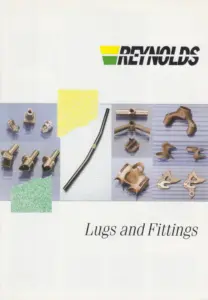 Reynolds c.1990 Lugs and Fittings — The All-Reynolds Frame, Part by Part
Ebykr presents this material for research and education. If you hold rights to it or notice an ownership issue, please contact us and we will respond promptly.
The Ebykr Digest
New articles, timelines, catalog finds and registry activity — assembled from the archive once a month. Your address is never shared.
Double opt-in. One email per month. Unsubscribe at any time with one click.