About Ebykr
Ebykr celebrates classic and vintage lightweight bicycles through provocative imagery and opinion. Ride along with us.
About Ebykr
Ebykr celebrates classic and vintage lightweight bicycles through provocative imagery and opinion. Ride along with us.

Source: Gallica (Bibliothèque nationale de France), L'Officiel du cycle, du motocycle et du camping, 1 November 1952, N° 44, page 43; ark:/12148/bd6t54182075k. Source gallica.bnf.fr / BnF.
| Marque | Huret |
|---|---|
| Type | Review |
| Year | 1952 |
| Publisher | L'Officiel du cycle |
| Artist | Daniel Rebour |
| Country | France |
| Language | French |
| Pages | 1 |
| Source | Gallica (Bibliothèque nationale de France), L'Officiel du cycle, du motocycle et du camping, 1 November 1952, N° 44, page 43; ark:/12148/bd6t54182075k. Source gallica.bnf.fr / BnF. |
| Credit | Ebykr archive; Bibliothèque nationale de France |
| Identifier | Gallica (BnF) ark:/12148/bd6t54182075k/f43 |
| Transcription | Headings and specifications transcribed; article text summarized |
Le dérailleur « Louison-Bobet » HURET 1° Réglage par le cycliste et à sa volonté, de la tension de chaîne, sur tous les développements, ceci ayant pour avantage la dimi- nution du coefficient de frottement des organes en contact et dimi- nuant de ce fait, d'une façon appréciable, l'effort à produire par le cycliste, ainsi …
This is a magazine article, so its running text is summarized here rather than reproduced; the headline, byline, specifications and scores are transcribed as printed.
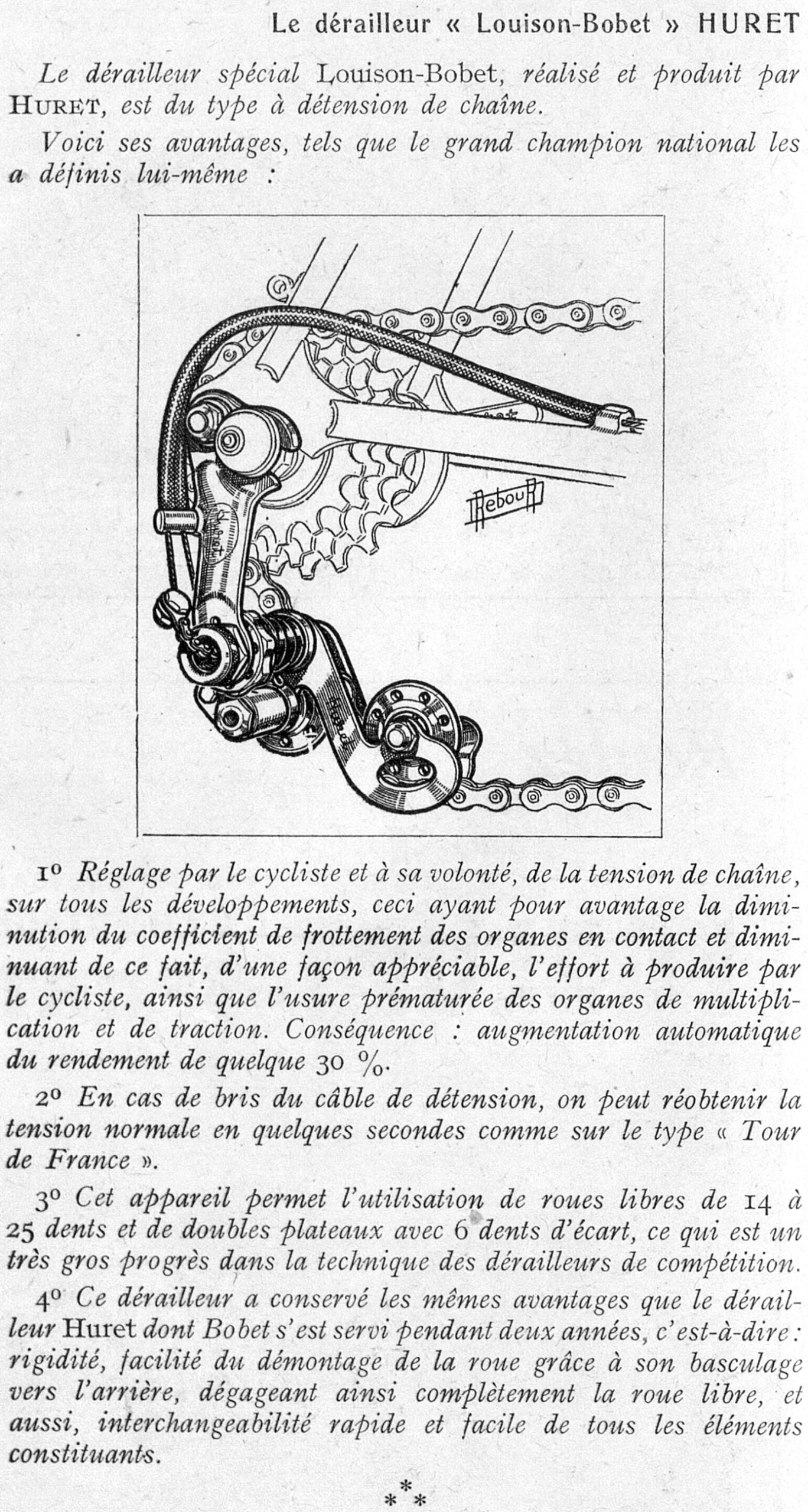
From L’Officiel du cycle, du motocycle et du camping, 1 November 1952, N° 44, the paper’s number reporting on the Salon du Cycle at the Porte de Versailles, page 43: note ‘Le dérailleur Louison-Bobet Huret’: chain-tension-type derailleur, advantages as defined by the national champion; line drawing of the derailleur on the rear wheel; freewheels of 14 to 25 teeth with up to 6 teeth difference. The title, headings, captions and lists are transcribed as printed; the text is summarized in Ebykr’s words, and the page images carry it in full.
— Page 1 —
Le dérailleur « Louison-Bobet » HURET
[Ebykr summary; the article’s text is not reproduced. The notice says the special Louison-Bobet derailleur, designed and produced by Huret, is of the chain-tension-release type (à détention de chaîne). It introduces the advantages as the great national champion defined them himself, listed below.]
1° Réglage par le cycliste et à sa volonté, de la tension de chaîne,
sur tous les développements, ceci ayant pour avantage la dimi-
nution du coefficient de frottement des organes en contact et dimi-
nuant de ce fait, d’une façon appréciable, l’effort à produire par
le cycliste, ainsi que l’usure prématurée des organes de multipli-
cation et de traction. Conséquence : augmentation automatique
du rendement de quelque 30 %.
2° En cas de bris du câble de détension, on peut réobtenir la
tension normale en quelques secondes comme sur le type « Tour
de France ».
3° Cet appareil permet l’utilisation de roues libres de 14 à
25 dents et de doubles plateaux avec 6 dents d’écart, ce qui est un
très gros progrès dans la technique des dérailleurs de compétition.
4° Ce dérailleur a conservé les mêmes avantages que le dérail-
leur Huret dont Bobet s’est servi pendant deux années, c’est-à-dire :
rigidité, facilité du démontage de la roue grâce à son basculage
vers l’arrière, dégageant ainsi complètement la roue libre, et
aussi, interchangeabilité rapide et facile de tous les éléments
constituants.
[An editorial note set in the magazine’s own column: a heading in roman type, right-aligned, with the firm’s name in capitals, over two short italic paragraphs, then a ruled rectangular panel holding one line-engraved drawing in black and white. The drawing shows a derailleur mounted at the rear dropout of a bicycle frame, seen from the chain side: a braided control cable arcs over the top from the right and down the left side to the body of the mechanism, a spring-loaded arm carries two small jockey wheels and a cage, and the drive chain runs in from the right at the top and out again at the lower right over a cluster of freewheel sprockets whose teeth are shaded. Frame tubes and a few straight ray lines are drawn behind. The artist’s signature, a boxed monogram reading “Rebour”, is drawn at the right of the sprockets inside the panel. Below the drawing, four numbered paragraphs in italic type run to the foot of the crop, with a three-star break mark underneath.]
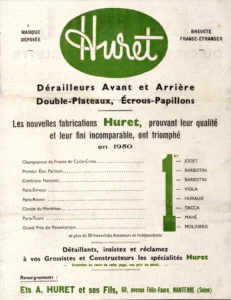 Huret 1950 Advertisement — Front and Rear Derailleurs, Double Chainrings and Wing Nuts, the 1950 Victories
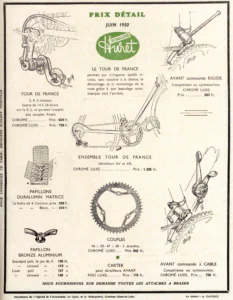 Huret 1950 Advertisement — The Retail Price List of June 1950: Derailleurs, Chainrings and Wing Nuts
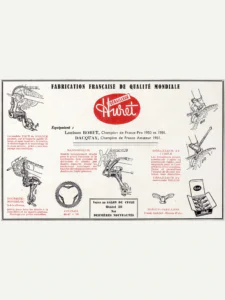 Huret 1951 Advertisement — Derailleurs for Louison Bobet and Dacquay, Drawn by Rebour
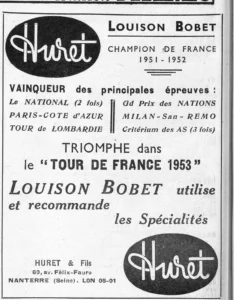 Huret 1953 Advertisement — The Specialties Louison Bobet Recommends
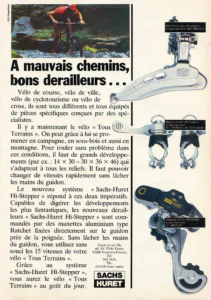 Huret 1984 Advertisement — A Mauvais Chemins, Bons Derailleurs
Ebykr presents this material for research and education. If you hold rights to it or notice an ownership issue, please contact us and we will respond promptly.
The Ebykr Digest
New articles, timelines, catalog finds and registry activity — assembled from the archive once a month. Your address is never shared.
Double opt-in. One email per month. Unsubscribe at any time with one click.