About Ebykr
Ebykr celebrates classic and vintage lightweight bicycles through provocative imagery and opinion. Ride along with us.
About Ebykr
Ebykr celebrates classic and vintage lightweight bicycles through provocative imagery and opinion. Ride along with us.

Source: nkilgariff.com (N. Kilgariff Holdsworth catalog archive) — documents sourced from the V-CC Library; enlarged for Ebykr.
| Marque | Holdsworth |
|---|---|
| Type | Review |
| Year | 1938 |
| Publisher | Cycling |
| Country | England |
| Language | English |
| Pages | 1 |
| Source | nkilgariff.com (N. Kilgariff Holdsworth catalog archive) — documents sourced from the V-CC Library; enlarged for Ebykr. |
| Credit | Ebykr archive |
| Identifier | Permalink https://nkilgariff.com/Holdsworth%20Articles/LaQuelda38Art.gif |
| Transcription | Transcribed by eye |
JANUARY 26, 1938. CYCLING 101 "NIMROD" TESTS THE HOLDSWORTH LA QUELDA A British-made "Continental Type" Racing Machine THIS is the bicycle, built exclusively for fast riding, with the completely welded frame. There are no lugs anywhere. And so, claims W. F. Holdsworth, the maker, of 121, Lennard Road, Beckenham, Kent, "all bumps, shocks and jars …
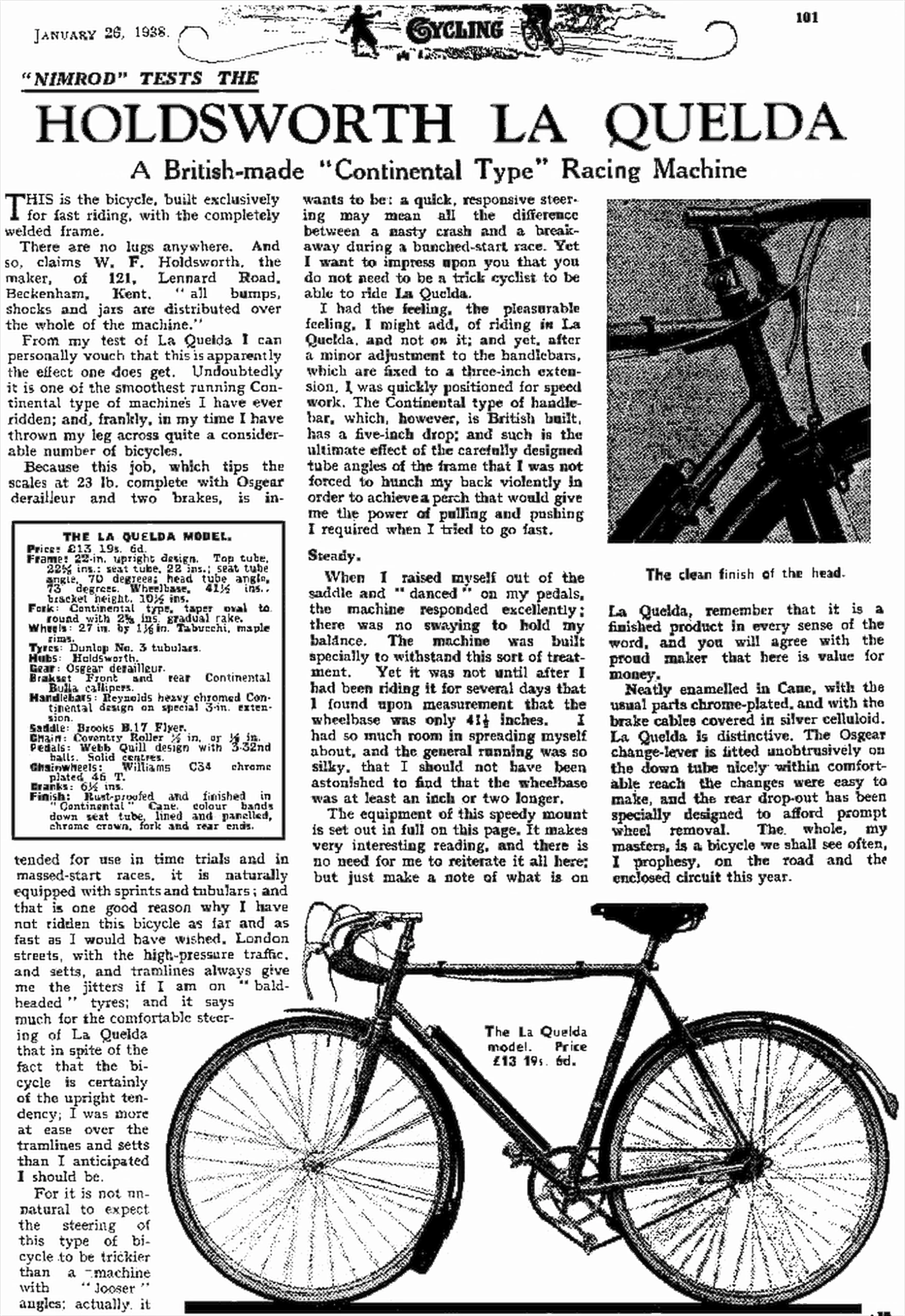
A road test from Cycling, page 101, 26 January 1938: “Nimrod” tests the Holdsworth La Quelda, a British-made “Continental type” racing machine with a completely welded frame, with a specification box.
— Page 1 —
JANUARY 26, 1938.
CYCLING
101
“NIMROD” TESTS THE
HOLDSWORTH LA QUELDA
A British-made “Continental Type” Racing Machine
THIS is the bicycle, built exclusively for fast riding, with the completely welded frame.
There are no lugs anywhere. And so, claims W. F. Holdsworth, the maker, of 121, Lennard Road, Beckenham, Kent, “all bumps, shocks and jars are distributed over the whole of the machine.”
From my test of La Quelda I can personally vouch that this is apparently the effect one does get. Undoubtedly it is one of the smoothest running Continental type of machines I have ever ridden; and, frankly, in my time I have thrown my leg across quite a considerable number of bicycles.
Because this job, which tips the scales at 23 lb. complete with Osgear derailleur and two brakes, is intended for use in time trials and in massed-start races, it is naturally equipped with sprints and tubulars; and that is one good reason why I have not ridden this bicycle as far and as fast as I would have wished. London streets, with the high-pressure traffic, and setts, and tramlines always give me the jitters if I am on “bald-headed” tyres; and it says much for the comfortable steering of La Quelda that in spite of the fact that the bicycle is certainly of the upright tendency; I was more at ease over the tramlines and setts than I anticipated I should be.
For it is not unnatural to expect the steering of this type of bicycle to be trickier than a machine with “looser” angles; actually it
wants to be: a quick, responsive steering may mean all the difference between a nasty crash and a break-away during a bunched-start race. Yet I want to impress upon you that you do not need to be a trick cyclist to be able to ride La Quelda.
I had the feeling, the pleasurable feeling, I might add, of riding in La Quelda, and not on it; and yet, after a minor adjustment to the handlebars, which are fixed to a three-inch extension, I was quickly positioned for speed work. The Continental type of handlebar, which, however, is British built, has a five-inch drop; and such is the ultimate effect of the carefully designed tube angles of the frame that I was not forced to hunch my back violently in order to achieve a perch that would give me the power of pulling and pushing I required when I tried to go fast.
Steady.
When I raised myself out of the saddle and “danced” on my pedals, the machine responded excellently; there was no swaying to hold my balance. The machine was built specially to withstand this sort of treatment. Yet it was not until after I had been riding it for several days that I found upon measurement that the wheelbase was only 41½ inches. I had so much room in spreading myself about, and the general running was so silky, that I should not have been astonished to find that the wheelbase was at least an inch or two longer.
The equipment of this speedy mount is set out in full on this page. It makes very interesting reading, and there is no need for me to reiterate it all here; but just make a note of what is on
THE LA QUELDA MODEL.
Price: £13 19s. 6d.
Frame: 22-in. upright design. Top tube, 22⅝[?] ins.; seat tube, 22 ins.; seat tube angle, 70 degrees; head tube angle, 73 degrees. Wheelbase, 41½ ins.; bracket height, 10½ ins.
Fork: Continental type, taper oval to round with 2⅜[?] ins. gradual rake.
Wheels: 27 in. by 1⅛[?] in. Tabucchi, maple rims.
Tyres: Dunlop No. 3 tubulars.
Hubs: Holdsworth.
Gear: Osgear derailleur.
Brakset Front and rear Continental Bulla callipers.
Handlebars: Reynolds heavy chromed Continental design on special 3-in. extension.
Saddle: Brooks B.17 Flyer.
Chain: Coventry Roller ½ in. or ⅛[?] in.
Pedals: Webb Quill design with 3-32nd balls. Solid centres.
Chainwheels: Williams C34 chrome plated 46 T.
Cranks: 6½ ins.
Finish: Rust-proofed and finished in “Continental” Cane, colour bands down seat tube, lined and panelled, chrome crown, fork and rear ends.
The clean finish of the head.
La Quelda, remember that it is a finished product in every sense of the word, and you will agree with the proud maker that here is value for money.
Neatly enamelled in Cane, with the usual parts chrome-plated, and with the brake cables covered in silver celluloid, La Quelda is distinctive. The Osgear change-lever is fitted unobtrusively on the down tube nicely within comfortable reach the changes were easy to make, and the rear drop-out has been specially designed to afford prompt wheel removal. The whole, my masters, is a bicycle we shall see often, I prophesy, on the road and the enclosed circuit this year.
The La Quelda model. Price £13 19s. 6d.
[A magazine page with a masthead, a large headline and an article in columns. A photograph of the head tube and handlebars of the bicycle sits at the upper right, a boxed specification table at the left and a large line-art photograph of the complete bicycle with drop handlebars along the bottom.]
[Folio 101.]
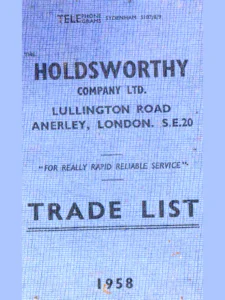 Holdsworthy Trade List 1958 — Clothing, Shoes, Bags, Brakes, Cranks, Gears, Hubs, Pedals, Rims, Saddles and Tubular Tires, with the Terms of Sale and Workshop Charges
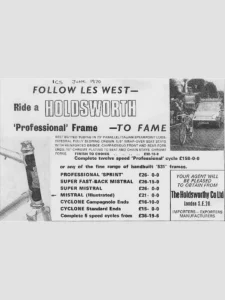 Holdsworth c.1970 Advertisement — Follow Les West: Ride a Holdsworth Professional Frame to Fame, with the Frame Prices
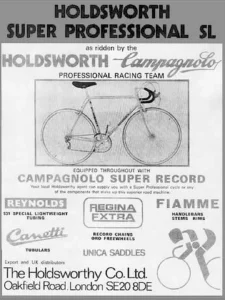 Holdsworth c.1978 Advertisement — the Super Professional SL as Ridden by the Holdsworth-Campagnolo Professional Racing Team
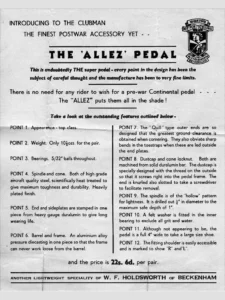 Holdsworth Allez Pedal Advertisement (Undated, after 1945) — The Finest Postwar Accessory Yet, with Twelve Points and the Price
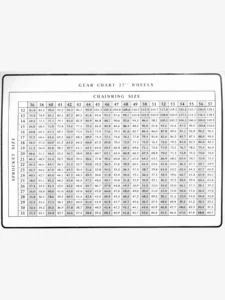 Holdsworth Gear Chart for 27 Inch Wheels (Undated) — Chainring Sizes 36 to 57 Against Sprocket Sizes
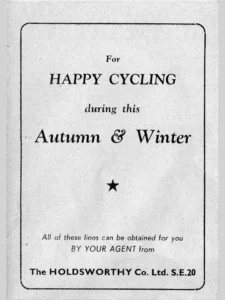 Holdsworthy Autumn and Winter Accessories Catalog (Undated, about 1957-58) — Capes, Shoes, Gloves, Jackets, Jerseys, Pantalons de Paris and Stockings
Ebykr presents this material for research and education. If you hold rights to it or notice an ownership issue, please contact us and we will respond promptly.
The Ebykr Digest
New articles, timelines, catalog finds and registry activity — assembled from the archive once a month. Your address is never shared.
Double opt-in. One email per month. Unsubscribe at any time with one click.