About Ebykr
Ebykr celebrates classic and vintage lightweight bicycles through provocative imagery and opinion. Ride along with us.
About Ebykr
Ebykr celebrates classic and vintage lightweight bicycles through provocative imagery and opinion. Ride along with us.

Source: National Cycle Archive, in partnership with the Veteran-Cycle Club (page 1); European Patent Office, Espacenet (page 2); the patent office abridgment, via Google Patents (page 3).
| Marque | Hetchins |
|---|---|
| Type | Ephemera |
| Year | 1936 |
| Publisher | Hyman Hetchin |
| Country | England |
| Language | English |
| Pages | 3 |
| Source | National Cycle Archive, in partnership with the Veteran-Cycle Club (page 1); European Patent Office, Espacenet (page 2); the patent office abridgment, via Google Patents (page 3). |
| Credit | National Cycle Archive, in partnership with the Veteran-Cycle Club |
| Identifier | Permalink https://worldwide.espacenet.com/patent/search?q=pn%3DGB443454A |
| Transcription | Transcribed by eye |
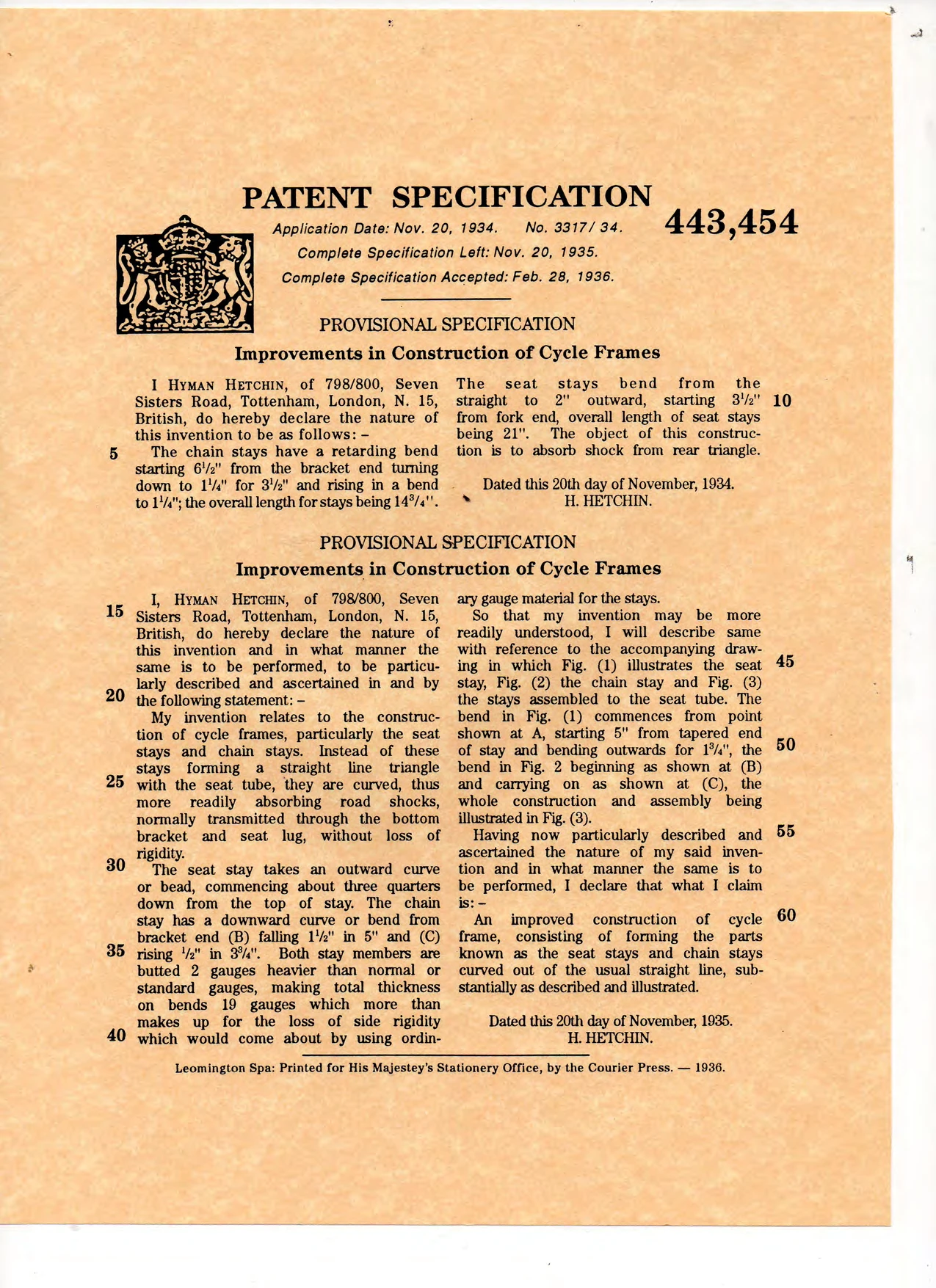
PATENT SPECIFICATION 443,454 Application Date: Nov. 20, 1934. No. 3317/ 34. Complete Specification Left: Nov. 20, 1935. Complete Specification Accepted: Feb. 28, 1936. PROVISIONAL SPECIFICATION Improvements in Construction of Cycle Frames I HYMAN HETCHIN, of 798/800, Seven Sisters Road, Tottenham, London, N. 15, British, do hereby declare the nature of this invention to be as …
British Patent Specification 443,454, granted to Hyman Hetchin for the curved seat stays and chain stays that Hetchins sold as the Vibrant rear triangle. Page 1, the text of the specification, comes from a later re-typeset copy, not from the original 1936 print, and that copy introduced errors of its own: its printer’s line reads “Leomington Spa” and “His Majestey’s”, the complete specification is headed PROVISIONAL SPECIFICATION a second time and the application number is printed “No. 3317/ 34.” where the patent office’s record gives 33317/34. The text below is transcribed as the copy prints it. Page 2 is the original printed drawing sheet and page 3 is the patent office’s own figure for its abridgment.
— Page 1 (specification) —
PATENT SPECIFICATION
443,454
Application Date: Nov. 20, 1934. No. 3317/ 34.
Complete Specification Left: Nov. 20, 1935.
Complete Specification Accepted: Feb. 28, 1936.
PROVISIONAL SPECIFICATION
Improvements in Construction of Cycle Frames
I HYMAN HETCHIN, of 798/800, Seven Sisters Road, Tottenham, London, N. 15, British, do hereby declare the nature of this invention to be as follows: –
The chain stays have a retarding bend starting 6½” from the bracket end turning down to 1¼” for 3½” and rising in a bend to 1¼”; the overall length for stays being 14¾”. The seat stays bend from the straight to 2″ outward, starting 3½” from fork end, overall length of seat stays being 21″. The object of this construction is to absorb shock from rear triangle.
Dated this 20th day of November, 1934.
H. HETCHIN.
PROVISIONAL SPECIFICATION
Improvements in Construction of Cycle Frames
I, HYMAN HETCHIN, of 798/800, Seven Sisters Road, Tottenham, London, N. 15, British, do hereby declare the nature of this invention and in what manner the same is to be performed, to be particularly described and ascertained in and by the following statement: –
My invention relates to the construction of cycle frames, particularly the seat stays and chain stays. Instead of these stays forming a straight line triangle with the seat tube, they are curved, thus more readily absorbing road shocks, normally transmitted through the bottom bracket and seat lug, without loss of rigidity.
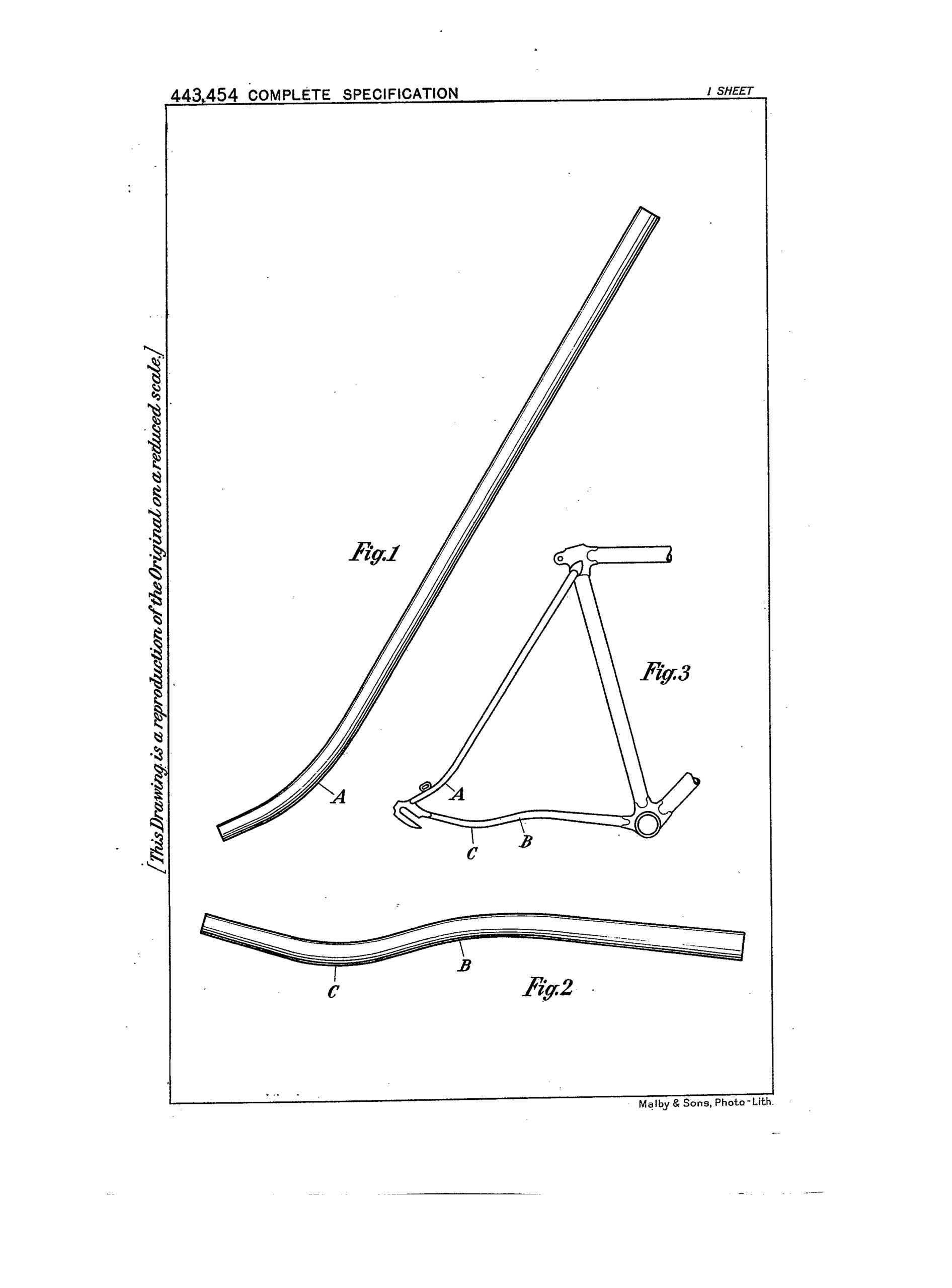
The seat stay takes an outward curve or bead, commencing about three quarters down from the top of stay. The chain stay has a downward curve or bend from bracket end (B) falling 1½” in 5″ and (C) rising ½” in 3¾”. Both stay members are butted 2 gauges heavier than normal or standard gauges, making total thickness on bends 19 gauges which more than makes up for the loss of side rigidity which would come about by using ordinary gauge material for the stays.
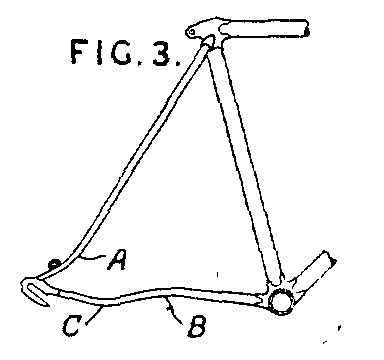
So that my invention may be more readily understood, I will describe same with reference to the accompanying drawing in which Fig. (1) illustrates the seat stay, Fig. (2) the chain stay and Fig. (3) the stays assembled to the seat tube. The bend in Fig. (1) commences from point shown at A, starting 5″ from tapered end of stay and bending outwards for 1¾”, the bend in Fig. 2 beginning as shown at (B) and carrying on as shown at (C), the whole construction and assembly being illustrated in Fig. (3).
Having now particularly described and ascertained the nature of my said invention and in what manner the same is to be performed, I declare that what I claim is: –
An improved construction of cycle frame, consisting of forming the parts known as the seat stays and chain stays curved out of the usual straight line, substantially as described and illustrated.
Dated this 20th day of November, 1935.
H. HETCHIN.
Leomington Spa: Printed for His Majestey’s Stationery Office, by the Courier Press. — 1936.
[Text page printed on tan paper. The Royal Arms, with lion and unicorn supporters, is printed in a black panel at upper left beside the heading block, with the patent number in large bold figures at upper right and a short rule under the three date lines. Two specifications follow, each under a centered heading and title and each set in two justified columns, with bold marginal line numbers at every fifth line (printed 5 to 60). The second is headed PROVISIONAL SPECIFICATION as set, although it carries the claim and the references to the drawing. Each closes with a centered date line and signature, and a rule sits above the printer’s line at the foot. There are no illustrations on this page.]
— Page 2 (drawing sheet) —
443,454 COMPLETE SPECIFICATION
1 SHEET
This Drawing is a reproduction of the Original on a reduced scale.
Fig.1
A
Fig.3
A
C
B
Fig.2
C
B
Malby & Sons, Photo-Lith.
[The original printed drawing sheet of the complete specification, with three figures inside a ruled border and the explanatory note set vertically up the left margin in square brackets; the figure numbers are in italic script. Fig. 1, running diagonally from the upper right, is a single seat stay, a long straight tube curving near its lower end at A. Fig. 2, across the foot, is a single chain stay with a downward bend lettered C and a rise lettered B. Fig. 3, at center right, is the assembled rear triangle: the seat lug with a binder ear and a stub of top tube, the seat tube running down to the bottom bracket shell with a stub of down tube, and the curved seat stay and chain stay meeting at an open hooked rear fork end, lettered A, C and B to match the other two figures.]
— Page 3 (the patent office’s figure for its abridgment) —
FIG. 3.
A
C
B
[The patent office’s own illustration for its abridgment of the patent: a separately drawn version of Fig. 3, bolder than the figure on page 2, with heavy shaded tubes and hand lettering, showing the assembled rear triangle with the curved seat stay lettered A and the curved chain stay lettered C and B. The abridgment it illustrates, from the patent office’s record of GB443454A, reads: “443,454. Cycle frames. HETCHIN, H., 798, Seven Sisters Road, Tottenham, London. Nov. 20, 1934, No. 33317. [Class 136 (iii)] The seat stays and chain stays of cycle frames are bent to a curved form, as shown at A, B, C, in order to increase their shock – absorbing properties. The tubes forming the stays may be tapered towards their outer ends.”]
 Hetchins 1938 Catalog — Brilliant, Anglo Continental, Tour de France and Toni Merkens Models and the Short Wheel-Base Tandem, with Two Letters
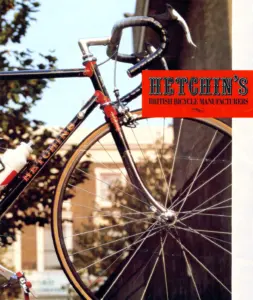 Hetchins 1988 Catalog — Magnum Opus, Novus Ductor and Scorpion Bonum Deluxe Specials, with the Southend Price List
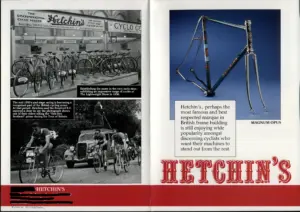 Hetchins c.1993 Brochure — Magnum Opus, Scorpion Bonum and Novus Ductor Frame Sets from Jackson Cycles of Leeds, with a German Price List
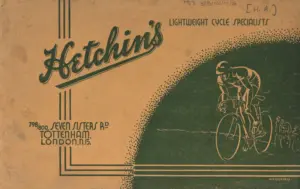 Hetchins Catalog — Super Special, Six Day, Massed Start and Toni Merkens Models, Prices Including Purchase Tax
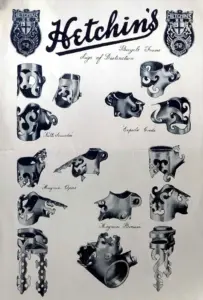 Hetchins Lug Sheet — Lugs of Distinction: Nulli Secundus, Experto Crede, Magnum Opus and Magnum Bonum
Ebykr presents this material for research and education. If you hold rights to it or notice an ownership issue, please contact us and we will respond promptly.
The Ebykr Digest
New articles, timelines, catalog finds and registry activity — assembled from the archive once a month. Your address is never shared.
Double opt-in. One email per month. Unsubscribe at any time with one click.