Colnago History: A Timeline of Key Corporate and Technical Events
A broken leg ended Ernesto Colnago's brief competitive cycling career in 1951, but it did not end his passion for the sport. This timeline traces his path from that injury to a bicycle shop opened in Cambiago, Italy in 1954, and its growth into one of cycling's most celebrated frame-building houses, marked by unbreakable forks and a long collaboration with Ferrari.
A broken leg ended Ernesto Colnago’s brief competitive cycling career in 1951, but it did not end his passion for the sport. Reassessing his path while recovering from that injury, Colnago went on to open his own bicycle shop in Cambiago, Italy in 1954 and build it into one of cycling’s most celebrated frame-building houses, marked by unbreakable forks, a decades-long collaboration with Ferrari and a steady march of technical firsts from steel through titanium and carbon fiber.
Here is a chronological timeline of key corporate and technical events at Colnago, spanning from 1945 to the present day, based on the sources used for an accompanying Ebykr article on its history, “Ernesto Colnago: Fortune in Fracture and Ferrari.”
28 of 28 events
1945
Career Beginning
Ernesto Colnago began working at the prestigious Gloria bicycle factory in post-war Milan, the starting point for both his racing career and his education in frame building.
1950
Racing Victory
Colnago won the Coppa Caldirola, considered possibly the most important race of his competitive cycling career, part of a run of thirteen major wins.
1951
Founder’s Turning Point
A bad fall in the Milan-Busseto Classic put Colnago in a leg cast for sixty days and ended his racing career. While recovering, Gloria assigned him wheel-building work, during which he first decided to start his own bicycle business.
1954
Company Founding
Colnago opened his own bike shop in the small Italian town of Cambiago, the modest beginning of what would become a legendary company.
1955
Racing Team Connection
Team Nivea racer Fiorenzo Magni visited Colnago’s shop with leg pain from riding. Colnago diagnosed incorrect crank arm length and fixed the problem, so impressing Magni that he invited Colnago to become his full-time mechanic at the Giro D’Italia.
1955–1960s
Corporate Leadership
Colnago worked as a professional mechanic for prestigious races including the Giro D’Italia, Vuelta Espana and Tour De France, and was eventually named head mechanic for the Italian National Team, a position he held for several consecutive years while continuing to develop his own frame designs.
1960
Racing Victory
Luigi Arienti rode a Colnago to its first major victory at the Rome Olympic Games.
1966
Grand Tour Victory
Gianni Motta, riding for team Molteni, won the Giro D’Italia on a Colnago, part of a wave of victories that confirmed the strength of Colnago’s frame designs.
c. 1966–1969
Technical Milestone
Colnago became known for unbreakable forks built with a new cold-bending method, fixing the blades in a jig on a workbench rather than heating the metal, a process he described as requiring extensive trial and error to perfect.
1969
Technical Milestone
Colnago adopted microfusion casting to fabricate fork crowns and lugs, a method more durable and reliable than traditional pressed lugs and forged crowns.
c. 1969–1970
Brand Identity
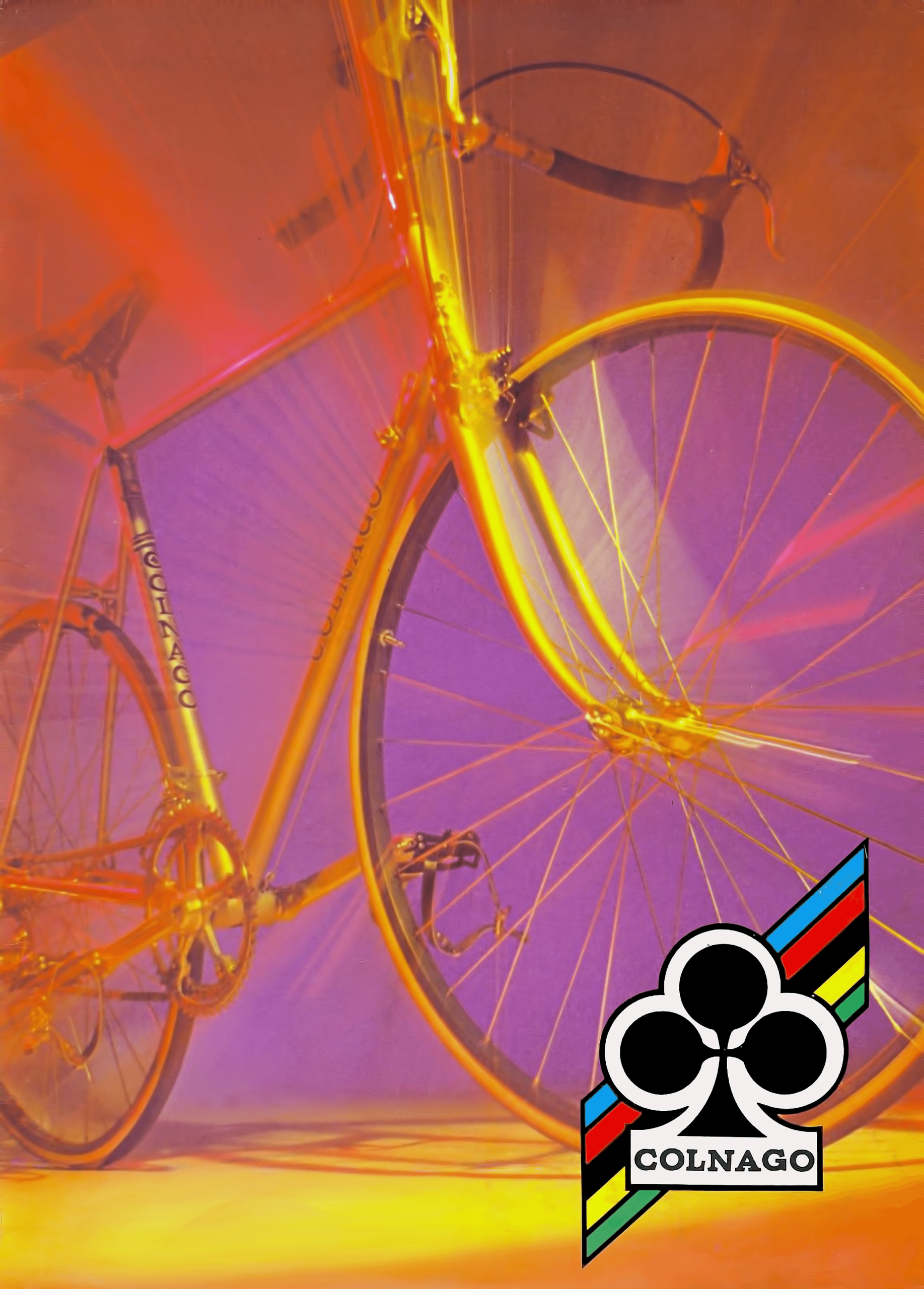
As his product line grew, Colnago developed the signature Asso di Fiori (Ace of Clubs) logo, giving his bicycles a distinct visual identity.
1970
Racing Victory
Michele Dancelli won the Milan San-Remo riding a Colnago.
1972
Racing Milestone
Eddy Merckx rode a custom Colnago track bike to set a new hour record.
1974
Racing Team Connection
Colnago began sponsoring race teams for the first time, starting with Team SCIC, a sponsorship program that would span thirty years and accumulate over 5,000 wins on Colnago bicycles.
1970s–1980s
Product Innovation
Colnago invented the Mexico frame, featuring a crimped top tube designed to reduce flex and increase lateral stiffness. A gold model was presented by Ernesto Colnago himself to Pope John Paul II, who called it marvelously light.
1980s
Product Innovation
Colnago produced early carbon fiber prototypes, including the aerodynamic full-carbon Krono Flight and the 1981 CX Pista, a time trial bike molded as a single lugless piece, among the first monocoque carbon fiber bicycle frames, establishing a fabrication standard that remains popular today.
1983
Product Innovation
Colnago released the Arabesque frame, notable for its oval CX tubing. The steel-tubed Master, cold-drawn in a star shape to add lateral stiffness and vertical compliance, followed at an unspecified later date.
1986
Strategic Pivot
Colnago began a collaboration with Ferrari S.p.A. to combine Ferrari Formula One technology with Colnago’s bicycle-building expertise, a partnership that would produce several of the marque’s most notable carbon models.
1987
Technical Milestone
Colnago introduced straight-bladed forks, a major advancement in the cycling industry due to their increased rigidity and reduced flex.
1989
Product Innovation
Colnago introduced the C35, designed using carbon fiber tubing and named to mark the company’s 35th anniversary, the most notable product to emerge from the Ferrari collaboration to that point. Both road and mountain models were offered.
c. 1989–1994
Product Innovation
Colnago also began experimenting with titanium, developing the Carbitubo downtube, a split downtube design combining carbon tubes and aluminum lugs, which led to the Bititan, helping bring titanium bikes into the mainstream.
1994
Patent Milestone
Colnago obtained a patent for a carbon fiber frame design using one-piece lugs, becoming the C40, arguably Colnago’s greatest achievement in frame design and one of the hottest bikes on the market for nearly a decade.
2003
Product Innovation
The C50 succeeded the C40, praised for combining passion and tradition with modern carbon construction.
c. 2000s
Strategic Pivot
The continuing Ferrari collaboration produced two additional full-carbon models, the CF1 and the monocoque CF3, as carbon fiber construction spread across most of the Colnago line.
2014
Product Innovation
Colnago introduced the C60, continuing the carbon line that had begun with the C40 and C50.
2016
Product Diversification
Colnago’s full carbon offerings included two further Ferrari collaborations, the CF10 road model and the CF12 mountain model, the latter featuring 27.5-inch wheels, the same size as classic 650b wheels.
2018
Product Innovation
Colnago introduced the C64, which together with the C60 took the place of the classic C40 and revolutionary C50, the C64 weighing a full 270 grams less than the C60.
present day
Product Diversification
Colnago Ernesto & C. S.r.l. continues to offer a broad range including the steel-and-alloy Master, the steel-carbon B-Stay line, cyclocross models the Prestige and GRV, occasional Ferrari-influenced mountain bikes, and the aluminum Impact hybrid, alongside a full carbon line that dominates the company’s modern output.
Join the Colnago Heritage Discussion!
From the Ace of Clubs mark to the Ferrari collaboration, Colnago has spent seven decades pushing frame technology forward. Share your Colnagos, dating questions and restoration tips with the community.


 Colnago