Terrot History: A Timeline of Key Corporate and Technical Events
From its 1887 beginnings as a modest textile workshop built by Charles Terrot in rural Dijon, France, the Terrot enterprise grew into a resoundingly popular manufacturer of bicycles and motorcycles over the next three quarters of a century. This timeline traces its groundbreaking products, aggressive marketing and podium record from 1887 to 1970.
From its 1887 beginnings as a modest textile workshop built by Charles Terrot in rural Dijon, France, the Terrot enterprise grew into a resoundingly popular manufacturer of bicycles and motorcycles over the next three quarters of a century, combining groundbreaking products, aggressive marketing and regularity on the podium to rise above a crowded field of competing interests in the cycling market.
Here is a chronological timeline of key corporate and technical events at Terrot, spanning from 1887 to 1970, based on the sources used for an accompanying Ebykr article on its history, “Terrot: Forging the Way.”
22 of 22 events
1887
Company Founding
Charles Terrot builds a modest textile workshop in rural Dijon, France, the origin point of what would become the Terrot enterprise.
1890
Company Founding
Bicyclettes Terrot is formally founded, three years after the original textile workshop, responding to design and production needs left unaddressed by other French industrialists.
1893
Brand Storytelling
Bicyclettes Terrot publishes its first two catalogs, offering both complete bicycles and supporting components. The cover of the first catalog features two safety bicycles passing on a tree-lined road above the declaration “C. Terrot, Constructeur, Mécanicien, Dijon.”
1893–1904
Technical Milestone
Across three catalogs (1893, 1901 and 1904), Terrot proves among the most technologically prolific manufacturers of the era, offering no fewer than six distinct bicycle braking solutions, from simple rod and pad designs to complicated internal coaster brakes, alongside both standard chain models and exotic chainless (“sans chaine”) direct-drive bicycles.
1899
Product Diversification
Terrot begins manufacturing quadricycles featuring the De Dion engine, its first step beyond pure bicycle production.
1902
Product Diversification
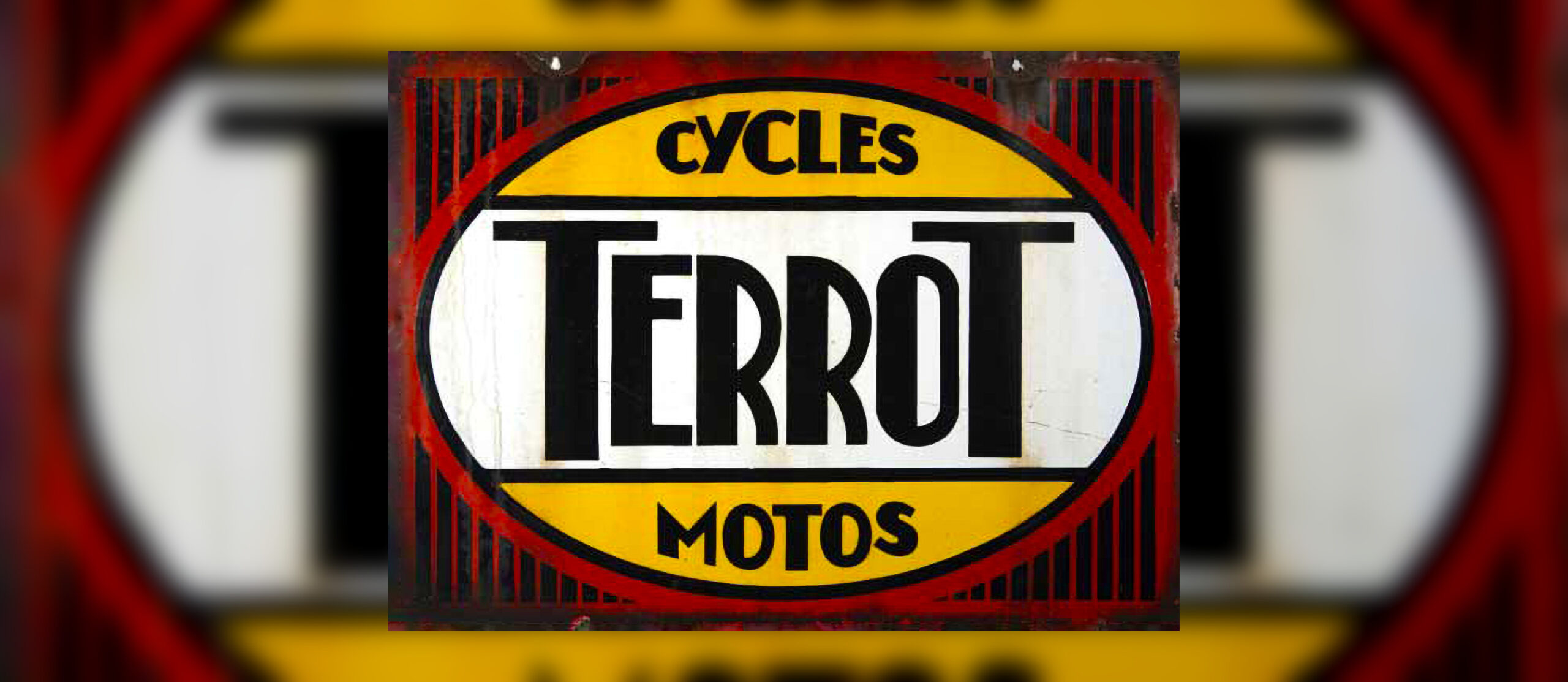
Terrot begins manufacturing motorcycles, building on its bicycle design, manufacturing and distribution experience as the motorcycle market segments into motos, scooters and cyclomoteurs. Promotional posters are updated to reflect the company’s new name, Cycles Terrot.
1904–1914
Technical Milestone
During Terrot’s second decade, mechanical drum brakes, spring suspension saddles and pneumatic tires gain popularity, while internally geared hubs progress from two to three speeds, followed by “rétro-pédalage” models and dual pulley parallelogram designs still found on bicycles today. The word “cycles” is dropped from the company name, which settles into Terrot & Co. until World War One.
1906–c.1920
Product Innovation
The Levocyclette, an unusual foot-pumped platform design driving an internally geared freewheel hub via chain, emerges from this transitional period. It is featured in a series of striking Francisco Tamagno posters from 1906 to 1909 and remains in use until around 1920 despite never achieving widespread commercial success.
c. 1918
Corporate Tragedy
After World War One ends, Terrot & Co. is seized by the French state under suspicion of having complied with the enemy.
1921
Corporate Reorganization
Doors reopen under the simplified name “Terrot” as a limited company backed by a group of industrialists led by Alfred Vurpillot, who remains general manager until 1933 and firmly reestablishes the brand with clearly defined organizational goals, often calling on his son Jean Vurpillot for technical expertise.
1928
Acquisition
Terrot acquires license to the Magnat-Debon name after that company recently ceased production, becoming the leading French manufacturer of two-wheeled vehicles.
1934
Corporate Leadership
Edmont Padovani takes over leadership of the company from the Vurpillot era.
1936
Market Contraction
Rising prices tied to the lingering effects of the 1929 stock market crash begin driving down production figures, despite diversification into other products such as baby carriages and motorcycle sidecars.
1938
Production Peak
Terrot offers a staggeringly complete line of 22 bicycle models in a single year, even as finer surviving examples from this era remain relatively difficult to find in today’s collector market.
1939
Corporate Tragedy
World War Two strikes, and Terrot factories turn their full attention to the French national war effort.
1940
Corporate Tragedy
Terrot factories are occupied by Nazi forces and repurposed for building power generators.
1946
Manufacturing Shift
With the war ended, Terrot slowly resumes production of two-wheeled vehicles, though with little or no improvement upon previous designs, and its motorcycles begin progressively losing market share.
1946–1956
Racing Victory
Even as its motorcycle business falters, Terrot’s professional and amateur cycling teams enjoy more podium success than in any other period in company history, including 22 stage wins at the Tour De France, several worn in the yellow jersey though never a General Classification win, and seven Champion du Monde titles across Amateur, Cyclo-Cross and University classes.
post-war (undated)
Corporate Leadership
After several long post-war years of flagging sales, Edmont Padovani returns to lead the company, making a valiant attempt at reclaiming former glory by reintroducing various classic Terrot motorcycle models.
1960
Corporate Liquidation
After an outdated management structure, low resale prices on competing automobiles, rising motorcycle insurance rates and stepped-up highway law enforcement erode the business, Terrot is absorbed unceremoniously into Indenor, the diesel-engine subsidiary of Peugeot.
1961
Production Milestone
In-house Terrot production halts, with a cumulative total of over 600,000 units shipped to 3,000 resellers worldwide across the company’s history. Motorcycle assembly continues only until stocks at another Peugeot subsidiary, the venerable Automoto, are depleted this same year.
1970
Manufacturing Shift
Lingering market demand compels Peugeot to keep building general-purpose bicycles under the Terrot name until 1970, a full nine years after Terrot motorcycles ceased under Indenor.
Join the Terrot Heritage Discussion!
From the earliest safety bicycles to the Levocyclette and beyond, Terrot spent three-quarters of a century forging its own path. Share your finds, dating questions and restoration tips with the community.



 Terrot