About Ebykr
Ebykr celebrates classic and vintage lightweight bicycles through provocative imagery and opinion. Ride along with us.
About Ebykr
Ebykr celebrates classic and vintage lightweight bicycles through provocative imagery and opinion. Ride along with us.

How Mafac’s own catalogs told a builder to fit the Racer centerpull: the fork head drilled for a 6 or 7 mm bolt, a rear brake held on spacers of 12 mm, the pads set low on the rim, and a small or large bridge tried on the frame. Every instruction is from the Ebykr archive, in Ebykr’s own translation from the French; the drawing is Ebykr’s own.
This page shows how a maker’s catalogs told a builder to fit one brake, step by step, in their own words and figures. It does not test or guarantee any fitting. Drilling a fork head and setting a brake are safety jobs: a brake that fails can throw you, and the catalogs give no tightness for the bolt. Have a bicycle shop check a brake you have fitted before you ride it.
On this page The drawing Tools and parts The steps in words What goes wrong Another way Sources
Your system asks for reduced motion, so each step is a still drawing. Play moves from still to still.
In the sources’ own terms; every item is named in them. Tick each one off as you gather it.
Both catalogs are Mafac’s own and give figures in millimeters.
The whole job, readable and printable without the drawing. Each step says what it rests on, and can take you back up to its drawing.
Mafac’s catalog of the early 1950s describes the Racer as a brake of the first class, guaranteed for five years: forged and treated dural said to match steel for strength, a fixing bolt of 6 or 7 mm in high-strength die-forged steel, joints on bronze bushings, an even pull from a center cable with independent springs, patented suction-cup pads said to be the only ones that work in the rain, and a cable that unhooks instantly so that a badly buckled wheel can still pass. Those are the maker’s own claims; the page tests none of them.
The front brake bolts come on request in 6 mm or 7 mm. For the 7 mm size the catalog says to drill the fork head to 7.1 mm, well in the center and plumb. It gives no instruction for the 6 mm size, so this step rests on one sentence.
The support shims of the rear brake are of unequal thickness, so that the brake can be moved nearer or further away. They are made for spacers of 12 mm, which the catalog calls the least size that holds the rear brake firmly.
The catalog says that, unlike the setting recommended for the Critérium cantilever, the Racer’s pads should strike the rim fairly low, so that they never reach the tire even when they wear abnormally. The method of setting them is not given.
The early catalog offers a small and a large bridge, made for spacers brazed at 36.5 and 37 (the catalog gives no units). The 1976 catalog lists a small and a large bridge for the Racer and the 2000, with height and width, and gives brazing dimensions for the pivots in a table, for a 700 C wheel with the Racer: 350 front and 346 rear (each plus 3), with a clearance of 60 to 64. It calls all these figures guidance only, and advises trying the whole brake and bridge on the frame, with or without a mudguard, before fixing.
Each of these is a source’s own warning, except the last, which is what the sources leave out.
Tightness and pad figures Neither catalog gives a tightness for the bolt nut, a height or toe-in for the pads, a cable length, or how to check the finished brake. They say how far to drill and how thick the spacer is, not how to tighten. The page does not supply any.
The Mechanism Workshop draws the Mafac Racer centerpull and the Mafac Critérium.
A side-pull brake adjusted: Adjust a Side-Pull Brake.
Every record opens in the Ebykr archive. Each step above names the page it rests on.
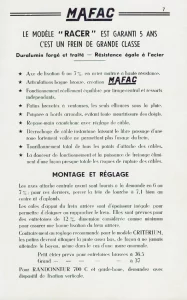
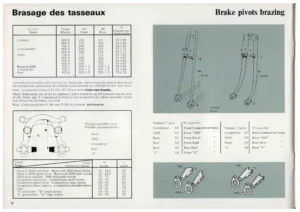
Both sources are Mafac’s own printed catalogs in the Ebykr archive: the 1950s one in French, the 1976 one in French and English. The French here is put into English by Ebykr. Neither is a workshop manual; each fitting step rests on a few sentences, and the page says so. The page quotes nothing at length.
The Ebykr Digest
New articles, timelines, catalog finds and registry activity — assembled from the archive once a month. Your address is never shared.
Double opt-in. One email per month. Unsubscribe at any time with one click.