About Ebykr
Ebykr celebrates classic and vintage lightweight bicycles through provocative imagery and opinion. Ride along with us.
About Ebykr
Ebykr celebrates classic and vintage lightweight bicycles through provocative imagery and opinion. Ride along with us.

How a handbook of 1913 looked after the lamp: oil or acetylene to choose between, the lamp set parallel with the road on the head of the machine, a wick trimmed hollow, a carbide lamp filled and put out the right way, the lime scraped out before it sets, and a reflex lens for the rear. Every instruction is from the Ebykr archive; the drawing is Ebykr’s own.
This page shows how a period source looked after oil and acetylene lamps, step by step, in its own words and figures. It does not test or guarantee any method. Paraffin, acetylene gas and calcium carbide are fire and explosion risks, and carbide gives off gas the moment it meets water. Keep a flame well away from the gas, work outdoors, and never use a lamp this way in a closed room. A modern LED lamp needs none of this. If you are not sure, ask a bicycle shop.
On this page The drawing Tools and parts The steps in words What goes wrong Another way Sources
Your system asks for reduced motion, so each step is a still drawing. Play moves from still to still.
In the sources’ own terms; every item is named in them. Tick each one off as you gather it.
Carbide cannot be sent by post (Henry).
The whole job, readable and printable without the drawing. Each step says what it rests on, and can take you back up to its drawing.
Henry lists four lights for a cyclist: oil, acetylene, candle and electric, and calls oil the most popular and acetylene a good second. Oil gives an inferior light but costs less, can be topped up at any village or with paraffin from nearly any cottage, and is the easier to clean. Acetylene weighs a few ounces more and its calcium carbide may be a long walk away. If you buy an acetylene lamp, Henry says to pay a little more for a lamp from a reputable maker; the cheap foreign ones at about two shillings shine in the shop window, but their spare parts cannot be had or cost too much, and few parts take to pieces for cleaning. Henry names Messrs. J. Lucas, Ltd., of Birmingham.
Henry says the position of the lamp is a very important detail that many riders do not understand: one often sees a lamp that seems to be lighting the heavens, or pointing at the road. It should be quite parallel with the road, as lamp C in Fig. 47, or smoked glasses and reflectors will follow, as in Figs. 48 and 49. The head of the machine is the best place for it, because on the forks it generally gets smothered in mud and gives an inferior light. An oil reservoir filled too full can run out onto the tire.
A new wick is best soaked in vinegar, then made quite dry before it goes into the burner, and it should not fit too tightly, so one a size smaller is often used. A wick cut straight across makes a pointed flame that smokes terribly and soon chokes the vent holes; cut with the middle lower than the two outer edges in a semicircle (Henry points to Fig. 50) it burns better. For oil, Henry mixes equal parts of colza oil and paraffin, with a small piece of camphor added for brightness; if paraffin alone is used, put cotton wool in the reservoir. Clean the lamp often, scrape away the soot from the top, and pass a pin through the vent holes. After cleaning the reflector, smear a little vaseline over it so that smoke does not harm the plating and cleaning is easier.
Fill the water reservoir through its plug hole and turn on the valve. The water should drip steadily and not too fast; once the flow is right, glance at the scale and note where the thumb screw of the valve stands for next time. Put in a little calcium carbide but do not quite fill the container, because the carbide expands, and keep carbide out of the central tube by putting a thumb over the tube while filling. Screw the container on tightly, turn the water valve slowly on and in about a minute or two there is gas enough for a light. If the flame flares, reduce the water a little, and the other way round for a small flame. Gas generated too quickly gives itself away by smelling horribly.
Use the lamp economically by turning the water down at a short stop or walking up a long hill. If only a little carbide has been used it can be used again for a day or so, but before a long ride Henry advises throwing it away and recharging, since what is left is uncertain. A light must never be allowed to burn itself out or the top of the burner carbonizes: turn off the water and blow the light out. Gas already made will escape, so take the lamp outside the house. When the carbide is spent, take the first chance to remove the container and scrape the lime residue onto paper, which is easily rolled up and thrown away; left three or four days it sets very hard. Clear the burners with a fine wire and by blowing through them. In frosty weather the reservoir water may freeze, so empty it when the lamp is not wanted, or add salt, which tends to corrode the metal. The filtering material needs renewing now and then, and Henry says carbide blocks, which cost 1½d. for about three hours’ light, are cleaner and carried safely loose in a pocket.
Henry advises every cyclist who rides at night to have some kind of rear light, to reduce the chance of being run down by a motor-car. A lamp with a side attachment of ruby glass shows a rear light but loses some of its forward light. The better way, Henry says, is a reflex lens (Fig. 53), which costs half a crown, needs no light and no upkeep, and shows the rider by reflecting the lights of an overtaking car. It is usually clipped to the right stay of the frame.
Each of these is a source’s own warning, except the last, which is what the sources leave out.
A modern lamp Henry gives no method for a candle lamp and describes electric lamps, which ran from a dynamo, a battery or an accumulator, only by their price and their light, with nothing to repair. Nothing here covers an LED lamp, a hub dynamo or a modern battery.
Henry describes a dynamo pressed against the tire, a lamp complete for 23s. 6d., and a battery lamp costing about a penny an hour, but gives no repair. Henry 1913, pages 89 to 91.
A monthly look at every part: Check, Adjust and Oil Once a Month.
Every record opens in the Ebykr archive. Each step above names the page it rests on.
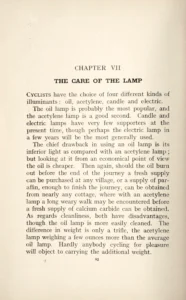
Henry’s book is the Library of Congress copy on the Internet Archive. It is public domain, and the archive carries its page images in full with Ebykr’s own reading of the print. Cassell’s book of 1916 has no chapter on lamps, so every step here rests on Henry alone, and the page says so. This page puts the source in Ebykr’s own words and quotes nothing at length.
The Ebykr Digest
New articles, timelines, catalog finds and registry activity — assembled from the archive once a month. Your address is never shared.
Double opt-in. One email per month. Unsubscribe at any time with one click.