Repair Workshop Steering, bearings and cranks Frame and fork truth

Repair · Steering, bearings and cranks

Test the Frame and Forks for Truth

How Cassell in 1916 tested a bicycle that runs to one side, with Peter Henry’s 1913 test of the wheels in track: the joints and fork crown examined, a straightedge against the front rim measured to the handlebar stem, the back rim lined up with the front, a tube in the fork tube, the blades checked parallel and the bars set square. Every instruction is from the Ebykr archive; the drawing is Ebykr’s own.

DifficultyHardThe tests are easy; the correcting is a frame builder’s work (Ebykr’s estimate)
StepsSevenCassell’s tests in his order
You will needThree tools, two partsThe list, in the sources’ terms
SourceCassell 1916, pages 30 and 31Record 94257, with Henry 1913

Before you start

This page shows how a period handbook tested a frame and fork, step by step, in its own words. It does not test or guarantee any frame. Cassell corrects a bent fork or frame by pulling it over in a vice; a fork or frame that has been bent and pulled back can be weakened, and a cracked joint or crown can fail without warning. Ebykr does not suggest bending a frame or fork at home: take any fault the tests find to a frame builder.

On this page The drawing Tools and parts The steps in words What goes wrong Another way Sources

Escape also leaves this view.
    Drawing key
    Workbench view: one step at a time in large type, for a phone or tablet on the bench.

    Tools and parts

    In the source’s own terms where it names them. Tick each one off as you gather it.

    Tools

    • A long straightedge For the rims (Cassell, 1916)
    • A straight tube or rod Through the spindle holes (Cassell, 1916)
    • A rule To measure to the stem (Ebykr’s assumption)

    Cassell’s vice is left off the list on purpose: the correcting is a frame builder’s work.

    Parts and materials

    • A piece of ⅞-in. tube For the fork tube (Cassell, 1916)
    • Trued wheels Before any test (Cassell, 1916)

    The steps in words

    The whole job, readable and printable without the drawing. Each step says what it rests on, and can take you back up to its drawing.

    Examine the joints and the fork crown

    Examine the whole frame, Cassell says, especially at the joints where the tubes are brazed into the lugs, for broken joints and cracked tubes. The fork crown is a very vital part: take the fork out of the head and examine it where the steering tube enters the crown.

    What this step rests on
    • exact The frame examined at the joints for broken joints and cracked tubes; the fork crown a very vital part, examined with the fork out of the head where the steering tube enters it: Cassell 1916, page 30 and Cassell 1916, page 31.
    • not stated What to do with a crack. Cassell does not say; it is a frame builder’s matter.

    A straightedge against the rim, measured to the stem

    A machine that tends to run to one side has probably had a fall that put the frame or fork out of truth. First see that the front wheel is true between the forks at the rim; unless the tires are quite true, take them off. Then hold a straightedge against the side of the rim and measure from it to the handlebar stem, on each side in turn. The straightedge should be the same distance from the stem on both sides.

    What this step rests on
    • exact A machine running to one side, probably from a fall; the front wheel true between the forks; tires off unless true; the straightedge against the side of the rim, the same distance from the stem on each side: Cassell 1916, page 31.
    • schematic The tilt of the wheel is exaggerated to be seen.

    A fork out of truth is pulled over in the vice

    If the fork is out of truth, Cassell takes it out of the head, takes the wheel out, and pulls the blades over in the vice one at a time, then tests again. The page shows his method; it does not recommend it. A bent fork is a part to replace or to take to a frame builder.

    What this step rests on
    • exact The fork out of the head, the wheel out, the blades pulled over in the vice one at a time: Cassell 1916, page 31.
    • derived The advice to take it to a frame builder is Ebykr’s, not Cassell’s.

    Straightedges along the back rim to the front rim

    With the fork right, turn the machine upside down and lay a long straightedge against each side of the back rim. It should fall the same distance from both sides of the front rim. If it does not, the frame must be pulled over or twisted to suit, Cassell says, which again is a frame builder’s work.

    What this step rests on
    • exact The machine upside down; a long straightedge against each side of the back rim, equidistant at both sides of the front rim; if out, the frame pulled over or twisted: Cassell 1916, page 31.
    • derived The frame builder is Ebykr’s advice.

    From the back rim to a tube in the fork tube

    Then turn the machine right side up and try the straightedge from the sides of the back rim to a piece of seven-eighths-inch tube placed in the fork tube. If these tests are right, the machine should run true, in track.

    What this step rests on
    • exact Right side up, the straightedge from the back rim sides to a piece of ⅞-in. tube in the fork tube; if correct, the machine should track: Cassell 1916, page 31.
    • not stated How long the piece of tube is. Cassell gives only its diameter.

    Check that the blades are parallel

    Test the fork to see that the blades are parallel with each other: put a piece of straight tube or rod through the spindle holes and lay a straightedge across the blades near the crown. The two should be parallel.

    What this step rests on
    • exact A straight tube or rod through the spindle holes, a straightedge across the blades near the crown, the two parallel: Cassell 1916, page 31.

    Set the bars square, and see the wheels in track

    Finally, Cassell says, see that the handlebar is set quite square with the front wheel. Henry gives the plain test for a machine just built: both wheels should be in track, in a perfectly straight line, and a straightedge laid across them should touch the rims in four places.

    What this step rests on

    What goes wrong

    Each of these is a source’s own warning, except the last, which is what the sources leave out.

    • Testing with a buckled wheel True the wheel and take off a tire that is not true first (Cassell).
    • Missing a crack Examine every brazed joint, and the crown with the fork out (Cassell).
    • Bending it back yourself Cassell did; a bent fork or frame is a frame builder’s job today (Ebykr).
    • Forgetting the bars Set them square with the front wheel (Cassell).
    • Stopping at the fork Test the frame too: the back rim to the front, and to the fork tube (Cassell).

    Tolerances Cassell gives no figure for how far out a frame may be, no length for the straightedge and no way to correct a cracked joint. The page supplies none of these and does not tell you how to bend metal.

    Related pages

    The wheels first

    True a Wheel.

    Sources

    Every record opens in the Ebykr archive. Each step above names the page it rests on.
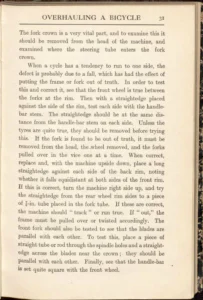
    Record 94257, pages 30 and 31Cassell, Cycle Repairing and Adjusting, 1916 reprintThe frame examined at its joints, the fork crown, a cycle that runs to one side, the straightedge tests, the blades parallel and the bars square.
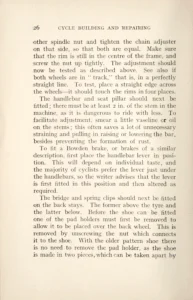
    Record 94435, page 26Peter Henry, Cycle Building and Repairing, 1913Both wheels in track: a straightedge across them should touch the rims in four places.

    Cassell’s book is a handbook for repairers, and Henry’s for the home builder; both are in the Ebykr archive. Each step names the one it rests on, and the page quotes nothing at length.
    Exact, derived and schematic

    • exactThe joints and crown examined, the straightedge to the stem, the fork pulled true in the vice, the back rim to the front and to a ⅞-in. tube, the blades parallel, the bars square, the wheels in track.
    • derivedThe advice to take a bent fork or frame to a frame builder.
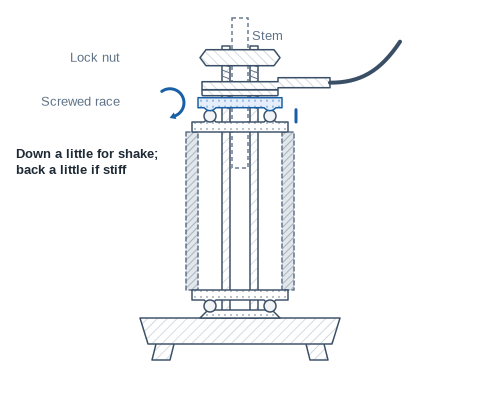
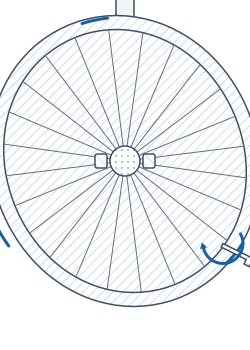
    • schematicThe drawing: the fork, wheels and straightedges, far simpler than the real machine, with the faults exaggerated.
    • not statedA tolerance, a length for the straightedge, and any repair of a crack.