About Ebykr
Ebykr celebrates classic and vintage lightweight bicycles through provocative imagery and opinion. Ride along with us.
About Ebykr
Ebykr celebrates classic and vintage lightweight bicycles through provocative imagery and opinion. Ride along with us.

Source: sheldonbrown.com (Sheldon Brown's Bridgestone catalogue archive, Harris Cyclery, Newton, Massachusetts); illustrations by George Retseck per the host's page views; enlarged for Ebykr.
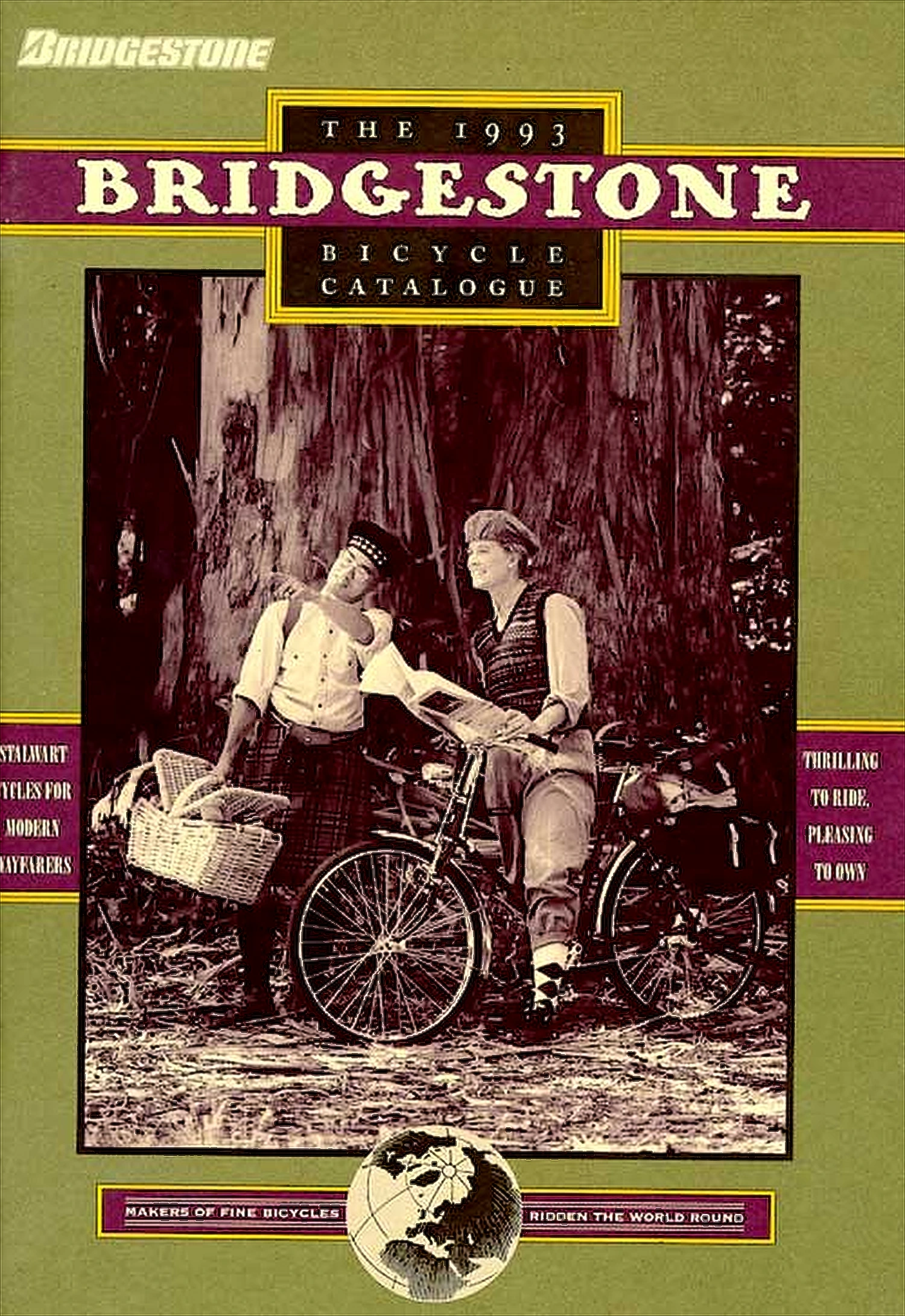 Page 1
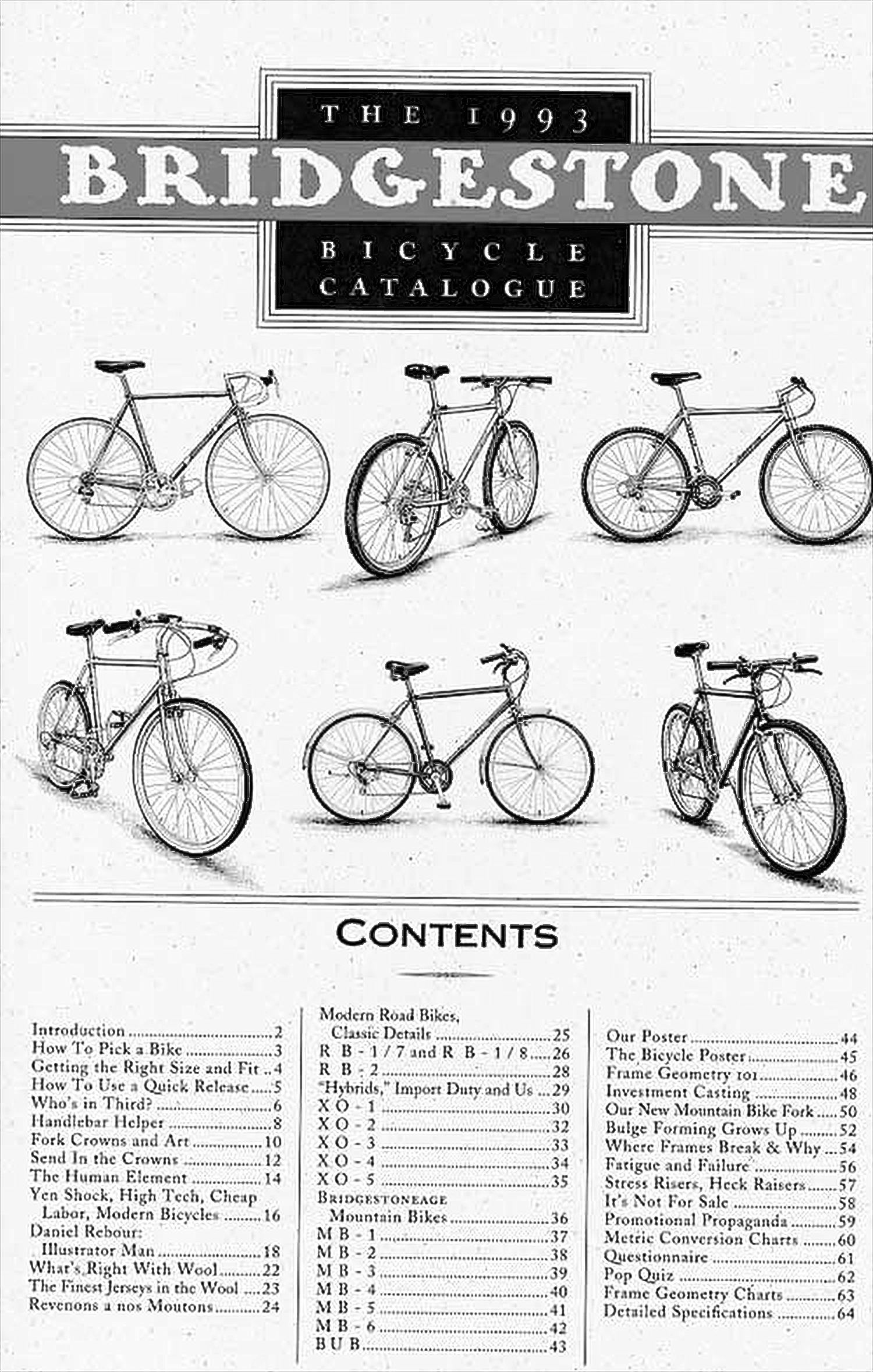 Page 2
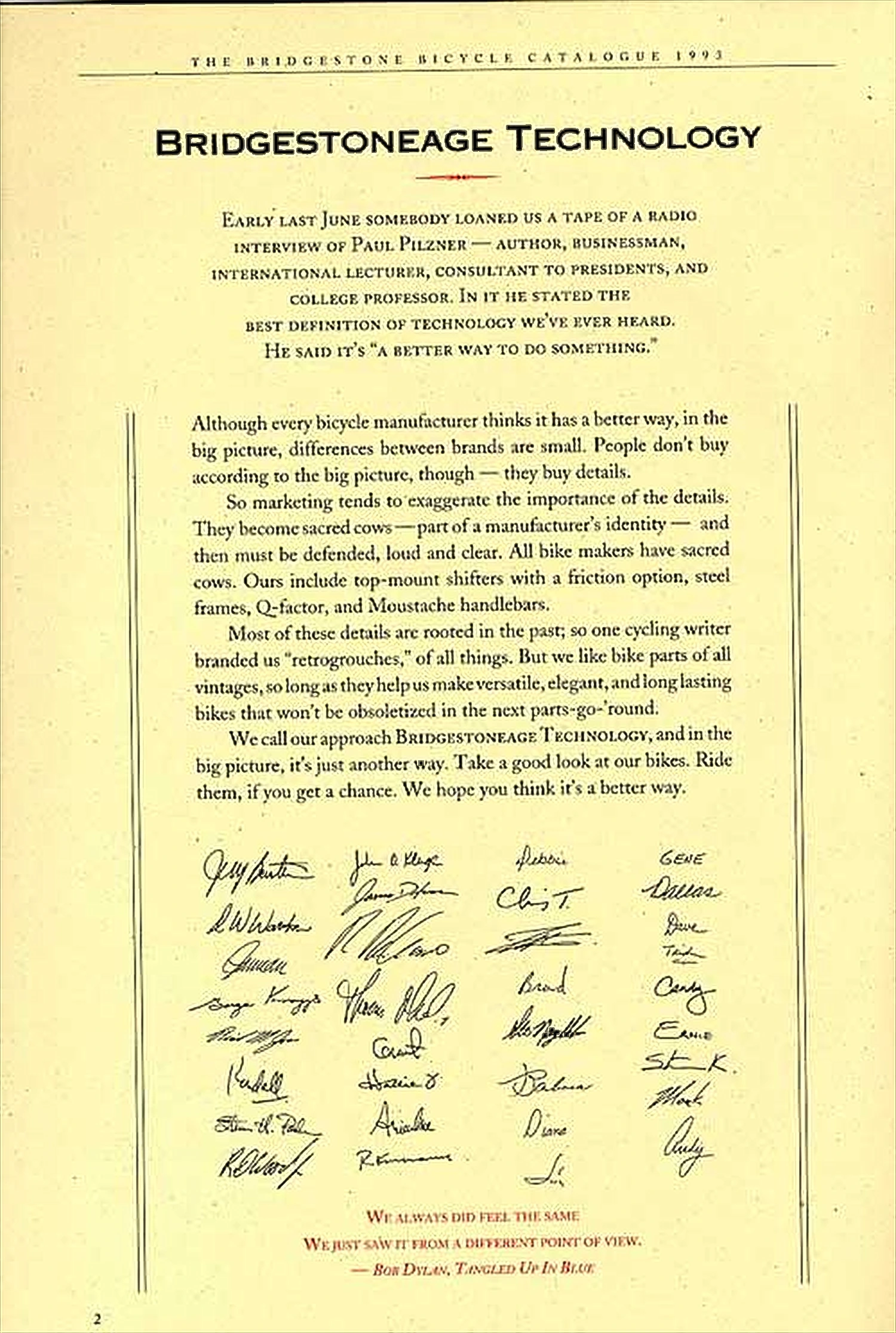 Page 3
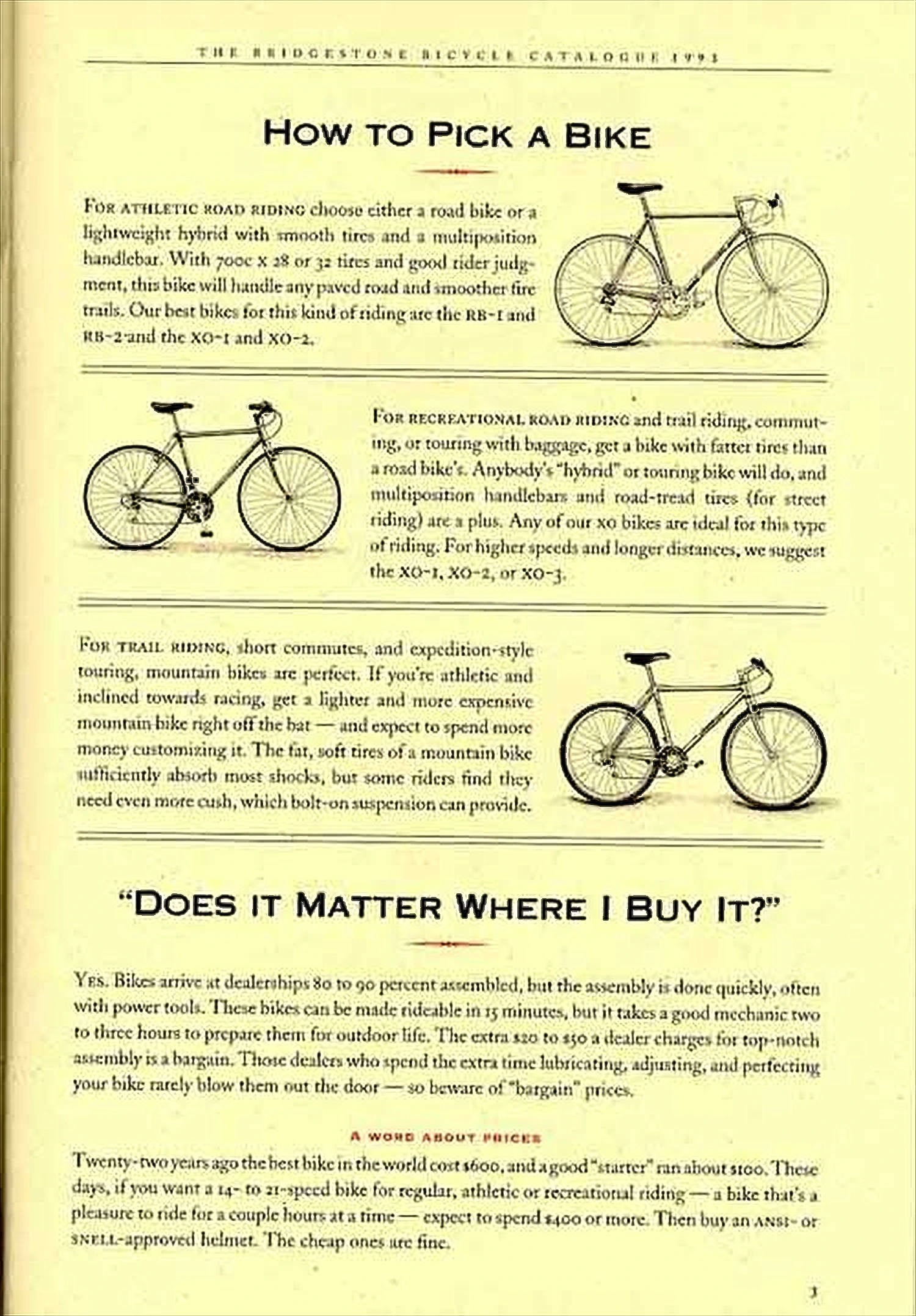 Page 4
 Page 5
 Page 6
 Page 7
 Page 8
 Page 9
 Page 10
 Page 11
 Page 12
 Page 13
 Page 14
 Page 15
 Page 16
 Page 17
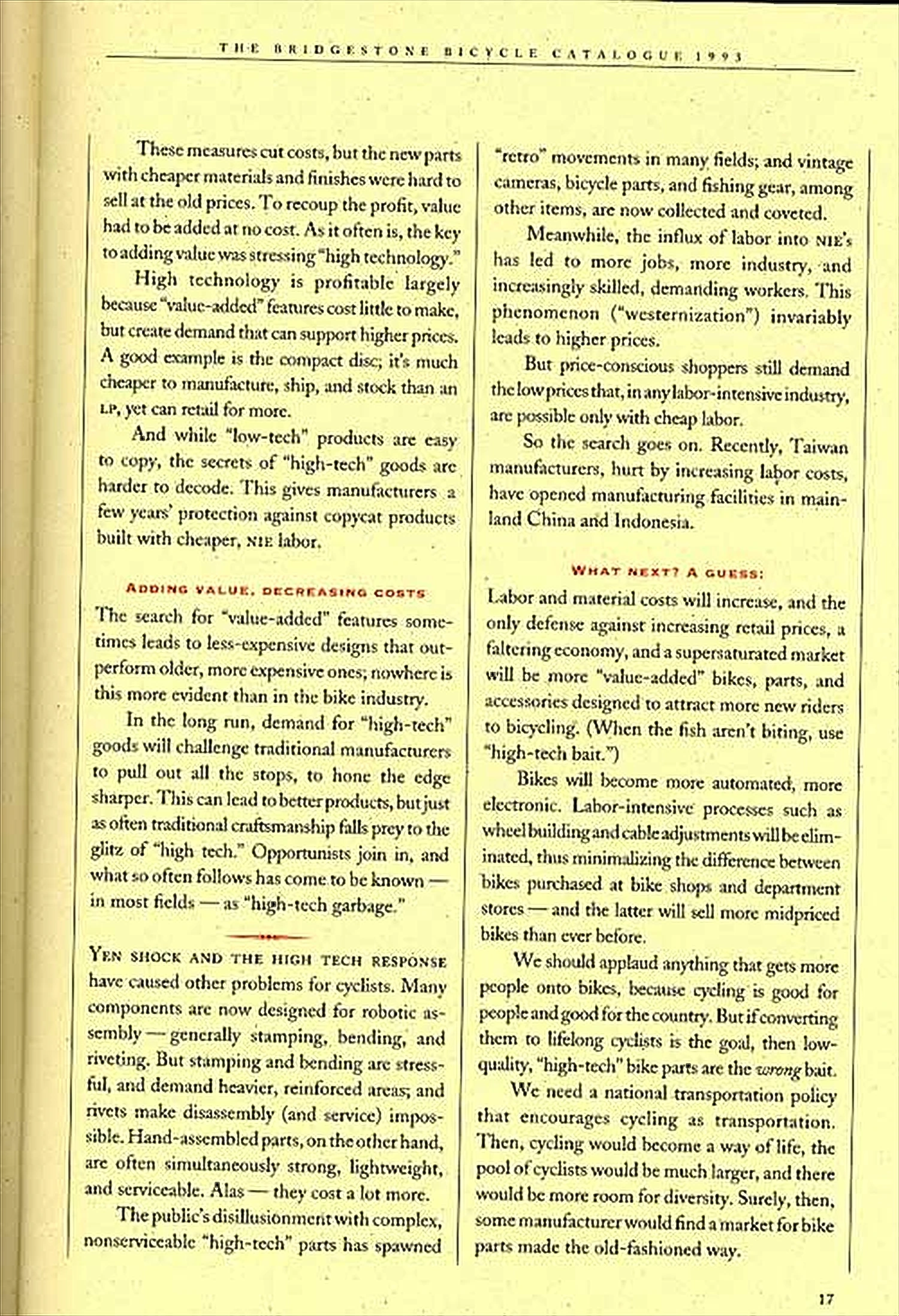 Page 18
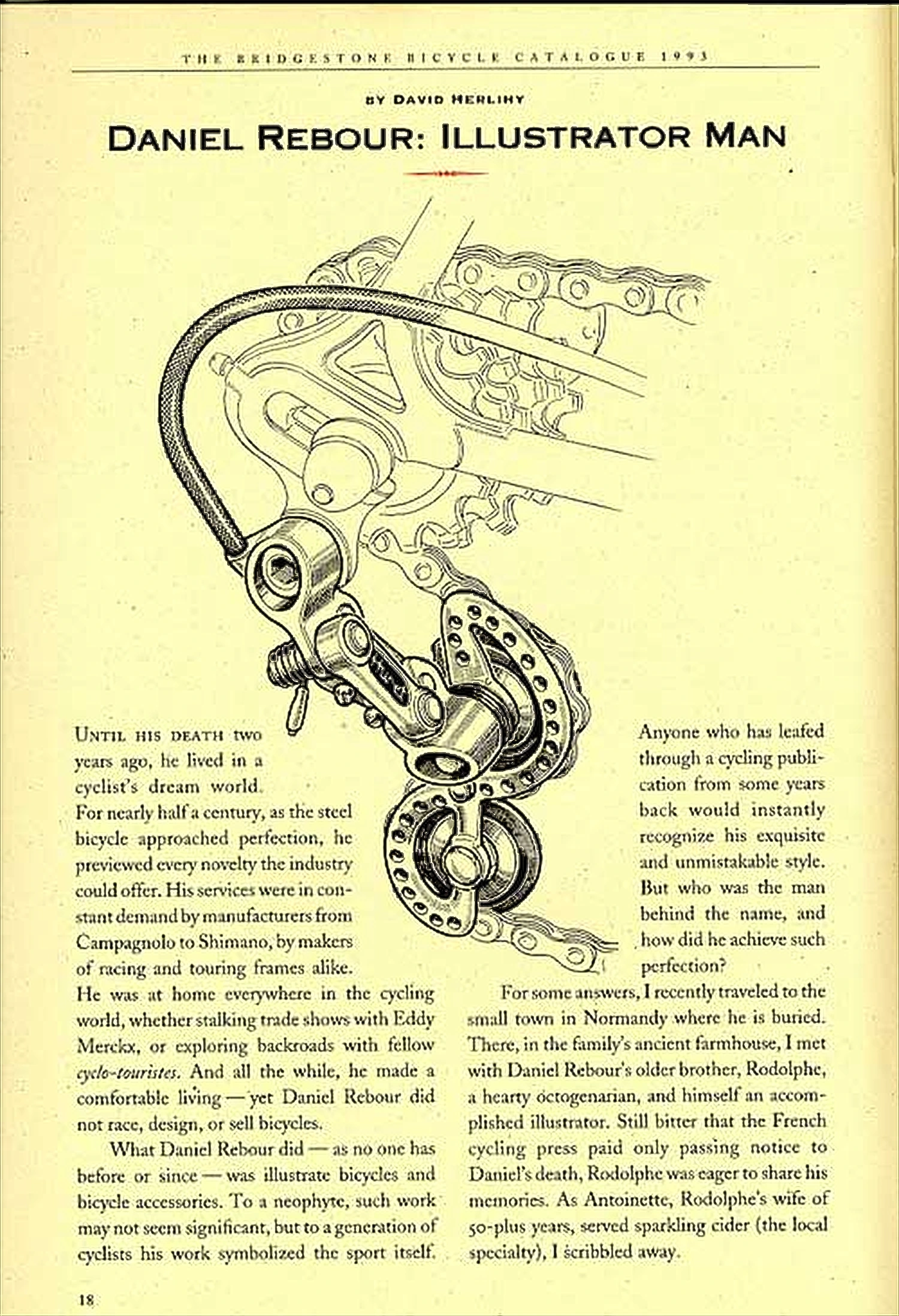 Page 19
 Page 20
 Page 21
 Page 22
 Page 23
 Page 24
 Page 25
 Page 26
 Page 27
 Page 28
 Page 29
 Page 30
 Page 31
 Page 32
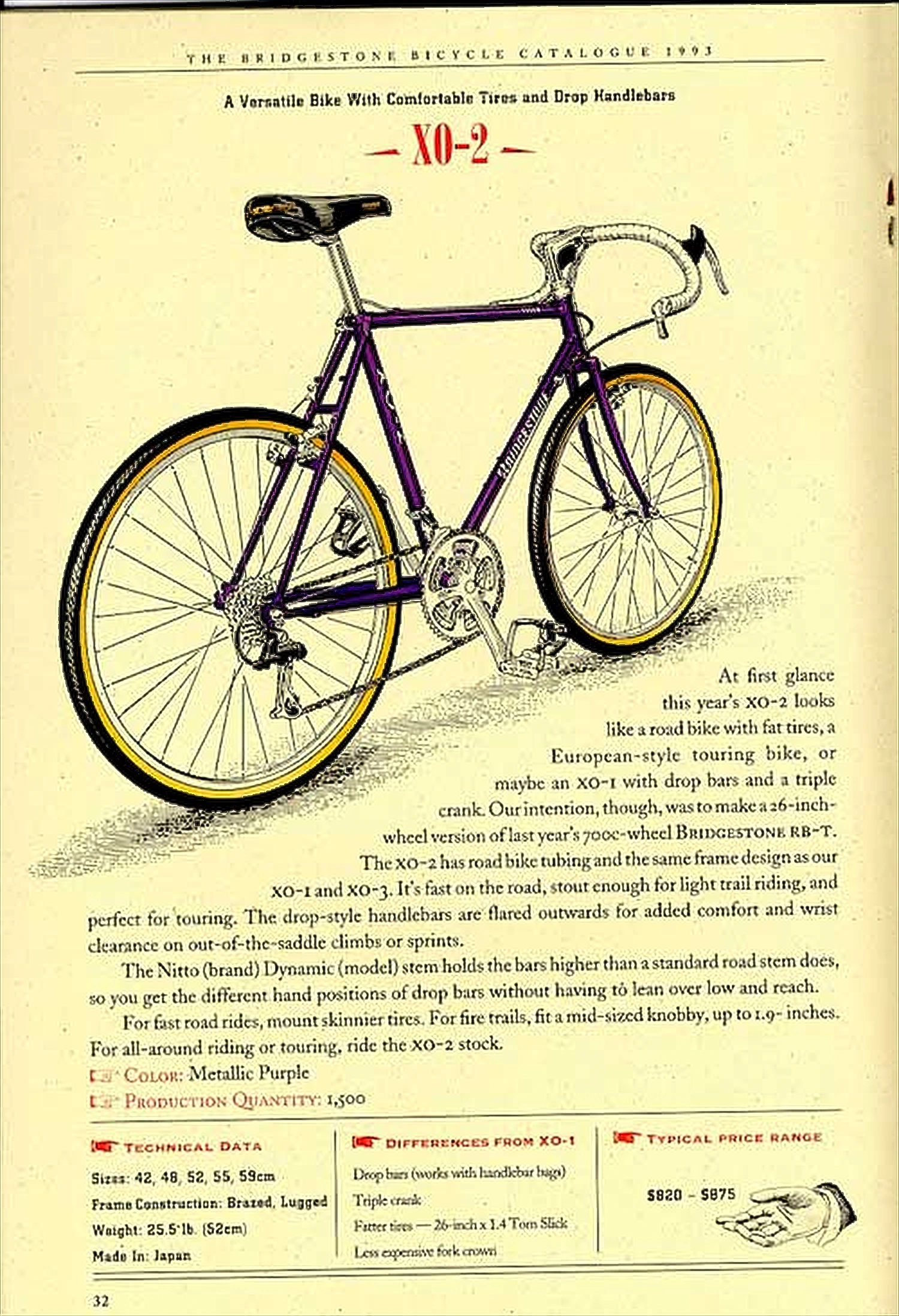 Page 33
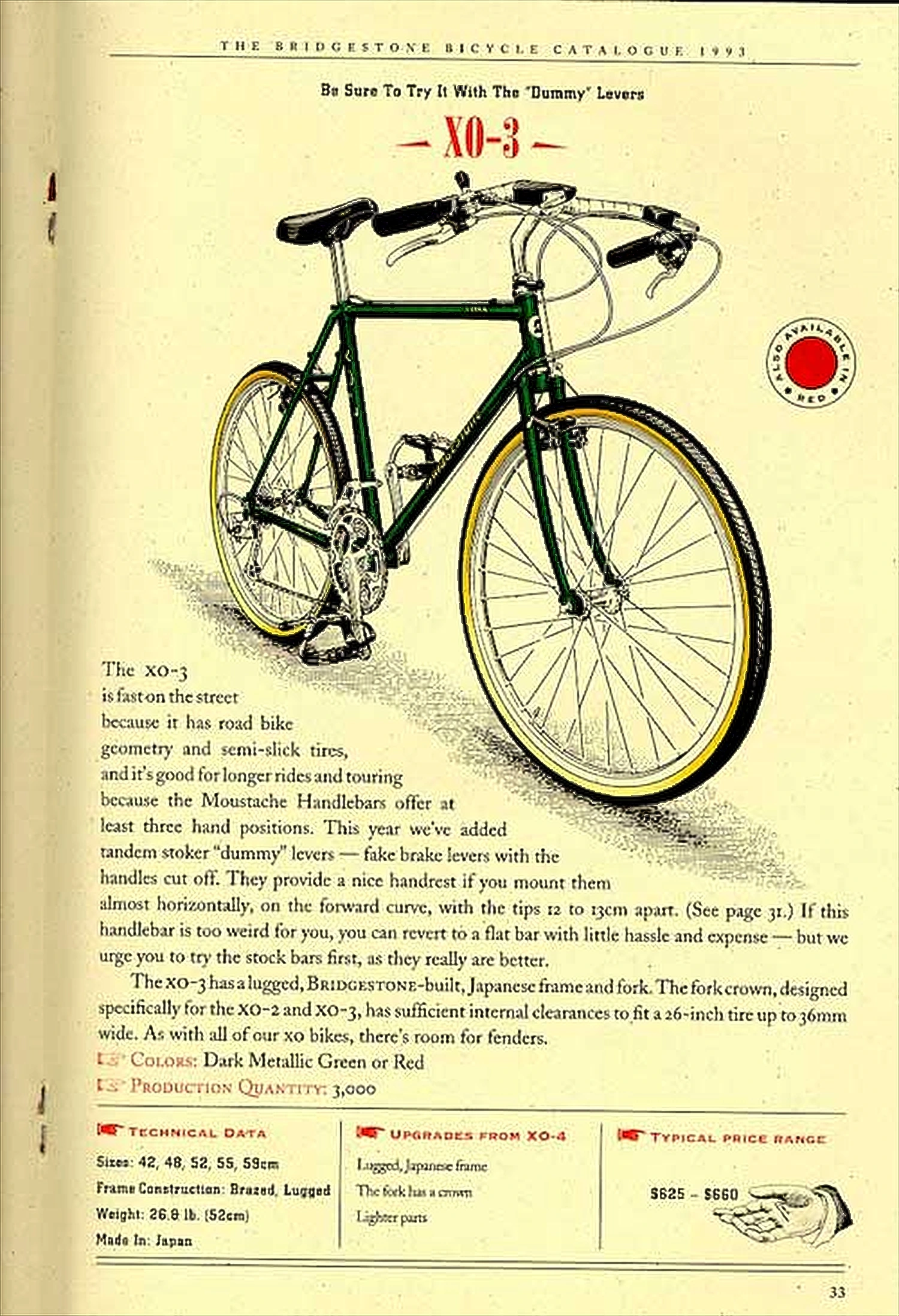 Page 34
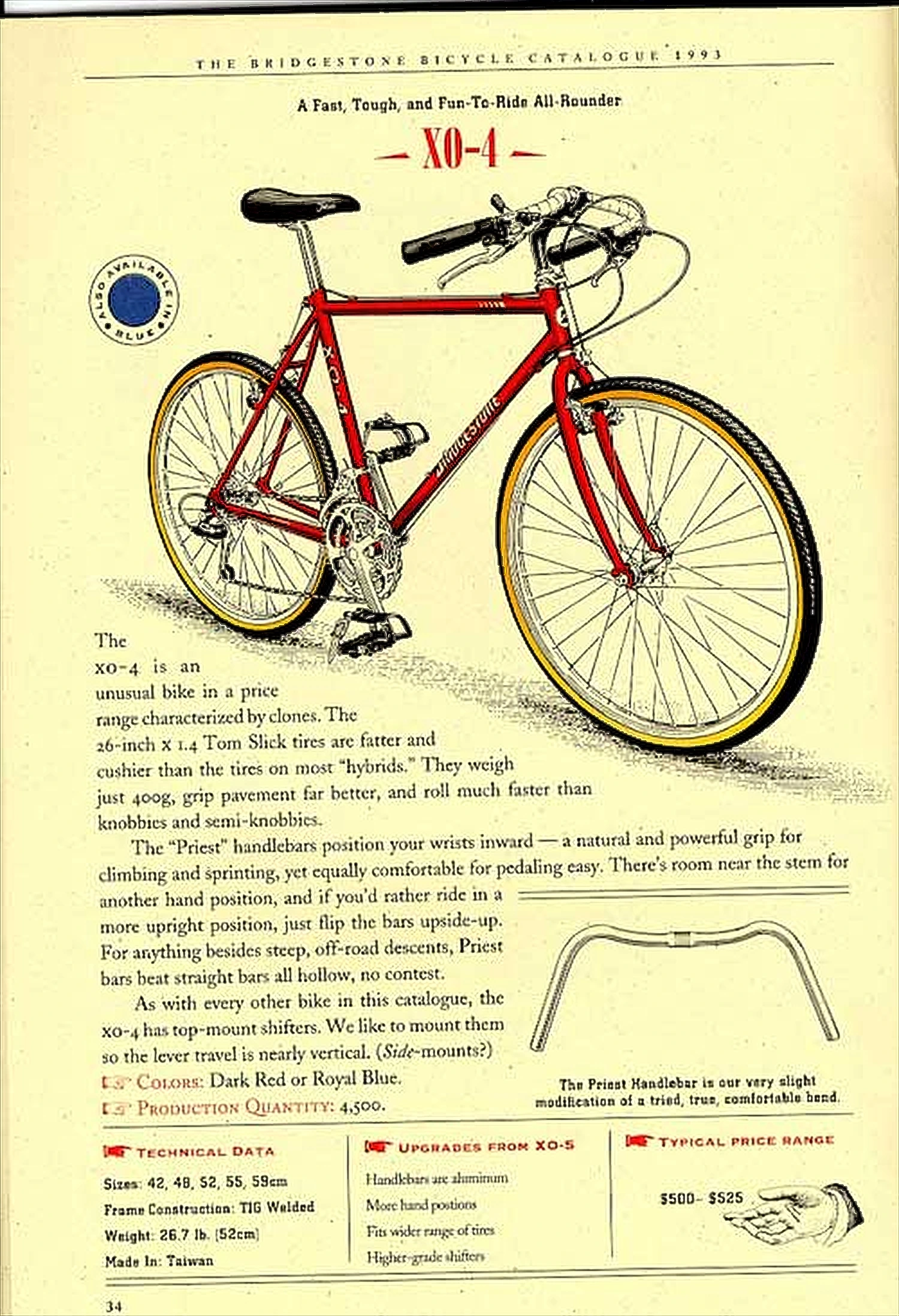 Page 35
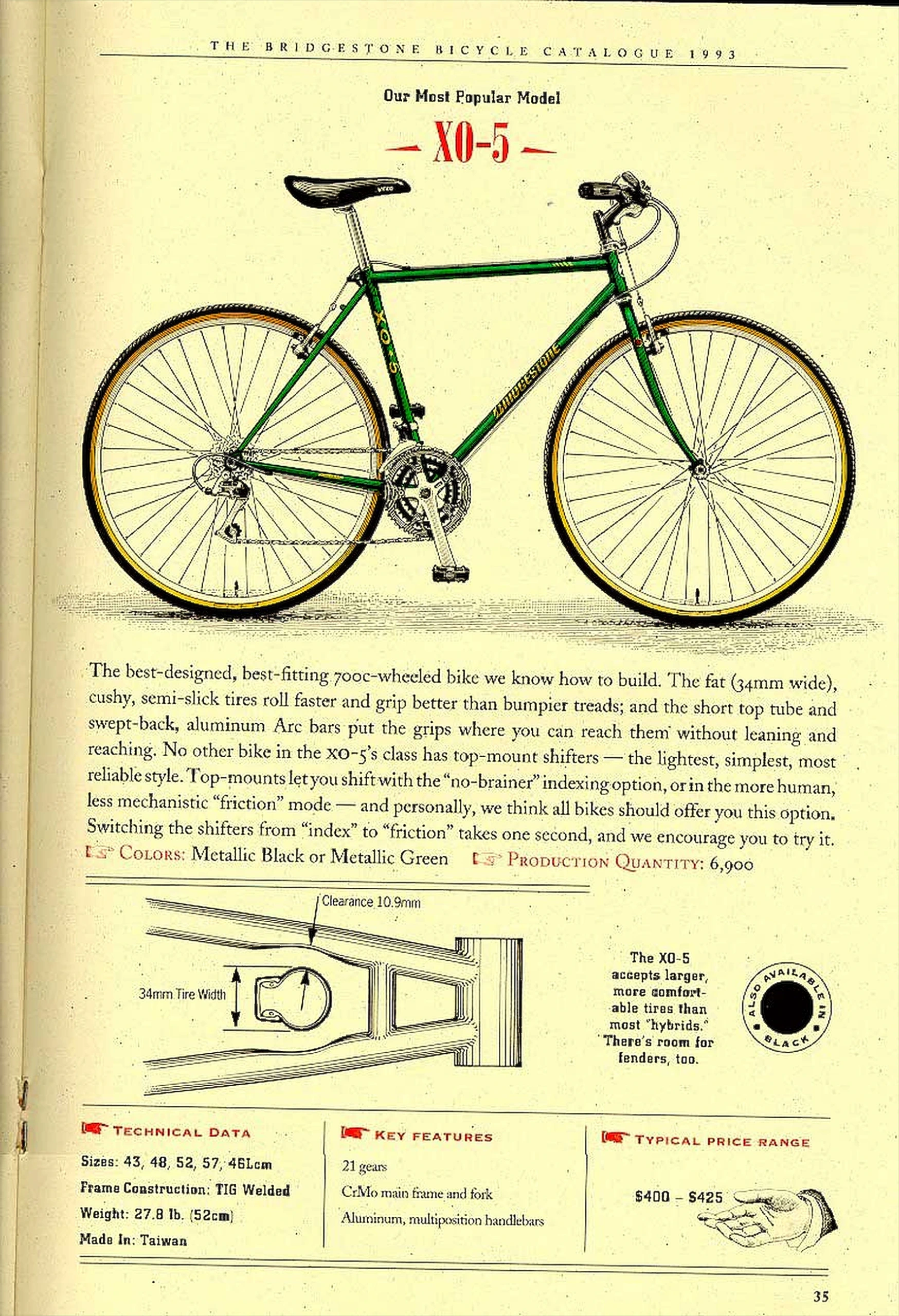 Page 36
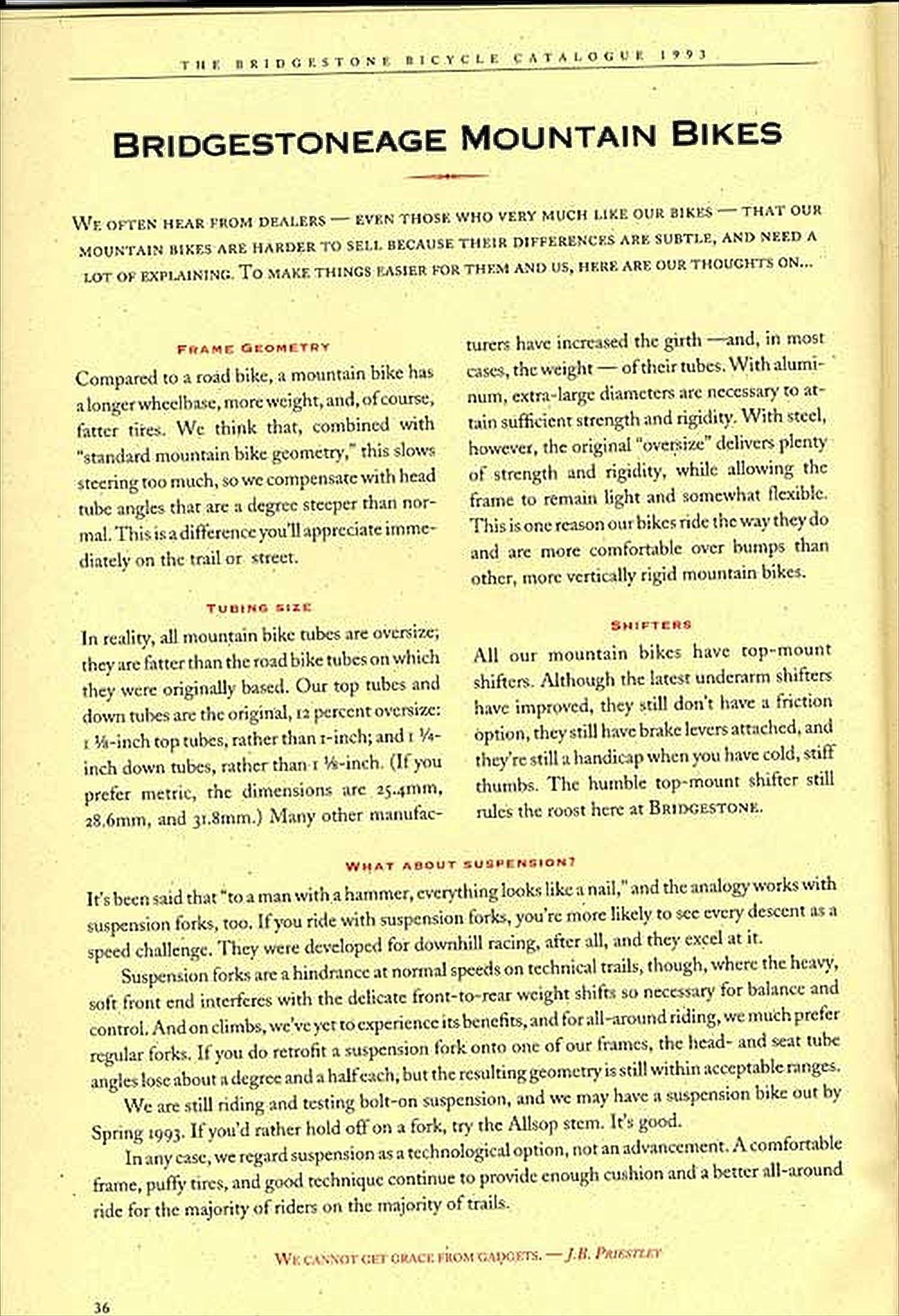 Page 37
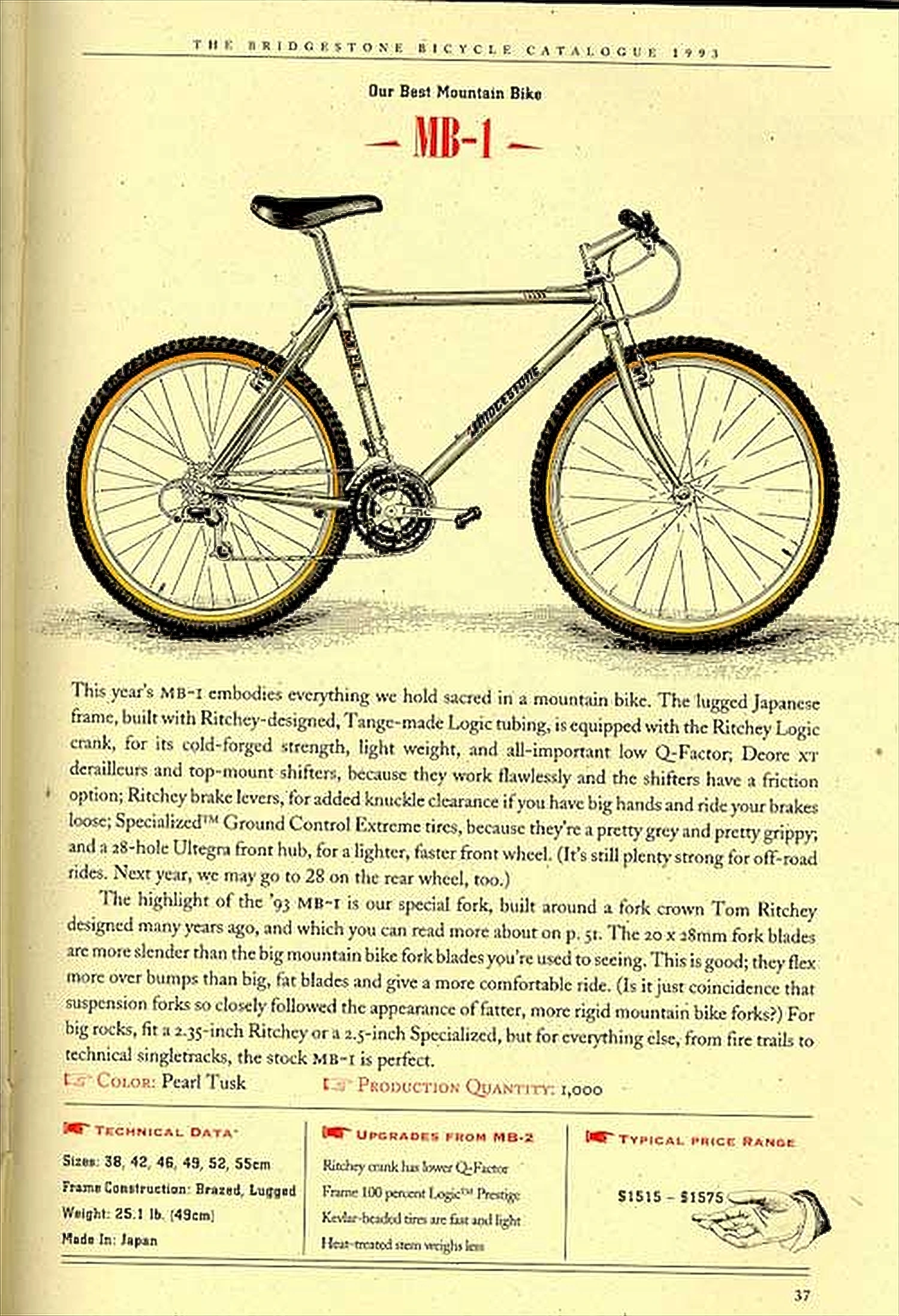 Page 38
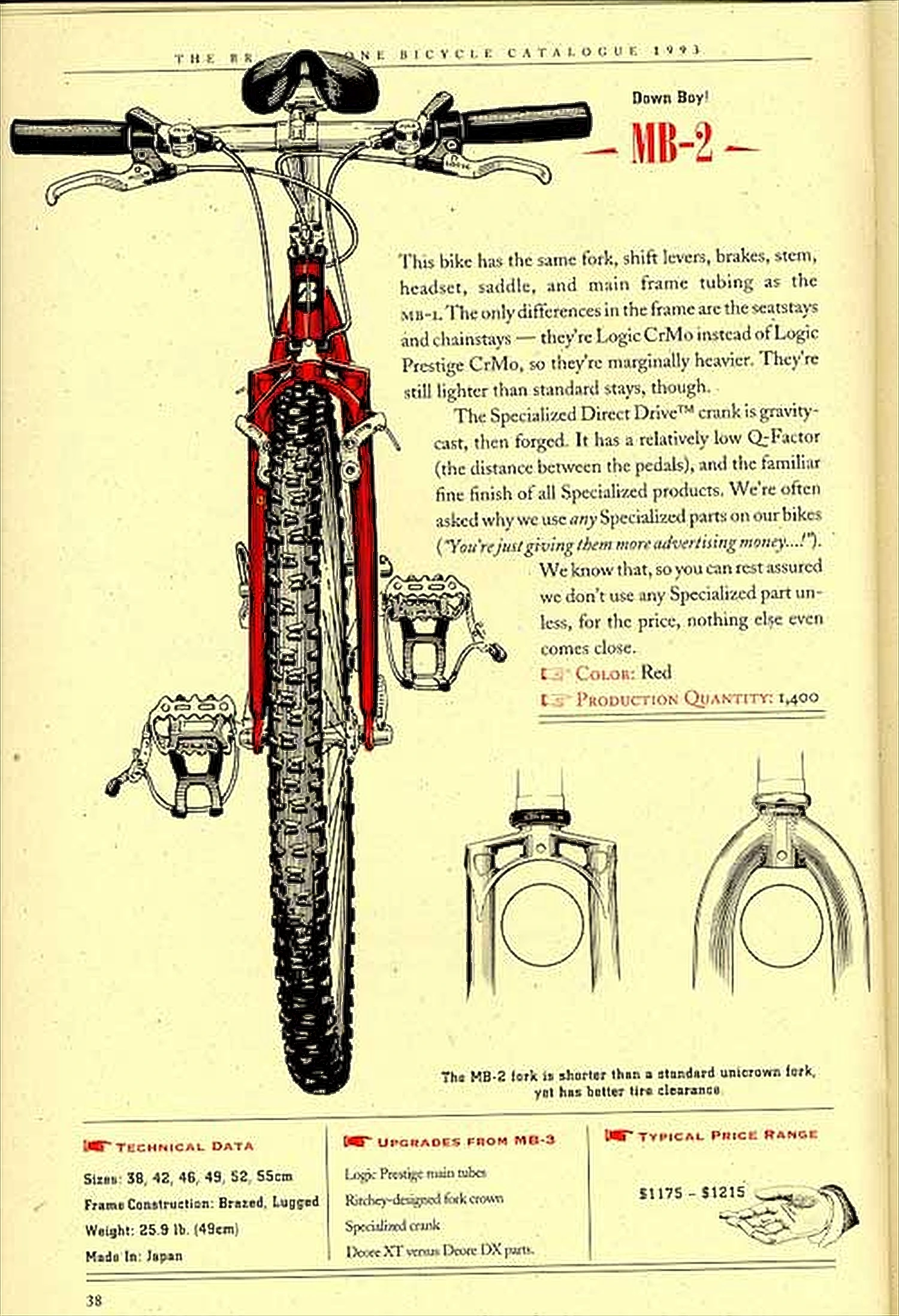 Page 39
 Page 40
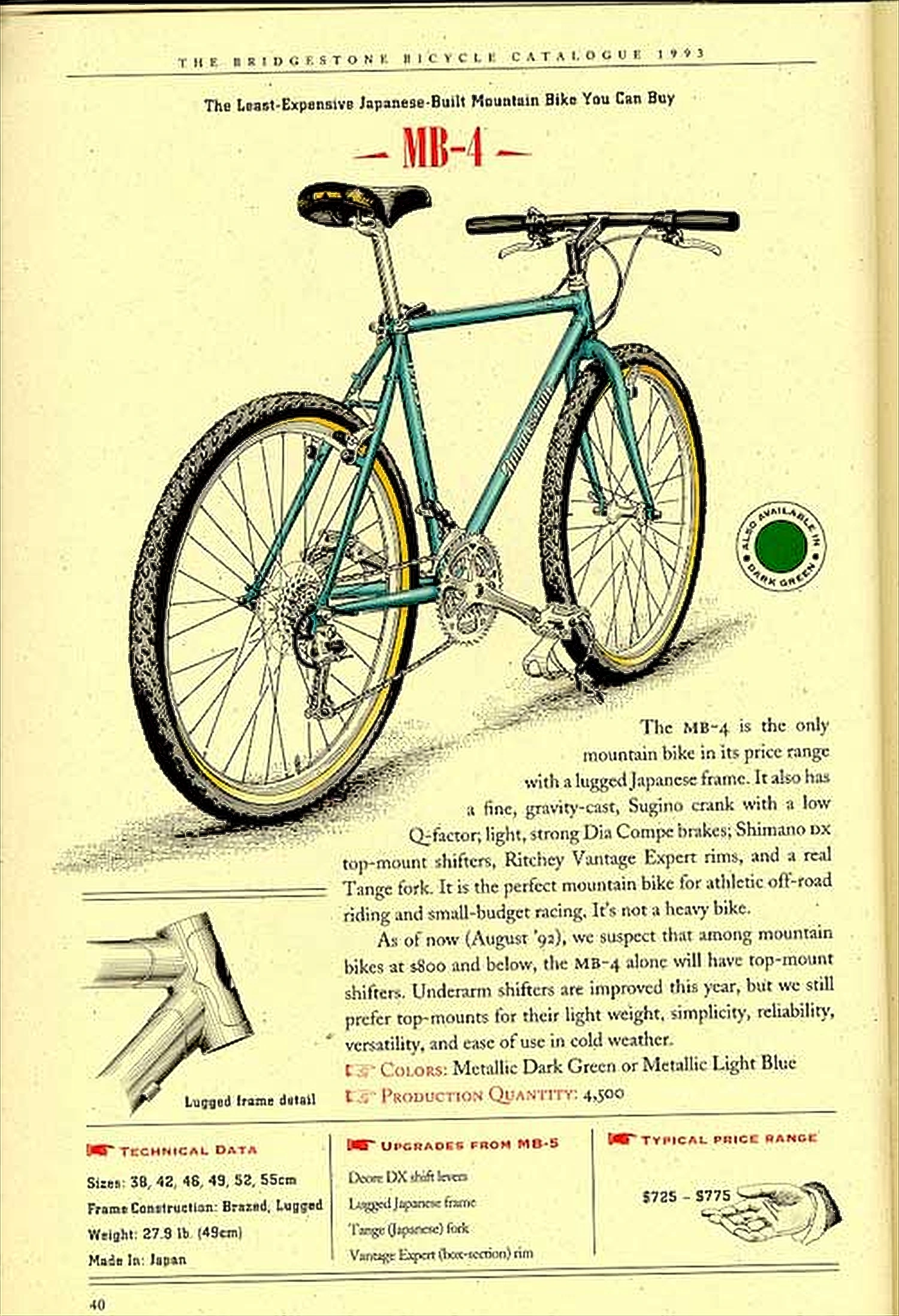 Page 41
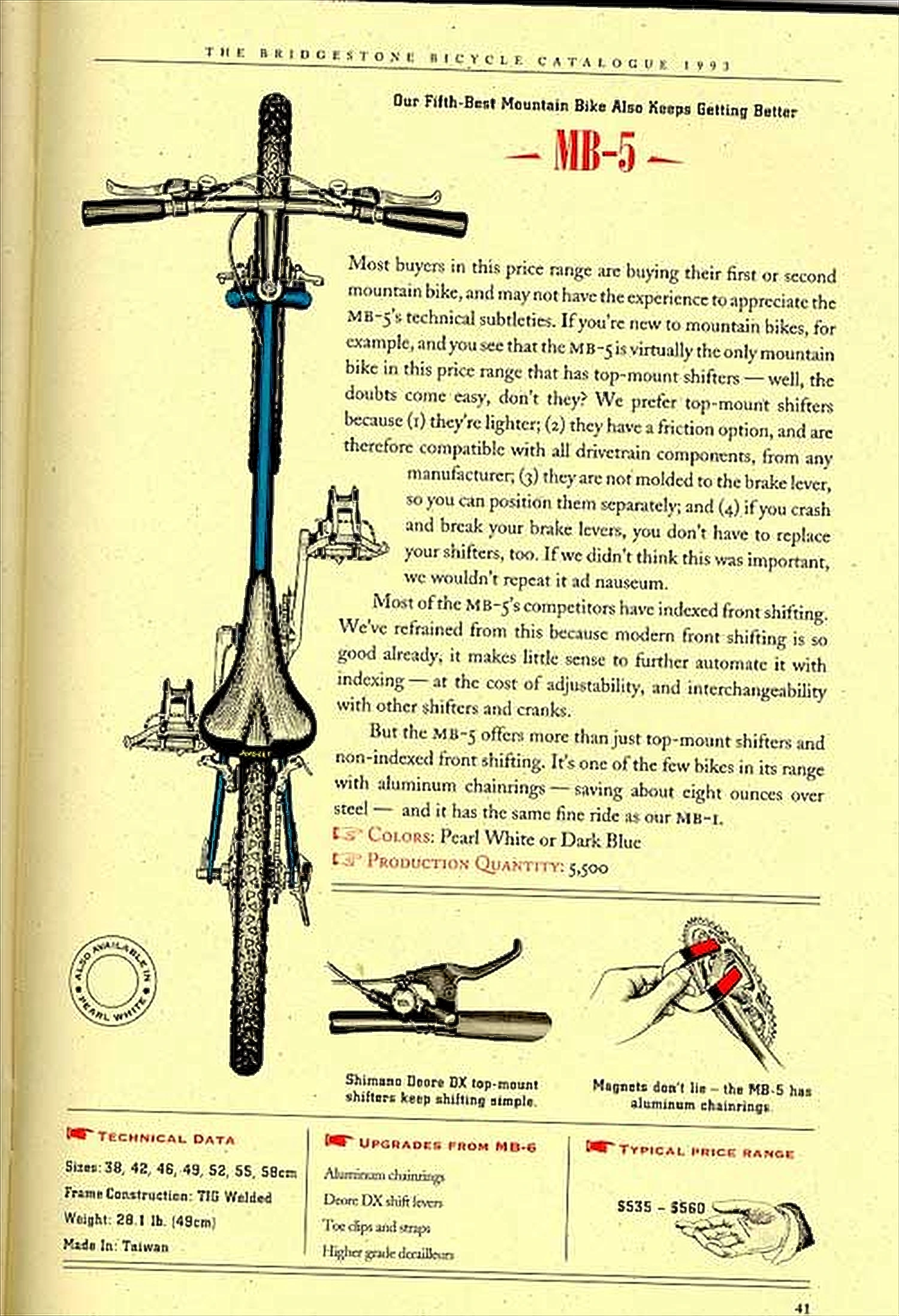 Page 42
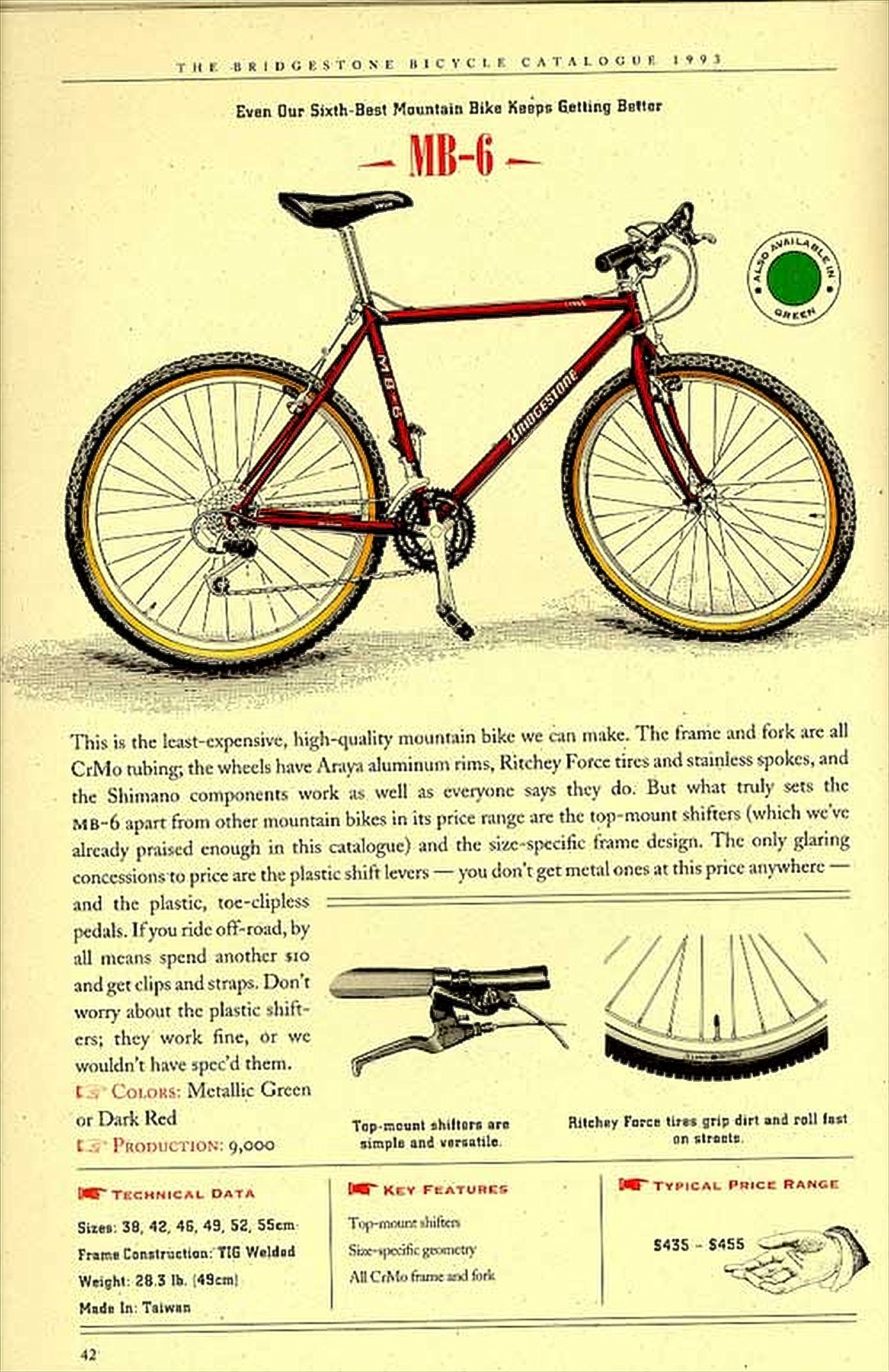 Page 43
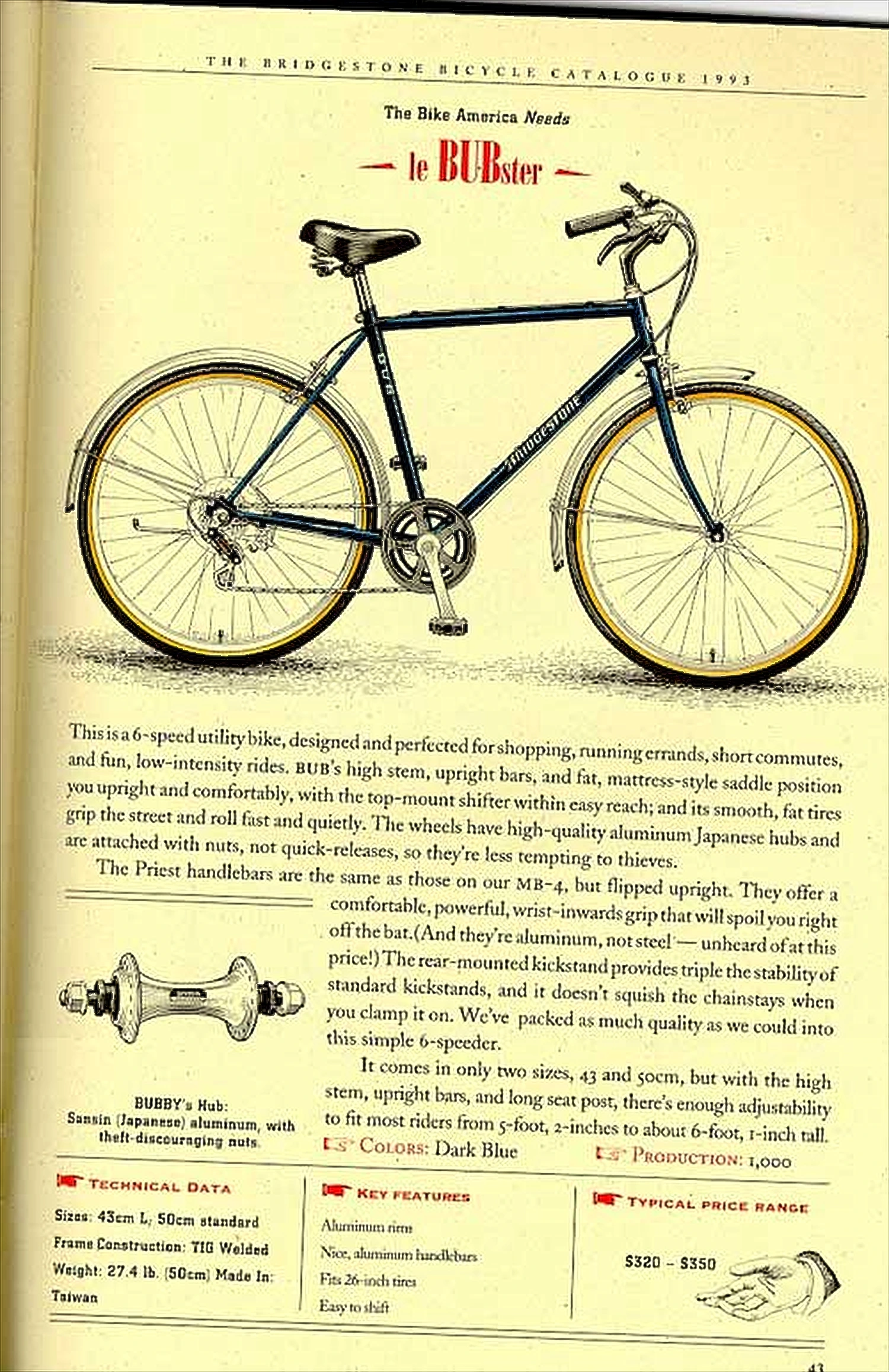 Page 44
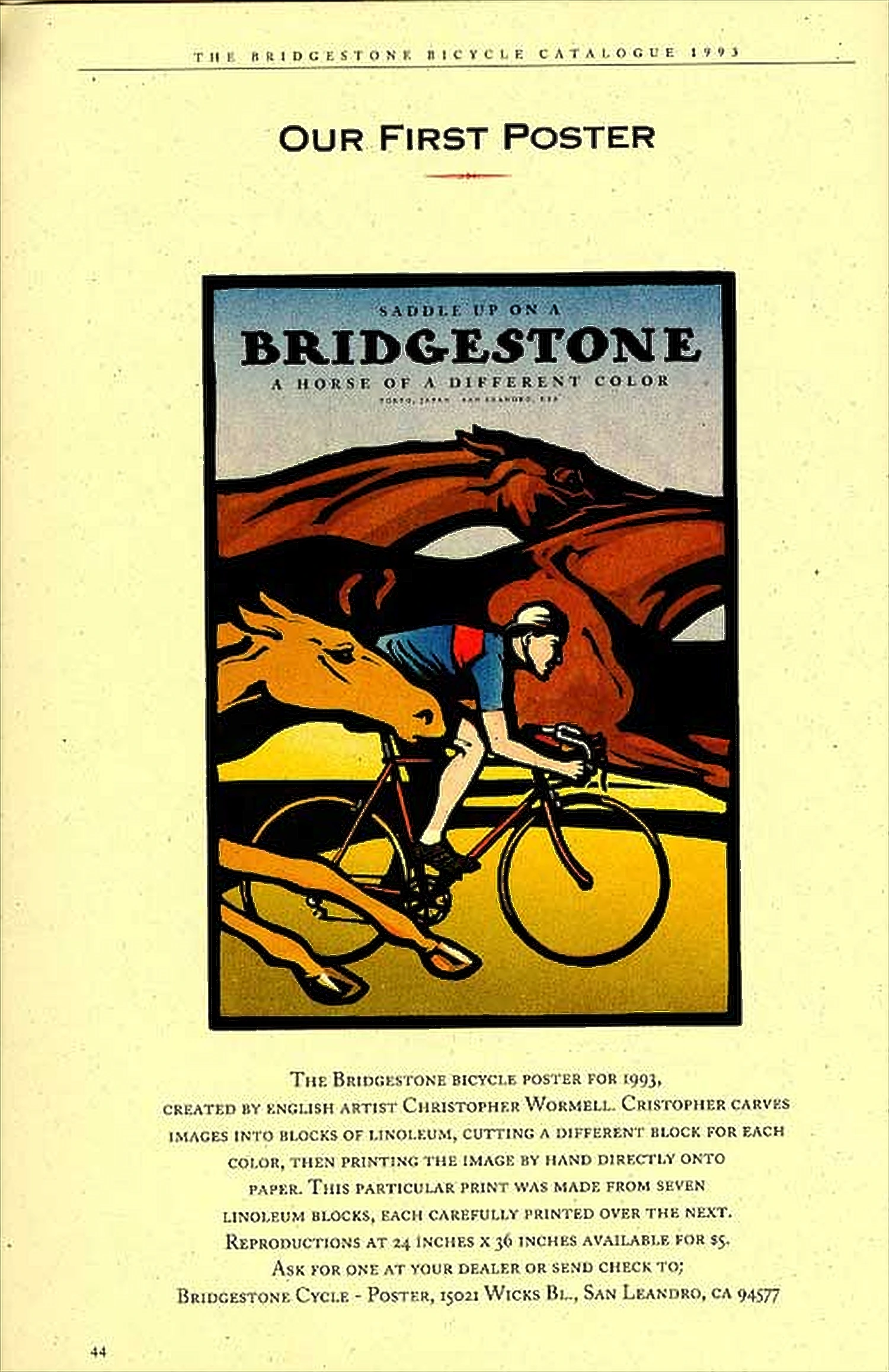 Page 45
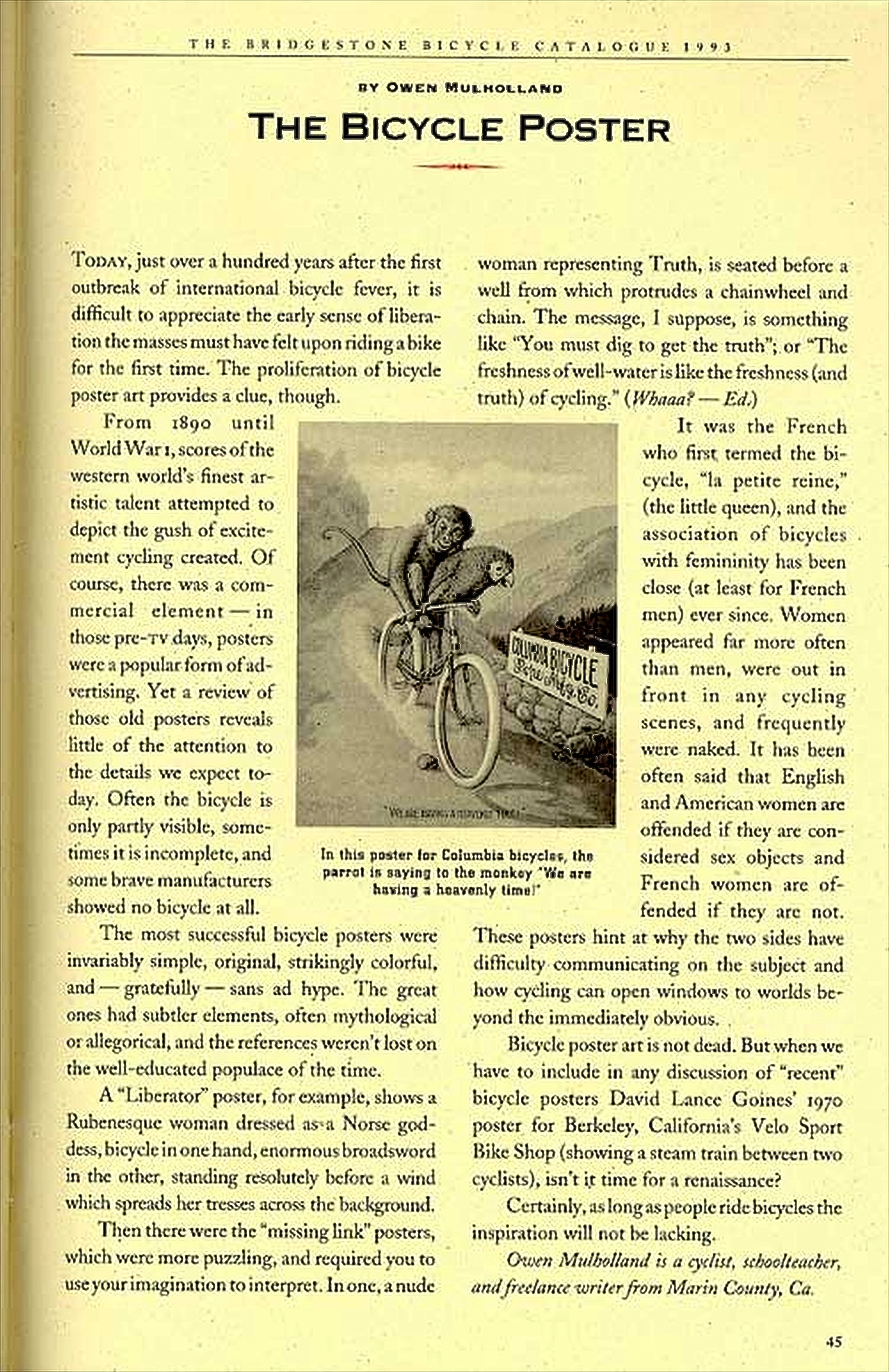 Page 46
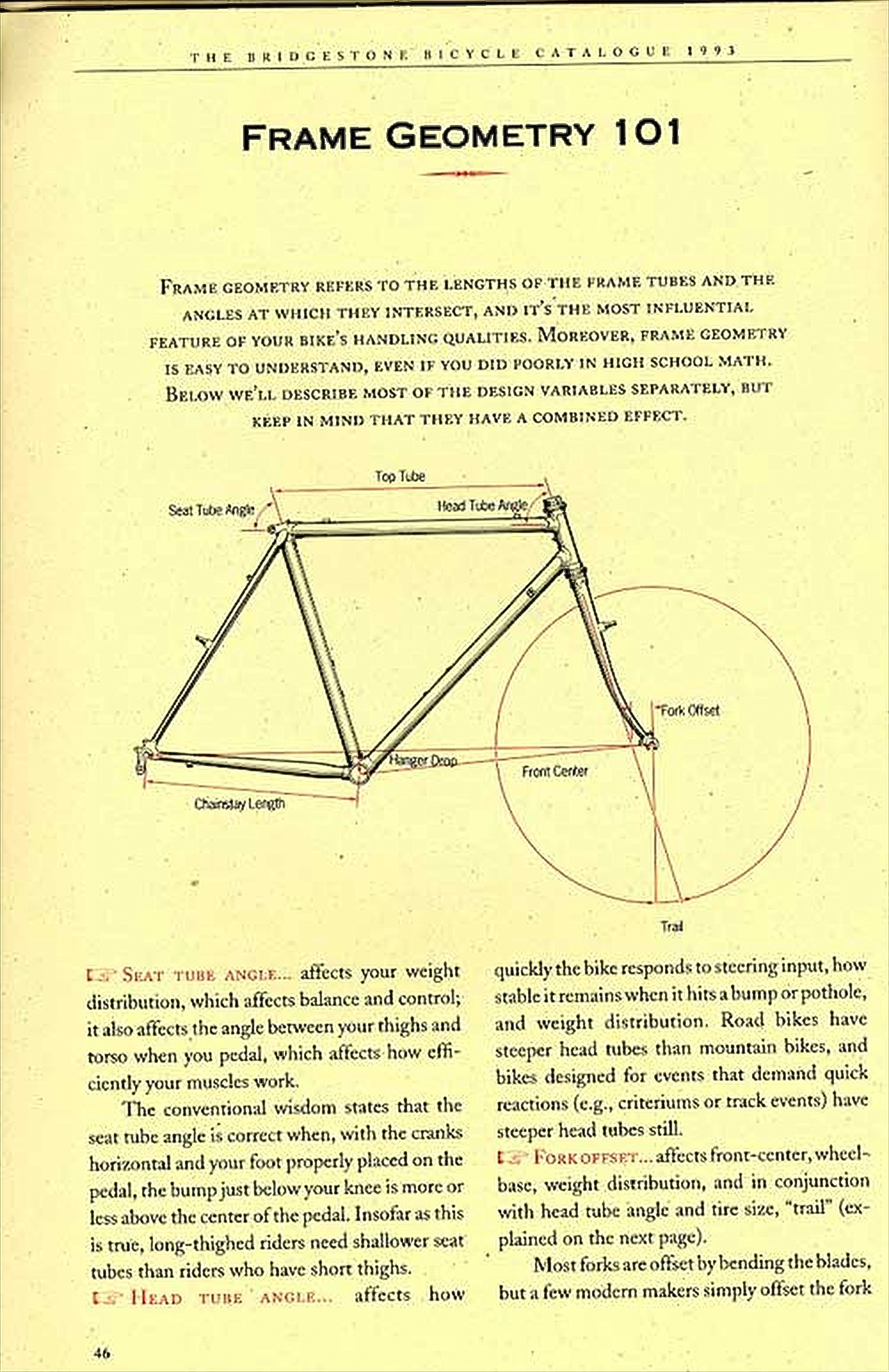 Page 47
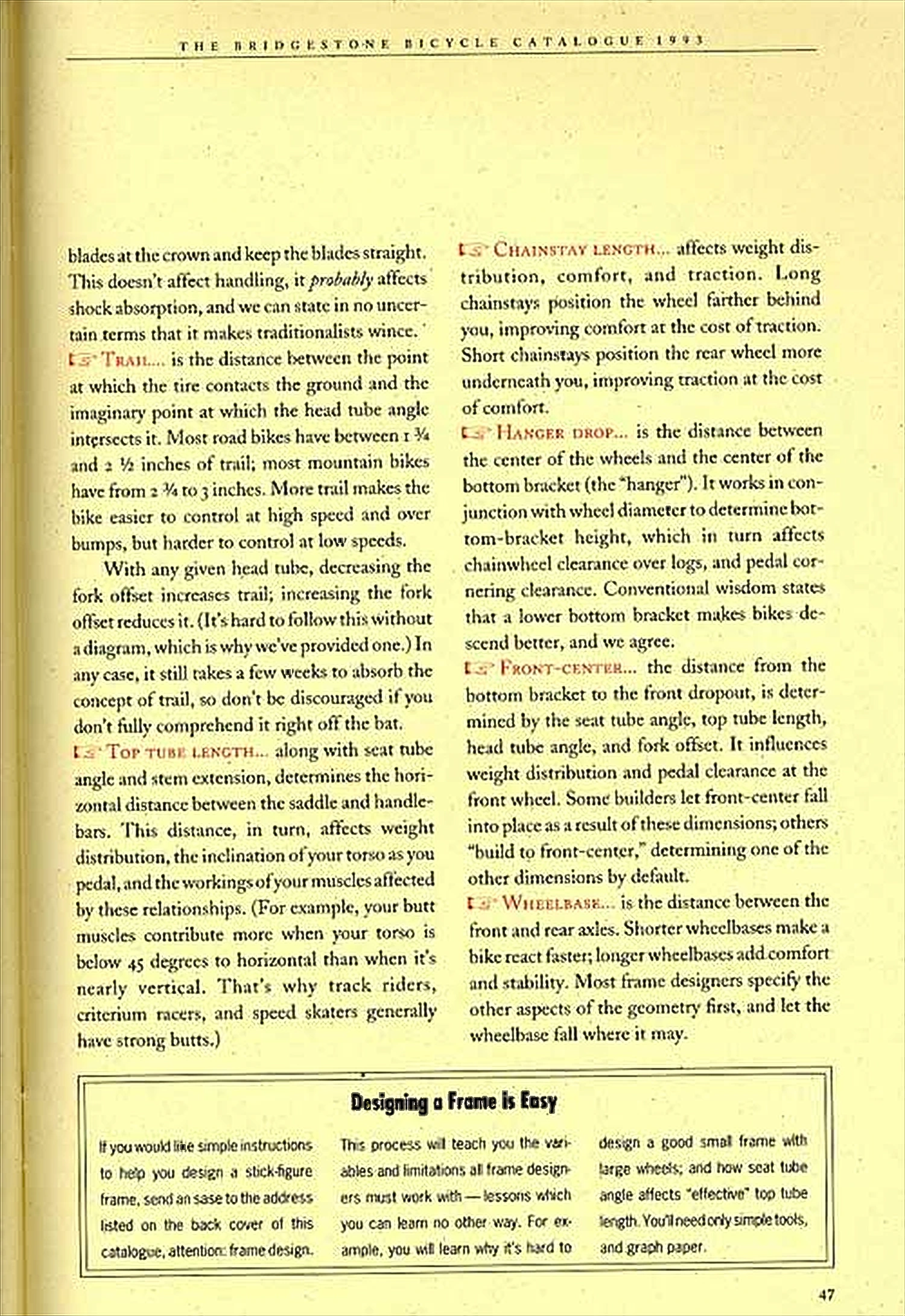 Page 48
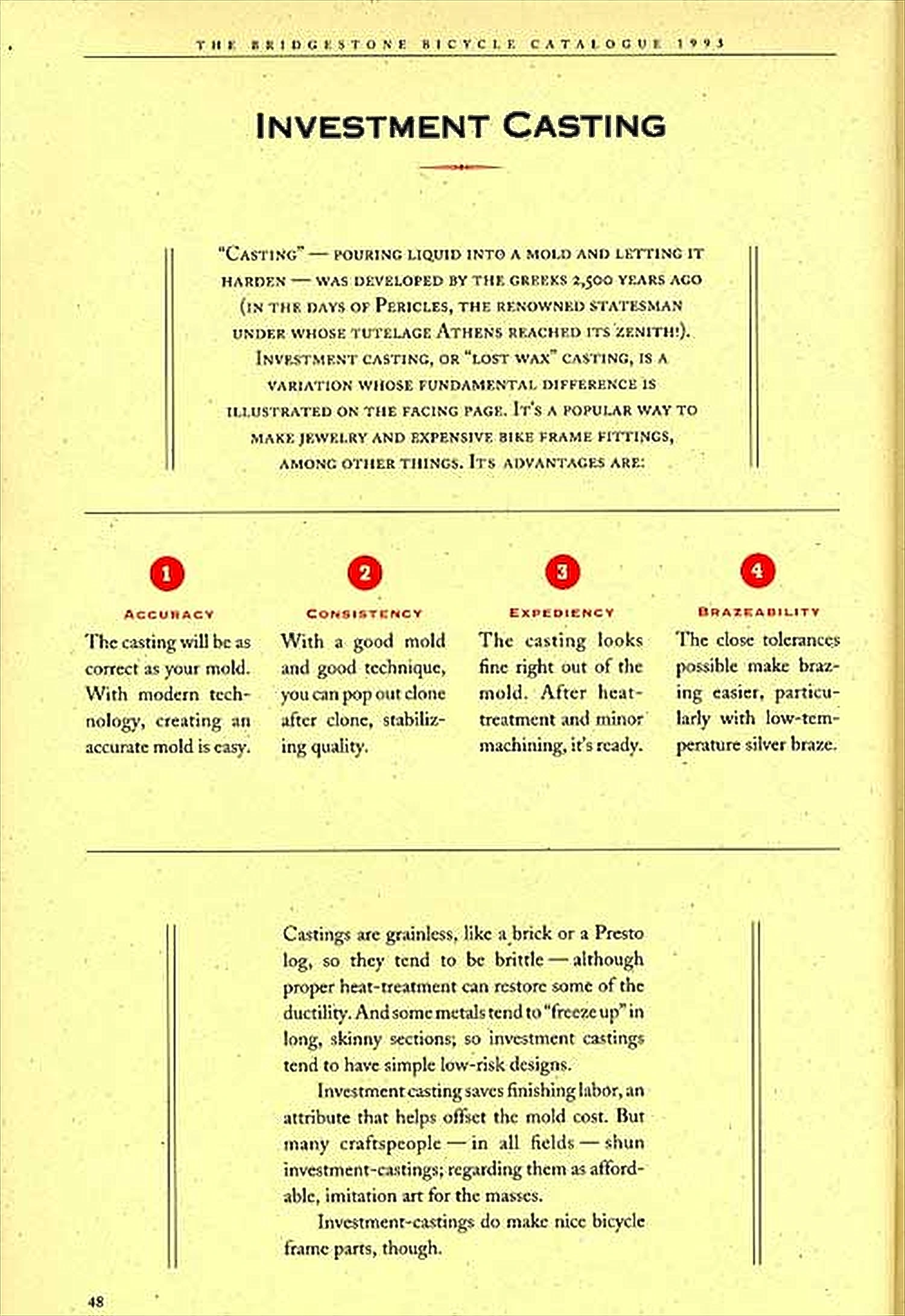 Page 49
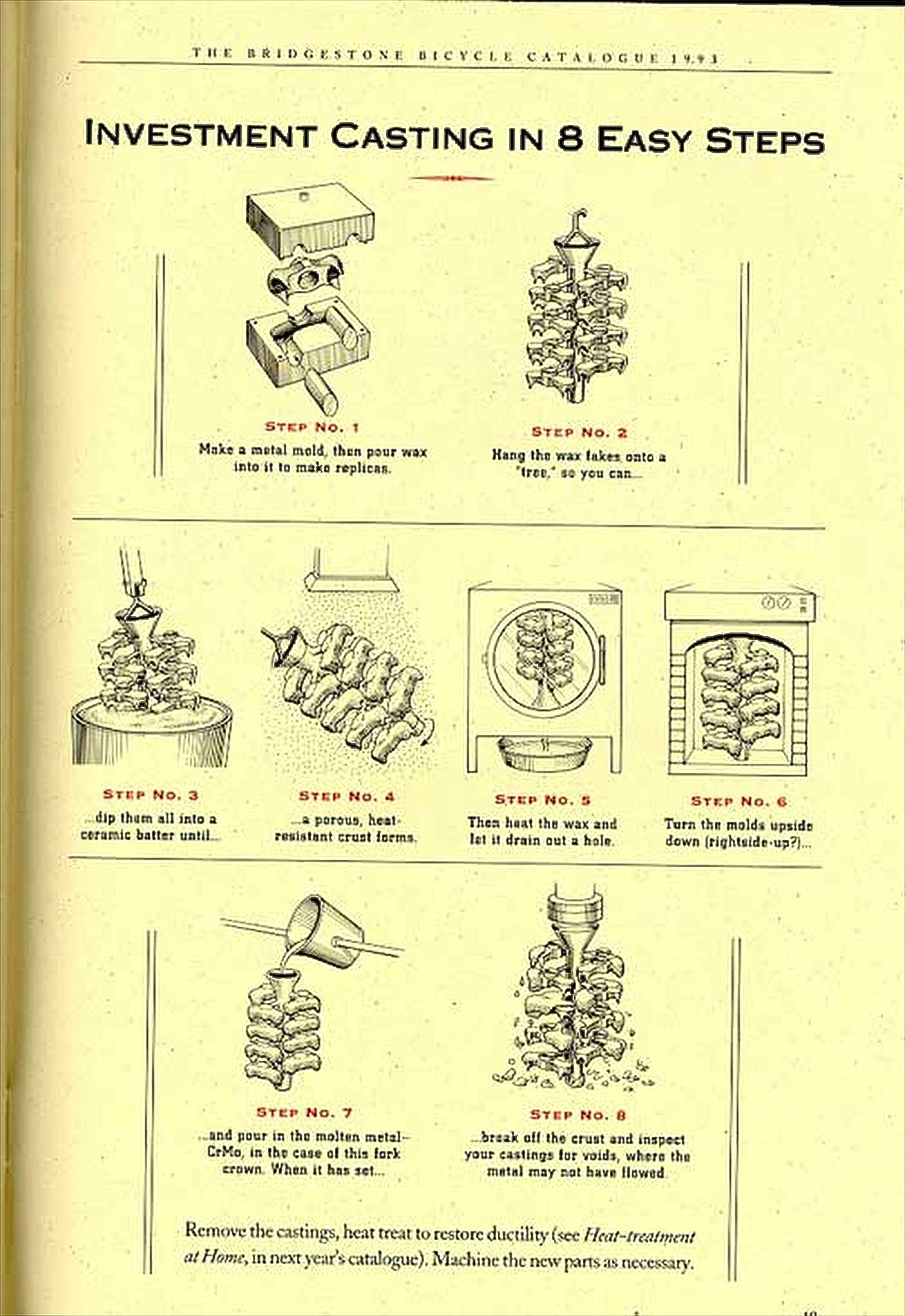 Page 50
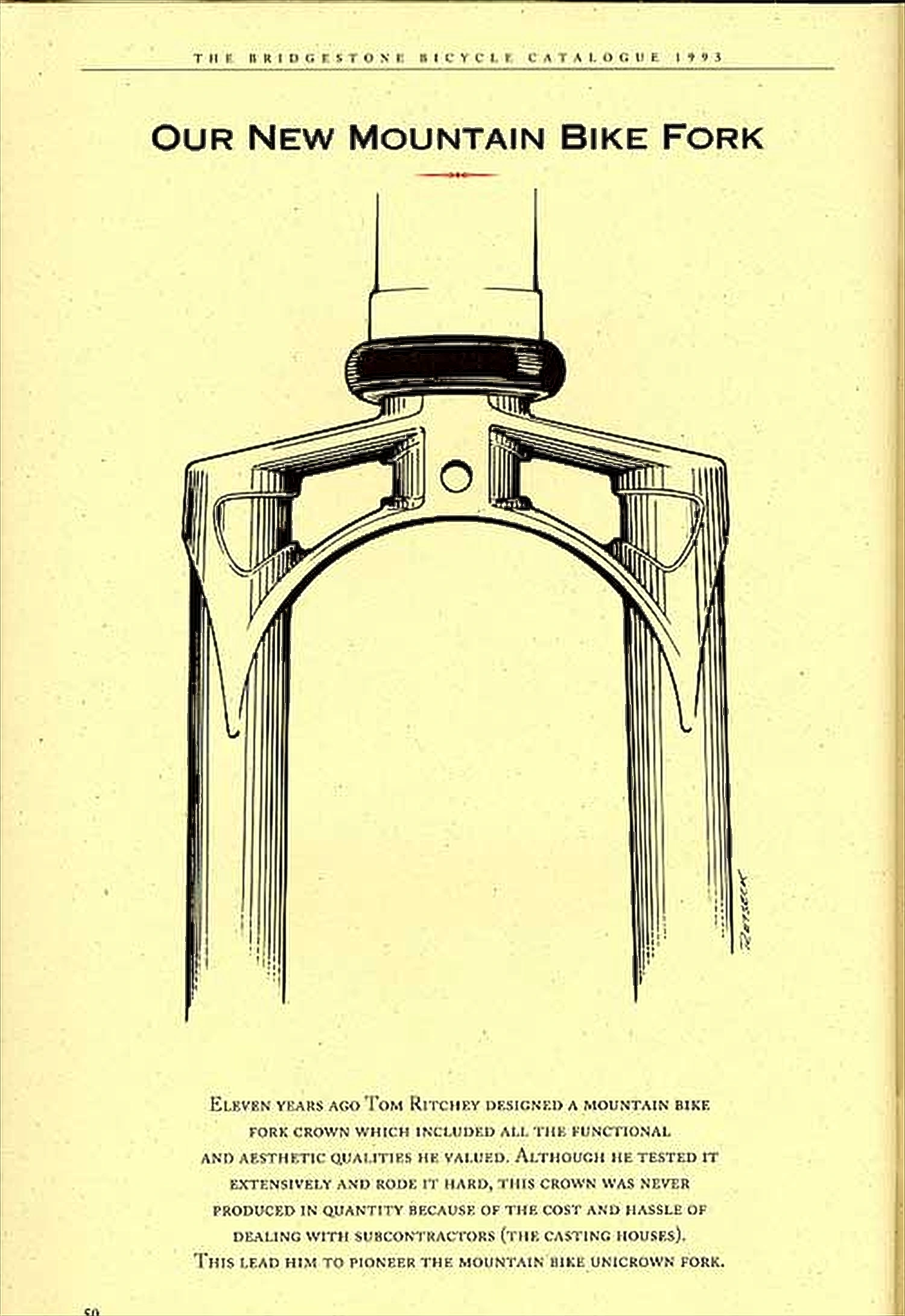 Page 51
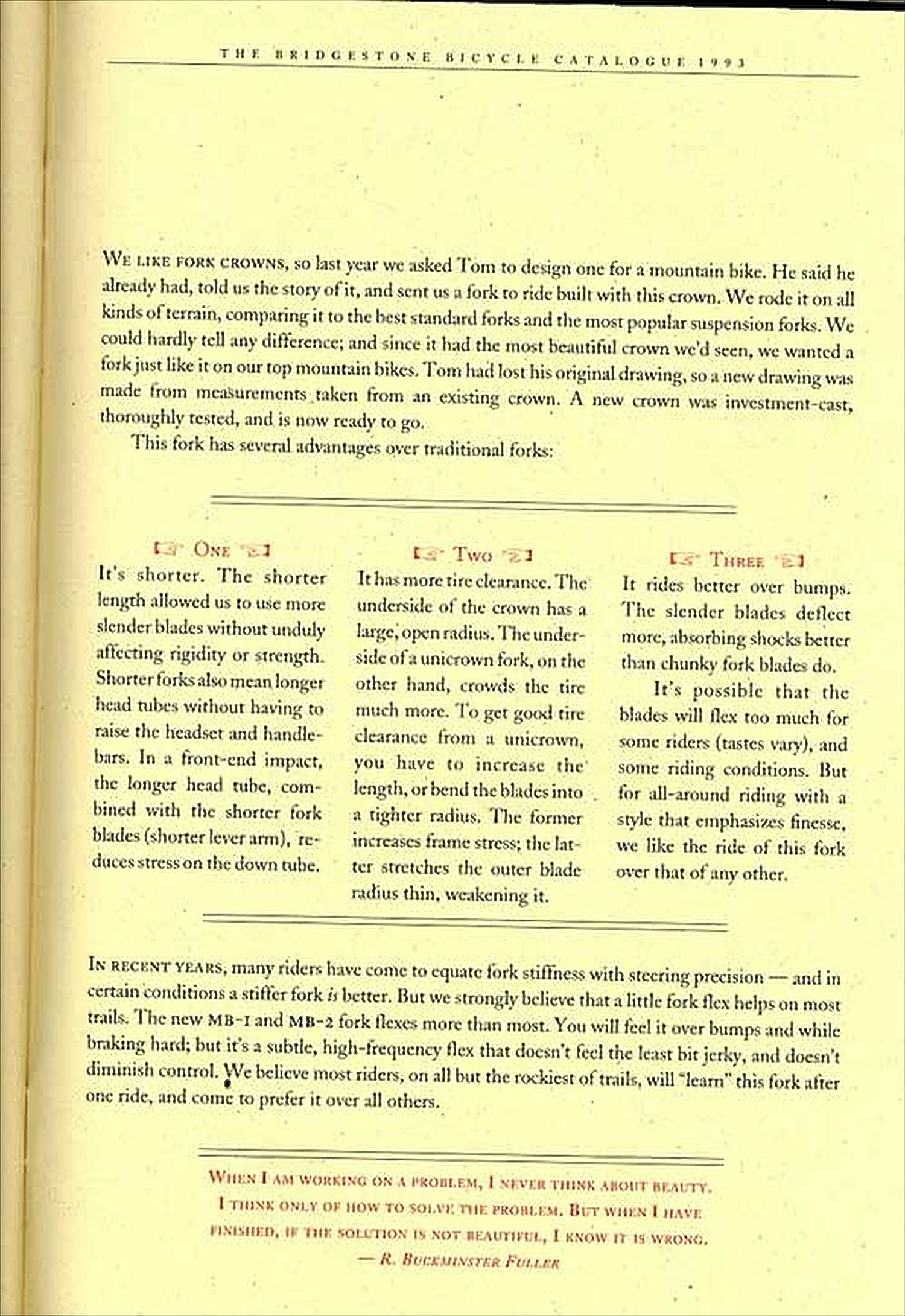 Page 52
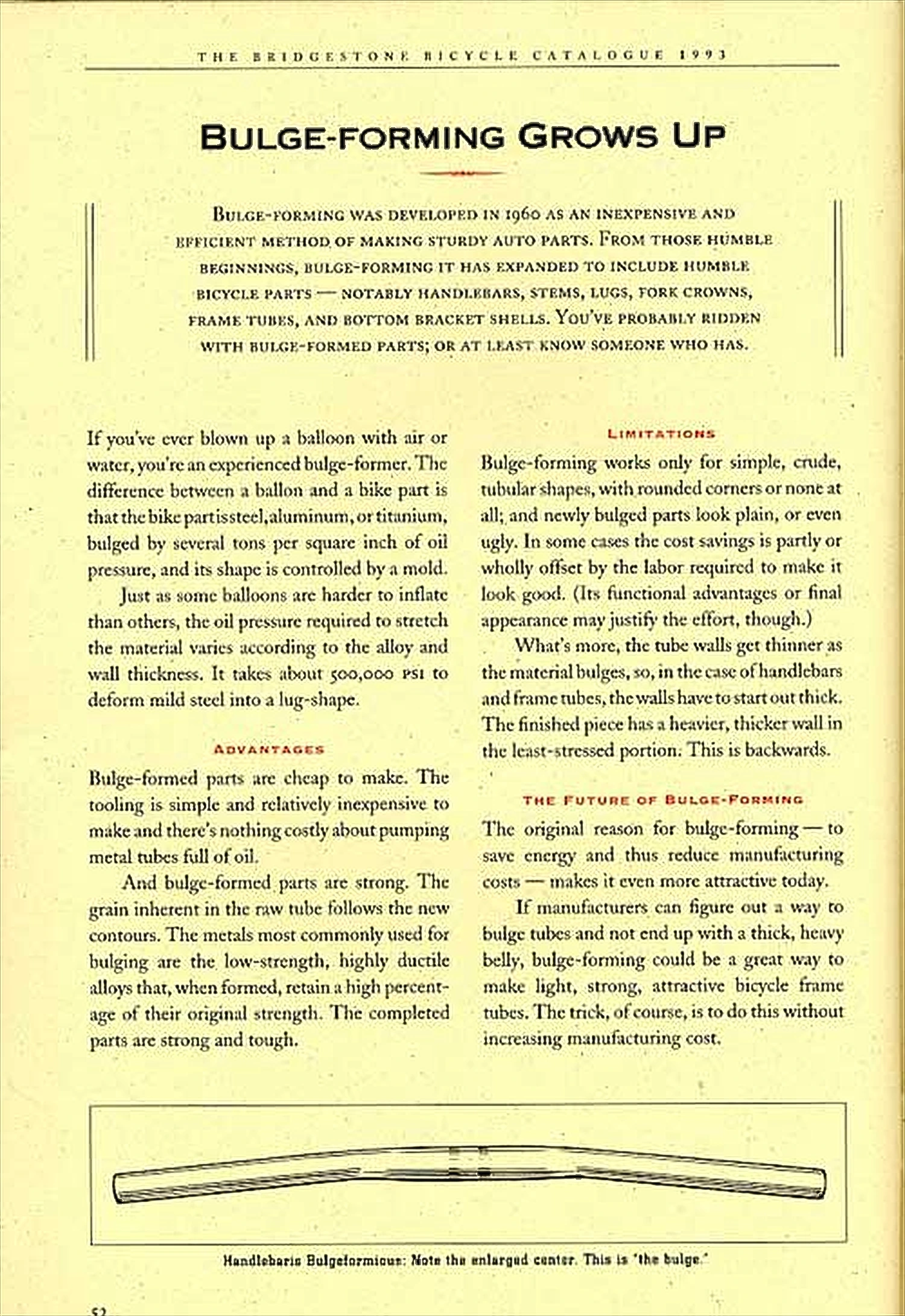 Page 53
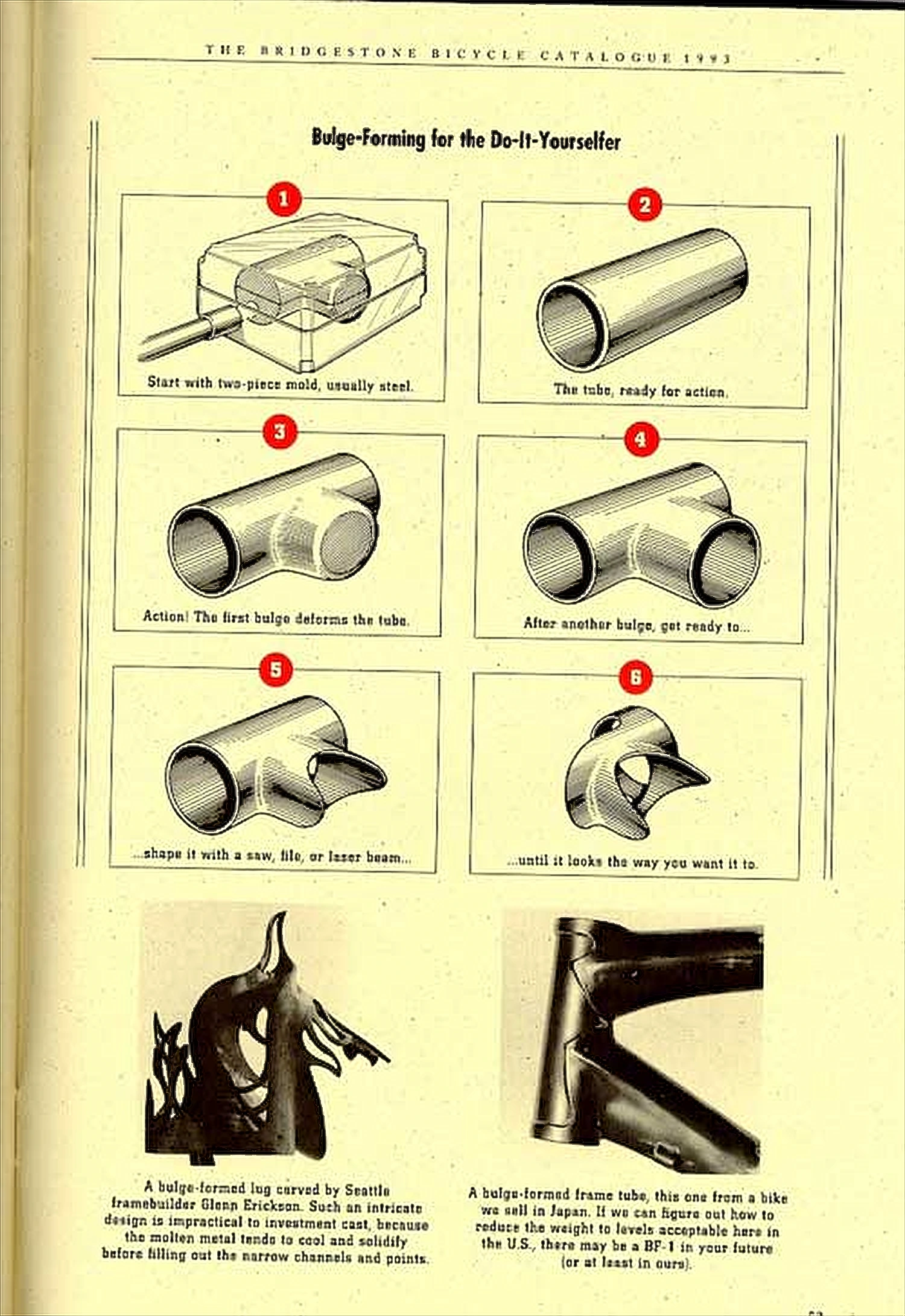 Page 54
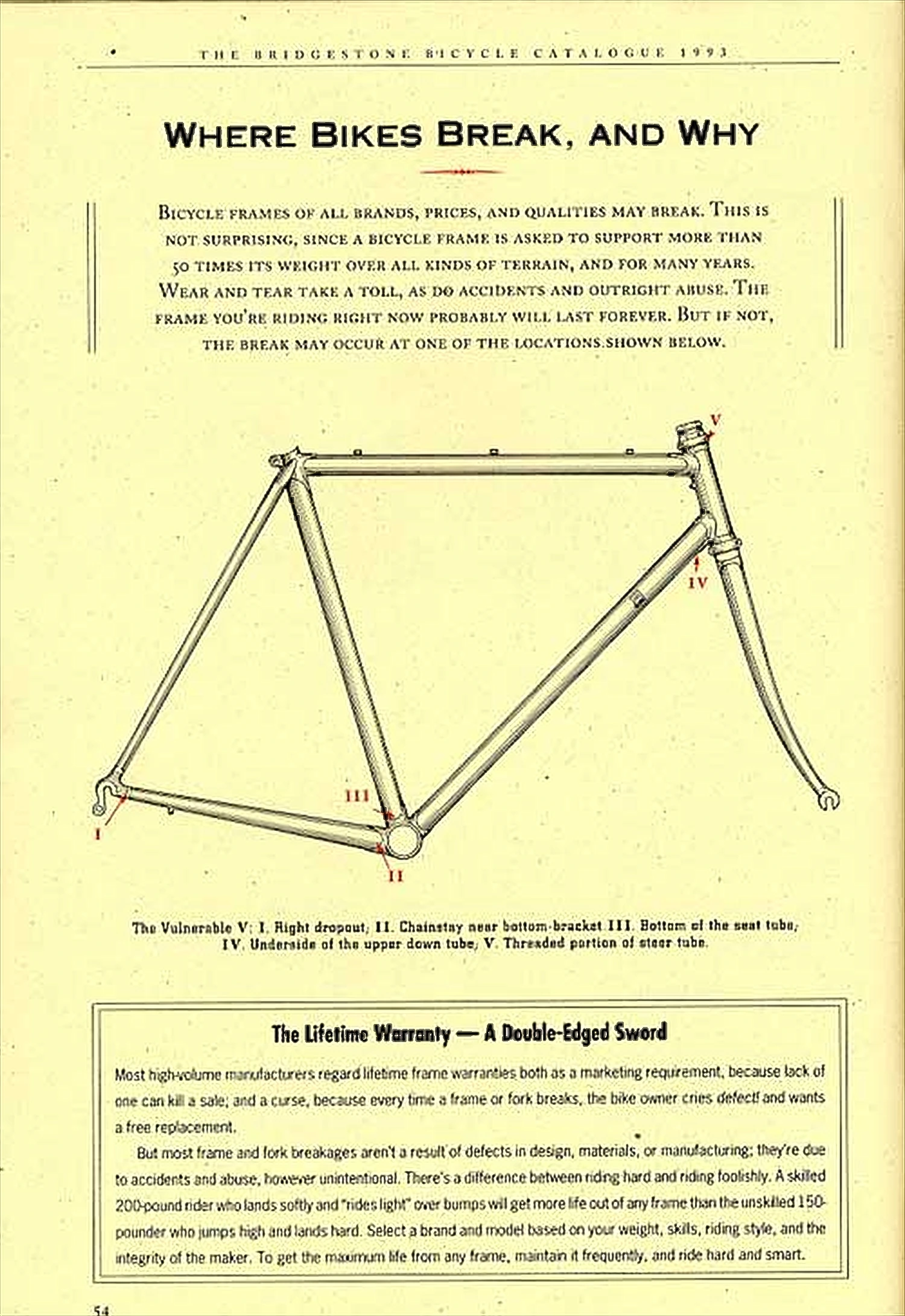 Page 55
 Page 56
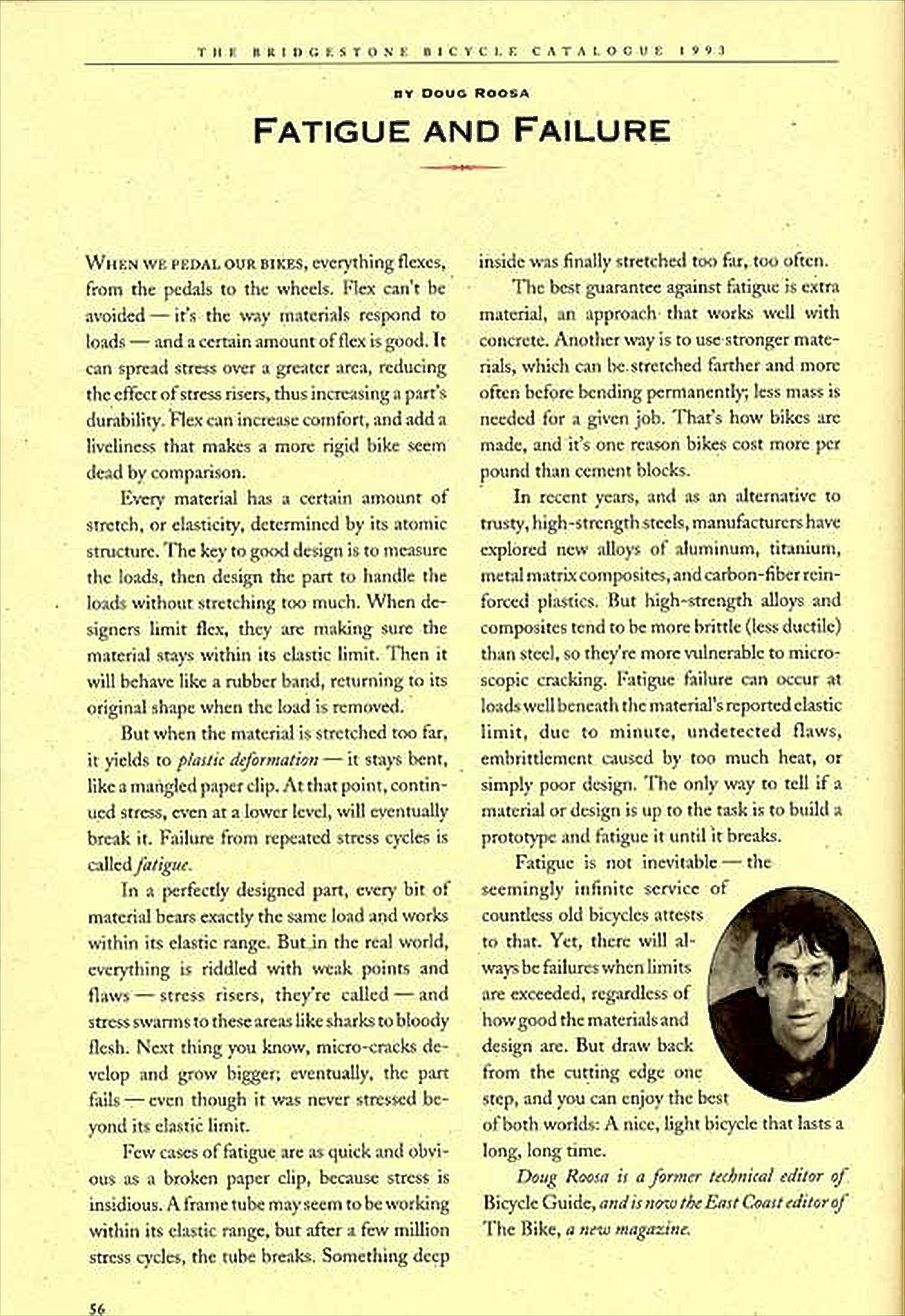 Page 57
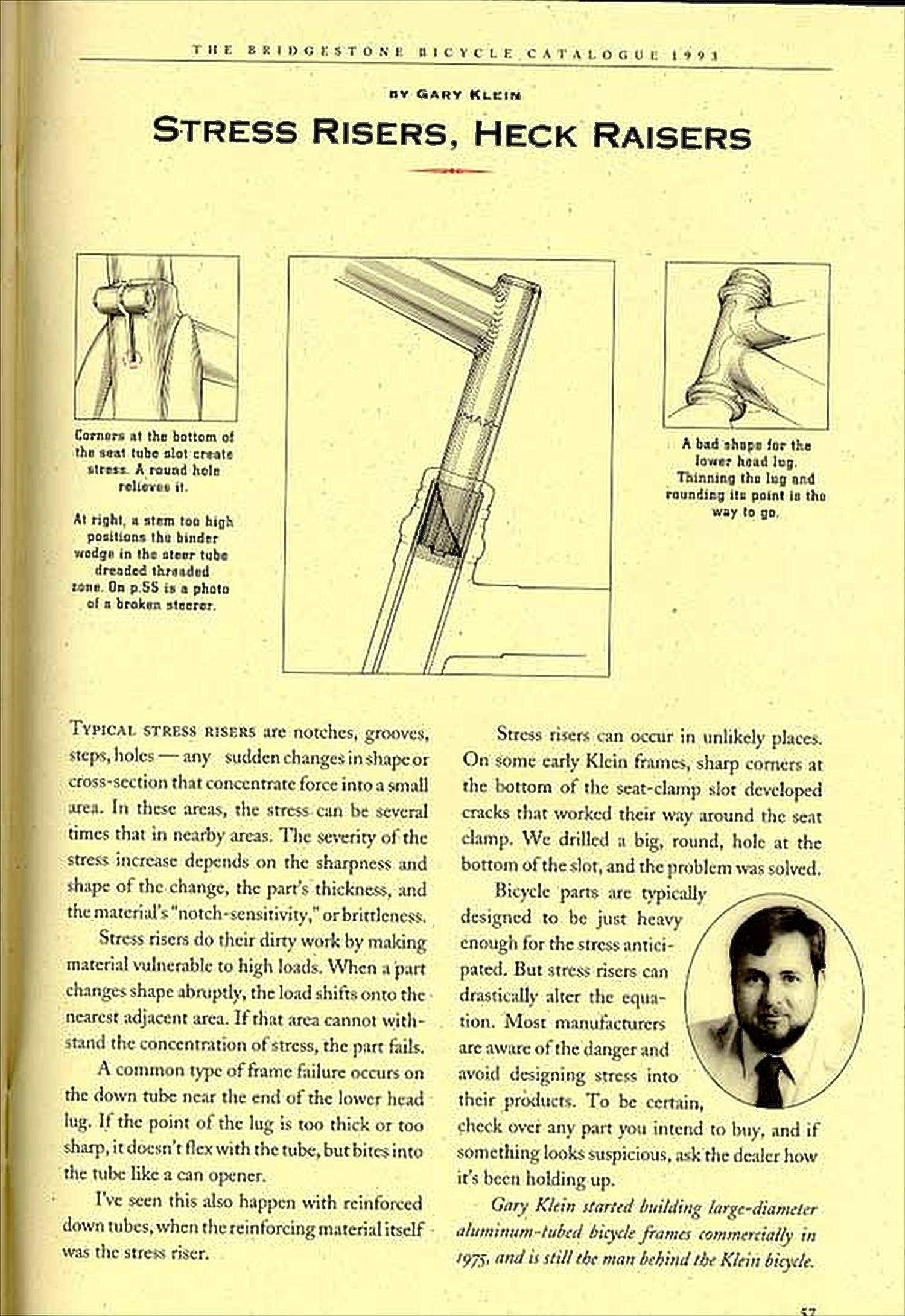 Page 58
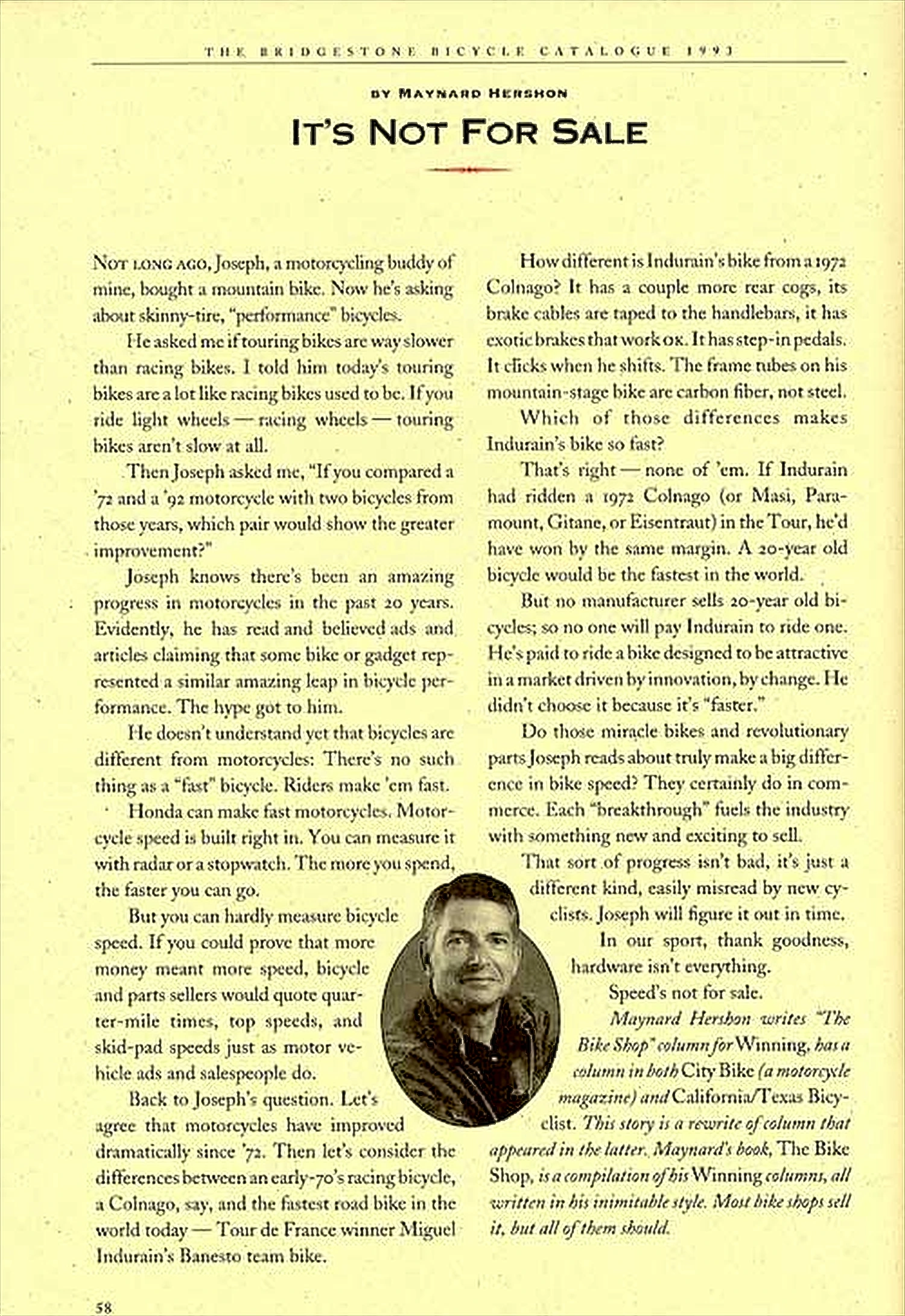 Page 59
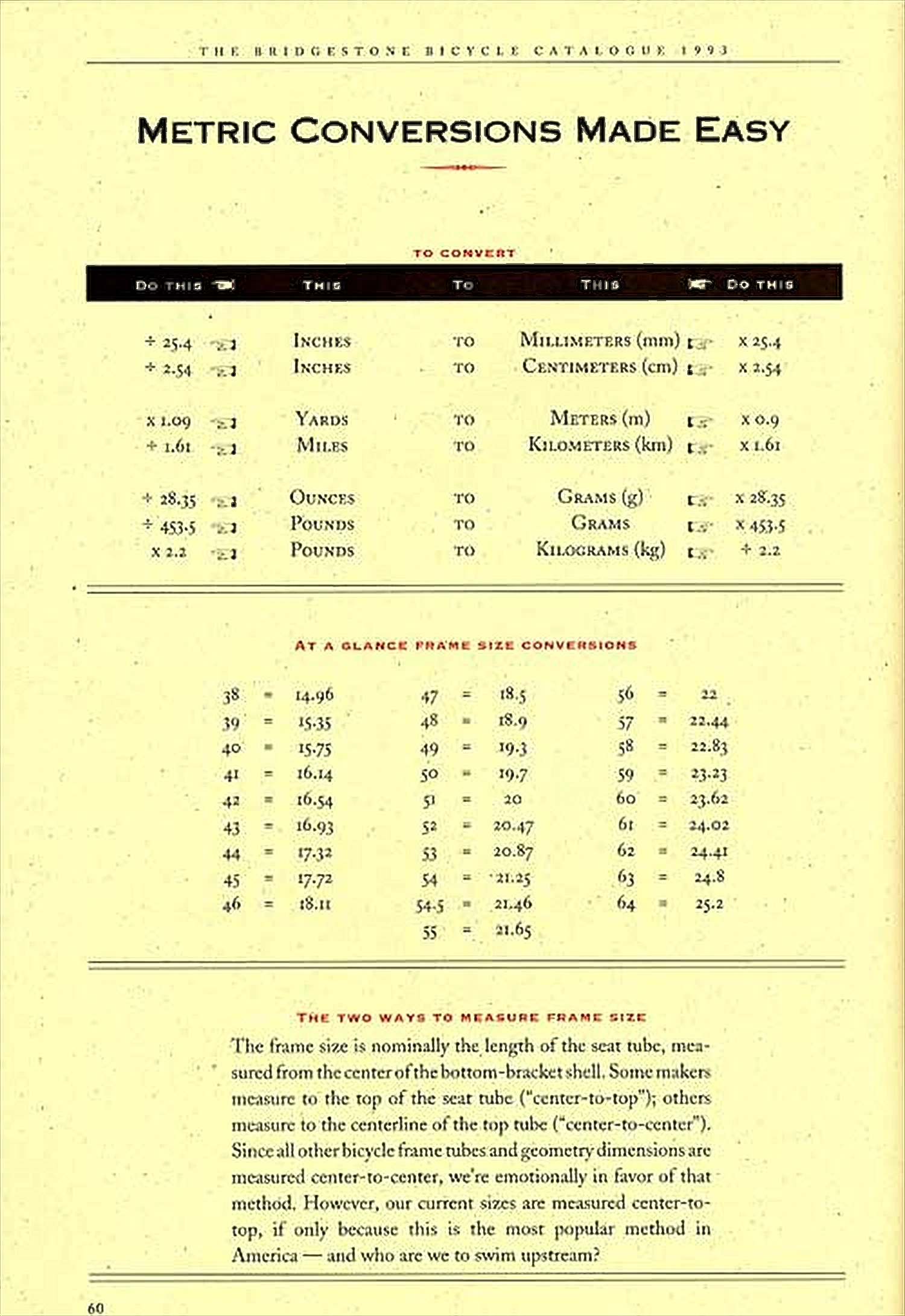
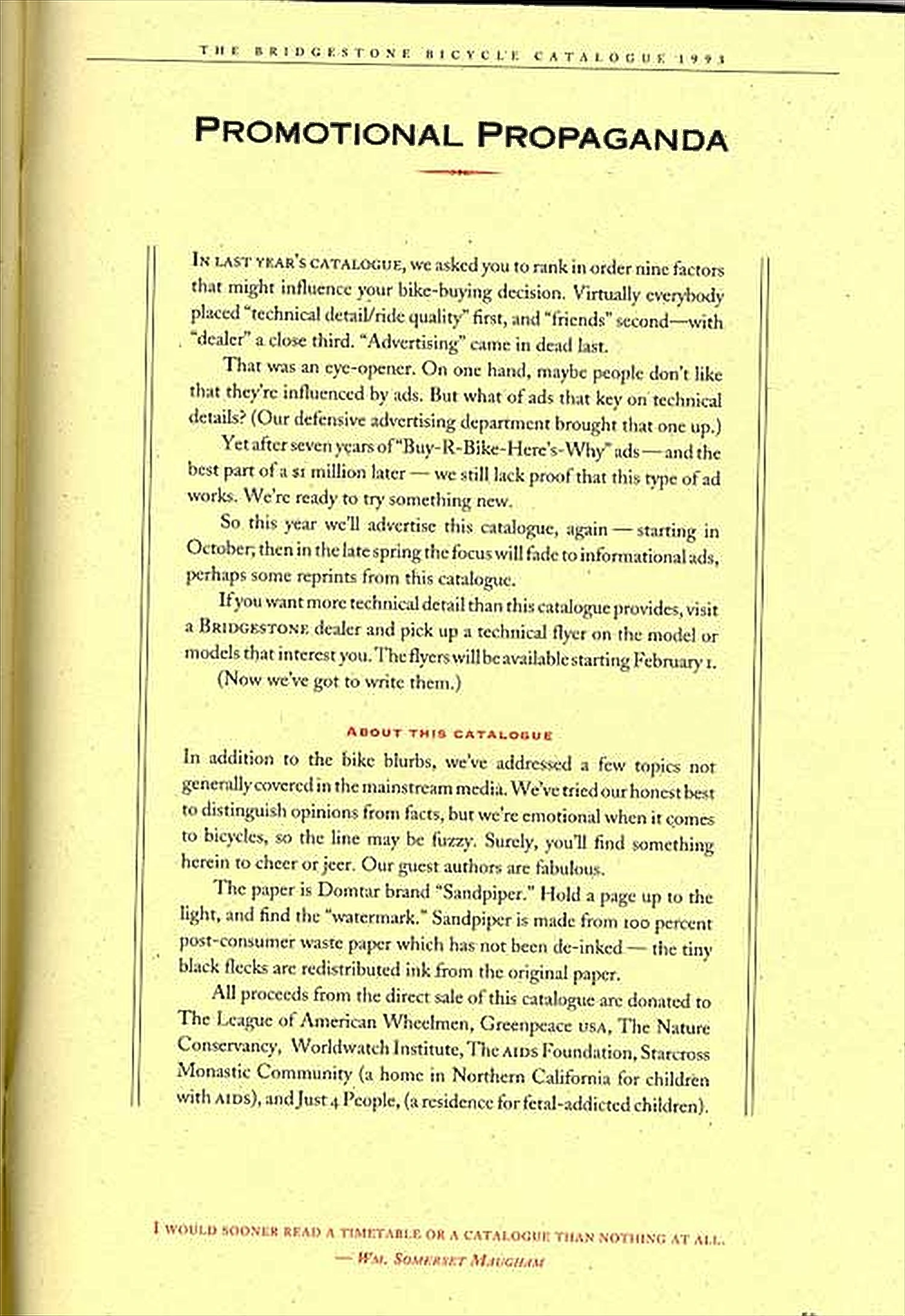 Page 60
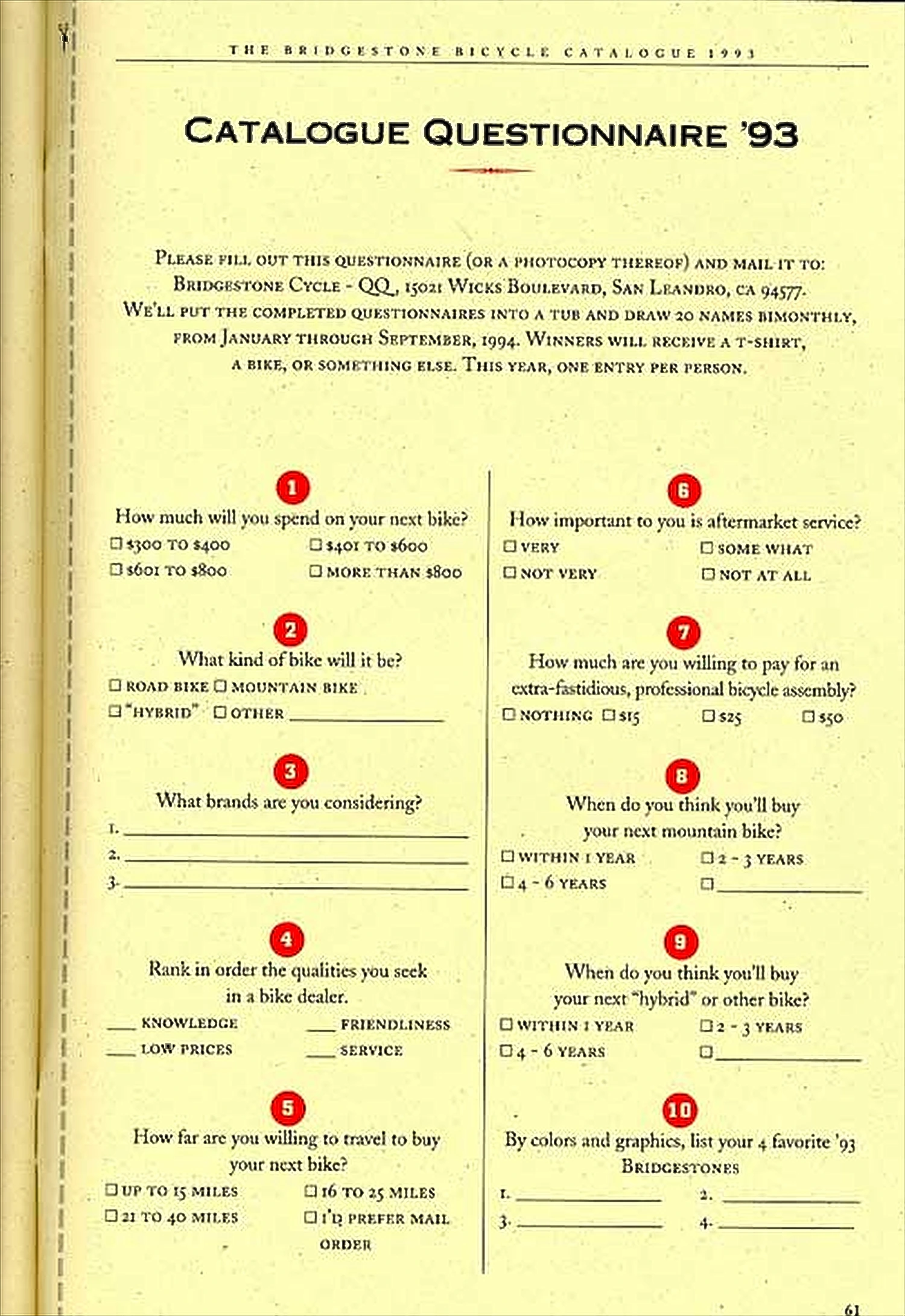
 Page 61
 Page 62
 Page 63
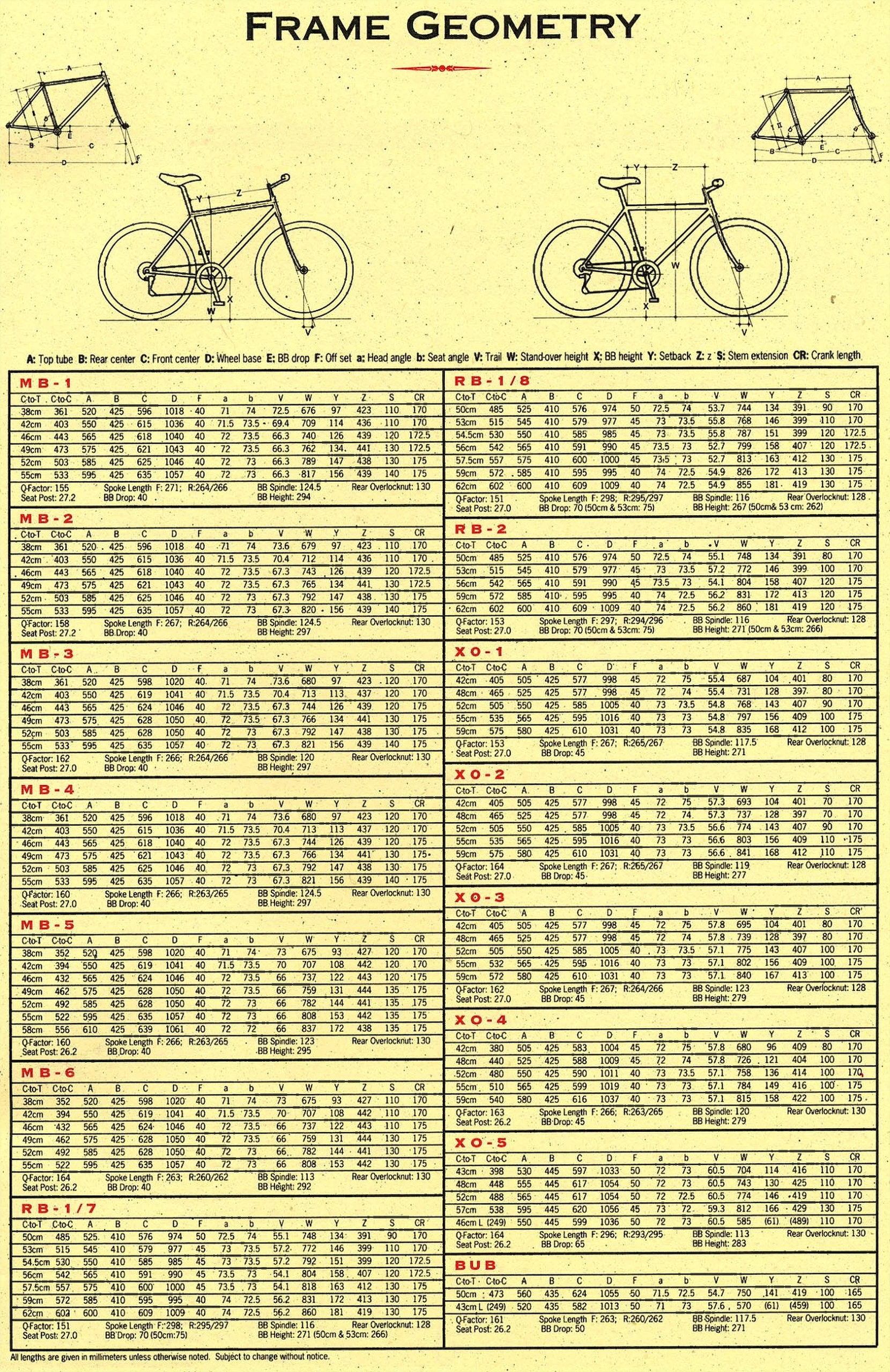 Page 64
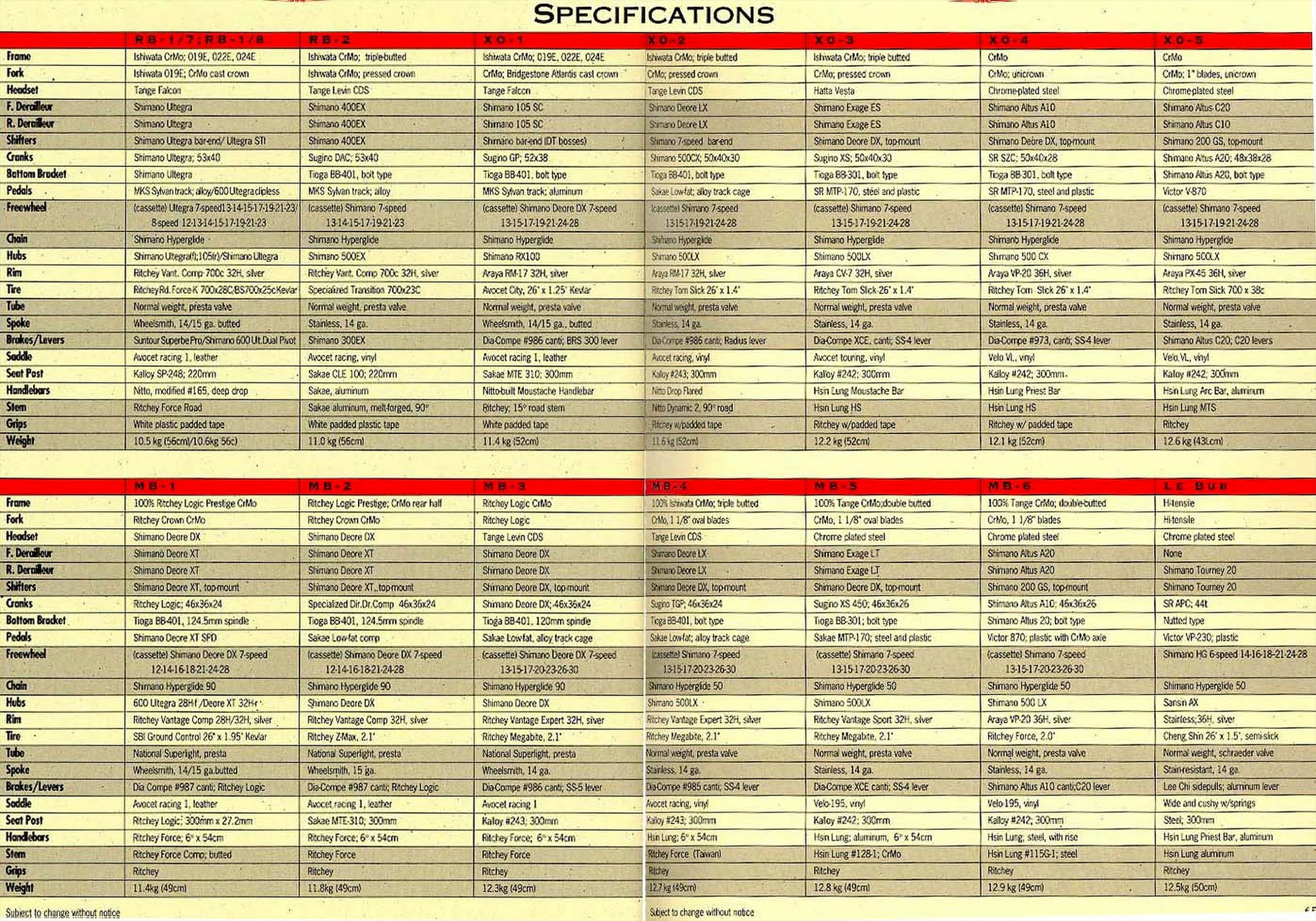 Page 65
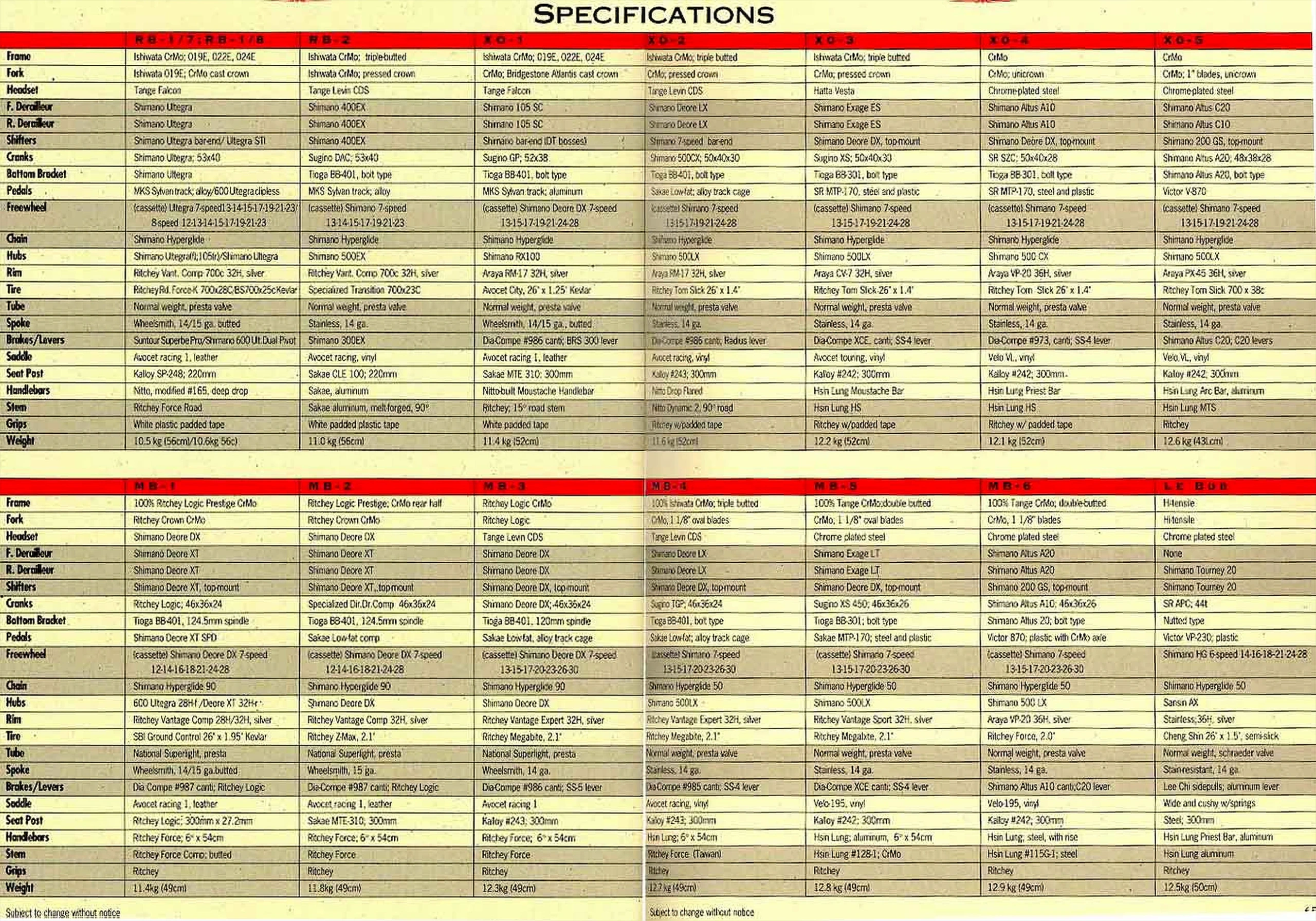 Page 66
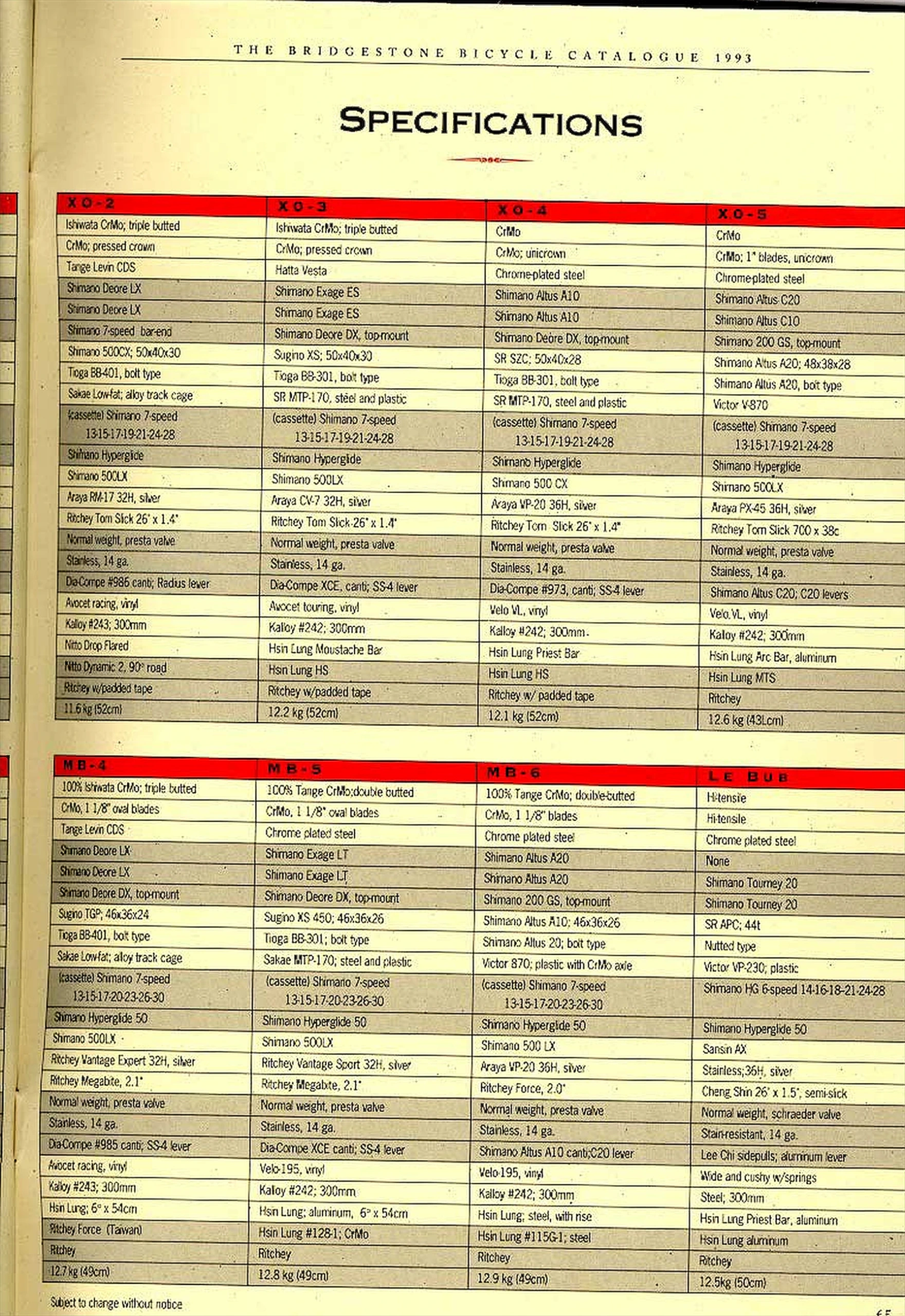 Page 67
 Page 68
| Marque | Bridgestone |
|---|---|
| Type | Catalog |
| Year | 1993 |
| Publisher | Bridgestone (United States) |
| Country | United States |
| Language | English |
| Pages | 68 |
| Source | sheldonbrown.com (Sheldon Brown's Bridgestone catalogue archive, Harris Cyclery, Newton, Massachusetts); illustrations by George Retseck per the host's page views; enlarged for Ebykr. |
| Credit | sheldonbrown.com |
| Identifier | Permalink https://www.sheldonbrown.com/bridgestone/1993/index.htm |
| Transcription | Transcribed by eye |
Reference
Bridgestone (United States). The Bridgestone Bicycle Catalogue 1993 (Bridgestone Cycle, United States). 1993. Ebykr, https://ebykr.com/library/bridgestone-bicycle-catalogue-1993-sheldonbrown/.
Wikipedia
{{cite book |title=The Bridgestone Bicycle Catalogue 1993 (Bridgestone Cycle, United States) |publisher=Bridgestone (United States) |date=1993 |url=https://ebykr.com/library/bridgestone-bicycle-catalogue-1993-sheldonbrown/ |via=Ebykr |access-date=}}BRIDGESTONE THE 1993 BRIDGESTONE BICYCLE CATALOGUE STALWART CYCLES FOR MODERN WAYFARERS THRILLING TO RIDE, PLEASING TO OWN MAKERS OF FINE BICYCLES RIDDEN THE WORLD ROUND THE 1993 BRIDGESTONE BICYCLE CATALOGUE CONTENTS Introduction ... 2 How To Pick a Bike ... 3 Getting the Right Size and Fit ... 4 How To Use a Quick Release …
THE BRIDGESTONE BICYCLE CATALOGUE 1993, the American catalogue of Bridgestone Cycle, from the Sheldon Brown archive. Transcribed from the page images (68 pages); each page ends with a bracketed description of its pictures.
— Page 1 —
BRIDGESTONE
THE 1993 BRIDGESTONE BICYCLE CATALOGUE
STALWART CYCLES FOR MODERN WAYFARERS
THRILLING TO RIDE, PLEASING TO OWN
MAKERS OF FINE BICYCLES RIDDEN THE WORLD ROUND
[The cover: an olive green cover with the Bridgestone logo at the upper left, the title “The 1993 Bridgestone Bicycle Catalogue” in a purple and gold panel, and a sepia photograph of a man in a tam and kilt and a woman in a cap and sweater vest with a loaded touring bicycle in a eucalyptus grove, with a world globe at the foot and purple side banners.]
— Page 2 —
THE 1993 BRIDGESTONE BICYCLE CATALOGUE
CONTENTS
Introduction … 2
How To Pick a Bike … 3
Getting the Right Size and Fit … 4
How To Use a Quick Release … 5
Who’s in Third? … 6
Handlebar Helper … 8
Fork Crowns and Art … 10
Seen in the Crowns … 12
The Human Element … 14
Yen Shock, High Tech, Cheap Labor, Modern Bicycles … 16
Daniel Rebour: Illustrator Man … 18
What’s Right With Wool … 22
The Finest Jerseys in the Wool … 23
Revenons a nos Moutons … 24
Modern Road Bikes, Classic Details … 25
RB-1/7 and RB-1/8 … 26
RB-2 … 28
“Hybrids,” Import Duty and Us … 29
XO-1 … 30
XO-2 … 32
XO-3 … 33
XO-4 … 34
XO-5 … 35
Bridgestoneage Mountain Bikes … 36
MB-1 … 37
MB-2 … 38
MB-3 … 39
MB-4 … 40
MB-5 … 41
MB-6 … 42
BUB … 43
Our Poster … 44
The Bicycle Poster … 45
Frame Geometry 101 … 46
Investment Casting … 48
Our New Mountain Bike Fork … 50
Bulge Forming Grows Up … 52
Where Frames Break & Why … 54
Fatigue and Failure … 56
Stress Risers, Heck Raisers … 57
It’s Not For Sale … 58
Promotional Propaganda … 59
Metric Conversion Charts … 60
Questionnaire … 61
Pop Quiz … 62
Frame Geometry Charts … 63
Detailed Specifications … 64
[The title page and contents: the logo panel “The 1993 Bridgestone Bicycle Catalogue” at the top over a row of six line drawings of bicycles (two road bikes, three mountain or hybrid bikes and a city bike) and the contents list in three columns at the foot.]
— Page 3 —
THE BRIDGESTONE BICYCLE CATALOGUE 1993
BRIDGESTONEAGE TECHNOLOGY
EARLY LAST JUNE SOMEBODY LOANED US A TAPE OF A RADIO INTERVIEW OF PAUL PILZNER — AUTHOR, BUSINESSMAN, INTERNATIONAL LECTURER, CONSULTANT TO PRESIDENTS, AND COLLEGE PROFESSOR. IN IT HE STATED THE BEST DEFINITION OF TECHNOLOGY WE’VE EVER HEARD. HE SAID IT’S “A BETTER WAY TO DO SOMETHING.”
Although every bicycle manufacturer thinks it has a better way, in the big picture, differences between brands are small. People don’t buy according to the big picture, though — they buy details.
So marketing tends to exaggerate the importance of the details. They become sacred cows — part of a manufacturer’s identity — and then must be defended, loud and clear. All bike makers have sacred cows. Ours include top-mount shifters with a friction option, steel frames, Q-factor, and Moustache handlebars.
Most of these details are rooted in the past; so one cycling writer branded us “retrogrouches,” of all things. But we like bike parts of all vintages, so long as they help us make versatile, elegant, and long lasting bikes that won’t be obsoleted in the next parts-go-’round.
We call our approach BRIDGESTONEAGE TECHNOLOGY, and in the big picture, it’s just another way. Take a good look at our bikes. Ride them, if you get a chance. We hope you think it’s a better way.
2
[A page with a bold heading, an introductory paragraph in capitals, and a long text column ruled on both sides, over a block of about twenty-six handwritten signatures of the staff. A red two-line quotation of song lines credited to Bob Dylan, “Tangled Up in Blue”, stands at the foot and is not transcribed.]
— Page 4 —
THE BRIDGESTONE BICYCLE CATALOGUE 1993
HOW TO PICK A BIKE
FOR ATHLETIC ROAD RIDING choose either a road bike or a lightweight hybrid with smooth tires and a multiposition handlebar. With 700c x 28 or 32 tires and good rider judgment, this bike will handle any paved road and smoother fire trails. Our best bikes for this kind of riding are the RB-1 and RB-2 and the XO-1 and XO-2.
FOR RECREATIONAL ROAD RIDING and trail riding, commuting, or touring with baggage, get a bike with fatter tires than a road bike’s. Anybody’s “hybrid” or touring bike will do, and multiposition handlebars and road-tread tires (for street riding) are a plus. Any of our XO bikes are ideal for this type of riding. For higher speeds and longer distances, we suggest the XO-1, XO-2, or XO-3.
FOR TRAIL RIDING, short commutes, and expedition-style touring, mountain bikes are perfect. If you’re athletic and inclined towards racing, get a lighter and more expensive mountain bike right off the bat — and expect to spend more money customizing it. The fat, soft tires of a mountain bike sufficiently absorb most shocks, but some riders find they need even more cush, which bolt-on suspension can provide.
“DOES IT MATTER WHERE I BUY IT?”
Yes. Bikes arrive at dealerships 80 to 90 percent assembled, but the assembly is done quickly, often with power tools. These bikes can be made rideable in 15 minutes, but it takes a good mechanic two to three hours to prepare them for outdoor life. The extra $20 to $50 a dealer charges for top-notch assembly is a bargain. Those dealers who spend the extra time lubricating, adjusting, and perfecting your bike rarely blow them out the door — so beware of “bargain” prices.
A WORD ABOUT PRICES
Twenty-two years ago the best bike in the world cost $600, and a good “starter” ran about $100. These days, if you want a 14- to 21-speed bike for regular, athletic or recreational riding — a bike that’s a pleasure to ride for a couple hours at a time — expect to spend $400 or more. Then buy an ANSI- or SNELL-approved helmet. The cheap ones are fine.
3
[A page headed “How to Pick a Bike” with three paragraphs, each beside a line drawing: a road bicycle, a hybrid bicycle and a mountain bicycle, then a second heading in quotation marks and a short red-headed note on prices.]
— Page 5 —
THE BRIDGESTONE BICYCLE CATALOGUE 1993
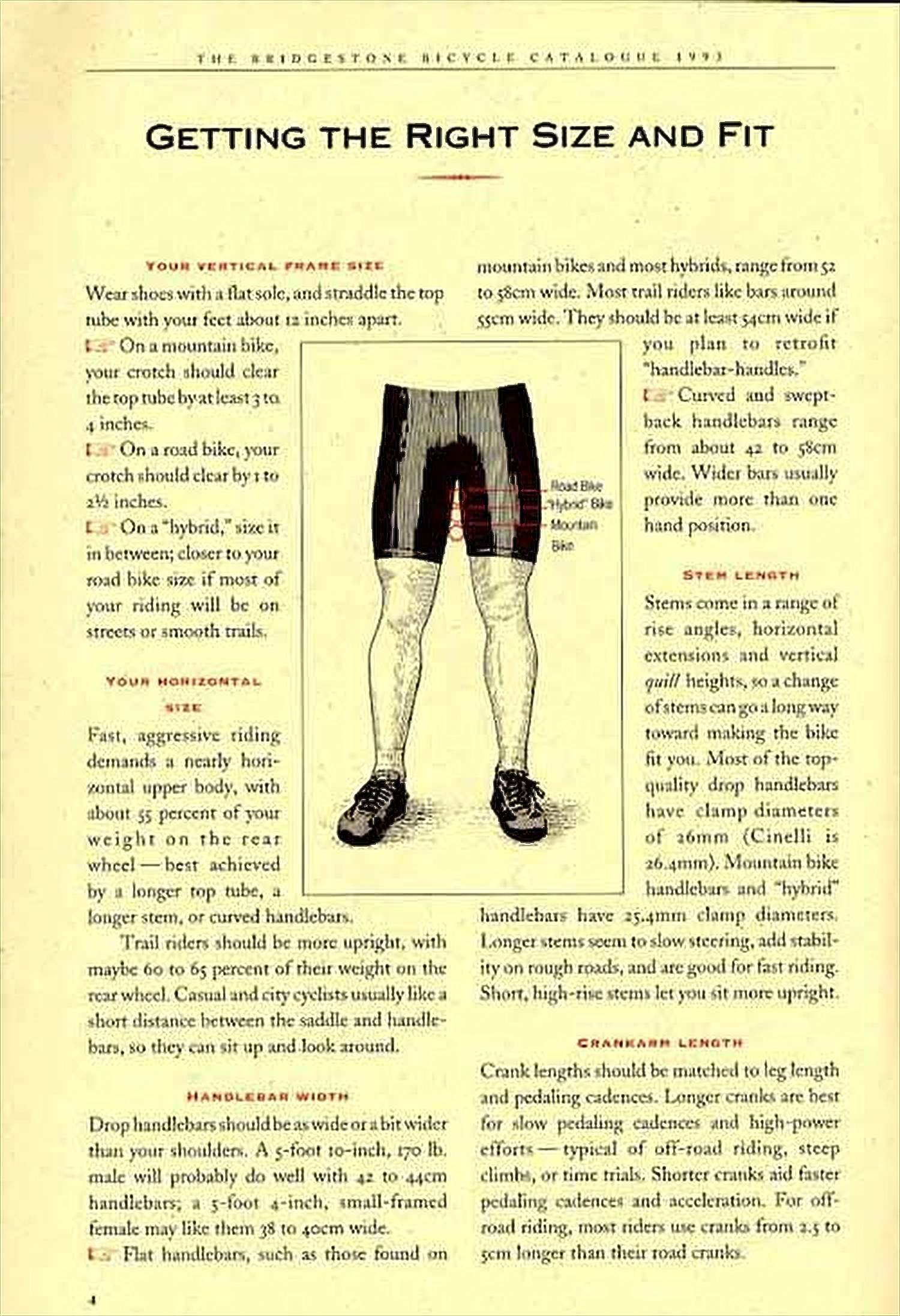
Getting the Right Size and Fit
YOUR VERTICAL FRAME SIZE
Wear shoes with a flat sole, and straddle the top tube with your feet about 12 inches apart.
• On a mountain bike, your crotch should clear the top tube by at least 3 to 4 inches.
• On a road bike, your crotch should clear by 1 to 2½ inches.
• On a “hybrid,” size it in between; closer to your road bike size if most of your riding will be on streets or smooth trails.
YOUR HORIZONTAL SIZE
Fast, aggressive riding demands a nearly horizontal upper body, with about 55 percent of your weight on the rear wheel — best achieved by a longer top tube, a longer stem, or curved handlebars.
Trail riders should be more upright, with maybe 60 to 65 percent of their weight on the rear wheel. Casual and city cyclists usually like a short distance between the saddle and handlebars, so they can sit up and look around.
HANDLEBAR WIDTH
Drop handlebars should be as wide or a bit wider than your shoulders. A 5-foot 10-inch, 170 lb. male will probably do well with 42 to 44cm handlebars; a 5-foot 4-inch, small-framed female may like them 38 to 40cm wide.
• Flat handlebars, such as those found on mountain bikes and most hybrids, range from 52 to 58cm wide. Most trail riders like bars around 55cm wide. They should be at least 54cm wide if you plan to retrofit “handlebar-handles.”
• Curved and swept-back handlebars range from about 42 to 58cm wide. Wider bars usually provide more than one hand position.
STEM LENGTH
Stems come in a range of rise angles, horizontal extensions and vertical quill heights, so a change of stems can go a long way toward making the bike fit you. Most of the top-quality drop handlebars have clamp diameters of 26mm (Cinelli is 26.4mm). Mountain bike handlebars and “hybrid” handlebars have 25.4mm clamp diameters. Longer stems seem to slow steering, add stability on rough roads, and are good for fast riding. Short, high-rise stems let you sit more upright.
CRANKARM LENGTH
Crank lengths should be matched to leg length and pedaling cadences. Longer cranks are best for slow pedaling cadences and high-power efforts — typical of off-road riding, steep climbs, or time trials. Shorter cranks aid faster pedaling cadences and acceleration. For off-road riding, most riders use cranks from 2.5 to 5cm longer than their road cranks.
4
[A page of advice in two columns around a boxed drawing of a rider’s shorts and bare legs and shoes, with three red lines at the crotch marked “Road Bike”, “Hybrid Bike” and “Mountain Bike” to show the clearance over the top tube for each type.]
— Page 6 —
THE BRIDGESTONE BICYCLE CATALOGUE 1993
How to Use a Quick Release
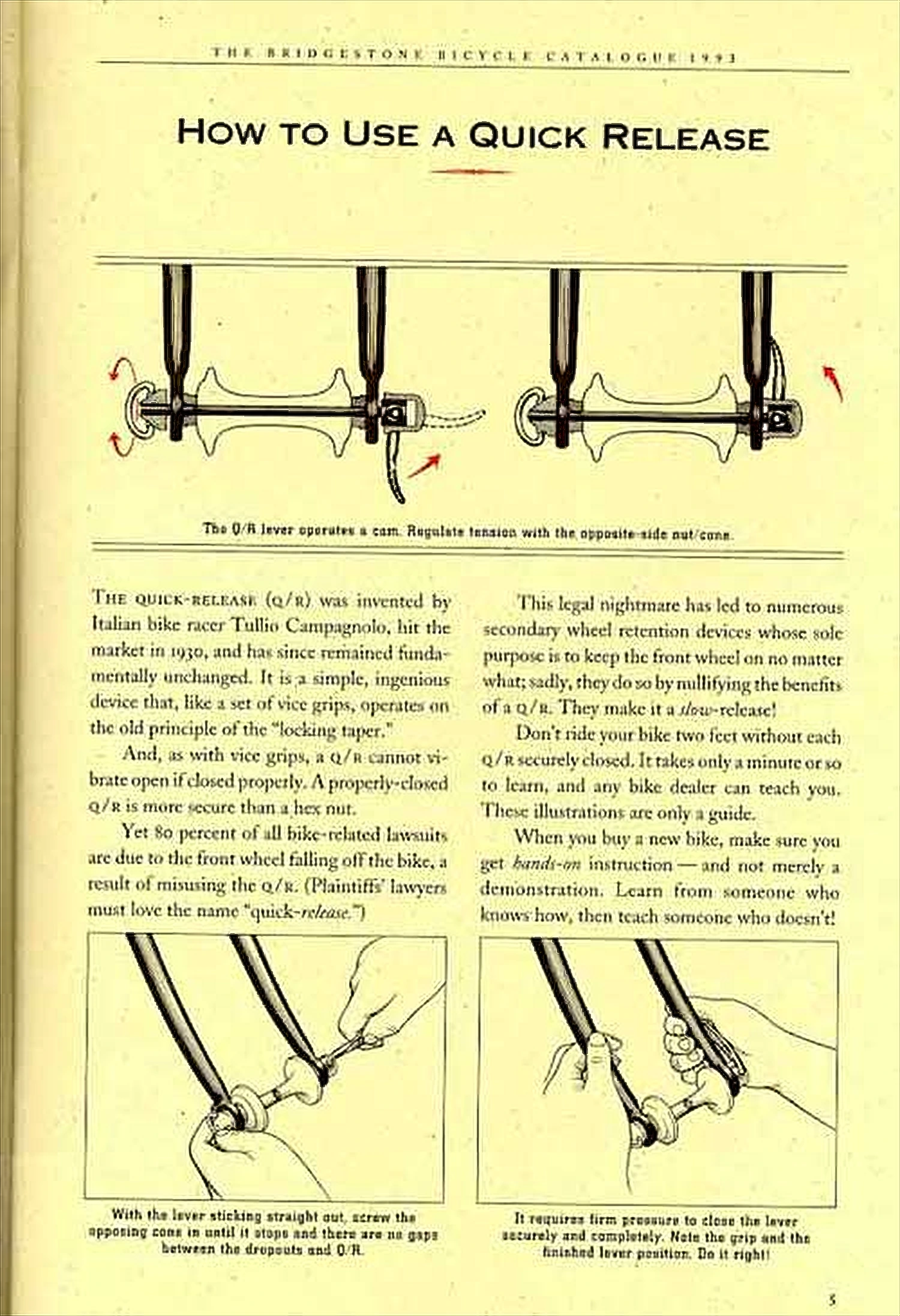
The Q/R lever operates a cam. Regulate tension with the opposite-side nut/cone.
The QUICK-RELEASE (Q/R) was invented by Italian bike racer Tullio Campagnolo, hit the market in 1930, and has since remained fundamentally unchanged. It is a simple, ingenious device that, like a set of vice grips, operates on the old principle of the “locking taper.”
And, as with vice grips, a Q/R cannot vibrate open if closed properly. A properly-closed Q/R is more secure than a hex nut.
Yet 80 percent of all bike-related lawsuits are due to the front wheel falling off the bike, a result of misusing the Q/R. (Plaintiffs’ lawyers must love the name “quick-release.”)
This legal nightmare has led to numerous secondary wheel retention devices whose sole purpose is to keep the front wheel on no matter what; sadly, they do so by nullifying the benefits of a Q/R. They make it a slow-release!
Don’t ride your bike two feet without each Q/R securely closed. It takes only a minute or so to learn, and any bike dealer can teach you. These illustrations are only a guide.
When you buy a new bike, make sure you get hands-on instruction — and not merely a demonstration. Learn from someone who knows how, then teach someone who doesn’t!
With the lever sticking straight out, screw the opposing cone in until it stops and there are no gaps between the dropouts and Q/R.
It requires firm pressure to close the lever securely and completely. Note the grip and the finished lever position. Do it right!
5
[A page headed “How to Use a Quick Release” with a wide diagram of a front hub between two fork tips shown open and closed, with red arrows on the lever, and below it two columns of text and two drawings of hands closing the lever on a fork tip, each with a caption.]
— Page 7 —
THE BRIDGESTONE BICYCLE CATALOGUE 1993
Who’s in Third?
A GEARING PRIMER
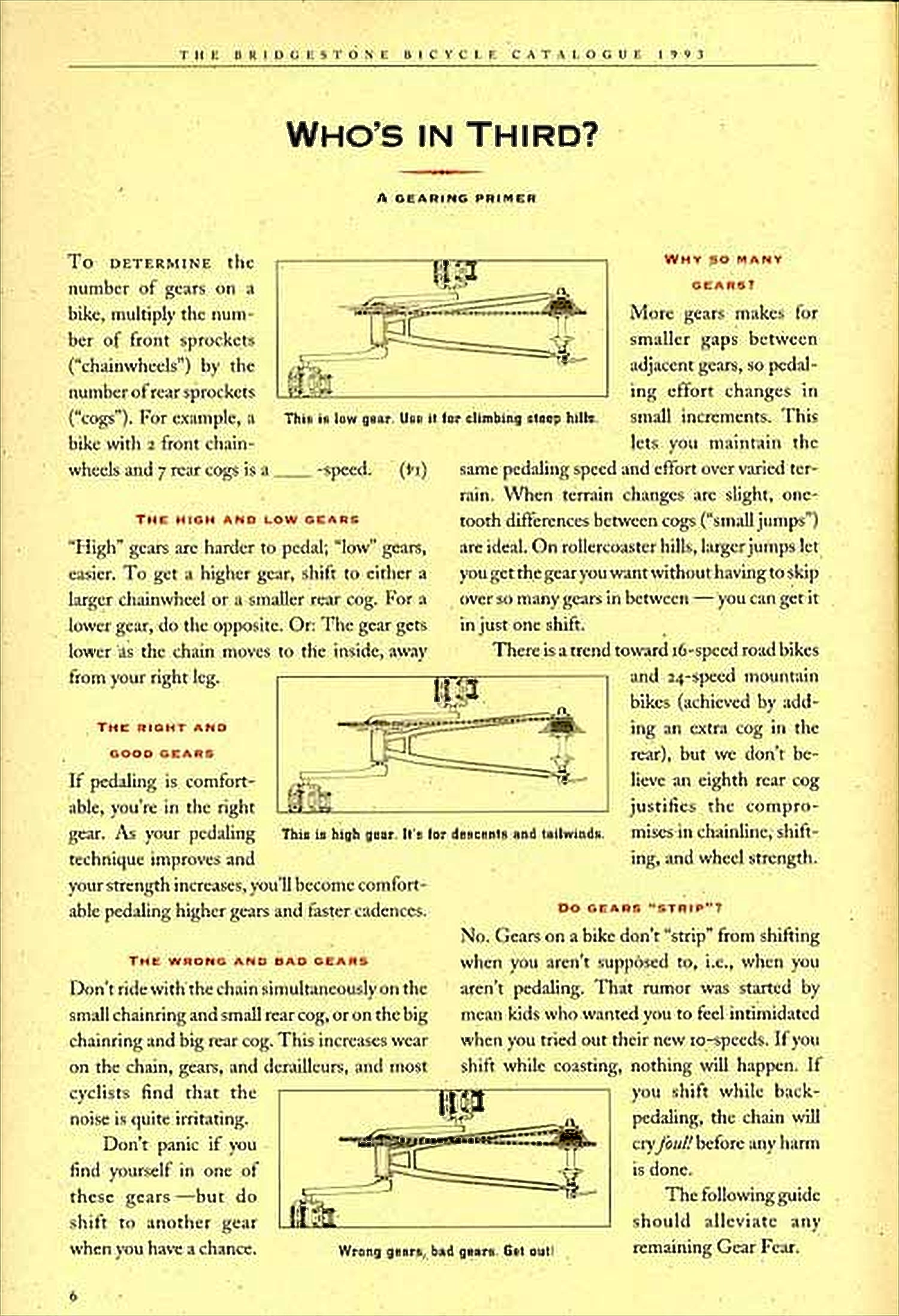
TO DETERMINE the number of gears on a bike, multiply the number of front sprockets (“chainwheels”) by the number of rear sprockets (“cogs”). For example, a bike with 2 front chainwheels and 7 rear cogs is a ____-speed. (The answer is printed upside down beside the blank.)
This is low gear. Use it for climbing steep hills.
WHY SO MANY GEARS?
More gears makes for smaller gaps between adjacent gears, so pedaling effort changes in small increments. This lets you maintain the same pedaling speed and effort over varied terrain. When terrain changes are slight, one-tooth differences between cogs (“small jumps”) are ideal. On rollercoaster hills, larger jumps let you get the gear you want without having to skip over so many gears in between — you can get it in just one shift.
There is a trend toward 16-speed road bikes and 24-speed mountain bikes (achieved by adding an extra cog in the rear), but we don’t believe an eighth rear cog justifies the compromises in chainline, shifting, and wheel strength.
THE HIGH AND LOW GEARS
“High” gears are harder to pedal; “low” gears, easier. To get a higher gear, shift to either a larger chainwheel or a smaller rear cog. For a lower gear, do the opposite. Or: The gear gets lower as the chain moves to the inside, away from your right leg.
This is high gear. It’s for descents and tailwinds.
THE RIGHT AND GOOD GEARS
If pedaling is comfortable, you’re in the right gear. As your pedaling technique improves and your strength increases, you’ll become comfortable pedaling higher gears and faster cadences.
DO GEARS “STRIP”?
No. Gears on a bike don’t “strip” from shifting when you aren’t supposed to, i.e., when you aren’t pedaling. That rumor was started by mean kids who wanted you to feel intimidated when you tried out their new 10-speeds. If you shift while coasting, nothing will happen. If you shift while back-pedaling, the chain will cry foul! before any harm is done.
THE WRONG AND BAD GEARS
Don’t ride with the chain simultaneously on the small chainring and small rear cog, or on the big chainring and big rear cog. This increases wear on the chain, gears, and derailleurs, and most cyclists find that the noise is quite irritating.
Don’t panic if you find yourself in one of these gears — but do shift to another gear when you have a chance.
Wrong gears, bad gears. Get out!
The following guide should alleviate any remaining Gear Fear.
6
[A page headed “Who’s in Third?” with the subhead “A Gearing Primer”, in two columns with red subheads around three small line drawings of a derailleur drivetrain seen from above, showing the chain in low gear, in high gear and in the wrong gears, each with a bold caption.]
— Page 8 —
THE BRIDGESTONE BICYCLE CATALOGUE 1993
Learning to Shift
LEARNING TO SHIFT
Practice on a vacant schoolyard blacktop. If your shift levers have a “friction” mode, use it. Then pedal away and shift every three seconds. Try to make the chain rub between gears, and don’t worry about the noise.
Just “trim” the lever, aligning the chain and the cog, until the noise stops, or the chain clunks cleanly onto an adjacent higher or lower gear.
This exercise will teach you the relationship between shifter movement and derailleur movement — something that can’t be learned as easily with indexing. (Only because index shifting does not allow you to “trim.”)
Practice shifting in a nonpunitive environment — don’t wait for a club ride with mean strangers, and don’t let a critical spouse coach you.
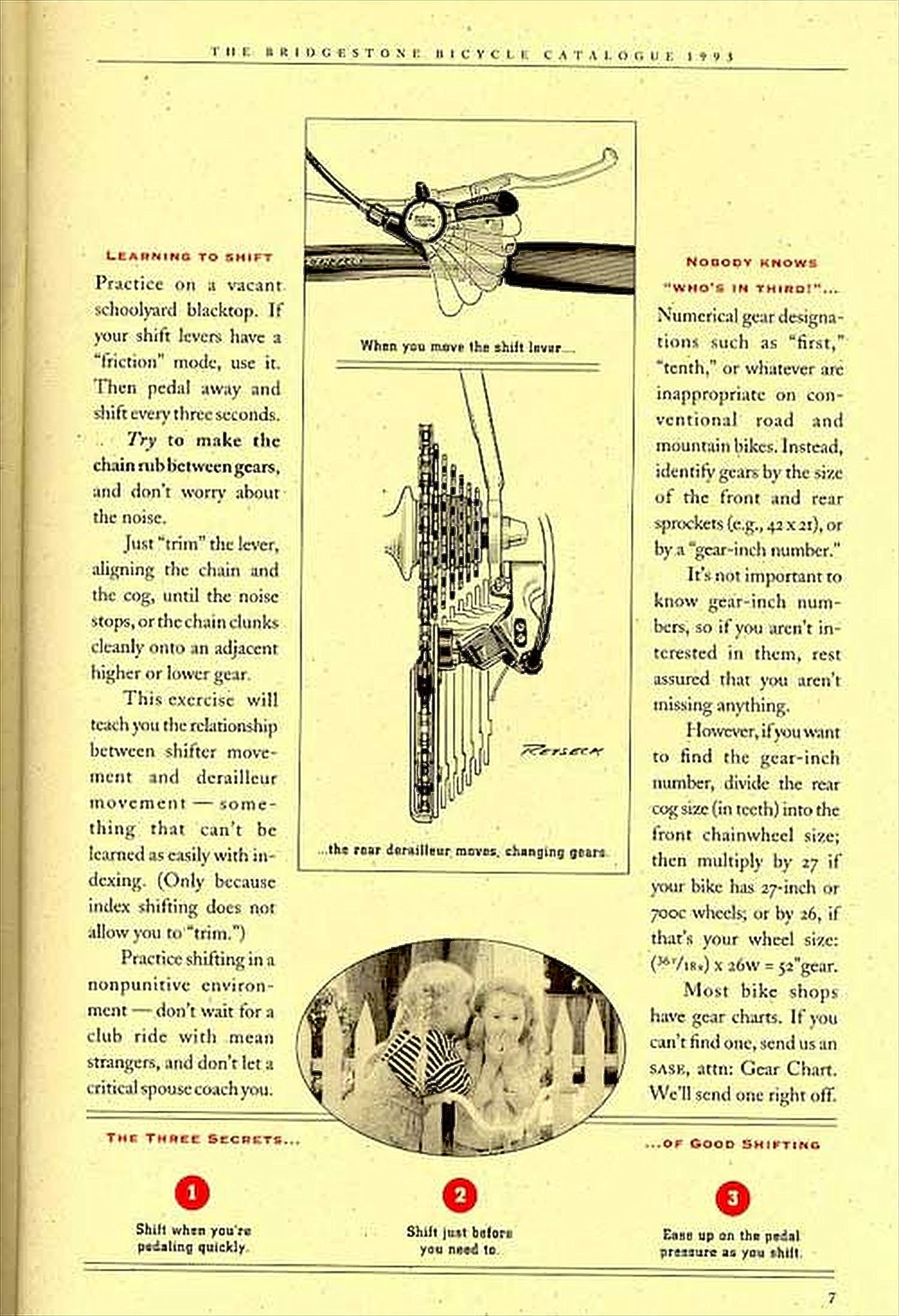
When you move the shift lever…
…the rear derailleur moves, changing gears.
NOBODY KNOWS “WHO’S IN THIRD!”…
Numerical gear designations such as “first,” “tenth,” or whatever are inappropriate on conventional road and mountain bikes. Instead, identify gears by the size of the front and rear sprockets (e.g., 42 x 21), or by a “gear-inch number.”
It’s not important to know gear-inch numbers, so if you aren’t interested in them, rest assured that you aren’t missing anything.
However, if you want to find the gear-inch number, divide the rear cog size (in teeth) into the front chainwheel size; then multiply by 27 if your bike has 27-inch or 700c wheels; or by 26, if that’s your wheel size: (36/18) x 26″ = 52″ gear.
Most bike shops have gear charts. If you can’t find one, send us an SASE, attn: Gear Chart. We’ll send one right off.
THE THREE SECRETS…
…OF GOOD SHIFTING
1. Shift when you’re pedaling quickly.
2. Shift just before you need to.
3. Ease up on the pedal pressure as you shift.
7
[The second page of the gearing primer, in two columns with red subheads around a boxed drawing of a shift lever on a handlebar above a rear derailleur and cogs (signed by the illustrator, Retseck), an oval black and white photograph of two little girls whispering to each other, and a row of three red numbered discs for “the three secrets of good shifting”.]
— Page 9 —
THE BRIDGESTONE BICYCLE CATALOGUE 1993
Handlebar Helper
MANY WONDERFUL HANDLEBARS FROM THE PAST HAVE BECOME SCARCE BECAUSE HANDLEBAR MAKERS DON’T MAKE THEM ANYMORE BECAUSE BIKE MANUFACTURERS DON’T ASK FOR THEM BECAUSE DEALERS DON’T ASK FOR THEM BECAUSE CUSTOMERS DON’T ASK FOR THEM BECAUSE — IN THE U.S., AT LEAST — THEY’RE OUT OF SIGHT AND MIND.
YET HANDLEBARS MAKE A BIG DIFFERENCE IN HOW YOUR BIKE FITS AND RIDES.
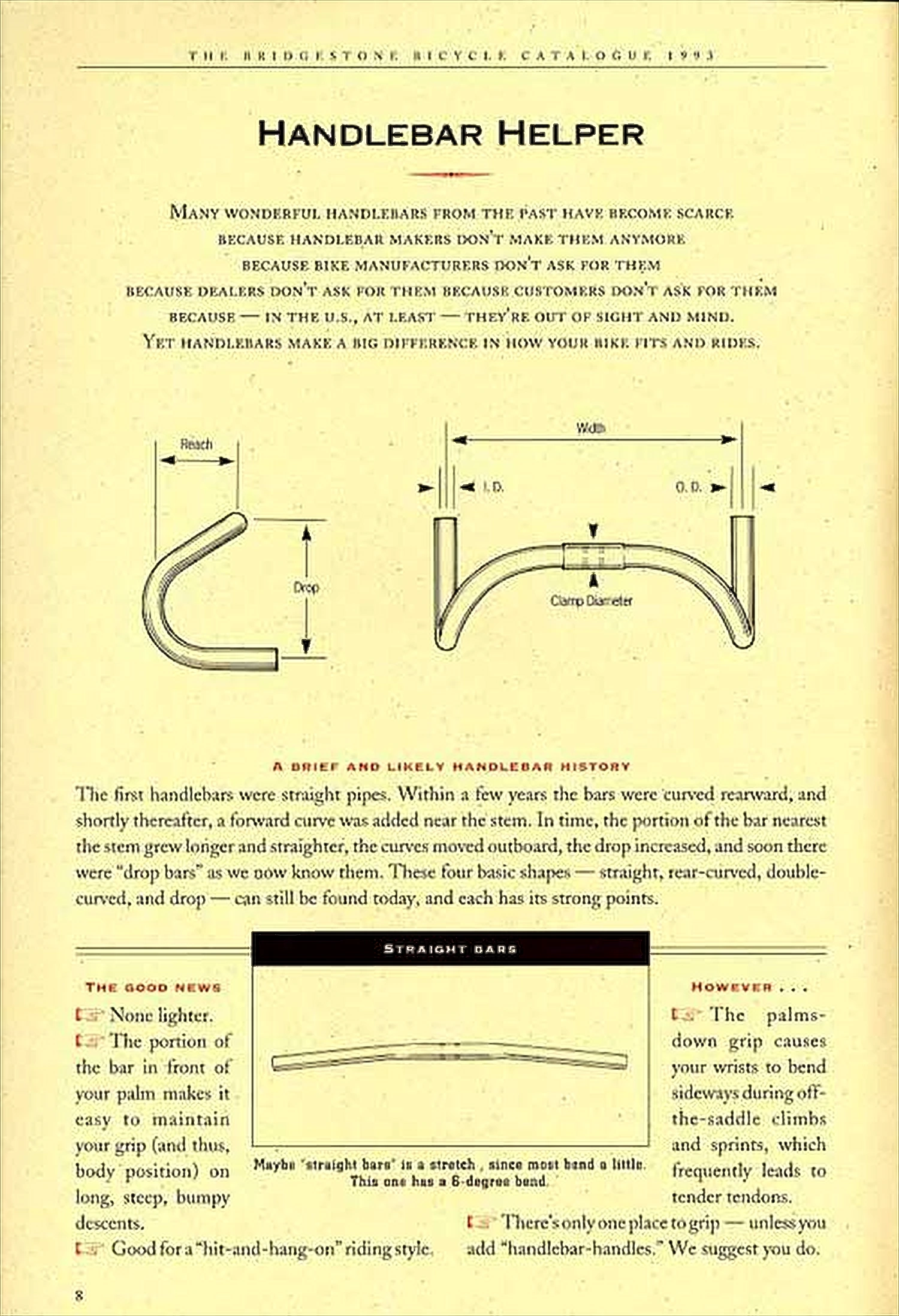
Reach; Drop; Width; I.D.; O.D.; Clamp Diameter (labels on the two diagrams).
A BRIEF AND LIKELY HANDLEBAR HISTORY
The first handlebars were straight pipes. Within a few years the bars were curved rearward, and shortly thereafter, a forward curve was added near the stem. In time, the portion of the bar nearest the stem grew longer and straighter, the curves moved outward, the drop increased, and soon there were “drop bars” as we now know them. These four basic shapes — straight, rear-curved, double-curved, and drop — can still be found today, and each has its strong points.
STRAIGHT BARS
THE GOOD NEWS
• None lighter.
• The portion of the bar in front of your palm makes it easy to maintain your grip (and thus, body position) on long, steep, bumpy descents.
• Good for a “hit-and-hang-on” riding style.
HOWEVER…
• The palms-down grip causes your wrists to bend sideways during off-saddle climbs and sprints, which frequently leads to tender tendons.
• There’s only one place to grip — unless you add “handlebar-handles.” We suggest you do.
Maybe ‘straight bars’ is a stretch, since most bend a little. This one has a 6-degree bend.
8
[A page headed “Handlebar Helper” with a centered five-line introduction in small capitals, two line drawings of a drop handlebar (a side view and a front view) marked with reach, drop, width, inside and outside diameter and clamp diameter, then a history paragraph and a black-headed box on straight bars with a drawing of one, between “the good news” and “however” columns.]
— Page 10 —
THE BRIDGESTONE BICYCLE CATALOGUE 1993
Handlebar Helper, continued
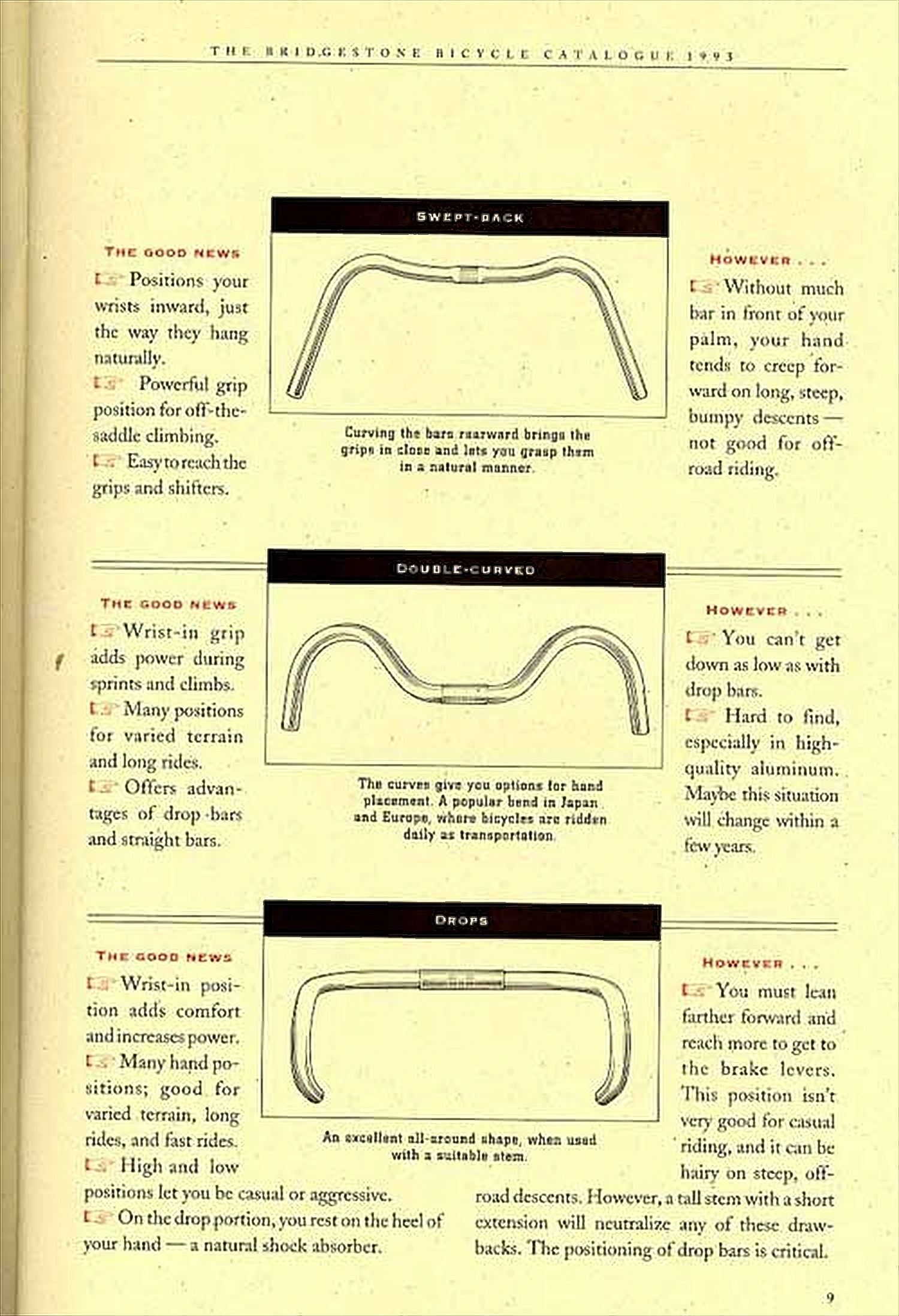
SWEPT-BACK
THE GOOD NEWS
• Positions your wrists inward, just the way they hang naturally.
• Powerful grip position for off-the-saddle climbing.
• Easy to reach the grips and shifters.
HOWEVER…
• Without much bar in front of your palm, your hand tends to creep forward on long, steep, bumpy descents — not good for off-road riding.
Curving the bars rearward brings the grips in close and lets you grasp them in a natural manner.
DOUBLE-CURVED
THE GOOD NEWS
• Wrist-in grip adds power during sprints and climbs.
• Many positions for varied terrain and long rides.
• Offers advantages of drop bars and straight bars.
HOWEVER…
• You can’t get down as low as with drop bars.
• Hard to find, especially in high-quality aluminum. Maybe this situation will change within a few years.
The curves give you options for hand placement. A popular bend in Japan and Europe, where bicycles are ridden daily as transportation.
DROPS
THE GOOD NEWS
• Wrist-in position adds comfort and increases power.
• Many hand positions; good for varied terrain, long rides, and fast rides.
• High and low positions let you be casual or aggressive.
• On the drop portion, you rest on the heel of your hand — a natural shock absorber.
HOWEVER…
• You must lean farther forward and reach more to get to the brake levers. This position isn’t very good for casual riding, and it can be hairy on steep, off-road descents. However, a tall stem with a short extension will neutralize any of these drawbacks. The positioning of drop bars is critical.
An excellent all-around shape, when used with a suitable stem.
9
[The second page of the handlebar guide: three black-headed boxes, each with a line drawing of a handlebar seen from the front (swept-back, double-curved and drop) and a bold caption, with a “good news” list at the left and a “however” list at the right of each.]
— Page 11 —
THE BRIDGESTONE BICYCLE CATALOGUE 1993
BY RICHARD SACHS
Fork Crowns and Art
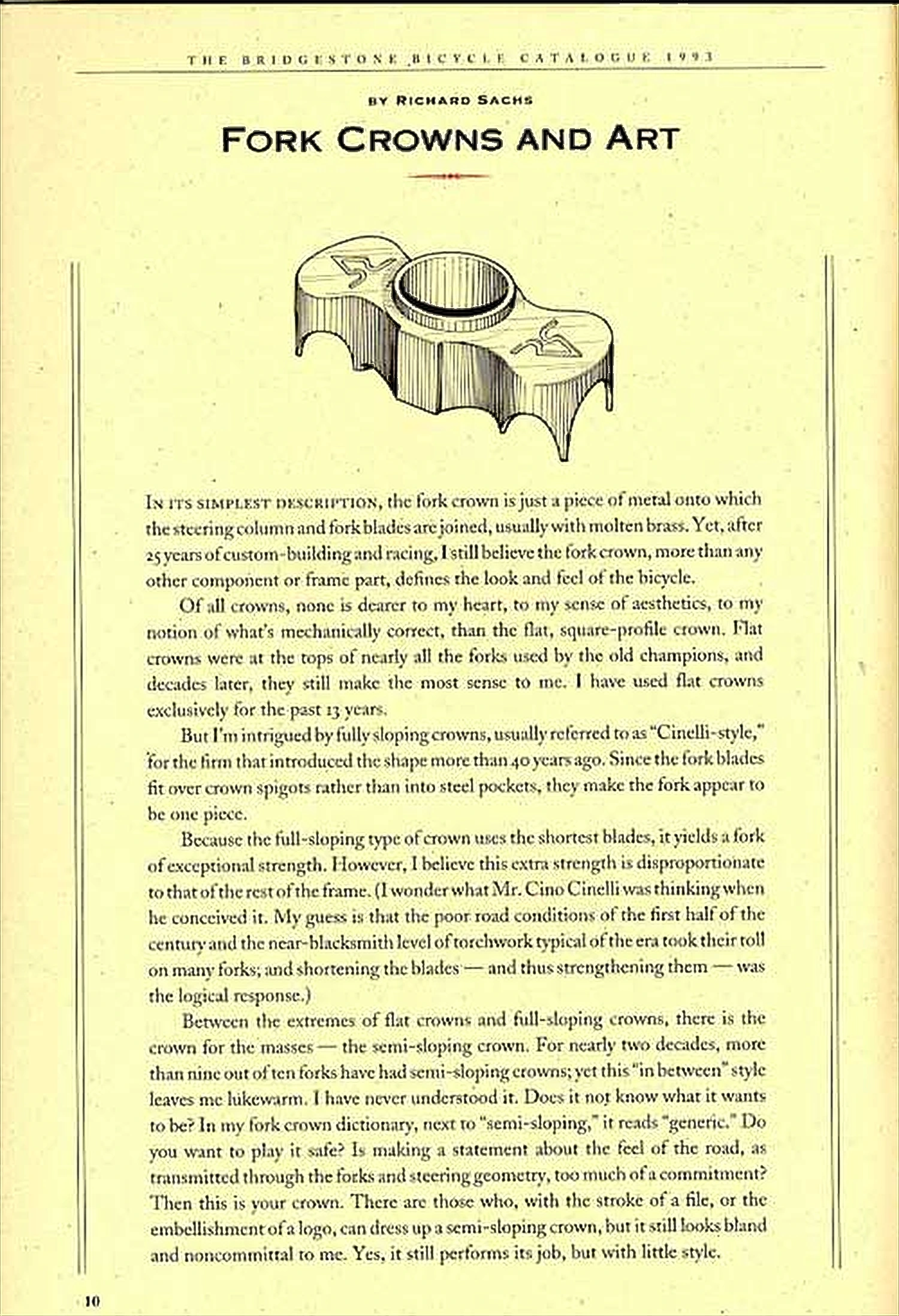
IN ITS SIMPLEST DESCRIPTION, the fork crown is just a piece of metal onto which the steering column and fork blades are joined, usually with molten brass. Yet, after 25 years of custom-building and racing, I still believe the fork crown, more than any other component or frame part, defines the look and feel of the bicycle.
Of all crowns, none is dearer to my heart, to my sense of aesthetics, to my notion of what’s mechanically correct, than the flat, square-profile crown. Flat crowns were at the tops of nearly all the forks used by the old champions, and decades later, they still make the most sense to me. I have used flat crowns exclusively for the past 13 years.
But I’m intrigued by fully sloping crowns, usually referred to as “Cinelli-style,” for the firm that introduced the shape more than 40 years ago. Since the fork blades fit over crown spigots rather than into steel pockets, they make the fork appear to be one piece.
Because the full-sloping type of crown uses the shortest blades, it yields a fork of exceptional strength. However, I believe this extra strength is disproportionate to that of the rest of the frame. (I wonder what Mr. Cino Cinelli was thinking when he conceived it. My guess is that the poor road conditions of the first half of the century and the near-blacksmith level of torchwork typical of the era took their toll on many forks; and shortening the blades — and thus strengthening them — was the logical response.)
Between the extremes of flat crowns and full-sloping crowns, there is the crown for the masses — the semi-sloping crown. For nearly two decades, more than nine out of ten forks have had semi-sloping crowns; yet this “in between” style leaves me lukewarm. I have never understood it. Does it not know what it wants to be? In my fork crown dictionary, next to “semi-sloping,” it reads “generic.” Do you want to play it safe? Is making a statement about the feel of the road, as transmitted through the forks and steering geometry, too much of a commitment? Then this is your crown. There are those who, with the stroke of a file, or the embellishment of a logo, can dress up a semi-sloping crown, but it still looks bland and noncommittal to me. Yes, it still performs its job, but with little style.
10
[A page headed “Fork Crowns and Art” by Richard Sachs, with a line drawing of a fork crown bearing two small ornamental cutouts, and a long text column ruled on both sides. The article continues on page 12.]
— Page 12 —
THE BRIDGESTONE BICYCLE CATALOGUE 1993
Fork Crowns and Art, continued
Which brings us to unicrowns, an onomatopoeic term first coined in response to hearing its first viewer’s first utterance, “Oh, no crown!” To me, unicrowns are functional, but sterile and style-less. They’re a clever way of joining the steering tube and fork blades, but they shout shortcut and economy, and they’re a waste of a precious place on a bicycle.
THOUGHTS ON CRAFTSMANSHIP
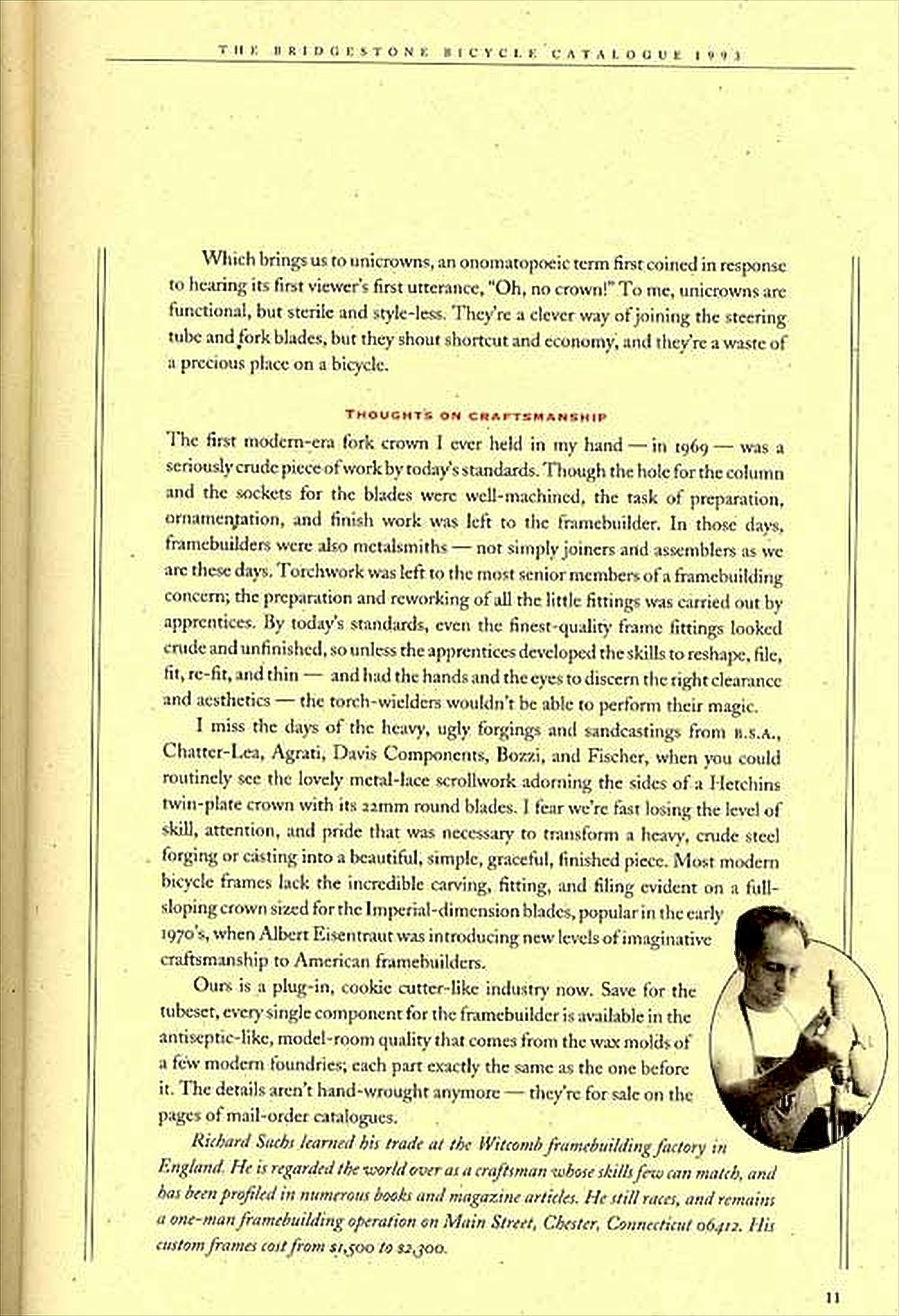
The first modern-era fork crown I ever held in my hand — in 1969 — was a seriously crude piece of work by today’s standards. Though the hole for the column and the sockets for the blades were well-machined, the task of preparation, ornamentation, and finish work was left to the framebuilder. In those days, framebuilders were also metalsmiths — not simply joiners and assemblers as we are these days. Torchwork was left to the most senior members of a framebuilding concern; the preparation and reworking of all the little fittings was carried out by apprentices. By today’s standards, even the finest-quality frame fittings looked crude and unfinished, so unless the apprentices developed the skills to reshape, file, fit, re-fit, and thin — and had the hands and the eyes to discern the right clearance and aesthetics — the torch-wielders wouldn’t be able to perform their magic.
I miss the days of the heavy, ugly forgings and sandcastings from B.S.A., Chatter-Lea, Agrati, Davis Components, Bozzi, and Fischer, when you could routinely see the lovely metal-lace scrollwork adorning the sides of a Hetchins twin-plate crown with its 22mm round blades. I fear we’re fast losing the level of skill, attention, and pride that was necessary to transform a heavy, crude steel forging or casting into a beautiful, simple, graceful, finished piece. Most modern bicycle frames lack the incredible carving, fitting, and filing evident on a full-sloping crown sized for the Imperial-dimension blades, popular in the early 1970’s, when Albert Eisentraut was introducing new levels of imaginative craftsmanship to American framebuilders.
Ours is a plug-in, cookie cutter-like industry now. Save for the tubeset, every single component for the framebuilder is available in the antiseptic-like, model-room quality that comes from the wax molds of a few modern foundries; each part exactly the same as the one before it. The details aren’t hand-wrought anymore — they’re for sale on the pages of mail-order catalogues.
Richard Sachs learned his trade at the Witcomb framebuilding factory in England. He is regarded the world over as a craftsman whose skills few can match, and has been profiled in numerous books and magazine articles. He still races, and remains a one-man framebuilding operation on Main Street, Chester, Connecticut 06412. His custom frames cost from $1,500 to $2,300.
11
[The second page of the essay, in a long text column ruled on both sides, with an oval photograph at the lower right of a man in an apron holding a fork crown and a fork in his hands.]
— Page 13 —
THE BRIDGESTONE BICYCLE CATALOGUE 1993
Send in the Crowns
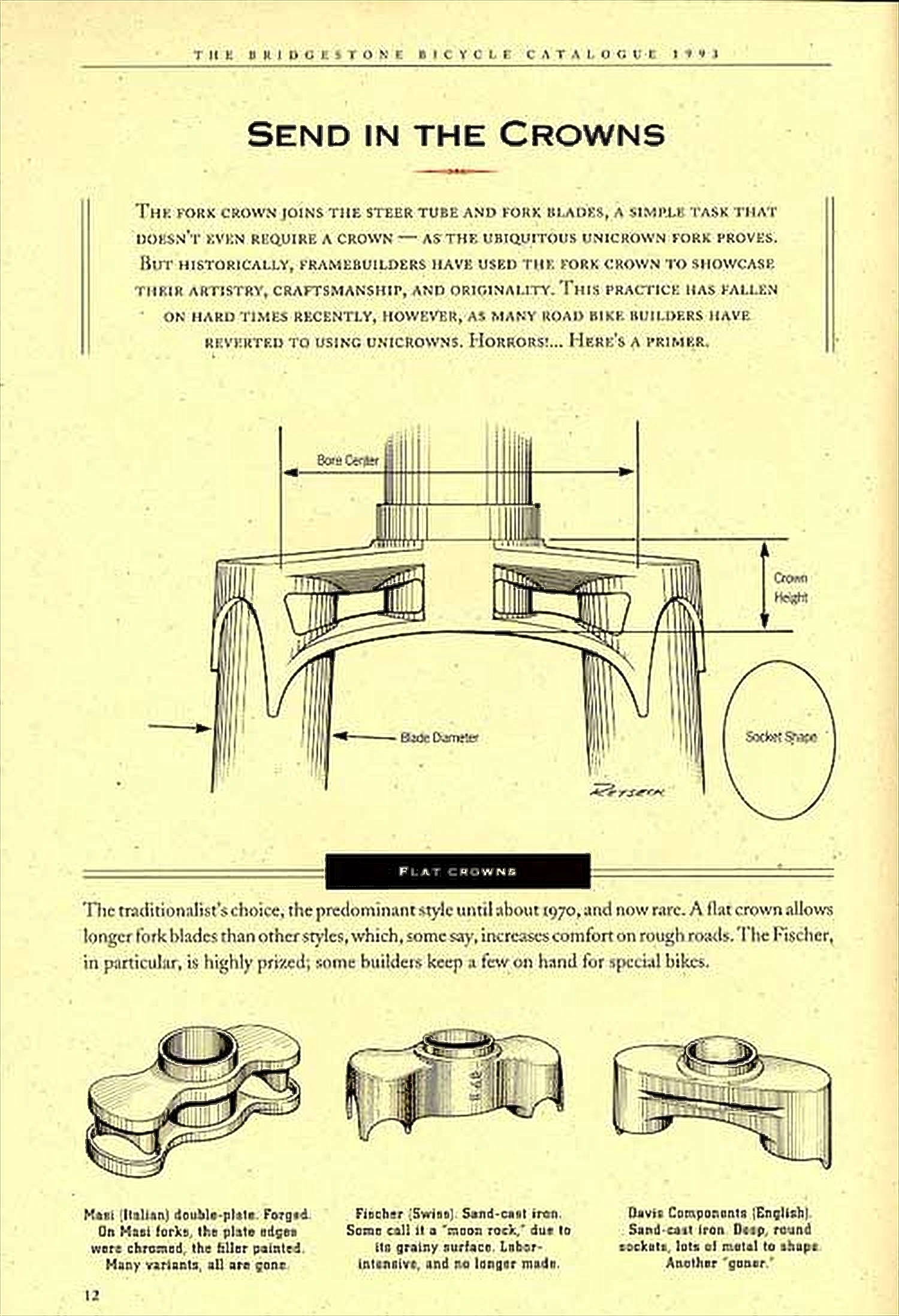
THE FORK CROWN JOINS THE STEER TUBE AND FORK BLADES, A SIMPLE TASK THAT DOESN’T EVEN REQUIRE A CROWN — AS THE UBIQUITOUS UNICROWN FORK PROVES. BUT HISTORICALLY, FRAMEBUILDERS HAVE USED THE FORK CROWN TO SHOWCASE THEIR ARTISTRY, CRAFTSMANSHIP, AND ORIGINALITY. THIS PRACTICE HAS FALLEN ON HARD TIMES RECENTLY, HOWEVER, AS MANY ROAD BIKE BUILDERS HAVE REVERTED TO USING UNICROWNS. HORRORS!… HERE’S A PRIMER.
Bore Center; Crown Height; Blade Diameter; Socket Shape (labels on the large drawing, signed Retseck).
FLAT CROWNS
The traditionalist’s choice, the predominant style until about 1970, and now rare. A flat crown allows longer fork blades than other styles, which, some say, increases comfort on rough roads. The Fischer, in particular, is highly prized; some builders keep a few on hand for special bikes.
Masi (Italian) double-plate. Forged. On Masi forks, the plate edges were chromed, the filler painted. Many variants, all are gone.
Fischer (Swiss). Sand-cast iron. Some call it a “moon rock,” due to its grainy surface. Labor-intensive, and no longer made.
Davis Components (English). Sand-cast iron. Deep, round sockets, lots of metal to shape. Another “goner.”
12
[A page headed “Send in the Crowns” with a bordered introduction, a large cutaway drawing of a fork crown marked with its bore center, crown height, blade diameter and socket shape, a black-headed band for flat crowns with a short paragraph, and three drawings of flat crowns with bold captions.]
— Page 14 —
THE BRIDGESTONE BICYCLE CATALOGUE 1993
Send in the Crowns, continued
FULL-SLOPING CROWNS
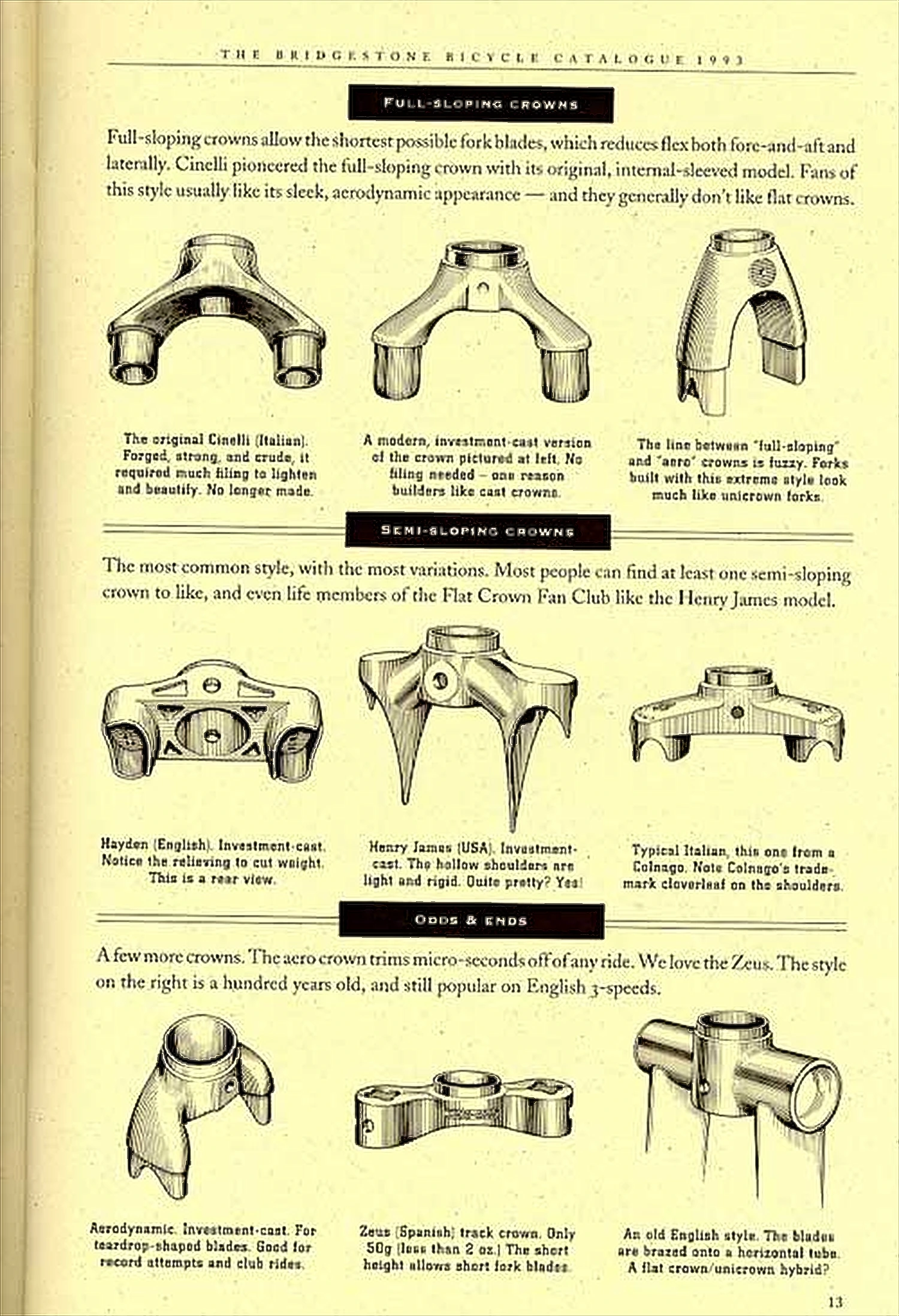
Full-sloping crowns allow the shortest possible fork blades, which reduces flex both fore-and-aft and laterally. Cinelli pioneered the full-sloping crown with its original, internal-sleeved model. Fans of this style usually like its sleek, aerodynamic appearance — and they generally don’t like flat crowns.
The original Cinelli (Italian). Forged, strong, and crude, it required much filing to lighten and beautify. No longer made.
A modern, investment-cast version of the crown pictured at left. No filing needed — one reason builders like cast crowns.
The line between “full-sloping” and “aero” crowns is fuzzy. Forks built with this extreme style look much like unicrown forks.
SEMI-SLOPING CROWNS
The most common style, with the most variations. Most people can find at least one semi-sloping crown to like, and even life members of the Flat Crown Fan Club like the Henry James model.
Hayden (English). Investment-cast. Notice the relieving to cut weight. This is a rear view.
Henry James (USA). Investment-cast. The hollow shoulders are light and rigid. Quite pretty? Yes!
Typical Italian, this one from a Colnago. Note Colnago’s trademark cloverleaf on the shoulders.
ODDS & ENDS
A few more crowns. The aero crown trims micro-seconds off of any ride. We love the Zeus. The style on the right is a hundred years old, and still popular on English 3-speeds.
Aerodynamic. Investment-cast. For teardrop-shaped blades. Good for record attempts and club rides.
Zeus (Spanish) track crown. Only 50g (less than 2 oz.) The short height allows short fork blades.
An old English style. The blades are brazed onto a horizontal tube. A flat crown/unicrown hybrid?
13
[The end of the crowns primer: two black-headed bands, for full-sloping and semi-sloping crowns, each with a short paragraph and three line drawings of crowns with bold captions, and a third band, “Odds & Ends”, with three more drawings.]
— Page 15 —
THE BRIDGESTONE BICYCLE CATALOGUE 1993
BY PETER EGAN
The Human Element
LISTENING TO THE STORY, I had to grin and shake my head. I’ve heard so many versions of it lately.
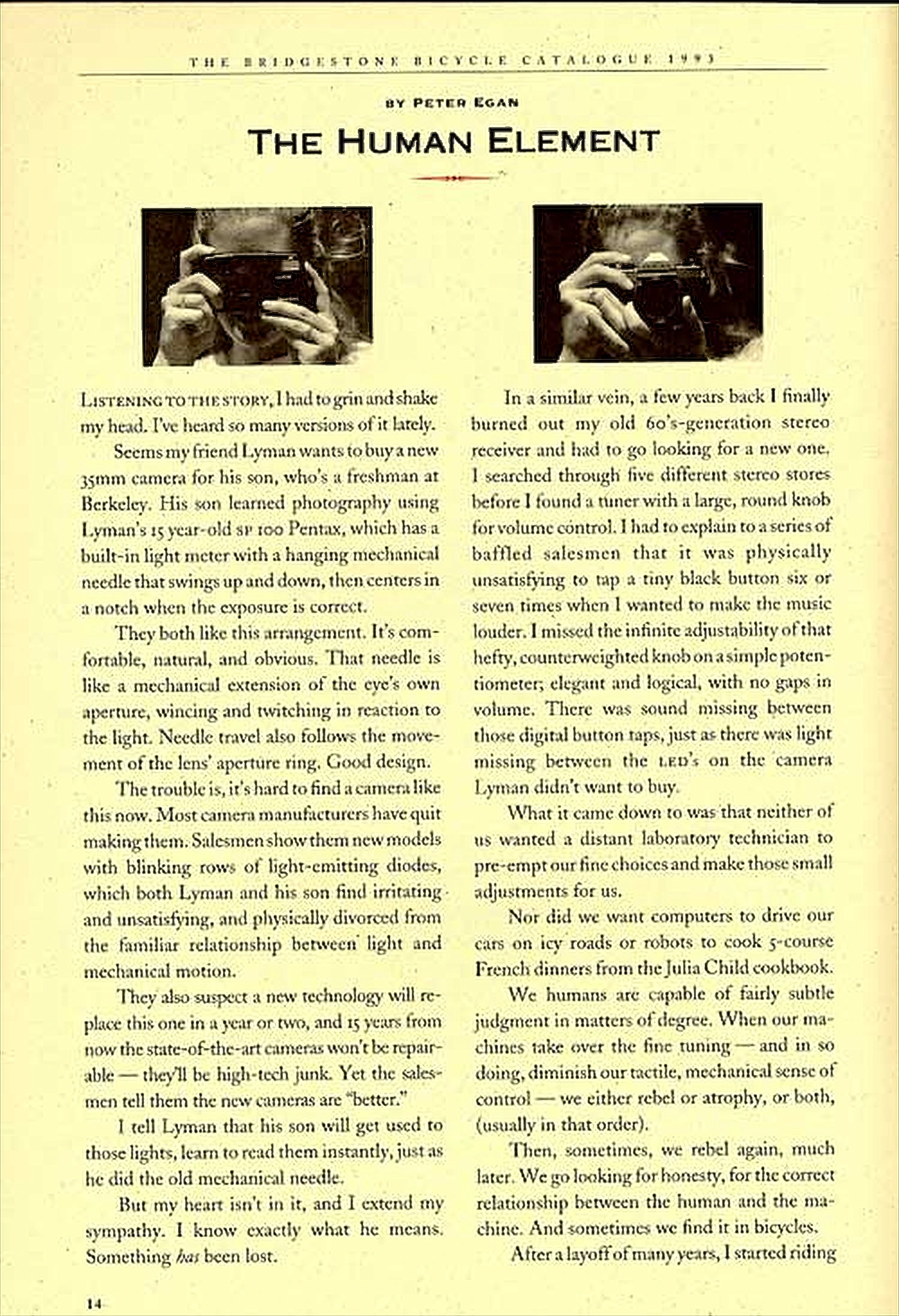
Seems my friend Lyman wants to buy a new 35mm camera for his son, who’s a freshman at Berkeley. His son learned photography using Lyman’s 15 year-old SP 100 Pentax, which has a built-in light meter with a hanging mechanical needle that swings up and down, then centers in a notch when the exposure is correct.
They both like this arrangement. It’s comfortable, natural, and obvious. That needle is like a mechanical extension of the eye’s own aperture, wincing and twitching in reaction to the light. Needle travel also follows the movement of the lens’ aperture ring. Good design.
The trouble is, it’s hard to find a camera like this now. Most camera manufacturers have quit making them. Salesmen show them new models with blinking rows of light-emitting diodes, which both Lyman and his son find irritating and unsatisfying, and physically divorced from the familiar relationship between light and mechanical motion.
They also suspect a new technology will replace this one in a year or two, and 15 years from now the state-of-the-art cameras won’t be repairable — they’ll be high-tech junk. Yet the salesmen tell them the new cameras are “better.”
I tell Lyman that his son will get used to those lights, learn to read them instantly, just as he did the old mechanical needle.
But my heart isn’t in it, and I extend my sympathy. I know exactly what he means. Something has been lost.
In a similar vein, a few years back I finally burned out my old 60’s-generation stereo receiver and had to go looking for a new one. I searched through five different stereo stores before I found a tuner with a large, round knob for volume control. I had to explain to a series of baffled salesmen that it was physically unsatisfying to tap a tiny black button six or seven times when I wanted to make the music louder. I missed the infinite adjustability of that hefty, counterweighted knob on a simple potentiometer; elegant and logical, with no gaps in volume. There was sound missing between those digital button taps, just as there was light missing between the LED’s on the camera Lyman didn’t want to buy.
What it came down to was that neither of us wanted a distant laboratory technician to pre-empt our fine choices and make those small adjustments for us.
Nor did we want computers to drive our cars on icy roads or robots to cook 5-course French dinners from the Julia Child cookbook.
We humans are capable of fairly subtle judgment in matters of degree. When our machines take over the fine tuning — and in so doing, diminish our tactile, mechanical sense of control — we either rebel or atrophy, or both, (usually in that order).
Then, sometimes, we rebel again, much later. We go looking for honesty, for the correct relationship between the human and the machine. And sometimes we find it in bicycles.
After a layoff of many years, I started riding
14
[A page headed “The Human Element”, by Peter Egan, with two small black and white photographs of a hand raising a camera to an eye, above two text columns. The article continues on page 16.]
— Page 16 —
THE BRIDGESTONE BICYCLE CATALOGUE 1993
The Human Element, continued
again last summer. Early one morning I found myself gliding down the driveway and marveling at the pure physical satisfaction of using my own muscles to cheat time and distance.
And then there was the mechanical side, the fine adjustment of the derailleur to quiet chain noise. The direct, obvious motion of the brakes, the well-oiled click of the freewheel.
My 20-year-old, yellow 10-speed is well worn. The rims are no longer round and straight; the frame is heavy; and the bottom-of-the-line (circa 1970) hardware is a little clunky by modern standards. I’ve ridden newer bikes belonging to friends; I know what I’m missing.
But my bike is enjoyable to ride simply because it’s a bicycle, not because it’s an especially good bicycle.
So I’ve been hanging around bicycle stores again for the first time in many years, looking at new components for my old bike and examining new bicycles. The picture is both heartening and a little disturbing to me.
On the good side, you can still buy bicycles that have resisted the alienation improvement syndrome. Frames are lighter and stronger; components are cleaner and more elegant. It’s clear that progress has been made.
But there’s also ample evidence of fad and trendiness, of change based more on manufacturer restlessness and boredom than on logic.
This worries me just a little bit. I used to believe that bicycles had already gone through their flashing LED/digital loudness phase long before most of us were born. That fads and bad ideas have been pursued to their illogical conclusions and left to wither on dead evolutionary branches decades ago.
I’d hoped that false advancement and contrived progress had largely faded away, leaving us in what might be called the second phase of betterness.
This is the phase where scattered, experimental ideas implode back to a single, dense logic of singular beauty, and we are left with the enviable chore of polishing the diamond.
It’s a nice phase, but I’m not sure if we’ve reached it or even passed it by. For someone who’s just re-entering the front door of the bicycle shop, it’s a tough call.
I do know that, beyond a certain point of cost and refinement, technology ceases to amaze. It may be manna for ad agencies and the media, but in time high tech becomes tedious and boring to real enthusiasts, whether they are photographers, audiophiles, skiers, motorcyclists, pilots, car owners, or mountain climbers. In my lifetime I’ve seen all these passions slightly diminished by an excessive sophistication of equipment — usually followed by a kind of breakaway, back-to-the-roots movement.
Momentum always seems to carry us just past the thing we are looking for, like the sliding weight on a doctor’s scale. When that happens, small adjustments are called for, usually in the direction of lightness.
Balance, you might say, is everything.
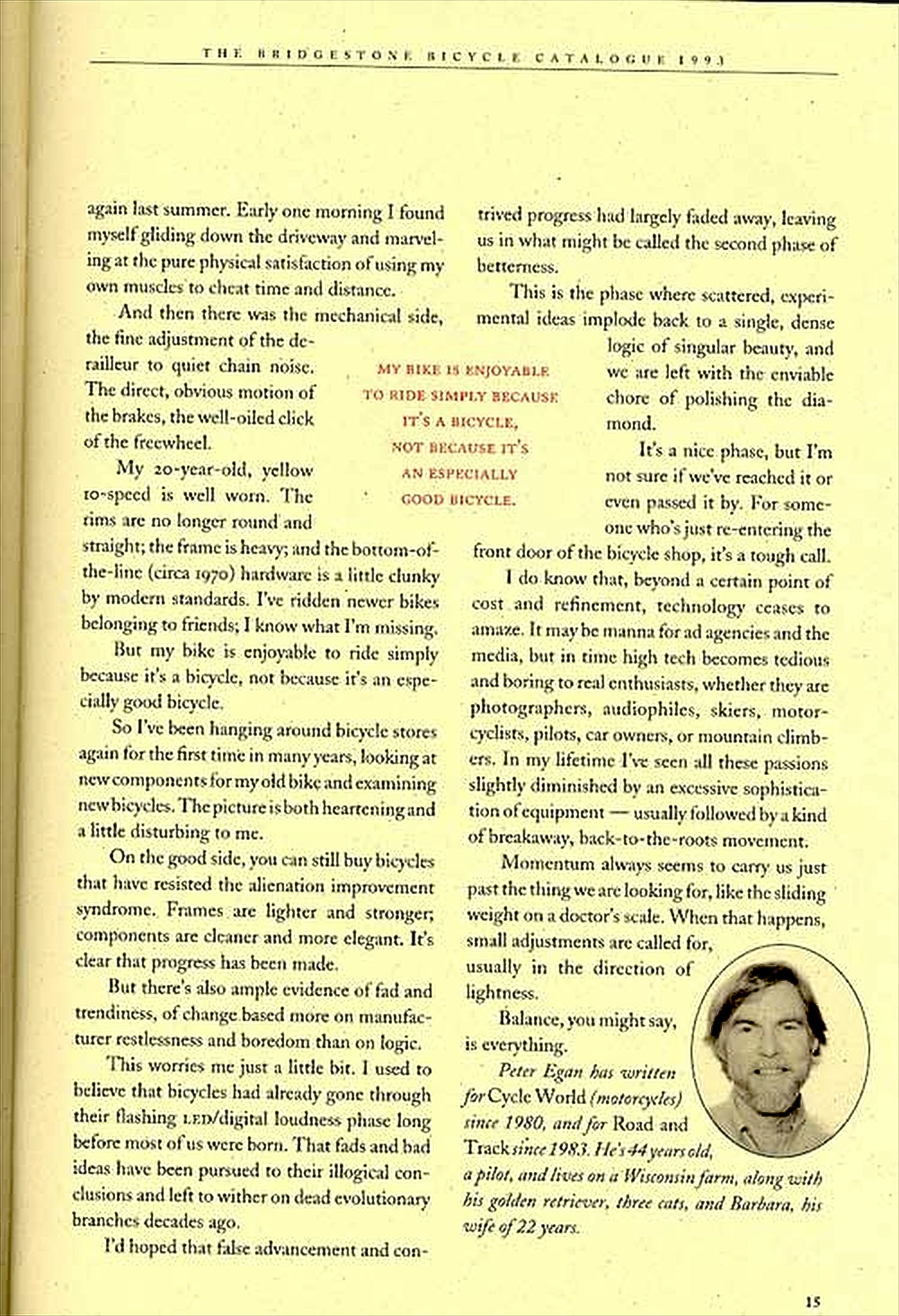
Peter Egan has written for Cycle World (motorcycles) since 1980, and for Road and Track since 1983. He’s 44 years old, a pilot, and lives on a Wisconsin farm, along with his golden retriever, three cats, and Barbara, his wife of 22 years.
MY BIKE IS ENJOYABLE TO RIDE SIMPLY BECAUSE IT’S A BICYCLE, NOT BECAUSE IT’S AN ESPECIALLY GOOD BICYCLE.
15
[The second page of the essay, in two columns with a red pull quote set into the first, and an oval photograph at the lower right of a bearded man in a collared shirt, the author.]
— Page 17 —
THE BRIDGESTONE BICYCLE CATALOGUE 1993
Yen Shock, High Tech, Cheap Labor, Modern Bicycles
IN 1984 ONE U.S. DOLLAR BOUGHT 240 JAPANESE YEN, AN EXCHANGE RATE THAT MADE JAPANESE PRODUCTS TREMENDOUS BARGAINS. NOT SURPRISINGLY, THE U.S. IMPORTED LOTS OF JAPANESE GOODS. OF COURSE, THE 240:1 RATIO MADE U.S. PRODUCTS EXPENSIVE IN JAPAN, SO WE EXPORTED LITTLE.
Since Canada, Germany, and Great Britain were suffering from similar trade imbalances, they met with representatives of Japan and the U.S. in May 1985 to revalue their currency exchange rates, to encourage a better balance of trade. [This summit was dubbed “G-5,” for the number (5) of (G)overnments attending.]
Over the next seven or eight months, the yen/dollar ratio dropped from 240:1 to 125:1 — a drastic weakening of the dollar and strengthening of the yen known in Japan as “yen shock.”
YEN SHOCK AND THE JAPANESE ECONOMY
Yen shock turned Japan’s manufacturing and exporting business upside down. For the first time in its history, Japan was forced to subcontract cheap labor to such newly-industrialized economies (NIE’s) as Taiwan, Singapore, and Korea. At home, Japanese manufacturers scrambled to reduce costs, and placed a new emphasis on marketing their suddenly expensive and hard-to-sell yen-shocked goods.
YEN SHOCK AND YOUR BICYCLE
Long before yen shock, Japan’s parts manufacturers had regarded Campagnolo, Italy’s best parts manufacturer, as the standard of quality. Using the same expensive manufacturing methods and high-quality materials, Shimano and SunTour created their own high-end parts groups, Dura-Ace (1972) and Superbe (1975), and filled the rungs below with rugged, inexpensive groups such as Shimano 600 and SunTour Sprint. By the early eighties, mid-priced Japanese bicycle components were incomparable values.
But yen shock made it impossible for Japanese manufacturers to produce those same parts at those same prices, and clearly, doubling prices overnight wouldn’t “fly.” Instead, they had to reduce the cost of labor and materials.
Bicycle and bicycle parts makers, like many other manufacturers, began farming out low-end production to NIE’s, where labor rates were up to 90 percent lower than in Japan. Much of the labor that remained — mold-making, polishing, and assembly — was reassigned to robots. Processes that were impractical to robotize were eliminated, and manufacturers who could not afford to robotize struggled to compete.
Shimano robotized early, and its design capabilities, production precision, and efficiency — and resulting success — are admirable and legendary. (It now owns nearly 85 percent of the worldwide market, a dominance virtually unheard of in any other retail field.)
After yen shock, expensive aluminum parts became steel, steel parts became plastic, cold-forgings gave way to castings, threaded dustcaps were replaced by pop-in substitutes, and hand-buffing and anodizing lost out to cheaper tumble-polishing and painting.
16
[A page headed “Yen Shock, High Tech, Cheap Labor, Modern Bicycles” in two lines, with a centered introduction in small capitals above two text columns ruled on both sides and red subheads. The article continues on page 18.]
— Page 18 —
THE BRIDGESTONE BICYCLE CATALOGUE 1993
Yen Shock, High Tech, Cheap Labor, Modern Bicycles, continued
These measures cut costs, but the new parts with cheaper materials and finishes were hard to sell at the old prices. To recoup the profit, value had to be added at no cost. As it often is, the key to adding value was stressing “high technology.”
High technology is profitable largely because “value-added” features cost little to make, but create demand that can support higher prices. A good example is the compact disc; it’s much cheaper to manufacture, ship, and stock than an LP, yet can retail for more.
And while “low-tech” products are easy to copy, the secrets of “high-tech” goods are harder to decode. This gives manufacturers a few years’ protection against copycat products built with cheaper, NIE labor.
ADDING VALUE, DECREASING COSTS
The search for “value-added” features sometimes leads to less-expensive designs that outperform older, more expensive ones; nowhere is this more evident than in the bike industry.
In the long run, demand for “high-tech” goods will challenge traditional manufacturers to pull out all the stops, to hone the edge sharper. This can lead to better products, but just as often traditional craftsmanship falls prey to the glitz of “high tech.” Opportunists join in, and what so often follows has come to be known — in most fields — as “high-tech garbage.”
YEN SHOCK AND THE HIGH TECH RESPONSE have caused other problems for cyclists. Many components are now designed for robotic assembly — generally stamping, bending, and riveting. But stamping and bending are stressful, and demand heavier, reinforced areas; and rivets make disassembly impossible. Hand-assembled parts, on the other hand, are often simultaneously strong, lightweight, and serviceable. Alas — they cost a lot more.
The public’s disillusionment with complex, nonserviceable “high-tech” parts has spawned “retro” movements in many fields; and vintage cameras, bicycle parts, and fishing gear, among other items, are now collected and coveted.
Meanwhile, the influx of labor into NIE’s has led to more jobs, more industry, and increasingly skilled, demanding workers. This phenomenon (“westernization”) invariably leads to higher prices.
But price-conscious shoppers still demand the low prices that, in any labor-intensive industry, are possible only with cheap labor.
So the search goes on. Recently, Taiwan manufacturers, hurt by increasing labor costs, have opened manufacturing facilities in mainland China and Indonesia.
WHAT NEXT? A GUESS:
Labor and material costs will increase, and the only defense against increasing retail prices, a faltering economy, and a supersaturated market will be more “value-added” bikes, parts, and accessories designed to attract more new riders to bicycling. (When the fish aren’t biting, use “high-tech bait.”)
Bikes will become more automated, more electronic. Labor-intensive processes such as wheelbuilding and cable adjustments will be eliminated, thus minimizing the difference between bikes purchased at bike shops and department stores — and the latter will sell more midpriced bikes than ever before.
We should applaud anything that gets more people onto bikes, because cycling is good for people and good for the country. But if converting them to lifelong cyclists is the goal, then low-quality, “high-tech” bike parts are the wrong bait.
We need a national transportation policy that encourages cycling as transportation. Then, cycling would become a way of life, the pool of cyclists would be much larger, and there would be more room for diversity. Surely, then, some manufacturer would find a market for bike parts made the old-fashioned way.
17
[The second page of the essay, in two text columns ruled on both sides, with red subheads and no pictures.]
— Page 19 —
THE BRIDGESTONE BICYCLE CATALOGUE 1993
BY DAVID HERLIHY
Daniel Rebour: Illustrator Man
UNTIL HIS DEATH two years ago, he lived in a cyclist’s dream world. For nearly half a century, as the steel bicycle approached perfection, he previewed every novelty the industry could offer. His services were in constant demand by manufacturers from Campagnolo to Shimano, by makers of racing and touring frames alike. He was at home everywhere in the cycling world, whether stalking trade shows with Eddy Merckx, or exploring backroads with fellow cyclo-touristes. And all the while, he made a comfortable living — yet Daniel Rebour did not race, design, or sell bicycles.
What Daniel Rebour did — as no one has before or since — was illustrate bicycles and bicycle accessories. To a neophyte, such work may not seem significant, but to a generation of cyclists his work symbolized the sport itself.
Anyone who has leafed through a cycling publication from some years back would instantly recognize his exquisite and unmistakable style. But who was the man behind the name, and how did he achieve such perfection?
For some answers, I recently traveled to the small town in Normandy where he is buried. There, in the family’s ancient farmhouse, I met with Daniel Rebour’s older brother, Rodolphe, a hearty octogenarian, and himself an accomplished illustrator. Still bitter that the French cycling press paid only passing notice to Daniel’s death, Rodolphe was eager to share his memories. As Antoinette, Rodolphe’s wife of 50-plus years, served sparkling cider (the local specialty), I scribbled away.
18
[A page headed “Daniel Rebour: Illustrator Man”, by David Herlihy, with a large pen-and-ink drawing of a rear derailleur with its cable and chain, in Rebour’s style, at the left and center, and two columns of text beneath. The article continues on page 20.]
— Page 20 —
THE BRIDGESTONE BICYCLE CATALOGUE 1993
Daniel Rebour: Illustrator Man, continued
Daniel was born in 1909 in the port city of Le Havre, but soon moved to Paris, where his father worked as a public works administrator. Bicycles were young Daniel’s first love; he would often skip school to hang out at the local bike shop — much to the chagrin of his schoolteacher mother.
Daniel was a keen observer of mechanical instruments (Rodolphe boasts that his brother once repaired the town clock). His exceptional intelligence and imagination prompted him to offer suggestions to cycling manufacturers, such as pre-working leather for softer saddles, or adding fork springs to counter the rubble of the Paris-Roubaix. (Say it ain’t so!-Ed.)
But his mechanical intuition would find its greatest expression in his art. Following Rodolphe’s example, Daniel enrolled in the Ecole Nationale Supérieure des Arts Décoratifs, where he perfected his technical drawing.
In this age before inexpensive photography and computer graphics, journals relied heavily on illustrators. Upon graduation in 1928, Daniel assumed the position of design director for Moto Revue, and for a while it seemed as if motorcycles would steal him away from bicycles.
Fortunately, Claude Thillet, Daniel’s lifelong friend and the editor of Le Cycle, lured him back to bicycles.
19
[The second page of the article: a pen drawing of a front hub with quick-release lever and cone nuts, the hub shell lettered “Professional Maillard”, at the top; a small black and white photograph of a young man in a jersey among a crowd, set into the text; and a pen drawing of a freewheel cluster of cogs at the foot.]
— Page 21 —
THE BRIDGESTONE BICYCLE CATALOGUE 1993
Daniel Rebour: Illustrator Man, continued
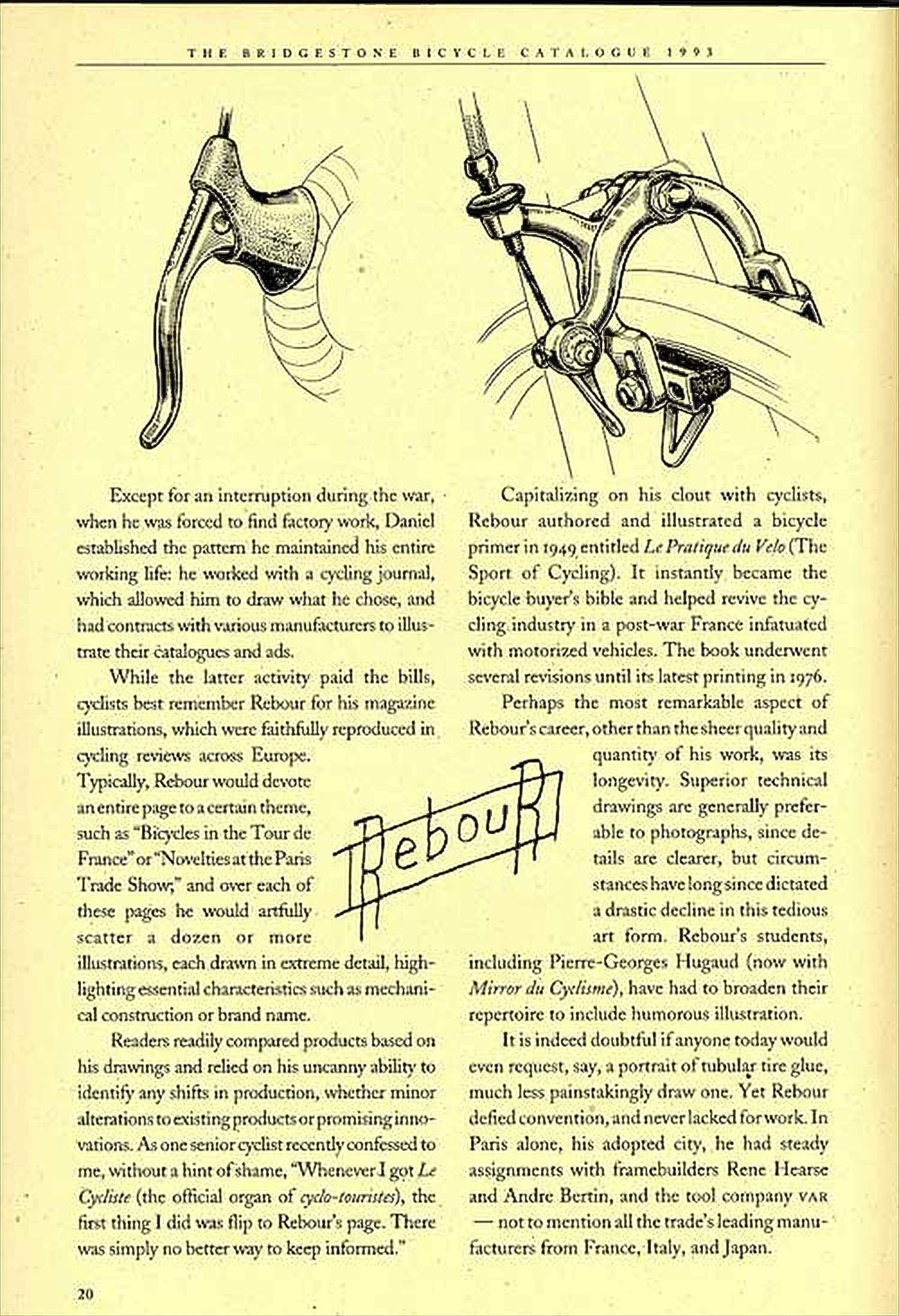
Except for an interruption during the war, when he was forced to find factory work, Daniel established the pattern he maintained his entire working life: he worked with a cycling journal, which allowed him to draw what he chose, and had contracts with various manufacturers to illustrate their catalogues and ads.
While the latter activity paid the bills, cyclists best remember Rebour for his magazine illustrations, which were faithfully reproduced in cycling reviews across Europe. Typically, Rebour would devote an entire page to a certain theme, such as “Bicycles in the Tour de France” or “Novelties at the Paris Trade Show;” and over each of these pages he would artfully scatter a dozen or more illustrations, each drawn in extreme detail, highlighting essential characteristics such as mechanical construction or brand name.
Readers readily compared products based on his drawings and relied on his uncanny ability to identify any shifts in production, whether minor alterations to existing products or promising innovations. As one senior cyclist recently confessed to me, without a hint of shame, “Whenever I got Le Cycliste (the official organ of cyclo-touristes), the first thing I did was flip to Rebour’s page. There was simply no better way to keep informed.”
Capitalizing on his clout with cyclists, Rebour authored and illustrated a bicycle primer in 1949 entitled Le Pratique du Velo (The Sport of Cycling). It instantly became the bicycle buyer’s bible and helped revive the cycling industry in a post-war France infatuated with motorized vehicles. The book underwent several revisions until its latest printing in 1976.
Perhaps the most remarkable aspect of Rebour’s career, other than the sheer quality and quantity of his work, was its longevity. Superior technical drawings are generally preferable to photographs, since details are clearer, but circumstances have long since dictated a drastic decline in this tedious art form. Rebour’s students, including Pierre-Georges Hugaud (now with Mirror du Cyclisme), have had to broaden their repertoire to include humorous illustration.
It is indeed doubtful if anyone today would even request, say, a portrait of tubular tire glue, much less painstakingly draw one. Yet Rebour defied convention, and never lacked for work. In Paris alone, his adopted city, he had steady assignments with framebuilders Rene Hearse and Andre Bertin, and the tool company VAR — not to mention all the trade’s leading manufacturers from France, Italy, and Japan.
20
[The third page of the article: pen drawings of a brake lever and of a sidepull caliper brake at the top, and the artist’s large signature “Rebour” drawn across the lower left of the text.]
— Page 22 —
THE BRIDGESTONE BICYCLE CATALOGUE 1993
Daniel Rebour: Illustrator Man, concluded
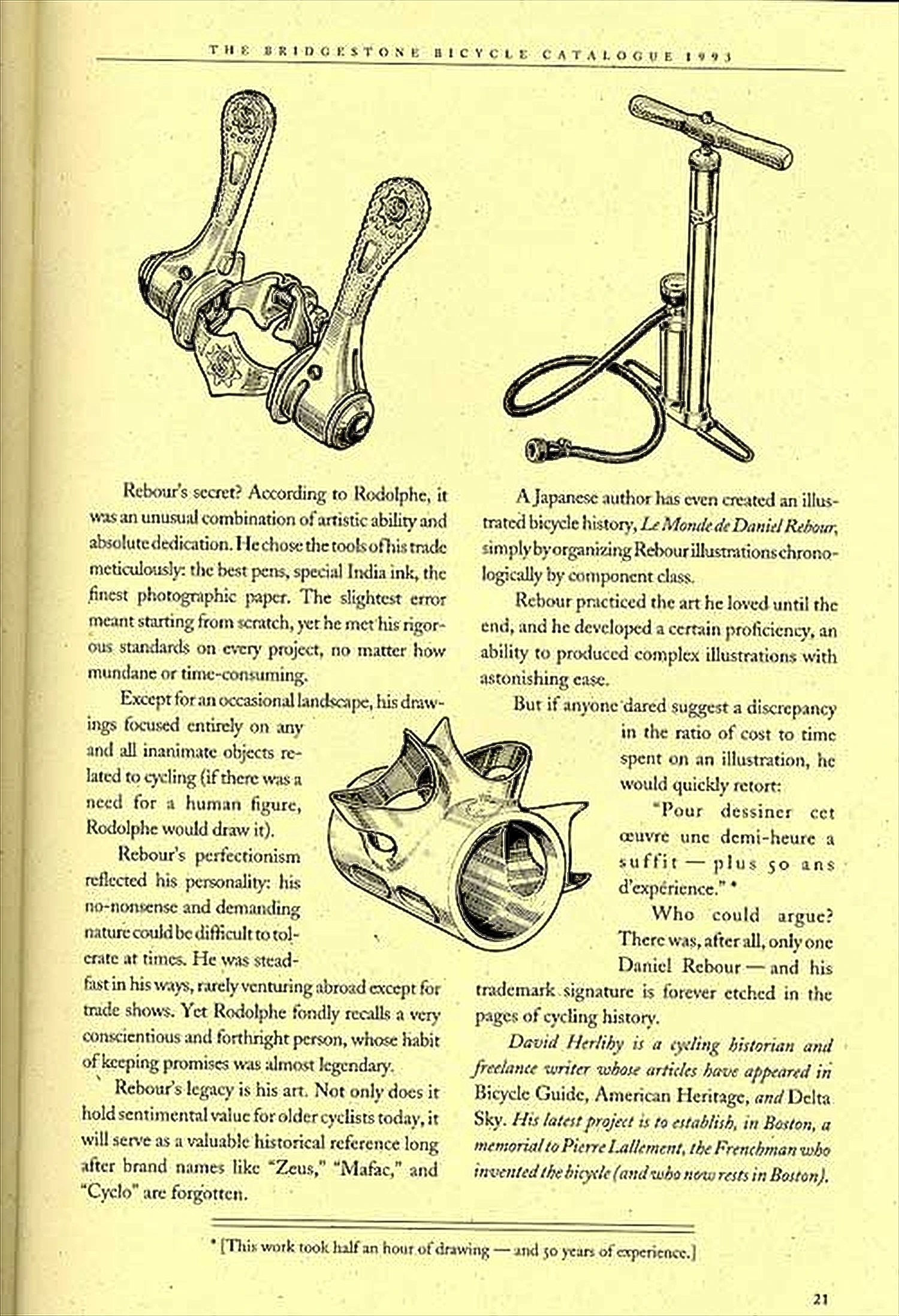
Rebour’s secret? According to Rodolphe, it was an unusual combination of artistic ability and absolute dedication. He chose the tools of his trade meticulously: the best pens, special India ink, the finest photographic paper. The slightest error meant starting from scratch, yet he met his rigorous standards on every project, no matter how mundane or time-consuming.
Except for an occasional landscape, his drawings focused entirely on any and all inanimate objects related to cycling (if there was a need for a human figure, Rodolphe would draw it).
Rebour’s perfectionism reflected his personality: his no-nonsense and demanding nature could be difficult to tolerate at times. He was steadfast in his ways, rarely venturing abroad except for trade shows. Yet Rodolphe fondly recalls a very conscientious and forthright person, whose habit of keeping promises was almost legendary.
Rebour’s legacy is his art. Not only does it hold sentimental value for older cyclists today, it will serve as a valuable historical reference long after brand names like “Zeus,” “Mafac,” and “Cyclo” are forgotten.
A Japanese author has even created an illustrated bicycle history, Le Monde de Daniel Rebour, simply by organizing Rebour illustrations chronologically by component class.
Rebour practiced the art he loved until the end, and he developed a certain proficiency, an ability to produced complex illustrations with astonishing ease.
But if anyone dared suggest a discrepancy in the ratio of cost to time spent on an illustration, he would quickly retort: “Pour dessiner cet œuvre une demi-heure a suffit — plus 50 ans d’expérience.”*
Who could argue? There was, after all, only one Daniel Rebour — and his trademark signature is forever etched in the pages of cycling history.
David Herlihy is a cycling historian and freelance writer whose articles have appeared in Bicycle Guide, American Heritage, and Delta Sky. His latest project is to establish, in Boston, a memorial to Pierre Lallement, the Frenchman who invented the bicycle (and who now rests in Boston).
* [This work took half an hour of drawing — and 50 years of experience.]
21
[The last page of the article: three pen drawings by Rebour, a pair of crankarms at the upper left, a floor pump with its hose at the upper right and a lugged bottom-bracket shell at the center left, set around two text columns.]
— Page 23 —
THE BRIDGESTONE BICYCLE CATALOGUE 1993
What’s Right with Wool
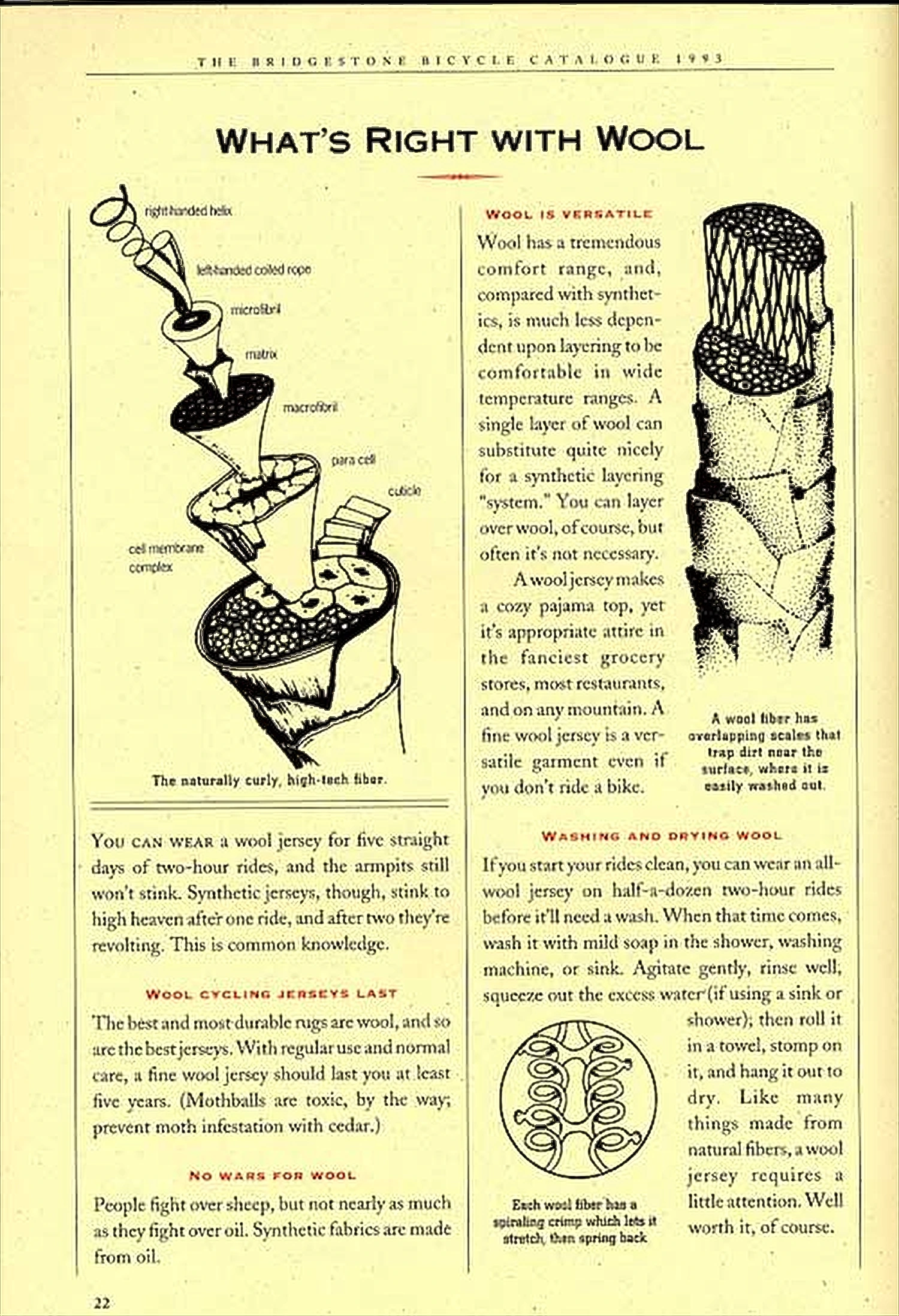
right-handed helix; left-handed coiled rope; microfibril; matrix; macrofibril; para cell; cuticle; cell membrane complex (labels on the diagram).
The naturally curly, high-tech fiber.
WOOL IS VERSATILE
Wool has a tremendous comfort range, and, compared with synthetics, is much less dependent upon layering to be comfortable in wide temperature ranges. A single layer of wool can substitute quite nicely for a synthetic layering “system.” You can layer over wool, of course, but often it’s not necessary. A wool jersey makes a cozy pajama top, yet it’s appropriate attire in the fanciest grocery stores, most restaurants, and on any mountain. A fine wool jersey is a versatile garment even if you don’t ride a bike.
A wool fiber has overlapping scales that trap dirt near the surface, where it is easily washed out.
YOU CAN WEAR a wool jersey for five straight days of two-hour rides, and the armpits still won’t stink. Synthetic jerseys, though, stink to high heaven after one ride, and after two they’re revolting. This is common knowledge.
WOOL CYCLING JERSEYS LAST
The best and most durable rugs are wool, and so are the best jerseys. With regular use and normal care, a fine wool jersey should last you at least five years. (Mothballs are toxic, by the way; prevent moth infestation with cedar.)
NO WARS FOR WOOL
People fight over sheep, but not nearly as much as they fight over oil. Synthetic fabrics are made from oil.
WASHING AND DRYING WOOL
If you start your rides clean, you can wear an all-wool jersey on half-a-dozen two-hour rides before it’ll need a wash. When that time comes, wash it with mild soap in the shower, washing machine, or sink. Agitate gently, rinse well, squeeze out the excess water (if using a sink or shower); then roll it in a towel, stomp on it, and hang it out to dry. Like many things made from natural fibers, a wool jersey requires a little attention. Well worth it, of course.
Each wool fiber has a spiraling crimp which lets it stretch, then spring back.
22
[A page headed “What’s Right with Wool” with a labeled exploded diagram of a wool fiber at the left (a helix, coiled rope, microfibrils and cells inside a cut fiber), a large drawing of a scaled fiber at the right, a small circular crimp diagram at the lower right and two text columns with red subheads.]
— Page 24 —
THE BRIDGESTONE BICYCLE CATALOGUE 1993
The Finest Jerseys in the Wool
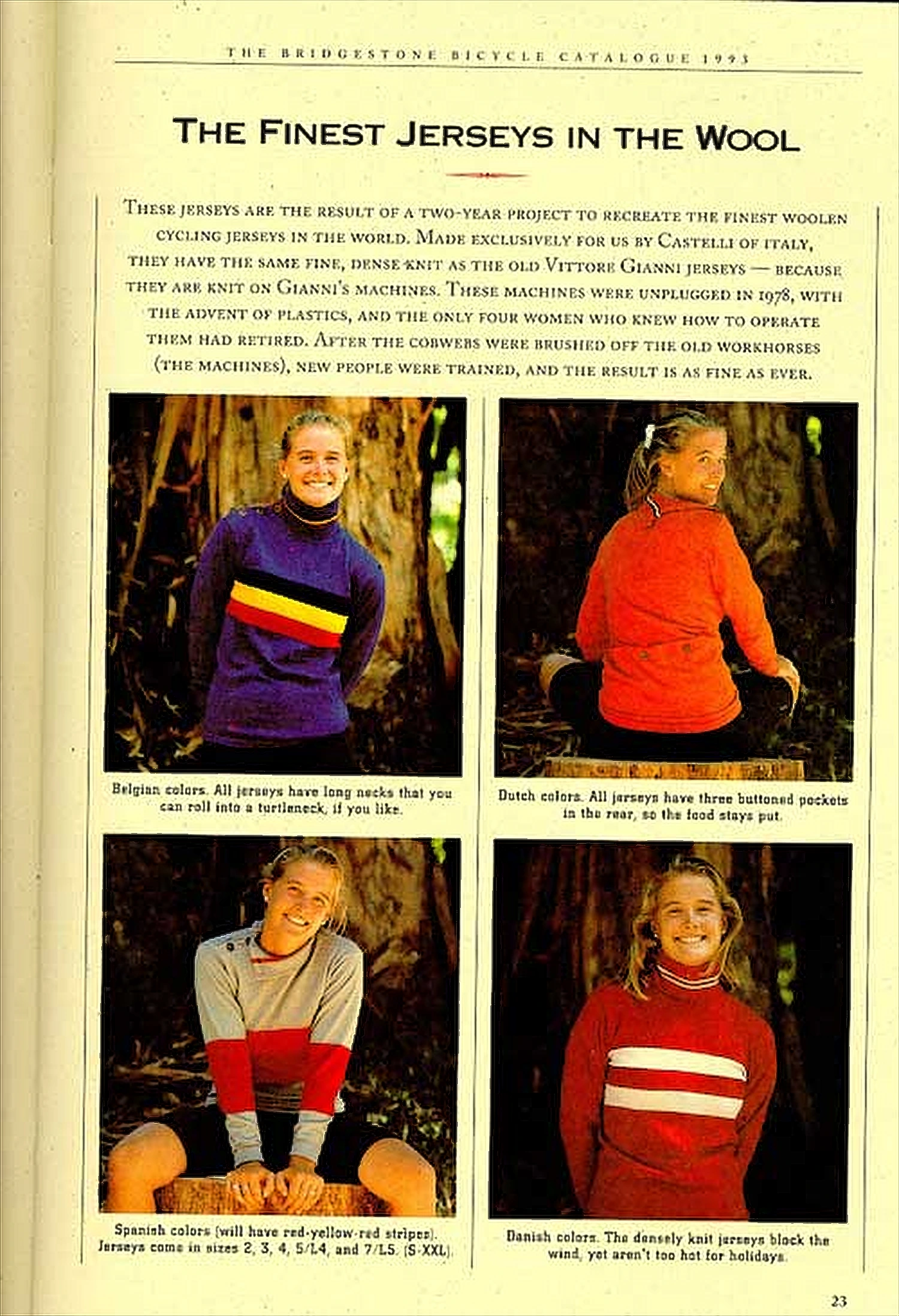
THESE JERSEYS ARE THE RESULT OF A TWO-YEAR PROJECT TO RECREATE THE FINEST WOOLEN CYCLING JERSEYS IN THE WORLD. MADE EXCLUSIVELY FOR US BY CASTELLI OF ITALY, THEY HAVE THE SAME FINE, DENSE KNIT AS THE OLD VITTORE GIANNI JERSEYS — BECAUSE THEY ARE KNIT ON GIANNI’S MACHINES. THESE MACHINES WERE UNPLUGGED IN 1978, WITH THE ADVENT OF PLASTICS, AND THE ONLY FOUR WOMEN WHO KNEW HOW TO OPERATE THEM HAD RETIRED. AFTER THE COBWEBS WERE BRUSHED OFF THE OLD WORKHORSES (THE MACHINES), NEW PEOPLE WERE TRAINED, AND THE RESULT IS AS FINE AS EVER.
Belgian colors. All jerseys have long necks that you can roll into a turtleneck, if you like.
Dutch colors. All jerseys have three buttoned pockets in the rear, so the food stays put.
Spanish colors (will have red-yellow-red stripes). Jerseys come in sizes 2, 3, 4, 5/L4, and 7/L5. (S-XXL)
Danish colors. The densely knit jerseys block the wind, yet aren’t too hot for holidays.
23
[A page headed “The Finest Jerseys in the Wool” with a bordered introduction in small capitals above four color photographs of young women wearing wool jerseys in a eucalyptus grove: a purple jersey with a black, yellow and red chest stripe (Belgian), an orange-red jersey seen from the back (Dutch), a gray jersey with red bands and shoulder buttons (Spanish) and a red jersey with two white chest stripes (Danish), each with a bold caption.]
— Page 25 —
THE BRIDGESTONE BICYCLE CATALOGUE 1993
LET US RETURN TO OUR SHEEP — ANONYMOUS, 15TH CENTURY
Revenons a nos Moutons
UP UNTIL THE LATE 70’s all cyclists rode in wool jerseys, and every bike shop sold them. The best jerseys were all wool, 100 percent, and were knit on a tube, like a T-shirt, to eliminate those nasty, chafing side seams. Pro team jerseys were hand-embroidered or “flocked” with the names of the sponsors — Molteni, Gis, Flandria…. Patterns ran the gamut, but the gamut was smaller then; and even the wildest woolies would wag their sleeves at today’s screaming neons.
WHAT HAPPENED TO WOOL, AND WHY?
Jersey designs, materials, and printing processes changed in the 80’s, when the number of sponsors per team jumped dramatically, and racers often changed sponsors over the course of a season. A pro racer’s jersey is the sponsor’s billboard, and wool’s muted colors and graphic limitations couldn’t keep pace with these constant changes.
For most riders, wool’s inability to adequately shout commercial messages to consumers is not an issue. But there are other reasons for wool’s demise and synthetics’ rise: modern synthetics are more profitable, easier to care for, comfortable — if not cozy — and win all the laboratory wicking contests.
Wool, on the other hand, is labor-intensive and expensive. It needs to be cleaned, dyed, de-burred, carded, and spun into yarn — and then it’s ready to knit.
SHEEP, LAND, AND THE OZONE LAYER
Recently, manufacturers of synthetic fabrics have accused sheep, and, therefore, wool, of being ecologically destructive: Sheep range far and wide, trample the land, eat things up, and belch out methane, a greenhouse gas. There’s some truth here, but keeping sheep cooped up like laying hens is no solution.
Besides, shepherding is the second oldest profession on Earth. Its contribution to despoiling the planet pales next to that of, say, drilling for oil. The modern superfabrics are all made from oil.
As to the methane: Anybody who has a high-fiber diet will understand…
BUTTONS, BUTTONS…WE’VE GOT THE BUTTONS!
Shoulder buttons on cycling jerseys were the style from 1915 through 1935, and we thought it was time to bring them back. Zippers are faster, we know, but buttons never jam or bite skin, and mastery comes easy.
We chose tagua nut buttons, made from the fruits of tagua palms grown in the rainforests of Ecuador. Harvesting these nuts adds commercial value to trees, which might otherwise be slashed and burned. (By the way, we requested the nut’s outer layer, or “bark,” be left on, thus ensuring that no two jerseys are identical.) Each jersey comes with a whole tagua nut, so if you lose a button, just carve another.
ALL WE LIKE SHEEP HAVE GONE ASTRAY. — ISAIAH 53:6
24
[A page headed “Revenons a nos Moutons”, under the line “Let us return to our sheep — Anonymous, 15th century”, with a text column ruled on both sides, red subheads, an oval line drawing of a sheep’s head at the left and a red line from the Book of Isaiah at the foot.]
— Page 26 —
THE BRIDGESTONE BICYCLE CATALOGUE 1993
Modern Road Bikes, Classic Details
NINETY PERCENT of all bike rides take place on the road, but fewer than 7 percent of new purchases are road bikes. This isn’t surprising; most modern road bikes are designed for racing, and are hobbled by potholed streets, fire roads, rain, and other ugly realities.
But those realities won’t go away, so we build BRIDGESTONES with them in mind.
The seat tube angles are relaxed and the top tubes are long, to encourage a butt-back, back-flat position that is aerodynamic, powerful, and shock absorbing.
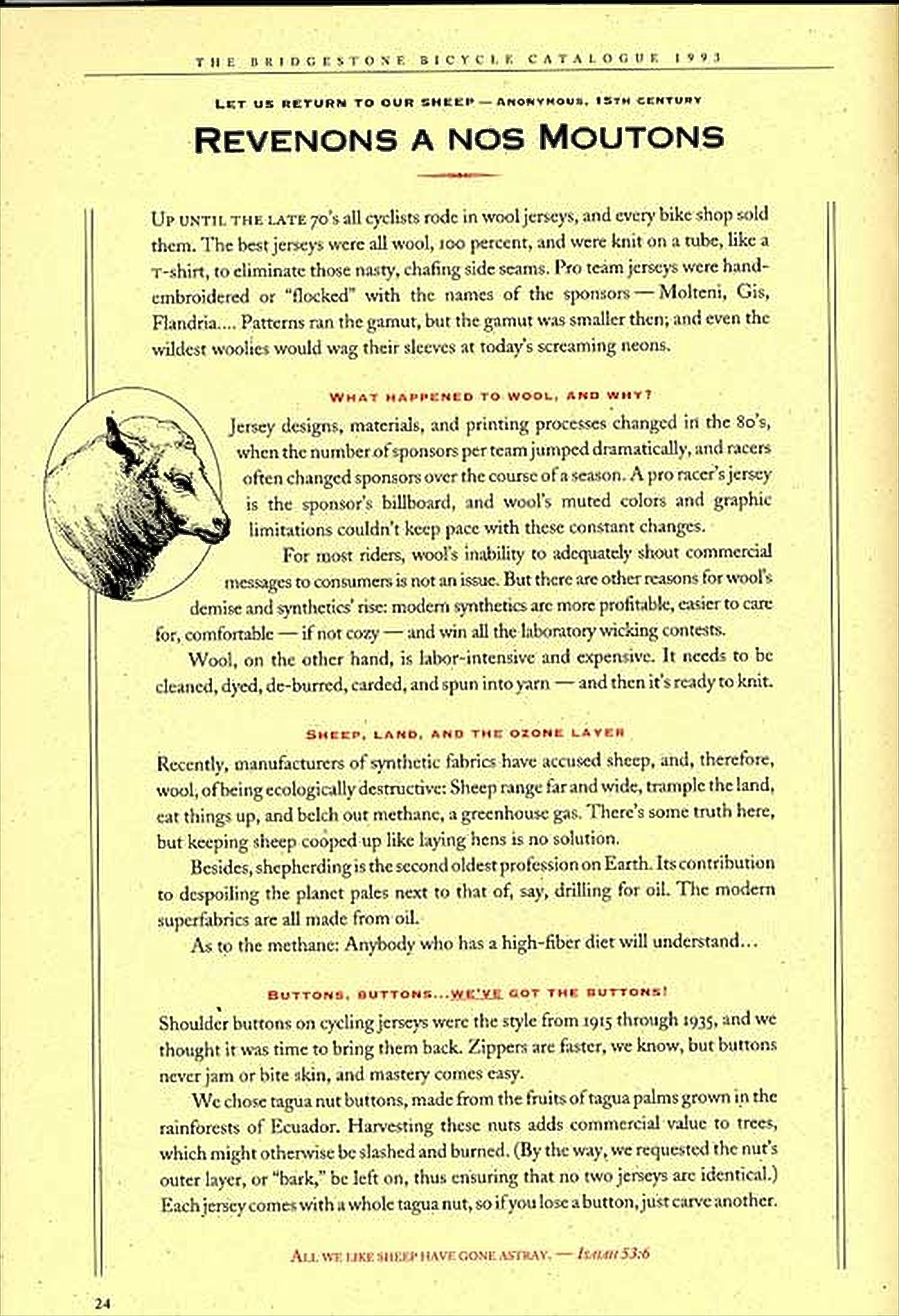
The front and rear dropouts have eyelets, because eyelets don’t slow you down in the least, but they can transform your summer road bike into a passable touring bike or a splatter-free winter training bike. With fenders, your RB-1 or RB-2 will be the preferred bicycle to draft on wet roads; you’ll wish everyone in the pack was riding one.
Compared to other racing bikes, our road bikes have more tire clearance at the fork crown, brakes, and chainstays, so they can accept tires as fat as 700 x 32c. Since tires — more than any other component — define a bicycle’s limits, a BRIDGESTONE’s ability to fit more tires makes it more versatile.
We’re pleased with the new fork crown on our RB-1. It was designed-to-spec by Tom Ritchey. A Bridgestone exclusive.
SIZE-SPECIFIC GEOMETRY
Each BRIDGESTONE road frame has geometry selected for its size. It’s more trouble and more expensive to do this — which is why almost nobody does — but there’s no question that it makes the bike fit and ride better. If frame design interests you in the least, you’ll want to read pages 46 and 47 in this catalogue.
IN THE PAST 3 YEARS, BRIDGESTONE riders have won several hundred Category 1 and 2 races, nearly a dozen state and district championships, and both the National and Collegiate World Championships. To fully appreciate the significance of this incredible statistic you will want to read Maynard Hershon’s It’s Not For Sale on page 58 of this catalogue. It’s an eye-opener.
TOUGH, LONG-LASTING STEEL
BRIDGESTONE road frames are tough, light, long-lasting steel, built the traditional way, with steel lugs and molten brass. Though not always as light as aluminum, carbon fiber or titanium, steel frames combine light weight, toughness, ride quality, alignability (after a crash, say), and longevity in a way no other frame material can match.
GOLD IS FOR THE MISTRESS — SILVER FOR THE MAID — / COPPER FOR THE CRAFTSMAN CUNNING AT HIS TRADE. / “GOOD!” SAID THE BARON, SITTING IN HIS HALL, / “BUT IRON — COLD IRON — IS MASTER OF THEM ALL.” — RUDYARD KIPLING, COLD IRON
25
[A page headed “Modern Road Bikes, Classic Details” in two columns with red subheads, around a boxed drawing of a fork crown with eyelets on the fork tips and a bold caption, and a four-line epigraph from Rudyard Kipling in red at the foot.]
— Page 27 —
THE BRIDGESTONE BICYCLE CATALOGUE 1993
Which side are you on?
RB-1
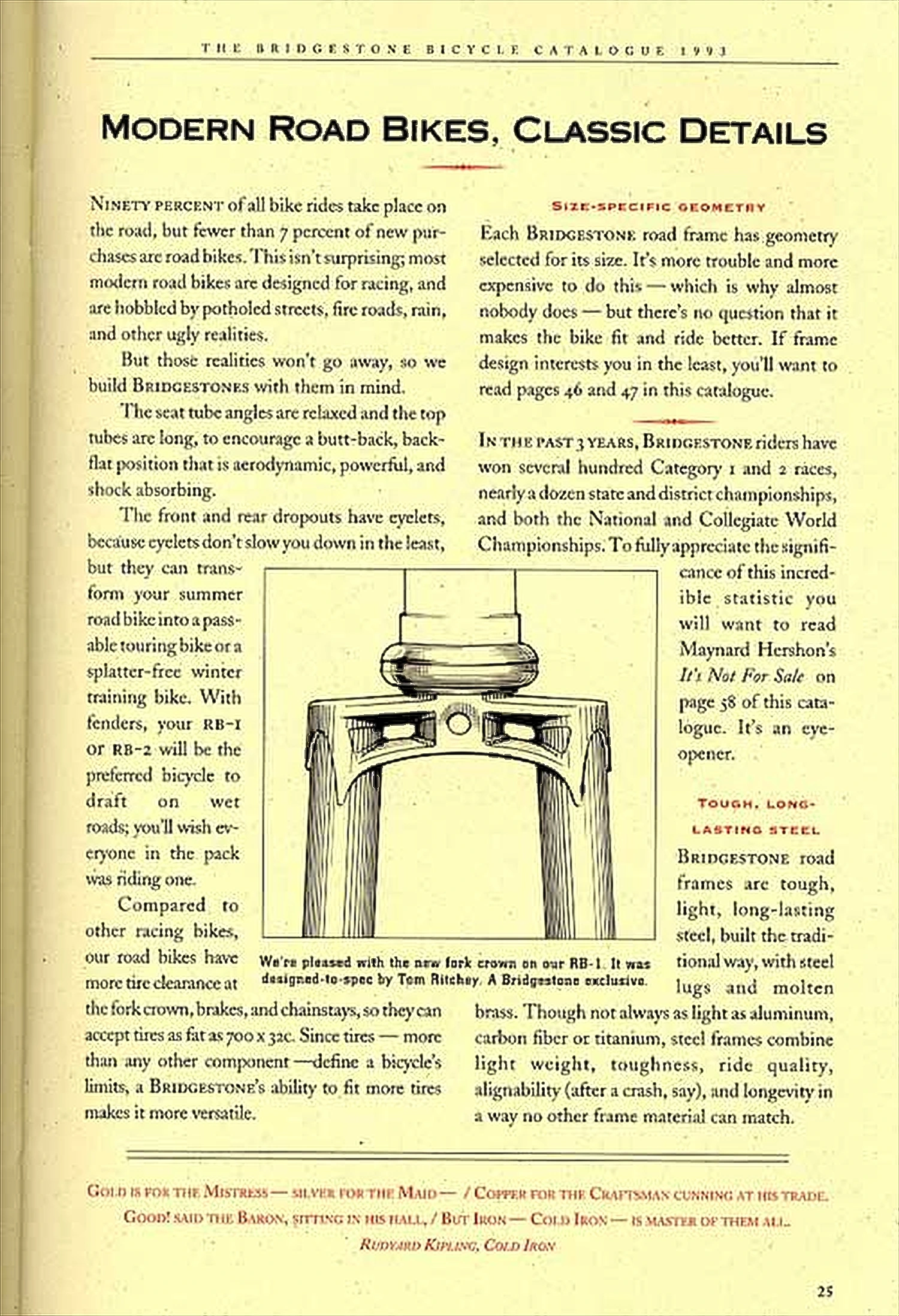
This year we make an RB-1/7, a red 14-speed model with seven rear cogs, and an RB-1/8 — a yellow 16-speeder with eight.
At first glance they both appear to be full Shimano Ultegra bikes; but $200-plus separates them, and our product manager definitely favors the less expensive RB-1/7. (Most contemporary cyclists, however, are sure to prefer the full-clicker RB-1/8.)
The component differences are:
• BRAKES. RB-1/7…SunTour Superbe Pro, the last of the traditional, lightweight sidepulls, with the smart combination of a barrel adjuster and a caliper-mounted quick-release. RB-1/8…Ultegra STI. They work great, but they’re heavy.
• SHIFTERS. RB-1/7…Shimano handlebar-end shifters. The only style of handlebar-mounted shifter with a friction option. RB-1/8…Ultegra STI. Fast and convenient. No friction option.
SunTour Superbe Pro sidepulls are the last of the classically-styled sidepulls. Get ’em while you can; no brakes are better.
TECHNICAL DATA
Sizes: 50, 53, 54.5, 56, 57.5, 59, 62cm
Frame Construction: Brazed, Lugged
Bike Weight: RB1/7, 23.0 lb. (56cm); RB1/8, 23.3 lb. (56cm)
Made In: Japan
UPGRADES FROM RB-2
Seamless tubing
Higher-grade parts overall
172.5 mm cranks in mid-sizes
Nicer fork crown
Two additional sizes (54.5 and 57.5cm)
TYPICAL PRICE RANGE
RB1/7, $1,175 – $1,250
RB1/8, $1,420 – $1,475
26
[The RB-1 model page: a color drawing of a red road bicycle with yellow-walled tires and “RB-1” and “Bridgestone” lettered on the frame, the headline “Which side are you on?” above it, a drawing of a sidepull brake at the lower left, and three ruled boxes for technical data, upgrades from the RB-2 and the typical price range, the last with a drawing of a pointing hand.]
— Page 28 —
THE BRIDGESTONE BICYCLE CATALOGUE 1993
RB-1, continued
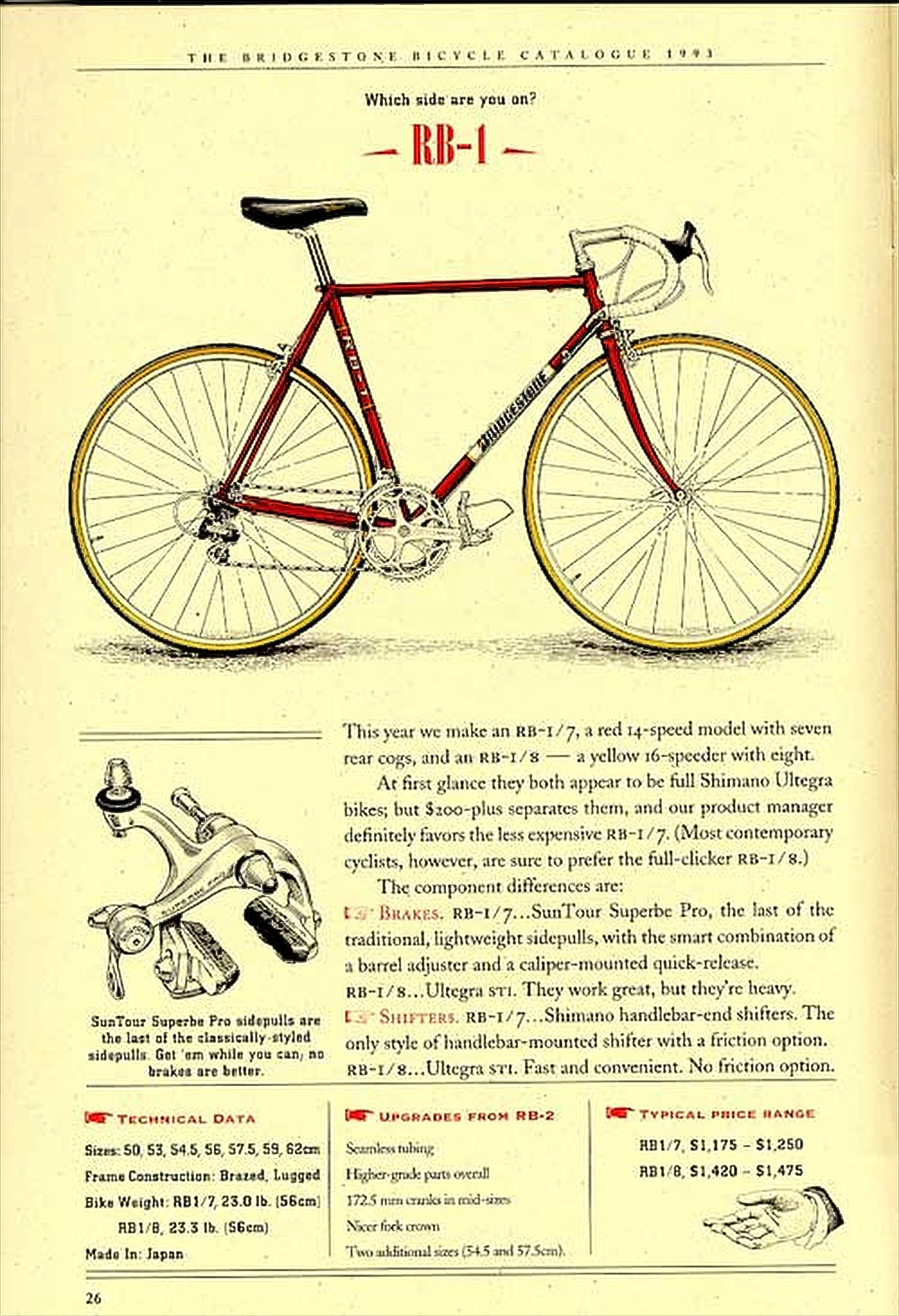
• REAR HUB. RB-1/7…Shimano 105 with 126mm overlocknut. (Ultegra with 126mm overlocknut has been discontinued.) RB-1/8…Ultegra 8-speed with 130mm overlocknut.
• TIRES. RB-1/7…Ritchey Road Force 700 x 28c — 220g. We use these on fast training rides and fire roads. Good tires! RB-1/8… Superclincher 700 x 25c — 200g. These look like a Vittoria tubular and are light enough and fast enough to race. Everyone on the starting line will think you’re on tubulars.
• PEDALS. RB-1/7…MKS traditional, aluminum track pedals. They’re light, durable, easily serviced, and compatible with any shoes. The toe straps are Keirin-approved for Japanese pro track racing. Surely a few of you recall Binda “EXTRA” toe straps; these are as good — and if you don’t want them, we’ll buy unused ones back for $4. Just send them in a padded envelope marked “TOE STRAP BUY-BACK.” Checks mailed once per month.
RB-1/8…Shimano Ultegra clipless.
• IF YOU WANT the lighter, more versatile bike with classical details, get the red RB-1/7. If you want the latest, get the yellow RB-1/8. In either case, you’ll get the best-designed, best-riding production bike we know how to build.
• COLORS: Red (7) or Yellow (8), with white panel.
• PRODUCTION QUANTITY: 1,000 each.
Is eight enough? The RB-1/8 has a 12-13-14-15-17-19-21-23 cluster. The RB-1/7 lacks a 12.
27
[The second page of the RB-1 spread: a color drawing of a yellow RB-1/8 road bicycle with yellow-walled tires above two columns of notes on its hub, tires and pedals, with a drawing of a rear cluster of eight cogs and a bold caption at the right.]
— Page 29 —
THE BRIDGESTONE BICYCLE CATALOGUE 1993
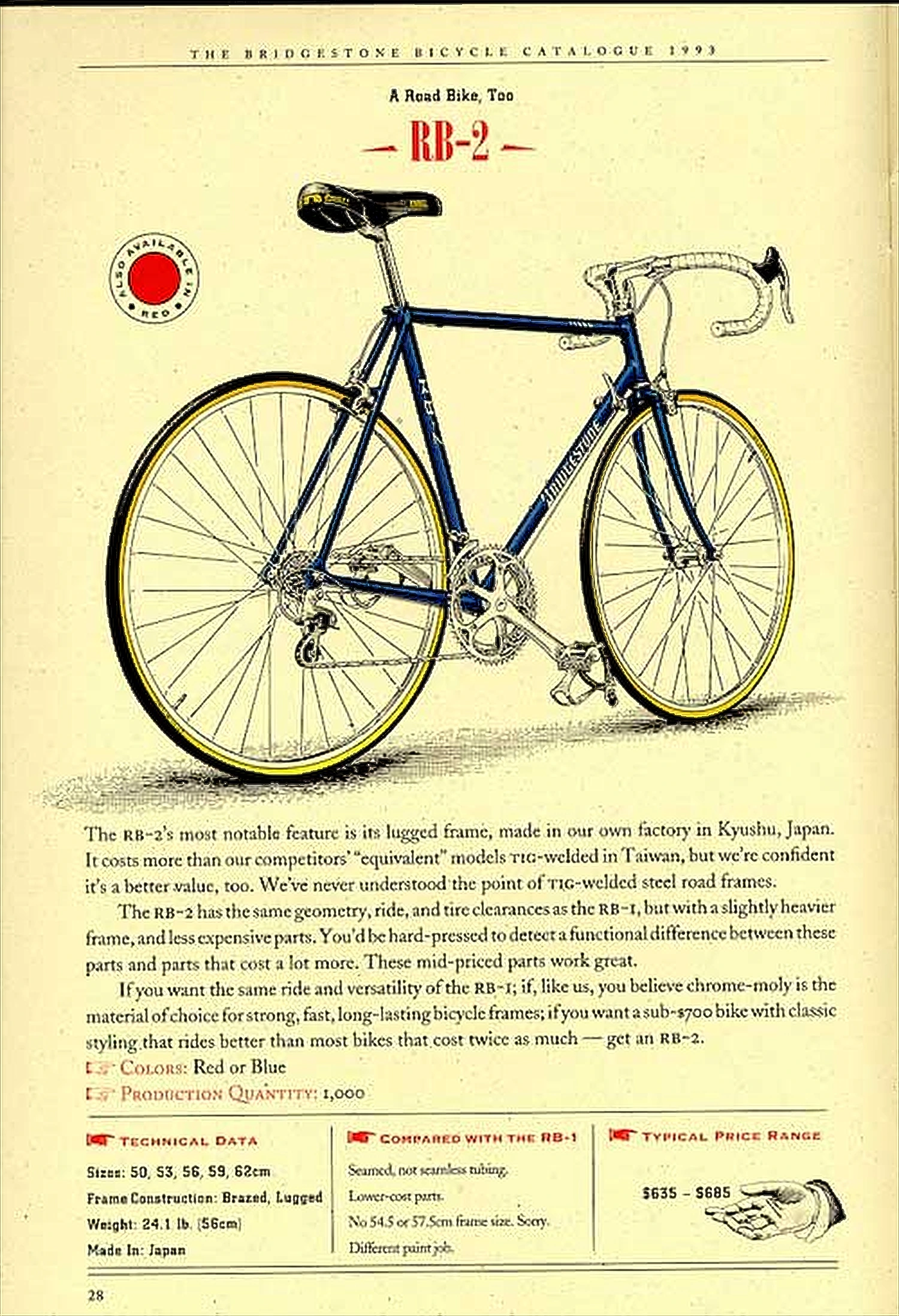
A Road Bike, Too
RB-2
ALSO AVAILABLE IN RED
The RB-2’s most notable feature is its lugged frame, made in our own factory in Kyushu, Japan. It costs more than our competitors’ “equivalent” models TIG-welded in Taiwan, but we’re confident it’s a better value, too. We’ve never understood the point of TIG-welded steel road frames.
The RB-2 has the same geometry, ride, and tire clearances as the RB-1, but with a slightly heavier frame, and less expensive parts. You’d be hard-pressed to detect a functional difference between these parts and parts that cost a lot more. These mid-priced parts work great.
If you want the same ride and versatility of the RB-1; if, like us, you believe chrome-moly is the material of choice for strong, fast, long-lasting bicycle frames; if you want a sub-$700 bike with classic styling that rides better than bikes that cost twice as much — get an RB-2.
• COLORS: Red or Blue
• PRODUCTION QUANTITY: 1,000
TECHNICAL DATA
Sizes: 50, 53, 56, 59, 62cm
Frame Construction: Brazed, Lugged
Weight: 24.1 lb. (56cm)
Made In: Japan
COMPARED WITH THE RB-1
Seamed, not seamless tubing.
Lower-cost parts.
No 54.5 or 57.5cm frame size. Sorry.
Different paint job.
TYPICAL PRICE RANGE
$635 – $685
28
[The RB-2 model page: the headline “A Road Bike, Too” above a color drawing of a blue road bicycle with yellow-walled tires and “RB-2” and “Bridgestone” lettered on the frame, with a red disc in a ring reading “Also available in red”, two paragraphs and three ruled boxes for technical data, a comparison with the RB-1 and the typical price range, the last with a drawing of a pointing hand.]
— Page 30 —
THE BRIDGESTONE BICYCLE CATALOGUE 1993
“Hybrids,” Import Duties, and Us
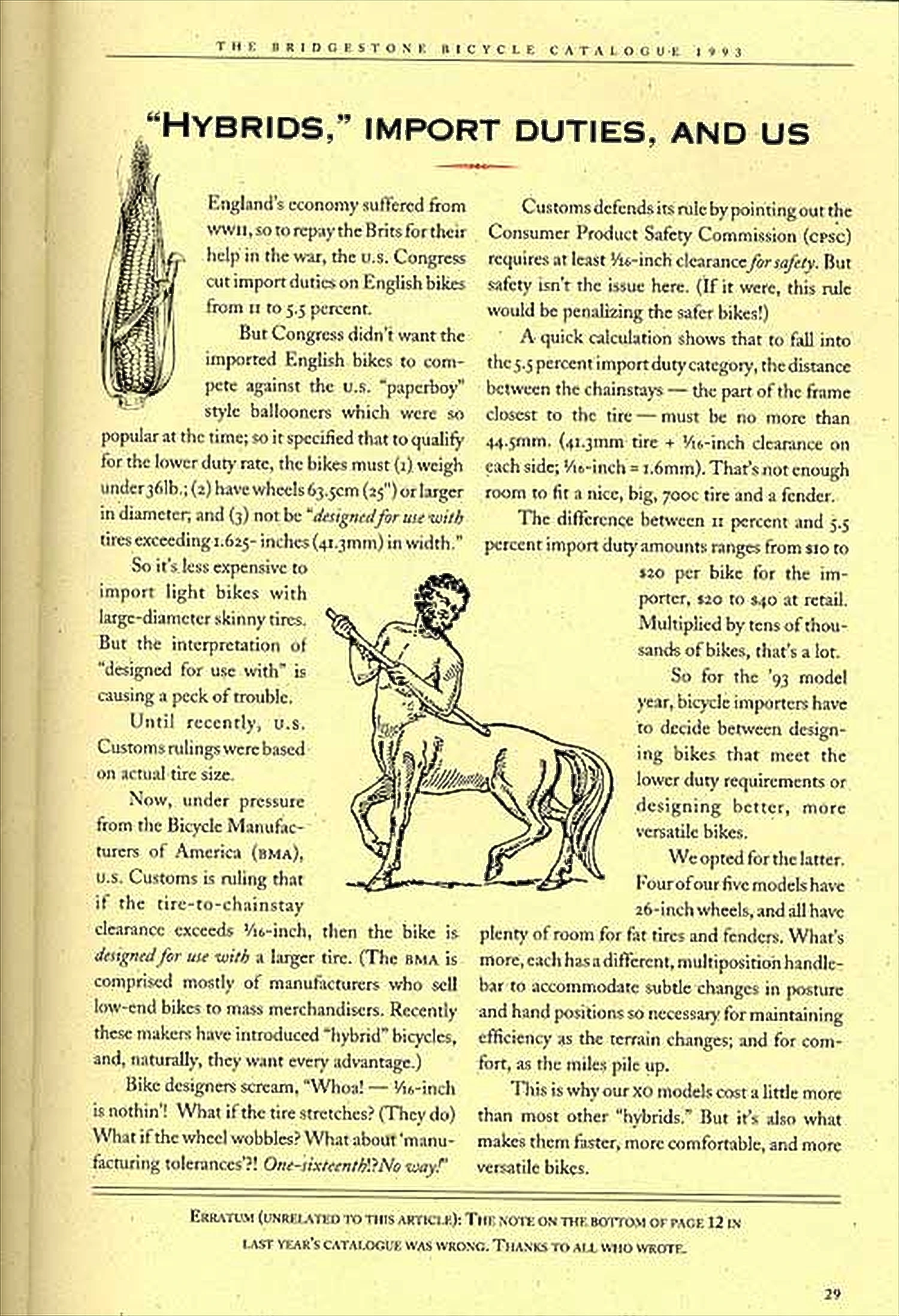
England’s economy suffered from WWII, so to repay the Brits for their help in the war, the U.S. Congress cut import duties on English bikes from 11 to 5.5 percent.
But Congress didn’t want the imported English bikes to compete against the U.S. “paperboy” style ballooners which were so popular at the time; so it specified that to qualify for the lower duty rate, the bikes must (1) weigh under 36 lb.; (2) have wheels 63.5cm (25″) or larger in diameter; and (3) not be “designed for use with” tires exceeding 1.625-inches (41.3mm) in width.
So it’s less expensive to import light bikes with large-diameter skinny tires. But the interpretation of “designed for use with” is causing a peck of trouble.
Until recently, U.S. Customs rulings were based on actual tire size.
Now, under pressure from the Bicycle Manufacturers of America (BMA), U.S. Customs is ruling that if the tire-to-chainstay clearance exceeds 1/16-inch, then the bike is designed for use with a larger tire. (The BMA is comprised mostly of manufacturers who sell low-end bikes to mass merchandisers. Recently these makers have introduced “hybrid” bicycles, and, naturally, they want every advantage.)
Bike designers scream, “Whoa! — 1/16-inch is nothin’! What if the tire stretches? (They do) What if the wheel wobbles? What about ‘manufacturing tolerances’?! One-sixteenth?! No way!”
Customs defends its rule by pointing out the Consumer Product Safety Commission (CPSC) requires at least 1/16-inch clearance for safety. But safety isn’t the issue here. (If it were, this rule would be penalizing the safer bikes!)
A quick calculation shows that to fall into the 5.5 percent import duty category, the distance between the chainstays — the part of the frame closest to the tire — must be no more than 44.5mm. (41.3mm tire + 1/16-inch clearance on each side; 1/16-inch = 1.6mm). That’s not enough room to fit a nice, big, 700c tire and a fender.
The difference between 11 percent and 5.5 percent import duty amounts ranges from $10 to $20 per bike for the importer, $20 to $40 at retail. Multiplied by tens of thousands of bikes, that’s a lot.
So for the ’93 model year, bicycle importers have to decide between designing bikes that meet the lower duty requirements or designing better, more versatile bikes.
We opted for the latter. Four of our five models have 26-inch wheels, and all have plenty of room for fat tires and fenders. What’s more, each has a different, multiposition handlebar to accommodate subtle changes in posture and hand positions as necessary for maintaining efficiency as the terrain changes; and for comfort, as the miles pile up.
This is why our XO models cost a little more than most other “hybrids.” But it’s also what makes them faster, more comfortable, and more versatile.
ERRATUM (UNRELATED TO THIS ARTICLE): THE NOTE ON THE BOTTOM OF PAGE 12 IN LAST YEAR’S CATALOGUE WAS WRONG. THANKS TO ALL WHO WROTE.
29
[A page headed “Hybrids, Import Duties, and Us” in two columns, with a line drawing of an ear of corn at the upper left and a line drawing of a centaur with a staff at the center, and a small erratum note in capitals at the foot.]
— Page 31 —
THE BRIDGESTONE BICYCLE CATALOGUE 1993
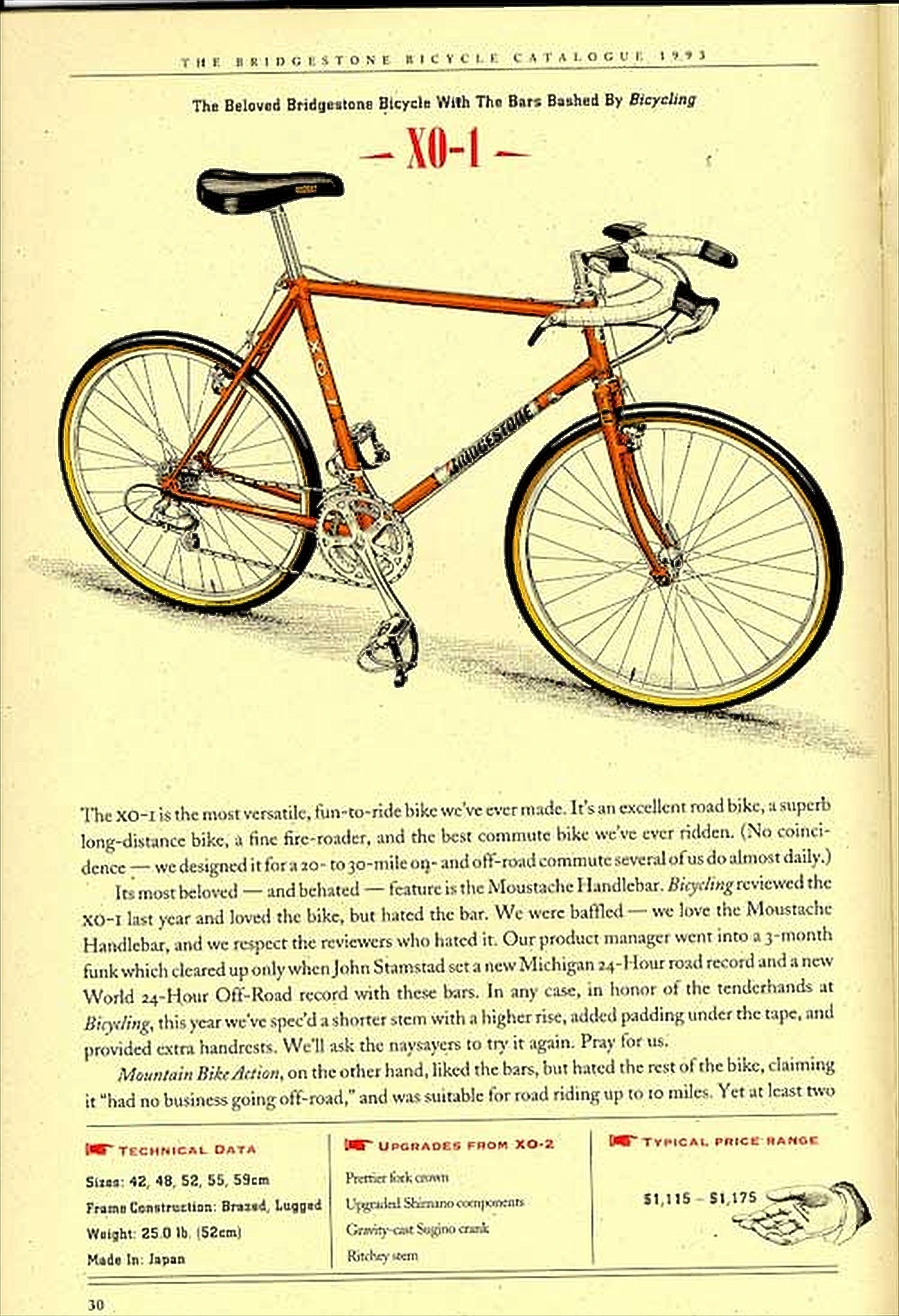
The Beloved Bridgestone Bicycle With The Bars Bashed By Bicycling
XO-1
The XO-1 is the most versatile, fun-to-ride bike we’ve ever made. It’s an excellent road bike, a superb long-distance bike, a fine fire-roader, and the best commute bike we’ve ever ridden. (No coincidence — we designed it for a 20- to 30-mile on- and off-road commute several of us do almost daily.)
Its most beloved — and behated — feature is the Moustache Handlebar. Bicycling reviewed the XO-1 last year and loved the bike, but hated the bar. We were baffled — we love the Moustache Handlebar, and we respect the reviewers who hated it. Our product manager went into a 3-month funk which cleared up only when John Stamstad set a new Michigan 24-Hour road record and a new World 24-Hour Off-Road record with these bars. In any case, in honor of the tenderhands at Bicycling, this year we’ve spec’d a shorter stem with a higher rise, added padding under the tape, and provided extra handrests. We’ll ask the naysayers to try it again. Pray for us.
Mountain Bike Action, on the other hand, liked the bars, but hated the rest of the bike, claiming it “had no business going off-road,” and was suitable for road riding up to 10 miles. Yet at least two
TECHNICAL DATA
Sizes: 42, 48, 52, 55, 59cm
Frame Construction: Brazed, Lugged
Weight: 25.0 lb. (52cm)
Made In: Japan
UPGRADES FROM XO-2
Prettier fork crown
Upgraded Shimano components
Gravity-cast Sugino crank
Ritchey stem
TYPICAL PRICE RANGE
$1,115 – $1,175
30
[The XO-1 model page: the headline “The Beloved Bridgestone Bicycle With The Bars Bashed By Bicycling” above a color drawing of an orange bicycle with Moustache handlebars, white bar tape and yellow-walled tires, “XO-1” and “Bridgestone” lettered on the frame, two paragraphs of text and three ruled boxes for technical data, upgrades from the XO-2 and the typical price range. The text continues on page 32.]
— Page 32 —
THE BRIDGESTONE BICYCLE CATALOGUE 1993
XO-1, continued
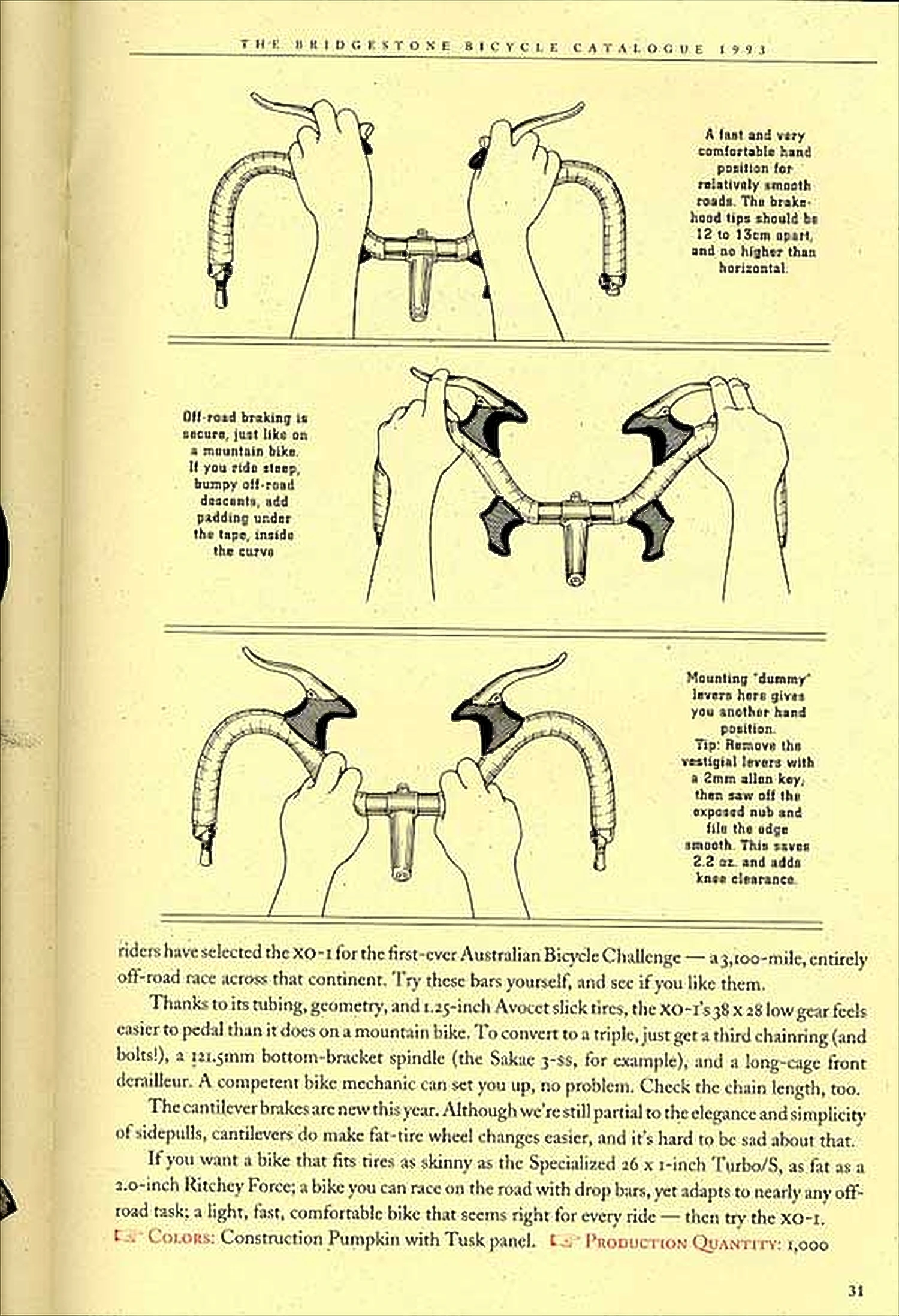
A fast and very comfortable hand position for relatively smooth roads. The brake-hood tips should be 12 to 13cm apart, and no higher than horizontal.
Off-road braking is secure, just like on a mountain bike. If you ride steep, bumpy off-road descents, add padding under the tape, inside the curve.
Mounting “dummy” levers here gives you another hand position. Tip: Remove the vestigial levers with a 2mm allen key, then saw off the exposed nub and file the edge smooth. This saves 2.2 oz. and adds knee clearance.
riders have selected the XO-1 for the first-ever Australian Bicycle Challenge — a 3,100-mile, entirely off-road race across that continent. Try these bars yourself, and see if you like them.
Thanks to its tubing, geometry, and 1.25-inch Avocet slick tires, the XO-1’s 38 x 28 low gear feels easier to pedal than it does on a mountain bike. To convert to a triple, just get a third chainring (and bolts!), a 121.5mm bottom-bracket spindle (the Sakae 3-ss, for example), and a long-cage front derailleur. A competent bike mechanic can set you up, no problem. Check the chain length, too.
The cantilever brakes are new this year. Although we’re still partial to the elegance and simplicity of sidepulls, cantilevers do make fat-tire wheel changes easier, and it’s hard to be sad about that.
If you want a bike that fits tires as skinny as the Specialized 26 x 1-inch Turbo/S, as fat as a 2.0-inch Ritchey Force; a bike you can race on the road with drop bars, yet adapts to nearly any off-road task; a light, fast, comfortable bike that seems right for every ride — then try the XO-1.
• COLORS: Construction Pumpkin with Tusk panel.
• PRODUCTION QUANTITY: 1,000
31
[The second page of the XO-1 spread: three pen drawings of a pair of hands gripping a drop handlebar in three positions, each with a bold caption, above the last paragraphs of the XO-1 text.]
— Page 33 —
THE BRIDGESTONE BICYCLE CATALOGUE 1993
A Versatile Bike With Comfortable Tires and Drop Handlebars
XO-2
At first glance this year’s XO-2 looks like a road bike with fat tires, a European-style touring bike, or maybe an XO-1 with drop bars and a triple crank. Our intention, though, was to make a 26-inch-wheel version of last year’s 700c-wheel BRIDGESTONE RB-T.
The XO-2 has road bike tubing and the same frame design as our XO-1 and XO-3. It’s fast on the road, stout enough for light trail riding, and perfect for touring. The drop-style handlebars are flared outwards for added comfort and wrist clearance on out-of-the-saddle climbs or sprints.
The Nitto (brand) Dynamic (model) stem holds the bars higher than a standard road stem does, so you get the different hand positions of drop bars without having to lean over low and reach.
For fast road rides, mount skinnier tires. For fire trails, fit a mid-sized knobby, up to 1.9-inches. For all-around riding or touring, ride the XO-2 stock.
• COLOR: Metallic Purple
• PRODUCTION QUANTITY: 1,500
TECHNICAL DATA
Sizes: 42, 48, 52, 55, 59cm
Frame Construction: Brazed, Lugged
Weight: 25.5 lb. (52cm)
Made In: Japan
DIFFERENCES FROM XO-1
Drop bars (works with handlebar bags)
Triple crank
Fatter tires — 26-inch x 1.4″ Tom Slick
Less expensive fork crown
TYPICAL PRICE RANGE
$820 – $875
32
[The XO-2 model page: the headline “A Versatile Bike With Comfortable Tires and Drop Handlebars” above a color drawing of a purple bicycle with drop handlebars, yellow-walled tires, “XO-2” and “Bridgestone” lettered on the frame, text wrapping around the drawing and three ruled boxes for technical data, differences from the XO-1 and the typical price range, the last with a drawing of a pointing hand.]
— Page 34 —
THE BRIDGESTONE BICYCLE CATALOGUE 1993
Be Sure To Try It With The “Dummy” Levers
XO-3
ALSO AVAILABLE IN RED
The XO-3 is fast on the street because it has road bike geometry and semi-slick tires, and it’s good for longer rides and touring because the Moustache Handlebars offer at least three hand positions. This year we’ve added tandem stoker “dummy” levers — fake brake levers with the handles cut off. They provide a nice handrest if you mount them almost horizontally, on the forward curve, with the tips 12 to 13cm apart. (See page 31.) If this handlebar is too weird for you, you can revert to a flat bar with little hassle and expense — but we urge you to try the stock bars first, as they really are better.
The XO-3 has a lugged, BRIDGESTONE-built, Japanese frame and fork. The fork crown, designed specifically for the XO-2 and XO-3, has sufficient internal clearances to fit a 26-inch tire up to 36mm wide. As with all of our XO bikes, there’s room for fenders.
• COLORS: Dark Metallic Green or Red
• PRODUCTION QUANTITY: 3,000
TECHNICAL DATA
Sizes: 42, 48, 52, 55, 59cm
Frame Construction: Brazed, Lugged
Weight: 26.8 lb. (52cm)
Made In: Japan
UPGRADES FROM XO-4
Lugged, Japanese frame
The fork has a crown
Lighter parts
TYPICAL PRICE RANGE
$625 – $660
33
[The XO-3 model page: a color drawing of a dark green bicycle with Moustache handlebars, “dummy” levers and yellow-walled tires, “XO-3” and “Bridgestone” lettered on the frame, with a red disc reading “Also available in red”, text wrapping around the drawing and three ruled boxes for technical data, upgrades from the XO-4 and the typical price range.]
— Page 35 —
THE BRIDGESTONE BICYCLE CATALOGUE 1993
A Fast, Tough, and Fun-To-Ride All-Rounder
XO-4
ALSO AVAILABLE IN BLUE
The XO-4 is an unusual bike in a price range characterized by clones. The 26-inch x 1.4 Tom Slick tires are fatter and cushier than the tires on most “hybrids.” They weigh just 400g, grip pavement far better, and roll much faster than knobbies and semi-knobbies.
The “Priest” handlebars position your wrists inward — a natural and powerful grip for climbing and sprinting, yet equally comfortable for pedaling easy. There’s room near the stem for another hand position, and if you’d rather ride in a more upright position, just flip the bars upside-up. For anything besides steep, off-road descents, Priest bars beat straight bars all hollow, no contest.
As with every other bike in this catalogue, the XO-4 has top-mount shifters. We like to mount them so the lever travel is nearly vertical. (Side-mounts?)
• COLORS: Dark Red or Royal Blue.
• PRODUCTION QUANTITY: 4,500.
The Priest Handlebar is our very slight modification of a tried, true, comfortable bend.
TECHNICAL DATA
Sizes: 42, 48, 52, 55, 59cm
Frame Construction: TIG Welded
Weight: 26.7 lb. (52cm)
Made In: Taiwan
UPGRADES FROM XO-5
Handlebars are aluminum
More hand positions
Fits wider range of tires
Higher-grade shifters
TYPICAL PRICE RANGE
$500 – $525
34
[The XO-4 model page: a color drawing of a red bicycle with swept-back “Priest” handlebars and yellow-walled tires, “XO-4” and “Bridgestone” lettered on the frame, with a blue disc reading “Also available in blue”, a small drawing of the handlebar and three ruled boxes for technical data, upgrades from the XO-5 and the typical price range.]
— Page 36 —
THE BRIDGESTONE BICYCLE CATALOGUE 1993
Our Most Popular Model
XO-5
The best-designed, best-fitting 700c-wheeled bike we know how to build. The fat (34mm wide), cushy, semi-slick tires roll faster and grip better than bumpier treads; and the short top tube and swept-back, aluminum Arc bars put the grips where you can reach them without leaning and reaching. No other bike in the XO-5’s class has top-mount shifters — the lightest, simplest, most reliable style. Top-mounts let you shift with the “no-brainer” indexing option, or in the more human, less mechanistic “friction” mode — and personally, we think all bikes should offer you this option. Switching the shifters from “index” to “friction” takes one second, and we encourage you to try it.
• COLORS: Metallic Black or Metallic Green
• PRODUCTION QUANTITY: 6,900
Clearance 10.9mm; 34mm Tire Width (labels on the diagram of the chainstay area).
The XO-5 accepts larger, more comfortable tires than most “hybrids.” There’s room for fenders, too.
ALSO AVAILABLE IN BLACK
TECHNICAL DATA
Sizes: 43, 48, 52, 57, 46Lcm
Frame Construction: TIG Welded
Weight: 27.8 lb. (52cm)
Made In: Taiwan
KEY FEATURES
21 gears
CrMo main frame and fork
Aluminum, multiposition handlebars
TYPICAL PRICE RANGE
$400 – $425
35
[The XO-5 model page: the headline “Our Most Popular Model” above a color drawing of a green bicycle with swept-back aluminum handlebars and yellow-walled tires, “XO-5” and “Bridgestone” lettered on the frame, a paragraph of text, a plan drawing of the chainstay area marked with the tire width and clearance beside a black disc reading “Also available in black”, and three ruled boxes for technical data, key features and the typical price range, the last with a drawing of a pointing hand. This page is a larger scan than most in the set.]
— Page 37 —
THE BRIDGESTONE BICYCLE CATALOGUE 1993
Bridgestoneage Mountain Bikes
WE OFTEN HEAR FROM DEALERS — EVEN THOSE WHO VERY MUCH LIKE OUR BIKES — THAT OUR MOUNTAIN BIKES ARE HARDER TO SELL BECAUSE THEIR DIFFERENCES ARE SUBTLE, AND NEED A LOT OF EXPLAINING. TO MAKE THINGS EASIER FOR THEM AND US, HERE ARE OUR THOUGHTS ON…
FRAME GEOMETRY
Compared to a road bike, a mountain bike has a longer wheelbase, more weight, and, of course, fatter tires. We think that, combined with “standard mountain bike geometry,” this slows steering too much, so we compensate with head tube angles that are a degree steeper than normal. This is a difference you’ll appreciate immediately on the trail or street.
TUBING SIZE
In reality, all mountain bike tubes are oversize; they are fatter than the road bike tubes on which they were originally based. Our top tubes and down tubes are the original, 12 percent oversize: 1 1/8-inch top tubes, rather than 1-inch; and 1 1/4-inch down tubes, rather than 1 1/8-inch. (If you prefer metric, the dimensions are 25.4mm, 28.6mm, and 31.8mm.) Many other manufacturers have increased the girth — and, in most cases, the weight — of their tubes. With aluminum, extra-large diameters are necessary to attain sufficient strength and rigidity. With steel, however, the original “oversize” delivers plenty of strength and rigidity, while allowing the frame to remain light and somewhat flexible. This is one reason our bikes ride the way they do and are more comfortable over bumps than other, more vertically rigid mountain bikes.
SHIFTERS
All our mountain bikes have top-mount shifters. Although the latest underarm shifters have improved, they still don’t have a friction option, they still have brake levers attached, and they’re still a handicap when you have cold, stiff thumbs. The humble top-mount shifter still rules the roost here at BRIDGESTONE.
WHAT ABOUT SUSPENSION?
It’s been said that “to a man with a hammer, everything looks like a nail,” and the analogy works with suspension forks, too. If you ride with suspension forks, you’re more likely to see every descent as a speed challenge. They were developed for downhill racing, after all, and they excel at it.
Suspension forks are a hindrance at normal speeds on technical trails, though, where the heavy, soft front end interferes with the delicate front-to-rear weight shifts so necessary for balance and control. And on climbs, we’ve yet to experience its benefits, and for all-around riding, we much prefer regular forks. If you do retrofit a suspension fork onto one of our frames, the head- and seat tube angles lose about a degree and a half each; but the resulting geometry is still within acceptable ranges.
We are still riding and testing bolt-on suspension, and we may have a suspension bike out by Spring 1993. If you’d rather hold off on a fork, try the Allsop stem. It’s good.
In any case, we regard suspension as a technological option, not an advancement. A comfortable frame, puffy tires, and good technique continue to provide enough cushion and a better all-around ride for the majority of riders on the majority of trails.
WE CANNOT GET GRACE FROM GADGETS. — J.B. PRIESTLEY
36
[A page headed “Bridgestoneage Mountain Bikes” with a bordered introduction in small capitals above two text columns with red subheads, a full-width section on suspension and a red epigraph at the foot. No pictures.]
— Page 38 —
THE BRIDGESTONE BICYCLE CATALOGUE 1993
Our Best Mountain Bike
MB-1
This year’s MB-1 embodies everything we hold sacred in a mountain bike. The lugged Japanese frame, built with Ritchey-designed, Tange-made Logic tubing, is equipped with the Ritchey Logic crank, for its cold-forged strength, light weight, and all-important low Q-Factor; Deore XT derailleurs and top-mount shifters, because they work flawlessly and the shifters have a friction option; Ritchey brake levers, for added knuckle clearance if you have big hands and ride your brakes loose; Specialized Ground Control Extreme tires, because they’re a pretty grey and pretty grippy; and a 28-hole Ultegra front hub, for a lighter, faster front wheel. (It’s still plenty strong for off-road rides. Next year, we may go to 28 on the rear wheel, too.)
The highlight of the ’93 MB-1 is our special fork, built around a fork crown Tom Ritchey designed many years ago, and which you can read more about on p. 51. The 20 x 28mm fork blades are more slender than the big mountain bike fork blades you’re used to seeing. This is good; they flex more over bumps than big, fat blades and give a more comfortable ride. (Is it just coincidence that suspension forks so closely followed the appearance of fatter, more rigid mountain bike forks?) For big rocks, fit a 2.35-inch Ritchey or a 2.5-inch Specialized, but for everything else, from fire trails to technical singletracks, the stock MB-1 is perfect.
• COLOR: Pearl Tusk
• PRODUCTION QUANTITY: 1,000
TECHNICAL DATA
Sizes: 38, 42, 46, 49, 52, 55cm
Frame Construction: Brazed, Lugged
Weight: 25.1 lb. (49cm)
Made In: Japan
UPGRADES FROM MB-2
Ritchey crank has lower Q-Factor
Frame 100 percent Logic Prestige
Kevlar-beaded tires are fast and light
Heat-treated stem weighs less
TYPICAL PRICE RANGE
$1515 – $1575
37
[The MB-1 model page: a color drawing of a pearl-colored mountain bicycle with knobby tires with yellow sidewalls, “MB-1” and “Bridgestone” lettered on the frame, two paragraphs of text and three ruled boxes for technical data, upgrades from the MB-2 and the typical price range, the last with a drawing of a pointing hand.]
— Page 39 —
THE BRIDGESTONE BICYCLE CATALOGUE 1993
Down Boy!
MB-2
This bike has the same fork, shift levers, brakes, stem, headset, saddle, and main frame tubing as the MB-1. The only differences in the frame are the seatstays and chainstays — they’re Logic CrMo instead of Logic Prestige CrMo, so they’re marginally heavier. They’re still lighter than standard stays, though.
The Specialized Direct Drive crank is gravity-cast, then forged. It has a relatively low Q-Factor (the distance between the pedals), and the familiar fine finish of all Specialized products. We’re often asked why we use any Specialized parts on our bikes (“You’re just giving them more advertising money…!”). We know that, so you can rest assured we don’t use any Specialized part unless, for the price, nothing else even comes close.
• COLOR: Red
• PRODUCTION QUANTITY: 1,400
The MB-2 fork is shorter than a standard unicrown fork, yet has better tire clearance.
TECHNICAL DATA
Sizes: 38, 42, 46, 49, 52, 55cm
Frame Construction: Brazed, Lugged
Weight: 25.9 lb. (49cm)
Made In: Japan
UPGRADES FROM MB-3
Logic Prestige main tubes
Ritchey-designed fork crown
Specialized crank
Deore XT versus Deore DX parts
TYPICAL PRICE RANGE
$1175 – $1215
38
[The MB-2 model page: a color drawing of a red mountain bicycle seen head-on, with a knobby front tire, two pedals turned toward the viewer and flat handlebars with brake levers, the headline “Down Boy!” and two paragraphs of text beside it, two drawings of fork crowns with a bold caption, and three ruled boxes for technical data, upgrades from the MB-3 and the typical price range.]
— Page 40 —
THE BRIDGESTONE BICYCLE CATALOGUE 1993
Our Third-Best Mountain Bike Keeps Getting Better
MB-3
ALSO AVAILABLE IN SILVER
If you’re looking for a no-nonsense, high-quality mountain bike for well under $1,000, you will do no better than our ’93 MB-3. It has a lugged Japanese frame, Ritchey Logic fork, Dia Compe 986 brakes and SS-5 levers, Shimano DX derailleurs with top-mount shifters, and Ritchey rims and tires. As with all our mountain bikes, we vary the geometry according to size. The relatively steep head tube angle gives you instant control over your bike in all conditions, yet isn’t the least bit twitchy. A good case can be made that the MB-3 is all the mountain bike anyone needs.
A solid, great-handling, long-lasting mountain bike.
• COLORS: Metallic Purple or Silver
• PRODUCTION QUANTITY: 5,000
TECHNICAL DATA
Sizes: 38, 42, 46, 49, 52, 55cm
Frame Construction: Brazed, Lugged
Weight: 27.1 lb. (49cm)
Made In: Japan
UPGRADES FROM MB-4
Ritchey Logic frame tubes
Ritchey Logic fork
Slightly lighter frame
Wheelsmith stainless spokes
TYPICAL PRICE RANGE
$835 – $890
39
[The MB-3 model page: a color drawing of a purple mountain bicycle with knobby tires with yellow sidewalls seen from the front left, “MB-3” in red, a disc reading “Also available in silver”, two paragraphs of text and three ruled boxes for technical data, upgrades from the MB-4 and the typical price range, the last with a drawing of a pointing hand.]
— Page 41 —
THE BRIDGESTONE BICYCLE CATALOGUE 1993
The Least-Expensive Japanese-Built Mountain Bike You Can Buy
MB-4
ALSO AVAILABLE IN DARK GREEN
The MB-4 is the only mountain bike in its price range with a lugged Japanese frame. It also has a fine, gravity-cast, Sugino crank with a low Q-factor; light, strong Dia Compe brakes; Shimano DX top-mount shifters, Ritchey Vantage Expert rims, and a real Tange fork. It is the perfect mountain bike for athletic off-road riding and small-budget racing. It’s not a heavy bike.
As of now (August ’92), we suspect that among mountain bikes at $800 and below, the MB-4 alone will have top-mount shifters. Underarm shifters are improved this year, but we still prefer top-mounts for their light weight, simplicity, reliability, versatility, and ease of use in cold weather.
• COLORS: Metallic Dark Green or Metallic Light Blue
• PRODUCTION QUANTITY: 4,500
Lugged frame detail
TECHNICAL DATA
Sizes: 38, 42, 46, 49, 52, 55cm
Frame Construction: Brazed, Lugged
Weight: 27.9 lb. (49cm)
Made In: Japan
UPGRADES FROM MB-5
Deore DX shift levers
Lugged Japanese frame
Tange (Japanese) fork
Vantage Expert (box-section) rim
TYPICAL PRICE RANGE
$725 – $775
40
[The MB-4 model page: a color drawing of a light blue mountain bicycle with knobby tires with yellow sidewalls, “MB-4” in red, a disc reading “Also available in dark green”, two paragraphs of text, a small drawing of a lugged head-tube joint and three ruled boxes for technical data, upgrades from the MB-5 and the typical price range, the last with a drawing of a pointing hand.]
— Page 42 —
THE BRIDGESTONE BICYCLE CATALOGUE 1993
Our Fifth-Best Mountain Bike Also Keeps Getting Better
MB-5
ALSO AVAILABLE IN PEARL WHITE
Most buyers in this price range are buying their first or second mountain bike, and may not have the experience to appreciate the MB-5’s technical subtleties. If you’re new to mountain bikes, for example, and you see that the MB-5 is virtually the only mountain bike in this price range that has top-mount shifters — well, the doubts come easy, don’t they? We prefer top-mount shifters because (1) they’re lighter; (2) they have a friction option, and are therefore compatible with all drivetrain components, from any manufacturer; (3) they are not molded to the brake lever, so you can position them separately; and (4) if you crash and break your brake levers, you don’t have to replace your shifters, too. If we didn’t think this was important, we wouldn’t repeat it ad nauseum.
Most of the MB-5’s competitors have indexed front shifting. We’ve refrained from this because modern front shifting is so good already, it makes little sense to further automate it with indexing — at the cost of adjustability, and interchangeability with other shifters and cranks.
But the MB-5 offers more than just top-mount shifters and non-indexed front shifting. It’s one of the few bikes in its range with aluminum chainrings — saving about eight ounces over steel — and it has the same fine ride as our MB-1.
• COLORS: Pearl White or Dark Blue
• PRODUCTION QUANTITY: 5,500
Shimano Deore DX top-mount shifters keep shifting simple.
Magnets don’t lie — the MB-5 has aluminum chainrings.
TECHNICAL DATA
Sizes: 38, 42, 46, 49, 52, 55, 58cm
Frame Construction: TIG Welded
Weight: 28.1 lb. (49cm)
Made In: Taiwan
UPGRADES FROM MB-6
Aluminum chainrings
Deore DX shift levers
Toe clips and straps
Higher grade derailleurs
TYPICAL PRICE RANGE
$535 – $560
41
[The MB-5 model page: a color drawing of a blue mountain bicycle seen from directly above, with flat handlebars, a saddle and two pedals, text to its right, a disc reading “Also available in pearl white”, two small drawings (a top-mount shift lever and a hand holding a magnet to a chainring) with bold captions, and three ruled boxes for technical data, upgrades from the MB-6 and the typical price range, the last with a drawing of a pointing hand.]
— Page 43 —
THE BRIDGESTONE BICYCLE CATALOGUE 1993
Even Our Sixth-Best Mountain Bike Keeps Getting Better
MB-6
ALSO AVAILABLE IN GREEN
This is the least-expensive, high-quality mountain bike we can make. The frame and fork are all CrMo tubing; the wheels have Araya aluminum rims, Ritchey Force tires and stainless spokes, and the Shimano components work as well as everyone says they do. But what truly sets the MB-6 apart from other mountain bikes in its price range are the top-mount shifters (which we’ve already praised enough in this catalogue) and the size-specific frame design. The only glaring concessions to price are the plastic shift levers — you don’t get metal ones at this price anywhere — and the plastic, toe-clipless pedals. If you ride off-road, by all means spend another $10 and get clips and straps. Don’t worry about the plastic shifters; they work fine, or we wouldn’t have spec’d them.
• COLORS: Metallic Green or Dark Red
• PRODUCTION: 9,000
Top-mount shifters are simple and versatile.
Ritchey Force tires grip dirt and roll fast on streets.
TECHNICAL DATA
Sizes: 38, 42, 46, 49, 52, 55cm
Frame Construction: TIG Welded
Weight: 28.3 lb. (49cm)
Made In: Taiwan
KEY FEATURES
Top-mount shifters
Size-specific geometry
All CrMo frame and fork
TYPICAL PRICE RANGE
$435 – $455
42
[The MB-6 model page: a color drawing of a red mountain bicycle with knobby tires with yellow sidewalls, “MB-6” in red, a disc reading “Also available in green”, a paragraph of text, two small drawings (a top-mount shift lever and a tire tread) with bold captions, and three ruled boxes for technical data, key features and the typical price range, the last with a drawing of a pointing hand.]
— Page 44 —
THE BRIDGESTONE BICYCLE CATALOGUE 1993
The Bike America Needs
le BUBster
This is a 6-speed utility bike, designed and perfected for shopping, running errands, short commutes, and fun, low-intensity rides. BUB’s high stem, upright bars, and fat, mattress-style saddle position you upright and comfortably, with the top-mount shifter within easy reach; and its smooth, fat tires grip the street and roll fast and quietly. The wheels have high-quality aluminum Japanese hubs and are attached with nuts, not quick-releases, so they’re less tempting to thieves.
The Priest handlebars are the same as those on our MB-4, but flipped upright. They offer a comfortable, powerful, wrist-inwards grip that will spoil you right off the bat. (And they’re aluminum, not steel — unheard of at this price!) The rear-mounted kickstand provides triple the stability of standard kickstands, and it doesn’t squish the chainstays when you clamp it on. We’ve packed as much quality as we could into this simple 6-speeder.
It comes in only two sizes, 43 and 50cm, but with the high stem, upright bars, and long seat post, there’s enough adjustability to fit most riders from 5-foot, 2-inches to about 6-foot, 1-inch tall.
• COLORS: Dark Blue
• PRODUCTION: 1,000
BUBBY’s Hub: Sansin (Japanese) aluminum, with theft-discouraging nuts.
TECHNICAL DATA
Sizes: 43cm L, 50cm standard
Frame Construction: TIG Welded
Weight: 27.4 lb. (50cm)
Made In: Taiwan
KEY FEATURES
Aluminum rims
Nice, aluminum handlebars
Fits 26-inch tires
Easy to shift
TYPICAL PRICE RANGE
$320 – $350
43
[The BUB model page: a color drawing of a dark blue utility bicycle with upright handlebars, fenders, a rear kickstand and yellow-walled tires, “BUB” and “Bridgestone” lettered on the frame, the headline “The Bike America Needs” above the name “le BUBster”, text with a small drawing of a front hub and a bold caption, and three ruled boxes for technical data, key features and the typical price range, the last with a drawing of a pointing hand.]
— Page 45 —
THE BRIDGESTONE BICYCLE CATALOGUE 1993
Our First Poster
SADDLE UP ON A BRIDGESTONE
A HORSE OF A DIFFERENT COLOR
TOKYO, JAPAN SAN LEANDRO, USA
THE BRIDGESTONE BICYCLE POSTER FOR 1993, CREATED BY ENGLISH ARTIST CHRISTOPHER WORMELL. CHRISTOPHER CARVES IMAGES INTO BLOCKS OF LINOLEUM, CUTTING A DIFFERENT BLOCK FOR EACH COLOR, THEN PRINTING THE IMAGE BY HAND DIRECTLY ONTO PAPER. THIS PARTICULAR PRINT WAS MADE FROM SEVEN LINOLEUM BLOCKS, EACH CAREFULLY PRINTED OVER THE NEXT. REPRODUCTIONS AT 24 INCHES X 36 INCHES AVAILABLE FOR $5. ASK FOR ONE AT YOUR DEALER OR SEND CHECK TO: BRIDGESTONE CYCLE – POSTER, 15021 WICKS BL., SAN LEANDRO, CA 94577
44
[A page headed “Our First Poster” showing the 1993 poster in a black frame: a linocut print in blue, red, orange and yellow of a racing cyclist in a blue jersey and white cap bent over the handlebars of a road bicycle, with the galloping heads and legs of brown and orange horses behind and around, and the lettering “Saddle up on a Bridgestone, a horse of a different color, Tokyo, Japan, San Leandro, USA” across the sky at the top.]
— Page 46 —
THE BRIDGESTONE BICYCLE CATALOGUE 1993
BY OWEN MULHOLLAND
The Bicycle Poster
TODAY, just over a hundred years after the first outbreak of international bicycle fever, it is difficult to appreciate the early sense of liberation the masses must have felt upon riding a bike for the first time. The proliferation of bicycle poster art provides a clue, though.
From 1890 until World War I, scores of the western world’s finest artistic talent attempted to depict the gush of excitement cycling created. Of course, there was a commercial element — in those pre-TV days, posters were a popular form of advertising. Yet a review of those old posters reveals little of the attention to the details we expect today. Often the bicycle is only partly visible, sometimes it is incomplete, and some brave manufacturers showed no bicycle at all.
The most successful bicycle posters were invariably simple, original, strikingly colorful, and — gratefully — sans ad hype. The great ones had subtler elements, often mythological or allegorical, and the references weren’t lost on the well-educated populace of the time.
A “Liberator” poster, for example, shows a Rubenesque woman dressed as a Norse goddess, bicycle in one hand, enormous broadsword in the other, standing resolutely before a wind which spreads her tresses across the background.
Then there were the “missing link” posters, which were more puzzling, and required you to use your imagination to interpret. In one, a nude woman representing Truth, is seated before a well from which protrudes a chainwheel and chain. The message, I suppose, is something like “You must dig to get the truth”; or “The freshness of well-water is like the freshness (and truth) of cycling.” (Whaaa? — Ed.)
It was the French who first termed the bicycle, “la petite reine,” (the little queen), the association of bicycles with femininity has been close (at least for French men) ever since. Women appeared far more often than men, were out in front in any cycling scenes, and frequently were naked. It has been often said that English and American women are offended if they are considered sex objects and French women are offended if they are not.
These posters hint at why the two sides have difficulty communicating on the subject and how cycling can open windows to worlds beyond the immediately obvious.
Bicycle poster art is not dead. But when we have to include in any discussion of “recent” bicycle posters David Lance Goines’ 1970 poster for Berkeley, California’s Velo Sport Bike Shop (showing a steam train between two cyclists), isn’t it time for a renaissance?
Certainly, as long as people ride bicycles the inspiration will not be lacking.
Owen Mulholland is a cyclist, schoolteacher, and freelance writer from Marin County, Ca.
In this poster for Columbia bicycles, the parrot is saying to the monkey “We are having a heavenly time!”
45
[A page headed “The Bicycle Poster”, by Owen Mulholland, in two columns around a black and white reproduction of an old Columbia Bicycle poster: a monkey and a parrot riding one bicycle down a mountain road past a signboard lettered “Columbia Bicycle”, with a small line of lettering at the foot of the print, and a bold caption beneath it.]
— Page 47 —
THE BRIDGESTONE BICYCLE CATALOGUE 1993
Frame Geometry 101
FRAME GEOMETRY REFERS TO THE LENGTHS OF THE FRAME TUBES AND THE ANGLES AT WHICH THEY INTERSECT, AND IT’S THE MOST INFLUENTIAL FEATURE OF YOUR BIKE’S HANDLING QUALITIES. MOREOVER, FRAME GEOMETRY IS EASY TO UNDERSTAND, EVEN IF YOU DID POORLY IN HIGH SCHOOL MATH. BELOW WE’LL DESCRIBE MOST OF THE DESIGN VARIABLES SEPARATELY, BUT KEEP IN MIND THAT THEY HAVE A COMBINED EFFECT.
Top Tube; Seat Tube Angle; Head Tube Angle; Fork Offset; Hanger Drop; Front Center; Chainstay Length; Trail (labels on the frame diagram).
• SEAT TUBE ANGLE… affects your weight distribution, which affects balance and control; it also affects the angle between your thighs and torso when you pedal, which affects how efficiently your muscles work.
The conventional wisdom states that the seat tube angle is correct when, with the cranks horizontal and your foot properly placed on the pedal, the bump just below your knee is more or less above the center of the pedal. Insofar as this is true, long-thighed riders need shallower seat tubes than riders who have short thighs.
• HEAD TUBE ANGLE… affects how quickly the bike responds to steering input, how stable it remains when it hits a bump or pothole, and weight distribution. Road bikes have steeper head tubes than mountain bikes, and bikes designed for events that demand quick reactions (e.g., criteriums or track events) have steeper head tubes still.
• FORK OFFSET… affects front-center, wheelbase, weight distribution, and in conjunction with head tube angle and tire size, “trail” (explained on the next page).
Most forks are offset by bending the blades, but a few modern makers simply offset the fork
46
[A page headed “Frame Geometry 101” with a bordered introduction in small capitals, a large line drawing of a bare steel road frame and fork labeled with the tube lengths and angles, with a red circle through the front wheel marking the trail and fork offset, and two text columns with red run-in heads. The text continues on page 48.]
— Page 48 —
THE BRIDGESTONE BICYCLE CATALOGUE 1993
Frame Geometry 101, continued
blades at the crown and keep the blades straight. This doesn’t affect handling, it probably affects shock absorption, and we can state in no uncertain terms that it makes traditionalists wince.
• TRAIL… is the distance between the point at which the tire contacts the ground and the imaginary point at which the head tube angle intersects it. Most road bikes have between 1 3/4 and 2 1/2 inches of trail; most mountain bikes have from 2 3/4 to 3 inches. More trail makes the bike easier to control at high speed and over bumps, but harder to control at low speeds.
With any given head tube, decreasing the fork offset increases trail; increasing the fork offset reduces it. (It’s hard to follow this without a diagram, which is why we’ve provided one.) In any case, it still takes a few weeks to absorb the concept of trail, so don’t be discouraged if you don’t fully comprehend it right off the bat.
• TOP TUBE LENGTH… along with seat tube angle and stem extension, determines the horizontal distance between the saddle and handlebars. This distance, in turn, affects weight distribution, the inclination of your torso as you pedal, and the workings of your muscles affected by these relationships. (For example, your butt muscles contribute more when your torso is below 45 degrees to horizontal than when it’s nearly vertical. That’s why track riders, criterium racers, and speed skaters generally have strong butts.)
• CHAINSTAY LENGTH… affects weight distribution, comfort, and traction. Long chainstays position the wheel farther behind you, improving comfort at the cost of traction. Short chainstays position the rear wheel more underneath you, improving traction at the cost of comfort.
• HANGER DROP… is the distance between the center of the wheels and the center of the bottom bracket (the “hanger”). It works in conjunction with wheel diameter to determine bottom-bracket height, which in turn affects chainwheel clearance over logs, and pedal cornering clearance. Conventional wisdom states that a lower bottom bracket makes bikes descend better, and we agree.
• FRONT-CENTER… the distance from the bottom bracket to the front dropout, is determined by the seat tube angle, top tube length, head tube angle, and fork offset. It influences weight distribution and pedal clearance at the front wheel. Some builders let front-center fall into place as a result of these dimensions; others “build to front-center,” determining one of the other dimensions by default.
• WHEELBASE… is the distance between the front and rear axles. Shorter wheelbases make a bike react faster; longer wheelbases add comfort and stability. Most frame designers specify the other aspects of the geometry first, and let the wheelbase fall where it may.
DESIGNING A FRAME IS EASY
If you would like simple instructions to help you design a stick-figure frame, send an SASE to the address listed on the back cover of this catalogue, attention: frame design. This process will teach you the variables and limitations all frame designers must work with — lessons which you can learn no other way. For example, you will learn why it’s hard to design a good small frame with large wheels; and how seat tube angle affects “effective” top tube length. You’ll need only simple tools, and graph paper.
47
[The second page of the frame geometry primer, in two text columns with red run-in heads and no pictures, with a bordered box across the foot headed “Designing a Frame is Easy” in three columns of small type.]
— Page 49 —
THE BRIDGESTONE BICYCLE CATALOGUE 1993
Investment Casting
“CASTING” — POURING LIQUID INTO A MOLD AND LETTING IT HARDEN — WAS DEVELOPED BY THE GREEKS 2,500 YEARS AGO (IN THE DAYS OF PERICLES, THE RENOWNED STATESMAN UNDER WHOSE TUTELAGE ATHENS REACHED ITS “ZENITH”!). INVESTMENT CASTING, OR “LOST WAX” CASTING, IS A VARIATION WHOSE FUNDAMENTAL DIFFERENCE IS ILLUSTRATED ON THE FACING PAGE. IT’S A POPULAR WAY TO MAKE JEWELRY AND EXPENSIVE BIKE FRAME FITTINGS, AMONG OTHER THINGS. ITS ADVANTAGES ARE:
1. ACCURACY
The casting will be as correct as your mold. With modern technology, creating an accurate mold is easy.
2. CONSISTENCY
With a good mold and good technique, you can pop out clone after clone, stabilizing quality.
3. EXPEDIENCY
The casting looks fine right out of the mold. After heat-treatment and minor machining, it’s ready.
4. BRAZEABILITY
The close tolerances possible make brazing easier, particularly with low-temperature silver braze.
Castings are grainless, like a brick or a Presto log, so they tend to be brittle — although proper heat-treatment can restore some of the ductility. And some metals tend to “freeze up” in long, skinny sections; so investment castings tend to have simple low-risk designs.
Investment casting saves finishing labor, an attribute that helps offset the mold cost. But many craftspeople — in all fields — shun investment-castings; regarding them as affordable, imitation art for the masses.
Investment-castings do make nice bicycle frame parts, though.
48
[A page headed “Investment Casting” with a bordered introduction in small capitals, a row of four numbered red discs over four short columns on the advantages of the process, and a text column ruled on both sides below. The process diagram is on the facing page.]
— Page 50 —
THE BRIDGESTONE BICYCLE CATALOGUE 1993
Investment Casting in 8 Easy Steps
STEP NO. 1
Make a metal mold, then pour wax into it to make replicas.
STEP NO. 2
Hang the wax fakes onto a “tree,” so you can…
STEP NO. 3
…dip them all into a ceramic batter until…
STEP NO. 4
…a porous, heat-resistant crust forms.
STEP NO. 5
Then heat the wax and let it drain out a hole.
STEP NO. 6
Turn the molds upside down (rightside-up?)…
STEP NO. 7
…and pour in the molten metal — CrMo, in the case of this fork crown. When it has set…
STEP NO. 8
…break off the crust and inspect your castings for voids, where the metal may not have flowed.
Remove the castings, heat treat to restore ductility (see Heat-treatment at Home, in next year’s catalogue). Machine the new parts as necessary.
49
[A page headed “Investment Casting in 8 Easy Steps”: eight small line drawings in three rows, each with a red step heading and a bold caption: a two-part metal mold with a wax crown, a “tree” of wax crowns hung on a hook, the tree dipped in ceramic batter, the tree coated with a crust, a heater draining wax from a mold, the mold turned over, molten metal poured from a ladle into the mold, and the broken crust and the finished castings.]
— Page 51 —
THE BRIDGESTONE BICYCLE CATALOGUE 1993
Our New Mountain Bike Fork
ELEVEN YEARS AGO TOM RITCHEY DESIGNED A MOUNTAIN BIKE FORK CROWN WHICH INCLUDED ALL THE FUNCTIONAL AND AESTHETIC QUALITIES HE VALUED. ALTHOUGH HE TESTED IT EXTENSIVELY AND RODE IT HARD, THIS CROWN WAS NEVER PRODUCED IN QUANTITY BECAUSE OF THE COST AND HASSLE OF DEALING WITH SUBCONTRACTORS (THE CASTING HOUSES). THIS LEAD HIM TO PIONEER THE MOUNTAIN BIKE UNICROWN FORK.
50
[A page headed “Our New Mountain Bike Fork” with a very large line drawing of a fork crown with the steerer tube above it and the two fork blades, signed Retseck, and a short introduction in small capitals at the foot. The article continues on page 52.]
— Page 52 —
THE BRIDGESTONE BICYCLE CATALOGUE 1993
Our New Mountain Bike Fork, continued
WE LIKE FORK CROWNS, so last year we asked Tom to design one for a mountain bike. He said he already had, told us the story of it, and sent us a fork to ride built with this crown. We rode it on all kinds of terrain, comparing it to the best standard forks and the most popular suspension forks. We could hardly tell any difference; and since it had the most beautiful crown we’d seen, we wanted a fork just like it on our top mountain bikes. Tom had lost his original drawing, so a new drawing was made from measurements taken from an existing crown. A new crown was investment-cast, thoroughly tested, and is now ready to go.
This fork has several advantages over traditional forks:
ONE
It’s shorter. The shorter length allowed us to use more slender blades without unduly affecting rigidity or strength. Shorter forks also mean longer head tubes without having to raise the headset and handlebars. In a front-end impact, the longer head tube, combined with the shorter fork blades (shorter lever arm), reduces stress on the down tube.
TWO
It has more tire clearance. The underside of the crown has a large, open radius. The underside of a unicrown fork, on the other hand, crowds the tire much more. To get good tire clearance from a unicrown, you have to increase the length, or bend the blades into a tighter radius. The former increases frame stress; the latter stretches the outer blade radius thin, weakening it.
THREE
It rides better over bumps. The slender blades deflect more, absorbing shocks better than chunky fork blades do.
It’s possible that the blades will flex too much for some riders (tastes vary), and some riding conditions. But for all-around riding with a style that emphasizes finesse, we like the ride of this fork over that of any other.
IN RECENT YEARS, many riders have come to equate fork stiffness with steering precision — and in certain conditions a stiffer fork is better. But we strongly believe that a little fork flex helps on most trails. The new MB-1 and MB-2 fork flexes more than most. You will feel it over bumps and while braking hard; but it’s a subtle, high-frequency flex that doesn’t feel the least bit jerky, and doesn’t diminish control. We believe most riders, on all but the rockiest of trails, will “learn” this fork after one ride, and come to prefer it over all others.
WHEN I AM WORKING ON A PROBLEM, I NEVER THINK ABOUT BEAUTY. I THINK ONLY OF HOW TO SOLVE THE PROBLEM. BUT WHEN I HAVE FINISHED, IF THE SOLUTION IS NOT BEAUTIFUL, I KNOW IT IS WRONG. — R. BUCKMINSTER FULLER
51
[The second page of the fork article: an opening paragraph, three red numbered-word columns (“One”, “Two”, “Three”) between ruled lines, a closing paragraph and a red epigraph attributed to R. Buckminster Fuller at the foot. No pictures.]
— Page 53 —
THE BRIDGESTONE BICYCLE CATALOGUE 1993
Bulge-Forming Grows Up
BULGE-FORMING WAS DEVELOPED IN 1960 AS AN INEXPENSIVE AND EFFICIENT METHOD OF MAKING STURDY AUTO PARTS. FROM THOSE HUMBLE BEGINNINGS, BULGE-FORMING IT HAS EXPANDED TO INCLUDE HUMBLE BICYCLE PARTS — NOTABLY HANDLEBARS, STEMS, LUGS, FORK CROWNS, FRAME TUBES, AND BOTTOM BRACKET SHELLS. YOU’VE PROBABLY RIDDEN WITH BULGE-FORMED PARTS; OR AT LEAST KNOW SOMEONE WHO HAS.
If you’ve ever blown up a balloon with air or water, you’re an experienced bulge-former. The difference between a balloon and a bike part is that the bike part is steel, aluminum, or titanium, bulged by several tons per square inch of oil pressure, and its shape is controlled by a mold.
Just as some balloons are harder to inflate than others, the oil pressure required to stretch the material varies according to the alloy and wall thickness. It takes about 500,000 PSI to deform mild steel into a lug-shape.
ADVANTAGES
Bulge-formed parts are cheap to make. The tooling is simple and relatively inexpensive to make and there’s nothing costly about pumping metal tubes full of oil.
And bulge-formed parts are strong. The grain inherent in the raw tube follows the new contours. The metals most commonly used for bulging are the low-strength, highly ductile alloys that, when formed, retain a high percentage of their original strength. The completed parts are strong and tough.
LIMITATIONS
Bulge-forming works only for simple, crude, tubular shapes, with rounded corners or none at all; and newly bulged parts look plain, or even ugly. In some cases the cost savings is partly or wholly offset by the labor required to make it look good. (Its functional advantages or final appearance may justify the effort, though.)
What’s more, the tube walls get thinner as the material bulges, so, in the case of handlebars and frame tubes, the walls have to start out thick. The finished piece has a heavier, thicker wall in the least-stressed portion. This is backwards.
THE FUTURE OF BULGE-FORMING
The original reason for bulge-forming — to save energy and thus reduce manufacturing costs — makes it even more attractive today.
If manufacturers can figure out a way to bulge tubes and not end up with a thick, heavy belly, bulge-forming could be a great way to make light, strong, attractive bicycle frame tubes. The trick, of course, is to do this without increasing manufacturing cost.
Handlebaris Bulgeformicus: Note the enlarged center. This is “the bulge.”
52
[A page headed “Bulge-Forming Grows Up” with a bordered introduction in small capitals, two text columns with red subheads, and a boxed line drawing of a handlebar with a swollen center section across the foot, with a bold caption.]
— Page 54 —
THE BRIDGESTONE BICYCLE CATALOGUE 1993
Bulge-Forming for the Do-It-Yourselfer
1. Start with two-piece mold, usually steel.
2. The tube, ready for action.
3. Action! The first bulge deforms the tube.
4. After another bulge, get ready to…
5. …shape it with a saw, file, or laser beam…
6. …until it looks the way you want it to.
A bulge-formed lug carved by Seattle framebuilder Glenn Erickson. Such an intricate design is impractical to investment cast, because the molten metal tends to cool and solidify before filling out the narrow channels and points.
A bulge-formed frame tube, this one from a bike we sell in Japan. If we can figure out how to reduce the weight to levels acceptable here in the U.S., there may be a BF-1 in your future (or at least in ours).
53
[The second page of the bulge-forming article: a ruled panel headed “Bulge-Forming for the Do-It-Yourselfer” with six numbered line drawings of a tube in a two-part mold, then bulged, then cut and shaped into a lug, each with a bold caption, and two black and white photographs below: a carved, flame-edged lug and a bulged frame tube joint.]
— Page 55 —
THE BRIDGESTONE BICYCLE CATALOGUE 1993
Where Bikes Break, and Why
BICYCLE FRAMES OF ALL BRANDS, PRICES, AND QUALITIES MAY BREAK. THIS IS NOT SURPRISING, SINCE A BICYCLE FRAME IS ASKED TO SUPPORT MORE THAN 50 TIMES ITS WEIGHT OVER ALL KINDS OF TERRAIN, AND FOR MANY YEARS. WEAR AND TEAR TAKE A TOLL, AS DO ACCIDENTS AND OUTRIGHT ABUSE. THE FRAME YOU’RE RIDING RIGHT NOW PROBABLY WILL LAST FOREVER. BUT IF NOT, THE BREAK MAY OCCUR AT ONE OF THE LOCATIONS SHOWN BELOW.
The Vulnerable V: I. Right dropout; II. Chainstay near bottom-bracket III. Bottom of the seat tube; IV. Underside of the upper down tube; V. Threaded portion of steer tube.
THE LIFETIME WARRANTY — A DOUBLE-EDGED SWORD
Most high-volume manufacturers regard lifetime frame warranties both as a marketing requirement, because lack of one can kill a sale; and a curse, because every time a frame or fork breaks, the bike owner cries defect! and wants a free replacement.
But most frame and fork breakages aren’t a result of defects in design, materials, or manufacturing; they’re due to accidents and abuse, however unintentional. There’s a difference between riding hard and riding foolishly. A skilled 200-pound rider who lands softly and “rides light” over bumps will get more life out of any frame than the unskilled 150-pounder who jumps high and lands hard. Select a brand and model based on your weight, skills, riding style, and the integrity of the maker. To get the maximum life from any frame, maintain it frequently, and ride hard and smart.
54
[A page headed “Where Bikes Break, and Why” with a bordered introduction in small capitals, a large line drawing of a bare steel road frame and fork with five red Roman numerals marking where frames break (right dropout, chainstay near the bottom bracket, bottom of the seat tube, underside of the down tube and the threaded steerer) and a bold caption, and a ruled box at the foot on the lifetime warranty.]
— Page 56 —
THE BRIDGESTONE BICYCLE CATALOGUE 1993
Where Bikes Break, and Why, continued
This aluminum dropout broke suddenly, as evidenced by the “sympathetic” cracks paralleling the main break, and the rough, unpolished cross section. Overload.
This cross section of a right rear dropout is polished, indicating a slow, fatigue with lots of rubbing. Fatigue, leading to overload.
A “can-opener” break underneath the down tube. Next time, a thinner lug with a rounder tip? Fatigue.
THERE ARE two common types of failures: Fatigue-failures, which develop slowly, and one-time overload failures, which occur suddenly, as in a crash. Each leaves its unmistakable fingerprint.
ONE-TIME OVERLOAD FAILURES
These are sudden failures, typical of those caused by crashing. The exposed surfaces aren’t polished, because there was no rubbing; and often you’ll see smaller cracks, known as “sympathetic cracks” paralleling the main break. (When you break a dry stick across your knee, you sometimes end up with not two, but three pieces. In this case, the nearby area “sympathizes” with the broken portion, fracturing along with it.)
FATIGUE FAILURES
These begin as microscopic cracks, which grow gradually until the remaining metal is overwhelmed and gives way suddenly. The most common fatigue failure is a broken right rear dropout. The photo, above center, shows the fatigued and the overloaded portions. Riding on bent rear hub axles or out-of-parallel dropouts adds unnecessary stress to any design.
Tear Lip (label on the photograph).
A common failure caused by raising the stem too high and tightening the “wedge” in the threaded portion. Keep the “Max Ht.” line buried!
Fatigue or overload, depending on the circumstances. Note the “tear lip” at the overloaded portion.
55
[The second page of the article on breakage: three black and white close-up photographs of broken parts across the top (an aluminum dropout, a cross section of a dropout and a cracked down-tube lug), each with a bold caption, two text sections with red subheads, and two photographs of broken threaded steerer tubes at the foot with a label and two captions.]
— Page 57 —
THE BRIDGESTONE BICYCLE CATALOGUE 1993
BY DOUG ROOSA
Fatigue and Failure
WHEN WE PEDAL OUR BIKES, everything flexes, from the pedals to the wheels. Flex can’t be avoided — it’s the way materials respond to loads — and a certain amount of flex is good. It can spread stress over a greater area, reducing the effect of stress risers, thus increasing a part’s durability. Flex can increase comfort, and add a liveliness that makes a more rigid bike seem dead by comparison.
Every material has a certain amount of stretch, or elasticity, determined by its atomic structure. The key to good design is to measure the loads, then design the part to handle the loads without stretching too much. When designers limit flex, they are making sure the material stays within its elastic limit. It will behave like a rubber band, returning to its original shape when the load is removed.
But when the material is stretched too far, it yields to plastic deformation — it stays bent, like a mangled paper clip. At that point, continued stress, even at a lower level, will eventually break it. Failure from repeated stress cycles is called fatigue.
In a perfectly designed part, every bit of material bears exactly the same load and works within its elastic range. But in the real world, everything is riddled with weak points and flaws — stress risers, they’re called — and stress swarms to these areas like sharks to bloody flesh. Next thing you know, micro-cracks develop and grow bigger; eventually, the part fails — even though it was never stressed beyond its elastic limit.
Few cases of fatigue are as quick and obvious as a broken paper clip, because stress is insidious. A frame tube may seem to be working within its elastic range, but after a few million stress cycles, the tube breaks. Something deep inside was finally stretched too far, too often.
The best guarantee against fatigue is extra material, an approach that works well with concrete. Another way is to use stronger materials, which can be stretched farther and more often before bending permanently; less mass is needed for a given job. That’s how bikes are made, and it’s one reason bikes cost more per pound than cement blocks.
In recent years, and as an alternative to trusty, high-strength steels, manufacturers have explored new alloys of aluminum, titanium, metal matrix composites, and carbon-fiber reinforced plastics. But high-strength alloys and composites tend to be more brittle (less ductile) than steel, so they’re more vulnerable to microscopic cracking. Fatigue failure can occur at loads well beneath the material’s reported elastic limit, due to minute, undetected flaws, embrittlement caused by too much heat, or simply poor design. The only way to tell if a material or design is up to the task is to build a prototype and fatigue it until it breaks.
Fatigue is not inevitable — the seemingly infinite service of countless old bicycles attests to that. Yet, there will always be failures when limits are exceeded, regardless of how good the materials and design are. But draw back from the cutting edge one step, and you can enjoy the best of both worlds. A nice, light bicycle that lasts a long, long time.
Doug Roosa is a former technical editor of Bicycle Guide, and is now the East Coast editor of The Bike, a new magazine.
56
[A page headed “Fatigue and Failure”, by Doug Roosa, in two long text columns, with an oval photograph at the lower right of a young man with glasses and dark hair, the author.]
— Page 58 —
THE BRIDGESTONE BICYCLE CATALOGUE 1993
BY GARY KLEIN
Stress Risers, Heck Raisers
Corners at the bottom of the seat tube slot create stress. A round hole relieves it.
At right, a stem too high positions the binder wedge in the steer tube dreaded threaded zone. On p.55 is a photo of a broken steerer.
A bad shape for the lower head lug. Thinning the lug and rounding its point is the way to go.
TYPICAL STRESS RISERS are notches, grooves, steps, holes — any sudden changes in shape or cross-section that concentrate force into a small area. In these areas, the stress can be several times that in nearby areas. The severity of the stress increase depends on the sharpness and shape of the change, the part’s thickness, and the material’s “notch-sensitivity,” or brittleness.
Stress risers do their dirty work by making material vulnerable to high loads. When a part changes shape abruptly, the load shifts onto the nearest adjacent area. If that area cannot withstand the concentration of stress, the part fails.
A common type of frame failure occurs on the down tube near the end of the lower head lug. If the point of the lug is too thick or too sharp, it doesn’t flex with the tube, but bites into the tube like a can opener.
I’ve seen this also happen on reinforced down tubes, when the reinforcing material itself was the stress riser.
Stress risers can occur in unlikely places. On some early Klein frames, sharp corners at the bottom of the seat-clamp slot developed cracks that worked their way around the seat clamp. We drilled a big, round, hole at the bottom of the slot, and the problem was solved.
Bicycle parts are typically designed to be just heavy enough for the stress anticipated. But stress risers can drastically alter the equation. Most manufacturers are aware of the danger and avoid designing stress into their products. To be certain, check over any part you intend to buy, and if something looks suspicious, ask the dealer how it’s been holding up.
Gary Klein started building large-diameter aluminum-tubed bicycle frames commercially in 1975, and is still the man behind the Klein bicycle.
57
[A page headed “Stress Risers, Heck Raisers”, by Gary Klein, with three small line drawings across the top (a seat-tube slot with a red circle, a bare seat tube and head tube joint, and a lower head lug), each with a bold caption, two text columns and an oval black and white photograph at the lower right of a bearded man in a jacket and tie.]
— Page 59 —
THE BRIDGESTONE BICYCLE CATALOGUE 1993
BY MAYNARD HERSHON
It’s Not For Sale
NOT LONG AGO, Joseph, a motorcycling buddy of mine, bought a mountain bike. Now he’s asking about skinny-tire, “performance” bicycles.
He asked me if touring bikes are way slower than racing bikes. I told him today’s touring bikes are a lot like racing bikes used to be. If you ride light wheels — racing wheels — touring bikes aren’t slow at all.
Then Joseph asked me, “If you compared a ’72 and a ’92 motorcycle with two bicycles from those years, which pair would show the greater improvement?”
Joseph knows there’s been an amazing progress in motorcycles in the past 20 years. Evidently, he has read and believed ads and articles claiming that some bike or gadget represented a similar amazing leap in bicycle performance. The hype got to him.
He doesn’t understand yet that bicycles are different from motorcycles: There’s no such thing as a “fast” bicycle. Riders make ’em fast.
Honda can make fast motorcycles. Motorcycle speed is built right in. You can measure it with radar or a stopwatch. The more you spend, the faster you can go.
But you can hardly measure bicycle speed. If you could prove that more money meant more speed, bicycle and parts sellers would quote quarter-mile times, top speeds, and skid-pad speeds just as motor vehicle ads and salespeople do.
Back to Joseph’s question. Let’s agree that motorcycles have improved dramatically since ’72. Then let’s consider the differences between an early-70’s racing bicycle, a Colnago, say, and the fastest road bike in the world today — Tour de France winner Miguel Indurain’s Banesto team bike.
How different is Indurain’s bike from a 1972 Colnago? It has a couple more rear cogs, its brake cables are taped to the handlebars, it has exotic brakes that work OK. It has step-in pedals. It clicks when he shifts. The frame tubes on his mountain-stage bike are carbon fiber, not steel.
Which of those differences makes Indurain’s bike so fast?
That’s right — none of ’em. If Indurain had ridden a 1972 Colnago (or Masi, Paramount, Gitane, or Eisentraut) in the Tour, he’d have won by the same margin. A 20-year old bicycle would be the fastest in the world.
But no manufacturer sells 20-year old bicycles; so no one will pay Indurain to ride one. He’s paid to ride a bike designed to be attractive in a market driven by innovation, by change. He didn’t choose it because it’s “faster.”
Do those miracle bikes and revolutionary parts Joseph reads about truly make a big difference in bike speed? They certainly do in commerce. Each “breakthrough” fuels the industry with something new and exciting to sell.
That sort of progress isn’t bad, it’s just a different kind, easily misread by new cyclists. Joseph will figure it out in time.
In our sport, thank goodness, hardware isn’t everything.
Speed’s not for sale.
Maynard Hershon writes “The Bike Shop” column for Winning, has a column in both City Bike (a motorcycle magazine) and California/Texas Bicyclist. This story is a rewrite of column that appeared in the latter. Maynard’s book, The Bike Shop, is a compilation of his Winning columns, all written in his inimitable style. Most bike shops sell it, but all of them should.
58
[A page headed “It’s Not For Sale”, by Maynard Hershon, in two text columns with an oval black and white photograph at the center right of a smiling man with short gray hair in a dark jacket, the author.]
— Page 60 —
THE BRIDGESTONE BICYCLE CATALOGUE 1993
Promotional Propaganda
IN LAST YEAR’S CATALOGUE, we asked you to rank in order nine factors that might influence your bike-buying decision. Virtually everybody placed “technical detail/ride quality” first, and “friends” second — with “dealer” a close third. “Advertising” came in dead last.
That was an eye-opener. On one hand, maybe people don’t like that they’re influenced by ads. But what of ads that key on technical details? (Our defensive advertising department brought that one up.)
Yet after seven years of “Buy-R-Bike-Here’s-Why” ads — and the best part of a $1 million later — we still lack proof that this type of ad works. We’re ready to try something new.
So this year we’ll advertise this catalogue, again — starting in October; then in the late spring the focus will fade to informational ads, perhaps some reprints from this catalogue.
If you want more technical detail than this catalogue provides, visit a BRIDGESTONE dealer and pick up a technical flyer on the model or models that interest you. The flyers will be available starting February 1.
(Now we’ve got to write them.)
ABOUT THIS CATALOGUE
In addition to the bike blurbs, we’ve addressed a few topics not generally covered in the mainstream media. We’ve tried our honest best to distinguish opinions from facts, but we’re emotional when it comes to bicycles, so the line may be fuzzy. Surely, you’ll find something herein to cheer or jeer. Our guest authors are fabulous.
The paper is Domtar brand “Sandpiper.” Hold a page up to the light, and find the “watermark.” Sandpiper is made from 100 percent post-consumer waste paper which has not been de-inked — the tiny black flecks are redistributed ink from the original paper.
All proceeds from the direct sale of this catalogue are donated to The League of American Wheelmen, Greenpeace USA, The Nature Conservancy, Worldwatch Institute, The AIDS Foundation, Starcross Monastic Community (a home in Northern California for children with AIDS), and Just 4 People, (a residence for fetal-addicted children).
I WOULD SOONER READ A TIMETABLE OR A CATALOGUE THAN NOTHING AT ALL. — WM. SOMERSET MAUGHAM
59
[A page headed “Promotional Propaganda” with a long text column ruled on both sides, a red subhead “About This Catalogue” and a red epigraph attributed to W. Somerset Maugham at the foot. No pictures.]
— Page 61 —
THE BRIDGESTONE BICYCLE CATALOGUE 1993
Metric Conversions Made Easy
TO CONVERT
Do this | This | To | This | Do this
÷ 25.4 | Inches | to | Millimeters (mm) | x 25.4
÷ 2.54 | Inches | to | Centimeters (cm) | x 2.54
x 1.09 | Yards | to | Meters (m) | x 0.9
÷ 1.61 | Miles | to | Kilometers (km) | x 1.61
÷ 28.35 | Ounces | to | Grams (g) | x 28.35
÷ 453.5 | Pounds | to | Grams | x 453.5
x 2.2 | Pounds | to | Kilograms (kg) | ÷ 2.2
AT A GLANCE FRAME SIZE CONVERSIONS
38 = 14.96; 39 = 15.35; 40 = 15.75; 41 = 16.14; 42 = 16.54; 43 = 16.93; 44 = 17.32; 45 = 17.72; 46 = 18.11
47 = 18.5; 48 = 18.9; 49 = 19.3; 50 = 19.7; 51 = 20; 52 = 20.47; 53 = 20.87; 54 = 21.25; 54.5 = 21.46; 55 = 21.65
56 = 22; 57 = 22.44; 58 = 22.83; 59 = 23.23; 60 = 23.62; 61 = 24.02; 62 = 24.41; 63 = 24.8; 64 = 25.2
THE TWO WAYS TO MEASURE FRAME SIZE
The frame size is nominally the length of the seat tube, measured from the center of the bottom-bracket shell. Some makers measure to the top of the seat tube (“center-to-top”); others measure to the centerline of the top tube (“center-to-center”). Since all other bicycle frame tubes and geometry dimensions are measured center-to-center, we’re emotionally in favor of that method. However, our current sizes are measured center-to-top, if only because this is the most popular method in America — and who are we to swim upstream?
60
[A page headed “Metric Conversions Made Easy” with a black-headed table of conversion factors between inches, yards, miles, ounces and pounds and their metric equivalents, a three-column list of frame sizes in centimeters and their equivalents in inches, and a short paragraph under a red subhead on the two ways to measure a frame.]
— Page 62 —
THE BRIDGESTONE BICYCLE CATALOGUE 1993
Catalogue Questionnaire ’93
PLEASE FILL OUT THIS QUESTIONNAIRE (OR A PHOTOCOPY THEREOF) AND MAIL IT TO: BRIDGESTONE CYCLE – QQ, 15021 WICKS BOULEVARD, SAN LEANDRO, CA 94577. WE’LL PUT THE COMPLETED QUESTIONNAIRES INTO A TUB AND DRAW 20 NAMES BIMONTHLY, FROM JANUARY THROUGH SEPTEMBER, 1994. WINNERS WILL RECEIVE A T-SHIRT, A BIKE, OR SOMETHING ELSE. THIS YEAR, ONE ENTRY PER PERSON.
1. How much will you spend on your next bike? $300 to $400; $401 to $600; $601 to $800; More than $800 (check boxes)
2. What kind of bike will it be? Road bike; Mountain bike; “Hybrid”; Other ____ (check boxes)
3. What brands are you considering? 1. ____ 2. ____ 3. ____
4. Rank in order the qualities you seek in a bike dealer. Knowledge; Friendliness; Low prices; Service (a blank to number each)
5. How far are you willing to travel to buy your next bike? Up to 15 miles; 16 to 25 miles; 21 to 40 miles; I’d prefer mail order (check boxes)
6. How important to you is aftermarket service? Very; Some what; Not very; Not at all (check boxes)
7. How much are you willing to pay for an extra-fastidious, professional bicycle assembly? Nothing; $15; $25; $50 (check boxes)
8. When do you think you’ll buy your next mountain bike? Within 1 year; 2 – 3 years; 4 – 6 years; ____ (check boxes)
9. When do you think you’ll buy your next “hybrid” or other bike? Within 1 year; 2 – 3 years; 4 – 6 years; ____ (check boxes)
10. By colors and graphics, list your 4 favorite ’93 BRIDGESTONES: 1. ____ 2. ____ 3. ____ 4. ____
61
[A page headed “Catalogue Questionnaire ’93” with a centered paragraph in small capitals giving the mailing address and the prize draw, above ten numbered questions in two columns, each number in a red disc, with check boxes and blank lines, in the host’s copy unfilled. A punched-hole edge runs down the left margin.]
— Page 63 —
THE BRIDGESTONE BICYCLE CATALOGUE 1993
Pop Quiz
1. How many Bridgestone models have fork crowns?
2. What does increasing the head tube angle do to “trail”?
3. If your bicycle frame breaks, and the broken area shows polishing, did it fail suddenly or gradually?
4. Which new model has sixty spokes?
5. How many different sizes do we offer in the MB-5?
6. Which models have “Priest” handlebars?
7. Which article in this catalogue did you most enjoy?
8. How many different seat tube angles do we use on mountain bikes?
9. When did cycling jerseys first come with buttons on the shoulder?
10. List three advantages of top-mount shifters over under-the-bar shifters:
IF YOU SCORE 100 PERCENT, WE WILL NEED TO CONTACT YOU. PLEASE FILL OUT THE FOLLOWING INFORMATION:
NAME; ADDRESS; STATE; ZIP; AGE; SEX; SHIRT SIZE; ROAD BIKE SIZE; MOUNTAIN BIKE SIZE
62
[A page headed “Pop Quiz” with ten numbered questions in two columns, each number in a red disc above a ruled answer line, and a blank form for name, address, age, sex, shirt size and bicycle sizes at the foot, in the host’s copy unfilled.]
— Page 64 —
THE BRIDGESTONE BICYCLE CATALOGUE 1993
Frame Geometry
A: Top tube. B: Rear center. C: Front center. D: Wheel base. E: BB drop. F: Off set. a: Head angle. b: Seat angle. V: Trail. W: Stand-over height. X: BB height. Y: Setback. Z: z. S: Stem extension. CR: Crank length.
Columns: C-to-T, C-to-C (frame size measured center-to-top and center-to-center), A, B, C, D, F, a, b, V, W, Y, Z, S, CR.
Models on this page, with their frame sizes: MB-1 (38, 42, 46, 49, 52, 55 cm); MB-2 (38, 42, 46, 49, 52, 55 cm); MB-3 (38, 42, 46, 49, 52, 55 cm); MB-4 (38, 42, 46, 49, 52, 55 cm); MB-5 (38, 42, 46, 49, 52, 55, 58 cm); MB-6 (38, 42, 46, 49, 52, 55 cm); RB-1/7 (50, 53, 54.5, 56, 57.5, 59, 62 cm); RB-1/8 (50, 53, 54.5, 56, 57.5, 59, 62 cm); RB-2 (50, 53, 56, 59, 62 cm); XO-1 (42, 48, 52, 55, 59 cm); XO-2 (42, 48, 52, 55, 59 cm); XO-3 (42, 48, 52, 55, 59 cm); XO-4 (42, 48, 52, 55, 59 cm); XO-5 (43, 48, 52, 57 cm and 46L); BUB (50 cm and 43L).
Under each model’s table: Q-Factor, Spoke Length (front and rear), BB Spindle, Rear Overlocknut, Seat Post, BB Drop and BB Height.
All lengths are given in millimeters unless otherwise noted. Subject to change without notice.
[The individual dimension cells of the tables, set very small, are not transcribed: they are better read from the page image. Two small line drawings of a bicycle frame and two of a whole bicycle at the top mark the dimensions; the page has two columns of fifteen small tables, one for each model, under a red-ornamented heading.]
— Page 65 —
THE BRIDGESTONE BICYCLE CATALOGUE 1993
Specifications
MODEL: RB-1/7 and RB-1/8, RB-2, XO-1, XO-2, XO-3, XO-4, XO-5
ROW LABELS: FRAME; FORK; HEADSET; F. DERAILLEUR; R. DERAILLEUR; SHIFTERS; CRANKS; BOTTOM BRACKET; PEDALS; FREEWHEEL; CHAIN; HUBS; RIM; TIRE; TUBE; SPOKE; BRAKES/LEVERS; SADDLE; SEAT POST; HANDLEBARS; STEM; GRIPS; WEIGHT
WEIGHT: RB-1/7 and RB-1/8 10.5 kg (56cm) and 10.6 kg (56cm) | RB-2 11.0 kg (56cm) | XO-1 11.4 kg (52cm) | XO-2 11.6 kg (52cm) | XO-3 12.2 kg (52cm) | XO-4 12.1 kg (52cm) | XO-5 12.6 kg (43Lcm)
MODEL: MB-1, MB-2, MB-3, MB-4, MB-5, MB-6, Le BUB
ROW LABELS: FRAME; FORK; HEADSET; F. DERAILLEUR; R. DERAILLEUR; SHIFTERS; CRANKS; BOTTOM BRACKET; PEDALS; FREEWHEEL; CHAIN; HUBS; RIM; TIRE; TUBE; SPOKE; BRAKES/LEVERS; SADDLE; SEAT POST; HANDLEBARS; STEM; GRIPS; WEIGHT
WEIGHT: MB-1 11.4 kg (49cm) | MB-2 11.8 kg (49cm) | MB-3 12.3 kg (49cm) | MB-4 12.7 kg (49cm) | MB-5 12.8 kg (49cm) | MB-6 12.9 kg (49cm) | Le BUB 12.5 kg (50cm)
Subject to change without notice.
64, 65
[The two-page spread of specifications, folios 64 and 65 together, as the host scanned it as one wide image: two tables of seven model columns each, with red column heads, the left page carrying the row labels and the first three models of each table and the right page the other four. Every other cell repeats the component and frame details given on each model’s own page, in the same words, in very small type; the cells are not transcribed here, because they are not reliably legible at the size of this scan. This page is a larger scan than most in the set.]
— Page 66 —
THE BRIDGESTONE BICYCLE CATALOGUE 1993
Specifications
The same two-page spread of specifications as the previous page, folios 64 and 65 together, scanned a second time (the host lists it as a copy of its page 64). The wording and layout are the same as on page 65; the tables are not transcribed again here.
64, 65
[A second scan of the two-page spread of specifications: two tables of seven model columns each, with red column heads and the weight in kilograms in the last row of each column, the same as the previous page. The cells are not transcribed.]
— Page 67 —
THE BRIDGESTONE BICYCLE CATALOGUE 1993
Specifications
MODEL: XO-2, XO-3, XO-4, XO-5
WEIGHT: XO-2 11.6 kg (52cm) | XO-3 12.2 kg (52cm) | XO-4 12.1 kg (52cm) | XO-5 12.6 kg (43Lcm)
MODEL: MB-4, MB-5, MB-6, Le BUB
WEIGHT: MB-4 12.7 kg (49cm) | MB-5 12.8 kg (49cm) | MB-6 12.9 kg (49cm) | Le BUB 12.5 kg (50cm)
Subject to change without notice.
65
[The right-hand page of the specifications on its own, scanned at a larger size than the spread: two tables of four model columns each, with red column heads, without the row labels, which are on the left-hand page. Every cell repeats the component and frame details given on each model’s own page, in very small type; the cells are not transcribed here.]
— Page 68 —
THE BRIDGESTONE BICYCLE CATALOGUE 1993
IF LILIES ARE LILY WHITE IF THEY EXHAUST NOISE AND DISTANCE AND EVEN DUST, IF THEY DUSTY WILL DIRT A SURFACE THAT HAS NO EXTREME GRACE, IF THEY DO THIS AND IT IS NOT NECESSARY IT IS NOT AT ALL NECESSARY IF THEY DO THIS THEY NEED A CATALOGUE. — GERTRUDE STEIN
ON THE COVER: PINEAPPLE MACBOB, OUT ON A PICNIC, HELPS LOST LASS KAREN FIND HER WAY HOME.
[The last page on the host: a plain pale yellow page with a red double-ruled box holding an epigraph attributed to Gertrude Stein, and a red line at the foot about the cover. The back cover itself, with the dealer address, is not among the host’s page images.]
 The Bridgestone Bicycle Catalogue 1989 (Bridgestone Cycle, United States)
 The Bridgestone Bicycle Catalogue 1990 (Bridgestone Cycle, United States)
 The Bridgestone Bicycle Catalogue 1991 (Bridgestone Cycle, United States)
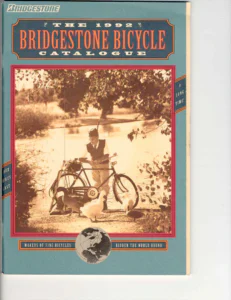 The Bridgestone Bicycle Catalogue 1992 (Bridgestone Cycle, United States)
 The Bridgestone Bicycle Catalogue 1994 (Bridgestone Cycle, United States)
Ebykr presents this material for research and education. If you hold rights to it or notice an ownership issue, please contact us and we will respond promptly.
The Ebykr Digest
New articles, timelines, catalog finds and registry activity — assembled from the archive once a month. Your address is never shared.
Double opt-in. One email per month. Unsubscribe at any time with one click.