About Ebykr
Ebykr celebrates classic and vintage lightweight bicycles through provocative imagery and opinion. Ride along with us.
About Ebykr
Ebykr celebrates classic and vintage lightweight bicycles through provocative imagery and opinion. Ride along with us.

Source: sheldonbrown.com (Sheldon Brown's Bridgestone catalogue archive), scans by Sheldon Brown, December 2004; enlarged for Ebykr.
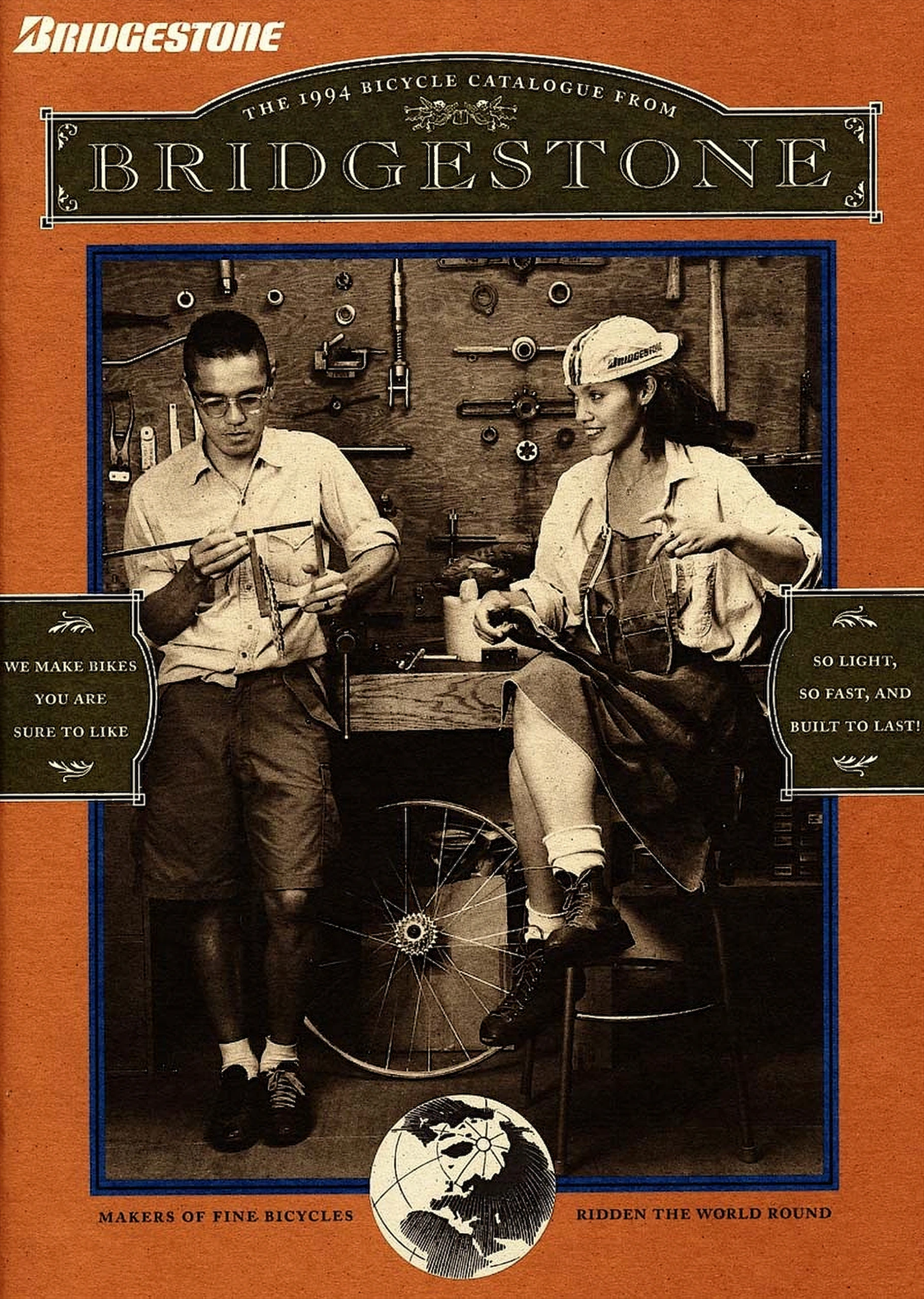 Page 1
 Page 2
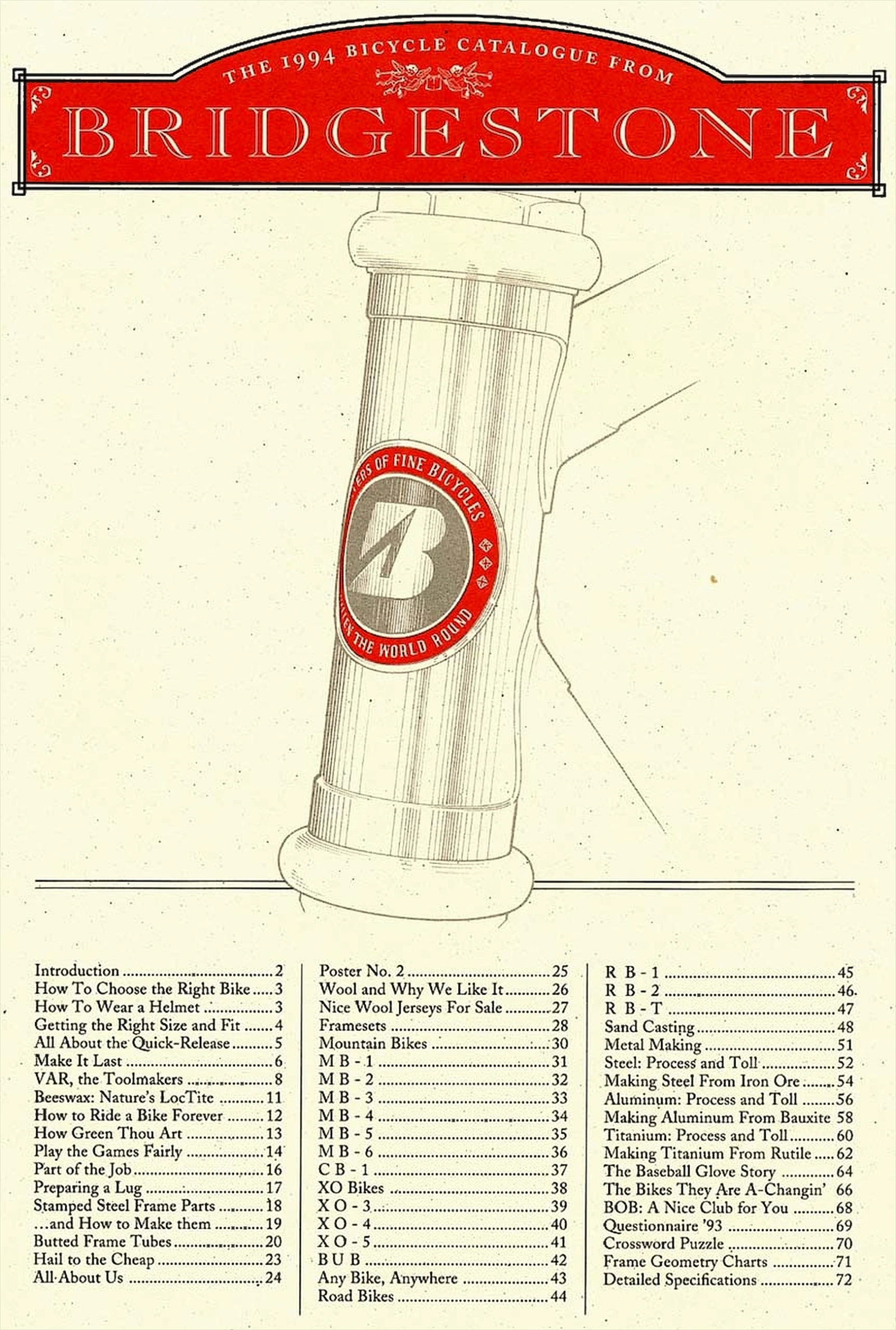 Page 3
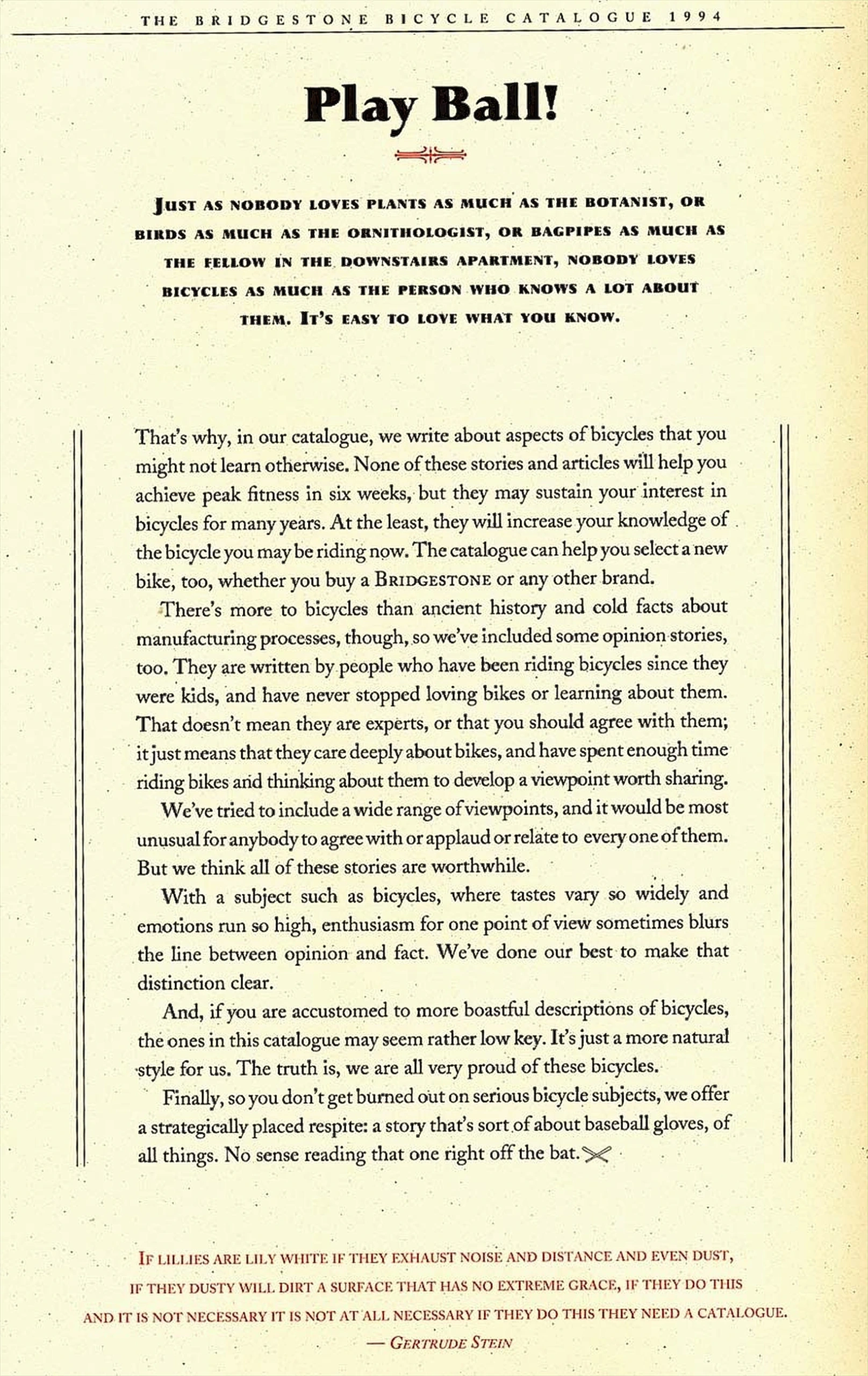 Page 4
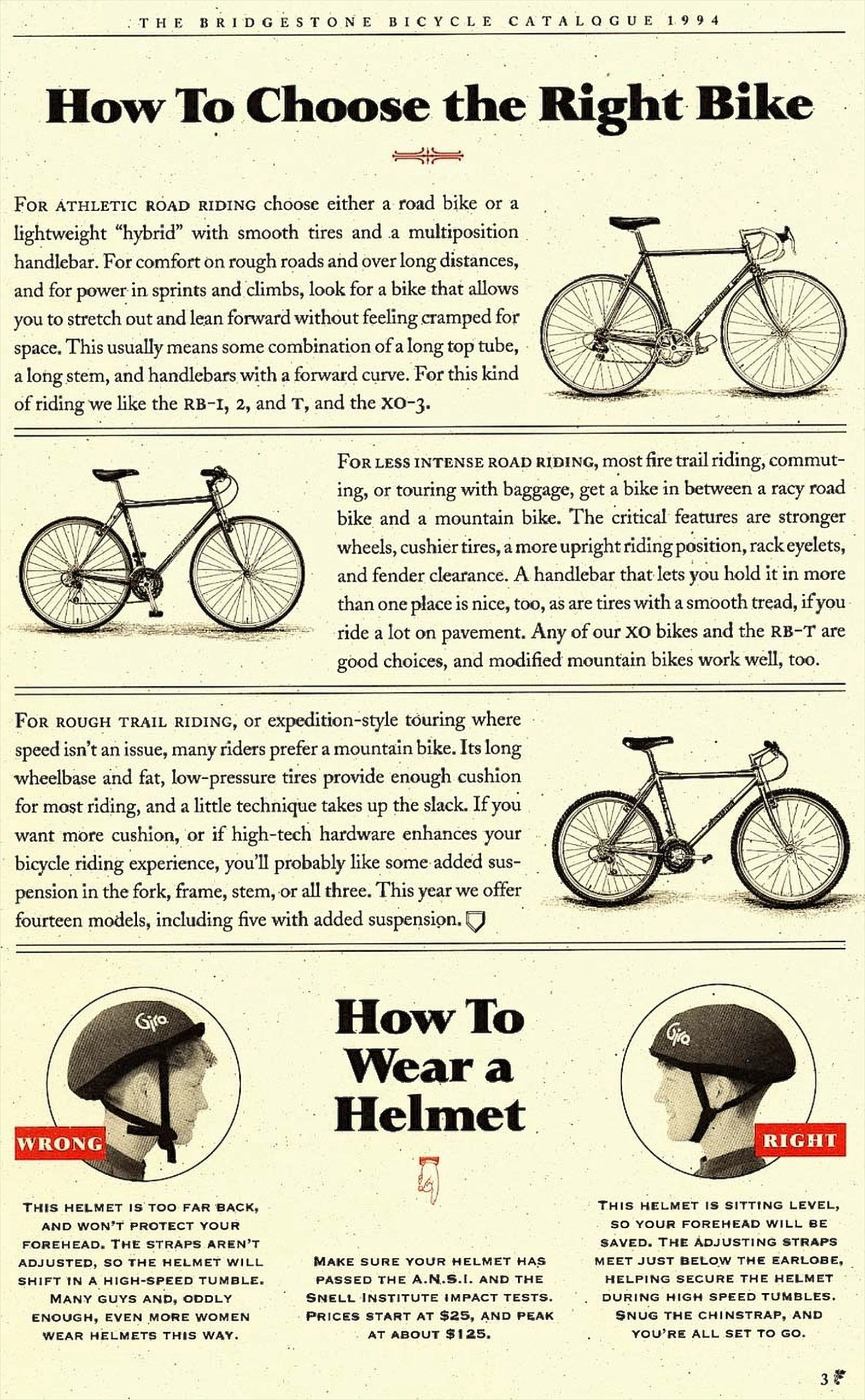 Page 5
 Page 6
 Page 7
 Page 8
 Page 9
 Page 10
 Page 11
 Page 12
 Page 13
 Page 14
 Page 15
 Page 16
 Page 17
 Page 18
 Page 19
 Page 20
 Page 21
 Page 22
 Page 23
 Page 24
 Page 25
 Page 26
 Page 27
 Page 28
 Page 29
 Page 30
 Page 31
 Page 32
 Page 33
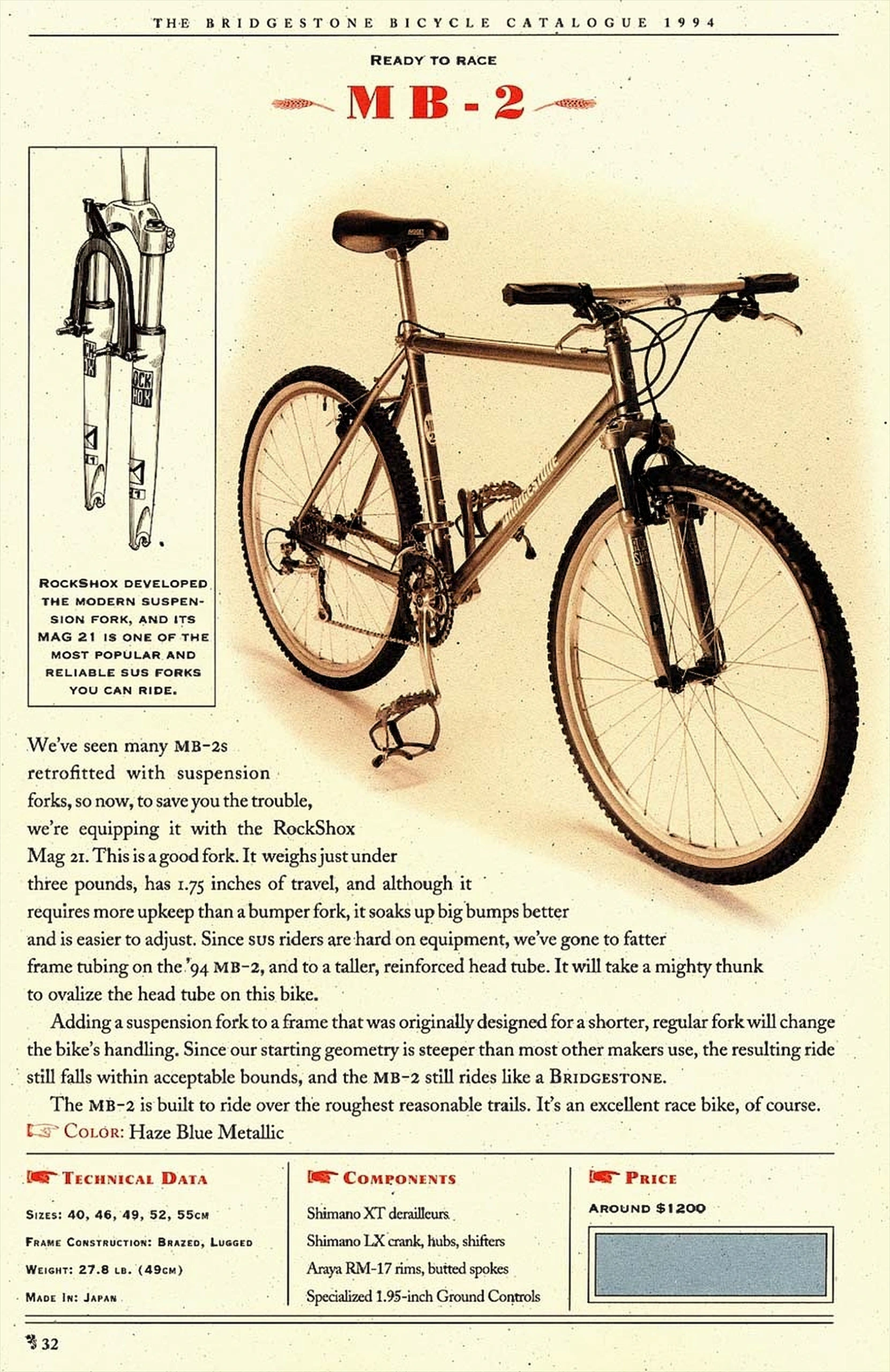 Page 34
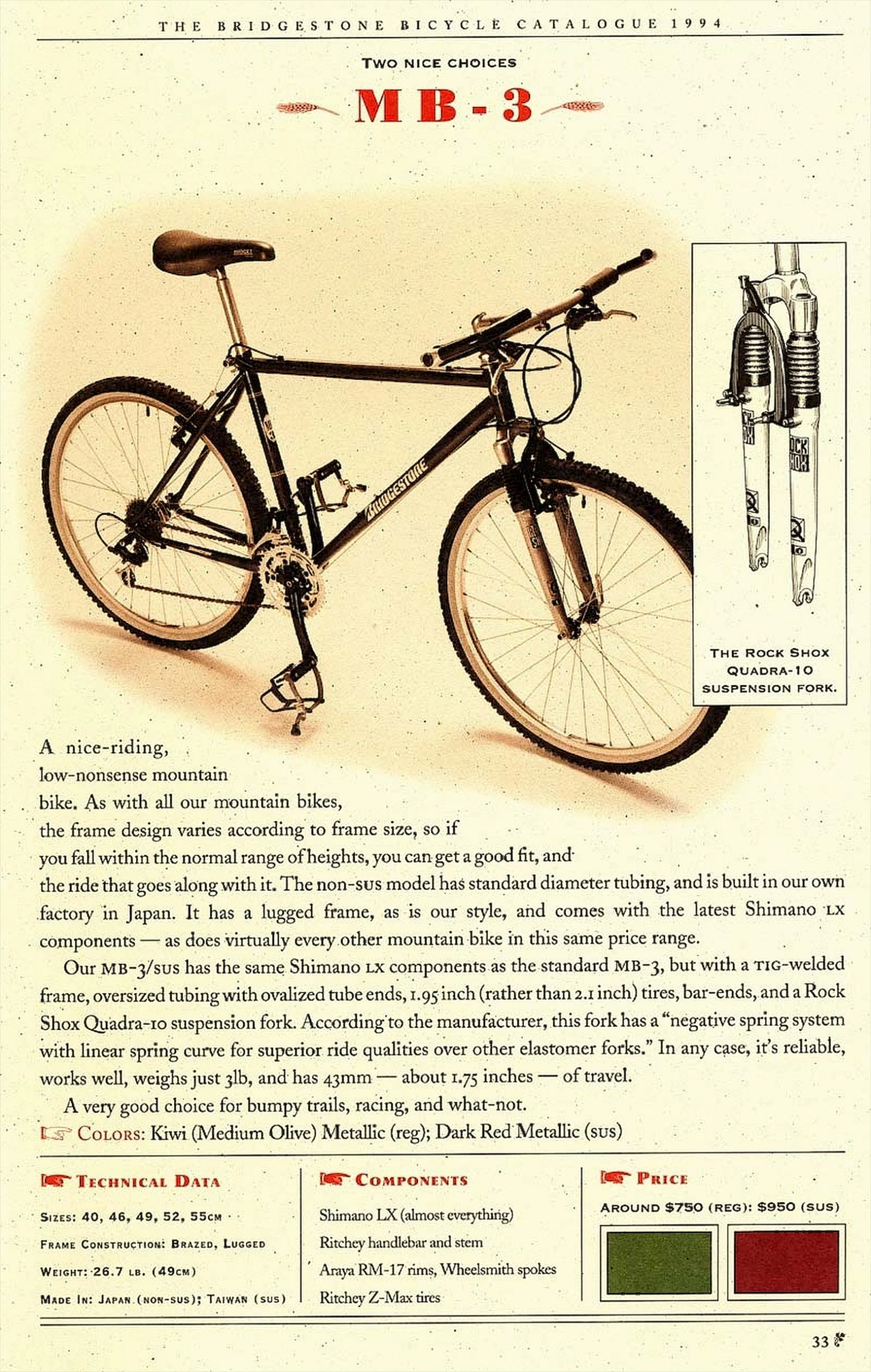 Page 35
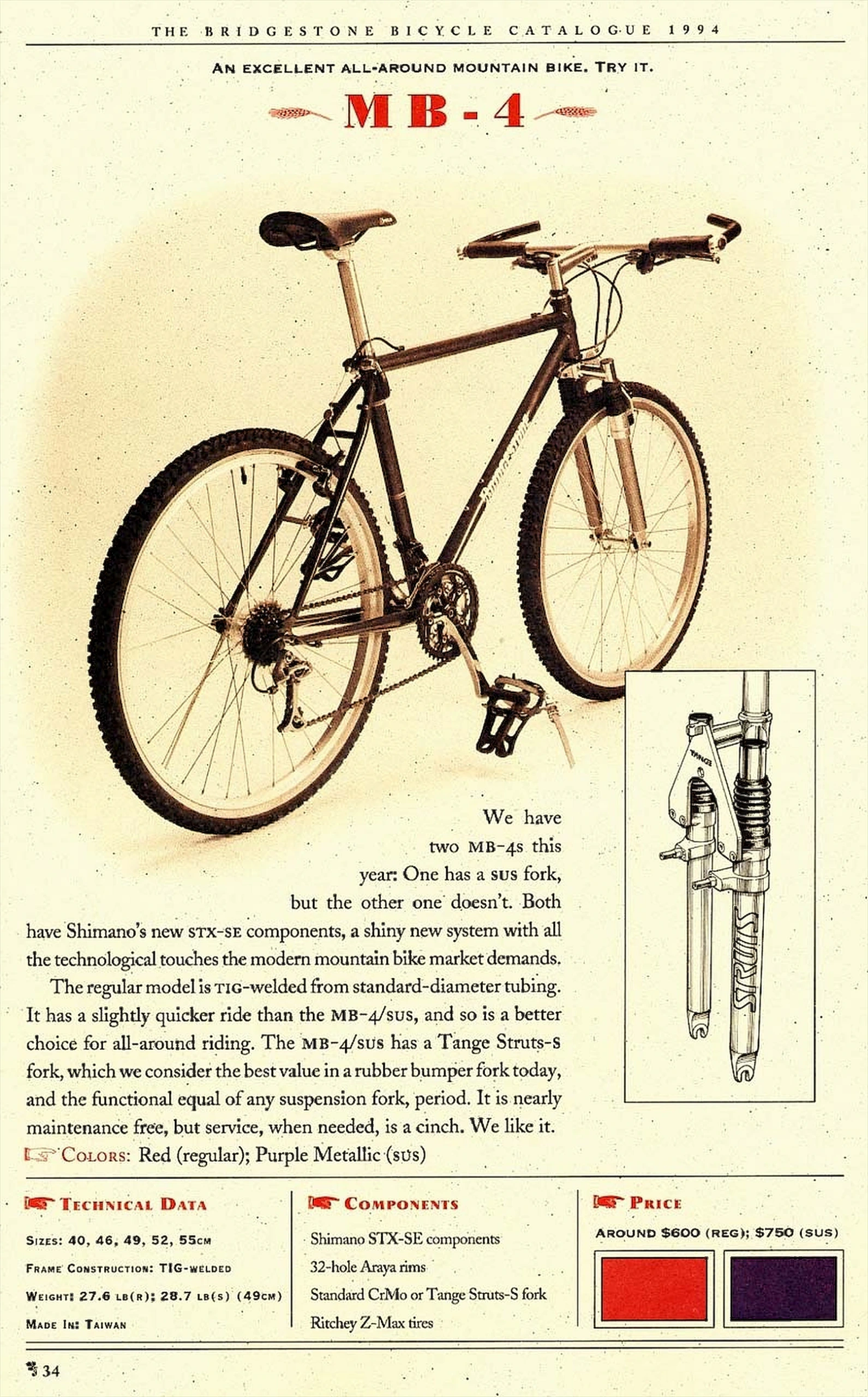 Page 36
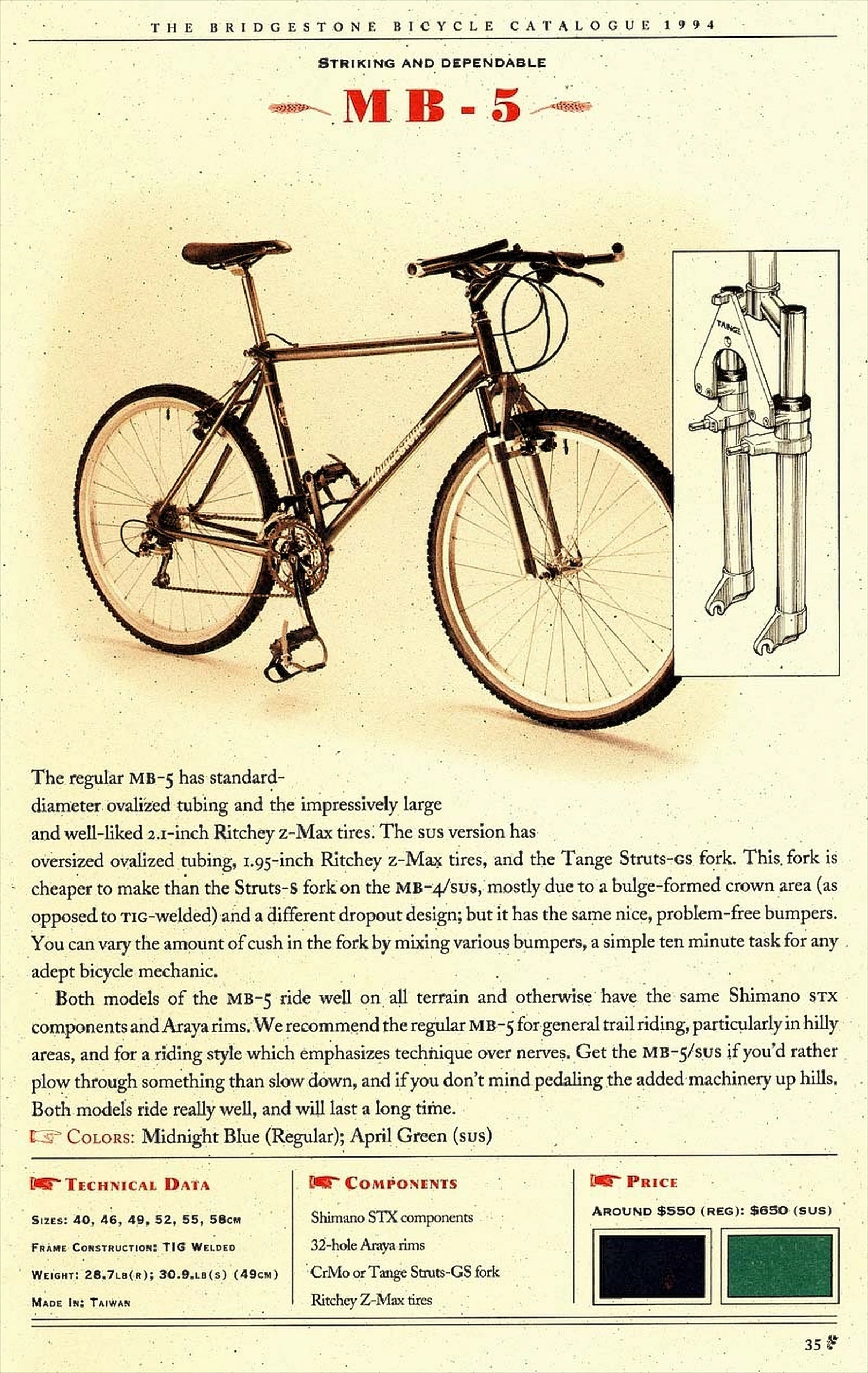 Page 37
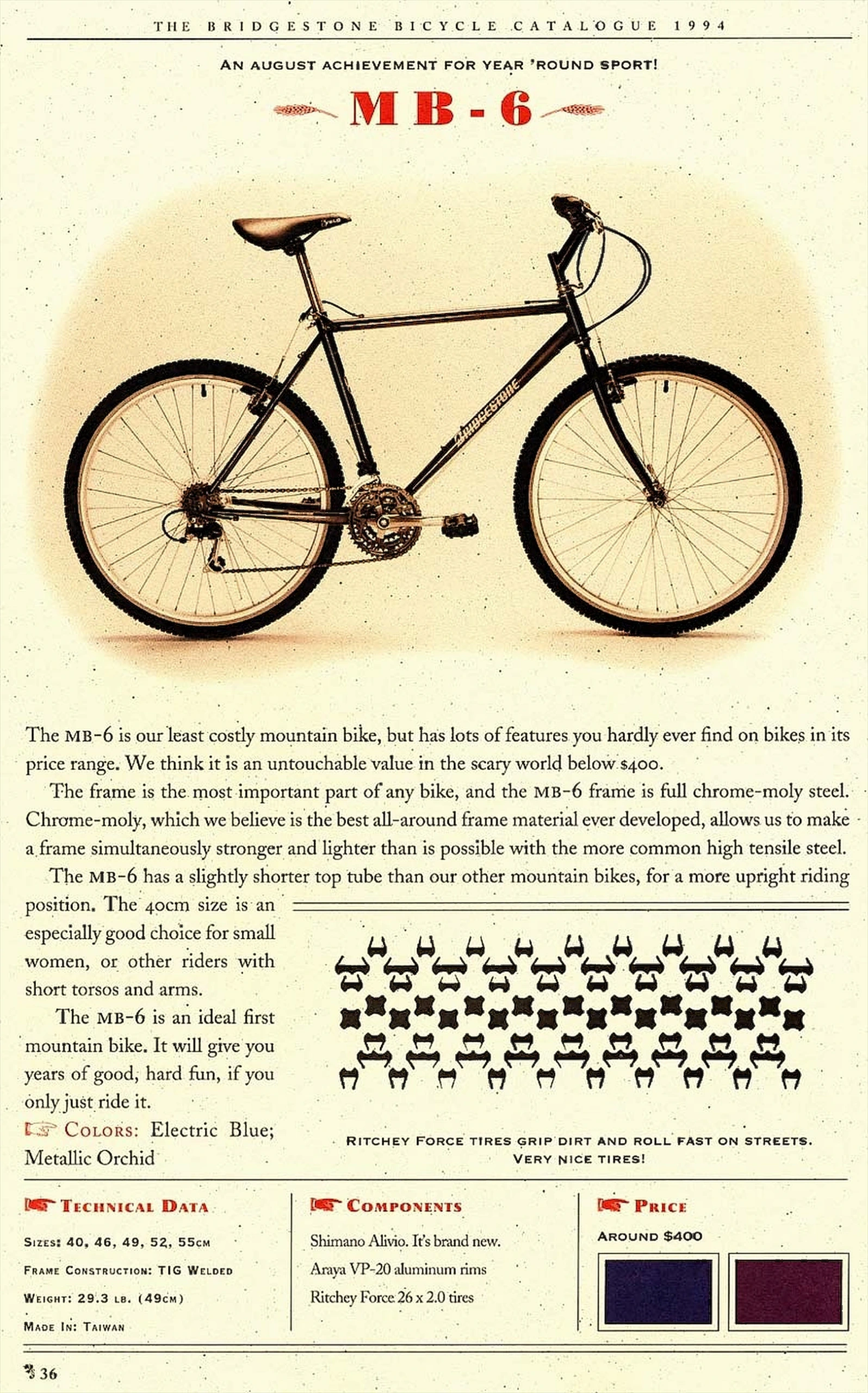 Page 38
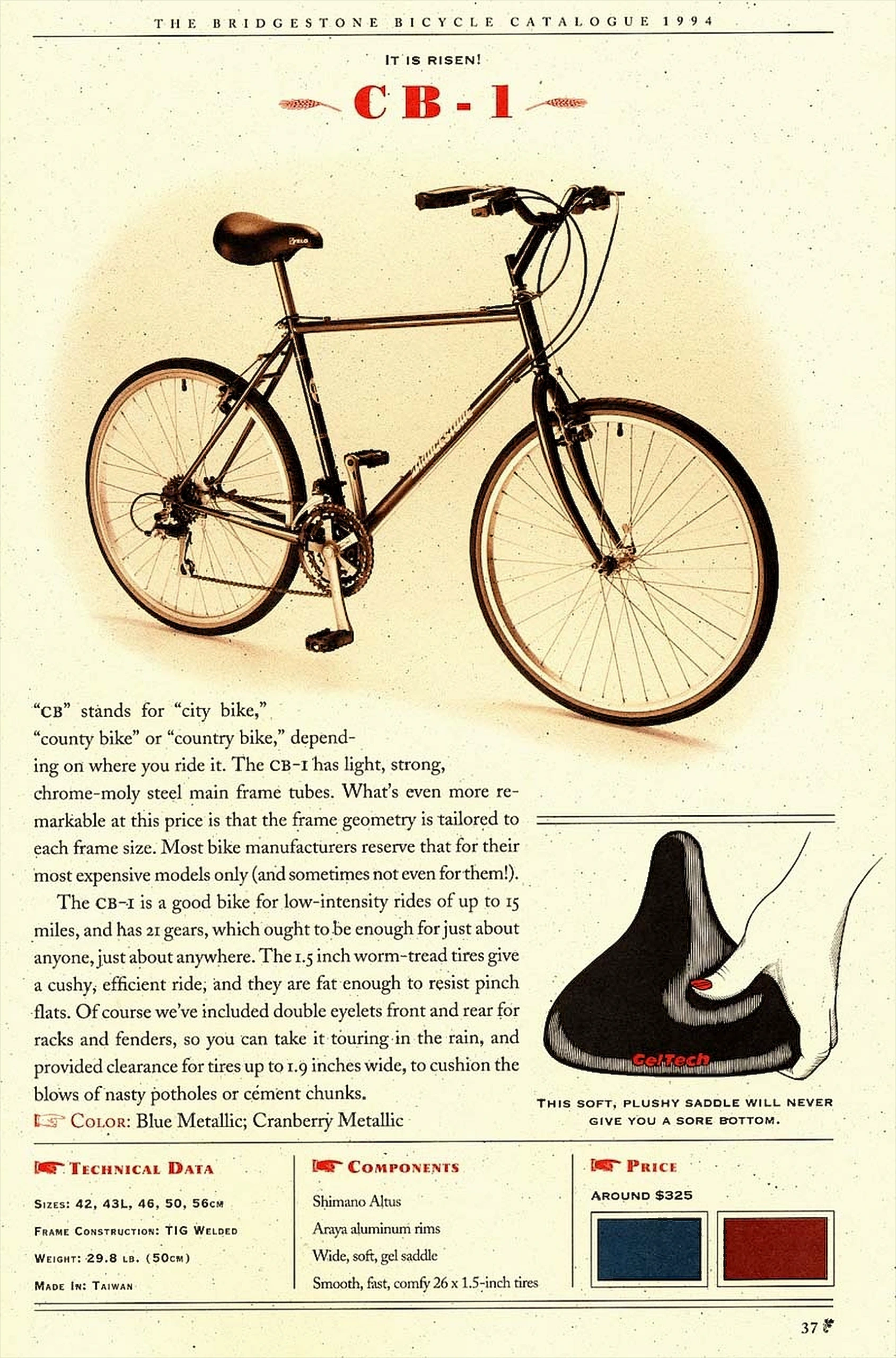 Page 39
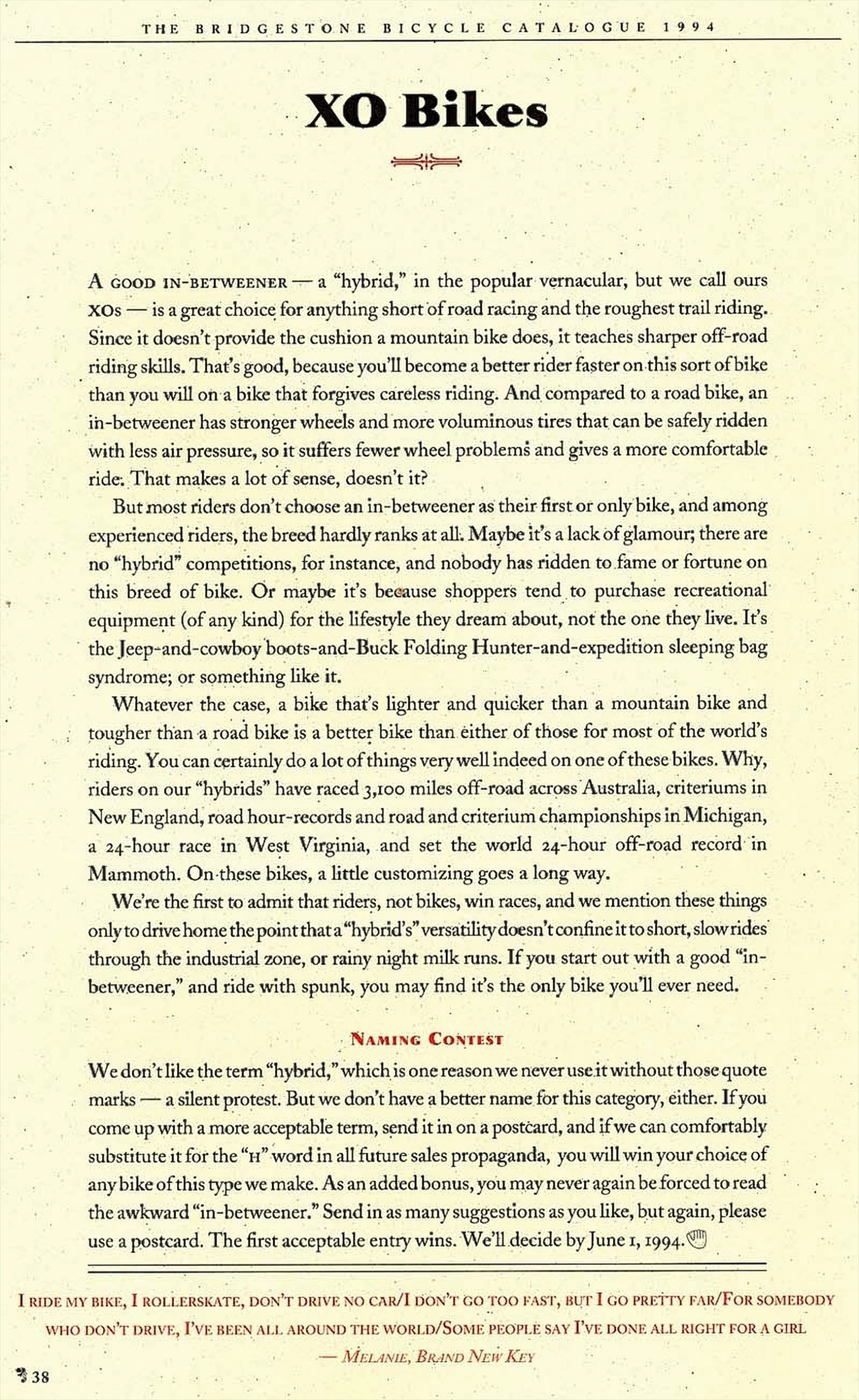 Page 40
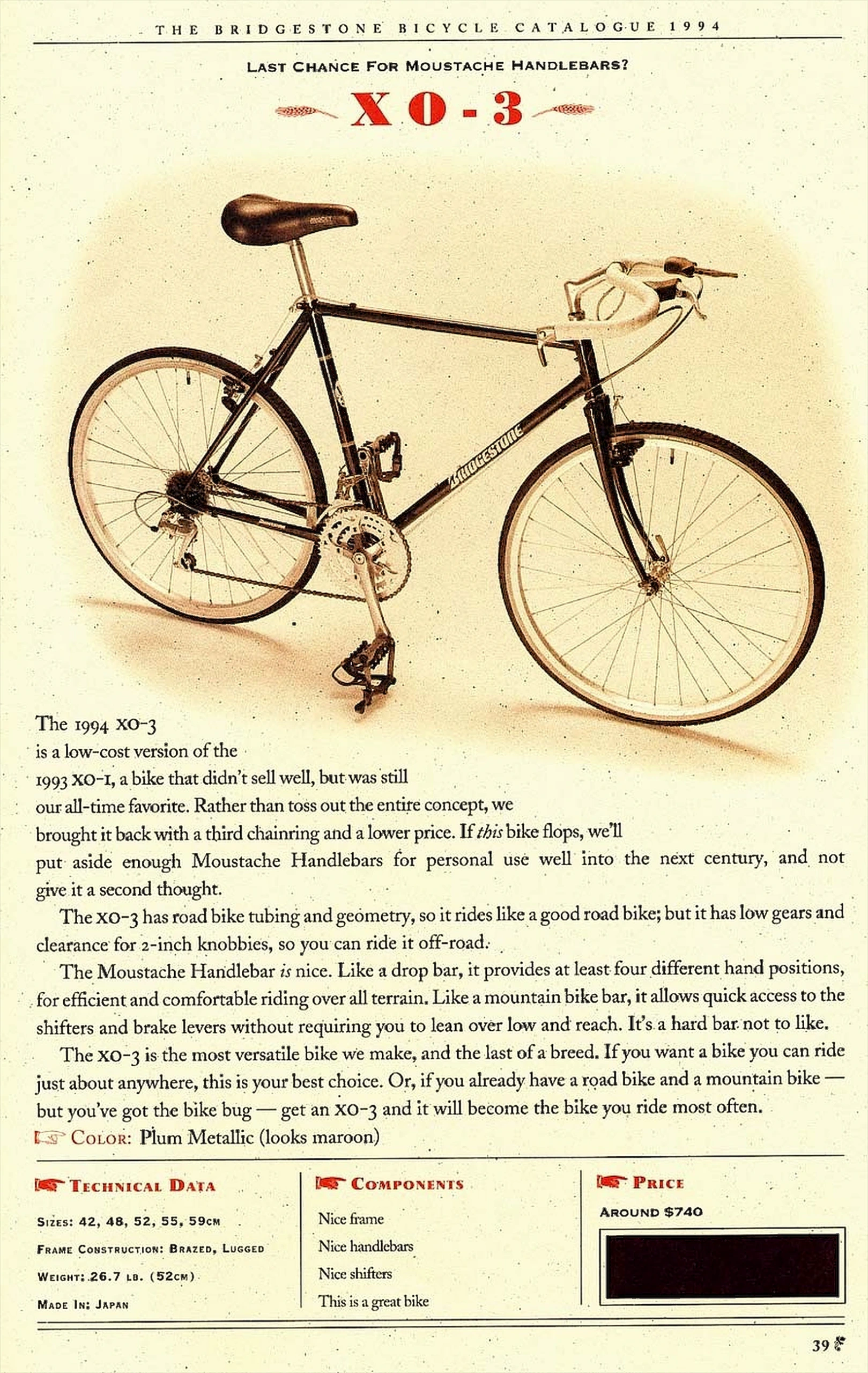 Page 41
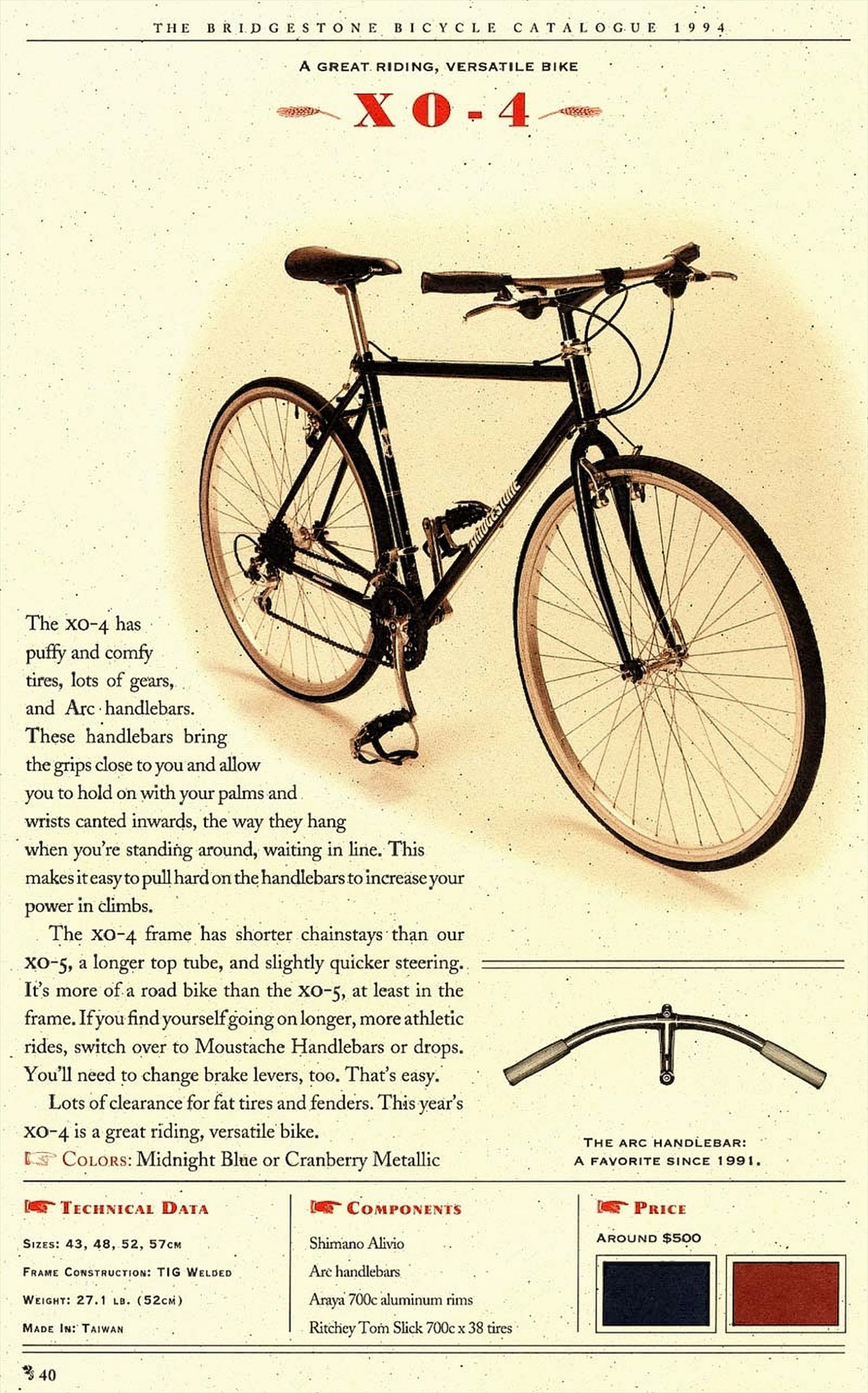 Page 42
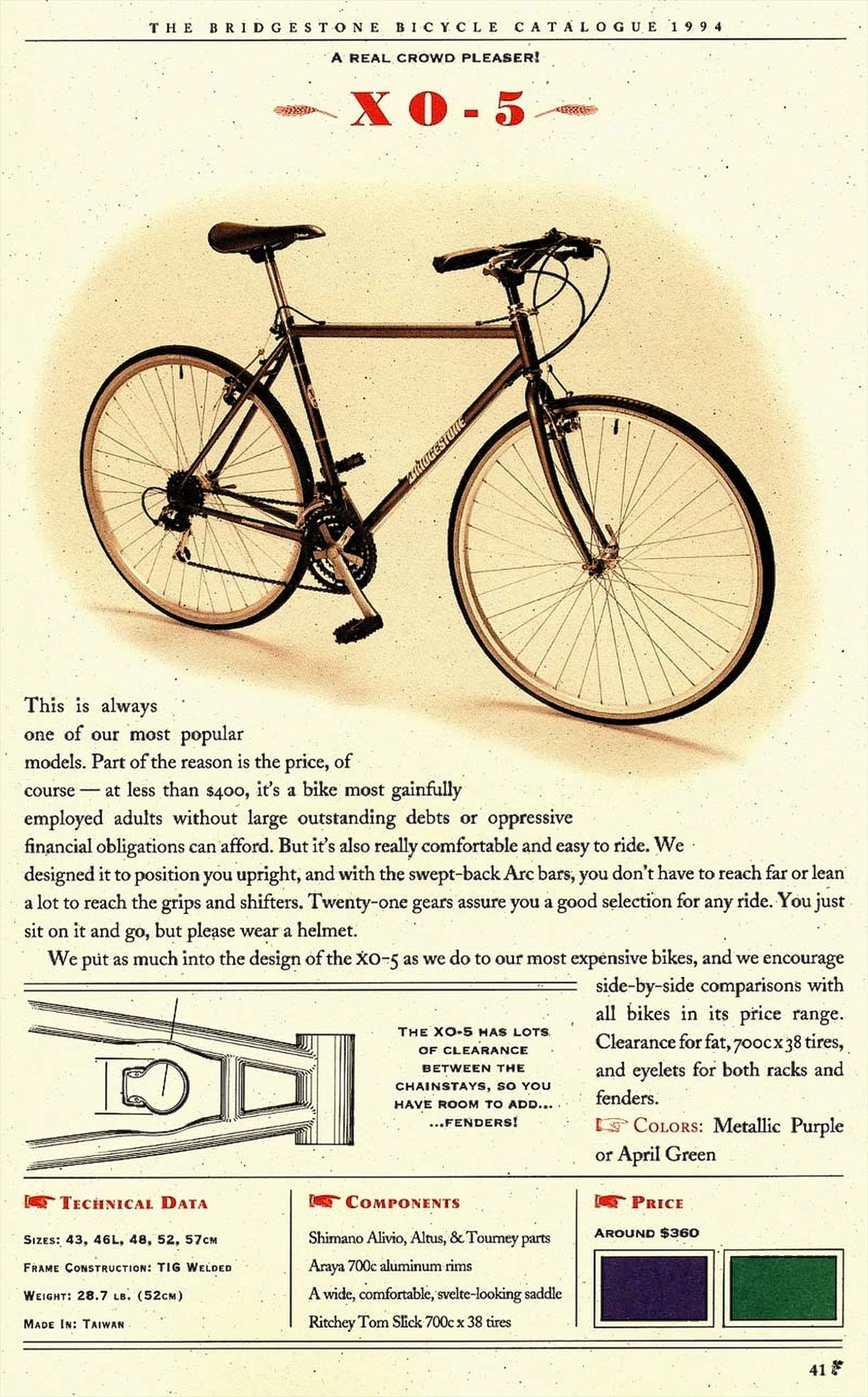 Page 43
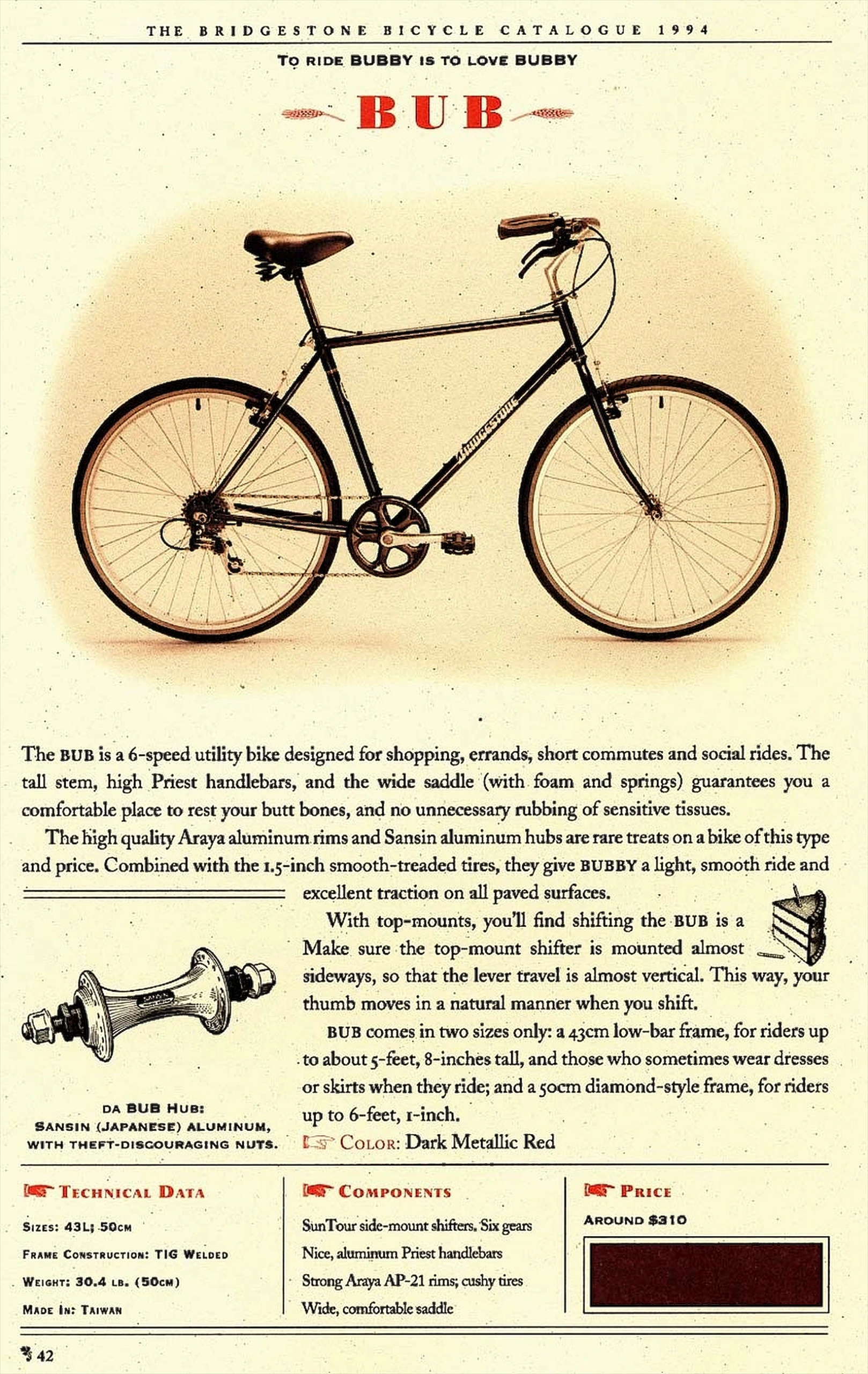 Page 44
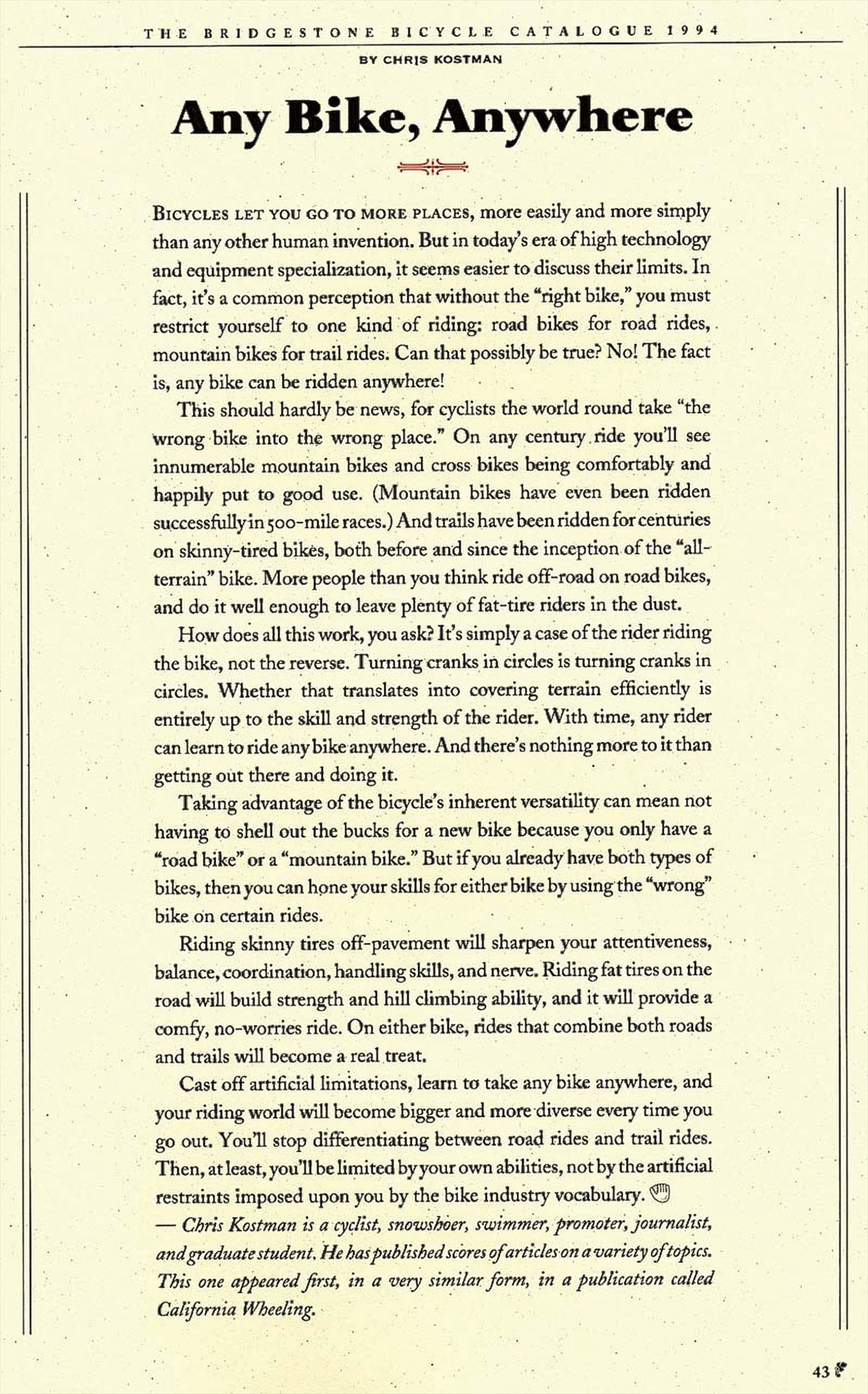 Page 45
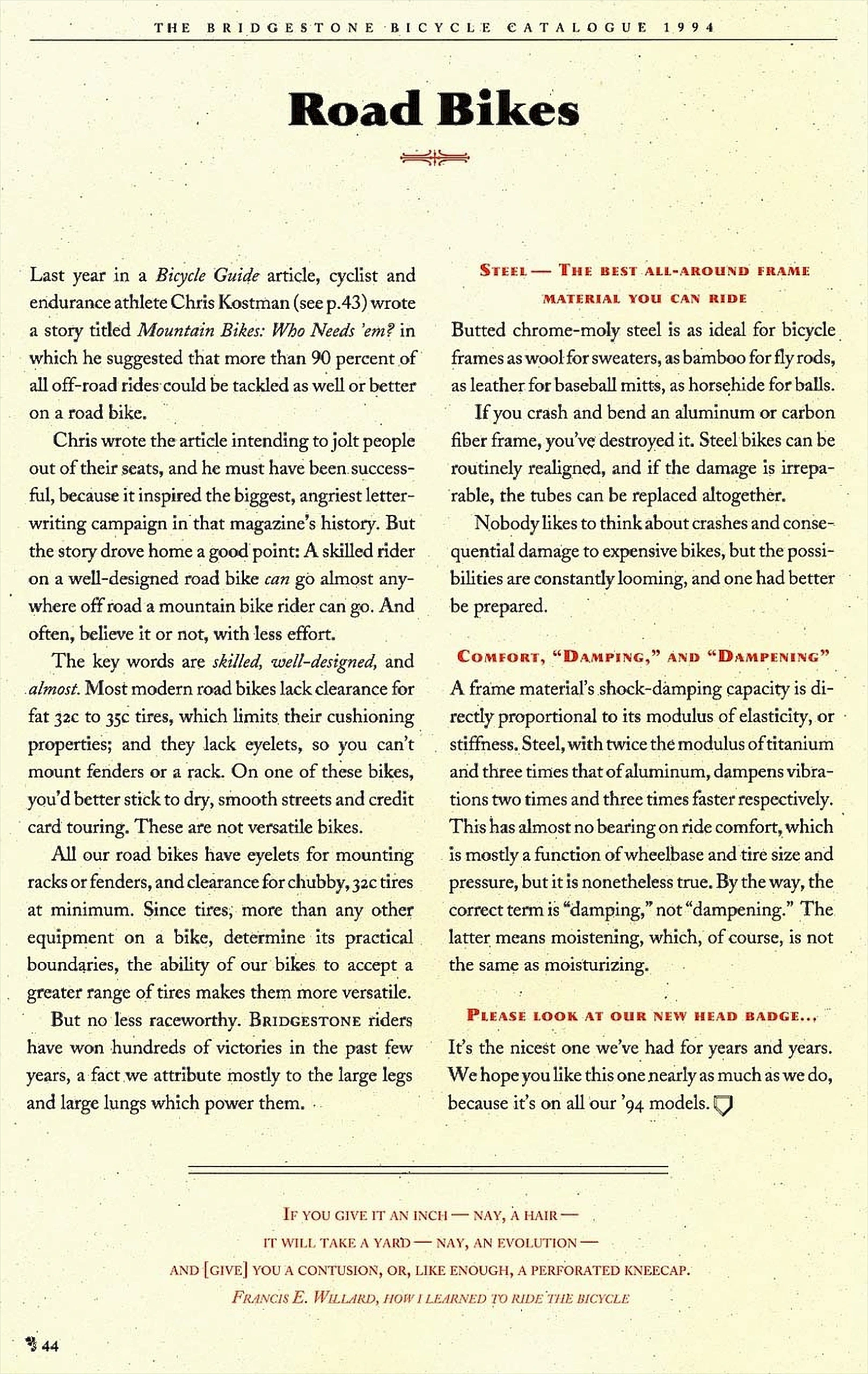 Page 46
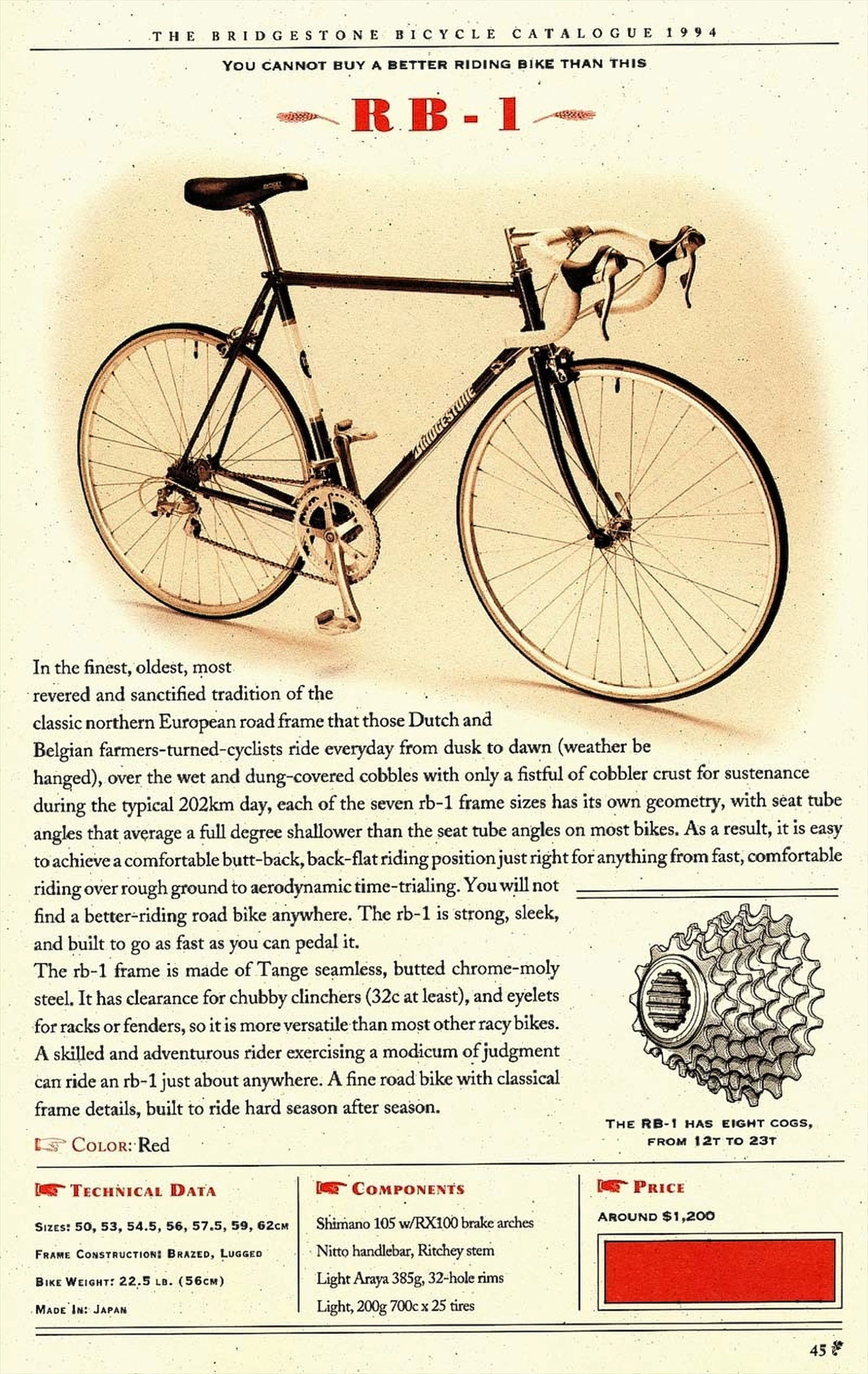 Page 47
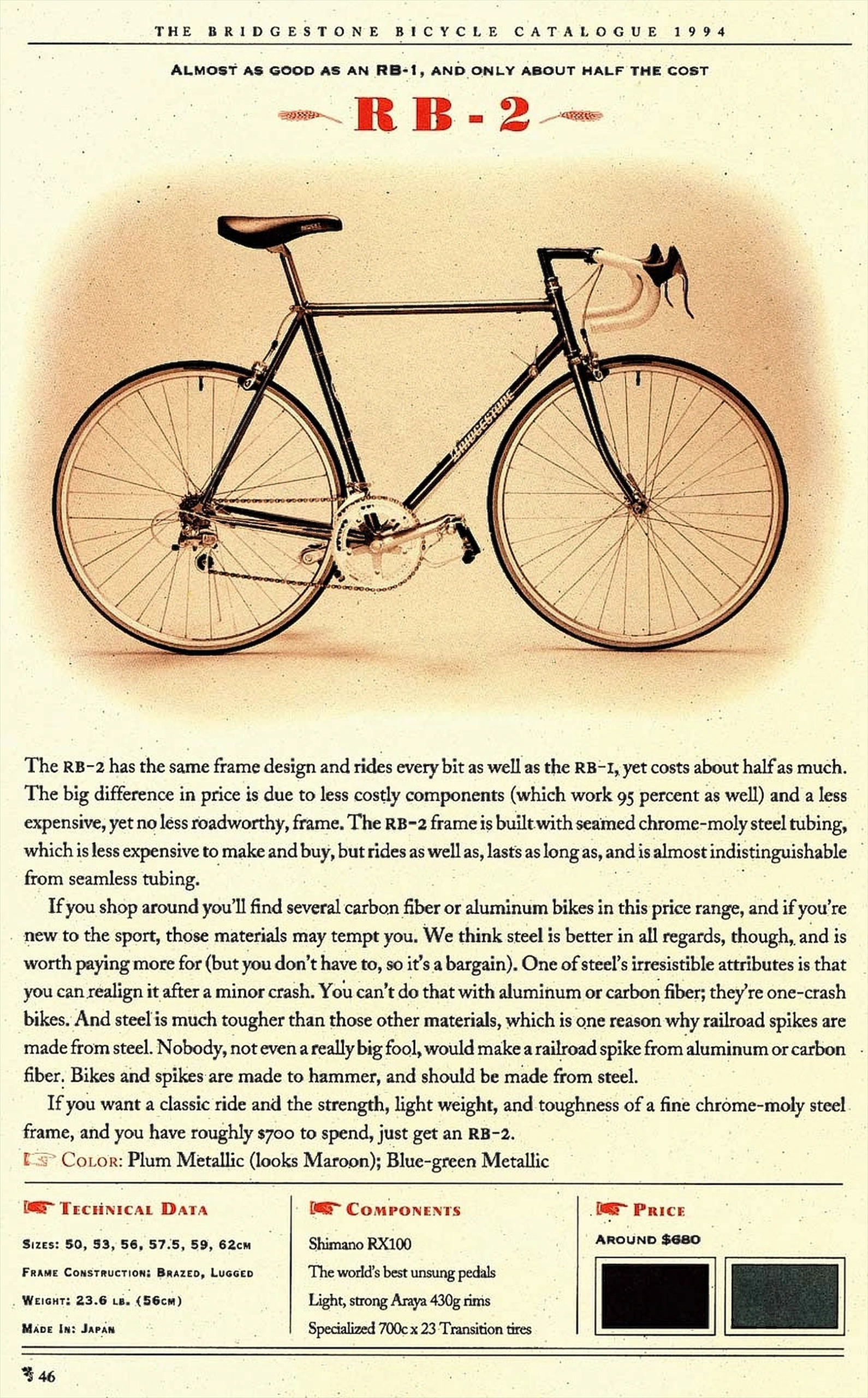 Page 48
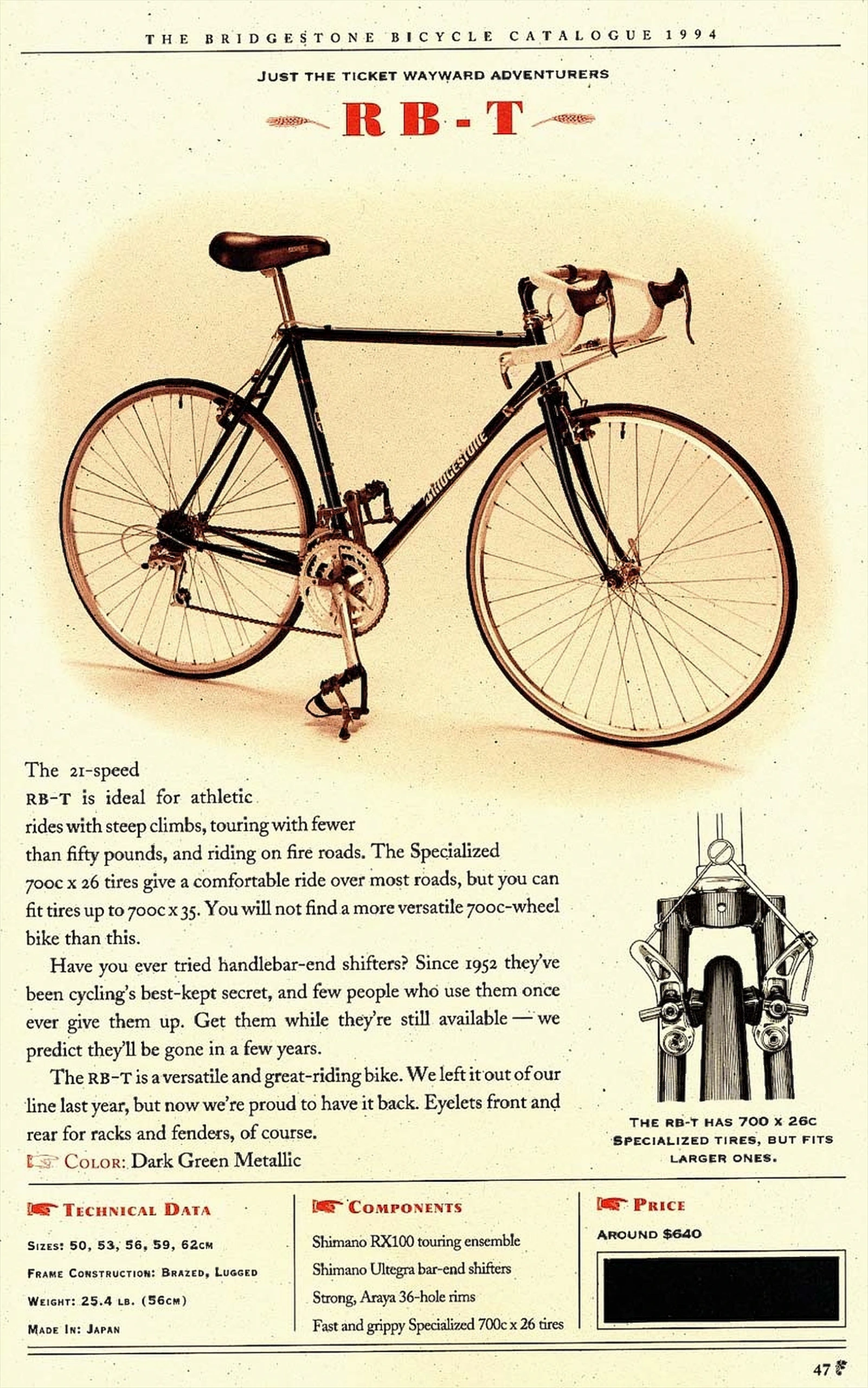 Page 49
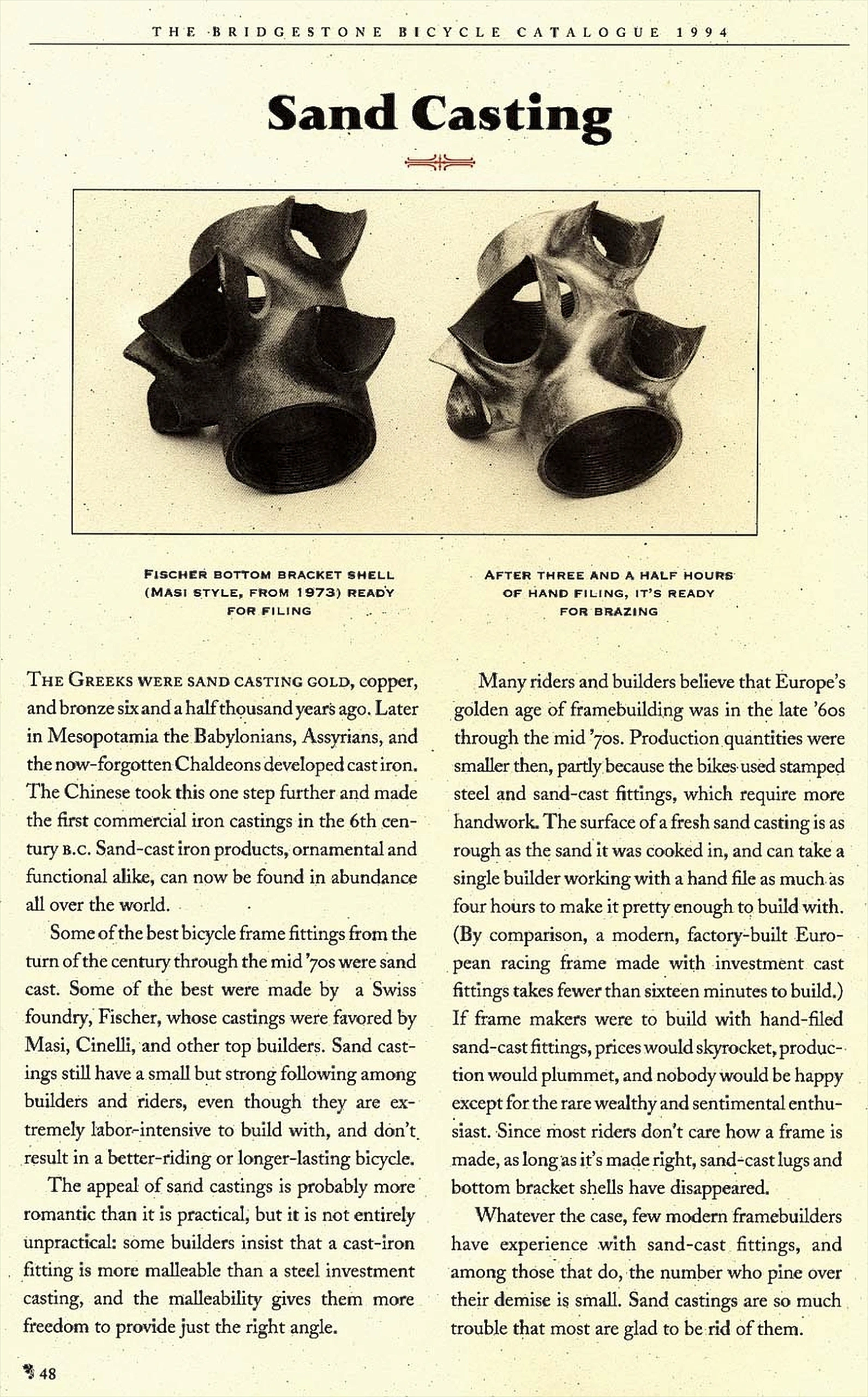 Page 50
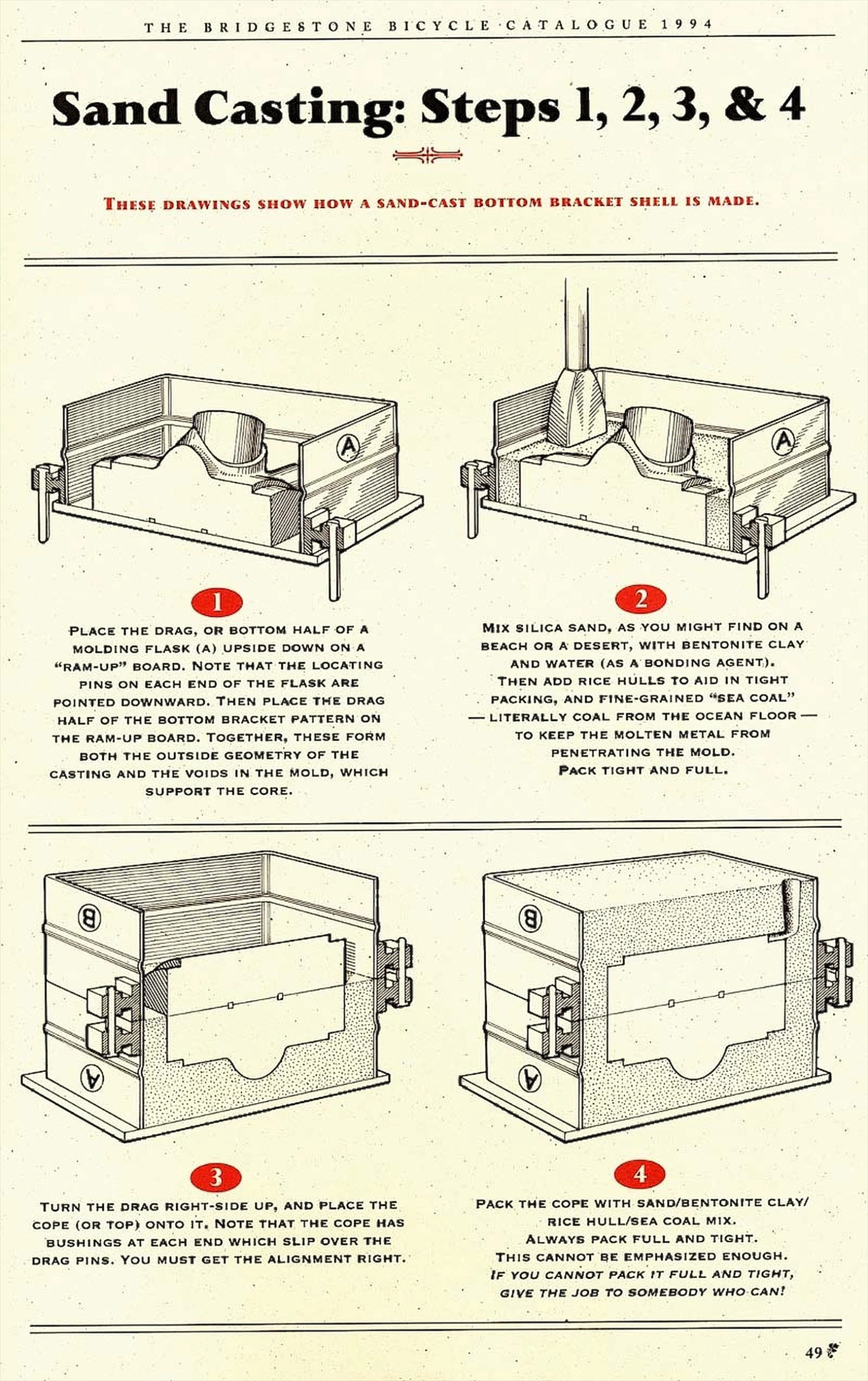 Page 51
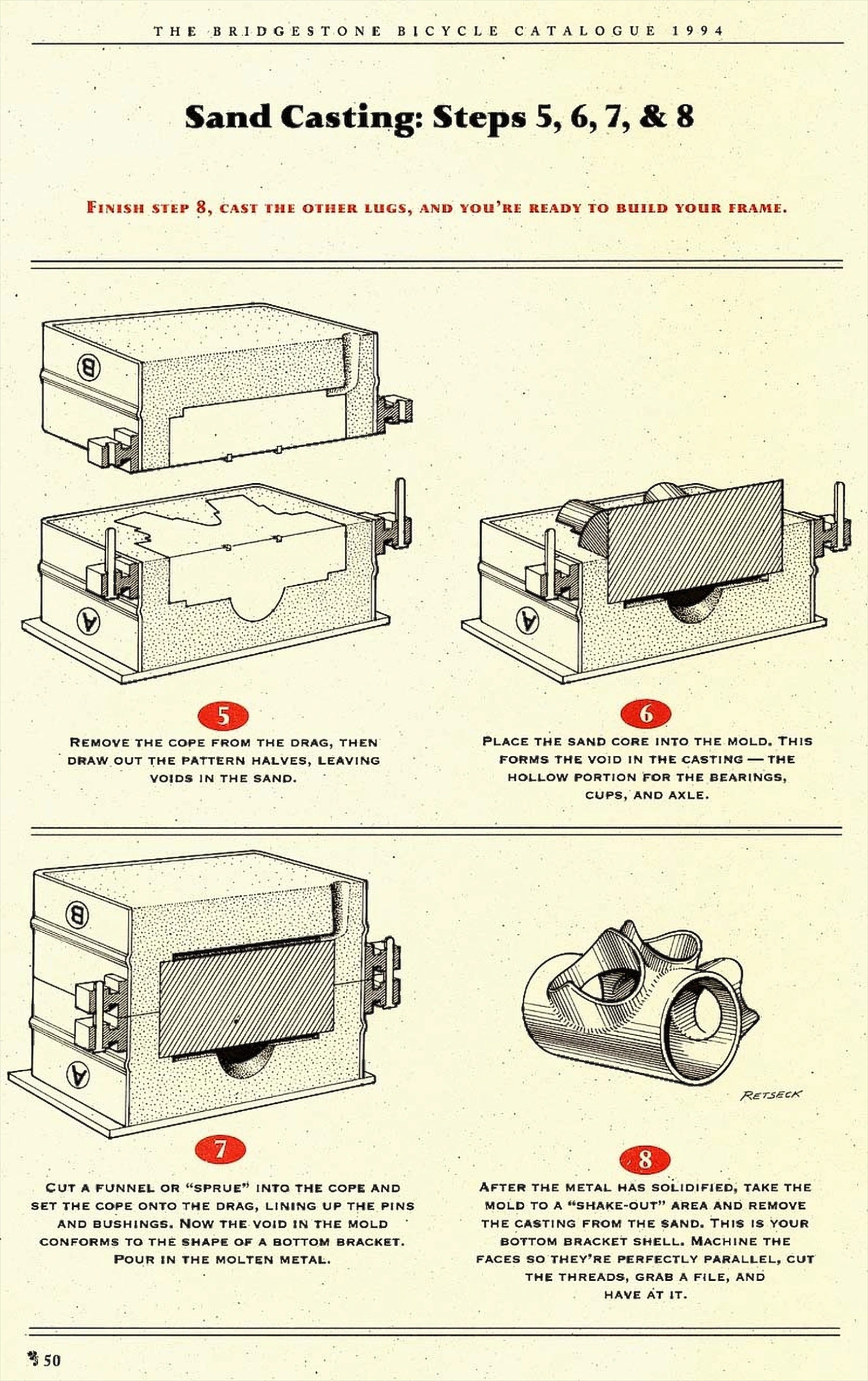 Page 52
 Page 53
 Page 54
 Page 55
 Page 56
 Page 57
 Page 58
 Page 59
 Page 60
 Page 61
 Page 62
 Page 63
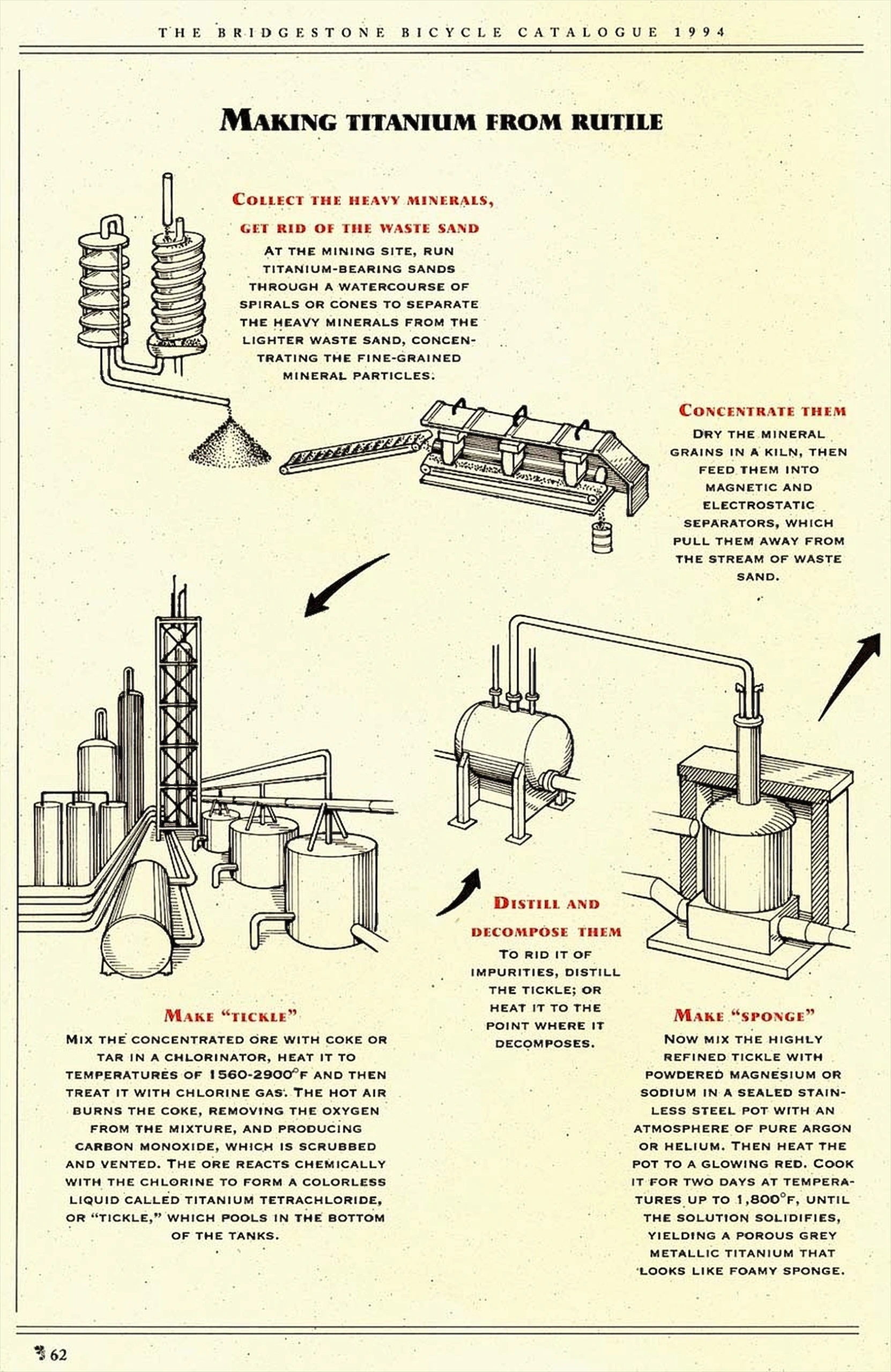 Page 64
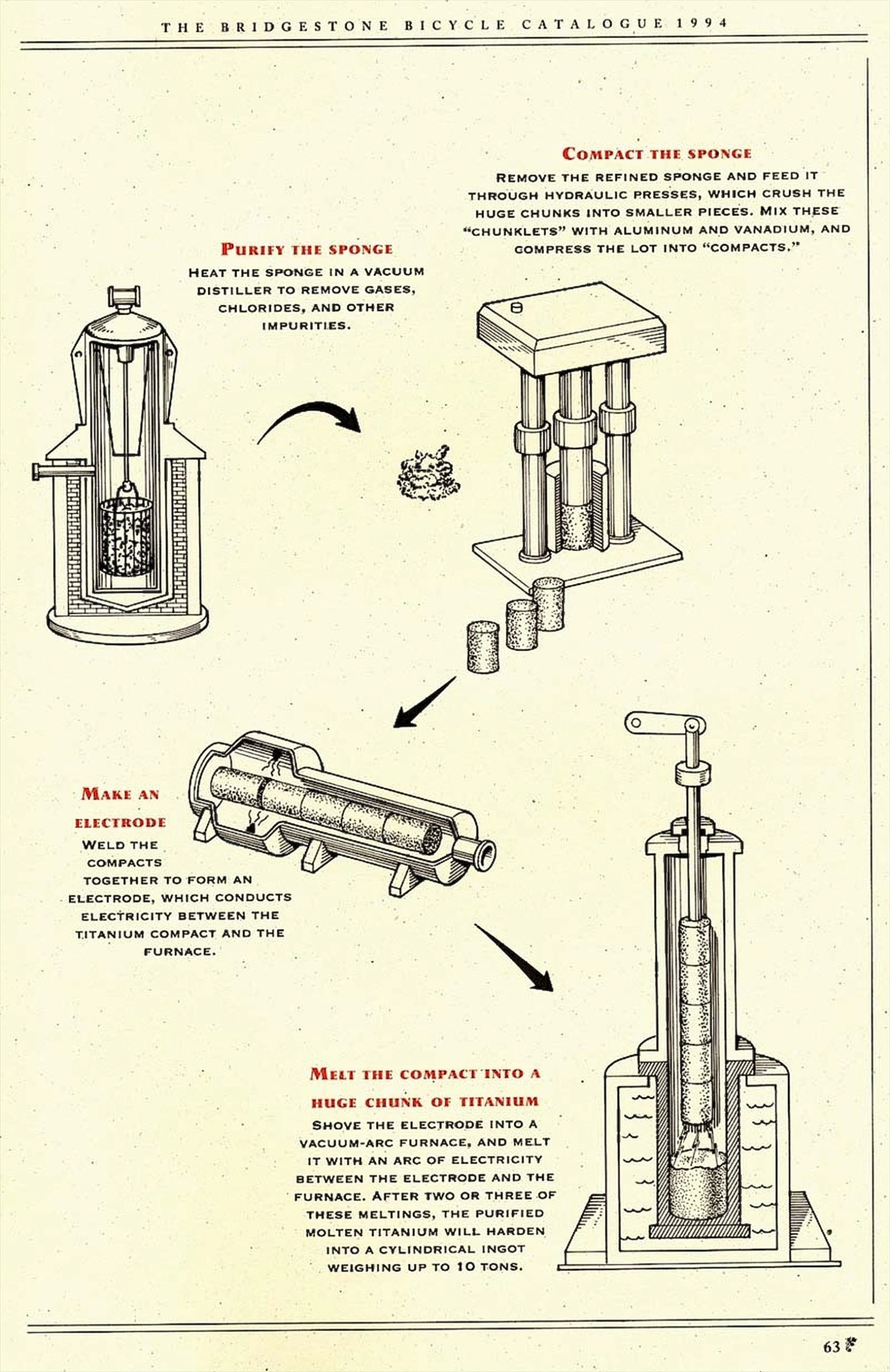 Page 65
 Page 66
 Page 67
 Page 68
 Page 69
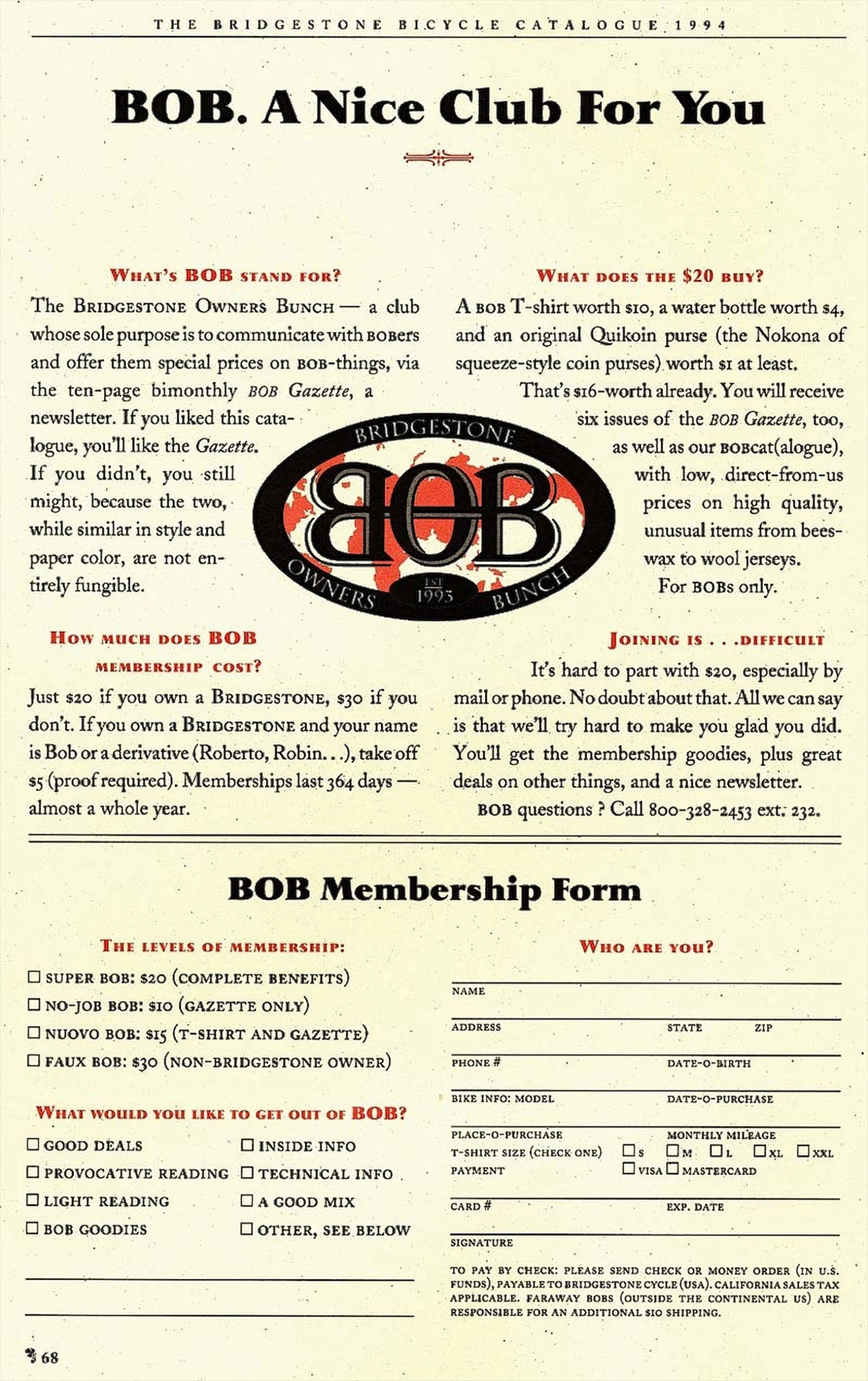 Page 70
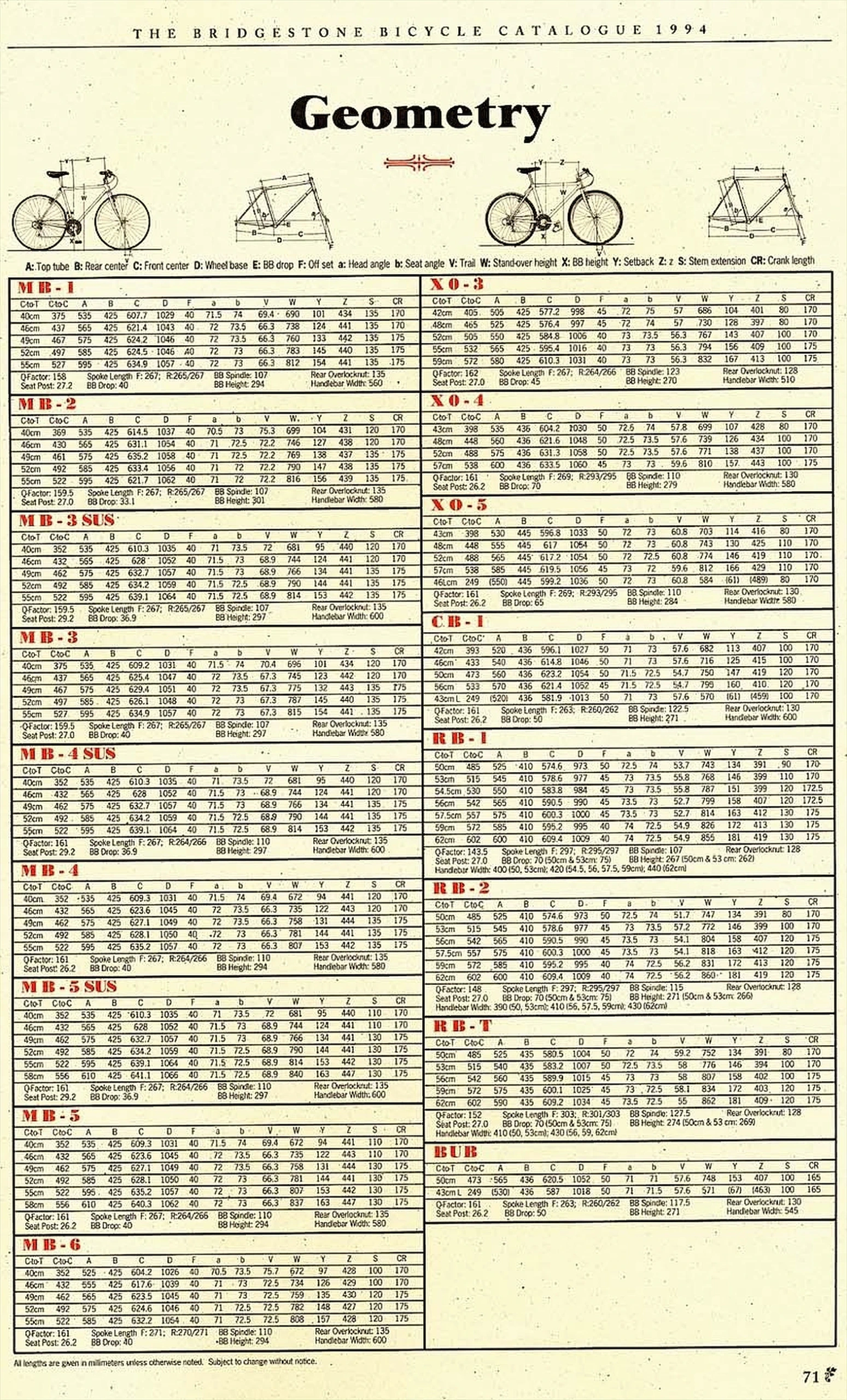 Page 71
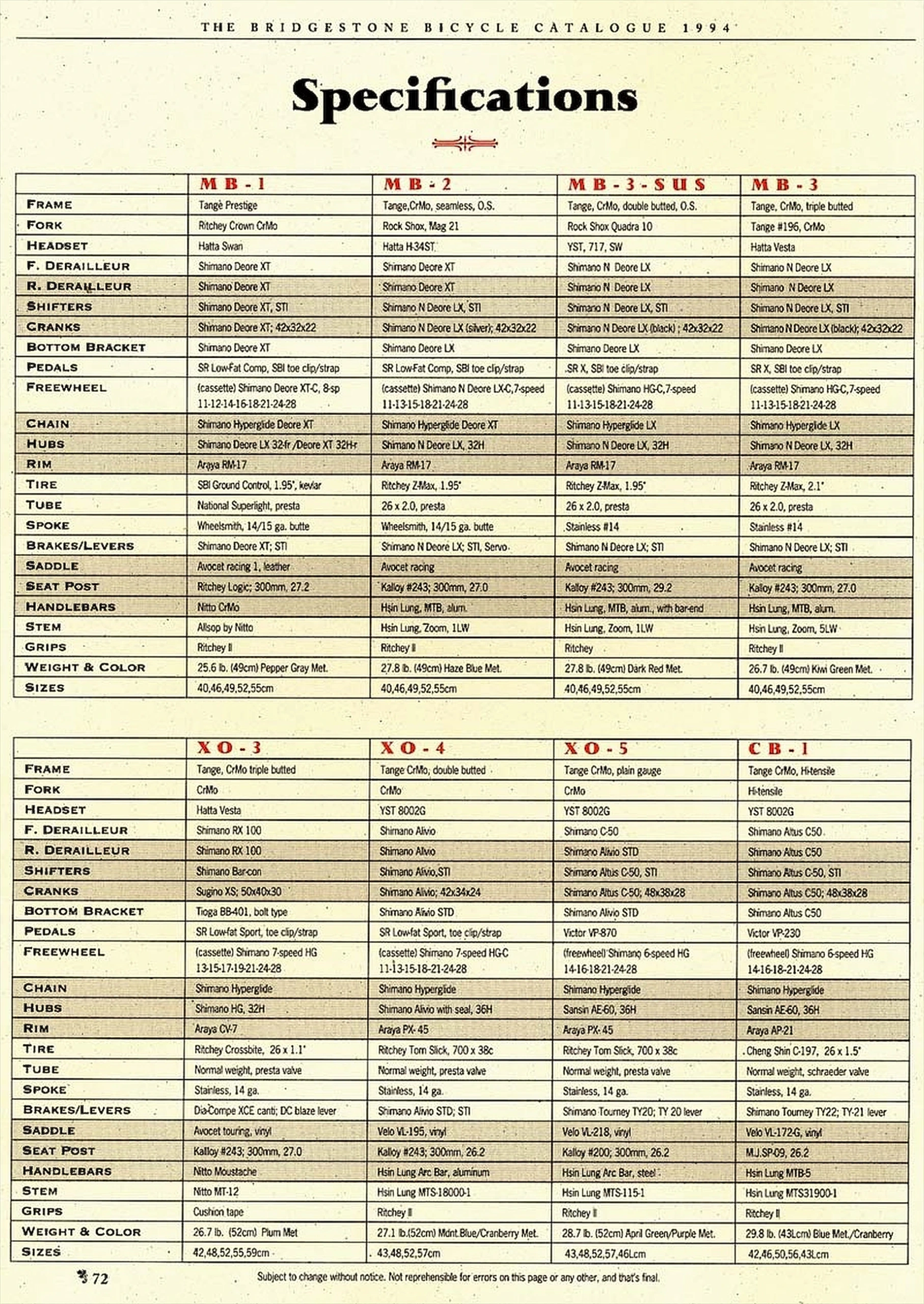 Page 72
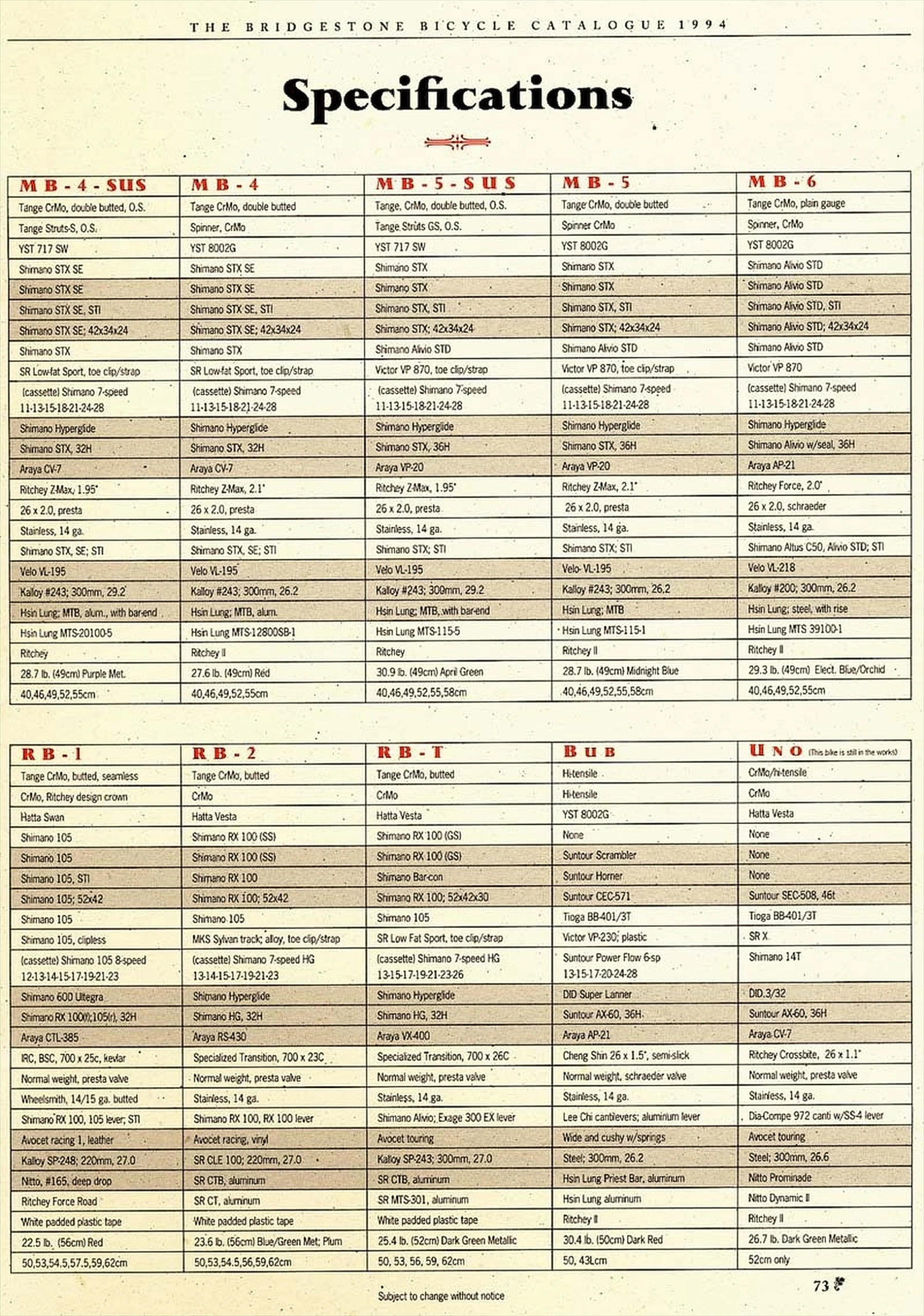 Page 73
 Page 74
| Marque | Bridgestone |
|---|---|
| Type | Catalog |
| Year | 1994 |
| Publisher | Bridgestone (United States) |
| Country | United States |
| Language | English |
| Pages | 74 |
| Source | sheldonbrown.com (Sheldon Brown's Bridgestone catalogue archive), scans by Sheldon Brown, December 2004; enlarged for Ebykr. |
| Credit | sheldonbrown.com |
| Identifier | Permalink https://www.sheldonbrown.com/bridgestone/1994/index.htm |
| Transcription | Transcribed by eye |
Reference
Bridgestone (United States). The Bridgestone Bicycle Catalogue 1994 (Bridgestone Cycle, United States). 1994. Ebykr, https://ebykr.com/library/bridgestone-bicycle-catalogue-1994/.
Wikipedia
{{cite book |title=The Bridgestone Bicycle Catalogue 1994 (Bridgestone Cycle, United States) |publisher=Bridgestone (United States) |date=1994 |url=https://ebykr.com/library/bridgestone-bicycle-catalogue-1994/ |via=Ebykr |access-date=}}BRIDGESTONE THE 1994 BICYCLE CATALOGUE FROM BRIDGESTONE WE MAKE BIKES YOU ARE SURE TO LIKE SO LIGHT, SO FAST, AND BUILT TO LAST! MAKERS OF FINE BICYCLES RIDDEN THE WORLD ROUND A DOZEN DON'TS BY MAJOR TAYLOR, WHO IN THE EARLY 1900'S, WAS THE FASTEST BICYCLE RIDER IN THE WORLD. 1. DON'T TRY TO "GYP." …
THE BRIDGESTONE BICYCLE CATALOGUE 1994, the American catalogue of Bridgestone Cycle, from the Sheldon Brown archive. Transcribed from the page images (74 pages); each page ends with a bracketed description of its pictures.
— Page 1 —
BRIDGESTONE
THE 1994 BICYCLE CATALOGUE FROM BRIDGESTONE
WE MAKE BIKES YOU ARE SURE TO LIKE
SO LIGHT, SO FAST, AND BUILT TO LAST!
MAKERS OF FINE BICYCLES
RIDDEN THE WORLD ROUND
[The cover: a sepia photograph of a man and a woman in a workshop, the man measuring a crank and the woman repairing a tubular tire, framed in blue on an orange ground under an engraved banner title, with a small globe at the foot.]
— Page 2 —
A DOZEN DON’TS
BY MAJOR TAYLOR, WHO IN THE EARLY 1900’S, WAS THE FASTEST BICYCLE RIDER IN THE WORLD.
1. DON’T TRY TO “GYP.”
2. DON’T BE A PIE BITER.
3. DON’T KEEP LATE HOURS.
4. DON’T USE INTOXICANTS.
5. DON’T BE A BIG BLUFFER.
6. DON’T EAT CHEAP CANDIES.
7. DON’T GET A SWELLED HEAD.
8. DON’T USE TOBACCO IN ANY FORM.
9. DON’T FAIL TO LIVE A CLEAN LIFE.
10. DON’T FORGET TO PLAY THE GAME FAIR.
11. DON’T TAKE AN UNFAIR ADVANTAGE OF AN OPPONENT.
12. DON’T FORGET THE PRACTICE OF GOOD SPORTSMANSHIP.
ON THE COVER: A FRESHLY SHORN PINEAPPLE BOB MEASURES THE Q-FACTOR ON A TA/STRONGLIGHT COMBINATION CRANK, HOPING TO GET BELOW 132MM, WHILE KIM REPAIRS A SEW-UP.
[A page of red type in a decorated border on cream paper.]
— Page 3 —
THE 1994 BICYCLE CATALOGUE FROM BRIDGESTONE
Introduction …….. 2
How To Choose the Right Bike …….. 3
How to Wear a Helmet …….. 3
Getting the Right Size and Fit …….. 4
All About the Quick-Release …….. 5
Make It Last …….. 6
VAR, the Toolmakers …….. 8
Beeswax: Nature’s LocTite …….. 11
How to Ride a Bike Forever …….. 12
How Green Thou Art …….. 13
Play the Games Fairly …….. 14
Part of the Job …….. 16
Preparing a Lug …….. 17
Stamped Steel Frame Parts …….. 18
…and How to Make them …….. 19
Butted Frame Tubes …….. 20
Hail to the Cheap …….. 23
All About Us …….. 24
Poster No. 2 …….. 25
Wool and Why We Like It …….. 26
Nice Wool Jerseys For Sale …….. 27
Framesets …….. 28
Mountain Bikes …….. 30
MB-1 …….. 31
MB-2 …….. 32
MB-3 …….. 33
MB-4 …….. 34
MB-5 …….. 35
MB-6 …….. 36
CB-1 …….. 37
XO Bikes …….. 38
XO-3 …….. 39
XO-4 …….. 40
XO-5 …….. 41
BUB …….. 42
Any Bike, Anywhere …….. 43
Road Bikes …….. 44
RB-1 …….. 45
RB-2 …….. 46
RB-T …….. 47
Sand Casting …….. 48
Metal Making …….. 51
Steel: Process and Toll …….. 52
Making Steel From Iron Ore …….. 54
Aluminum: Process and Toll …….. 56
Making Aluminum From Bauxite …….. 58
Titanium: Process and Toll …….. 60
Making Titanium From Rutile …….. 62
The Baseball Glove Story …….. 64
The Bikes They Are A-Changin’ …….. 66
BOB: A Nice Club for You …….. 68
Questionnaire ’93 …….. 69
Crossword Puzzle …….. 70
Frame Geometry Charts …….. 71
Detailed Specifications …….. 72
[The contents page under a red engraved banner “THE 1994 BICYCLE CATALOGUE FROM BRIDGESTONE”, with a drawing of a head tube carrying a round badge reading “…YEARS OF FINE BICYCLES …THE WORLD ROUND”.]
— Page 4 —
THE BRIDGESTONE BICYCLE CATALOGUE 1994
Play Ball!
JUST AS NOBODY LOVES PLANTS AS MUCH AS THE BOTANIST, OR BIRDS AS MUCH AS THE ORNITHOLOGIST, OR BAGPIPES AS MUCH AS THE FELLOW IN THE DOWNSTAIRS APARTMENT, NOBODY LOVES BICYCLES AS MUCH AS THE PERSON WHO KNOWS A LOT ABOUT THEM. IT’S EASY TO LOVE WHAT YOU KNOW.
That’s why, in our catalogue, we write about aspects of bicycles that you might not learn otherwise. None of these stories and articles will help you achieve peak fitness in six weeks, but they may sustain your interest in bicycles for many years. At the least, they will increase your knowledge of the bicycle you may be riding now. The catalogue can help you select a new bike, too, whether you buy a BRIDGESTONE or any other brand.
There’s more to bicycles than ancient history and cold facts about manufacturing processes, though, so we’ve included some opinion stories, too. They are written by people who have been riding bicycles since they were kids, and have never stopped loving bikes or learning about them. That doesn’t mean they are experts, or that you should agree with them; it just means that they care deeply about bikes, and have spent enough time riding bikes and thinking about them to develop a viewpoint worth sharing.
We’ve tried to include a wide range of viewpoints, and it would be most unusual for anybody to agree with or applaud or relate to every one of them. But we think all of these stories are worthwhile.
With a subject such as bicycles, where tastes vary so widely and emotions run so high, enthusiasm for one point of view sometimes blurs the line between opinion and fact. We’ve done our best to make that distinction clear.
And, if you are accustomed to more boastful descriptions of bicycles, the ones in this catalogue may seem rather low key. It’s just a more natural style for us. The truth is, we are all very proud of these bicycles.
Finally, so you don’t get burned out on serious bicycle subjects, we offer a strategically placed respite: a story that’s sort of about baseball gloves, of all things. No sense reading that one right off the bat.
IF LILLIES ARE LILY WHITE IF THEY EXHAUST NOISE AND DISTANCE AND EVEN DUST, IF THEY DUSTY WILL DIRT A SURFACE THAT HAS NO EXTREME GRACE, IF THEY DO THIS AND IT IS NOT NECESSARY IT IS NOT AT ALL NECESSARY IF THEY DO THIS THEY NEED A CATALOGUE.
— GERTRUDE STEIN
[A page headed “Play Ball!” in a ruled column on cream paper.]
— Page 5 —
THE BRIDGESTONE BICYCLE CATALOGUE 1994
How To Choose the Right Bike
FOR ATHLETIC ROAD RIDING choose a road bike or a lightweight “hybrid” with smooth tires and a multiposition handlebar. For comfort on rough roads and over long distances, and for power in sprints and climbs, look for a bike that allows you to stretch out and lean forward without feeling cramped for space. This usually means some combination of a long top tube, a long stem, and handlebars with a forward curve. For this kind of riding we like the RB-1, 2, and T, and the XO-3.
FOR LESS INTENSE ROAD RIDING, most fire trail riding, commuting, or touring with baggage, get a bike in between a racy road bike and a mountain bike. The critical features are stronger wheels, cushier tires, a more upright riding position, rack eyelets, and fender clearance. A handlebar that lets you hold it in more than one place is nice, too, as are tires with a smooth tread, if you ride a lot on pavement. Any of our XO bikes and the RB-T are good choices, and modified mountain bikes work well, too.
FOR ROUGH TRAIL RIDING, or expedition-style touring where speed isn’t an issue, many riders prefer a mountain bike. Its long wheelbase and fat, low-pressure tires provide enough cushion for most riding, and a little technique takes up the slack. If you want more cushion, or if high-tech hardware enhances your bicycle riding experience, you’ll probably like some added suspension in the fork, frame, stem, or all three. This year we offer fourteen models, including five with added suspension.
How To Wear a Helmet
WRONG: THIS HELMET IS TOO FAR BACK, AND WON’T PROTECT YOUR FOREHEAD. THE STRAPS AREN’T ADJUSTED, SO THE HELMET WILL SHIFT IN A HIGH-SPEED TUMBLE. GUYS AND, ODDLY ENOUGH, EVEN MORE WOMEN WEAR HELMETS THIS WAY.
MAKE SURE YOUR HELMET HAS PASSED THE A.N.S.I. AND THE SNELL INSTITUTE IMPACT TESTS. PRICES START AT $25, AND PEAK AT ABOUT $125.
RIGHT: THIS HELMET IS SITTING LEVEL, SO YOUR FOREHEAD WILL BE SAVED. THE ADJUSTING STRAPS MEET JUST BELOW THE EARLOBE, HELPING SECURE THE HELMET DURING HIGH SPEED TUMBLES. SNUG THE CHINSTRAP, AND YOU’RE ALL SET TO GO.
3
[A page of three engraved bicycle illustrations beside the text, and two photographs of a head in a helmet marked WRONG and RIGHT.]
— Page 6 —
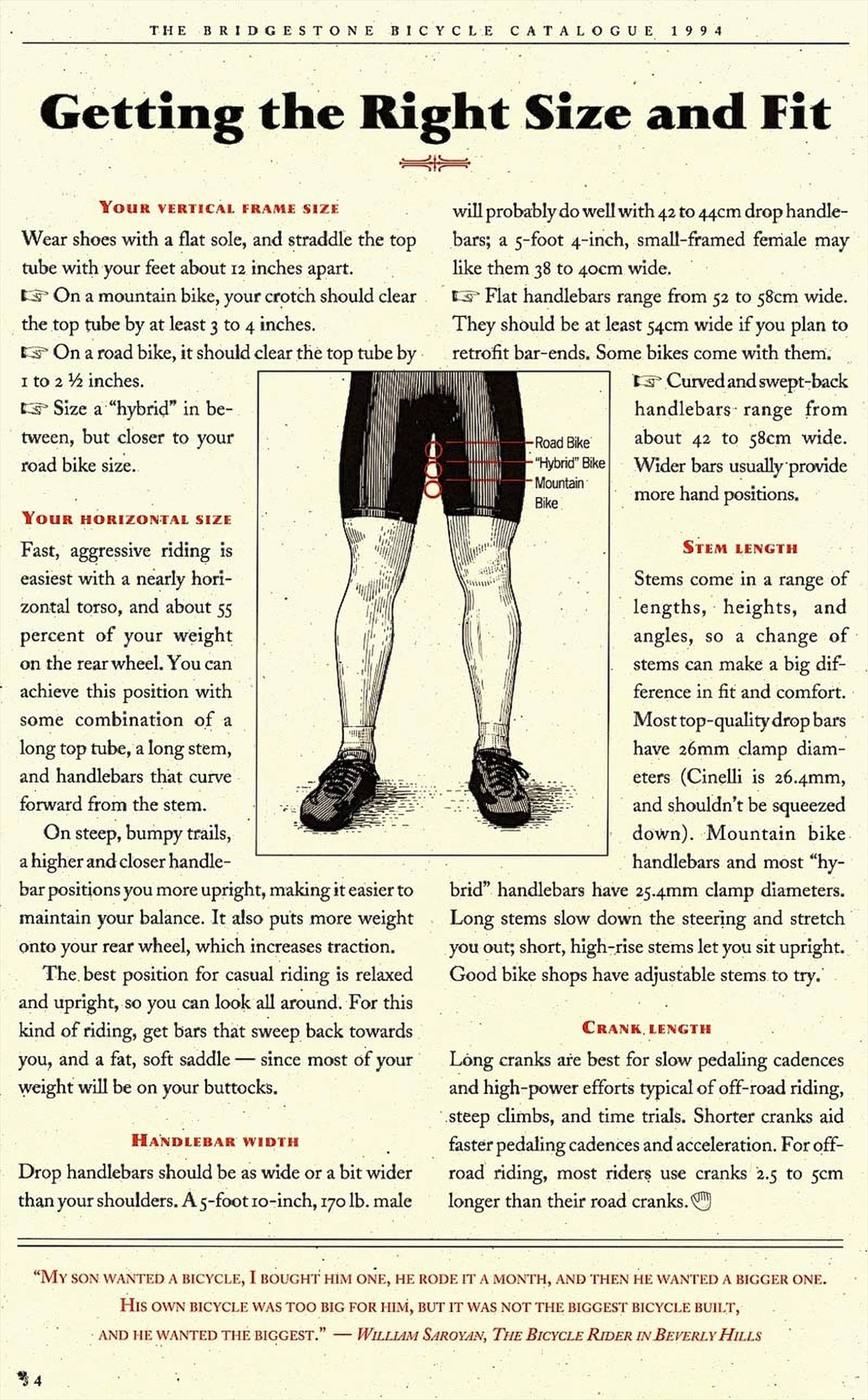
Getting the Right Size and Fit
YOUR VERTICAL FRAME SIZE
Wear shoes with a flat sole, and straddle the top tube with your feet about 12 inches apart.
On a mountain bike, your crotch should clear the top tube by at least 3 to 4 inches.
On a road bike, it should clear the top tube by 1 to 2 1/2 inches.
Size a “hybrid” in between, but closer to your road bike size.
Road Bike / “Hybrid” Bike / Mountain Bike (labels on a diagram of a rider’s legs and crotch heights)
YOUR HORIZONTAL SIZE
Fast, aggressive riding is easiest with a nearly horizontal torso, and about 55 percent of your weight on the rear wheel. You can achieve this position with some combination of a long top tube, a long stem, and handlebars that curve forward from the stem.
On steep, bumpy trails, a higher and closer handlebar positions you more upright, making it easier to maintain your balance. It also puts more weight onto your rear wheel, which increases traction.
The best position for casual riding is relaxed and upright, so you can look all around. For this kind of riding, get bars that sweep back towards you, and a fat, soft saddle — since most of your weight will be on your buttocks.
HANDLEBAR WIDTH
Drop handlebars should be as wide or a bit wider than your shoulders. A 5-foot 10-inch, 170 lb. male will probably do well with 42 to 44cm drop handlebars; a 5-foot 4-inch, small-framed female may like them 38 to 40cm wide.
Flat handlebars range from 52 to 58cm wide. They should be at least 54cm wide if you plan to retrofit bar-ends. Some bikes come with them.
Curved and swept-back handlebars range from about 42 to 58cm wide. Wider bars usually provide more hand positions.
STEM LENGTH
Stems come in a range of lengths, heights, and angles, so a change of stems can make a big difference in fit and comfort. Most top-quality drop bars have 26mm clamp diameters (Cinelli is 26.4mm, and shouldn’t be squeezed down). Mountain bike handlebars and most “hybrid” handlebars have 25.4mm clamp diameters. Long stems slow down the steering and stretch you out; short, high-rise stems let you sit upright. Good bike shops have adjustable stems to try.
CRANK LENGTH
Long cranks are best for slow pedaling cadences and high-power efforts typical of off-road riding, steep climbs, and time trials. Shorter cranks aid faster pedaling cadences and acceleration. For off-road riding, most riders use cranks 2.5 to 5cm longer than their road cranks.
“MY SON WANTED A BICYCLE, I BOUGHT HIM ONE, HE RODE IT A MONTH, AND THEN HE WANTED A BIGGER ONE. HIS OWN BICYCLE WAS TOO BIG FOR HIM, BUT IT WAS NOT THE BIGGEST BICYCLE BUILT, AND HE WANTED THE BIGGEST.” — WILLIAM SAROYAN, THE BICYCLE RIDER IN BEVERLY HILLS
4
[A page with a diagram of a rider’s legs and crotch height.]
— Page 7 —
All About the Quick-Release
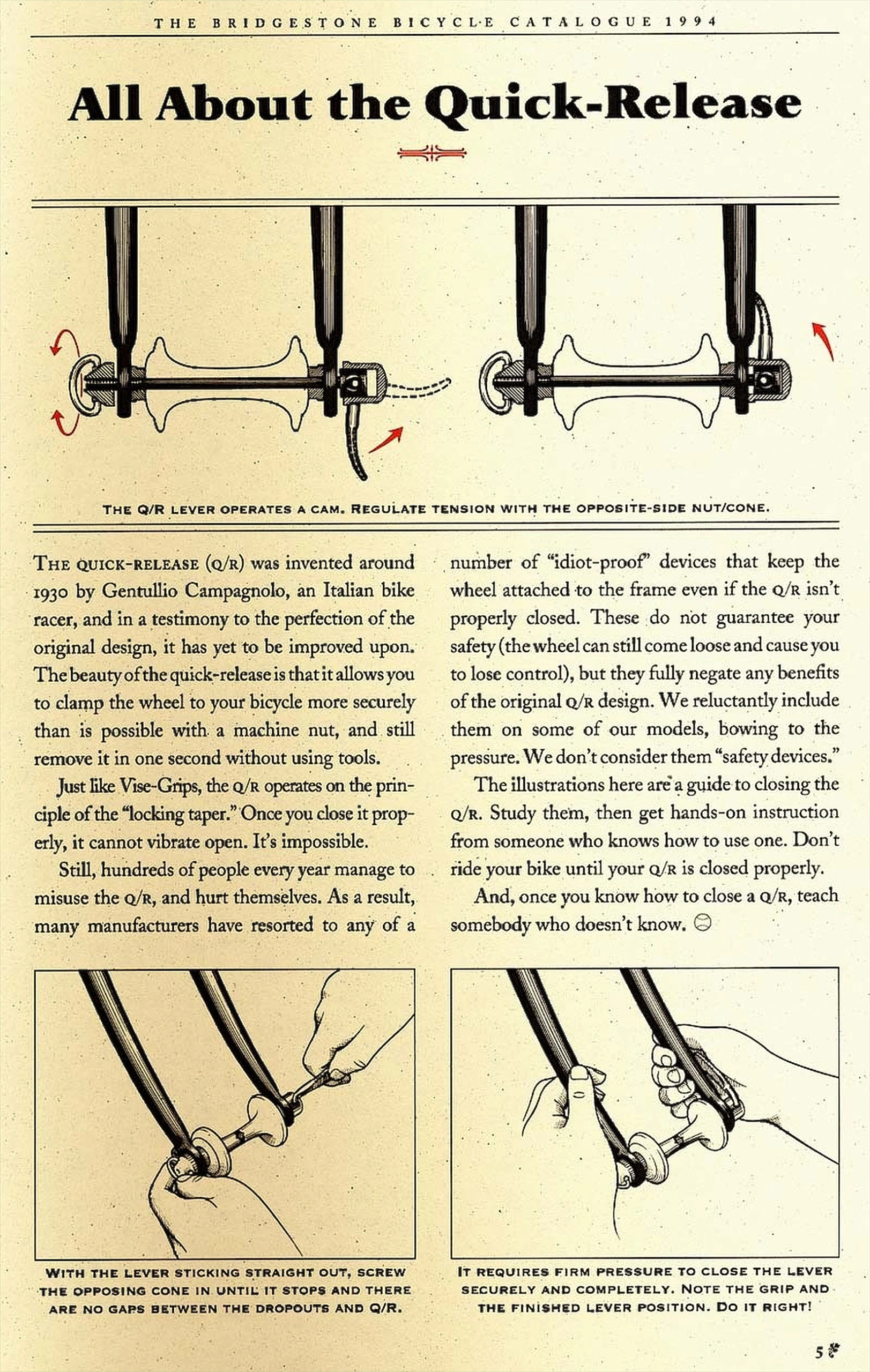
THE Q/R LEVER OPERATES A CAM. REGULATE TENSION WITH THE OPPOSITE-SIDE NUT/CONE.
THE QUICK-RELEASE (Q/R) was invented around 1930 by Gentullio Campagnolo, an Italian bike racer, and in a testimony to the perfection of the original design, it has yet to be improved upon. The beauty of the quick-release is that it allows you to clamp the wheel to your bicycle more securely than is possible with a machine nut, and still remove it in one second without using tools.
Just like Vise-Grips, the Q/R operates on the principle of the “locking taper.” Once you close it properly, it cannot vibrate open. It’s impossible.
Still, hundreds of people every year manage to misuse the Q/R, and hurt themselves. As a result, many manufacturers have resorted to any of a number of “idiot-proof” devices that keep the wheel attached to the frame even if the Q/R isn’t properly closed. These do not guarantee your safety (the wheel can still come loose and cause you to lose control), but they fully negate any benefits of the original Q/R design. We reluctantly include them on some of our models, bowing to the pressure. We don’t consider them “safety devices.”
The illustrations here are a guide to closing the Q/R. Study them, then get hands-on instruction from someone who knows how to use one. Don’t ride your bike until your Q/R is closed properly.
And, once you know how to close a Q/R, teach somebody who doesn’t know.
WITH THE LEVER STICKING STRAIGHT OUT, SCREW THE OPPOSING CONE IN UNTIL IT STOPS AND THERE ARE NO GAPS BETWEEN THE DROPOUTS AND Q/R.
IT REQUIRES FIRM PRESSURE TO CLOSE THE LEVER SECURELY AND COMPLETELY. NOTE THE GRIP AND THE FINISHED LEVER POSITION. DO IT RIGHT!
5
[A page of engraved drawings of a quick-release hub in the open and closed positions and of hands closing the lever.]
— Page 8 —
THE BRIDGESTONE BICYCLE CATALOGUE 1994
BY PETER EGAN
Make It Last
WHEN I WAS A BOY, we had an elderly neighbor who spoke with a Dutch accent, and everyone called him “Dutch.”
The Dutch, like the Scottish, were reputed to be careful with a nickel, and our neighbor fit the pattern pretty well. Long after everyone in the neighborhood had power lawn mowers, Dutch was still cutting his neat lawn with a push mower, which was in remarkably good shape, despite its age. He was always oiling and sharpening the thing, and wiping the wet grass off with a rag.
Dutch’s grandson, Danny, was a friend of mine, so I spent a lot of time at Dutch’s house whenever Danny came to visit. One day while Danny and I were watching him mow, Dutch suddenly stopped and picked something out of the grass. It was an old bent nail. He carried the nail into his workshop, cleaned it off on a treadle-operated wheel, straightened it with a hammer on the top of his anvil and put the nail in a baby-food jar above the bench. Danny and I grinned and shook our heads in amazement.
Nail rescued, Dutch went back to mowing.
What we were seeing was a genuine pre-War European and Great Depression survivor at work; a man who was the product of an era and a culture where people had more time than money. Dutch didn’t waste anything, hardly ever threw anything away and never bought anything that couldn’t be repaired in his small workshop.
Danny and I, on the other hand, grew up in the Fifties. Our families were not rich, but we didn’t rescue old nails. Need nails? Buy a box of shiny new ones. We didn’t use push-mowers, either, once the cheap two-stroke rotaries came along, changing the sound and smell of summer forever. And of course we were tired of hearing about the Depression and the Old Country. Excessive material conservatism was, frankly, a drag. Danny may have laughed, but he was slightly embarrassed by his grandfather.
Most Americans, if they are fortunate enough to be gainfully employed at the moment, continue to have more money than time. We still don’t straighten old nails, nor do most of us oil and adjust an old lawn mower with the expectation that it will last a lifetime, as Dutch’s did.
But if we haven’t yet run low on money or materials (which we eventually will, unless we prove to be an historical aberration), many of us are now noticing that we are running out of space. Space to throw things away, that is.
Barges and semi-trailers full of trash have become the new interstate hot potato. Our cast-off TV sets, air conditioners, bicycles, 8-track tape decks, computer screens and dishwashers are coming back to haunt us. Recycling is in, but recyclers are having a hard time finding markets for our mountains of trash.
Could the next step be permanence and reliability? Could be it’s happening right now.
Most of us have developed a sense of malaise over large objects that have to be thrown away because small parts have failed. Just in the past two weeks, I’ve had to order the entire electric mirror assembly on my truck — plastic shell, pedestal, servo motors and all — for $98 because the mirror glass (about 98 cents worth) was cracked. The mirror can’t be sold separately, the parts man told me. “Sorry, pal, it’s all one part number.”
This week, our 1981 microwave oven groaned and flashed its last. Ancient technology, no parts, not worth fixing, kaput. More landfill.
My computer/word processor and printer have also started to give me trouble. “They’re eight years old, for God’s sake,” my computer whiz pal Jim told me when I asked for advice. “Why bother? Get something new.”
In the computer world, a man who tries to repair an early PC is little better than a Dutch nail-straightener.
I can see junking old stuff when a new product that is truly better or more useful has come along, but there is something disquieting in the burial of useful objects that have died for want of a small part, or because they are no longer in fashion.
What does this have to do with bicycles?
Everything.
In the rural Midwest where I live, the cheap, nonrepairable, abandoned bicycle (originally acquired free with the purchase of a microwave oven, in some cases) has become almost a cliché of yard trash, along with tilting, two-legged barbecue grills and defunct kitchen appliances in avocado green. You see them in back yards among the weeds, or set out at the curb to be picked up and hauled off with old sofas and car tires.
Initial cheapness and low quality are not the only villains, of course. At a slightly higher level, we now have bikes with hubs, bearings, and other parts that are either sold as sealed units or are non-interchangeable with newer, older, or slightly different models. They are unique to machines whose overall design may or may not have enduring appeal. Standardization is losing ground.
Go to your local bike shop and see. It’s a small battleground in there, a marketing diorama in which the ephemeral and transitory are locked in combat with the logical and the infinitely repairable — and clearly winning. It takes a keen eye indeed to sort through the future landfill and find bicycles that will be repairable ten or twenty years from now. Or that, once repaired, will still be worth having.
Properly maintained, a well-built bike (like a good airplane) may outlive its owner. The difficult task is for the bicycle to outlive its owner’s enthusiasm. Nearly all machines eventually fall victim to some kind of neglect. The original owner loses interest, buys something new and different, changes hobbies, or decides that golf is easier on bad knees. The bike resurfaces at a garage sale, and someone then has to fix it, make it presentable — or throw it out.
Fixing an older, high quality bicycle or maintaining a newer one can be a delightful task. As one who has spent much of his life dialing back the odometer with airplanes, motorcycles, houses, and cars, I have developed the habit of looking for the ruins beneath the glow of newness, judging the value of something new partly on its capacity to age gracefully and to eventually be restored.
It’s becoming harder to do that with bikes; you have to learn what to look for. My own early Dutch tendency is to be drawn to bicycles and other machines I can fix; things that will never have to be thrown away.
Unless I accidentally back over them with my mirrorless truck, en route to the dump with our dead microwave oven.
— Peter Egan has written for Cycle World (motorcycles) since 1980, Road & Track since 1983, and our catalogue since 1993. He lives on a Wisconsin farm with his wife Barbara and some pets.
THERE IS SOMETHING DISQUIETING IN THE BURIAL OF USEFUL OBJECTS THAT HAVE DIED FOR WANT OF A SMALL PART, OR BECAUSE THEY ARE NO LONGER IN FASHION.
6-7
[The left half of a two-page spread: the essay “Make It Last” in four columns. The essay is transcribed here whole, across both halves of the spread.]
— Page 9 —
[The right half of the same spread: the later columns of the essay “Make It Last” with a red pull quote, transcribed with page 8.]
— Page 10 —
THE BRIDGESTONE BICYCLE CATALOGUE 1994
BY DAVID HERLIHY
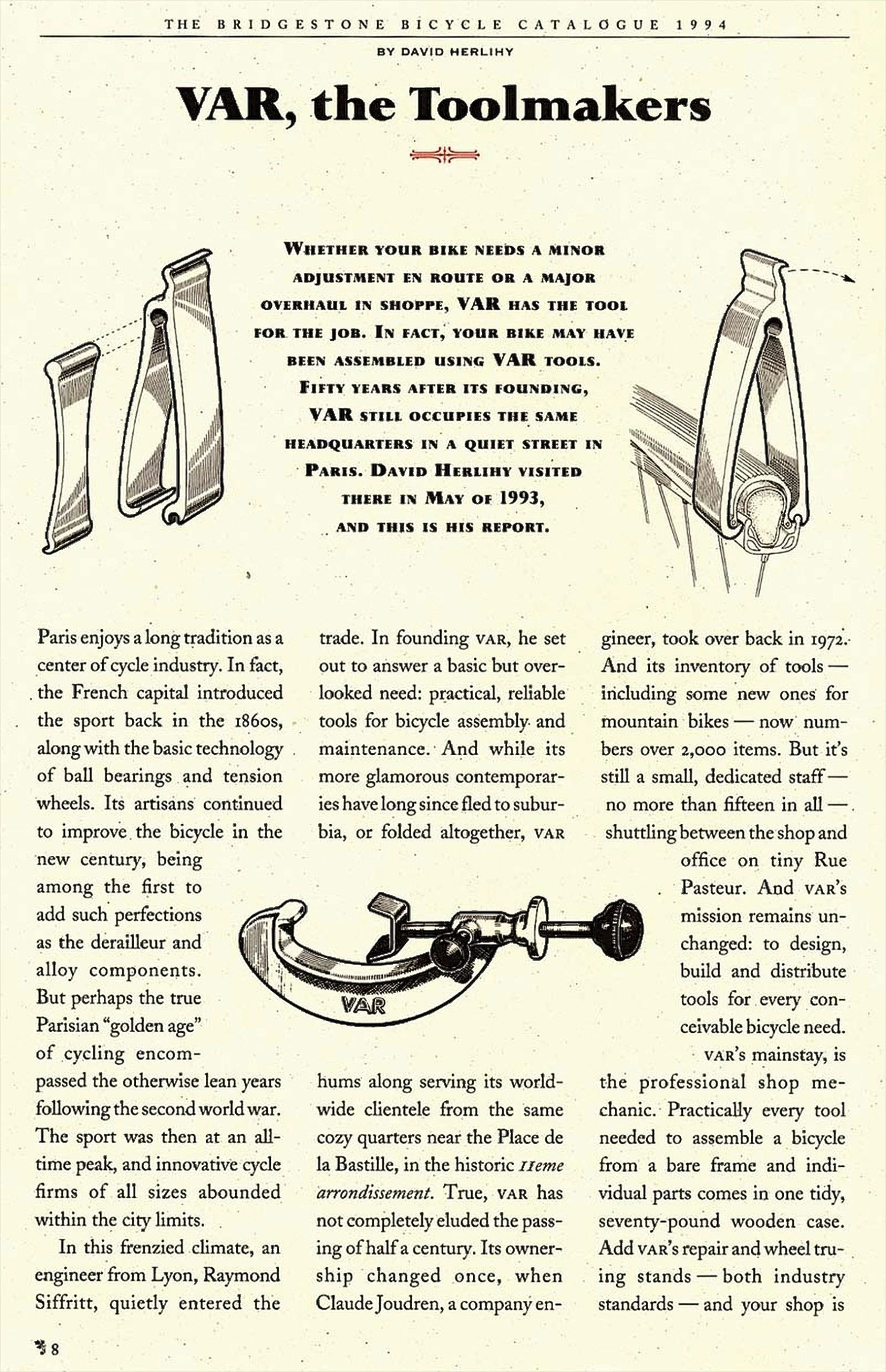
VAR, the Toolmakers
WHETHER YOUR BIKE NEEDS A MINOR ADJUSTMENT EN ROUTE OR A MAJOR OVERHAUL IN SHOPPE, VAR HAS THE TOOL FOR THE JOB. IN FACT, YOUR BIKE MAY HAVE BEEN ASSEMBLED USING VAR TOOLS. FIFTY YEARS AFTER ITS FOUNDING, VAR STILL OCCUPIES THE SAME HEADQUARTERS IN A QUIET STREET IN PARIS. DAVID HERLIHY VISITED THERE IN MAY OF 1993, AND THIS IS HIS REPORT.
Paris enjoys a long tradition as a center of cycle industry. In fact, the French capital introduced the 1860s, along with the basic technology of ball bearings and tension wheels. Its artisans continued to improve the bicycle in the new century, being among the first to add such perfections as the derailleur and alloy components. But perhaps the true Parisian “golden age” of cycling encompassed the otherwise lean years following the second world war. The sport was then at an all-time peak, and innovative cycle firms of all sizes abounded within the city limits.
In this frenzied climate, an engineer from Lyon, Raymond Siffritt, quietly entered the trade. In founding VAR, he set out to answer a basic but overlooked need: practical, reliable tools for bicycle assembly and maintenance. And while its more glamorous contemporaries have long since fled to suburbia, or folded altogether, VAR hums along serving its worldwide clientele from the same cozy quarters near the Place de la Bastille, in the historic 11eme arrondissement. True, VAR has not completely eluded the passing of half a century. Its ownership changed once, when Claude Joudren, a company engineer, took over back in 1972. And its inventory of tools — including some new ones for mountain bikes — now numbers over 2,000 items. But it’s still a small, dedicated staff — no more than fifteen in all — shuttling between the shop and office on tiny Rue Pasteur. And VAR’s mission remains unchanged: to design, build and distribute tools for every conceivable bicycle need.
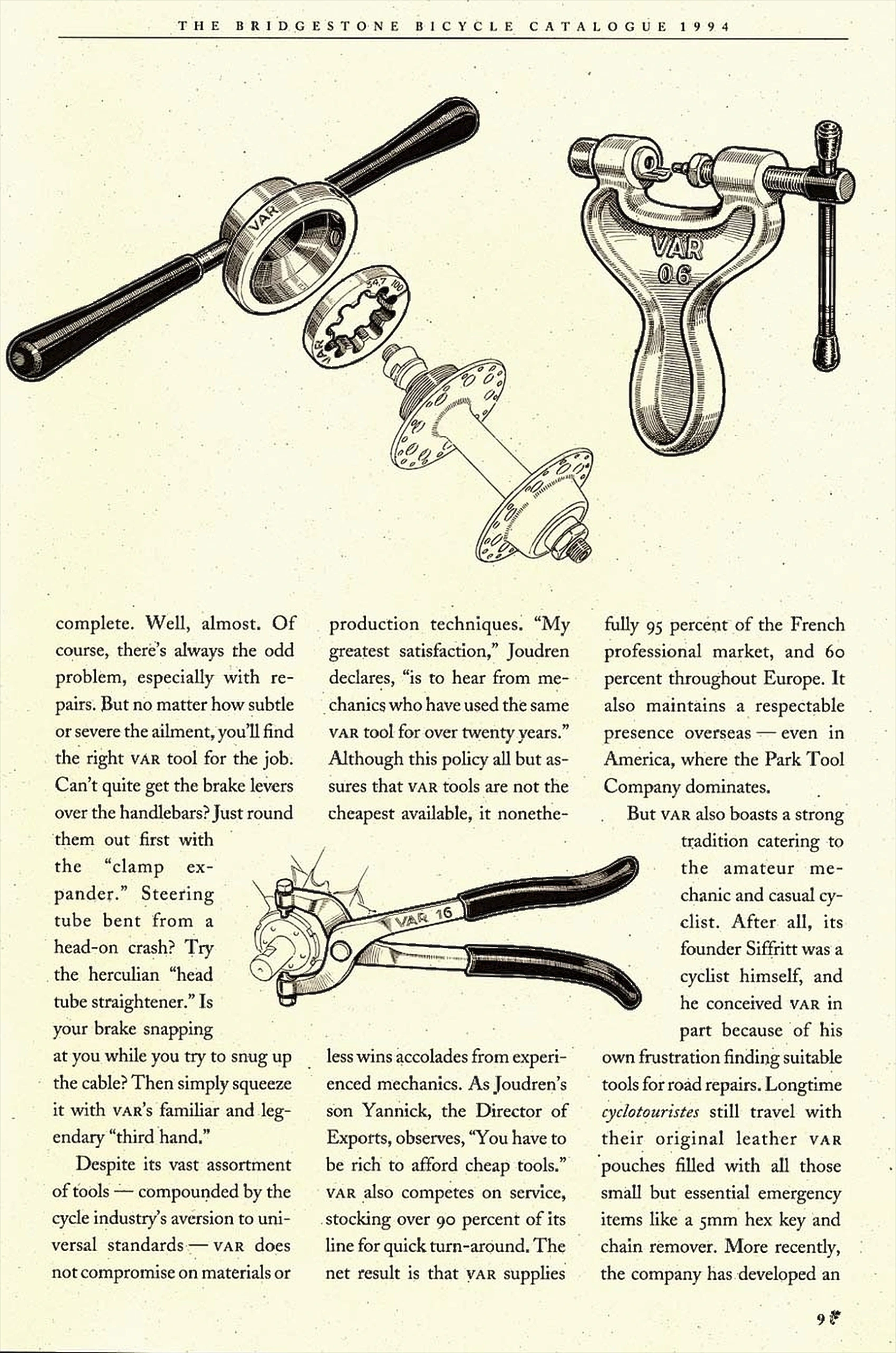
VAR’s mainstay, is the professional shop mechanic. Practically every tool needed to assemble a bicycle from a bare frame and individual parts comes in one tidy, seventy-pound wooden case. Add VAR’s repair and wheel truing stands — both industry standards — and your shop is complete. Well, almost. Of course, there’s always the odd problem, especially with repairs. But no matter how subtle or severe the ailment, you’ll find the right VAR tool for the job. Can’t quite get the brake levers over the handlebars? Just round them out first with the “clamp expander.” Steering tube bent in a head-on crash? Try the herculian “head tube straightener.” Is your brake snapping at you while you try to snug up the cable? Then simply squeeze it with VAR’s familiar and legendary “third hand.”
Despite its vast assortment of tools — compounded by the cycle industry’s aversion to universal standards — VAR does not compromise on materials or production techniques. “My greatest satisfaction,” Joudren declares, “is to hear from mechanics who have used the same VAR tool for over twenty years.” Although this policy all but assures that VAR tools are not the cheapest available, it nonetheless wins accolades from experienced mechanics. As Joudren’s son Yannick, the Director of Exports, observes, “You have to be rich to afford cheap tools.” VAR also competes on service, stocking over 90 percent of its line for quick turn-around. The net result is that VAR supplies fully 95 percent of the French professional market, and 60 percent throughout Europe. It also maintains a respectable presence overseas — even in America, where the Park Tool Company dominates.
But VAR also boasts a strong tradition catering to the amateur mechanic and casual cyclist. After all, its founder Siffritt was a cyclist himself, and he conceived VAR in part because of his own frustration finding suitable tools for road repairs. Longtime cyclotouristes still travel with their original leather VAR pouches filled with all those small but essential emergency items like a 5mm hex key and chain remover. More recently, the company has developed an
8-9
[A two-page spread under the heading “VAR, the Toolmakers”, with engraved drawings of tire levers, a tubing cutter, a freewheel remover with hub and a chain tool marked VAR 06, and a hand tool marked VAR 16. The text continues on the next spread.]
— Page 11 —
[The right half of the spread: the later columns of the article, with engraved drawings of VAR tools, transcribed with page 10.]
— Page 12 —
THE BRIDGESTONE BICYCLE CATALOGUE 1994
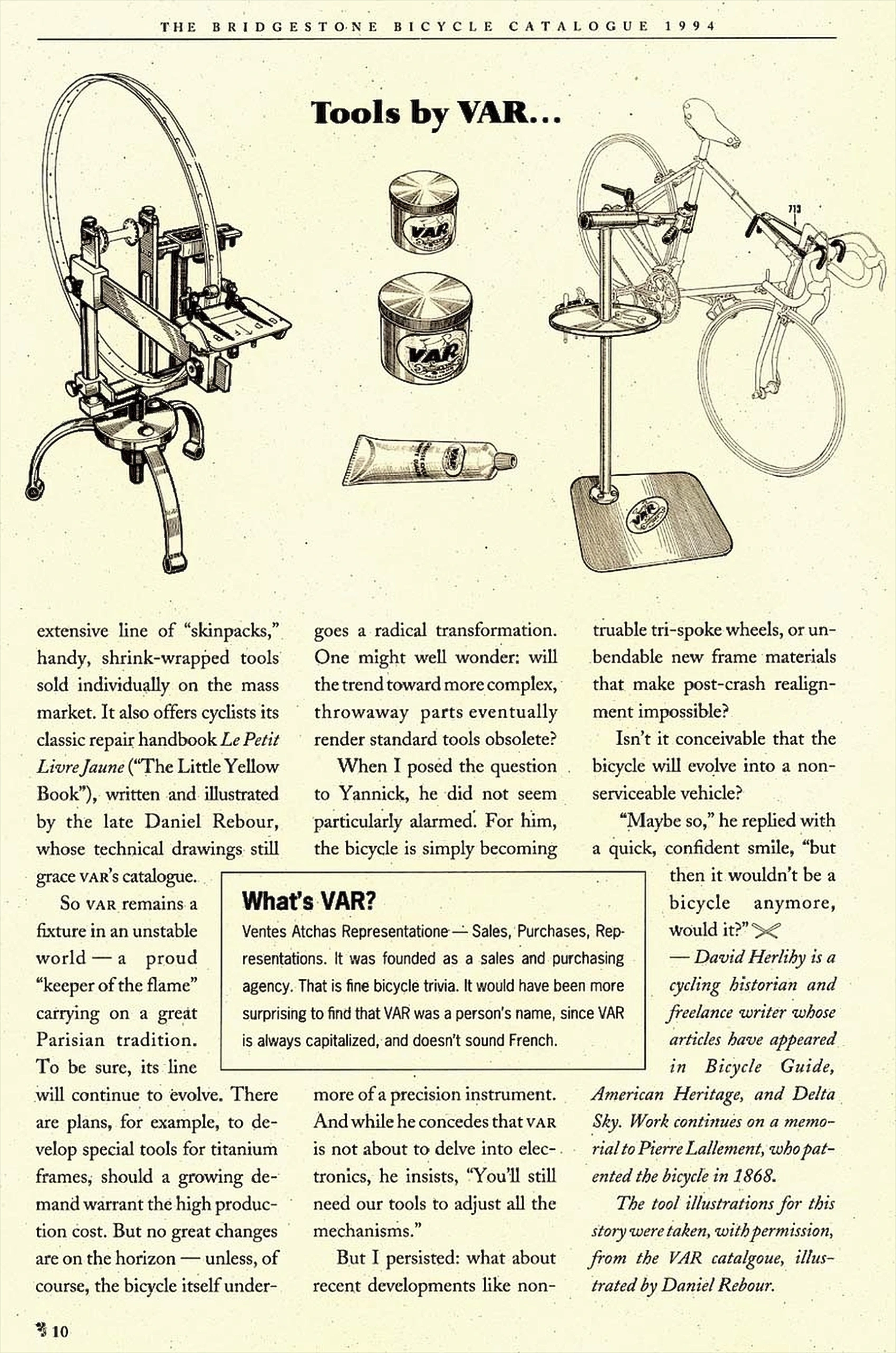
Tools by VAR…
extensive line of “skinpacks,” handy, shrink-wrapped tools sold individually on the mass market. It also offers cyclists its classic repair handbook Le Petit Livre Jaune (“The Little Yellow Book”), written and illustrated by the late Daniel Rebour, whose technical drawings still grace VAR’s catalogue.
So VAR remains a fixture in an unstable world — a proud “keeper of the flame” carrying on a great Parisian tradition. To be sure, its line will continue to evolve. There are plans, for example, to develop special tools for titanium frames, should a growing demand warrant the high production cost. But no great changes are on the horizon — unless, of course, the bicycle itself undergoes a radical transformation. One might well wonder: will the trend toward more complex, throwaway parts eventually render standard tools obsolete?
When I posed the question to Yannick, he did not seem particularly alarmed. For him, the bicycle is simply becoming more of a precision instrument. And while he concedes that VAR is not about to delve into electronics, he insists, “You’ll still need our tools to adjust all the mechanisms.”
But I persisted: what about recent developments like non-truable tri-spoke wheels, or unbendable new frame materials that make post-crash realignment impossible?
Isn’t it conceivable that the bicycle will evolve into a non-serviceable vehicle?
“Maybe so,” he replied with a quick, confident smile, “but then it wouldn’t be a bicycle anymore, would it?”
— David Herlihy is a cycling historian and freelance writer whose articles have appeared in Bicycle Guide, American Heritage, and Delta Sky. Work continues on a memorial to Pierre Lallement, who patented the bicycle in 1868.
The tool illustrations for this story were taken, with permission, from the VAR catalgoue, illustrated by Daniel Rebour.
What’s VAR?
Ventes Atchas Representatione — Sales, Purchases, Representations. It was founded as a sales and purchasing agency. That is fine bicycle trivia. It would have been more surprising to find that VAR was a person’s name, since VAR is always capitalized, and doesn’t sound French.
10
[A page headed “Tools by VAR…” with engraved drawings of a wheel truing stand, two tins and a tube of VAR grease and a repair stand holding a road bicycle, the end of the article and a boxed note “What’s VAR?”.]
— Page 13 —
THE BRIDGESTONE BICYCLE CATALOGUE 1994
Beeswax: Nature’s LocTite
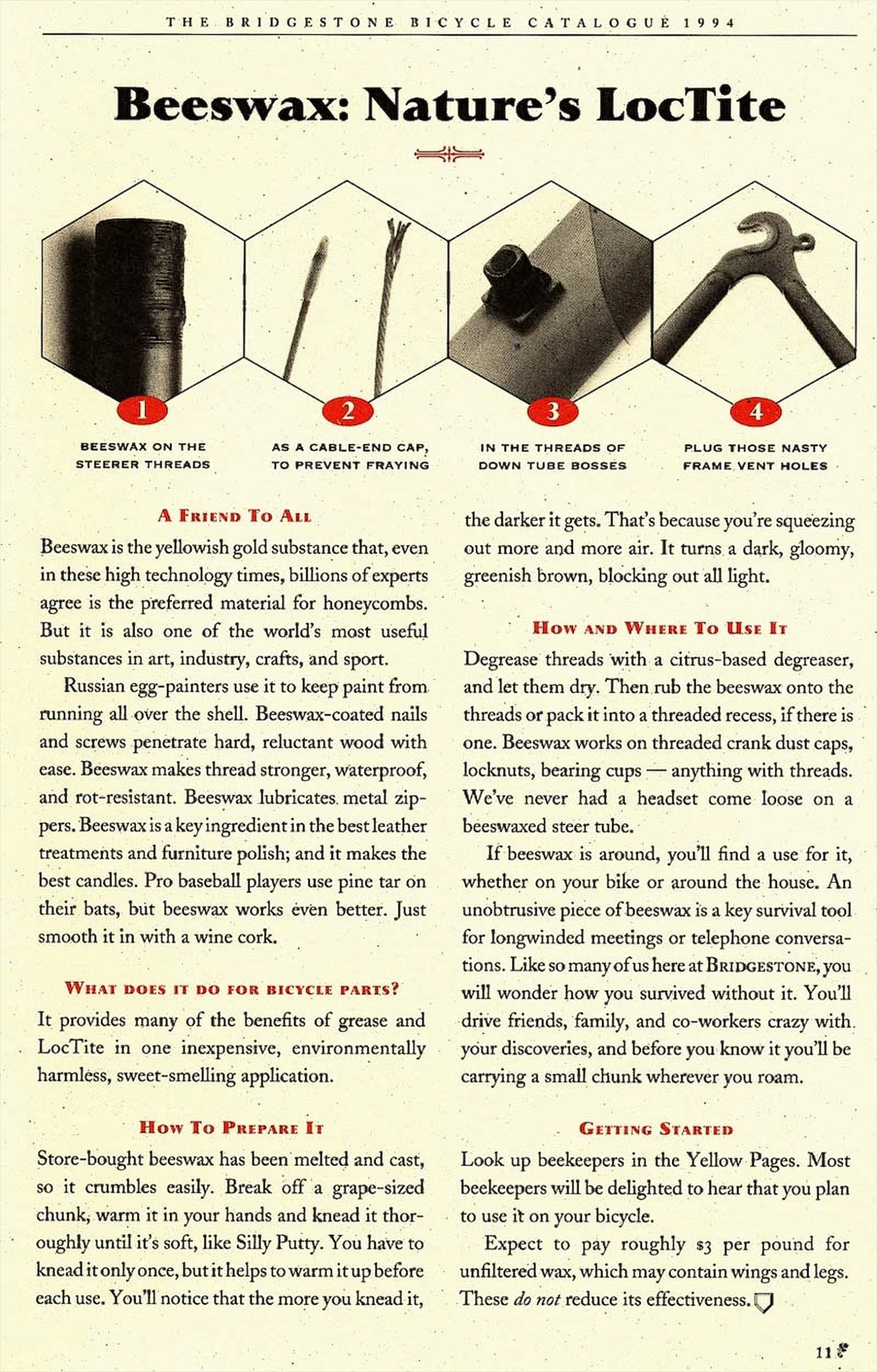
1. BEESWAX ON THE STEERER THREADS
2. AS A CABLE-END CAP, TO PREVENT FRAYING
3. IN THE THREADS OF DOWN TUBE BOSSES
4. PLUG THOSE NASTY FRAME VENT HOLES
A FRIEND TO ALL
Beeswax is the yellowish gold substance that, even in these high technology times, billions of experts agree is the preferred material for honeycombs. But it is also one of the world’s most useful substances in art, industry, crafts, and sport.
Russian egg-painters use it to keep paint from running all over the shell. Beeswax-coated nails and screws penetrate hard, reluctant wood with ease. Beeswax makes thread stronger, waterproof, and rot-resistant. Beeswax lubricates metal zippers. Beeswax is a key ingredient in the best leather treatments and furniture polish; and it makes the best candles. Pro baseball players use pine tar on their bats, but beeswax works even better. Just smooth it in with a wine cork.
WHAT DOES IT DO FOR BICYCLE PARTS?
It provides many of the benefits of grease and LocTite in one inexpensive, environmentally harmless, sweet-smelling application.
HOW TO PREPARE IT
Store-bought beeswax has been melted and cast, so it crumbles easily. Break off a grape-sized chunk, warm it in your hands and knead it thoroughly until it’s soft, like Silly Putty. You have to knead it only once, but it helps to warm it up before each use. You’ll notice that the more you knead it, the darker it gets. That’s because you’re squeezing out more and more air. It turns a dark, gloomy, greenish brown, blocking out all light.
HOW AND WHERE TO USE IT
Degrease threads with a citrus-based degreaser, and let them dry. Then rub the beeswax onto the threads or pack it into a threaded recess, if there is one. Beeswax works on threaded crank dust caps, locknuts, bearing cups — anything with threads. We’ve never had a headset come loose on a beeswaxed steer tube.
If beeswax is around, you’ll find a use for it, whether on your bike or around the house. An unobtrusive piece of beeswax is a key survival tool for longwinded meetings or telephone conversations. Like so many of us here at BRIDGESTONE, you will wonder how you survived without it. You’ll drive friends, family, and co-workers crazy with your discoveries, and before you know it you’ll be carrying a small chunk wherever you roam.
GETTING STARTED
Look up beekeepers in the Yellow Pages. Most beekeepers will be delighted to hear that you plan to use it on your bicycle.
Expect to pay roughly $3 per pound for unfiltered wax, which may contain wings and legs. These do not reduce its effectiveness.
11
[A page headed “Beeswax: Nature’s LocTite” with four hexagonal photographs numbered 1 to 4 showing beeswax on steerer threads, a cable end, a down tube boss and a frame vent hole.]
— Page 14 —
THE BRIDGESTONE BICYCLE CATALOGUE 1994
How To Ride A Bike Forever
1. RIDE WHEN YOU LIKE.
Don’t ride out of guilt over last night’s meal. Don’t be a slave to your bike, or else you’ll resent it, and feel guilty whenever you think about it or look at it. Soon you’ll be avoiding it altogether. If all your rides are like a swimmer’s workout, you’ll burn out on bikes as fast as swimmers burn out on laps. Ride when you want to ride.
2. GO SLOWLY.
Don’t push yourself too hard, physically or mentally. Don’t ride with racers or obsessive aerobicizers. (If you’re a racer, don’t race with riders; let them be.) Learn to relax on your bike. Of course your bike can be a tremendous tool to build cardiovascular fitness, but why let that get in the way? Unless you race, you can rely on something else, like running, to get fit and lose weight. Running is more efficient for this anyway.
3. GO SHORT.
A ten-minute ride is always worth it, even though it won’t elevate your heart rate to your “target training level” and keep it there for twelve minutes. (Or is it supposed to be eleven? Or fourteen?)
4. DON’T KEEP TRACK.
If you never use an on-board computer or a heart rate monitor, you can ride with us any time. Avoid “logs.” Forget the graphs and the home computer programs. Keep your bicycle free of extraneous wires and LEDS. You don’t need them.
5. OWN MORE THAN ONE BIKE.
This is not a commercial message! Runners have learned that nothing improves a run as much as a new pair of shoes, or shorts, or socks, or something. Bikes, unfortunately, cost a lot more, but the effect is the same. Make your bicycles so different that your experience on one is unlike the other — a mountain bike and a road bike, a multispeed and a single speed, or a clunker, or a recumbent. For some people, even different handlebars are enough of a change. It’s worth a try.
6. LEARN HOW TO FIX YOUR BIKE.
Learn to fix a flat. Learn how to install a wheel. Learn how to adjust derailleurs. It’s all easy, and you’ll never feel at ease on a bike if you’re at its mercy. Being able to fix your bike will give you enormous confidence and satisfaction, not to mention self-sufficiency.
7. DON’T CHASE TECHNOLOGY.
You will never catch it, and if you pursue it year after year it will break your wallet in half. Some wonderful things have happened to bicycles in the last fifteen years, but so have a lot of dumb things. You don’t need a fancy machine with the latest equipment to enjoy something that is so joyous and simple. A simple, reliable bike will do.
IT SHOULD BE BORNE IN MIND THAT REGULAR EXERCISE ON THE WHEEL PROMOTES DIGESTION, AND THE FOOD IS MORE THOROUGHLY ASSIMILATED THAN IT IS PROBABLY IN ANY OTHER FORM OF EXERCISE EXCEPT, PERHAPS, HORSEBACK RIDING…. BICYCLING, COUPLED WITH COLD-WATER BATHS, CONSTITUTE ALMOST A CERTAIN PANACEA OF ALL THE ILLS THAT HUMAN FLESH IS HEIR TO. — GEO. W. BLUM, THE CYCLER’S GUIDE AND ROAD BOOK (1895)
12
[A page headed “How To Ride A Bike Forever” in two columns of seven numbered points.]
— Page 15 —
THE BRIDGESTONE BICYCLE CATALOGUE 1994
BY MAYNARD HERSHON
How Green Thou Art
WE CYCLISTS SEE OURSELVES and our sport as kind to the earth, “green.” At stoplights, we looking in through the safety glass and feel superior to car drivers, callous polluters closed off from nature in glass and steel boxes.
We’re green, we think; they’re not. Right? Not necessarily.
We know bikes don’t burn petroleum fuel like cars do; bikes don’t pollute the air with exhaust or fuel vapor. Bikes use less material and energy in their construction. Beyond those givens, what’s so green about riding?
Seems to me cycling’s green only when it keeps us from driving, when it freezes our cars in our garages, when we’re riding instead of driving.
Let’s say you drive your car 15,000 miles a year, the national average last time I heard, and you “get into” cycling big-time: you ride four or five thousand miles in 1994. But — you put the same 15,000 miles on your car. Is your cycling green?
Or are you spewing out the same number of particulate brown meanies into the air and feeling superior to driver-polluters while you turn yourself into a bronzed god or goddess in your spare time?
I commute five miles each workday on my bicycle. If I weren’t a cyclist, I suppose I’d drive a car or ride a motorcycle. Those five are the only miles I do that are essentially kind to the earth, because I do them on a bike instead of in or on a motor vehicle.
My training rides are fun, but they aren’t green. I’m on my non-polluting bike for those miles, true enough, but I’m not keeping a car off the road. I’m not going somewhere I would have gone in a car. I wouldn’t do those same loops in a car. I’ve seen those roads before.
Bicycle racing is exciting, but it isn’t green either. Racers and support people fly and drive to and from events. Motorcycles and cars, sometimes dozens, precede and follow big races.
If watching a race inspires a few spectators to pump the tires on their old ten-speeds and ride to work instead of driving, that’s racing’s one ecological saving grace.
Big group bicycle rides, centuries and the like, aren’t green either. Participants drive miles to events, filling the parking lots at start/finish to overflowing with cars. Drive 220 miles, ride 100.
Even bike touring is not necessarily green. If you cycle the Green Mountains after flying to Boston, renting a car and driving to Vermont, are you walking gently on the earth, or are you merely taking an athletic vacation?
Start and end a tour at your door, a tour you just might have done in a car, and you’ve done something you could call green.
Bike commuting truly is green, but bike commuting is difficult. Takes grit. It’s cold in the winter and wet when it rains. Commuting reality for most of us is mean streets clogged with one-person carloads of tight-jawed resolutely uncharitable motorists. Freshly oiled, cocked and locked.
Tough and scary as it is, even though green is “in,” I don’t believe bicycle commuting is growing. Commuting attracts mostly cycling true-believers. Hey, maybe you’re a true-believer yourself or on your way to becoming one.
Listen, true-believer: If you want to put your muscles and resolve where your ideals are — if you want to do what you can for the water, air, your health, and the health of fellow Americans — put in the miles where they matter.
Ride your bike to work. Rde it to school. Run errands on your bike. Ride your bike whenever you can. Leave your car parked, and if you don’t have a car, if you truly don’t need one, don’t buy one.
Ride.
— Maynard Hershon is a well-known cycling writer, with columns in various publications. Many of his Winning magazine columns have been published in a book called Tales From the Bike Shop, available at all good establishments of that type.
13
[A page headed “How Green Thou Art” in three columns.]
— Page 16 —
THE BRIDGESTONE BICYCLE CATALOGUE 1994
BY TED COSTANTINO
Play the Games Fairly
DISC WHEELS, RUBBER SUITS, AERO BARS, AND SINGLE-SIDED FORKS: HAVE THE OLYMPICS BECOME A SHOWCASE FOR TECHNOLOGY AT THE EXPENSE OF FAIR COMPETITION? ARE ATHLETIC RECORDS DISHONORED WHEN THEY ARE BROKEN BY MACHINERY? LET’S SEE.
When it comes to bicycle racing, Henri Desgrange was mostly right: Don’t cut anyone a break. Desgrange was the mustachioed despot who created the Tour de France in 1903, and in the early years of his race competitors fended almost wholly for themselves.
They carried their own spares and fixed their own flats. They repaired their own bikes (who can forget the story of Eugène Christophe losing the Tour in 1914 because he allowed a boy to work the bellows while Christophe fixed his own fork in a blacksmith’s shed?). In fact, for a number of years the racers were forced to ride virtually identical bicycles. Desgrange even banned derailleurs until the mid-thirties. For this, and for the tortuous routes he mapped out each year, his riders gave him an endearing nickname. They called him “assassin.”
Deadly his races might have been, but Desgrange had a higher purpose: He wanted to make sure he didn’t kill off interest in his event. As a seasoned newspaperman (and a one-time hour record holder), Desgrange knew that the best stories always involve people. Accordingly, he made sure that his Tour de France was a test of athletes, not machines. The bicycles were always relegated to a secondary role.
Although the passing years have seen commercial pressures change the face of pro racing, there’s still one place that ought to embrace the purity of Desgrange’s vision: The Olympics.
Look at the games today: Every four years, the countries that can afford it spend tens of thousands of dollars on fragile, one-race wonderbikes. Someone inevitably wins a gold medal on one of these things, and for the next four years framebuilders all over the world chase this design, while racers argue endlessly with their local officials over whether the bikes are legal. Eventually, someone develops a newer bike and everybody takes off after that one. Forgotten in all this is the fellow who won the medal to begin with.
Banning such bikes, on the other hand, returns the Olympics to the athletes. It removes the wild card of technology from the deck, and it doesn’t penalize the riders who can’t afford one-of-a-kind funny bikes backed by four years of defense-level spending. It’s just another form of neutral support.
Eliminating exotic machinery could bring cycling into the Olympic mainstream, too. Consider the most popular sports of the summer games: running, swimming, and basketball. One thing they share is pure athleticism unfettered by a cloak of machinery. Unlike archery, say, or even pole-vaulting, where the outcome is hopelessly skewed by equipment, runners from one country are at no particular disadvantage to runners from anywhere else. The fact that Kenya, for example, lacks an advanced plastics industry doesn’t affect the marathon results a bit. And the public certainly responds more readily to the sight of an athlete practicing fundamental skills — albeit at an exalted level — than to a bug-like figure strapped aboard a rolling monument to aerospace engineering.
The admission of professional athletes to the ’96 games presents a perfect opportunity to revise the rules, to honor Desgrange’s vision. If he were in charge, he’d probably create a set of reasonable standards for such things as wheelbase, minimum weight, and aerodynamic aids (and Q-factor — ed.). He’d draw up a list of eligible off-the-shelf components. Then he’d ban everything else. So should we.
Leveling the technological landscape every four years would not only make the Olympics fairer, it could make them more interesting — something we’d all welcome the next time the cameras swing over to the time trial course at 3 a.m. For one thing, the results would certainly give us a more accurate record of athletic progress than the lab-boosted scores we keep today.
I mean, haven’t you always wondered whether the Italians could win a team time trial aboard bikes that look and work just like everyone else’s? Did the U.S. really needed to spend $50,000 each on those 1984 funny bikes? Could Chris Boardman, a perennial also-ran, have possibly won his gold medal in 1992 without a bike that gave him a 15-second advantage in the 4000-meter pursuit?
Finally, what does it say to the next generation of cyclists if the only path to Olympic victory is paved with technological gold? Shouldn’t the most accessible display of the sport — and with unrivalled television reach, Olympic cycling is certainly that — shouldn’t it present the most accessible face of cycling?
When you think about it, the whole premise of the Olympics is sort of odd. Pitting country against country in an age when each local dispute threatens to become a global crisis seems counterproductive. If anything, we should create games that erase national boundaries, not encourage them.
But given the existing national team structure, why not at least eliminate — just for the Olympics — the element of advanced technology so that all countries can compete on an equal level? Admittedly, it’s not the solution for world peace. But it’ll certainly be a better show.
— Ted Costantino is the former editor of Bicycle Guide, and now handles marketing for Merlin Metalworks. If you think he needs to write more often, be sure to drop us a line and we’ll pass it on to him.
14
[The left half of a two-page spread headed “Play the Games Fairly”. The article is transcribed here whole, across both halves of the spread.]
— Page 17 —
DON’T TAKE AN UNFAIR ADVANTAGE OF AN OPPONENT. — MAJOR TAYLOR
15
[The right half of the spread: the later column of the article, transcribed with page 16, under a red quotation.]
— Page 18 —
THE BRIDGESTONE BICYCLE CATALOGUE 1994
BY RICHARD SACHS
Part of the Job
HAND LABOR IS SO EXPENSIVE THAT MOST PRODUCTS ARE DESIGNED TO MINIMIZE IT. EITHER THAT, OR THEIR MANUFACTURE IS FARMED OUT TO NON-INDUSTRIALIZED COUNTRIES WHERE LABOR IS STILL CHEAP. BUT ARTISANS SUCH AS RICHARD SACHS ACTUALLY LIKE WORKING WITH THEIR HANDS, AND THEIR EFFORTS REMIND US THAT IN CERTAIN APPLICATIONS, THERE’S NO SUBSTITUTE FOR HUMAN LABOR. (RICHARD CAN AFFORD HIS OWN LABOR, BECAUSE HE DOES NOT ANSWER TO STOCKHOLDERS OR INVESTORS WHO DEMAND MAXIMUM RETURN ON INVESTMENT.) HE IS A CRAFTSMAN OF THE OLD SCHOOL, AND NATURALLY HIS FRAMES COST A LOT — FROM $1,500 TO $2,300 EACH. BUT WHAT A BARGAIN!
In 1974 I bought several thousand sets of Nervex Professional frame lugs through M. Yvars & Co. of Paris. Yvars was a parts distributor for the cycle trade in Europe and specialized in French products. They were distributors for DuBois lugs, of which Nervex was one model. The company’s full name was Etablissement Aime DuBois.
I recall feeling that I could make a superior frame joint with these crude lugs than I could with all other available types. I still believe that, even now, when investment cast lugs are so popular. The Nervex lugs seemed softer and thicker. They held up better during brazing, and wouldn’t heat up faster than the tubes. They came in a terribly crude state, so it was up to me as a frame maker to reshape them. But that was part of the job, and I looked forward to all the filing needed to make them beautiful. It’s a good thing, because I’d already sent in the order.
Months later, when all the correspondence, wire transfers, catalogues, and wooden shipping crates arrived, I had to question my own judgment — I now had more lugs in stock than I thought I would make into frames in my lifetime. I spent more money for this folly than I could ever expect to recoup. In time I would come to believe it was the right thing to do, and I expected I wouldn’t need any more lugs for decades!
But DuBois stopped making lugs long ago. I’m not sure exactly why. Perhaps it was in response to the investment-cast era ushered in during the 1980s. Maybe it was in response to the growing popularity of non-steel frames. But certainly it was in response to the bike industry’s move away from hand-made products, forsaking generations of tradition, and towards frames made with the aid of pre-heaters, robots, and disinterested line workers.
Anyway, I have used up most of those lugs now, but the packing papers and boxes are still here, and I like having them around. They remind me of how beautiful frames once were — the result of hours of skilled hand labor. Those days are gone, but many of the bikes are still kicking around. If you have one, hold onto it. If it is damaged, it can be fixed, and you can ride it almost forever, as its maker intended.
— Richard Sachs still races and maintains his one-man framebuilding business on Main Street, Chester, Connecticut 06412. (203) 526-2059.
16
[A page headed “Part of the Job” in two columns under a boxed introduction.]
— Page 19 —
THE BRIDGESTONE BICYCLE CATALOGUE 1994
Preparing a Lug
THIS IS A DUBOIS LUG — A MODEL USED ON MANY OF THE TOP EUROPEAN FRAMES IN THE ’60S AND ’70S. IT IS ACCEPTABLE AS IT IS, BUT IT’S RATHER ROUGH, AND WITH A LITTLE IMAGINATION, IT CAN BE TRANSFORMED INTO SOMETHING QUITE BEAUTIFUL.
THE FIRST THING I DO IS BRAZE ON A PIECE OF STEEL. IT DOESN’T HAVE TO BE SPECIAL; A SCRAP FROM A TUBE MITER WILL DO.
NEXT, I USE A VARIETY OF FILES TO RESHAPE AND RECONTOUR THE EDGES, INCLUDING THE BRAZED-ON SCRAP. I DON’T DRAW ANYTHING. I HAVE A MENTAL IMAGE OF WHAT I WANT, AND I TRY TO REMOVE EVERYTHING THAT ISN’T PART OF THAT IMAGE.
AFTER EXTENSIVE FILING, SHAPING, AND SANDING, THE LUG IS READY TO BRAZE. IF NECESSARY, I CAN DO SOME TOUCH-UP FILING AND SANDING AFTER BRAZING.
17
[A page of four photographs of a head lug in successive stages of filing, in sepia.]
— Page 20 —
THE BRIDGESTONE BICYCLE CATALOGUE 1994
Stamped Steel Frame Parts…
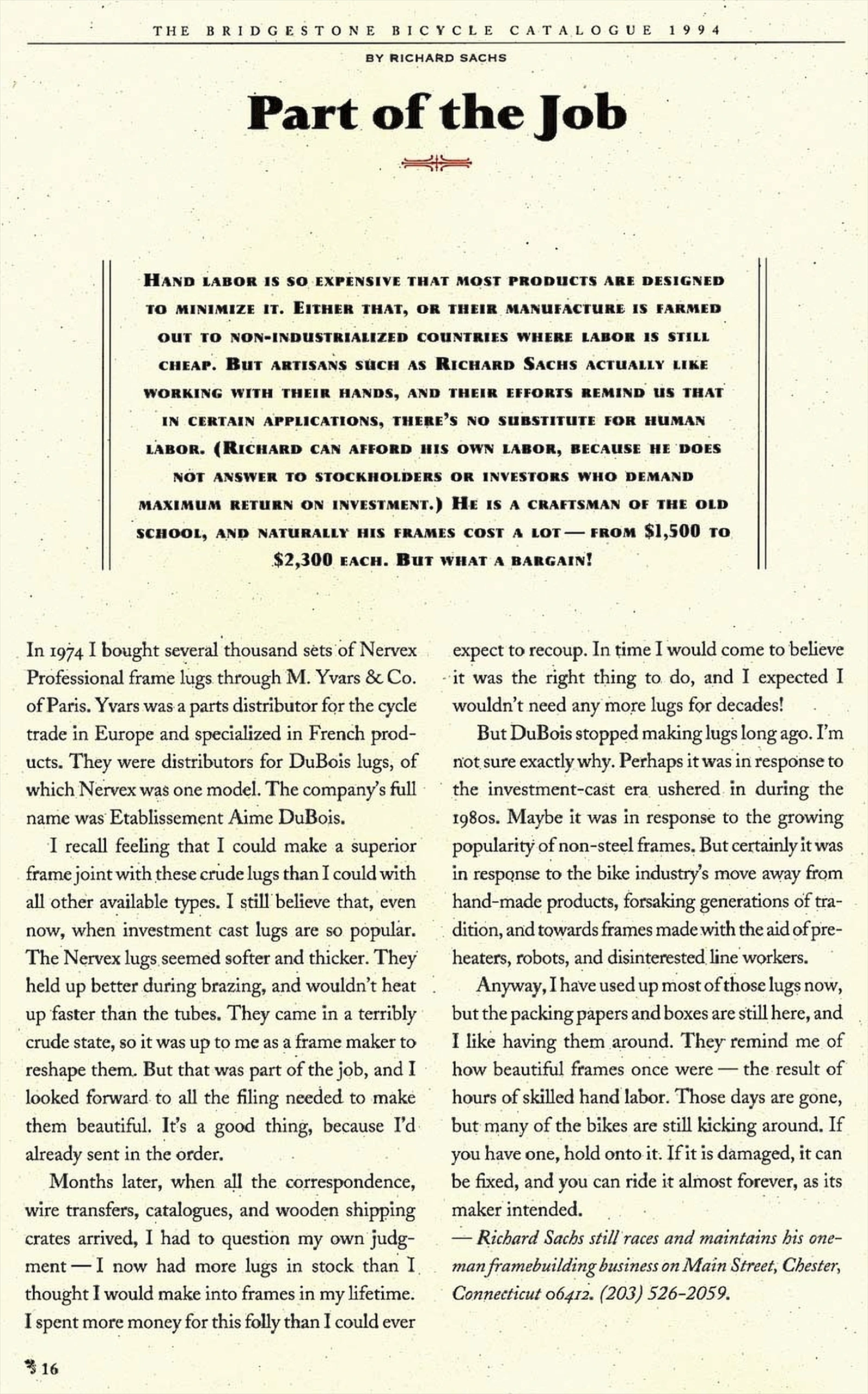
ONE OF THE SIMPLEST WAYS to form a bicycle frame lug, fork crown, or bottom bracket shell is to stamp it out of a sheet of steel, press it around a form, and then weld the edges together. Frame parts made this way are called stamped, or pressed, or welded. We’ll just call them stamped.
Stamping used to be a common way to make high quality frame parts, and manufacturers like Prugnat, Haden, and Eisho thrived. But now TIG-welded mountain bikes comprise most of the U.S. market, and most of the remaining high quality lugged bicycles are built with labor-saving investment castings. Good stamped lugs are becoming scarce.
It takes a lot of hand labor — filing, mostly — to make a stamped fitting look really pretty, and the cost of labor more than offsets the low cost of the stamped piece.
MATERIAL
Most stamped lugs are made from high tensile steel, like that used in the frames of inexpensive bicycles. This steel is ideal for stamped fittings, since it is more formable than chrome-moly (it doesn’t spring back as readily), and it bends without cracking. Unlike investment cast fittings, whose size and shape are restricted by the ability of the molten metal to fill in the nooks, corners, and points, stamped fittings can be as long and as ornate as you like — just make the braking punch (step #1) to suit.
WHERE TO FIND THEM
The most ornate lugged bicycles, such those made by the English builders Hetchins and Cottingham, are built with stamped lugs; and stamped fittings are still popular in Japan on low-end sport and utility bikes.
AN ASSORTMENT OF STAMPED LUGS FROM FRANCE, AND AN INEXPENSIVE STAMPED FORK CROWN FROM JAPAN.
18
[A page headed “Stamped Steel Frame Parts…” with a photograph of an assortment of stamped lugs.]
— Page 21 —
THE BRIDGESTONE BICYCLE CATALOGUE 1994
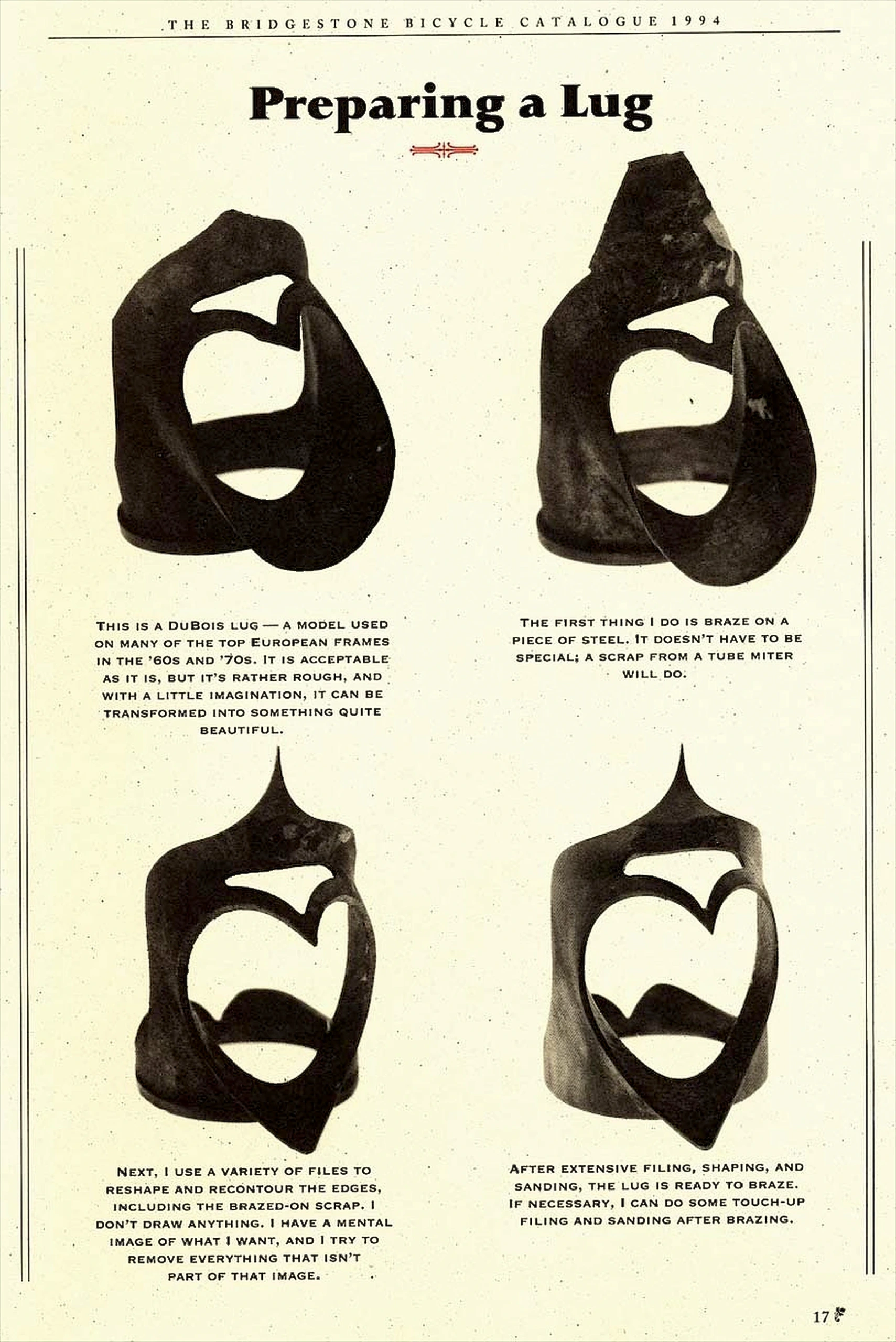
…and How to Make Them
STAMP NO. 1: GET A TOOL STEEL DIE AND A FLAT SHEET OF STEEL BETWEEN 1.2MM AND 2.0MM THICK. STAMP OUT YOUR SHAPE, USING 30 TO 80 TONS OF FORCE.
PUNCH NO. 1: THEN PUNCH THE SHEET STEEL WITH ANOTHER 30 TO 50 TONS, DRAWING IT OVER AN APPROPRIATE FORM, TO PREPARE IT FOR…
PUNCH NO. 2: …YOUR BENDING PUNCH. THIS PUNCH IS COATED WITH RUBBER TO PROTECT THE METAL. THE EDGES ARE NOW CLOSER TOGETHER.
PUNCH NO. 3: THEN SLIDE IN A SOLID BAR TO LIMIT THE DEFORMATION, AND PUNCH IT ONCE MORE WITH 30 TONS OF FORCE. NOW THE EDGES SHOULD ALMOST TOUCH.
WELDING: BUTT-WELD THE EDGES TOGETHER, BEING CAREFUL TO LEAVE NO GAPS. THE BORES SHOULD BE ROUND, SO THE FRAME TUBE FITS WELL. THIS HELPS IN BRAZING.
FINISHED. FILE THE WELD. THE FRAMEBUILDER SHOULD NOT HAVE TO DO MUCH WORK ON THIS LUG, BUT IT’S NICE TO LEAVE A LITTLE EXTRA METAL TO WORK WITH.
19
[A page of six engraved drawings of the stages of making a stamped lug.]
— Page 22 —
THE BRIDGESTONE BICYCLE CATALOGUE 1994
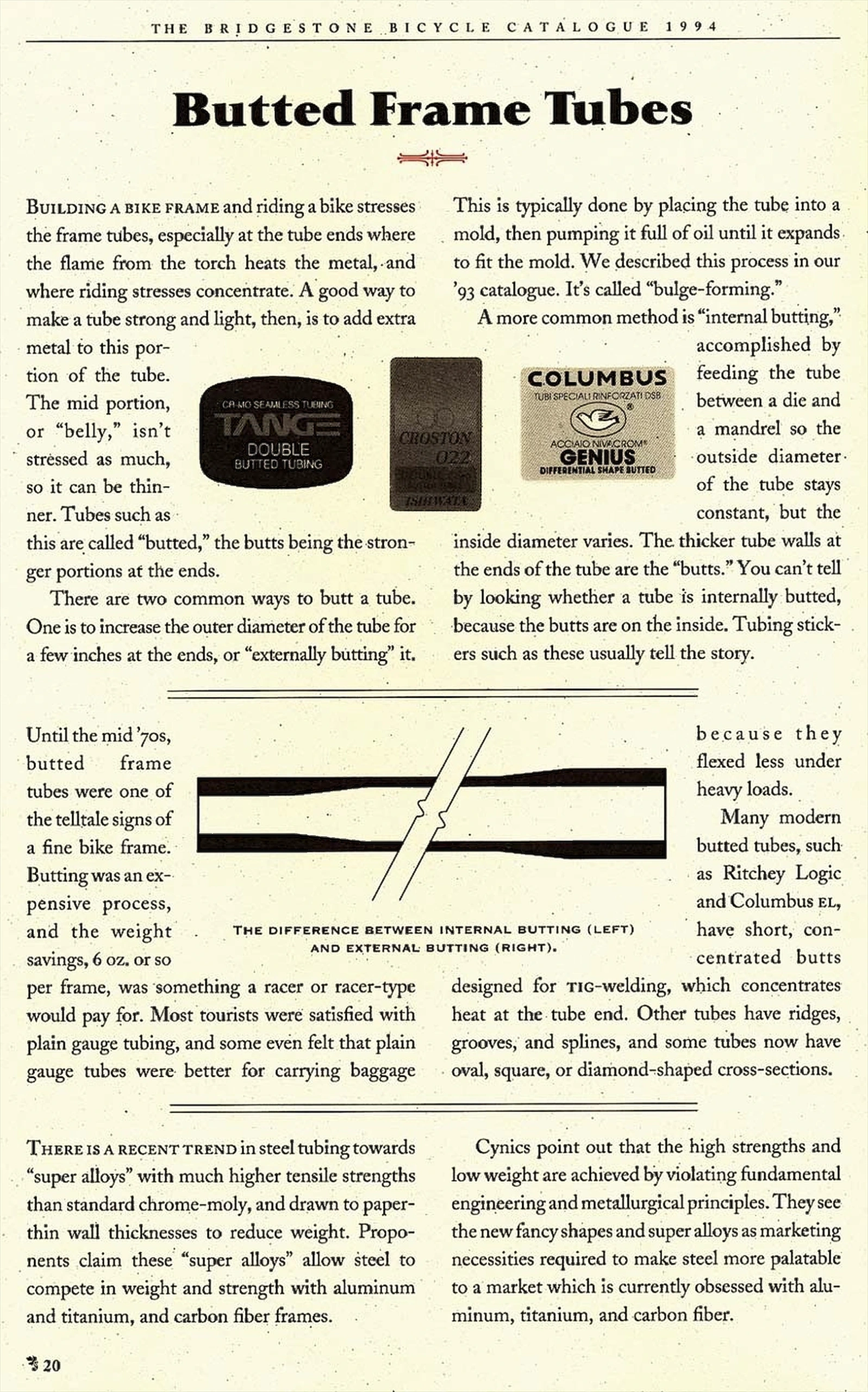
Butted Frame Tubes
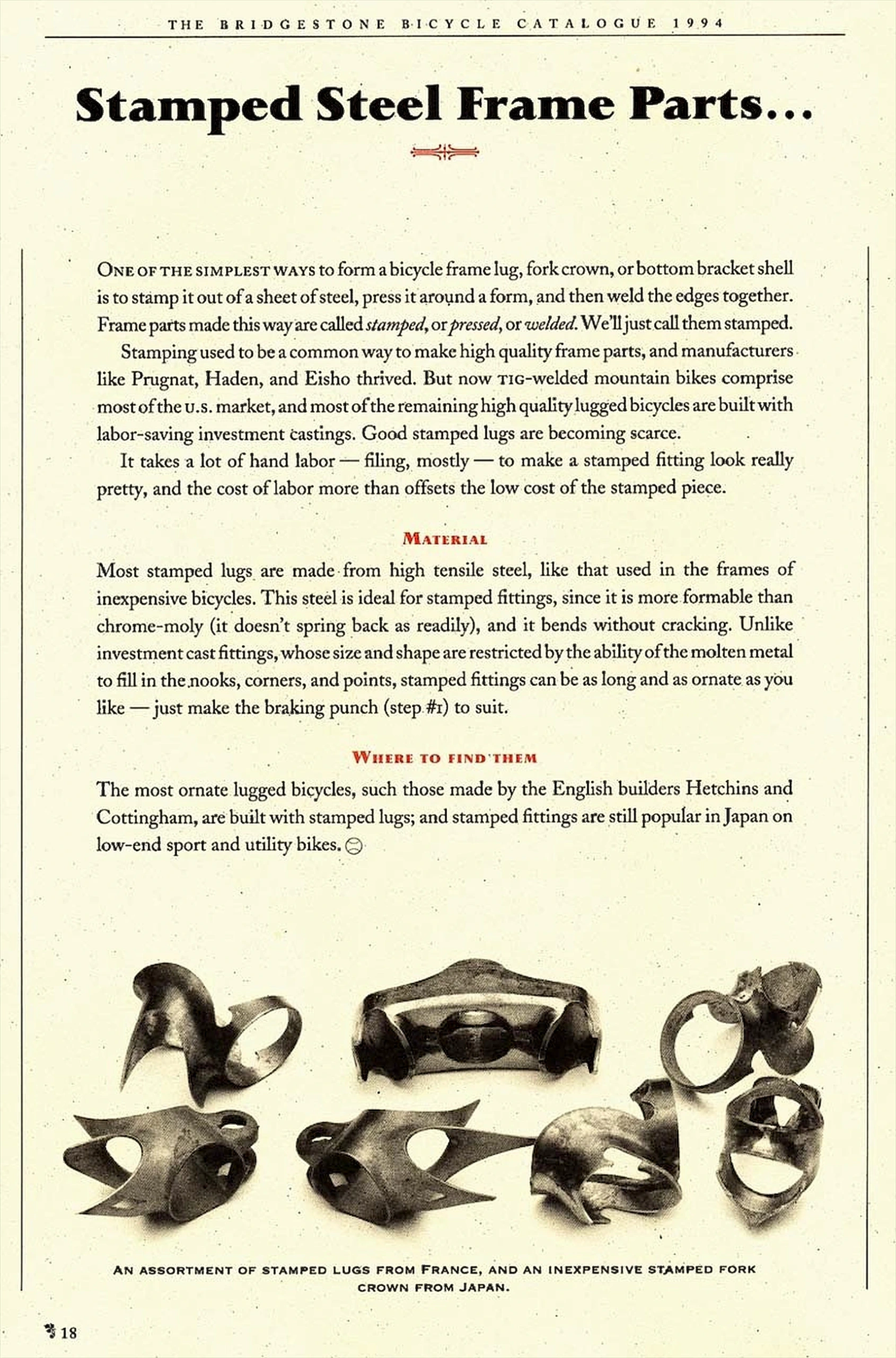
BUILDING A BIKE FRAME and riding a bike stresses the frame tubes, especially at the tube ends where the flame from the torch heats the metal, and where riding stresses concentrate. A good way to make a tube strong and light, then, is to add extra metal to this portion of the tube. The mid portion, or “belly,” isn’t stressed as much, so it can be thinner. Tubes such as this are called “butted,” the butts being the stronger portions at the ends.
There are two common ways to butt a tube. One is to increase the outer diameter of the tube for a few inches at the ends, or “externally butting” it. This is typically done by placing the tube into a mold, then pumping it full of oil until it expands to fit the mold. We described this process in our ’93 catalogue. It’s called “bulge-forming.”
A more common method is “internal butting,” accomplished by feeding the tube between a die and a mandrel so the outside diameter of the tube stays constant, but the inside diameter varies. The thicker tube walls at the ends of the tube are the “butts.” You can’t tell by looking whether a tube is internally butted, because the butts are on the inside. Tubing stickers such as these usually tell the story.
TANGE CR-MO SEAMLESS TUBING DOUBLE BUTTED TUBING; CROSTON 022 ISHIWATA; COLUMBUS TUBI SPECIALI RINFORZATI DSB ACCIAIO NIVACROM GENIUS DIFFERENTIAL SHAPE BUTTED (tubing stickers)
Until the mid ’70s, butted frame tubes were one of the telltale signs of a fine bike frame. Butting was an expensive process, and the weight savings, 6 oz. or so per frame, was something a racer or racer-type would pay for. Most tourists were satisfied with plain gauge tubing, and some even felt that plain gauge tubes were better for carrying baggage because they flexed less under heavy loads.
Many modern butted tubes, such as Ritchey Logic and Columbus EL, have short, concentrated butts designed for TIG-welding, which concentrates heat at the tube end. Other tubes have ridges, grooves, and splines, and some tubes now have oval, square, or diamond-shaped cross-sections.
THE DIFFERENCE BETWEEN INTERNAL BUTTING (LEFT) AND EXTERNAL BUTTING (RIGHT).
THERE IS A RECENT TREND in steel tubing towards “super alloys” with much higher tensile strengths than standard chrome-moly, and drawn to paper-thin wall thicknesses to reduce weight. Proponents claim these “super alloys” allow steel to compete in weight and strength with aluminum and titanium, and carbon fiber frames.
Cynics point out that the high strengths and low weight are achieved by violating fundamental engineering and metallurgical principles. They see the new fancy shapes and super alloys as marketing necessities required to make steel more palatable to a market which is currently obsessed with aluminum, titanium, and carbon fiber.
20
[A page headed “Butted Frame Tubes” with three tubing stickers and a diagram of internal and external butting.]
— Page 23 —
THE BRIDGESTONE BICYCLE CATALOGUE 1994
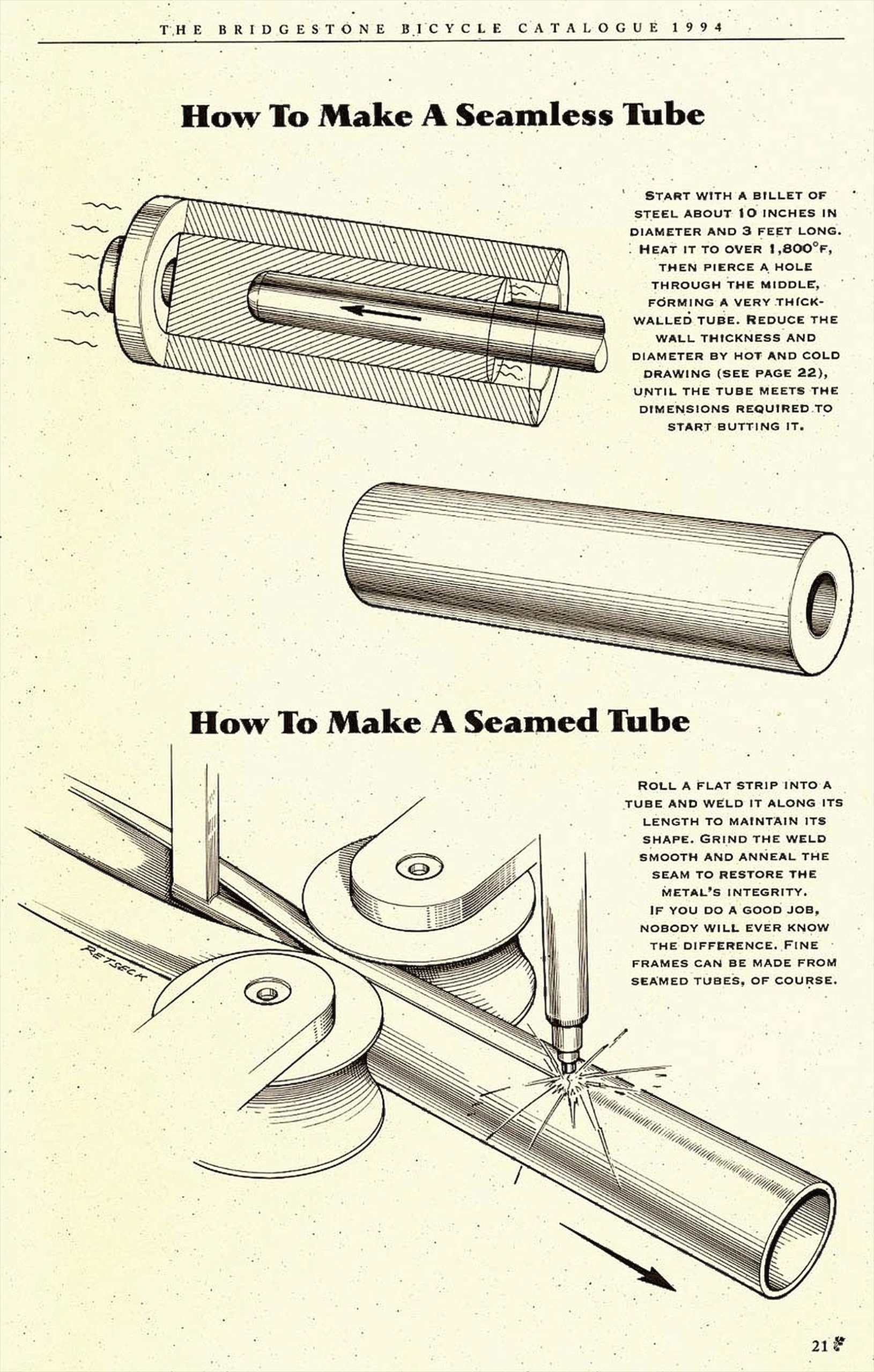
How To Make A Seamless Tube
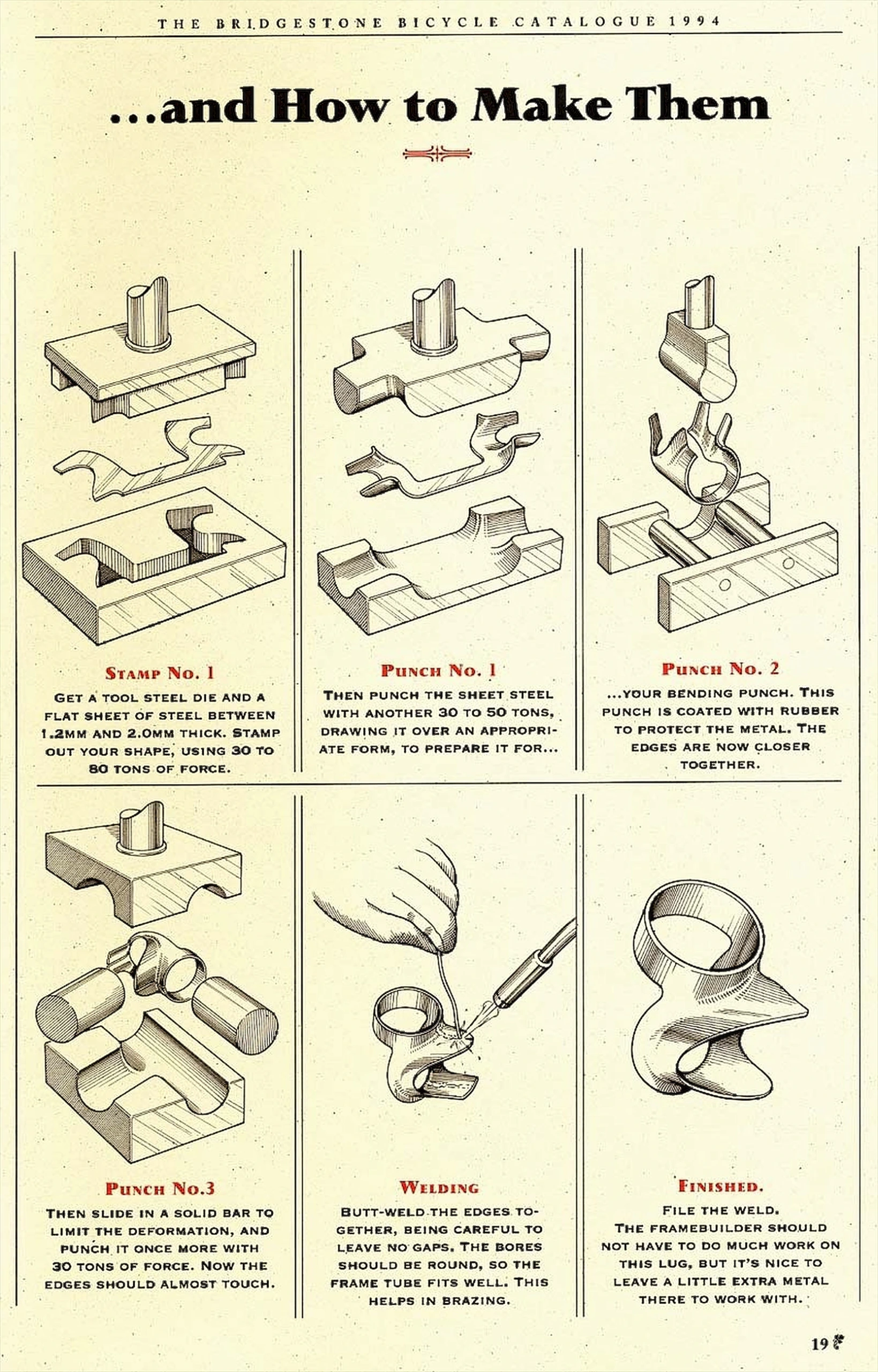
START WITH A BILLET OF STEEL ABOUT 10 INCHES IN DIAMETER AND 3 FEET LONG. HEAT IT TO OVER 1,800°F, THEN PIERCE A HOLE THROUGH THE MIDDLE, FORMING A VERY THICK-WALLED TUBE. REDUCE THE WALL THICKNESS AND DIAMETER BY HOT AND COLD DRAWING (SEE PAGE 22), UNTIL THE TUBE MEETS THE DIMENSIONS REQUIRED TO START BUTTING IT.
How To Make A Seamed Tube
ROLL A FLAT STRIP INTO A TUBE AND WELD IT ALONG ITS LENGTH TO MAINTAIN ITS SHAPE. GRIND THE WELD SMOOTH AND ANNEAL THE SEAM TO RESTORE THE METAL’S INTEGRITY. IF YOU DO A GOOD JOB, NOBODY WILL EVER KNOW THE DIFFERENCE. FINE FRAMES CAN BE MADE FROM SEAMED TUBES, OF COURSE.
RETSECK (artist’s name in the drawing)
21
[A page of engraved drawings of piercing a steel billet and of rolling and welding a seamed tube.]
— Page 24 —
THE BRIDGESTONE BICYCLE CATALOGUE 1994
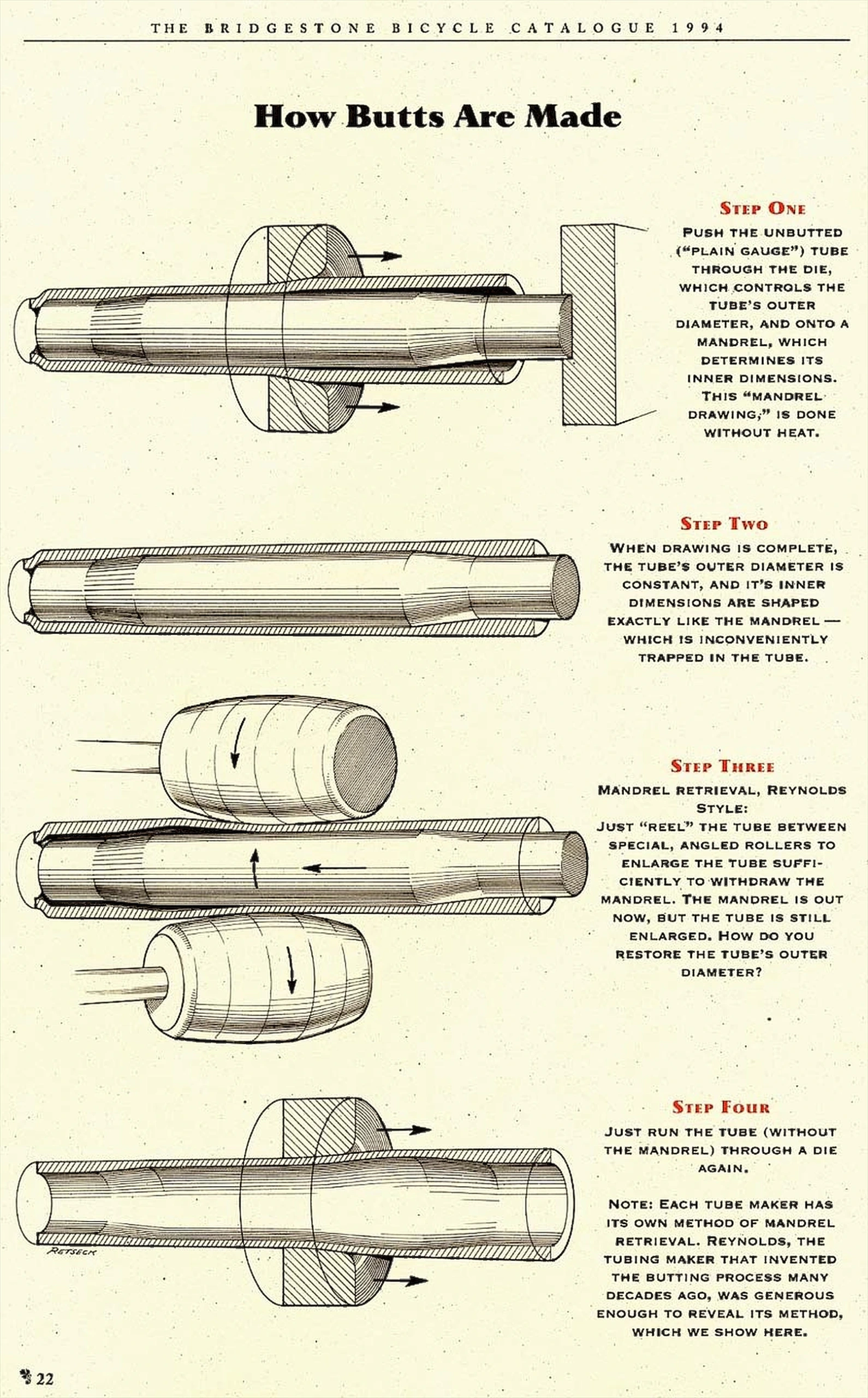
How Butts Are Made
STEP ONE: PUSH THE UNBUTTED (“PLAIN GAUGE”) TUBE THROUGH THE DIE, WHICH CONTROLS THE TUBE’S OUTER DIAMETER, AND ONTO A MANDREL, WHICH DETERMINES ITS INNER DIMENSIONS. THIS “MANDREL DRAWING,” IS DONE WITHOUT HEAT.
STEP TWO: WHEN DRAWING IS COMPLETE, THE TUBE’S OUTER DIAMETER IS CONSTANT, AND IT’S INNER DIMENSIONS ARE SHAPED EXACTLY LIKE THE MANDREL — WHICH IS INCONVENIENTLY TRAPPED IN THE TUBE.
STEP THREE: MANDREL RETRIEVAL, REYNOLDS STYLE: JUST “REEL” THE TUBE BETWEEN SPECIAL, ANGLED ROLLERS TO ENLARGE THE TUBE SUFFICIENTLY TO WITHDRAW THE MANDREL. THE MANDREL IS OUT NOW, BUT THE TUBE IS STILL ENLARGED. HOW DO YOU RESTORE THE TUBE’S OUTER DIAMETER?
STEP FOUR: JUST RUN THE TUBE (WITHOUT THE MANDREL) THROUGH A DIE AGAIN.
NOTE: EACH TUBE MAKER HAS ITS OWN METHOD OF MANDREL RETRIEVAL. REYNOLDS, THE TUBING MAKER THAT INVENTED THE BUTTING PROCESS MANY DECADES AGO, WAS GENEROUS ENOUGH TO REVEAL ITS METHOD, WHICH WE SHOW HERE.
RETSECK (artist’s name in the drawing)
22
[A page of four engraved drawings of the stages of butting a tube between a die and a mandrel.]
— Page 25 —
THE BRIDGESTONE BICYCLE CATALOGUE 1994
Hail To the Cheap
THERE’S FRICTION IN THE BICYCLE INDUSTRY BETWEEN INDEPENDENT BICYCLE DEALERS (IBD) AND MASS MERCHANTS (MM). THEY AREN’T AT WAR, NOT OVERTLY, AT LEAST. BUT IT’S AN UNEASY TRUCE AT BEST, WITH THE PEACE-KEEPING BICYCLE INDUSTRY FAVORING THE IBDS. SHOULD IT?
Ten years ago the IBD sold high quality bikes to committed enthusiasts, and the MM sold inexpensive bikes to kids, first-timers, and dilletantes. Their markets didn’t overlap. But now many IBDs sell inexpensive bikes with riveted steel chainrings, plastic-coated steel parts, and other features that were once the hallmark of a low-priced MM bike. At the same time, MMs are branching out into the adult recreational bike market, selling bikes that look (if not ride) a lot like the bikes sold in IBDs, yet cost a lot less. The two markets still don’t overlap, but the gap is narrowing.
For instance, you can get a Huffy “Titanium” 18-speed fat-tire bike for between $130 and $145. (The “titanium” refers to the color of the fork’s paint.) This isn’t nearly the bike that a bike shop’s cheap “mountain bike” is, but then, ignorance can be bliss. For literally a few dollars more, you can buy models with suspension forks. The most expensive MM bikes sell for around $239. These bikes are not in the same class or of the same quality as the more expensive bikes sold in IBDs, but they’re a far cry from the cheap sting rays, beach cruisers, and kiddie bikes one associates with MMs: No wonder so many IBDs feel threatened.
Last year in a publication for IBDs, there was an article describing how to sell against the low-cost MM bikes. This article advised dealers to buy a Huffy, put it on the floor, suggest to customers that the bike is dangerous and difficult to ride, and send them out on a test ride to prove it. This sales approach respects neither the person nor the bike.
And it just might be enough to steer the customer away from any bike at all. Afterall, there are other ways to get around.
Most of us here at BRIDGESTONE learned to ride on a bike our parents bought from a mass merchant. You too? These bikes had heavy steel frames, leaden wheels, and those funky Ashtabula cranks — and by our current standards, they were pretty crummy bikes. But in those days we didn’t revere our bicycles — we neglected and abused them, and they still kept on rolling, if sometimes noisily. Childhood wouldn’t have been nearly as much fun without those heavy squeakers. (What an understatement that is!)
What’s more, those cheap bikes saved our parents innumerable shuttle trips. If the greatest contribution a bike can make is to get a car off the road (and we believe it is), then the $400 to $2,500 whoppers we’ve graduated to could take lessons from those very first bikes.
So thank goodness for cheap bicycles and the mass merchants who sell them. Inexpensive bicycles helped make childhood fun, and without them, lots of people would never have learned to ride a bike at all. Can you imagine not knowing how to ride a bike? Horrors. That would also mean a lot more cars on the road, and a lot less business for the IBD — who, for now, is your best source when you’re ready for something better.
23
[A page headed “Hail To the Cheap” in a single ruled column.]
— Page 26 —
THE BRIDGESTONE BICYCLE CATALOGUE 1994
All About Us
IN THE BEGINNING
BRIDGESTONE was founded in Japan in 1939 by Shojiro Ishibashi. In Japanese, ishi means stone, bashi means bridge. BRIDGESTONE’S first product was a rubber-soled shoe, but production soon shifted to tires.
Bike production began in 1949. By 1970 BRIDGESTONE was Japan’s largest bike manufacturer. That was the year of the Bike Boom in America, and when Schwinn found itself unable to satisfy the demand, BRIDGESTONE was hired. Between 1971 and 1980, close to a million Schwinns were built in our factories.
BRIDGESTONES IN AMERICA
Shortly thereafter, BRIDGESTONE started exporting bikes to the U.S. under its own label. The company then was called BRIDGESTONE BICYCLES, and had headquarters in Torrance, California. Many of the models were named after stars — Sirius, Regulus, Spica, Antares. Sad to say, that company folded in 1983.
We, BRIDGESTONE CYCLE (U.S.A.), INC. were born in July of 1984, when it seemed everyone had or wanted a Fuji, Miyata, Schwinn, Raleigh, Panasonic, Trek, Specialized, or Nishiki, and here we were with a name known chiefly for car and truck tires. Our reputation as “upstream swimmers,” as one writer called us — started in 1986, when our MB-1 mountain bike came with narrow handlebars, “two-finger” brake levers, sub-17-inch chainstays, quick-release wheels, a racing saddle, toe clips and straps — all industry firsts. Combined with the now standard (but then radical) 73/71 frame angles, the MB-1 was quite the freak, but it sold well.
Ever since then we’ve built our reputation on bicycles that were conspicuously different than those of our competitors. Being different has never been our driving force, but we never let the prospect of it interfere with the way we wanted to make bikes. We’ve shunned most of the recent fads, and quite frankly, some of our own favorite models have not sold well at all. The new bikes reflect past bike sales and current parts availability, and are the best bikes we know how to build with the components that are available to us. We’re proud of them.
COMPANY PHILOSOPHY
We think bicycles can save — if not the world — at least the quality of our immediate environments, and we’re proud to be a part of that. But it is frustrating to live with a national transportation system so dedicated toward the car. We’d just as soon be designing and manufacturing utilitarian workhorse bikes, than flashy, fancy bikes you cannot conveniently commute or shop with. We enjoy immensely our decidedly non-utilitarian rides on our flashy, fancy bikes, though.
We also acknowledge our responsibility to help others. Each year we donate close to $12 thousand from catalogue sales to a handful of socially and environmentally responsible organizations, and bicycle advocacy groups.
THE PEN PAL PROPOSAL
If you have any comments about bicycles, ours or others, or any questions, please drop us a line. We try to respond to every letter we receive, but if this invitation should, by chance, create a flood of mail, our batting average may fall a few points.
24
[A page headed “All About Us” in two columns.]
— Page 27 —
THE BRIDGESTONE BICYCLE CATALOGUE 1994
Poster No. 2
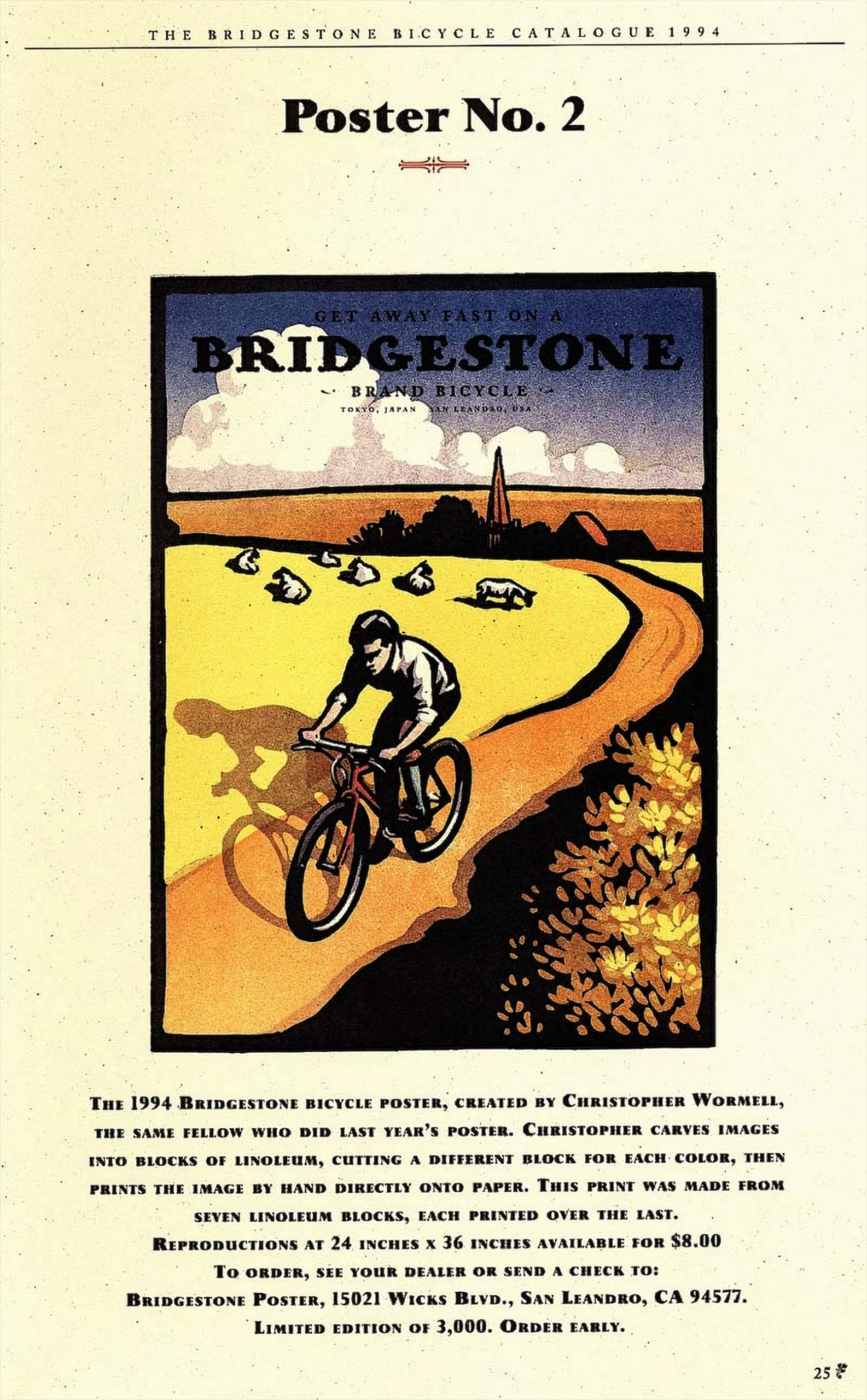
GET AWAY FAST ON A BRIDGESTONE BRAND BICYCLE
TOKYO, JAPAN — SAN LEANDRO, USA
THE 1994 BRIDGESTONE BICYCLE POSTER, CREATED BY CHRISTOPHER WORMELL, THE SAME FELLOW WHO DID LAST YEAR’S POSTER. CHRISTOPHER CARVES IMAGES INTO BLOCKS OF LINOLEUM, CUTTING A DIFFERENT BLOCK FOR EACH COLOR, THEN PRINTS THE IMAGE BY HAND DIRECTLY ONTO PAPER. THIS PRINT WAS MADE FROM SEVEN LINOLEUM BLOCKS, EACH PRINTED OVER THE LAST.
REPRODUCTIONS AT 24 INCHES × 36 INCHES AVAILABLE FOR $8.00
TO ORDER, SEE YOUR DEALER OR SEND A CHECK TO: BRIDGESTONE POSTER, 15021 WICKS BLVD., SAN LEANDRO, CA 94577.
LIMITED EDITION OF 3,000. ORDER EARLY.
25
[A page with a color linocut poster of a cyclist riding a country road past sheep and a church spire, lettered “Get away fast on a Bridgestone brand bicycle”.]
— Page 28 —
THE BRIDGESTONE BICYCLE CATALOGUE 1994
Wool and Why We Like It
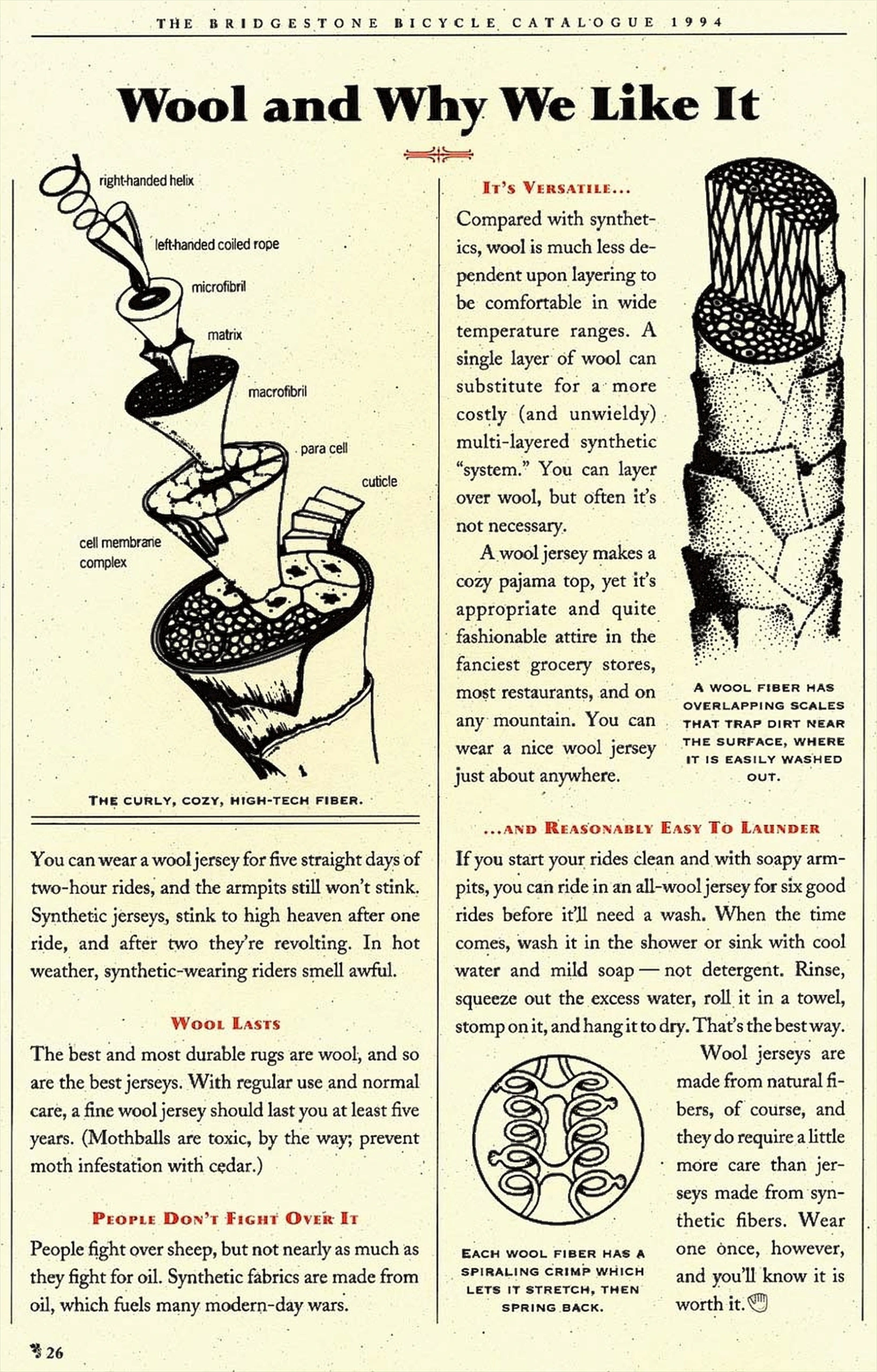
right-handed helix; left-handed coiled rope; microfibril; matrix; macrofibril; para cell; cuticle; cell membrane complex
THE CURLY, COZY, HIGH-TECH FIBER.
You can wear a wool jersey for five straight days of two-hour rides, and the armpits still won’t stink. Synthetic jerseys, stink to high heaven after one ride, and after two they’re revolting. In hot weather, synthetic-wearing riders smell awful.
WOOL LASTS
The best and most durable rugs are wool, and so are the best jerseys. With regular use and normal care, a fine wool jersey should last you at least five years. (Mothballs are toxic, by the way; prevent moth infestation with cedar.)
PEOPLE DON’T FIGHT OVER IT
People fight over sheep, but not nearly as much as they fight for oil. Synthetic fabrics are made from oil, which fuels many modern-day wars.
IT’S VERSATILE…
Compared with synthetics, wool is much less dependent upon layering to be comfortable in wide temperature ranges. A single layer of wool can substitute for a more costly (and unwieldy) multi-layered synthetic “system.” You can layer over wool, but often it’s not necessary.
A wool jersey makes a cozy pajama top, yet it’s appropriate and quite fashionable attire in the fanciest grocery stores, most restaurants, and on any mountain. You can wear a nice wool jersey just about anywhere.
A WOOL FIBER HAS OVERLAPPING SCALES THAT TRAP DIRT NEAR THE SURFACE, WHERE IT IS EASILY WASHED OUT.
…AND REASONABLY EASY TO LAUNDER
If you start your rides clean and with soapy armpits, you can ride in an all-wool jersey for six good rides before it’ll need a wash. When the time comes, wash it in the shower or sink with cool water and mild soap — not detergent. Rinse, squeeze out the excess water, roll it in a towel, stomp on it, and hang it to dry. That’s the best way.
Wool jerseys are made from natural fibers, of course, and they do require a little more care than jerseys made from synthetic fibers. Wear one once, however, and you’ll know it is worth it.
EACH WOOL FIBER HAS A SPIRALING CRIMP WHICH LETS IT STRETCH, THEN SPRING BACK.
26
[A page headed “Wool and Why We Like It” with diagrams of the structure of a wool fiber.]
— Page 29 —
THE BRIDGESTONE BICYCLE CATALOGUE 1994
Nice Wool Jerseys For Sale
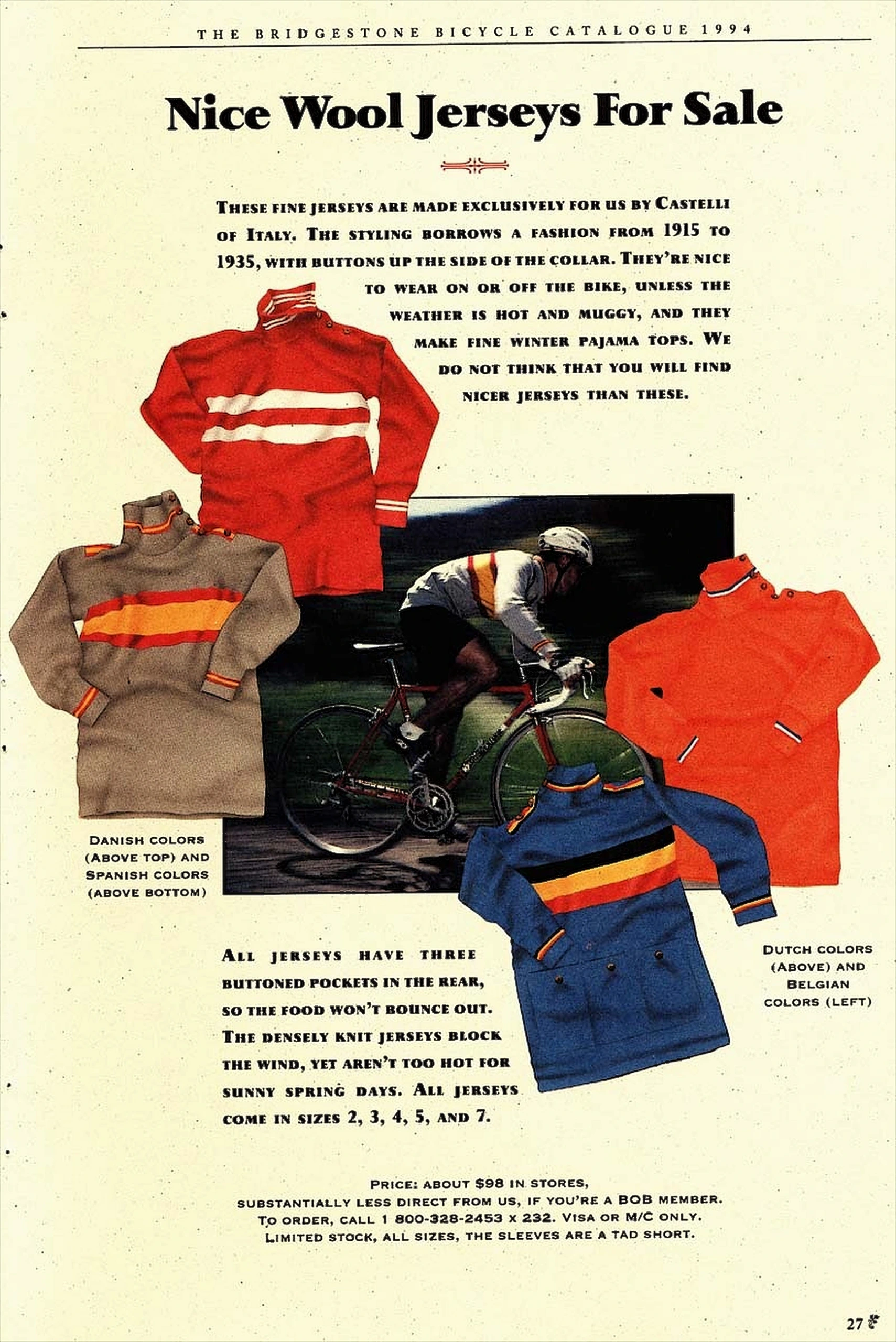
THESE FINE JERSEYS ARE MADE EXCLUSIVELY FOR US BY CASTELLI OF ITALY. THE STYLING BORROWS A FASHION FROM 1915 TO 1935, WITH BUTTONS UP THE SIDE OF THE COLLAR. THEY’RE NICE TO WEAR ON OR OFF THE BIKE, UNLESS THE WEATHER IS HOT AND MUGGY, AND THEY MAKE FINE WINTER PAJAMA TOPS. WE DO NOT THINK THAT YOU WILL FIND NICER JERSEYS THAN THESE.
DANISH COLORS (ABOVE TOP) AND SPANISH COLORS (ABOVE BOTTOM)
DUTCH COLORS (ABOVE) AND BELGIAN COLORS (LEFT)
ALL JERSEYS HAVE THREE BUTTONED POCKETS IN THE REAR, SO THE FOOD WON’T BOUNCE OUT. THE DENSELY KNIT JERSEYS BLOCK THE WIND, YET AREN’T TOO HOT FOR SUNNY SPRING DAYS. ALL JERSEYS COME IN SIZES 2, 3, 4, 5, AND 7.
PRICE: ABOUT $98 IN STORES, SUBSTANTIALLY LESS DIRECT FROM US, IF YOU’RE A BOB MEMBER. TO ORDER, CALL 1 800-328-2453 X 232. VISA OR M/C ONLY. LIMITED STOCK, ALL SIZES, THE SLEEVES ARE A TAD SHORT.
27
[A page of photographs of four wool jerseys in red, gray, orange and blue with colored stripes and a photograph of a rider in a wool jersey on a red road bicycle.]
— Page 30 —
THE BRIDGESTONE BICYCLE CATALOGUE 1994
Bike Design in the Nineties
IF THE BEST DESIGN IS APPROPRIATE DESIGN, THEN DESIGNING A LINE OF BICYCLES SHOULD REQUIRE EXPERIENCE, CREATIVITY, AND KNOW-HOW. SOMETIMES IT DOES. BUT THE PUSH FOR EFFICIENCY IN MANUFACTURING AND DELIVERY CAN DRIVE DESIGN IN WAYS YOU WOULDN’T EXPECT. HERE’S HOW OUR BIKES COME TOGETHER.
DECEMBER THROUGH JANUARY: ROUGH PLAN
In the middle of December, we travel to Japan for a couple of weeks to visit our parent company and plan how many models we’ll have, and at what prices. We know what changes to make, if any, because by December our dealers have ordered the current bikes, and have just begun to sell them.
Planning new bikes when the paint is barely dry on the old ones is not the ideal way to do things. It’s necessary, though, because the bicycle “season” runs from March to June, and most dealers order the bikes they want in the “pre-season,” right after they’ve seen them at the big bike shows in the fall. In other words, our dealers order the 1994 bikes they want in the fall of 1993, just a month or so before we go to work on the ’95s. Their orders for 1994 tell us what to make for 1995.
Admittedly, this doesn’t leave any time for our customers to vote for the bikes they like, but our dealers stock what they feel comfortable selling, and if they don’t buy a bike in the pre-season, they’re not likely to stock it in the spring, either.
In December we also broadly outline how each bike will be made. If we want special lugs or a new fork crown — two things dear to us — we start planning them then. And we might indulge ourselves with a particular bike we’ve been dying to build, whether the market is asking for it or not, such as the XO-1s of ’92 and ’93.
If there’s time, we may visit parts makers to make special requests. It’s hard to get custom components because parts makers are reluctant to tool up for something different unless there is a huge demand. If we’re the only ones asking for a particular new part, the maker may quote a high price tag or a long delivery schedule in an effort to steer us back to the standard menu. Still, it’s difficult to get a firm “No, we won’t build it” or “Yes, we will!” Invariably, since it’s still December, these things “must be studied.”
We return home with a “paper lineup.”
FEBRUARY THROUGH MAY: SPEC SEASON
We go to Japan again in February, and we’ll jog over to Taiwan for a few days. The worst part about these trips, besides being away from family, is getting fat from too much food and too little exercise. Bike business is done in the big cities, where the smog and humidity are as thick as the impenetrable traffic on the narrow streets. Everyone is on a tight schedule, and we have to make quick decisions about colors, graphics, prices, and any changes in frame design. Delays here will delay production, and we don’t want that.
On this trip, we may get to see some photographs of the new parts that companies like Shimano are working on. But we won’t get to touch parts until the next trip, probably in April. Even then, parts are only clay or wooden samples. The real parts won’t be made for a few more months. It feels funny to order parts that don’t yet exist, but most product managers learn to live with this. Dealing with manufacturers that have a history worthy of the tremendous faith you must place in them helps, too. Shimano scores well here.
THE SHIMANO CONNECTION (A DIVERSION)
Shimano owns more than 90 percent of the components market. For a product manager, Shimano is both easy and hard to work with.
The easy part is that you know the parts will work well, even if you can’t try them yourself, because Shimano’s design department is unsurpassed. And should a freak design accident occur, at least you’ll have a lot of company in all the other bicycles that use the same parts. More important, when there has been a Shimano recall, the company has been fast and thorough in fixing the problem.
Shimano also delivers on time, every time. We have to schedule production far in advance, and we want to have the parts when the bikes are built and not a lot before. If something isn’t ready, we have to find a last-minute substitute or put off making the bike, disasters both. Shimano’s delivery record, since 1991 at least, has been exemplary.
The hard part is that Shimano makes dedicated systems — groups of parts designed to work only with the other parts in the same group. This absolutely stifles a product manager’s creativity. Instead of being allowed to draw on bicycle knowledge acquired over many years, a manager is forced to pick the same parts group that any inexperienced fool could check off a chart. This is frustrating and bad for the ego.
ROLL OVER, PLAY DED
The moment you specify one part of a dedicated system, the system sucks you in the whole way. Spec a dedicated shifter and you must select the derailleurs, cogs, and hub it was designed for, and the cables and housing that connect them. If the shifters and brake levers are integrated, you are forced to use those brake levers too, whether you want them or not, and the dedicated brake calipers, cable and housing. From one shift lever your choice spreads like a virus through the entire bike.
If you go outside the system (“ex-system”), you pay more and expose your company to some sobering liability risks. Even though one part may be perfectly compatible with an ex-system part, lawyers won’t see it that way. For example, a Shimano Deore XT seven-speed top-mount shifter — now, sadly, on the endangered species list — has an extra click, and a good mechanic can make it work flawlessly with an eight-speed XTR cogset. But if a rider mis-shifts and crashes for any reason, he or she might claim that the mis-shift caused the crash. Plaintiff’s counsel will charge that you knowingly spec’d a shifter that was not designed for the cogs. “How could it be, members of the jury? The two weren’t designed at the same time.” Maybe you’d never believe such a thing, but a juror might.
The good news is that some ex-system parts, such as GripShift, are designed specifically to be compatible with system parts. These make it easier to beat the system, if that’s what you want to do.
JUNE THROUGH AUGUST: THE GOOD, THE BAD, THE UGLY
By June the specs are set and the colors are picked, and the first bikes are being built. You find out whether your pet project is going to make the cut, and start making last-minute changes to the catalogue that reflect the latest word. This year we’d planned to offer framesets for sale, and had written and designed pages 28 and 29 in this catalogue for them. We couldn’t get color choices and photo samples in time, though, so at the last second we had to fill these pages some other way. (And if you are interested in a frameset, please bear with us — we expect them by January.)
THE MOMENT YOU SPECIFY ONE PART OF A DEDICATED SYSTEM, THE SYSTEM SUCKS YOU IN THE WHOLE WAY. FROM ONE SHIFT LEVER YOUR CHOICE SPREADS LIKE A VIRUS THROUGH THE ENTIRE BIKE.
28-29
[A two-page spread headed “Bike Design in the Nineties” in four columns with a red pull quote. The article is transcribed here whole, across both halves of the spread.]
— Page 31 —
[The right half of the same spread: the later columns of “Bike Design in the Nineties”, transcribed with page 30.]
— Page 32 —
THE BRIDGESTONE BICYCLE CATALOGUE 1994
Mountain Bikes
YOU’LL HAVE A HARD TIME finding a bad mountain bike in any good bike shop. But if you investigate further, you’ll see that almost all mountain bikes in a given price range come equipped with the same nearly faultless Shimano components.
And that is why manufacturers try to differentiate their brand by doing something conspicuously unusual with the frame. It may be the material, the shape of the tubes, the way the tubes come together, or even the paint. There are differences between brands, but most are inconsequential. And many innovations occur only because somebody wants a patent. But beneath the flash, it has just about reached the point where, in the words of friend and bike industry sage Tom Franges, “one grain of rice (or bike) is fungible for another.” (“Fungible” and “interchangeable” are fungible.)
Since there are so few real differences, it’s tempting to exaggerate the importance of trivial ones. We try not to do that, but it’s tempting.
For instance, on this year’s TIG-welded models, we’ve specified ovalized ends for the seat and down tubes. We could shout about a resulting increase in durability and decreased flex that theoretically result from ovalizing the tube ends — but we know that round tubes are strong and rigid enough already. The real reason we’re using ovalized tubes is that it costs just fifty cents per tube end, or in our case, $1.50 per bike. We thought that was well worth any of ovalization’s advantages, real or theoretical. And it’s not just the truth, it’s a more interesting story, too — don’t you think?
BE SMART ABOUT PARTS…
All modern parts work very well. The biggest difference between the low-priced Shimano Alivio and the high-priced XT, for instance, is the cost to manufacture them (which often depends on where they are made), not how well each works. Inexpensive brakes and derailleurs, like inexpensive bowls and spoons, work quite well.
AND WEIGHT…
Light mountain bikes are more fun to ride than heavy ones, no doubt about that. But it seems silly to fret about two extra ounces on a handlebar or saddle when those couple of ounces may affect the bike’s durability or comfort, or your safety — especially if your stomach’s not yet a sucked-in washboard.
Of course the ounces do add up, but the point here is to keep things sensible. (Last year a serious accident occurred when a superlight handlebar snapped in a downhill competition!)
If you want your mountain bike to ride faster and you know you aren’t going to lose weight, take some off the tires, tubes, rims, spoke nipples, and spokes — in that order. Rotating weight is much more important than non-rotating weight, and the larger the circle it turns, the bigger the difference it makes.
THE FRAME, THE FIT, THE RIDE!
The frame determines how your bike will respond to your input and the terrain. It is also the most expensive and difficult component to replace; and it should outlast most of the high-wear parts, such as chains, cogs, bearings, and wheels. For these reasons, it’s important to get a good frame.
We offer our mountain bikes in five sizes each, except for the MB-3, which comes in six. More sizes make it easier for you to get a proper fit.
BRIDGESTONE mountain bikes ride well because we’ve learned how subtle changes in design affect bike handling. Our bikes ride differently than other brands, but it may require experience on a lot of different bikes to appreciate it.
A SHOPPING SUGGESTION
Before you buy a bike off a spec chart or price list, ride it. Ride several brands of bikes before you buy any of them, and buy the one you think rides the best, regardless of brand.
30
[A page headed “Mountain Bikes” in two columns.]
— Page 33 —
THE BRIDGESTONE BICYCLE CATALOGUE 1994
HAPPY ANNIVERSARY, BIKE!
MB-1
1994 IS THE 10TH ANNIVERSARY OF THE MB-1, and although it has changed with the times, it still stands out among its high-end peers — mostly because it has a suspension stem, not a suspension fork.
The MB-1 frame is lugged and built with Tange Prestige. (Tange is Japan’s largest bicycle frame tubing maker, and Prestige is the name given to its top quality, heat-treated-for-extra-strength chrome-moly steel.) The head tube is strengthened by means of the tall (10mm) lug rings, for extra strength in this high-stress area. Except for an LX front hub, the parts this year are the industry standard Shimano Deore XT, with RapidFire shifters and a whopping eight gears in back.
The fork has an elegant crown designed by Tom Ritchey, and strong, road-diameter fork blades to provide a nice ride over bumps. For added shock absorption we’ve included an exclusive Nitto-built Allsop stem — our top choice for add-on suspension. We prefer it to any sus fork, because it’s lighter, less ugly, and seems to work better. We know sus forks are more popular, but we prefer this stem.
COLOR: Pepper Grey Metallic
OUR NITTO-BUILT ALLSOP STEM. IT ADDS LESS WEIGHT THAN A SUS FORK, DOES NOT AFFECT YOUR FRAME’S GEOMETRY, REQUIRES LITTLE OR NO UPKEEP, AND WORKS SO WELL.
TECHNICAL DATA
SIZES: 40, 46, 49, 52, 55CM
FRAME CONSTRUCTION: BRAZED, LUGGED
WEIGHT: 25.6 LB. (49CM)
MADE IN: JAPAN
COMPONENTS
Shimano Deore XT w/LX front hub
Nitto-built Allsop Softride stem
Araya RM-17 rims, butted spokes
Light but strong Nitto CrMo handlebar
PRICE
AROUND $1350
31
[The MB-1 mountain bicycle in dark gray with a sepia photograph tone, a drawing of the Allsop Softride stem, and a technical box; the price box is blacked out in the host’s copy.]
— Page 34 —
THE BRIDGESTONE BICYCLE CATALOGUE 1994
READY TO RACE
MB-2
ROCKSHOX DEVELOPED THE MODERN SUSPENSION FORK, AND ITS MAG 21 IS ONE OF THE MOST POPULAR AND RELIABLE SUS FORKS YOU CAN RIDE.
We’ve seen many MB-2s retrofitted with suspension forks, so now, to save you the trouble, we’re equipping it with the RockShox Mag 21. This is a good fork. It weighs just under three pounds, has 1.75 inches of travel, and although it requires more upkeep than a bumper fork, it soaks up big bumps better and is easier to adjust. Since SUS riders are hard on equipment, we’ve gone to fatter frame tubing on the ’94 MB-2, and to a taller, reinforced head tube. It will take a mighty thunk to ovalize the head tube on this bike.
Adding a suspension fork to a frame that was originally designed for a shorter, regular fork will change the bike’s handling. Since our starting geometry is steeper than most other makers use, the resulting ride still falls within acceptable bounds, and the MB-2 still rides like a BRIDGESTONE.
The MB-2 is built to ride over the roughest reasonable trails. It’s an excellent race bike, of course.
COLOR: Haze Blue Metallic
TECHNICAL DATA
SIZES: 40, 46, 49, 52, 55CM
FRAME CONSTRUCTION: BRAZED, LUGGED
WEIGHT: 27.8 LB. (49CM)
MADE IN: JAPAN
COMPONENTS
Shimano XT derailleurs
Shimano LX crank, hubs, shifters
Araya RM-17 rims, butted spokes
Specialized 1.95-inch Ground Controls
PRICE
AROUND $1200
32
[The MB-2 mountain bicycle with a suspension fork, a drawing of the RockShox fork, a technical box and a colour chip.]
— Page 35 —
THE BRIDGESTONE BICYCLE CATALOGUE 1994
TWO NICE CHOICES
MB-3
THE ROCK SHOX QUADRA-10 SUSPENSION FORK.
A nice-riding, low-nonsense mountain bike. As with all our mountain bikes, the frame design varies according to frame size, so if you fall within the normal range of heights, you can get a good fit, and the ride that goes along with it. The non-SUS model has standard diameter tubing, and is built in our own factory in Japan. It has a lugged frame, as is our style, and comes with the latest Shimano LX components — as does virtually every other mountain bike in this same price range.
Our MB-3/SUS has the same Shimano LX components as the standard MB-3, but with a TIG-welded frame, oversized tubing with ovalized tube ends, 1.95 inch (rather than 2.1 inch) tires, bar-ends, and a Rock Shox Quadra-10 suspension fork. According to the manufacturer, this fork has a “negative spring system with linear spring curve for superior ride qualities over other elastomer forks.” In any case, it’s reliable, works well, weighs just 3lb, and has 43mm — about 1.75 inches — of travel.
A very good choice for bumpy trails, racing, and what-not.
COLORS: Kiwi (Medium Olive) Metallic (reg); Dark Red Metallic (SUS)
TECHNICAL DATA
SIZES: 40, 46, 49, 52, 55CM
FRAME CONSTRUCTION: BRAZED, LUGGED
WEIGHT: 26.7 LB. (49CM)
MADE IN: JAPAN (NON-SUS); TAIWAN (SUS)
COMPONENTS
Shimano LX (almost everything)
Ritchey handlebar and stem
Araya RM-17 rims, Wheelsmith spokes
Ritchey Z-Max tires
PRICE
AROUND $750 (REG); $950 (SUS)
33
[The MB-3 mountain bicycle in dark gray, a drawing of the RockShox Quadra-10 fork, a technical box and two colour chips.]
— Page 36 —
THE BRIDGESTONE BICYCLE CATALOGUE 1994
AN EXCELLENT ALL-AROUND MOUNTAIN BIKE. TRY IT.
MB-4
We have two MB-4s this year: One has a SUS fork, but the other one doesn’t. Both have Shimano’s new STX-SE components, a shiny new system with all the technological touches the modern mountain bike market demands.
The regular model is TIG-welded from standard-diameter tubing. It has a slightly quicker ride than the MB-4/SUS, and so is a better choice for all-around riding. The MB-4/SUS has a Tange Struts-S fork, which we consider the best value in a rubber bumper fork today, and the functional equal of any suspension fork, period. It is nearly maintenance free, but service, when needed, is a cinch. We like it.
COLORS: Red (regular); Purple Metallic (SUS)
TECHNICAL DATA
SIZES: 40, 46, 49, 52, 55CM
FRAME CONSTRUCTION: TIG-WELDED
WEIGHT: 27.6 LB(R); 28.7 LB(S) (49CM)
MADE IN: TAIWAN
COMPONENTS
Shimano STX-SE components
32-hole Araya rims
Standard CrMo or Tange Struts-S fork
Ritchey Z-Max tires
PRICE
AROUND $600 (REG); $750 (SUS)
34
[The MB-4 mountain bicycle, a drawing of the Tange Struts fork, a technical box and two colour chips.]
— Page 37 —
THE BRIDGESTONE BICYCLE CATALOGUE 1994
STRIKING AND DEPENDABLE
MB-5
The regular MB-5 has standard-diameter ovalized tubing and the impressively large and well-liked 2.1-inch Ritchey Z-Max tires. The SUS version has oversized ovalized tubing, 1.95-inch Ritchey Z-Max tires, and the Tange Struts-GS fork. This fork is cheaper to make than the Struts-S fork on the MB-4/SUS, mostly due to a bulge-formed crown area (as opposed to TIG-welded) and a different dropout design; but it has the same nice, problem-free bumpers. You can vary the amount of cush in the fork by mixing various bumpers, a simple ten minute task for any adept bicycle mechanic.
Both models of the MB-5 ride well on all terrain and otherwise have the same Shimano STX components and Araya rims. We recommend the regular MB-5 for general trail riding, particularly in hilly areas, and for a riding style which emphasizes technique over nerves. Get the MB-5/SUS if you’d rather plow through something than slow down, and if you don’t mind pedaling the added machinery up hills. Both models ride really well, and will last a long time.
COLORS: Midnight Blue (Regular); April Green (SUS)
TECHNICAL DATA
SIZES: 40, 46, 49, 52, 55, 58CM
FRAME CONSTRUCTION: TIG WELDED
WEIGHT: 28.7LB(R); 30.9LB(S) (49CM)
MADE IN: TAIWAN
COMPONENTS
Shimano STX components
32-hole Araya rims
CrMo or Tange Struts-GS fork
Ritchey Z-Max tires
PRICE
AROUND $550 (REG); $650 (SUS)
35
[The MB-5 mountain bicycle, a drawing of the Tange Struts-GS fork, a technical box and two colour chips.]
— Page 38 —
THE BRIDGESTONE BICYCLE CATALOGUE 1994
AN AUGUST ACHIEVEMENT FOR YEAR ‘ROUND SPORT!
MB-6
The MB-6 is our least costly mountain bike, but has lots of features you hardly ever find on bikes in its price range. We think it is an untouchable value in the scary world below $400.
The frame is the most important part of any bike, and the MB-6 frame is full chrome-moly steel. Chrome-moly, which we believe is the best all-around frame material ever developed, allows us to make a frame simultaneously stronger and lighter than is possible with the more common high tensile steel.
The MB-6 has a slightly shorter top tube than our other mountain bikes, for a more upright riding position. The 40cm size is an especially good choice for small women, or other riders with short torsos and arms.
The MB-6 is an ideal first mountain bike. It will give you years of good, hard fun, if you only just ride it.
COLORS: Electric Blue; Metallic Orchid
RITCHEY FORCE TIRES GRIP DIRT AND ROLL FAST ON STREETS. VERY NICE TIRES!
TECHNICAL DATA
SIZES: 40, 46, 49, 52, 55CM
FRAME CONSTRUCTION: TIG WELDED
WEIGHT: 29.3 LB. (49CM)
MADE IN: TAIWAN
COMPONENTS
Shimano Alivio. It’s brand new.
Araya VP-20 aluminum rims
Ritchey Force 26 x 2.0 tires
PRICE
AROUND $400
36
[The MB-6 mountain bicycle, a pattern of tire treads, a technical box and two colour chips.]
— Page 39 —
THE BRIDGESTONE BICYCLE CATALOGUE 1994
IT IS RISEN!
CB-1
“CB” stands for “city bike,” “county bike” or “country bike,” depending on where you ride it. The CB-1 has light, strong, chrome-moly steel main frame tubes. What’s even more remarkable at this price is that the frame geometry is tailored to each frame size. Most bike manufacturers reserve that for their most expensive models only (and sometimes not even for them!).
The CB-1 is a good bike for low-intensity rides of up to 15 miles, and has 21 gears, which ought to be enough for just about anyone, just about anywhere. The 1.5 inch worm-tread tires give a cushy, efficient ride, and they are fat enough to resist pinch flats. Of course we’ve included double eyelets front and rear for racks and fenders, so you can take it touring in the rain, and provided clearance for tires up to 1.9 inches wide, to cushion the blows of nasty potholes or cement chunks.
COLOR: Blue Metallic; Cranberry Metallic
THIS SOFT, PLUSHY SADDLE WILL NEVER GIVE YOU A SORE BOTTOM.
TECHNICAL DATA
SIZES: 42, 43L, 46, 50, 56CM
FRAME CONSTRUCTION: TIG WELDED
WEIGHT: 29.8 LB. (50CM)
MADE IN: TAIWAN
COMPONENTS
Shimano Altus
Araya aluminum rims
Wide, soft, gel saddle
Smooth, fast, comfy 26 x 1.5-inch tires
PRICE
AROUND $325
37
[The CB-1 city bicycle, a drawing of a gel saddle, a technical box and two colour chips.]
— Page 40 —
THE BRIDGESTONE BICYCLE CATALOGUE 1994
XO Bikes
A GOOD IN-BETWEENER — a “hybrid,” in the popular vernacular, but we call ours XOs — is a great choice for anything short of road racing and the roughest trail riding. Since it doesn’t provide the cushion a mountain bike does, it teaches sharper off-road riding skills. That’s good, because you’ll become a better rider faster on this sort of bike than you will on a bike that forgives careless riding. And compared to a road bike, an in-betweener has stronger wheels and more voluminous tires that can be safely ridden with less air pressure, so it suffers fewer wheel problems and gives a more comfortable ride. That makes a lot of sense, doesn’t it?
But most riders don’t choose an in-betweener as their first or only bike, and among experienced riders, the breed hardly ranks at all. Maybe it’s a lack of glamour; there are no “hybrid” competitions, for instance, and nobody has ridden to fame or fortune on this breed of bike. Or maybe it’s because shoppers tend to purchase recreational equipment (of any kind) for the lifestyle they dream about, not the one they live. It’s the Jeep-and-cowboy boots-and-Buck Folding Hunter-and-expedition sleeping bag syndrome; or something like it.
Whatever the case, a bike that’s lighter and quicker than a mountain bike and tougher than a road bike is a better bike than either of those for most of the world’s riding. You can certainly do a lot of things very well indeed on one of these bikes. Why, riders on our “hybrids” have raced 3,100 miles off-road across Australia, criteriums in New England, road hour-records and criterium championships in Michigan, a 24-hour race in West Virginia, and set the world 24-hour off-road record in Mammoth. On these bikes, a little customizing goes a long way.
We’re the first to admit that riders, not bikes, win races, and we mention these things only to drive home the point that a “hybrid’s” versatility doesn’t confine it to short, slow rides through the industrial zone, or rainy night milk runs. If you start out with a good “in-betweener,” and ride with spunk, you may find it’s the only bike you’ll ever need.
NAMING CONTEST
We don’t like the term “hybrid,” which is one reason we never use it without those quote marks — a silent protest. But we don’t have a better name for this category, either. If you come up with a more acceptable term, send it in on a postcard, and if we can comfortably substitute it for the “H” word in all future sales propaganda, you will win your choice of any bike of this type we make. As an added bonus, you may never again be forced to read the awkward “in-betweener.” Send in as many suggestions as you like, but again, please use a postcard. The first acceptable entry wins. We’ll decide by June 1, 1994.
[A red pull quote of song lyrics at the foot of the page, credited to Melanie, “Brand New Key”, is not transcribed.]
38
[A page headed “XO Bikes” in one column of text on a cream ground, with a red ornament under the heading, a “Naming Contest” panel and a red pull quote at the foot.]
— Page 41 —
THE BRIDGESTONE BICYCLE CATALOGUE 1994
LAST CHANCE FOR MOUSTACHE HANDLEBARS?
XO-3
The 1994 XO-3 is a low-cost version of the 1993 XO-1, a bike that didn’t sell well, but was still our all-time favorite. Rather than toss out the entire concept, we brought it back with a third chainring and a lower price. If this bike flops, we’ll put aside enough Moustache Handlebars for personal use well into the next century, and not give it a second thought.
The XO-3 has road bike tubing and geometry, so it rides like a good road bike; but it has low gears and clearance for 2-inch knobbies, so you can ride it off-road.
The Moustache Handlebar is nice. Like a drop bar, it provides at least four different hand positions, for efficient and comfortable riding over all terrain. Like a mountain bike bar, it allows quick access to the shifters and brake levers without requiring you to lean over low and reach. It’s a hard bar not to like.
The XO-3 is the most versatile bike we make, and the last of a breed. If you want a bike you can ride just about anywhere, this is your best choice. Or, if you already have a road bike and a mountain bike — but you’ve got the bike bug — get an XO-3 and it will become the bike you ride most often.
COLOR: Plum Metallic (looks maroon)
TECHNICAL DATA
SIZES: 42, 48, 52, 55, 59CM
FRAME CONSTRUCTION: BRAZED, LUGGED
WEIGHT: 26.7 LB. (52CM)
MADE IN: JAPAN
COMPONENTS
Nice frame
Nice handlebars
Nice shifters
This is a great bike
PRICE
AROUND $740
39
[The XO-3 bicycle in dark plum with moustache handlebars, in a sepia photograph tone, with a technical box; the price box is blacked out in the host’s copy.]
— Page 42 —
THE BRIDGESTONE BICYCLE CATALOGUE 1994
A GREAT RIDING, VERSATILE BIKE
XO-4
The XO-4 has puffy and comfy tires, lots of gears, and Arc handlebars. These handlebars bring the grips close to you and allow you to hold on with your palms and wrists canted inwards, the way they hang when you’re standing around, waiting in line. This makes it easy to pull hard on the handlebars to increase your power in climbs.
The XO-4 frame has shorter chainstays than our XO-5, a longer top tube, and slightly quicker steering. It’s more of a road bike than the XO-5, at least in the frame. If you find yourself going on longer, more athletic rides, switch over to Moustache Handlebars or drops. You’ll need to change brake levers, too. That’s easy.
Lots of clearance for fat tires and fenders. This year’s XO-4 is a great riding, versatile bike.
COLORS: Midnight Blue or Cranberry Metallic
THE ARC HANDLEBAR: A FAVORITE SINCE 1991.
TECHNICAL DATA
SIZES: 43, 48, 52, 57CM
FRAME CONSTRUCTION: TIG WELDED
WEIGHT: 27.1 LB. (52CM)
MADE IN: TAIWAN
COMPONENTS
Shimano Alivio
Arc handlebars
Araya 700c aluminum rims
Ritchey Tom Slick 700c x 38 tires
PRICE
AROUND $500
40
[The XO-4 bicycle in dark blue with Arc handlebars, a drawing of the Arc handlebar, a technical box and two colour chips.]
— Page 43 —
THE BRIDGESTONE BICYCLE CATALOGUE 1994
A REAL CROWD PLEASER!
XO-5
This is always one of our most popular models. Part of the reason is the price, of course — at less than $400, it’s a bike most gainfully employed adults without large outstanding debts or oppressive financial obligations can afford. But it’s also really comfortable and easy to ride. We designed it to position you upright, and with the swept-back Arc bars, you don’t have to reach far or lean a lot to reach the grips and shifters. Twenty-one gears assure you a good selection for any ride. You just sit on it and go, but please wear a helmet.
We put as much into the design of the XO-5 as we do to our most expensive bikes, and we encourage side-by-side comparisons with all bikes in its price range. Clearance for fat, 700c x 38 tires, and eyelets for both racks and fenders.
THE XO-5 HAS LOTS OF CLEARANCE BETWEEN THE CHAINSTAYS, SO YOU HAVE ROOM TO ADD… …FENDERS!
COLORS: Metallic Purple or April Green
TECHNICAL DATA
SIZES: 43, 46L, 48, 52, 57CM
FRAME CONSTRUCTION: TIG WELDED
WEIGHT: 28.7 LB. (52CM)
MADE IN: TAIWAN
COMPONENTS
Shimano Alivio, Altus, & Tourney parts
Araya 700c aluminum rims
A wide, comfortable, svelte-looking saddle
Ritchey Tom Slick 700c x 38 tires
PRICE
AROUND $360
41
[The XO-5 bicycle in dark gray with Arc handlebars, a drawing of the chainstay and bottom bracket area, a technical box and two colour chips.]
— Page 44 —
THE BRIDGESTONE BICYCLE CATALOGUE 1994
TO RIDE BUBBY IS TO LOVE BUBBY
BUB
The BUB is a 6-speed utility bike designed for shopping, errands, short commutes and social rides. The tall stem, high Priest handlebars, and the wide saddle (with foam and springs) guarantees you a comfortable place to rest your butt bones, and no unnecessary rubbing of sensitive tissues.
The high quality Araya aluminum rims and Sansin aluminum hubs are rare treats on a bike of this type and price. Combined with the 1.5-inch smooth-treaded tires, they give BUBBY a light, smooth ride and excellent traction on all paved surfaces.
With top-mounts, you’ll find shifting the BUB is a [a drawing of a slice of cake]. Make sure the top-mount shifter is mounted almost sideways, so that the lever travel is almost vertical. This way, your thumb moves in a natural manner when you shift.
BUB comes in two sizes only: a 43cm low-bar frame, for riders up to about 5-feet, 8-inches tall, and those who sometimes wear dresses or skirts when they ride; and a 50cm diamond-style frame, for riders up to 6-feet, 1-inch.
COLOR: Dark Metallic Red
DA BUB HUB: SANSIN (JAPANESE) ALUMINUM, WITH THEFT-DISCOURAGING NUTS.
TECHNICAL DATA
SIZES: 43L; 50CM
FRAME CONSTRUCTION: TIG WELDED
WEIGHT: 30.4 LB. (50CM)
MADE IN: TAIWAN
COMPONENTS
SunTour side-mount shifters. Six gears
Nice, aluminum Priest handlebars
Strong Araya AP-21 rims; cushy tires
Wide, comfortable saddle
PRICE
AROUND $310
42
[The BUB utility bicycle in dark red with high handlebars and a sprung saddle, a drawing of the Sansin hub, a drawing of a cake slice, a technical box and a colour chip; the price box is blacked out in the host’s copy.]
— Page 45 —
THE BRIDGESTONE BICYCLE CATALOGUE 1994
BY CHRIS KOSTMAN
Any Bike, Anywhere
BICYCLES LET YOU GO TO MORE PLACES, more easily and more simply than any other human invention. But in today’s era of high technology and equipment specialization, it seems easier to discuss their limits. In fact, it’s a common perception that without the “right bike,” you must restrict yourself to one kind of riding: road bikes for road rides, mountain bikes for trail rides. Can that possibly be true? No! The fact is, any bike can be ridden anywhere!
This should hardly be news, for cyclists the world round take “the wrong bike into the wrong place.” On any century ride you’ll see innumerable mountain bikes and cross bikes being comfortably and happily put to good use. (Mountain bikes have even been ridden successfully in 500-mile races.) And trails have been ridden for centuries on skinny-tired bikes, both before and since the inception of the “all-terrain” bike. More people than you think ride off-road on road bikes, and do it well enough to leave plenty of fat-tire riders in the dust.
How does all this work, you ask? It’s simply a case of the rider riding the bike, not the reverse. Turning cranks in circles is turning cranks in circles. Whether that translates into covering terrain efficiently is entirely up to the skill and strength of the rider. With time, any rider can learn to ride any bike anywhere. And there’s nothing more to it than getting out there and doing it.
Taking advantage of the bicycle’s inherent versatility can mean not having to shell out the bucks for a new bike because you only have a “road bike” or a “mountain bike.” But if you already have both types of bikes, then you can hone your skills for either bike by using the “wrong” bike on certain rides.
Riding skinny tires off-pavement will sharpen your attentiveness, balance, coordination, handling skills, and nerve. Riding fat tires on the road will build strength and hill climbing ability, and it will provide a comfy, no-worries ride. On either bike, rides that combine both roads and trails will become a real treat.
Cast off artificial limitations, learn to take any bike anywhere, and your riding world will become bigger and more diverse every time you go out. You’ll stop differentiating between road rides and trail rides. Then, at least, you’ll be limited by your own abilities, not by the artificial restraints imposed upon you by the bike industry vocabulary.
— Chris Kostman is a cyclist, snowshoer, swimmer, promoter, journalist, and graduate student. He has published scores of articles on a variety of topics. This one appeared first, in a very similar form, in a publication called California Wheeling.
43
[A page headed “Any Bike, Anywhere” in one column of text between two vertical rules on a cream ground, with a red ornament under the heading.]
— Page 46 —
THE BRIDGESTONE BICYCLE CATALOGUE 1994
Road Bikes
Last year in a Bicycle Guide article, cyclist and endurance athlete Chris Kostman (see p.43) wrote a story titled Mountain Bikes: Who Needs ’em? in which he suggested that more than 90 percent of all off-road rides could be tackled as well or better on a road bike.
Chris wrote the article intending to jolt people out of their seats, and he must have been successful, because it inspired the biggest, angriest letter-writing campaign in that magazine’s history. But the story drove home a good point: A skilled rider on a well-designed road bike can go almost anywhere off road a mountain bike rider can go. And often, believe it or not, with less effort.
The key words are skilled, well-designed, and almost. Most modern road bikes lack clearance for fat 32c to 35c tires, which limits their cushioning properties; and they lack eyelets, so you can’t mount fenders or a rack. On one of these bikes, you’d better stick to dry, smooth streets and credit card touring. These are not versatile bikes.
All our road bikes have eyelets for mounting racks or fenders, and clearance for chubby, 32c tires at minimum. Since tires, more than any other equipment on a bike, determine its practical boundaries, the ability of our bikes to accept a greater range of tires makes them more versatile.
But no less raceworthy. BRIDGESTONE riders have won hundreds of victories in the past few years, a fact we attribute mostly to the large legs and large lungs which power them.
STEEL — THE BEST ALL-AROUND FRAME MATERIAL YOU CAN RIDE
Butted chrome-moly steel is as ideal for bicycle frames as wool for sweaters, as bamboo for fly rods, as leather for baseball mitts, as horsehide for balls.
If you crash and bend an aluminum or carbon fiber frame, you’ve destroyed it. Steel bikes can be routinely realigned, and if the damage is irreparable, the tubes can be replaced altogether.
Nobody likes to think about crashes and consequential damage to expensive bikes, but the possibilities are constantly looming, and one had better be prepared.
COMFORT, “DAMPING,” AND “DAMPENING”
A frame material’s shock-damping capacity is directly proportional to its modulus of elasticity, or stiffness. Steel, with twice the modulus of titanium and three times that of aluminum, dampens vibrations two times and three times faster respectively. This has almost no bearing on ride comfort, which is mostly a function of wheelbase and tire size and pressure, but it is nonetheless true. By the way, the correct term is “damping,” not “dampening.” The latter means moistening, which, of course, is not the same as moisturizing.
PLEASE LOOK AT OUR NEW HEAD BADGE…
It’s the nicest one we’ve had for years and years. We hope you like this one nearly as much as we do, because it’s on all our ’94 models.
IF YOU GIVE IT AN INCH — NAY, A HAIR — IT WILL TAKE A YARD — NAY, AN EVOLUTION — AND [GIVE] YOU A CONTUSION, OR, LIKE ENOUGH, A PERFORATED KNEECAP.
FRANCIS E. WILLARD, HOW I LEARNED TO RIDE THE BICYCLE
44
[A two-column page headed “Road Bikes” on a cream ground, with a red ornament under the heading, red subheads and a red quotation at the foot.]
— Page 47 —
THE BRIDGESTONE BICYCLE CATALOGUE 1994
YOU CANNOT BUY A BETTER RIDING BIKE THAN THIS
RB-1
In the finest, oldest, most revered and sanctified tradition of the classic northern European road frame that those Dutch and Belgian farmers-turned-cyclists ride everyday from dusk to dawn (weather be hanged), over the wet and dung-covered cobbles with only a fistful of cobbler crust for sustenance during the typical 202km day, each of the seven RB-1 frame sizes has its own geometry, with seat tube angles that average a full degree shallower than the seat tube angles on most bikes. As a result, it is easy to achieve a comfortable butt-back, back-flat riding position just right for anything from fast, comfortable riding over rough ground to aerodynamic time-trialing. You will not find a better-riding road bike anywhere. The RB-1 is strong, sleek, and built to go as fast as you can pedal it.
The RB-1 frame is made of Tange seamless, butted chrome-moly steel. It has clearance for chubby clinchers (32c at least), and eyelets for racks or fenders, so it is more versatile than most other racy bikes. A skilled and adventurous rider exercising a modicum of judgment can ride an RB-1 just about anywhere. A fine road bike with classical frame details, built to ride hard season after season.
COLOR: Red
THE RB-1 HAS EIGHT COGS, FROM 12T TO 23T
TECHNICAL DATA
SIZES: 50, 53, 54.5, 56, 57.5, 59, 62CM
FRAME CONSTRUCTION: BRAZED, LUGGED
BIKE WEIGHT: 22.5 LB. (56CM)
MADE IN: JAPAN
COMPONENTS
Shimano 105 w/RX100 brake arches
Nitto handlebar, Ritchey stem
Light Araya 385g, 32-hole rims
Light, 200g 700c x 25 tires
PRICE
AROUND $1,200
45
[The RB-1 road bicycle in dark red with white handlebar tape, a drawing of an eight-cog cluster, a technical box; the price box is blacked out in the host’s copy.]
— Page 48 —
THE BRIDGESTONE BICYCLE CATALOGUE 1994
ALMOST AS GOOD AS AN RB-1, AND ONLY ABOUT HALF THE COST
RB-2
The RB-2 has the same frame design and rides every bit as well as the RB-1, yet costs about half as much. The big difference in price is due to less costly components (which work 95 percent as well) and a less expensive, yet no less roadworthy, frame. The RB-2 frame is built with seamed chrome-moly steel tubing, which is less expensive to make and buy, but rides as well as, lasts as long as, and is almost indistinguishable from seamless tubing.
If you shop around you’ll find several carbon fiber or aluminum bikes in this price range, and if you’re new to the sport, those materials may tempt you. We think steel is better in all regards, though, and is worth paying more for (but you don’t have to, so it’s a bargain). One of steel’s irresistible attributes is that you can realign it after a minor crash. You can’t do that with aluminum or carbon fiber; they’re one-crash bikes. And steel is much tougher than those other materials, which is one reason why railroad spikes are made from steel. Nobody, not even a really big fool, would make a railroad spike from aluminum or carbon fiber. Bikes and spikes are made to hammer, and should be made from steel.
If you want a classic ride and the strength, light weight, and toughness of a fine chrome-moly steel frame, and you have roughly $700 to spend, just get an RB-2.
COLOR: Plum Metallic (looks Maroon); Blue-green Metallic
TECHNICAL DATA
SIZES: 50, 53, 56, 57.5, 59, 62CM
FRAME CONSTRUCTION: BRAZED, LUGGED
WEIGHT: 23.6 LB. (56CM)
MADE IN: JAPAN
COMPONENTS
Shimano RX100
The world’s best unsung pedals
Light, strong Araya 430g rims
Specialized 700c x 23 Transition tires
PRICE
AROUND $680
46
[The RB-2 road bicycle in dark plum with white handlebar tape, a technical box and two colour chips.]
— Page 49 —
THE BRIDGESTONE BICYCLE CATALOGUE 1994
JUST THE TICKET WAYWARD ADVENTURERS
RB-T
The 21-speed RB-T is ideal for athletic rides with steep climbs, touring with fewer than fifty pounds, and riding on fire roads. The Specialized 700c x 26 tires give a comfortable ride over most roads, but you can fit tires up to 700c x 35. You will not find a more versatile 700c-wheel bike than this.
Have you ever tried handlebar-end shifters? Since 1952 they’ve been cycling’s best-kept secret, and few people who use them once ever give them up. Get them while they’re still available — we predict they’ll be gone in a few years.
The RB-T is a versatile and great-riding bike. We left it out of our line last year, but now we’re proud to have it back. Eyelets front and rear for racks and fenders, of course.
COLOR: Dark Green Metallic
THE RB-T HAS 700 X 26C SPECIALIZED TIRES, BUT FITS LARGER ONES.
TECHNICAL DATA
SIZES: 50, 53, 56, 59, 62CM
FRAME CONSTRUCTION: BRAZED, LUGGED
WEIGHT: 25.4 LB. (56CM)
MADE IN: JAPAN
COMPONENTS
Shimano RX100 touring ensemble
Shimano Ultegra bar-end shifters
Strong, Araya 36-hole rims
Fast and grippy Specialized 700c x 26 tires
PRICE
AROUND $640
47
[The RB-T touring bicycle in dark green with white handlebar tape, a drawing of a brake caliper on a fork, a technical box; the price box is blacked out in the host’s copy.]
— Page 50 —
THE BRIDGESTONE BICYCLE CATALOGUE 1994
Sand Casting
FISCHER BOTTOM BRACKET SHELL (MASI STYLE, FROM 1973) READY FOR FILING
AFTER THREE AND A HALF HOURS OF HAND FILING, IT’S READY FOR BRAZING
THE GREEKS WERE SAND CASTING GOLD, copper, and bronze six and a half thousand years ago. Later in Mesopotamia the Babylonians, Assyrians, and the now-forgotten Chaldeons developed cast iron. The Chinese took this one step further and made the first commercial iron castings in the 6th century B.C. Sand-cast iron products, ornamental and functional alike, can now be found in abundance all over the world.
Some of the best bicycle frame fittings from the turn of the century through the mid ’70s were sand cast. Some of the best were made by a Swiss foundry, Fischer, whose castings were favored by Masi, Cinelli, and other top builders. Sand castings still have a small but strong following among builders and riders, even though they are extremely labor-intensive to build with, and don’t result in a better-riding or longer-lasting bicycle.
The appeal of sand castings is probably more romantic than it is practical, but it is not entirely unpractical: some builders insist that a cast-iron fitting is more malleable than a steel investment casting, and the malleability gives them more freedom to provide just the right angle.
Many riders and builders believe that Europe’s golden age of framebuilding was in the late ’60s through the mid ’70s. Production quantities were smaller then, partly because the bikes used stamped steel and sand-cast fittings, which require more handwork. The surface of a fresh sand casting is as rough as the sand it was cooked in, and can take a single builder working with a hand file as much as four hours to make it pretty enough to build with. (By comparison, a modern, factory-built European racing frame made with investment cast fittings takes fewer than sixteen minutes to build.) If frame makers were to build with hand-filed sand-cast fittings, prices would skyrocket, production would plummet, and nobody would be happy except for the rare wealthy and sentimental enthusiast. Since most riders don’t care how a frame is made, as long as it’s made right, sand-cast lugs and bottom bracket shells have disappeared.
Whatever the case, few modern framebuilders have experience with sand-cast fittings, and among those that do, the number who pine over their demise is small. Sand castings are so much trouble that most are glad to be rid of them.
48
[A page headed “Sand Casting” with a photograph of two bottom bracket shells before and after filing, and two columns of text.]
— Page 51 —
THE BRIDGESTONE BICYCLE CATALOGUE 1994
Sand Casting: Steps 1, 2, 3, & 4
THESE DRAWINGS SHOW HOW A SAND-CAST BOTTOM BRACKET SHELL IS MADE.
1
PLACE THE DRAG, OR BOTTOM HALF OF A MOLDING FLASK (A) UPSIDE DOWN ON A “RAM-UP” BOARD. NOTE THAT THE LOCATING PINS ON EACH END OF THE FLASK ARE POINTED DOWNWARD. THEN PLACE THE DRAG HALF OF THE BOTTOM BRACKET PATTERN ON THE RAM-UP BOARD. TOGETHER, THESE FORM BOTH THE OUTSIDE GEOMETRY OF THE CASTING AND THE VOIDS IN THE MOLD, WHICH SUPPORT THE CORE.
2
MIX SILICA SAND, AS YOU MIGHT FIND ON A BEACH OR A DESERT, WITH BENTONITE CLAY AND WATER (AS A BONDING AGENT). THEN ADD RICE HULLS TO AID IN TIGHT PACKING, AND FINE-GRAINED “SEA COAL” — LITERALLY COAL FROM THE OCEAN FLOOR — TO KEEP THE MOLTEN METAL FROM PENETRATING THE MOLD. PACK TIGHT AND FULL.
3
TURN THE DRAG RIGHT-SIDE UP, AND PLACE THE COPE (OR TOP) ONTO IT. NOTE THAT THE COPE HAS BUSHINGS AT EACH END WHICH SLIP OVER THE DRAG PINS. YOU MUST GET THE ALIGNMENT RIGHT.
4
PACK THE COPE WITH SAND/BENTONITE CLAY/RICE HULL/SEA COAL MIX. ALWAYS PACK FULL AND TIGHT. THIS CANNOT BE EMPHASIZED ENOUGH. IF YOU CANNOT PACK IT FULL AND TIGHT, GIVE THE JOB TO SOMEBODY WHO CAN!
49
[A page headed “Sand Casting: Steps 1, 2, 3, & 4” with four numbered line drawings of a molding flask, each with a caption.]
— Page 52 —
THE BRIDGESTONE BICYCLE CATALOGUE 1994
Sand Casting: Steps 5, 6, 7, & 8
FINISH STEP 8, CAST THE OTHER LUGS, AND YOU’RE READY TO BUILD YOUR FRAME.
5
REMOVE THE COPE FROM THE DRAG, THEN DRAW OUT THE PATTERN HALVES, LEAVING VOIDS IN THE SAND.
6
PLACE THE SAND CORE INTO THE MOLD. THIS FORMS THE VOID IN THE CASTING — THE HOLLOW PORTION FOR THE BEARINGS, CUPS, AND AXLE.
7
CUT A FUNNEL OR “SPRUE” INTO THE COPE AND SET THE COPE ONTO THE DRAG, LINING UP THE PINS AND BUSHINGS. NOW THE VOID IN THE MOLD CONFORMS TO THE SHAPE OF A BOTTOM BRACKET. POUR IN THE MOLTEN METAL.
8
AFTER THE METAL HAS SOLIDIFIED, TAKE THE MOLD TO A “SHAKE-OUT” AREA AND REMOVE THE CASTING FROM THE SAND. THIS IS YOUR BOTTOM BRACKET SHELL. MACHINE THE FACES SO THEY’RE PERFECTLY PARALLEL, CUT THE THREADS, GRAB A FILE, AND HAVE AT IT.
(The drawings are signed RETSECK.)
50
[A page headed “Sand Casting: Steps 5, 6, 7, & 8” with four numbered line drawings of molding flasks and a finished bottom bracket shell, each with a caption.]
— Page 53 —
THE BRIDGESTONE BICYCLE CATALOGUE 1994
BY JENNIFER ACKERMAN
Metal Making
WE’RE SO USED TO SEEING METALS IN THEIR FINISHED FORM THAT MOST OF US HAVE GROWN UP NOT EVEN QUESTIONING HOW THEY CAME TO BE.
IN THIS NEXT SECTION, JENNIFER ACKERMAN EXPLAINS HOW STEEL, ALUMINUM, AND TITANIUM ARE MADE, AND THE ENVIRONMENTAL CONSEQUENCES OF THEIR MANUFACTURE. IF YOU RIDE A BIKE MADE FROM ANY OF THESE MATERIALS, YOU MIGHT AS WELL KNOW WHERE IT CAME FROM, DON’T YOU THINK?
THE ENVIRONMENTAL IMPACT OF MAKING ANYTHING MUST BE WEIGHED AGAINST HOW LONG IT LASTS, WHAT SORT OF ENVIRONMENTAL PAYBACK IT EFFECTS DURING ITS LIFE, AND WHAT HAPPENS TO IT WHEN IT FINALLY GOES TO THE GRAVE. FROM THIS POINT OF VIEW, THE BICYCLE HAS A MUCH GREATER POTENTIAL TO MAKE A CONTRIBUTION TO THE ENVIRONMENT THAN, SAY, A ONE-USE ALUMINUM BEER CAN DOES. REALIZING THE BIKE’S POTENTIAL IS NOT AS SIMPLE AS IT SEEMS, THOUGH, AS MAYNARD HERSHON EXPLAINS ON PAGE 13.
Jennifer Ackerman is a writer specializing in natural history, science, and the environment. Her articles have appeared in The New York Times, Nature Conservancy, and National Geographic books and magazines.
51
[A page headed “Metal Making” with a centered introduction in capitals, between two vertical rules on a cream ground.]
— Page 54 —
THE BRIDGESTONE BICYCLE CATALOGUE 1994
Steel: Process and Toll
STEEL — the strong, cheap material that goes into buildings and bridges, safety pins and paper clips, buildings and bicycle frames — is made from iron, the world’s most common refined metal. Thirty times more iron is produced worldwide than the runner up, aluminum. Most of it enters a labyrinth of giant furnaces to be converted into the crystalline alloy known as steel.
Ancient people probably discovered iron by accident when they built fires on outcroppings of red iron ore and found metallic iron among the ashes, a discovery that led to smelting. Mass production of steel had to wait for the invention of the Bessemer process: blowing air through large amounts of molten iron to remove excess carbon. Today some steel is made by smelting iron ore in blast furnaces; some, by melting scrap steel in electric furnaces.
THE REAL TAB
Figuring the ecological cost of any metal means looking at the cost of making the raw materials that go into it. To make steel, you need electricity to power the giant drills and shovels that extract the iron ore, and diesel fuel to run the hauling trucks. You need limestone — cut from a quarry and crushed — to remove impurities from the iron. You need coal — lots of it, stripmined from the earth — which is converted into coke, the industry’s primary fuel, in a nasty process that generates air pollution and acid waste, and acid drainage. You need electricity for the melting furnaces — 150 kilowatt hours per ton of steel. And you need manganese, chromium, nickel, and molybdenum — metals extracted only through damaging mining operations, and highly toxic to fish and invertebrates if they leak into water systems.
Mining and processing metals is a dirty job, and steelmaking is no exception. As early as the 16th century, German scholar Georgius Agricola wrote: “The fields are devastated by mining… The woods and groves are cut down, for there is need of an endless supply of wood for timber, machines and the smelting of metals. And when the woods and groves are felled, then are exterminated the beasts and birds… Further, when the areas are washed, the water which has been used poisons the brooks and streams and either destroys the fish or drives them away.”
Mining is no longer a pick-and-shovel business. Technological advances have stepped up the efficiency of the industry — and its impact on the environment. Making millions of tons of steel a year from raw materials involves a long chain of complicated processes, each of which generates waste and pollution.
FIRST YOU DIG A HOLE…
Though iron deposits vary in size and differ in subtle geological ways, all iron miners extract the raw material from open-pit mines. Using tools and machinery almost cartoonishly large — shovels that load 20 cubic yards per scoop and 200-ton hauling trucks — they strip the soil and vegetation, and then blast and haul out a huge cone-shaped wedge of earth, be it mountain, field, or wetland. At most U.S. mines, about five tons of material must be mined for each ton of usable ore.
Returning these large open pits to original land contours is next to impossible, and the land surrounding the pits — a patchwork of leftover rock and other mining wastes — is often infertile and hard to replant. The damage is not limited to the immediate area. Waste rock, and soil eroded from newly exposed surfaces, can clog streams with sediment and algae-producing nutrients.
In the Mesabi Iron Range of Minnesota — the source of much of this country’s iron — rainwater percolating through waste rock has leached copper, nickel, zinc, and other metals into area streams and lakes, threatening wildlife.
52
[The left half of a two-page spread headed “Steel: Process and Toll”, in two columns with red subheads; the text continues on page 55.]
— Page 55 —
[The right half of the spread, in two columns with red subheads and a red pull quote. The article is transcribed here after the left half.]
Similar effects result from the disposal of tailings, the dustlike material left over from concentrating the ore. According to the Bureau of Mines, in 1992 the processing of low-grade ores in the U.S. produced more than 70 million tons of tailings, which were deposited in impoundment areas covering up to ten square miles each. Tailings often contain metals and processing chemicals that contaminate ground and surface waters and damage soils.
The quality of an ore determines the impact of mining. When high-grade iron ores are used up, miners turn to low-grade ores that create more waste and require more energy for crushing, concentrating, and smelting.
STEEL IS SO EASY TO RECYCLE THAT 60 PERCENT OF AMERICA’S PRODUCTION COMES FROM SCRAP. BUT ONLY 10 PERCENT OF THE STEEL MADE WORLDWIDE IS REUSED.
SMELTING “COKE”
Smelting, the next step in the steelmaking process, spawns some of the most noxious pollutants in steelmaking. The coke ovens that fuel the industry produce tars containing highly toxic chemicals. Blast furnaces and associated steelmaking processes in the U.S. — which accounts for only 11 percent of the world’s steel — generate close to 450,000 tons of toxins yearly. As for air pollutants: In 1991 U.S. iron and steel industries produced 800 thousand tons of carbon monoxide, 160 thousand tons of lead, and 390 thousand tons of sulfur oxides.
Smelters in most industrial countries must bow to laws requiring pollution control equipment. In the U.S., under the Clean Air Act of 1990, the steel industry has until 2020 to completely eliminate cancer-causing emissions from coke ovens. In many developing countries and formerly socialist nations, however, where mining and smelting are regulated poorly or not at all, the iron and steel industries can create environmental disaster areas.
In Guinea’s Nimba Mountains, West Africa’s largest mountain range and an area renowned for its biodiversity, the Nimba International Mining Company, an international consortium, plans to build a giant opencut iron mine on the peaks of the Nimba range. According to the Environmental Defense Fund, the mine would reduce the height of the peaks by up to 1,000 feet, possibly affecting rainfall. And since Guinea lacks strong environmental laws, the EDF fears the mine will pollute the air and discharge wastes directly into local rivers, altering the ecosystem and endangering up to 500 animal species, including leopards, forest buffalo, and pygmy hippopotami.
In Brazil’s Amazon Basin, the smelting operation at the world’s largest iron mine threatens tropical forests. The Grande Carajás Project, a huge state-run development scheme, includes plans for 20 smelters, which will require roughly 2.4 million tons of charcoal annually. If the project relies on native trees, it will have to clear-cut close to 124,000 acres of tropical forest a year. The Carajás mine is expected to operate for 250 years.
RECYCLING AND RUSTABILITY
The trick is to use steel more efficiently, and to reuse and recycle it. Steel is so easy to recycle that roughly 60 percent of U.S. iron and steel production comes from scrap. (It’s simple to recover steel from trash: Use big magnets.)
Recycling still consumes energy and much of the limestone and coal required to process it. And when steel reaches its final resting place, it will rust away and be absorbed by the earth.
53
— Page 56 —
THE BRIDGESTONE BICYCLE CATALOGUE 1994
Making steel from iron ore
CRUSH THE ROCKS
Near the mines and below the ground, turn on powerful gyratory crushers to crush iron ore first into football-sized chunks, then into gravel-size pieces.
GRIND INTO SAND
Feed the gravel-size pieces of ore into spinning steel barrels filled with steel rods or balls to pulverize the ore to the consistency of fine sand.
CULL THE GOOD GRAINS
Place the iron-rich “fines” into revolving drums containing magnets. The magnets will capture the iron-bearing grains (“iron concentrate”). Discard the remaining waste, or “tailings.”
POWDERIZE THE CONCENTRATE
Using massive tanks, or thickeners, remove most of the water from the concentrate. Use filters (not pictured) to suck out the rest, leaving a powdery iron concentrate.
MIX IRON/CLAY PELLETS
Suck out the remaining water with filters, then feed the powdery iron concentrate into the revolving drums of a balling machine, along with traces of sticky volcanic bentonite clay. The clay helps the grains of iron ore stick together, forming marble-size pellets.
COOK THE PELLETS
Fire the pellets at 2,400°F and then take them to a steelworks.
54
[The left page of a two-page diagram headed “Making steel from iron ore”: line drawings of a crusher, a grinding barrel, magnetic drums, a thickener tank, a balling drum and a pellet-firing furnace joined by conveyors and arrows, each with a red heading and a caption.]
— Page 57 —
THE BRIDGESTONE BICYCLE CATALOGUE 1994
MAKE MOLTEN IRON
Here, employ a massive blast furnace, 25 feet in diameter and 750 feet high, to strip the iron of oxygen and impurities. Charge the pellets into the top of the furnace with coke and limestone and heat it with a blast of super-hot air at temperatures up to 2,100°F. The air blast will burn the coke, releasing heat and gases that remove the oxygen from the ore. The limestone acts as a cleansing agent, combining with impurities and carrying them off as the floating by-product called “slag.” The result? Molten iron.
PURIFY IT IN A BASIC OXYGEN FURNACE (FOR MOST OTHER STEELS)
Ladle the hot metal into a basic oxygen furnace. Then add lime (a cleansing agent) and blow high-purity oxygen onto the surface of the mix. The oxidized impurities will be carried off as floating “slag,” and the pure, molten metal will pool at the bottom.
PURIFY, THEN MAKE THE ALLOY IN AN ELECTRICAL FURNACE. (FOR BIKE TUBING STEEL)
Charge scrap steel into the furnace, and melt it with the aid of three carbon electrodes. Add limestone and flux, and the impurities will rise into slag. Pour them off. Add trace amounts of metallic elements until you have the alloy you want.
MAKE THE “BILLET”
Flow molten steel from the bottom of a ladle into the copper molds of a casting machine. Spray water to form a thin skin on the liquid metal. As the skin emerges from the bottom of the mold, spray a steady stream of cool water. The steel will thicken inward until it’s a solid hunk, or “billet.”
55
[The right page of the diagram: line drawings of a blast furnace, a basic oxygen furnace, an electric furnace charged with scrap, and a continuous casting machine, joined by pipes and arrows, each with a red heading and a caption.]
— Page 58 —
THE BRIDGESTONE BICYCLE CATALOGUE 1994
Aluminum: Process and Toll
SCOOP UP A HANDFUL of earth from your yard; chances are there’s aluminum in it. The most abundant metallic element in the earth’s crust, aluminum occurs in virtually all common rocks. It’s strong and light, weighing about a third as much as steel. Thanks to a protective oxide surface film that forms the instant the metal is exposed to air, it’s extremely durable and resists corrosion. What’s more, there’s an aluminum alloy for just about every common manufacturing process — casting, forging, machining, extruding, and welding. Almost anything can be made from it.
THE CATCH
Extracting this miracle metal from its principal ore, bauxite, guzzles huge amounts of energy. Most other metals separate from their ores with heating, hammering, or soaking in chemicals. But aluminum forms such strong chemical bonds with the other elements that it can be liberated only by a massive jolt of energy. Producing aluminum requires so much power — 8 to 10 kilowatt hours per pound — that the metal has earned the nickname “congealed electricity.”
People have been using aluminum in a crude salt form for thousands of years. As early as 5000 B.C. pottery makers in Iraq used a clay heavy in aluminum to make pots. But it wasn’t until 1825, after the discovery of bauxite — a rock consisting of more than half aluminum oxide, or alumina — that scientists finally isolated the metal. A few bars of aluminum, produced at great labor and expense, were introduced to the public at the 1855 Paris Exposition as “silver from clay.” It took another thirty years or so to discover the modern method of using electricity to wrest the metal from its oxide. Today the world uses more aluminum than any other metal except iron and steel.
DIGGING BAUXITE
Aluminum’s principal ore, bauxite, has been found in all continents except Antarctica, but Guinea and Australia together have half of the world’s known reserves. Jamaica and Brazil are also big producers. To extract the ore, miners strip vegetation and topsoil, then scrape up the bauxite. Since bauxite deposits tend to occur in broad, thin surface layers, mining them destroys more surface area than the mining of any other metal.
For almost a hundred years, the U.S. aluminum industry got most of its bauxite from ore beds in central Arkansas. But by 1990, most of the original reserves — close to 15 million metric tons — were gone, leaving Jamaica, Guinea, Brazil, and Guyana as the best sources. Because the U.S. imports most of its bauxite, the environmental damage occurs elsewhere.
RED MUD AND GREENHOUSE GASES
Extracting the alumina from bauxite takes energy and creates waste. For every ton of alumina a refinery produces, it generates a ton of “red mud.” This caustic, insoluble mix of metallic oxides and other contaminants is piped into large lakes near refineries and allowed to settle slowly. Over the years of storage, it can leak through retaining dikes polluting surface and groundwater. If the lake dries up, red dust can become windborne and pollute the air.
To convert alumina to metal, smelters apply a powerful electric current that breaks the bond between aluminum and oxide. Without proper pollution control equipment, this process can release tons of fluorinated compounds, potent greenhouse gases with about 5,000 to 10,000 times the global warming potential of carbon dioxide, the chief greenhouse gas.
56
[The left half of a two-page spread headed “Aluminum: Process and Toll”, in two columns with red subheads; the text continues on page 59.]
— Page 59 —
[The right half of the spread, in two columns with red subheads. The article is transcribed here after the left half.]
The aluminum industry spews out close to 30,000 tons of carbon tetrafluorides and hexaflourides each year, a relatively small amount compared with emissions of carbon dioxide, but still significant. Scientists believe these gases may linger in the atmosphere for thousands of years, contributing substantially to global warming.
ENERGY REQUIREMENTS
To make a single ton of metal from alumina, you need about 16,000 kilowatt hours of power. Most modern smelters make between 100,000 and 400,000 tons of aluminum per year. They run without interruption around the clock because if power ceases for even a half hour, the aluminum can freeze in the pot cells and cause expensive damage. In an average year, the global industry turns out 18 million tons of metal, devouring 280 billion kilowatt hours of energy, enough to power 35 million American homes.
THE HYDROELECTRIC CONNECTION
Most of the electricity for aluminum smelting comes from hydroelectric dams. Starting in the 1940s, dams on the Columbia River in the Pacific Northwest provided artificially cheap power to U.S. smelters, but at a high ecological price, and aluminum smelters rushed to take advantage of the subsidies. In a related story, the huge populations of salmon and steelhead that once migrated between the region’s streams and rivers and the Pacific Ocean have virtually disappeared.
Nine aluminum smelters still operate in the region, consuming a third of the power generated from dams on the Columbia. But because of rising energy prices in the U.S. and other industrial nations, many aluminum smelters have sought sources of cheap power in less developed regions.
THE CANADIAN THREAT
One energy project in northeastern Canada has drawn the largest concentration of aluminum smelters in any hydrographic basin in the world.
To harness the energy of the region’s wild rivers, a publicly owned utility, Hydro-Québec, has mapped out hundreds of dams and dikes across the vast lands east of James Bay — a rich mosaic of bogs, rivers, lakes, and taiga. One-third of the project is already finished.
If the entire development is completed, it will disfigure a swath of subarctic wilderness the size of France, drowning thousands of square miles of wetlands that are essential feeding grounds for huge numbers of waterfowl, shorebirds, raptors, and displacing the Cree and Inuit people. Some diverted rivers have already transformed harmless mercury in the soil into a toxic form that has poisoned fish critical to the Cree Indian’s diet.
In 1993, more than a quarter of the 61 billion kilowatt hours produced by the dams will go to aluminum smelters at bargain basement prices — even though, according to the Montréal-based Société pour Vaincre la Pollution, smelters are releasing large quantities of pollutants into the St. Lawrence River.
Examples of energy projects that have caused similar damage abound. The giant Tucuruí dam on the Tocantins River in Brazil — which sends a third of its energy to aluminum smelters — has submerged two Indian reserves and endangered fish, turtles, caimans, dolphins, and manatees. The Akosombo Dam on the Volta River, built to supply electricity for a smelter in Ghana, transformed 5 percent of the country’s land into the world’s largest artificial lake and caused the erosion of long stretches of West Africa’s coastline. Proposed hydroelectric projects threaten pristine
57
— Page 60 —
THE BRIDGESTONE BICYCLE CATALOGUE 1994
Making aluminum from bauxite
CRUSH AND WASH THE BAUXITE
Crush the raw bauxite, then wash off the clay, silica, and organic matter.
DRY IT
Put the bauxite into a rotary drying kiln at about 600°F until it’s dry.
PULVERIZING IT
Pulverize it in a ball mill or a rod mill, then take it to an alumina plant.
MIX IT WITH CAUSTIC SODA
Mix the crushed, dried bauxite in a slurry mixer with hot, caustic soda.
MAKE SODIUM ALUMINATE
Pump this brew into digester vessels, huge pressure tanks up to 90 feet high and 15 feet in diameter. Under high heat and pressure of 1,000 pounds per square inch, the caustic soda will react with the bauxite to form sodium aluminate.
PURIFY IT… AND TOSS OUT THE “RED MUD”
Feed the aluminate into settling tanks, where iron oxides and other insoluble impurities drop out of the solution and settle in the bottom of the tanks. Then pump the “red mud” to disposal ponds.
areas in the south of Chile and in Venezuela, where the government is aggressively promoting the growth of the aluminum industry.
A METAL’S LIFE CYCLE
Measuring the energy tab of any material means totaling up the amount of energy consumed and subtracting the amount of energy saved during its entire life cycle. Recycling aluminum saves about 95 percent of the energy needed to produce new metal from bauxite. Nearly a quarter of the world’s output is recycled metal. (Aluminum bicycle frames contain only a very small percentage of recycled material, though.)
58
[The left page of a two-page diagram headed “Making aluminum from bauxite”: line drawings of a washer, a drying kiln, a mill, a slurry mixer, a digester vessel and a settling tank joined by conveyors and pipes, each with a red heading and a caption; the last lines of the aluminum article run along the foot.]
— Page 61 —
THE BRIDGESTONE BICYCLE CATALOGUE 1994
FILTER, SEED, AND LET SETTLE
After the remaining green “liquor” passes through filters into tall silo-like precipitator towers, seed it with fine crystals of aluminum hydroxide. The seed crystals attract other crystals to form clumps that are heavy enough to settle out of the solution.
ROAST AND POWDERIZE
Wash these large aluminum hydroxide crystals, then roast them in “calcifining” kilns at temperatures of 1,700°F to 1,900°F to remove water. The resulting floury white powder, alumina, is a tightly bonded chemical, half aluminum, half oxygen, ready for processing into metal.
MAKE MOLTEN METAL
Feed the pure white alumina into deep carbon-lined steel pots 20 or 30 feet long and 15 feet wide, then dissolve it in a bath of a molten compound called cryolite, which acts as a conductor. Lower a carbon electrode into each pot, to deliver up to 150,000 amperes of electrical current, a powerful jolt that wrests the oxygen from the aluminum. The oxygen combines with carbon to form carbon dioxide. The molten metal settles to the bottom of the pot. Siphon it off.
FERRY IT TO THE FURNACE
Put the metal into crucibles, cast-iron pots with airtight lids and downward sloping spouts, and ferry the metal to holding and alloying furnaces.
MAKE THE ALLOY
Keep the molten aluminum at 1200-1500°F and alloy it with small amounts of other metals that give it the specified properties. Most of the aluminum used for bicycle tubing is alloyed with magnesium, magnesium and silicon, or zinc.
MOLD THE BILLET!
Flow the alloyed aluminum into long, water-cooled molds to solidify the metal into “billets.” You’re done.
For some uses, even aluminum made from ore is an energy bargain, saving more energy than is required for its manufacture. Substituting aluminum for heavier metals in vehicles and moving parts of machinery saves fuel. And, of course, steel airplanes would have a hard time flying.
But by far the largest single use of the metal produced in this country is for beverage cans, more than 91 billion in 1991. While roughly half of these are recycled, the rest end up in dumps.
Using massive amounts of energy to produce beer and soda cans is too costly to the planet; aluminum should be limited to energy saving uses — bicycle parts included.
59
[The right page of the diagram: line drawings of a precipitator tank, a calcining kiln, a smelting pot with electrodes, a crucible and a casting furnace, each with a red heading and a caption; the last paragraphs of the aluminum article run along the foot.]
— Page 62 —
THE BRIDGESTONE BICYCLE CATALOGUE 1994
Titanium: Process and Toll
DISCOVERED IN A MILLSTREAM in England in 1790 and named after the Titans of Greek mythology, titanium is as strong as steel, but 45 percent lighter — and it doesn’t rust, corrode, or even tarnish. These qualities make it attractive in airplanes, jewelry and watches, and bicycles — but less than 5 percent of the world’s yearly consumption goes into these things. The big users are paints, plastics, and paper, which use titanium oxide pigment as a whitening agent.
Titanium’s drawbacks are the environmental toll of mining it, and the pollution caused by the heat and electricity needed to refine metal from ore.
RUTILE FROM SAND
Most titanium is made from rutile — the reddish-brown mineral form of titanium dioxide, which is found in sands and volcanic rocks scattered around the world. The U.S. has some reserves in Florida, but most of the titanium made in this country comes from beach sands in Australia, Sierra Leone, and South Africa.
To extract rutile and other heavy minerals from sand deposits, miners strip away vegetation and topsoil and then mine the sand that lies beneath with floating dredges. The dredges create their own vast, temporary, mobile lakes, scooping up the sand along a wide path. The grains of rutile are separated from the sand by means of water and gravity, in much the same way that gold miners separate the weighty nuggets from gravel. Only a few grains out of every hundred are valuable, and the waste, or tailings, are spit out behind the dredge or floating barge.
MINING THE WETLANDS
Sand mining would seem to be less damaging than other forms of stripmining, since it doesn’t require blasting or harsh chemicals, and the bulk of what’s taken is returned to the site. But ore-laden sands often lie beneath complex and fragile ecosystems such as wetlands and heathlands, and scraping off the most important top six inches of these lands, uprooting plants and soil, can have disastrous effects on drainage and vegetation patterns. Also, the disturbance and aeration of the earth that occurs during sand mining can disrupt microorganisms essential to the ecosystem’s health.
In the U.S. and Australia, mining companies are trying to rehabilitate mined wetland sites, returning the quartz sand tailings and recontouring them, covering the area with topsoil, and then seeding and replanting it. In some places, the U.S. has strict regulations that dictate acre-for-acre “replacement” of wetlands. That’s difficult to do. Wetlands that have evolved over thousands of years support a rich array of species, each with unique, specialized needs and interdependencies that are poorly understood and difficult to fulfill. While ecologists and engineers can replant native vegetation to restore a natural-looking landscape, they can’t remake the real thing in all of its complexity and diversity.
One of the world’s most important rutile deposits lies beneath specialized heathlands in southwestern Australia, an area graced with an astonishing assortment of unusual plants, nearly a quarter of which are classified as rare or threatened. The British conservationist Norman Myers lists these heathlands as one of 18 environmental “hotspots” — habitats with many species found nowhere else on earth, and in greatest danger of extinction from human activity. Roughly half of this unusual ecosystem has already been lost to agriculture. The remainder is being degraded by various disturbances, including mining.
60
[The left half of a two-page spread headed “Titanium: Process and Toll”, in two columns with red subheads; the text continues on page 63.]
— Page 63 —
[The right half of the spread, in two columns with red subheads and a closing note in italics. The article is transcribed here after the left half.]
“TICKLE” FROM RUTILE
Converting titanium ore to metal generates a wicked mix of pollutants. The chloride process used to make rutile into titanium tetrachloride, or “tickle,” generates noxious fumes, sludge, slurries, and wastewater.
Though the fumes are scrubbed before they are vented, they still hold significant amounts of carbon monoxide. The waste acids and solids created in the reaction and discharged to on-site impoundments contain toxic chemicals and metals such as chromium, lead, radium, and arsenic. In 1991, when the Environmental Protection Agency studied nine titanium tetrachloride plants in the U.S., it determined that leachate from the waste solids could reach ground water at half of the sites, some of which are located within a mile of fragile ecosystems — wetlands, endangered species habitats, and national parks or wildlife refuges.
While virtually all of the titanium metal produced in the U.S. begins with the chloride-processed rutile, the metal coming out of China and the former Soviet Union — which in 1991 amounted to nearly half of world production — is generally made from ilmenite. In converting ilmenite to titanium tetrachloride, the ore reacts with sulfuric acid, generating large amounts of air pollution and waste — up to 3.5 pounds per pound of titanium dioxide produced. In several countries, this acidic brew is simply and conveniently dumped into streams or the ocean.
Turning titanium tetrachloride into metal requires lots of heat and energy. To make a pound of titanium, you need 2 to 2.5 kilowatt hours of electricity. That may be only a quarter of the amount need to make a pound of aluminum, but it’s still a lot.
USE IT CONSCIENTIOUSLY
Worldwide, only about 117,000 tons of titanium metal are made each year. More than 150 times more aluminum is produced, and 6,500 times more steel. Still, making even small amounts of titanium has grim ecological consequences, suggesting that use of the metal should perhaps be reserved for products with a critical need for high strength-to-weight ratios, and high potential for payback, ecological or otherwise. Jewelry? Fighter planes? Bolts and bottle cages on your race bike?
Decide for yourself.
For the information contained in these articles, I would like to thank the following individuals and organizations: Dean Abrahamson of the University of Minnesota; the Aluminum Association; the American Iron and Steel Institute; Lisa Capozzoli of the U.S. EPA’s Toxic Release Inventory; the Environmental Defense Fund; Jennifer Gitlitz; Peter Kelly-Detwiler of the Goodman Group; Victoria Tauxe of the Florida State Department of Environmental Regulation; the Titanium Development Association; Joseph Gambogi, Gerald Houck; Peter Kuck, and Errol Sehnke of the U.S. Bureau of Mines; and especially John Young of the Worldwatch Institute. — J.A.
61
— Page 64 —
THE BRIDGESTONE BICYCLE CATALOGUE 1994
Making titanium from rutile
COLLECT THE HEAVY MINERALS, GET RID OF THE WASTE SAND
At the mining site, run titanium-bearing sands through a watercourse of spirals or cones to separate the heavy minerals from the lighter waste sand, concentrating the fine-grained mineral particles.
CONCENTRATE THEM
Dry the mineral grains in a kiln, then feed them into magnetic and electrostatic separators, which pull them away from the stream of waste sand.
MAKE “TICKLE”
Mix the concentrated ore with coke or tar in a chlorinator, heat it to temperatures of 1560-2900°F and then treat it with chlorine gas. The hot air burns the coke, removing the oxygen from the mixture, and producing carbon monoxide, which is scrubbed and vented. The ore reacts chemically with the chlorine to form a colorless liquid called titanium tetrachloride, or “tickle,” which pools in the bottom of the tanks.
DISTILL AND DECOMPOSE THEM
To rid it of impurities, distill the tickle; or heat it to the point where it decomposes.
MAKE “SPONGE”
Now mix the highly refined tickle with powdered magnesium or sodium in a sealed stainless steel pot with an atmosphere of pure argon or helium. Then heat the pot to a glowing red. Cook it for two days at temperatures up to 1,800°F, until the solution solidifies, yielding a porous grey metallic titanium that looks like foamy sponge.
62
[The left page of a two-page diagram headed “Making titanium from rutile”: line drawings of a spiral separator, a kiln, a chlorinator plant, a distillation vessel and a sealed pot, joined by arrows, each with a red heading and a caption.]
— Page 65 —
THE BRIDGESTONE BICYCLE CATALOGUE 1994
PURIFY THE SPONGE
Heat the sponge in a vacuum distiller to remove gases, chlorides, and other impurities.
COMPACT THE SPONGE
Remove the refined sponge and feed it through hydraulic presses, which crush the huge chunks into smaller pieces. Mix these “chunklets” with aluminum and vanadium, and compress the lot into “compacts.”
MAKE AN ELECTRODE
Weld the compacts together to form an electrode, which conducts electricity between the titanium compact and the furnace.
MELT THE COMPACT INTO A HUGE CHUNK OF TITANIUM
Shove the electrode into a vacuum-arc furnace, and melt it with an arc of electricity between the electrode and the furnace. After two or three of these meltings, the purified molten titanium will harden into a cylindrical ingot weighing up to 10 tons.
63
[The right page of the diagram: line drawings of a vacuum distiller, a hydraulic press, a welding tube and a vacuum-arc furnace, joined by arrows, each with a red heading and a caption.]
— Page 66 —
THE BRIDGESTONE BICYCLE CATALOGUE 1994
BY KEITH MILLS
The Baseball Glove Story
THIS IS A STORY ABOUT A LOT OF THINGS YOU CAN’T GET YOUR HANDS INTO, MUCH LESS ON: TRADITION, LOYALTY, CRAFTSMANSHIP, AND OF COURSE, BASEBALL. THAT’S A DISAPPEARING COMBINATION THESE DAYS, WHEN BOTH THE NATIONAL PASTIME AND THE VALUES IT SUPPOSEDLY EMBODIES ARE IN DECLINE. BUT ALL IS NOT LOST — YOU JUST HAVE TO KNOW WHERE TO FIND THEM, AND THAT CAN BE IN THE MOST UNEXPECTED PLACES.
Amid the farms, oil fields, and improbably big skies of north Texas lies the small town of Nocona, the self-proclaimed “leather goods center of the Southwest.” Here, in a modest brick building at the edge of downtown’s hot brick-covered streets, the Nocona Athletic Goods company has been manufacturing baseball gloves since 1932.
By virtue — and I do mean virtue — of that simple fact, Nocona is a special company. Of the nearly four million new baseball gloves Americans purchase each year, 98 percent are produced overseas. Nocona’s annual output of 10-12,000 American-made gloves barely shows up on the sporting goods radar screen — and makes an even fainter impression at your local sporting goods chain.
Indeed, Nocona is the kind of company that’s not supposed to exist anymore. It makes a labor-intensive product and steadfastly refuses to automate or transfer the manufacturing to a low-wage foreign country. It relies on the same manufacturing process — and in some cases, the same employees and same machines — that were in service 40 and 50 years ago. It also goes years without changing its product line, and doesn’t bother with any names beyond “AMG” (“American-Made Glove”). Perhaps most heretical of all, it does little promotion and has no aspirations of growing much beyond its small high-end niche.
But when you slide your hand inside one of Nocona’s gloves, or run your fingers over the exquisitely finished leather, or snare a sinking liner in the intricate basket-like webbing, then you come to know the value of an American-made glove. And that, essentially, is why Nocona survives as the last old-time glove maker in an industry controlled by a few sporting-goods titans.
“We’d be hard-pressed to do anything proprietary,” shrugs Nocona president Robby Storey, who represents the third generation of Storeys to run the family business. “CAD/CAM, that’s not us,” he drawls, gently dismissing the computer-aided design and manufacturing that so many companies consider essential. “We go our own way.”
That independent spirit has guided Nocona since its early days. The company began in 1926 and made leather handbags and billfolds until the Great Depression, when demand sank. Then Bob Storey — an erstwhile Texas oilman and college athlete — kick-started the stalled factory with the bright idea of producing baseball gloves. Soon the company was turning out “Nokona” gloves (the brand took on a “k” for uncertain reasons; maybe it was thought that a town name couldn’t be trademarked, maybe in honor of the Comanche Indian chief who gave the town its name).
Baseball was different back then, and no piece of equipment offers as much evidence as baseball gloves. They were stubby, well-padded pancakes with hardly any pocket to trap the ball (two-handed catches were mandatory). They came from factories all over the United States, and they carried the endorsement of major leaguers who were happy to exchange their signature for a few free samples.
In the ’40s and ’50s, Nocona made up to 50,000 gloves a year, and supplied pros, including the slick-fielding shortstop Chico Carrasquel, Hall of Famer Bob Lemon, Dodger ace Carl Erskine, slugger Rudy York, and future managers Dick Williams and Billy Martin. But when players started demanding payment for using gloves, the endorsement game was over for Nocona. That’s why you never see its gloves in pro ball, and why it produces no “autograph” models.
64
[The left half of a two-page spread headed “The Baseball Glove Story”, by Keith Mills, in two columns under a bold red-ruled introduction; the text continues on page 67.]
— Page 67 —
[The right half of the spread, in two columns around a round black and white seal reading “TOP-GRAIN-LEATHER AMERICAN MADE” with an Indian chief’s head. The article is transcribed here after the left half.]
And when glove companies started consolidating and shifting production to Asia in the late ’50s, Nocona wanted no part of that, either. Explains Robby Storey, “My grandfather said if he had to start importing and tell the people in the factory to go home, he was just gonna get a bucket of worms and go fishing.”
That unabashed sentiment hasn’t wavered, even in an era when corporate commitment to something other than the bottom line is about as rare as a nine-inning pitcher. While Nocona has branched out — it also makes football equipment and does some govenment work — all manufacturing remains in-house. “The company’s never been a big moneymaker,” Storey says. “It’s always been here to provide jobs to the community.”
Inside the factory, the goodwill seems reciprocal. Men and women who have toiled here for as long as 51 years go about their jobs cutting precise pieces from sides of hides, and stitching together a glove. “People ask us, ‘Have you automated?’ “No — you can’t,” Storey claims. “There’s so much turning and lacing on glove, it has to be done the way it was 60 years ago — by hand.”
Still, a few things have changed. “My uncle had a saying, ‘They don’t make cows like they used to,'” says Storey. “In the past, range-fed cattle lived a few years, and their hides were of consistent good quality. Nowadays cattle are raised on feed lots, steroids fatten them up, and they don’t live as long, so the leather isn’t as good as it used to be.” Because of that, and the popularity of softball, which stresses gloves more, Storey freely admits that modern gloves won’t last forever.
But Nocona hasn’t given up. It still uses the finest leather, and offers several models made with kangaroo hide, which is lighter, stronger and more flexible than cowhide. And in the last two years, it has introduced several new models — the first new Nokonas in nearly ten years.
True to form, however, the updates have nothing to do with air bladders, dimpled pockets, or spin dials — all features available right now on different foreign-made gloves. It’s as though you can’t play catch unless you’re carrying some patented technology in your glove. Instead of that dubious progress, Nocona focuses on classic details — the precision of the stitching, the shape of the pocket and finger holes, the finish of the leather. It even offers every single one of its gloves in rights and lefts — including catcher’s mitts — and fills orders for custom gloves.
That reliability — plus the cachet of being, as the Nocona slogan goes, “American-made for American-played” — has earned the company a faithful following. But Nokona devotees have always been there. “We get letters every week from people saying, ‘I’m glad to know you are still in business. I had a Nokona ball glove when I was a kid, and I’ve kept it. Now I want to get a Nokona for my grandson,'” Storey says.
Through three generations, Nokona gloves have come to be more than just sporting goods. Sure, they catch the ball as they should, but at their best, they can remind you why old-fashioned craftsmanship still matters — and maybe, just maybe, why you love the game so much.
— Keith Mills is a former editor of Bicycle Guide, a Red Sox fan, and a partner in Geronimo, a creative services agency in San Francisco.
65
— Page 68 —
THE BRIDGESTONE BICYCLE CATALOGUE 1994
The Bikes They Are a-Changin’
THE BICYCLE OF THE FUTURE WILL BE DESIGNED PRIMARILY TO MINIMIZE THE NEED FOR SKILLED ASSEMBLY. THIS WILL MAKE IT EASIER FOR LARGE PARTS MAKERS TO SELL MULTI-GEARED BICYCLES IN CHINA AND INDIA, TWO COUNTRIES KEY TO THE INDUSTRY’S CONTINUED GROWTH. THE LOW-LABOR BICYCLE WILL ALSO AFFECT HOW BIKES ARE SOLD. BELOW WE OFFER MORE SPECIFIC PREDICTIONS, NOT JUST ON BIKES, BUT ON THE SPORT OF CYCLING, TOO. WE COULD BE WAY OFF. THEY’RE JUST GUESSES, ANYWAY.
FRAMES
One piece “monocoque” molded from a plastic or polymer not yet in circulation. It’ll cost less to make than carbon fiber does, and by the year 2005 prices will come down to the current equivalent of a $400 bike. There will be no threads anywhere — parts will click on and off in perfect adjustment. Front and rear suspension will be built in. Repair will be impossible, but sections of frames will be replaceable (and with luck, recyclable).
WHEELS
Spokeless and molded, similar to today’s “tri-spoke” designs, and available in wide range of price and quality. The rim will no longer have a braking surface out near the tire; instead we’ll have hydraulic or electronic disc or drum brakes. The tires will be tubeless, like modern car tires. Flats will be almost entirely eliminated, overcoming a major obstacle to bike sales and riding.
GEARING
Derailleurs will be replaced by internal gearing. There won’t be distinct steps between gears. You will select your gears by choosing removable “gearing cartridges.” Less expensive bicycles will have preselected ranges; high-end models will allow you to program your own gearing, according to your fitness, and the terrain and wind conditions. It will tell you which gear to use in a sprint or time trial. The gearing cartridges will be light, and changing cartridges will be a pop-off/pop-on cinch. Chains will be shrouded, greaseless, and maintenance free.
COMPUTERIZATION
Wireless, and built into the bike. You’ll get all the functions already available on current bicycle computers, but it’ll be much easier to access the information. Electronic route finders (like maps) will be built in. You’ll be able to communicate with other cyclists within a three-mile radius. On-board readouts and progress reports will be available options. Anaerobic threshold will be constantly monitored on racing bikes. And, as you might expect, there will be frequent upgrades.
Bicycle software will become big business; get into it now, and be a kingpin later.
SAFETY & COMFORT
At night your entire bicycle will light up like a Cyalume stick; or maybe we’ll have reflective paints suitable for bicycles. Helmets will be thinner and lighter than they are now, with something akin to an airbag built in to absorb shock. To keep your head cool, helmets will have lightweight, chemically actuated cooling packets, so helmet makers will finally be telling the truth when they claim “cooler than no helmet at all!” These will be available in various strengths to suit bald cyclists or those with large ‘fros or perms. (Unfortunately, “helmet head” will always be with us.)
66
[The left half of a two-page spread headed “The Bikes They Are a-Changin'” with a bold introduction and two columns with red subheads; the text continues on page 69.]
— Page 69 —
[The right half of the spread, in two columns with red subheads. A red quotation of song lines credited to Bob Dylan, “The Times They Are A-Changin'”, stands at the top and is not transcribed. The article is transcribed here after the left half.]
SADDLES
Individualized fit and cushioning will be made possible by means of a gel that senses pressure points and maps them on a computerized read-out. You’ll change density or shape by individual cell, to accommodate the occasional pimple or boil. The good old days of placing a raw steak into your cycling shorts to alleviate the pain of saddle sores will be only a memory. (A practice the true, hard-core “retro-grouch” will continue, however.)
TECHNO-BACKLASH
Enough riders will rebel against the electronification of bicycles to maintain a market for “mechanical bicycles.” These will be the bikes of sentimental “retro-grouches,” hobbyists, historians, and collectors.
There will be a market for pre-1986 Japanese bikes and pre-1980 French ones, almost without regard to the original selling price. The prized features will be all-metal derailleurs, anodized and polished metal parts, riveted metal headbadges, contrasting color head tubes, lugs, and any overt attempt at art. The most esteemed bikes will be those with fixed gears, followed by bikes with five-, six-, seven-, and eight-speed freewheels. There’s a small movement in this direction now, but, like the return of bell-bottoms, it will have less of an impact the second time around.
RIDING
COMPETITION. The hassles and liability of promoting races, combined with continuing complaints about small prize lists will make most promoters give up their hobbies and take back their weekends. Racing will finally make it onto network television when the events become outrageous enough to appeal to a mass audience. Downhill racing events will become popular, and the courses will become standardized, with modular “trails,” a concept not unlike indoor rock climbing gyms. (Insurance coverage will make this mandatory. Racers will have to pass objective tests before being allowed to compete.) Still, sad to say, a few competitors will be permanently injured, or worse.
COMMUTING. Centralized work stations will become popular, and will be designed for convenient public transportation and bicycle commuting. More people will commute; tolerance for cyclists will increase.
RECREATIONAL RIDING. An increased awareness of cyclists and a new appreciation of their contribution will help popularize cycling. Cyclists will get their own trails, but will pay a users fee and be required to wear identification numbers, in an effort to “keep them honest.” Frequently reported violators will have their rights taken away for a year or so. The number of shared trails will dwindle. More ski resorts will open for summer riding, with high users fees and, of course, ironclad liability waivers.
67
— Page 70 —
THE BRIDGESTONE BICYCLE CATALOGUE 1994
BOB. A Nice Club For You
WHAT’S BOB STAND FOR?
The BRIDGESTONE OWNERS BUNCH — a club whose sole purpose is to communicate with BOBERS and offer them special prices on BOB-things, via the ten-page bimonthly BOB Gazette, a newsletter. If you liked this catalogue, you’ll like the Gazette. If you didn’t, you still might, because the two, while similar in style and paper color, are not entirely fungible.
HOW MUCH DOES BOB MEMBERSHIP COST?
Just $20 if you own a BRIDGESTONE, $30 if you don’t. If you own a BRIDGESTONE and your name is Bob or a derivative (Roberto, Robin…), take off $5 (proof required). Memberships last 364 days — almost a whole year.
WHAT DOES THE $20 BUY?
A BOB T-shirt worth $10, a water bottle worth $4, and an original Quikoin purse (the Nokona of squeeze-style coin purses) worth $1 at least.
That’s $16-worth already. You will receive six issues of the BOB Gazette, too, as well as our BOBCAT(alogue), with low, direct-from-us prices on high quality, unusual items from beeswax to wool jerseys.
For BOBs only.
JOINING IS… DIFFICULT
It’s hard to part with $20, especially by mail or phone. No doubt about that. All we can say is that we’ll try hard to make you glad you did. You’ll get the membership goodies, plus great deals on other things, and a nice newsletter.
BOB questions? Call 800-328-2453 ext. 232.
BOB Membership Form
THE LEVELS OF MEMBERSHIP:
SUPER BOB: $20 (COMPLETE BENEFITS)
NO-JOB BOB: $10 (GAZETTE ONLY)
NUOVO BOB: $15 (T-SHIRT AND GAZETTE)
FAUX BOB: $30 (NON-BRIDGESTONE OWNER)
WHAT WOULD YOU LIKE TO GET OUT OF BOB?
GOOD DEALS; INSIDE INFO; PROVOCATIVE READING; TECHNICAL INFO; LIGHT READING; A GOOD MIX; BOB GOODIES; OTHER, SEE BELOW
WHO ARE YOU?
NAME; ADDRESS; STATE; ZIP; PHONE #; DATE-O-BIRTH; BIKE INFO: MODEL; DATE-O-PURCHASE; PLACE-O-PURCHASE; MONTHLY MILEAGE; T-SHIRT SIZE (CHECK ONE): S, M, L, XL, XXL; PAYMENT: VISA, MASTERCARD; CARD #; EXP. DATE; SIGNATURE
TO PAY BY CHECK: PLEASE SEND CHECK OR MONEY ORDER (IN U.S. FUNDS), PAYABLE TO BRIDGESTONE CYCLE (USA). CALIFORNIA SALES TAX APPLICABLE. FARAWAY BOBS (OUTSIDE THE CONTINENTAL US) ARE RESPONSIBLE FOR AN ADDITIONAL $10 SHIPPING.
68
[A page headed “BOB. A Nice Club For You” in two columns around an oval black and red seal reading “BRIDGESTONE BOB OWNERS BUNCH EST 1993” over a world map, with a blank membership form below, in the host’s copy unfilled.]
— Page 71 —
THE BRIDGESTONE BICYCLE CATALOGUE 1994
Geometry
A: Top tube. B: Rear center. C: Front center. D: Wheel base. E: BB drop. F: Off set. a: Head angle. b: Seat angle. V: Trail. W: Stand-over height. X: BB height. Y: Setback. Z: z. S: Stem extension. CR: Crank length.
Models on this page, with their frame sizes: MB-1 (40, 46, 49, 52, 55 cm); MB-2 (40, 46, 49, 52, 55 cm); MB-3 SUS (40, 46, 49, 52, 55 cm); MB-3 (40, 46, 49, 52, 55 cm); MB-4 SUS (40, 46, 49, 52, 55 cm); MB-4 (40, 46, 49, 52, 55 cm); MB-5 SUS (40, 46, 49, 52, 58 cm); MB-5 (40, 46, 49, 52, 58 cm); MB-6 (40, 46, 49, 52, 55 cm); XO-3 (42, 48, 52, 55, 59 cm); XO-4 (43, 48, 52, 57 cm); XO-5 (43, 48, 52, 57 cm and 46L); CB-1 (42, 46, 50, 56 cm and 43L); RB-1 (50, 53, 54.5, 56, 57.5, 59, 62 cm); RB-2 (50, 53, 56, 57.5, 59, 62 cm); RB-T (50, 53, 56, 59, 62 cm); BUB (50 cm and 43L).
Each model’s table also gives a Q-Factor, spoke lengths, a BB spindle, seat post, BB drop and height, rear overlocknut and handlebar width.
All lengths are given in millimeters unless otherwise noted. Subject to change without notice.
71
[The individual dimension cells of the tables, set very small, are not transcribed: they cannot be read reliably at the size of the host’s scan. Read them from the page image. Four small diagrams of a bicycle and frame mark the dimensions; the page has two columns of seventeen small tables, one for each model.]
— Page 72 —
THE BRIDGESTONE BICYCLE CATALOGUE 1994
Specifications
MODEL: MB-1, MB-2, MB-3 SUS, MB-3
ROW LABELS: FRAME; FORK; HEADSET; F. DERAILLEUR; R. DERAILLEUR; SHIFTERS; CRANKS; BOTTOM BRACKET; PEDALS; FREEWHEEL; CHAIN; HUBS; RIM; TIRE; TUBE; SPOKE; BRAKES/LEVERS; SADDLE; SEAT POST; HANDLEBARS; STEM; GRIPS; WEIGHT & COLOR; SIZES
WEIGHT & COLOR: MB-1 25.6 lb. (49cm) Pepper Gray Met. | MB-2 27.8 lb. (49cm) Haze Blue Met. | MB-3 SUS 27.8 lb. (49cm) Dark Red Met. | MB-3 26.7 lb. (49cm) Kiwi Green Met.
SIZES: 40, 46, 49, 52, 55cm (each of the four)
MODEL: XO-3, XO-4, XO-5, CB-1
WEIGHT & COLOR: XO-3 26.7 lb. (52cm) Plum Met | XO-4 27.1 lb. (52cm) Mdnt.Blue/Cranberry Met. | XO-5 28.7 lb. (52cm) April Green/Purple Met. | CB-1 29.8 lb. (43Lcm) Blue Met./Cranberry
SIZES: XO-3 42, 48, 52, 55, 59cm | XO-4 43, 48, 52, 57cm | XO-5 43, 48, 52, 57, 46Lcm | CB-1 42, 46, 50, 56, 43Lcm
Subject to change without notice. Not reprehensible for errors on this page or any other, and that’s final.
72
[Every other cell repeats the component and frame details printed on each model’s own page (pages 33 to 43), in the same words, set in small type in a grid of two tables of four columns each; the cells are not transcribed here. The page is a table headed “Specifications” with a red ornament.]
— Page 73 —
THE BRIDGESTONE BICYCLE CATALOGUE 1994
Specifications
MODEL: MB-4 SUS, MB-4, MB-5 SUS, MB-5, MB-6
WEIGHT & COLOR: MB-4 SUS 28.7 lb. (49cm) Purple Met. | MB-4 27.6 lb. (49cm) Red | MB-5 SUS 30.9 lb. (49cm) April Green | MB-5 28.7 lb. (49cm) Midnight Blue | MB-6 29.3 lb. (49cm) Elect. Blue/Orchid
SIZES: MB-4 SUS 40, 46, 49, 52, 55cm | MB-4 40, 46, 49, 52, 55cm | MB-5 SUS 40, 46, 49, 52, 55, 58cm | MB-5 40, 46, 49, 52, 58cm | MB-6 40, 46, 49, 52, 55cm
MODEL: RB-1, RB-2, RB-T, BUB, UNO (This bike is still in the works)
WEIGHT & COLOR: RB-1 22.5 lb. (56cm) Red | RB-2 23.6 lb. (56cm) Blue/Green Met; Plum | RB-T 25.4 lb. (52cm) Dark Green Metallic | BUB 30.4 lb. (50cm) Dark Red | UNO 26.7 lb. Dark Green Metallic
SIZES: RB-1 50, 53, 54.5, 56, 57.5, 59, 62cm | RB-2 50, 53, 54.5, 56, 59, 62cm | RB-T 50, 53, 56, 59, 62cm | BUB 50, 43Lcm | UNO 52cm only
UNO (new, not described elsewhere in the catalogue): Frame CrMo/hi-tensile; Fork CrMo; Headset Hatta Vesta; F. Derailleur None; R. Derailleur None; Shifters None; Cranks Suntour SEC-508, 46t; Bottom Bracket Tioga BB-401/3T; Pedals SR X; Freewheel Shimano 14T; Chain DID 3/32; Hubs Suntour AX-60, 36H; Rim Araya CV-7; Tire Ritchey Crossbite 26 x 1.1″; Tube Normal weight, presta valve; Spoke Stainless, 14 ga.; Brakes/Levers Dia-Compe 972 canti w/SS-4 lever; Saddle Avocet touring; Seat Post Steel, 300mm, 26.6; Handlebars Nitto Promenade; Stem Nitto Dynamic II; Grips Ritchey II.
Subject to change without notice.
73
[Every other cell repeats the component and frame details printed on each model’s own page, in the same words, set in small type in two tables of five columns each; the cells are not transcribed here, except the UNO column, whose bike appears on no model page.]
— Page 74 —
THE BRIDGESTONE BICYCLE CATALOGUE 1994
$5.20
BRIDGESTONE CYCLE (U.S.A.), INC.
15021 WICKS BOULEVARD
SAN LEANDRO, CALIFORNIA 94577
TELEPHONE (510) 895-5480
BRIDGESTONE CYCLE CO., LTD.
NO. 2-1-1 YAESU,
CHUO-KU, TOKYO 104
TELEPHONE: (03) 3274-3411
Thank you George, Ted, Kim, Graeme and Keith at Reynolds, Fred and Norm at Ridge, Tange, Wheelsmith, Robby and Bobby at Nokona, DeFrancis Studio in Cambridge, Jack from Anderson Lithograph, Bob, Robert, and Eric, Nikko, always Tom F., lots of people at BSCA and BSCJ, Tad, and all the contributors.
All rights reserved. Please ask for written permission before reproducing. Printed in U.S.A. on 100 percent post-consumer waste paper.
[The back cover: an orange paper-textured ground with a white oval seal reading “$5.20” at the upper right, a large blacked-out panel in the centre (blacked out in the host’s copy) and the two addresses and a thanks paragraph at the foot.]
 The Bridgestone Bicycle Catalogue 1988 (Bridgestone Cycle, United States)
 The Bridgestone Bicycle Catalogue 1989 (Bridgestone Cycle, United States)
 The Bridgestone Bicycle Catalogue 1990 (Bridgestone Cycle, United States)
 The Bridgestone Bicycle Catalogue 1991 (Bridgestone Cycle, United States)
 The Bridgestone Bicycle Catalogue 1992 (Bridgestone Cycle, United States)
Ebykr presents this material for research and education. If you hold rights to it or notice an ownership issue, please contact us and we will respond promptly.
The Ebykr Digest
New articles, timelines, catalog finds and registry activity — assembled from the archive once a month. Your address is never shared.
Double opt-in. One email per month. Unsubscribe at any time with one click.