About Ebykr
Ebykr celebrates classic and vintage lightweight bicycles through provocative imagery and opinion. Ride along with us.
About Ebykr
Ebykr celebrates classic and vintage lightweight bicycles through provocative imagery and opinion. Ride along with us.

Source: sheldonbrown.com (Sheldon Brown's Bridgestone catalogue archive), scans credited to Terry Scott on the host's index page; enlarged for Ebykr.
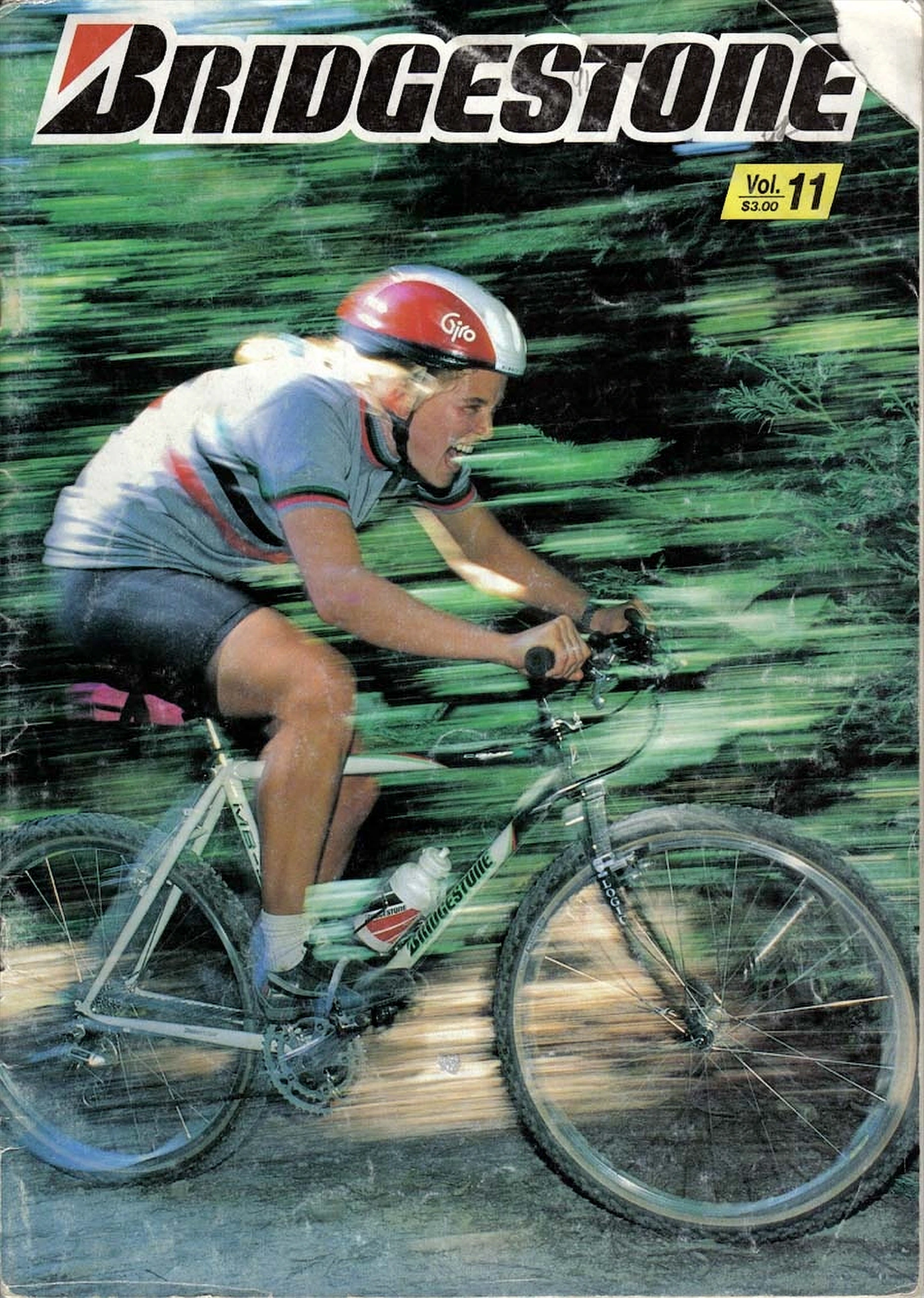 Page 1
 Page 2
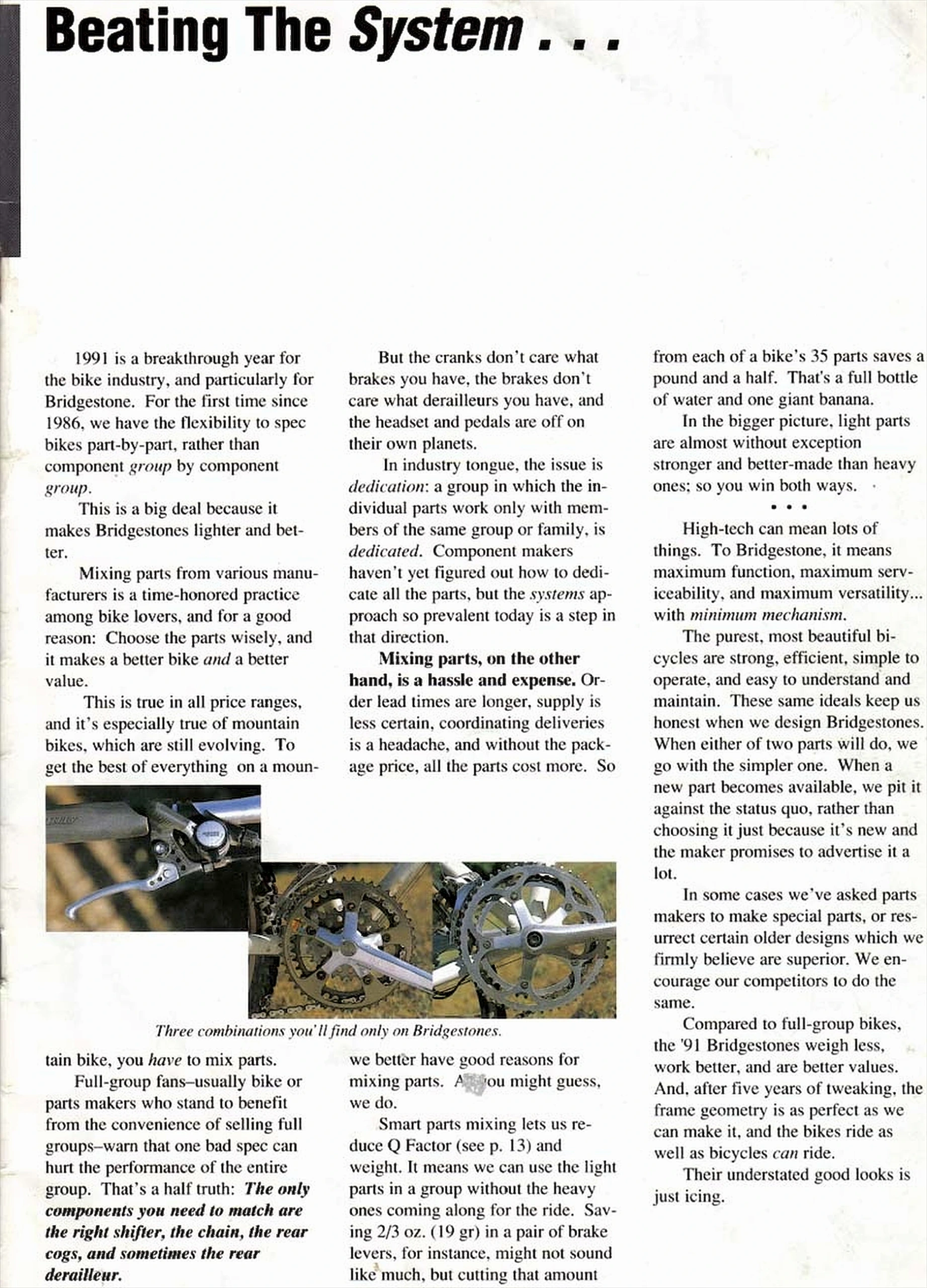 Page 3
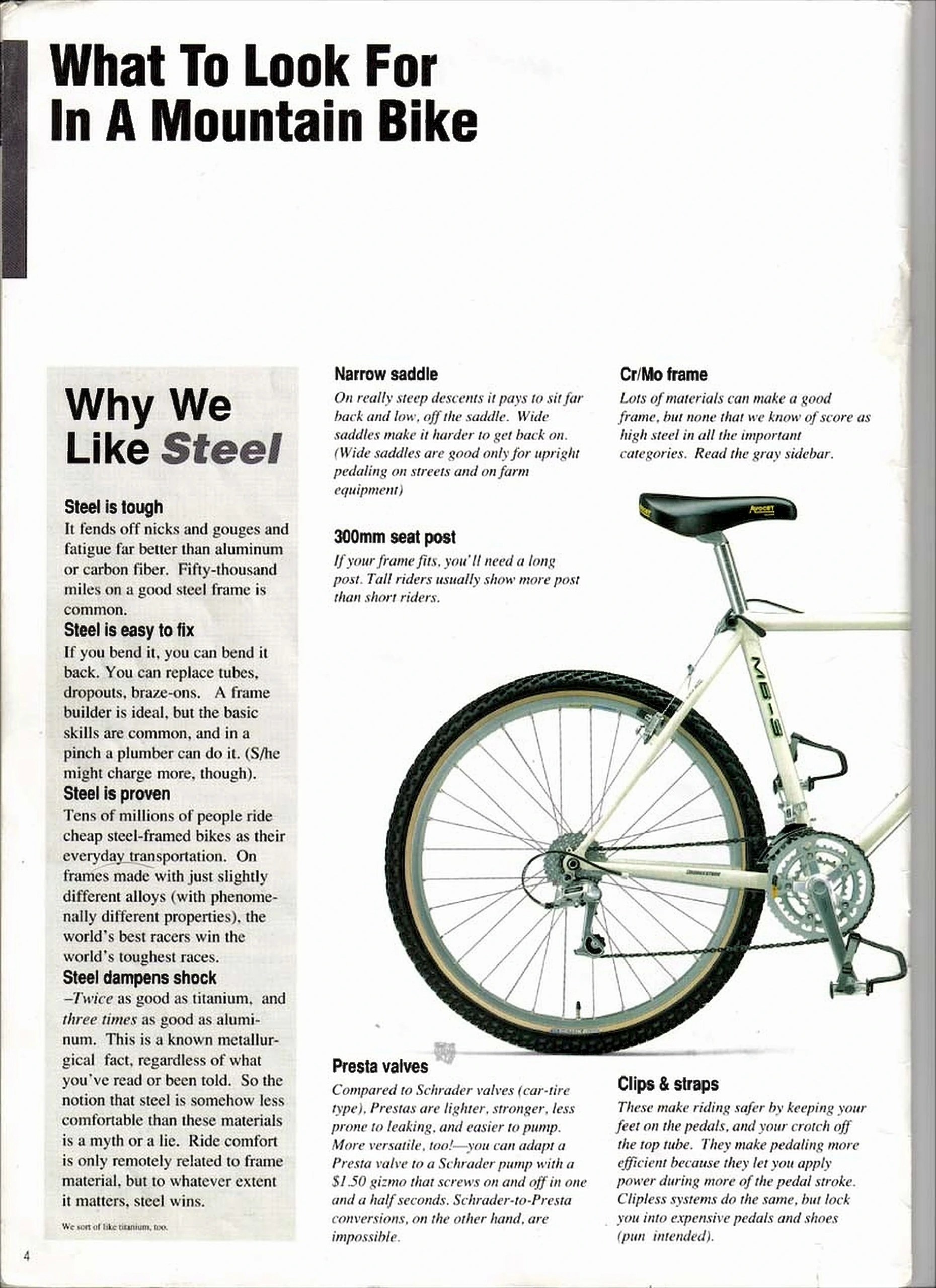 Page 4
 Page 5
 Page 6
 Page 7
 Page 8
 Page 9
 Page 10
 Page 11
 Page 12
 Page 13
 Page 14
 Page 15
 Page 16
 Page 17
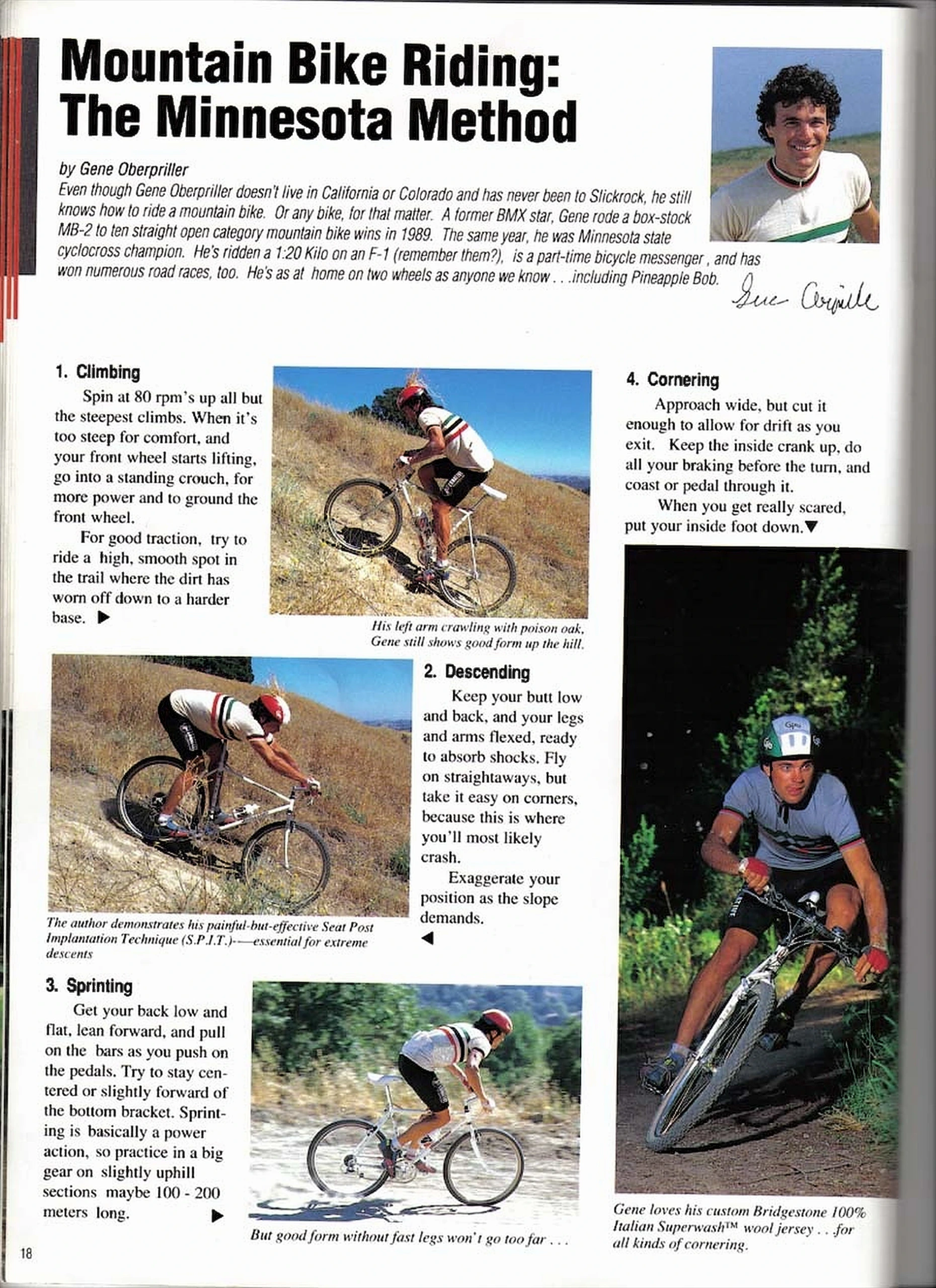 Page 18
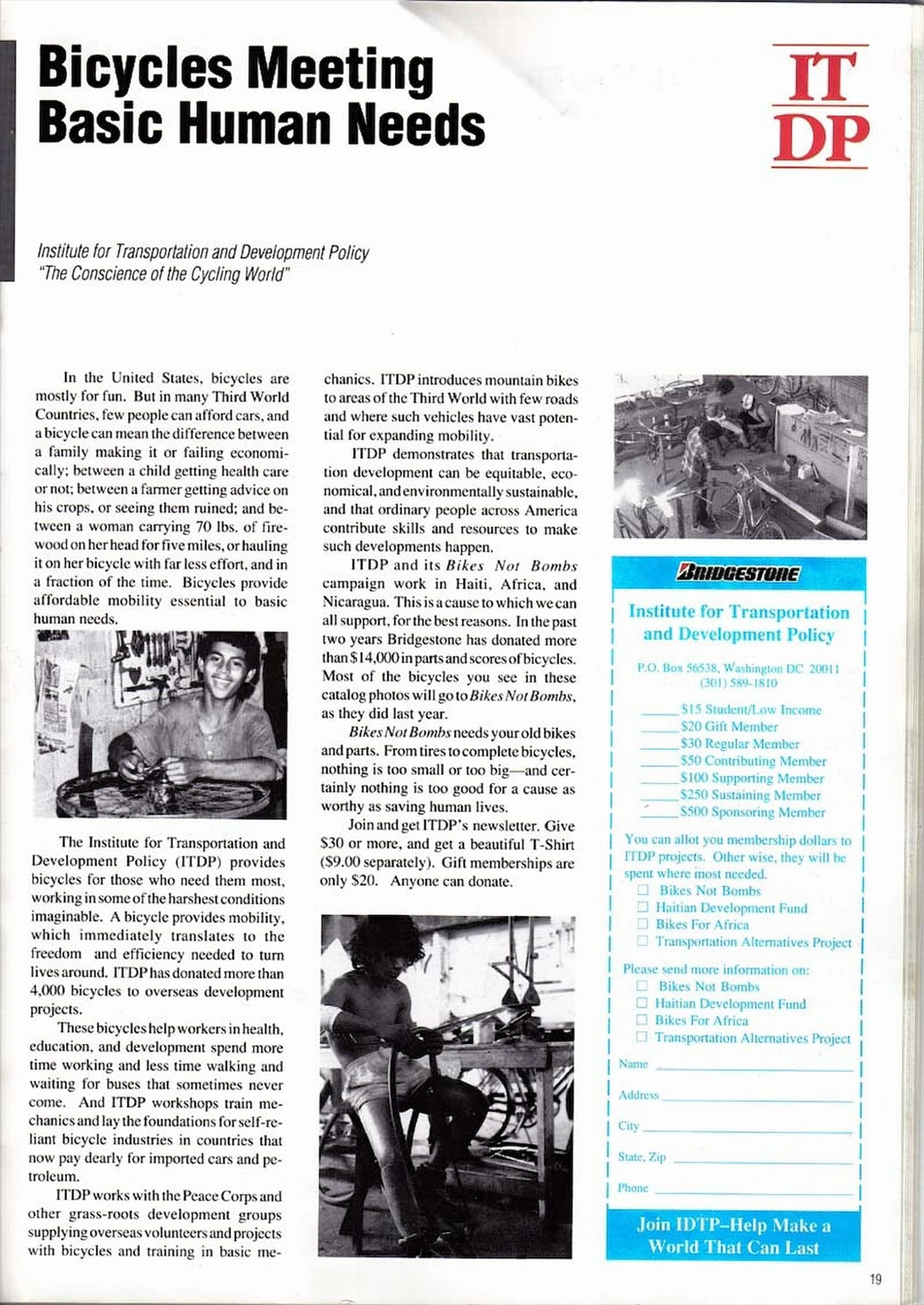 Page 19
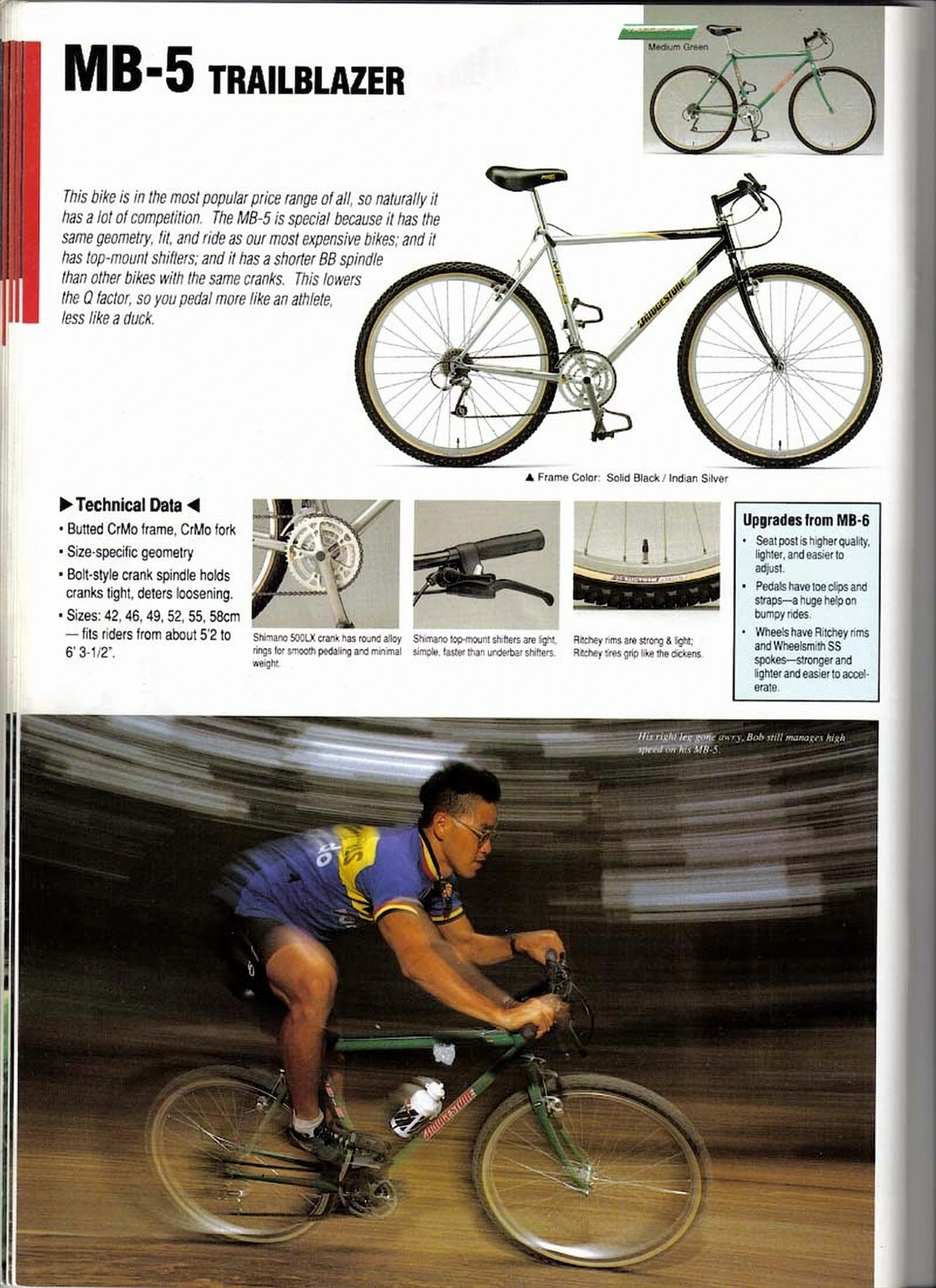 Page 20
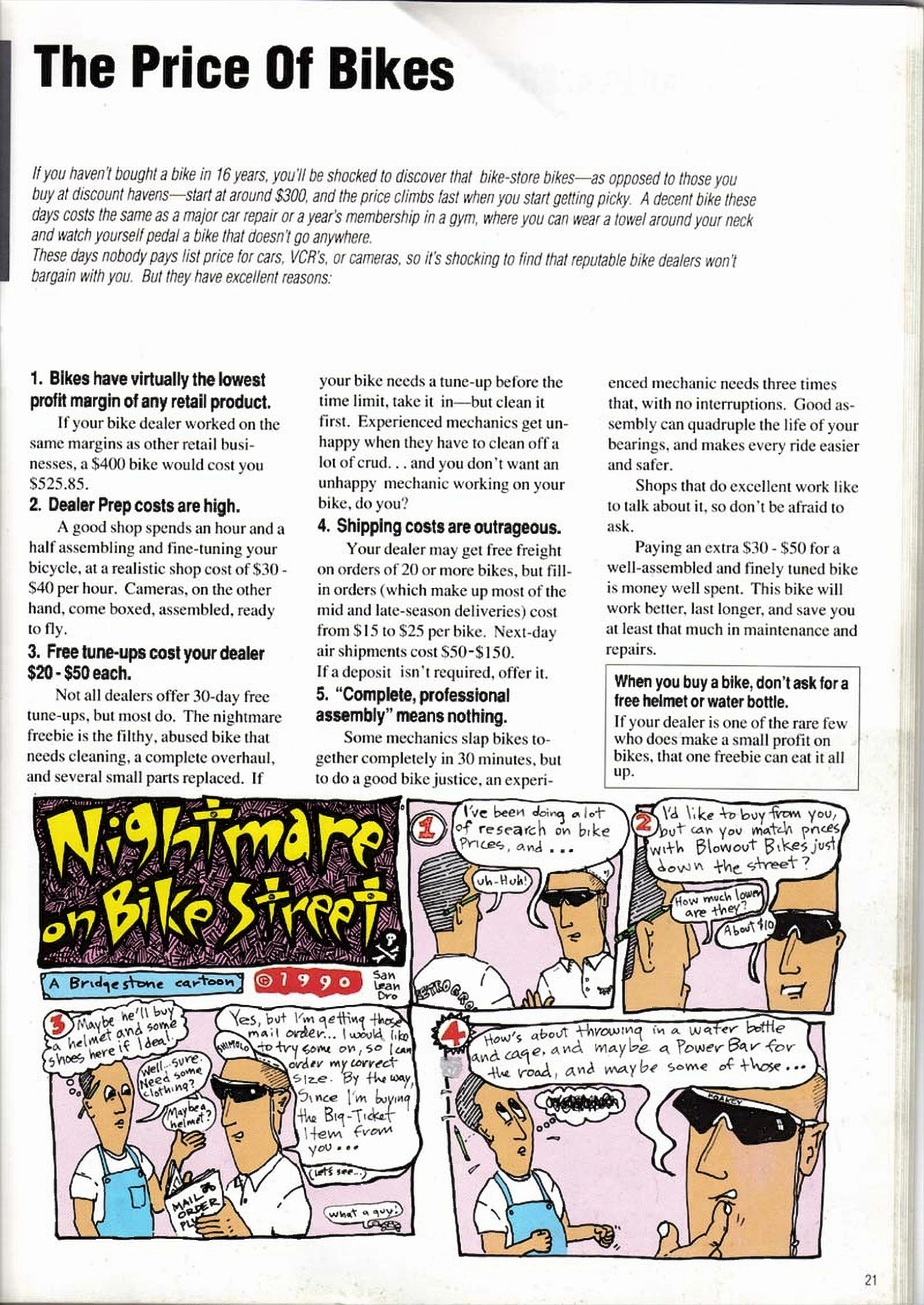 Page 21
 Page 22
 Page 23
 Page 24
 Page 25
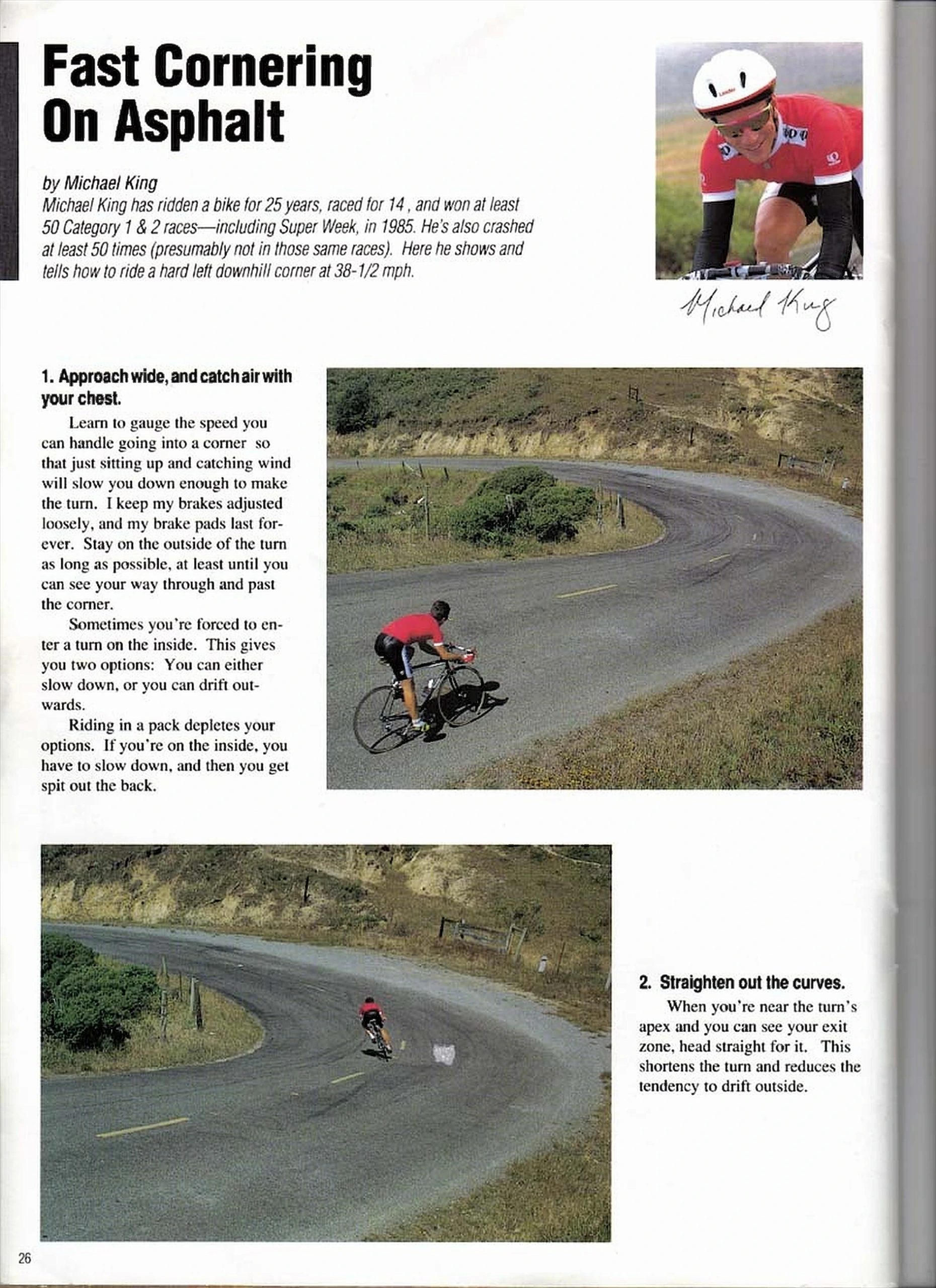 Page 26
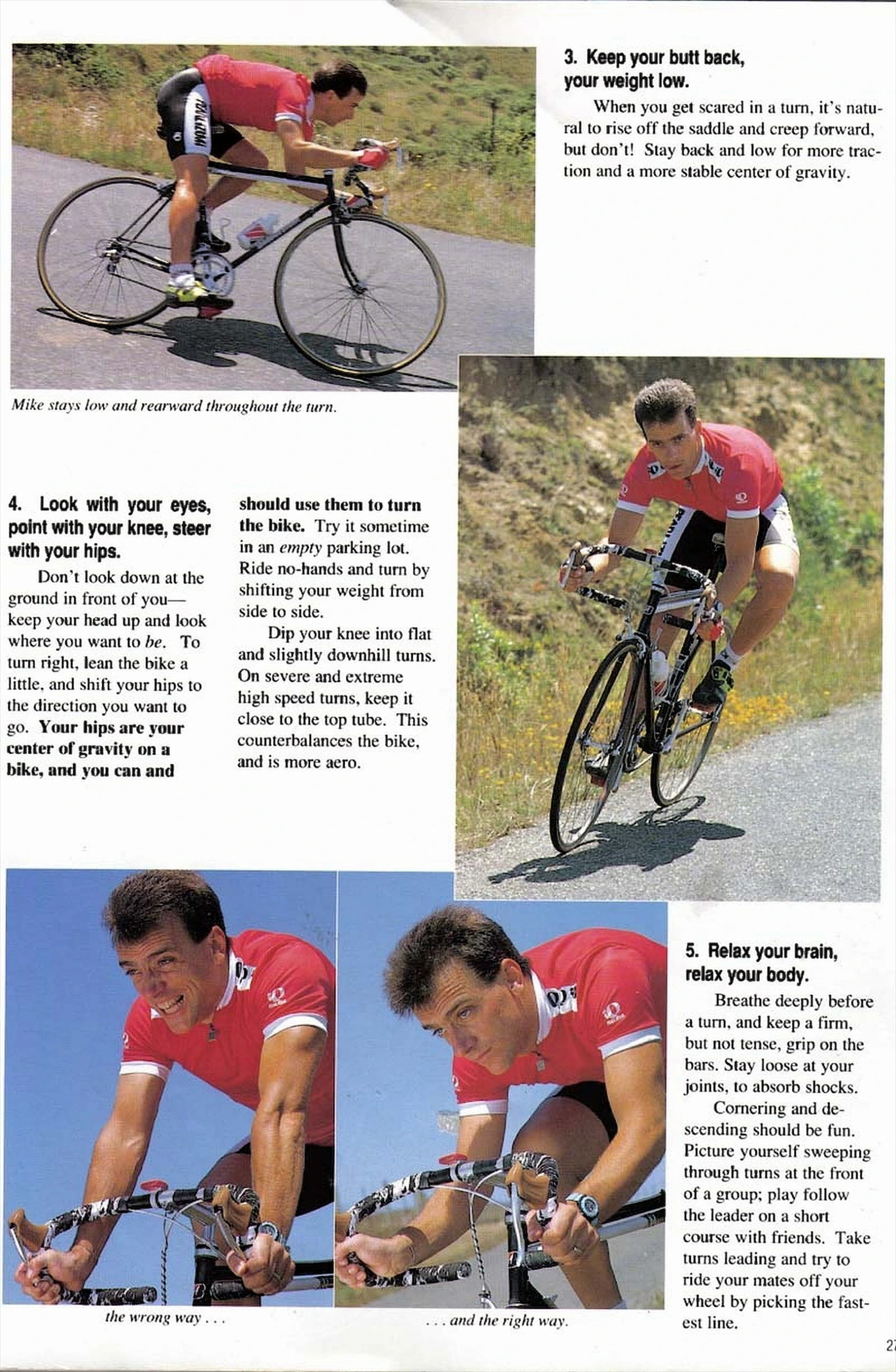 Page 27
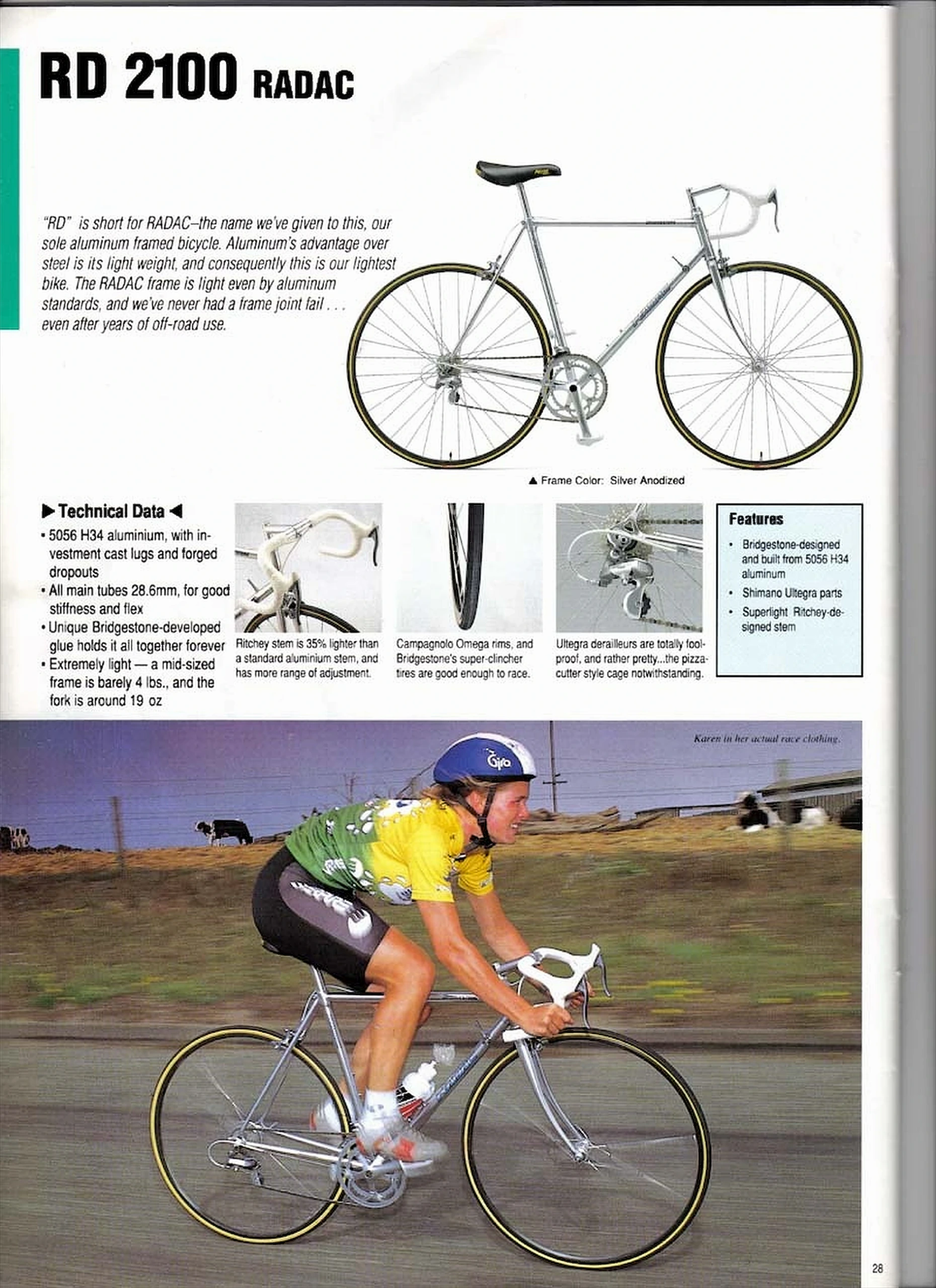 Page 28
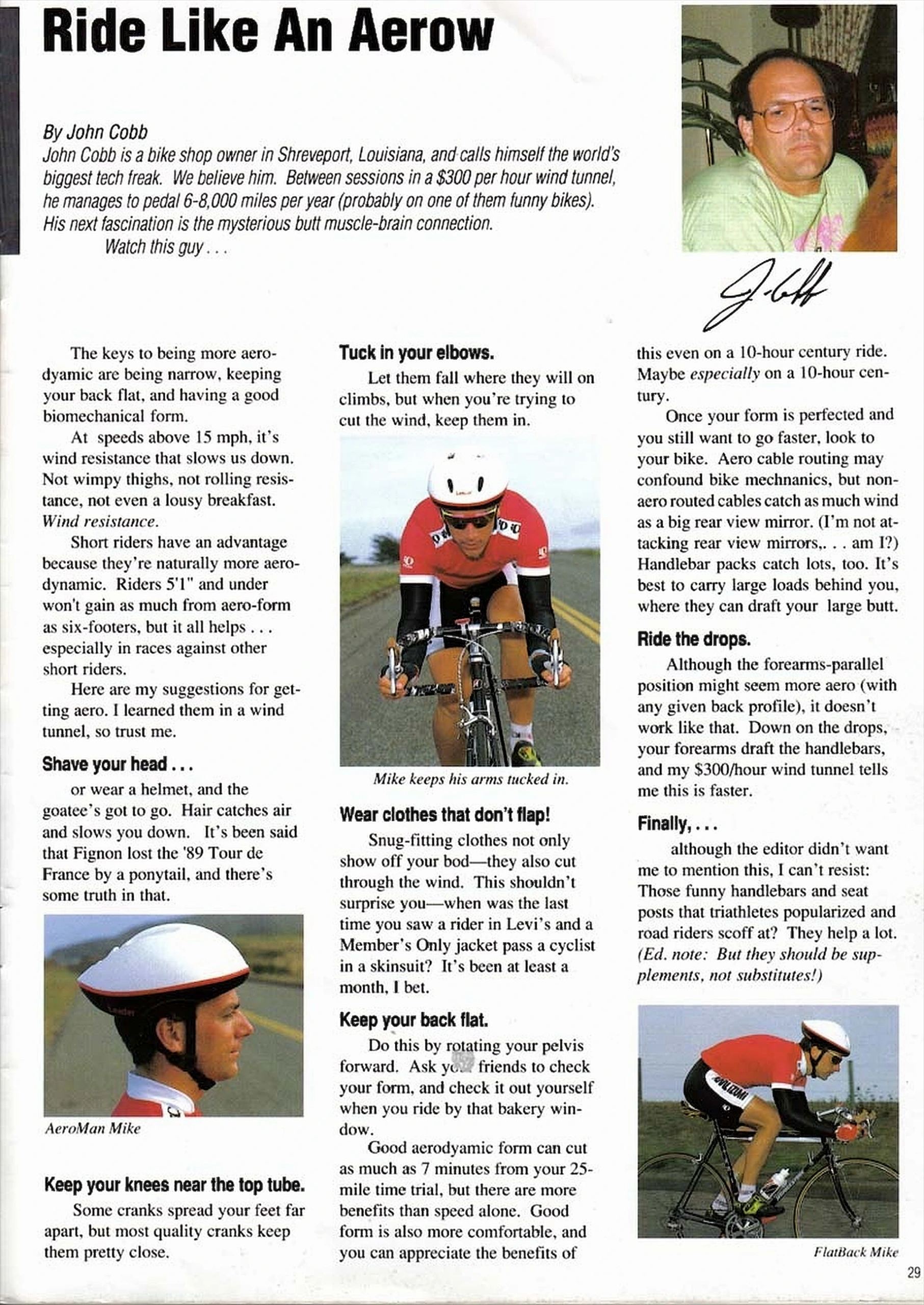 Page 29
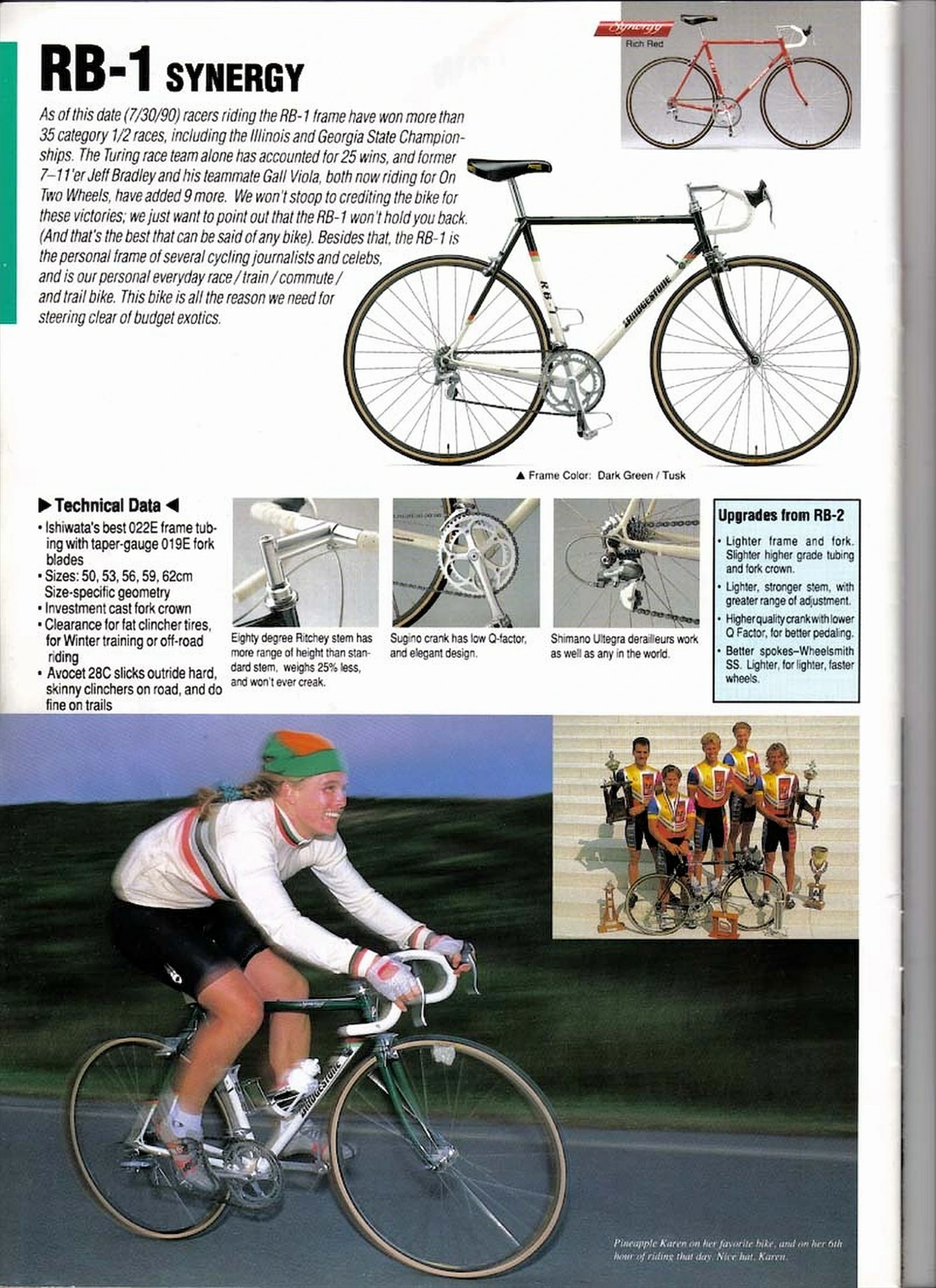 Page 30
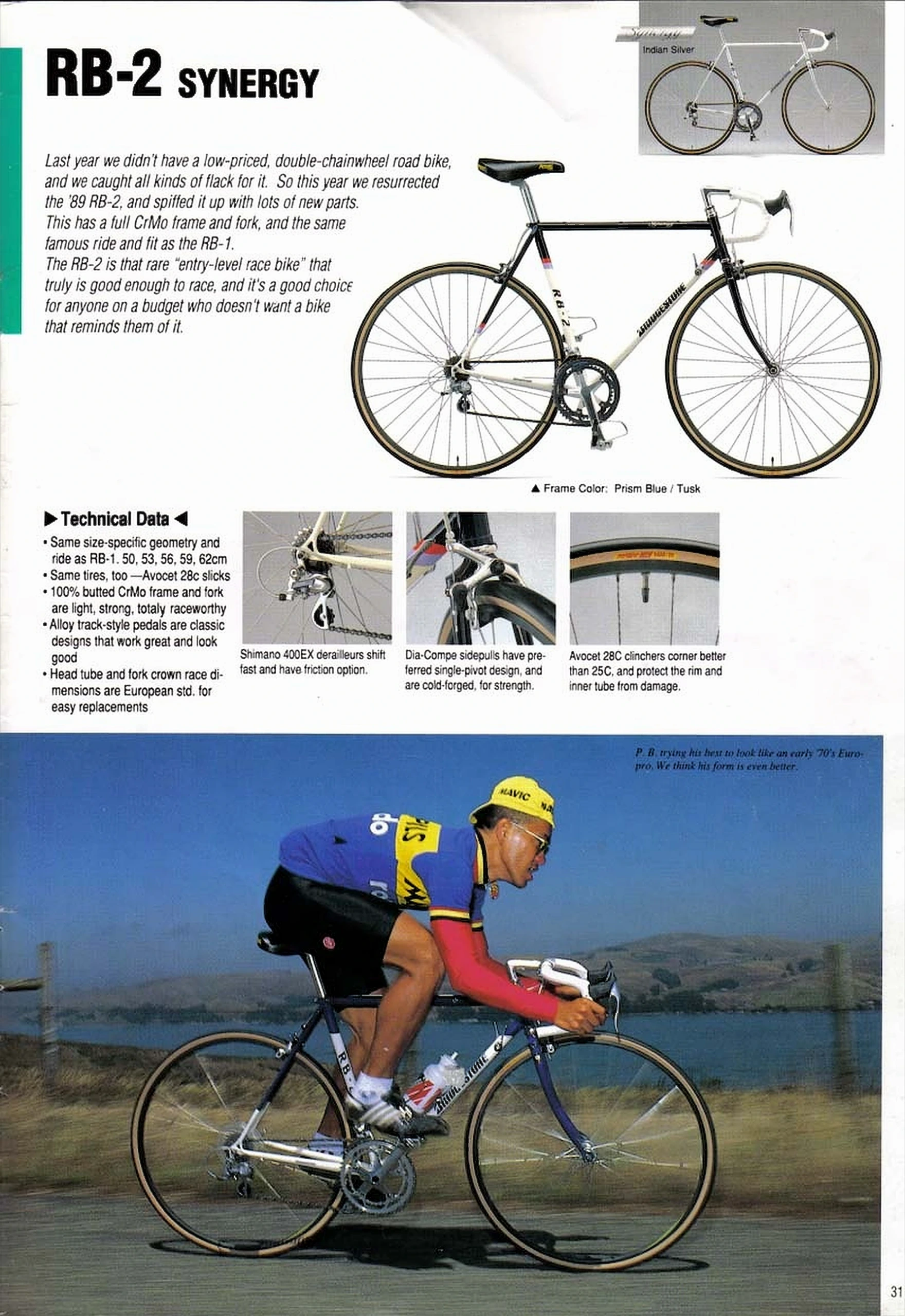 Page 31
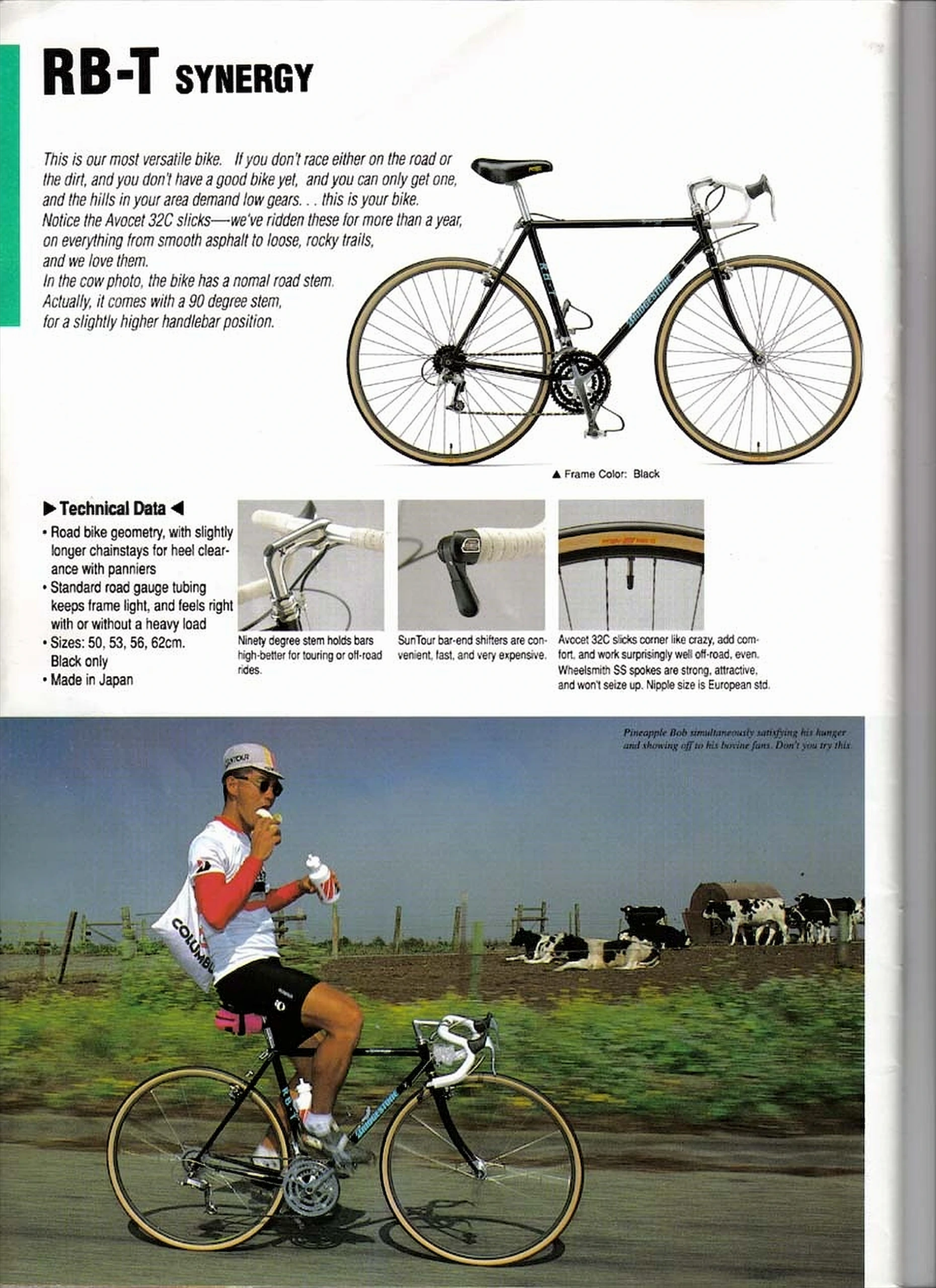 Page 32
 Page 33
 Page 34
 Page 35
 Page 36
 Page 37
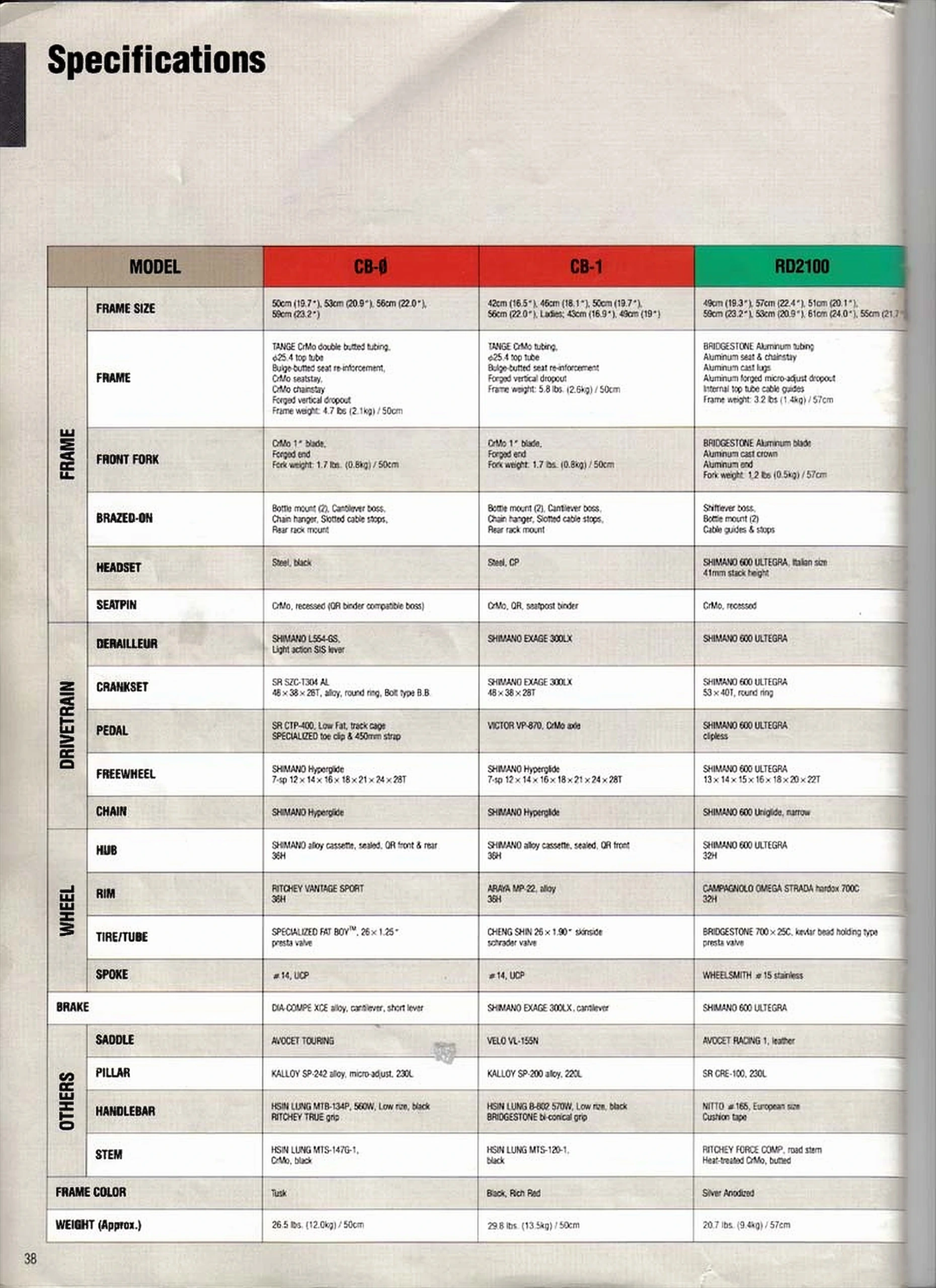 Page 38
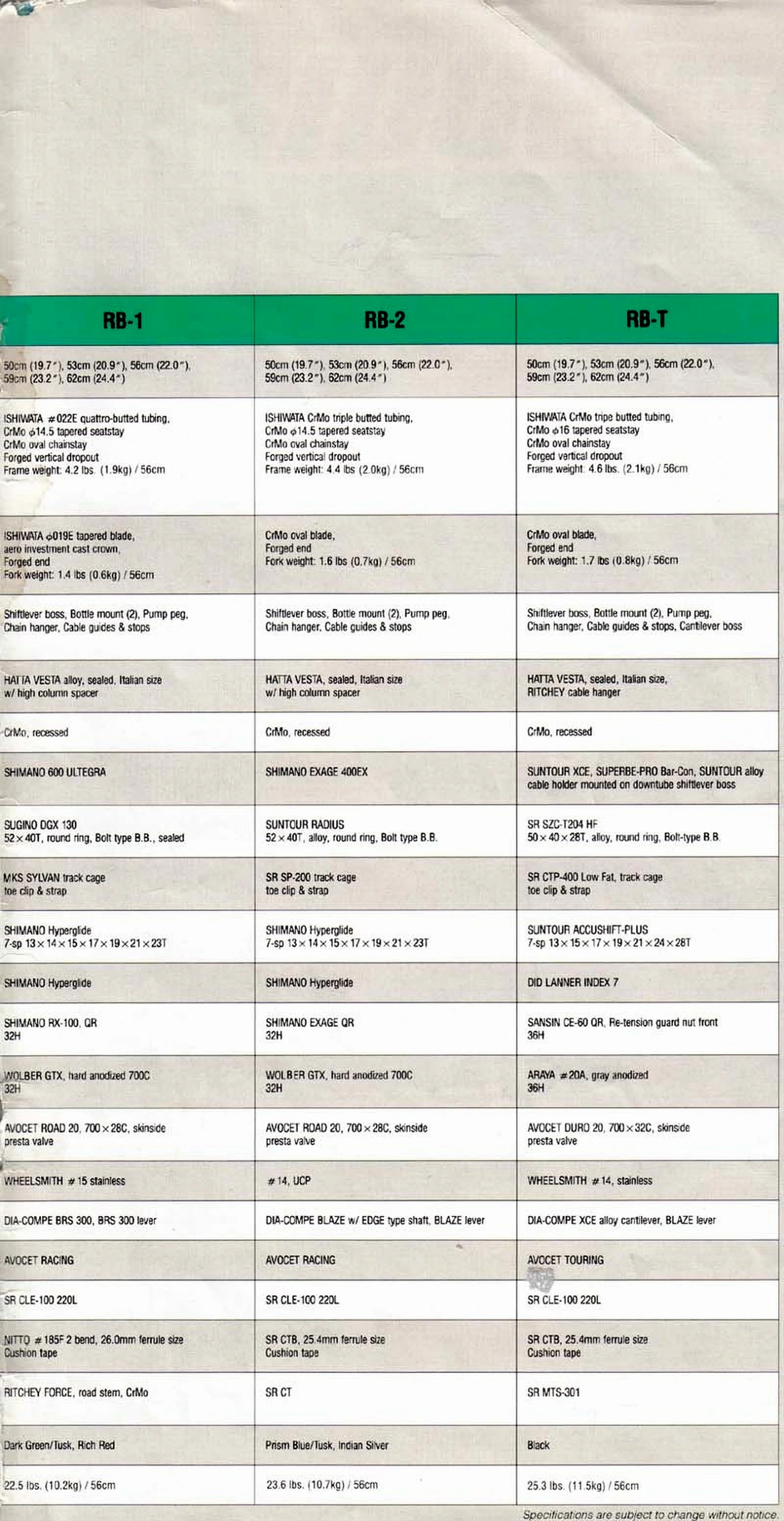 Page 39
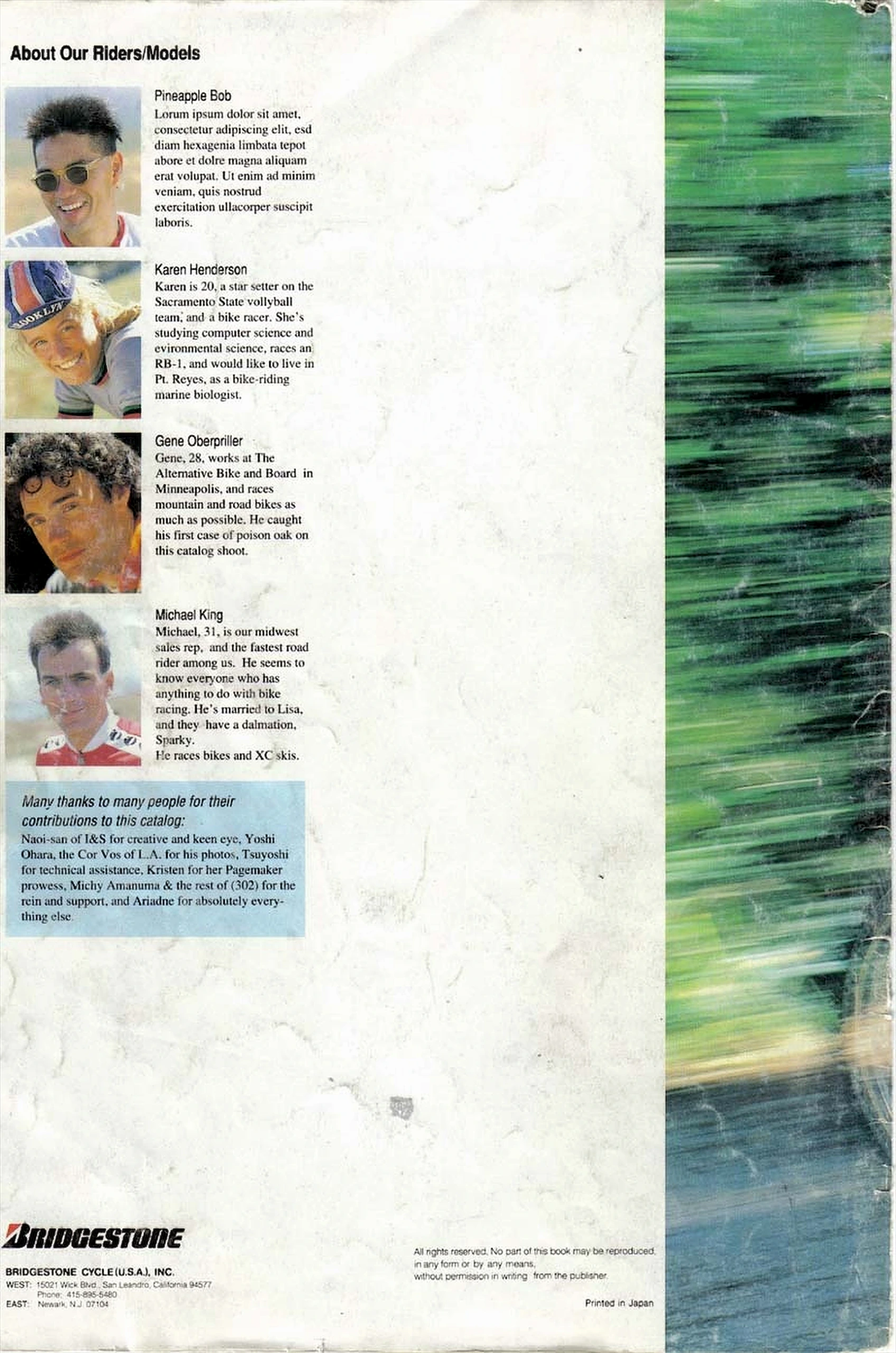 Page 40
| Marque | Bridgestone |
|---|---|
| Type | Catalog |
| Year | 1991 |
| Publisher | Bridgestone (United States) |
| Country | United States |
| Language | English |
| Pages | 40 |
| Source | sheldonbrown.com (Sheldon Brown's Bridgestone catalogue archive), scans credited to Terry Scott on the host's index page; enlarged for Ebykr. |
| Credit | sheldonbrown.com |
| Identifier | Permalink https://www.sheldonbrown.com/bridgestone/1991/index.htm |
| Transcription | Transcribed by eye |
Reference
Bridgestone (United States). The Bridgestone Bicycle Catalogue 1991 (Bridgestone Cycle, United States). 1991. Ebykr, https://ebykr.com/library/bridgestone-bicycle-catalogue-1991/.
Wikipedia
{{cite book |title=The Bridgestone Bicycle Catalogue 1991 (Bridgestone Cycle, United States) |publisher=Bridgestone (United States) |date=1991 |url=https://ebykr.com/library/bridgestone-bicycle-catalogue-1991/ |via=Ebykr |access-date=}}BRIDGESTONE Vol. 11 $3.00 Beating The System... 1991 is a breakthrough year for the bike industry, and particularly for Bridgestone. For the first time since 1986, we have the flexibility to spec bikes part-by-part, rather than component group by component group. This is a big deal because it makes Bridgestones lighter and better. Mixing parts …
THE BRIDGESTONE BICYCLE CATALOGUE 1991, the American catalogue of Bridgestone Cycle, from the Sheldon Brown archive. Transcribed from the page images (40 pages); each page ends with a bracketed description of its pictures.
— Page 1 —
BRIDGESTONE
Vol. 11
$3.00
[The cover: a color photograph of a woman in a red Giro helmet riding a white mountain bicycle through a forest, blurred by motion, with the Bridgestone logo at the top and a yellow “Vol. 11 $3.00” flash. The scan shows a torn upper corner.]
— Page 2 —
[A full-page photograph of a dark forest and a grassy slope with a single distant mountain bike rider at the lower right. No printed words.]
— Page 3 —
Beating The System…
1991 is a breakthrough year for the bike industry, and particularly for Bridgestone. For the first time since 1986, we have the flexibility to spec bikes part-by-part, rather than component group by component group.
This is a big deal because it makes Bridgestones lighter and better.
Mixing parts from various manufacturers is a time-honored practice among bike lovers, and for a good reason: Choose the parts wisely, and it makes a better bike and a better value.
This is true in all price ranges, and it’s especially true of mountain bikes, which are still evolving. To get the best of everything on a mountain bike, you have to mix parts.
Full-group fans—usually bike or parts makers who stand to benefit from the convenience of selling full groups—warn that one bad spec can hurt the performance of the entire group. That’s a half truth: The only components you need to match are the right shifter, the chain, the rear cogs, and sometimes the rear derailleur.
But the cranks don’t care what brakes you have, the brakes don’t care what derailleurs you have, and the headset and pedals are off on their own planets.
In industry tongue, the issue is dedication: a group in which the individual parts work only with members of the same group or family, is dedicated. Component makers haven’t yet figured out how to dedicate all the parts, but the systems approach so prevalent today is a step in that direction.
Mixing parts, on the other hand, is a hassle and expense. Order lead times are longer, supply is less certain, coordinating deliveries is a headache, and without the package price, all the parts cost more. So we better have good reasons for mixing parts. As you might guess, we do.
Smart parts mixing lets us reduce Q Factor (see p. 13) and weight. It means we can use the light parts in a group without the heavy ones coming along for the ride. Saving 2/3 oz. (19 gr) in a pair of brake levers, for instance, might not sound like much, but cutting that amount from each of a bike’s 35 parts saves a pound and a half. That’s a full bottle of water and one giant banana.
In the bigger picture, light parts are almost without exception stronger and better-made than heavy ones; so you win both ways.
…
High-tech can mean lots of things. To Bridgestone, it means maximum function, maximum serviceability, and maximum versatility… with minimum mechanism.
The purest, most beautiful bicycles are strong, efficient, simple to operate, and easy to understand and maintain. These same ideals keep us honest when we design Bridgestones. When either of two parts will do, we go with the simpler one. When a new part becomes available, we pit it against the status quo, rather than choosing it just because it’s new and the maker promises to advertise it a lot.
In some cases we’ve asked parts makers to make special parts, or resurrect certain older designs which we firmly believe are superior. We encourage our competitors to do the same.
Compared to full-group bikes, the ’91 Bridgestones weigh less, work better, and are better values. And, after five years of tweaking, the frame geometry is as perfect as we can make it, and the bikes ride as well as bicycles can ride.
Their understated good looks is just icing.
Three combinations you’ll find only on Bridgestones.
[The essay “Beating The System…” in three columns under a photograph of a brake lever and shifter and two photographs of cranks and chainrings, with the caption “Three combinations you’ll find only on Bridgestones.”]
— Page 4 —
What To Look For In A Mountain Bike
Why We Like Steel
Steel is tough
It fends off nicks and gouges and fatigue far better than aluminum or carbon fiber. Fifty-thousand miles on a good steel frame is common.
Steel is easy to fix
If you bend it, you can bend it back. You can replace tubes, dropouts, braze-ons. A frame builder is ideal, but the basic skills are common, and in a pinch a plumber can do it. (S/he might charge more, though).
Steel is proven
Tens of millions of people ride cheap steel-framed bikes as their everyday transportation. On frames made with just slightly different alloys (with phenomenally different properties), the world’s best racers win the world’s toughest races.
Steel dampens shock
—Twice as good as titanium, and three times as good as aluminum. This is a known metallurgical fact, regardless of what you’ve read or been told. So the notion that steel is somehow less comfortable than these materials is a myth or a lie. Ride comfort is only remotely related to frame material, but to whatever extent it matters, steel wins.
We sort of like titanium, too.
Narrow saddle
On really steep descents it pays to sit far back and low, off the saddle. Wide saddles make it harder to get back on. (Wide saddles are good only for upright pedaling on streets and on farm equipment)
Cr/Mo frame
Lots of materials can make a good frame, but none that we know of score as high steel in all the important categories. Read the gray sidebar.
300mm seat post
If your frame fits, you’ll need a long post. Tall riders usually show more post than short riders.
Presta valves
Compared to Schrader valves (car-tire type), Prestas are lighter, stronger, less prone to leaking, and easier to pump. More versatile, too!—you can adapt a Presta valve to a Schrader pump with a $1.50 gizmo that screws on and off in one and a half seconds. Schrader-to-Presta conversions, on the other hand, are impossible.
Clips & straps
These make riding safer by keeping your feet on the pedals, and your crotch off the top tube. They make pedaling more efficient because they let you apply power during more of the pedal stroke. Clipless systems do the same, but lock you into expensive pedals and shoes (pun intended).
4
[A page headed “What To Look For In A Mountain Bike” with a gray sidebar “Why We Like Steel” and a white mountain bicycle drawn across the spread, with callouts. The callouts continue on the next page.]
— Page 5 —
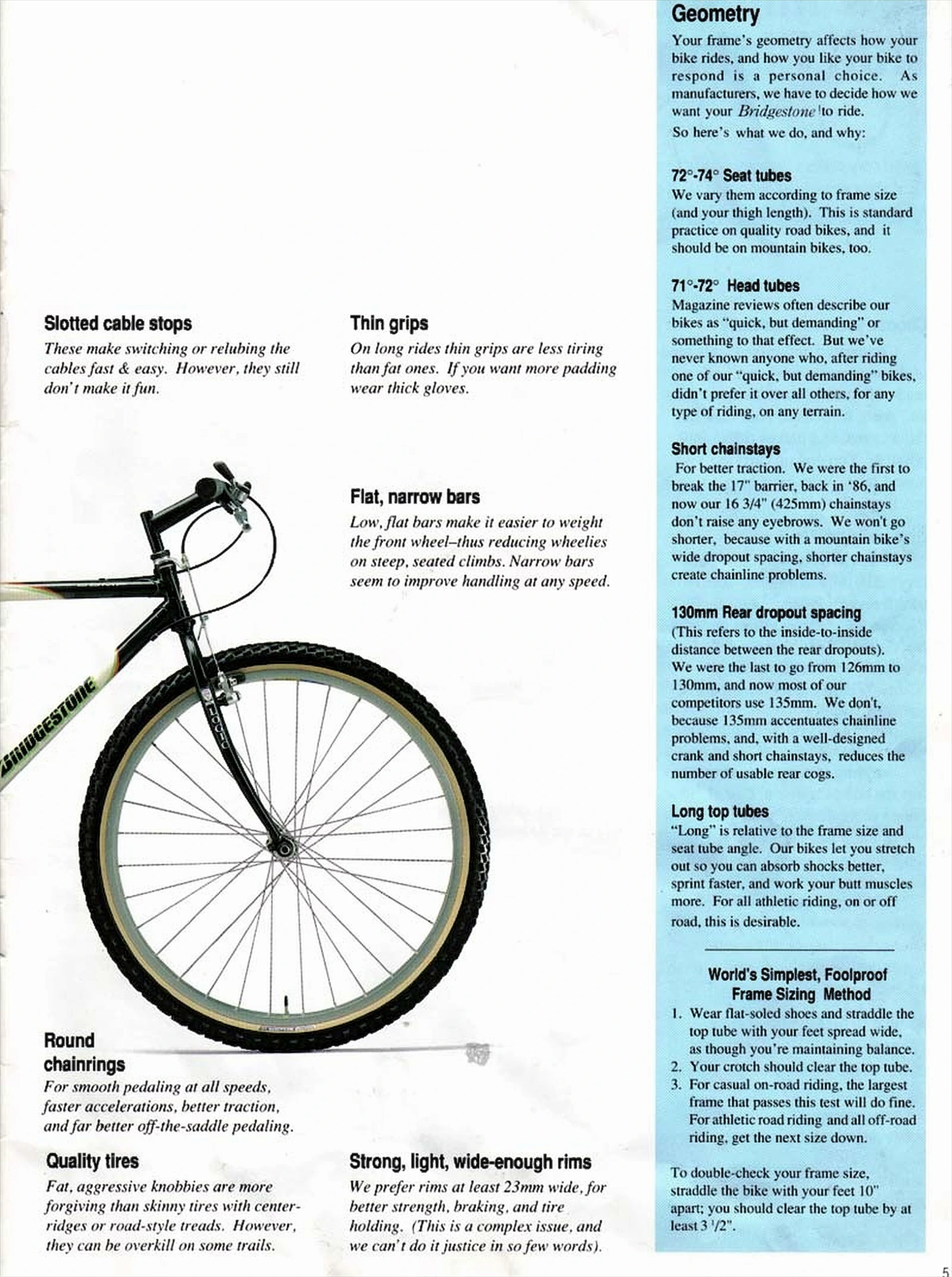
Slotted cable stops
These make switching or relubing the cables fast & easy. However, they still don’t make it fun.
Thin grips
On long rides thin grips are less tiring than fat ones. If you want more padding wear thick gloves.
Flat, narrow bars
Low, flat bars make it easier to weight the front wheel—thus reducing wheelies on steep, seated climbs. Narrow bars seem to improve handling at any speed.
Round chainrings
For smooth pedaling at all speeds, faster accelerations, better traction, and far better off-the-saddle pedaling.
Quality tires
Fat, aggressive knobbies are more forgiving than skinny tires with center-ridges or road-style treads. However, they can be overkill on some trails.
Strong, light, wide-enough rims
We prefer rims at least 23mm wide, for better strength, braking, and tire holding. (This is a complex issue, and we can’t do it justice in so few words).
Geometry
Your frame’s geometry affects how your bike rides, and how you like your bike to respond is a personal choice. As manufacturers, we have to decide how we want your Bridgestone to ride.
So here’s what we do, and why:
72°-74° Seat tubes
We vary them according to frame size (and your thigh length). This is standard practice on quality road bikes, and it should be on mountain bikes, too.
71°-72° Head tubes
Magazine reviews often describe our bikes as “quick, but demanding” or something to that effect. But we’ve never known anyone who, after riding one of our “quick, but demanding” bikes, didn’t prefer it over all others, for any type of riding, on any terrain.
Short chainstays
For better traction. We were the first to break the 17″ barrier, back in ’86, and now our 16 3/4″ (425mm) chainstays don’t raise any eyebrows. We won’t go shorter, because with a mountain bike’s wide dropout spacing, shorter chainstays create chainline problems.
130mm Rear dropout spacing
(This refers to the inside-to-inside distance between the rear dropouts). We were the last to go from 126mm to 130mm, and now most of our competitors use 135mm. We don’t, because 135mm accentuates chainline problems, and, with a well-designed crank and short chainstays, reduces the number of usable rear cogs.
Long top tubes
“Long” is relative to the frame size and seat tube angle. Our bikes let you stretch out so you can absorb shocks better, sprint faster, and work your butt muscles more. For all athletic riding, on or off road, this is desirable.
World’s Simplest, Foolproof Frame Sizing Method
1. Wear flat-soled shoes and straddle the top tube with your feet spread wide, as though you’re maintaining balance.
2. Your crotch should clear the top tube.
3. For casual on-road riding, the largest frame that passes this test will do fine. For athletic road riding and all off-road riding, get the next size down.
To double-check your frame size, straddle the bike with your feet 10″ apart; you should clear the top tube by at least 3 1/2″.
5
[The right half of the spread: more callouts around the mountain bicycle and a pale blue column headed “Geometry”.]
— Page 6 —
Low Impact Trail Riding
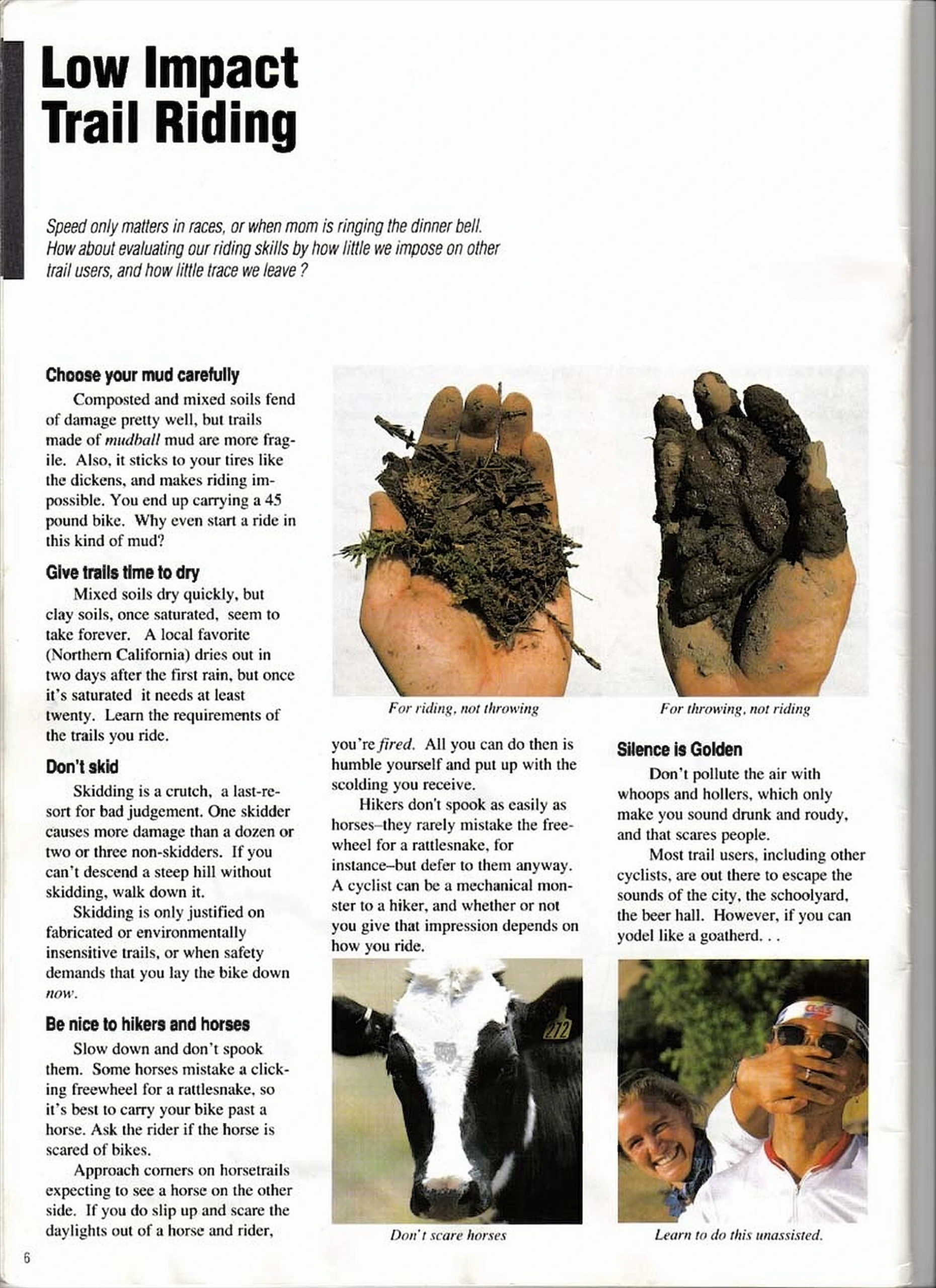
Speed only matters in races, or when mom is ringing the dinner bell. How about evaluating our riding skills by how little we impose on other trail users, and how little trace we leave ?
Choose your mud carefully
Composted and mixed soils fend of damage pretty well, but trails made of mudball mud are more fragile. Also, it sticks to your tires like the dickens, and makes riding impossible. You end up carrying a 45 pound bike. Why even start a ride in this kind of mud?
Give trails time to dry
Mixed soils dry quickly, but clay soils, once saturated, seem to take forever. A local favorite (Northern California) dries out in two days after the first rain, but once it’s saturated it needs at least twenty. Learn the requirements of the trails you ride.
Don’t skid
Skidding is a crutch, a last-resort for bad judgement. One skidder causes more damage than a dozen or two or three non-skidders. If you can’t descend a steep hill without skidding, walk down it.
Skidding is only justified on fabricated or environmentally insensitive trails, or when safety demands that you lay the bike down now.
Be nice to hikers and horses
Slow down and don’t spook them. Some horses mistake a clicking freewheel for a rattlesnake, so it’s best to carry your bike past a horse. Ask the rider if the horse is scared of bikes.
Approach corners on horsetrails expecting to see a horse on the other side. If you do slip up and scare the daylights out of a horse and rider, you’re fired. All you can do then is humble yourself and put up with the scolding you receive.
Hikers don’t spook as easily as horses—they rarely mistake the freewheel for a rattlesnake, for instance—but defer to them anyway. A cyclist can be a mechanical monster to a hiker, and whether or not you give that impression depends on how you ride.
Silence is Golden
Don’t pollute the air with whoops and hollers, which only make you sound drunk and roudy, and that scares people.
Most trail users, including other cyclists, are out there to escape the sounds of the city, the schoolyard, the beer hall. However, if you can yodel like a goatherd…
For riding, not throwing
For throwing, not riding
Don’t scare horses
Learn to do this unassisted.
6
[A page headed “Low Impact Trail Riding” with photographs of two handfuls of mud, a cow’s face and a woman and man laughing with the man covering his mouth.]
— Page 7 —
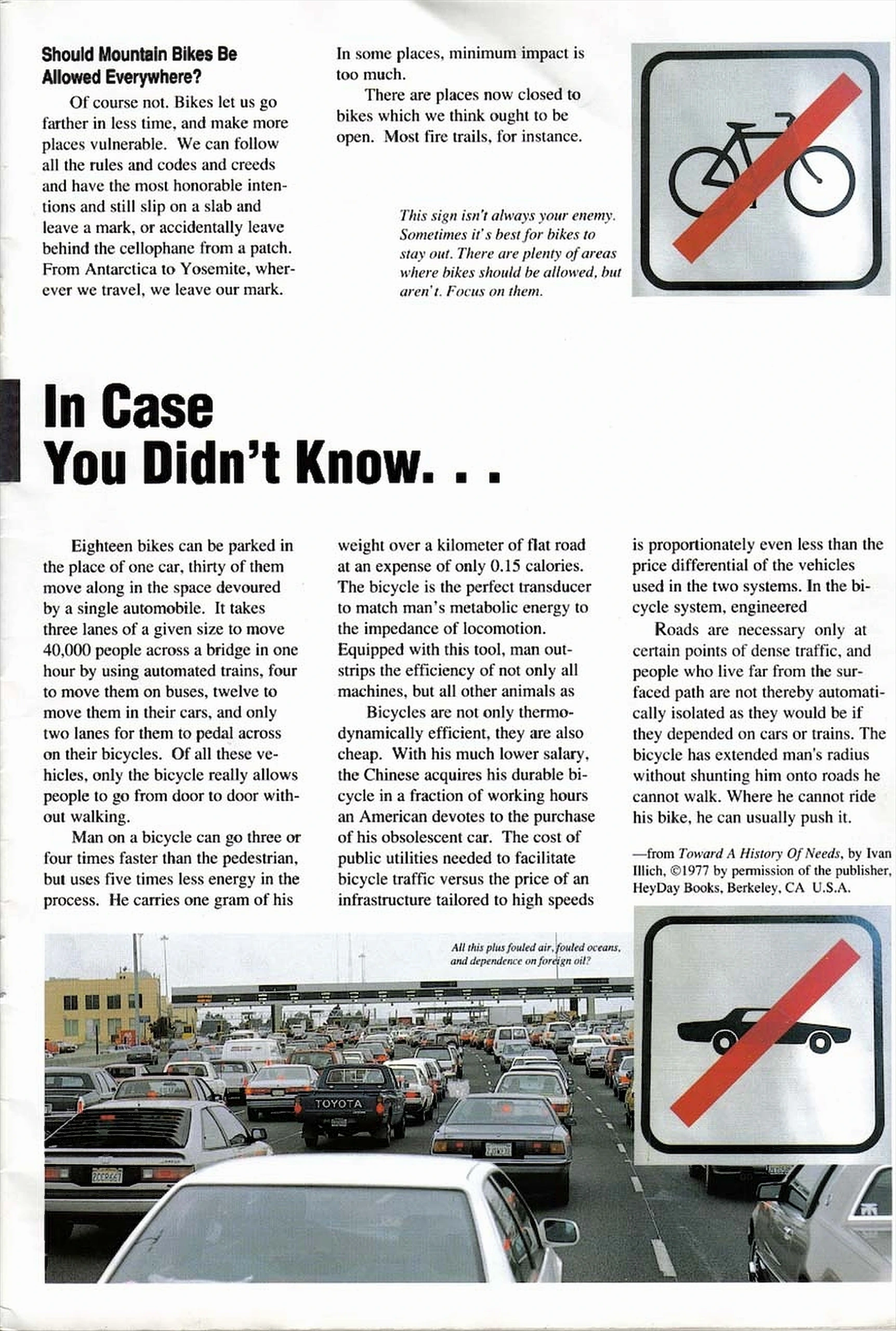
Should Mountain Bikes Be Allowed Everywhere?
Of course not. Bikes let us go farther in less time, and make more places vulnerable. We can follow all the rules and codes and creeds and have the most honorable intentions and still slip on a slab and leave a mark, or accidentally leave behind the cellophane from a patch. From Antarctica to Yosemite, wherever we travel, we leave our mark.
In some places, minimum impact is too much.
There are places now closed to bikes which we think ought to be open. Most fire trails, for instance.
This sign isn’t always your enemy. Sometimes it’s best for bikes to stay out. There are plenty of areas where bikes should be allowed, but aren’t. Focus on them.
In Case You Didn’t Know…
Eighteen bikes can be parked in the place of one car, thirty of them move along in the space devoured by a single automobile. It takes three lanes of a given size to move 40,000 people across a bridge in one hour by using automated trains, four to move them on buses, twelve to move them in their cars, and only two lanes for them to pedal across on their bicycles. Of all these vehicles, only the bicycle really allows people to go from door to door without walking.
Man on a bicycle can go three or four times faster than the pedestrian, but uses five times less energy in the process. He carries one gram of his weight over a kilometer of flat road at an expense of only 0.15 calories. The bicycle is the perfect transducer to match man’s metabolic energy to the impedance of locomotion. Equipped with this tool, man outstrips the efficiency of not only all machines, but all other animals as
Bicycles are not only thermodynamically efficient, they are also cheap. With his much lower salary, the Chinese acquires his durable bicycle in a fraction of working hours an American devotes to the purchase of his obsolescent car. The cost of public utilities needed to facilitate bicycle traffic versus the price of an infrastructure tailored to high speeds is proportionately even less than the price differential of the vehicles used in the two systems. In the bicycle system, engineered
Roads are necessary only at certain points of dense traffic, and people who live far from the surfaced path are not thereby automatically isolated as they would be if they depended on cars or trains. The bicycle has extended man’s radius without shunting him onto roads he cannot walk. Where he cannot ride his bike, he can usually push it.
—from Toward A History Of Needs, by Ivan Illich, ©1977 by permission of the publisher, HeyDay Books, Berkeley, CA U.S.A.
All this plus fouled air, fouled oceans, and dependence on foreign oil?
[A page with two “no bicycles” and “no cars” road signs, a photograph of a traffic jam at a toll plaza and the quoted essay “In Case You Didn’t Know…”. The text of the essay is cut off at the foot of its second and third columns, as printed.]
— Page 8 —
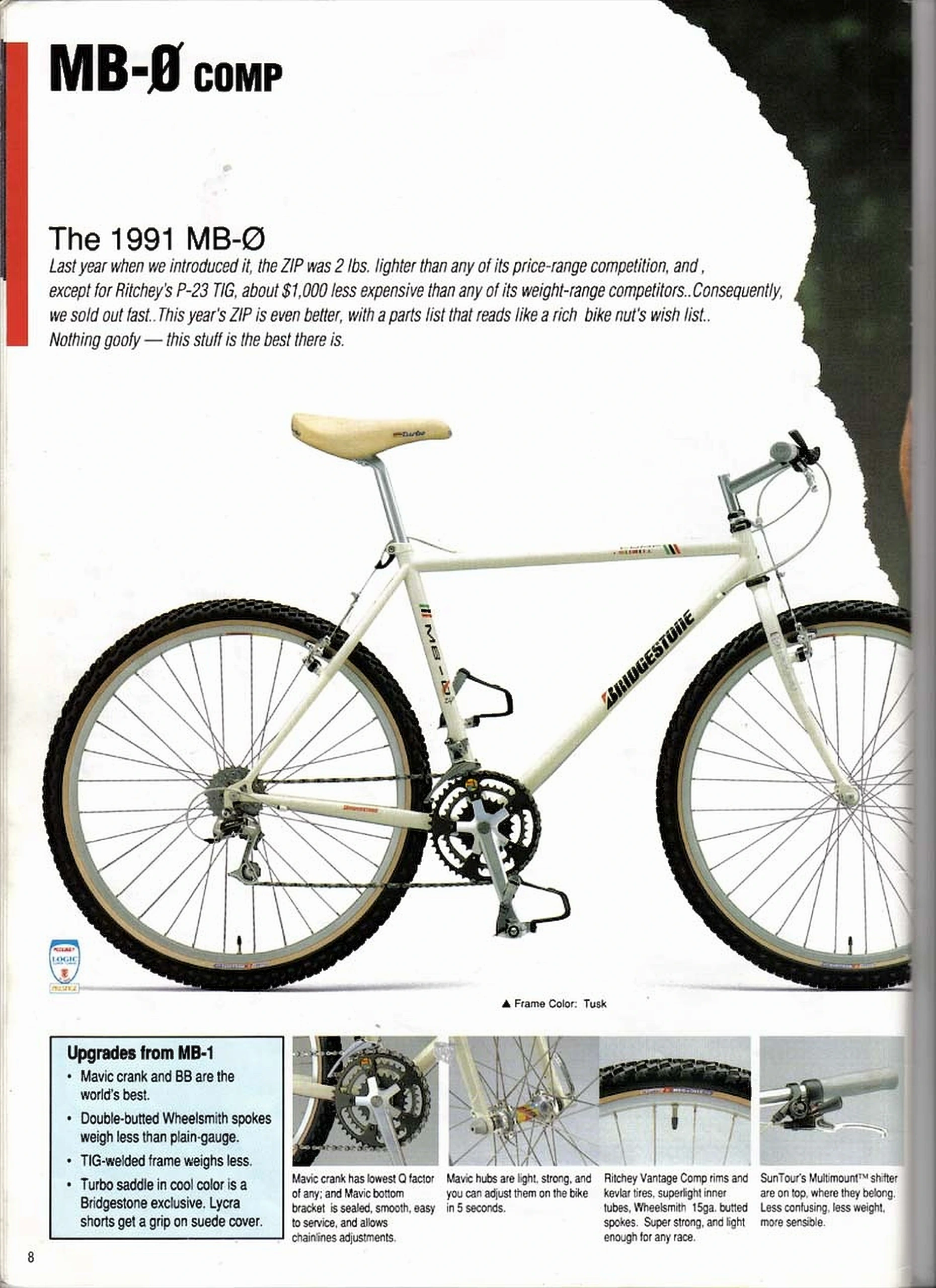
MB-Ø COMP
The 1991 MB-Ø
Last year when we introduced it, the ZIP was 2 lbs. lighter than any of its price-range competition, and, except for Ritchey’s P-23 TIG, about $1,000 less expensive than any of its weight-range competitors..Consequently, we sold out fast..This year’s ZIP is even better, with a parts list that reads like a rich bike nut’s wish list.. Nothing goofy — this stuff is the best there is.
Frame Color: Tusk
Upgrades from MB-1
• Mavic crank and BB are the world’s best.
• Double-butted Wheelsmith spokes weigh less than plain-gauge.
• TIG-welded frame weighs less.
• Turbo saddle in cool color is a Bridgestone exclusive. Lycra shorts get a grip on suede cover.
Mavic crank has lowest Q factor of any; and Mavic bottom bracket is sealed, smooth, easy to service, and allows chainlines adjustments.
Mavic hubs are light, strong, and you can adjust them on the bike in 5 seconds.
Ritchey Vantage Comp rims and kevlar tires, superlight inner tubes, Wheelsmith 15ga. butted spokes. Super strong, and light enough for any race.
SunTour’s Multimount™ shifter are on top, where they belong. Less confusing, less weight, more sensible.
8
[The MB-Ø Comp mountain bicycle in ivory (frame color Tusk) with a LOGIC PRESTIGE badge on a page with a torn right edge, a box of upgrades and four detail photographs with captions.]
— Page 9 —
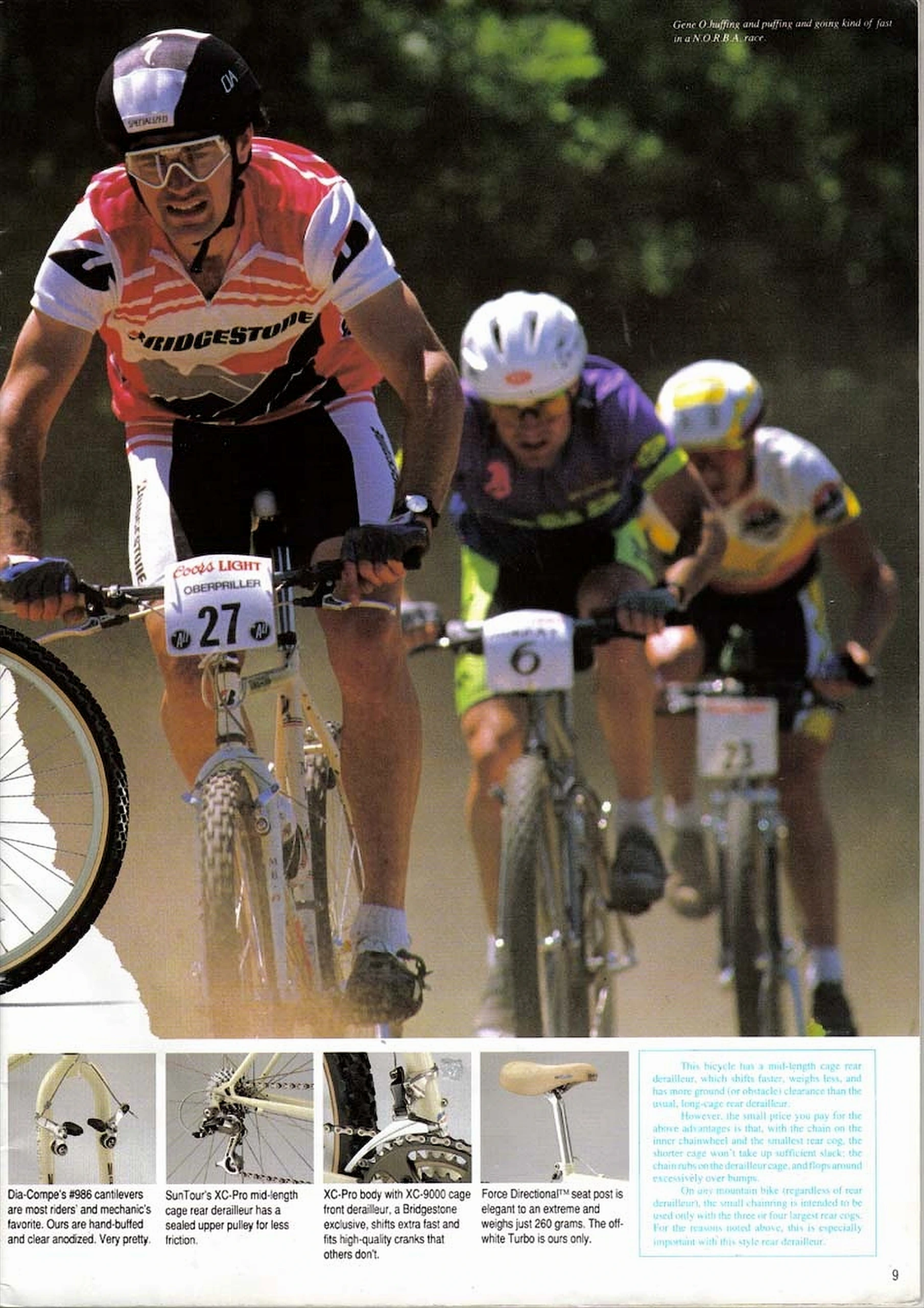
Gene O. huffing and puffing and going kind of fast in a N.O.R.B.A. race.
Dia-Compe’s #986 cantilevers are most riders’ and mechanic’s favorite. Ours are hand-buffed and clear anodized. Very pretty.
SunTour’s XC-Pro mid-length cage rear derailleur has a sealed upper pulley for less friction.
XC-Pro body with XC-9000 cage front derailleur, a Bridgestone exclusive, shifts extra fast and fits high-quality cranks that others don’t.
Force Directional™ seat post is elegant to an extreme and weighs just 260 grams. The off-white Turbo is ours only.
This bicycle has a mid-length cage rear derailleur, which shifts faster, weighs less, and has more ground (or obstacle) clearance than the usual, long-cage rear derailleur.
However, the small price you pay for the above advantages is that, with the chain on the inner chainwheel and the smallest rear cog, the shorter cage won’t take up sufficient slack: the chain rubs on the derailleur cage, and flops around excessively over bumps.
On any mountain bike (regardless of rear derailleur), the small chainring is intended to be used only with the three or four largest rear cogs. For the reasons noted above, this is especially important with this style rear derailleur.
9
[A full-page photograph of three racers on mountain bikes in a N.O.R.B.A. race, with the racer in front wearing number 27, above four detail photographs with captions and a boxed note on the derailleur cage.]
— Page 10 —
The Case For Spoked Wheels
by Jon and Ric Hjertberg/Wheelsmith
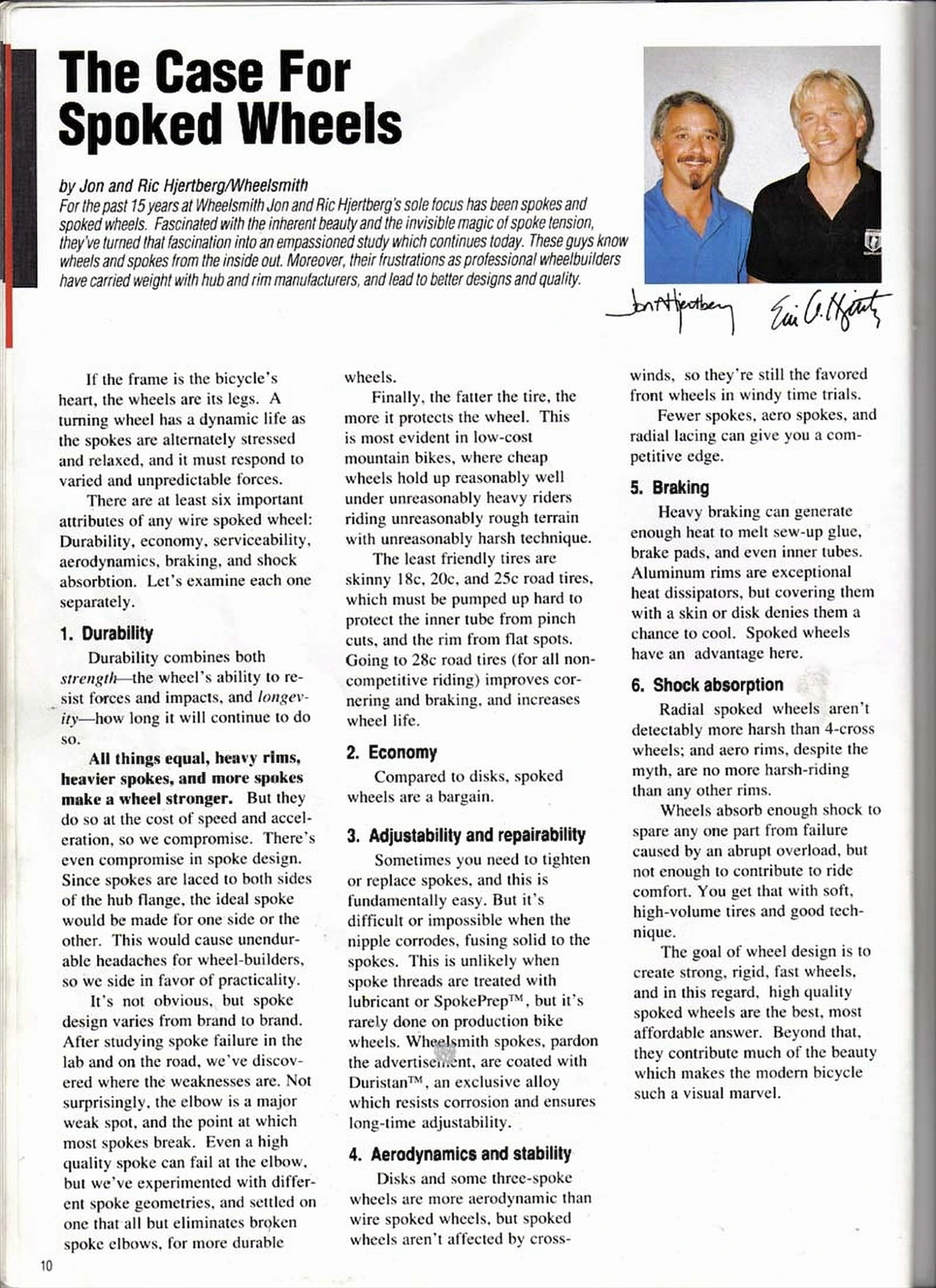
For the past 15 years at Wheelsmith Jon and Ric Hjertberg’s sole focus has been spokes and spoked wheels. Fascinated with the inherent beauty and the invisible magic of spoke tension, they’ve turned that fascination into an empassioned study which continues today. These guys know wheels and spokes from the inside out. Moreover, their frustrations as professional wheelbuilders have carried weight with hub and rim manufacturers, and lead to better designs and quality.
(signatures: Jon Hjertberg, Eric C. Hjertberg)
If the frame is the bicycle’s heart, the wheels are its legs. A turning wheel has a dynamic life as the spokes are alternately stressed and relaxed, and it must respond to varied and unpredictable forces.
There are at least six important attributes of any wire spoked wheel: Durability, economy, serviceability, aerodynamics, braking, and shock absorbtion. Let’s examine each one separately.
1. Durability
Durability combines both strength—the wheel’s ability to resist forces and impacts, and longevity—how long it will continue to do so.
All things equal, heavy rims, heavier spokes, and more spokes make a wheel stronger. But they do so at the cost of speed and acceleration, so we compromise. There’s even compromise in spoke design. Since spokes are laced to both sides of the hub flange, the ideal spoke would be made for one side or the other. This would cause unendurable headaches for wheel-builders, so we side in favor of practicality.
It’s not obvious, but spoke design varies from brand to brand. After studying spoke failure in the lab and on the road, we’ve discovered where the weaknesses are. Not surprisingly, the elbow is a major weak spot, and the point at which most spokes break. Even a high quality spoke can fail at the elbow, but we’ve experimented with different spoke geometries, and settled on one that all but eliminates broken spoke elbows, for more durable wheels.
Finally, the fatter the tire, the more it protects the wheel. This is most evident in low-cost mountain bikes, where cheap wheels hold up reasonably well under unreasonably heavy riders riding unreasonably rough terrain with unreasonably harsh technique.
The least friendly tires are skinny 18c, 20c, and 25c road tires, which must be pumped up hard to protect the inner tube from pinch cuts, and the rim from flat spots. Going to 28c road tires (for all noncompetitive riding) improves cornering and braking, and increases wheel life.
2. Economy
Compared to disks, spoked wheels are a bargain.
3. Adjustability and repairability
Sometimes you need to tighten or replace spokes, and this is fundamentally easy. But it’s difficult or impossible when the nipple corrodes, fusing solid to the spokes. This is unlikely when spoke threads are treated with lubricant or SpokePrep™, but it’s rarely done on production bike wheels. Wheelsmith spokes, pardon the advertisement, are coated with Duristan™, an exclusive alloy which resists corrosion and ensures long-time adjustability.
4. Aerodynamics and stability
Disks and some three-spoke wheels are more aerodynamic than wire spoked wheels, but spoked wheels aren’t affected by crosswinds, so they’re still the favored front wheels in windy time trials.
Fewer spokes, aero spokes, and radial lacing can give you a competitive edge.
5. Braking
Heavy braking can generate enough heat to melt sew-up glue, brake pads, and even inner tubes. Aluminum rims are exceptional heat dissipators, but covering them with a skin or disk denies them a chance to cool. Spoked wheels have an advantage here.
6. Shock absorption
Radial spoked wheels aren’t detectably more harsh than 4-cross wheels; and aero rims, despite the myth, are no more harsh-riding than any other rims.
Wheels absorb enough shock to spare any one part from failure caused by an abrupt overload, but not enough to contribute to ride comfort. You get that with soft, high-volume tires and good technique.
The goal of wheel design is to create strong, rigid, fast wheels, and in this regard, high quality spoked wheels are the best, most affordable answer. Beyond that, they contribute much of the beauty which makes the modern bicycle such a visual marvel.
10
[A page headed “The Case For Spoked Wheels” with a photograph of the two Hjertberg brothers.]
— Page 11 —
MB-1 COMP
This bicycle has a mid-length cage rear derailleur, which shifts faster, weighs less, and has more ground (or obstacle) clearance than the usual, long-cage rear derailleur.
On any mountain bike (regardless of rear derailleur), the small chainring should be used only with the three or four largest rear cogs. For the reasons noted above, this is especially important with this style rear derailleur.
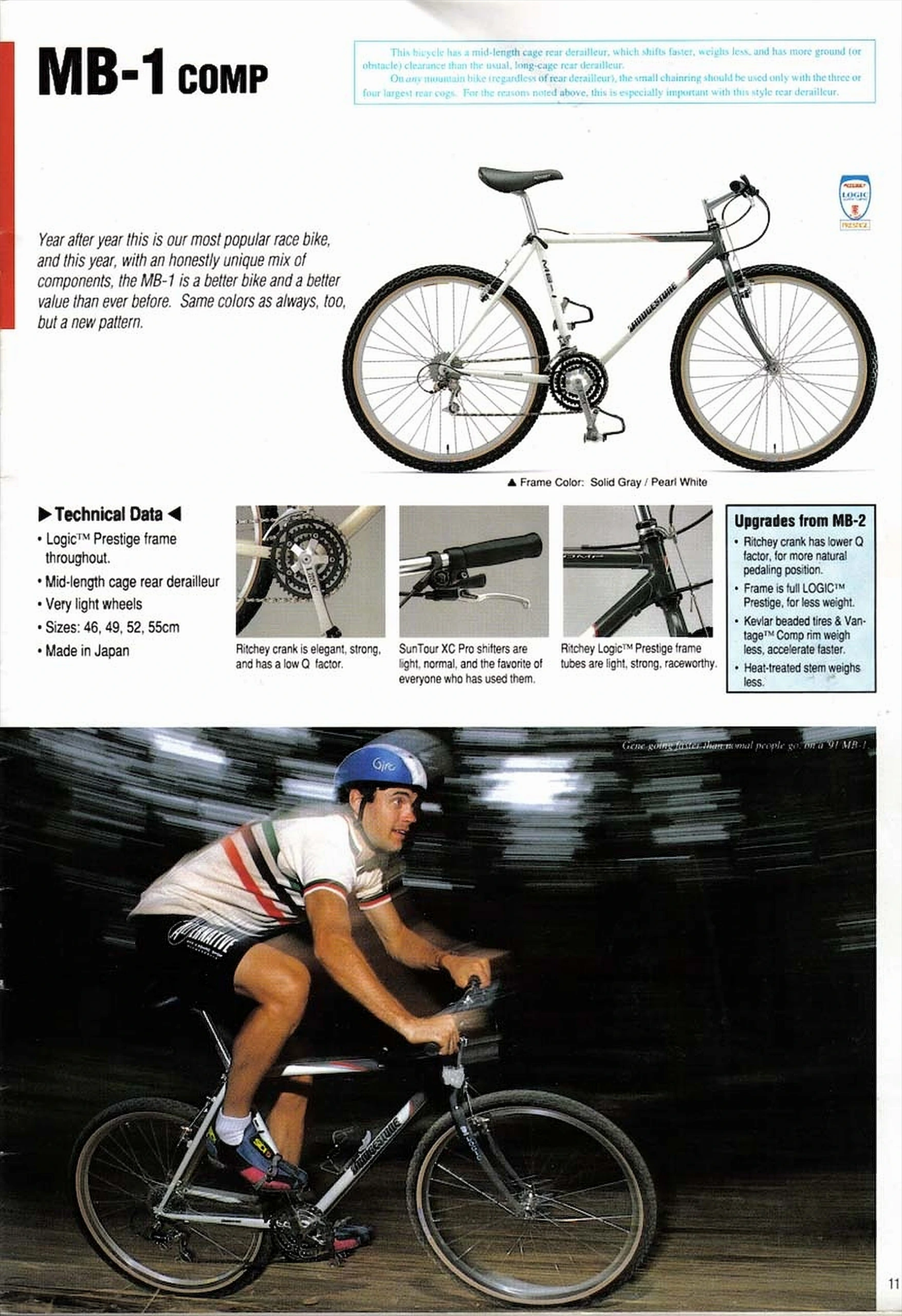
Year after year this is our most popular race bike, and this year, with an honestly unique mix of components, the MB-1 is a better bike and a better value than ever before. Same colors as always, too, but a new pattern.
Frame Color: Solid Gray / Pearl White
Technical Data
• Logic™ Prestige frame throughout.
• Mid-length cage rear derailleur
• Very light wheels
• Sizes: 46, 49, 52, 55cm
• Made in Japan
Ritchey crank is elegant, strong, and has a low Q factor.
SunTour XC Pro shifters are light, normal, and the favorite of everyone who has used them.
Ritchey Logic™ Prestige frame tubes are light, strong, raceworthy.
Upgrades from MB-2
• Ritchey crank has lower Q factor, for more natural pedaling position.
• Frame is full LOGIC™ Prestige, for less weight.
• Kevlar beaded tires & Vantage™ Comp rim weigh less, accelerate faster.
• Heat-treated stem weighs less.
Gene going faster than normal people go, on a ’91 MB-1
11
[The MB-1 Comp mountain bicycle in gray and white with a LOGIC PRESTIGE badge, a Technical Data list, three detail photographs with captions, a box of upgrades and a photograph of a rider in a blue helmet and an Italian-striped jersey on a mountain bike.]
— Page 12 —
MB-2 COMP
This bicycle has a short-cage rear derailleur, which shifts faster, weighs less, and has more ground (or obstacle) clearance than the usual, long-cage rear derailleur.
However, the small price you pay for the above advantages is that, with the chain on the inner chainwheel and the 3 smallest rear cogs, the shorter cage won’t take up sufficient slack: the chain rubs on the derailleur cage, and flops around excessively over bumps.
On any mountain bike (regardless of rear derailleur), the small chainring is should be used only with the three or four largest rear cogs. For the reasons noted above, this is especially important with this style rear derailleur.
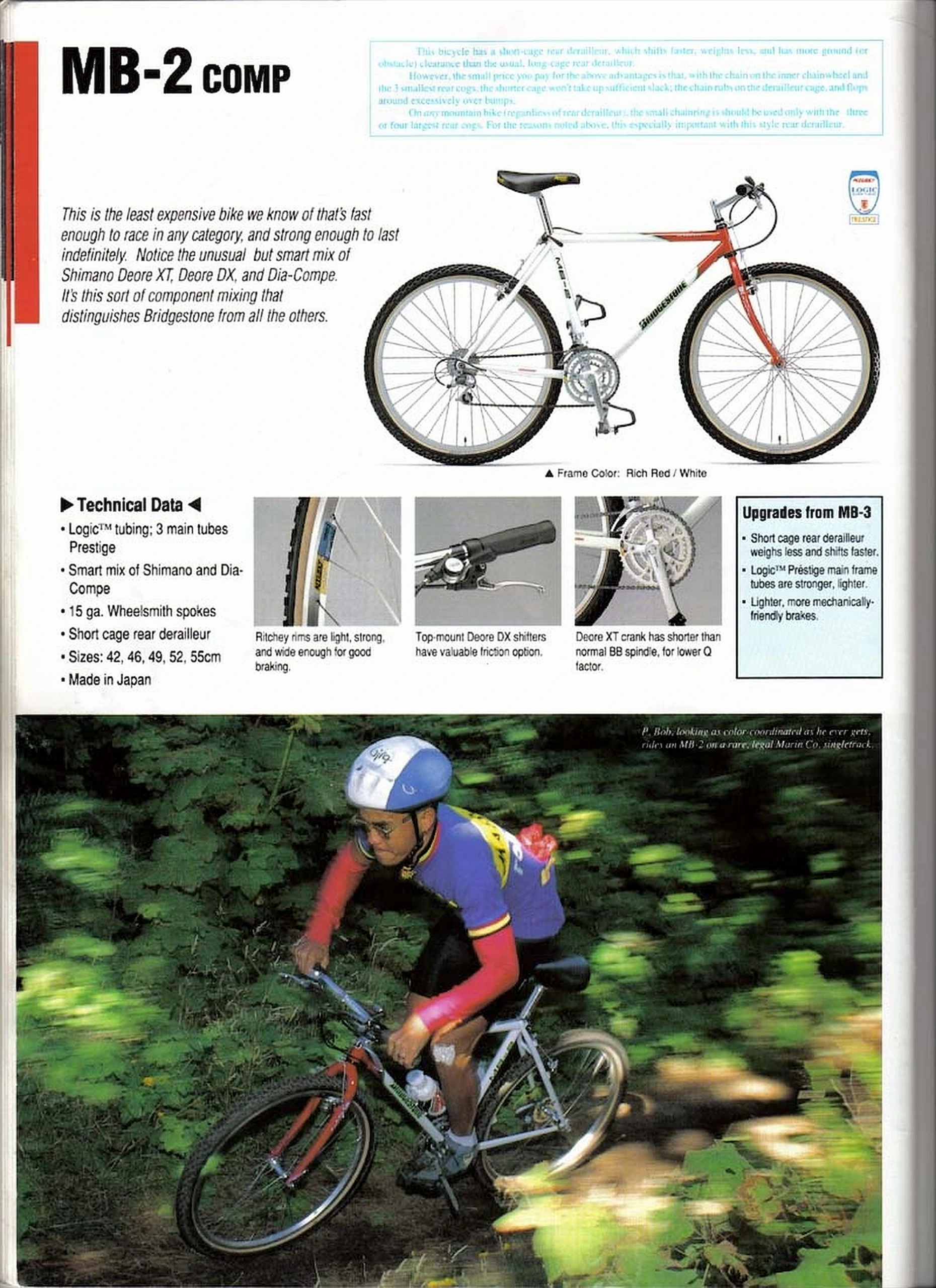
This is the least expensive bike we know of that’s fast enough to race in any category, and strong enough to last indefinitely. Notice the unusual but smart mix of Shimano Deore XT, Deore DX, and Dia-Compe. It’s this sort of component mixing that distinguishes Bridgestone from all the others.
Frame Color: Rich Red / White
Technical Data
• Logic™ tubing; 3 main tubes Prestige
• Smart mix of Shimano and Dia-Compe
• 15 ga. Wheelsmith spokes
• Short cage rear derailleur
• Sizes: 42, 46, 49, 52, 55cm
• Made in Japan
Ritchey rims are light, strong, and wide enough for good braking.
Top-mount Deore DX shifters have valuable friction option.
Deore XT crank has shorter than normal BB spindle, for lower Q factor.
Upgrades from MB-3
• Short cage rear derailleur weighs less and shifts faster.
• Logic™ Prestige main frame tubes are stronger, lighter.
• Lighter, more mechanically-friendly brakes.
P. Bob, looking as color-coordinated as he ever gets, rides an MB-2 on a rare, legal Marin Co. singletrack.
Giro (helmet name)
[The MB-2 Comp mountain bicycle in white and red with a LOGIC PRESTIGE badge, a Technical Data list, three detail photographs with captions, a box of upgrades and a photograph of a rider in a Giro helmet and a blue and red jersey on a wooded trail.]
— Page 13 —
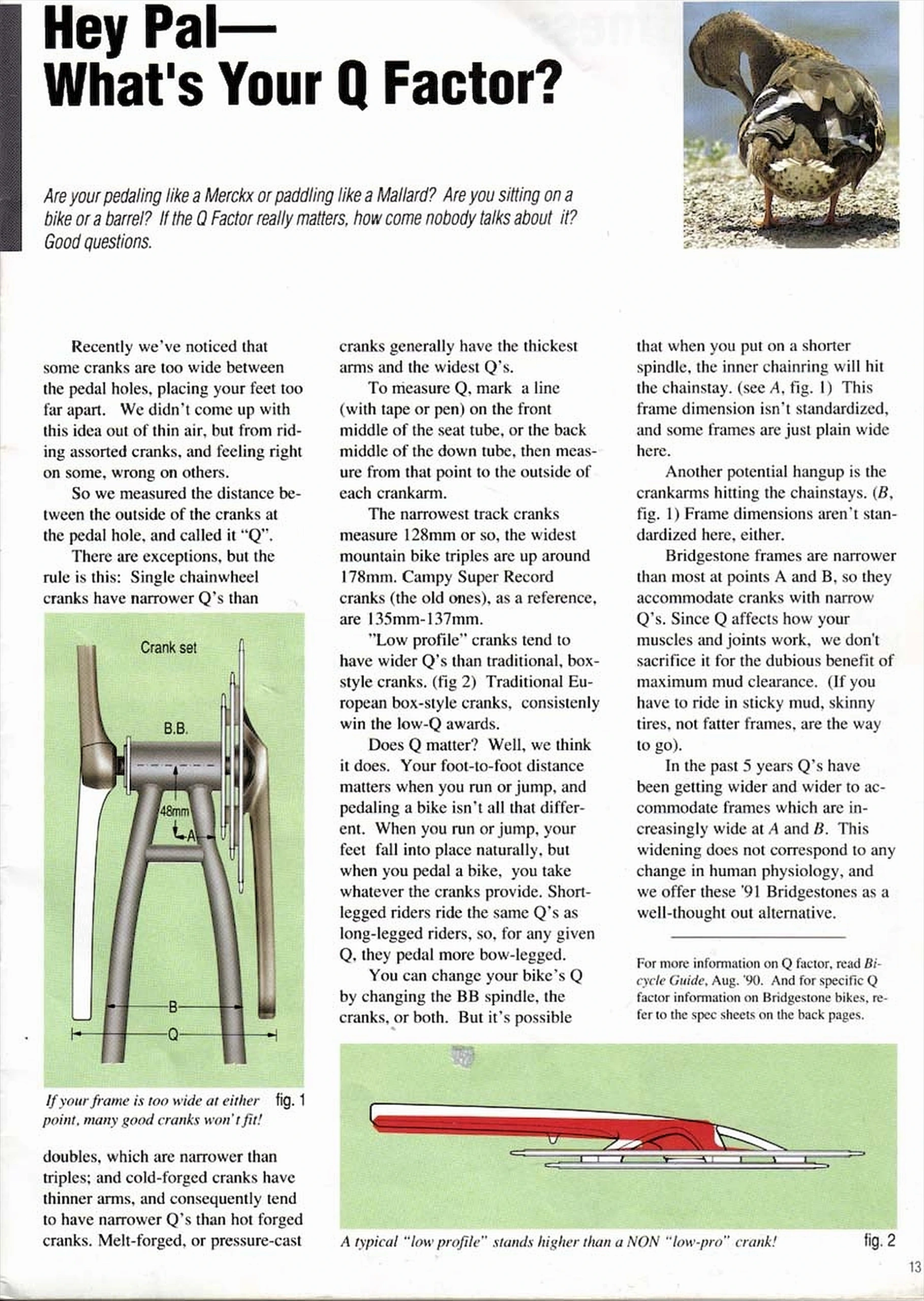
Hey Pal— What’s Your Q Factor?
Are your pedaling like a Merckx or paddling like a Mallard? Are you sitting on a bike or a barrel? If the Q Factor really matters, how come nobody talks about it? Good questions.
Recently we’ve noticed that some cranks are too wide between the pedal holes, placing your feet too far apart. We didn’t come up with this idea out of thin air, but from riding assorted cranks, and feeling right on some, wrong on others.
So we measured the distance between the outside of the cranks at the pedal hole, and called it “Q”.
There are exceptions, but the rule is this: Single chainwheel cranks have narrower Q’s than doubles, which are narrower than triples; and cold-forged cranks have thinner arms, and consequently tend to have narrower Q’s than hot forged cranks. Melt-forged, or pressure-cast cranks generally have the thickest arms and the widest Q’s.
To measure Q, mark a line (with tape or pen) on the front middle of the seat tube, or the back middle of the down tube, then measure from that point to the outside of each crankarm.
The narrowest track cranks measure 128mm or so, the widest mountain bike triples are up around 178mm. Campy Super Record cranks (the old ones), as a reference, are 135mm-137mm.
“Low profile” cranks tend to have wider Q’s than traditional, box-style cranks. (fig 2) Traditional European box-style cranks, consistently win the low-Q awards.
Does Q matter? Well, we think it does. Your foot-to-foot distance matters when you run or jump, and pedaling a bike isn’t all that different. When you run or jump, your feet fall into place naturally, but when you pedal a bike, you take whatever the cranks provide. Short-legged riders ride the same Q’s as long-legged riders, so, for any given Q, they pedal more bow-legged.
You can change your bike’s Q by changing the BB spindle, the cranks, or both. But it’s possible that when you put on a shorter spindle, the inner chainring will hit the chainstay. (see A, fig. 1) This frame dimension isn’t standardized, and some frames are just plain wide here.
Another potential hangup is the crankarms hitting the chainstays. (B, fig. 1) Frame dimensions aren’t standardized here, either.
Bridgestone frames are narrower than most at points A and B, so they accommodate cranks with narrow Q’s. Since Q affects how your muscles and joints work, we don’t sacrifice it for the dubious benefit of maximum mud clearance. (If you have to ride in sticky mud, skinny tires, not fatter frames, are the way to go).
In the past 5 years Q’s have been getting wider and wider to accommodate frames which are increasingly wide at A and B. This widening does not correspond to any change in human physiology, and we offer these ’91 Bridgestones as a well-thought out alternative.
For more information on Q factor, read Bicycle Guide, Aug. ’90. And for specific Q factor information on Bridgestone bikes, refer to the spec sheets on the back pages.
Crank set
B.B.
48mm
B
Q
If your frame is too wide at either point, many good cranks won’t fit! fig. 1
A typical “low profile” stands higher than a NON “low-pro” crank! fig. 2
13
[A page headed “Hey Pal—What’s Your Q Factor?” with a photograph of a mallard duck preening, a diagram of a crankset and bottom bracket with the dimensions B, Q and 48mm marked, and a second diagram of a low-profile crank.]
— Page 14 —
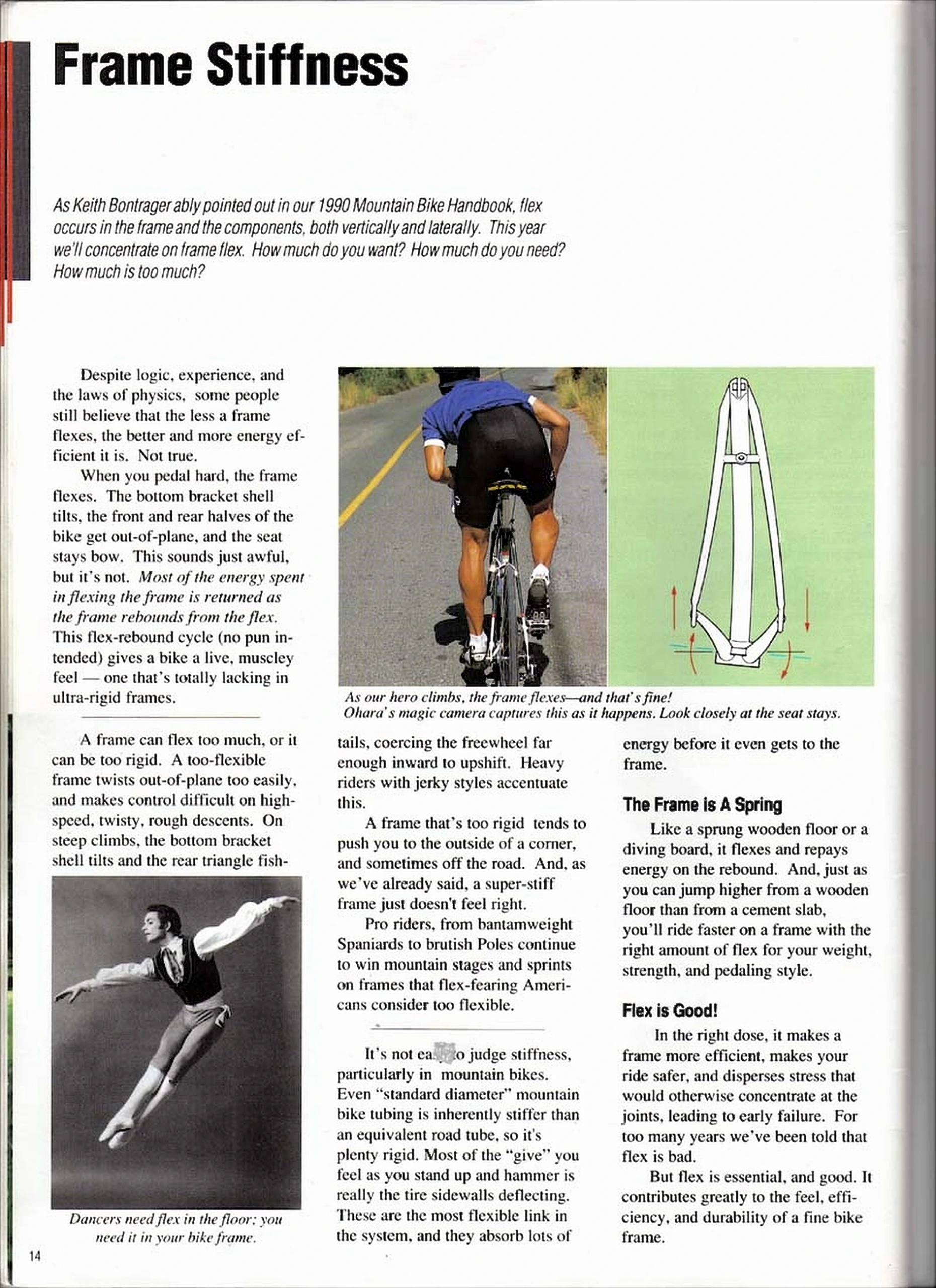
Frame Stiffness
As Keith Bontrager ably pointed out in our 1990 Mountain Bike Handbook, flex occurs in the frame and the components, both vertically and laterally. This year we’ll concentrate on frame flex. How much do you want? How much do you need? How much is too much?
Despite logic, experience, and the laws of physics, some people still believe that the less a frame flexes, the better and more energy efficient it is. Not true.
When you pedal hard, the frame flexes. The bottom bracket shell tilts, the front and rear halves of the bike get out-of-plane, and the seat stays bow. This sounds just awful, but it’s not. Most of the energy spent in flexing the frame is returned as the frame rebounds from the flex. This flex-rebound cycle (no pun intended) gives a bike a live, muscley feel — one that’s totally lacking in ultra-rigid frames.
A frame can flex too much, or it can be too rigid. A too-flexible frame twists out-of-plane too easily, and makes control difficult on high-speed, twisty, rough descents. On steep climbs, the bottom bracket shell tilts and the rear triangle fishtails, coercing the freewheel far enough inward to upshift. Heavy riders with jerky styles accentuate this.
A frame that’s too rigid tends to push you to the outside of a corner, and sometimes off the road. And, as we’ve already said, a super-stiff frame just doesn’t feel right.
Pro riders, from bantamweight Spaniards to brutish Poles continue to win mountain stages and sprints on frames that flex-fearing Americans consider too flexible.
It’s not easy to judge stiffness, particularly in mountain bikes. Even “standard diameter” mountain bike tubing is inherently stiffer than an equivalent road tube, so it’s plenty rigid. Most of the “give” you feel as you stand up and hammer is really the tire sidewalls deflecting. These are the most flexible link in the system, and they absorb lots of energy before it even gets to the frame.
The Frame is A Spring
Like a sprung wooden floor or a diving board, it flexes and repays energy on the rebound. And, just as you can jump higher from a wooden floor than from a cement slab, you’ll ride faster on a frame with the right amount of flex for your weight, strength, and pedaling style.
Flex is Good!
In the right dose, it makes a frame more efficient, makes your ride safer, and disperses stress that would otherwise concentrate at the joints, leading to early failure. For too many years we’ve been told that flex is bad.
But flex is essential, and good. It contributes greatly to the feel, efficiency, and durability of a fine bike frame.
As our hero climbs, the frame flexes—and that’s fine! Ohara’s magic camera captures this as it happens. Look closely at the seat stays.
Dancers need flex in the floor; you need it in your bike frame.
14
[A page headed “Frame Stiffness” with a photograph of a cyclist climbing seen from behind, a diagram of a frame flexing with arrows, and a photograph of a ballet dancer leaping.]
— Page 15 —
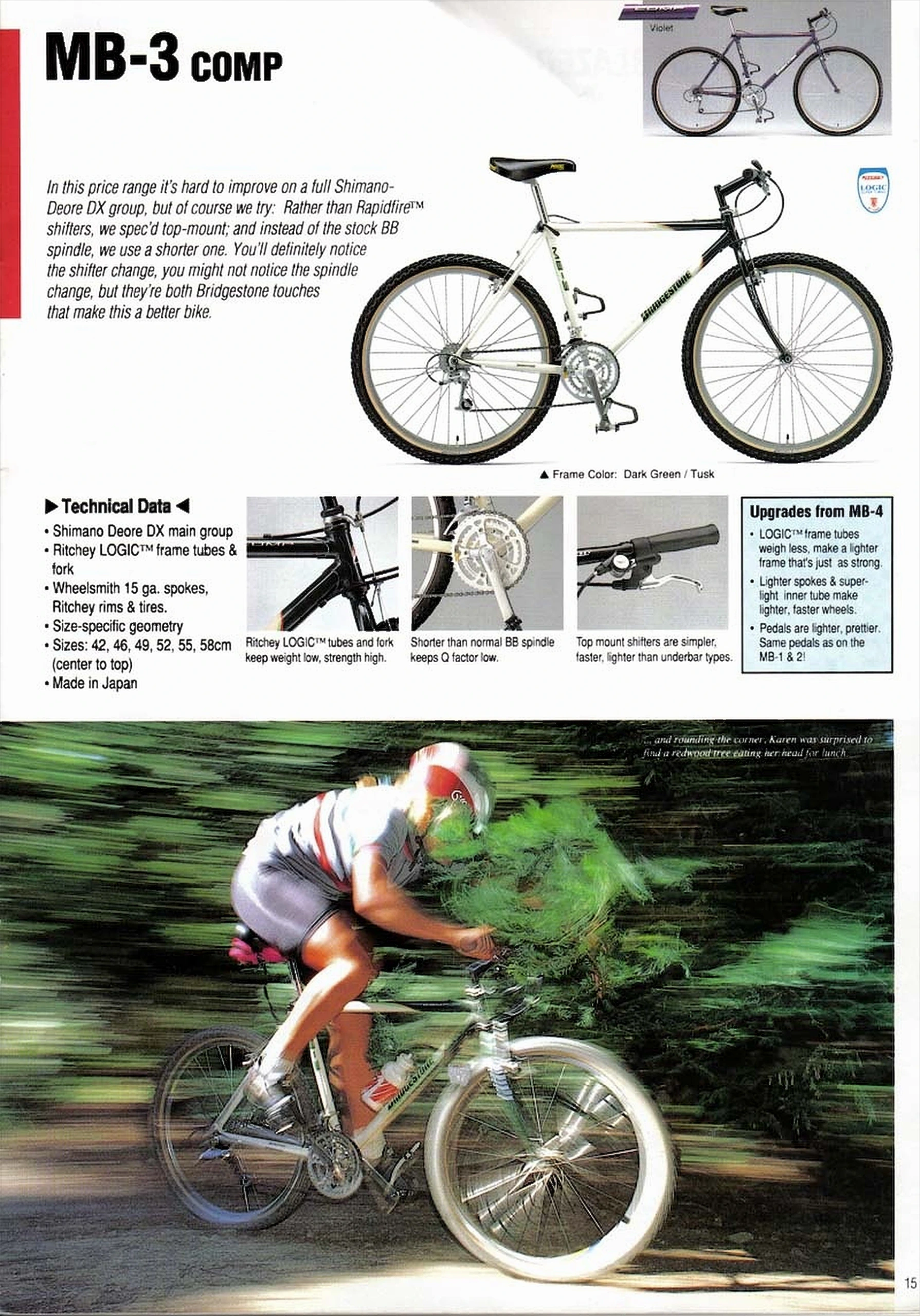
MB-3 COMP
In this price range it’s hard to improve on a full Shimano-Deore DX group, but of course we try: Rather than Rapidfire™ shifters, we spec’d top-mount; and instead of the stock BB spindle, we use a shorter one. You’ll definitely notice the shifter change, you might not notice the spindle change, but they’re both Bridgestone touches that make this a better bike.
Frame Color: Dark Green / Tusk
Violet (inset version)
Technical Data
• Shimano Deore DX main group
• Ritchey LOGIC™ frame tubes & fork
• Wheelsmith 15 ga. spokes, Ritchey rims & tires.
• Size-specific geometry
• Sizes: 42, 46, 49, 52, 55, 58cm (center to top)
• Made in Japan
Ritchey LOGIC™ tubes and fork keep weight low, strength high.
Shorter than normal BB spindle keeps Q factor low.
Top mount shifters are simpler, faster, lighter than underbar types.
Upgrades from MB-4
• LOGIC™ frame tubes weigh less, make a lighter frame that’s just as strong.
• Lighter spokes & super-light inner tube make lighter, faster wheels.
• Pedals are lighter, prettier. Same pedals as on MB-1 & 2!
…and rounding the corner, Karen was surprised to find a redwood tree eating her head for lunch.
15
[The MB-3 Comp mountain bicycle in white and dark green with a LOGIC badge, with an inset photograph of a violet version, a Technical Data list, three detail photographs, a box of upgrades and a photograph of a woman rider in a red and white helmet passing a tree.]
— Page 16 —
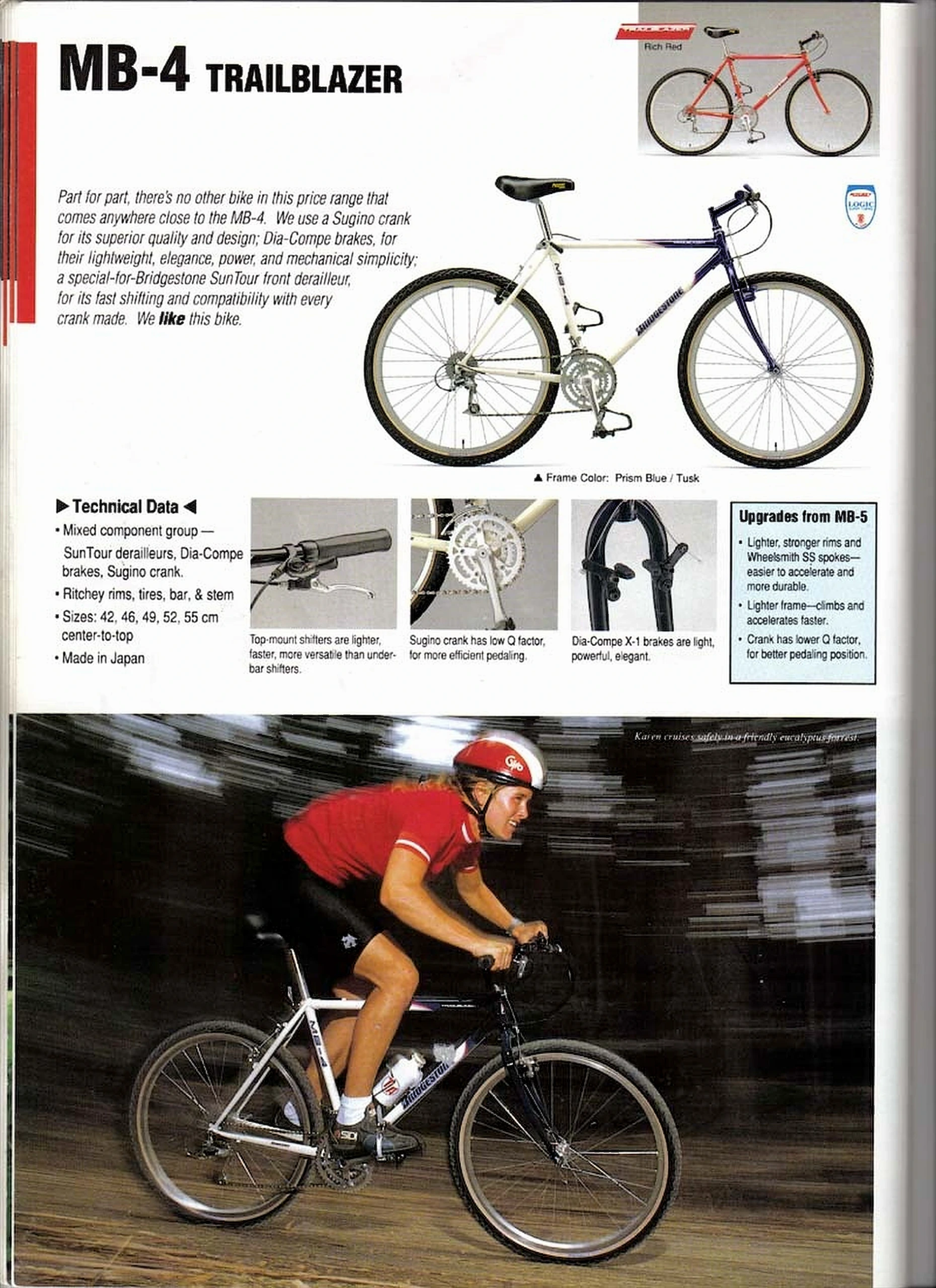
MB-4 TRAILBLAZER
Part for part, there’s no other bike in this price range that comes anywhere close to the MB-4. We use a Sugino crank for its superior quality and design; Dia-Compe brakes, for their lightweight, elegance, power, and mechanical simplicity; a special-for-Bridgestone SunTour front derailleur, for its fast shifting and compatibility with every crank made. We like this bike.
Frame Color: Prism Blue / Tusk
Rich Red (inset version)
Technical Data
• Mixed component group—SunTour derailleurs, Dia-Compe brakes, Sugino crank.
• Ritchey rims, tires, bar, & stem
• Sizes: 42, 46, 49, 52, 55 cm center-to-top
• Made in Japan
Top-mount shifters are lighter, faster, more versatile than underbar shifters.
Sugino crank has low Q factor, for more efficient pedaling.
Dia-Compe X-1 brakes are light, powerful, elegant.
Upgrades from MB-5
• Lighter, stronger rims and Wheelsmith SS spokes—easier to accelerate and more durable.
• Lighter frame—climbs and accelerates faster.
• Crank has lower Q factor, for better pedaling position.
Karen cruises safely in a friendly eucalyptus forest.
16
[The MB-4 Trailblazer mountain bicycle in white and blue with a LOGIC badge, with an inset photograph of a red version, a Technical Data list, three detail photographs, a box of upgrades and a photograph of a woman in a red jersey and Giro helmet riding in a forest.]
— Page 17 —
Bridgestone Colors
Plain, as usual…
The 1991 Bridgestone colors reflect our preference for bold, strong colors that don’t go out of style. We’ve resisted the trendy dayglows, fades, smokes and splatter paint jobs, because they’re trendy. They’re fine for cheap mall-shorts and back-to-school fashions, but they aren’t so fine on a $500 bike that you’re going to live with year after year.
The red, blue, greens, black, silver, white, and tusk are classic colors—which means they’ve been used on good bikes going back further than we can remember. We favor colors that occur naturally–in flowers, rivers, feathers, rocks, trees, elephants and bugs. The violet? This is our first year with violet, but we’ve wanted a good violet ever since we fell in love with a 1965 violet Schwinn Varsity. Remember that one? We tried to copy it. The color.
In last year’s Mountain Bike Handbook, we criticized gaudy colors for what we saw as their negative effect on non-cycling trail users. This angered some people, but we still feel the same way.
Dayglows are fine when visibility is important, or in town, where people are used to them.
On trail rides, more natural colors blend in better and just may offend fewer people. This year we’ve carried over last year’s ivory, and renamed it tusk. Ivory, as you know, is ornamental tusk, and not beautiful in any form. Tusk refers to the beautiful color as it is in its natural state on the elephant.
17
[A page headed “Bridgestone Colors” with photographs of a red flower, a mossy tree stump, a beetle on a hand, a violet flower, purple flowers, white flowers and an elephant’s head with its tusk.]
— Page 18 —
Mountain Bike Riding: The Minnesota Method
by Gene Oberpriller
Even though Gene Oberpriller doesn’t live in California or Colorado and has never been to Slickrock, he still knows how to ride a mountain bike. Or any bike, for that matter. A former BMX star, Gene rode a box-stock MB-2 to ten straight open category mountain bike wins in 1989. The same year, he was Minnesota state cyclocross champion. He’s ridden a 1:20 Kilo on an F-1 (remember them?), is a part-time bicycle messenger, and has won numerous road races, too. He’s as at home on two wheels as anyone we know…including Pineapple Bob.
(signature: Gene Oberpriller)
1. Climbing
Spin at 80 rpm’s up all but the steepest climbs. When it’s too steep for comfort, and your front wheel starts lifting, go into a standing crouch, for more power and to ground the front wheel.
For good traction, try to ride a high, smooth spot in the trail where the dirt has worn off down to a harder base.
His left arm crawling with poison oak, Gene still shows good form up the hill.
2. Descending
Keep your butt low and back, and your legs and arms flexed, ready to absorb shocks. Fly on straightaways, but take it easy on corners, because this is where you’ll most likely crash.
Exaggerate your position as the slope demands.
The author demonstrates his painful-but-effective Seat Post Implantation Technique (S.P.I.T.)—essential for extreme descents
3. Sprinting
Get your back low and flat, lean forward, and pull on the bars as you push on the pedals. Try to stay centered or slightly forward of the bottom bracket. Sprinting is basically a power action, so practice in a big gear on slightly uphill sections maybe 100 – 200 meters long.
But good form without fast legs won’t go too far…
4. Cornering
Approach wide, but cut it enough to allow for drift as you exit. Keep the inside crank up, do all your braking before the turn, and coast or pedal through it.
When you get really scared, put your inside foot down.
Gene loves his custom Bridgestone 100% Italian Superwash™ wool jersey…for all kinds of cornering.
18
[A page headed “Mountain Bike Riding: The Minnesota Method” with a portrait of Gene Oberpriller in a striped wool jersey and photographs of him climbing, descending, sprinting and cornering on a white mountain bicycle.]
— Page 19 —
Bicycles Meeting Basic Human Needs
ITDP
Institute for Transportation and Development Policy
“The Conscience of the Cycling World”
In the United States, bicycles are mostly for fun. But in many Third World Countries, few people can afford cars, and a bicycle can mean the difference between a family making it or failing economically; between a child getting health care or not; between a farmer getting advice on his crops, or seeing them ruined; and between a woman carrying 70 lbs. of firewood on her head for five miles, or hauling it on her bicycle with far less effort, and in a fraction of the time. Bicycles provide affordable mobility essential to basic human needs.
The Institute for Transportation and Development Policy (ITDP) provides bicycles for those who need them most, working in some of the harshest conditions imaginable. A bicycle provides mobility, which immediately translates to the freedom and efficiency needed to turn lives around. ITDP has donated more than 4,000 bicycles to overseas development projects.
These bicycles help workers in health, education, and development spend more time working and less time walking and waiting for buses that sometimes never come. And ITDP workshops train mechanics and lay the foundations for self-reliant bicycle industries in countries that now pay dearly for imported cars and petroleum.
ITDP works with the Peace Corps and other grass-roots development groups supplying overseas volunteers and projects with bicycles and training in basic mechanics. ITDP introduces mountain bikes to areas of the Third World with few roads and where such vehicles have vast potential for expanding mobility.
ITDP demonstrates that transportation development can be equitable, economical, and environmentally sustainable, and that ordinary people across America contribute support and resources to make such developments happen.
ITDP and its Bikes Not Bombs campaign work in Haiti, Africa, and Nicaragua. This is a cause to which we can all support, for the best reasons. In the past two years Bridgestone has donated more than $14,000 in parts and scores of bicycles. Most of the bicycles you see in these catalog photos will go to Bikes Not Bombs, as they did last year.
Bikes Not Bombs needs your old bikes and parts. From tires to complete bicycles, nothing is too small or too big—and certainly nothing is too good for a cause as worthy as saving human lives.
Join and get ITDP’s newsletter. Give $30 or more, and get a beautiful T-Shirt ($9.00 separately). Gift memberships are only $20. Anyone can donate.
BRIDGESTONE
Institute for Transportation and Development Policy
P.O. Box 56538, Washington DC 20011 (301) 589-1810
$15 Student/Low Income
$20 Gift Member
$30 Regular Member
$50 Contributing Member
$100 Supporting Member
$250 Sustaining Member
$500 Sponsoring Member
You can allot you membership dollars to ITDP projects. Other wise, they will be spent where most needed.
Bikes Not Bombs
Haitian Development Fund
Bikes For Africa
Transportation Alternatives Project
Please send more information on:
Bikes Not Bombs
Haitian Development Fund
Bikes For Africa
Transportation Alternatives Project
Name
Address
City
State, Zip
Phone
Join IDTP—Help Make a World That Can Last
19
[A page with a photograph of a smiling man in a bicycle workshop, two photographs of workers repairing bicycles, and a blue membership coupon for the Institute for Transportation and Development Policy.]
— Page 20 —
MB-5 TRAILBLAZER
This bike is in the most popular price range of all, so naturally it has a lot of competition. The MB-5 is special because it has the same geometry, fit, and ride as our most expensive bikes; and it has top-mount shifters; and it has a shorter BB spindle than other bikes with the same cranks. This lowers the Q factor, so you pedal more like an athlete, less like a duck.
Frame Color: Solid Black / Indian Silver
Medium Green (inset version)
Technical Data
• Butted CrMo frame, CrMo fork
• Size-specific geometry
• Bolt-style crank spindle holds cranks tight, deters loosening.
• Sizes: 42, 46, 49, 52, 55, 58cm—fits riders from about 5’2 to 6′ 3-1/2″.
Shimano 500LX crank has round alloy rings for smooth pedaling and minimal weight.
Shimano top-mount shifters are light, simple, faster than underbar shifters.
Ritchey rims are strong & light; Ritchey tires grip like the dickens.
Upgrades from MB-6
• Seat post is higher quality, lighter, and easier to adjust.
• Pedals have toe clips and straps—a huge help on bumpy rides.
• Wheels have Ritchey rims and Wheelsmith SS spokes—stronger and lighter and easier to accelerate.
His right leg gone awry, Bob still manages high speed on his MB-5.
20
[The MB-5 Trailblazer mountain bicycle in black and silver, with an inset photograph of a green version, a Technical Data list, three detail photographs, a box of upgrades and a photograph of a rider in a blue and yellow jersey on a green bicycle.]
— Page 21 —
The Price Of Bikes
If you haven’t bought a bike in 16 years, you’ll be shocked to discover that bike-store bikes—as opposed to those you buy at discount havens—start at around $300, and the price climbs fast when you start getting picky. A decent bike these days costs the same as a major car repair or a year’s membership in a gym, where you can wear a towel around your neck and watch yourself pedal a bike that doesn’t go anywhere.
These days nobody pays list price for cars, VCR’s, or cameras, so it’s shocking to find that reputable bike dealers won’t bargain with you. But they have excellent reasons:
1. Bikes have virtually the lowest profit margin of any retail product.
If your bike dealer worked on the same margins as other retail businesses, a $400 bike would cost you $525.85.
2. Dealer Prep costs are high.
A good shop spends an hour and a half assembling and fine-tuning your bicycle, at a realistic shop cost of $30 – $40 per hour. Cameras, on the other hand, come boxed, assembled, ready to fly.
3. Free tune-ups cost your dealer $20 – $50 each.
Not all dealers offer 30-day free tune-ups, but most do. The nightmare freebie is the filthy, abused bike that needs cleaning, a complete overhaul, and several small parts replaced. If your bike needs a tune-up before the time limit, take it in—but clean it first. Experienced mechanics get unhappy when they have to clean off a lot of crud… and you don’t want an unhappy mechanic working on your bike, do you?
4. Shipping costs are outrageous.
Your dealer may get free freight on orders of 20 or more bikes, but fill-in orders (which make up most of the mid and late-season deliveries) cost from $15 to $25 per bike. Next-day air shipments cost $50-$150.
If a deposit isn’t required, offer it.
5. “Complete, professional assembly” means nothing.
Some mechanics slap bikes together completely in 30 minutes, but to do a good bike justice, an experienced mechanic needs three times that, with no interruptions. Good assembly can quadruple the life of your bearings, and makes every ride easier and safer.
Shops that do excellent work like to talk about it, so don’t be afraid to ask.
Paying an extra $30 – $50 for a well-assembled and finely tuned bike is money well spent. This bike will work better, last longer, and save you at least that much in maintenance and repairs.
When you buy a bike, don’t ask for a free helmet or water bottle.
If your dealer is one of the rare few who does make a small profit on bikes, that one freebie can eat it all up.
Nightmare on Bike Street
A Bridgestone cartoon ©1990 San Lean Dro
(A four-panel cartoon. 1. “I’ve been doing a lot of research on bike prices, and…” “Uh-Huh!” 2. “I’d like to buy from you, but can you match prices with Blowout Bikes just down the street?” “How much lower are they?” “About $10” 3. “Maybe he’ll buy a helmet and some shoes here if I deal!” “Well, sure. Need some clothing?” “Maybe a helmet?” “Yes, but I’m getting those mail order… I would like to try some on, so I can order my correct size. By the way, since I’m buying the Big-Ticket item from you…” “(let’s see…)” “what a guy!” 4. “How’s about throwing in a water bottle and cage, and maybe a Power Bar for the road, and maybe some of those…” )
21
[A page headed “The Price Of Bikes” with five numbered points in three columns, a boxed note about free helmets and water bottles, and a four-panel comic strip titled “Nightmare on Bike Street”.]
— Page 22 —
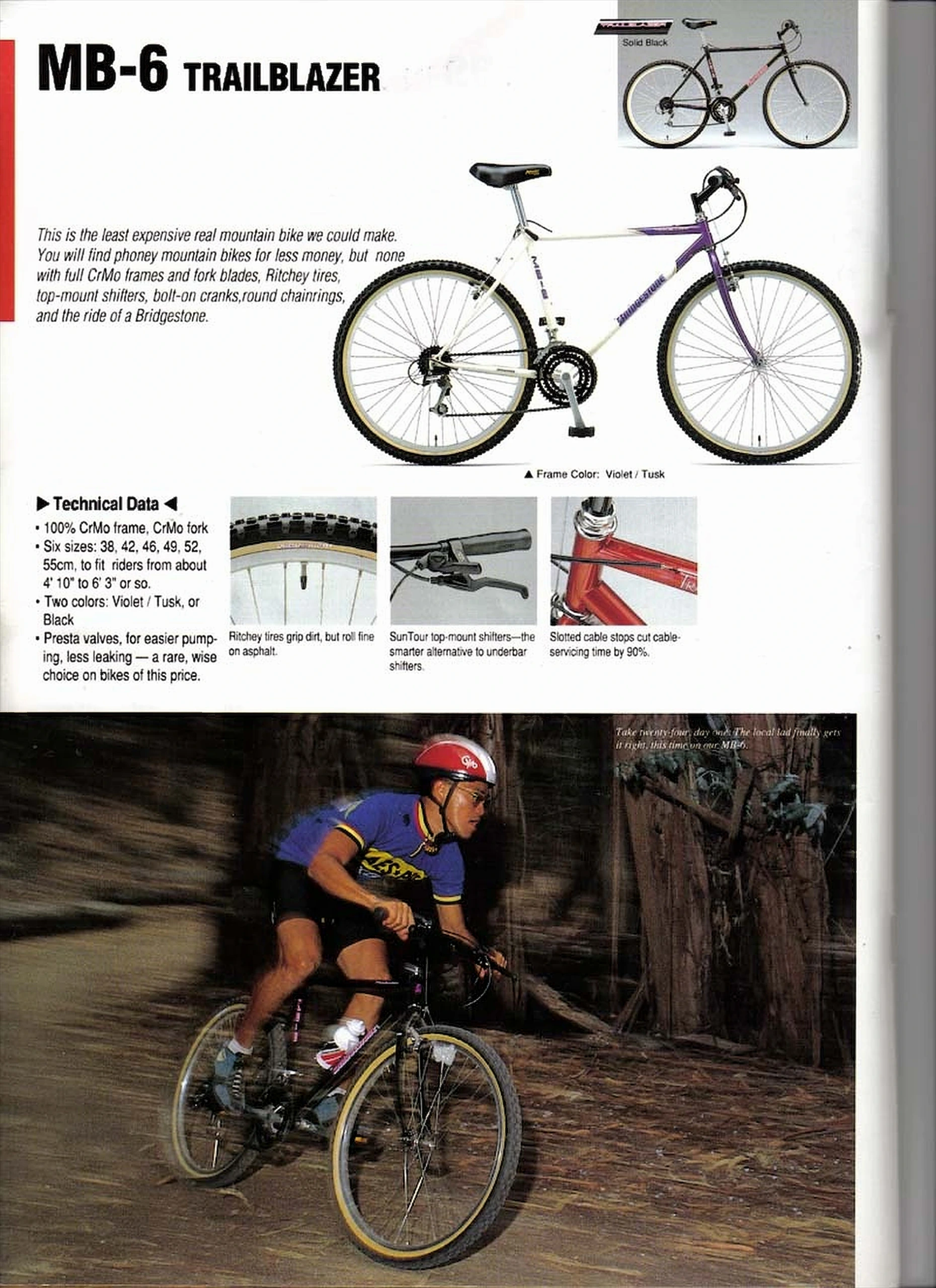
MB-6 TRAILBLAZER
This is the least expensive real mountain bike we could make. You will find phoney mountain bikes for less money, but none with full CrMo frames and fork blades, Ritchey tires, top-mount shifters, bolt-on cranks, round chainrings, and the ride of a Bridgestone.
Frame Color: Violet / Tusk
Solid Black (inset version)
Technical Data
• 100% CrMo frame, CrMo fork
• Six sizes: 38, 42, 46, 49, 52, 55cm, to fit riders from about 4′ 10″ to 6′ 3″ or so.
• Two colors: Violet / Tusk, or Black
• Presta valves, for easier pumping, less leaking—a rare, wise choice on bikes of this price.
Ritchey tires grip dirt, but roll fine on asphalt.
SunTour top-mount shifters—the smarter alternative to underbar shifters.
Slotted cable stops cut cable-servicing time by 90%.
Take twenty-four, day one. The local lad finally gets it right, this time on our MB-6.
22
[The MB-6 Trailblazer mountain bicycle in violet and white, with an inset photograph of a black version, a Technical Data list, three detail photographs and a photograph of a rider in a blue and yellow jersey cornering on a wooded trail.]
— Page 23 —
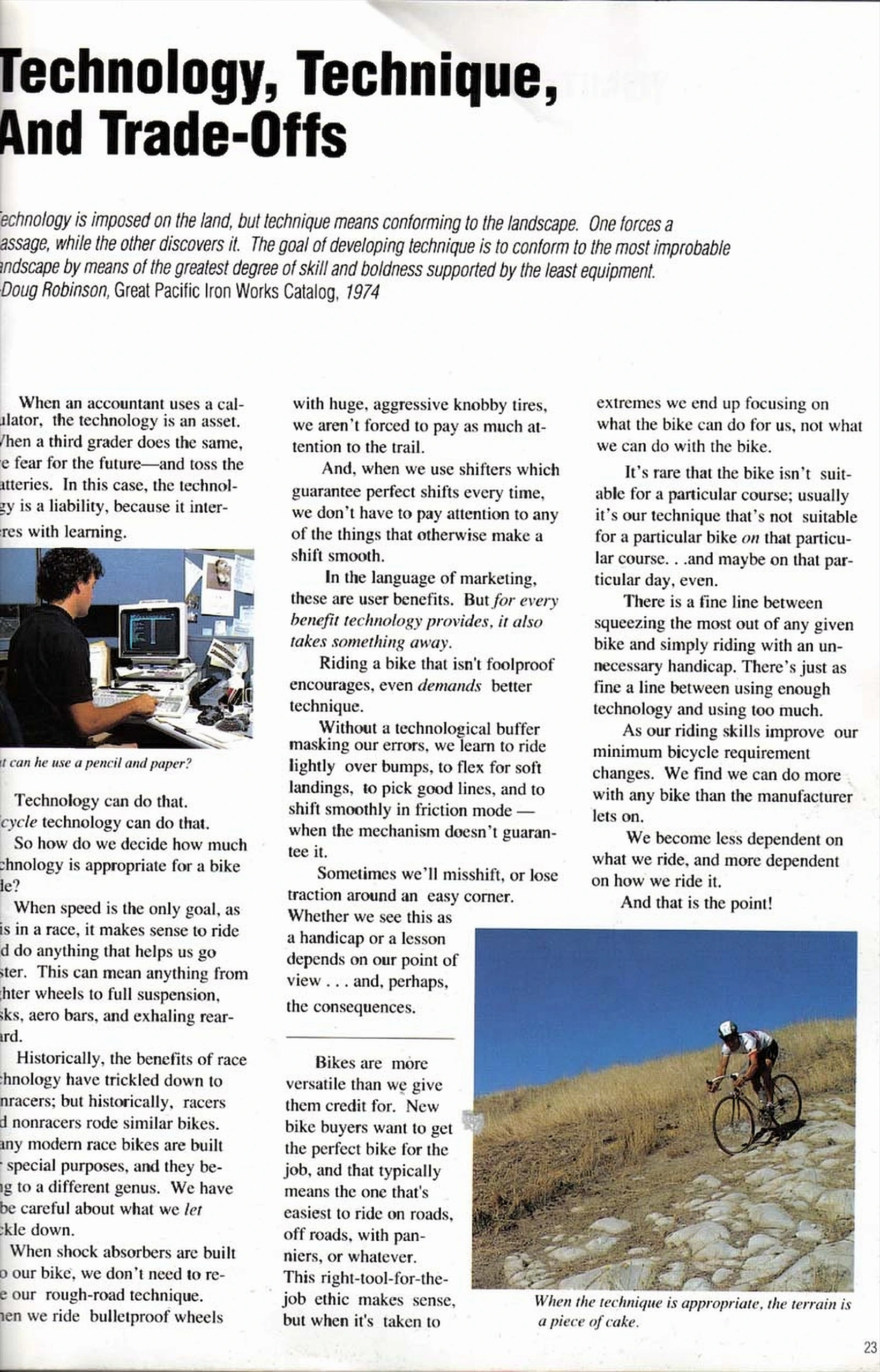
Technology, Technique, And Trade-Offs
Technology is imposed on the land, but technique means conforming to the landscape. One forces a passage, while the other discovers it. The goal of developing technique is to conform to the most improbable landscape by means of the greatest degree of skill and boldness supported by the least equipment.
—Doug Robinson, Great Pacific Iron Works Catalog, 1974
When an accountant uses a calculator, the technology is an asset. When a third grader does the same, we fear for the future—and toss the batteries. In this case, the technology is a liability, because it interferes with learning.
[Can he use a pencil and paper?]
Technology can do that. Bicycle technology can do that.
So how do we decide how much technology is appropriate for a bike?
When speed is the only goal, as is in a race, it makes sense to ride and do anything that helps us go faster. This can mean anything from lighter wheels to full suspension, disks, aero bars, and exhaling rearward.
Historically, the benefits of race technology have trickled down to nonracers; but historically, racers and nonracers rode similar bikes. Many modern race bikes are built for special purposes, and they belong to a different genus. We have to be careful about what we let trickle down.
When shock absorbers are built into our bike, we don’t need to refine our rough-road technique. When we ride bulletproof wheels with huge, aggressive knobby tires, we aren’t forced to pay as much attention to the trail.
And, when we use shifters which guarantee perfect shifts every time, we don’t have to pay attention to any of the things that otherwise make a shift smooth.
In the language of marketing, these are user benefits. But for every benefit technology provides, it also takes something away.
Riding a bike that isn’t foolproof encourages, even demands better technique.
Without a technological buffer masking our errors, we learn to ride lightly over bumps, to flex for soft landings, to pick good lines, and to shift smoothly in friction mode—when the mechanism doesn’t guarantee it.
Sometimes we’ll misshift, or lose traction around an easy corner. Whether we see this as a handicap or a lesson depends on our point of view…and, perhaps, the consequences.
Bikes are more versatile than we give them credit for. New bike buyers want to get the perfect bike for the job, and that typically means the one that’s easiest to ride on roads, off roads, with panniers, or whatever. This right-tool-for-the-job ethic makes sense, but when it’s taken to extremes we end up focusing on what the bike can do for us, not what we can do with the bike.
It’s rare that the bike isn’t suitable for a particular course; usually it’s our technique that’s not suitable for a particular bike on that particular day, even.
There is a fine line between squeezing the most out of any given bike and simply riding with an unnecessary handicap. There’s just as fine a line between using enough technology and using too much.
As our riding skills improve our minimum bicycle requirement changes. We find we can do more with any bike than the manufacturer lets on.
We become less dependent on what we ride, and more dependent on how we ride it.
And that is the point!
When the technique is appropriate, the terrain is a piece of cake.
23
[A page headed “Technology, Technique, And Trade-Offs” with a photograph of a man at a computer and a photograph of a rider descending a rocky hillside. The first letters of the left-hand lines are cut off at the edge of the scan; they are supplied here from the sense.]
— Page 24 —
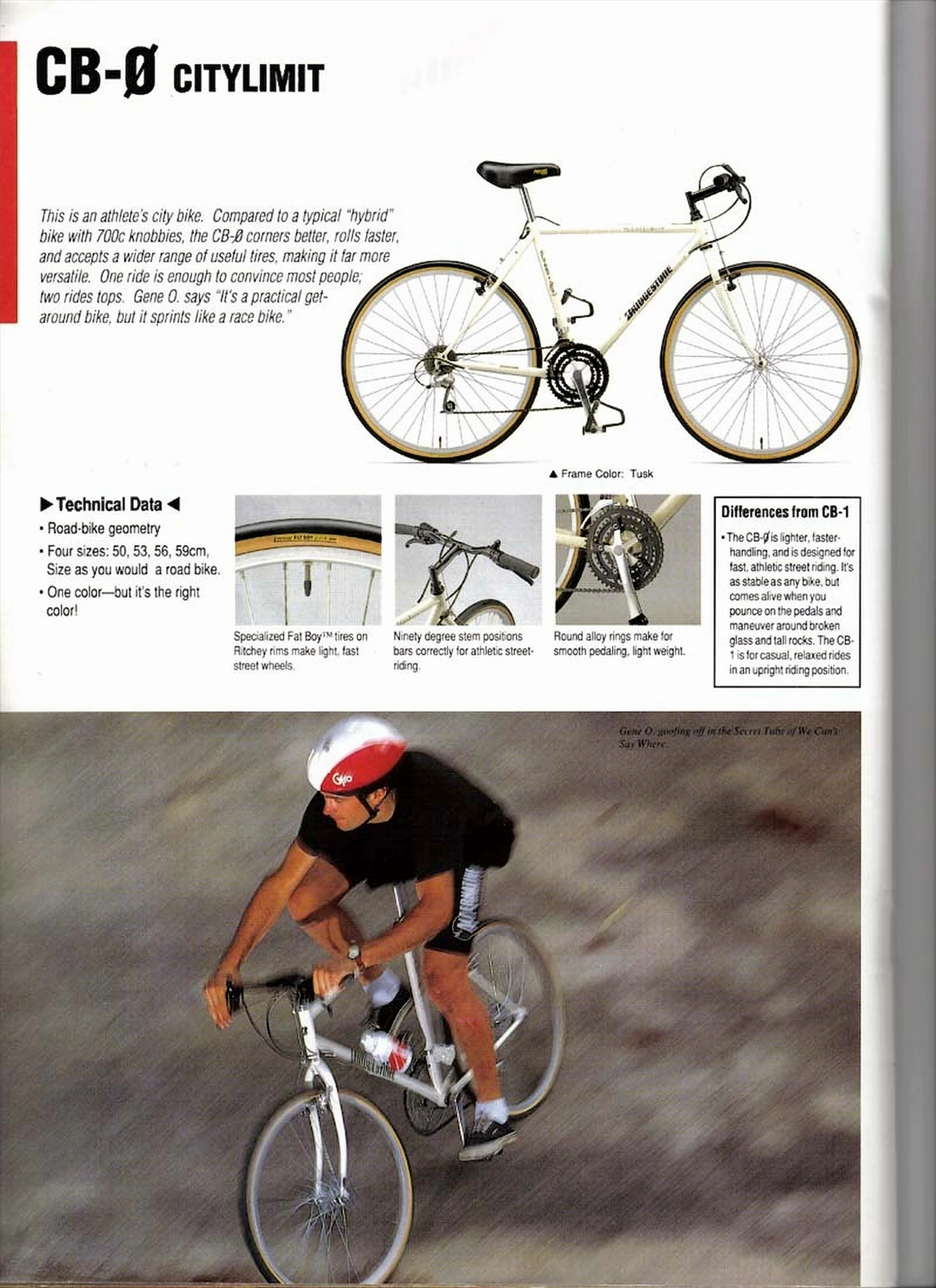
CB-Ø CITYLIMIT
This is an athlete’s city bike. Compared to a typical “hybrid” bike with 700c knobbies, the CB-Ø corners better, rolls faster, and accepts a wider range of useful tires, making it far more versatile. One ride is enough to convince most people; two rides tops. Gene O. says “It’s a practical get-around bike, but it sprints like a race bike.”
Frame Color: Tusk
Technical Data
• Road-bike geometry
• Four sizes: 50, 53, 56, 59cm. Size as you would a road bike.
• One color—but it’s the right color!
Specialized Fat Boy™ tires on Ritchey rims make light, fast street wheels.
Ninety degree stem positions bars correctly for athletic street-riding.
Round alloy rings make for smooth pedaling, light weight.
Differences from CB-1
• The CB-Ø is lighter, faster-handling, and is designed for fast, athletic street riding. It’s as stable as any bike, but comes alive when you pounce on the pedals and maneuver around broken glass and tall rocks. The CB-1 is for casual, relaxed rides in an upright riding position.
Gene O. goofing off in the Secret Tube of We Can’t Say Where.
[The CB-Ø Citylimit city bicycle in tusk white, a Technical Data list, three detail photographs, a box of differences from the CB-1 and a photograph of a rider in a black jersey and Giro helmet on a white bicycle.]
— Page 25 —
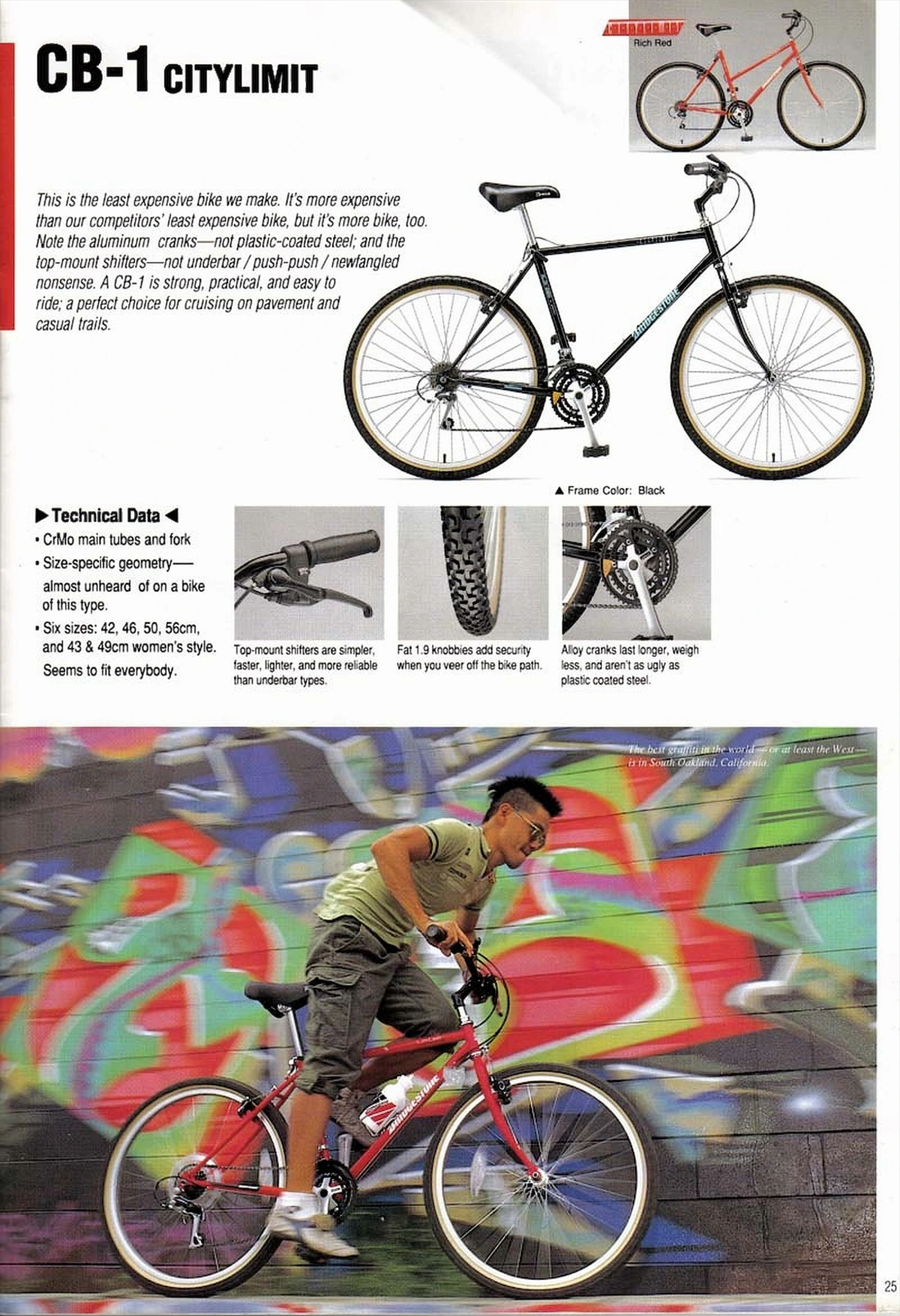
CB-1 CITYLIMIT
This is the least expensive bike we make. It’s more expensive than our competitors’ least expensive bike, but it’s more bike, too. Note the aluminum cranks—not plastic-coated steel; and the top-mount shifters—not underbar / push-push / newfangled nonsense. A CB-1 is strong, practical, and easy to ride; a perfect choice for cruising on pavement and casual trails.
Frame Color: Black
Rich Red (inset version)
Technical Data
• CrMo main tubes and fork
• Size-specific geometry—almost unheard of on a bike of this type.
• Six sizes: 42, 46, 50, 56cm, and 43 & 49cm women’s style. Seems to fit everybody.
Top-mount shifters are simpler, faster, lighter, and more reliable than underbar types.
Fat 1.9 knobbies add security when you veer off the bike path.
Alloy cranks last longer, weigh less, and aren’t as ugly as plastic coated steel.
The best graffiti in the world—or at least the West—is in South Oakland, California.
25
[The CB-1 Citylimit city bicycle in black, with an inset photograph of a red step-through version, a Technical Data list, three detail photographs and a photograph of a rider in an olive shirt on a red bicycle in front of a graffiti wall.]
— Page 26 —
Fast Cornering On Asphalt
by Michael King
Michael King has ridden a bike for 25 years, raced for 14, and won at least 50 Category 1 & 2 races—including Super Week, in 1985. He’s also crashed at least 50 times (presumably not in those same races). Here he shows and tells how to ride a hard left downhill corner at 38-1/2 mph.
(signature: Michael King)
1. Approach wide, and catch air with your chest.
Learn to gauge the speed you can handle going into a corner so that just sitting up and catching wind will slow you down enough to make the turn. I keep my brakes adjusted loosely, and my brake pads last forever. Stay on the outside of the turn as long as possible, at least until you can see your way through and past the corner.
Sometimes you’re forced to enter a turn on the inside. This gives you two options: You can either slow down, or you can drift outwards.
Riding in a pack depletes your options. If you’re on the inside, you have to slow down, and then you get spit out the back.
2. Straighten out the curves.
When you’re near the turn’s apex and you can see your exit zone, head straight for it. This shortens the turn and reduces the tendency to drift outside.
26
[A page headed “Fast Cornering On Asphalt” with a portrait of Michael King and two photographs of a cyclist descending a curving mountain road.]
— Page 27 —
3. Keep your butt back, your weight low.
When you get scared in a turn, it’s natural to rise off the saddle and creep forward, but don’t! Stay back and low for more traction and a more stable center of gravity.
Mike stays low and rearward throughout the turn.
4. Look with your eyes, point with your knee, steer with your hips.
Don’t look down at the ground in front of you—keep your head up and look where you want to be. To turn right, lean the bike a little, and shift your hips to the direction you want to go. Your hips are your center of gravity on a bike, and you can and should use them to turn the bike. Try it sometime in an empty parking lot. Ride no-hands and turn by shifting your weight from side to side.
Dip your knee into flat and slightly downhill turns. On severe and extreme high speed turns, keep it close to the top tube. This counterbalances the bike, and is more aero.
5. Relax your brain, relax your body.
Breathe deeply before a turn, and keep a firm, but not tense, grip on the bars. Stay loose at your joints, to absorb shocks.
Cornering and descending should be fun. Picture yourself sweeping through turns at the front of a group; play follow the leader on a short course with friends. Take turns leading and try to ride your mates off your wheel by picking the fastest line.
the wrong way…
…and the right way.
27
[A page of photographs of Michael King cornering on a road bicycle and of his hands on the bars, with the last three numbered points of the article.]
— Page 28 —
RD 2100 RADAC
“RD” is short for RADAC—the name we’ve given to this, our sole aluminum framed bicycle. Aluminum’s advantage over steel is its light weight, and consequently this is our lightest bike. The RADAC frame is light even by aluminum standards, and we’ve never had a frame joint fail…even after years of off-road use.
Frame Color: Silver Anodized
Technical Data
• 5056 H34 aluminium, with investment cast lugs and forged dropouts
• All main tubes 28.6mm, for good stiffness and flex
• Unique Bridgestone-developed glue holds it all together forever
• Extremely light—a mid-sized frame is barely 4 lbs., and the fork is around 19 oz
Ritchey stem is 35% lighter than a standard aluminum stem, and has more range of adjustment.
Campagnolo Omega rims, and Bridgestone’s super-clincher tires are good enough to race.
Ultegra derailleurs are totally fool-proof, and rather pretty…the pizza-cutter style cage notwithstanding.
Features
• Bridgestone-designed and built from 5056 H34 aluminum
• Shimano Ultegra parts
• Superlight Ritchey-designed stem
Karen in her actual race clothing.
28
[The RD 2100 RADAC aluminum road bicycle in silver, a Technical Data list, three detail photographs, a box of features and a photograph of a woman racer in a yellow and green jersey and a blue helmet on a silver bicycle.]
— Page 29 —
Ride Like An Aerow
By John Cobb
John Cobb is a bike shop owner in Shreveport, Louisiana, and calls himself the world’s biggest tech freak. We believe him. Between sessions in a $300 per hour wind tunnel, he manages to pedal 6-8,000 miles per year (probably on one of them funny bikes). His next fascination is the mysterious butt muscle-brain connection.
Watch this guy…
(signature: J. Cobb)
The keys to being more aerodynamic are being narrow, keeping your back flat, and having a good biomechanical form.
At speeds above 15 mph, it’s wind resistance that slows us down. Not wimpy thighs, not rolling resistance, not even a lousy breakfast. Wind resistance.
Short riders have an advantage because they’re naturally more aerodynamic. Riders 5’1″ and under won’t gain as much from aero-form as six-footers, but it all helps…especially in races against other short riders.
Here are my suggestions for getting aero. I learned them in a wind tunnel, so trust me.
Shave your head…
or wear a helmet, and the goatee’s got to go. Hair catches air and slows you down. It’s been said that Fignon lost the ’89 Tour de France by a ponytail, and there’s some truth in that.
AeroMan Mike
Keep your knees near the top tube.
Some cranks spread your feet far apart, but most quality cranks keep them pretty close.
Tuck in your elbows.
Let them fall where they will on climbs, but when you’re trying to cut the wind, keep them in.
Mike keeps his arms tucked in.
Wear clothes that don’t flap!
Snug-fitting clothes not only show off your bod—they also cut through the wind. This shouldn’t surprise you—when was the last time you saw a rider in Levi’s and a Member’s Only jacket pass a cyclist in a skinsuit? It’s been at least a month, I bet.
Keep your back flat.
Do this by rotating your pelvis forward. Ask your friends to check your form, and check it out yourself when you ride by that bakery window.
Good aerodynamic form can cut as much as 7 minutes from your 25-mile time trial, but there are more benefits than speed alone. Good form is also more comfortable, and you can appreciate the benefits of this even on a 10-hour century ride. Maybe especially on a 10-hour century.
Once your form is perfected and you still want to go faster, look to your bike. Aero cable routing may confound bike mechanics, but non-aero routed cables catch as much wind as a big rear view mirror. (I’m not attacking rear view mirrors,…am I?) Handlebar packs catch lots, too. It’s best to carry large loads behind you, where they can draft your large butt.
Ride the drops.
Although the forearms-parallel position might seem more aero (with any given back profile), it doesn’t work like that. Down on the drops, your forearms draft the handlebars, and my $300/hour wind tunnel tells me this is faster.
Finally,…
although the editor didn’t want me to mention this, I can’t resist: Those funny handlebars and seat posts that triathletes popularized and road riders scoff at? They help a lot. (Ed. note: But they should be supplements, not substitutes!)
FlatBack Mike
29
[A page headed “Ride Like An Aerow” with a portrait of John Cobb and photographs of riders in aerodynamic positions.]
— Page 30 —
RB-1 SYNERGY
As of this date (7/30/90) racers riding the RB-1 frame have won more than 35 category 1/2 races, including the Illinois and Georgia State Championships. The Turing race team alone has accounted for 25 wins, and former 7-11’er Jeff Bradley and his teammate Gail Viola, both now riding for On Two Wheels, have added 9 more. We won’t stoop to crediting the bike for these victories; we just want to point out that the RB-1 won’t hold you back. (And that’s the best that can be said of any bike). Besides that, the RB-1 is the personal frame of several cycling journalists and celebs, and is our personal everyday race / train / commute / and trail bike. This bike is all the reason we need for steering clear of budget exotics.
Frame Color: Dark Green / Tusk
Rich Red (inset version)
Technical Data
• Ishiwata’s best 022E frame tubing with taper-gauge 019E fork blades
• Sizes: 50, 53, 56, 59, 62cm
• Size-specific geometry
• Investment cast fork crown
• Clearance for fat clincher tires, for Winter training or off-road riding
• Avocet 28C slicks outride hard, skinny clinchers on road, and do fine on trails
Eighty degree Ritchey stem has more range of height than standard stem, weighs 25% less, and won’t ever creak.
Sugino crank has low Q-factor, and elegant design.
Shimano Ultegra derailleurs work as well as any in the world.
Upgrades from RB-2
• Lighter frame and fork. Slighter higher grade tubing and fork crown.
• Lighter, stronger stem, with greater range of adjustment.
• Higher quality crank with lower Q Factor, for better pedaling.
• Better spokes—Wheelsmith SS. Lighter, for lighter, faster wheels.
Pineapple Karen on her favorite bike, and on her 6th hour of riding that day. Nice hat, Karen.
30
[The RB-1 Synergy steel road bicycle in dark green and white, with an inset photograph of a red version, a Technical Data list, three detail photographs, a box of upgrades, a photograph of a woman rider in a green cap and a photograph of a team on a podium with trophies.]
— Page 31 —
RB-2 SYNERGY
Last year we didn’t have a low-priced, double-chainwheel road bike, and we caught all kinds of flack for it. So this year we resurrected the ’89 RB-2, and spiffed it up with lots of new parts. This has a full CrMo frame and fork, and the same famous ride and fit as the RB-1.
The RB-2 is that rare “entry-level race bike” that truly is good enough to race, and it’s a good choice for anyone on a budget who doesn’t want a bike that reminds them of it.
Frame Color: Prism Blue / Tusk
Indian Silver (inset version)
Technical Data
• Same size-specific geometry and ride as RB-1. 50, 53, 56, 59, 62cm
• Same tires, too—Avocet 28c slicks
• 100% butted CrMo frame and fork are light, strong, totally raceworthy
• Alloy track-style pedals are classic designs that work great and look good
• Head tube and fork crown race dimensions are European std. for easy replacements
Shimano 400EX derailleurs shift fast and have friction option.
Dia-Compe sidepulls have preferred single-pivot design, and are cold-forged, for strength.
Avocet 28C clinchers corner better than 25C, and protect the rim and inner tube from damage.
P. B. trying his best to look like an early ’70’s Europro. We think his form is even better.
31
[The RB-2 Synergy road bicycle in black and white, with an inset photograph of a silver version, a Technical Data list, three detail photographs and a photograph of a rider in a Mavic cap and a blue and red jersey on a road bicycle beside the sea.]
— Page 32 —
RB-T SYNERGY
This is our most versatile bike. If you don’t race either on the road or the dirt, and you don’t have a good bike yet, and you can only get one, and the hills in your area demand low gears… this is your bike.
Notice the Avocet 32C slicks—we’ve ridden these for more than a year, on everything from smooth asphalt to loose, rocky trails, and we love them.
In the cow photo, the bike has a nomal road stem. Actually, it comes with a 90 degree stem, for a slightly higher handlebar position.
Frame Color: Black
Technical Data
• Road bike geometry, with slightly longer chainstays for heel clearance with panniers
• Standard road gauge tubing keeps frame light, and feels right with or without a heavy load
• Sizes: 50, 53, 56, 62cm.
• Black only
• Made in Japan
Ninety degree stem holds bars high-better for touring or off-road rides.
SunTour bar-end shifters are convenient, fast, and very expensive.
Avocet 32C slicks corner like crazy, add comfort, and work surprisingly well off-road, even. Wheelsmith SS spokes are strong, attractive, and won’t seize up. Nipple size is European std.
Pineapple Bob simultaneously satisfying his hunger and showing off to his bovine fans. Don’t you try this.
[The RB-T Synergy touring bicycle in black, a Technical Data list, three detail photographs and a photograph of a rider eating while riding past a field of cows.]
— Page 33 —
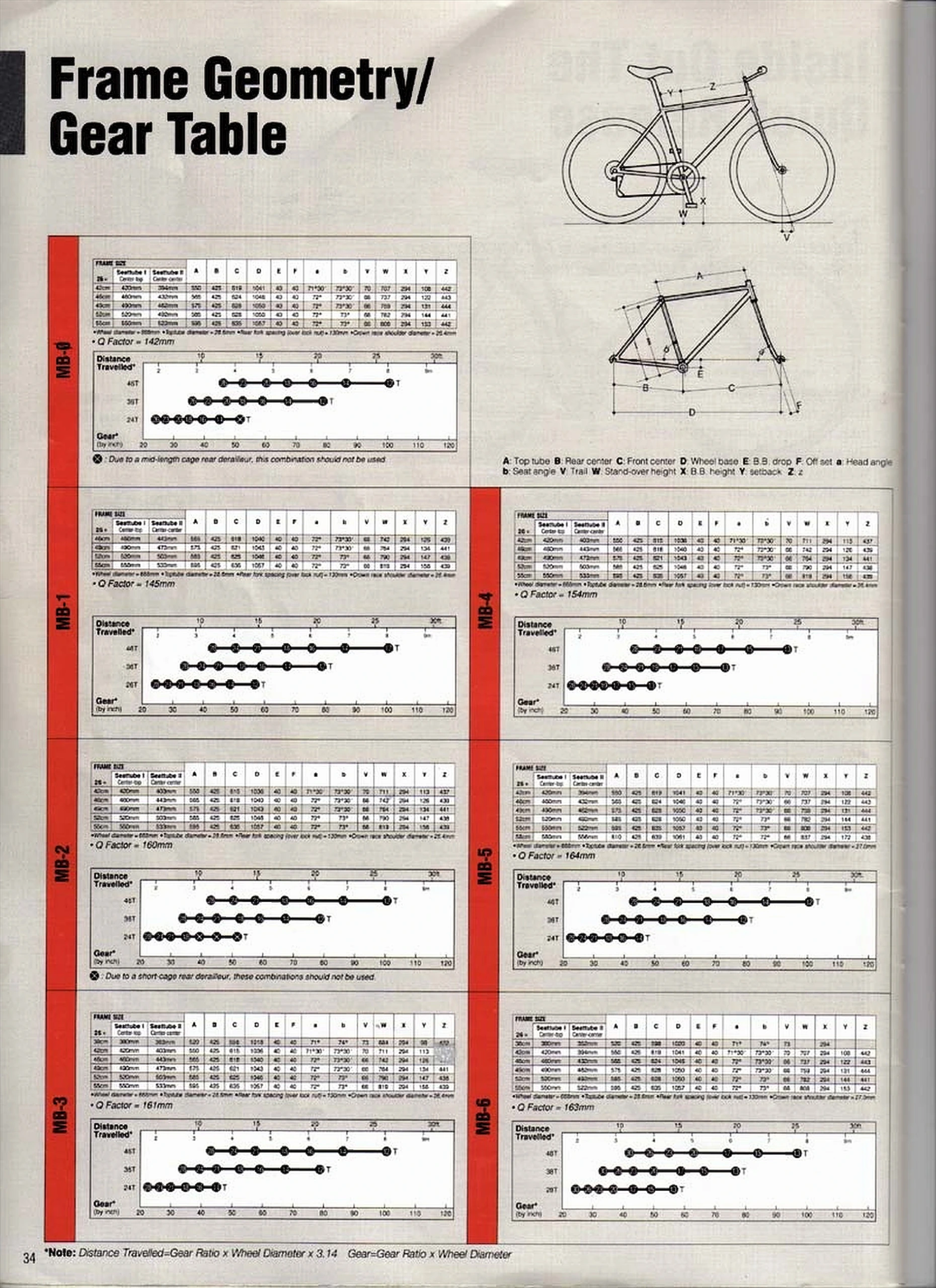
Frame Geometry/Gear Table
A: Top tube. B: Rear center. C: Front center. D: Wheel base. E: B.B. drop. F: Off set. a: Head angle. b: Seat angle. V: Trail. W: Stand-over height. X: B.B. height. Y: Setback. Z: z
Models on this page, with their frame sizes: MB-Ø (26″: 42, 46, 49, 52, 55cm; Q factor 142mm), MB-1 (46, 49, 52, 55cm; Q factor 145mm), MB-2 (42, 46, 49, 52, 55cm; Q factor 160mm), MB-3 (38, 42, 46, 49, 52, 55cm; Q factor 161mm), MB-4 (42, 46, 49, 52, 55cm; Q factor 154mm), MB-5 (42, 46, 49, 52, 55, 58cm; Q factor 164mm), MB-6 (38, 42, 46, 49, 52, 55cm; Q factor 163mm). Each model carries a Distance Travelled and Gear chart (chainrings 46T, 36T and 24T). On the MB-Ø and the MB-2 a mark flags gear combinations that should not be used because of the mid-length or short-cage rear derailleur.
*Note: Distance Travelled=Gear Ratio × Wheel Diameter × 3.14. Gear=Gear Ratio × Wheel Diameter
Under each table: wheel diameter 666mm, toptube diameter 28.6mm, rear fork spacing (over lock nut) 130mm, crown race shoulder diameter 25.4mm (or 27.0mm).
34
[The individual dimension cells of the tables, set very small, are not transcribed: they cannot be read reliably at the size of the host’s scan. Read them from the page image.]
— Page 34 —
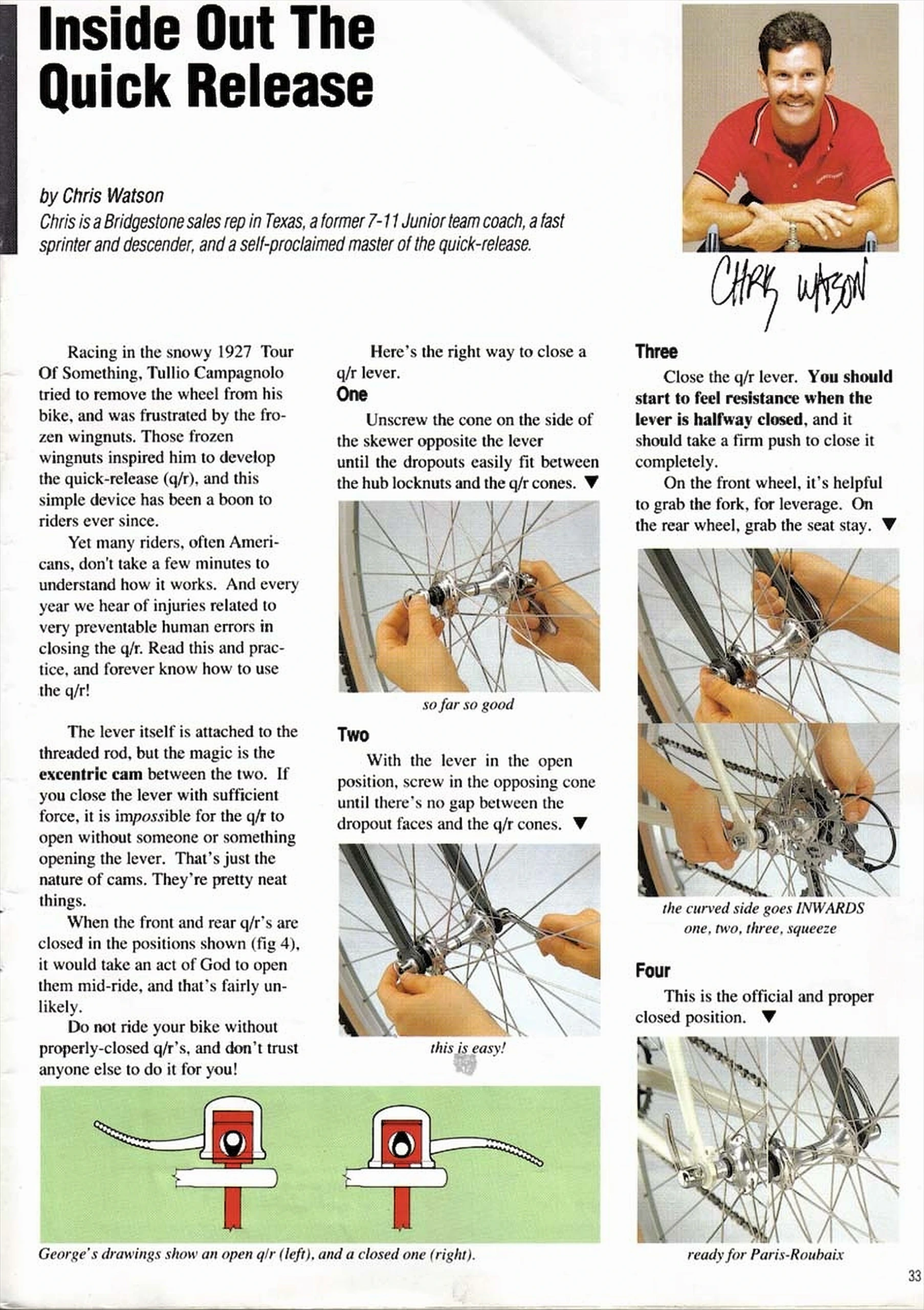
Inside Out The Quick Release
by Chris Watson
Chris is a Bridgestone sales rep in Texas, a former 7-11 Junior team coach, a fast sprinter and descender, and a self-proclaimed master of the quick-release.
(signature: Chris Watson)
Racing in the snowy 1927 Tour Of Something, Tullio Campagnolo tried to remove the wheel from his bike, and was frustrated by the frozen wingnuts. Those frozen wingnuts inspired him to develop the quick-release (q/r), and this simple device has been a boon to riders ever since.
Yet many riders, often Americans, don’t take a few minutes to understand how it works. And every year we hear of injuries related to very preventable human errors in closing the q/r. Read this and practice, and forever know how to use the q/r!
The lever itself is attached to the threaded rod, but the magic is the excentric cam between the two. If you close the lever with sufficient force, it is impossible for the q/r to open without someone or something opening the lever. That’s just the nature of cams. They’re pretty neat things.
When the front and rear q/r’s are closed in the positions shown (fig 4), it would take an act of God to open them mid-ride, and that’s fairly unlikely.
Do not ride your bike without properly-closed q/r’s, and don’t trust anyone else to do it for you!
Here’s the right way to close a q/r lever.
One
Unscrew the cone on the side of the skewer opposite the lever until the dropouts easily fit between the hub locknuts and the q/r cones.
so far so good
Two
With the lever in the open position, screw in the opposing cone until there’s no gap between the dropout faces and the q/r cones.
this is easy!
Three
Close the q/r lever. You should start to feel resistance when the lever is halfway closed, and it should take a firm push to close it completely.
On the front wheel, it’s helpful to grab the fork, for leverage. On the rear wheel, grab the seat stay.
the curved side goes INWARDS
one, two, three, squeeze
Four
This is the official and proper closed position.
ready for Paris-Roubaix
George’s drawings show an open q/r (left), and a closed one (right).
33
[A page headed “Inside Out The Quick Release” with a portrait of Chris Watson, photographs of hands closing a quick release on a front wheel and a rear wheel, and two line drawings of an open and a closed quick-release lever.]
— Page 35 —
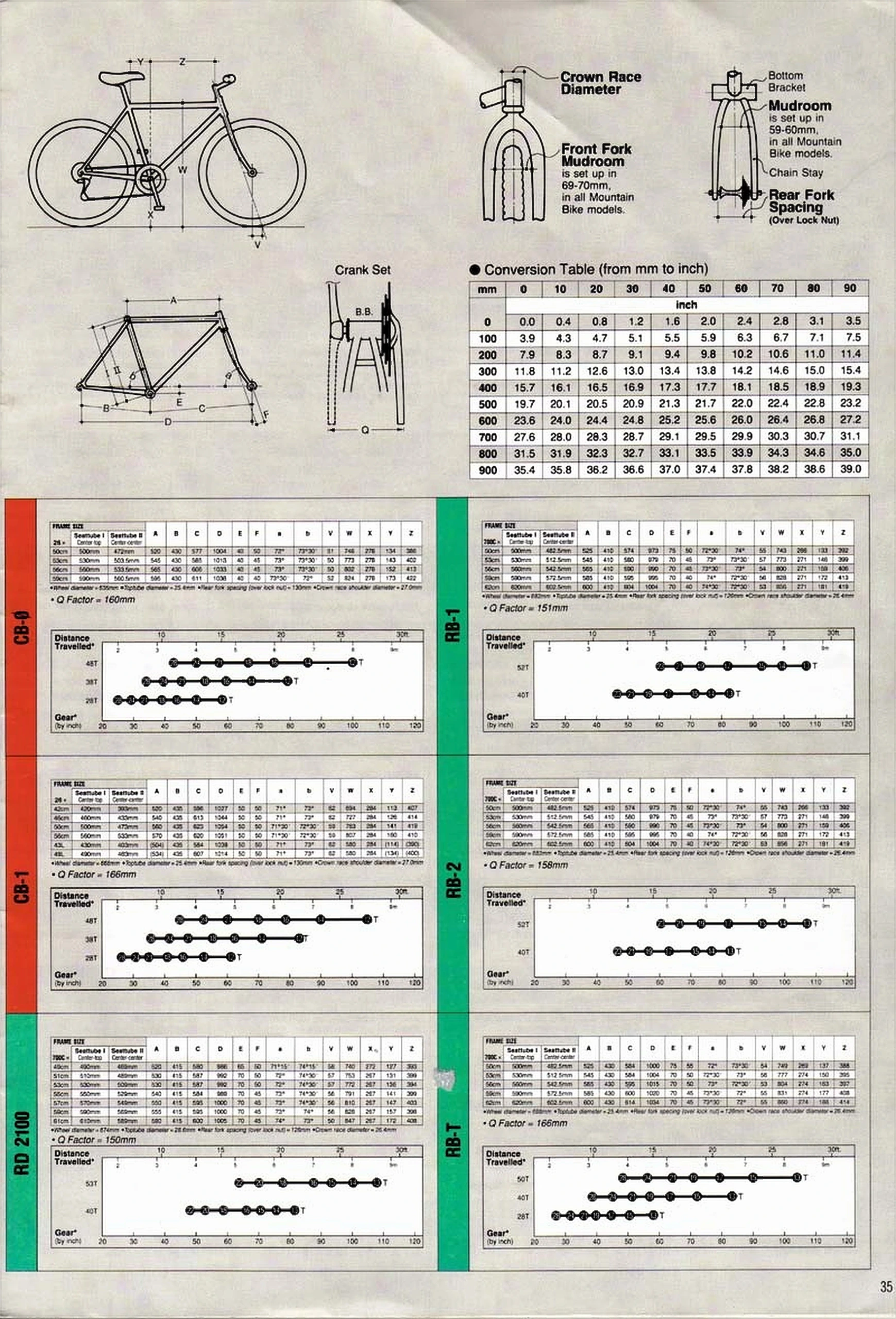
Crown Race Diameter
Front Fork Mudroom is set up in 69-70mm, in all Mountain Bike models.
Bottom Bracket
Mudroom is set up in 59-60mm, in all Mountain Bike models.
Chain Stay
Rear Fork Spacing (Over Lock Nut)
Crank Set
B.B.
Conversion Table (from mm to inch)
mm: 0, 10, 20, 30, 40, 50, 60, 70, 80, 90 across; 0, 100, 200, 300, 400, 500, 600, 700, 800, 900 down; inches from 0.0 (0 mm) to 39.0 (990 mm).
Models on this page, with their frame sizes: CB-Ø (26″: 50, 53, 56, 59cm; Q factor 160mm), CB-1 (42, 46, 50, 56cm and 43, 49cm women’s; Q factor 166mm), RD 2100 (700C: 49 to 61cm; Q factor 150mm), RB-1 (Q factor 151mm), RB-2 (Q factor 158mm), RB-T (50, 53, 56, 62cm; Q factor 166mm). Each model carries a Distance Travelled and Gear chart.
35
[The individual dimension cells of the tables, set very small, are not transcribed: they cannot be read reliably at the size of the host’s scan. Read them from the page image.]
— Page 36 —
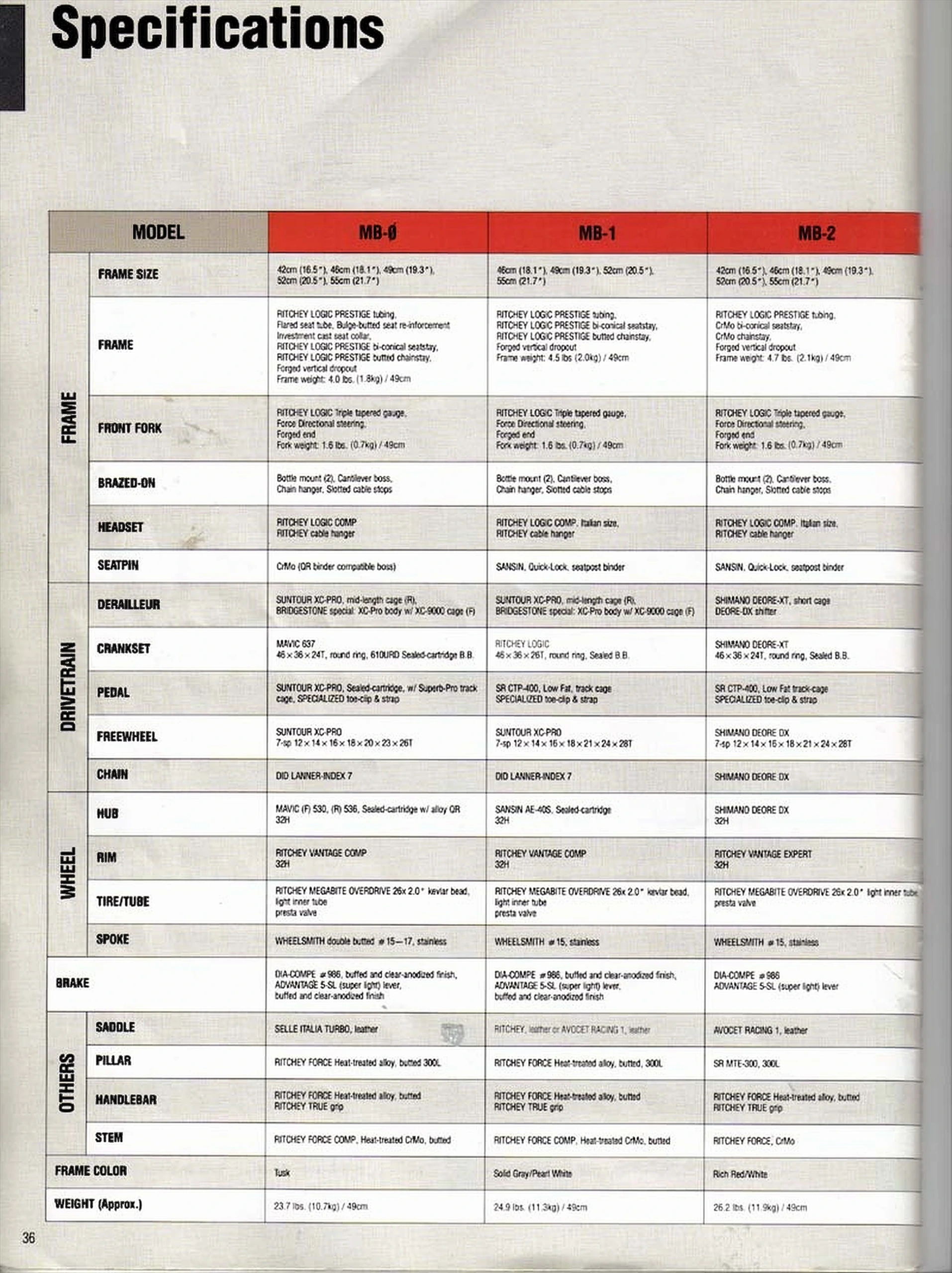
Specifications
MODEL: MB-Ø, MB-1, MB-2
FRAME SIZE: 42cm (16.5″), 46cm (18.1″), 49cm (19.3″), 52cm (20.5″), 55cm (21.7″) | 46cm (18.1″), 49cm (19.3″), 52cm (20.5″), 55cm (21.7″) | 42cm (16.5″), 46cm (18.1″), 49cm (19.3″), 52cm (20.5″), 55cm (21.7″)
FRAME COLOR: Tusk | Solid Gray/Pearl White | Rich Red/White
WEIGHT (Approx.): 23.7 lbs. (10.7kg) / 49cm | 24.9 lbs. (11.3kg) / 49cm | 26.2 lbs. (11.9kg) / 49cm
FRAME WEIGHTS: 4.0 lbs. (1.8kg) / 49cm | 4.5 lbs. (2.0kg) / 49cm | 4.7 lbs. (2.1kg) / 49cm
FORK WEIGHT: 1.6 lbs. (0.7kg) / 49cm (all three)
[The specifications table of the competition mountain models; its other cells (frame, fork, headset, derailleur, crankset, pedal, freewheel, chain, hub, rim, tire, spoke, brake, saddle, pillar, handlebar and stem) repeat and extend the models’ own pages and are not transcribed here because the type is too small to read reliably at the size of the host’s scan.]
36
[The specifications table.]
— Page 37 —
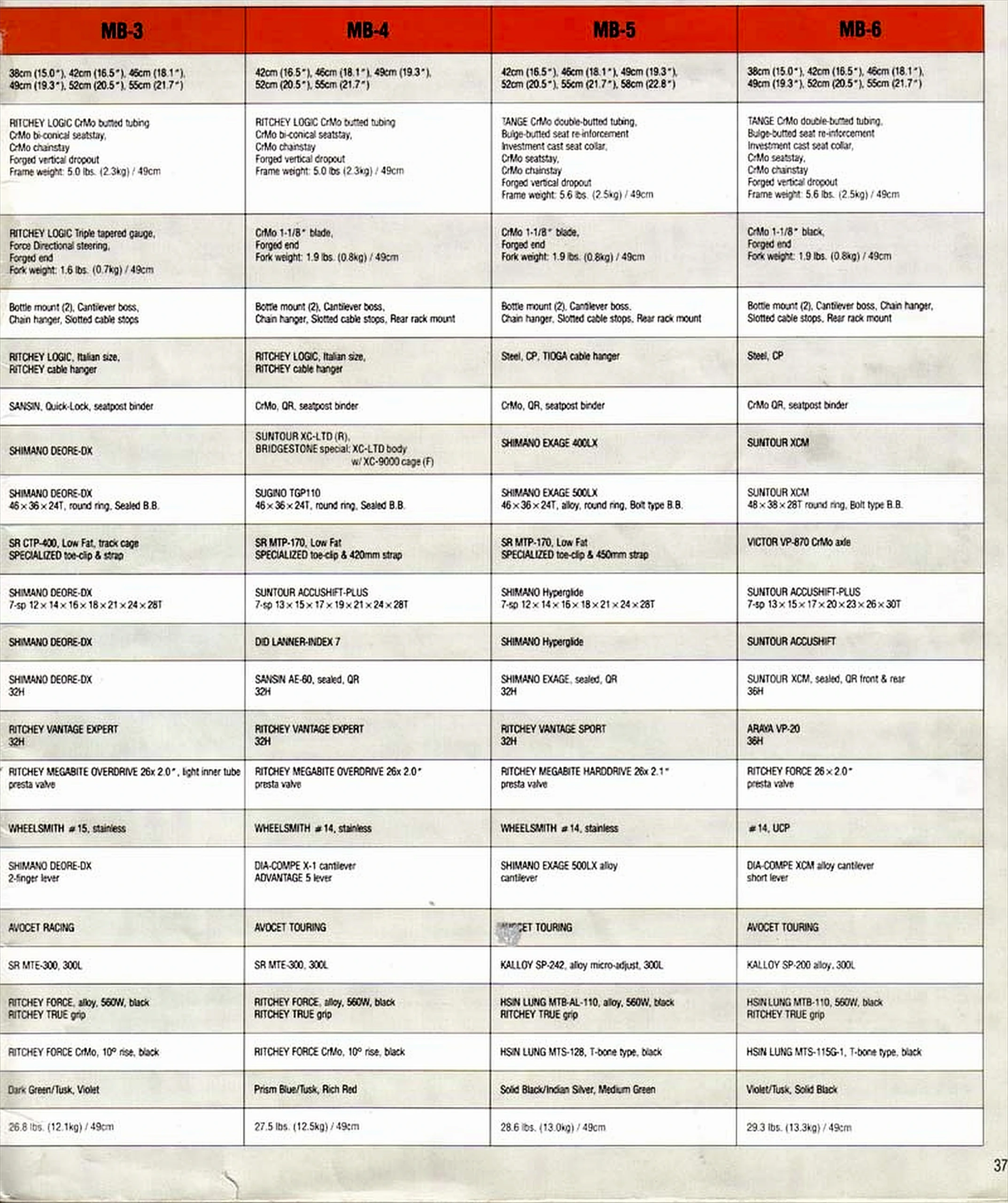
MODEL: MB-3, MB-4, MB-5, MB-6
FRAME SIZE: 38cm (15.0″), 42cm (16.5″), 46cm (18.1″), 49cm (19.3″), 52cm (20.5″), 55cm (21.7″) | 42cm (16.5″), 46cm (18.1″), 49cm (19.3″), 52cm (20.5″), 55cm (21.7″) | 42cm (16.5″), 46cm (18.1″), 49cm (19.3″), 52cm (20.5″), 55cm (21.7″), 58cm (22.8″) | 38cm (15.0″), 42cm (16.5″), 46cm (18.1″), 49cm (19.3″), 52cm (20.5″), 55cm (21.7″)
FRAME COLOR: Dark Green/Tusk, Violet | Prism/Tusk, Rich Red | Solid Black/Indian Silver, Medium Green | Violet/Tusk, Solid Black
WEIGHT (Approx.): 26.8 lbs. (12.1kg) / 49cm | 27.5 lbs. (12.5kg) / 49cm | 28.6 lbs. (13.0kg) / 49cm | 29.3 lbs. (13.3kg) / 49cm
FRAME WEIGHTS: 5.0 lbs. (2.3kg) / 49cm | 5.0 lbs. (2.3kg) / 49cm | 5.6 lbs. (2.5kg) / 49cm | 5.6 lbs. (2.5kg) / 49cm
FORK WEIGHT: 1.6 lbs. (0.7kg) / 49cm | 1.9 lbs. (0.8kg) / 49cm | 1.9 lbs. (0.8kg) / 49cm | 1.9 lbs. (0.8kg) / 49cm
[The specifications table of the Trailblazer and MB-3 models, continued; its other cells repeat and extend the models’ own pages and are not transcribed here because the type is too small to read reliably.]
37
— Page 38 —
Specifications
MODEL: CB-Ø, CB-1, RD2100
FRAME SIZE: 50cm (19.7″), 53cm (20.9″), 56cm (22.0″), 59cm (23.2″) | 42cm (16.5″), 46cm (18.1″), 50cm (19.7″), 56cm (22.0″), Ladies: 43cm (16.9″), 49cm (19″) | 49cm (19.3″), 51cm (20.1″), 53cm (20.9″), 55cm (21.7″), 57cm (22.4″), 59cm (23.2″), 61cm (24.0″)
FRAME: TANGE CrMo double butted tubing, ϕ25.4 top tube, Bulge-butted seat re-inforcement, CrMo seatstay, CrMo chainstay, Forged vertical dropout, Frame weight: 4.7 lbs (2.1kg) / 50cm | TANGE CrMo tubing, ϕ25.4 top tube, Bulge-butted seat re-inforcement, Forged vertical dropout, Frame weight: 5.8 lbs. (2.6kg) / 50cm | BRIDGESTONE Aluminum tubing, Aluminum seat & chainstay, Aluminum cast lugs, Aluminum forged micro-adjust dropout, Internal top tube cable guides, Frame weight: 3.2 lbs (1.4kg) / 57cm
FRONT FORK: CrMo 1″ blade, Forged end, Fork weight: 1.7 lbs. (0.8kg) / 50cm | CrMo 1″ blade, Forged end, Fork weight: 1.7 lbs. (0.8kg) / 50cm | BRIDGESTONE Aluminum blade, Aluminum cast crown, Aluminum end, Fork weight: 1.2 lbs (0.5kg) / 57cm
BRAZED-ON: Bottle mount (2), Cantilever boss, Chain hanger, Slotted cable stops, Rear rack mount | the same | Shiftlever boss, Bottle mount (2), Cable guides & stops
HEADSET: Steel, black | Steel, CP | SHIMANO 600 ULTEGRA, Italian size, 41mm stack height
SEATPIN: CrMo, recessed (QR binder compatible boss) | CrMo, QR, seatpost binder | CrMo, recessed
DERAILLEUR: SHIMANO L554-GS, Light action SIS lever | SHIMANO EXAGE 300LX | SHIMANO 600 ULTEGRA
CRANKSET: SR SZC-T304 AL 48×38×28T, alloy, round ring, Bolt type B.B | SHIMANO EXAGE 300LX 48×38×28T | SHIMANO 600 ULTEGRA 53×40T, round ring
PEDAL: SR CTP-400, Low Fat, track cage SPECIALIZED toe clip & 450mm strap | VICTOR VP-870, CrMo axle | SHIMANO 600 ULTEGRA clipless
FREEWHEEL: SHIMANO Hyperglide 7-sp 12×14×16×18×21×24×28T | SHIMANO Hyperglide 7-sp 12×14×16×18×21×24×28T | SHIMANO 600 ULTEGRA 13×14×15×16×18×20×22T
CHAIN: SHIMANO Hyperglide | SHIMANO Hyperglide | SHIMANO 600 Uniglide, narrow
HUB: SHIMANO alloy cassette, sealed, QR front & rear 36H | SHIMANO alloy cassette, sealed, QR front 36H | SHIMANO 600 ULTEGRA 32H
RIM: RITCHEY VANTAGE SPORT 36H | ARAYA MP-22, alloy 36H | CAMPAGNOLO OMEGA STRADA hardox 700C 32H
TIRE/TUBE: SPECIALIZED FAT BOY™, 26×1.25″ presta valve | CHENG SHIN 26×1.90″ skinside schrader valve | BRIDGESTONE 700×25C, kevlar bead holding type presta valve
SPOKE: #14, UCP | #14, UCP | WHEELSMITH #15 stainless
BRAKE: DIA-COMPE XCE alloy, cantilever, short lever | SHIMANO EXAGE 300LX, cantilever | SHIMANO 600 ULTEGRA
SADDLE: AVOCET TOURING | VELO VL-155N | AVOCET RACING 1, leather
PILLAR: KALLOY SP-242 alloy, micro-adjust, 230L | KALLOY SP-200 alloy, 220L | SR CRE-100, 230L
HANDLEBAR: HSIN LUNG MTB-134P, 560W, Low rise, black RITCHEY TRUE grip | HSIN LUNG B-802 570W, Low rise, black BRIDGESTONE bi-conical grip | NITTO #165, European size Cushion tape
STEM: HSIN LUNG MTS-147G-1, CrMo, black | HSIN LUNG MTS-120-1, black | RITCHEY FORCE COMP, road stem Heat-treated CrMo, butted
FRAME COLOR: Tusk | Black, Rich Red | Silver Anodized
WEIGHT (Approx.): 26.5 lbs. (12.0kg) / 50cm | 29.8 lbs. (13.5kg) / 50cm | 20.7 lbs. (9.4kg) / 57cm
38
[The specifications table of the city models and the RD 2100.]
— Page 39 —
MODEL: RB-1, RB-2, RB-T
FRAME SIZE: 50cm (19.7″), 53cm (20.9″), 56cm (22.0″), 59cm (23.2″), 62cm (24.4″) | 50cm (19.7″), 53cm (20.9″), 56cm (22.0″), 59cm (23.2″), 62cm (24.4″) | 50cm (19.7″), 53cm (20.9″), 56cm (22.0″), 59cm (23.2″), 62cm (24.4″)
FRAME: ISHIWATA #022E quattro-butted tubing, CrMo ϕ14.5 tapered seatstay, CrMo oval chainstay, Forged vertical dropout, Frame weight: 4.2 lbs. (1.9kg) / 56cm | ISHIWATA CrMo triple butted tubing, CrMo ϕ14.5 tapered seatstay, CrMo oval chainstay, Forged vertical dropout, Frame weight: 4.4 lbs. (2.0kg) / 56cm | ISHIWATA CrMo triple butted tubing, CrMo ϕ16 tapered seatstay, CrMo oval chainstay, Forged vertical dropout, Frame weight: 4.6 lbs. (2.1kg) / 56cm
FRONT FORK: ISHIWATA ϕ019E tapered blade, aero investment cast crown, Forged end, Fork weight: 1.4 lbs. (0.6kg) / 56cm | CrMo oval blade, Forged end, Fork weight: 1.6 lbs. (0.7kg) / 56cm | CrMo oval blade, Forged end, Fork weight: 1.7 lbs. (0.8kg) / 56cm
BRAZED-ON: Shiftlever boss, Bottle mount (2), Pump peg, Chain hanger, Cable guides & stops | the same | Shiftlever boss, Bottle mount (2), Pump peg, Chain hanger, Cable guides & stops, Cantilever boss
HEADSET: HATTA VESTA alloy, sealed, Italian size w/ high column spacer | HATTA VESTA, sealed, Italian size w/ high column spacer | HATTA VESTA, sealed, Italian size, RITCHEY cable hanger
SEATPIN: CrMo, recessed | CrMo, recessed | CrMo, recessed
DERAILLEUR: SHIMANO 600 ULTEGRA | SHIMANO EXAGE 400EX | SUNTOUR XCE, SUPERBE-PRO Bar-Con, SUNTOUR alloy cable holder mounted on downtube shiftlever boss
CRANKSET: SUGINO DGX 130 52×40T, round ring, Bolt type B.B., sealed | SUNTOUR RADIUS 52×40T, alloy, round ring, Bolt type B.B. | SR SZC-T204 HF 50×40×28T, alloy, round ring, Bolt-type B.B.
PEDAL: MKS SYLVAN track cage toe clip & strap | SR SP-200 track cage toe clip & strap | SR CTP-400 Low Fat, track cage toe clip & strap
FREEWHEEL: SHIMANO Hyperglide 7-sp 13×14×15×17×19×21×23T | SHIMANO Hyperglide 7-sp 13×14×15×17×19×21×23T | SUNTOUR ACCUSHIFT-PLUS 7-sp 13×15×17×19×21×24×28T
CHAIN: SHIMANO Hyperglide | SHIMANO Hyperglide | DID LANNER INDEX 7
HUB: SHIMANO RX-100, QR 32H | SHIMANO EXAGE QR 32H | SANSIN CE-60 QR, Re-tension guard nut front 36H
RIM: WOLBER GTX, hard anodized 700C 32H | WOLBER GTX, hard anodized 700C 32H | ARAYA #20A, gray anodized 36H
TIRE/TUBE: AVOCET ROAD 20, 700×28C, skinside presta valve | AVOCET ROAD 20, 700×28C, skinside presta valve | AVOCET DURO 20, 700×32C, skinside presta valve
SPOKE: WHEELSMITH #15 stainless | #14, UCP | WHEELSMITH #14, stainless
BRAKE: DIA-COMPE BRS 300, BRS 300 lever | DIA-COMPE BLAZE w/ EDGE type shaft, BLAZE lever | DIA-COMPE XCE alloy cantilever, BLAZE lever
SADDLE: AVOCET RACING | AVOCET RACING | AVOCET TOURING
PILLAR: SR CLE-100 220L | SR CLE-100 220L | SR CLE-100 220L
HANDLEBAR: NITTO #185F 2 bend, 26.0mm ferrule size Cushion tape | SR CTB, 25.4mm ferrule size Cushion tape | SR CTB, 25.4mm ferrule size Cushion tape
STEM: RITCHEY FORCE, road stem, CrMo | SR CT | SR MTS-301
FRAME COLOR: Dark Green/Tusk, Rich Red | Prism Blue/Tusk, Indian Silver | Black
WEIGHT (Approx.): 22.5 lbs. (10.2kg) / 56cm | 23.6 lbs. (10.7kg) / 56cm | 25.3 lbs. (11.5kg) / 56cm
Specifications are subject to change without notice.
[The specifications table of the road models, in three columns.]
— Page 40 —
About Our Riders/Models
Pineapple Bob
Lorum ipsum dolor sit amet, consectetur adipiscing elit, esd diam hexagenia limbata tepot abore et dolre magna aliquam erat volupat. Ut enim ad minim veniam, quis nostrud exercitation ullamcorper suscipit laboris. (placeholder text, as printed)
Karen Henderson
Karen is 20, a star setter on the Sacramento State vollyball team, and a bike racer. She’s studying computer science and evironmental science, races an RB-1, and would like to live in Pt. Reyes, as a bike-riding marine biologist.
Gene Oberpriller
Gene, 28, works at The Alternative Bike and Board in Minneapolis, and races mountain and road bikes as much as possible. He caught his first case of poison oak on this catalog shoot.
Michael King
Michael, 31, is our midwest sales rep, and the fastest road rider among us. He seems to know everyone who has anything to do with bike racing. He’s married to Lisa, and they have a dalmation, Sparky. He races bikes and XC skis.
Many thanks to many people for their contributions to this catalog:
Naoi-san of I&S for creative and keen eye, Yoshi Ohara, the Cor Vos of L.A. for his photos, Tsuyoshi for technical assistance. Kristen for her Pagemaker prowess, Michy Amanuma & the rest of (302) for the rein and support, and Ariadne for absolutely everything else.
BRIDGESTONE
BRIDGESTONE CYCLE (U.S.A.), INC.
WEST: 15021 Wicks Blvd., San Leandro, California 94577 Phone: 415-895-5480
EAST: Newark, N.J. 07104
All rights reserved. No part of this book may be reproduced in any form or by any means, without permission in writing from the publisher.
Printed in Japan
[The back cover: a photograph panel of four riders with short biographies, the thanks note on a blue panel, the Bridgestone logo and addresses, and at the right the blurred green forest of the cover photograph.]
 The Bridgestone Bicycle Catalogue 1986 (Bridgestone Cycle, United States)
 The Bridgestone Bicycle Catalogue 1987 (Bridgestone Cycle, United States)
 The Bridgestone Bicycle Catalogue 1988 (Bridgestone Cycle, United States)
 The Bridgestone Bicycle Catalogue 1989 (Bridgestone Cycle, United States)
 The Bridgestone Bicycle Catalogue 1990 (Bridgestone Cycle, United States)
Ebykr presents this material for research and education. If you hold rights to it or notice an ownership issue, please contact us and we will respond promptly.
The Ebykr Digest
New articles, timelines, catalog finds and registry activity — assembled from the archive once a month. Your address is never shared.
Double opt-in. One email per month. Unsubscribe at any time with one click.