About Ebykr
Ebykr celebrates classic and vintage lightweight bicycles through provocative imagery and opinion. Ride along with us.
About Ebykr
Ebykr celebrates classic and vintage lightweight bicycles through provocative imagery and opinion. Ride along with us.

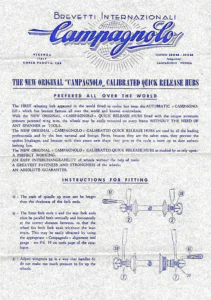
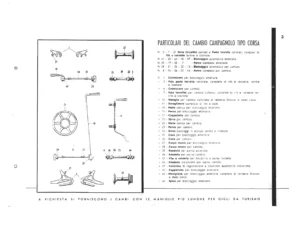
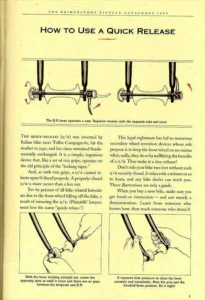
How Campagnolo told riders to fit its calibrated quick-release hubs, from its sheet of about 1960 and its catalog of about 1951, with Bridgestone’s 1993 page on closing the lever: the spindle ends, the fork ends set parallel, the wing nut run in with the lever straight out, and the lever closed firmly before every ride. Every instruction is from the Ebykr archive; the drawing is Ebykr’s own.
This page shows how period sources fitted and closed a quick-release hub, step by step, in their own words. It does not test or guarantee any fitting. A front wheel that comes out of the fork can throw you off: Bridgestone says not to ride two feet without each lever securely closed, and to learn the closing hands-on from someone who knows how. Have a bicycle shop check your wheels before you rely on them.
On this page The drawing Tools and parts The steps in words What goes wrong Another way Sources
Your system asks for reduced motion, so each step is a still drawing. Play moves from still to still.
In the sources’ own terms. Tick each one off as you gather it.
No spanner is needed for the wheel itself: that is the point of the hub.
The whole job, readable and printable without the drawing. Each step says what it rests on, and can take you back up to its drawing.
Campagnolo’s first rule: the ends of the hub spindle must not be longer than the thickness of the fork ends. A spindle that stands out past the fork end keeps the lever and the wing nut from bearing on the fork end itself. The 1951 catalog numbers the parts this page names: the fork ends, the lever, the wing nut and the cone.
The second rule: the front fork ends and the rear fork ends must be parallel both vertically and horizontally, and at the correct distance apart, so that the wheel fits both of them without the least strain. Campagnolo says this is easily got with its own alignment gauge, shown on the tools page of its catalog.
With the lever open and the wing nut slack, the wheel goes into the fork ends. Campagnolo’s whole claim for the hub is that the wheel can be mounted on any frame without a spanner or any other tool.
Bridgestone’s page gives the order: with the lever sticking straight out, screw the opposing nut in until it stops and there are no gaps between the fork ends and the quick release. Campagnolo’s third rule sets the limit: adjust the wing nuts so that the levers do not press too hard to hold the wheel. The lever works a cam, and the nut sets how hard it bears.
It takes firm pressure to close the lever securely and completely, Bridgestone says, and its drawings show the grip and where the closed lever should lie. If it closes with no effort, the nut is too slack; if it will not close, the nut is too far in. Campagnolo’s rule is the other side of the same thing: not too much pressure.
Closed properly, a quick release cannot vibrate open, Bridgestone says, and is more secure than a hex nut. Its danger is misuse: do not ride two feet without each lever securely closed. Its advice is to get hands-on instruction rather than a demonstration, learn from someone who knows how, and then teach someone who does not.
Each of these is a source’s own warning, except the last, which is what the sources leave out.
The figures Neither Campagnolo nor Bridgestone gives the distance between the fork ends, a number of turns for the nut, or a force for the lever. Campagnolo’s sheet is about fitting the hub, not using it, and Bridgestone’s page is thirty years later. The page supplies none of these.
The Mechanism Workshop draws the Campagnolo quick-release hub and its cam.
The cones inside the hub: Check and Adjust Hub Cones.
Every record opens in the Ebykr archive. Each step above names the page it rests on.
The sheet and the catalog are Campagnolo’s own; Bridgestone’s page is from a maker’s catalog of 1993, for its customers. Each step names the one it rests on, and the page quotes nothing at length.