About Ebykr
Ebykr celebrates classic and vintage lightweight bicycles through provocative imagery and opinion. Ride along with us.
About Ebykr
Ebykr celebrates classic and vintage lightweight bicycles through provocative imagery and opinion. Ride along with us.

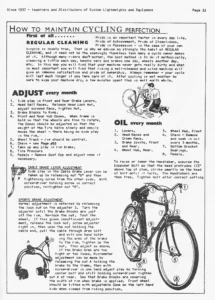
How a 1961 booklet told riders to free the handlebar stem and set it higher or lower, with Peter Henry’s 1913 rule for how much stem must stay in the frame and Brooks’s order of 1926, saddle first and bars to suit: the expander bolt unscrewed and struck, the stem greased, moved and tightened. Every instruction is from the Ebykr archive; the drawing is Ebykr’s own.
This page shows how period sources set a handlebar, step by step, in their own words and figures. It does not test or guarantee any setting. The stem is a safety part: a stem pulled up too far or left loose can let the bars move or come away under you. Henry says at least 2 in. of the stem must stay in the machine, and no source gives a tightness for the bolt. Have a bicycle shop check it before you rely on it.
On this page The drawing Tools and parts The steps in words What goes wrong Another way Sources
Your system asks for reduced motion, so each step is a still drawing. Play moves from still to still.
In the sources’ own terms where they name them. Tick each one off as you gather it.
The sources name no tool for this job. The spanner and mallet are what it plainly needs.
The whole job, readable and printable without the drawing. Each step says what it rests on, and can take you back up to its drawing.
To raise or lower the handlebar, the Cyclo-pedia says, unscrew the expander bolt until its head stands half an inch above the top of the stem. The bolt runs down through the stem to a cone at its foot, which wedges the stem in the steering column; Cassell’s parts list of 1916 names both, the expander bolt and the expander cone.
Strike smartly on the head of the bolt until it falls. The blow drives the cone down out of the stem, and the handlebars are then free.
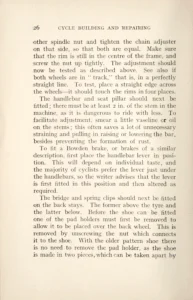
Henry advises smearing a little vaseline or oil on the stems of the handlebar and seat pillar. It saves a lot of straining and pulling in raising or lowering the bar, and it keeps rust from forming.
Raise or lower the stem to the height you want. Henry’s rule is that there must be at least 2 in. of the stem in the machine, as it is dangerous to ride with less. Henry gives no mark to go by, so measure it.
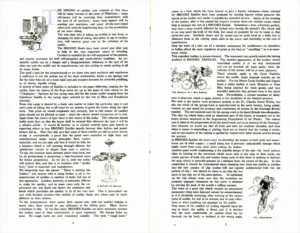
Brooks gives the order: the saddle is placed in relation to the pedals, and the handlebars are then adjusted to suit it. Set the saddle first (Set the Height, Position and Angle of a Saddle), then the bars.
Tighten the bolt after the correct setting, the Cyclo-pedia says. The bolt draws the cone back up into the stem and wedges it in the column. Check that the bars turn with the wheel and do not move under your hands.
Each of these is a source’s own warning, except the last, which is what the sources leave out.
The height and the tightness No source here says how high the bars should be, how tight the bolt should be or what to strike it with. The page supplies none of these, and gives Ebykr’s assumptions as assumptions.
Every record opens in the Ebykr archive. Each step above names the page it rests on.
The Cyclo-pedia was the catalog of Gene Portuesi, an importer of lightweights in Detroit; Henry’s book is a 1913 handbook; Brooks wrote to sell saddles. Each step names the one it rests on, and the page quotes nothing at length.