About Ebykr
Ebykr celebrates classic and vintage lightweight bicycles through provocative imagery and opinion. Ride along with us.
About Ebykr
Ebykr celebrates classic and vintage lightweight bicycles through provocative imagery and opinion. Ride along with us.

Source: Chronicling America, Library of Congress. St. Croix Avis (Christiansted, St. Croix, Virgin Islands), 15 April 1946, page 2. Advertisement cropped from the newspaper page.
| Marque | Raleigh |
|---|---|
| Type | Advertisement |
| Year | 1946 |
| Publisher | The Raleigh Cycle Company Limited |
| Country | United States |
| Language | English |
| Pages | 1 |
| Source | Chronicling America, Library of Congress. St. Croix Avis (Christiansted, St. Croix, Virgin Islands), 15 April 1946, page 2. Advertisement cropped from the newspaper page. |
| Credit | Library of Congress, Chronicling America |
| Identifier | Chronicling America sn84037526/1946-04-15/ed-1/seq-2 |
| Transcription | Machine OCR, checked by eye |
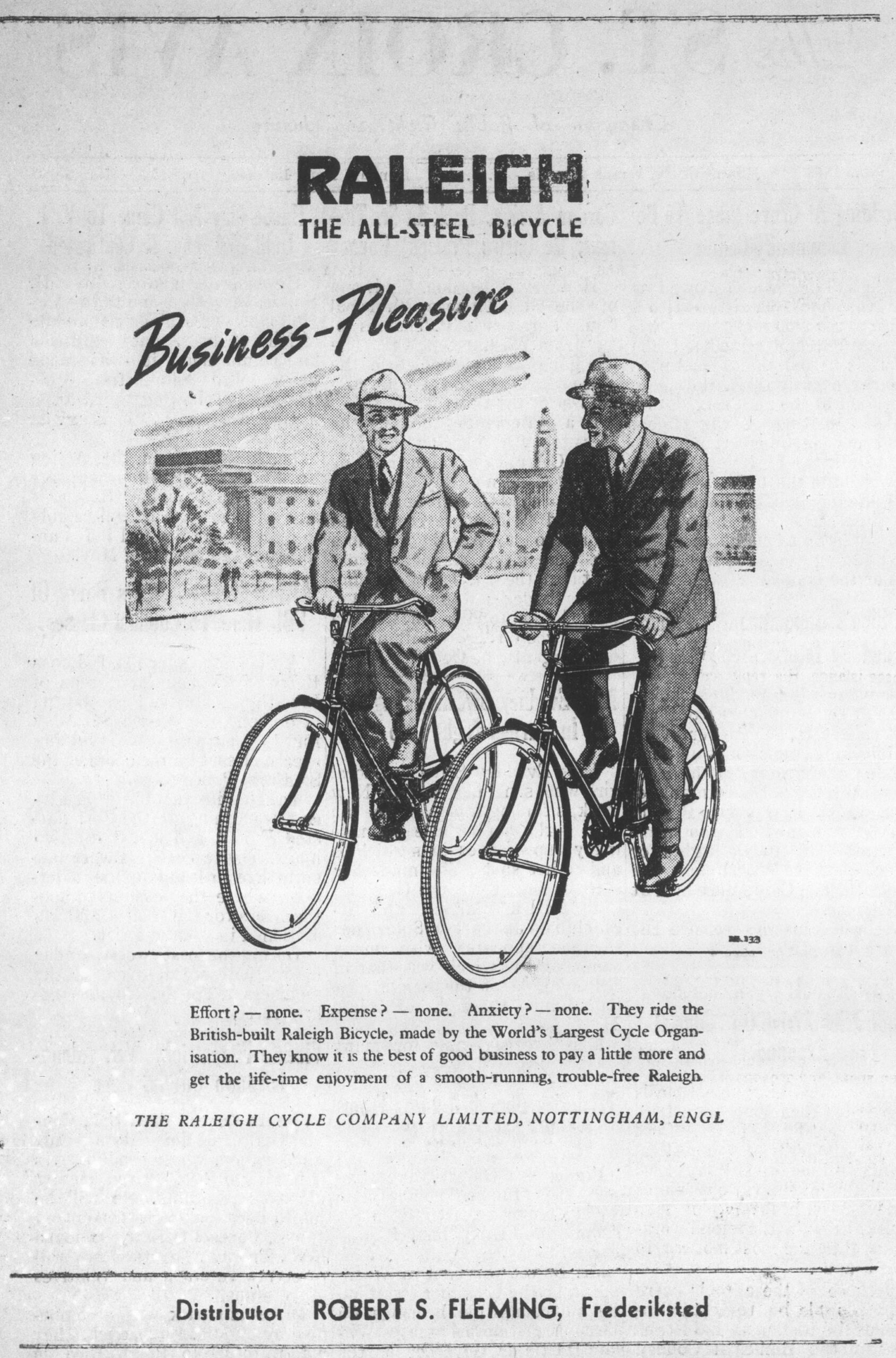
RALEIGH THE ALL-STEEL BICYCLE Business-Pleasure Effort? — none. Expense? — none. Anxiety? — none. They ride the British-built Raleigh Bicycle, made by the World's Largest Cycle Organisation. They know it is the best of good business to pay a little more and get the life-time enjoyment of a smooth-running, trouble-free Raleigh. THE RALEIGH CYCLE COMPANY …
This text began as machine OCR from the holding institution and has since been checked against the page.
RALEIGH
THE ALL-STEEL BICYCLE
Business-Pleasure
Effort? — none. Expense? — none. Anxiety? — none. They ride the British-built Raleigh Bicycle, made by the World’s Largest Cycle Organisation. They know it is the best of good business to pay a little more and get the life-time enjoyment of a smooth-running, trouble-free Raleigh.
THE RALEIGH CYCLE COMPANY LIMITED, NOTTINGHAM, ENGL
Distributor ROBERT S. FLEMING, Frederiksted
[The advertisement fills almost the whole newspaper page and is ruled off top and bottom. Beneath the wordmark and the slogan, the word Business-Pleasure is set in a sloping script across the upper left. The illustration is a wash drawing: two men in business suits and soft hats ride side by side toward the viewer, the nearer man in a light suit with one hand in his pocket, the further man in a dark suit turning to speak to him, both machines drawn as roadsters with rod-and-stirrup front brakes, mudguards and upright bars. Behind them a city of civic buildings and a clock tower is sketched in flat gray, the drawing stopping in a hard rectangular edge that leaves the riders standing clear of it. A small block reference is printed at the lower right of the illustration. The body copy sits in four justified lines under a rule, the company line below it in spaced italic capitals, and the distributor’s name is set in the lower panel between two more rules.]
[One advertisement occupying almost all of page 2 of the St. Croix Avis of Christiansted for 15 April 1946. It is the first Raleigh document in this archive taken from a newspaper, the first from Chronicling America, and the first that shows the marque advertising itself rather than a catalog or a poster.
The archive already holds thirty-five Raleigh documents and every one of them comes from Britain. This one was placed by the same company for readers in a United States territory in the Caribbean, seven months after the end of the war, and that is the whole of its interest. Postwar Britain needed dollars badly and bicycles were among the goods it had to sell, so Nottingham advertising turns up in a Virgin Islands paper carrying a Frederiksted distributor’s name at its foot.
The claims are the company’s two standing ones. THE ALL-STEEL BICYCLE is the slogan Raleigh had used for decades, and the World’s Largest Cycle Organisation is the corporate boast that goes with it. The argument in between is unusual for a bicycle advertisement in that it never mentions a model, a price, a gear or a component. It asks the reader to spend more once rather than less repeatedly — the best of good business to pay a little more and get the life-time enjoyment — and it sells the machine as a way of getting to work in a suit without arriving in a state. Both riders are dressed for an office and neither is exerting himself.
⚠ The same block ran at least thirty-seven times in this paper between April 1946 and June 1947, and this record cites the earliest impression held. The block itself does not change; what changes is the name in the panel at the foot, because the local agent’s imprint was set into it. This impression carries Distributor ROBERT S. FLEMING, Frederiksted. The impression of 11 May 1946 carries Lionel Hendricks — Agent instead, with the artwork and every word of the copy identical. Later impressions were not surveyed one by one.
The company line is trimmed in the printing itself and reads NOTTINGHAM, ENGL where the block has been cut short. It is transcribed as it appears. The advertisement sets Organisation with an s and it is left alone.
The whole newspaper page is never the document here. The advertisement was cropped from the Library of Congress IIIF master at native resolution and the page identifier is kept in the provenance pair. The body text was set from the Library of Congress machine text and then read against the image at native resolution, which is why this record is marked as machine text checked by eye rather than as transcription.]
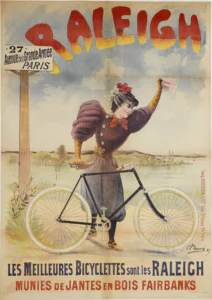 Raleigh 1895 Poster — E. Clouet
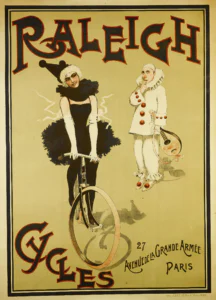 Raleigh c.1895 Poster — Raleigh Cycles, 27 Avenue de la Grande Armée
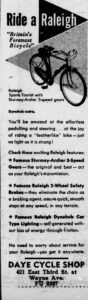 Raleigh 1952 Advertisement — Ride a Raleigh, the Sports Tourist with Sturmey-Archer Gears
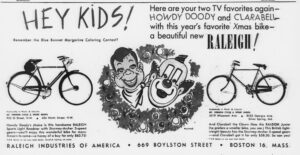 Raleigh 1953 Advertisement — Howdy Doody and Clarabell, and a Beautiful New Raleigh
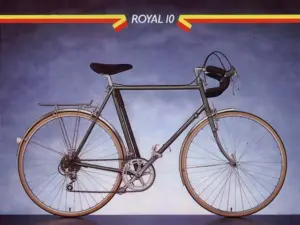 Raleigh 1983 Catalog — Royal 10
Ebykr presents this material for research and education. If you hold rights to it or notice an ownership issue, please contact us and we will respond promptly.
The Ebykr Digest
New articles, timelines, catalog finds and registry activity — assembled from the archive once a month. Your address is never shared.
Double opt-in. One email per month. Unsubscribe at any time with one click.