About Ebykr
Ebykr celebrates classic and vintage lightweight bicycles through provocative imagery and opinion. Ride along with us.
About Ebykr
Ebykr celebrates classic and vintage lightweight bicycles through provocative imagery and opinion. Ride along with us.

Source: Northwestern University Libraries, Transportation Library, "Monarch and Defiance bicycles" (digital collection, https://dc.library.northwestern.edu/items/01e6a2dc-7604-486e-9558-c6cdf0b08ec4); rights statement "No Copyright - United States".
 Page 1
 Page 2
 Page 3
 Page 4
 Page 5
 Page 6
 Page 7
 Page 8
 Page 9
 Page 10
 Page 11
 Page 12
 Page 13
 Page 14
 Page 15
 Page 16
 Page 17
 Page 18
 Page 19
 Page 20
 Page 21
 Page 22
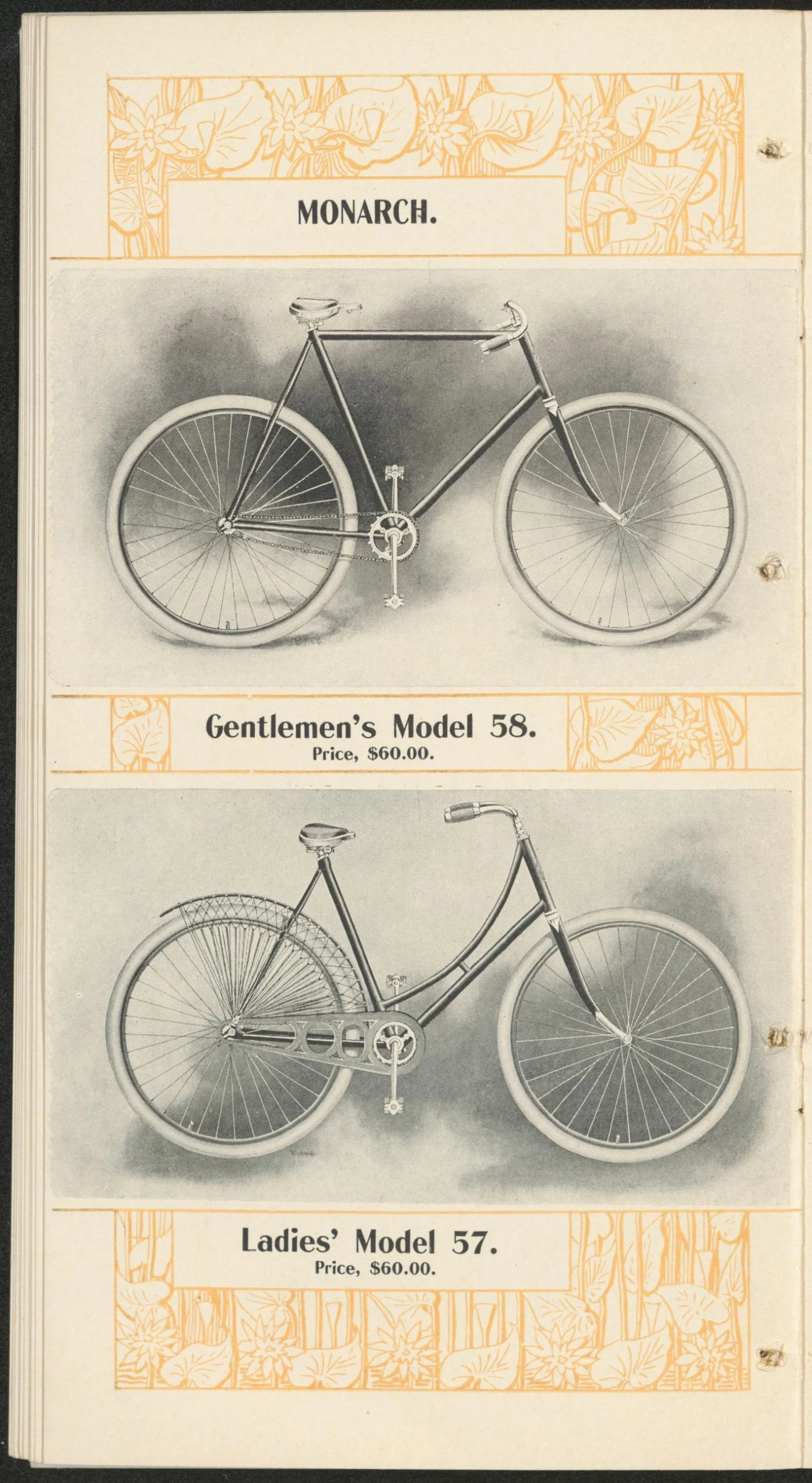 Page 23
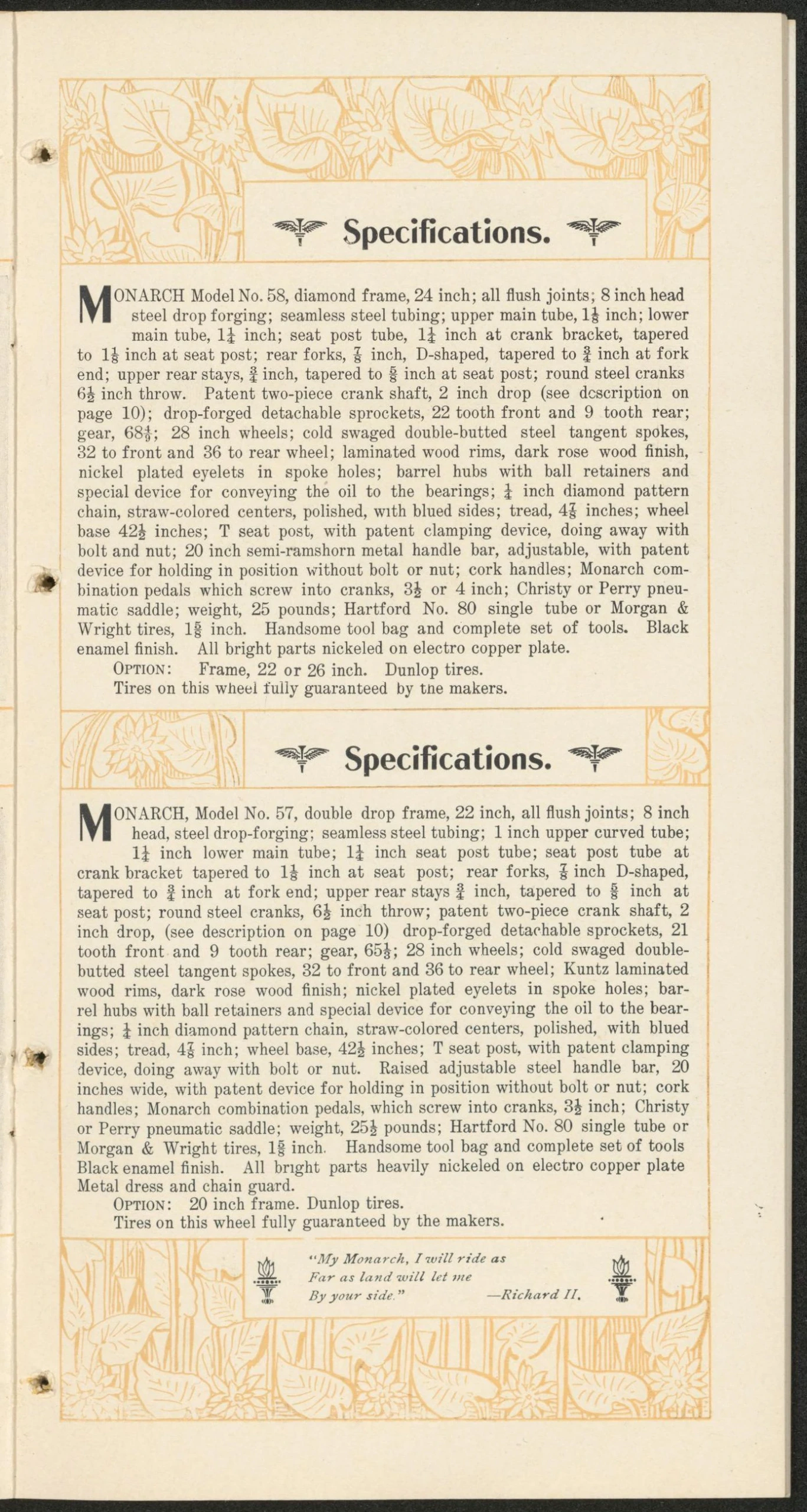 Page 24
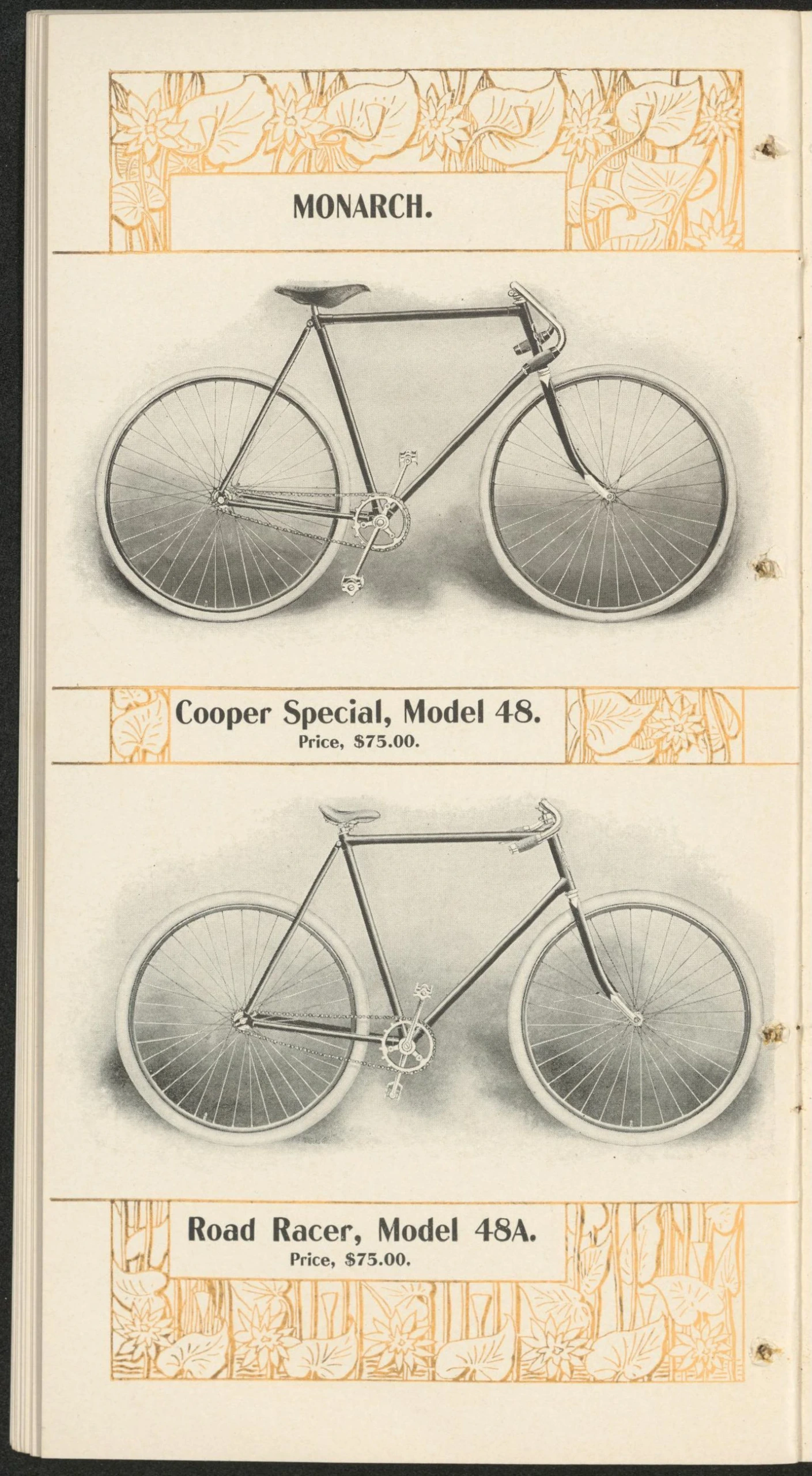 Page 25
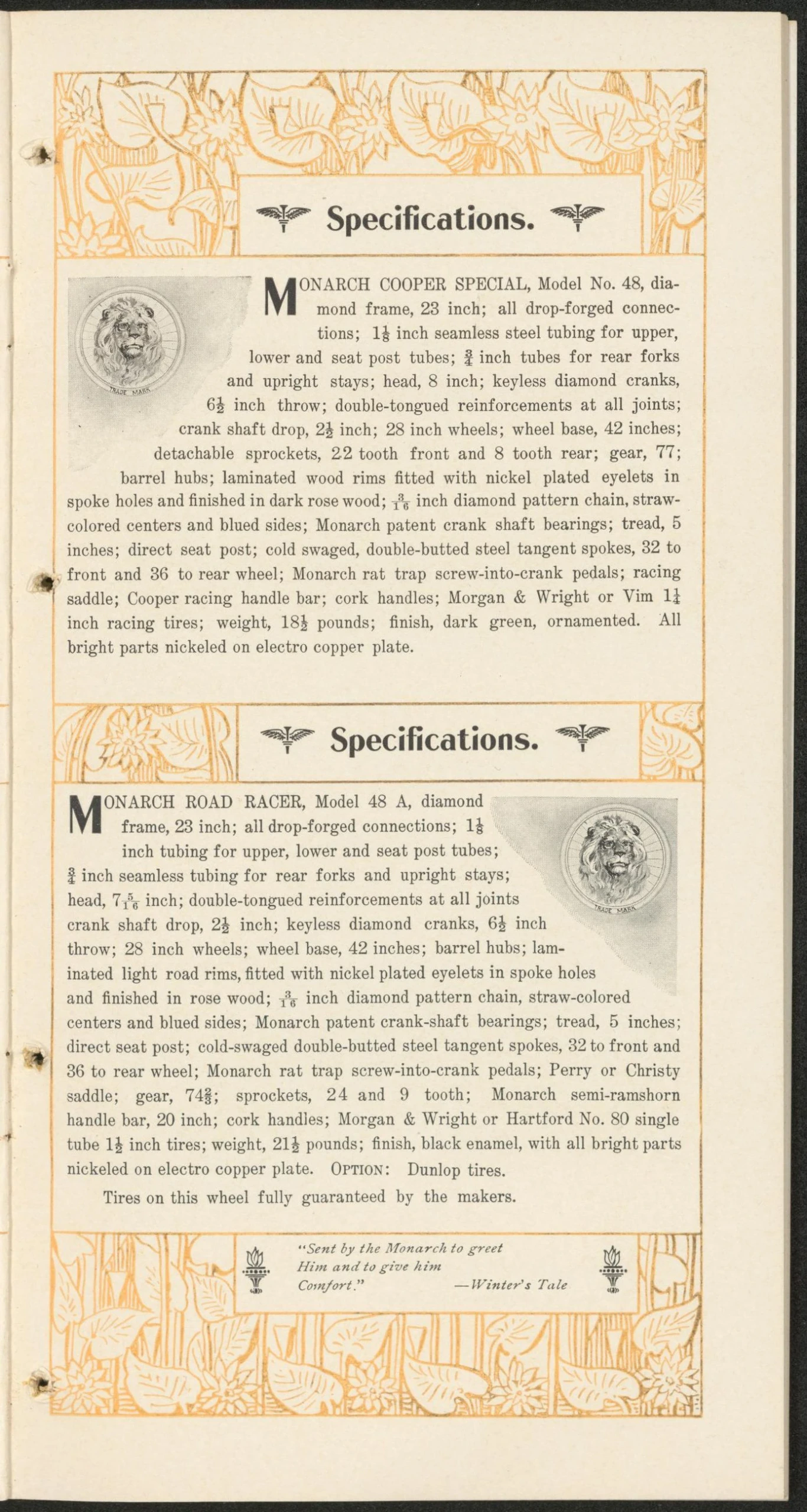 Page 26
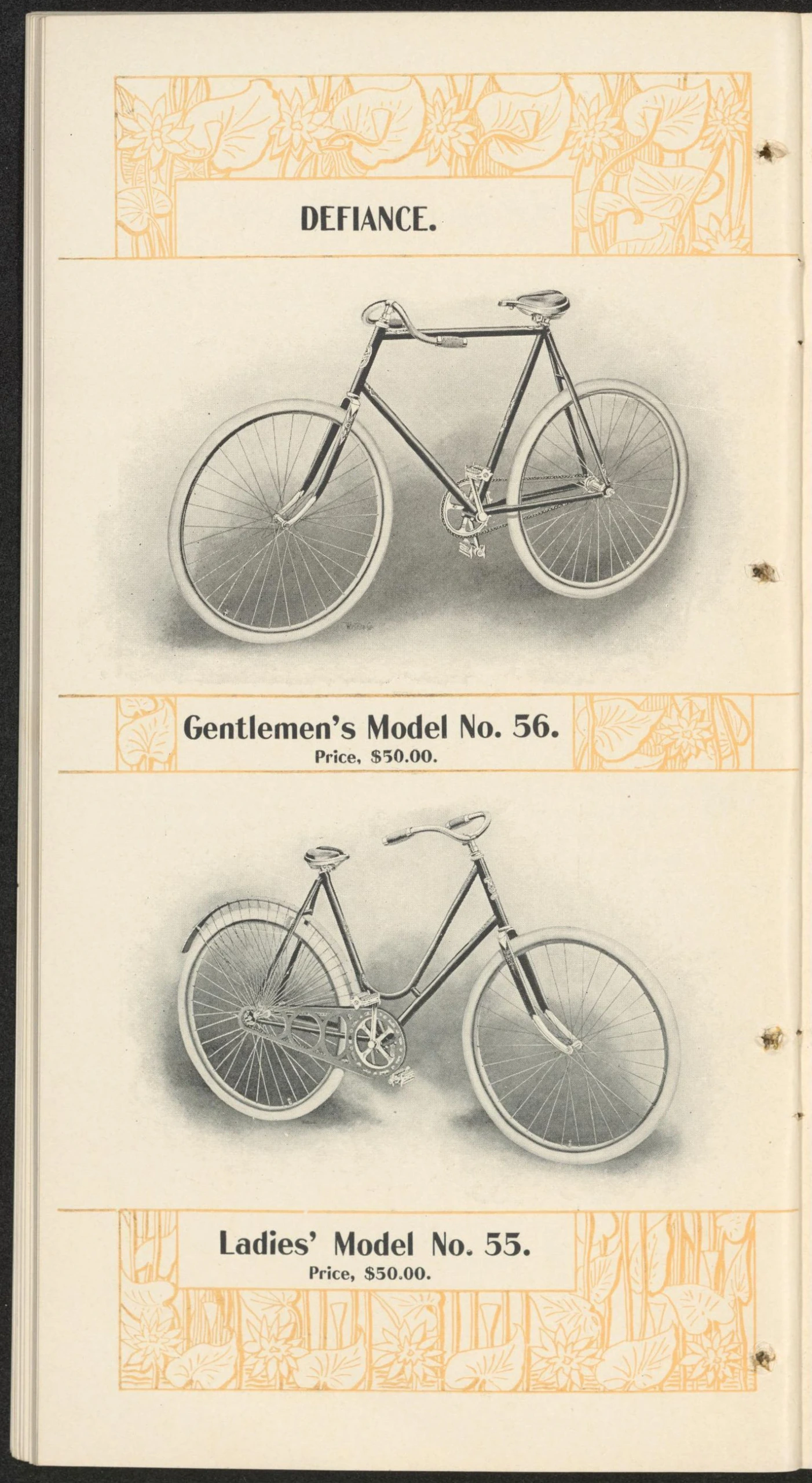 Page 27
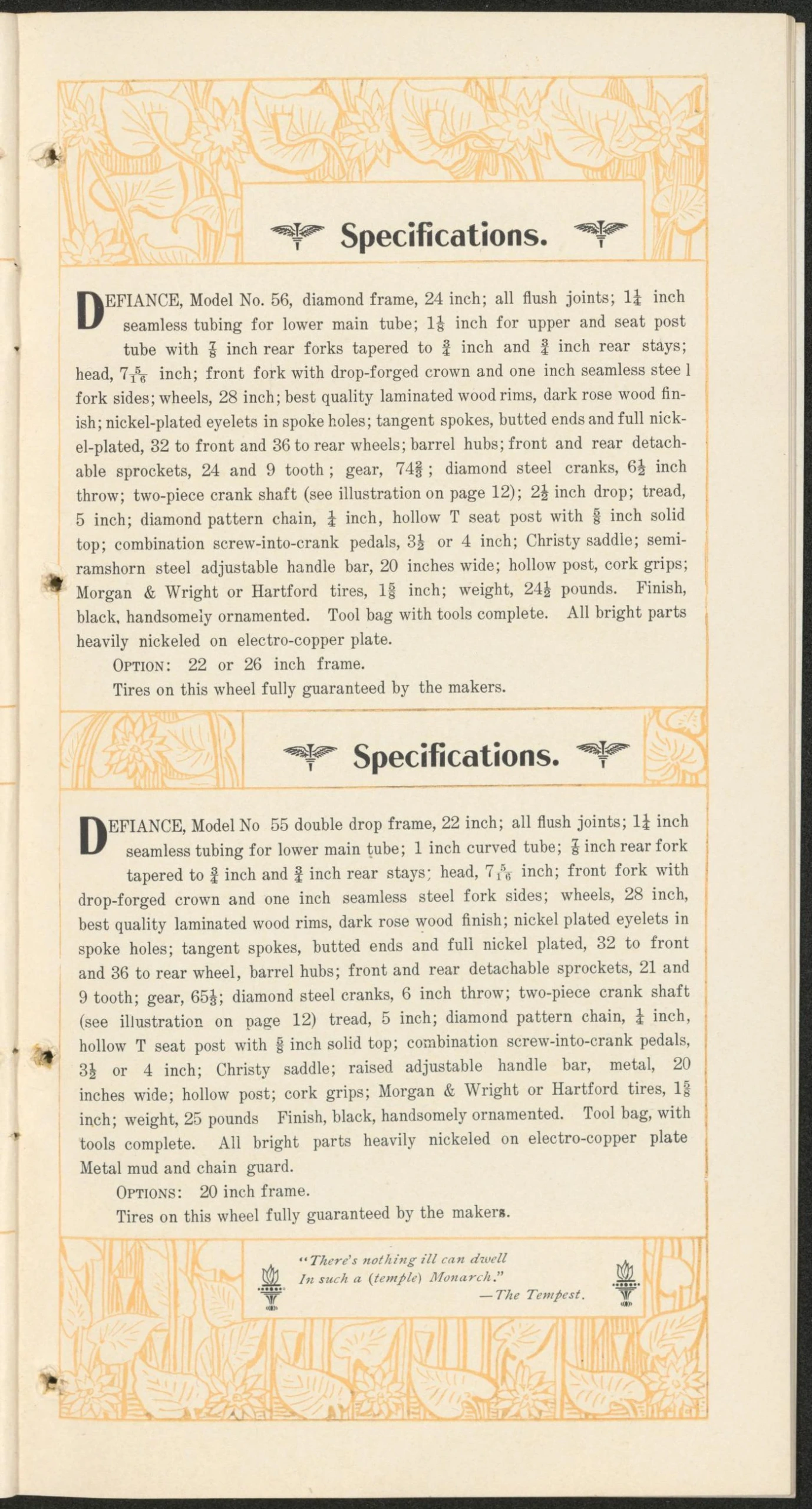 Page 28
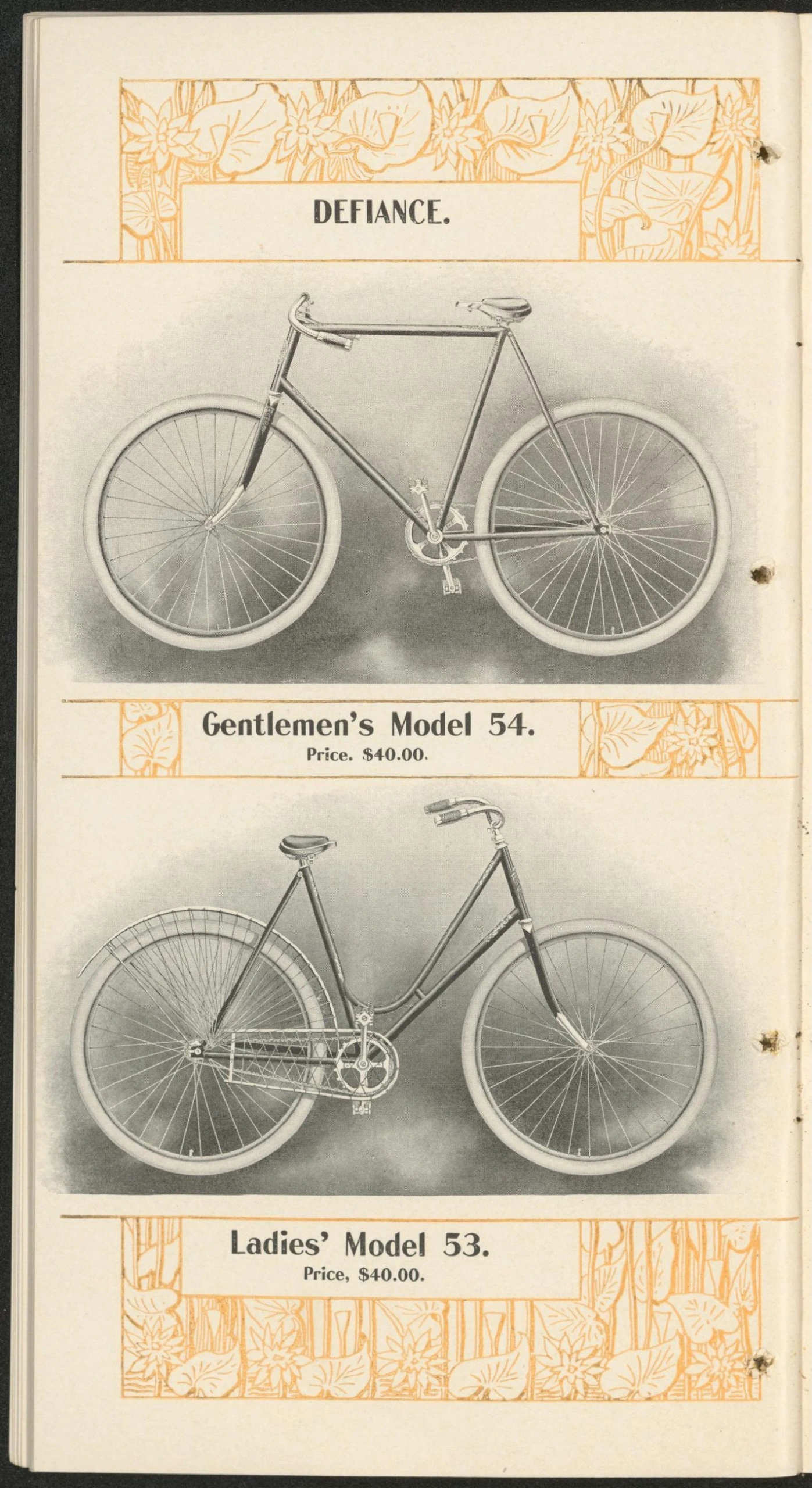 Page 29
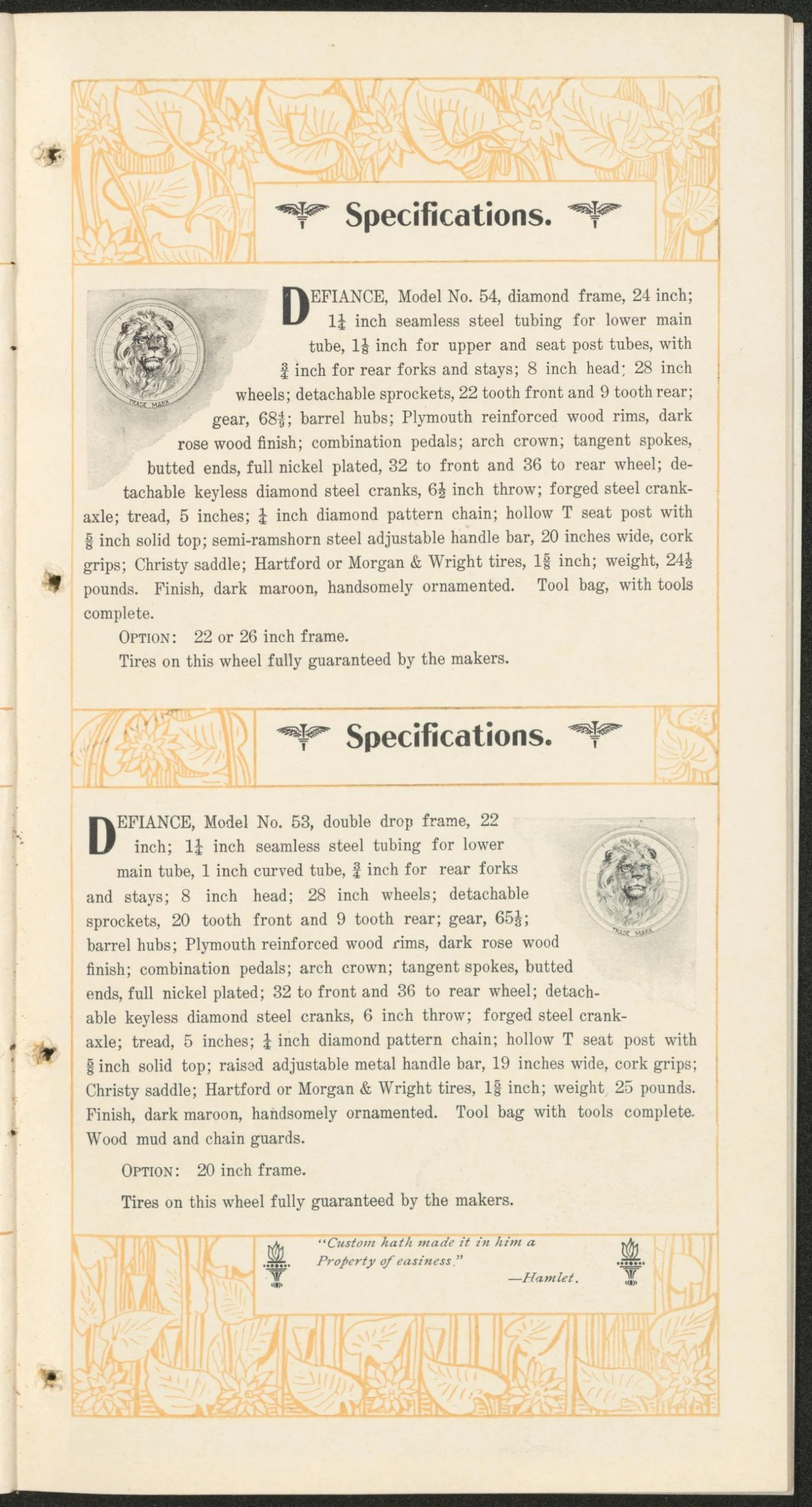 Page 30
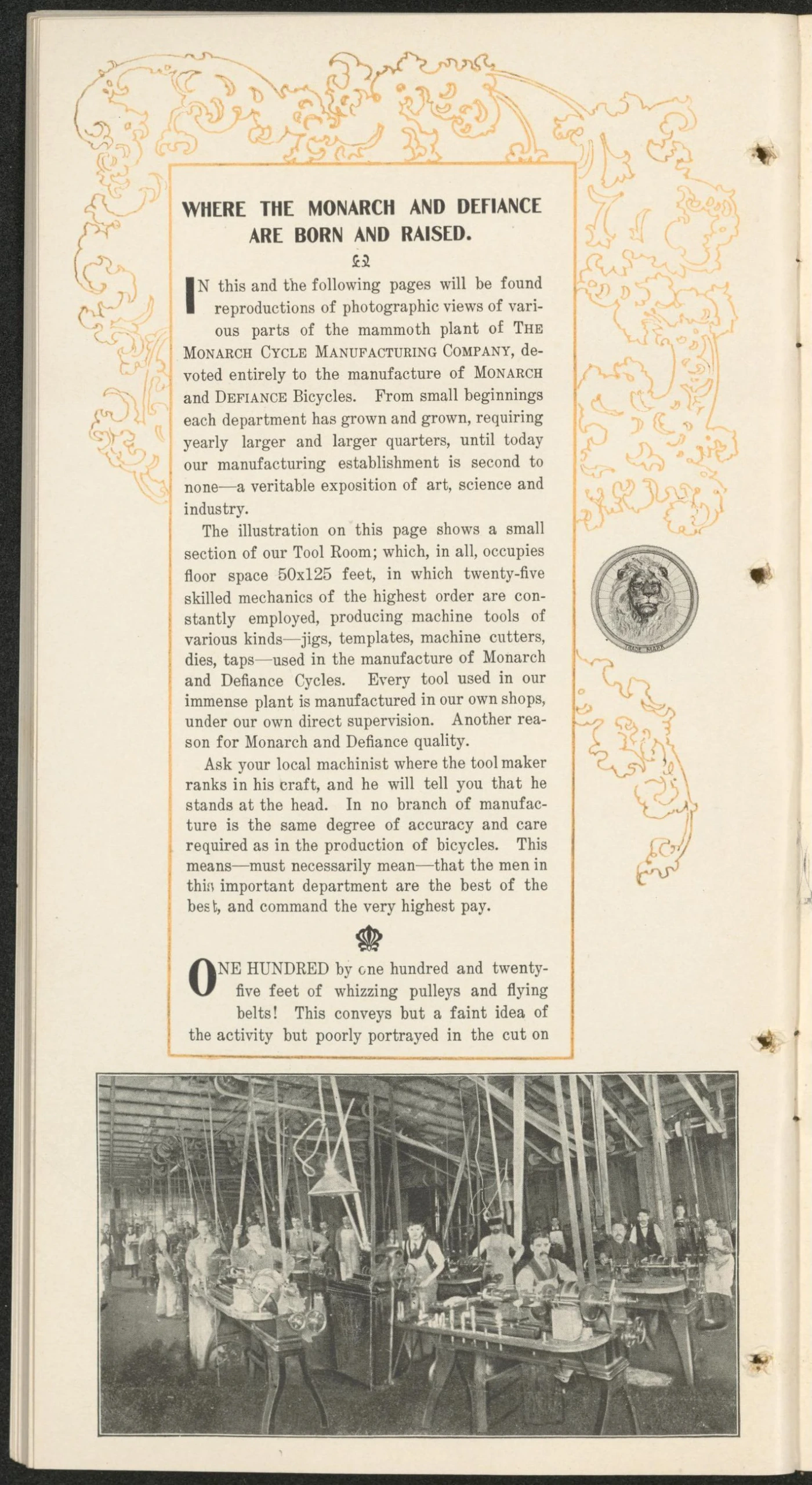 Page 31
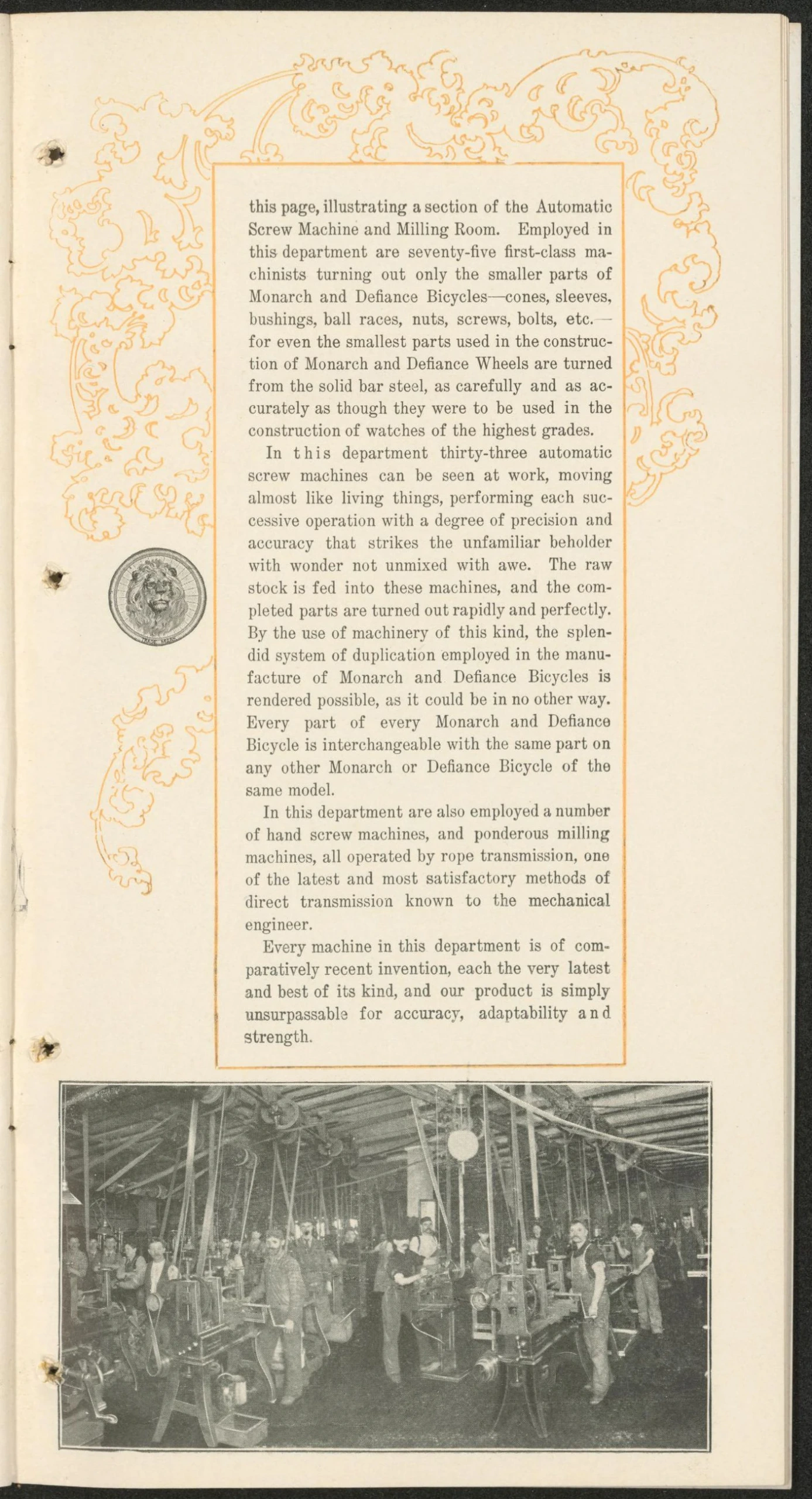 Page 32
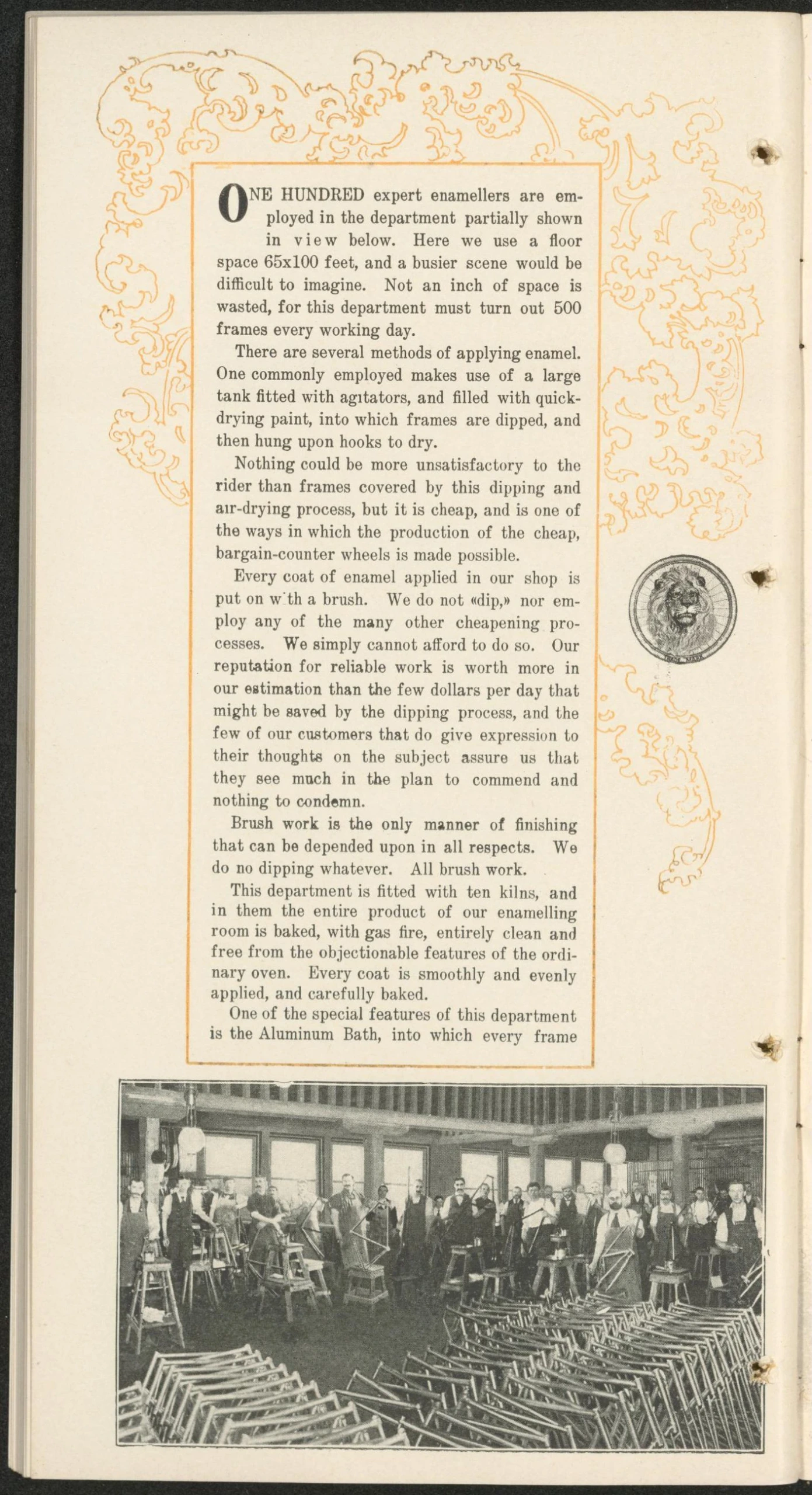 Page 33
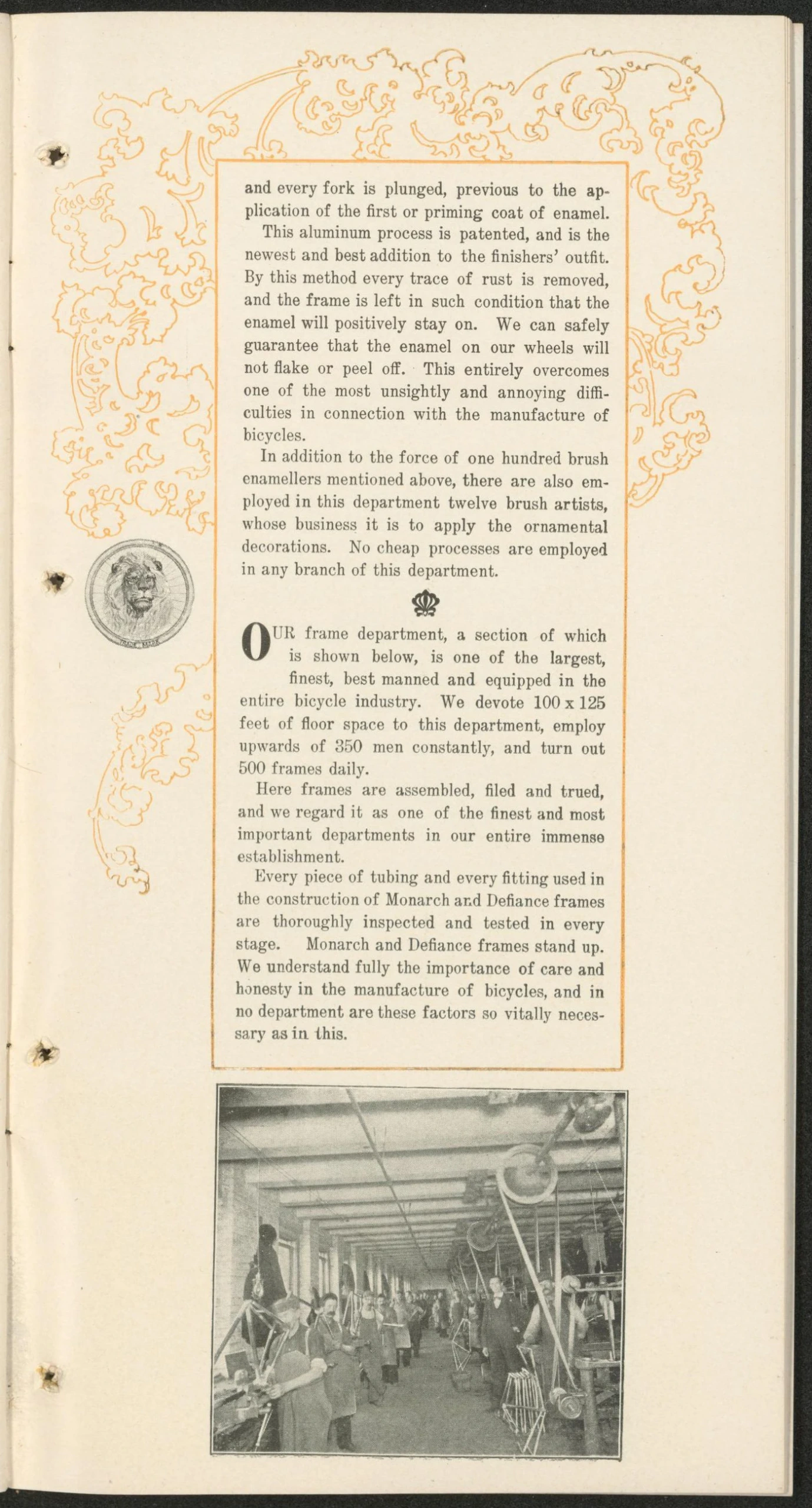 Page 34
 Page 35
 Page 36
 Page 37
 Page 38
 Page 39
 Page 40
 Page 41
 Page 42
 Page 43
| Marque | Monarch |
|---|---|
| Type | Catalog |
| Year | 1898 |
| Publisher | Monarch Cycle Manufacturing Co. |
| Country | United States |
| Language | English |
| Pages | 43 |
| Source | Northwestern University Libraries, Transportation Library, "Monarch and Defiance bicycles" (digital collection, https://dc.library.northwestern.edu/items/01e6a2dc-7604-486e-9558-c6cdf0b08ec4); rights statement "No Copyright - United States". |
| Credit | Northwestern University Libraries |
| Identifier | Permalink https://dc.library.northwestern.edu/items/01e6a2dc-7604-486e-9558-c6cdf0b08ec4 |
| Transcription | Transcribed by eye |
Reference
Monarch Cycle Manufacturing Co. Monarch 1898 Catalog (Monarch Cycle Mfg. Co., Chicago): Monarch and Defiance Bicycles. 1898. Ebykr, https://ebykr.com/library/monarch-catalog-1898/.
Wikipedia
{{cite book |title=Monarch 1898 Catalog (Monarch Cycle Mfg. Co., Chicago): Monarch and Defiance Bicycles |publisher=Monarch Cycle Manufacturing Co. |date=1898 |url=https://ebykr.com/library/monarch-catalog-1898/ |via=Ebykr |access-date=}}MONARCH BICYCLES 1898 MEETING OF THE MONARCHS. "Ride a Monarch And keep in front." MONARCH CYCLE M'F'G CO. MONARCH CYCLE M'F'G CO. MONARCH MONARCH CYCLES MONARCH CYCLE M'F'G CO. MONARCH CYCLE M'F'G CO. SHIPPING DEPOT EASTERN OFFICE AND WAREHOUSE, 83 READE STREET, NEW YORK. EUROPEAN OFFICES, 37 AND 38 SHOE LANE, LONDON, ENG. 7 to …
The Monarch Cycle Manufacturing Company’s catalog for 1898, “Meeting of the Monarchs”: the Monarch tandems 59 and 60 at $100, the Model 48 Cooper Special and 48A Road Racer at $75 and the Models 58 and 57 at $60, with the second-grade Defiance 56 and 55 at $50 and 54 and 53 at $40, each with specifications, then the crank-shaft mechanism, forks, handlebars, pedals, saddles, hubs, chains, finish and gear options, views of seven factory departments, a gear table, terms and guarantee. Transcribed from the page images (43 pages); each page ends with a bracketed description of its pictures.
— Page 1 —
MONARCH
BICYCLES
1898
MEETING OF
THE MONARCHS.
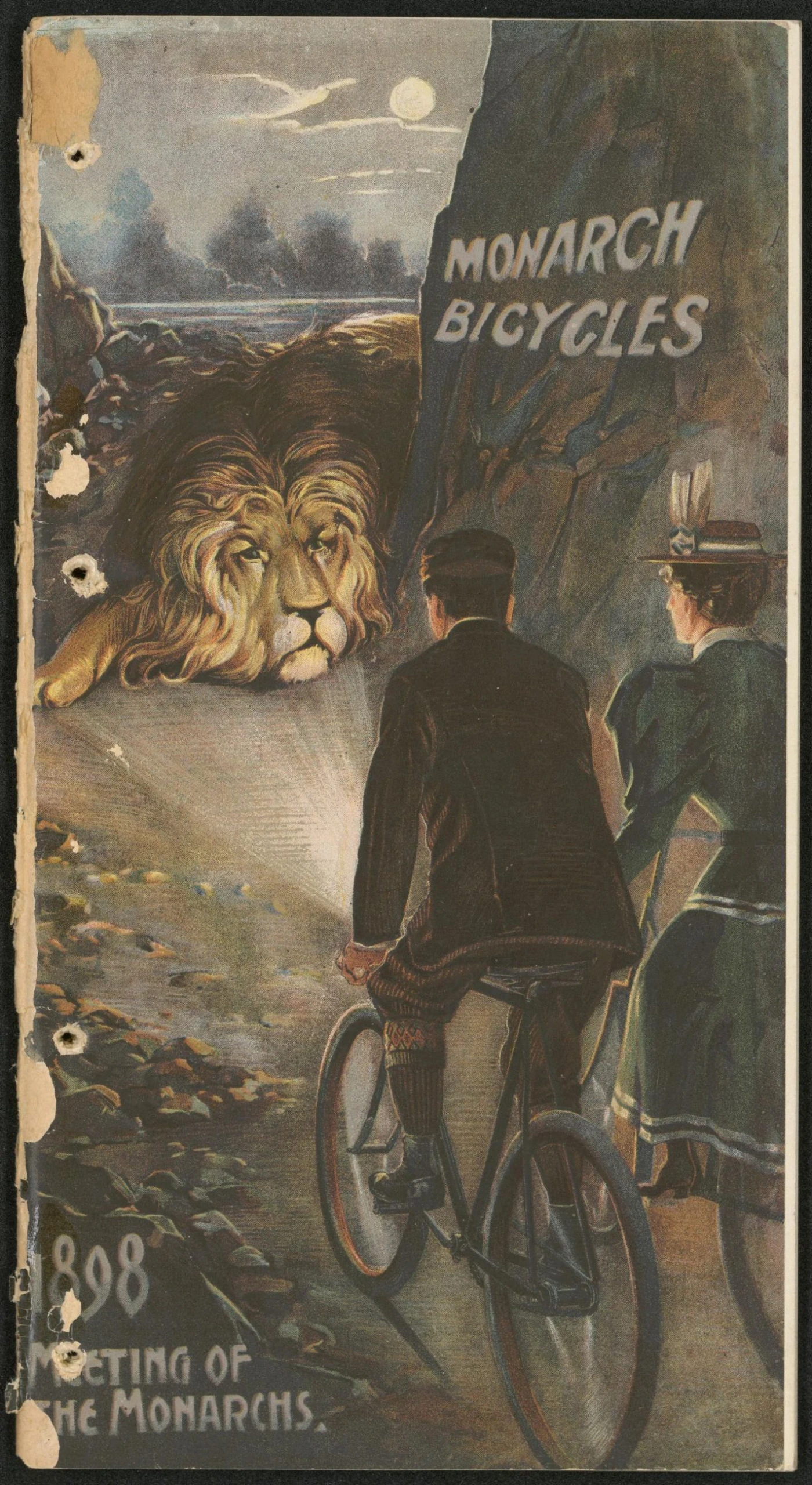
[The color-printed front cover: a moonlit rocky road where a man and a woman on bicycles, seen from behind, meet a lion lying across the path, the lamp beam lighting it; the title is lettered on the rock face. The left edge is worn and torn, with a row of binding holes punched through.]
— Page 2 —
[The blank inside front cover, with four binding holes punched along the right edge.]
— Page 3 —
“Ride a Monarch
And keep in front.”
[A blank leaf with the motto set small in italics at the center; four binding holes punched along the left edge.]
— Page 4 —
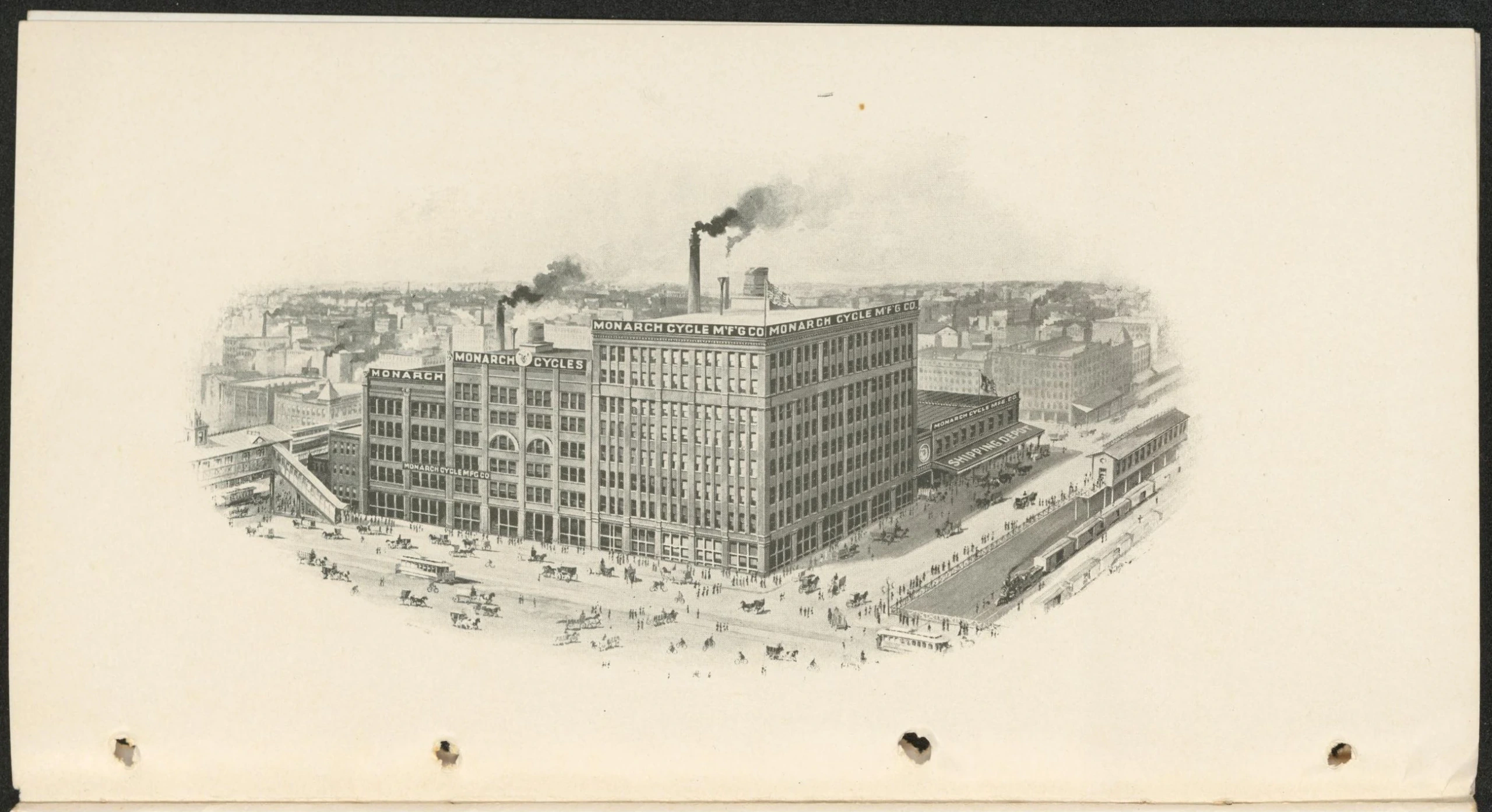
MONARCH CYCLE M’F’G CO.
MONARCH CYCLE M’F’G CO.
MONARCH
MONARCH CYCLES
MONARCH CYCLE M’F’G CO.
MONARCH CYCLE M’F’G CO.
SHIPPING DEPOT
[A vignetted bird’s-eye engraving of the Monarch works, printed sideways on the page: a tall corner block and a lower wing lettered with the firm’s name, smoking chimneys, a shipping depot, an elevated railway, freight cars and streets busy with carriages, streetcars and cyclists. No caption; binding holes along one edge.]
— Page 5 —
EASTERN OFFICE AND
WAREHOUSE,
83 READE STREET,
NEW YORK.
EUROPEAN OFFICES,
37 AND 38 SHOE LANE,
LONDON, ENG.
7 to 11 HOLZBRUCKE,
HAMBURG, GERMANY.
CHICAGO RETAIL
STORES,
152 DEARBORN STREET,
87-89 ASHLAND AVENUE.
CABLE ADDRESSES:
“MONARCH” CHICAGO.
“MONARCH” NEW YORK.
“LOURITZ” HAMBURG.
“EMBILLOW” LONDON
TRADE MARK | TRADE MARK | TRADE MARK
MONARCH AND
DEFIANCE
BICYCLES
THE MONARCH CYCLE
MANUFACTURING CO.
LAKE, HALSTEAD AND
FULTON STREETS
CHICAGO
CAPITAL STOCK AND SURPLUS, $1,000,000.00
J. W. KISER,
President and Treasurer.
CHANDLER ROBBINS,
Vice-President.
A. WEINBERG,
Secretary.
W. J. MEAD
General Manager.
L. M. RICHARDSON,
Ass’t Manager.
P. BIRNER,
General Superintendent.
EDWARD BANGS,
Assistant Superintendent.
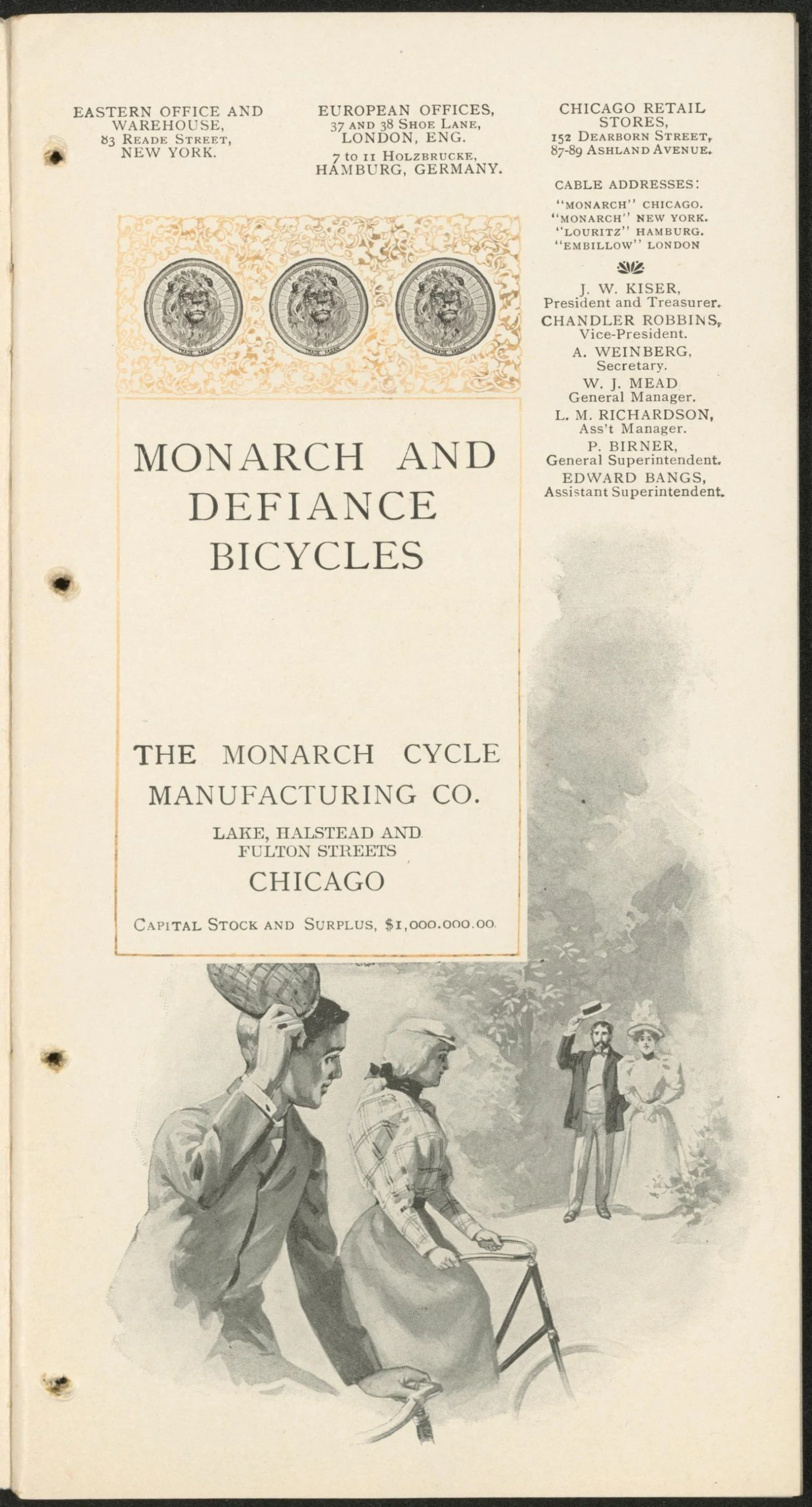
[The title page: a framed title panel headed by three lion-head trade-mark medallions on a gold scrollwork band; below, a halftone of a young man raising his cap beside a young woman on a drop-frame bicycle, with a couple greeting them in a wooded park behind. Binding holes along the left edge.]
— Page 6 —
PREFACE.
“MONARCH” and “DEFIANCE”! What need be said in further recommendation of a line of bicycles that bear these well known brands? The cycling public the world over has long since been convinced, by actual experience, that Monarch and Defiance Bicycles represent, in their respective classes, the most advanced ideas as well as the very best values that the combination of capital, skill and energy can produce.
Conscious of the fact that, owing to this well-earned reputation for originality and progress, very much is expected of us, we have spent several months investigating the requirements of the trade for 1898, both at home and abroad. We are therefore able to present herewith, a line of machines that, not only for mechanical design and construction but also for price, will, we feel confident, meet the approval of all classes of purchasers.
In design, each machine is built upon new and latest approved lines, and contains sufficient new features or improvements to enable us to still retain the same lead in styles over all other makes that it has been our good fortune to hold in the past. True to the purpose, that has contributed more than anything else to our remarkable success as bicycle builders, we have made quite as great improvements in the quality, as during any former year. We have always aimed to produce the
TRADE MARK
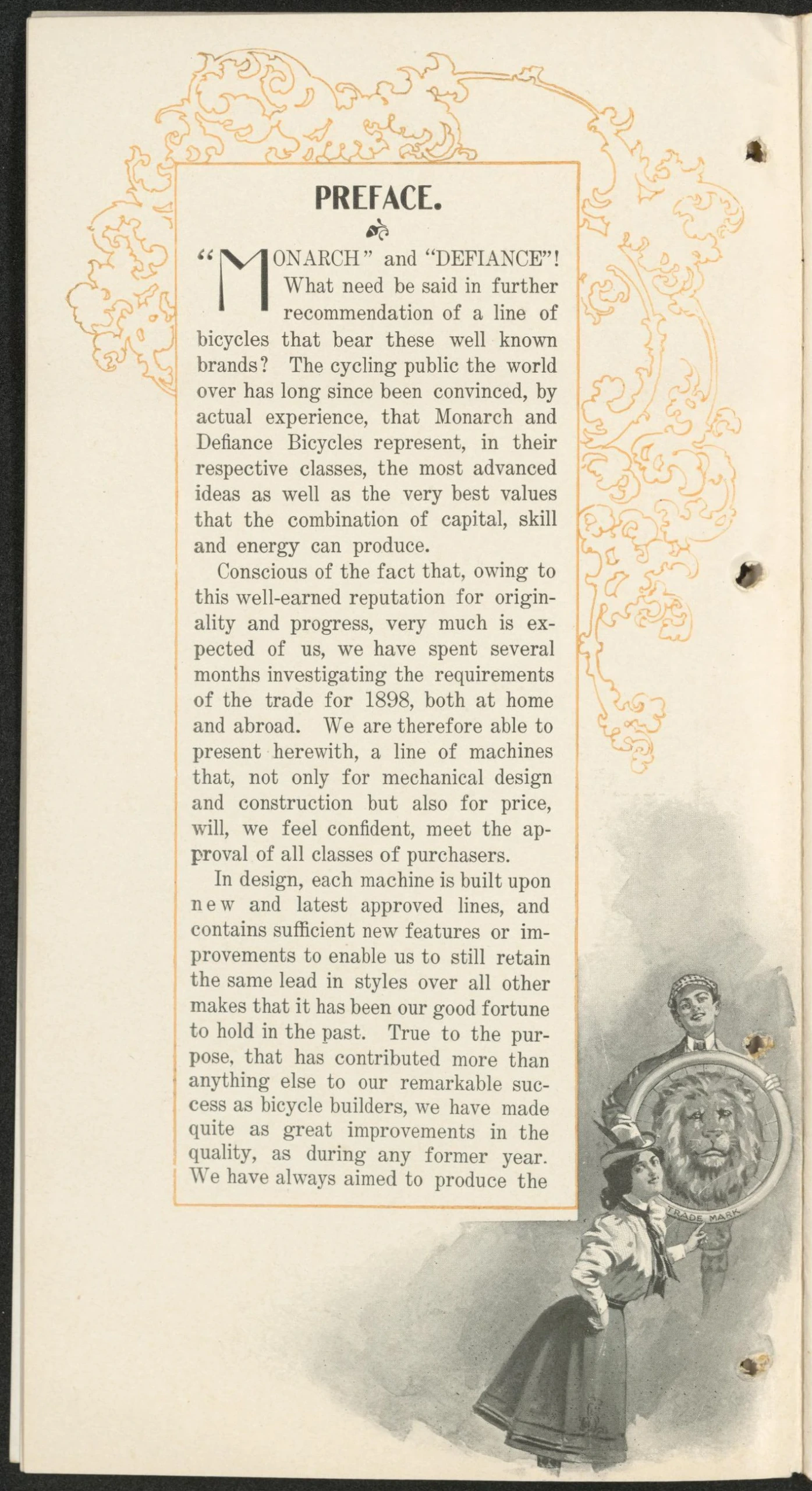
[A text panel framed by gold scrollwork; at lower right a halftone of a young man holding up a wheel rim that frames the lion-head trade mark, with a young woman pointing to it. Binding holes along the right edge.]
— Page 7 —
very best goods that it was possible to build, believing that merit would reap its reward in way of increased business. That those anticipations have been fully realized, is evidenced by the development, in a few years, from a very small beginning, of a large industry with an annual output of fifty thousand bicycles.
So zealously have we protected our reputation for quality, that, notwithstanding the universal demand for lower prices, which we have met with a most radical reduction, we have not only not reduced the quality but have made all the improvements in quality and design that it has been possible to make. This great reduction in list price has only been possible by entirely reorganizing our methods of business, eliminating many items of expense and reducing the discount to our agents to so great an extent that it will be necessary to invariably sell at list prices. We have endeavored to make this reduction in price great enough to command a still larger public patronage, thereby compensating, with increased sales, our agents as well as ourselves, for the small margin of profit on each machine.
While the quality of our goods will not permit of the lowest prices, we believe the judicious purchaser will recognize the difference as too small to justify the selection of a cheap machine under an unknown brand in preference to a “MONARCH” or “DEFIANCE” at the honest price we have placed upon them.
MONARCH
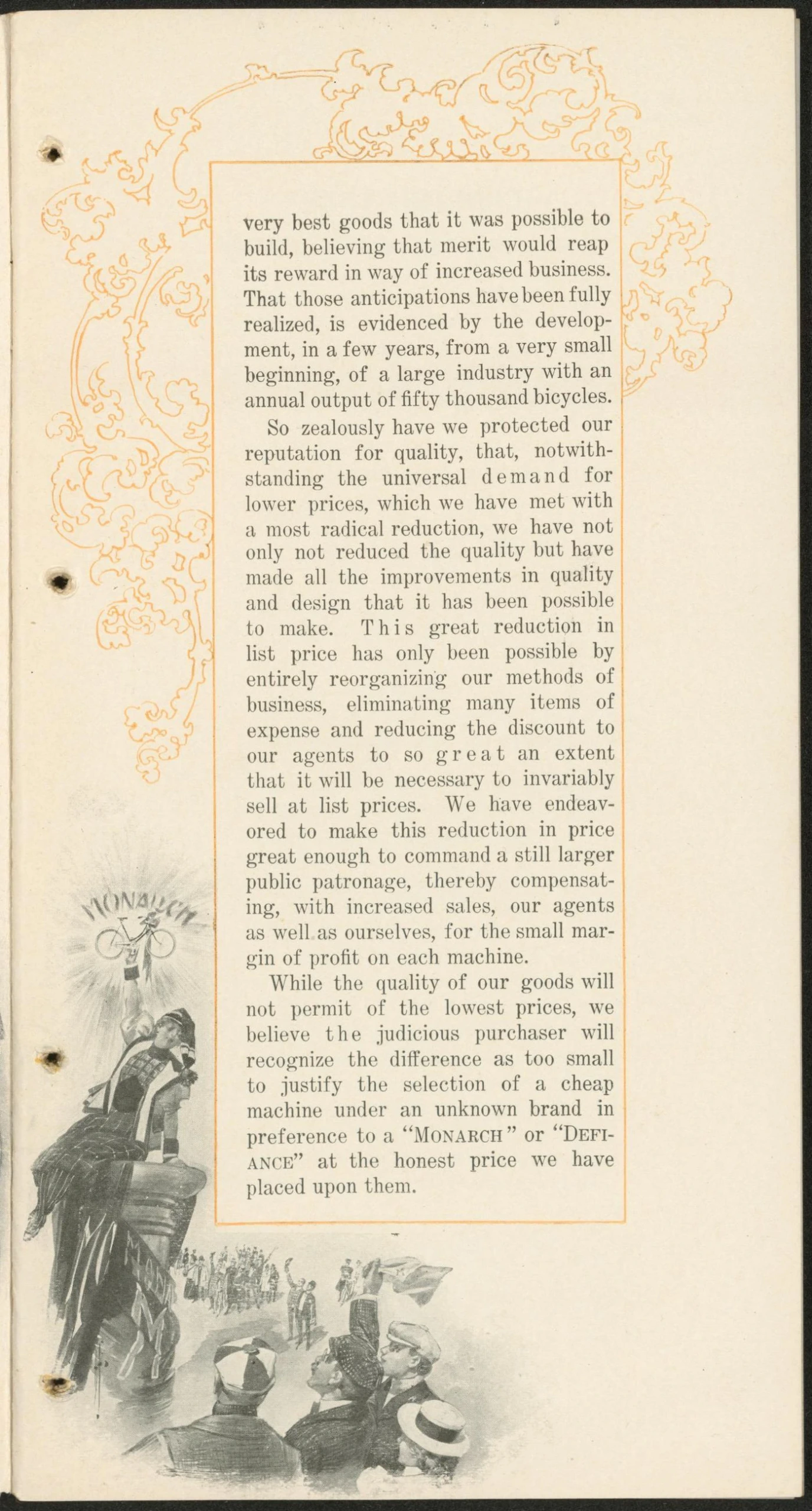
[The preface continued in a gold scrollwork frame; at lower left a halftone of a woman standing on a pedestal holding aloft a bicycle in a burst of light under the word “Monarch,” cheered by a hat-waving crowd. Binding holes along the left edge.]
— Page 8 —
(Lord)
“Come, my gracious Monarch,
Shall I be your play fellow?”
—Winter’s Tale.
CONSTRUCTION.
MODELS 59 AND 60 MONARCH TANDEMS
TANDEMS for ’98 surpass any of our previous models in double machines, and in every respect embody all the leading features of up-to-date construction in tandem bicycles. Where the slightest improvement was possible over our ’97 models, we have made such changes as practical tests have proven desirable.
On model No. 59, two braces have been placed between the tubes in the curve of the frame instead of one, yielding a very rigid support to the front parts of the machine. Double steering rods have been substituted for the single rod on both No. 59 and No. 60.
MODELS 57 AND 58 MONARCHS.
THE same general lines and details of construction are retained in these patterns as were embodied in our $100 Models No. 46 and No. 47 the past season, experience having demonstrated to us that improvements were practically out of the question, except in a few minor details, where slight changes could be made to advantage. We have increased the width of the periphery of the crank-bearing ball cups, thereby providing a greater clamping surface, and have introduced ball retainers. When pressure is put upon the binding lugs by clamping bolts, position of which has been changed slightly by throwing the lugs in towards the center of bracket, a locking device is obtained that makes it absolutely
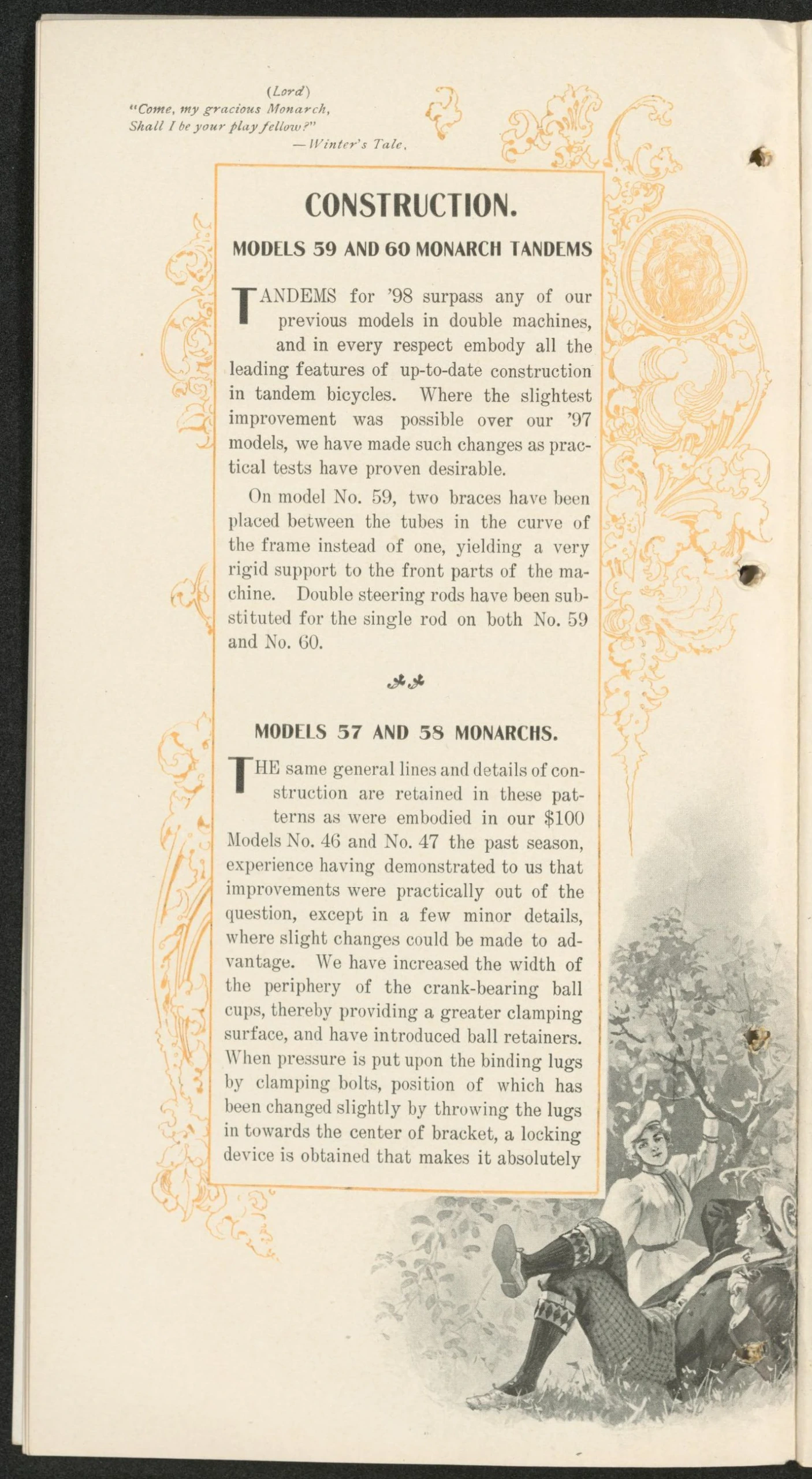
[A text panel framed by gold scrollwork with a gold lion-head trade-mark medallion at upper right; at lower right a halftone of a woman in a straw hat standing beside a young man in checked knickerbockers who lies laughing in the grass, feet in the air. Binding holes along the right edge.]
— Page 9 —
“Ride a Monarch
And keep in front.”
impossible for position of ball cups to change until clamping bolts are loosened.
This pair of bicycles surpasses by far any pair of machines heretofore produced by us, and are the equal of any in the world, without exception. Every detail in their construction has been given special attention, and minute accuracy has been maintained in connection with every feature of their manufacture.
MODEL 48, COOPER SPECIAL RACER
WHILE we have made no particular effort to create a large demand for Monarch Racers, it is evident that our «Cooper Special» is the most popular racing machine on the market. It is being ridden by many of the most prominent racing men, including Mr. Tom Cooper, in this country and in Europe, with great success; and can always be depended upon to respond quickly to the efforts of the rider in a hot finish. The Cooper Special has never been the cause of defeat by breaking down at a critical moment, when quality counts most in man and machine.
MODEL 48 A, MONARCH ROAD RACER
THIS machine is a most elegant light road wheel for riders of medium weight and experience. It is very similar in construction to our Model No. 48 Cooper Special Racer, with tires and rims slightly heavier, and equipped with our regular semi-ramshorn handle bar and Perry pneumatic saddle.
Its weight is about 22 pounds, and it is suitable for experienced riders not exceeding 175 pounds in weight for general road riding.
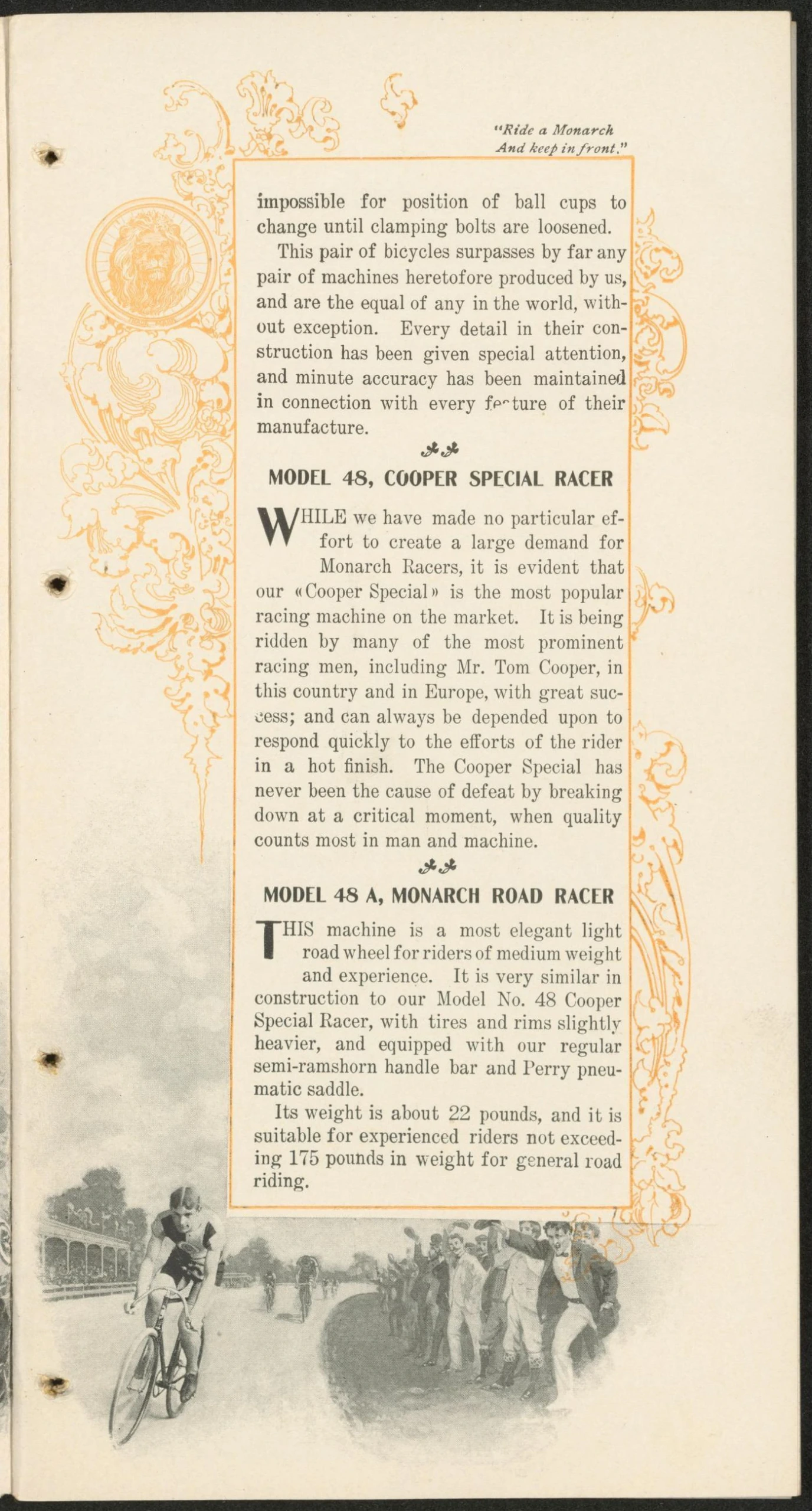
[A text panel framed by gold scrollwork with a gold lion-head medallion at upper left; below, a halftone of a racing cyclist on a track before a grandstand while a crowd of men cheer and wave hats at the trackside. The type of “feature” is damaged. Binding holes along the left edge.]
— Page 10 —
DEFIANCE BICYCLES
IN our Models No. 55 and No. 56 we have produced a pair of bicycles unsurpassed for general road riding. They possess high-grade features throughout, and are designed to meet the demand for medium-priced wheels.
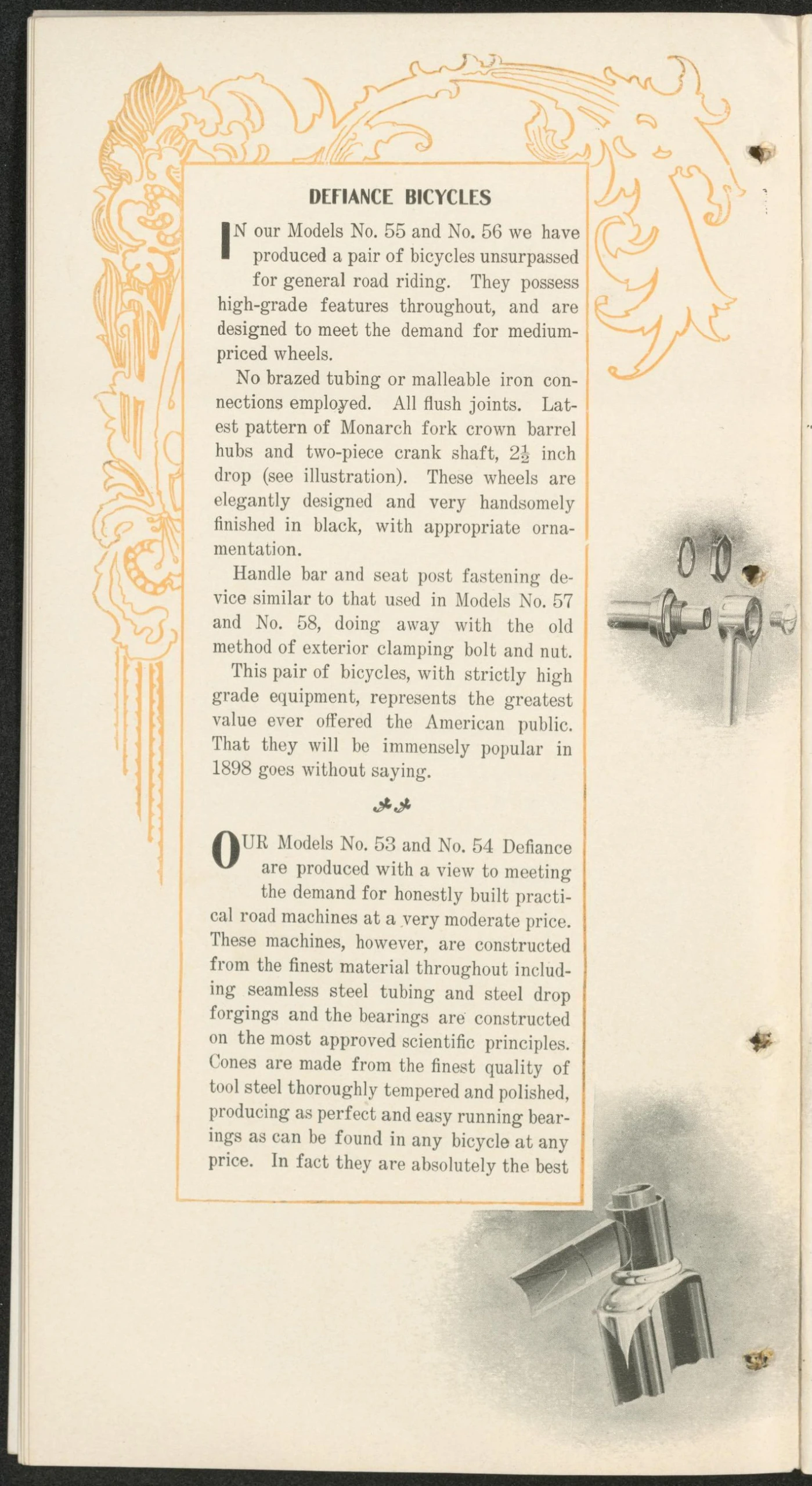
No brazed tubing or malleable iron connections employed. All flush joints. Latest pattern of Monarch fork crown barrel hubs and two-piece crank shaft, 2½ inch drop (see illustration). These wheels are elegantly designed and very handsomely finished in black, with appropriate ornamentation.
Handle bar and seat post fastening device similar to that used in Models No. 57 and No. 58, doing away with the old method of exterior clamping bolt and nut.
This pair of bicycles, with strictly high grade equipment, represents the greatest value ever offered the American public. That they will be immensely popular in 1898 goes without saying.
OUR Models No. 53 and No. 54 Defiance are produced with a view to meeting the demand for honestly built practical road machines at a very moderate price. These machines, however, are constructed from the finest material throughout including seamless steel tubing and steel drop forgings and the bearings are constructed on the most approved scientific principles. Cones are made from the finest quality of tool steel thoroughly tempered and polished, producing as perfect and easy running bearings as can be found in any bicycle at any price. In fact they are absolutely the best
[A text panel framed by gold scrollwork; at right two halftone part views: an exploded two-piece crank shaft with its crank, lock ring and nut, and below a fork crown with the head tube in a sectioned view. Binding holes along the right edge.]
— Page 11 —
“All roads are alike to a
Monarch.”
—Jessie Bartlett Davis
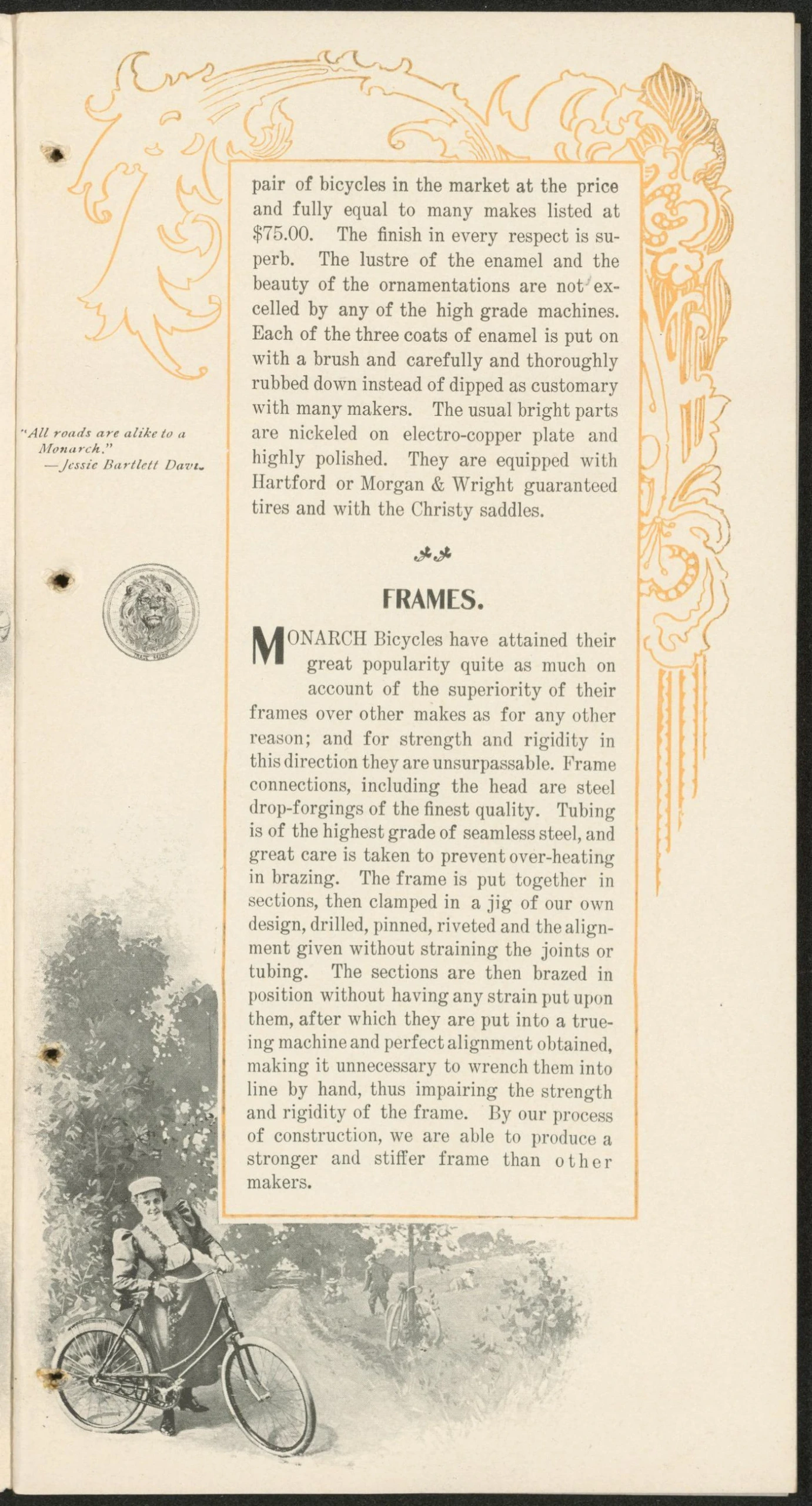
pair of bicycles in the market at the price and fully equal to many makes listed at $75.00. The finish in every respect is superb. The lustre of the enamel and the beauty of the ornamentations are not excelled by any of the high grade machines. Each of the three coats of enamel is put on with a brush and carefully and thoroughly rubbed down instead of dipped as customary with many makers. The usual bright parts are nickeled on electro-copper plate and highly polished. They are equipped with Hartford or Morgan & Wright guaranteed tires and with the Christy saddles.
FRAMES.
MONARCH Bicycles have attained their great popularity quite as much on account of the superiority of their frames over other makes as for any other reason; and for strength and rigidity in this direction they are unsurpassable. Frame connections, including the head are steel drop-forgings of the finest quality. Tubing is of the highest grade of seamless steel, and great care is taken to prevent over-heating in brazing. The frame is put together in sections, then clamped in a jig of our own design, drilled, pinned, riveted and the alignment given without straining the joints or tubing. The sections are then brazed in position without having any strain put upon them, after which they are put into a trueing machine and perfect alignment obtained, making it unnecessary to wrench them into line by hand, thus impairing the strength and rigidity of the frame. By our process of construction, we are able to produce a stronger and stiffer frame than other makers.
TRADE MARK
[A text panel framed by gold scrollwork; at left a small lion-head trade-mark medallion and below it a halftone of a smiling woman in a cap standing with her drop-frame bicycle on a wooded lane, other cyclists resting behind. The last letter of the quoted name is broken. Binding holes along the left edge.]
— Page 12 —
“A Monarch! a Monarch! My
Kingdom for a Monarch!”
CRANK-SHAFT MECHANISM.
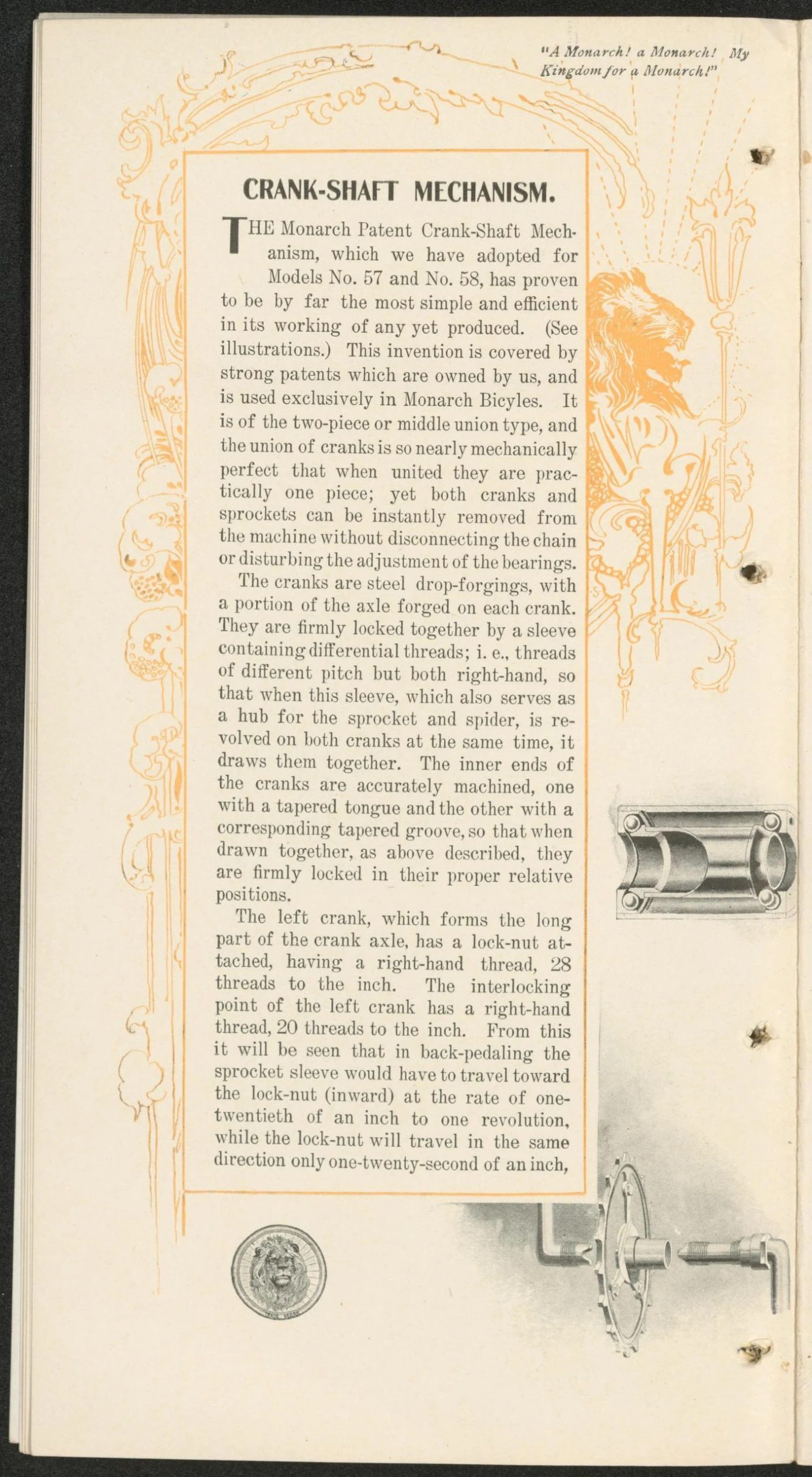
THE Monarch Patent Crank-Shaft Mechanism, which we have adopted for Models No. 57 and No. 58, has proven to be by far the most simple and efficient in its working of any yet produced. (See illustrations.) This invention is covered by strong patents which are owned by us, and is used exclusively in Monarch Bicyles. It is of the two-piece or middle union type, and the union of cranks is so nearly mechanically perfect that when united they are practically one piece; yet both cranks and sprockets can be instantly removed from the machine without disconnecting the chain or disturbing the adjustment of the bearings.
The cranks are steel drop-forgings, with a portion of the axle forged on each crank. They are firmly locked together by a sleeve containing differential threads; i. e., threads of different pitch but both right-hand, so that when this sleeve, which also serves as a hub for the sprocket and spider, is revolved on both cranks at the same time, it draws them together. The inner ends of the cranks are accurately machined, one with a tapered tongue and the other with a corresponding tapered groove, so that when drawn together, as above described, they are firmly locked in their proper relative positions.
The left crank, which forms the long part of the crank axle, has a lock-nut attached, having a right-hand thread, 28 threads to the inch. The interlocking point of the left crank has a right-hand thread, 20 threads to the inch. From this it will be seen that in back-pedaling the sprocket sleeve would have to travel toward the lock-nut (inward) at the rate of one-twentieth of an inch to one revolution, while the lock-nut will travel in the same direction only one-twenty-second of an inch,
TRADE MARK
[A text panel framed by gold scrollwork with a gold rampant lion in a sunburst at upper right; at right two halftone part views: a sectioned crank hanger shell with its ball cups, and below an exploded two-piece crank set with the sprocket on its sleeve. A small lion trade-mark medallion at lower left. Binding holes along the right edge.]
— Page 13 —
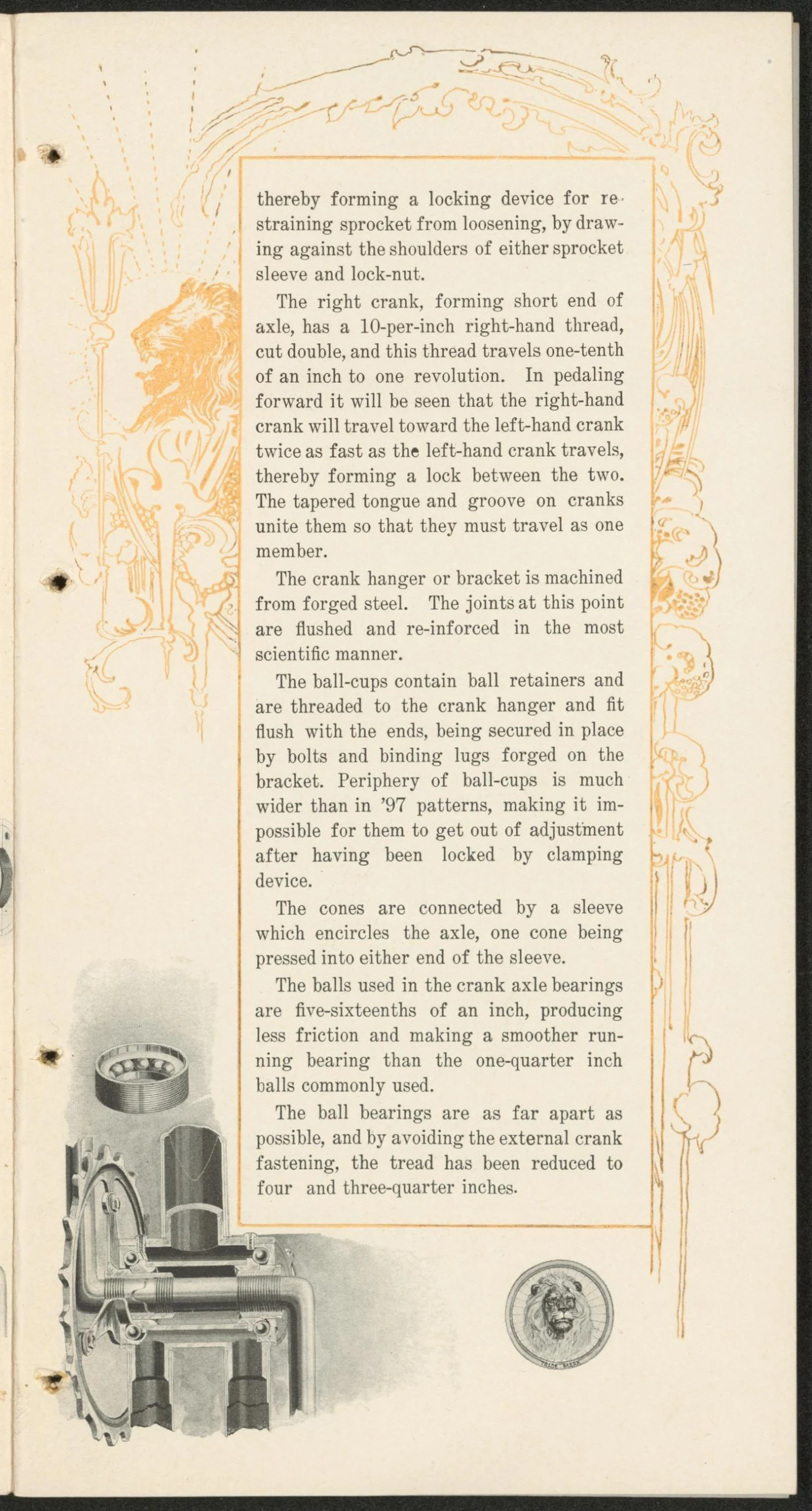
thereby forming a locking device for restraining sprocket from loosening, by drawing against the shoulders of either sprocket sleeve and lock-nut.
The right crank, forming short end of axle, has a 10-per-inch right-hand thread, cut double, and this thread travels one-tenth of an inch to one revolution. In pedaling forward it will be seen that the right-hand crank will travel toward the left-hand crank twice as fast as the left-hand crank travels, thereby forming a lock between the two. The tapered tongue and groove on cranks unite them so that they must travel as one member.
The crank hanger or bracket is machined from forged steel. The joints at this point are flushed and re-inforced in the most scientific manner.
The ball-cups contain ball retainers and are threaded to the crank hanger and fit flush with the ends, being secured in place by bolts and binding lugs forged on the bracket. Periphery of ball-cups is much wider than in ’97 patterns, making it impossible for them to get out of adjustment after having been locked by clamping device.
The cones are connected by a sleeve which encircles the axle, one cone being pressed into either end of the sleeve.
The balls used in the crank axle bearings are five-sixteenths of an inch, producing less friction and making a smoother running bearing than the one-quarter inch balls commonly used.
The ball bearings are as far apart as possible, and by avoiding the external crank fastening, the tread has been reduced to four and three-quarter inches.
TRADE MARK
[A text panel framed by gold scrollwork with a gold rampant lion and sunburst at upper left; at lower left halftones of a threaded ball cup with its ball retainer and a sectioned crank hanger assembled with the sprocket; a lion trade-mark medallion at lower right. Binding holes along the left edge.]
— Page 14 —
TRADE MARK
HOW TO REMOVE CRANK SHAFT.
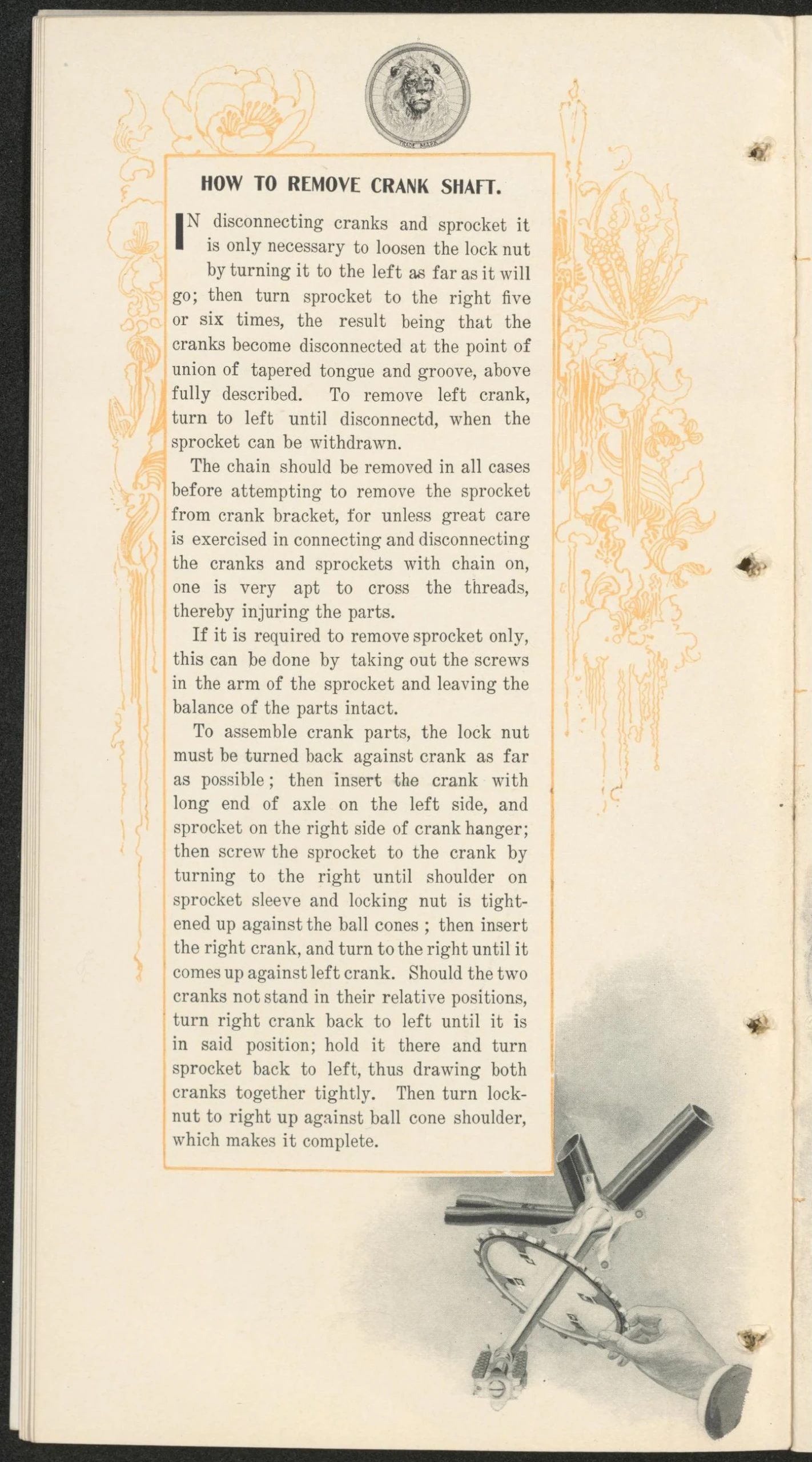
IN disconnecting cranks and sprocket it is only necessary to loosen the lock nut by turning it to the left as far as it will go; then turn sprocket to the right five or six times, the result being that the cranks become disconnected at the point of union of tapered tongue and groove, above fully described. To remove left crank, turn to left until disconnectd, when the sprocket can be withdrawn.
The chain should be removed in all cases before attempting to remove the sprocket from crank bracket, for unless great care is exercised in connecting and disconnecting the cranks and sprockets with chain on, one is very apt to cross the threads, thereby injuring the parts.
If it is required to remove sprocket only, this can be done by taking out the screws in the arm of the sprocket and leaving the balance of the parts intact.
To assemble crank parts, the lock nut must be turned back against crank as far as possible; then insert the crank with long end of axle on the left side, and sprocket on the right side of crank hanger; then screw the sprocket to the crank by turning to the right until shoulder on sprocket sleeve and locking nut is tightened up against the ball cones; then insert the right crank, and turn to the right until it comes up against left crank. Should the two cranks not stand in their relative positions, turn right crank back to left until it is in said position; hold it there and turn sprocket back to left, thus drawing both cranks together tightly. Then turn lock-nut to right up against ball cone shoulder, which makes it complete.
[A text panel framed by gold floral ornament, headed by a lion trade-mark medallion; at lower right a halftone of a hand turning the sprocket of a crank hanger cluster with tubes, crank and pedal attached. Binding holes along the right edge.]
— Page 15 —
“I think the Monarch much the best wheel
I have ever ridden.”
—W. H. Crane.
FORKS.
THE MONARCH front fork crown is a distinctive mark of a Monarch Bicycle and is made from a steel drop-forging of a very neat design, accurately milled. The union with the fork blades is so accurately made as to conceal the joints, thereby making a handsome, smooth finish.
Models No. 55 and No. 56 fork crown same as on No. 57 and No. 58 Monarch.
Front forks of Models No. 53 and No. 54 Defiance are constructed with an arch crown nickel plated with nickeled fork ends.
REAR FORK AND CHAIN ADJUSTMENT.
THE rear forks of our new models embody the latest and most practicable device for the adjustment of chain, as after repeated experiments we have not been able to develope any improvement in this direction. (See illustration.)
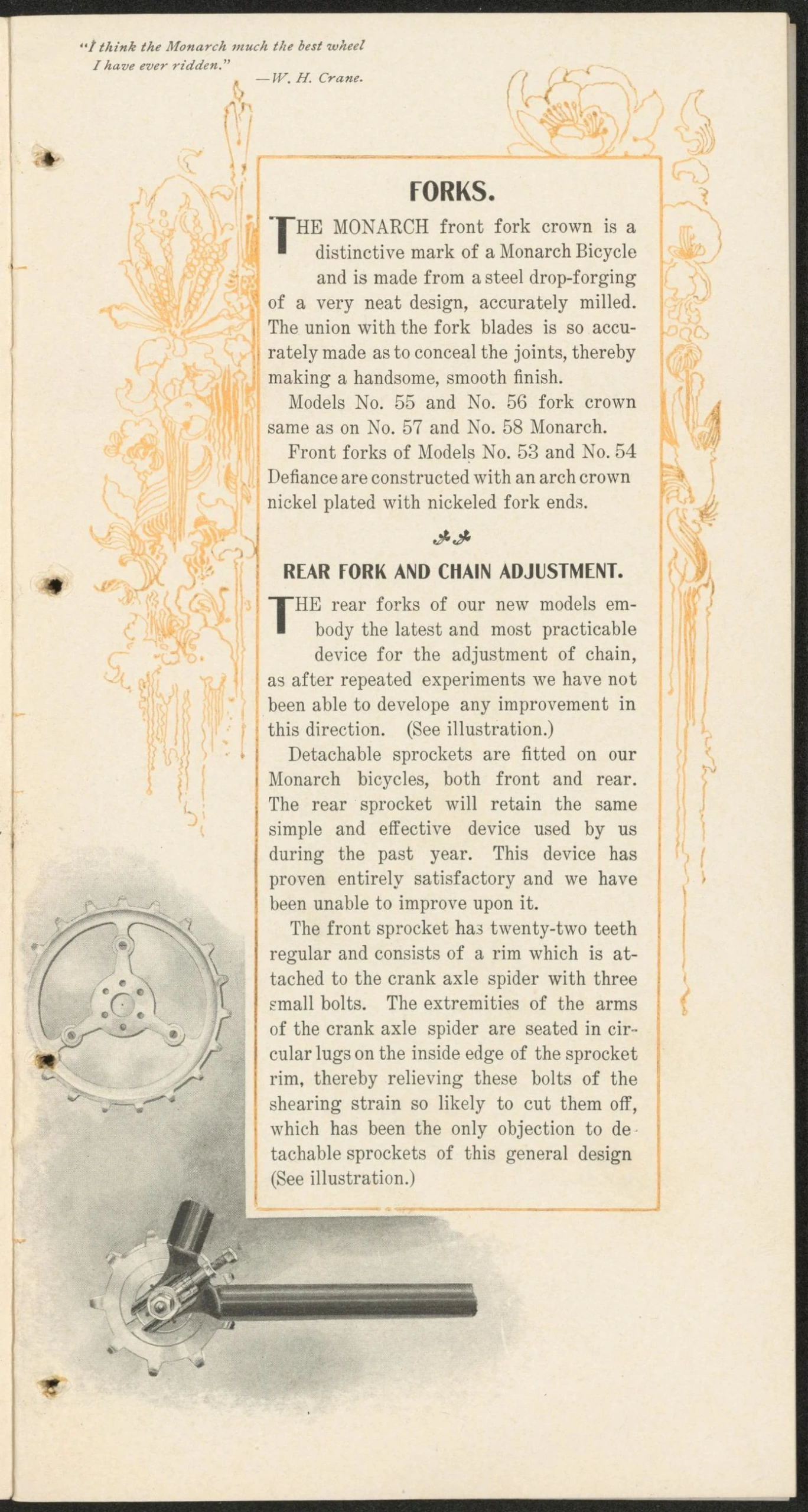
Detachable sprockets are fitted on our Monarch bicycles, both front and rear. The rear sprocket will retain the same simple and effective device used by us during the past year. This device has proven entirely satisfactory and we have been unable to improve upon it.
The front sprocket has twenty-two teeth regular and consists of a rim which is attached to the crank axle spider with three small bolts. The extremities of the arms of the crank axle spider are seated in circular lugs on the inside edge of the sprocket rim, thereby relieving these bolts of the shearing strain so likely to cut them off, which has been the only objection to detachable sprockets of this general design (See illustration.)
[A text panel framed by gold floral ornament; at lower left halftones of the detachable front sprocket rim on its three-armed spider and of a rear fork end with the chain-adjusting bolt and rear sprocket. Binding holes along the left edge.]
— Page 16 —
HANDLE BARS.
ADJUSTABLE semi-ramshorn steel handle bars will continue to be a feature of our wheels. By an ingenious device, the handle bar can be quickly and easily changed to any desired position, except on Model No. 48 Racer, which is fitted with stationary ramshorn bar.
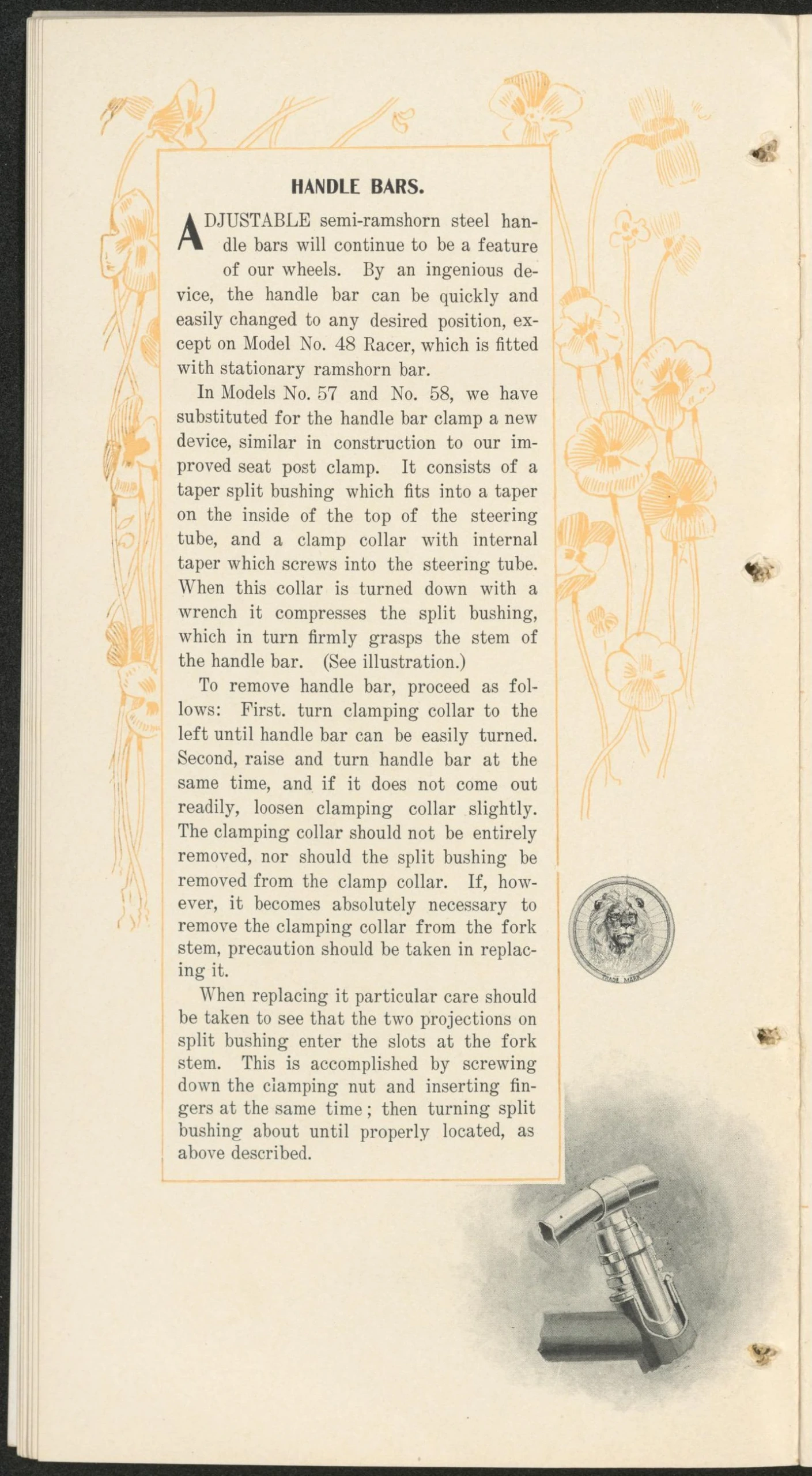
In Models No. 57 and No. 58, we have substituted for the handle bar clamp a new device, similar in construction to our improved seat post clamp. It consists of a taper split bushing which fits into a taper on the inside of the top of the steering tube, and a clamp collar with internal taper which screws into the steering tube. When this collar is turned down with a wrench it compresses the split bushing, which in turn firmly grasps the stem of the handle bar. (See illustration.)
To remove handle bar, proceed as follows: First. turn clamping collar to the left until handle bar can be easily turned. Second, raise and turn handle bar at the same time, and if it does not come out readily, loosen clamping collar slightly. The clamping collar should not be entirely removed, nor should the split bushing be removed from the clamp collar. If, however, it becomes absolutely necessary to remove the clamping collar from the fork stem, precaution should be taken in replacing it.
When replacing it particular care should be taken to see that the two projections on split bushing enter the slots at the fork stem. This is accomplished by screwing down the clamping nut and inserting fingers at the same time; then turning split bushing about until properly located, as above described.
TRADE MARK
[A text panel framed by gold pansy ornament; a lion trade-mark medallion at right and, at lower right, a halftone of the handle bar stem in its split-bushing clamp, the head tube cut away. Binding holes along the right edge.]
— Page 17 —
“I prefer the Monarch to all others.”
—Lillian Russell.
PEDALS.
MONARCH pedals are as near perfection as possible. They are of neat design, light, yet capable of standing heavy service. They are made in the combination pattern 3½ or 4 inch. The ball cups, ball cones and ball races are made from solid bar steel, very accurately machined to gauge, hardened, tempered to straw color, ground out and inspected separately.
SADDLES.
ON OUR MONARCH line we will supply Christy or Perry pneumatic saddles, and on Models No. 53, No. 54, No. 55 and No. 56 Defiance, the Christy saddle.
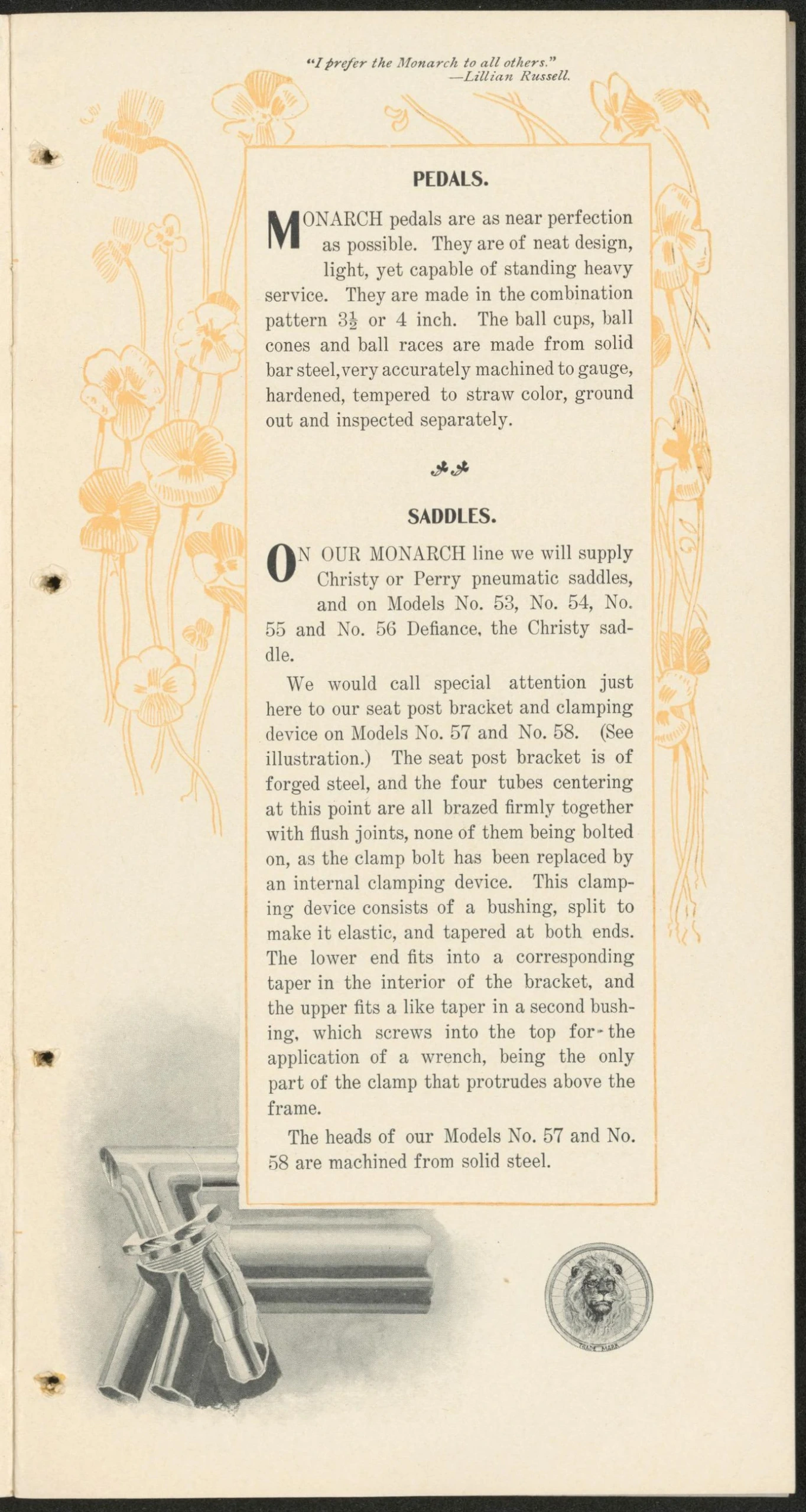
We would call special attention just here to our seat post bracket and clamping device on Models No. 57 and No. 58. (See illustration.) The seat post bracket is of forged steel, and the four tubes centering at this point are all brazed firmly together with flush joints, none of them being bolted on, as the clamp bolt has been replaced by an internal clamping device. This clamping device consists of a bushing, split to make it elastic, and tapered at both ends. The lower end fits into a corresponding taper in the interior of the bracket, and the upper fits a like taper in a second bushing, which screws into the top for the application of a wrench, being the only part of the clamp that protrudes above the frame.
The heads of our Models No. 57 and No. 58 are machined from solid steel.
TRADE MARK
[A text panel framed by gold pansy ornament; at lower left a halftone of the seat post cluster with the top tube, seat stays and the internal split-bushing clamp; a lion trade-mark medallion at lower right. Binding holes along the left edge.]
— Page 18 —
TRADE MARK
HUBS.
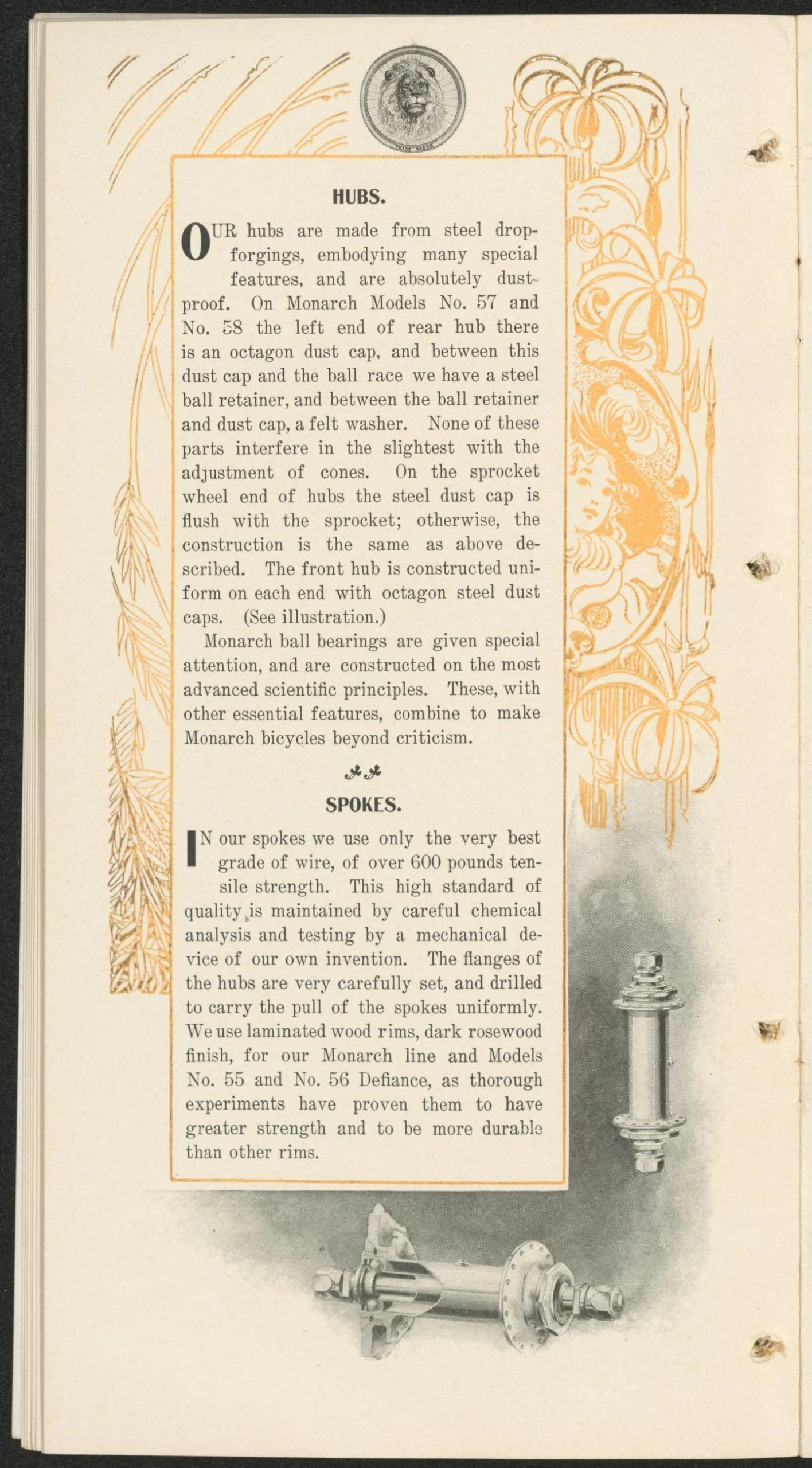
OUR hubs are made from steel drop-forgings, embodying many special features, and are absolutely dust-proof. On Monarch Models No. 57 and No. 58 the left end of rear hub there is an octagon dust cap, and between this dust cap and the ball race we have a steel ball retainer, and between the ball retainer and dust cap, a felt washer. None of these parts interfere in the slightest with the adjustment of cones. On the sprocket wheel end of hubs the steel dust cap is flush with the sprocket; otherwise, the construction is the same as above described. The front hub is constructed uniform on each end with octagon steel dust caps. (See illustration.)
Monarch ball bearings are given special attention, and are constructed on the most advanced scientific principles. These, with other essential features, combine to make Monarch bicycles beyond criticism.
SPOKES.
IN our spokes we use only the very best grade of wire, of over 600 pounds tensile strength. This high standard of quality is maintained by careful chemical analysis and testing by a mechanical device of our own invention. The flanges of the hubs are very carefully set, and drilled to carry the pull of the spokes uniformly. We use laminated wood rims, dark rosewood finish, for our Monarch line and Models No. 55 and No. 56 Defiance, as thorough experiments have proven them to have greater strength and to be more durable than other rims.
[A text panel headed by a lion trade-mark medallion and framed by gold ornament of grasses, lilies and a girl’s head in a bonnet; at lower right halftones of a front hub and of a rear hub with its sprocket cut away. Binding holes along the right edge.]
— Page 19 —
TRADE MARK
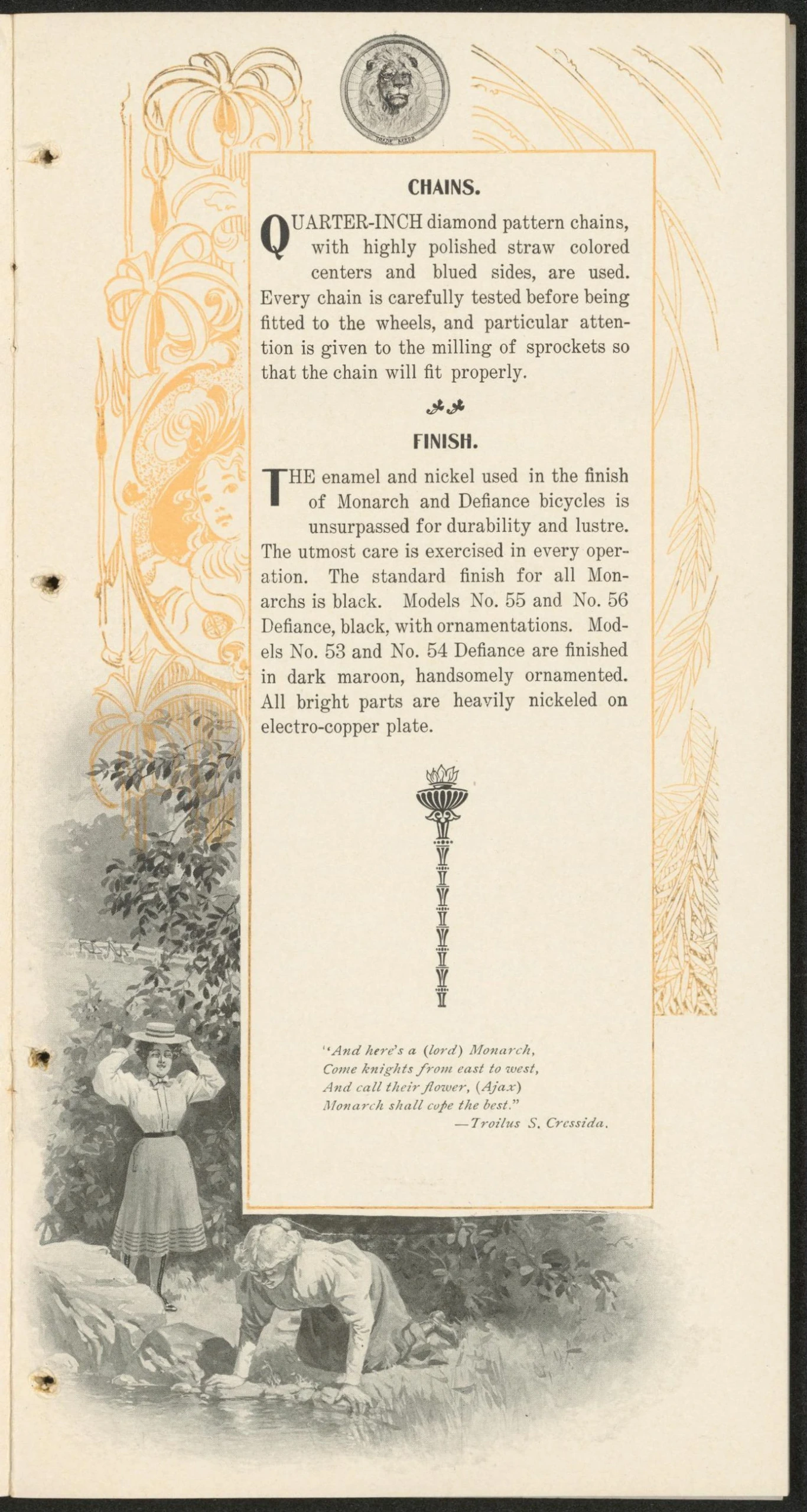
CHAINS.
QUARTER-INCH diamond pattern chains, with highly polished straw colored centers and blued sides, are used. Every chain is carefully tested before being fitted to the wheels, and particular attention is given to the milling of sprockets so that the chain will fit properly.
FINISH.
THE enamel and nickel used in the finish of Monarch and Defiance bicycles is unsurpassed for durability and lustre. The utmost care is exercised in every operation. The standard finish for all Monarchs is black. Models No. 55 and No. 56 Defiance, black, with ornamentations. Models No. 53 and No. 54 Defiance are finished in dark maroon, handsomely ornamented. All bright parts are heavily nickeled on electro-copper plate.
“And here’s a (lord) Monarch,
Come knights from east to west,
And call their flower, (Ajax)
Monarch shall cope the best.”
—Troilus S. Cressida.
[A text panel headed by a lion trade-mark medallion and framed by gold ornament of grasses, lilies and a girl’s head; a torch-shaped ornament in the panel; at lower left a halftone of two young women at a woodland stream, one standing holding her straw hat, one kneeling at the water. Binding holes along the left edge.]
— Page 20 —
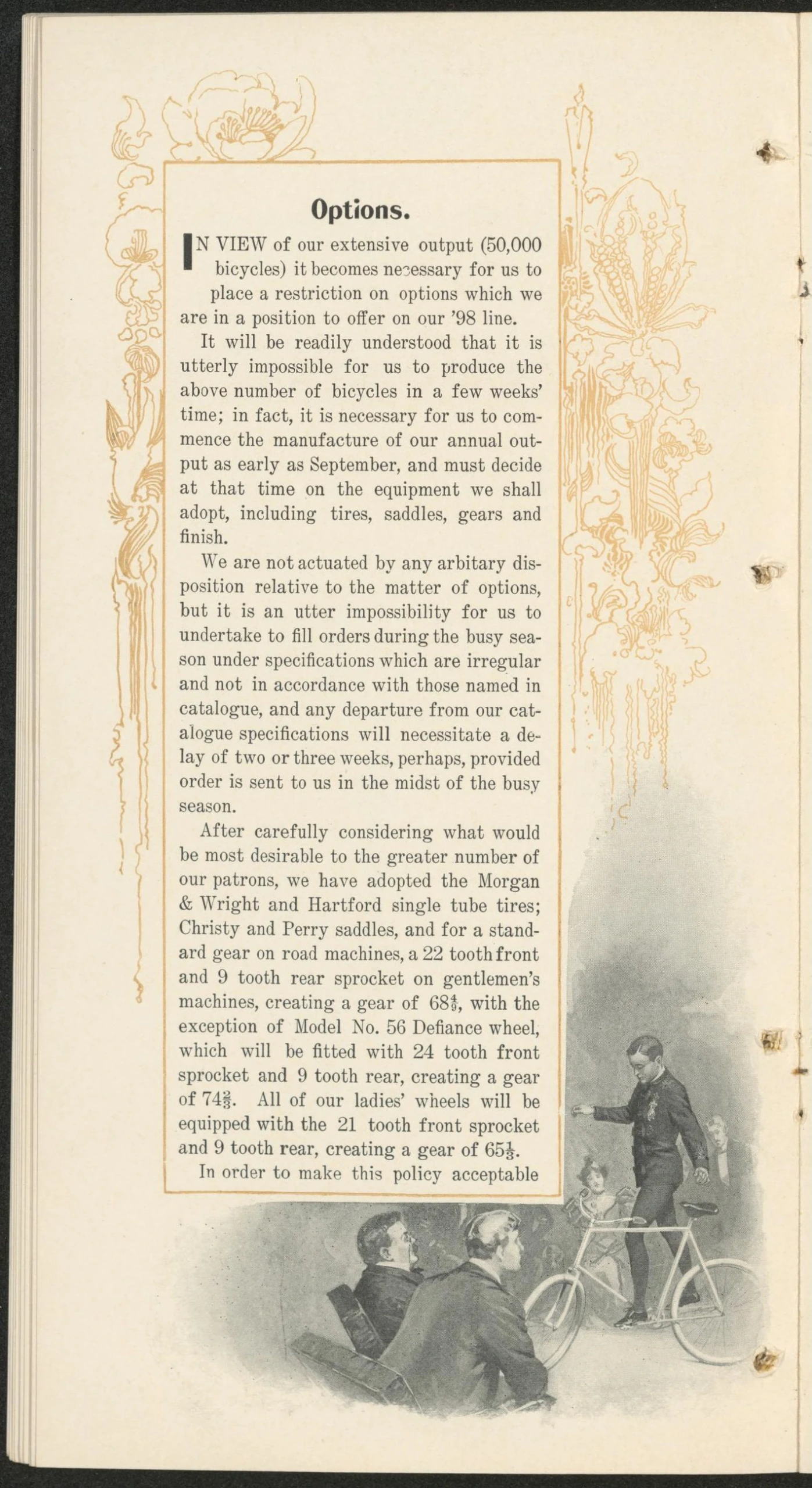
Options.
IN VIEW of our extensive output (50,000 bicycles) it becomes necessary for us to place a restriction on options which we are in a position to offer on our ’98 line.
It will be readily understood that it is utterly impossible for us to produce the above number of bicycles in a few weeks’ time; in fact, it is necessary for us to commence the manufacture of our annual output as early as September, and must decide at that time on the equipment we shall adopt, including tires, saddles, gears and finish.
We are not actuated by any arbitary disposition relative to the matter of options, but it is an utter impossibility for us to undertake to fill orders during the busy season under specifications which are irregular and not in accordance with those named in catalogue, and any departure from our catalogue specifications will necessitate a delay of two or three weeks, perhaps, provided order is sent to us in the midst of the busy season.
After carefully considering what would be most desirable to the greater number of our patrons, we have adopted the Morgan & Wright and Hartford single tube tires; Christy and Perry saddles, and for a standard gear on road machines, a 22 tooth front and 9 tooth rear sprocket on gentlemen’s machines, creating a gear of 68 4/9, with the exception of Model No. 56 Defiance wheel, which will be fitted with 24 tooth front sprocket and 9 tooth rear, creating a gear of 74 2/3. All of our ladies’ wheels will be equipped with the 21 tooth front sprocket and 9 tooth rear, creating a gear of 65 1/3.
In order to make this policy acceptable
[A text panel framed by gold floral ornament; at lower right a halftone of a trick rider in a frogged jacket standing on the saddle and bars of a bicycle before a theater audience, two men watching in the foreground. Binding holes along the right edge.]
— Page 21 —
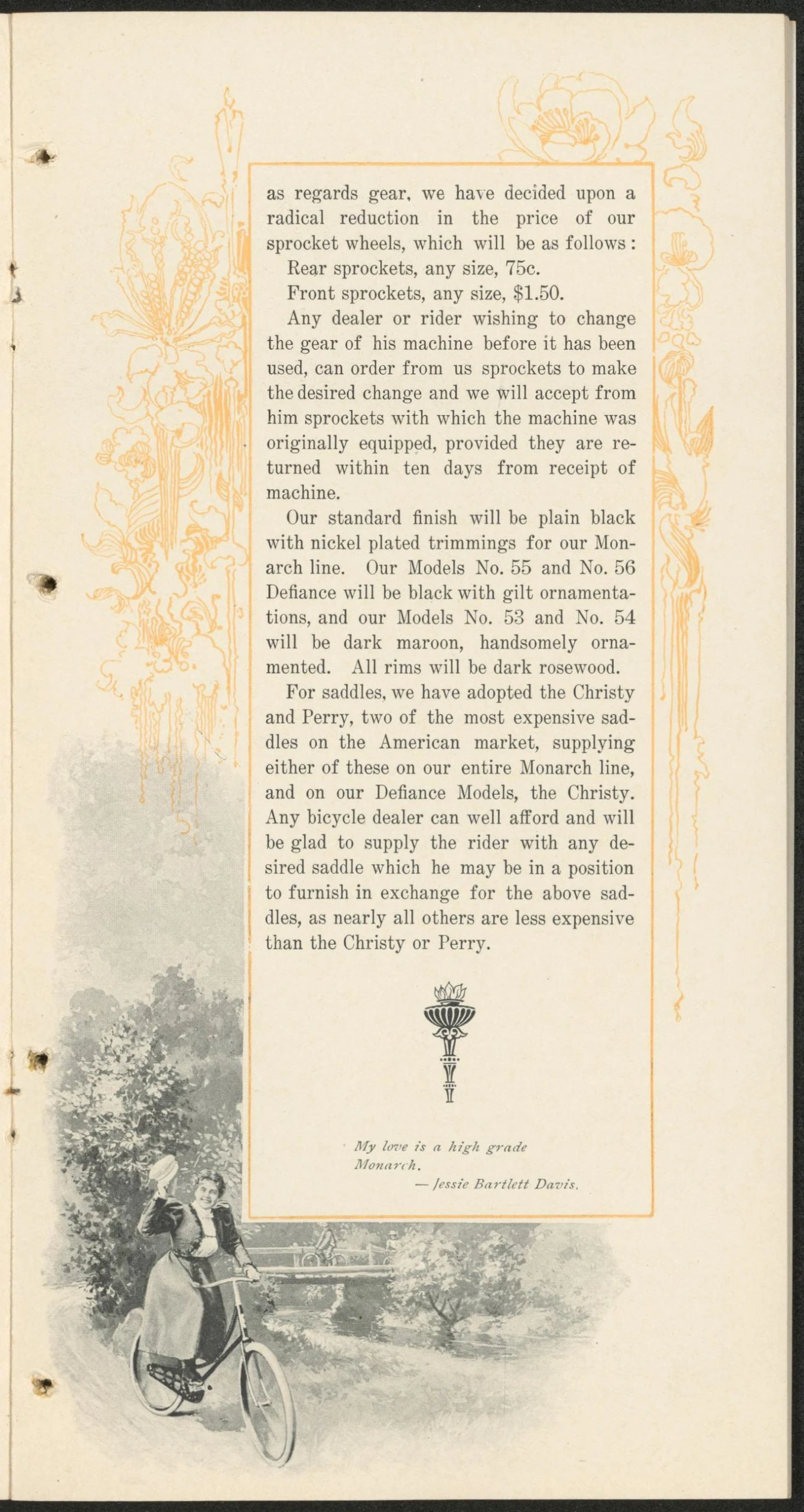
as regards gear, we have decided upon a radical reduction in the price of our sprocket wheels, which will be as follows:
Rear sprockets, any size, 75c.
Front sprockets, any size, $1.50.
Any dealer or rider wishing to change the gear of his machine before it has been used, can order from us sprockets to make the desired change and we will accept from him sprockets with which the machine was originally equipped, provided they are returned within ten days from receipt of machine.
Our standard finish will be plain black with nickel plated trimmings for our Monarch line. Our Models No. 55 and No. 56 Defiance will be black with gilt ornamentations, and our Models No. 53 and No. 54 will be dark maroon, handsomely ornamented. All rims will be dark rosewood.
For saddles, we have adopted the Christy and Perry, two of the most expensive saddles on the American market, supplying either of these on our entire Monarch line, and on our Defiance Models, the Christy. Any bicycle dealer can well afford and will be glad to supply the rider with any desired saddle which he may be in a position to furnish in exchange for the above saddles, as nearly all others are less expensive than the Christy or Perry.
My love is a high grade
Monarch.
—Jessie Bartlett Davis.
[A text panel framed by gold floral ornament with a torch-shaped ornament; at lower left a halftone of a smiling woman on a drop-frame bicycle waving a handkerchief on a country lane, other riders crossing a bridge behind. Binding holes along the left edge.]
— Page 22 —
PRICE
$100.
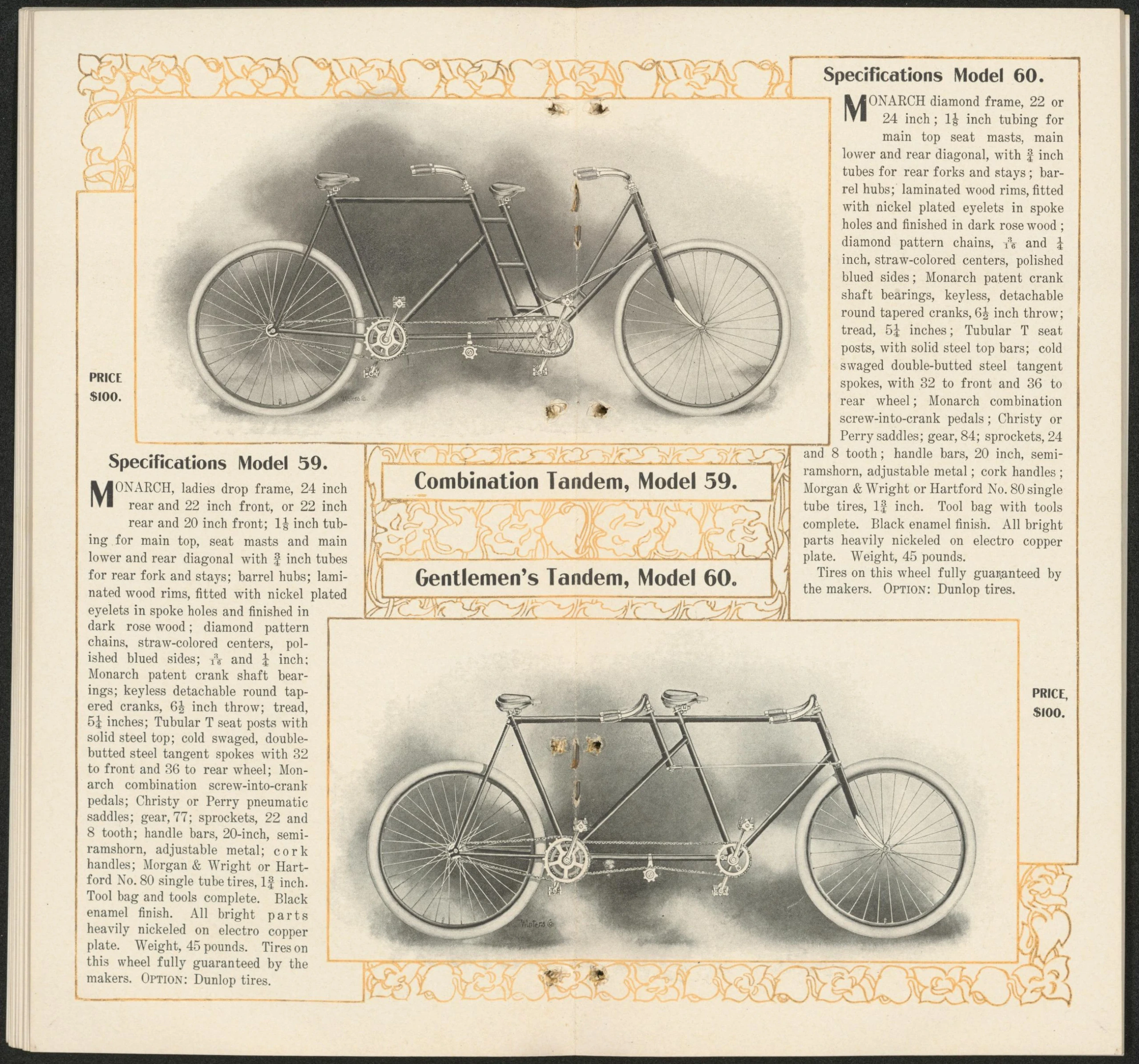
Specifications Model 60.
MONARCH diamond frame, 22 or 24 inch; 1⅛ inch tubing for main top seat masts, main lower and rear diagonal, with ¾ inch tubes for rear forks and stays; barrel hubs; laminated wood rims, fitted with nickel plated eyelets in spoke holes and finished in dark rose wood; diamond pattern chains, 3/16 and ¼ inch, straw-colored centers, polished blued sides; Monarch patent crank shaft bearings, keyless, detachable round tapered cranks, 6½ inch throw; tread, 5¼ inches; Tubular T seat posts, with solid steel top bars; cold swaged double-butted steel tangent spokes, with 32 to front and 36 to rear wheel; Monarch combination screw-into-crank pedals; Christy or Perry saddles; gear, 84; sprockets, 24 and 8 tooth; handle bars, 20 inch, semi-ramshorn, adjustable metal; cork handles; Morgan & Wright or Hartford No. 80 single tube tires, 1¾ inch. Tool bag with tools complete. Black enamel finish. All bright parts heavily nickeled on electro copper plate. Weight, 45 pounds.
Tires on this wheel fully guaranteed by the makers. OPTION: Dunlop tires.
Combination Tandem, Model 59.
Gentlemen’s Tandem, Model 60.
Specifications Model 59.
MONARCH, ladies drop frame, 24 inch rear and 22 inch front, or 22 inch rear and 20 inch front; 1⅛ inch tubing for main top, seat masts and main lower and rear diagonal with ¾ inch tubes for rear fork and stays; barrel hubs; laminated wood rims, fitted with nickel plated eyelets in spoke holes and finished in dark rose wood; diamond pattern chains, straw-colored centers, polished blued sides; 3/16 and ¼ inch; Monarch patent crank shaft bearings; keyless detachable round tapered cranks, 6½ inch throw; tread, 5¼ inches; Tubular T seat posts with solid steel top; cold swaged, double-butted steel tangent spokes with 32 to front and 36 to rear wheel; Monarch combination screw-into-crank pedals; Christy or Perry pneumatic saddles; gear, 77; sprockets, 22 and 8 tooth; handle bars, 20-inch, semi-ramshorn, adjustable metal; cork handles; Morgan & Wright or Hartford No. 80 single tube tires, 1¾ inch. Tool bag and tools complete. Black enamel finish. All bright parts heavily nickeled on electro copper plate. Weight, 45 pounds. Tires on this wheel fully guaranteed by the makers. OPTION: Dunlop tires.
PRICE,
$100.
[A two-page spread in gold leaf-scroll borders: halftones in side view of the Model 59 combination tandem, a drop-frame front with a diamond rear, at top and the Model 60 gentlemen’s diamond tandem below, each with an engraver’s small signature. Binding holes through the center fold.]
— Page 23 —
MONARCH.
Gentlemen’s Model 58.
Price, $60.00.
Ladies’ Model 57.
Price, $60.00.
[Two halftones in side view within a gold water-lily border: the Model 58 gentlemen’s diamond-frame roadster with a forward-curved fork and adjustable bars above, and the Model 57 ladies’ drop frame with laced rear dress guard and openwork chain guard below; each signed small by the engraver. Binding holes along the right edge.]
— Page 24 —
Specifications.
MONARCH Model No. 58, diamond frame, 24 inch; all flush joints; 8 inch head steel drop forging; seamless steel tubing; upper main tube, 1⅛ inch; lower main tube, 1¼ inch; seat post tube, 1¼ inch at crank bracket, tapered to 1⅛ inch at seat post; rear forks, ⅞ inch, D-shaped, tapered to ¾ inch at fork end; upper rear stays, ¾ inch, tapered to ⅝ inch at seat post; round steel cranks 6½ inch throw. Patent two-piece crank shaft, 2 inch drop (see dcscription on page 10); drop-forged detachable sprockets, 22 tooth front and 9 tooth rear; gear, 68 4/9; 28 inch wheels; cold swaged double-butted steel tangent spokes, 32 to front and 36 to rear wheel; laminated wood rims, dark rose wood finish, nickel plated eyelets in spoke holes; barrel hubs with ball retainers and special device for conveying the oil to the bearings; ¼ inch diamond pattern chain, straw-colored centers, polished, with blued sides; tread, 4⅞ [?] inches; wheel base 42½ inches; T seat post, with patent clamping device, doing away with bolt and nut; 20 inch semi-ramshorn metal handle bar, adjustable, with patent device for holding in position without bolt or nut; cork handles; Monarch combination pedals which screw into cranks, 3½ or 4 inch; Christy or Perry pneumatic saddle; weight, 25 pounds; Hartford No. 80 single tube or Morgan & Wright tires, 1⅝ inch. Handsome tool bag and complete set of tools. Black enamel finish. All bright parts nickeled on electro copper plate.
OPTION: Frame, 22 or 26 inch. Dunlop tires.
Tires on this wheel fully guaranteed by the makers.
Specifications.
MONARCH, Model No. 57, double drop frame, 22 inch, all flush joints; 8 inch head, steel drop-forging; seamless steel tubing; 1 inch upper curved tube; 1¼ inch lower main tube; 1¼ inch seat post tube; seat post tube at crank bracket tapered to 1⅛ inch at seat post; rear forks, ⅞ inch D-shaped, tapered to ¾ inch at fork end; upper rear stays ¾ inch, tapered to ⅝ inch at seat post; round steel cranks, 6½ inch throw; patent two-piece crank shaft, 2 inch drop, (see description on page 10) drop-forged detachable sprockets, 21 tooth front and 9 tooth rear; gear, 65⅓; 28 inch wheels; cold swaged double-butted steel tangent spokes, 32 to front and 36 to rear wheel; Kuntz laminated wood rims, dark rose wood finish; nickel plated eyelets in spoke holes; barrel hubs with ball retainers and special device for conveying the oil to the bearings; ¼ inch diamond pattern chain, straw-colored centers, polished, with blued sides; tread, 4⅞ [?] inch; wheel base, 42½ inches; T seat post, with patent clamping device, doing away with bolt or nut. Raised adjustable steel handle bar, 20 inches wide, with patent device for holding in position without bolt or nut; cork handles; Monarch combination pedals, which screw into cranks, 3½ inch; Christy or Perry pneumatic saddle; weight, 25½ pounds; Hartford No. 80 single tube or Morgan & Wright tires, 1⅝ inch. Handsome tool bag and complete set of tools Black enamel finish. All bright parts heavily nickeled on electro copper plate Metal dress and chain guard.
OPTION: 20 inch frame. Dunlop tires.
Tires on this wheel fully guaranteed by the makers.
“My Monarch, I will ride as
Far as land will let me
By your side.” —Richard II.
[Two specification blocks in a gold water-lily border, each headed by “Specifications.” between winged ornaments; small torch ornaments flank the closing quotation. The fraction in the tread figure is small and could be read as 4¾, as page 13 gives. Binding holes along the left edge.]
— Page 25 —
MONARCH.
Cooper Special, Model 48.
Price, $75.00.
Road Racer, Model 48A.
Price, $75.00.
[Two halftones in side view within a gold water-lily border: the Model 48 Cooper Special track racer with a long low frame, dropped ramshorn bars and a racing saddle above, and the Model 48A road racer with raised semi-ramshorn bars below. Binding holes along the right edge.]
— Page 26 —
Specifications.
TRADE MARK
MONARCH COOPER SPECIAL, Model No. 48, diamond frame, 23 inch; all drop-forged connections; 1⅛ inch seamless steel tubing for upper, lower and seat post tubes; ¾ inch tubes for rear forks and upright stays; head, 8 inch; keyless diamond cranks, 6½ inch throw; double-tongued reinforcements at all joints; crank shaft drop, 2½ inch; 28 inch wheels; wheel base, 42 inches; detachable sprockets, 22 tooth front and 8 tooth rear; gear, 77; barrel hubs; laminated wood rims fitted with nickel plated eyelets in spoke holes and finished in dark rose wood; 3/16 inch diamond pattern chain, straw-colored centers and blued sides; Monarch patent crank shaft bearings; tread, 5 inches; direct seat post; cold swaged, double-butted steel tangent spokes, 32 to front and 36 to rear wheel; Monarch rat trap screw-into-crank pedals; racing saddle; Cooper racing handle bar; cork handles; Morgan & Wright or Vim 1¼ inch racing tires; weight, 18½ pounds; finish, dark green, ornamented. All bright parts nickeled on electro copper plate.
Specifications.
TRADE MARK
MONARCH ROAD RACER, Model 48 A, diamond frame, 23 inch; all drop-forged connections; 1⅛ inch tubing for upper, lower and seat post tubes; ¾ inch seamless tubing for rear forks and upright stays; head, 7 5/16 inch; double-tongued reinforcements at all joints crank shaft drop, 2½ inch; keyless diamond cranks, 6½ inch throw; 28 inch wheels; wheel base, 42 inches; barrel hubs; laminated light road rims, fitted with nickel plated eyelets in spoke holes and finished in rose wood; 3/16 inch diamond pattern chain, straw-colored centers and blued sides; Monarch patent crank-shaft bearings; tread, 5 inches; direct seat post; cold-swaged double-butted steel tangent spokes, 32 to front and 36 to rear wheel; Monarch rat trap screw-into-crank pedals; Perry or Christy saddle; gear, 74⅔; sprockets, 24 and 9 tooth; Monarch semi-ramshorn handle bar, 20 inch; cork handles; Morgan & Wright or Hartford No. 80 single tube 1½ inch tires; weight, 21½ pounds; finish, black enamel, with all bright parts nickeled on electro copper plate. OPTION: Dunlop tires.
Tires on this wheel fully guaranteed by the makers.
“Sent by the Monarch to greet
Him and to give him
Comfort.” —Winter’s Tale
[Two specification blocks in a gold water-lily border, each headed by “Specifications.” between winged ornaments and set beside a vignetted lion trade-mark medallion; small torch ornaments flank the closing quotation. Binding holes along the left edge.]
— Page 27 —
DEFIANCE.
Gentlemen’s Model No. 56.
Price, $50.00.
Ladies’ Model No. 55.
Price, $50.00.
[Two halftones in three-quarter view within a gold water-lily border: the Model 56 gentlemen’s diamond-frame Defiance facing left above, and the Model 55 ladies’ drop frame with rear dress guard and openwork chain guard below, both with ornamented head tubes; the upper one signed small by the engraver. Binding holes along the right edge.]
— Page 28 —
Specifications.
DEFIANCE, Model No. 56, diamond frame, 24 inch; all flush joints; 1¼ inch seamless tubing for lower main tube; 1⅛ inch for upper and seat post tube with ⅞ inch rear forks tapered to ¾ inch and ¾ inch rear stays; head, 7 5/16 inch; front fork with drop-forged crown and one inch seamless stee l fork sides; wheels, 28 inch; best quality laminated wood rims, dark rose wood finish; nickel-plated eyelets in spoke holes; tangent spokes, butted ends and full nickel-plated, 32 to front and 36 to rear wheels; barrel hubs; front and rear detachable sprockets, 24 and 9 tooth; gear, 74⅔; diamond steel cranks, 6½ inch throw; two-piece crank shaft (see illustration on page 12); 2½ inch drop; tread, 5 inch; diamond pattern chain, ¼ inch, hollow T seat post with ⅝ inch solid top; combination screw-into-crank pedals, 3½ or 4 inch; Christy saddle; semi-ramshorn steel adjustable handle bar, 20 inches wide; hollow post, cork grips; Morgan & Wright or Hartford tires, 1⅝ inch; weight, 24½ pounds. Finish, black, handsomely ornamented. Tool bag with tools complete. All bright parts heavily nickeled on electro-copper plate.
OPTION: 22 or 26 inch frame.
Tires on this wheel fully guaranteed by the makers.
Specifications.
DEFIANCE, Model No 55 double drop frame, 22 inch; all flush joints; 1¼ inch seamless tubing for lower main tube; 1 inch curved tube; ⅞ inch rear fork tapered to ¾ inch and ¾ inch rear stays; head, 7 5/16 inch; front fork with drop-forged crown and one inch seamless steel fork sides; wheels, 28 inch, best quality laminated wood rims, dark rose wood finish; nickel plated eyelets in spoke holes; tangent spokes, butted ends and full nickel plated, 32 to front and 36 to rear wheel, barrel hubs; front and rear detachable sprockets, 21 and 9 tooth; gear, 65⅓; diamond steel cranks, 6 inch throw; two-piece crank shaft (see illustration on page 12) tread, 5 inch; diamond pattern chain, ¼ inch, hollow T seat post with ⅝ inch solid top; combination screw-into-crank pedals, 3½ or 4 inch; Christy saddle; raised adjustable handle bar, metal, 20 inches wide; hollow post; cork grips; Morgan & Wright or Hartford tires, 1⅝ inch; weight, 25 pounds Finish, black, handsomely ornamented. Tool bag, with tools complete. All bright parts heavily nickeled on electro-copper plate Metal mud and chain guard.
OPTIONS: 20 inch frame.
Tires on this wheel fully guaranteed by the makers.
“There’s nothing ill can dwell
In such a (temple) Monarch.”
—The Tempest.
[Two specification blocks in a gold water-lily border, each headed by “Specifications.” between winged ornaments; small torch ornaments flank the closing quotation. Binding holes along the left edge.]
— Page 29 —
DEFIANCE.
Gentlemen’s Model 54.
Price. $40.00.
Ladies’ Model 53.
Price, $40.00.
[Two halftones in side view within a gold water-lily border: the Model 54 gentlemen’s diamond-frame Defiance facing left with an arch-crown fork above, and the Model 53 ladies’ drop frame with rear dress guard and laced chain guard below, both with ornamented tubes. Binding holes along the right edge.]
— Page 30 —
Specifications.
TRADE MARK
DEFIANCE, Model No. 54, diamond frame, 24 inch; 1¼ inch seamless steel tubing for lower main tube, 1⅛ inch for upper and seat post tubes, with ¾ inch for rear forks and stays; 8 inch head; 28 inch wheels; detachable sprockets, 22 tooth front and 9 tooth rear; gear, 68 4/9; barrel hubs; Plymouth reinforced wood rims, dark rose wood finish; combination pedals; arch crown; tangent spokes, butted ends, full nickel plated, 32 to front and 36 to rear wheel; detachable keyless diamond steel cranks, 6½ inch throw; forged steel crank-axle; tread, 5 inches; ¼ inch diamond pattern chain; hollow T seat post with ⅝ inch solid top; semi-ramshorn steel adjustable handle bar, 20 inches wide, cork grips; Christy saddle; Hartford or Morgan & Wright tires, 1⅝ inch; weight, 24½ pounds. Finish, dark maroon, handsomely ornamented. Tool bag, with tools complete.
OPTION: 22 or 26 inch frame.
Tires on this wheel fully guaranteed by the makers.
Specifications.
TRADE MARK
DEFIANCE, Model No. 53, double drop frame, 22 inch; 1¼ inch seamless steel tubing for lower main tube, 1 inch curved tube, ¾ inch for rear forks and stays; 8 inch head; 28 inch wheels; detachable sprockets, 20 tooth front and 9 tooth rear; gear, 65⅓; barrel hubs; Plymouth reinforced wood rims, dark rose wood finish; combination pedals; arch crown; tangent spokes, butted ends, full nickel plated; 32 to front and 36 to rear wheel; detachable keyless diamond steel cranks, 6 inch throw; forged steel crank-axle; tread, 5 inches; ¼ inch diamond pattern chain; hollow T seat post with ⅝ inch solid top; raised adjustable metal handle bar, 19 inches wide, cork grips; Christy saddle; Hartford or Morgan & Wright tires, 1⅝ inch; weight, 25 pounds. Finish, dark maroon, handsomely ornamented. Tool bag with tools complete. Wood mud and chain guards.
OPTION: 20 inch frame.
Tires on this wheel fully guaranteed by the makers.
“Custom hath made it in him a
Property of easiness.”
—Hamlet.
[Two specification blocks in a gold water-lily border, each headed by “Specifications.” between winged ornaments and set beside a vignetted lion trade-mark medallion; small torch ornaments flank the closing quotation. Binding holes along the left edge.]
— Page 31 —
WHERE THE MONARCH AND DEFIANCE
ARE BORN AND RAISED.
IN this and the following pages will be found reproductions of photographic views of various parts of the mammoth plant of THE MONARCH CYCLE MANUFACTURING COMPANY, devoted entirely to the manufacture of MONARCH and DEFIANCE Bicycles. From small beginnings each department has grown and grown, requiring yearly larger and larger quarters, until today our manufacturing establishment is second to none—a veritable exposition of art, science and industry.
The illustration on this page shows a small section of our Tool Room; which, in all, occupies floor space 50×125 feet, in which twenty-five skilled mechanics of the highest order are constantly employed, producing machine tools of various kinds—jigs, templates, machine cutters, dies, taps—used in the manufacture of Monarch and Defiance Cycles. Every tool used in our immense plant is manufactured in our own shops, under our own direct supervision. Another reason for Monarch and Defiance quality.
Ask your local machinist where the tool maker ranks in his craft, and he will tell you that he stands at the head. In no branch of manufacture is the same degree of accuracy and care required as in the production of bicycles. This means—must necessarily mean—that the men in this important department are the best of the best, and command the very highest pay.
ONE HUNDRED by one hundred and twenty-five feet of whizzing pulleys and flying belts! This conveys but a faint idea of the activity but poorly portrayed in the cut on
TRADE MARK
[A text panel framed by gold scrollwork with a lion trade-mark medallion at right; below, a halftone photograph of the tool room, men in aprons at lathes and benches under overhead line shafting and belts. Binding holes along the right edge.]
— Page 32 —
this page, illustrating a section of the Automatic Screw Machine and Milling Room. Employed in this department are seventy-five first-class machinists turning out only the smaller parts of Monarch and Defiance Bicycles—cones, sleeves, bushings, ball races, nuts, screws, bolts, etc.—for even the smallest parts used in the construction of Monarch and Defiance Wheels are turned from the solid bar steel, as carefully and as accurately as though they were to be used in the construction of watches of the highest grades.
In this department thirty-three automatic screw machines can be seen at work, moving almost like living things, performing each successive operation with a degree of precision and accuracy that strikes the unfamiliar beholder with wonder not unmixed with awe. The raw stock is fed into these machines, and the completed parts are turned out rapidly and perfectly. By the use of machinery of this kind, the splendid system of duplication employed in the manufacture of Monarch and Defiance Bicycles is rendered possible, as it could be in no other way. Every part of every Monarch and Defiance Bicycle is interchangeable with the same part on any other Monarch or Defiance Bicycle of the same model.
In this department are also employed a number of hand screw machines, and ponderous milling machines, all operated by rope transmission, one of the latest and most satisfactory methods of direct transmission known to the mechanical engineer.
Every machine in this department is of comparatively recent invention, each the very latest and best of its kind, and our product is simply unsurpassable for accuracy, adaptability and strength.
TRADE MARK
[A text panel framed by gold scrollwork with a lion trade-mark medallion at left; below, a halftone photograph of the automatic screw machine and milling room, rows of belt-driven machines with workmen standing among them. Binding holes along the left edge.]
— Page 33 —
ONE HUNDRED expert enamellers are employed in the department partially shown in view below. Here we use a floor space 65×100 feet, and a busier scene would be difficult to imagine. Not an inch of space is wasted, for this department must turn out 500 frames every working day.
There are several methods of applying enamel. One commonly employed makes use of a large tank fitted with agitators, and filled with quick-drying paint, into which frames are dipped, and then hung upon hooks to dry.
Nothing could be more unsatisfactory to the rider than frames covered by this dipping and air-drying process, but it is cheap, and is one of the ways in which the production of the cheap, bargain-counter wheels is made possible.
Every coat of enamel applied in our shop is put on with a brush. We do not «dip,» nor employ any of the many other cheapening processes. We simply cannot afford to do so. Our reputation for reliable work is worth more in our estimation than the few dollars per day that might be saved by the dipping process, and the few of our customers that do give expression to their thoughts on the subject assure us that they see much in the plan to commend and nothing to condemn.
Brush work is the only manner of finishing that can be depended upon in all respects. We do no dipping whatever. All brush work.
This department is fitted with ten kilns, and in them the entire product of our enamelling room is baked, with gas fire, entirely clean and free from the objectionable features of the ordinary oven. Every coat is smoothly and evenly applied, and carefully baked.
One of the special features of this department is the Aluminum Bath, into which every frame
TRADE MARK
[A text panel framed by gold scrollwork with a lion trade-mark medallion at right; below, a halftone photograph of the enameling room, aproned workmen at stands brushing frames, with rows of finished frames laid on the floor in front. Binding holes along the right edge.]
— Page 34 —
and every fork is plunged, previous to the application of the first or priming coat of enamel.
This aluminum process is patented, and is the newest and best addition to the finishers’ outfit. By this method every trace of rust is removed, and the frame is left in such condition that the enamel will positively stay on. We can safely guarantee that the enamel on our wheels will not flake or peel off. This entirely overcomes one of the most unsightly and annoying difficulties in connection with the manufacture of bicycles.
In addition to the force of one hundred brush enamellers mentioned above, there are also employed in this department twelve brush artists, whose business it is to apply the ornamental decorations. No cheap processes are employed in any branch of this department.
OUR frame department, a section of which is shown below, is one of the largest, finest, best manned and equipped in the entire bicycle industry. We devote 100 x 125 feet of floor space to this department, employ upwards of 350 men constantly, and turn out 500 frames daily.
Here frames are assembled, filed and trued, and we regard it as one of the finest and most important departments in our entire immense establishment.
Every piece of tubing and every fitting used in the construction of Monarch and Defiance frames are thoroughly inspected and tested in every stage. Monarch and Defiance frames stand up. We understand fully the importance of care and honesty in the manufacture of bicycles, and in no department are these factors so vitally necessary as in this.
TRADE MARK
[A text panel framed by gold scrollwork with a lion trade-mark medallion at left; below, a halftone photograph of the frame department, a long aisle of aproned men filing frames at vises under belt-driven shafting. Binding holes along the left edge.]
— Page 35 —
The frame of a bicycle is its foundation, and as the foundation is, so is the superstructure. Frames must be rigid and reliable, and Monarch and Defiance frames are just that.
Every frame is carefully trued in jigs constructed for that purpose before being transferred to the enamelling department, and we know they are right.
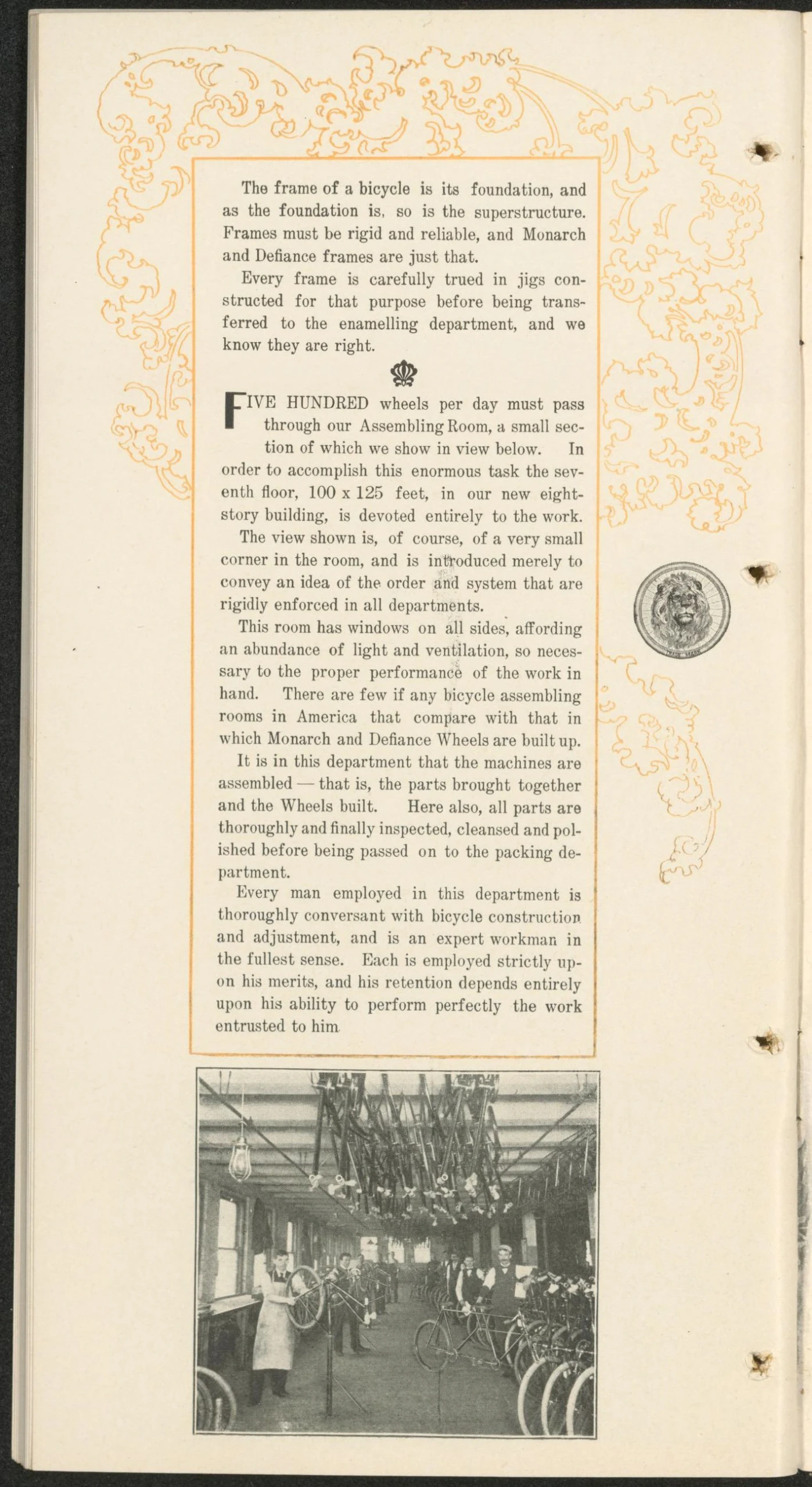
FIVE HUNDRED wheels per day must pass through our Assembling Room, a small section of which we show in view below. In order to accomplish this enormous task the seventh floor, 100 x 125 feet, in our new eight-story building, is devoted entirely to the work.
The view shown is, of course, of a very small corner in the room, and is introduced merely to convey an idea of the order and system that are rigidly enforced in all departments.
This room has windows on all sides, affording an abundance of light and ventilation, so necessary to the proper performance of the work in hand. There are few if any bicycle assembling rooms in America that compare with that in which Monarch and Defiance Wheels are built up.
It is in this department that the machines are assembled — that is, the parts brought together and the Wheels built. Here also, all parts are thoroughly and finally inspected, cleansed and polished before being passed on to the packing department.
Every man employed in this department is thoroughly conversant with bicycle construction and adjustment, and is an expert workman in the fullest sense. Each is employed strictly upon his merits, and his retention depends entirely upon his ability to perform perfectly the work entrusted to him
TRADE MARK
[A text panel framed by gold scrollwork with a lion trade-mark medallion at right; below, a halftone photograph of the assembling room, frames hanging from overhead racks, a workman truing a wheel and rows of finished bicycles, a tandem among them. Binding holes along the right edge.]
— Page 36 —
Five hundred Monarch and Defiance Wheels per day! The words are easily written, but only a visit to and a trip through our shops can convey an adequate idea of the stupendous nature of the task in actuality. Come and see us when in Chicago. Our friends cannot know too much about us.
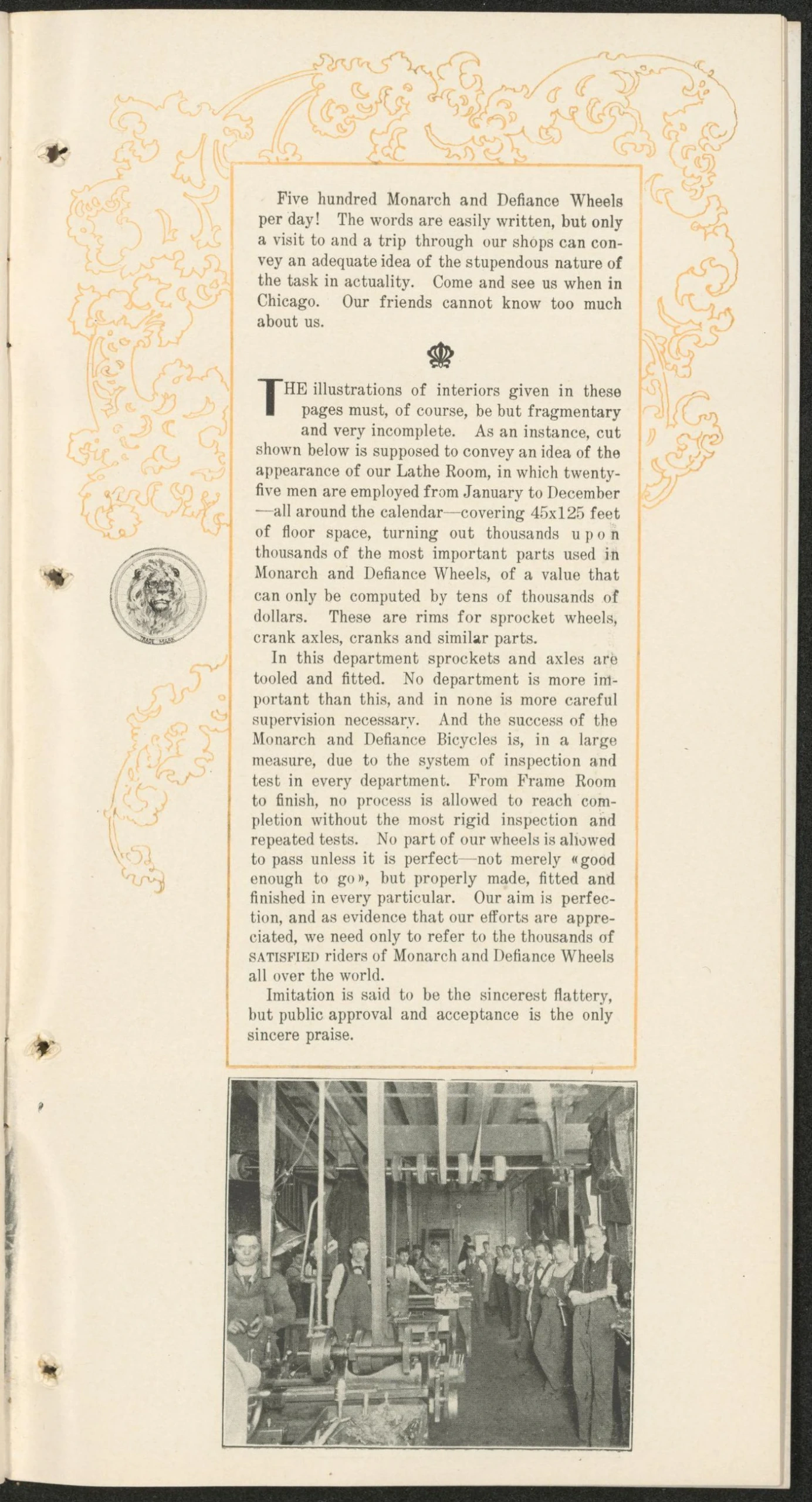
THE illustrations of interiors given in these pages must, of course, be but fragmentary and very incomplete. As an instance, cut shown below is supposed to convey an idea of the appearance of our Lathe Room, in which twenty-five men are employed from January to December—all around the calendar—covering 45×125 feet of floor space, turning out thousands upon thousands of the most important parts used in Monarch and Defiance Wheels, of a value that can only be computed by tens of thousands of dollars. These are rims for sprocket wheels, crank axles, cranks and similar parts.
In this department sprockets and axles are tooled and fitted. No department is more important than this, and in none is more careful supervision necessary. And the success of the Monarch and Defiance Bicycles is, in a large measure, due to the system of inspection and test in every department. From Frame Room to finish, no process is allowed to reach completion without the most rigid inspection and repeated tests. No part of our wheels is allowed to pass unless it is perfect—not merely «good enough to go», but properly made, fitted and finished in every particular. Our aim is perfection, and as evidence that our efforts are appreciated, we need only to refer to the thousands of SATISFIED riders of Monarch and Defiance Wheels all over the world.
Imitation is said to be the sincerest flattery, but public approval and acceptance is the only sincere praise.
TRADE MARK
[A text panel framed by gold scrollwork with a lion trade-mark medallion at left; below, a halftone photograph of the lathe room, workmen in aprons and shirtsleeves standing at belt-driven lathes. Binding holes along the left edge.]
— Page 37 —
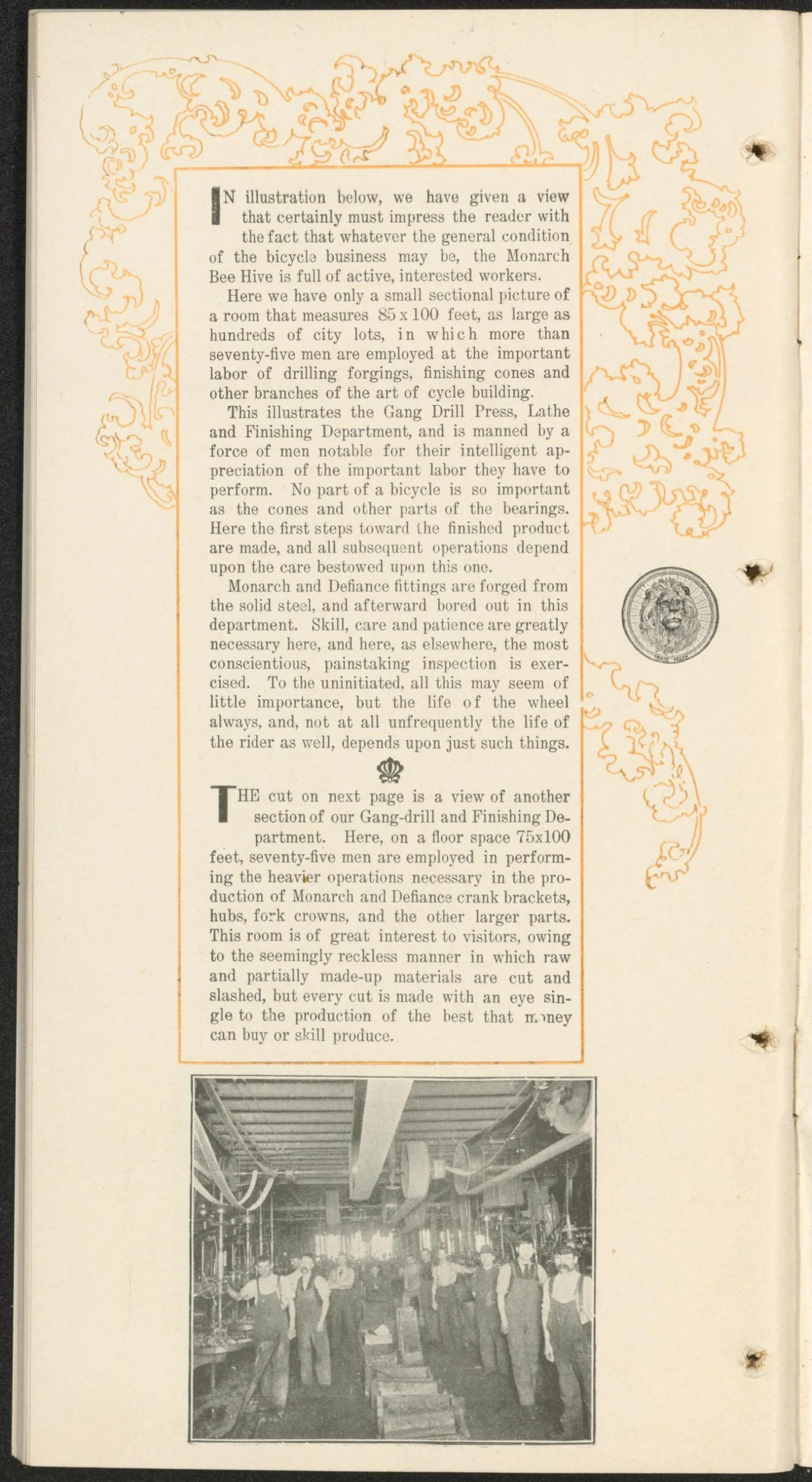
IN illustration below, we have given a view that certainly must impress the reader with the fact that whatever the general condition of the bicycle business may be, the Monarch Bee Hive is full of active, interested workers.
Here we have only a small sectional picture of a room that measures 85 x 100 feet, as large as hundreds of city lots, in which more than seventy-five men are employed at the important labor of drilling forgings, finishing cones and other branches of the art of cycle building.
This illustrates the Gang Drill Press, Lathe and Finishing Department, and is manned by a force of men notable for their intelligent appreciation of the important labor they have to perform. No part of a bicycle is so important as the cones and other parts of the bearings. Here the first steps toward the finished product are made, and all subsequent operations depend upon the care bestowed upon this one.
Monarch and Defiance fittings are forged from the solid steel, and afterward bored out in this department. Skill, care and patience are greatly necessary here, and here, as elsewhere, the most conscientious, painstaking inspection is exercised. To the uninitiated, all this may seem of little importance, but the life of the wheel always, and, not at all unfrequently the life of the rider as well, depends upon just such things.
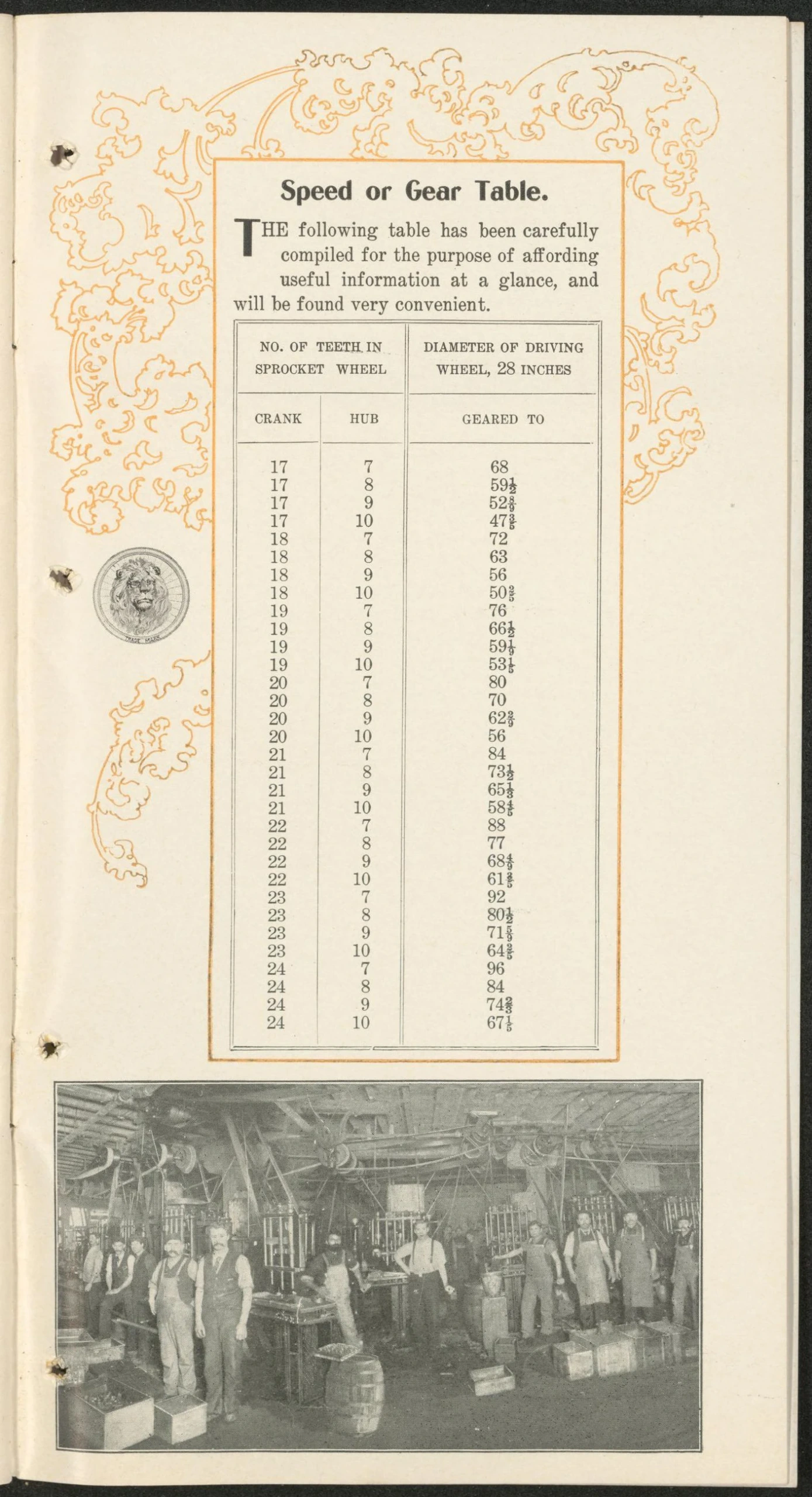
THE cut on next page is a view of another section of our Gang-drill and Finishing Department. Here, on a floor space 75×100 feet, seventy-five men are employed in performing the heavier operations necessary in the production of Monarch and Defiance crank brackets, hubs, fork crowns, and the other larger parts. This room is of great interest to visitors, owing to the seemingly reckless manner in which raw and partially made-up materials are cut and slashed, but every cut is made with an eye single to the production of the best that money can buy or skill produce.
TRADE MARK
[A text panel framed by gold scrollwork with a lion trade-mark medallion at right; below, a halftone photograph of the gang drill press, lathe and finishing department, men in overalls standing among belt-driven drill presses. Binding holes along the right edge.]
— Page 38 —
Speed or Gear Table.
THE following table has been carefully compiled for the purpose of affording useful information at a glance, and will be found very convenient.
NO. OF TEETH IN SPROCKET WHEEL | DIAMETER OF DRIVING WHEEL, 28 INCHES
CRANK | HUB | GEARED TO
17 | 7 | 68
17 | 8 | 59½
17 | 9 | 52 8/9
17 | 10 | 47 3/5
18 | 7 | 72
18 | 8 | 63
18 | 9 | 56
18 | 10 | 50 2/5
19 | 7 | 76
19 | 8 | 66½
19 | 9 | 59 1/9
19 | 10 | 53 1/5
20 | 7 | 80
20 | 8 | 70
20 | 9 | 62 2/9
20 | 10 | 56
21 | 7 | 84
21 | 8 | 73½
21 | 9 | 65⅓
21 | 10 | 58 4/5
22 | 7 | 88
22 | 8 | 77
22 | 9 | 68 4/9
22 | 10 | 61 3/5
23 | 7 | 92
23 | 8 | 80½
23 | 9 | 71 5/9
23 | 10 | 64 2/5
24 | 7 | 96
24 | 8 | 84
24 | 9 | 74⅔
24 | 10 | 67 1/5
TRADE MARK
[A ruled gear table in a frame of gold scrollwork with a lion trade-mark medallion at left; below, a halftone photograph of a second gang-drill and finishing room, men in aprons and overalls among drill presses, barrels and boxes of parts. Binding holes along the left edge.]
— Page 39 —
TRADE MARK
Terms.
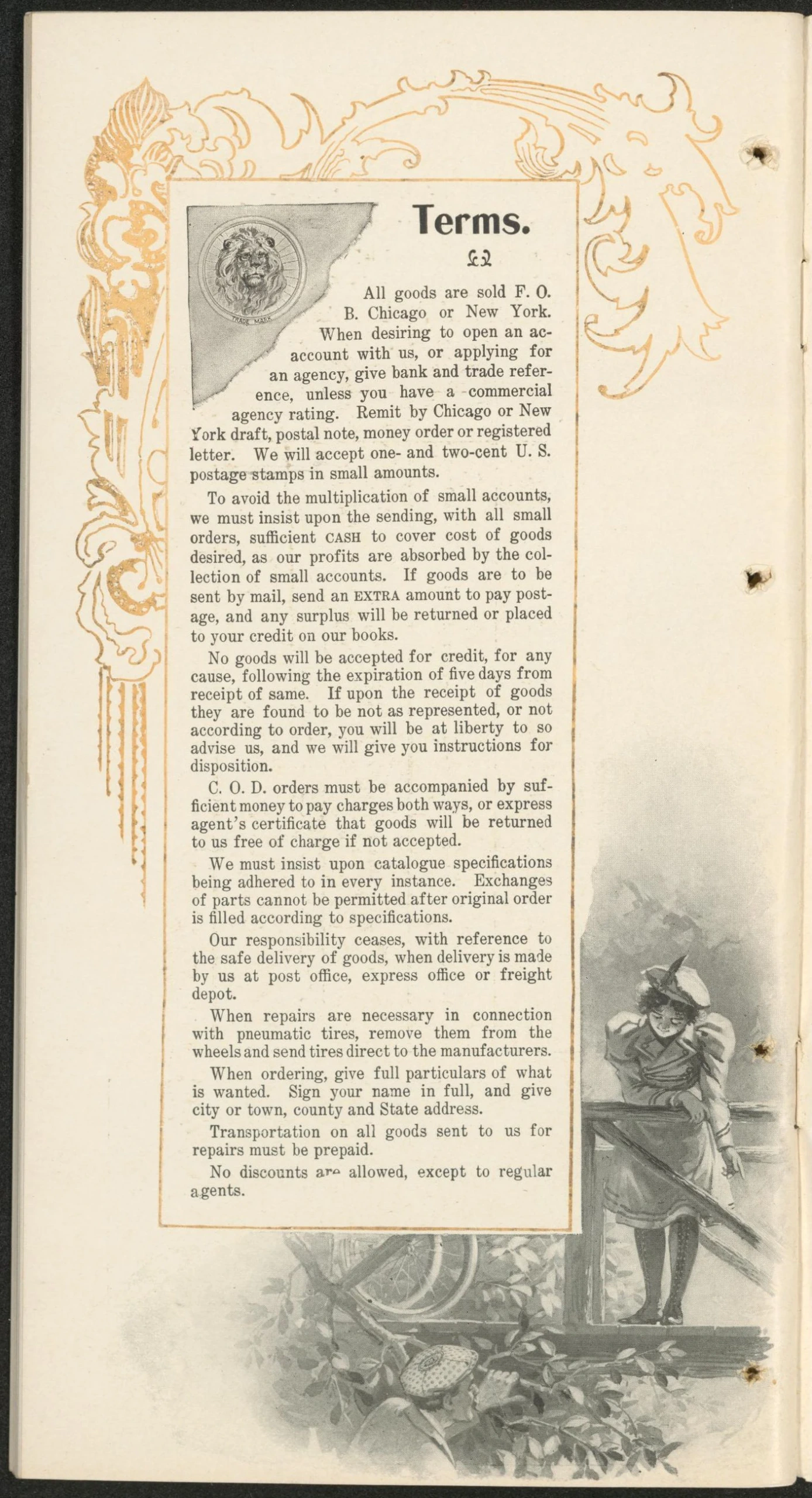
All goods are sold F. O. B. Chicago or New York. When desiring to open an ac- account with us, or applying for an agency, give bank and trade reference, unless you have a commercial agency rating. Remit by Chicago or New York draft, postal note, money order or registered letter. We will accept one- and two-cent U. S. postage stamps in small amounts.
To avoid the multiplication of small accounts, we must insist upon the sending, with all small orders, sufficient CASH to cover cost of goods desired, as our profits are absorbed by the collection of small accounts. If goods are to be sent by mail, send an EXTRA amount to pay postage, and any surplus will be returned or placed to your credit on our books.
No goods will be accepted for credit, for any cause, following the expiration of five days from receipt of same. If upon the receipt of goods they are found to be not as represented, or not according to order, you will be at liberty to so advise us, and we will give you instructions for disposition.
C. O. D. orders must be accompanied by sufficient money to pay charges both ways, or express agent’s certificate that goods will be returned to us free of charge if not accepted.
We must insist upon catalogue specifications being adhered to in every instance. Exchanges of parts cannot be permitted after original order is filled according to specifications.
Our responsibility ceases, with reference to the safe delivery of goods, when delivery is made by us at post office, express office or freight depot.
When repairs are necessary in connection with pneumatic tires, remove them from the wheels and send tires direct to the manufacturers.
When ordering, give full particulars of what is wanted. Sign your name in full, and give city or town, county and State address.
Transportation on all goods sent to us for repairs must be prepaid.
No discounts are allowed, except to regular agents.
[A text panel framed by gold scrollwork with a vignetted lion trade-mark medallion at upper left; at lower right a halftone of a young woman leaning over a wooden footbridge rail, a bicycle wheel and a cap in the foliage below. “Account” is printed with its first syllable repeated across the line break. Binding holes along the right edge.]
— Page 40 —
RIDE A MONARCH
AND KEEP IN FRONT.
TRADE MARK
GUARANTEE.
ADOPTED BY
THE NATIONAL BOARD OF TRADE OF
CYCLE MANUFACTURERS
FOR 1898.
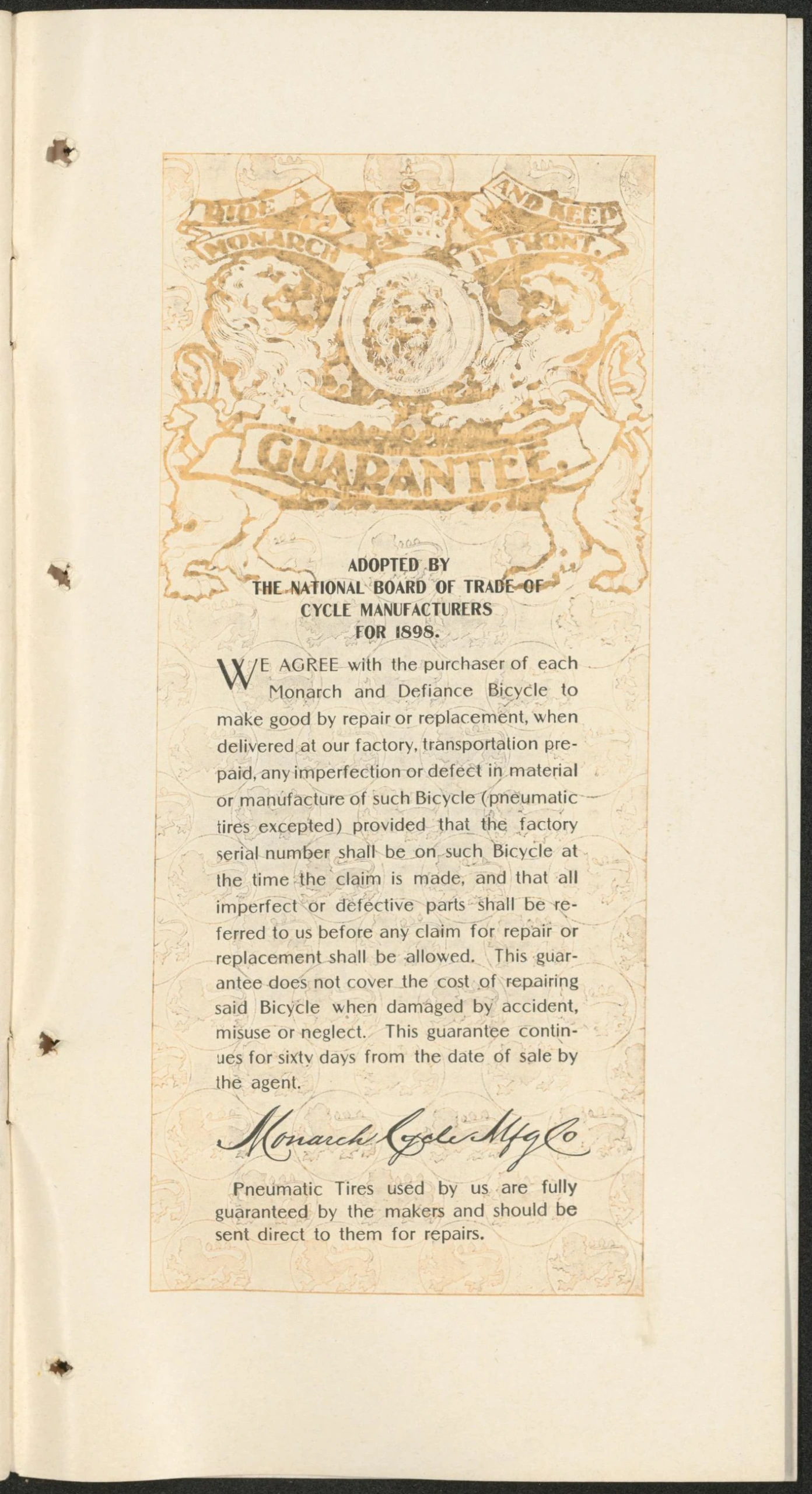
WE AGREE with the purchaser of each Monarch and Defiance Bicycle to make good by repair or replacement, when delivered at our factory, transportation prepaid, any imperfection or defect in material or manufacture of such Bicycle (pneumatic tires excepted) provided that the factory serial number shall be on such Bicycle at the time the claim is made, and that all imperfect or defective parts shall be referred to us before any claim for repair or replacement shall be allowed. This guarantee does not cover the cost of repairing said Bicycle when damaged by accident, misuse or neglect. This guarantee continues for sixty days from the date of sale by the agent.
Monarch Cycle Mfg Co
Pneumatic Tires used by us are fully guaranteed by the makers and should be sent direct to them for repairs.
[The guarantee printed over a pale ground of lion medallions, headed by a heraldic design in gold: two rampant lions supporting the lion trade-mark medallion under a crown, with motto ribbons and a “Guarantee” banner. The firm’s name is a facsimile script signature. Binding holes along the left edge.]
— Page 41 —
THE WINTERS PRESS
SPRINGFIELD, O.
CHICAGO. NEW YORK.
[A vignetted halftone at the center of an otherwise blank page: a crowned lion in an ermine-trimmed royal robe seated on a pedestal decorated with lion medallions, among clouds; the printer’s imprint at lower right. Binding holes along the right edge.]
— Page 42 —
[The blank inside back cover, with four binding holes punched along the left edge and the spine edge worn.]
— Page 43 —
TRADE MARK.
[The color-printed back cover, continuing the front-cover scene: a dark cave mouth and a rocky ravine, with the lion-head trade mark in color in a wheel-rim medallion at the center. The right (spine) edge is torn and worn, with binding holes punched through.]
Ebykr presents this material for research and education. If you hold rights to it or notice an ownership issue, please contact us and we will respond promptly.