About Ebykr
Ebykr celebrates classic and vintage lightweight bicycles through provocative imagery and opinion. Ride along with us.
About Ebykr
Ebykr celebrates classic and vintage lightweight bicycles through provocative imagery and opinion. Ride along with us.

Source: Northwestern University Libraries, Transportation Library, "1896 Monarch bicycles" (digital collection, https://dc.library.northwestern.edu/items/2501319c-d7fa-412a-a4b0-1181192340af); rights statement "No Copyright - United States".
 Page 1
 Page 2
 Page 3
 Page 4
 Page 5
 Page 6
 Page 7
 Page 8
 Page 9
 Page 10
 Page 11
 Page 12
 Page 13
 Page 14
 Page 15
 Page 16
 Page 17
 Page 18
 Page 19
 Page 20
 Page 21
 Page 22
 Page 23
 Page 24
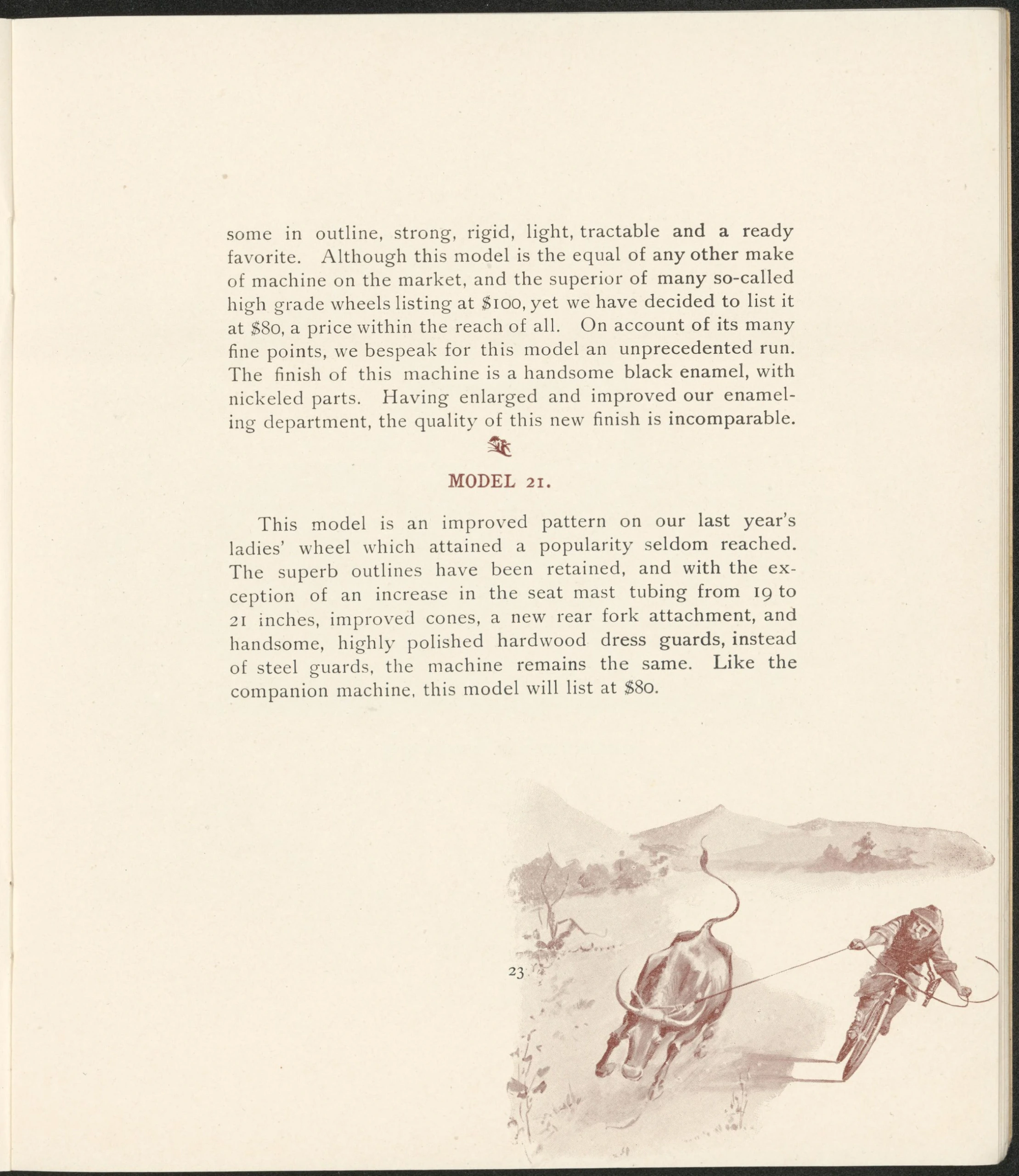 Page 25
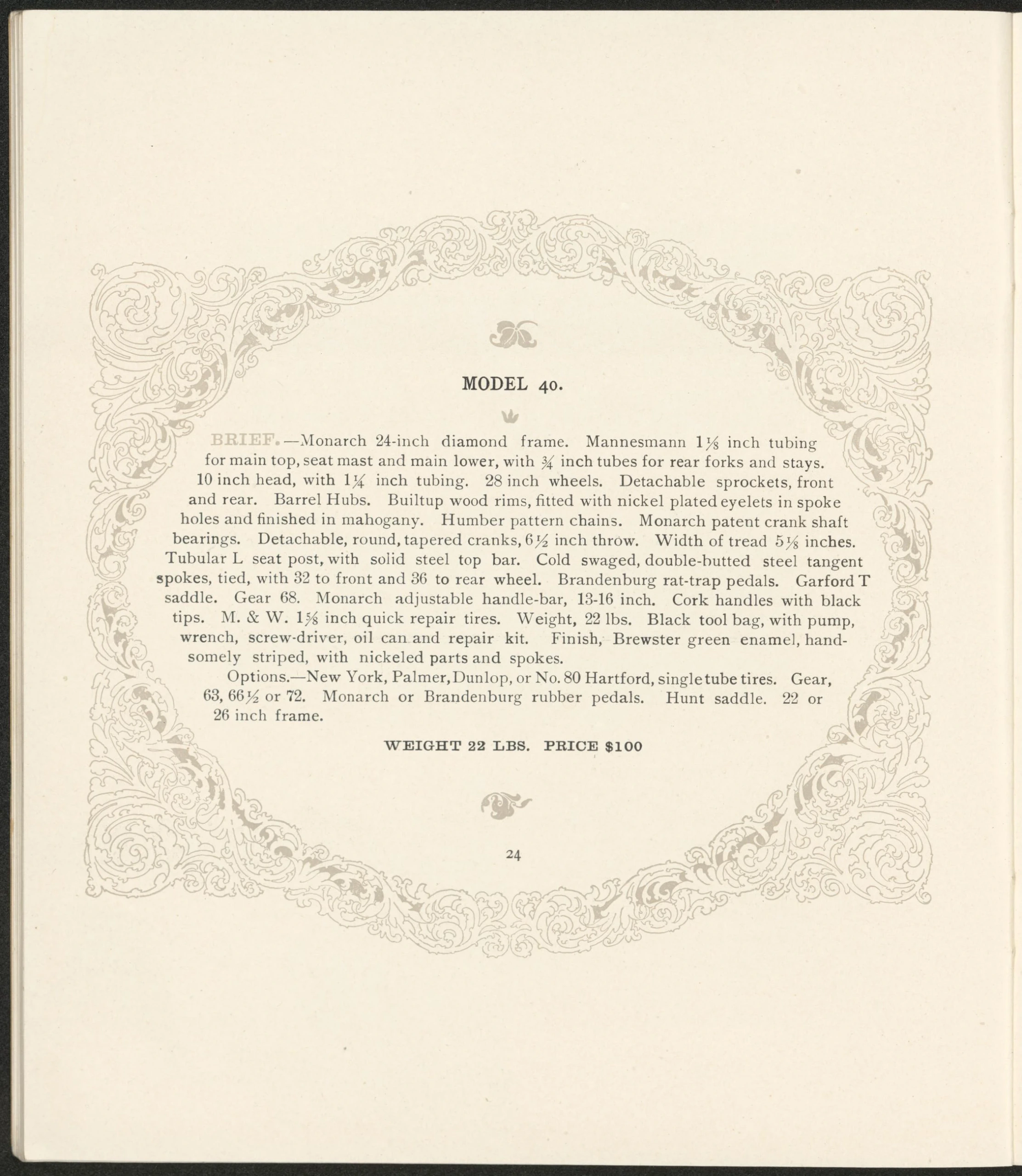 Page 26
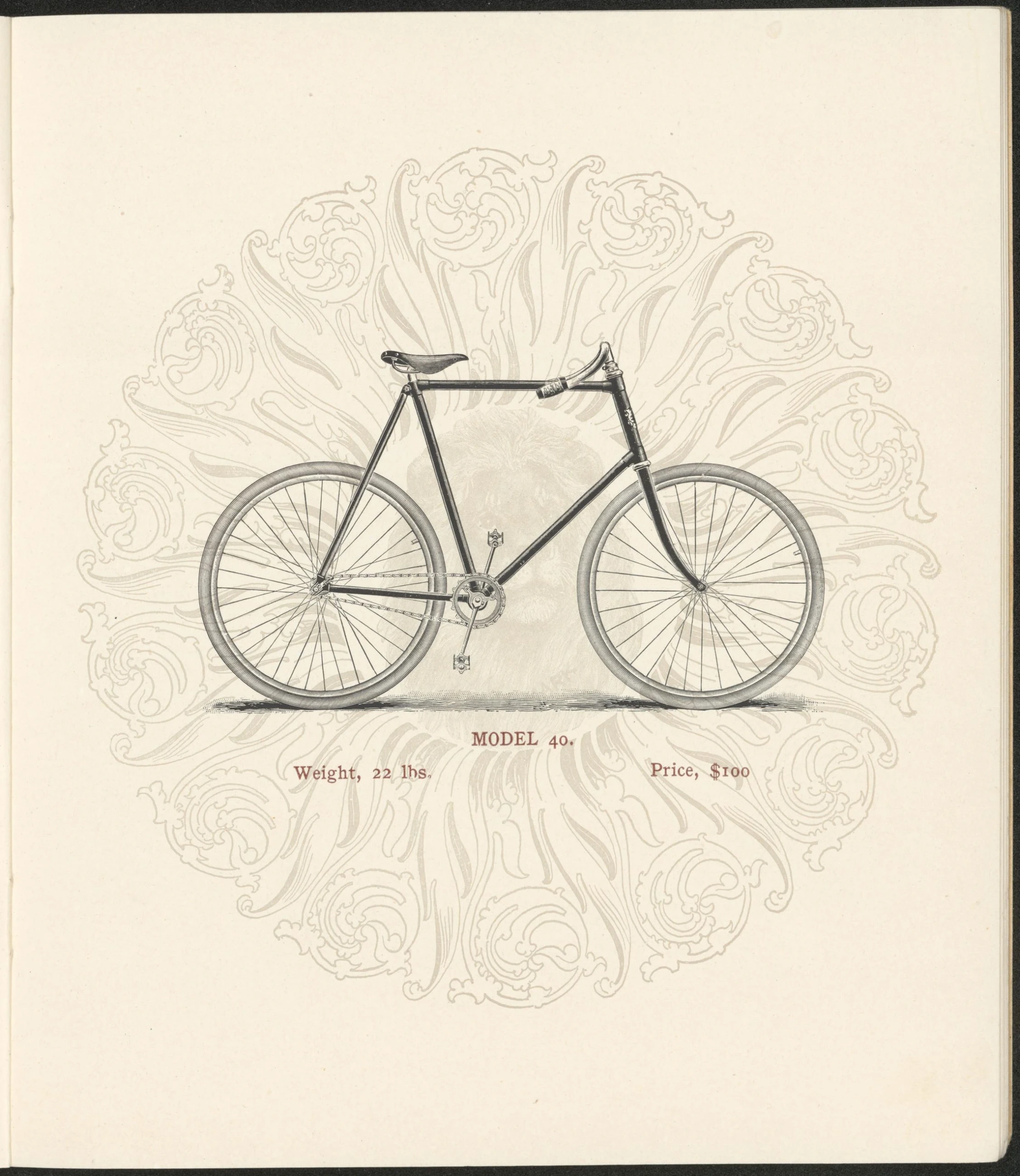 Page 27
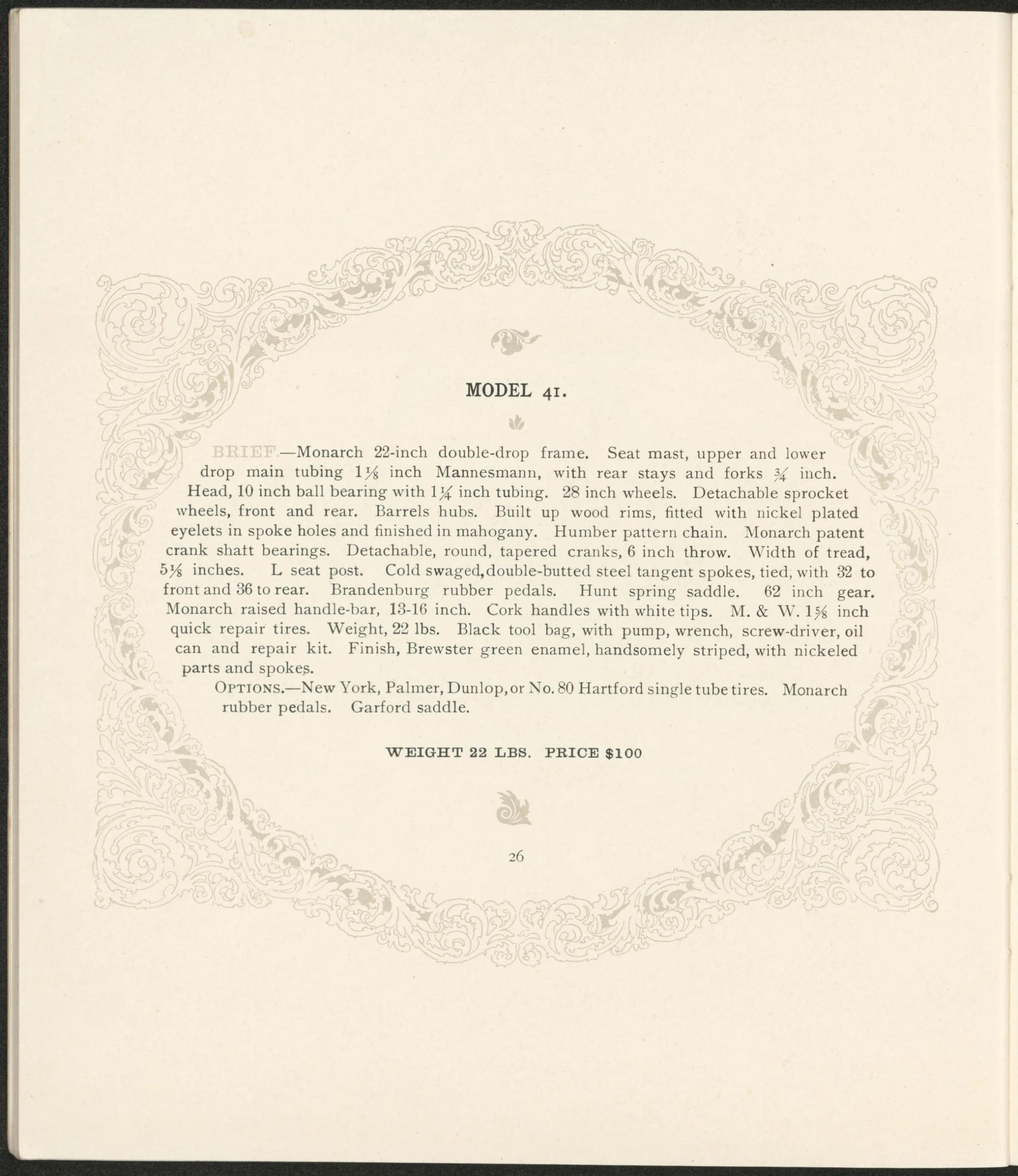 Page 28
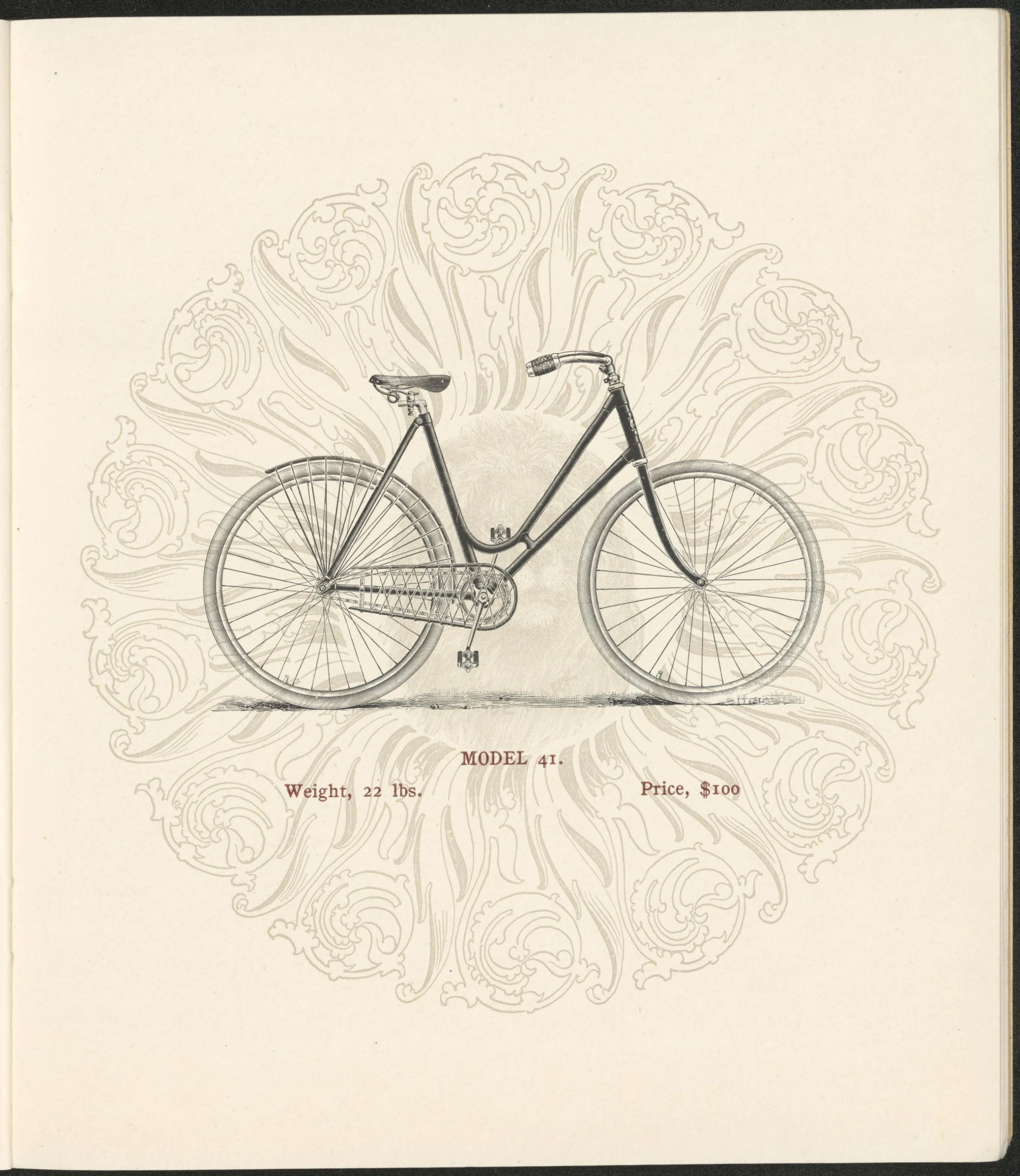 Page 29
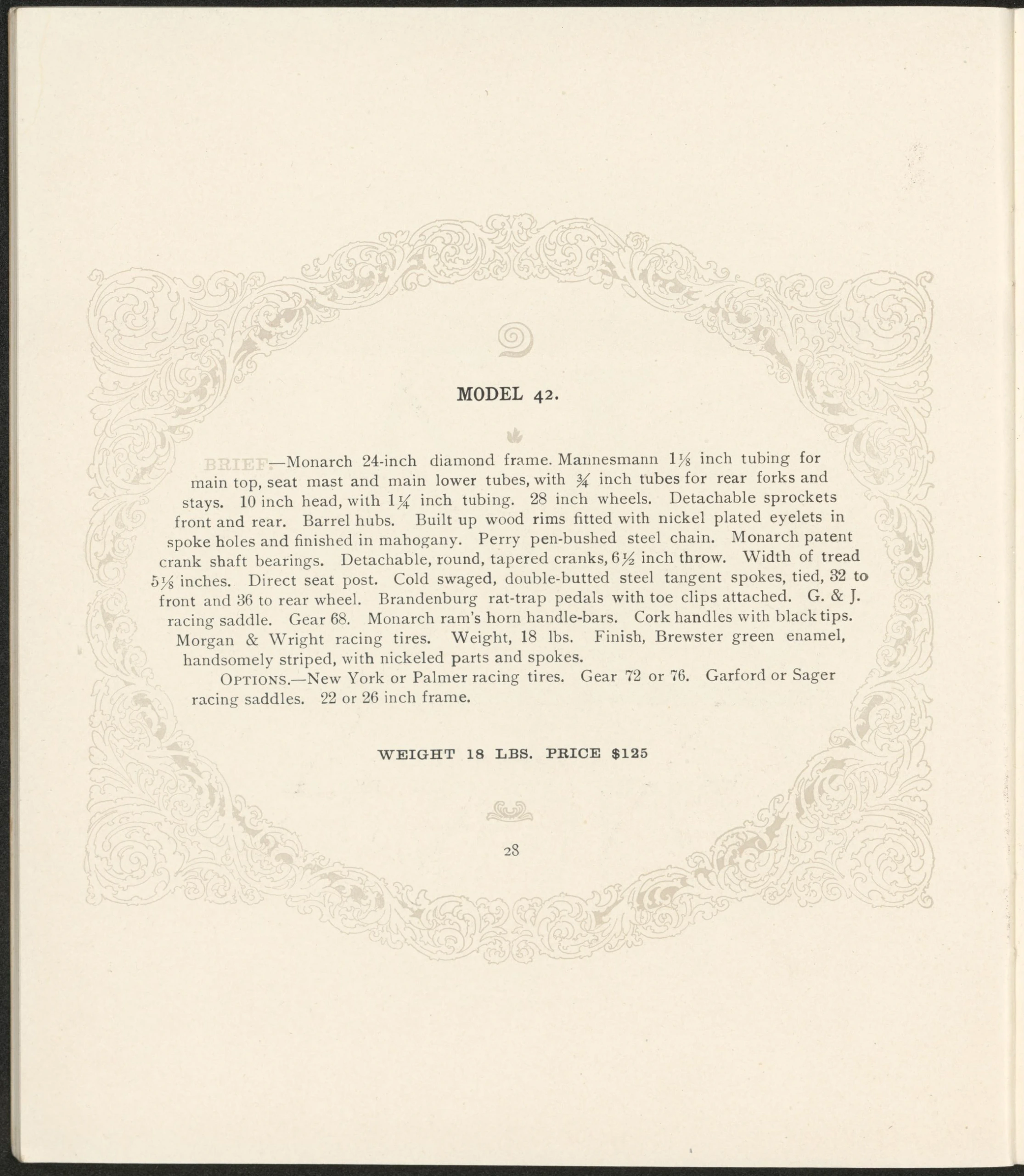 Page 30
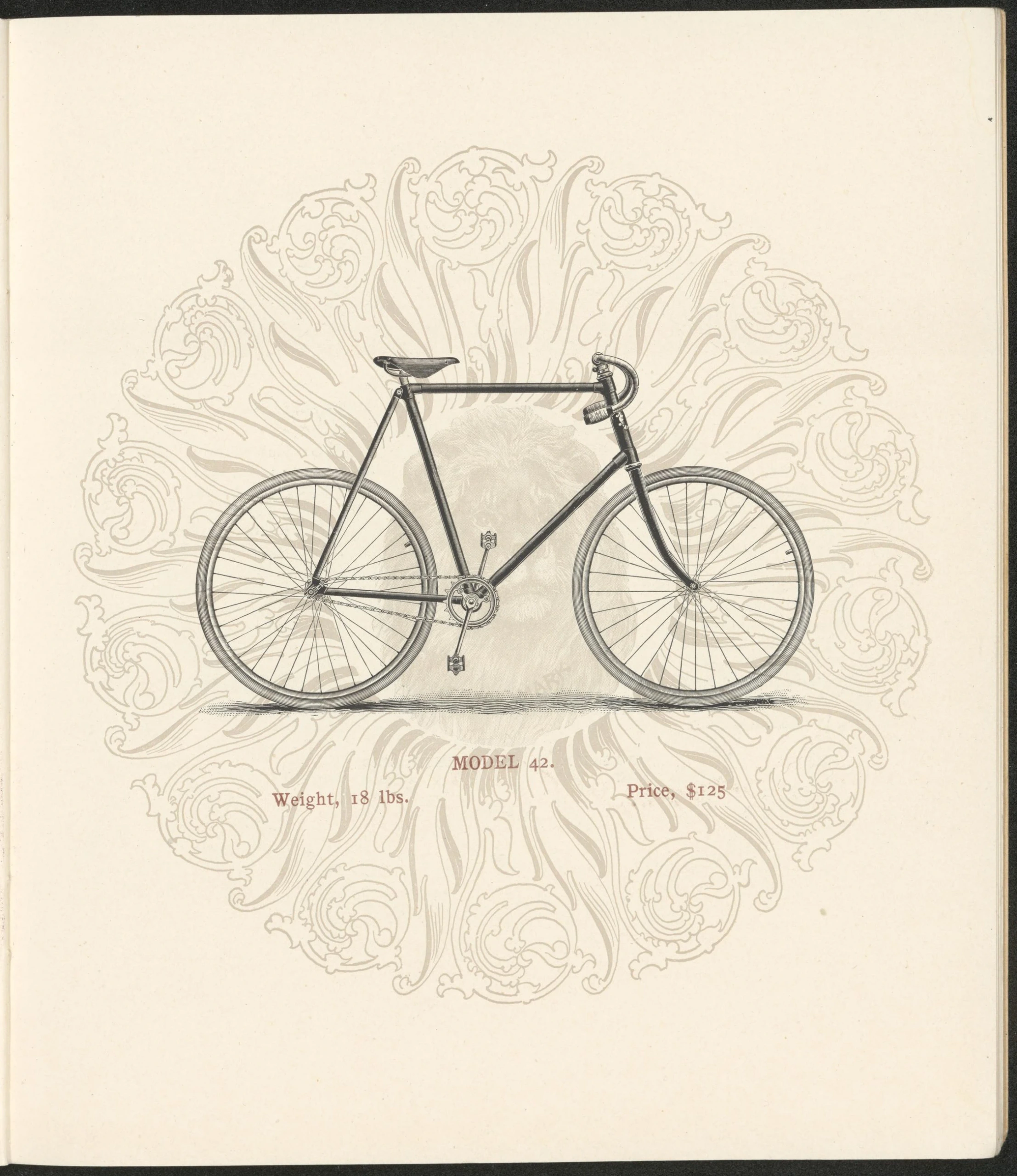 Page 31
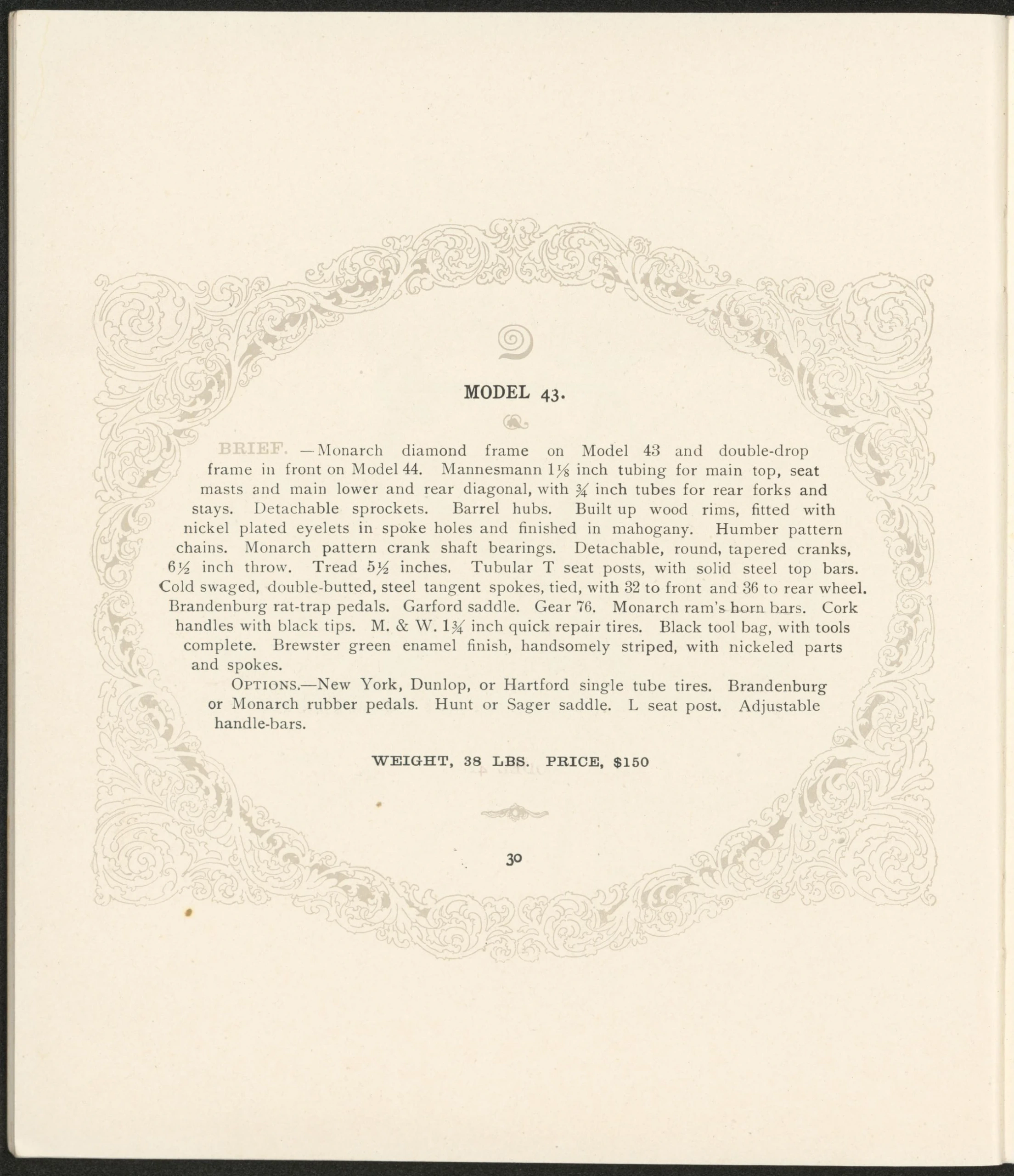 Page 32
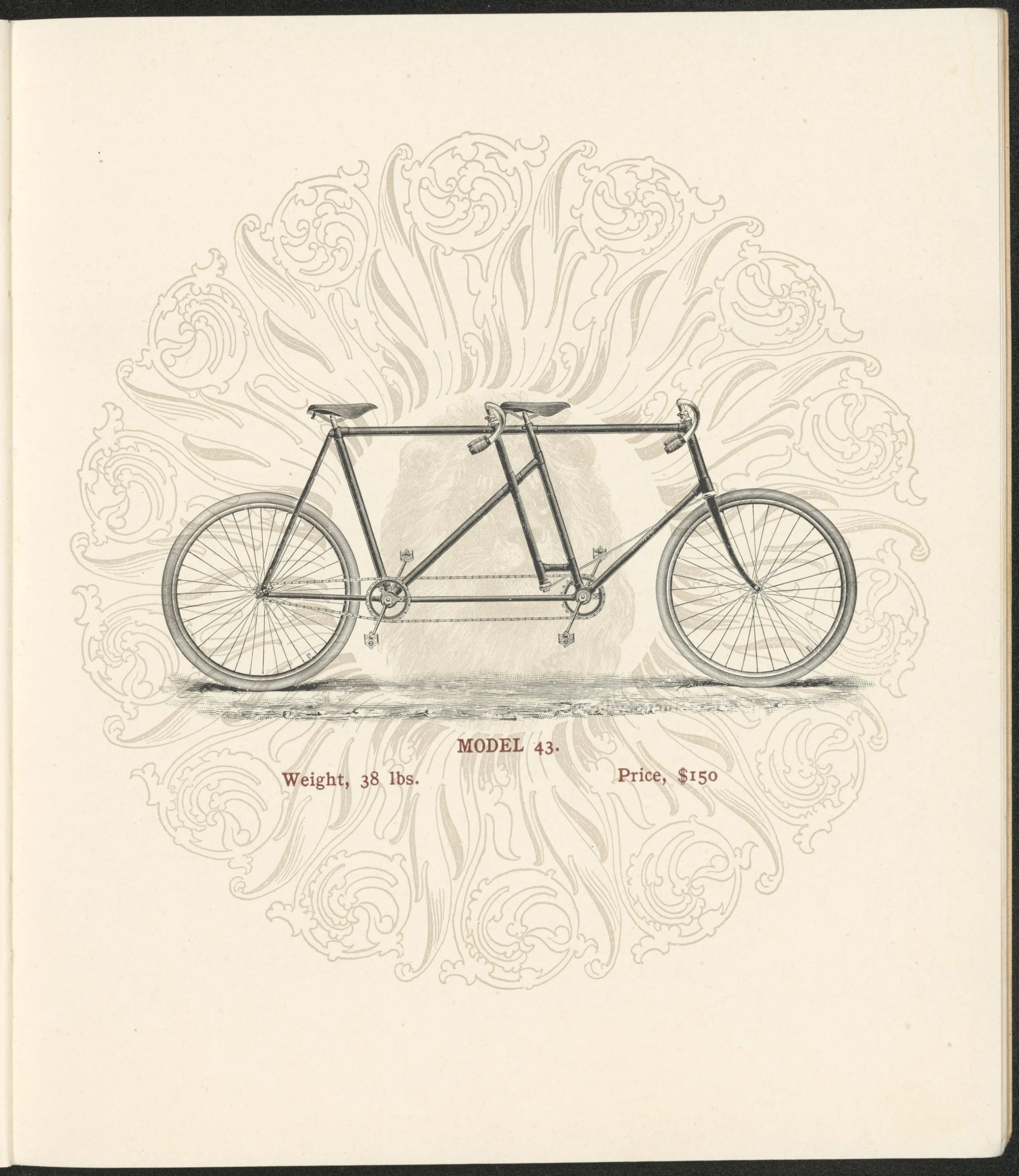 Page 33
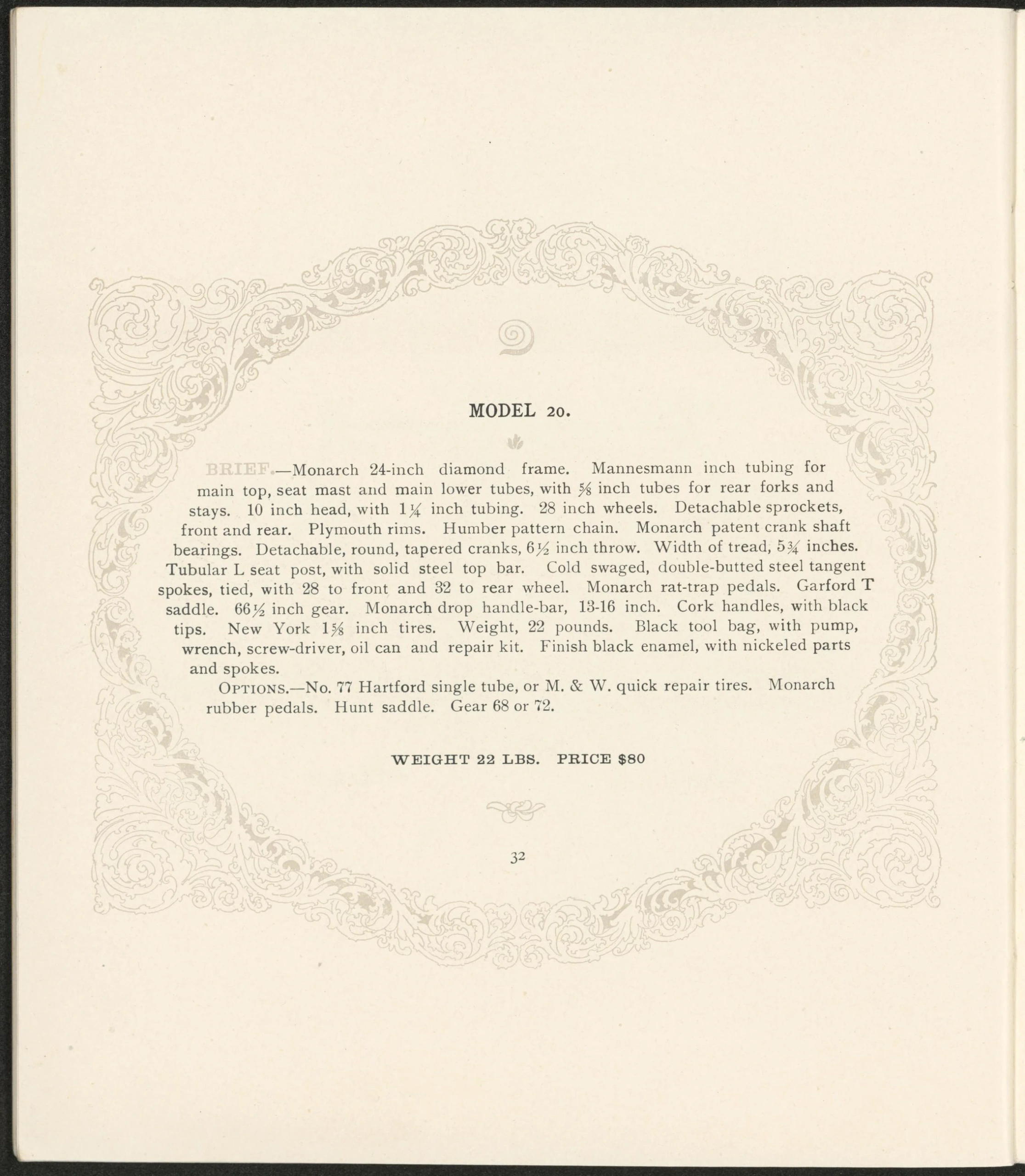 Page 34
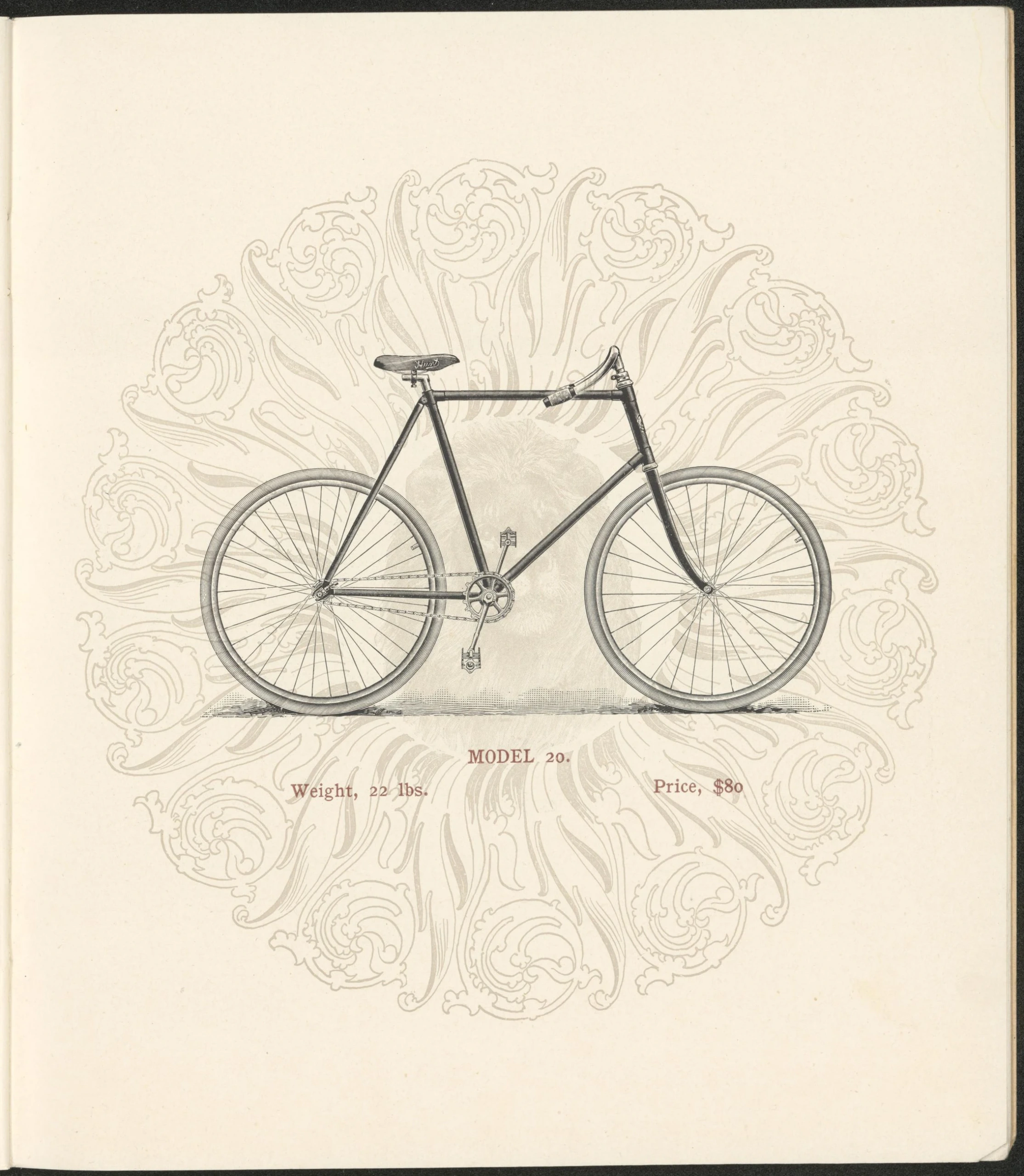 Page 35
 Page 36
 Page 37
 Page 38
 Page 39
 Page 40
 Page 41
 Page 42
 Page 43
 Page 44
| Marque | Monarch |
|---|---|
| Type | Catalog |
| Year | 1896 |
| Publisher | Monarch Cycle Manufacturing Co. |
| Country | United States |
| Language | English |
| Pages | 44 |
| Source | Northwestern University Libraries, Transportation Library, "1896 Monarch bicycles" (digital collection, https://dc.library.northwestern.edu/items/2501319c-d7fa-412a-a4b0-1181192340af); rights statement "No Copyright - United States". |
| Credit | Northwestern University Libraries |
| Identifier | Permalink https://dc.library.northwestern.edu/items/2501319c-d7fa-412a-a4b0-1181192340af |
| Transcription | Transcribed by eye |
Reference
Monarch Cycle Manufacturing Co. Monarch 1896 Catalog (Monarch Cycle Mfg. Co., Chicago): Models 20, 21 and 40 to 43. 1896. Ebykr, https://ebykr.com/library/monarch-catalog-1896/.
Wikipedia
{{cite book |title=Monarch 1896 Catalog (Monarch Cycle Mfg. Co., Chicago): Models 20, 21 and 40 to 43 |publisher=Monarch Cycle Manufacturing Co. |date=1896 |url=https://ebykr.com/library/monarch-catalog-1896/ |via=Ebykr |access-date=}}The Monarch Cycle Mfg. Co. TRADE MARK 1896 Monarch Bicycles J. W. Kiser, President, Treasurer and General Manager. Chandler Robbins, Vice-President and Secretary. L. M. Richardson, Asst Manager. P. Birner, Master Mechanic, Edward Bangs Superintendent W. J. Mead Factory Manager CAPITAL STOCK $500,000.00 The Monarch Cycle Manufacturing Co. LAKE, HALSTED AND FULTON STREETS, CHICAGO. EASTERN …
The Monarch Cycle Manufacturing Company’s “fifth annual catalogue”, for 1896: the factory, the frame joints and alignment, the crank hanger, detachable sprockets, wheels, rims, adjustable handlebars and finish, then the Models 40 and 41 (ladies’) at $100, the Model 42 racer at $125, the Model 43 diamond tandem at $150 and the Models 20 and 21 at $80, each with its specifications and plate, with the sundries price list, terms, guarantee and the firm’s racing riders. Transcribed from the page images (44 pages); each page ends with a bracketed description of its pictures.
— Page 1 —
The Monarch Cycle Mfg. Co.
TRADE MARK
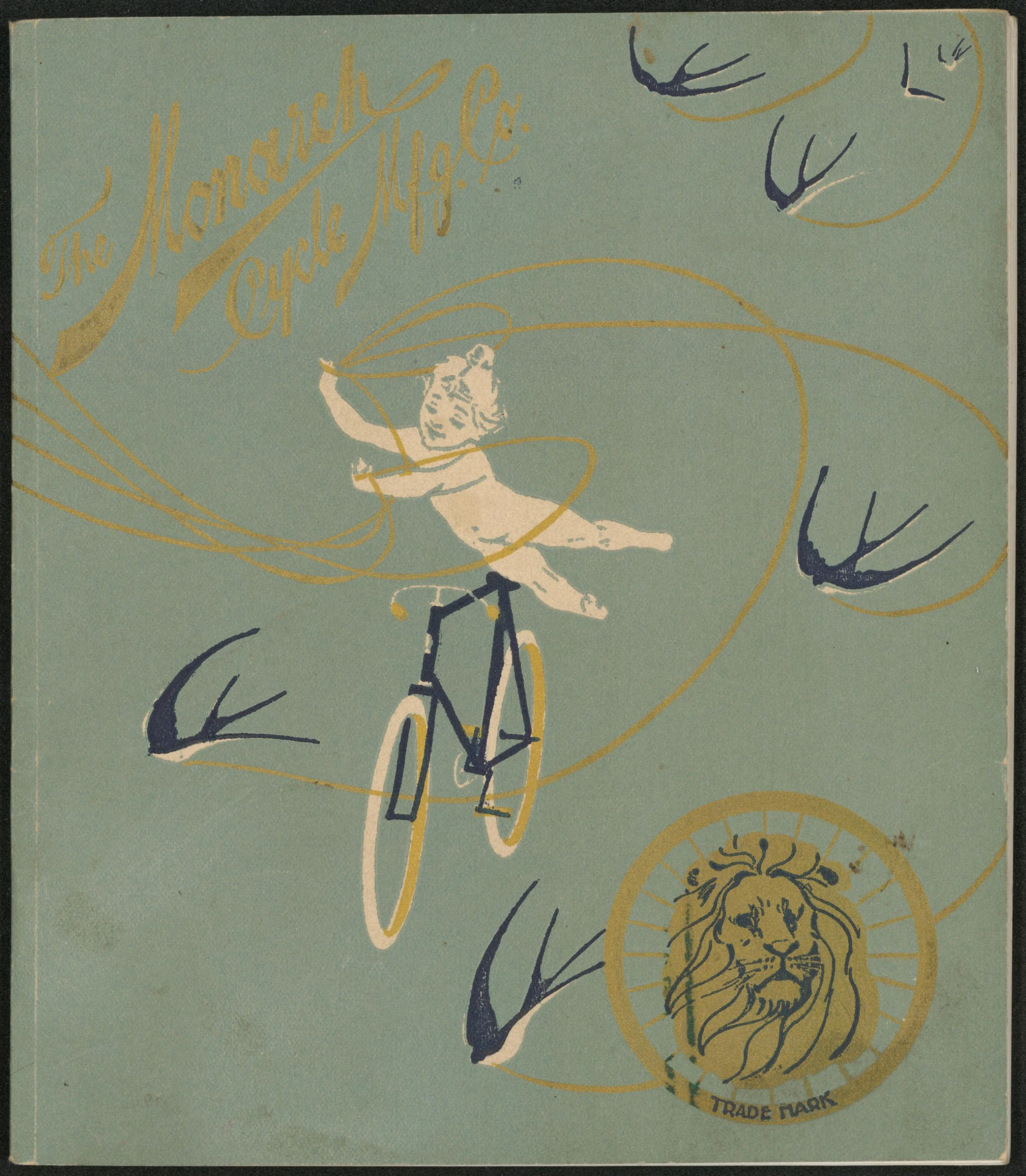
[The front cover, printed on sage-green stock: the firm name in gold script at upper left, a white cherub flying above a blue and gold diamond-frame safety trailing gold ribbons, blue swallows in flight and the gold lion’s-head trade mark in a spoked wheel at lower right; small stains near the top right.]
— Page 2 —
[The blank inside front cover, tan stock.]
— Page 3 —
[A blank endpaper with later pencil notes at upper right reading “135” and “(1896)”.]
— Page 4 —
[Blank page; a small paper stub or tear shows at the right edge.]
— Page 5 —
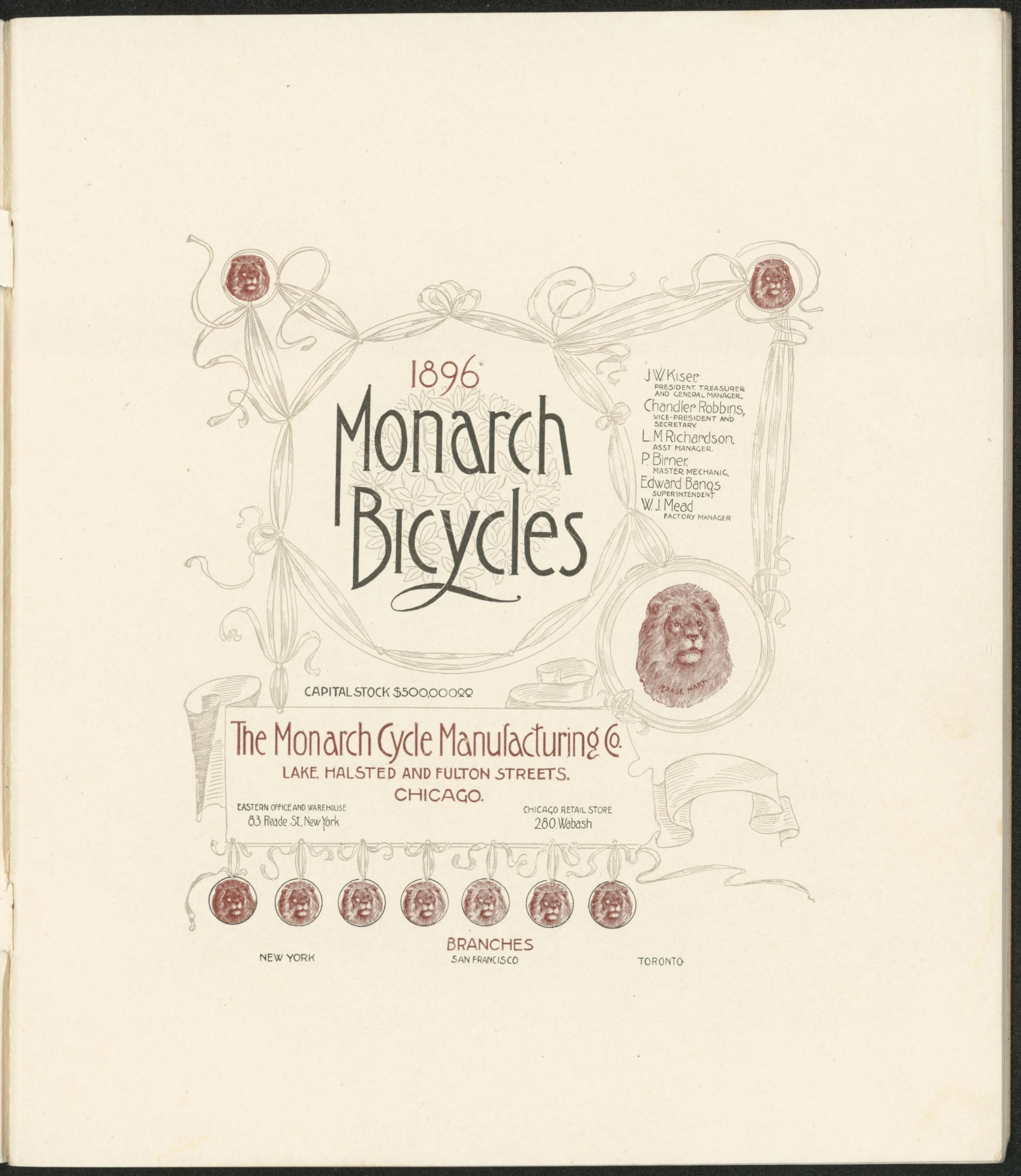
1896
Monarch Bicycles
J. W. Kiser, President, Treasurer and General Manager.
Chandler Robbins, Vice-President and Secretary.
L. M. Richardson, Asst Manager.
P. Birner, Master Mechanic,
Edward Bangs Superintendent
W. J. Mead Factory Manager
CAPITAL STOCK $500,000.00
The Monarch Cycle Manufacturing Co.
LAKE, HALSTED AND FULTON STREETS,
CHICAGO.
EASTERN OFFICE AND WAREHOUSE
83 Reade St., New York
CHICAGO RETAIL STORE
280 Wabash
BRANCHES
NEW YORK | SAN FRANCISCO | TORONTO
TRADE MARK
[The title page: a gray ribbon-and-bow frame with red lion’s-head medallions at the corners, a large lion’s-head trade mark in a ring at right, a row of seven small lion medallions along the foot, the name panel on a scroll; title in black, year and firm name in red.]
— Page 6 —
MONARCH
MONARCH CYCLE MFG. CO. | MONARCH CYCLE MFG. CO.
MONARCH CYCLES
MONARCH
FRANKLIN CO.-CHI.
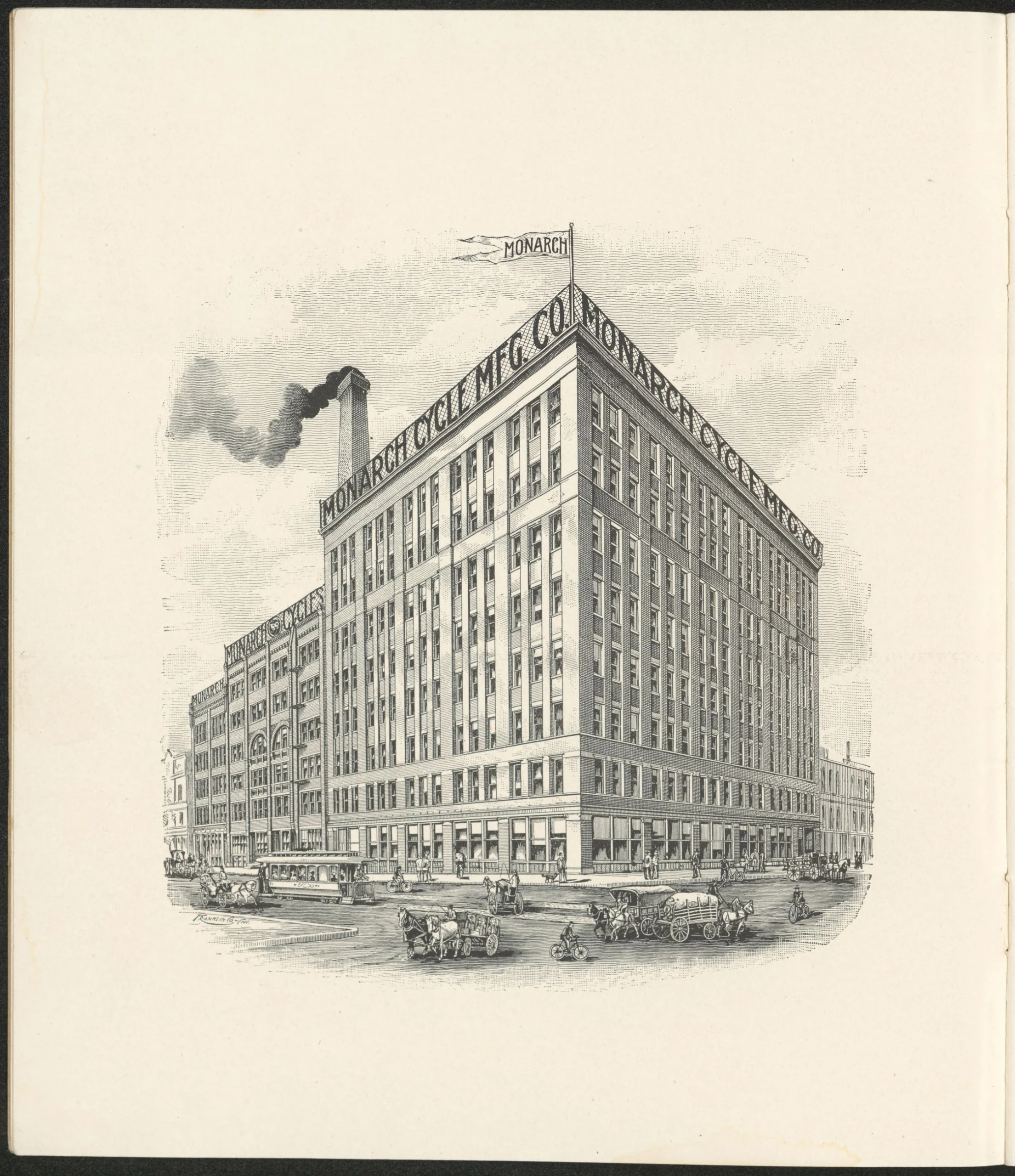
[A full-page wood engraving of the Monarch factory, an eight-story corner block with the firm name along both rooflines and a MONARCH pennant on the flagstaff, older Monarch buildings to the left, a smoking chimney and a street of cable car, wagons, carriages and cyclists; engraver’s signature at lower left.]
— Page 7 —
INTRODUCTION.
MONARCH bicycles need no introduction. They are well and favorably known in every civilized country on the globe. While we are not the oldest makers, we have most successfully passed through all the experimental stages of an infant industry, and have established a trade and reputation for our production second to that of no other maker, not only in America, but in the world.
We have from the first endeavored to make Monarchs as good as it was possible for the trinity of mechanical skill, capital and energy to produce. We have always bought the best material, regardless of cost, and have employed the most scientific method of construction. As a consequence, Monarchs have been accepted from the beginning as bicycles of the highest grade, embodying advanced ideas, and have universally withstood the unfailing test of actual service. The demand for them has increased at a phenomenal rate, extending not only throughout America, but to every land in which bicycles are used. This remarkable growth, we believe, is generally recognized as without a parallel in the trade, and we take it as a reasonable endorsement of the quality of Monarchs.
To supply this rapidly growing trade, large yearly enlargements to the Monarch factory have been necessary. The addition of the past season is a large factory in itself, consisting of an eight story and basement building,
5
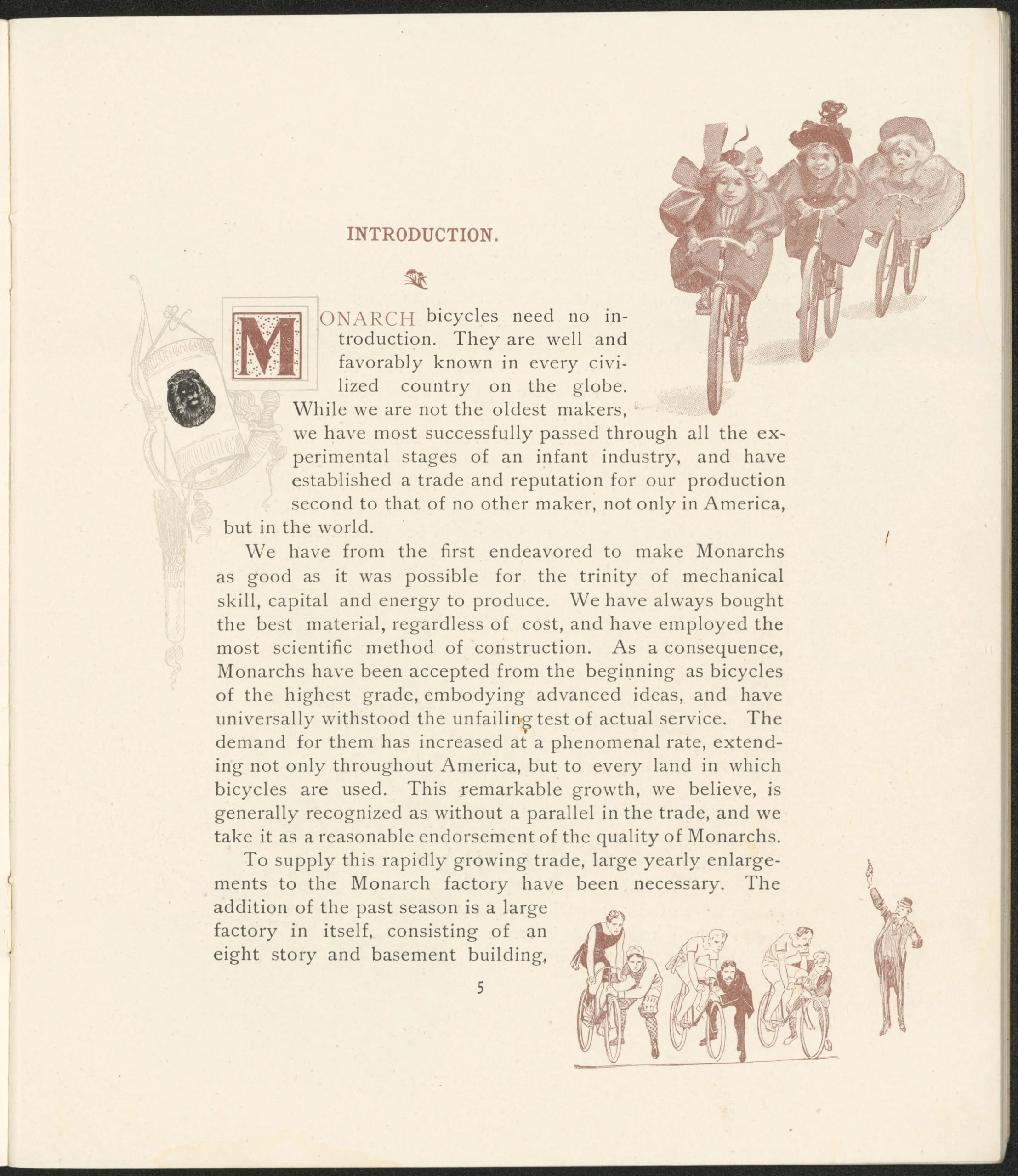
[Red-brown vignettes: three little girls in big bonnets riding toward the reader at upper right, three racing cyclists held at the start by their pushers with a starter raising a pistol at lower right; a red initial M and a gray lion-shield ornament at left.]
— Page 8 —
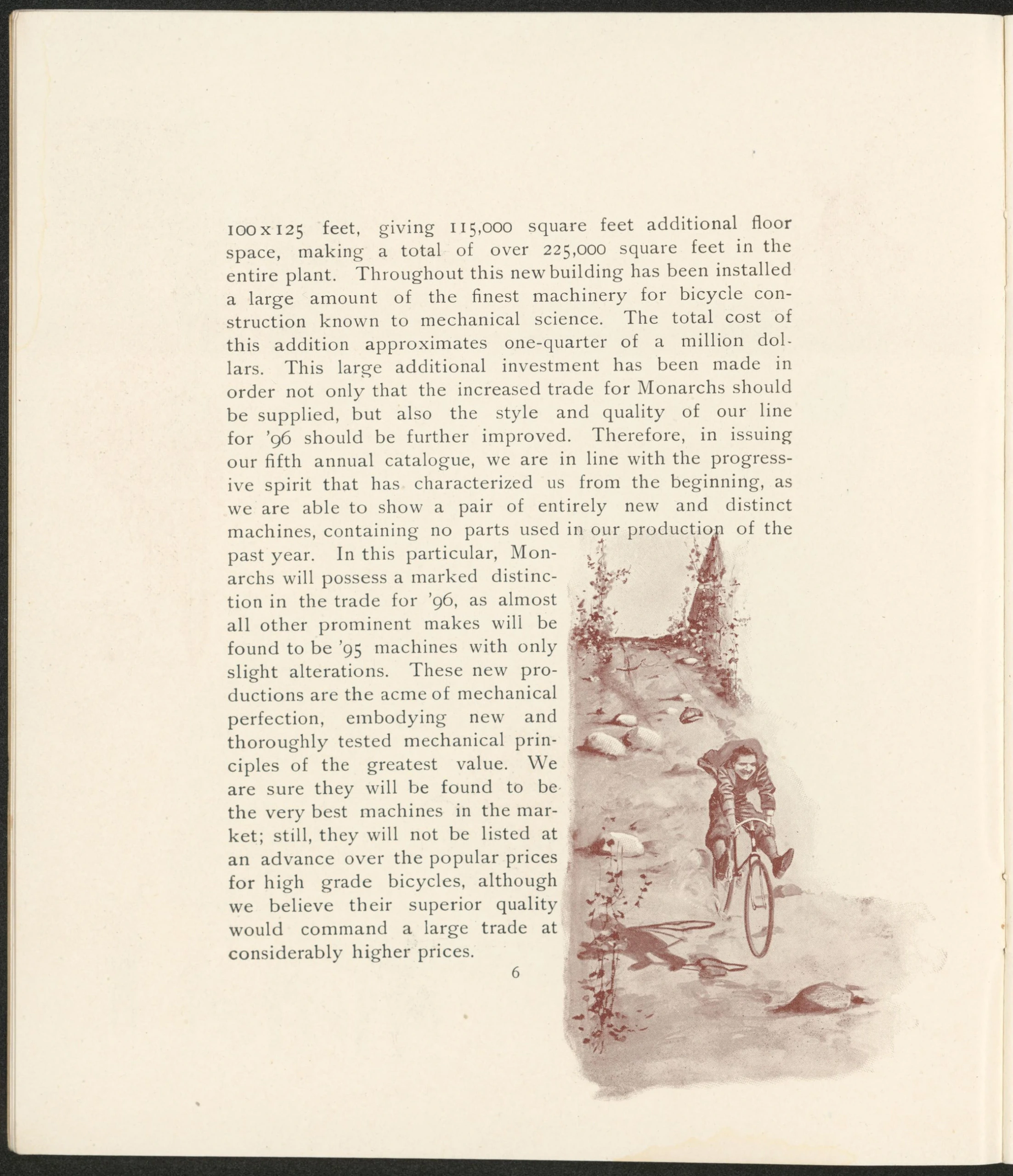
100 x 125 feet, giving 115,000 square feet additional floor space, making a total of over 225,000 square feet in the entire plant. Throughout this new building has been installed a large amount of the finest machinery for bicycle construction known to mechanical science. The total cost of this addition approximates one-quarter of a million dollars. This large additional investment has been made in order not only that the increased trade for Monarchs should be supplied, but also the style and quality of our line for ’96 should be further improved. Therefore, in issuing our fifth annual catalogue, we are in line with the progressive spirit that has characterized us from the beginning, as we are able to show a pair of entirely new and distinct machines, containing no parts used in our production of the past year. In this particular, Monarchs will possess a marked distinction in the trade for ’96, as almost all other prominent makes will be found to be ’95 machines with only slight alterations. These new productions are the acme of mechanical perfection, embodying new and thoroughly tested mechanical principles of the greatest value. We are sure they will be found to be the very best machines in the market; still, they will not be listed at an advance over the popular prices for high grade bicycles, although we believe their superior quality would command a large trade at considerably higher prices.
6
[A red-brown halftone vignette at right of a grinning boy riding a safety down a rocky country lane past a fallen tree.]
— Page 9 —
In addition to these we offer a pair of machines at $80 each, which are great improvements over our ’95 $100 models. These machines are extraordinary values, and will, we predict, be great favorites with those who do not care to invest the requisite amount for our Models 40 and 41. They possess all of the advantages both in quality and finish of the average high grade bicycle; in fact, are much better than many of them.
We shall rigidly maintain one fair price for Monarchs, to all alike, and any dealer handling them who fails to adhere strictly to this policy will be obliged to relinquish the agency. It shall be our constant aim to establish in the minds of all purchasers of Monarch bicycles the assurance that they have paid one and the same price, and have received full value for their investment.
TRADE MARK
7
[Red-brown vignettes: a cheering man in a flying overcoat leaping at upper left, a young man riding a safety toward the reader with a young woman waving a handkerchief perched behind him on a country road at right, and the lion’s-head trade mark at center below.]
— Page 10 —
DETAILS OF CONSTRUCTION.
Models 40 and 41.
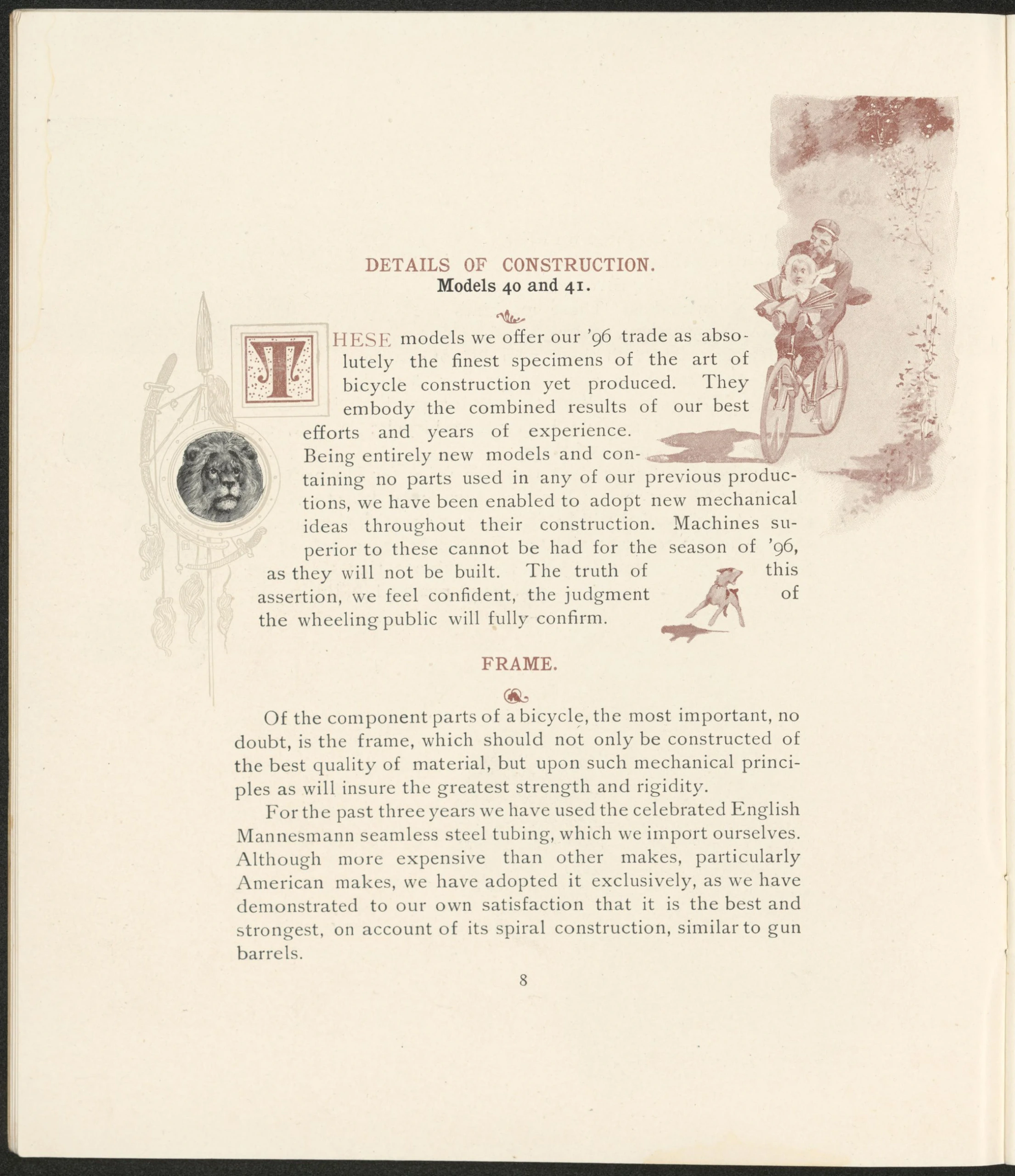
THESE models we offer our ’96 trade as absolutely the finest specimens of the art of bicycle construction yet produced. They embody the combined results of our best efforts and years of experience. Being entirely new models and containing no parts used in any of our previous productions, we have been enabled to adopt new mechanical ideas throughout their construction. Machines superior to these cannot be had for the season of ’96, as they will not be built. The truth of this assertion, we feel confident, the judgment of the wheeling public will fully confirm.
FRAME.
Of the component parts of a bicycle, the most important, no doubt, is the frame, which should not only be constructed of the best quality of material, but upon such mechanical principles as will insure the greatest strength and rigidity.
For the past three years we have used the celebrated English Mannesmann seamless steel tubing, which we import ourselves. Although more expensive than other makes, particularly American makes, we have adopted it exclusively, as we have demonstrated to our own satisfaction that it is the best and strongest, on account of its spiral construction, similar to gun barrels.
8
[A red-brown vignette at upper right of a bearded man riding a safety with a small child seated on the handlebar in front of him; a small dog chasing a lizard in the text; a red initial T and a gray trophy of arms with a lion medallion at left.]
— Page 11 —
The frame connections or joints are solid steel drop forgings, accurately machined by special tools of our own construction, that are adjusted to work to the finest angles. We make no use of the cheap, sheet steel stampings that have come into such general use for frame connections or joints.
The use of such materials is not consistent with strictly high grade claims, and will become, we predict, if it has not already done so, the chief distinction between high grade and medium grade machines.
The fact that such materials have been available for bicycle construction without requiring any machining has stimulated their use by manufacturers who have not possessed the essential facilities for high grade bicycle construction, such as fine machinery and tools necessary for working steel forgings.
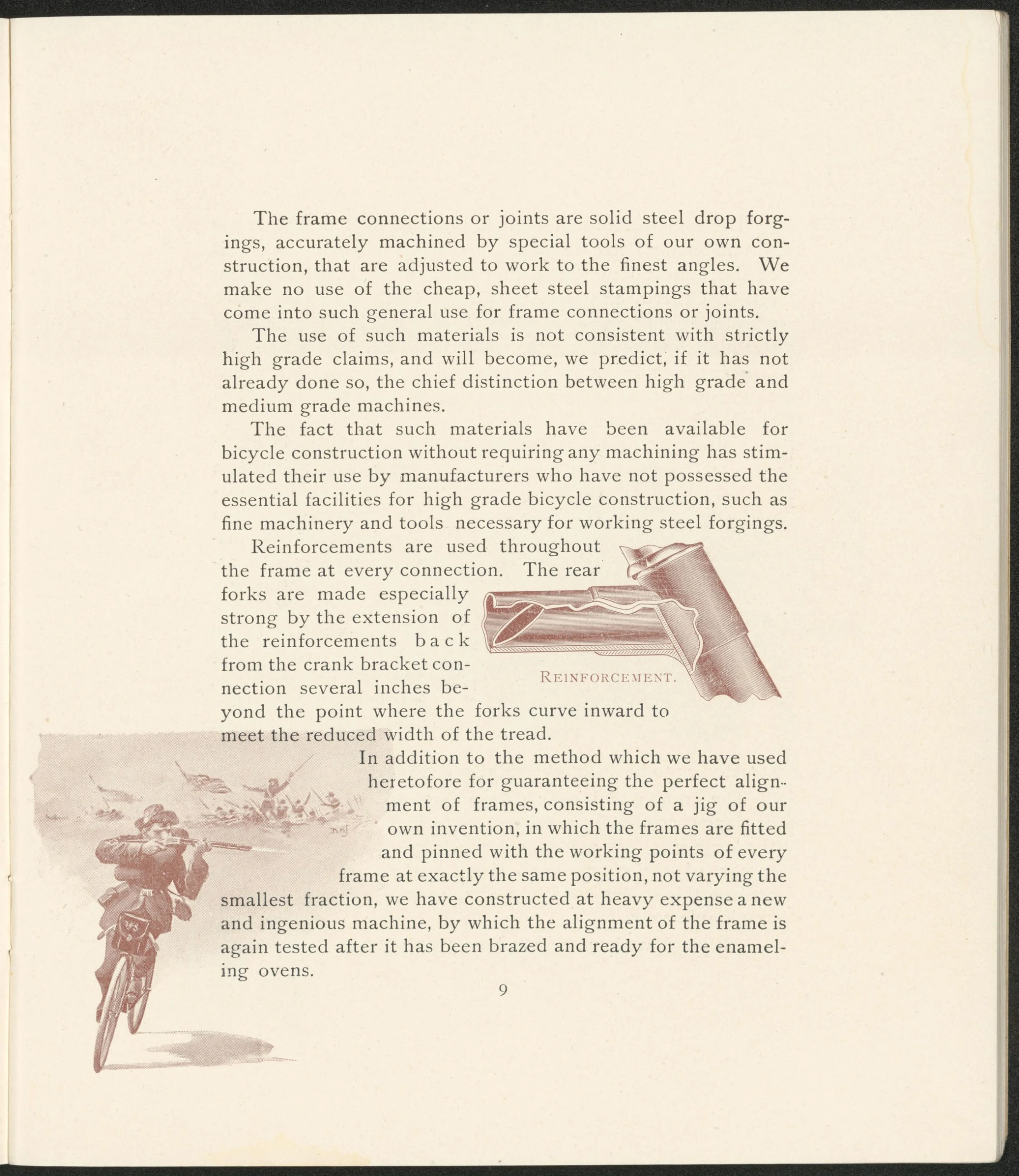
Reinforcements are used throughout the frame at every connection. The rear forks are made especially strong by the extension of the reinforcements back from the crank bracket connection several inches beyond the point where the forks curve inward to meet the reduced width of the tread.
REINFORCEMENT.
In addition to the method which we have used heretofore for guaranteeing the perfect alignment of frames, consisting of a jig of our own invention, in which the frames are fitted and pinned with the working points of every frame at exactly the same position, not varying the smallest fraction, we have constructed at heavy expense a new and ingenious machine, by which the alignment of the frame is again tested after it has been brazed and ready for the enameling ovens.
9
[A red-brown cutaway engraving of a frame joint showing the internal reinforcement; a halftone vignette at lower left of a soldier with a “U.S.” bag riding a safety and firing a rifle, troops charging behind; artist’s initials in the vignette.]
— Page 12 —
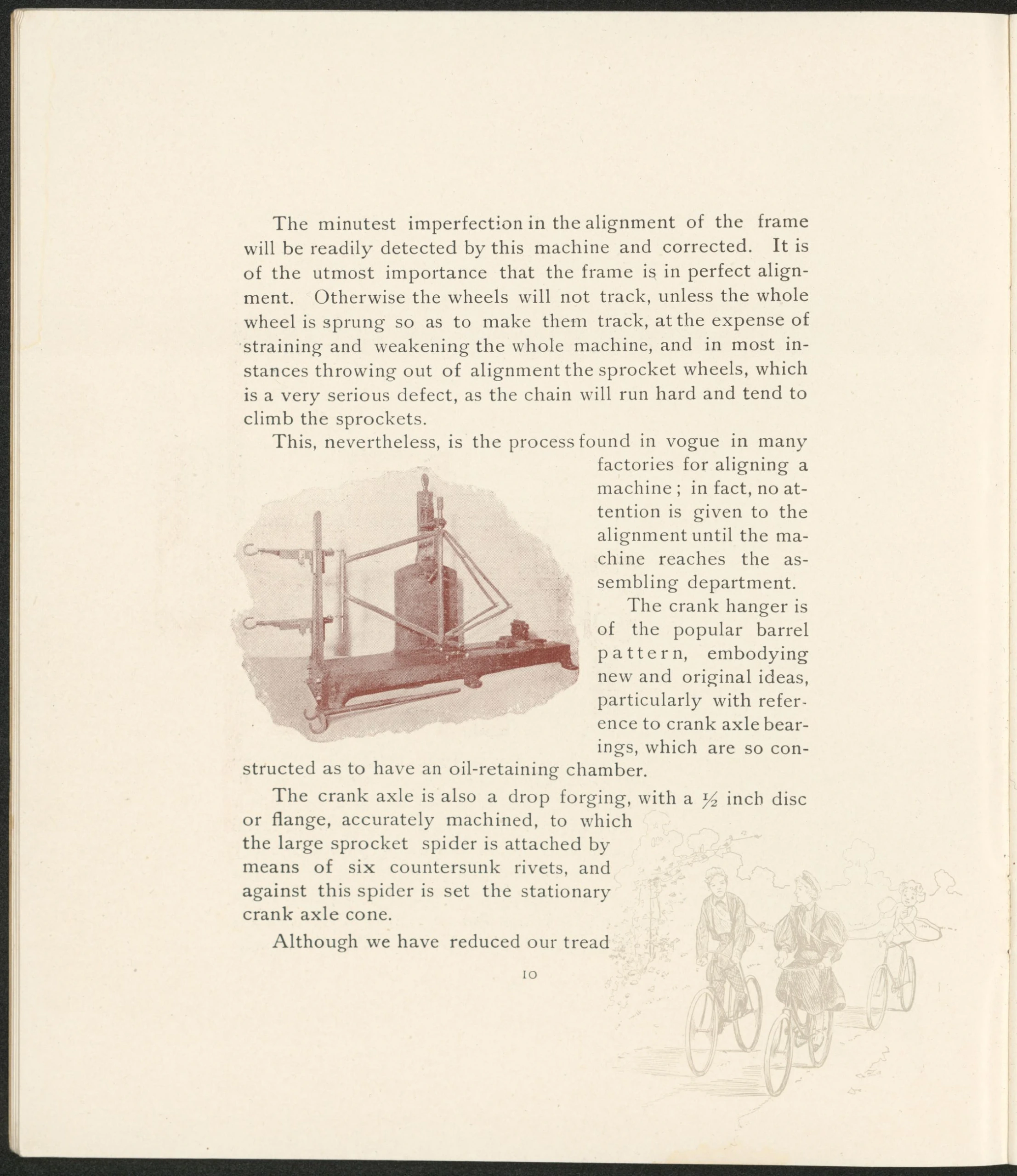
The minutest imperfection in the alignment of the frame will be readily detected by this machine and corrected. It is of the utmost importance that the frame is in perfect alignment. Otherwise the wheels will not track, unless the whole wheel is sprung so as to make them track, at the expense of straining and weakening the whole machine, and in most instances throwing out of alignment the sprocket wheels, which is a very serious defect, as the chain will run hard and tend to climb the sprockets.
This, nevertheless, is the process found in vogue in many factories for aligning a machine; in fact, no attention is given to the alignment until the machine reaches the assembling department.
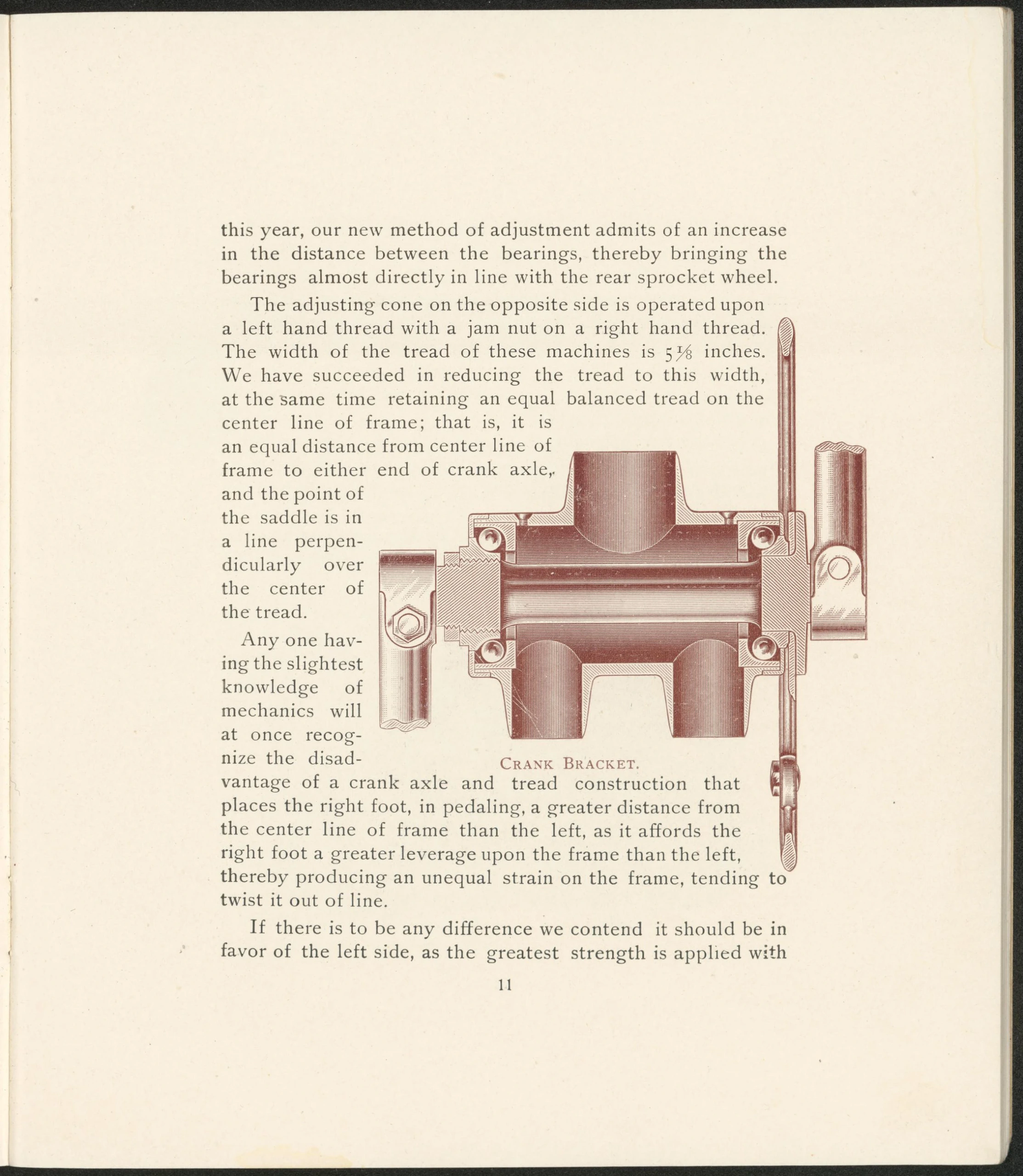
The crank hanger is of the popular barrel pattern, embodying new and original ideas, particularly with reference to crank axle bearings, which are so constructed as to have an oil-retaining chamber.
The crank axle is also a drop forging, with a 1/2 inch disc or flange, accurately machined, to which the large sprocket spider is attached by means of six countersunk rivets, and against this spider is set the stationary crank axle cone.
Although we have reduced our tread
10
[A red-brown halftone of the frame-alignment testing machine with a frame clamped in it; a faint gray line drawing at lower right of a boy, a young woman and a little girl riding safeties along a lane.]
— Page 13 —
this year, our new method of adjustment admits of an increase in the distance between the bearings, thereby bringing the bearings almost directly in line with the rear sprocket wheel.
The adjusting cone on the opposite side is operated upon a left hand thread with a jam nut on a right hand thread. The width of the tread of these machines is 5 1/8 inches. We have succeeded in reducing the tread to this width, at the same time retaining an equal balanced tread on the center line of frame; that is, it is an equal distance from center line of frame to either end of crank axle, and the point of the saddle is in a line perpendicularly over the center of the tread.
Any one having the slightest knowledge of mechanics will at once recognize the disadvantage of a crank axle and tread construction that places the right foot, in pedaling, a greater distance from the center line of frame than the left, as it affords the right foot a greater leverage upon the frame than the left, thereby producing an unequal strain on the frame, tending to twist it out of line.
CRANK BRACKET.
If there is to be any difference we contend it should be in favor of the left side, as the greatest strength is applied with
11
[A large red-brown sectional engraving of the barrel crank bracket showing the axle, ball bearings, cones, sprocket spider and both cranks.]
— Page 14 —
the right foot, and a slight difference in favor of the left foot might tend to equalize the strain on each side of the frame.
The error, however, is always on the right side, as it is made to accommodate the large sprocket and bring it into line with the rear sprocket. In order to avoid this faulty construction, some makers have reduced the length of the rear hub, bringing the spoke flanges so near together that the wheel is made extremely weak in order to bring the hub sprocket in line with the large sprocket.
We have also been able to avoid this defect, as the spoke flanges on the rear hubs of these machines will be found to be 2 5/8 inches apart, thereby retaining the greatest strength in the rear wheels.
Many manufacturers in their mad endeavors to reduce the tread of their machines have sacrificed both of these most vital features.
No. 2 [?]
CHEMICAL
12
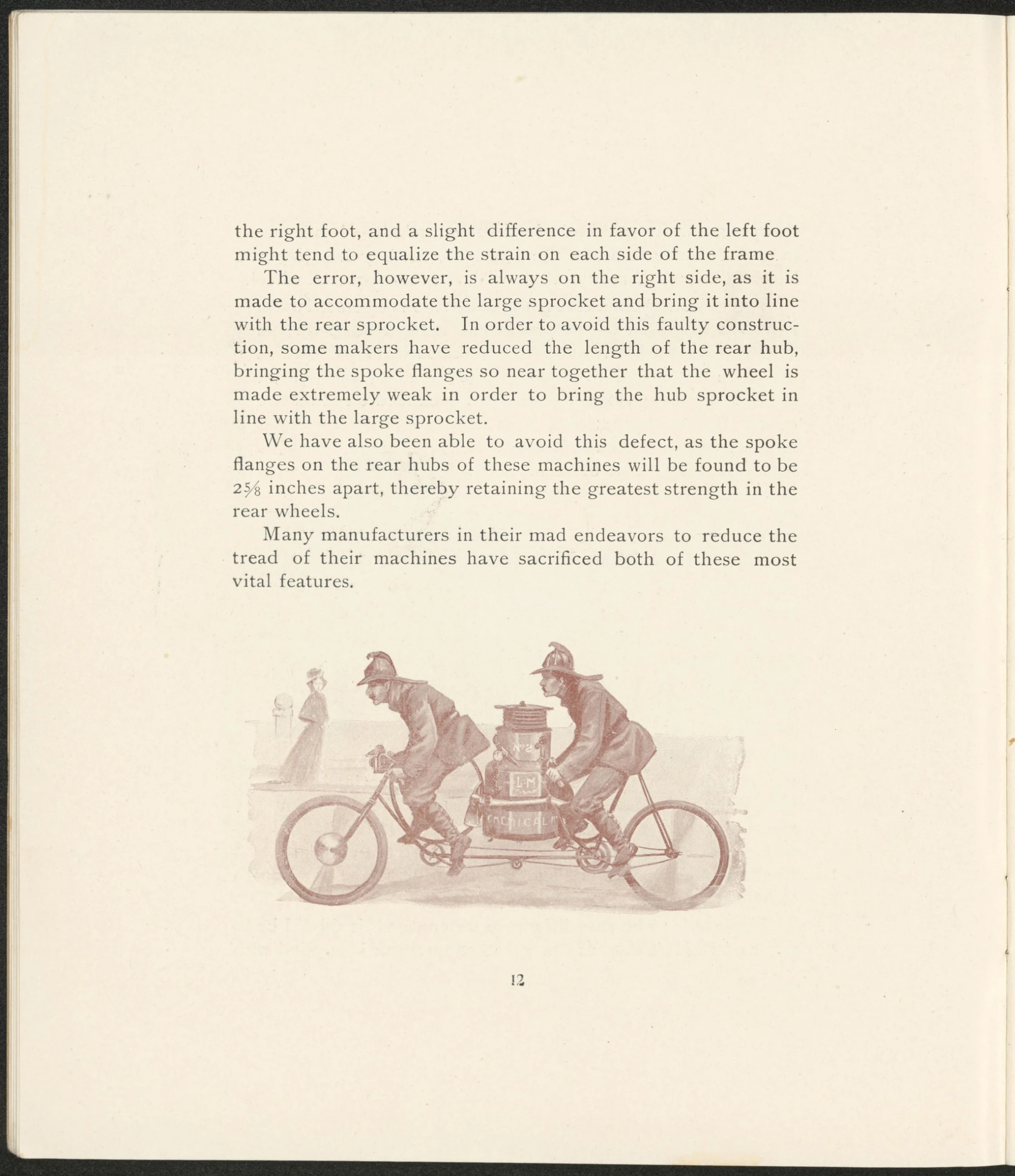
[A red-brown halftone of two firemen in helmets riding a tandem safety carrying a chemical fire extinguisher tank lettered “CHEMICAL” between them, a woman watching from the sidewalk.]
— Page 15 —
REAR FORK AND CHAIN ADJUSTMENT.
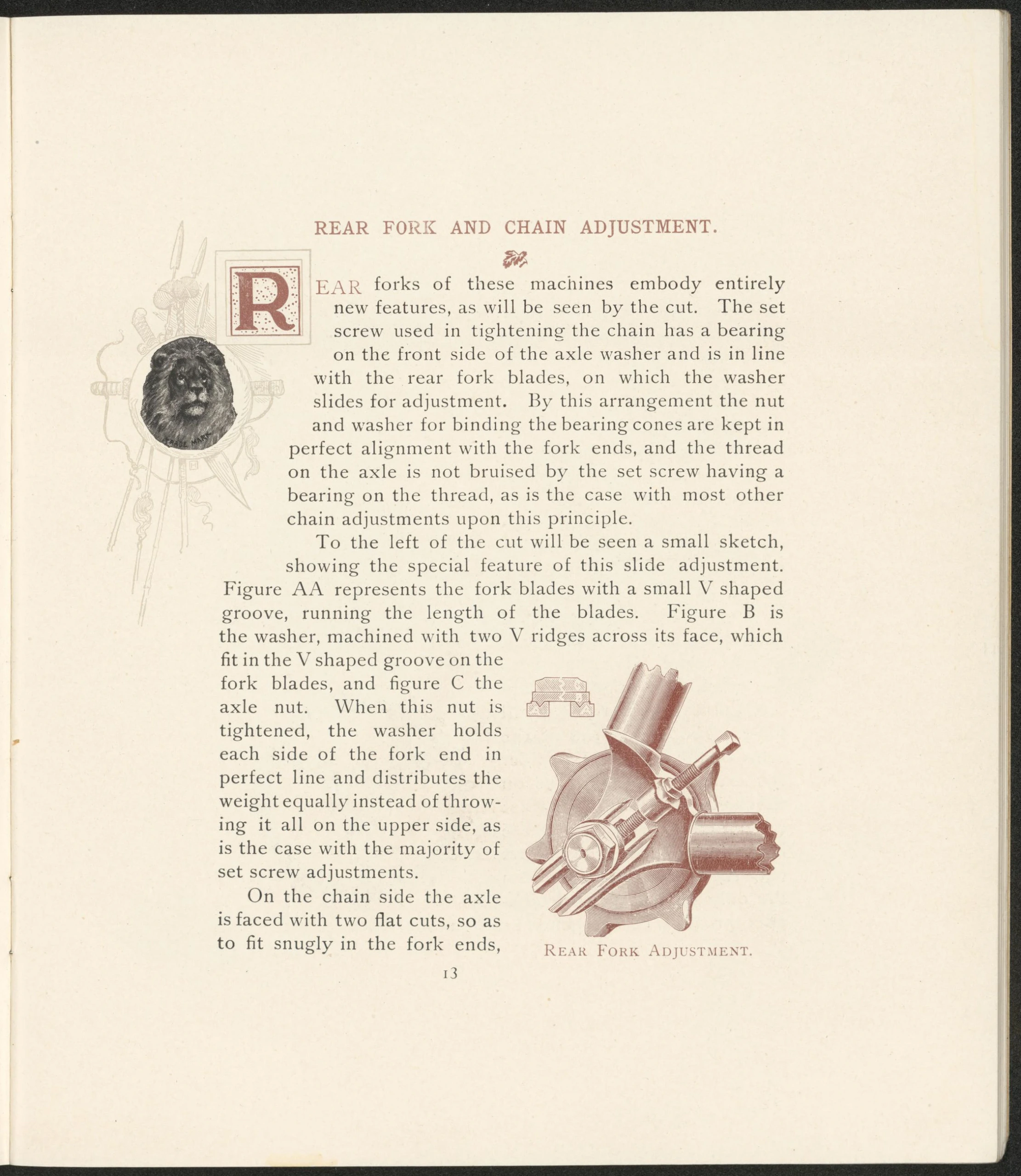
REAR forks of these machines embody entirely new features, as will be seen by the cut. The set screw used in tightening the chain has a bearing on the front side of the axle washer and is in line with the rear fork blades, on which the washer slides for adjustment. By this arrangement the nut and washer for binding the bearing cones are kept in perfect alignment with the fork ends, and the thread on the axle is not bruised by the set screw having a bearing on the thread, as is the case with most other chain adjustments upon this principle.
To the left of the cut will be seen a small sketch, showing the special feature of this slide adjustment. Figure AA represents the fork blades with a small V shaped groove, running the length of the blades. Figure B is the washer, machined with two V ridges across its face, which fit in the V shaped groove on the fork blades, and figure C the axle nut. When this nut is tightened, the washer holds each side of the fork end in perfect line and distributes the weight equally instead of throwing it all on the upper side, as is the case with the majority of set screw adjustments.
On the chain side the axle is faced with two flat cuts, so as to fit snugly in the fork ends,
REAR FORK ADJUSTMENT.
TRADE MARK
13
[A red-brown engraving of the rear fork end with the sprocket, axle nut and chain-adjusting set screw, a small sectional sketch of the grooved washer beside it; a red initial R and a gray trophy of spears with a black lion’s-head medallion at left.]
— Page 16 —
thereby preventing the axle from turning, as the adjustment is made and the axle nut tightened.
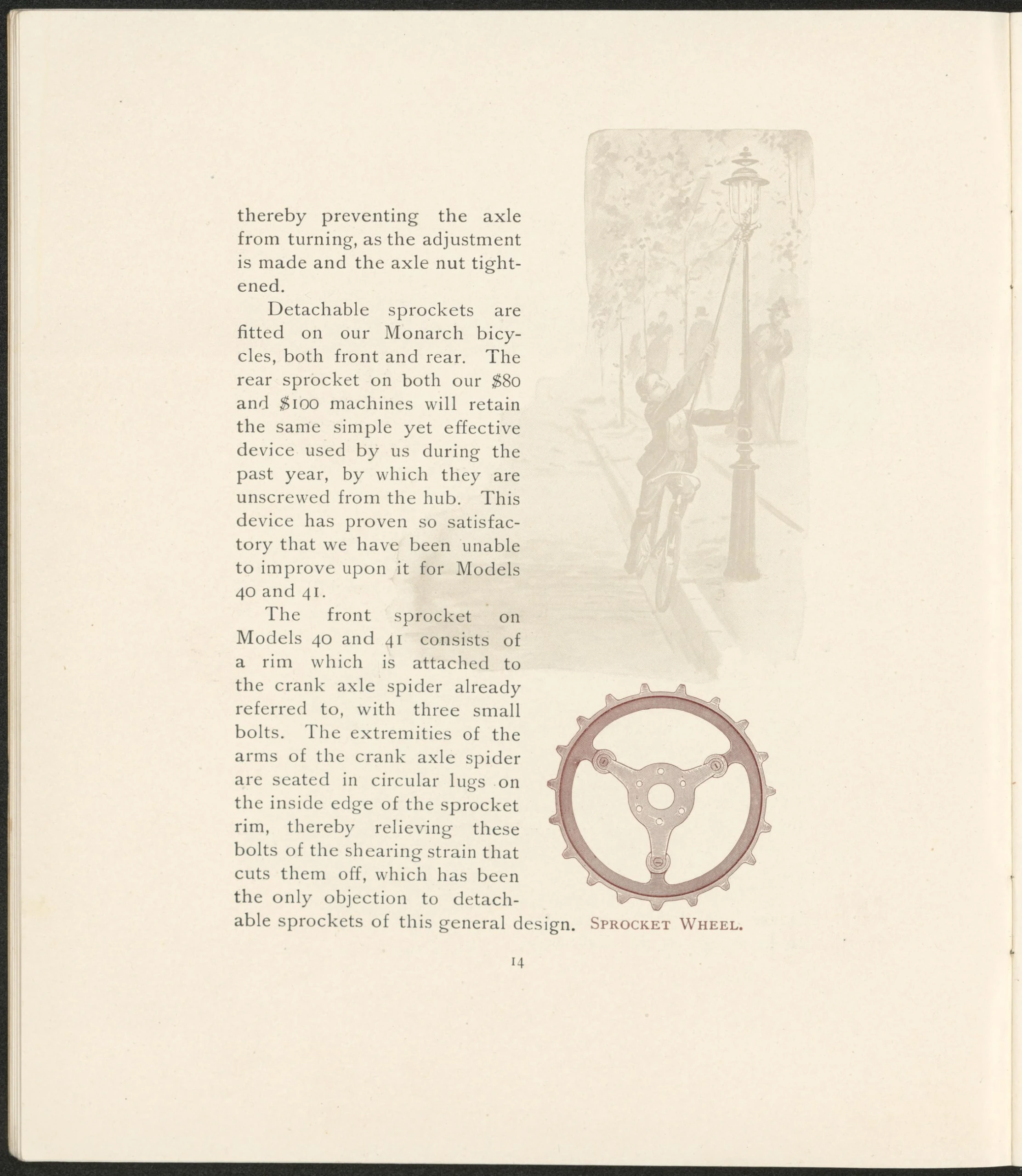
Detachable sprockets are fitted on our Monarch bicycles, both front and rear. The rear sprocket on both our $80 and $100 machines will retain the same simple yet effective device used by us during the past year, by which they are unscrewed from the hub. This device has proven so satisfactory that we have been unable to improve upon it for Models 40 and 41.
The front sprocket on Models 40 and 41 consists of a rim which is attached to the crank axle spider already referred to, with three small bolts. The extremities of the arms of the crank axle spider are seated in circular lugs on the inside edge of the sprocket rim, thereby relieving these bolts of the shearing strain that cuts them off, which has been the only objection to detachable sprockets of this general design.
SPROCKET WHEEL.
14
[A faint gray halftone at upper right of a lamplighter on a bicycle lighting a street gas lamp with a long pole, strollers behind; a red-brown engraving of the detachable front sprocket rim on its three-armed spider below.]
— Page 17 —
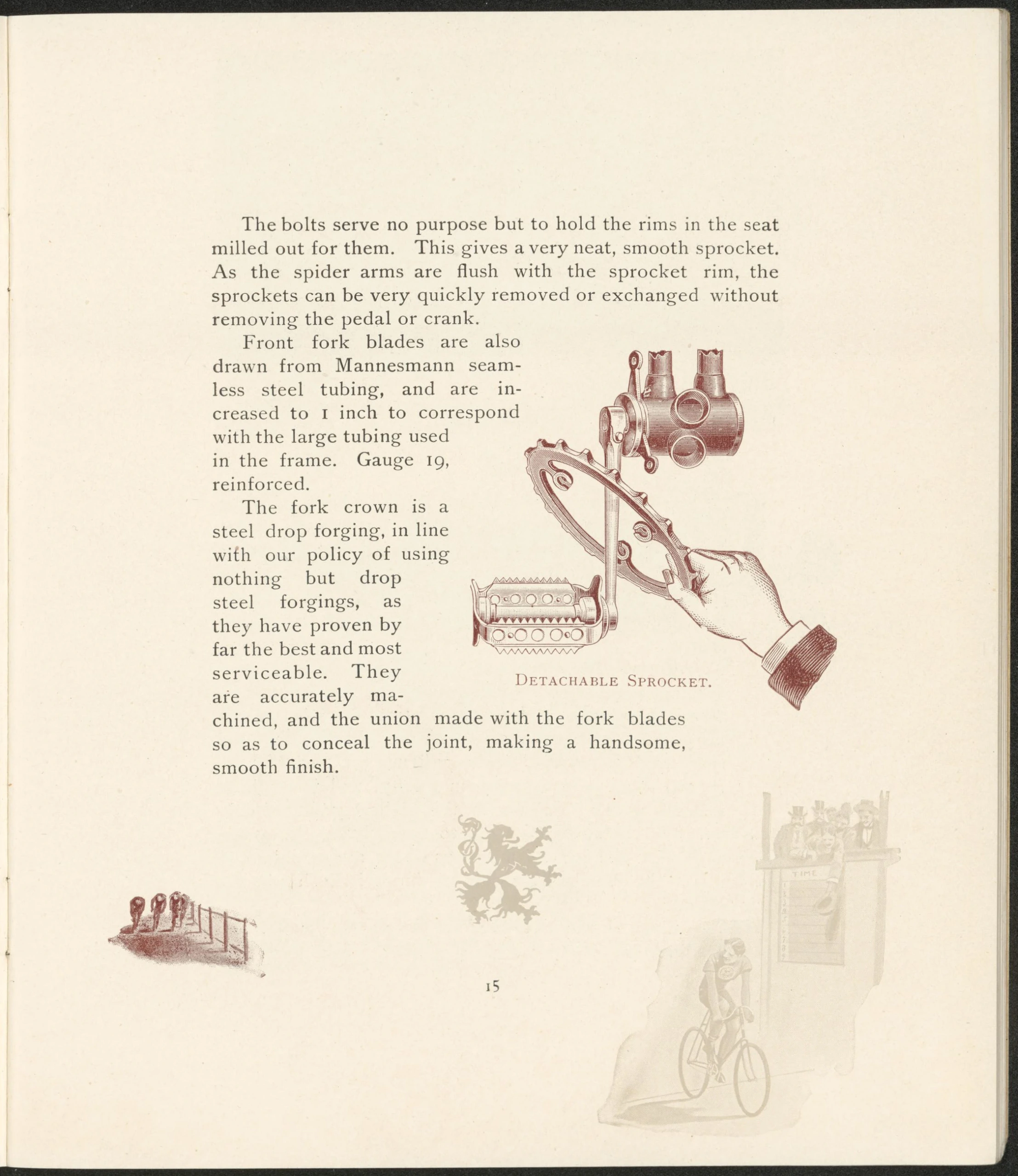
The bolts serve no purpose but to hold the rims in the seat milled out for them. This gives a very neat, smooth sprocket. As the spider arms are flush with the sprocket rim, the sprockets can be very quickly removed or exchanged without removing the pedal or crank.
Front fork blades are also drawn from Mannesmann seamless steel tubing, and are increased to 1 inch to correspond with the large tubing used in the frame. Gauge 19, reinforced.
The fork crown is a steel drop forging, in line with our policy of using nothing but drop steel forgings, as they have proven by far the best and most serviceable. They are accurately machined, and the union made with the fork blades so as to conceal the joint, making a handsome, smooth finish.
DETACHABLE SPROCKET.
TIME
15
[A red-brown engraving of a hand lifting the detachable sprocket rim off the crank, with the bracket shell and a rat-trap pedal; a tiny vignette of racers on a track at left, a gray rampant lion at center and a faint gray racing cyclist passing the timers’ stand at lower right.]
— Page 18 —
THE WHEELS.
FOR the very best material for the wheels of these machines we have searched the markets of the world. Hubs are of the barrel pattern, made from steel drop forgings, rather than the cheap style of hub drawn from tubing, which will be so common during ’96, but principally confined to cheap wheels.
Although the process of producing hubs from steel forgings is far more expensive than the tubular hubs referred to, or even the hubs turned from bar stock which are used by some makers, we prefer to continue to use the steel forgings, as with the experience we have had we regard them as far superior in quality, and in addition possessing the requisites of the highest grade of construction. Oil chambers are fitted to these hubs. They are made to fit over the ends of the hubs which are machined to the depth of the chambers, so that the finish is flush and the joint is tight.
The openings of the chambers are accurately gauged, and the cones likewise, so as to admit of a close fitting flush with
16
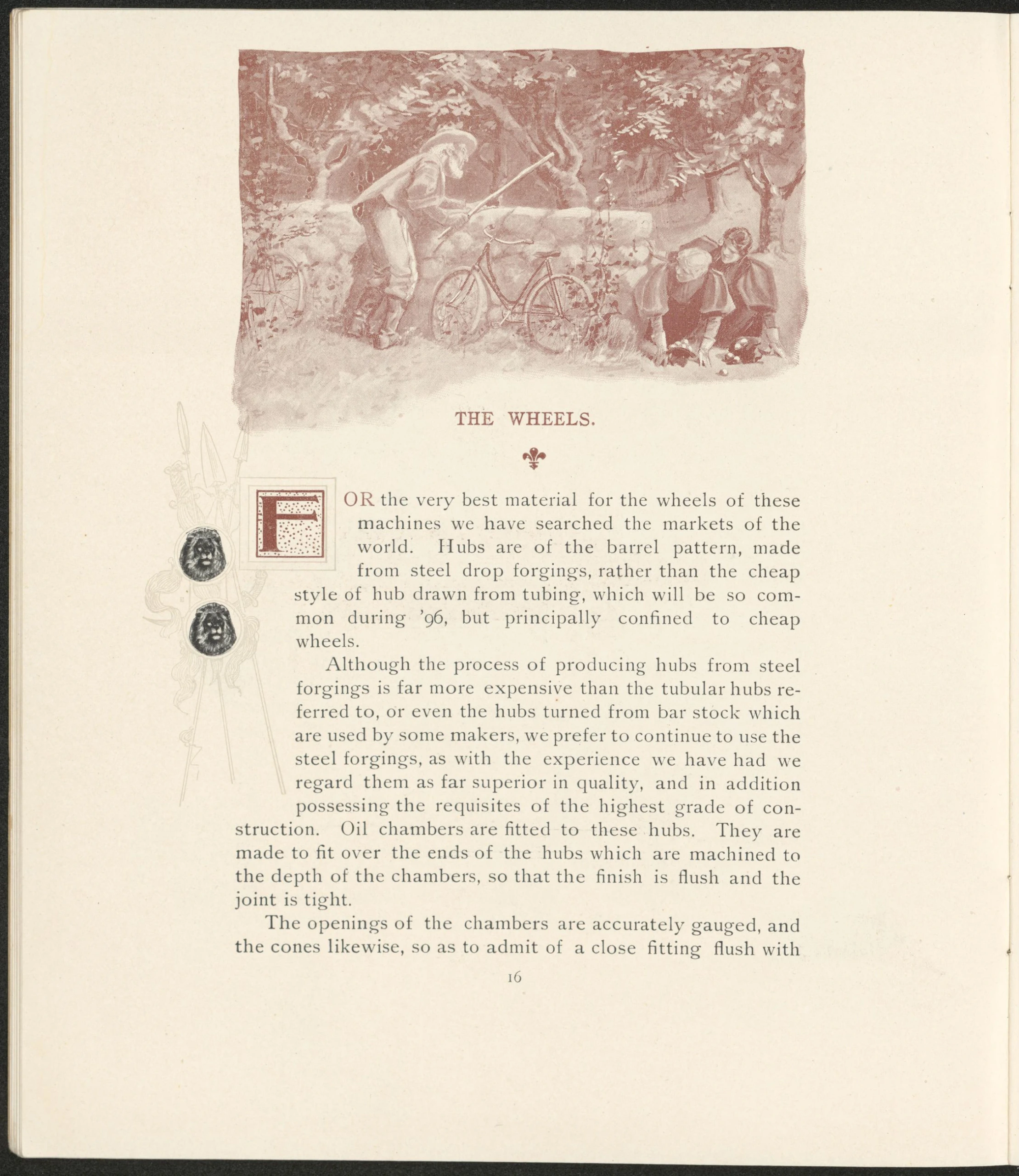
[A red-brown halftone at the top of an old farmer with a pitchfork leaning over a stone wall to scold two young women gathering fruit, their drop-frame safety propped against the wall; a red initial F and a gray trophy with two black lion medallions at left.]
— Page 19 —
the end or face of the chamber. By this arrangement there is no exposed surface where dust accumulates, nor can the dust and dirt reach the bearings.
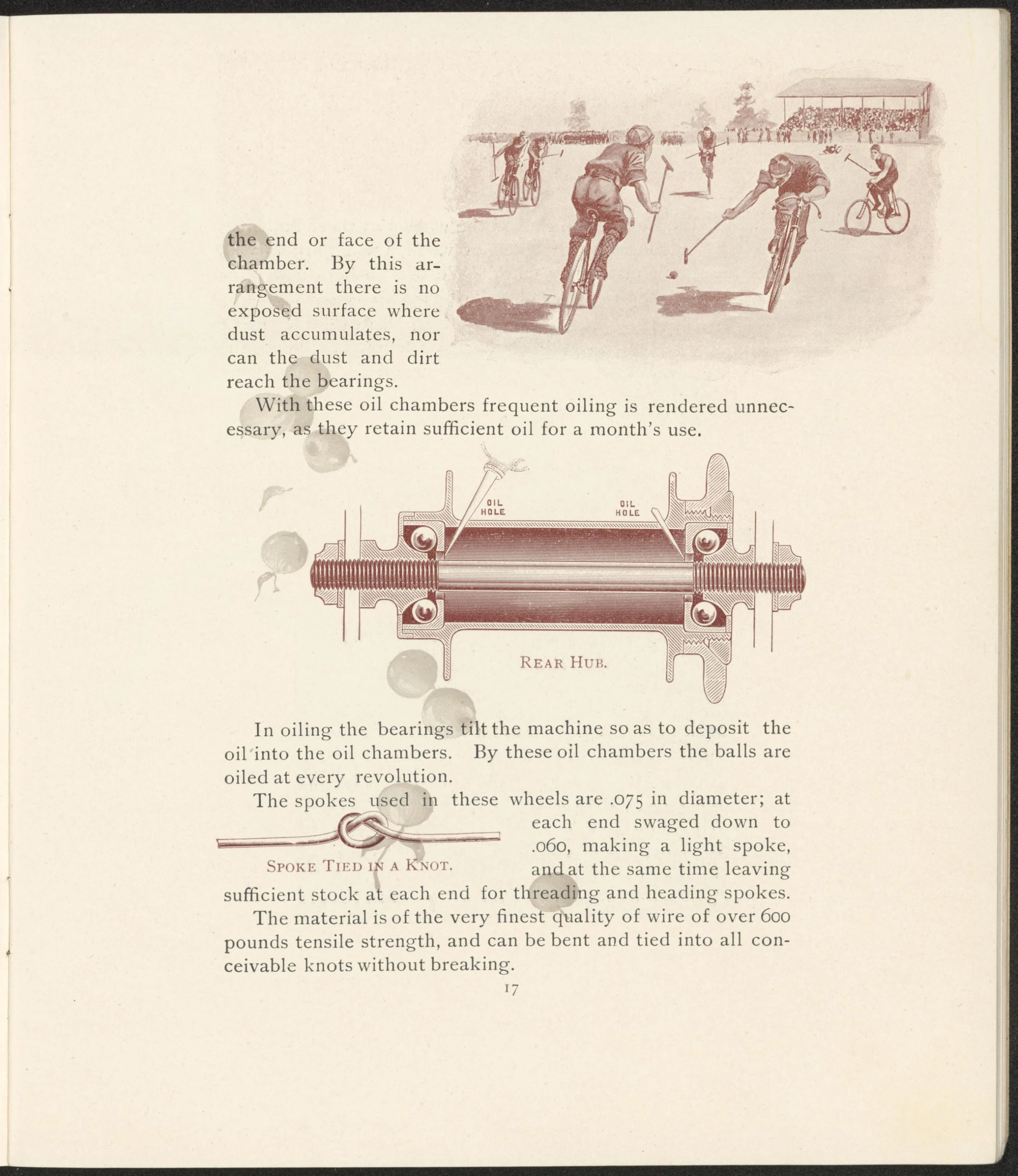
With these oil chambers frequent oiling is rendered unnecessary, as they retain sufficient oil for a month’s use.
OIL HOLE | OIL HOLE
REAR HUB.
In oiling the bearings tilt the machine so as to deposit the oil into the oil chambers. By these oil chambers the balls are oiled at every revolution.
The spokes used in these wheels are .075 in diameter; at each end swaged down to .060, making a light spoke, and at the same time leaving sufficient stock at each end for threading and heading spokes.
SPOKE TIED IN A KNOT.
The material is of the very finest quality of wire of over 600 pounds tensile strength, and can be bent and tied into all conceivable knots without breaking.
17
[A red-brown halftone at top of men playing bicycle polo with mallets before a crowded grandstand; a sectional engraving of the rear hub with its oil holes and a swaged spoke tied in a knot below; a faint gray spray of berries down the left side.]
— Page 20 —
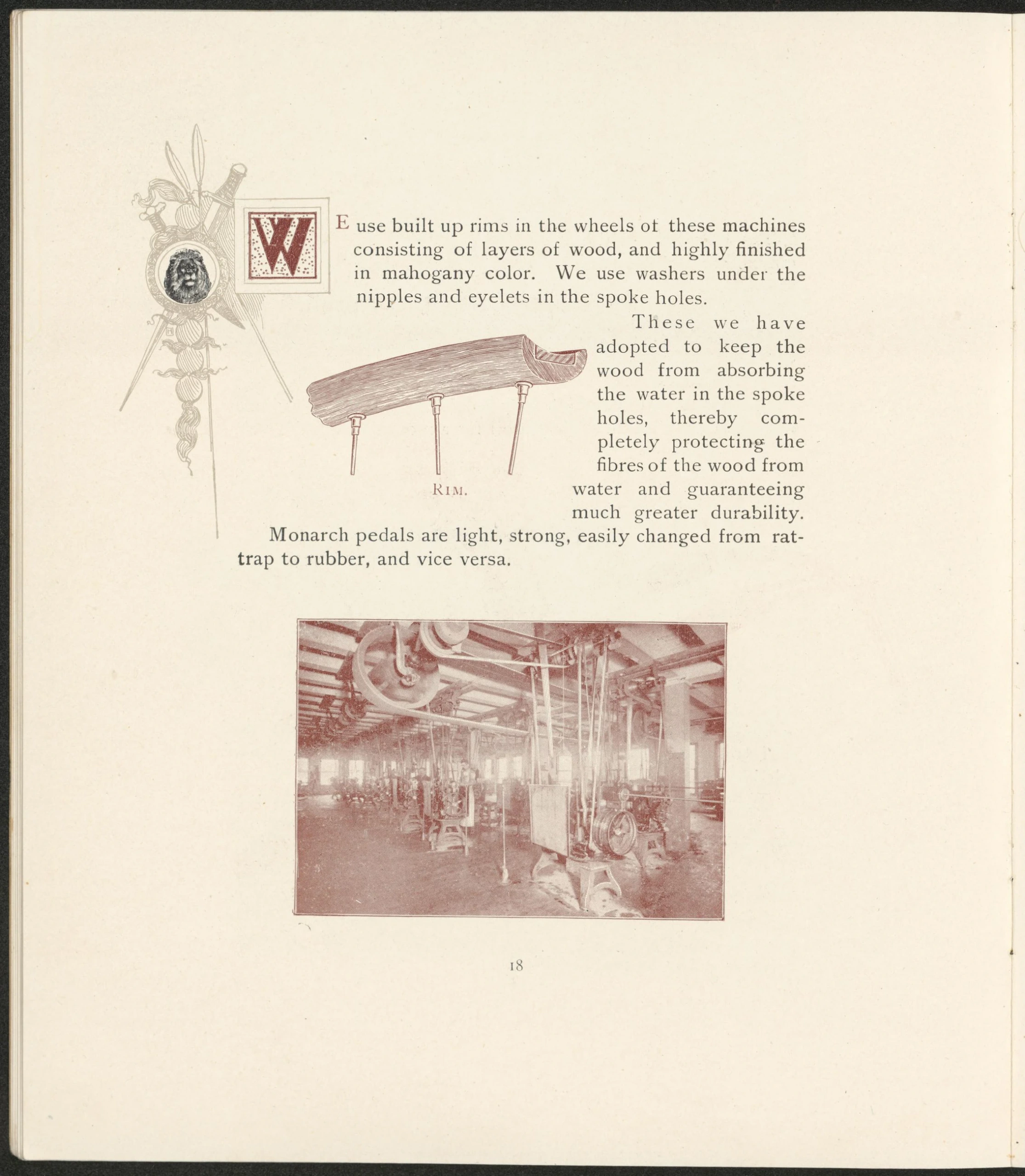
WE use built up rims in the wheels of these machines consisting of layers of wood, and highly finished in mahogany color. We use washers under the nipples and eyelets in the spoke holes.
These we have adopted to keep the wood from absorbing the water in the spoke holes, thereby completely protecting the fibres of the wood from water and guaranteeing much greater durability.
RIM.
Monarch pedals are light, strong, easily changed from rat-trap to rubber, and vice versa.
18
[A red-brown engraving of a section of wood rim with three spokes and nipples; below, a red-brown halftone photograph of a factory machine room with overhead line shafting, belts and pulleys; a red initial W and a gray trophy with a lion medallion at upper left.]
— Page 21 —
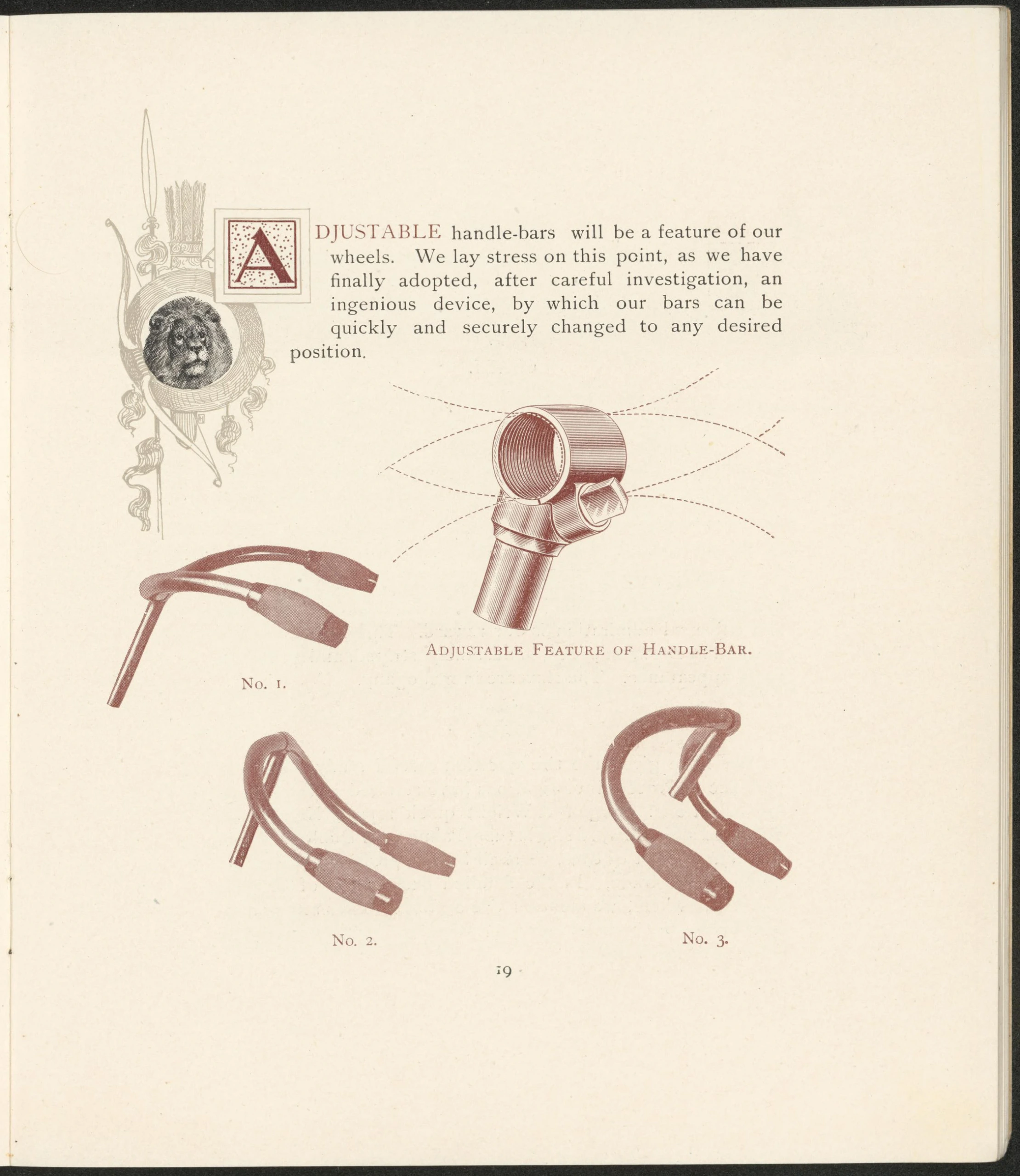
ADJUSTABLE handle-bars will be a feature of our wheels. We lay stress on this point, as we have finally adopted, after careful investigation, an ingenious device, by which our bars can be quickly and securely changed to any desired position.
ADJUSTABLE FEATURE OF HANDLE-BAR.
No. 1.
No. 2.
No. 3.
19
[Red-brown engravings of the adjustable handlebar stem clamp with dotted lines showing the range of bar positions, and halftones of three cork-gripped handlebar bends numbered 1, 2 and 3; a red initial A and a gray trophy with a lion medallion at left.]
— Page 22 —
SADDLES.
WE present on our different models a few popular styles of the Garford, Hunt and Sager saddles, all of which will be used on Monarch wheels.
CHAIN.
We use a quarter-inch block hardened chain of the Humber pattern. These chains have been especially selected, and are carefully tested before being fitted to our wheels. Particular attention is also given to the milling of sprocket wheels, so as to admit of a perfect fit of the chain.
FINISH.
A standard finish on these machines is given with the idea of attaining distinctiveness. We have spared no pains or expense, and universal admiration is our reward. These machines are finished in Brewster green, handsomely striped, and present a natty appearance. The rims are in mahogany.
TIRES.
We have given the tire question careful study. Our experience and recent investigations have resulted in the following selections: Morgan & Wright quick repair, New York, Diamond and Hartford single tube, Palmer and Dunlop. From this complement of tires, we shall be in a position to meet the wants of the trade. In the detailed description of models, found elsewhere, we mention tire options. Tires are guaranteed by the tire makers, and all claims for defects should be referred to them direct.
20
[A text page with red headings and small red fleurons; a red initial W and a gray trophy of arms with a black lion medallion at upper left.]
— Page 23 —
MODEL 41.
WE have built this model entirely on new lines, thereby adding grace to our last season’s model, which was pronounced by many competent judges at the ’95 cycle show to be the handsomest ladies’ wheel on exhibition. In this light, graceful mount, we have embodied all the new features described in the companion machine, our elegant Model 40. In fact, it is a duplicate of the men’s wheel, differing only in the double drop frame. By producing such a machine our fair riders are put on an equal footing with their hitherto swifter mounted companions. In equipment it is complete. Handsomely finished hardwood dress guards, with lacing to match, set off the wheel and afford complete protection to the skirt. In line with a general demand we have continued the mud guards farther back than was customary last season. Height of frame, 22 inches.
For ladies desiring a light smooth running, graceful diamond frame machine, we would particularly recommend our Model 40, with 22 inch frame.
MODEL 42.
Acting on the urgent request of our friends in many quarters, we placed on the market last season a specially designed 18 pound racing machine. That our efforts in this direction have proven successful is shown by the scores of victories that have fallen to Monarch riders. This was noticeable with our racing team in their phenomenal winings on the
21
[A text page with red headings and a red fleuron; a red initial W and a gray trophy of arms with a black lion medallion at upper left.]
— Page 24 —
National Circuit. The history of racing has probably no such record of one man or one machine leaping into such sudden fame as Tom Cooper and his Monarch ’95 racer.
Taking our past achievements in the racing line as a criterion, with our improved cones, sprocket wheels, and crank axle attachment, we can reasonably expect even greater success for the coming year.
This machine will embody all the new features, as mentioned in connection with our Model 40, differing only in the matter of weight.
MODEL 43.
In response to repeated calls for tandems, we have decided to place a pair on the market for ’96, thereby making our line of wheels complete. We shall use the same high grade material throughout these machines as used in our Model 40, and shall employ the same careful detail of construction. Model 43, our diamond frame tandem, is built on the most approved lines. Model 44 will be a counterpart of Model 43, differing only in having a drop front top main tubing.
MODEL 20.
The flattering reception given our Model 10 of last season has been the means of deciding us to place this machine on the market again, with some slight alterations, where it was possible to make improvements. Our new rear fork attachment, illustrated elsewhere, which is attracting such widespread attention, is one of these innovations. We have reinforced the tubing at all connections. This gives us a machine hand-
22
[A text page with red headings and small red fleurons; no illustration.]
— Page 25 —
some in outline, strong, rigid, light, tractable and a ready favorite. Although this model is the equal of any other make of machine on the market, and the superior of many so-called high grade wheels listing at $100, yet we have decided to list it at $80, a price within the reach of all. On account of its many fine points, we bespeak for this model an unprecedented run. The finish of this machine is a handsome black enamel, with nickeled parts. Having enlarged and improved our enameling department, the quality of this new finish is incomparable.
MODEL 21.
This model is an improved pattern on our last year’s ladies’ wheel which attained a popularity seldom reached. The superb outlines have been retained, and with the exception of an increase in the seat mast tubing from 19 to 21 inches, improved cones, a new rear fork attachment, and handsome, highly polished hardwood dress guards, instead of steel guards, the machine remains the same. Like the companion machine, this model will list at $80.
23
[A red-brown halftone vignette at lower right of a cowboy on a safety lassoing a charging steer on an open plain with hills behind.]
— Page 26 —
MODEL 40.
BRIEF.—Monarch 24-inch diamond frame. Mannesmann 1 1/8 inch tubing for main top, seat mast and main lower, with 3/4 inch tubes for rear forks and stays. 10 inch head, with 1 1/4 inch tubing. 28 inch wheels. Detachable sprockets, front and rear. Barrel Hubs. Builtup wood rims, fitted with nickel plated eyelets in spoke holes and finished in mahogany. Humber pattern chains. Monarch patent crank shaft bearings. Detachable, round, tapered cranks, 6 1/2 inch throw. Width of tread 5 1/8 inches. Tubular L seat post, with solid steel top bar. Cold swaged, double-butted steel tangent spokes, tied, with 32 to front and 36 to rear wheel. Brandenburg rat-trap pedals. Garford T saddle. Gear 68. Monarch adjustable handle-bar, 13-16 inch. Cork handles with black tips. M. & W. 1 5/8 inch quick repair tires. Weight, 22 lbs. Black tool bag, with pump, wrench, screw-driver, oil can and repair kit. Finish, Brewster green enamel, handsomely striped, with nickeled parts and spokes.
Options.—New York, Palmer, Dunlop, or No. 80 Hartford, single tube tires. Gear, 63, 66 1/2 or 72. Monarch or Brandenburg rubber pedals. Hunt saddle. 22 or 26 inch frame.
WEIGHT 22 LBS. PRICE $100
24
[The specification text set inside a large oval of pale gray rococo scrollwork filling the page, with small fleurons above and below.]
— Page 27 —
MODEL 40.
Weight, 22 lbs. | Price, $100
[A full-page engraving of the Model 40 men’s diamond-frame safety in side view with dropped handlebars, set on a pale gray rococo scroll ground with a faint lion’s-head trade mark behind the frame; caption in red.]
— Page 28 —
MODEL 41.
BRIEF.—Monarch 22-inch double-drop frame. Seat mast, upper and lower drop main tubing 1 1/8 inch Mannesmann, with rear stays and forks 3/4 inch. Head, 10 inch ball bearing with 1 1/4 inch tubing. 28 inch wheels. Detachable sprocket wheels, front and rear. Barrels hubs. Built up wood rims, fitted with nickel plated eyelets in spoke holes and finished in mahogany. Humber pattern chain. Monarch patent crank shaft bearings. Detachable, round, tapered cranks, 6 inch throw. Width of tread, 5 1/8 inches. L seat post. Cold swaged, double-butted steel tangent spokes, tied, with 32 to front and 36 to rear. Brandenburg rubber pedals. Hunt spring saddle. 62 inch gear. Monarch raised handle-bar, 13-16 inch. Cork handles with white tips. M. & W. 1 5/8 inch quick repair tires. Weight, 22 lbs. Black tool bag, with pump, wrench, screw-driver, oil can and repair kit. Finish, Brewster green enamel, handsomely striped, with nickeled parts and spokes.
OPTIONS.—New York, Palmer, Dunlop, or No. 80 Hartford single tube tires. Monarch rubber pedals. Garford saddle.
WEIGHT 22 LBS. PRICE $100
26
[The specification text set inside a large oval of pale gray rococo scrollwork filling the page, with small fleurons above and below.]
— Page 29 —
MODEL 41.
Weight, 22 lbs. | Price, $100
[A full-page engraving of the Model 41 ladies’ double-drop-frame safety in side view with raised handlebar and chain guard, set on a pale gray rococo scroll ground with a faint lion’s-head trade mark behind; caption in red.]
— Page 30 —
MODEL 42.
BRIEF.—Monarch 24-inch diamond frame. Mannesmann 1 1/8 inch tubing for main top, seat mast and main lower tubes, with 3/4 inch tubes for rear forks and stays. 10 inch head, with 1 1/4 inch tubing. 28 inch wheels. Detachable sprockets front and rear. Barrel hubs. Built up wood rims fitted with nickel plated eyelets in spoke holes and finished in mahogany. Perry pen-bushed steel chain. Monarch patent crank shaft bearings. Detachable, round, tapered cranks, 6 1/2 inch throw. Width of tread 5 1/8 inches. Direct seat post. Cold swaged, double-butted steel tangent spokes, tied, 32 to front and 36 to rear wheel. Brandenburg rat-trap pedals with toe clips attached. G. & J. racing saddle. Gear 68. Monarch ram’s horn handle-bars. Cork handles with black tips. Morgan & Wright racing tires. Weight, 18 lbs. Finish, Brewster green enamel, handsomely striped, with nickeled parts and spokes.
OPTIONS.—New York or Palmer racing tires. Gear 72 or 76. Garford or Sager racing saddles. 22 or 26 inch frame.
WEIGHT 18 LBS. PRICE $125
28
[The specification text set inside a large oval of pale gray rococo scrollwork filling the page, with small fleurons above and below.]
— Page 31 —
MODEL 42.
Weight, 18 lbs. | Price, $125
[A full-page engraving of the Model 42 racing safety in side view with ram’s-horn handlebars, rat-trap pedals and toe clips, set on a pale gray rococo scroll ground with a faint lion’s-head trade mark behind; caption in red.]
— Page 32 —
MODEL 43.
BRIEF.—Monarch diamond frame on Model 43 and double-drop frame in front on Model 44. Mannesmann 1 1/8 inch tubing for main top, seat masts and main lower and rear diagonal, with 3/4 inch tubes for rear forks and stays. Detachable sprockets. Barrel hubs. Built up wood rims, fitted with nickel plated eyelets in spoke holes and finished in mahogany. Humber pattern chains. Monarch pattern crank shaft bearings. Detachable, round, tapered cranks, 6 1/2 inch throw. Tread 5 1/2 inches. Tubular T seat posts, with solid steel top bars. Cold swaged, double-butted, steel tangent spokes, tied, with 32 to front and 36 to rear wheel. Brandenburg rat-trap pedals. Garford saddle. Gear 76. Monarch ram’s horn bars. Cork handles with black tips. M. & W. 1 3/4 inch quick repair tires. Black tool bag, with tools complete. Brewster green enamel finish, handsomely striped, with nickeled parts and spokes.
OPTIONS.—New York, Dunlop, or Hartford single tube tires. Brandenburg or Monarch rubber pedals. Hunt or Sager saddle. L seat post. Adjustable handle-bars.
WEIGHT, 38 LBS. PRICE, $150
30
[The specification text set inside a large oval of pale gray rococo scrollwork filling the page, with small fleurons above and below.]
— Page 33 —
MODEL 43.
Weight, 38 lbs. | Price, $150
[A full-page engraving of the Model 43 diamond-frame tandem safety in side view with two saddles and ram’s-horn bars, set on a pale gray rococo scroll ground with a faint lion’s-head trade mark behind; caption in red.]
— Page 34 —
MODEL 20.
BRIEF.—Monarch 24-inch diamond frame. Mannesmann inch tubing for main top, seat mast and main lower tubes, with 5/8 inch tubes for rear forks and stays. 10 inch head, with 1 1/4 inch tubing. 28 inch wheels. Detachable sprockets, front and rear. Plymouth rims. Humber pattern chain. Monarch patent crank shaft bearings. Detachable, round, tapered cranks, 6 1/2 inch throw. Width of tread, 5 3/4 inches. Tubular L seat post, with solid steel top bar. Cold swaged, double-butted steel tangent spokes, tied, with 28 to front and 32 to rear wheel. Monarch rat-trap pedals. Garford T saddle. 66 1/2 inch gear. Monarch drop handle-bar, 13-16 inch. Cork handles, with black tips. New York 1 5/8 inch tires. Weight, 22 pounds. Black tool bag, with pump, wrench, screw-driver, oil can and repair kit. Finish black enamel, with nickeled parts and spokes.
OPTIONS.—No. 77 Hartford single tube, or M. & W. quick repair tires. Monarch rubber pedals. Hunt saddle. Gear 68 or 72.
WEIGHT 22 LBS. PRICE $80
32
[The specification text set inside a large oval of pale gray rococo scrollwork filling the page, with small fleurons above and below.]
— Page 35 —
MODEL 20.
Weight, 22 lbs. | Price, $80
[A full-page engraving of the Model 20 men’s diamond-frame safety in side view with dropped handlebars, set on a pale gray rococo scroll ground with a faint lion’s-head trade mark behind; caption in red.]
— Page 36 —
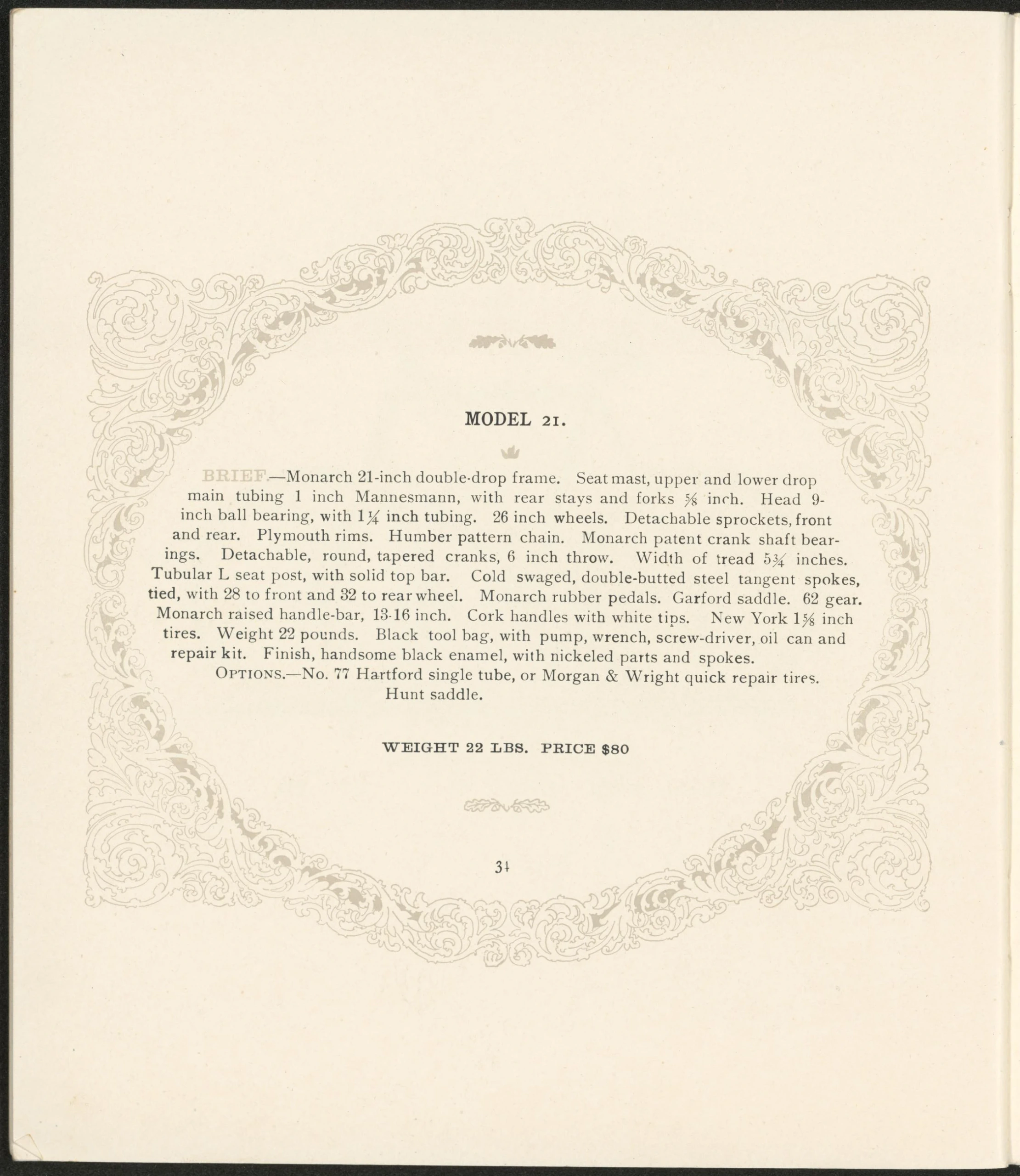
MODEL 21.
BRIEF.—Monarch 21-inch double-drop frame. Seat mast, upper and lower drop main tubing 1 inch Mannesmann, with rear stays and forks 5/8 inch. Head 9-inch ball bearing, with 1 1/4 inch tubing. 26 inch wheels. Detachable sprockets, front and rear. Plymouth rims. Humber pattern chain. Monarch patent crank shaft bearings. Detachable, round, tapered cranks, 6 inch throw. Width of tread 5 3/4 inches. Tubular L seat post, with solid top bar. Cold swaged, double-butted steel tangent spokes, tied, with 28 to front and 32 to rear wheel. Monarch rubber pedals. Garford saddle. 62 gear. Monarch raised handle-bar, 13-16 inch. Cork handles with white tips. New York 1 5/8 inch tires. Weight 22 pounds. Black tool bag, with pump, wrench, screw-driver, oil can and repair kit. Finish, handsome black enamel, with nickeled parts and spokes.
OPTIONS.—No. 77 Hartford single tube, or Morgan & Wright quick repair tires. Hunt saddle.
WEIGHT 22 LBS. PRICE $80
34
[The specification text set inside a large oval of pale gray rococo scrollwork filling the page, with small fleurons above and below.]
— Page 37 —
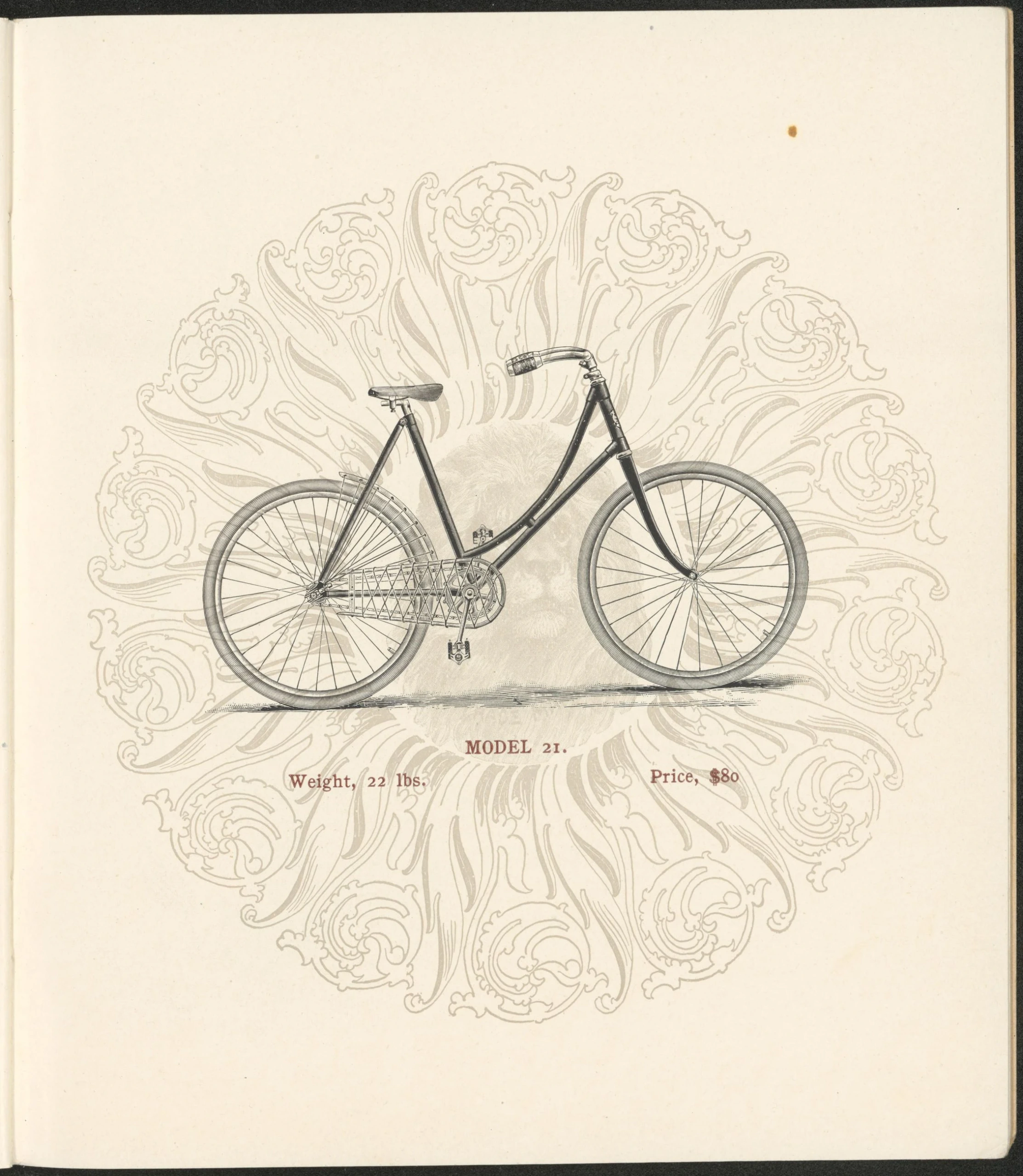
MODEL 21.
Weight, 22 lbs. | Price, $80
[A full-page engraving of the Model 21 ladies’ double-drop-frame safety in side view with raised handlebar, chain guard and dress guard, set on a pale gray rococo scroll ground with a faint lion’s-head trade mark behind; caption in red.]
— Page 38 —
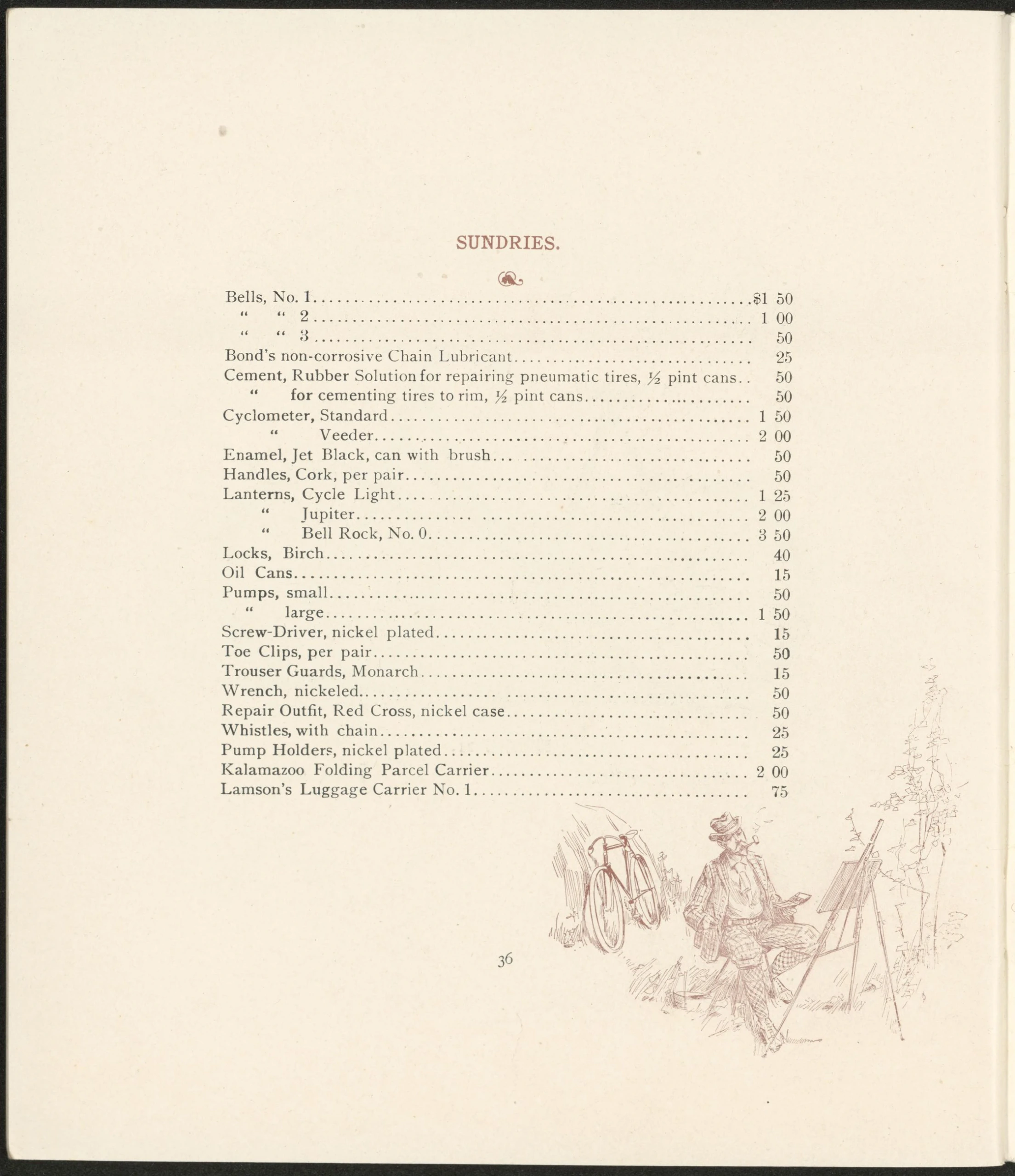
SUNDRIES.
Bells, No. 1 | $1 50
” ” 2 | 1 00
” ” 3 | 50
Bond’s non-corrosive Chain Lubricant | 25
Cement, Rubber Solution for repairing pneumatic tires, 1/2 pint cans | 50
” for cementing tires to rim, 1/2 pint cans | 50
Cyclometer, Standard | 1 50
” Veeder | 2 00
Enamel, Jet Black, can with brush | 50
Handles, Cork, per pair | 50
Lanterns, Cycle Light | 1 25
” Jupiter | 2 00
” Bell Rock, No. 0 | 3 50
Locks, Birch | 40
Oil Cans | 15
Pumps, small | 50
” large | 1 50
Screw-Driver, nickel plated | 15
Toe Clips, per pair | 50
Trouser Guards, Monarch | 15
Wrench, nickeled | 50
Repair Outfit, Red Cross, nickel case | 50
Whistles, with chain | 25
Pump Holders, nickel plated | 25
Kalamazoo Folding Parcel Carrier | 2 00
Lamson’s Luggage Carrier No. 1 | 75
36
[A price list with dot leaders under a red heading; a red-brown line drawing at lower right of a pipe-smoking artist sketching at an easel in a meadow, his safety propped beside him.]
— Page 39 —
TERMS.
ALL goods are sold F. O. B. Chicago or New York.
When desiring to open an account with us, or applying for an agency, give bank and trade reference, unless you have a Commercial Agency rating. Remit by Chicago or New York Draft, Postal Note, Money Order or Registered Letter. We will accept one and two-cent U. S. Postage Stamps in small amounts.
C. O. D. orders must be accompanied by sufficient money to pay charges both ways, or Express Agent’s Certificate that goods will be returned to us free of charge, if not accepted.
To avoid the multiplication of small accounts, we must insist upon the sending with all small orders, sufficient cash to cover cost of goods desired, as our profits are absorbed by the collection of small accounts. If goods are to be sent by mail, send an extra amount to pay postage, and any surplus will be returned or placed to your credit on our books.
No goods will be accepted for credit, for any cause, following the expiration of five days from receipt of same. If upon the receipt of goods, they are found to be not as represented, or according to order, you will be at liberty to so advise us, and we will give you instructions for disposition.
Our responsibility ceases, with reference to the safe delivery of goods, when delivery is made by us at Post Office, Express Office or Freight Depot.
Order machines according to specifications. Any alterations in our regular models will cause delay and inconvenience. When ordering give full particulars of what is wanted. Sign your name in full, and give city or town, county and state address. Our line of cycle accessories is complete, and we are in position to quote the lowest possible prices.
Transportation on all goods sent to us for repairs must be prepaid.
No discounts are allowed except to regular agents.
When repairs are necessary, in connection with pneumatic tires, remove them from the wheels and send tires direct to the manufacturers, instead of to us, as they will make all repairs free of charge, when the needed repair is the result of defective material or inferior workmanship (see guarantee elsewhere).
US MAIL
37
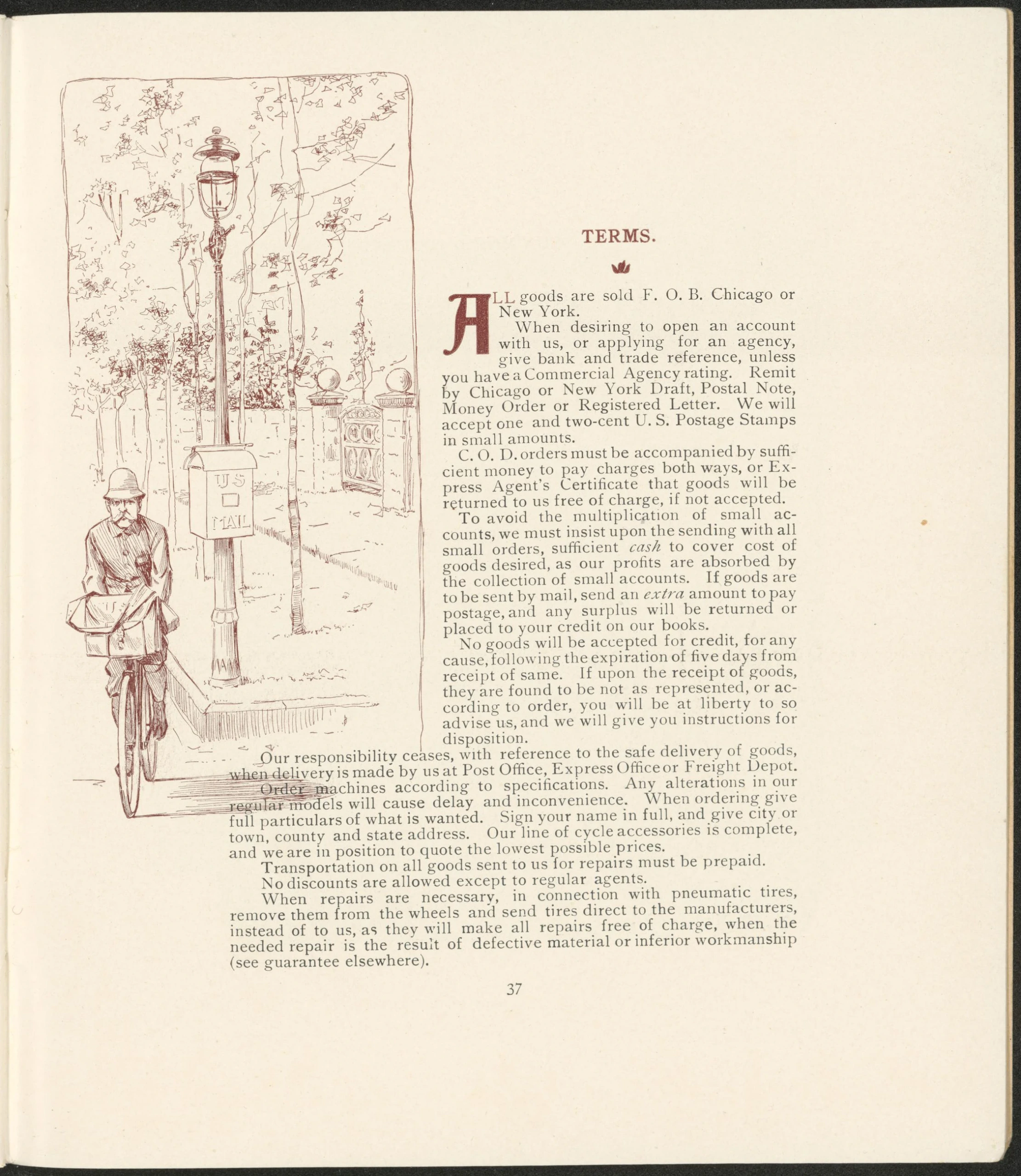
[A red-brown pen drawing at left of a mustached mail carrier riding a safety with his mailbag past a street lamp with a “US MAIL” box, gate piers and trees behind; a red initial A.]
— Page 40 —
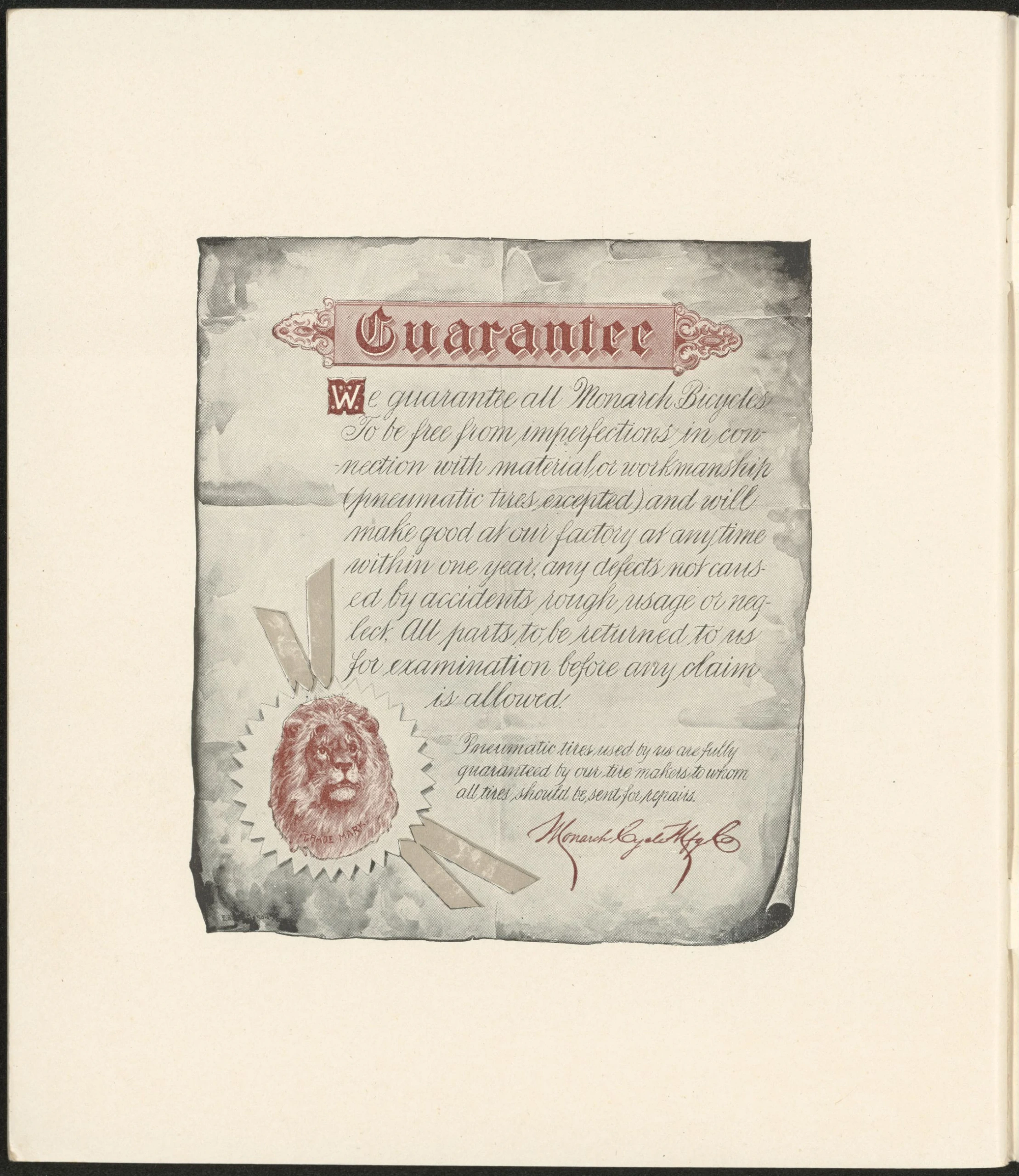
Guarantee
We guarantee all Monarch Bicycles To be free from imperfections in connection with material or workmanship (pneumatic tires excepted) and will make good at our factory at any time within one year, any defects not caused by accidents, rough usage or neglect. All parts to be returned to us for examination before any claim is allowed.
TRADE MARK
Pneumatic tires used by us are fully guaranteed by our tire makers to whom all tires should be sent for repairs.
Monarch Cycle Mfg. Co.
Ed. [illegible]
[A halftone of a stained and curled parchment certificate written in copperplate script, a red black-letter “Guarantee” panel at top, a red lion’s-head trade mark on a starburst seal with gray ribbons at lower left, the firm’s signature in red; an artist’s signature at lower left edge.]
— Page 41 —
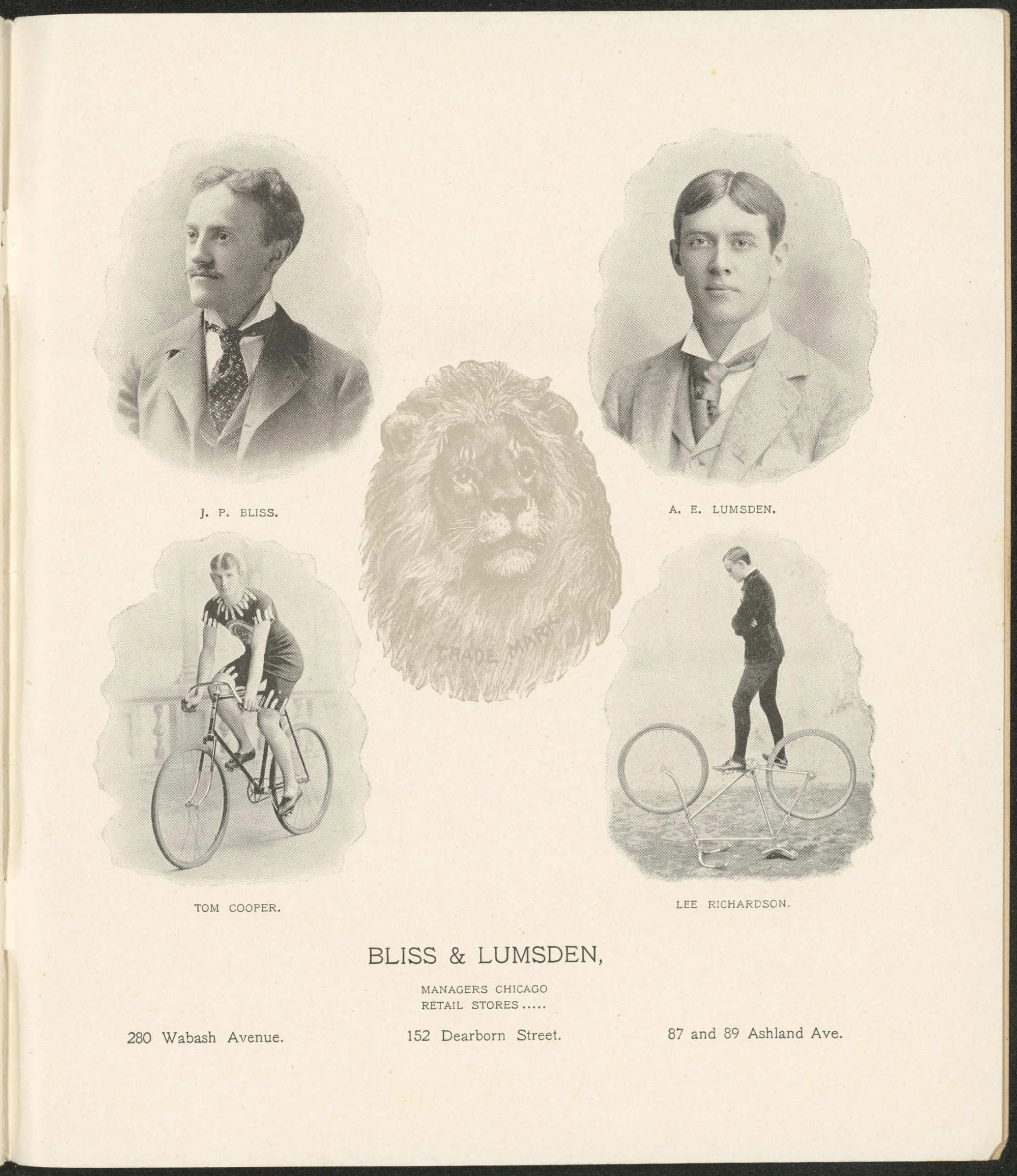
J. P. BLISS.
A. E. LUMSDEN.
TRADE MARK
TOM COOPER.
LEE RICHARDSON.
BLISS & LUMSDEN,
MANAGERS CHICAGO RETAIL STORES…..
280 Wabash Avenue. | 152 Dearborn Street. | 87 and 89 Ashland Ave.
[A page of four vignetted halftone photographs: bust portraits of J. P. Bliss and A. E. Lumsden above, the racer Tom Cooper in a striped jersey on a racing safety and the trick rider Lee Richardson standing on a bicycle lying on its side below, a large pale gray lion’s-head trade mark at center.]
— Page 42 —
ARTISTIC CATALOGUE DEPARTMENT
W. B. CONKEY COMPANY
CHICAGO
E. A. WHEATLEY, DIRECTOR
[The printer’s imprint in small capitals at center of an otherwise blank page, with a tiny red fleuron below.]
— Page 43 —
[The blank inside back cover, tan stock; the stitched edge of the text block shows at left.]
— Page 44 —
MFG
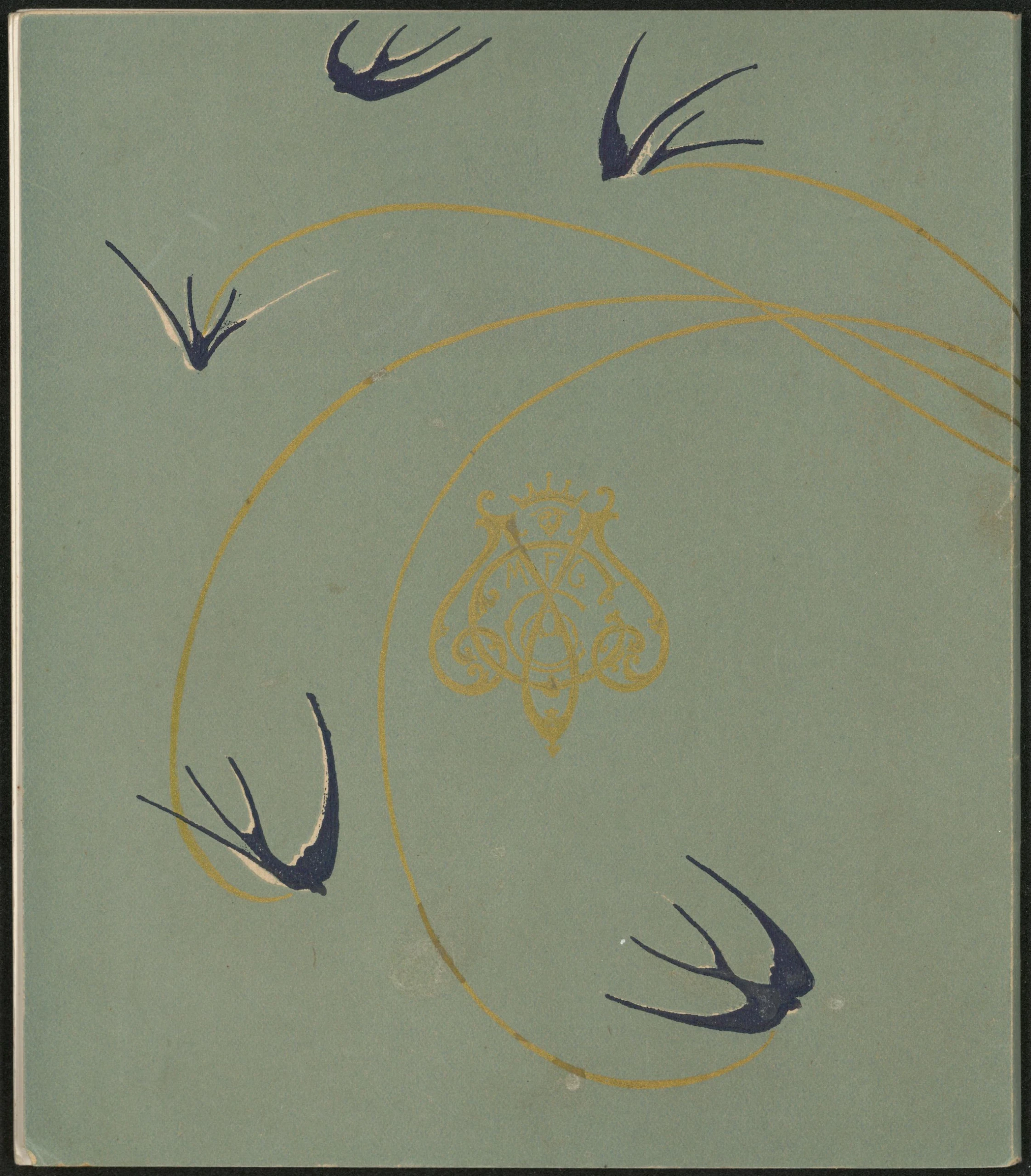
[The back cover, sage-green stock: a gold crowned monogram of the firm’s initials with “MFG” at center, sweeping gold lines and five blue swallows in flight; light scuffs.]
Ebykr presents this material for research and education. If you hold rights to it or notice an ownership issue, please contact us and we will respond promptly.