About Ebykr
Ebykr celebrates classic and vintage lightweight bicycles through provocative imagery and opinion. Ride along with us.
About Ebykr
Ebykr celebrates classic and vintage lightweight bicycles through provocative imagery and opinion. Ride along with us.

Source: Gallica (Bibliothèque nationale de France), L'Officiel du cycle, du motocycle et du camping, 16 June 1951, N° 17, page 13; ark:/12148/bd6t541855453. Source gallica.bnf.fr / BnF.
| Marque | Cycloutil |
|---|---|
| Type | Review |
| Year | 1951 |
| Publisher | L'Officiel du cycle |
| Country | France |
| Language | French |
| Pages | 2 |
| Source | Gallica (Bibliothèque nationale de France), L'Officiel du cycle, du motocycle et du camping, 16 June 1951, N° 17, page 13; ark:/12148/bd6t541855453. Source gallica.bnf.fr / BnF. |
| Credit | Ebykr archive; Bibliothèque nationale de France |
| Identifier | Gallica (BnF) ark:/12148/bd6t541855453/f13 |
| Transcription | Headings and specifications transcribed; article text summarized |
Reference
"Le coffret Cycloutil." L'Officiel du cycle, 16 June 1951. Ebykr, https://ebykr.com/library/lofficiel-du-cycle-1951-06-16-coffret-cycloutil/.
Wikipedia
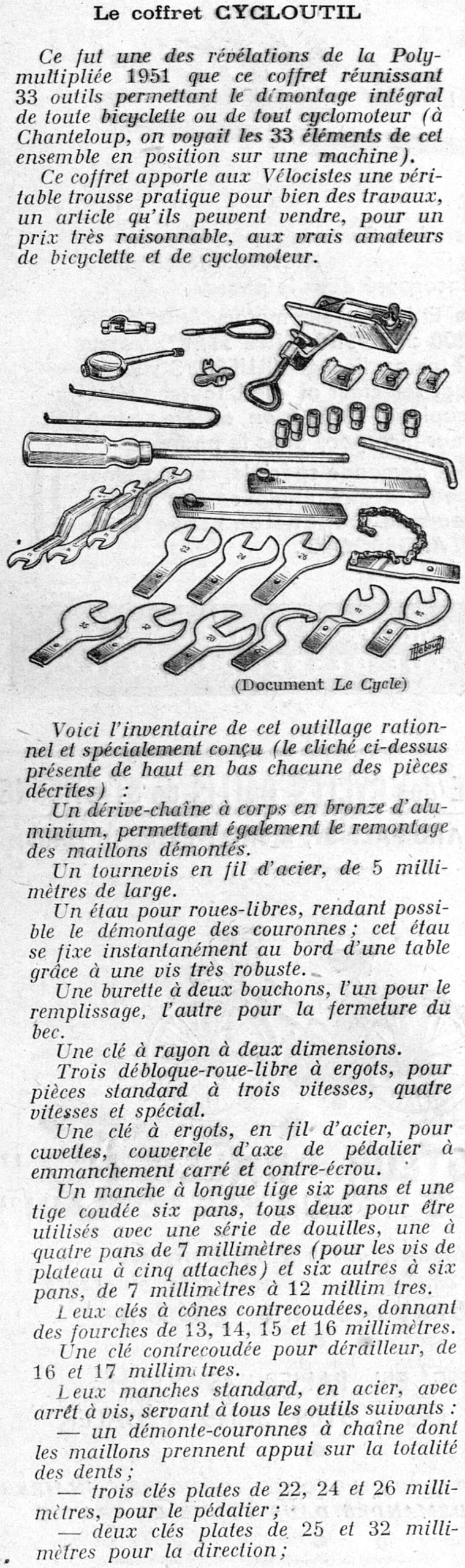
{{cite magazine |title=Le coffret Cycloutil |magazine=L'Officiel du cycle |date=16 June 1951 |language=French |url=https://ebykr.com/library/lofficiel-du-cycle-1951-06-16-coffret-cycloutil/ |via=Ebykr |access-date=}}Le coffret CYCLOUTIL (Document Le Cycle) Un dérive-chaîne à corps en bronze d'aluminium, permettant également le remontage des maillons démontés. Un tournevis en fil d'acier, de 5 millimètres de large. Un étau pour roues-libres, rendant possible le démontage des couronnes ; cet étau se fixe instantanément au bord d'une table grâce à une vis très …
This is a magazine article, so its running text is summarized here rather than reproduced; the headline, byline, specifications and scores are transcribed as printed.
From L’Officiel du cycle, du motocycle et du camping, 16 June 1951, N° 17, page 13: le coffret Cycloutil: a 33-tool kit for taking a whole bicycle or cyclomoteur apart, with a tool-by-tool inventory; drawing of the tools, credited ‘Document Le Cycle’. The title, headings, captions and lists are transcribed as printed; the text is summarized in Ebykr’s words, and the page images carry it in full.
— Page 1 —
Le coffret CYCLOUTIL
[Ebykr summary; the article’s text is not reproduced. The article presents the Cycloutil kit as one of the revelations of the 1951 Poly-multipliée show: a chest holding 33 tools that allow the complete dismantling of any bicycle or cyclomoteur, all 33 pieces having been shown in position on a machine at Chanteloup. It describes the chest as a practical set for many jobs and as an item dealers can sell, at a very reasonable price, to true bicycle and cyclomoteur enthusiasts.]
(Document Le Cycle)
[Ebykr summary, after the illustration. The text announces an inventory of the specially designed tools, the picture above showing each described piece from top to bottom. The inventory then reads as follows.]
Un dérive-chaîne à corps en bronze d’aluminium, permettant également le remontage des maillons démontés.
Un tournevis en fil d’acier, de 5 millimètres de large.
Un étau pour roues-libres, rendant possible le démontage des couronnes ; cet étau se fixe instantanément au bord d’une table grâce à une vis très robuste.
Une burette à deux bouchons, l’un pour le remplissage, l’autre pour la fermeture du bec.
Une clé à rayon à deux dimensions.
Trois déblogue-roue-libre à ergots, pour pièces standard à trois vitesses, quatre vitesses et spécial.
Une clé à ergots, en fil d’acier, pour cuvettes, couvercle d’axe de pédalier à emmanchement carré et contre-écrou.
Un manche à longue tige six pans et une tige coudée six pans, tous deux pour être utilisés avec une série de douilles, une à quatre pans de 7 millimètres (pour les vis de plateau à cinq attaches) et six autres à six pans, de 7 millimètres à 12 millimètres.
Deux clés à cônes contrecoudées, donnant des fourches de 13, 14, 15 et 16 millimètres.
Une clé contrecoudée pour dérailleur, de 16 et 17 millimètres.
Deux manches standard, en acier, avec arrêt à vis, servant à tous les outils suivants :
— un démonte-couronnes à chaîne dont les maillons prennent appui sur la totalité des dents ;
— trois clés plates de 22, 24 et 26 millimètres, pour le pédalier ;
— deux clés plates de 25 et 32 millimètres pour la direction ;
[A text article set in italic roman type under a heading in roman type, the word CYCLOUTIL in heavy capitals. The column opens with the title centered above two italic paragraphs, followed by a line engraving that fills the width of the column. The engraving shows the loose tools laid out on a flat ground: at the upper left a small chain tool, a loop-handled wire tool and a round-headed oiler with a long spout; at the upper right a clamp vise with a triangular screw handle and three small notched blocks; below them a row of seven short sockets; down the left a long hooked wire, a wooden-handled screwdriver and a group of forked wrenches; across the lower part two flat bars, a length of chain on a flat plate, and a spread of open-ended spanners of graded sizes, some with numbers stamped on the jaws. A handwritten signature, read as Hebou with a short flourish, sits at the lower right corner of the drawing. The caption “(Document Le Cycle)” stands beneath it at the right, in roman type with the title in italics. The inventory below is set as short italic paragraphs with the dash entries indented. The inventory continues on the next image.]
— Page 2 —
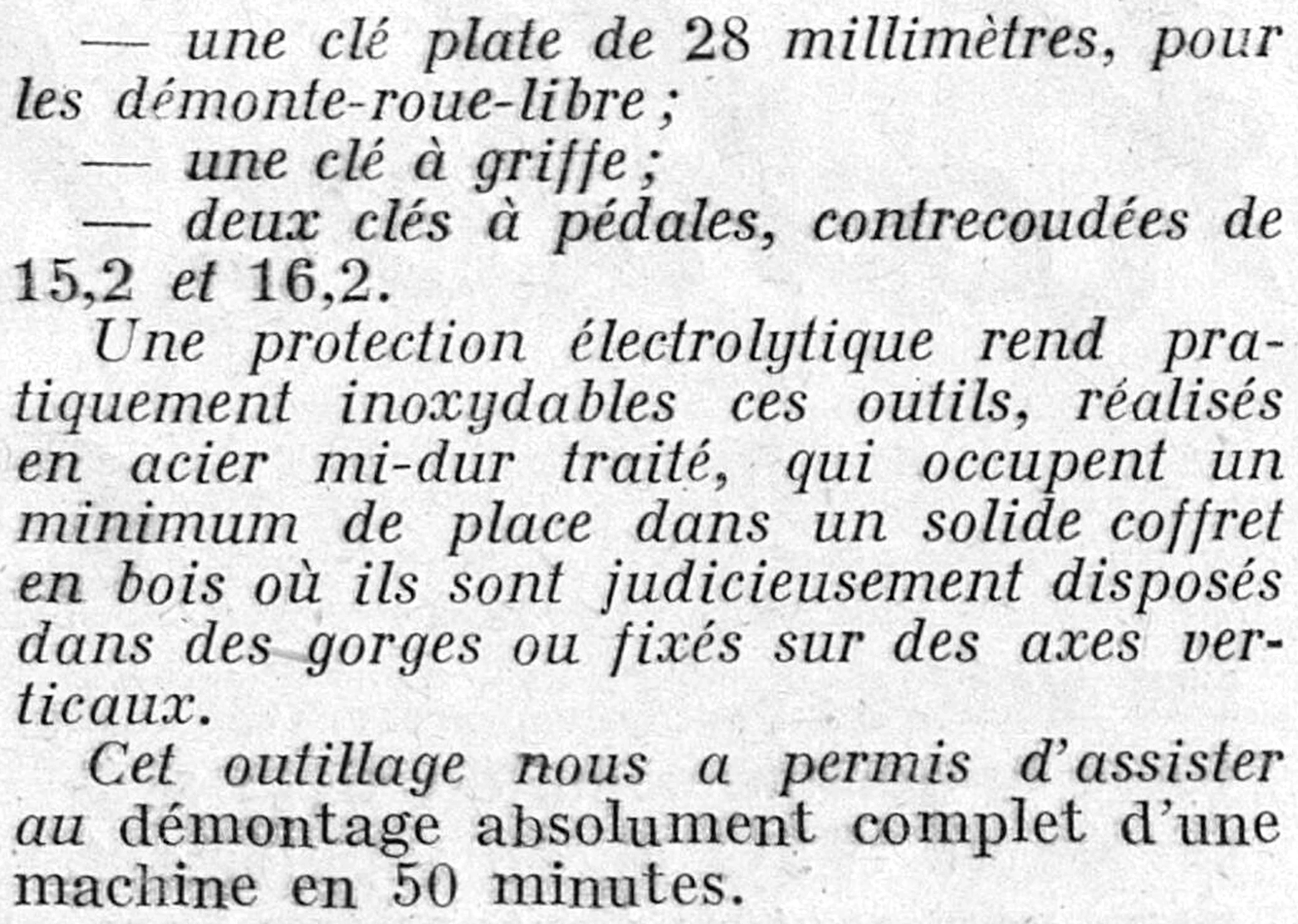
— une clé plate de 28 millimètres, pour les démonte-roue-libre ;
— une clé à griffe ;
— deux clés à pédales, contrecoudées de 15,2 et 16,2.
[Ebykr summary; the article’s text is not reproduced. The closing paragraphs say that an electrolytic protection makes the tools practically rustproof, that they are made of treated semi-hard steel, and that they take up a minimum of room in a solid wooden chest, where they are fitted in grooves or on vertical pins. The writer ends by saying that this kit allowed the editors to watch an absolutely complete dismantling of a machine in 50 minutes.]
[Text only, set in italic roman type in a single wide column. The last lines of an inventory list appear as three dash entries, then two short paragraphs, the final line of the second in upright roman type. No drawing, signature or agency mark appears on this part of the item.]
Ebykr presents this material for research and education. If you hold rights to it or notice an ownership issue, please contact us and we will respond promptly.
The Ebykr Digest
New articles, timelines, catalog finds and registry activity — assembled from the archive once a month. Your address is never shared.
Double opt-in. One email per month. Unsubscribe at any time with one click.