About Ebykr
Ebykr celebrates classic and vintage lightweight bicycles through provocative imagery and opinion. Ride along with us.
About Ebykr
Ebykr celebrates classic and vintage lightweight bicycles through provocative imagery and opinion. Ride along with us.

Source: Northwestern University Libraries, Transportation Library, "Columbia bicycles" (digital collection, https://dc.library.northwestern.edu/items/667b76f3-ca5a-42eb-baad-f7e929db2efa); rights statement "No Copyright - United States".
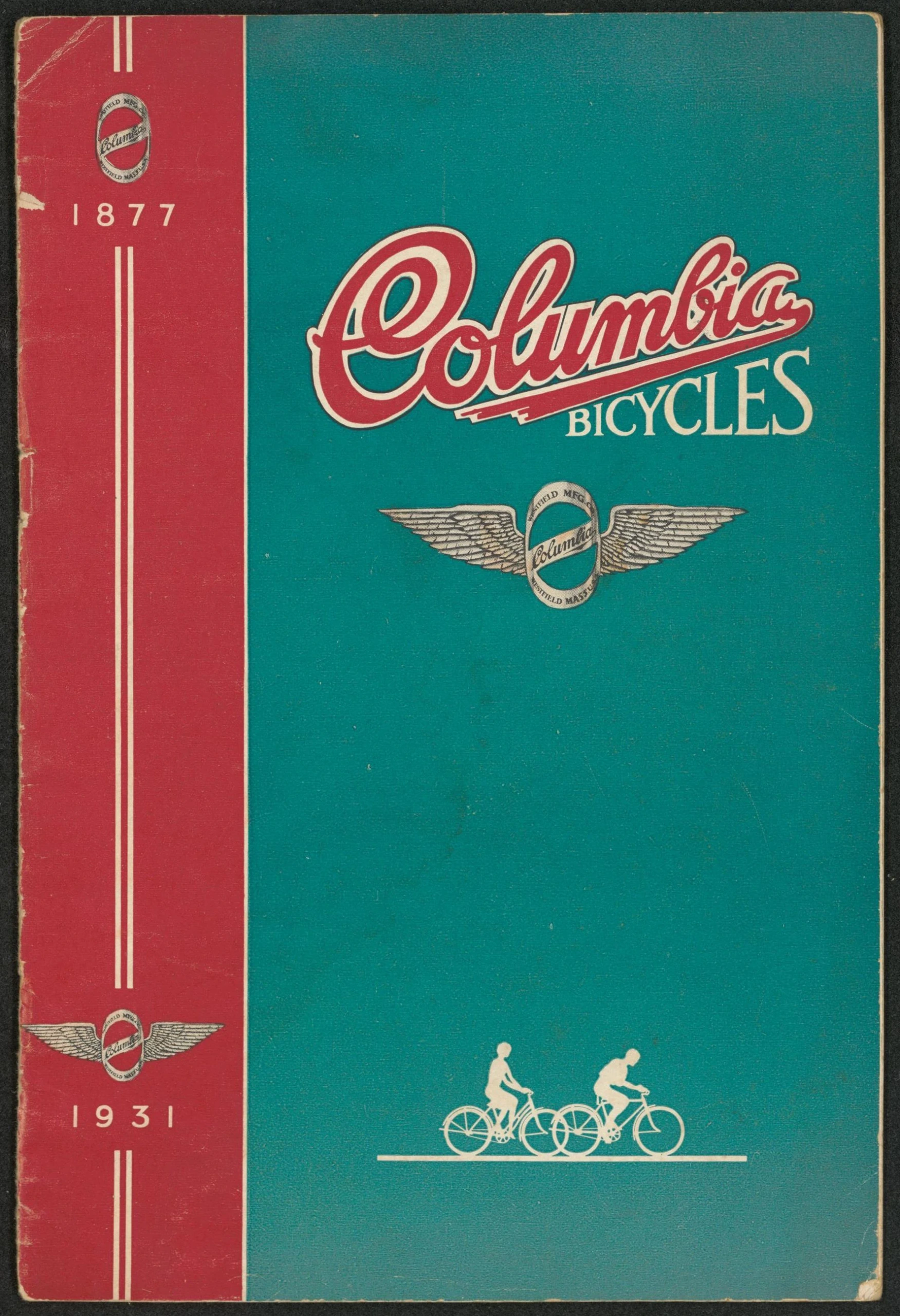 Page 1
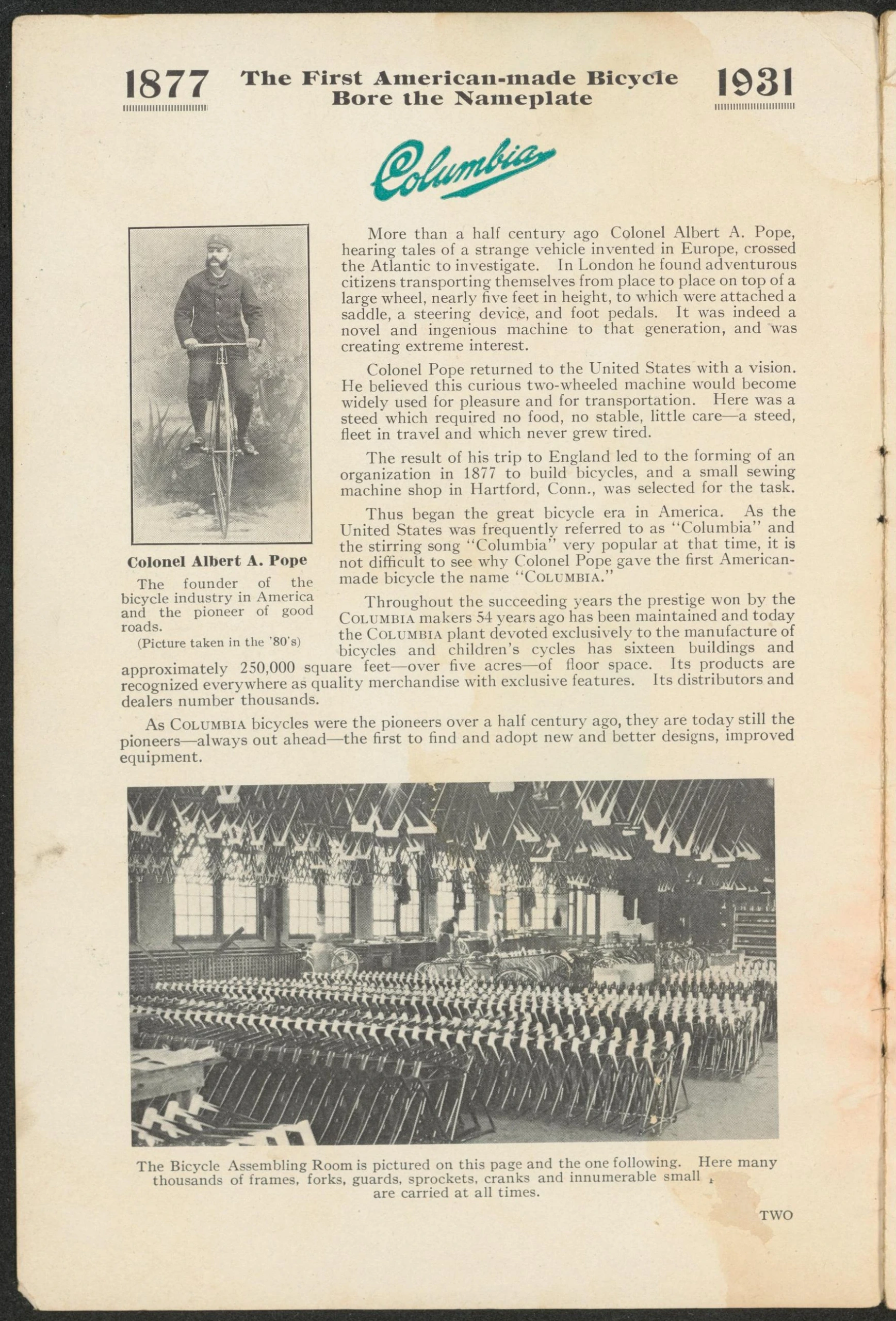 Page 2
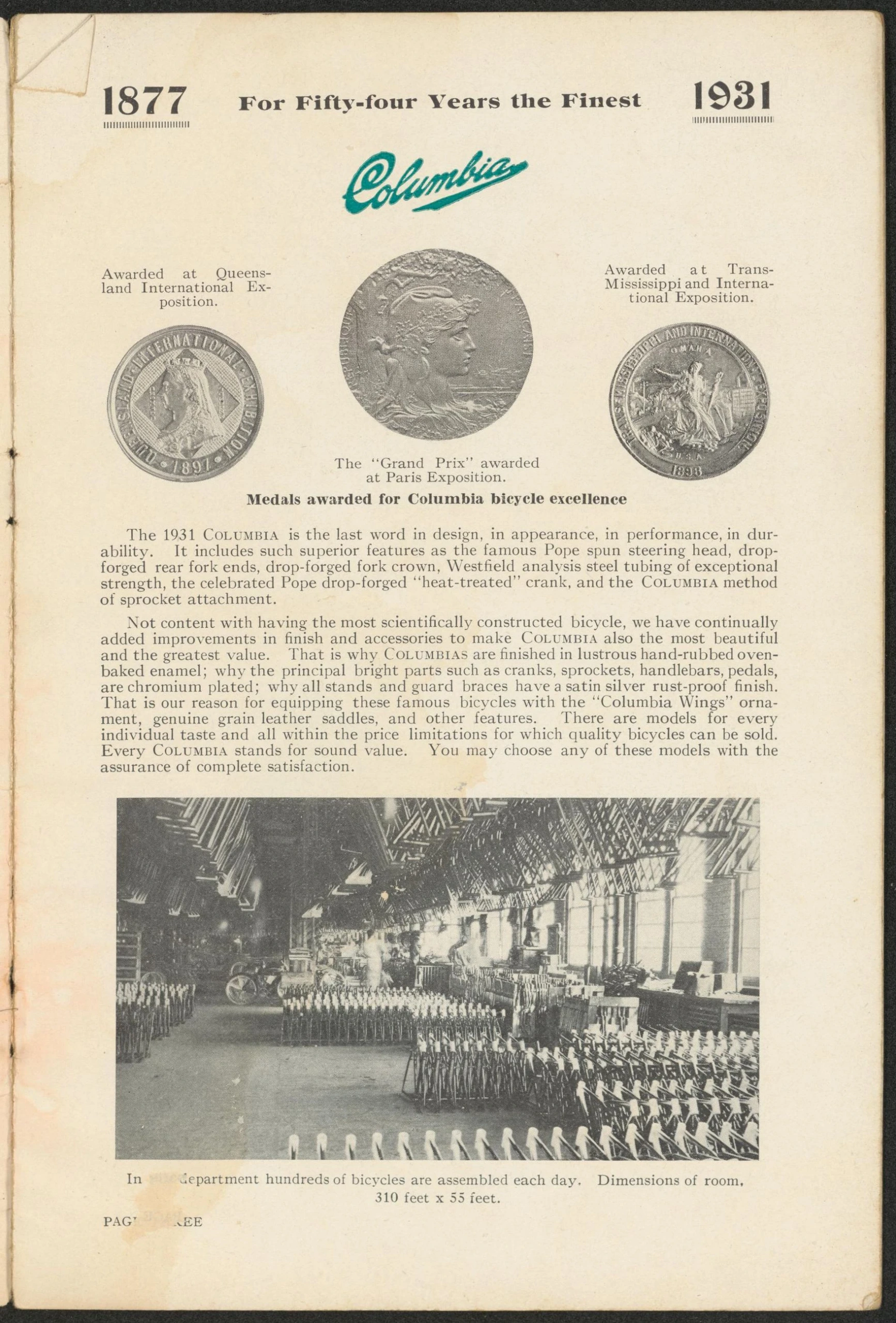 Page 3
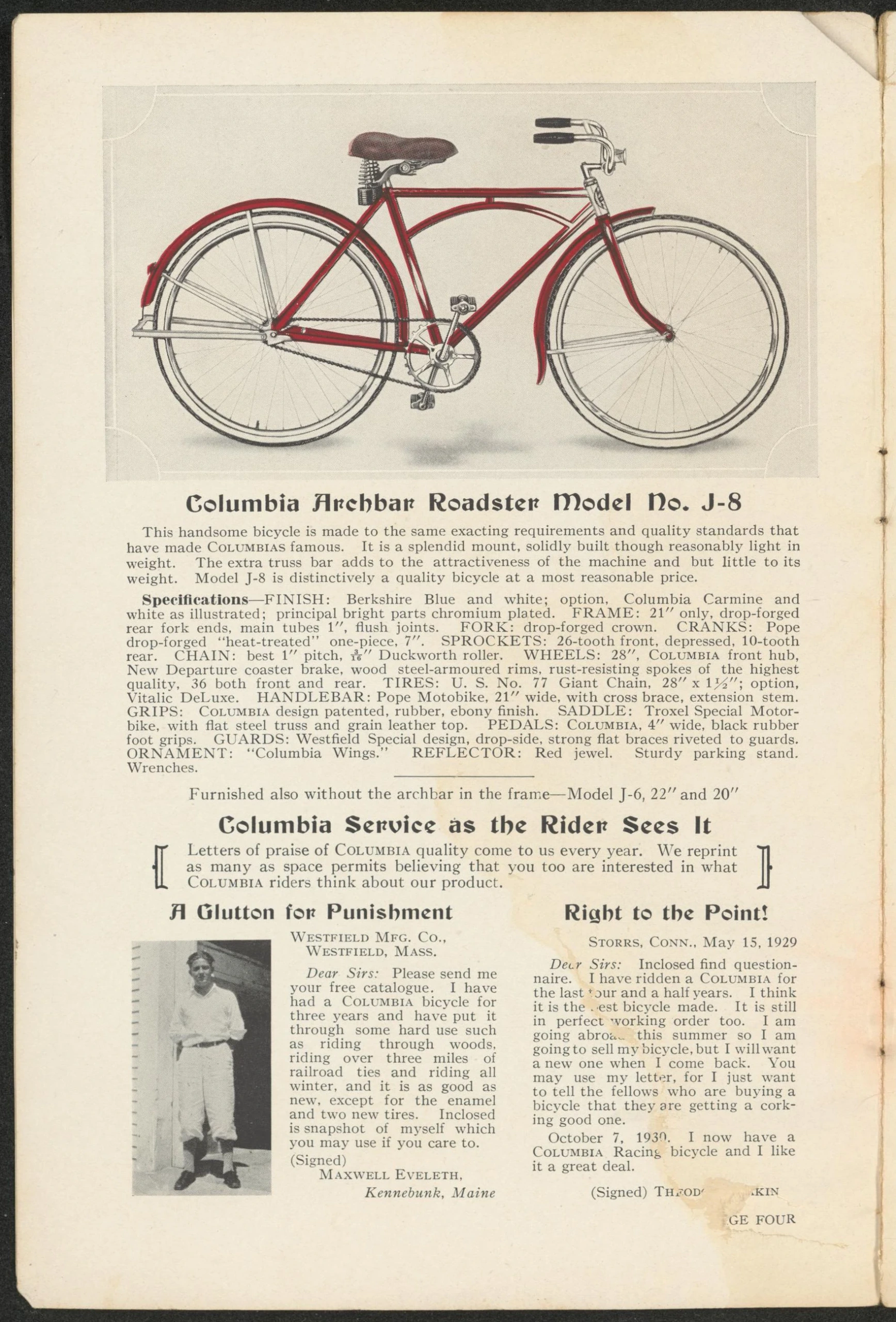 Page 4
 Page 5
 Page 6
 Page 7
 Page 8
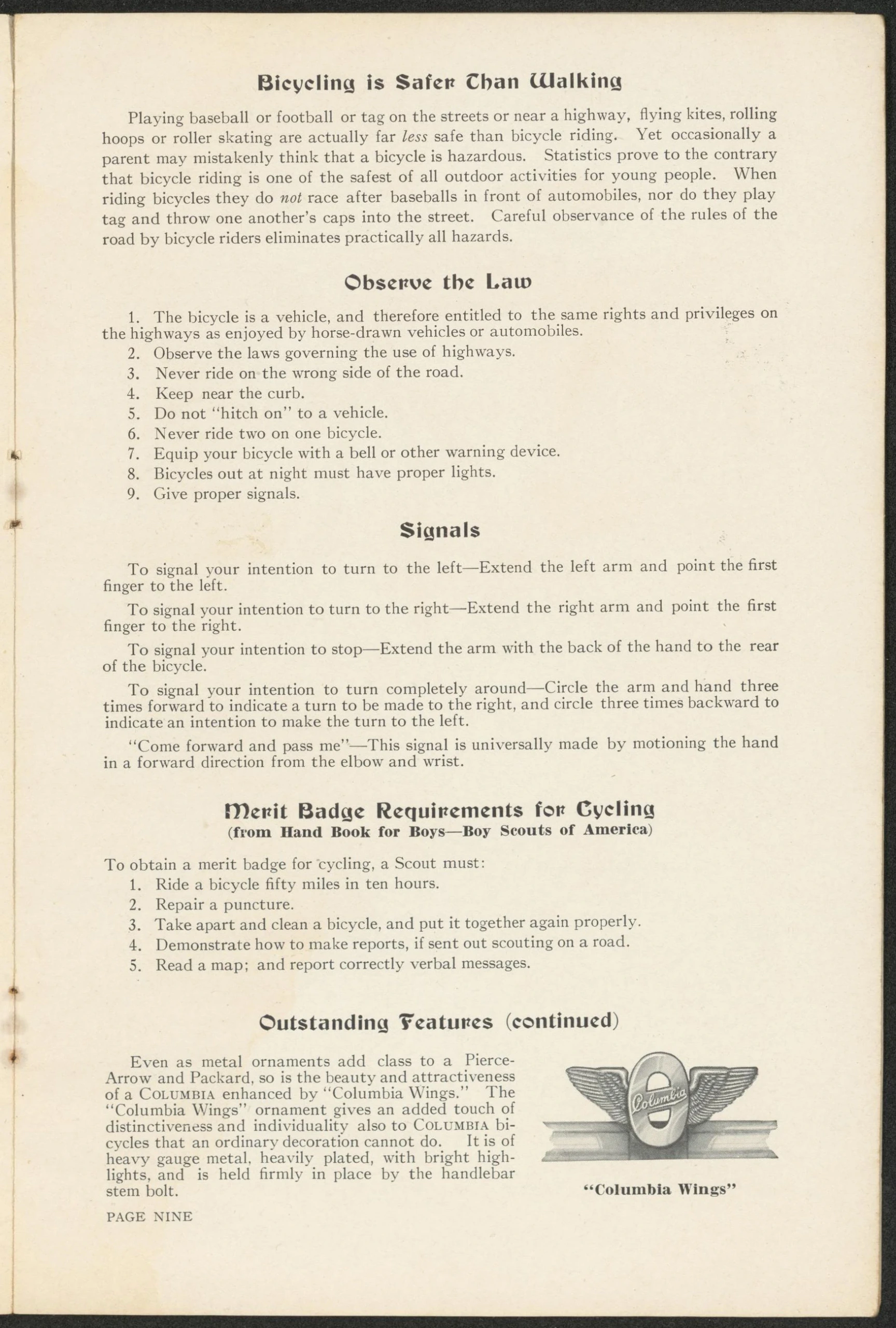 Page 9
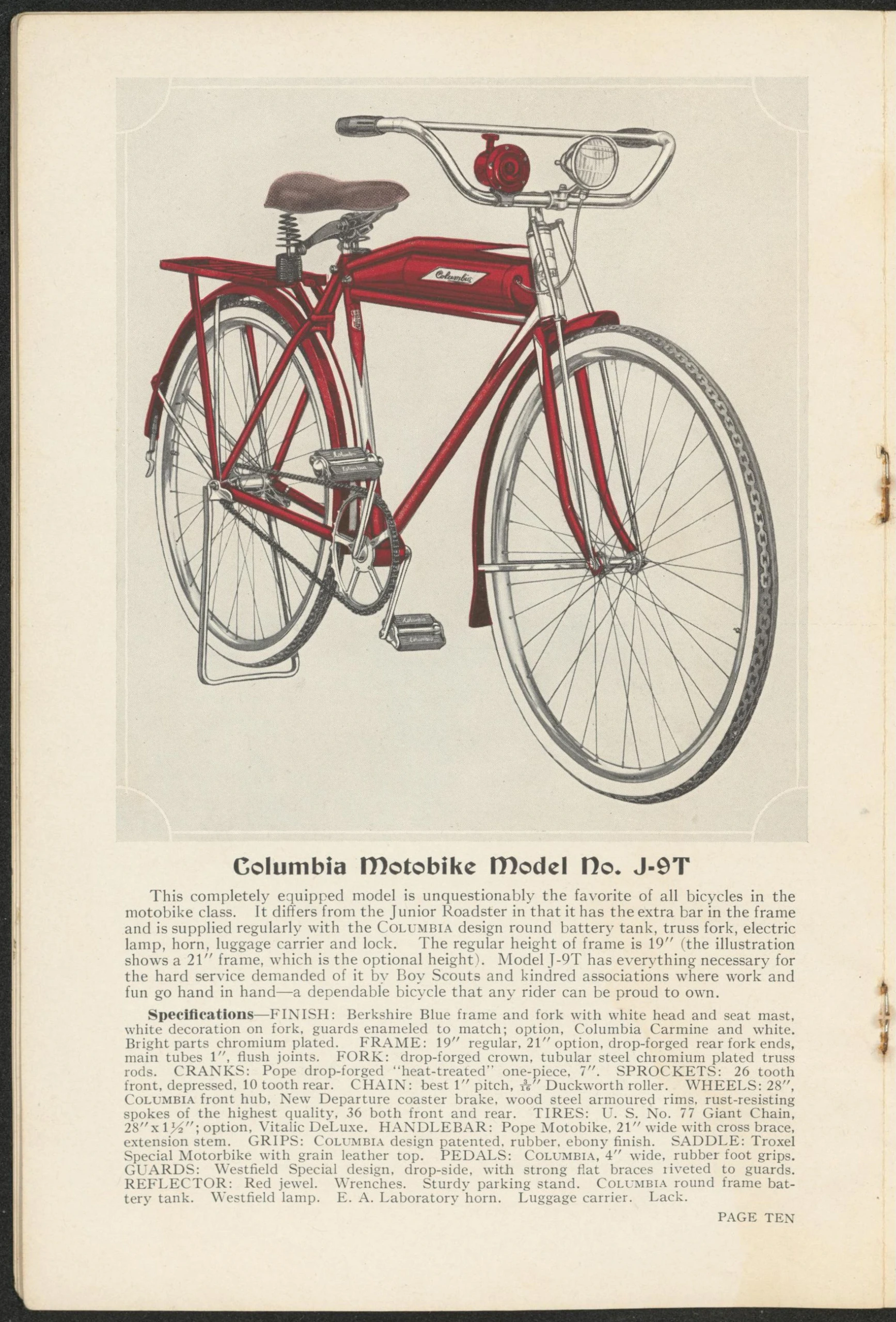 Page 10
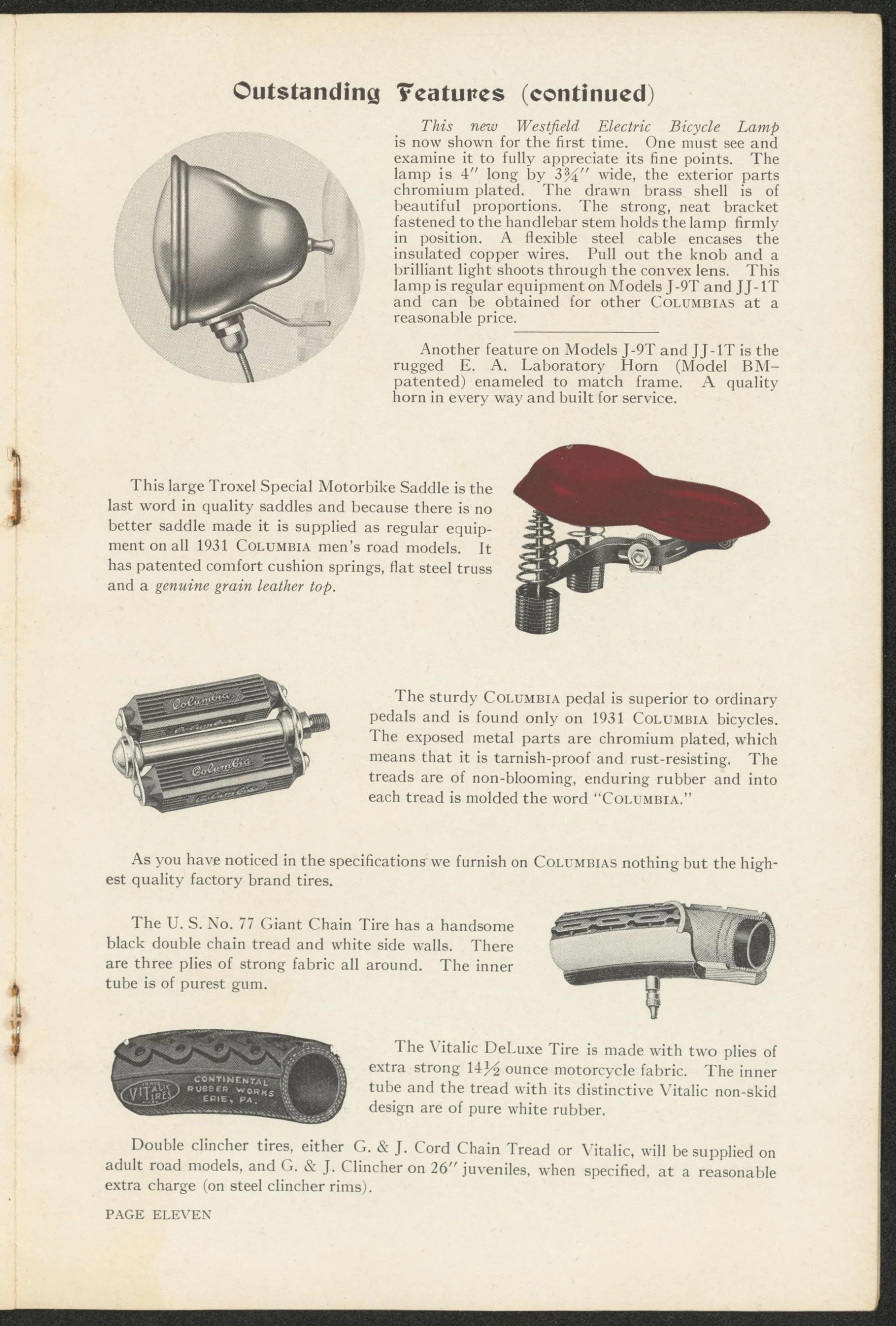 Page 11
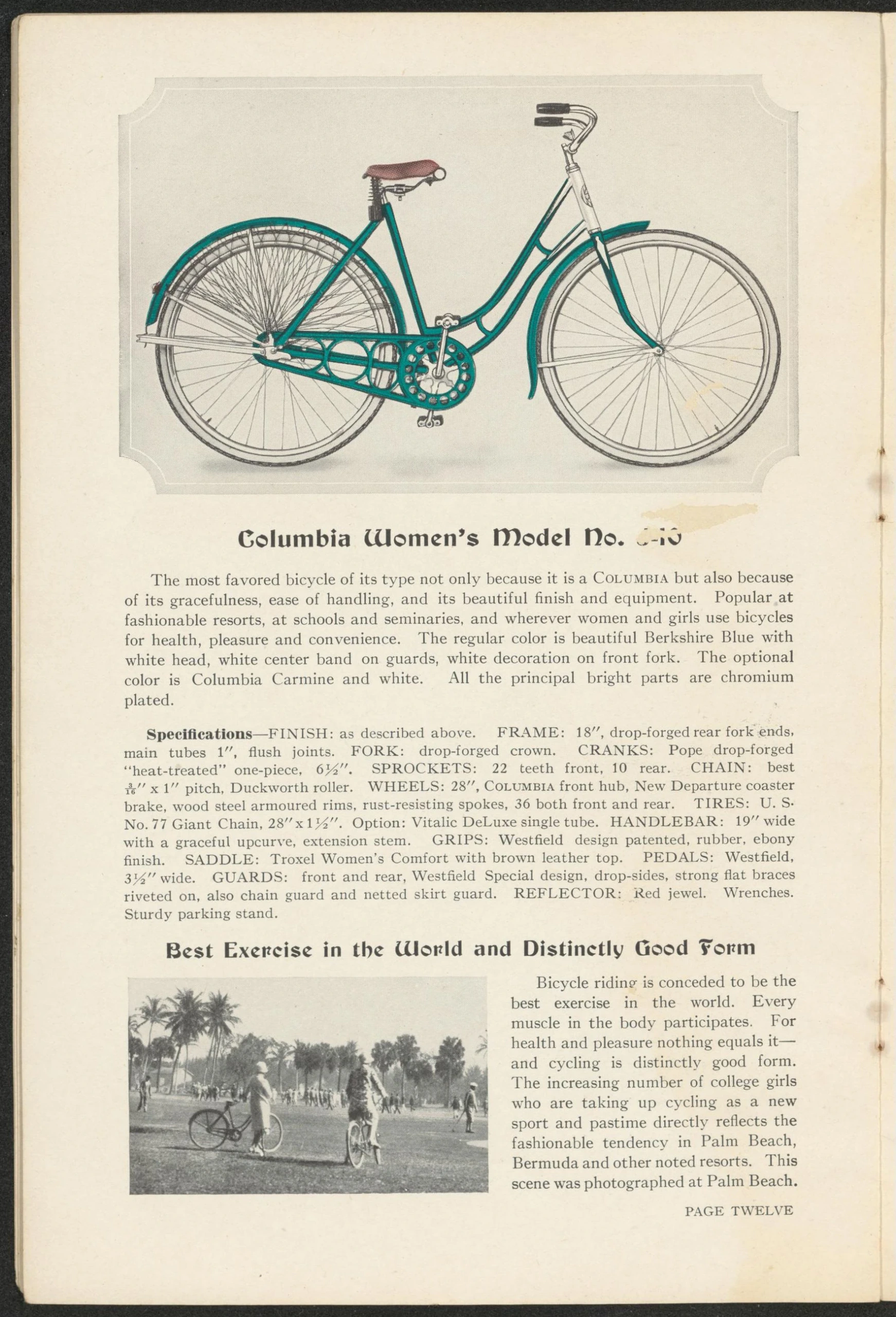 Page 12
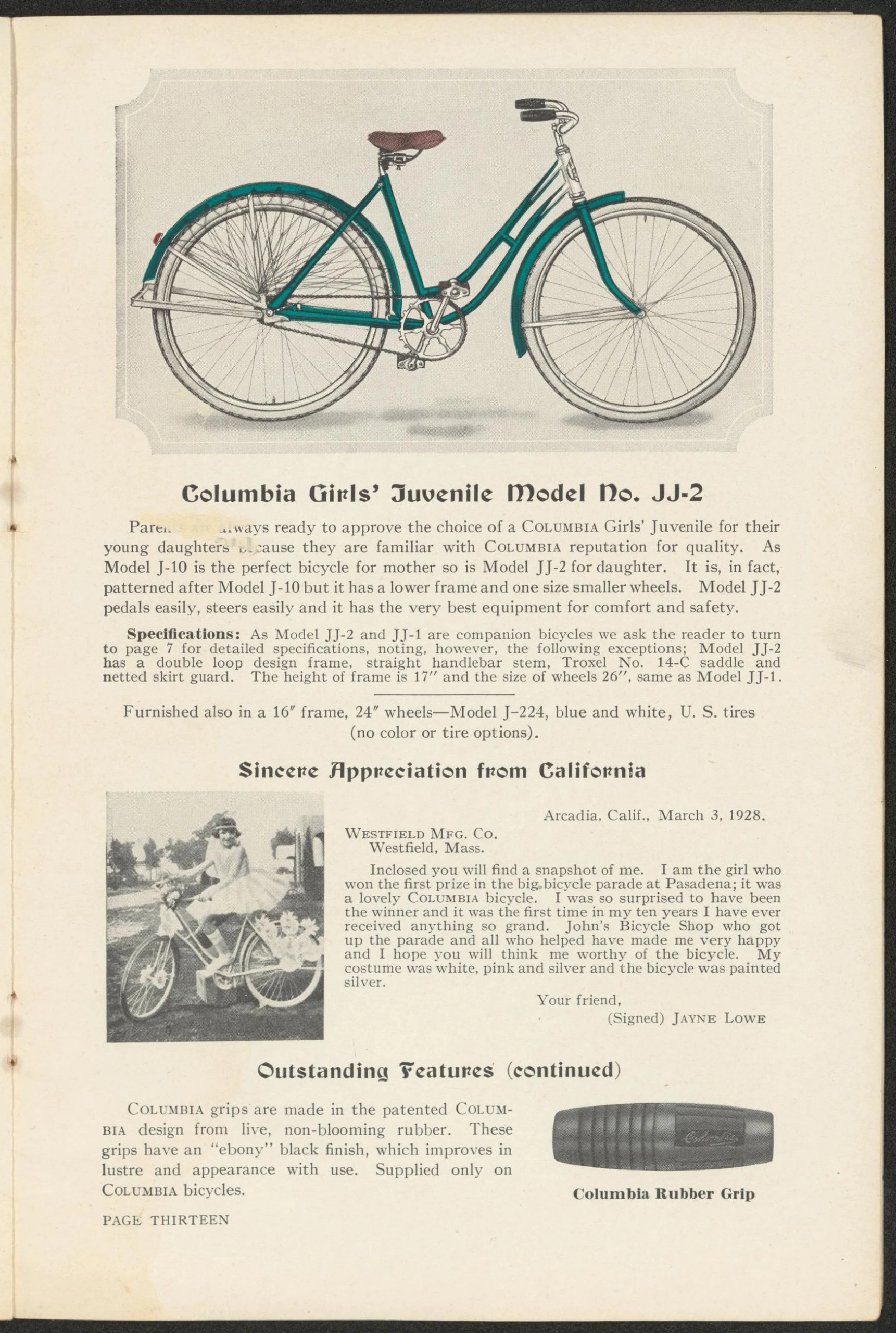 Page 13
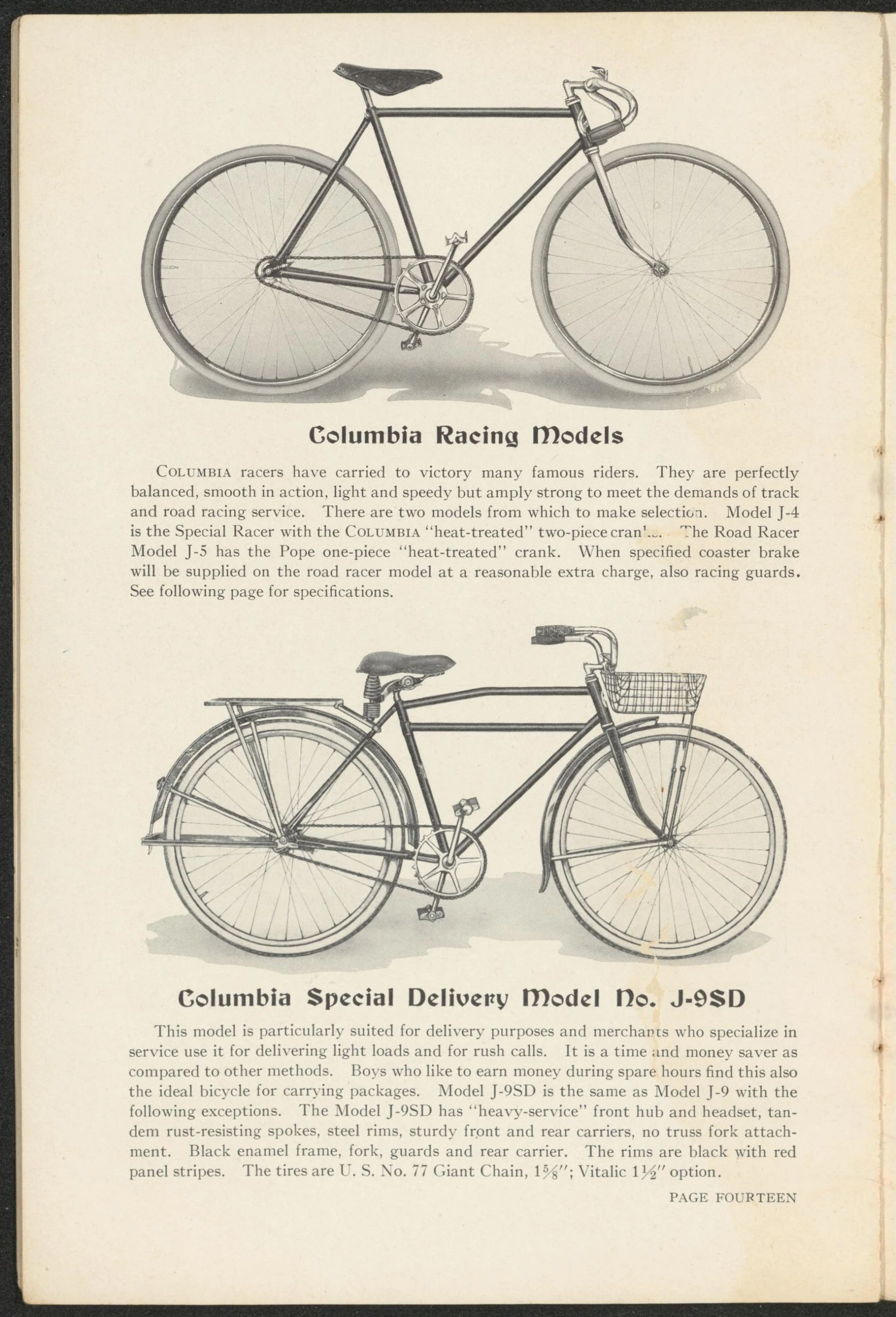 Page 14
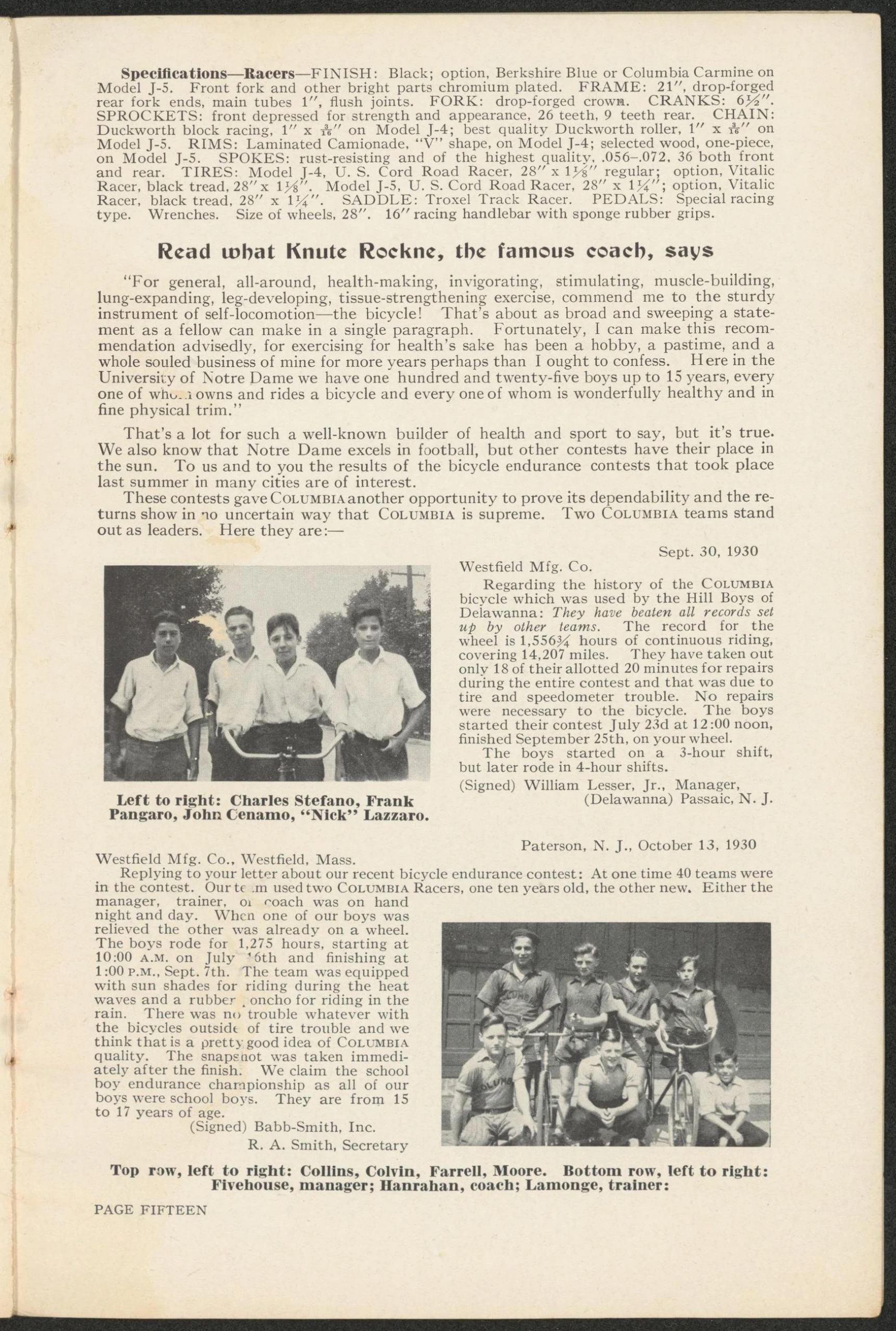 Page 15
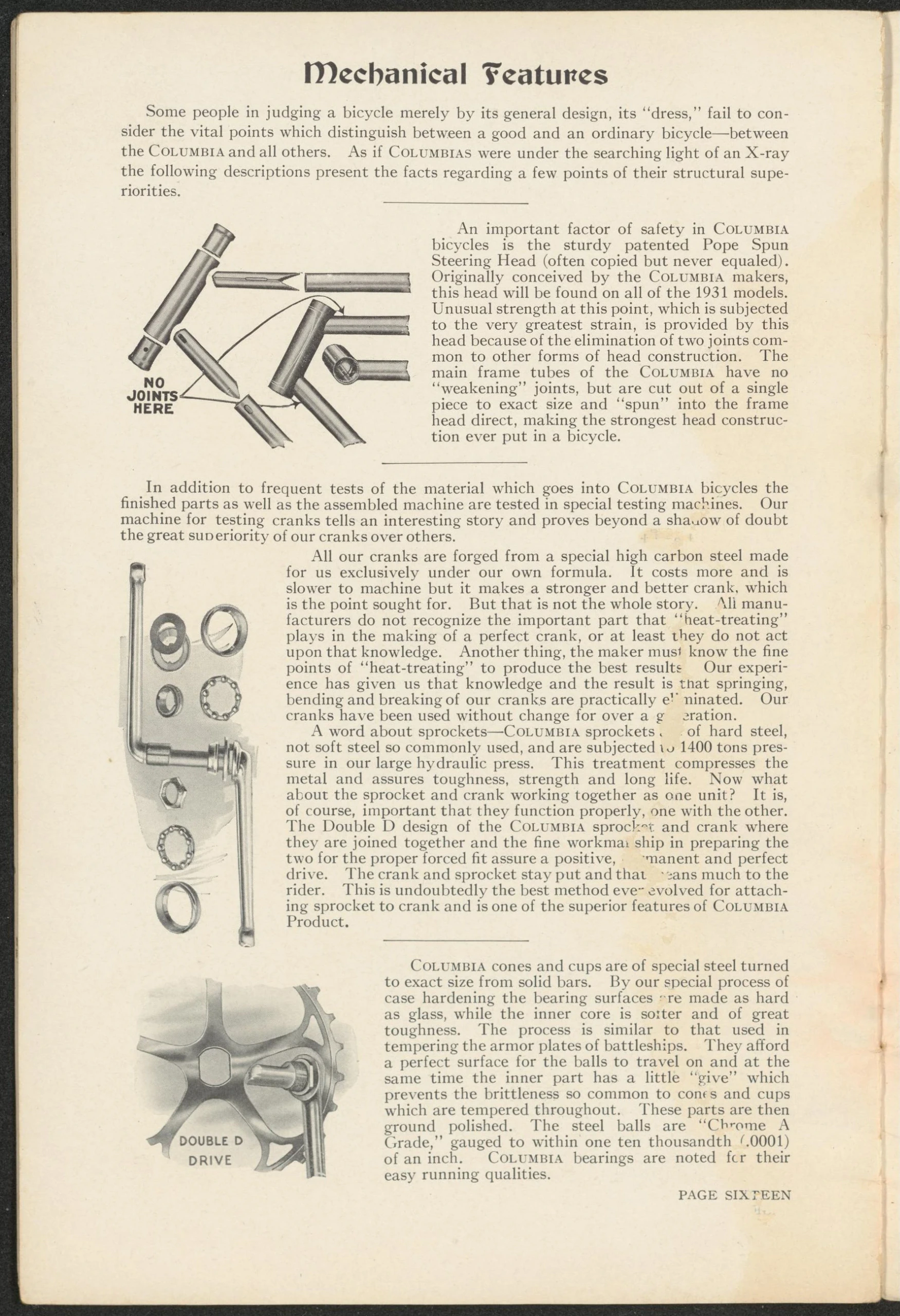 Page 16
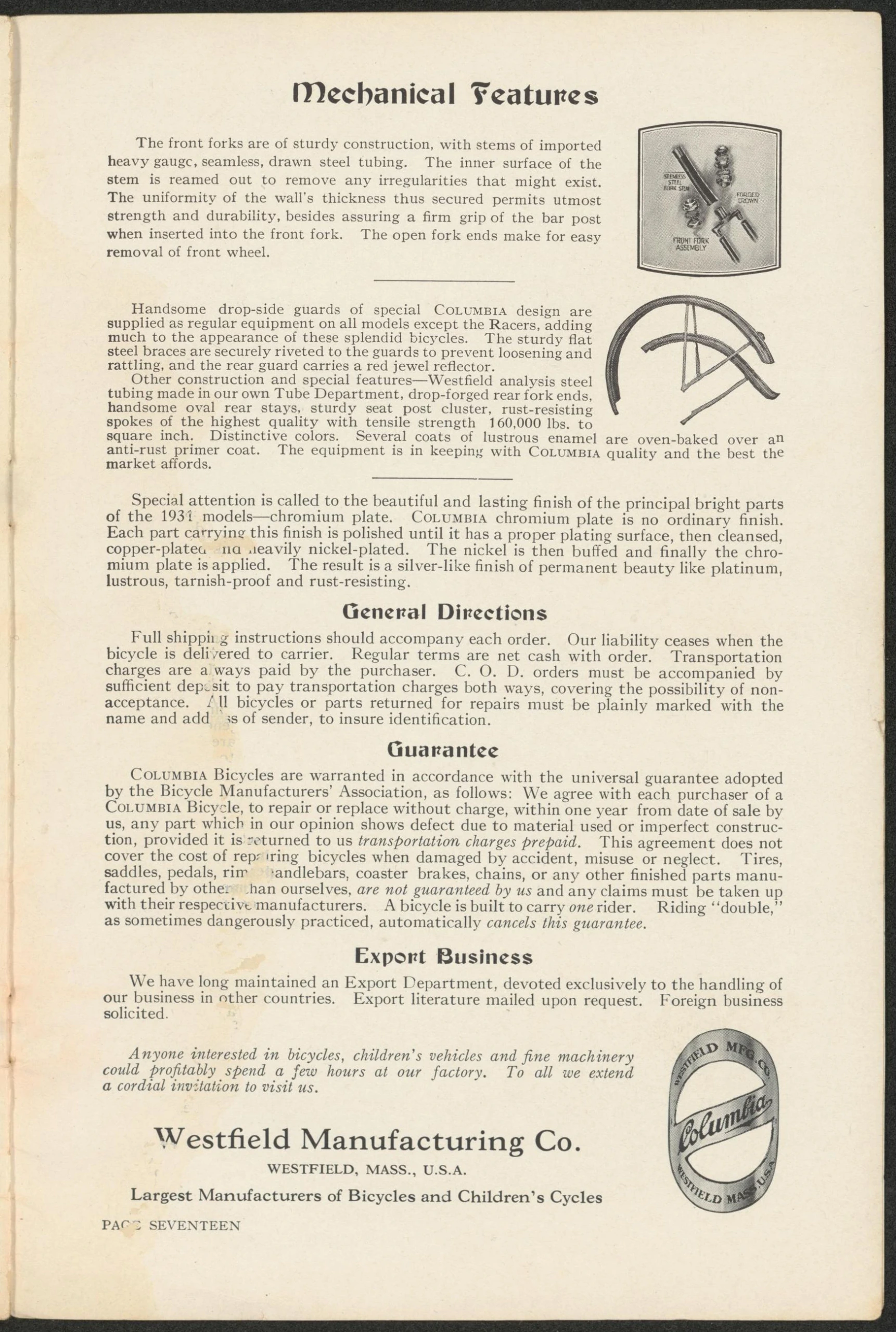 Page 17
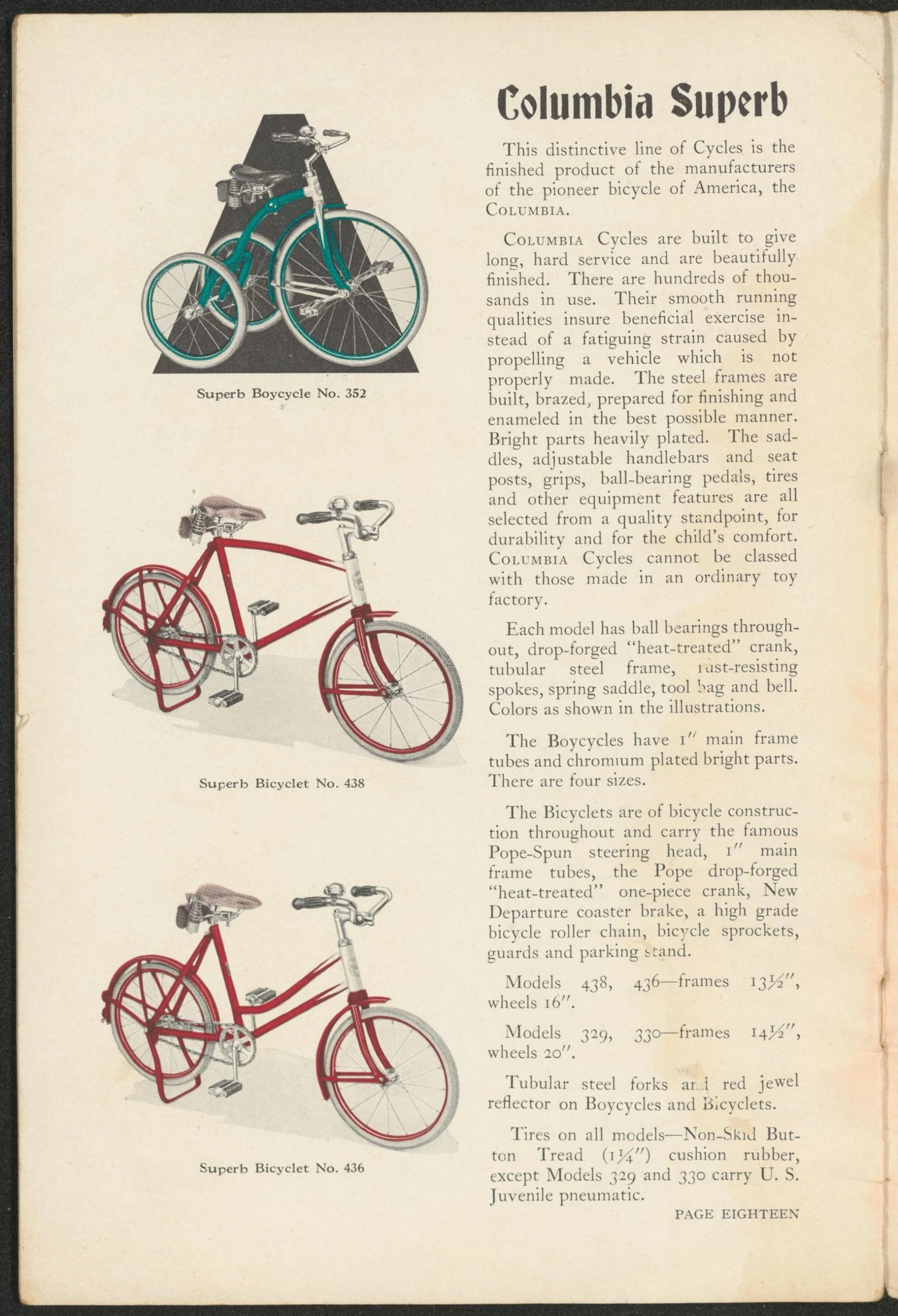 Page 18
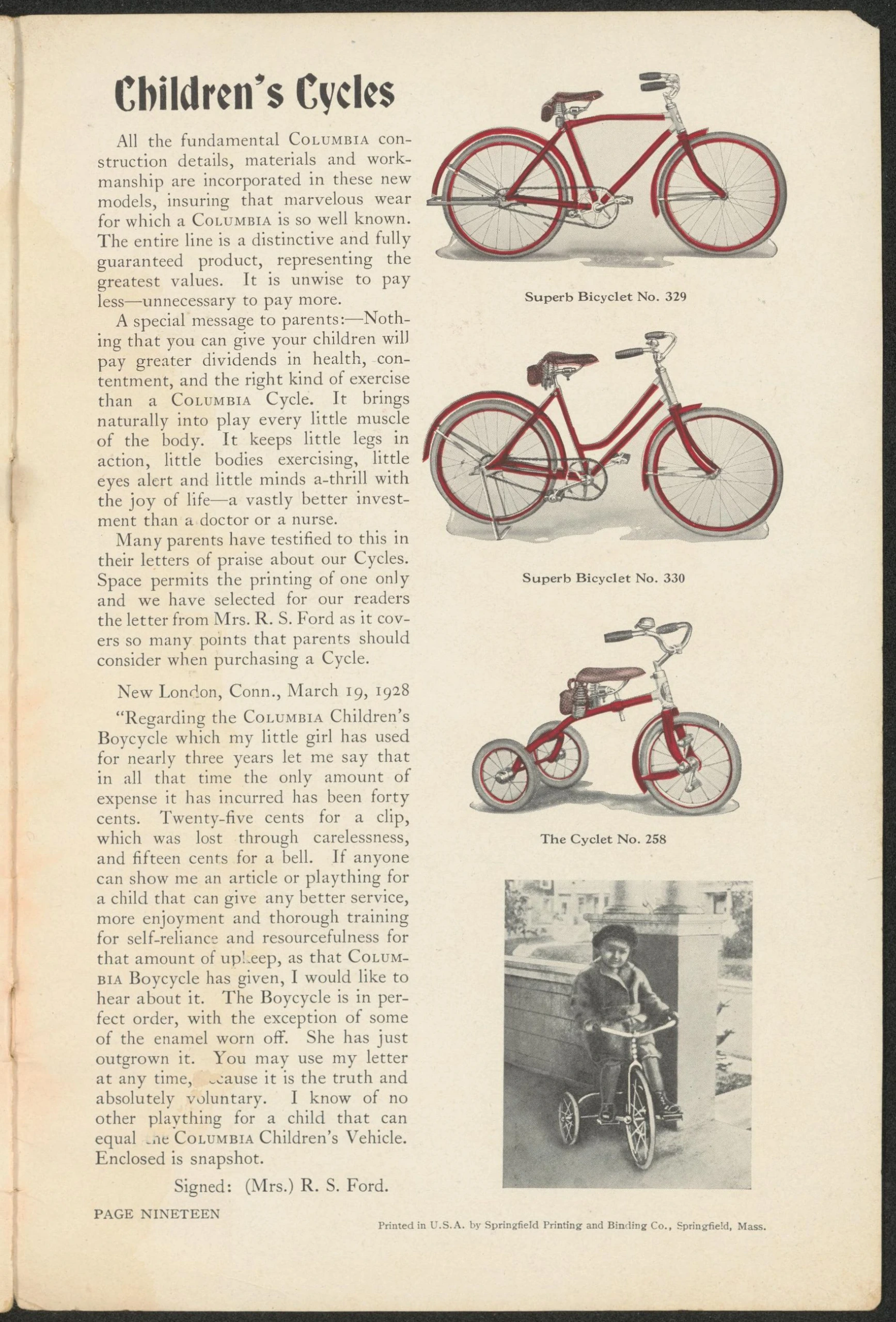 Page 19
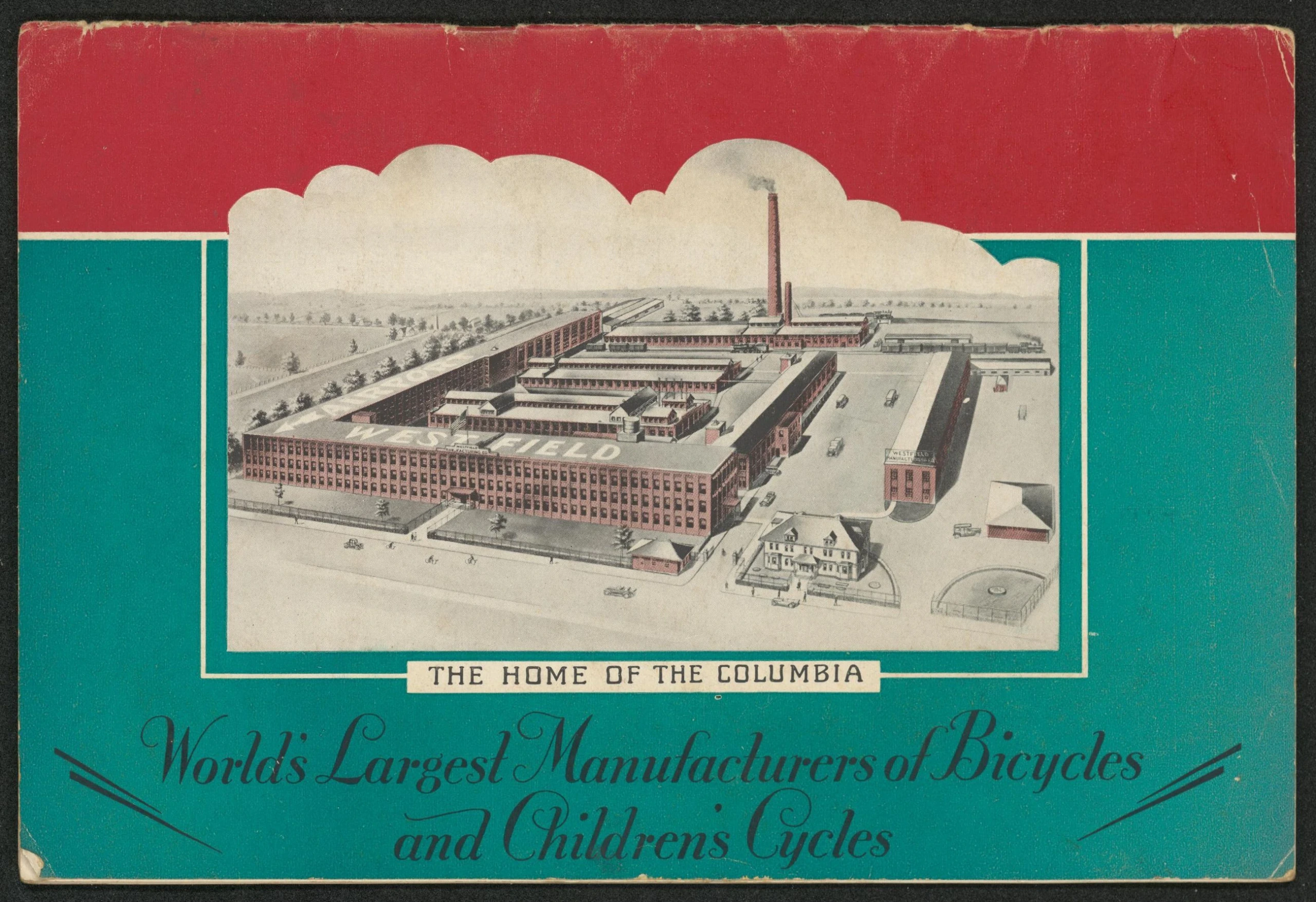 Page 20
| Marque | Columbia |
|---|---|
| Type | Catalog |
| Year | 1931 |
| Publisher | Westfield Manufacturing Co. |
| Country | United States |
| Language | English |
| Pages | 20 |
| Source | Northwestern University Libraries, Transportation Library, "Columbia bicycles" (digital collection, https://dc.library.northwestern.edu/items/667b76f3-ca5a-42eb-baad-f7e929db2efa); rights statement "No Copyright - United States". |
| Credit | Northwestern University Libraries |
| Identifier | Permalink https://dc.library.northwestern.edu/items/667b76f3-ca5a-42eb-baad-f7e929db2efa |
| Transcription | Transcribed by eye |
Reference
Westfield Manufacturing Co. Columbia 1931 Catalog (Westfield Manufacturing Co., United States): Roadsters, Motobikes, Racers and Columbia Superb Children's Cycles. 1931. Ebykr, https://ebykr.com/library/columbia-catalog-1931/.
Wikipedia
{{cite book |title=Columbia 1931 Catalog (Westfield Manufacturing Co., United States): Roadsters, Motobikes, Racers and Columbia Superb Children's Cycles |publisher=Westfield Manufacturing Co. |date=1931 |url=https://ebykr.com/library/columbia-catalog-1931/ |via=Ebykr |access-date=}}1877 1931 Columbia BICYCLES WESTFIELD MFG. CO. Columbia WESTFIELD MASS. U.S.A. 1877 The First American-made Bicycle Bore the Nameplate 1931 Columbia Colonel Albert A. Pope The founder of the bicycle industry in America and the pioneer of good roads. (Picture taken in the '80's) More than a half century ago Colonel Albert A. Pope, hearing …
The Westfield Manufacturing Company’s Columbia catalog for 1931, marking 1877 to 1931: the J-8 Archbar Roadster, the J-9 and J-9T Motobikes, the J-7 Junior Roadster, the J-10 women’s model, the J-4 and J-5 racers and the J-9SD Special Delivery, the juvenile JJ-1, JJ-1T and JJ-2, the Columbia Superb children’s cycles, a history of the Pope firm, safety rules, riders’ letters and the mechanical features and guarantee. No prices are printed. Transcribed from the page images (20 pages); each page ends with a bracketed description of its pictures.
— Page 1 —
1877
1931
Columbia
BICYCLES
WESTFIELD MFG. CO.
Columbia
WESTFIELD MASS. U.S.A. [?]
[The front cover: a red band at left with white rules, the dates 1877 and 1931 and two small Columbia head-badge emblems, one winged; on the teal field the red script “Columbia” with “BICYCLES” below, a large winged Columbia head badge and white silhouettes of a woman and a man riding bicycles at the foot. Light wear at the edges.]
— Page 2 —
1877 The First American-made Bicycle Bore the Nameplate 1931
Columbia
Colonel Albert A. Pope
The founder of the bicycle industry in America and the pioneer of good roads.
(Picture taken in the ’80’s)
More than a half century ago Colonel Albert A. Pope, hearing tales of a strange vehicle invented in Europe, crossed the Atlantic to investigate. In London he found adventurous citizens transporting themselves from place to place on top of a large wheel, nearly five feet in height, to which were attached a saddle, a steering device, and foot pedals. It was indeed a novel and ingenious machine to that generation, and was creating extreme interest.
Colonel Pope returned to the United States with a vision. He believed this curious two-wheeled machine would become widely used for pleasure and for transportation. Here was a steed which required no food, no stable, little care—a steed, fleet in travel and which never grew tired.
The result of his trip to England led to the forming of an organization in 1877 to build bicycles, and a small sewing machine shop in Hartford, Conn., was selected for the task.
Thus began the great bicycle era in America. As the United States was frequently referred to as “Columbia” and the stirring song “Columbia” very popular at that time, it is not difficult to see why Colonel Pope gave the first American-made bicycle the name “COLUMBIA.”
Throughout the succeeding years the prestige won by the COLUMBIA makers 54 years ago has been maintained and today the COLUMBIA plant devoted exclusively to the manufacture of bicycles and children’s cycles has sixteen buildings and approximately 250,000 square feet—over five acres—of floor space. Its products are recognized everywhere as quality merchandise with exclusive features. Its distributors and dealers number thousands.
As COLUMBIA bicycles were the pioneers over a half century ago, they are today still the pioneers—always out ahead—the first to find and adopt new and better designs, improved equipment.
The Bicycle Assembling Room is pictured on this page and the one following. Here many thousands of frames, forks, guards, sprockets, cranks and innumerable small [illegible] are carried at all times.
TWO
[A text page with a halftone portrait of Colonel Albert A. Pope standing astride a high-wheel bicycle at upper left, the green script Columbia logo at top and a wide halftone photograph of the factory assembling room with rows of frames hanging from the ceiling and racked on the floor. A brown water stain at lower right has lifted part of the caption.]
— Page 3 —
1877 For Fifty-four Years the Finest 1931
Columbia
Awarded at Queensland International Exposition.
QUEENSLAND INTERNATIONAL EXHIBITION · 1897 ·
The “Grand Prix” awarded at Paris Exposition.
REPUBLIQUE FRANCAISE
Awarded at Trans-Mississippi and International Exposition.
TRANS-MISSISSIPPI AND INTERNATIONAL EXPOSITION · OMAHA · U.S.A. · 1898
Medals awarded for Columbia bicycle excellence
The 1931 COLUMBIA is the last word in design, in appearance, in performance, in durability. It includes such superior features as the famous Pope spun steering head, drop-forged rear fork ends, drop-forged fork crown, Westfield analysis steel tubing of exceptional strength, the celebrated Pope drop-forged “heat-treated” crank, and the COLUMBIA method of sprocket attachment.
Not content with having the most scientifically constructed bicycle, we have continually added improvements in finish and accessories to make COLUMBIA also the most beautiful and the greatest value. That is why COLUMBIAS are finished in lustrous hand-rubbed oven-baked enamel; why the principal bright parts such as cranks, sprockets, handlebars, pedals, are chromium plated; why all stands and guard braces have a satin silver rust-proof finish. That is our reason for equipping these famous bicycles with the “Columbia Wings” ornament, genuine grain leather saddles, and other features. There are models for every individual taste and all within the price limitations for which quality bicycles can be sold. Every COLUMBIA stands for sound value. You may choose any of these models with the assurance of complete satisfaction.
In [illegible] department hundreds of bicycles are assembled each day. Dimensions of room, 310 feet x 55 feet.
PAG[illegible]EE
[A text page with halftones of three exhibition medals (the Queensland 1897 medal with the head of Queen Victoria, the Paris Grand Prix with a head of the Republic and the Omaha 1898 medal) above a wide halftone of the assembling room. A brown water stain at lower left has lifted words of the caption and folio; a creased upper left corner.]
— Page 4 —
Columbia Archbar Roadster Model No. J-8
This handsome bicycle is made to the same exacting requirements and quality standards that have made COLUMBIAS famous. It is a splendid mount, solidly built though reasonably light in weight. The extra truss bar adds to the attractiveness of the machine and but little to its weight. Model J-8 is distinctively a quality bicycle at a most reasonable price.
Specifications—FINISH: Berkshire Blue and white; option, Columbia Carmine and white as illustrated; principal bright parts chromium plated. FRAME: 21″ only, drop-forged rear fork ends, main tubes 1″, flush joints. FORK: drop-forged crown. CRANKS: Pope drop-forged “heat-treated” one-piece, 7″. SPROCKETS: 26-tooth front, depressed, 10-tooth rear. CHAIN: best 1″ pitch, 3/16″ Duckworth roller. WHEELS: 28″, COLUMBIA front hub, New Departure coaster brake, wood steel-armoured rims, rust-resisting spokes of the highest quality, 36 both front and rear. TIRES: U. S. No. 77 Giant Chain, 28″ x 1 1/2″; option, Vitalic DeLuxe. HANDLEBAR: Pope Motobike, 21″ wide, with cross brace, extension stem. GRIPS: COLUMBIA design patented, rubber, ebony finish. SADDLE: Troxel Special Motorbike, with flat steel truss and grain leather top. PEDALS: COLUMBIA, 4″ wide, black rubber foot grips. GUARDS: Westfield Special design, drop-side, strong flat braces riveted to guards. ORNAMENT: “Columbia Wings.” REFLECTOR: Red jewel. Sturdy parking stand. Wrenches.
Furnished also without the archbar in the frame—Model J-6, 22″ and 20″
Columbia Service as the Rider Sees It
Letters of praise of COLUMBIA quality come to us every year. We reprint as many as space permits believing that you too are interested in what COLUMBIA riders think about our product.
A Glutton for Punishment
WESTFIELD MFG. CO., WESTFIELD, MASS.
Dear Sirs: Please send me your free catalogue. I have had a COLUMBIA bicycle for three years and have put it through some hard use such as riding through woods, riding over three miles of railroad ties and riding all winter, and it is as good as new, except for the enamel and two new tires. Inclosed is snapshot of myself which you may use if you care to.
(Signed)
MAXWELL EVELETH,
Kennebunk, Maine
Right to the Point!
STORRS, CONN., May 15, 1929
Dear [?] Sirs: Inclosed find questionnaire. I have ridden a COLUMBIA for the last four [?] and a half years. I think it is the best [?] bicycle made. It is still in perfect working [?] order too. I am going abroad [?] this summer so I am going to sell my bicycle, but I will want a new one when I come back. You may use my letter, for I just want to tell the fellows who are buying a bicycle that they are getting a corking good one.
October 7, 1930. I now have a COLUMBIA Racing bicycle and I like it a great deal.
(Signed) THEOD[illegible]KIN
[illegible]GE FOUR
[A halftone of the Columbia Archbar Roadster J-8 in side view, tinted carmine and white, with balloon-section tires, a sprung saddle, a curved archbar truss under the top tube and a front and rear mudguard; a small snapshot of a young man in white trousers beside the first letter. A brown water stain at lower right has lifted letters of the second letter, its signature and the folio.]
— Page 5 —
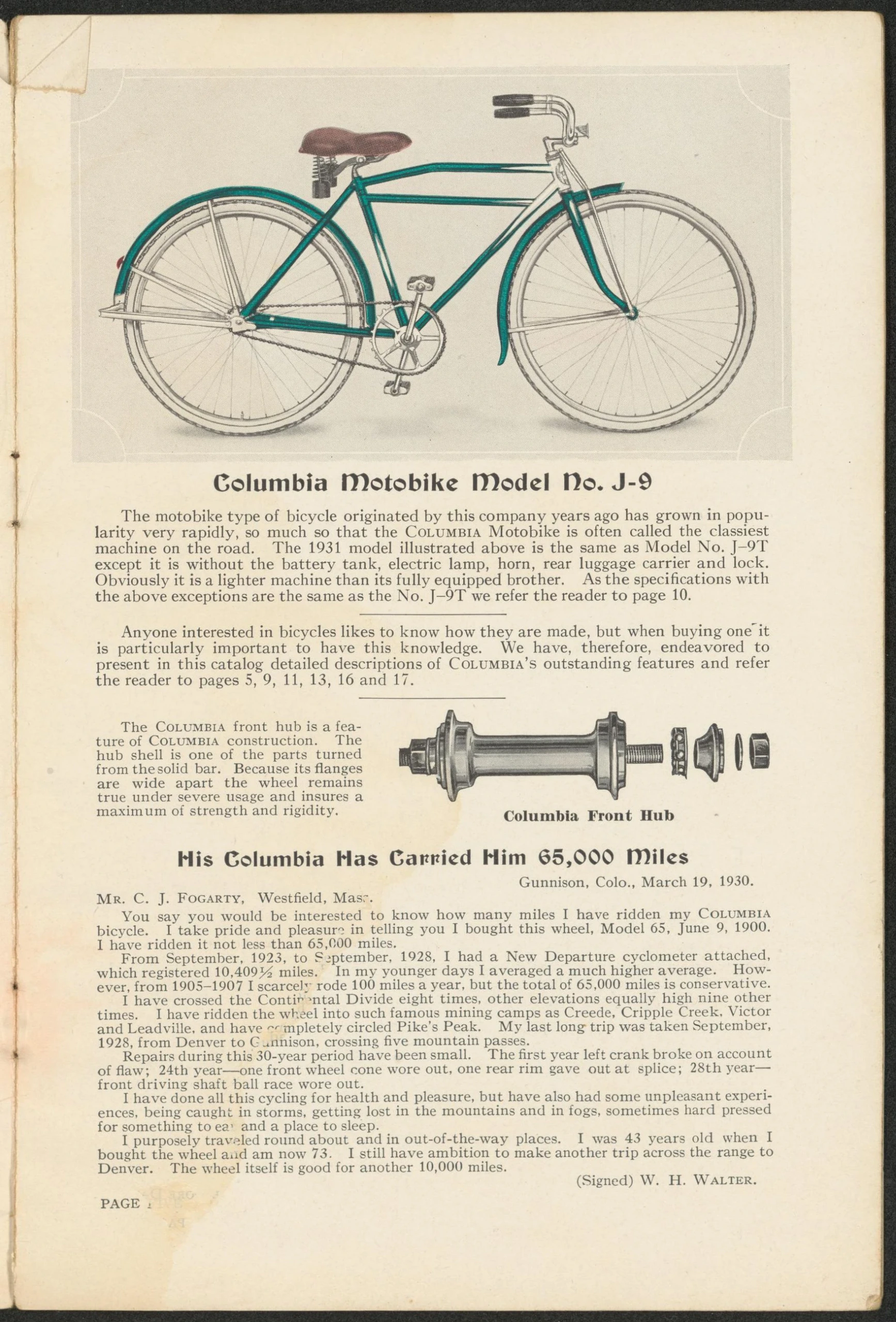
Columbia Motobike Model No. J-9
The motobike type of bicycle originated by this company years ago has grown in popularity very rapidly, so much so that the COLUMBIA Motobike is often called the classiest machine on the road. The 1931 model illustrated above is the same as Model No. J-9T except it is without the battery tank, electric lamp, horn, rear luggage carrier and lock. Obviously it is a lighter machine than its fully equipped brother. As the specifications with the above exceptions are the same as the No. J-9T we refer the reader to page 10.
Anyone interested in bicycles likes to know how they are made, but when buying one it is particularly important to have this knowledge. We have, therefore, endeavored to present in this catalog detailed descriptions of COLUMBIA’S outstanding features and refer the reader to pages 5, 9, 11, 13, 16 and 17.
The COLUMBIA front hub is a feature of COLUMBIA construction. The hub shell is one of the parts turned from the solid bar. Because its flanges are wide apart the wheel remains true under severe usage and insures a maximum of strength and rigidity.
Columbia Front Hub
His Columbia Has Carried Him 65,000 Miles
Gunnison, Colo., March 19, 1930.
MR. C. J. FOGARTY, Westfield, Mass.
You say you would be interested to know how many miles I have ridden my COLUMBIA bicycle. I take pride and pleasure in telling you I bought this wheel, Model 65, June 9, 1900. I have ridden it not less than 65,000 miles.
From September, 1923, to September, 1928, I had a New Departure cyclometer attached, which registered 10,409 1/2 miles. In my younger days I averaged a much higher average. However, from 1905-1907 I scarcely rode 100 miles a year, but the total of 65,000 miles is conservative.
I have crossed the Continental Divide eight times, other elevations equally high nine other times. I have ridden the wheel into such famous mining camps as Creede, Cripple Creek, Victor and Leadville, and have completely circled Pike’s Peak. My last long trip was taken September, 1928, from Denver to Gunnison, crossing five mountain passes.
Repairs during this 30-year period have been small. The first year left crank broke on account of flaw; 24th year—one front wheel cone wore out, one rear rim gave out at splice; 28th year—front driving shaft ball race wore out.
I have done all this cycling for health and pleasure, but have also had some unpleasant experiences, being caught in storms, getting lost in the mountains and in fogs, sometimes hard pressed for something to eat and a place to sleep.
I purposely traveled round about and in out-of-the-way places. I was 43 years old when I bought the wheel and am now 73. I still have ambition to make another trip across the range to Denver. The wheel itself is good for another 10,000 miles.
(Signed) W. H. WALTER.
PAGE [illegible]
[A halftone of the Columbia Motobike J-9 in side view, tinted green and white, with a double top tube, balloon-section tires, sprung saddle and mudguards; an engraving of the Columbia front hub with its cone, balls and nut shown apart. A brown water stain at left touches the letter and the folio; a creased upper left corner.]
— Page 6 —
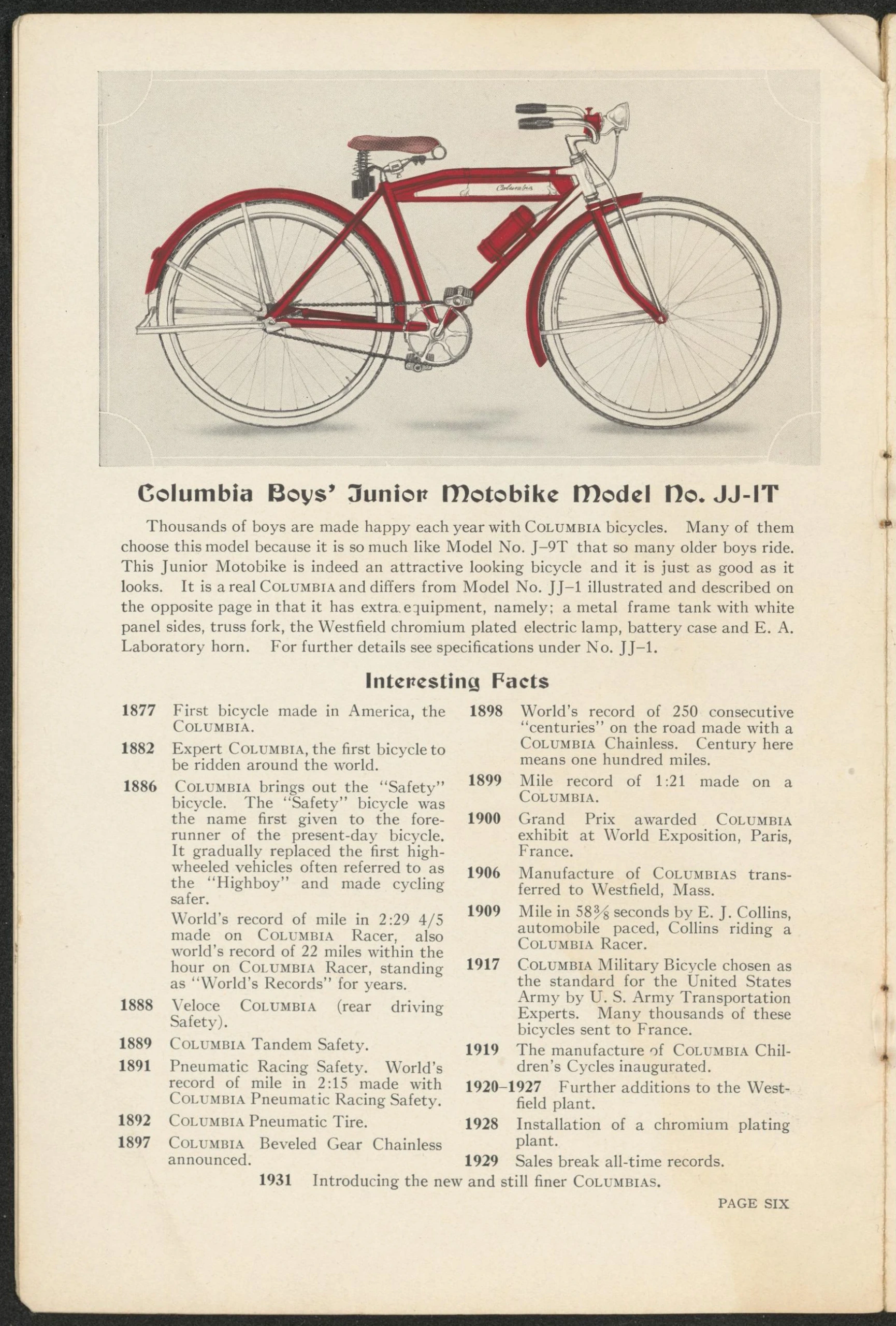
Columbia Boys’ Junior Motobike Model No. JJ-1T
Thousands of boys are made happy each year with COLUMBIA bicycles. Many of them choose this model because it is so much like Model No. J-9T that so many older boys ride. This Junior Motobike is indeed an attractive looking bicycle and it is just as good as it looks. It is a real COLUMBIA and differs from Model No. JJ-1 illustrated and described on the opposite page in that it has extra equipment, namely; a metal frame tank with white panel sides, truss fork, the Westfield chromium plated electric lamp, battery case and E. A. Laboratory horn. For further details see specifications under No. JJ-1.
Interesting Facts
1877 First bicycle made in America, the COLUMBIA.
1882 Expert COLUMBIA, the first bicycle to be ridden around the world.
1886 COLUMBIA brings out the “Safety” bicycle. The “Safety” bicycle was the name first given to the forerunner of the present-day bicycle. It gradually replaced the first high-wheeled vehicles often referred to as the “Highboy” and made cycling safer.
World’s record of mile in 2:29 4/5 made on COLUMBIA Racer, also world’s record of 22 miles within the hour on COLUMBIA Racer, standing as “World’s Records” for years.
1888 Veloce COLUMBIA (rear driving Safety).
1889 COLUMBIA Tandem Safety.
1891 Pneumatic Racing Safety. World’s record of mile in 2:15 made with COLUMBIA Pneumatic Racing Safety.
1892 COLUMBIA Pneumatic Tire.
1897 COLUMBIA Beveled Gear Chainless announced.
1898 World’s record of 250 consecutive “centuries” on the road made with a COLUMBIA Chainless. Century here means one hundred miles.
1899 Mile record of 1:21 made on a COLUMBIA.
1900 Grand Prix awarded COLUMBIA exhibit at World Exposition, Paris, France.
1906 Manufacture of COLUMBIAS transferred to Westfield, Mass.
1909 Mile in 58 3/8 seconds by E. J. Collins, automobile paced, Collins riding a COLUMBIA Racer.
1917 COLUMBIA Military Bicycle chosen as the standard for the United States Army by U. S. Army Transportation Experts. Many thousands of these bicycles sent to France.
1919 The manufacture of COLUMBIA Children’s Cycles inaugurated.
1920-1927 Further additions to the Westfield plant.
1928 Installation of a chromium plating plant.
1929 Sales break all-time records.
1931 Introducing the new and still finer COLUMBIAS.
PAGE SIX
[A halftone of the Columbia Boys’ Junior Motobike JJ-1T in side view, tinted carmine and white, with a tank between the top tubes bearing a Columbia script, an electric headlamp, a battery case and a truss fork; a two-column chronology of facts below.]
— Page 7 —
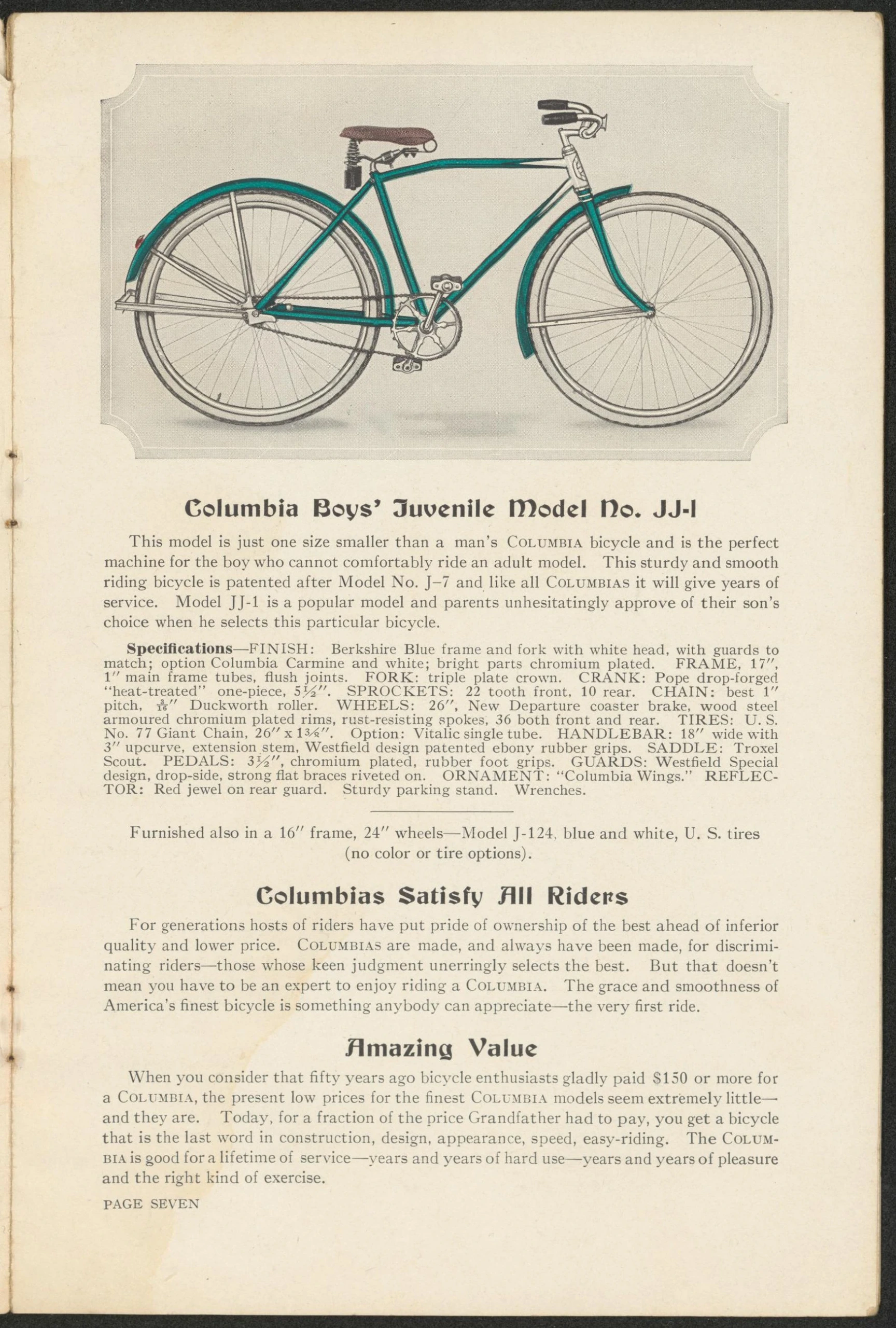
Columbia Boys’ Juvenile Model No. JJ-1
This model is just one size smaller than a man’s COLUMBIA bicycle and is the perfect machine for the boy who cannot comfortably ride an adult model. This sturdy and smooth riding bicycle is patented after Model No. J-7 and like all COLUMBIAS it will give years of service. Model JJ-1 is a popular model and parents unhesitatingly approve of their son’s choice when he selects this particular bicycle.
Specifications—FINISH: Berkshire Blue frame and fork with white head, with guards to match; option Columbia Carmine and white; bright parts chromium plated. FRAME, 17″, 1″ main frame tubes, flush joints. FORK: triple plate crown. CRANK: Pope drop-forged “heat-treated” one-piece, 5 1/2″. SPROCKETS: 22 tooth front, 10 rear. CHAIN: best 1″ pitch, 3/16″ Duckworth roller. WHEELS: 26″, New Departure coaster brake, wood steel armoured chromium plated rims, rust-resisting spokes, 36 both front and rear. TIRES: U. S. No. 77 Giant Chain, 26″ x 1 3/8″. Option: Vitalic single tube. HANDLEBAR: 18″ wide with 3″ upcurve, extension stem, Westfield design patented ebony rubber grips. SADDLE: Troxel Scout. PEDALS: 3 1/2″, chromium plated, rubber foot grips. GUARDS: Westfield Special design, drop-side, strong flat braces riveted on. ORNAMENT: “Columbia Wings.” REFLECTOR: Red jewel on rear guard. Sturdy parking stand. Wrenches.
Furnished also in a 16″ frame, 24″ wheels—Model J-124, blue and white, U. S. tires (no color or tire options).
Columbias Satisfy All Riders
For generations hosts of riders have put pride of ownership of the best ahead of inferior quality and lower price. COLUMBIAS are made, and always have been made, for discriminating riders—those whose keen judgment unerringly selects the best. But that doesn’t mean you have to be an expert to enjoy riding a COLUMBIA. The grace and smoothness of America’s finest bicycle is something anybody can appreciate—the very first ride.
Amazing Value
When you consider that fifty years ago bicycle enthusiasts gladly paid $150 or more for a COLUMBIA, the present low prices for the finest COLUMBIA models seem extremely little—and they are. Today, for a fraction of the price Grandfather had to pay, you get a bicycle that is the last word in construction, design, appearance, speed, easy-riding. The COLUMBIA is good for a lifetime of service—years and years of hard use—years and years of pleasure and the right kind of exercise.
PAGE SEVEN
[A halftone of the Columbia Boys’ Juvenile JJ-1 in side view, tinted blue-green and white, with a diamond frame, balloon-section tires, sprung saddle and drop-side mudguards; text below.]
— Page 8 —
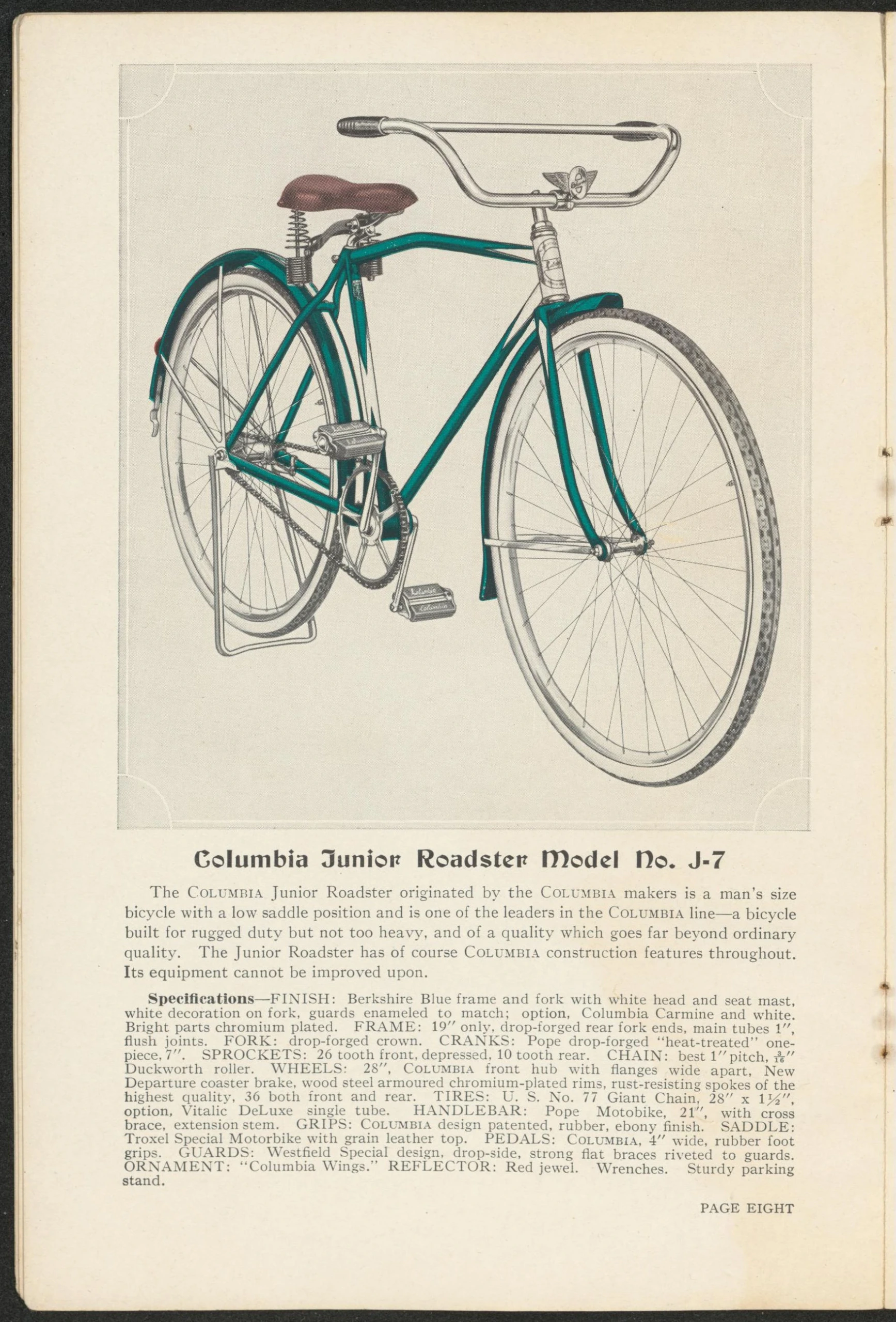
Columbia Junior Roadster Model No. J-7
The COLUMBIA Junior Roadster originated by the COLUMBIA makers is a man’s size bicycle with a low saddle position and is one of the leaders in the COLUMBIA line—a bicycle built for rugged duty but not too heavy, and of a quality which goes far beyond ordinary quality. The Junior Roadster has of course COLUMBIA construction features throughout. Its equipment cannot be improved upon.
Specifications—FINISH: Berkshire Blue frame and fork with white head and seat mast, white decoration on fork, guards enameled to match; option, Columbia Carmine and white. Bright parts chromium plated. FRAME: 19″ only, drop-forged rear fork ends, main tubes 1″, flush joints. FORK: drop-forged crown. CRANKS: Pope drop-forged “heat-treated” one-piece, 7″. SPROCKETS: 26 tooth front, depressed, 10 tooth rear. CHAIN: best 1″ pitch, 3/16″ Duckworth roller. WHEELS: 28″, COLUMBIA front hub with flanges wide apart, New Departure coaster brake, wood steel armoured chromium-plated rims, rust-resisting spokes of the highest quality, 36 both front and rear. TIRES: U. S. No. 77 Giant Chain, 28″ x 1 1/2″, option, Vitalic DeLuxe single tube. HANDLEBAR: Pope Motobike, 21″, with cross brace, extension stem. GRIPS: COLUMBIA design patented, rubber, ebony finish. SADDLE: Troxel Special Motorbike with grain leather top. PEDALS: COLUMBIA, 4″ wide, rubber foot grips. GUARDS: Westfield Special design, drop-side, strong flat braces riveted to guards. ORNAMENT: “Columbia Wings.” REFLECTOR: Red jewel. Wrenches. Sturdy parking stand.
PAGE EIGHT
[A large halftone of the Columbia Junior Roadster J-7 in three-quarter front view, tinted blue-green and white, with a wide swept-back handlebar bearing the Columbia Wings ornament, a sprung saddle, balloon-section tires and a parking stand; specifications below.]
— Page 9 —
Bicycling is Safer Than Walking
Playing baseball or football or tag on the streets or near a highway, flying kites, rolling hoops or roller skating are actually far less safe than bicycle riding. Yet occasionally a parent may mistakenly think that a bicycle is hazardous. Statistics prove to the contrary that bicycle riding is one of the safest of all outdoor activities for young people. When riding bicycles they do not race after baseballs in front of automobiles, nor do they play tag and throw one another’s caps into the street. Careful observance of the rules of the road by bicycle riders eliminates practically all hazards.
Observe the Law
1. The bicycle is a vehicle, and therefore entitled to the same rights and privileges on the highways as enjoyed by horse-drawn vehicles or automobiles.
2. Observe the laws governing the use of highways.
3. Never ride on the wrong side of the road.
4. Keep near the curb.
5. Do not “hitch on” to a vehicle.
6. Never ride two on one bicycle.
7. Equip your bicycle with a bell or other warning device.
8. Bicycles out at night must have proper lights.
9. Give proper signals.
Signals
To signal your intention to turn to the left—Extend the left arm and point the first finger to the left.
To signal your intention to turn to the right—Extend the right arm and point the first finger to the right.
To signal your intention to stop—Extend the arm with the back of the hand to the rear of the bicycle.
To signal your intention to turn completely around—Circle the arm and hand three times forward to indicate a turn to be made to the right, and circle three times backward to indicate an intention to make the turn to the left.
“Come forward and pass me”—This signal is universally made by motioning the hand in a forward direction from the elbow and wrist.
Merit Badge Requirements for Cycling
(from Hand Book for Boys—Boy Scouts of America)
To obtain a merit badge for cycling, a Scout must:
1. Ride a bicycle fifty miles in ten hours.
2. Repair a puncture.
3. Take apart and clean a bicycle, and put it together again properly.
4. Demonstrate how to make reports, if sent out scouting on a road.
5. Read a map; and report correctly verbal messages.
Outstanding Features (continued)
Even as metal ornaments add class to a Pierce-Arrow and Packard, so is the beauty and attractiveness of a COLUMBIA enhanced by “Columbia Wings.” The “Columbia Wings” ornament gives an added touch of distinctiveness and individuality also to COLUMBIA bicycles that an ordinary decoration cannot do. It is of heavy gauge metal, heavily plated, with bright highlights, and is held firmly in place by the handlebar stem bolt.
“Columbia Wings”
PAGE NINE
[A text page with a small halftone of the “Columbia Wings” ornament, a winged oval badge with the Columbia script, mounted on a handlebar stem, at lower right.]
— Page 10 —
Columbia
Columbia Motobike Model No. J-9T
This completely equipped model is unquestionably the favorite of all bicycles in the motobike class. It differs from the Junior Roadster in that it has the extra bar in the frame and is supplied regularly with the COLUMBIA design round battery tank, truss fork, electric lamp, horn, luggage carrier and lock. The regular height of frame is 19″ (the illustration shows a 21″ frame, which is the optional height). Model J-9T has everything necessary for the hard service demanded of it by Boy Scouts and kindred associations where work and fun go hand in hand—a dependable bicycle that any rider can be proud to own.
Specifications—FINISH: Berkshire Blue frame and fork with white head and seat mast, white decoration on fork, guards enameled to match; option, Columbia Carmine and white. Bright parts chromium plated. FRAME: 19″ regular, 21″ option, drop-forged rear fork ends, main tubes 1″, flush joints. FORK: drop-forged crown, tubular steel chromium plated truss rods. CRANKS: Pope drop-forged “heat-treated” one-piece, 7″. SPROCKETS: 26 tooth front, depressed, 10 tooth rear. CHAIN: best 1″ pitch, 3/16″ Duckworth roller. WHEELS: 28″, COLUMBIA front hub, New Departure coaster brake, wood steel armoured rims, rust-resisting spokes of the highest quality, 36 both front and rear. TIRES: U. S. No. 77 Giant Chain, 28″ x 1 1/2″; option, Vitalic DeLuxe. HANDLEBAR: Pope Motobike, 21″ wide with cross brace, extension stem. GRIPS: COLUMBIA design patented, rubber, ebony finish. SADDLE: Troxel Special Motorbike with grain leather top. PEDALS: COLUMBIA, 4″ wide, rubber foot grips. GUARDS: Westfield Special design, drop-side, with strong flat braces riveted to guards. REFLECTOR: Red jewel. Wrenches. Sturdy parking stand. COLUMBIA round frame battery tank. Westfield lamp. E. A. Laboratory horn. Luggage carrier. Lack.
PAGE TEN
[A large halftone of the Columbia Motobike J-9T in three-quarter front view, tinted carmine and white, with a round battery tank between the top tubes bearing the Columbia script, a red horn and electric headlamp on the wide handlebar, a truss fork, rear luggage carrier and parking stand; specifications below.]
— Page 11 —
Outstanding Features (continued)
This new Westfield Electric Bicycle Lamp is now shown for the first time. One must see and examine it to fully appreciate its fine points. The lamp is 4″ long by 3 3/4″ wide, the exterior parts chromium plated. The drawn brass shell is of beautiful proportions. The strong, neat bracket fastened to the handlebar stem holds the lamp firmly in position. A flexible steel cable encases the insulated copper wires. Pull out the knob and a brilliant light shoots through the convex lens. This lamp is regular equipment on Models J-9T and JJ-1T and can be obtained for other COLUMBIAS at a reasonable price.
Another feature on Models J-9T and JJ-1T is the rugged E. A. Laboratory Horn (Model BM—patented) enameled to match frame. A quality horn in every way and built for service.
This large Troxel Special Motorbike Saddle is the last word in quality saddles and because there is no better saddle made it is supplied as regular equipment on all 1931 COLUMBIA men’s road models. It has patented comfort cushion springs, flat steel truss and a genuine grain leather top.
The sturdy COLUMBIA pedal is superior to ordinary pedals and is found only on 1931 COLUMBIA bicycles. The exposed metal parts are chromium plated, which means that it is tarnish-proof and rust-resisting. The treads are of non-blooming, enduring rubber and into each tread is molded the word “COLUMBIA.”
As you have noticed in the specifications we furnish on COLUMBIAS nothing but the highest quality factory brand tires.
The U. S. No. 77 Giant Chain Tire has a handsome black double chain tread and white side walls. There are three plies of strong fabric all around. The inner tube is of purest gum.
VITALIC TIRES
CONTINENTAL RUBBER WORKS ERIE, PA.
The Vitalic DeLuxe Tire is made with two plies of extra strong 14 1/2 ounce motorcycle fabric. The inner tube and the tread with its distinctive Vitalic non-skid design are of pure white rubber.
Double clincher tires, either G. & J. Cord Chain Tread or Vitalic, will be supplied on adult road models, and G. & J. Clincher on 26″ juveniles, when specified, at a reasonable extra charge (on steel clincher rims).
PAGE ELEVEN
[A text page with halftones of the Westfield electric lamp in a round vignette, a red Troxel Special Motorbike saddle on coil springs, a Columbia rubber-block pedal with Columbia molded in the treads, a cut-away U. S. No. 77 Giant Chain tire with valve and a cut-away Vitalic tire. Rust stains from the staples at left.]
— Page 12 —
Columbia Women’s Model No. J-10 [?]
The most favored bicycle of its type not only because it is a COLUMBIA but also because of its gracefulness, ease of handling, and its beautiful finish and equipment. Popular at fashionable resorts, at schools and seminaries, and wherever women and girls use bicycles for health, pleasure and convenience. The regular color is beautiful Berkshire Blue with white head, white center band on guards, white decoration on front fork. The optional color is Columbia Carmine and white. All the principal bright parts are chromium plated.
Specifications—FINISH: as described above. FRAME: 18″, drop-forged rear fork ends, main tubes 1″, flush joints. FORK: drop-forged crown. CRANKS: Pope drop-forged “heat-treated” one-piece, 6 1/2″. SPROCKETS: 22 teeth front, 10 rear. CHAIN: best 3/16″ x 1″ pitch, Duckworth roller. WHEELS: 28″, COLUMBIA front hub, New Departure coaster brake, wood steel armoured rims, rust-resisting spokes, 36 both front and rear. TIRES: U. S. No. 77 Giant Chain, 28″ x 1 1/2″. Option: Vitalic DeLuxe single tube. HANDLEBAR: 19″ wide with a graceful upcurve, extension stem. GRIPS: Westfield design patented, rubber, ebony finish. SADDLE: Troxel Women’s Comfort with brown leather top. PEDALS: Westfield, 3 1/2″ wide. GUARDS: front and rear, Westfield Special design, drop-sides, strong flat braces riveted on, also chain guard and netted skirt guard. REFLECTOR: Red jewel. Wrenches. Sturdy parking stand.
Best Exercise in the World and Distinctly Good Form
Bicycle riding is conceded to be the best exercise in the world. Every muscle in the body participates. For health and pleasure nothing equals it—and cycling is distinctly good form. The increasing number of college girls who are taking up cycling as a new sport and pastime directly reflects the fashionable tendency in Palm Beach, Bermuda and other noted resorts. This scene was photographed at Palm Beach.
PAGE TWELVE
[A halftone of the Columbia Women’s drop-frame bicycle in side view, tinted blue-green and white, with a curved double top tube, pierced chain guard, netted skirt guard, mudguards and balloon-section tires; a halftone photograph of women with bicycles on a lawn under palm trees at Palm Beach. A brown stain has lifted the model number in the heading.]
— Page 13 —
Columbia Girls’ Juvenile Model No. JJ-2
Pare[illegible] always ready to approve the choice of a COLUMBIA Girls’ Juvenile for their young daughters [illegible]cause they are familiar with COLUMBIA reputation for quality. As Model J-10 is the perfect bicycle for mother so is Model JJ-2 for daughter. It is, in fact, patterned after Model J-10 but it has a lower frame and one size smaller wheels. Model JJ-2 pedals easily, steers easily and it has the very best equipment for comfort and safety.
Specifications: As Model JJ-2 and JJ-1 are companion bicycles we ask the reader to turn to page 7 for detailed specifications, noting, however, the following exceptions; Model JJ-2 has a double loop design frame, straight handlebar stem, Troxel No. 14-C saddle and netted skirt guard. The height of frame is 17″ and the size of wheels 26″, same as Model JJ-1.
Furnished also in a 16″ frame, 24″ wheels—Model J-224, blue and white, U. S. tires (no color or tire options).
Sincere Appreciation from California
Arcadia, Calif., March 3, 1928.
WESTFIELD MFG. CO.
Westfield, Mass.
Inclosed you will find a snapshot of me. I am the girl who won the first prize in the big bicycle parade at Pasadena; it was a lovely COLUMBIA bicycle. I was so surprised to have been the winner and it was the first time in my ten years I have ever received anything so grand. John’s Bicycle Shop who got up the parade and all who helped have made me very happy and I hope you will think me worthy of the bicycle. My costume was white, pink and silver and the bicycle was painted silver.
Your friend,
(Signed) JAYNE LOWE
Outstanding Features (continued)
COLUMBIA grips are made in the patented COLUMBIA design from live, non-blooming rubber. These grips have an “ebony” black finish, which improves in lustre and appearance with use. Supplied only on COLUMBIA bicycles.
Columbia Rubber Grip
PAGE THIRTEEN
[A halftone of the Columbia Girls’ Juvenile JJ-2 in side view, tinted blue-green and white, with a double-loop drop frame, netted skirt guard and mudguards; a snapshot of a girl in a frilled white costume on a flower-decked bicycle; a halftone of a ribbed Columbia rubber grip. Small stains at upper left of the text.]
— Page 14 —
Columbia Racing Models
COLUMBIA racers have carried to victory many famous riders. They are perfectly balanced, smooth in action, light and speedy but amply strong to meet the demands of track and road racing service. There are two models from which to make selection. Model J-4 is the Special Racer with the COLUMBIA “heat-treated” two-piece cran[illegible]. The Road Racer Model J-5 has the Pope one-piece “heat-treated” crank. When specified coaster brake will be supplied on the road racer model at a reasonable extra charge, also racing guards. See following page for specifications.
Columbia Special Delivery Model No. J-9SD
This model is particularly suited for delivery purposes and merchants who specialize in service use it for delivering light loads and for rush calls. It is a time and money saver as compared to other methods. Boys who like to earn money during spare hours find this also the ideal bicycle for carrying packages. Model J-9SD is the same as Model J-9 with the following exceptions. The Model J-9SD has “heavy-service” front hub and headset, tandem rust-resisting spokes, steel rims, sturdy front and rear carriers, no truss fork attachment. Black enamel frame, fork, guards and rear carrier. The rims are black with red panel stripes. The tires are U. S. No. 77 Giant Chain, 1 5/8″; Vitalic 1 1/2″ option.
PAGE FOURTEEN
[Two halftones in black and white: a Columbia racing bicycle in side view with a dropped handlebar, racing saddle and no mudguards and the Columbia Special Delivery J-9SD with a double top tube, a wire basket on the front, a rear carrier, sprung saddle and mudguards. Small stains on the page.]
— Page 15 —
Specifications—Racers—FINISH: Black; option, Berkshire Blue or Columbia Carmine on Model J-5. Front fork and other bright parts chromium plated. FRAME: 21″, drop-forged rear fork ends, main tubes 1″, flush joints. FORK: drop-forged crown. CRANKS: 6 1/2″. SPROCKETS: front depressed for strength and appearance, 26 teeth, 9 teeth rear. CHAIN: Duckworth block racing, 1″ x 3/16″ on Model J-4; best quality Duckworth roller, 1″ x 3/16″ on Model J-5. RIMS: Laminated Camionade, “V” shape, on Model J-4; selected wood, one-piece, on Model J-5. SPOKES: rust-resisting and of the highest quality, .056-.072, 36 both front and rear. TIRES: Model J-4, U. S. Cord Road Racer, 28″ x 1 1/8″ regular; option, Vitalic Racer, black tread, 28″ x 1 1/8″. Model J-5, U. S. Cord Road Racer, 28″ x 1 1/4″; option, Vitalic Racer, black tread, 28″ x 1 1/4″. SADDLE: Troxel Track Racer. PEDALS: Special racing type. Wrenches. Size of wheels, 28″. 16″ racing handlebar with sponge rubber grips.
Read what Knute Rockne, the famous coach, says
“For general, all-around, health-making, invigorating, stimulating, muscle-building, lung-expanding, leg-developing, tissue-strengthening exercise, commend me to the sturdy instrument of self-locomotion—the bicycle! That’s about as broad and sweeping a statement as a fellow can make in a single paragraph. Fortunately, I can make this recommendation advisedly, for exercising for health’s sake has been a hobby, a pastime, and a whole souled business of mine for more years perhaps than I ought to confess. Here in the University of Notre Dame we have one hundred and twenty-five boys up to 15 years, every one of whom owns and rides a bicycle and every one of whom is wonderfully healthy and in fine physical trim.”
That’s a lot for such a well-known builder of health and sport to say, but it’s true. We also know that Notre Dame excels in football, but other contests have their place in the sun. To us and to you the results of the bicycle endurance contests that took place last summer in many cities are of interest.
These contests gave COLUMBIA another opportunity to prove its dependability and the returns show in no uncertain way that COLUMBIA is supreme. Two COLUMBIA teams stand out as leaders. Here they are:—
Sept. 30, 1930
Westfield Mfg. Co.
Regarding the history of the COLUMBIA bicycle which was used by the Hill Boys of Delawanna: They have beaten all records set up by other teams. The record for the wheel is 1,556 3/4 hours of continuous riding, covering 14,207 miles. They have taken out only 18 of their allotted 20 minutes for repairs during the entire contest and that was due to tire and speedometer trouble. No repairs were necessary to the bicycle. The boys started their contest July 23d at 12:00 noon, finished September 25th, on your wheel.
The boys started on a 3-hour shift, but later rode in 4-hour shifts.
(Signed) William Lesser, Jr., Manager,
(Delawanna) Passaic, N. J.
Left to right: Charles Stefano, Frank Pangaro, John Cenamo, “Nick” Lazzaro.
Paterson, N. J., October 13, 1930
Westfield Mfg. Co., Westfield, Mass.
Replying to your letter about our recent bicycle endurance contest: At one time 40 teams were in the contest. Our team used two COLUMBIA Racers, one ten years old, the other new. Either the manager, trainer, or coach was on hand night and day. When one of our boys was relieved the other was already on a wheel. The boys rode for 1,275 hours, starting at 10:00 A.M. on July [?]6th and finishing at 1:00 P.M., Sept. 7th. The team was equipped with sun shades for riding during the heat waves and a rubber poncho for riding in the rain. There was no trouble whatever with the bicycles outside of tire trouble and we think that is a pretty good idea of COLUMBIA quality. The snapshot was taken immediately after the finish. We claim the school boy endurance championship as all of our boys were school boys. They are from 15 to 17 years of age.
(Signed) Babb-Smith, Inc.
R. A. Smith, Secretary
Top row, left to right: Collins, Colvin, Farrell, Moore. Bottom row, left to right: Fivehouse, manager; Hanrahan, coach; Lamonge, trainer:
PAGE FIFTEEN
[A text page with two halftone photographs: four teenage boys in white shirts standing behind a bicycle and a team of seven boys, two in Columbia jerseys, with two racing bicycles on a doorstep. Small stains on the text.]
— Page 16 —
Mechanical Features
Some people in judging a bicycle merely by its general design, its “dress,” fail to consider the vital points which distinguish between a good and an ordinary bicycle—between the COLUMBIA and all others. As if COLUMBIAS were under the searching light of an X-ray the following descriptions present the facts regarding a few points of their structural superiorities.
NO JOINTS HERE
An important factor of safety in COLUMBIA bicycles is the sturdy patented Pope Spun Steering Head (often copied but never equaled). Originally conceived by the COLUMBIA makers, this head will be found on all of the 1931 models. Unusual strength at this point, which is subjected to the very greatest strain, is provided by this head because of the elimination of two joints common to other forms of head construction. The main frame tubes of the COLUMBIA have no “weakening” joints, but are cut out of a single piece to exact size and “spun” into the frame head direct, making the strongest head construction ever put in a bicycle.
In addition to frequent tests of the material which goes into COLUMBIA bicycles the finished parts as well as the assembled machine are tested in special testing machines. Our machine for testing cranks tells an interesting story and proves beyond a shadow of doubt the great superiority of our cranks over others.
All our cranks are forged from a special high carbon steel made for us exclusively under our own formula. It costs more and is slower to machine but it makes a stronger and better crank, which is the point sought for. But that is not the whole story. All manufacturers do not recognize the important part that “heat-treating” plays in the making of a perfect crank, or at least they do not act upon that knowledge. Another thing, the maker must know the fine points of “heat-treating” to produce the best results. Our experience has given us that knowledge and the result is that springing, bending and breaking of our cranks are practically eliminated [?]. Our cranks have been used without change for over a generation [?].
A word about sprockets—COLUMBIA sprockets are [?] of hard steel, not soft steel so commonly used, and are subjected to [?] 1400 tons pressure in our large hydraulic press. This treatment compresses the metal and assures toughness, strength and long life. Now what about the sprocket and crank working together as one unit? It is, of course, important that they function properly, one with the other. The Double D design of the COLUMBIA sprocket and crank where they are joined together and the fine workmanship in preparing the two for the proper forced fit assure a positive, permanent [?] and perfect drive. The crank and sprocket stay put and that means [?] much to the rider. This is undoubtedly the best method ever evolved for attaching sprocket to crank and is one of the superior features of COLUMBIA Product.
COLUMBIA cones and cups are of special steel turned to exact size from solid bars. By our special process of case hardening the bearing surfaces are [?] made as hard as glass, while the inner core is softer and of great toughness. The process is similar to that used in tempering the armor plates of battleships. They afford a perfect surface for the balls to travel on and at the same time the inner part has a little “give” which prevents the brittleness so common to cones and cups which are tempered throughout. These parts are then ground polished. The steel balls are “Chrome A Grade,” gauged to within one ten thousandth (.0001) of an inch. COLUMBIA bearings are noted for their easy running qualities.
DOUBLE D DRIVE
PAGE SIXTEEN
[A text page with three line drawings: the Pope spun steering head shown with its tubes apart and arrows marking “no joints here,” an exploded crank with bearing cups, cones and ball retainers and the Double D sprocket and crank joint. Patchy ink loss and a stain through the middle text block.]
— Page 17 —
Mechanical Features
The front forks are of sturdy construction, with stems of imported heavy gauge, seamless, drawn steel tubing. The inner surface of the stem is reamed out to remove any irregularities that might exist. The uniformity of the wall’s thickness thus secured permits utmost strength and durability, besides assuring a firm grip of the bar post when inserted into the front fork. The open fork ends make for easy removal of front wheel.
SEAMLESS STEEL FORK STEM
FORGED CROWN
FRONT FORK ASSEMBLY
Handsome drop-side guards of special COLUMBIA design are supplied as regular equipment on all models except the Racers, adding much to the appearance of these splendid bicycles. The sturdy flat steel braces are securely riveted to the guards to prevent loosening and rattling, and the rear guard carries a red jewel reflector.
Other construction and special features—Westfield analysis steel tubing made in our own Tube Department, drop-forged rear fork ends, handsome oval rear stays, sturdy seat post cluster, rust-resisting spokes of the highest quality with tensile strength 160,000 lbs. to square inch. Distinctive colors. Several coats of lustrous enamel are oven-baked over an anti-rust primer coat. The equipment is in keeping with COLUMBIA quality and the best the market affords.
Special attention is called to the beautiful and lasting finish of the principal bright parts of the 1931 models—chromium plate. COLUMBIA chromium plate is no ordinary finish. Each part carrying this finish is polished until it has a proper plating surface, then cleansed, copper-plated and [?] heavily nickel-plated. The nickel is then buffed and finally the chromium plate is applied. The result is a silver-like finish of permanent beauty like platinum, lustrous, tarnish-proof and rust-resisting.
General Directions
Full shipping instructions should accompany each order. Our liability ceases when the bicycle is delivered to carrier. Regular terms are net cash with order. Transportation charges are always paid by the purchaser. C. O. D. orders must be accompanied by sufficient deposit to pay transportation charges both ways, covering the possibility of non-acceptance. All bicycles or parts returned for repairs must be plainly marked with the name and address of sender, to insure identification.
Guarantee
COLUMBIA Bicycles are warranted in accordance with the universal guarantee adopted by the Bicycle Manufacturers’ Association, as follows: We agree with each purchaser of a COLUMBIA Bicycle, to repair or replace without charge, within one year from date of sale by us, any part which in our opinion shows defect due to material used or imperfect construction, provided it is returned to us transportation charges prepaid. This agreement does not cover the cost of repairing bicycles when damaged by accident, misuse or neglect. Tires, saddles, pedals, rims, handlebars, coaster brakes, chains, or any other finished parts manufactured by others than ourselves, are not guaranteed by us and any claims must be taken up with their respective manufacturers. A bicycle is built to carry one rider. Riding “double,” as sometimes dangerously practiced, automatically cancels this guarantee.
Export Business
We have long maintained an Export Department, devoted exclusively to the handling of our business in other countries. Export literature mailed upon request. Foreign business solicited.
Anyone interested in bicycles, children’s vehicles and fine machinery could profitably spend a few hours at our factory. To all we extend a cordial invitation to visit us.
Westfield Manufacturing Co.
WESTFIELD, MASS., U.S.A.
Largest Manufacturers of Bicycles and Children’s Cycles
WESTFIELD MFG. CO.
Columbia
WESTFIELD MASS. U.S.A.
PAGE SEVENTEEN
[A text page with a halftone of the front fork parts labeled “seamless steel fork stem,” “forged crown” and “front fork assembly,” a drawing of a drop-side mudguard with its braces and a large Columbia oval head badge at lower right. Patchy ink loss and small stains at left; letters dropped in several words are restored here where certain.]
— Page 18 —
Columbia Superb
This distinctive line of Cycles is the finished product of the manufacturers of the pioneer bicycle of America, the COLUMBIA.
COLUMBIA Cycles are built to give long, hard service and are beautifully finished. There are hundreds of thousands in use. Their smooth running qualities insure beneficial exercise instead of a fatiguing strain caused by propelling a vehicle which is not properly made. The steel frames are built, brazed, prepared for finishing and enameled in the best possible manner. Bright parts heavily plated. The saddles, adjustable handlebars and seat posts, grips, ball-bearing pedals, tires and other equipment features are all selected from a quality standpoint, for durability and for the child’s comfort. COLUMBIA Cycles cannot be classed with those made in an ordinary toy factory.
Each model has ball bearings throughout, drop-forged “heat-treated” crank, tubular steel frame, rust-resisting spokes, spring saddle, tool bag and bell. Colors as shown in the illustrations.
The Boycycles have 1″ main frame tubes and chromium plated bright parts. There are four sizes.
The Bicyclets are of bicycle construction throughout and carry the famous Pope-Spun steering head, 1″ main frame tubes, the Pope drop-forged “heat-treated” one-piece crank, New Departure coaster brake, a high grade bicycle roller chain, bicycle sprockets, guards and parking stand.
Models 438, 436—frames 13 1/2″, wheels 16″.
Models 329, 330—frames 14 1/2″, wheels 20″.
Tubular steel forks and red jewel reflector on Boycycles and Bicyclets.
Tires on all models—Non-Skid Button Tread (1 1/4″) cushion rubber, except Models 329 and 330 carry U. S. Juvenile pneumatic.
Superb Boycycle No. 352
Superb Bicyclet No. 438
Superb Bicyclet No. 436
PAGE EIGHTEEN
[Three color halftones down the left side: the Superb Boycycle No. 352, a blue-green and white tricycle against a black triangle; the red and white Superb Bicyclet No. 438, a boy’s model and the Superb Bicyclet No. 436, a girl’s drop-frame model; each with a sprung saddle, tool bag and parking stand.]
— Page 19 —
Children’s Cycles
All the fundamental COLUMBIA construction details, materials and workmanship are incorporated in these new models, insuring that marvelous wear for which a COLUMBIA is so well known. The entire line is a distinctive and fully guaranteed product, representing the greatest values. It is unwise to pay less—unnecessary to pay more.
A special message to parents:—Nothing that you can give your children will pay greater dividends in health, contentment, and the right kind of exercise than a COLUMBIA Cycle. It brings naturally into play every little muscle of the body. It keeps little legs in action, little bodies exercising, little eyes alert and little minds a-thrill with the joy of life—a vastly better investment than a doctor or a nurse.
Many parents have testified to this in their letters of praise about our Cycles. Space permits the printing of one only and we have selected for our readers the letter from Mrs. R. S. Ford as it covers so many points that parents should consider when purchasing a Cycle.
New London, Conn., March 19, 1928
“Regarding the COLUMBIA Children’s Boycycle which my little girl has used for nearly three years let me say that in all that time the only amount of expense it has incurred has been forty cents. Twenty-five cents for a clip, which was lost through carelessness, and fifteen cents for a bell. If anyone can show me an article or plaything for a child that can give any better service, more enjoyment and thorough training for self-reliance and resourcefulness for that amount of upkeep, as that COLUMBIA Boycycle has given, I would like to hear about it. The Boycycle is in perfect order, with the exception of some of the enamel worn off. She has just outgrown it. You may use my letter at any time, because it is the truth and absolutely voluntary. I know of no other plaything for a child that can equal the COLUMBIA Children’s Vehicle. Enclosed is snapshot.
Signed: (Mrs.) R. S. Ford.
Superb Bicyclet No. 329
Superb Bicyclet No. 330
The Cyclet No. 258
PAGE NINETEEN
Printed in U.S.A. by Springfield Printing and Binding Co., Springfield, Mass.
[Three color halftones down the right side: the red and white Superb Bicyclet No. 329, a boy’s model, the Superb Bicyclet No. 330, a girl’s drop-frame model and the Cyclet No. 258, a small tricycle; below, a halftone snapshot of a small child in a cap and coat on a tricycle beside a stone gatepost; the printer’s imprint at the foot.]
— Page 20 —
AIRPORT [?]
WESTFIELD
WESTFIELD MANUFACTURING CO. [?]
THE HOME OF THE COLUMBIA
World’s Largest Manufacturers of Bicycles and Children’s Cycles
[The back cover, scanned sideways: a red band above a teal field, with a tinted bird’s-eye view of the Westfield factory, long red-brick mill buildings with WESTFIELD and an arrow lettered on the roofs as an air marker, a tall chimney and a house and cars in front, framed by a cloud-shaped top; a caption label and a script slogan below. Light wear at the corners.]
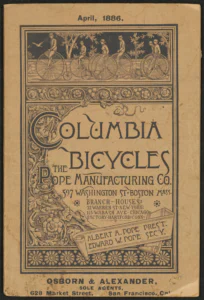 Columbia 1886 Catalog (Pope Manufacturing Co., United States): Expert, Light Roadster, Columbia Safety and Tricycles
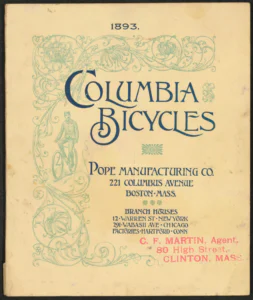 Columbia 1893 Catalog (Pope Manufacturing Co., United States): Century Columbia, Light Roadster, Ladies’ Models and Racing Safety
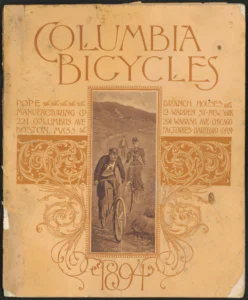 Columbia 1894 Catalog (Pope Manufacturing Co., United States): Models 33 to 39, the New Century Columbia
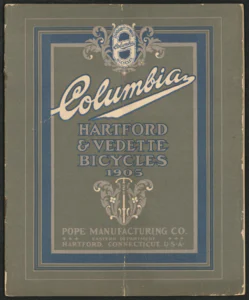 Columbia 1905 Catalog (Pope Manufacturing Co., United States): Columbia, Hartford and Vedette Bicycles
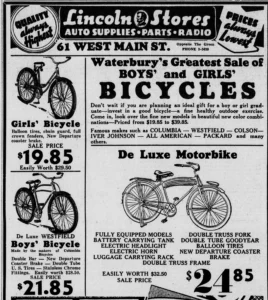 Columbia 1938 Advertisement — Lincoln Stores, Waterbury’s Greatest Sale of Boys’ and Girls’ Bicycles: De Luxe Westfield $21.85, De Luxe Motorbike $24.85
Ebykr presents this material for research and education. If you hold rights to it or notice an ownership issue, please contact us and we will respond promptly.