About Ebykr
Ebykr celebrates classic and vintage lightweight bicycles through provocative imagery and opinion. Ride along with us.
About Ebykr
Ebykr celebrates classic and vintage lightweight bicycles through provocative imagery and opinion. Ride along with us.

Source: Northwestern University Libraries, Transportation Library, "Columbia bicycles" (digital collection, https://dc.library.northwestern.edu/items/a4cf2002-5cd4-4033-8c71-fcadb0170ff2); rights statement "No Copyright - United States".
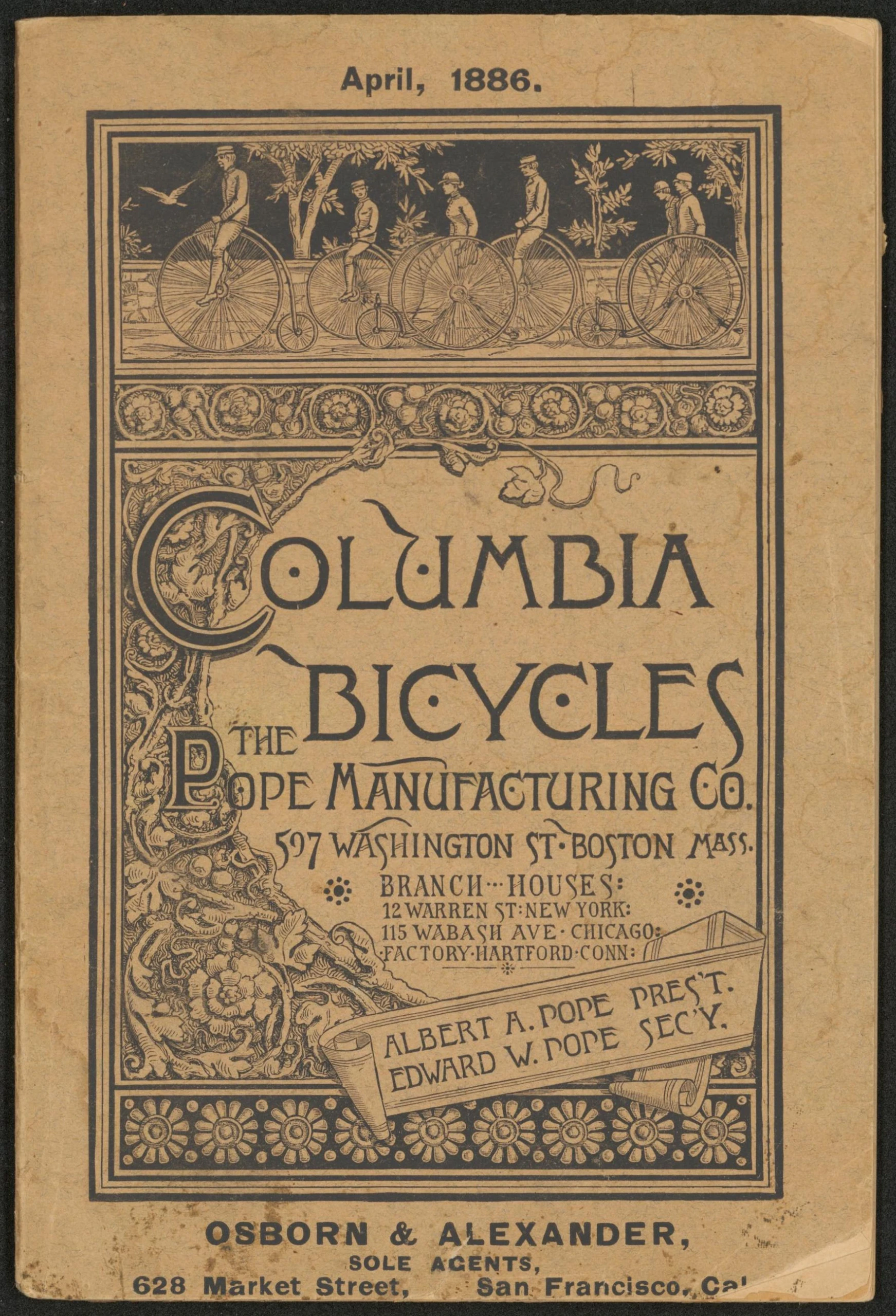 Page 1
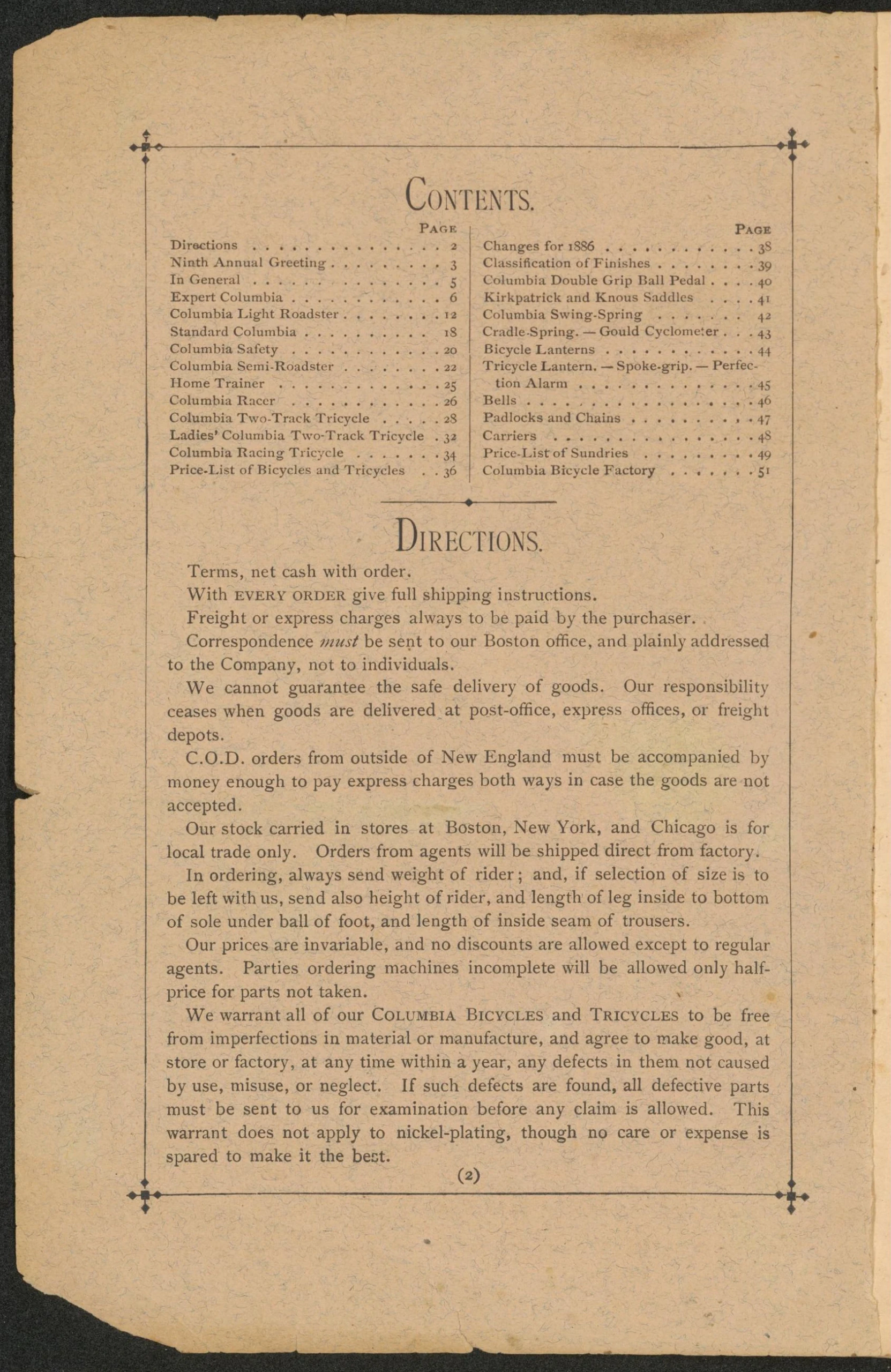 Page 2
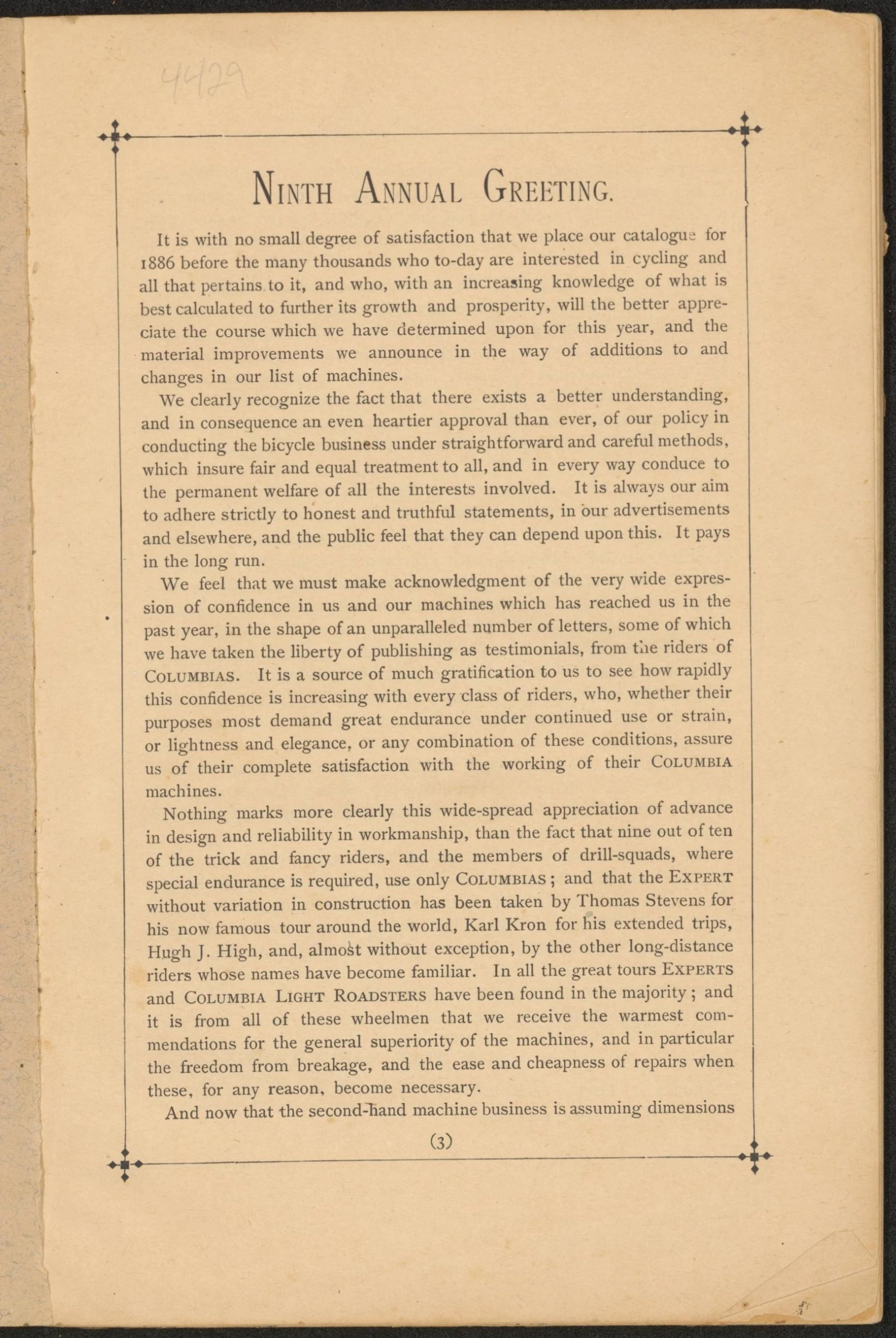 Page 3
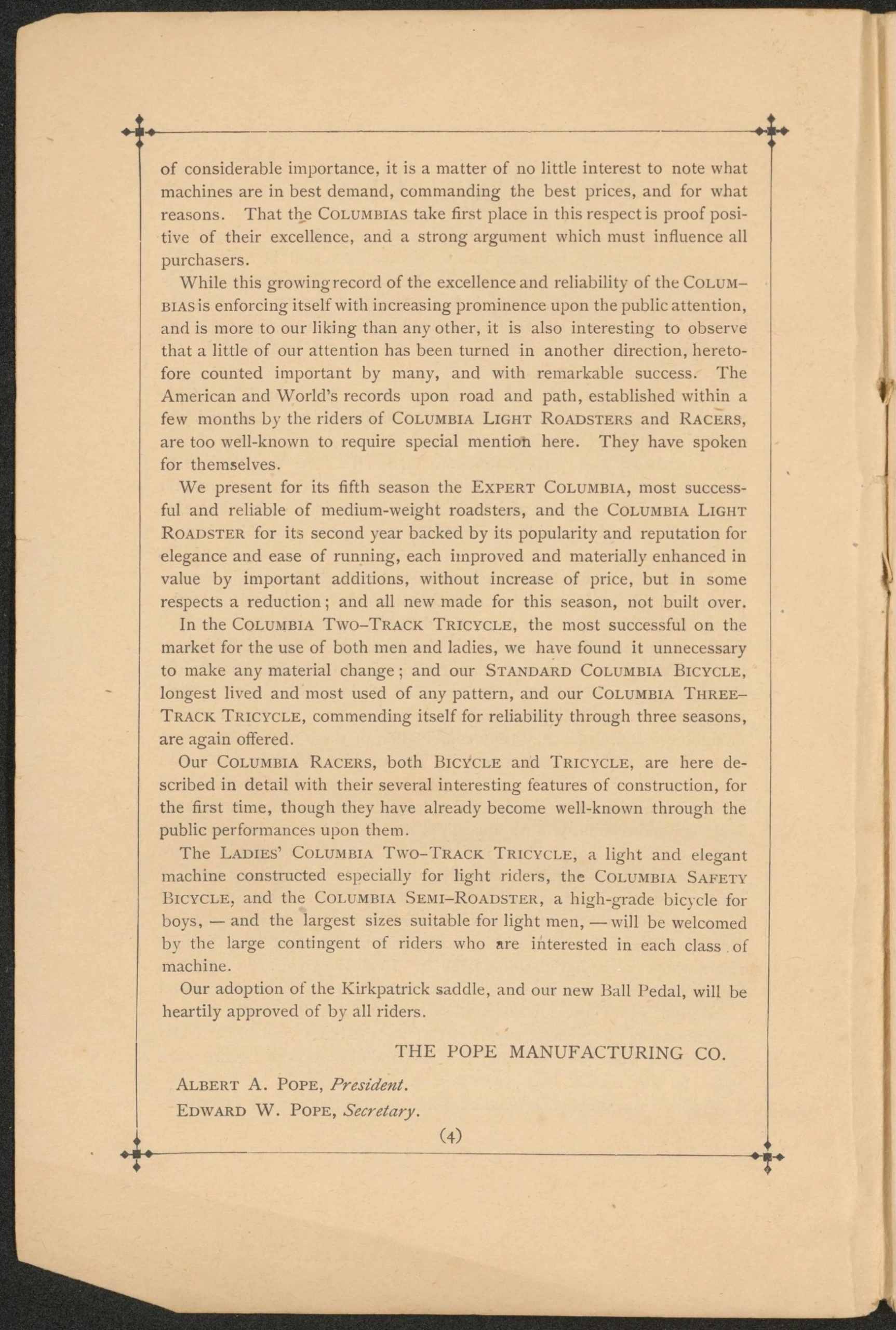 Page 4
 Page 5
 Page 6
 Page 7
 Page 8
 Page 9
 Page 10
 Page 11
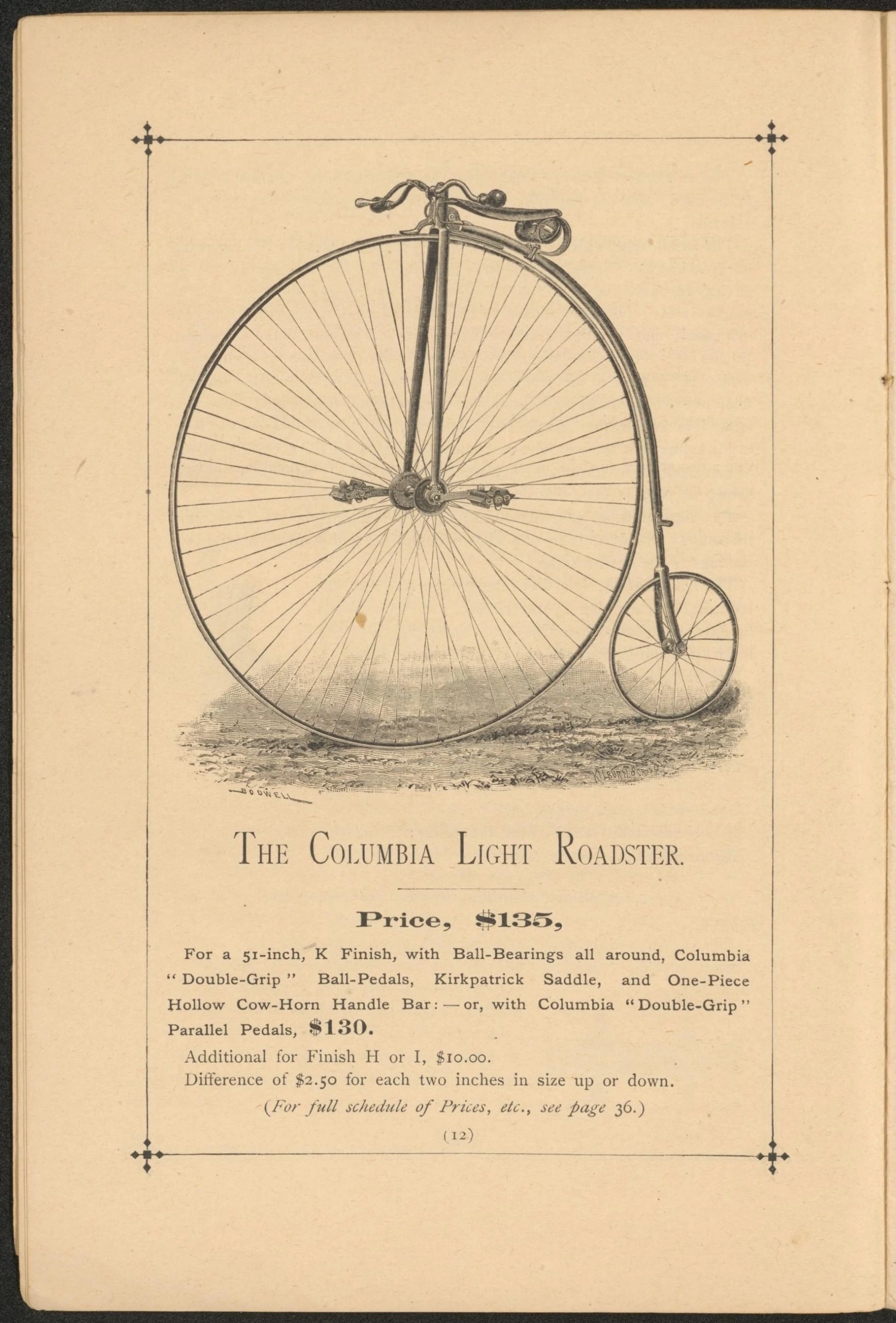
 Page 12
 Page 13
 Page 14
 Page 15
 Page 16
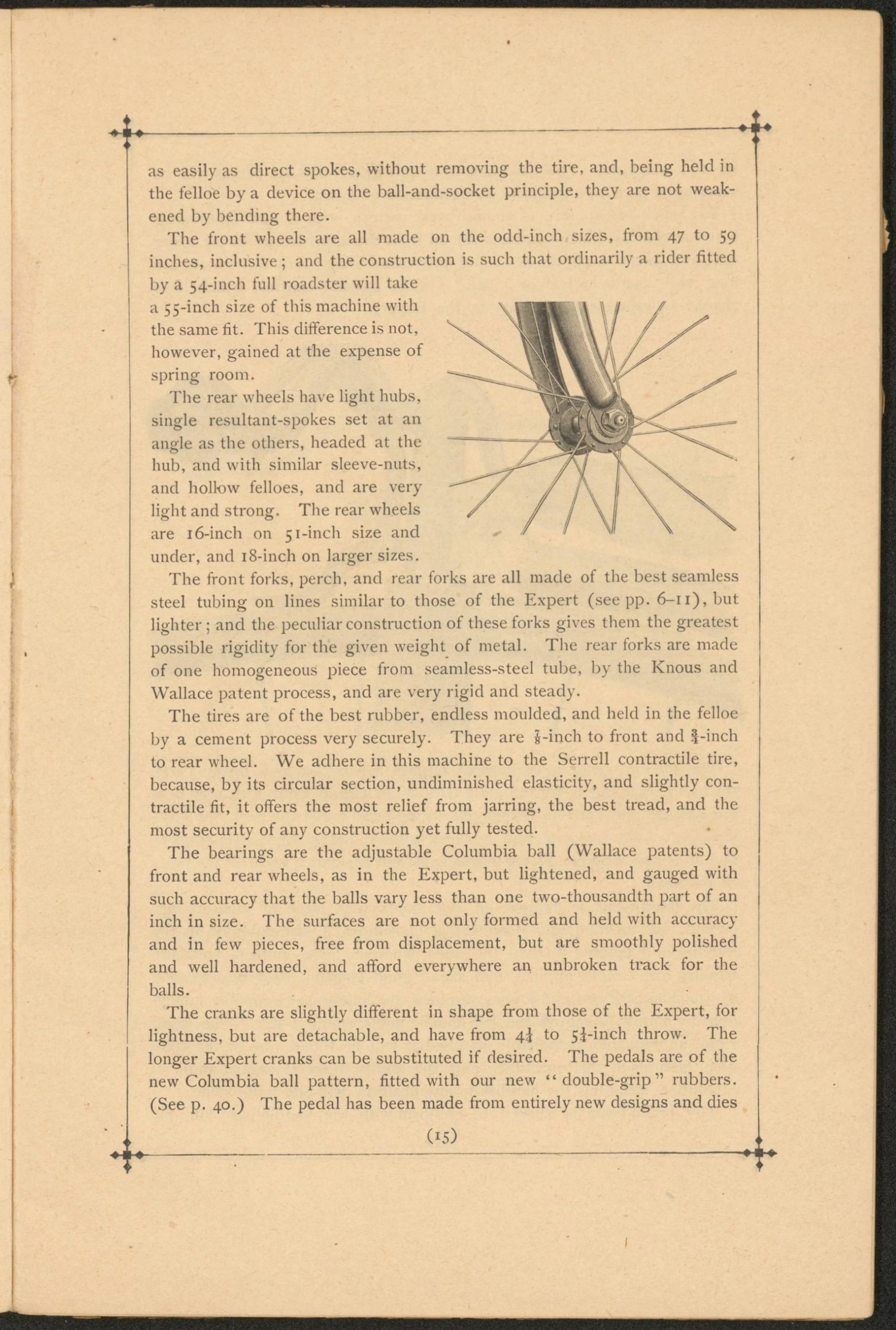 Page 17
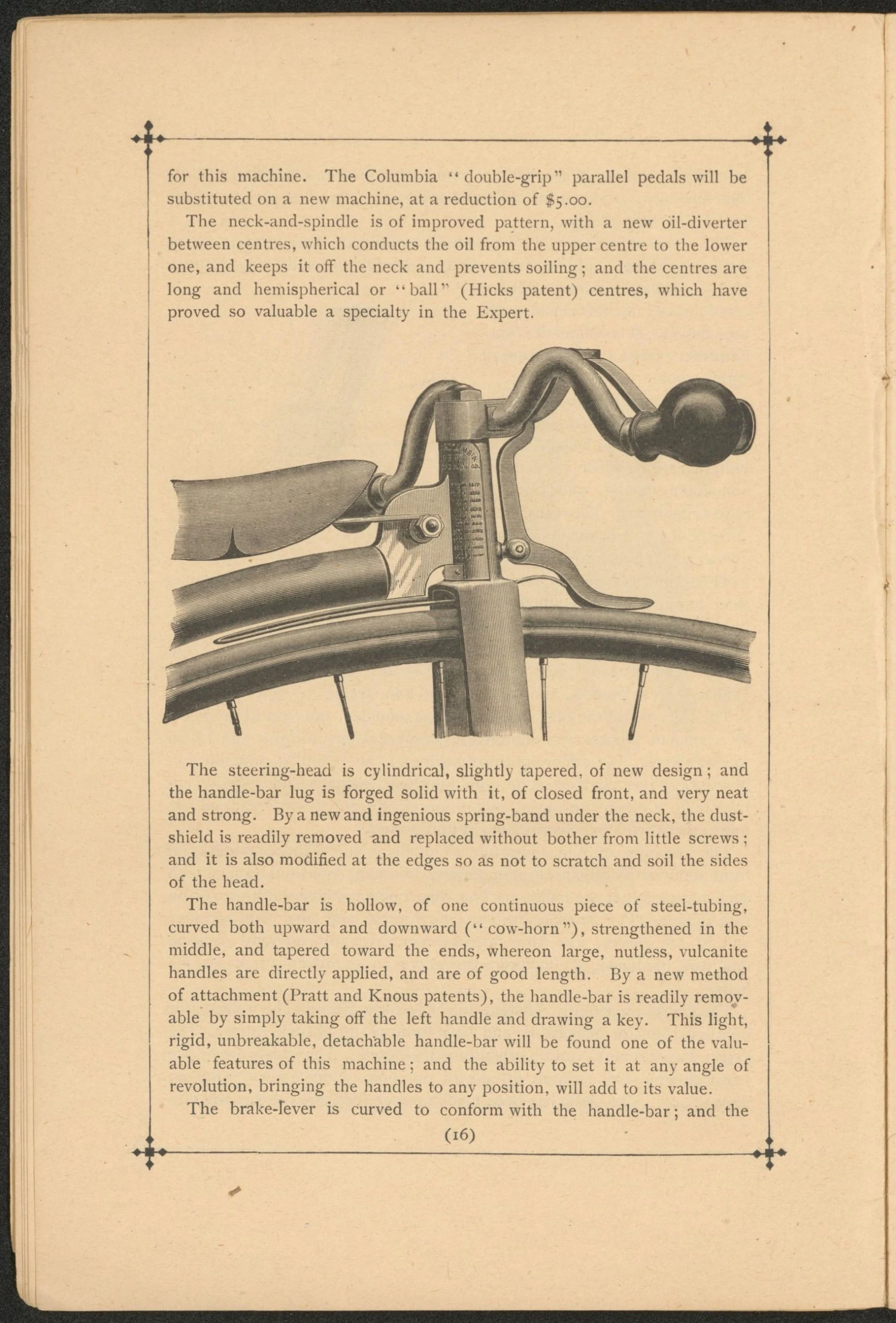 Page 18
 Page 19
 Page 20
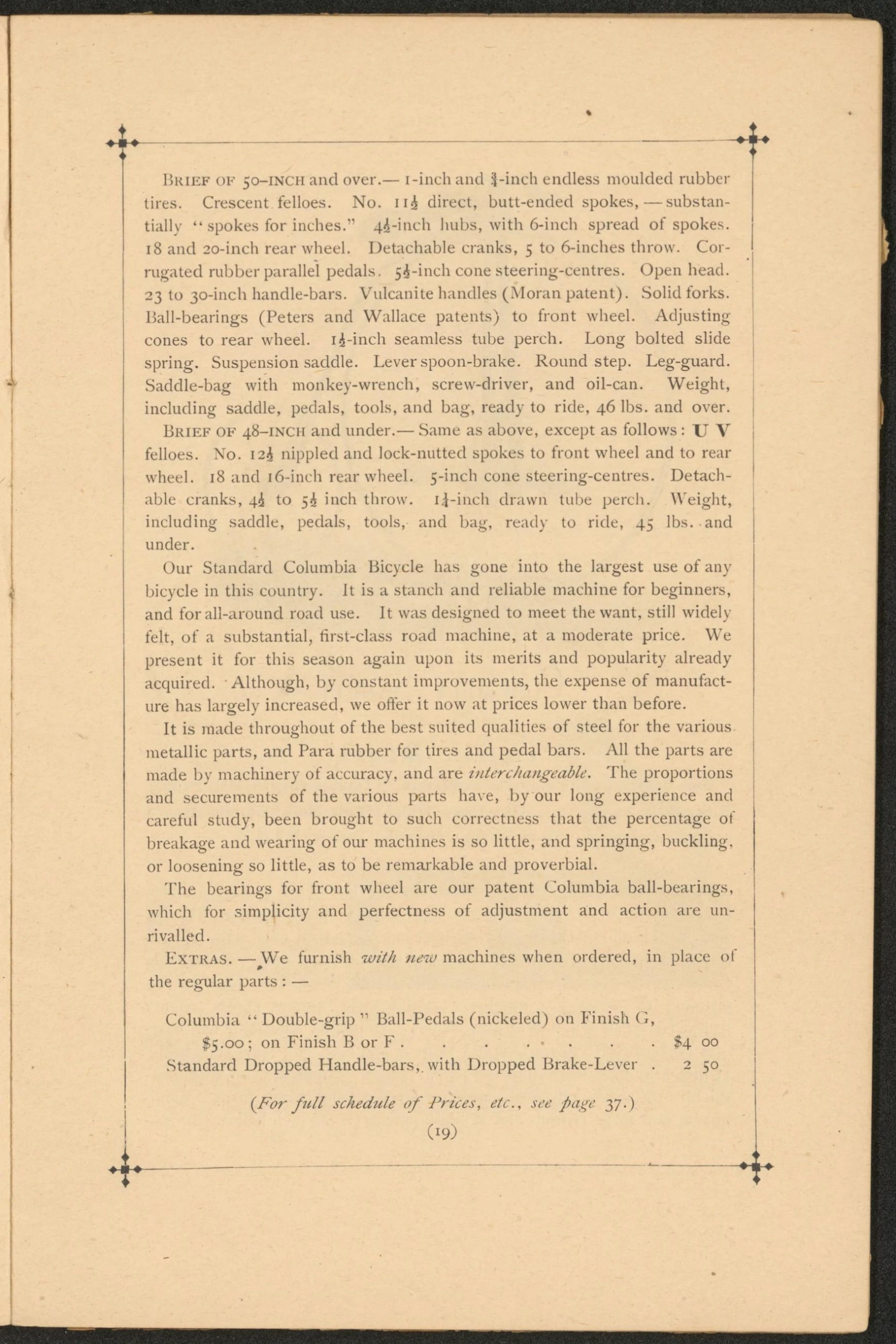 Page 21
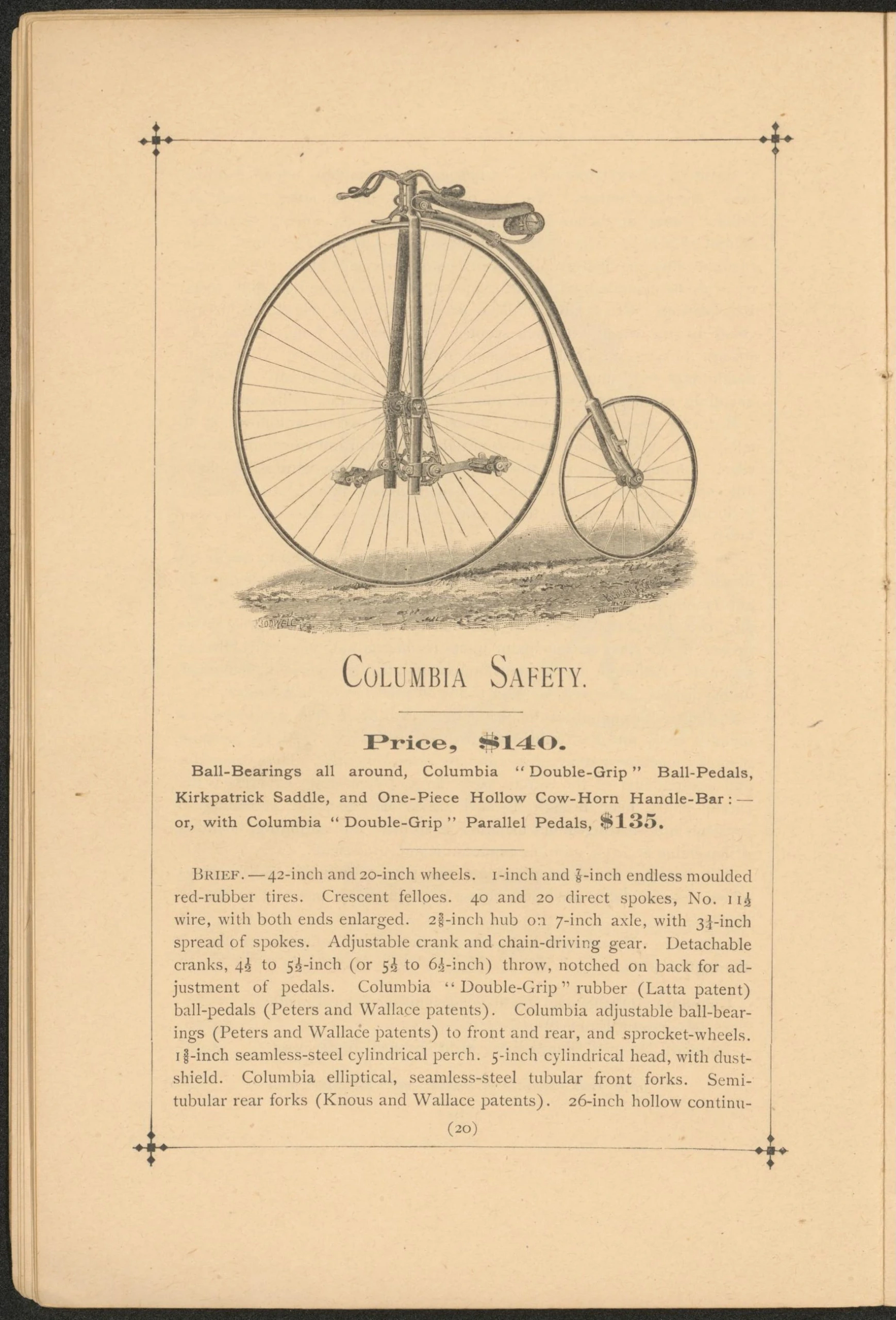 Page 22
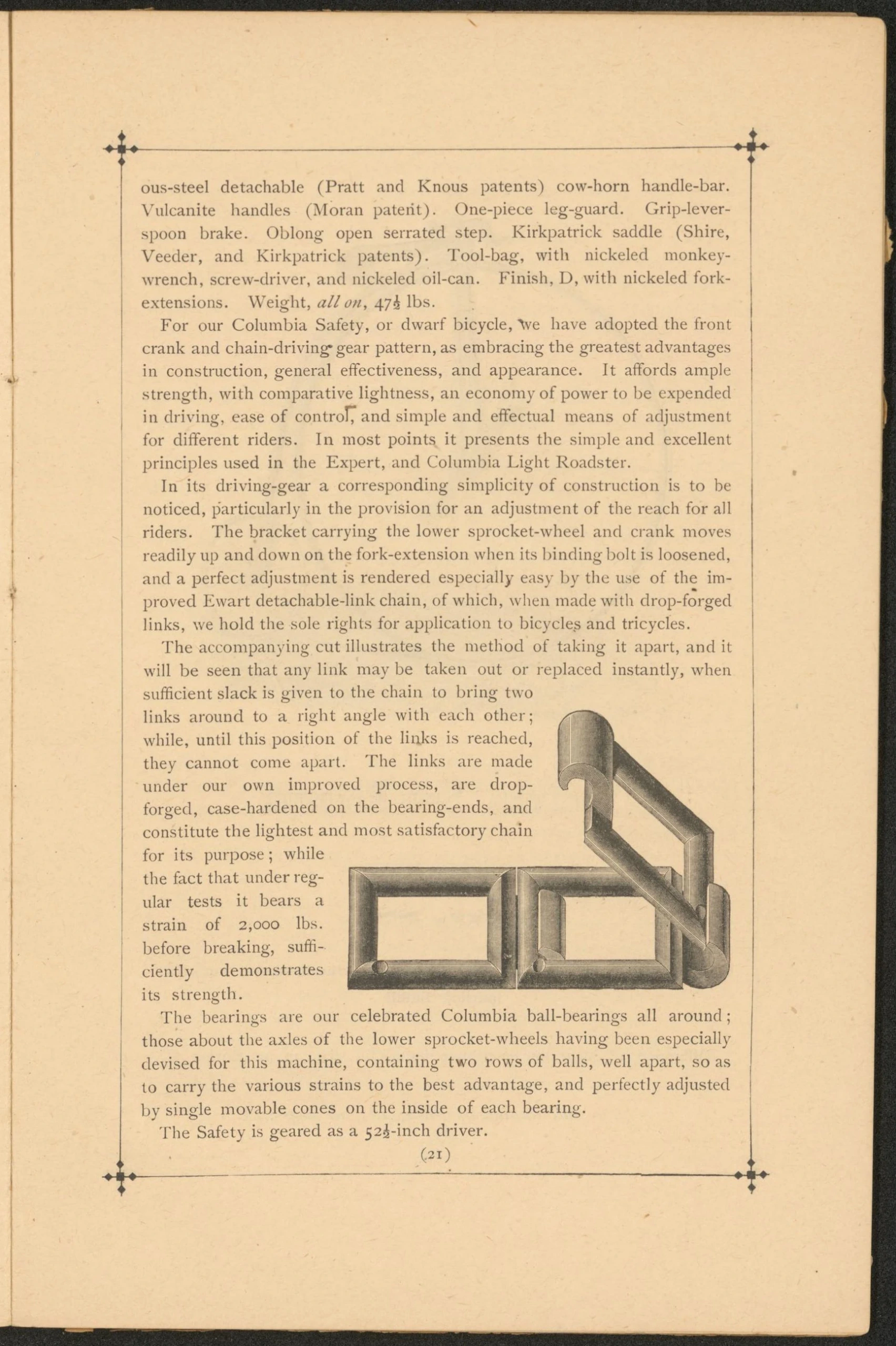 Page 23
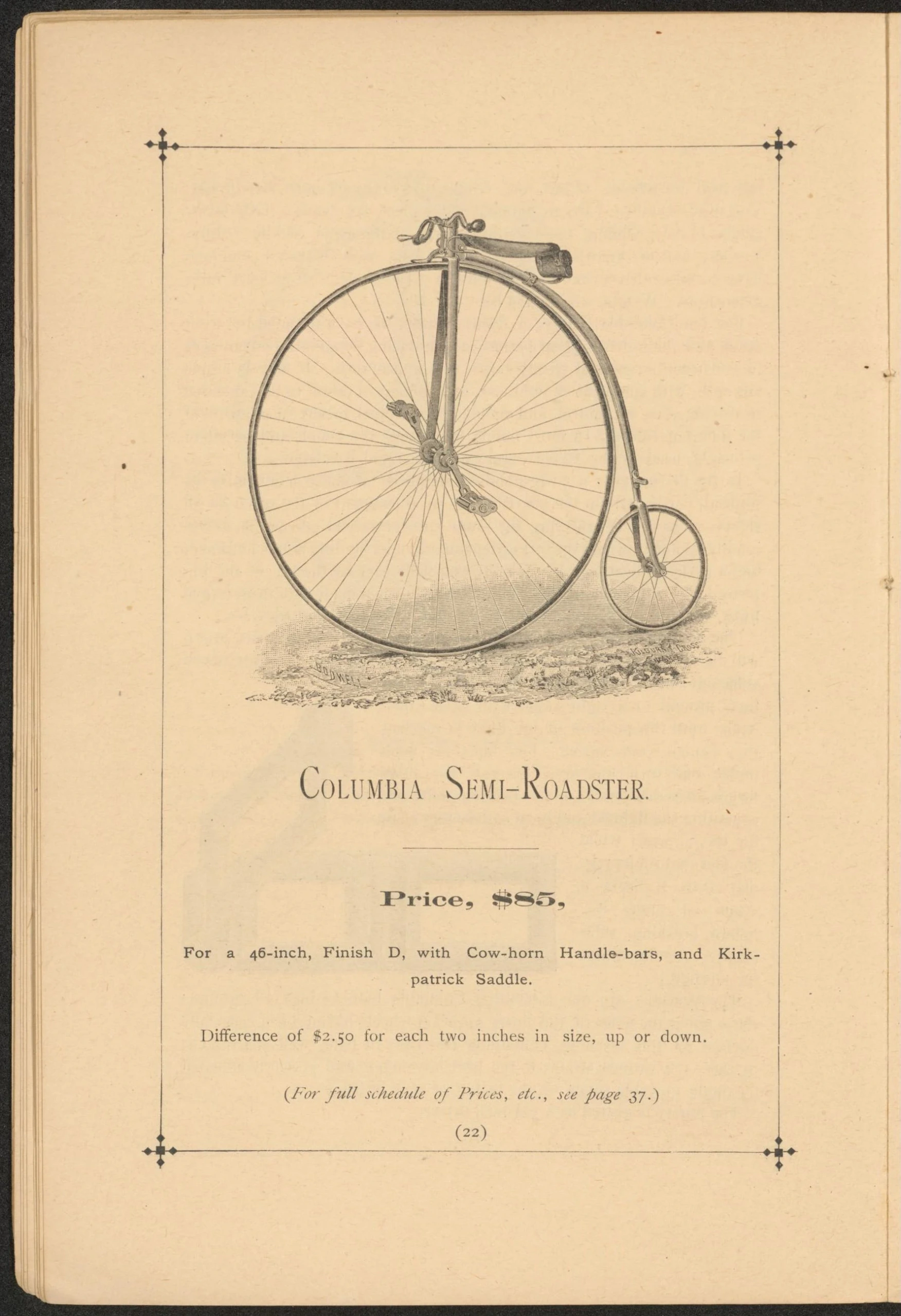 Page 24
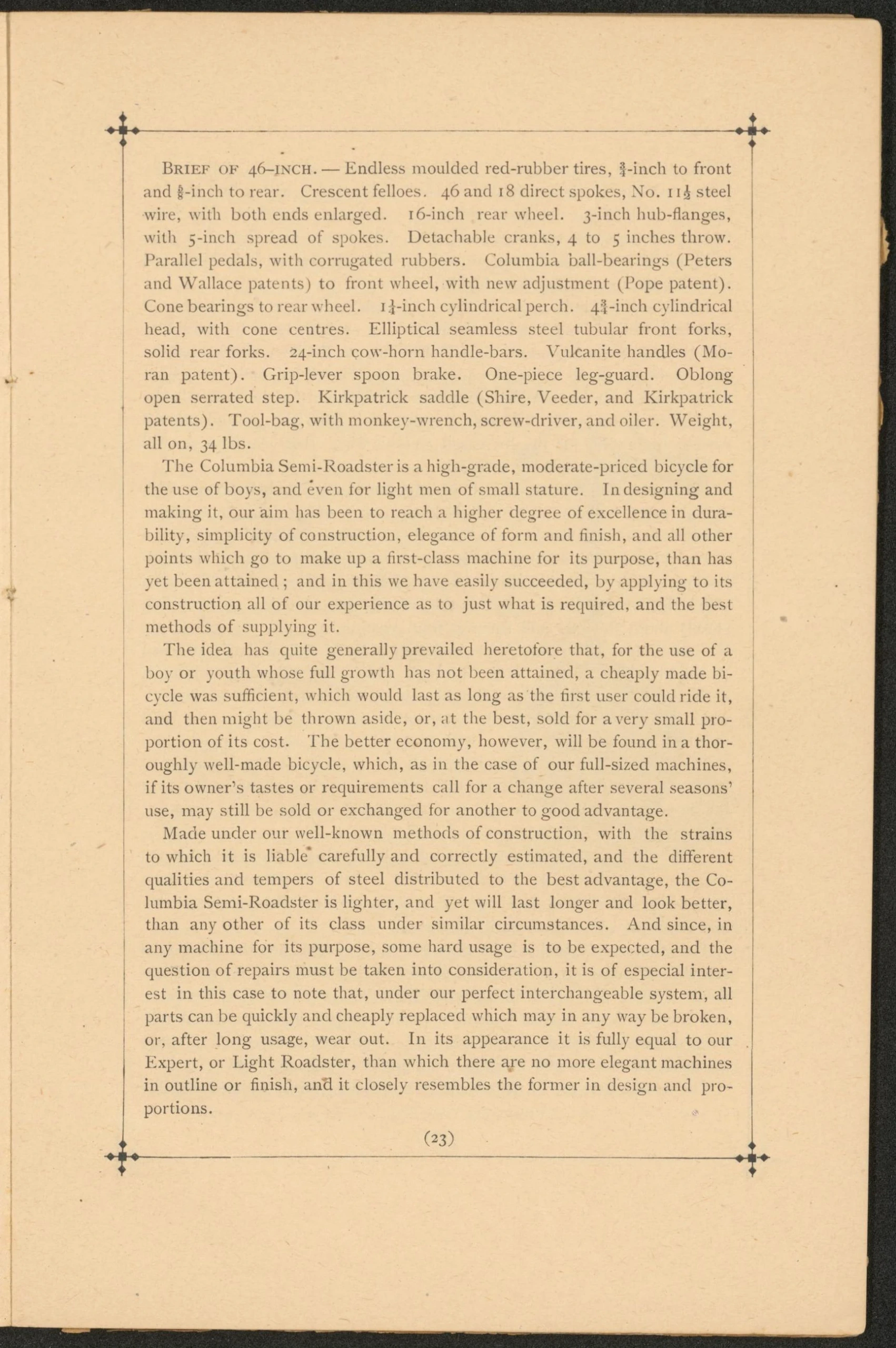 Page 25
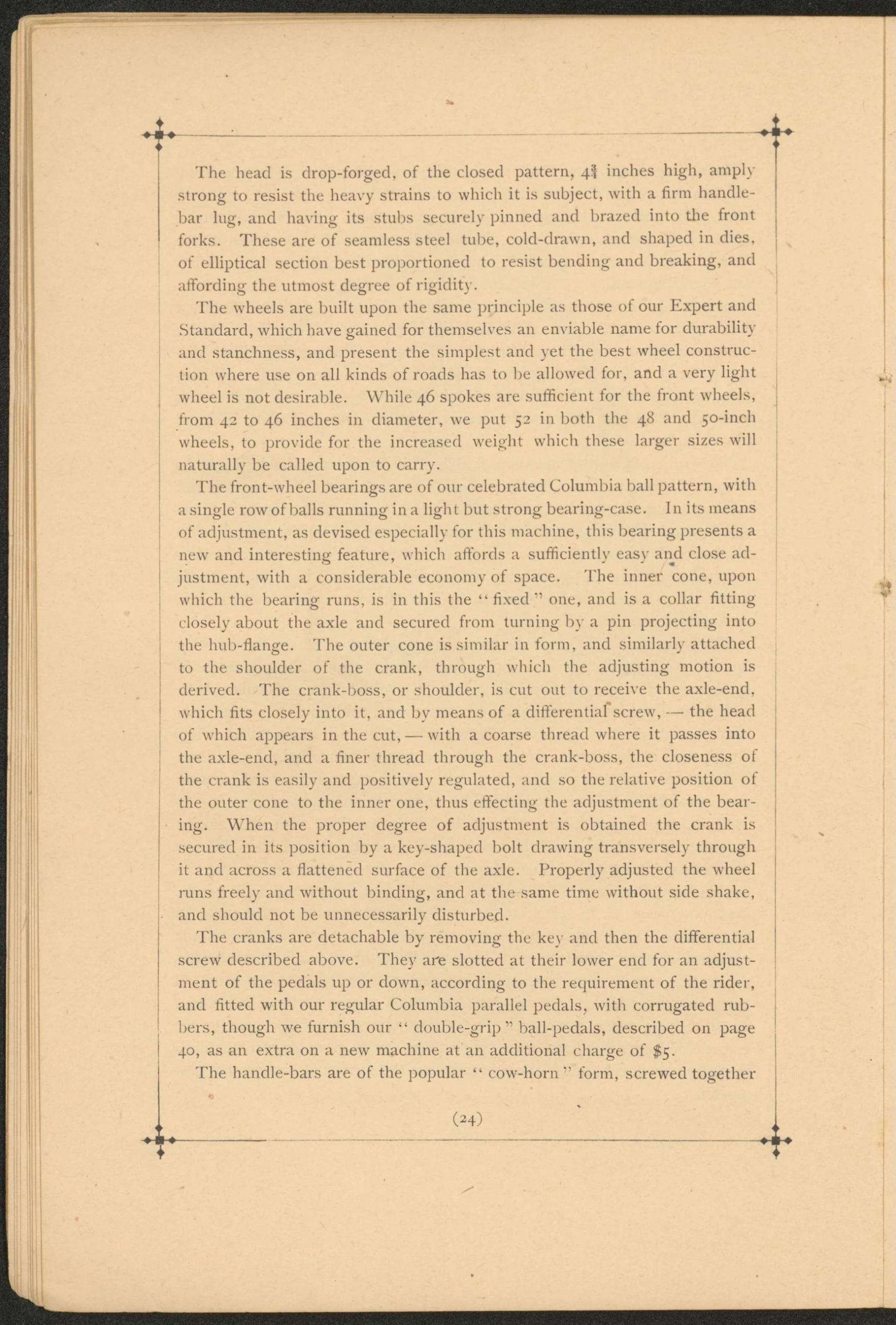 Page 26
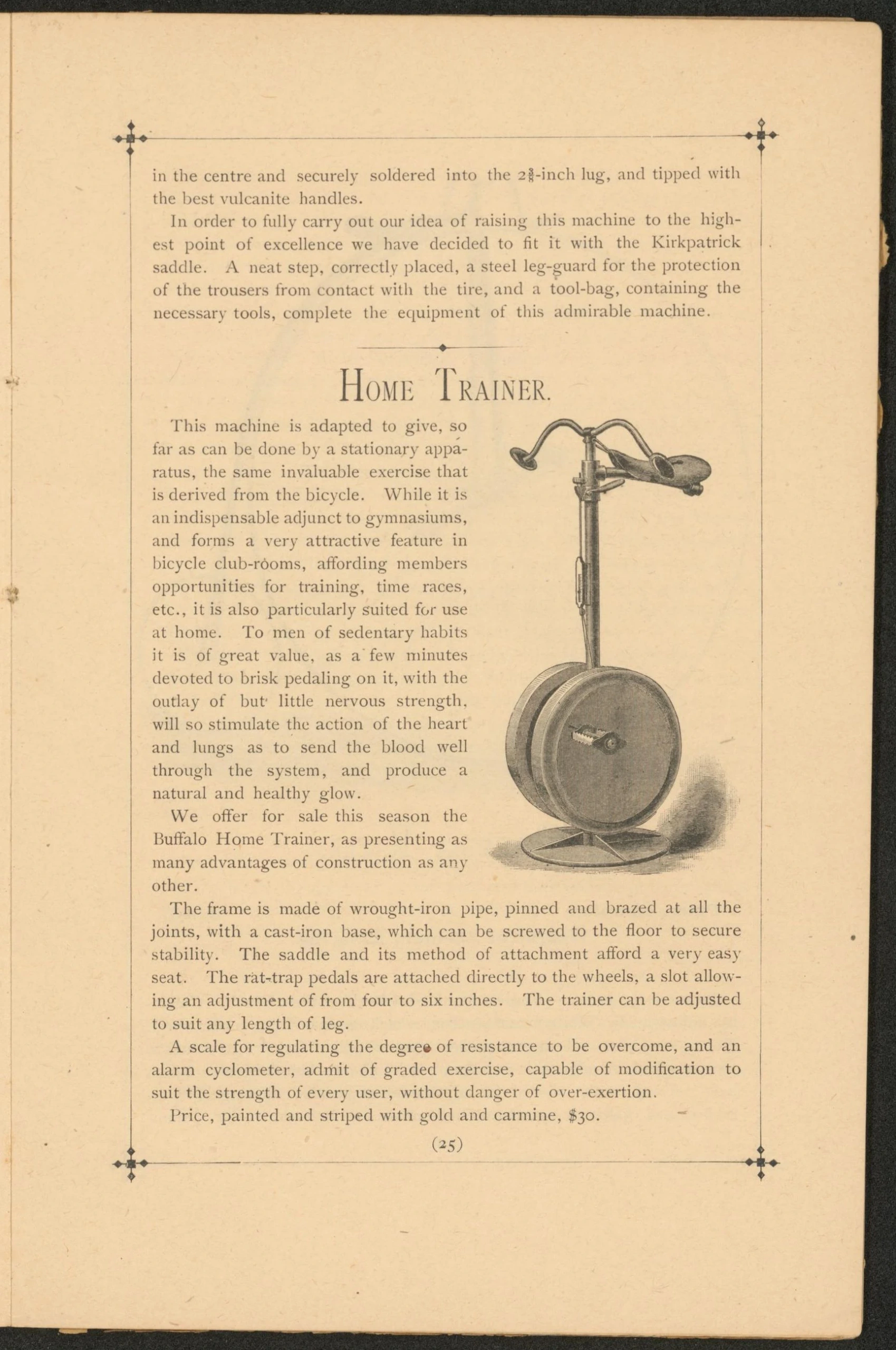 Page 27
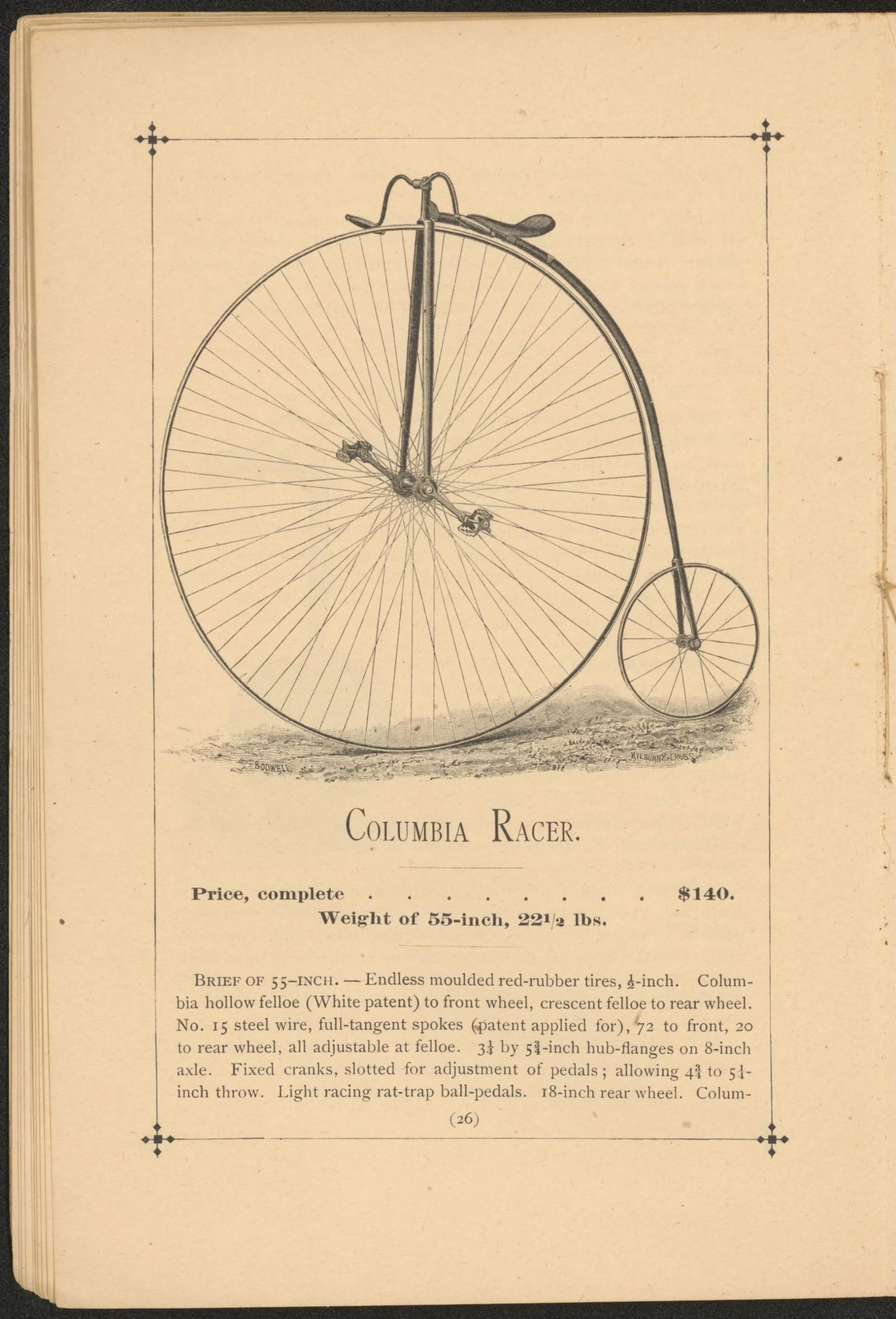 Page 28
 Page 29
 Page 30
 Page 31
 Page 32
 Page 33
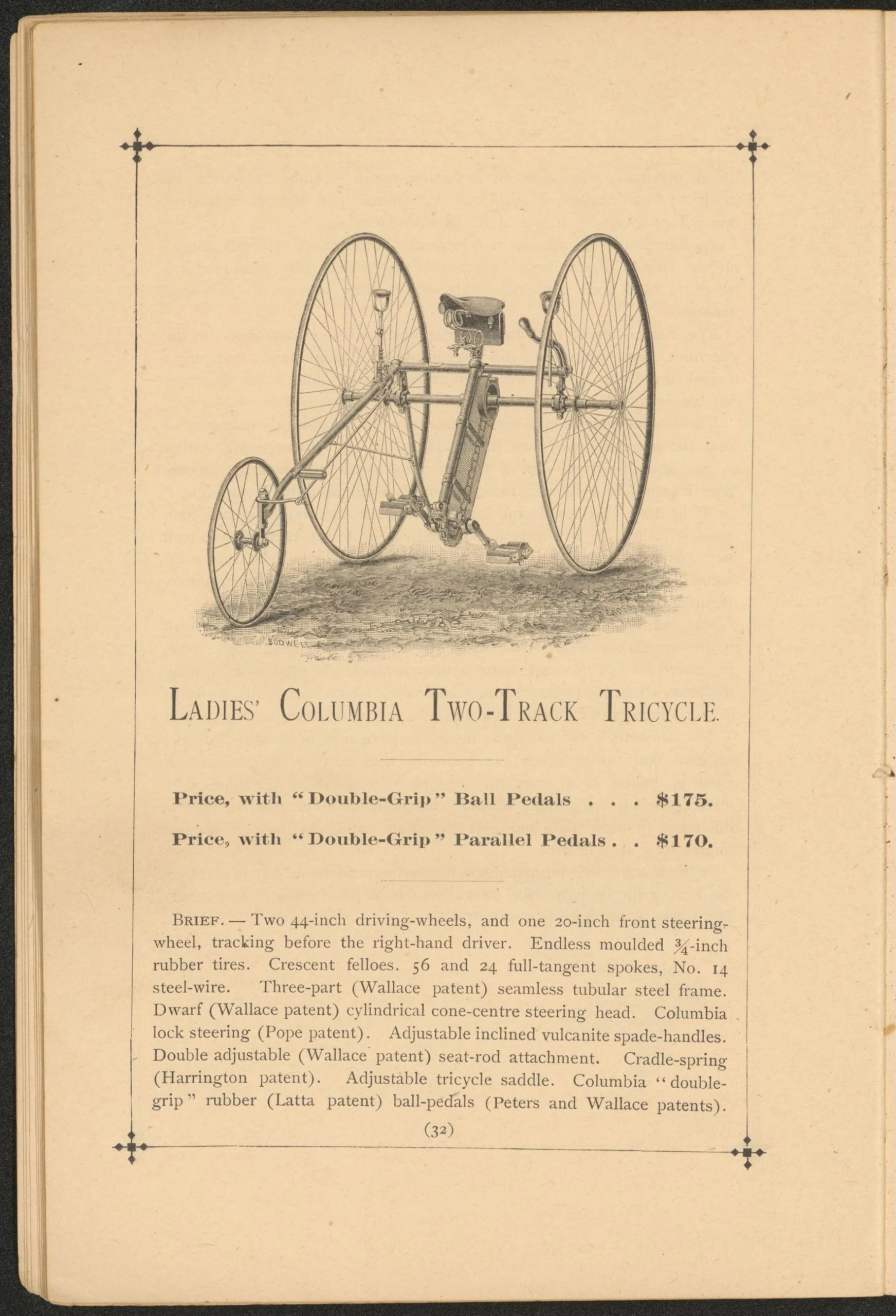 Page 34
 Page 35
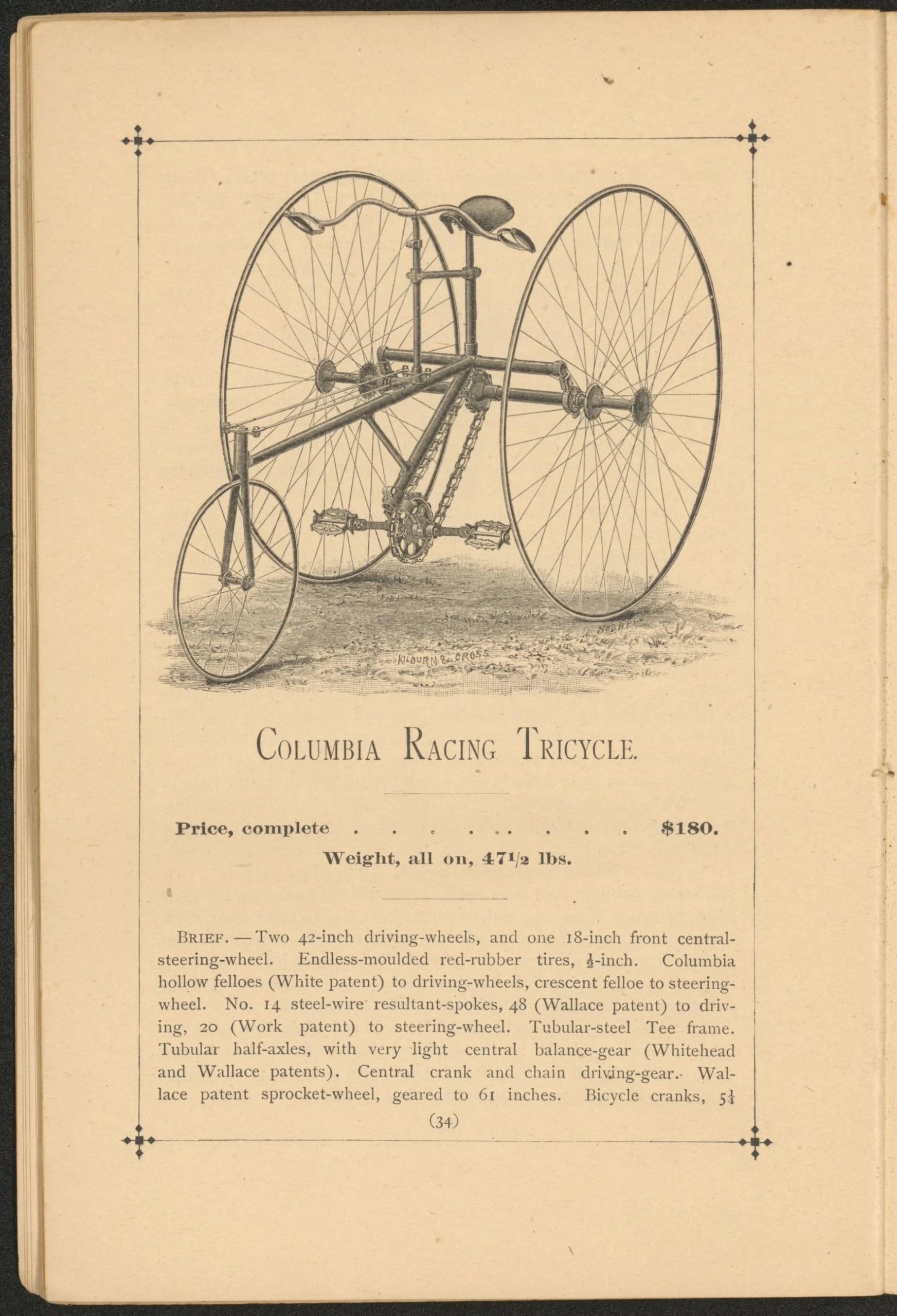 Page 36
 Page 37
 Page 38
 Page 39
 Page 40
 Page 41
 Page 42
 Page 43
 Page 44
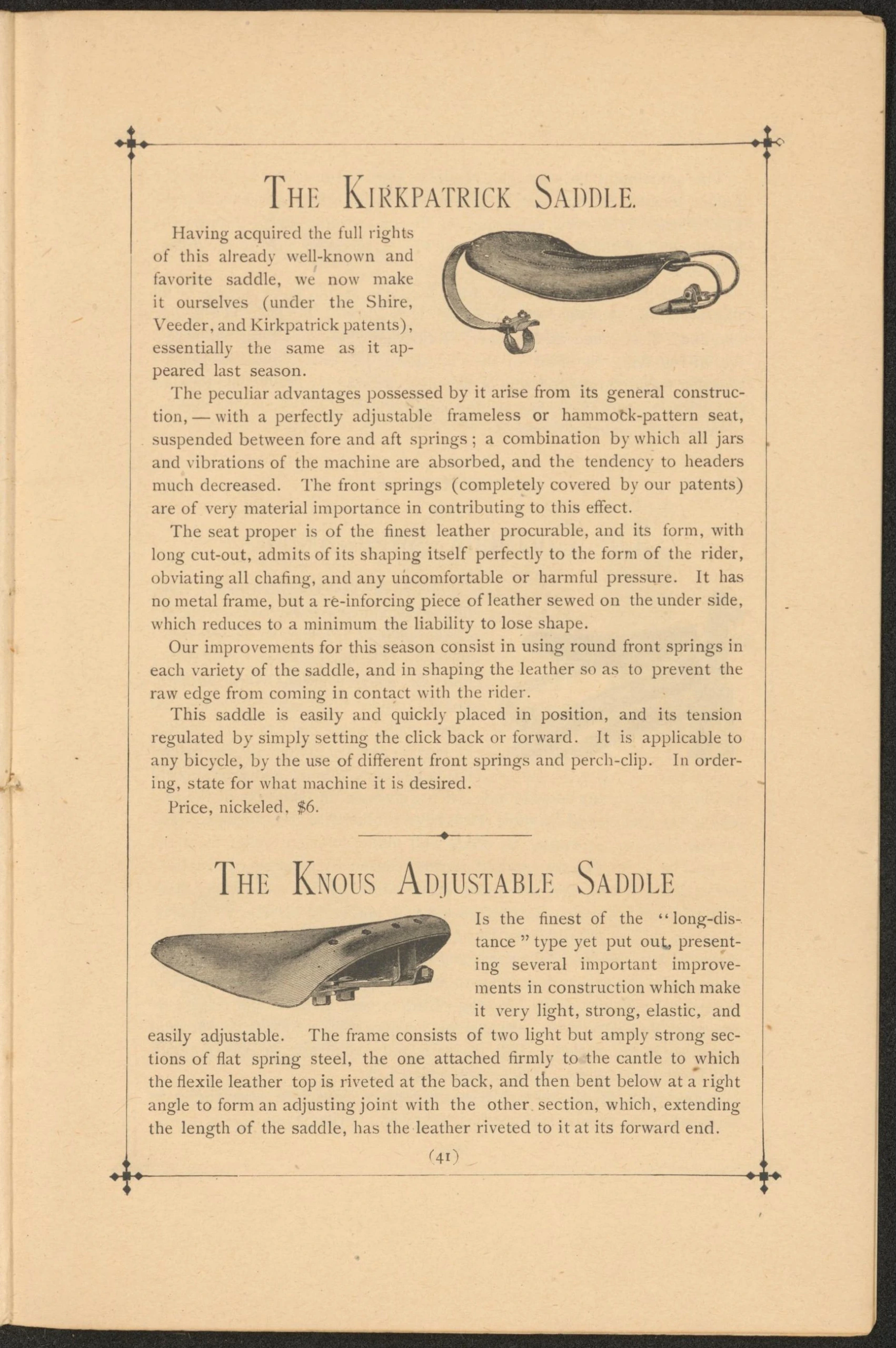 Page 45
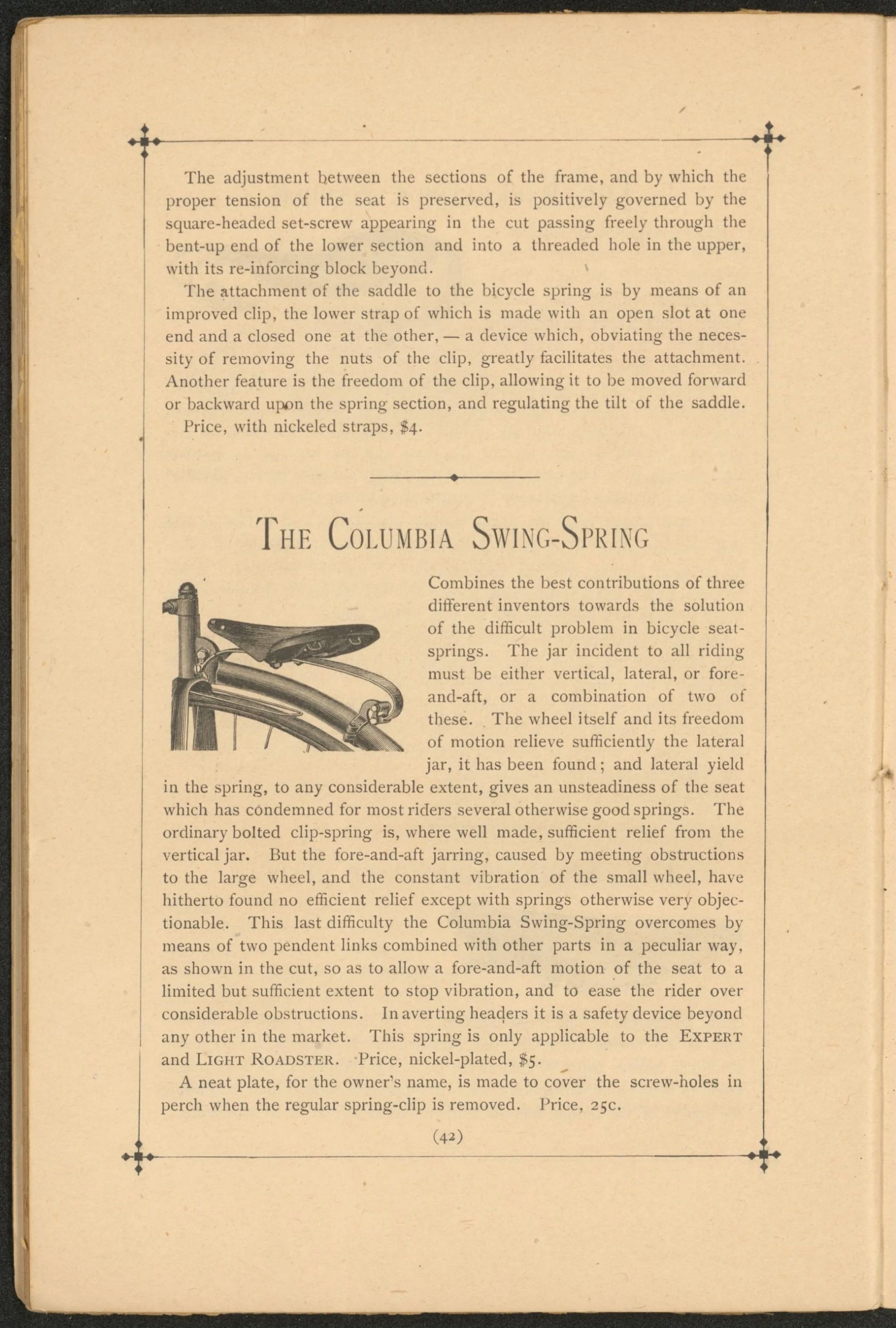 Page 46
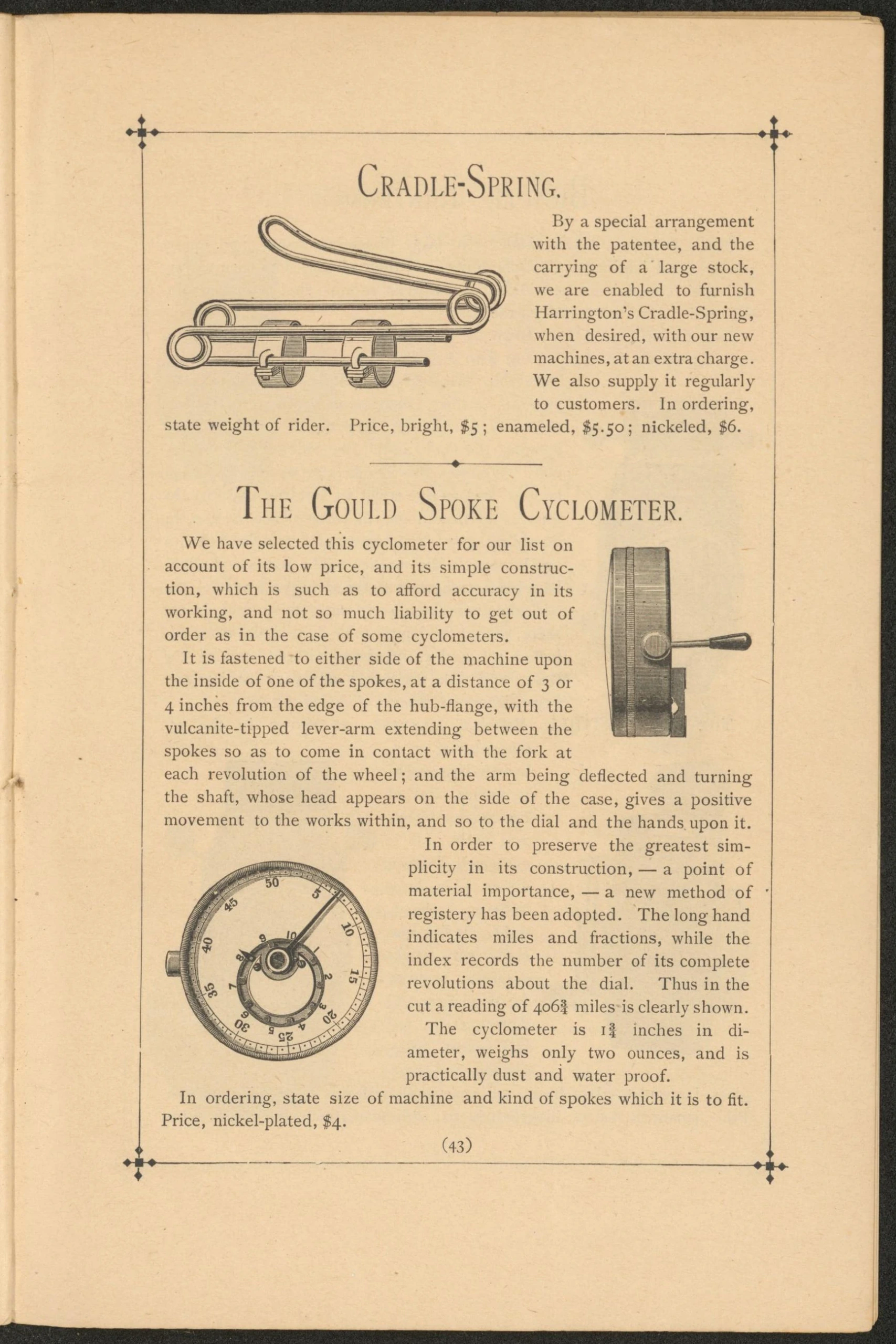 Page 47
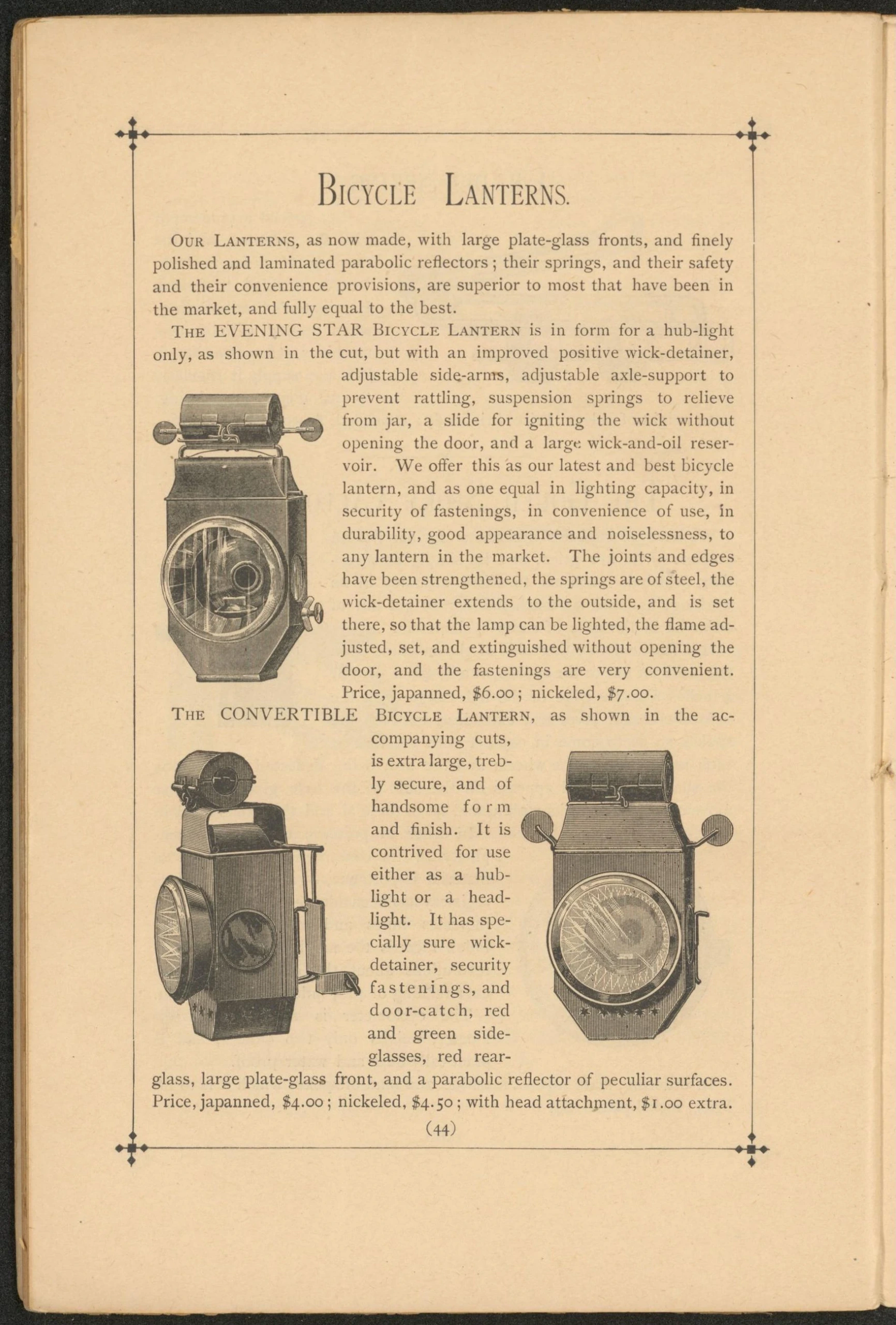 Page 48
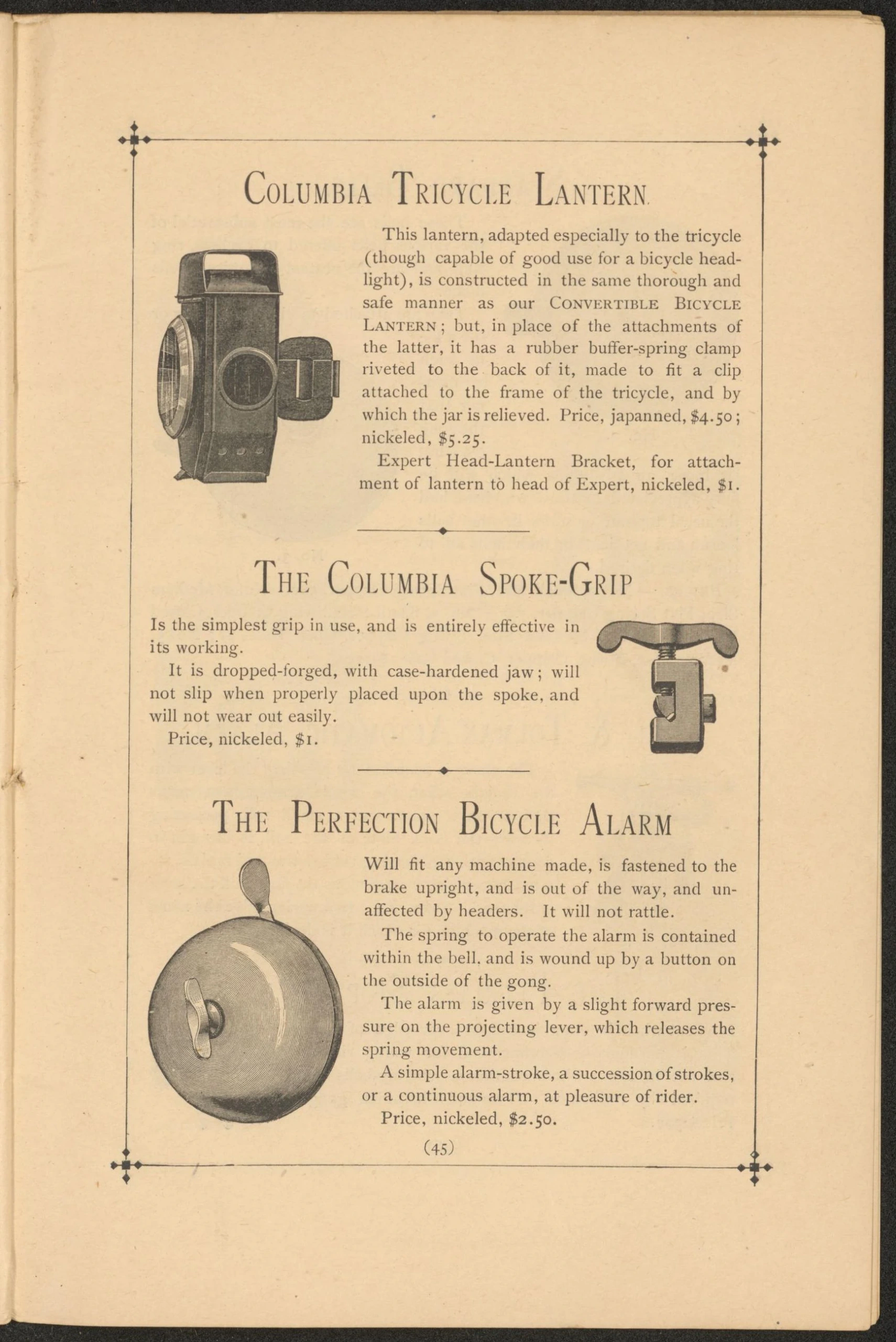 Page 49
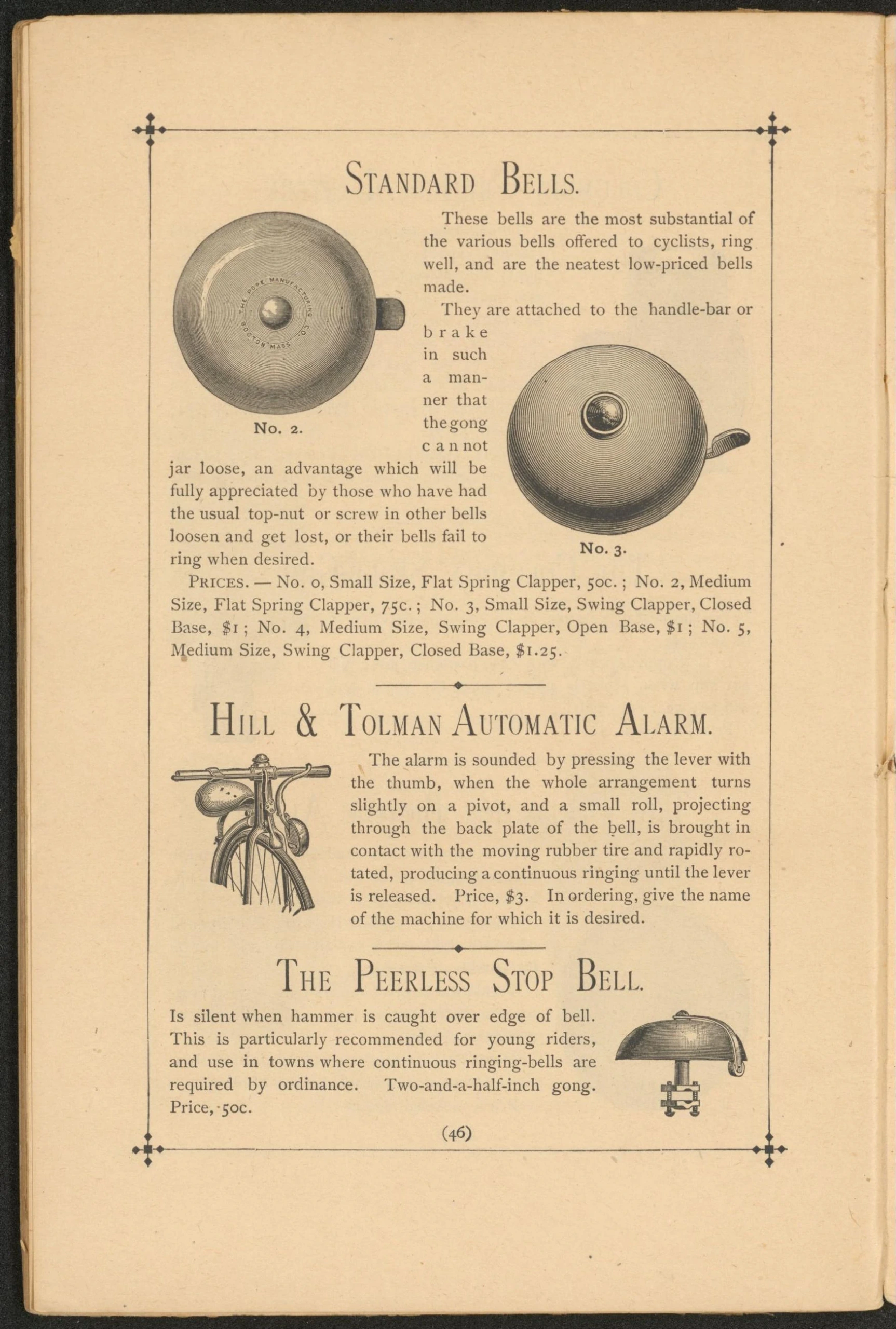 Page 50
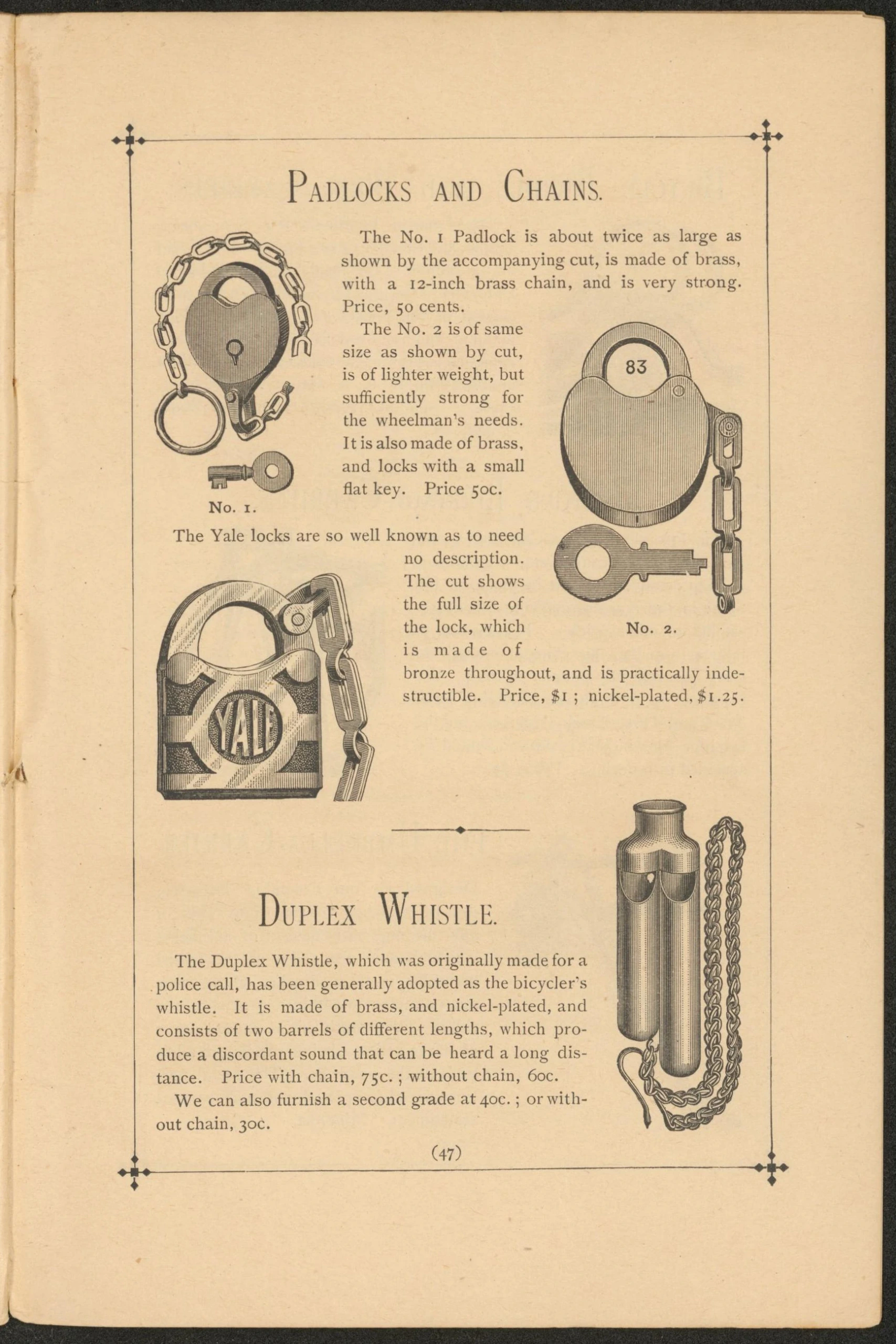 Page 51
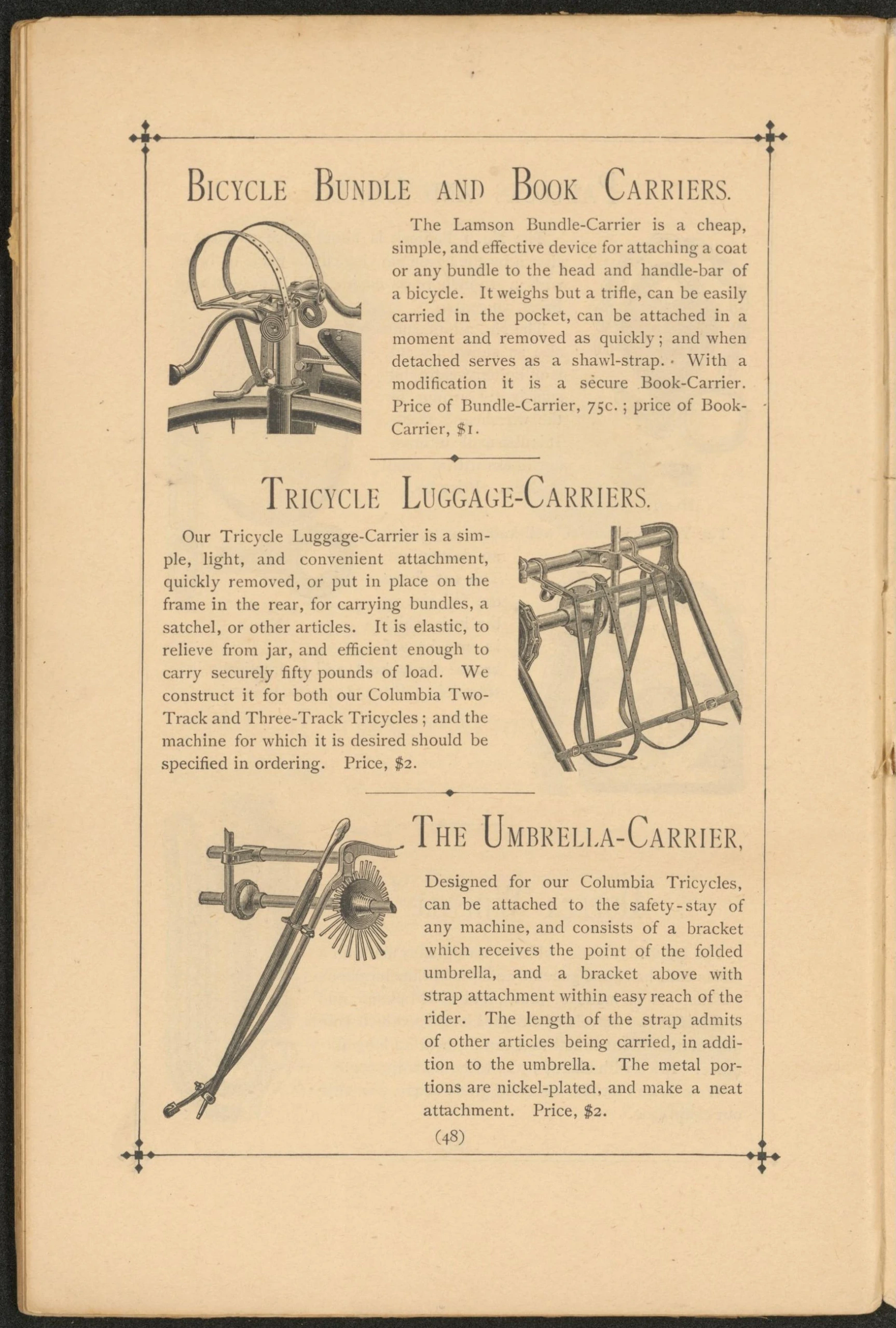 Page 52
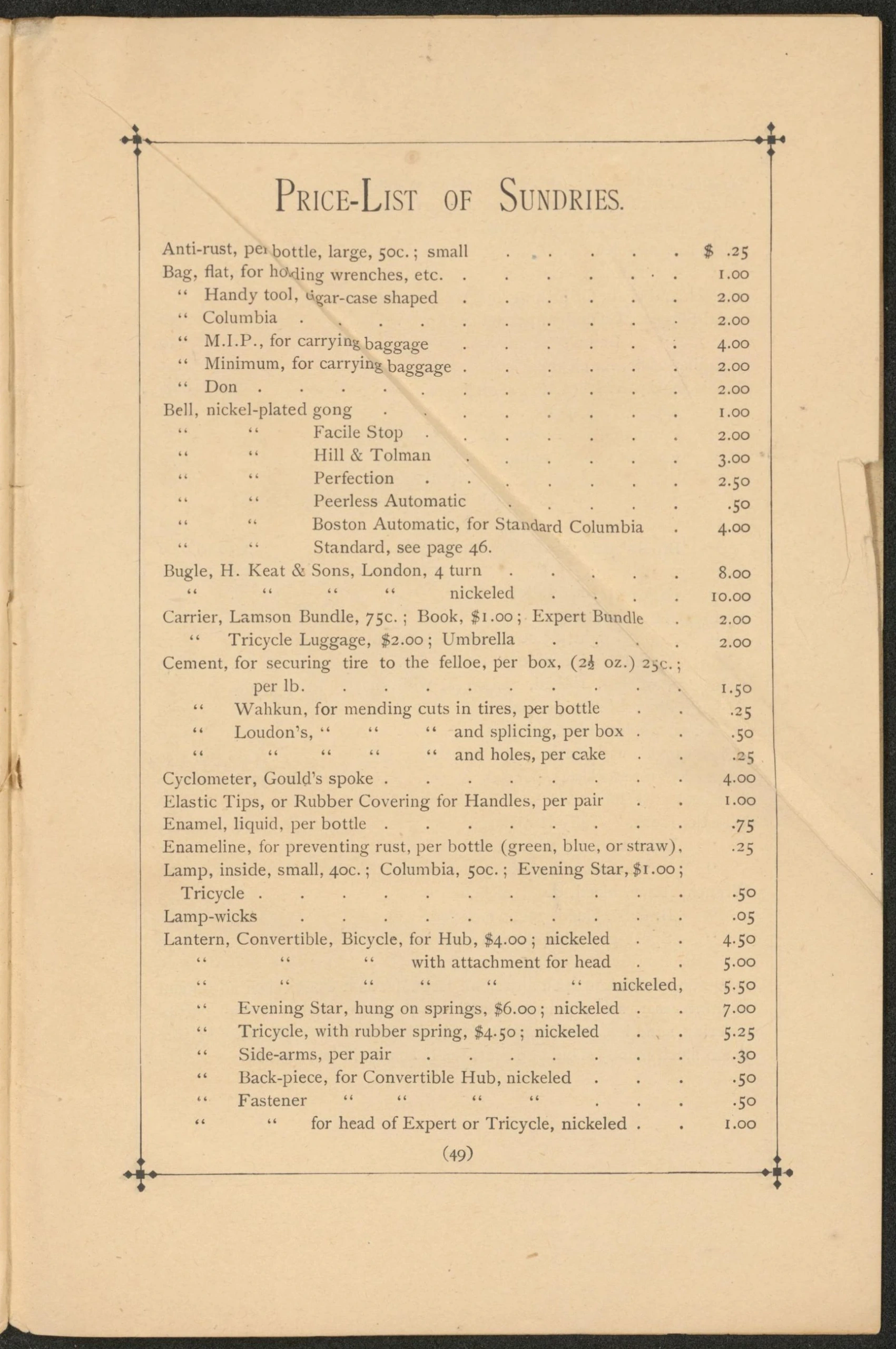 Page 53
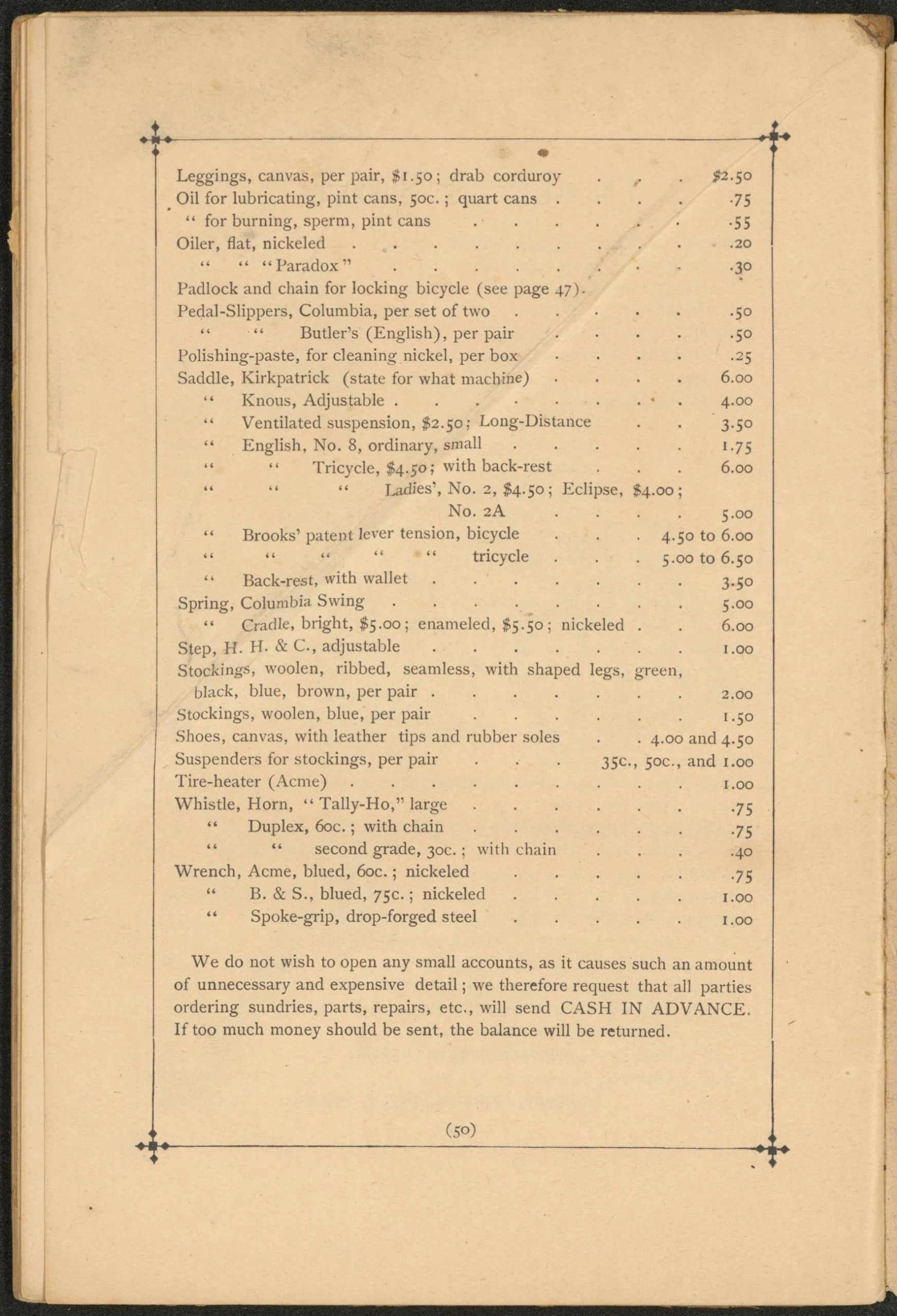 Page 54
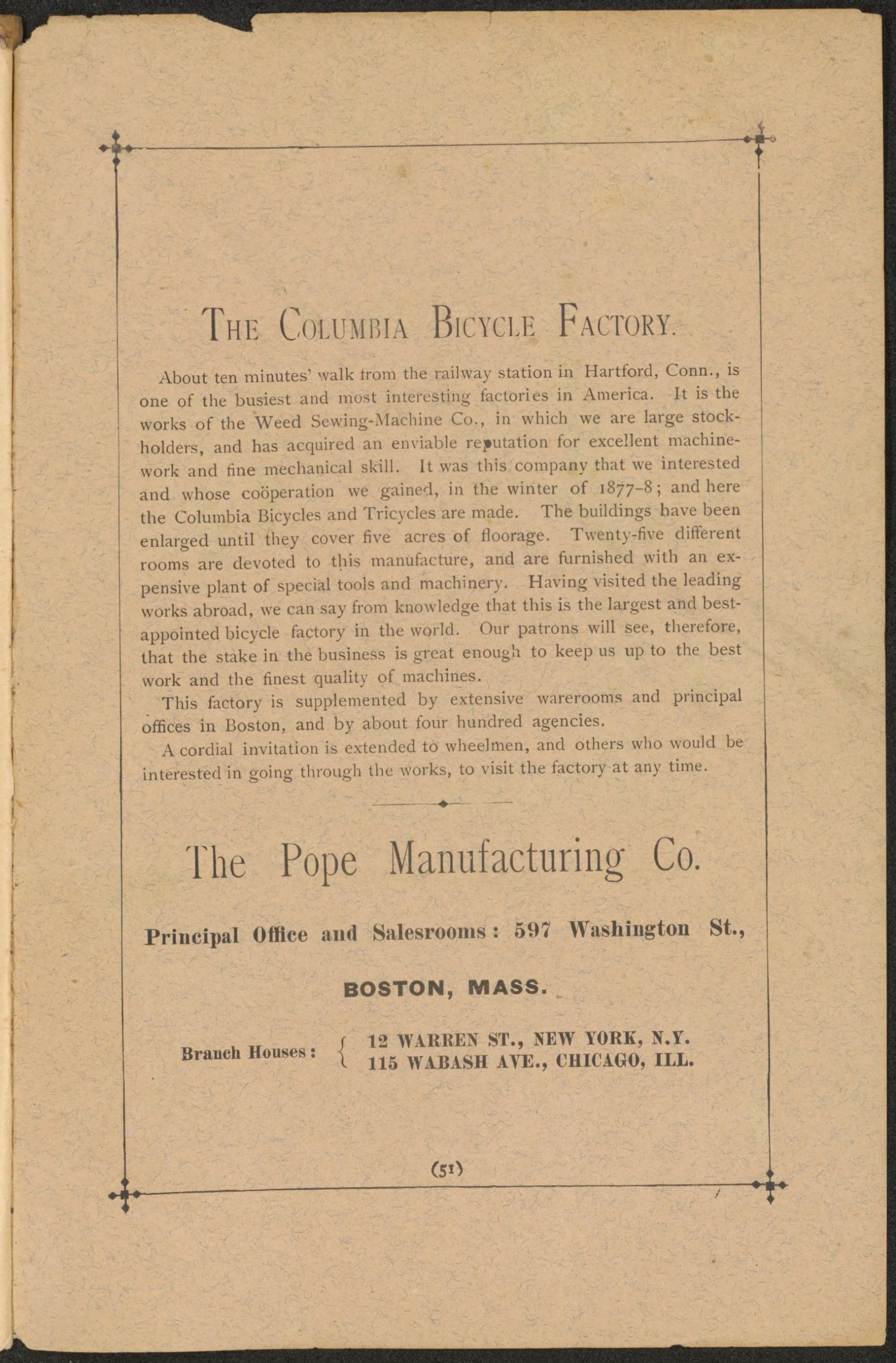 Page 55
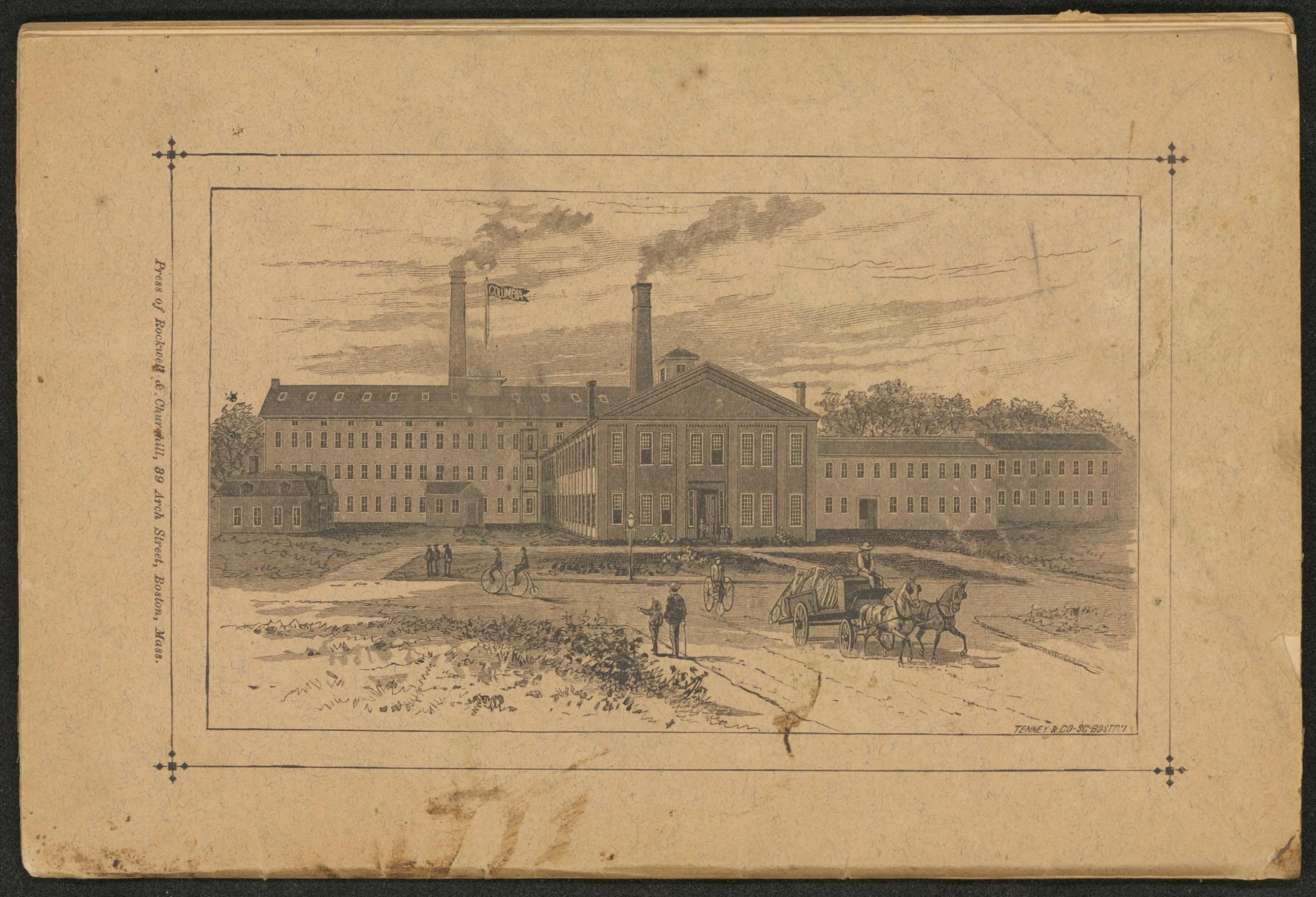 Page 56
| Marque | Columbia |
|---|---|
| Type | Catalog |
| Year | 1886 |
| Publisher | Pope Manufacturing Co. |
| Country | United States |
| Language | English |
| Pages | 56 |
| Source | Northwestern University Libraries, Transportation Library, "Columbia bicycles" (digital collection, https://dc.library.northwestern.edu/items/a4cf2002-5cd4-4033-8c71-fcadb0170ff2); rights statement "No Copyright - United States". |
| Credit | Northwestern University Libraries |
| Identifier | Permalink https://dc.library.northwestern.edu/items/a4cf2002-5cd4-4033-8c71-fcadb0170ff2 |
| Transcription | Transcribed by eye |
Reference
Pope Manufacturing Co. Columbia 1886 Catalog (Pope Manufacturing Co., United States): Expert, Light Roadster, Columbia Safety and Tricycles. 1886. Ebykr, https://ebykr.com/library/columbia-catalog-1886/.
Wikipedia
{{cite book |title=Columbia 1886 Catalog (Pope Manufacturing Co., United States): Expert, Light Roadster, Columbia Safety and Tricycles |publisher=Pope Manufacturing Co. |date=1886 |url=https://ebykr.com/library/columbia-catalog-1886/ |via=Ebykr |access-date=}}April, 1886. COLUMBIA BICYCLES THE POPE MANUFACTURING CO. 597 WASHINGTON ST. BOSTON MASS. BRANCH HOUSES: 12 WARREN ST: NEW YORK: 115 WABASH AVE. CHICAGO: FACTORY. HARTFORD. CONN: ALBERT A. POPE PRES'T. EDWARD W. POPE SEC'Y. OSBORN & ALEXANDER, SOLE AGENTS, 628 Market Street, San Francisco, Cal. CONTENTS. PAGE | PAGE Directions . . . . …
The Pope Manufacturing Company’s Columbia catalog of April 1886, its “Ninth Annual Greeting”, issued through Osborn & Alexander, sole agents at San Francisco: the Expert Columbia, Light Roadster, Standard Columbia, Semi-Roadster and Columbia Racer high wheels, the front-driving Columbia Safety, the Two-Track, Ladies’ and Racing Tricycles, the Buffalo Home Trainer, the changes for 1886, finishes and a sundries section of pedals, saddles, cyclometers, lanterns, bells, locks and carriers with its price list. Transcribed from the page images (56 pages); each page ends with a bracketed description of its pictures.
— Page 1 —
April, 1886.
COLUMBIA
BICYCLES
THE
POPE MANUFACTURING CO.
597 WASHINGTON ST. BOSTON MASS.
BRANCH HOUSES:
12 WARREN ST: NEW YORK:
115 WABASH AVE. CHICAGO:
FACTORY. HARTFORD. CONN:
ALBERT A. POPE PRES’T.
EDWARD W. POPE SEC’Y.
OSBORN & ALEXANDER,
SOLE AGENTS,
628 Market Street, San Francisco, Cal.
[The printed paper front cover in black on tan: a frieze of men and women riding high-wheel bicycles and a tricycle along a wall, an ornate foliate initial C and border, the officers’ names on a scroll; the San Francisco agents’ imprint below. Faint stains; the lower right corner is chipped.]
— Page 2 —
CONTENTS.
PAGE | PAGE
Directions . . . . . 2 | Changes for 1886 . . . . . 38
Ninth Annual Greeting . . . . . 3 | Classification of Finishes . . . . . 39
In General . . . . . 5 | Columbia Double Grip Ball Pedal . . . . 40
Expert Columbia . . . . . 6 | Kirkpatrick and Knous Saddles . . . . 41
Columbia Light Roadster . . . . . 12 | Columbia Swing-Spring . . . . . 42
Standard Columbia . . . . . 18 | Cradle-Spring. — Gould Cyclometer . . . 43
Columbia Safety . . . . . 20 | Bicycle Lanterns . . . . . 44
Columbia Semi-Roadster . . . . . 22 | Tricycle Lantern. — Spoke-grip. — Perfection Alarm . . . . . 45
Home Trainer . . . . . 25 | Bells . . . . . 46
Columbia Racer . . . . . 26 | Padlocks and Chains . . . . . 47
Columbia Two-Track Tricycle . . . . . 28 | Carriers . . . . . 48
Ladies’ Columbia Two-Track Tricycle . 32 | Price-List of Sundries . . . . . 49
Columbia Racing Tricycle . . . . . 34 | Columbia Bicycle Factory . . . . . 51
Price-List of Bicycles and Tricycles . . 36 |
DIRECTIONS.
Terms, net cash with order.
With EVERY ORDER give full shipping instructions.
Freight or express charges always to be paid by the purchaser.
Correspondence must be sent to our Boston office, and plainly addressed to the Company, not to individuals.
We cannot guarantee the safe delivery of goods. Our responsibility ceases when goods are delivered at post-office, express offices, or freight depots.
C.O.D. orders from outside of New England must be accompanied by money enough to pay express charges both ways in case the goods are not accepted.
Our stock carried in stores at Boston, New York, and Chicago is for local trade only. Orders from agents will be shipped direct from factory.
In ordering, always send weight of rider; and, if selection of size is to be left with us, send also height of rider, and length of leg inside to bottom of sole under ball of foot, and length of inside seam of trousers.
Our prices are invariable, and no discounts are allowed except to regular agents. Parties ordering machines incomplete will be allowed only half-price for parts not taken.
We warrant all of our COLUMBIA BICYCLES and TRICYCLES to be free from imperfections in material or manufacture, and agree to make good, at store or factory, at any time within a year, any defects in them not caused by use, misuse, or neglect. If such defects are found, all defective parts must be sent to us for examination before any claim is allowed. This warrant does not apply to nickel-plating, though no care or expense is spared to make it the best.
(2)
[A text page within a ruled border with ornamental corners, the two-column contents above the directions. The paper is browned with a chipped left edge and lower left corner.]
— Page 3 —
4429
NINTH ANNUAL GREETING.
It is with no small degree of satisfaction that we place our catalogue for 1886 before the many thousands who to-day are interested in cycling and all that pertains to it, and who, with an increasing knowledge of what is best calculated to further its growth and prosperity, will the better appreciate the course which we have determined upon for this year, and the material improvements we announce in the way of additions to and changes in our list of machines.
We clearly recognize the fact that there exists a better understanding, and in consequence an even heartier approval than ever, of our policy in conducting the bicycle business under straightforward and careful methods, which insure fair and equal treatment to all, and in every way conduce to the permanent welfare of all the interests involved. It is always our aim to adhere strictly to honest and truthful statements, in our advertisements and elsewhere, and the public feel that they can depend upon this. It pays in the long run.
We feel that we must make acknowledgment of the very wide expression of confidence in us and our machines which has reached us in the past year, in the shape of an unparalleled number of letters, some of which we have taken the liberty of publishing as testimonials, from the riders of COLUMBIAS. It is a source of much gratification to us to see how rapidly this confidence is increasing with every class of riders, who, whether their purposes most demand great endurance under continued use or strain, or lightness and elegance, or any combination of these conditions, assure us of their complete satisfaction with the working of their COLUMBIA machines.
Nothing marks more clearly this wide-spread appreciation of advance in design and reliability in workmanship, than the fact that nine out of ten of the trick and fancy riders, and the members of drill-squads, where special endurance is required, use only COLUMBIAS; and that the EXPERT without variation in construction has been taken by Thomas Stevens for his now famous tour around the world, Karl Kron for his extended trips, Hugh J. High, and, almost without exception, by the other long-distance riders whose names have become familiar. In all the great tours EXPERTS and COLUMBIA LIGHT ROADSTERS have been found in the majority; and it is from all of these wheelmen that we receive the warmest commendations for the general superiority of the machines, and in particular the freedom from breakage, and the ease and cheapness of repairs when these, for any reason, become necessary.
And now that the second-hand machine business is assuming dimensions
(3)
[A text page within a ruled border with ornamental corners. The number 4429 is written in pencil at the upper left, probably a library or accession number.]
— Page 4 —
of considerable importance, it is a matter of no little interest to note what machines are in best demand, commanding the best prices, and for what reasons. That the COLUMBIAS take first place in this respect is proof positive of their excellence, and a strong argument which must influence all purchasers.
While this growing record of the excellence and reliability of the COLUMBIAS is enforcing itself with increasing prominence upon the public attention, and is more to our liking than any other, it is also interesting to observe that a little of our attention has been turned in another direction, heretofore counted important by many, and with remarkable success. The American and World’s records upon road and path, established within a few months by the riders of COLUMBIA LIGHT ROADSTERS and RACERS, are too well-known to require special mention here. They have spoken for themselves.
We present for its fifth season the EXPERT COLUMBIA, most successful and reliable of medium-weight roadsters, and the COLUMBIA LIGHT ROADSTER for its second year backed by its popularity and reputation for elegance and ease of running, each improved and materially enhanced in value by important additions, without increase of price, but in some respects a reduction; and all new made for this season, not built over.
In the COLUMBIA TWO-TRACK TRICYCLE, the most successful on the market for the use of both men and ladies, we have found it unnecessary to make any material change; and our STANDARD COLUMBIA BICYCLE, longest lived and most used of any pattern, and our COLUMBIA THREE-TRACK TRICYCLE, commending itself for reliability through three seasons, are again offered.
Our COLUMBIA RACERS, both BICYCLE and TRICYCLE, are here described in detail with their several interesting features of construction, for the first time, though they have already become well-known through the public performances upon them.
The LADIES’ COLUMBIA TWO-TRACK TRICYCLE, a light and elegant machine constructed especially for light riders, the COLUMBIA SAFETY BICYCLE, and the COLUMBIA SEMI-ROADSTER, a high-grade bicycle for boys, — and the largest sizes suitable for light men, — will be welcomed by the large contingent of riders who are interested in each class of machine.
Our adoption of the Kirkpatrick saddle, and our new Ball Pedal, will be heartily approved of by all riders.
THE POPE MANUFACTURING CO.
ALBERT A. POPE, President.
EDWARD W. POPE, Secretary.
(4)
[A text page within a ruled border with ornamental corners, signed by the company’s officers. The lower left corner of the leaf is torn away.]
— Page 5 —
IN GENERAL.
A bicycle or tricycle is an instrument, — a tool, — and that one is best which is most effective, convenient, and enduring for its proper uses.
Simplicity and directness of parts and operation are more to be desired than novelties and fixings, which either tend to shakiness and weakness, or else to add weight and friction, and surface for air and track, or to pervert the application and transmission of power.
Materials, proportions, fitting, and tempering are matters of more importance in determining the excellence of a machine than mere matters of style. More power may be lost in a bicycle by an ill-fitted joint, or in a tricycle by a stiffly-working chain, than is gained by all the ball-bearings on it.
To many, steel is steel; but when we say, for instance, that the Expert is made of steel throughout, we have not said half. The varying quality and temper of steel requisite for different parts have been carefully studied and calculated for the strains to be resisted, and with reference to its resistance to springing, bending, and wear, as well as to breaking.
Weight of machine or accessories, above what is necessary to strength, rigidity, and durability, is, of course, undesirable; but lightness within certain limits is of less importance than stanchness. This is particularly true in respect to machines for general American road-work, where the heavier (if rightly proportioned) are not only stronger but less susceptible to jars and obstructions, and its operation is less jerky.
Interchangeability of parts (as well as precision and firmness in their putting together) is obtained by making them with dies, gauges, and special tools of mathematical accuracy; and this system of manufacture has long been appreciated by owners of Columbia machines, who know that any duplicate part may be readily obtained from the store in Boston, or from any of the principal agencies, and when obtained will fit its place.
A bicycle or tricycle will last as long as the owner will replace worn or broken parts. Many riders go through a whole season without any repairs at all, and several seasons with very few and inexpensive ones. We have in our store a foreign bicycle which was used four years, and over four thousand miles, and, without repairs, appears to be in good riding condition now; and beside it we have one of our own early make which was used the same number of years and over six thousand miles, and in equally good condition — the tires and bearings in better. So it is safe to say that a good bicycle will last, with reasonable use and care, for five or ten years.
(5)
[A text page within a ruled border with ornamental corners; the text block is printed slightly askew.]
— Page 6 —
BODWELL [?] | KILBURN & CROSS SC. [?]
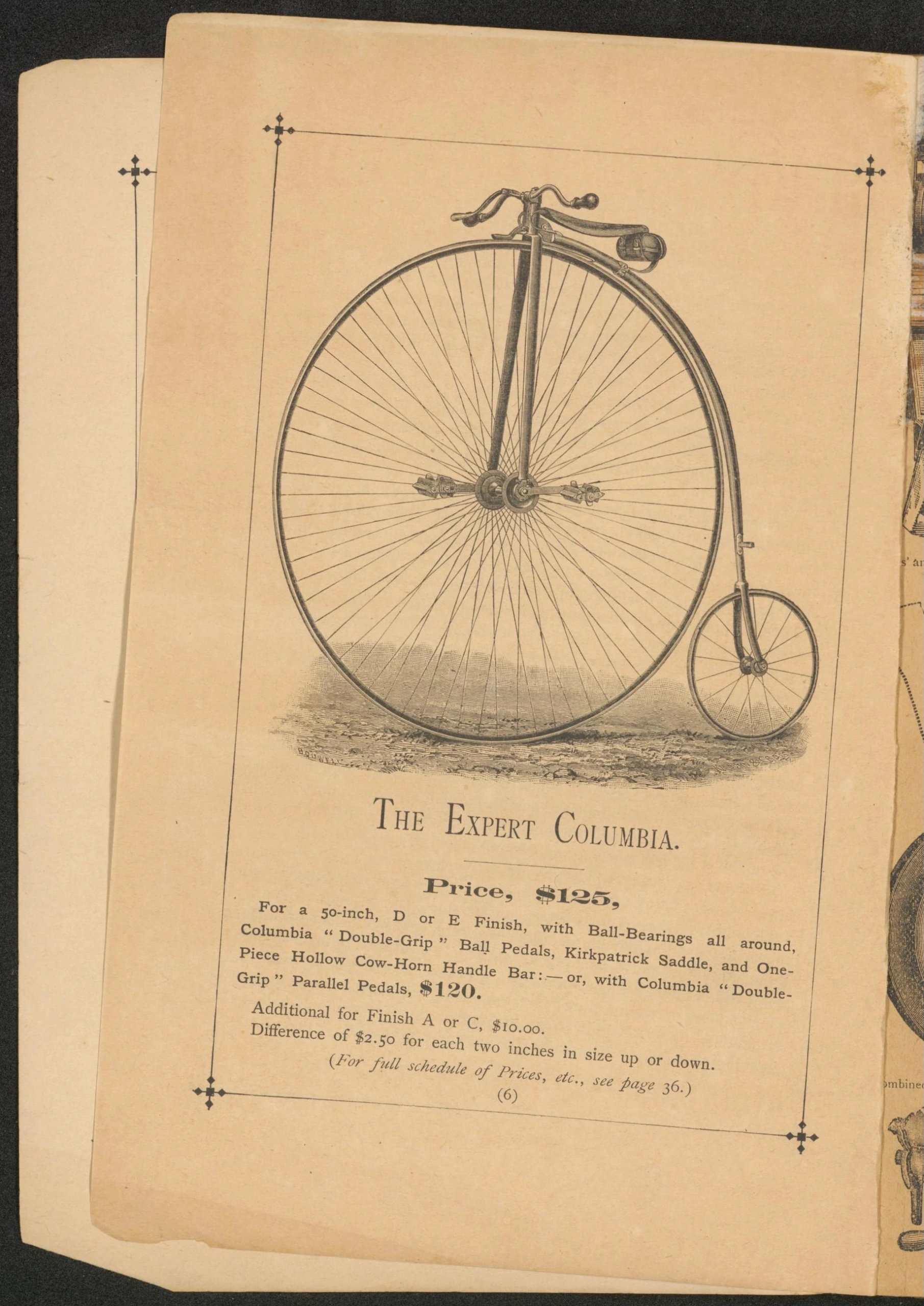
THE EXPERT COLUMBIA.
Price, $125,
For a 50-inch, D or E Finish, with Ball-Bearings all around, Columbia “Double-Grip” Ball Pedals, Kirkpatrick Saddle, and One-Piece Hollow Cow-Horn Handle Bar: — or, with Columbia “Double-Grip” Parallel Pedals, $120.
Additional for Finish A or C, $10.00.
Difference of $2.50 for each two inches in size up or down.
(For full schedule of Prices, etc., see page 36.)
(6)
[A full-page wood engraving of the Expert Columbia high-wheel bicycle in side view with tool bag behind the saddle, engravers’ signatures in the ground; a ruled border with ornamental corners. The leaf is shorter than the book and the scan shows the edge of the next page behind it.]
— Page 7 —
12 INCHES SWING!
44 ” BETWEEN CENTRES
7/16 HOLLOW SPINDLE
[…]es’ Screw Cutting Lathes, $107.50 to $160.
Eureka Lathes, $15 00.
CONANT [?]
Scroll Saws, $5 to $25.
Steel Cutting Nipper, 25 cts
[…]s’ and Gent’s Tool Chests — Best Steel Tools.
LE PAGE’S CARRIAGE GLUE
CARRIAGE BUILDERS CABINETMAKERS CARPENTERS &c. ALWAYS READY FOR USE
DIRECTIONS [small print illegible]
Fish Glue.
Vise, Drill and Anvil.
SHIPMAN 2 ENGINE
SEND FOR CATALOGUE AND REFERENCES
Shipman Coal Oil Engine for boats and stationary purposes. Requires no engineer. From $155 to $300
Pad Lock.
Fluting Machine.
[…]ombined Oil Can Screw Driver and Wrench, 35 cts.
Vises — 1 1/8 inch face — 50 cts.
Patent Brad Awl with Awls.
“EUREKA” WRINGER. BOSTON.
Spiral Screw [Driver; cut off at the foot]
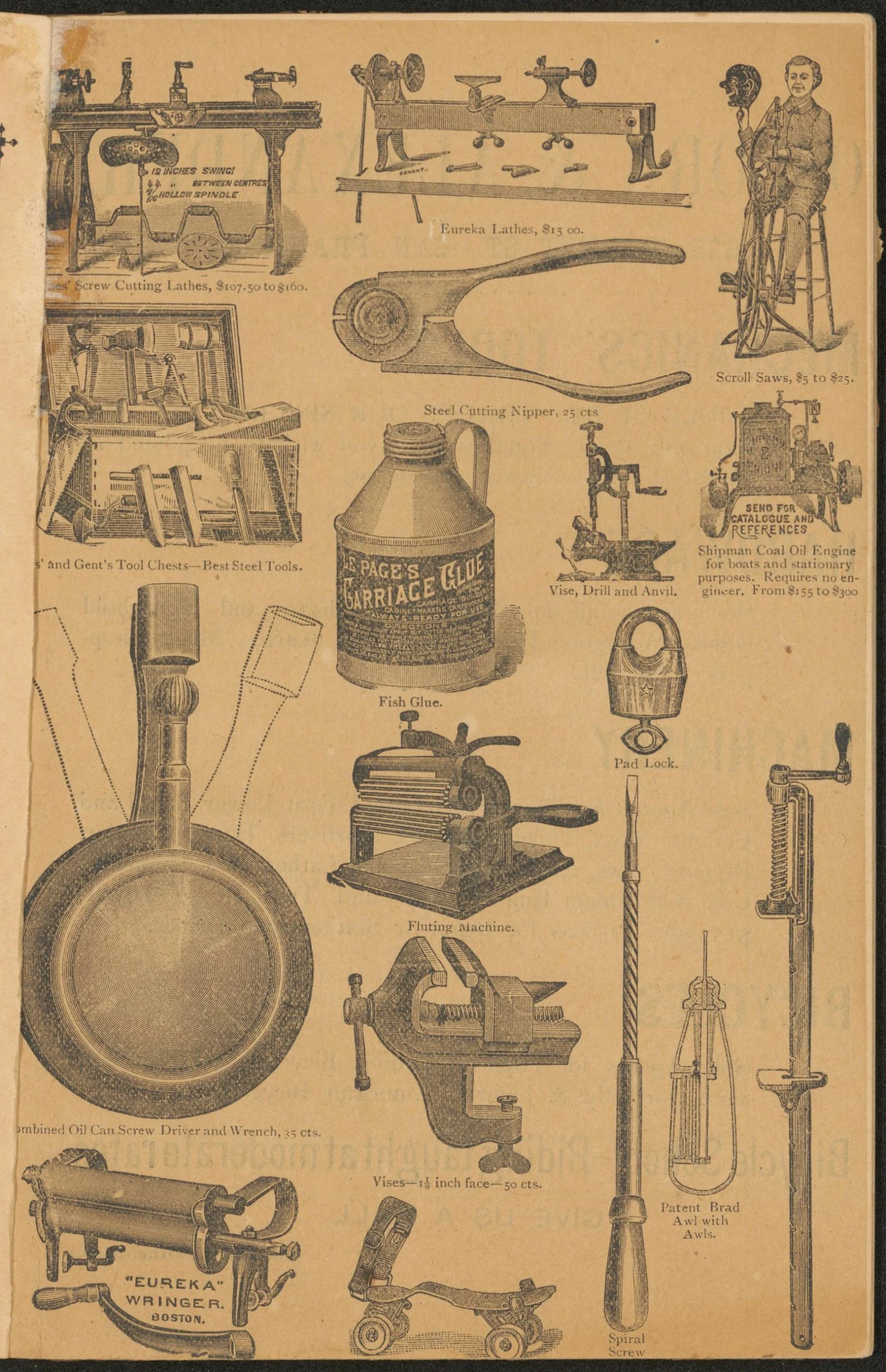
[The reverse of an inserted dealer’s leaflet: a crowded sheet of wood engravings of lathes, a boy at a treadle scroll saw, tool chests, glue can, oil engine, padlock, fluting machine, vises, roller skate, wringer and tools, with price captions. The left edge is caught in the binding; the face of the leaflet shows through.]
— Page 8 —
OSBORN & ALEXANDER,
628 MARKET ST., SAN FRANCISCO.
MECHANICS’ TOOLS
TOOLS OF ALL TRADES OUR SPECIALTY. We keep only the best makes. If you wish to be posted in the latest improvements, call on us.
HARDWARE
We keep a full line of Shelf Hardware and Household Goods, Wringers, Fluting Machines, Knives, Meat Choppers, Hose, etc.
MACHINERY
Sole Agents for Barnes’ Celebrated Foot Power Scroll and Circular Saws, Turning Lathes, Mortisers, Hand, Circular, Ripping Saws, Amateur’s Saws and Lathes, also, Shipman’s Coal Oil Steam Engines, One and Two Horse Power, $155.00; $250.00 for Boats or Stationary purposes.
BICYCLES
Sole Agents for Pope’s Columbia Bicycles and Tricycles, also, Gormully & Jeffery’s American Bicycles.
Bicycle School — Riding taught at moderate rates
GIVE US A CALL.
6-11-86.
(Look on the Other Side.)
[The face of the inserted San Francisco agents’ leaflet, printed in black on tan paper in bold display type; a print code at lower left. The catalog page behind it shows at the left.]
— Page 9 —
BRIEF OF 50-INCH. — Endless moulded red-rubber tires, 1-inch front and ¾-inch rear. Crescent felloes. 56 and 18 direct spokes, No. 11½ gauge, with both ends enlarged. 4½-inch recessed steel hubs, on 8¾-inch axle, with 5¾-inch spread of spokes. Detachable cranks, 4½ to 5½-inch (or 5½ to 6½-inch) throw, notched on back for adjustment of pedal. Columbia “Double-grip” rubber (Latta patent) ball-pedals (Peters and Wallace patents) 18-inch rear wheel. Columbia adjustable ball-bearings (Peters and Wallace patents) to front and rear wheels. 1½-inch cylindrical perch, made of imported patent cold-drawn seamless-steel tube. 5-inch cylindrical head, with dust-shield; 4-inch hemispherical centres (Hicks patent). Columbia elliptical, cold-drawn seamless-steel tubular front forks. Semi-tubular rear forks (Knous and Wallace patents). 26-inch hollow continuous-steel detachable (Pratt and Knous patents) cow-horn handle-bar. Large vulcanite handles (Moran patent). One-piece leg-guard. Grip-lever-spoon brake. Oblong open serrated step. Kirkpatrick saddle (Shire, Veeder, and Kirkpatrick patents). Tool-bag with nickeled monkey-wrench, screw-driver, and nickeled oil-can. Weight, with these parts all on and ready to ride, 45 lbs.
The Expert is put out for its fifth year with its world-wide reputation for stanchness, durability, ease of running, and beauty of lines and finish, holding it easily first among all medium-weight machines, and with the noteworthy distinction of being the only bicycle which has ever passed to this stage of its history with constantly increasing favor and sales.
As it was the first high-grade roadster scientifically constructed, and upon the interchangeable plan, to be placed on the market, it met with an immediate and unqualified success, and we have at all times taken pride in so adding to its excellence that its popularity could not be superseded by that of any other machine; and it stands to-day as the most reliable — and relied-on — roadster in the world. Perhaps no better evidence of this fact exists than the high prices at which it is, in all cases, held after two, three, or even four seasons’ use: invariably commanding better prices than other machines under similar circumstances, — and for very obvious reasons.
It was designed to stand long and hard usage on any roads, by any rider, combining the maximum of strength and elegance, and the lowest weight consistent with all that would within reason be required of it, at a price proportionate to the prices of other machines and its own excellence. While the improvements we have added to it continually have materially increased the value of the Expert, the price has never been raised; — and at no one time have we added more to it than now, when, in putting it out for 1886, we equip it with our unequalled cow-horn handle-bar, the “double-grip” ball pedals, and Kirkpatrick saddle.
In its manufacture, strength has in no case been sacrificed for lightness,
(7)
[A text page within a ruled border with ornamental corners; the torn edge of the inserted leaflet shows at the left.]
— Page 10 —
nor durability for cheapness, nor simplicity and practicality of construction for unnecessary novelty. All parts are shaped in dies, — a method of construction which secures not only a perfect interchangeability of parts, and an elegant finish and form, but homogeneity of metal, and greater strength and reliability.
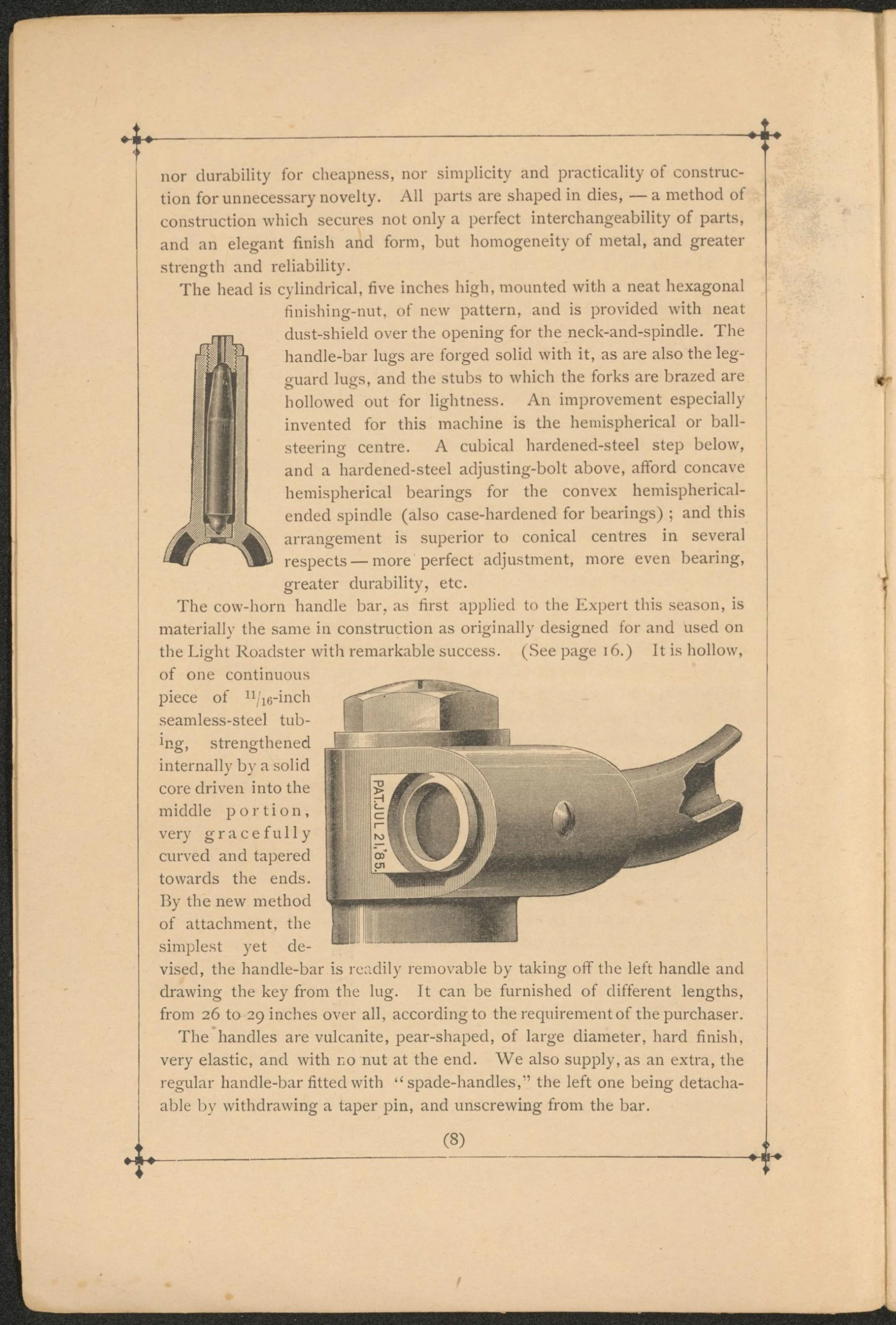
The head is cylindrical, five inches high, mounted with a neat hexagonal finishing-nut, of new pattern, and is provided with neat dust-shield over the opening for the neck-and-spindle. The handle-bar lugs are forged solid with it, as are also the leg-guard lugs, and the stubs to which the forks are brazed are hollowed out for lightness. An improvement especially invented for this machine is the hemispherical or ball-steering centre. A cubical hardened-steel step below, and a hardened-steel adjusting-bolt above, afford concave hemispherical bearings for the convex hemispherical-ended spindle (also case-hardened for bearings); and this arrangement is superior to conical centres in several respects — more perfect adjustment, more even bearing, greater durability, etc.
The cow-horn handle bar, as first applied to the Expert this season, is materially the same in construction as originally designed for and used on the Light Roadster with remarkable success. (See page 16.) It is hollow, of one continuous piece of 11/16-inch seamless-steel tubing, strengthened internally by a solid core driven into the middle portion, very gracefully curved and tapered towards the ends. By the new method of attachment, the simplest yet devised, the handle-bar is readily removable by taking off the left handle and drawing the key from the lug. It can be furnished of different lengths, from 26 to 29 inches over all, according to the requirement of the purchaser.
PAT. JUL. 21, ’85.
The handles are vulcanite, pear-shaped, of large diameter, hard finish, very elastic, and with no nut at the end. We also supply, as an extra, the regular handle-bar fitted with “spade-handles,” the left one being detachable by withdrawing a taper pin, and unscrewing from the bar.
(8)
[A text page within a ruled border, with two engravings: a sectional view of the Expert head showing the hemispherical steering centre, and a large view of the handle-bar lug at the head, stamped “Pat. Jul. 21, ’85.”]
— Page 11 —
The brake is of the general form of grip-lever spoon, front-wheel brake, of improved pattern and increased power, with long lever curved to conform with the handle-bar, — thoroughly strong, easy, and reliable.
The perch (or backbone) is of best imported patent seamless steel 1½-inch tubing, and of circular section, to which we adhere because it is more correct for strains, takes less space for the strength between saddle and wheel, and appears more graceful.
The tires are made of the best Para rubber, in an endless mould, and are put on by a cement process with the greatest care and skill. They have a well-earned reputation for staying in, though readily removed and replaced when necessary, without having to be shipped to our factory.
The spokes are of the best drawn steel, No. 11½ wire, enlarged at both ends, and they are “direct.” We exceed the conservative rule of spokes for inches, and put in an extra number of six to fourteen more, according to size. They are headed and nicely fitted in the felloe, which is of crescent form, of wide section, and deeply rolled and welded by our patented machinery. We have constructed this with special reference to resisting lateral strain, or “buckling.”
The flanges of the forward wheel are 4½ inches in diameter, recessed sufficiently to take all the bearing-mechanism except the thickness of the fork-lug. They give from 5½ to 6½ inches breadth between centres of spokes. This breadth of hub, together with its great diameter, the num- and size of the spokes, and the construction of the felloe, make the Expert wheel exceedingly rigid.
The cranks are detachable, closely fitted, and keyed. They are of peculiar shape for strength and rigidity, allow 4½ to 5½ inches throw, and are ribbed on the back side for ribbed washers, to prevent loosening and slipping. We also furnish, when desired, extra long cranks, allowing 5½ to 6½ inches throw.
The pedals are the improved Columbia ball-pedals shown on page 36. The frames are made especially strong and light, with perfected bearings and pins, and fitted with our patented “double-grip” rubbers, made of pure gum; a form and material giving a firmer and easier hold for the foot than any other we have yet seen, and such as to absorb to a great extent the jars and vibrations, to the advantage of both rider and machine. The flange is one-quarter inch from face of crank. Our parallel pedals, which we furnish with new machines at a reduction in price, are also fitted with the “double-grip” rubbers.
The front forks are of the best seamless-steel tube, of thick shell, of elliptical cross-section, 1⅝ inches in one diameter and ¾-inch in the other; and the form of fork throughout its length is made with a regard to scien-
(9)
[A text page within a ruled border with ornamental corners. The word “number” is printed as “num-” with its second half dropped at a line break.]
— Page 12 —
tific principles of mechanics, to resist lateral and torsional strains, for rigidity. The rear forks are semi-tubular, and made of a single seamless-steel tube by a patent process.
By recessing the hub, and knuckling inward the fork-end, by thinness of crank and short axle, by compactness of bearing-box, by closeness of pedal and by other slight, but well-considered, modifications of structure, the Expert is made with all the advantages of very narrow tread.
The rake of the Expert, that is, the inclination of the centre line of the forks, backward from a perpendicular through the axle of the front wheel, measuring at the bottom of the head, is two inches for a 54-inch wheel, and the same angle on other sizes. This rake insures strength of the machine, steadiness in riding, easier trundling, and a proper degree of safety in passing over obstacles.
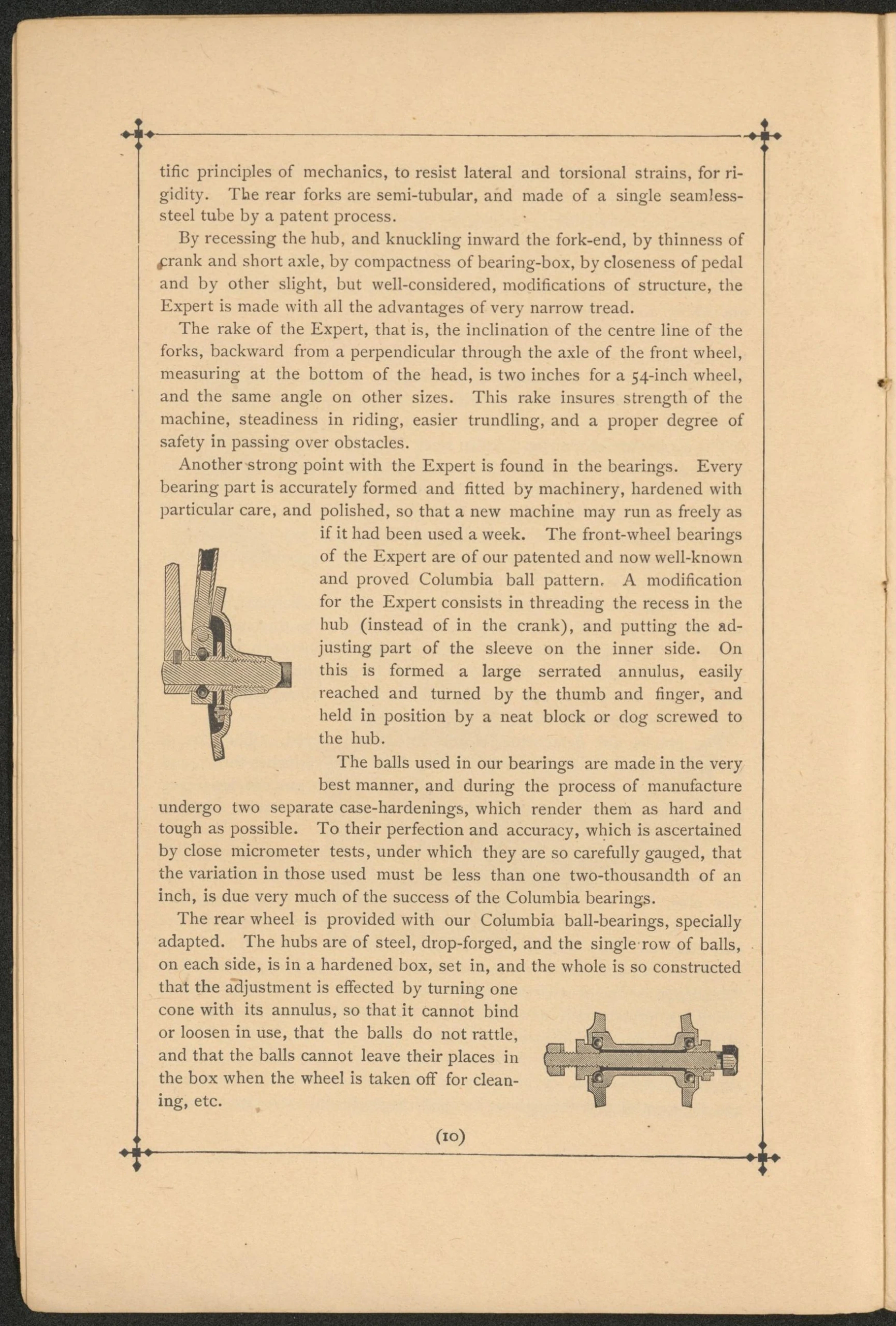
Another strong point with the Expert is found in the bearings. Every bearing part is accurately formed and fitted by machinery, hardened with particular care, and polished, so that a new machine may run as freely as if it had been used a week. The front-wheel bearings of the Expert are of our patented and now well-known and proved Columbia ball pattern. A modification for the Expert consists in threading the recess in the hub (instead of in the crank), and putting the adjusting part of the sleeve on the inner side. On this is formed a large serrated annulus, easily reached and turned by the thumb and finger, and held in position by a neat block or dog screwed to the hub.
The balls used in our bearings are made in the very best manner, and during the process of manufacture undergo two separate case-hardenings, which render them as hard and tough as possible. To their perfection and accuracy, which is ascertained by close micrometer tests, under which they are so carefully gauged, that the variation in those used must be less than one two-thousandth of an inch, is due very much of the success of the Columbia bearings.
The rear wheel is provided with our Columbia ball-bearings, specially adapted. The hubs are of steel, drop-forged, and the single row of balls, on each side, is in a hardened box, set in, and the whole is so constructed that the adjustment is effected by turning one cone with its annulus, so that it cannot bind or loosen in use, that the balls do not rattle, and that the balls cannot leave their places in the box when the wheel is taken off for cleaning, etc.
(10)
[A text page within a ruled border, with two sectional engravings: the front-wheel ball bearing in the hub and the rear-wheel hub with its two ball races.]
— Page 13 —
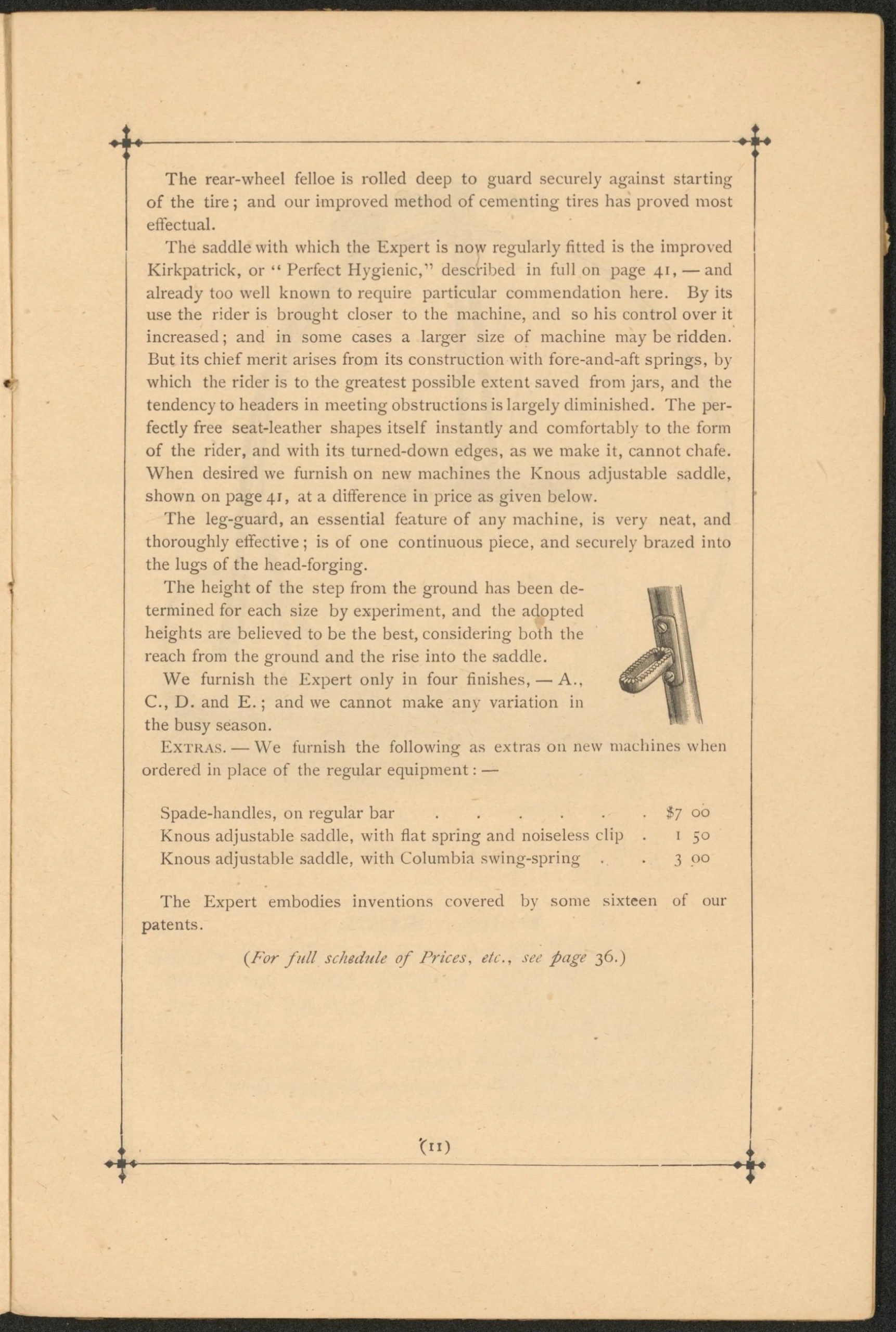
The rear-wheel felloe is rolled deep to guard securely against starting of the tire; and our improved method of cementing tires has proved most effectual.
The saddle with which the Expert is now regularly fitted is the improved Kirkpatrick, or “Perfect Hygienic,” described in full on page 41, — and already too well known to require particular commendation here. By its use the rider is brought closer to the machine, and so his control over it increased; and in some cases a larger size of machine may be ridden. But its chief merit arises from its construction with fore-and-aft springs, by which the rider is to the greatest possible extent saved from jars, and the tendency to headers in meeting obstructions is largely diminished. The perfectly free seat-leather shapes itself instantly and comfortably to the form of the rider, and with its turned-down edges, as we make it, cannot chafe. When desired we furnish on new machines the Knous adjustable saddle, shown on page 41, at a difference in price as given below.
The leg-guard, an essential feature of any machine, is very neat, and thoroughly effective; is of one continuous piece, and securely brazed into the lugs of the head-forging.
The height of the step from the ground has been determined for each size by experiment, and the adopted heights are believed to be the best, considering both the reach from the ground and the rise into the saddle.
We furnish the Expert only in four finishes, — A., C., D. and E.; and we cannot make any variation in the busy season.
EXTRAS. — We furnish the following as extras on new machines when ordered in place of the regular equipment: —
Spade-handles, on regular bar . . . . . . . $7 00
Knous adjustable saddle, with flat spring and noiseless clip . 1 50
Knous adjustable saddle, with Columbia swing-spring . . 3 00
The Expert embodies inventions covered by some sixteen of our patents.
(For full schedule of Prices, etc., see page 36.)
(11)
[A text page within a ruled border, with a small engraving of the serrated step on the rear fork at right.]
— Page 14 —
BODWELL [?] | KILBURN & CROSS SC. [?]
THE COLUMBIA LIGHT ROADSTER.
Price, $135,
For a 51-inch, K Finish, with Ball-Bearings all around, Columbia “Double-Grip” Ball-Pedals, Kirkpatrick Saddle, and One-Piece Hollow Cow-Horn Handle Bar: — or, with Columbia “Double-Grip” Parallel Pedals, $130.
Additional for Finish H or I, $10.00.
Difference of $2.50 for each two inches in size up or down.
(For full schedule of Prices, etc., see page 36.)
(12)
[A full-page wood engraving of the Columbia Light Roadster high-wheel bicycle in side view, with the artist’s and engravers’ signatures in the ground; a ruled border with ornamental corners. A small brown spot on the large wheel.]
— Page 15 —
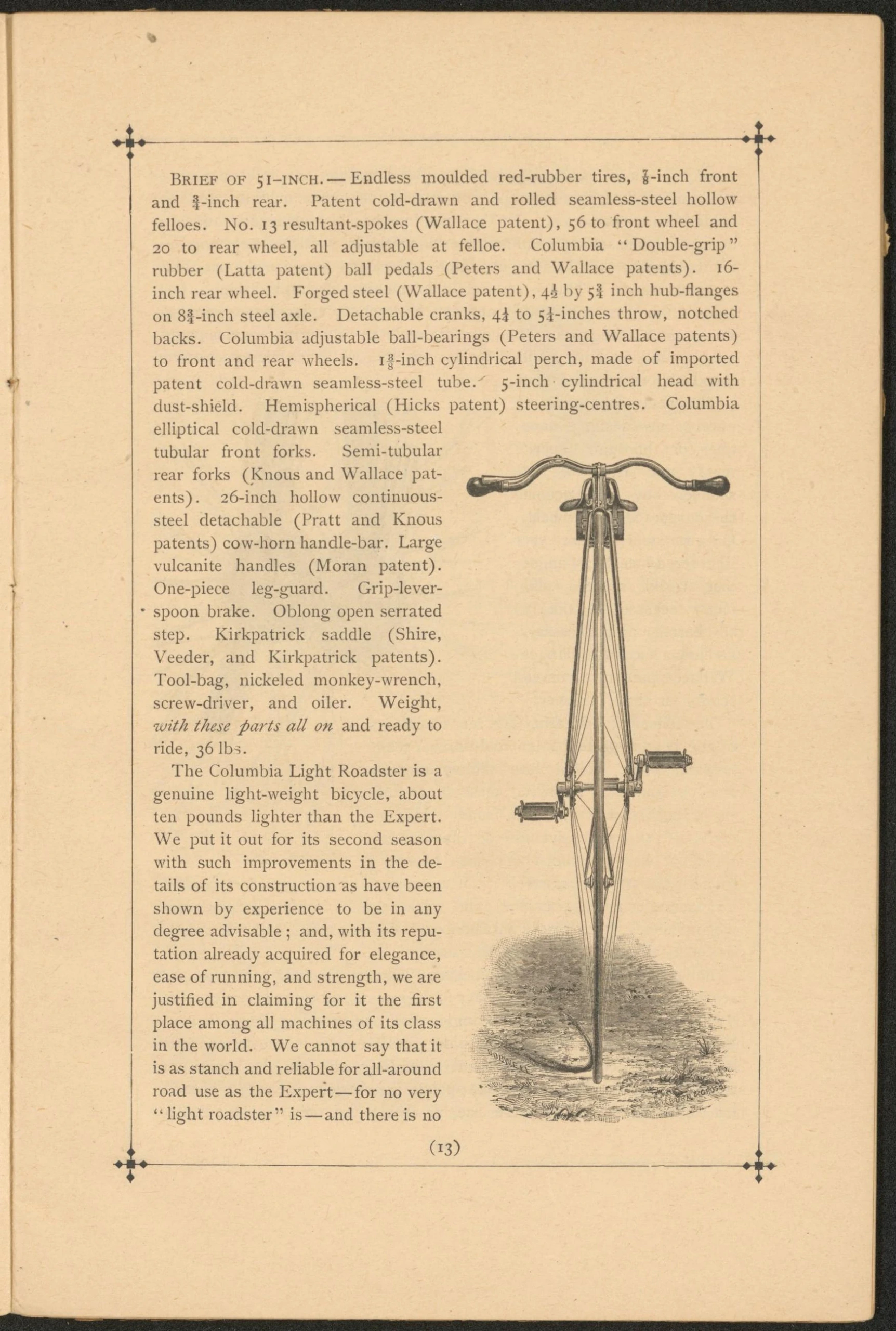
BRIEF OF 51-INCH. — Endless moulded red-rubber tires, ⅞-inch front and ¾-inch rear. Patent cold-drawn and rolled seamless-steel hollow felloes. No. 13 resultant-spokes (Wallace patent), 56 to front wheel and 20 to rear wheel, all adjustable at felloe. Columbia “Double-grip” rubber (Latta patent) ball pedals (Peters and Wallace patents). 16-inch rear wheel. Forged steel (Wallace patent), 4½ by 5¾ inch hub-flanges on 8¾-inch steel axle. Detachable cranks, 4¼ to 5¼-inches throw, notched backs. Columbia adjustable ball-bearings (Peters and Wallace patents) to front and rear wheels. 1⅜-inch cylindrical perch, made of imported patent cold-drawn seamless-steel tube. 5-inch cylindrical head with dust-shield. Hemispherical (Hicks patent) steering-centres. Columbia elliptical cold-drawn seamless-steel tubular front forks. Semi-tubular rear forks (Knous and Wallace patents). 26-inch hollow continuous-steel detachable (Pratt and Knous patents) cow-horn handle-bar. Large vulcanite handles (Moran patent). One-piece leg-guard. Grip-lever-spoon brake. Oblong open serrated step. Kirkpatrick saddle (Shire, Veeder, and Kirkpatrick patents). Tool-bag, nickeled monkey-wrench, screw-driver, and oiler. Weight, with these parts all on and ready to ride, 36 lbs.
The Columbia Light Roadster is a genuine light-weight bicycle, about ten pounds lighter than the Expert. We put it out for its second season with such improvements in the details of its construction as have been shown by experience to be in any degree advisable; and, with its reputation already acquired for elegance, ease of running, and strength, we are justified in claiming for it the first place among all machines of its class in the world. We cannot say that it is as stanch and reliable for all-around road use as the Expert — for no very “light roadster” is — and there is no
BODWELL [?] | KILBURN & CROSS [?]
(13)
[A text page within a ruled border, with a wood engraving at lower right of the Light Roadster seen head-on, showing the cow-horn bar, cranks and pedals, signed in the ground by artist and engravers.]
— Page 16 —
magic by which mechanical laws can be subverted, or three pounds of steel made as strong as four pounds when of the same qualities and distributed in the same way. But this machine has been designed and constructed by the same careful and scientific methods, with the best improvements known to the art, for very light riders and experienced ones, and for good roads. That is, it is a light machine for light riding. It is made of the best qualities of materials throughout, in forgings, seamless-tubing, and all the parts. The description of the Expert on previous pages may be read first and applied to this machine, with the differences to be noted which we now point out.
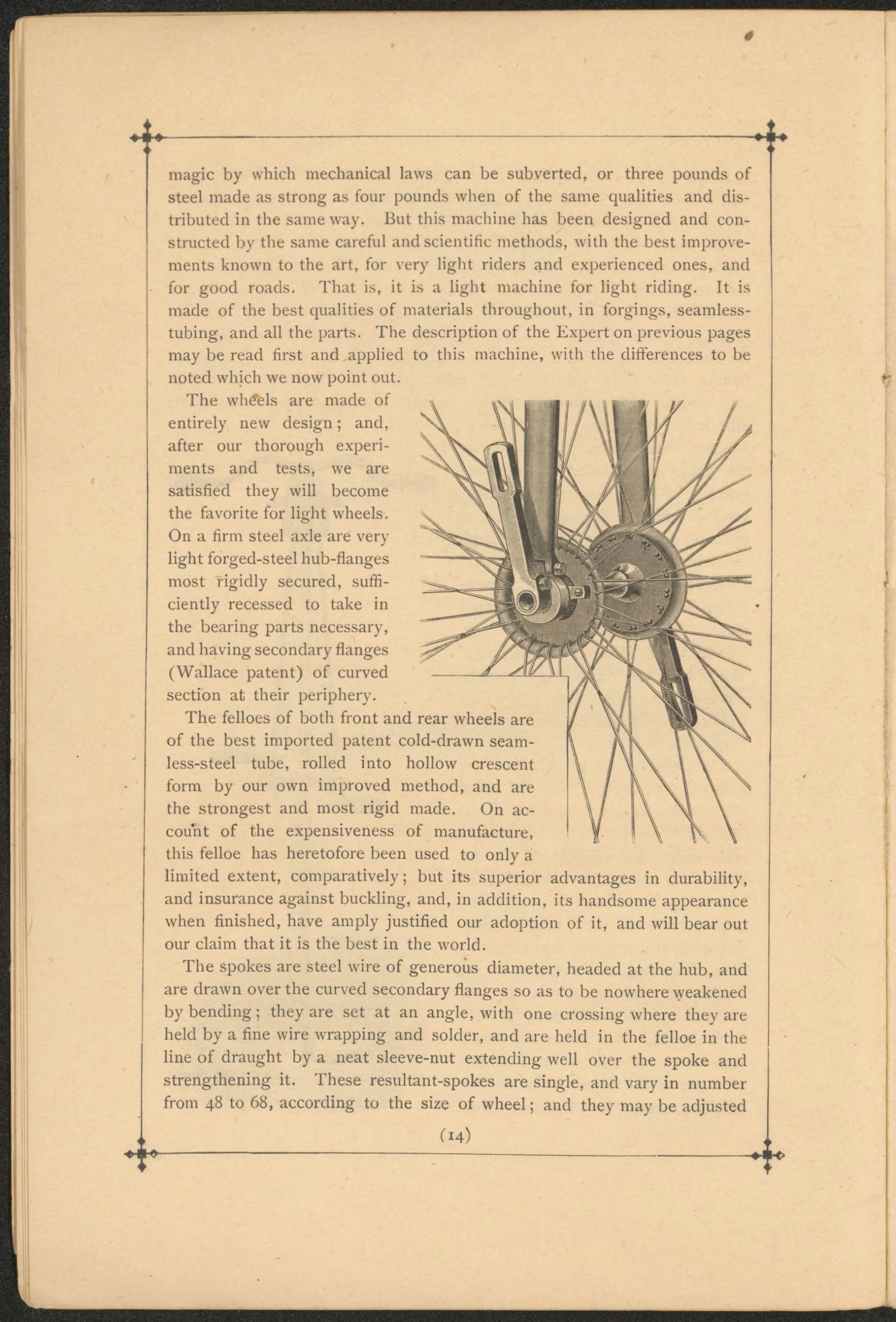
The wheels are made of entirely new design; and, after our thorough experiments and tests, we are satisfied they will become the favorite for light wheels. On a firm steel axle are very light forged-steel hub-flanges most rigidly secured, sufficiently recessed to take in the bearing parts necessary, and having secondary flanges (Wallace patent) of curved section at their periphery.
The felloes of both front and rear wheels are of the best imported patent cold-drawn seamless-steel tube, rolled into hollow crescent form by our own improved method, and are the strongest and most rigid made. On account of the expensiveness of manufacture, this felloe has heretofore been used to only a limited extent, comparatively; but its superior advantages in durability, and insurance against buckling, and, in addition, its handsome appearance when finished, have amply justified our adoption of it, and will bear out our claim that it is the best in the world.
The spokes are steel wire of generous diameter, headed at the hub, and are drawn over the curved secondary flanges so as to be nowhere weakened by bending; they are set at an angle, with one crossing where they are held by a fine wire wrapping and solder, and are held in the felloe in the line of draught by a neat sleeve-nut extending well over the spoke and strengthening it. These resultant-spokes are single, and vary in number from 48 to 68, according to the size of wheel; and they may be adjusted
(14)
[A text page within a ruled border, with a large engraving at right of the Light Roadster front hub, crank and fork end, showing the tangent spokes over the curved secondary flange.]
— Page 17 —
as easily as direct spokes, without removing the tire, and, being held in the felloe by a device on the ball-and-socket principle, they are not weakened by bending there.
The front wheels are all made on the odd-inch sizes, from 47 to 59 inches, inclusive; and the construction is such that ordinarily a rider fitted by a 54-inch full roadster will take a 55-inch size of this machine with the same fit. This difference is not, however, gained at the expense of spring room.
The rear wheels have light hubs, single resultant-spokes set at an angle as the others, headed at the hub, and with similar sleeve-nuts, and hollow felloes, and are very light and strong. The rear wheels are 16-inch on 51-inch size and under, and 18-inch on larger sizes.
The front forks, perch, and rear forks are all made of the best seamless steel tubing on lines similar to those of the Expert (see pp. 6-11), but lighter; and the peculiar construction of these forks gives them the greatest possible rigidity for the given weight of metal. The rear forks are made of one homogeneous piece from seamless-steel tube, by the Knous and Wallace patent process, and are very rigid and steady.
The tires are of the best rubber, endless moulded, and held in the felloe by a cement process very securely. They are ⅞-inch to front and ¾-inch to rear wheel. We adhere in this machine to the Serrell contractile tire, because, by its circular section, undiminished elasticity, and slightly contractile fit, it offers the most relief from jarring, the best tread, and the most security of any construction yet fully tested.
The bearings are the adjustable Columbia ball (Wallace patents) to front and rear wheels, as in the Expert, but lightened, and gauged with such accuracy that the balls vary less than one two-thousandth part of an inch in size. The surfaces are not only formed and held with accuracy and in few pieces, free from displacement, but are smoothly polished and well hardened, and afford everywhere an unbroken track for the balls.
The cranks are slightly different in shape from those of the Expert, for lightness, but are detachable, and have from 4¼ to 5¼-inch throw. The longer Expert cranks can be substituted if desired. The pedals are of the new Columbia ball pattern, fitted with our new “double-grip” rubbers. (See p. 40.) The pedal has been made from entirely new designs and dies
(15)
[A text page within a ruled border, with an engraving at right of the Light Roadster rear wheel hub and fork end with tangent spokes.]
— Page 18 —
for this machine. The Columbia “double-grip” parallel pedals will be substituted on a new machine, at a reduction of $5.00.
The neck-and-spindle is of improved pattern, with a new oil-diverter between centres, which conducts the oil from the upper centre to the lower one, and keeps it off the neck and prevents soiling; and the centres are long and hemispherical or “ball” (Hicks patent) centres, which have proved so valuable a specialty in the Expert.
COLUMBIA […] POPE MFG. CO. [?]
The steering-head is cylindrical, slightly tapered, of new design; and the handle-bar lug is forged solid with it, of closed front, and very neat and strong. By a new and ingenious spring-band under the neck, the dust-shield is readily removed and replaced without bother from little screws; and it is also modified at the edges so as not to scratch and soil the sides of the head.
The handle-bar is hollow, of one continuous piece of steel-tubing, curved both upward and downward (“cow-horn”), strengthened in the middle, and tapered toward the ends, whereon large, nutless, vulcanite handles are directly applied, and are of good length. By a new method of attachment (Pratt and Knous patents), the handle-bar is readily removable by simply taking off the left handle and drawing a key. This light, rigid, unbreakable, detachable handle-bar will be found one of the valuable features of this machine; and the ability to set it at any angle of revolution, bringing the handles to any position, will add to its value.
The brake-lever is curved to conform with the handle-bar; and the
(16)
[A text page within a ruled border, with a large engraving of the Light Roadster head, cow-horn handle-bar, brake lever and spoon brake over the tire, the head bearing a small maker’s name plate.]
— Page 19 —
brake is of easy action and reliable. There is a rigid steel leg-guard, and a step well adjusted for height to the different sizes of machines.
The saddle is of the improved Kirkpatrick pattern, as described fully on page 41, and has been adopted for this machine on account of its wide and well-merited popularity. Its use adds materially to the easy-riding qualities of the machine, and by bringing the rider closer to the wheel increases his control over it. When particularly desired the Knous adjustable saddle (see page 41) will be substituted, fitted to either the bolted flat-spring with anti-rattling (Knous patent) clip, or the Columbia swing-spring, at an extra price.
The lines of this machine, whether seen in front or side view, are believed to be as beautiful as can be obtained with due regard to non-excess of metal and thorough stanchness for work, and the more they are looked at the better they will please. The tread is extremely narrow, and yet the wheel is broad between flanges, as is necessary to insure against buckling. The rake of the front forks is a good mean between the requirements of the coefficient of safety in position and steadiness in work, and of the correct position of the pedals with reference to the perpendicular through the centre of gravity of the rider in propelling. Hence it is both a safe and an easy mount. And those who desire a very light machine will find here a weight of some ten to twelve pounds below that of ordinary roadsters, and less than the average of “light roadsters,” when weighed under the same conditions.
EXTRAS. — We furnish the following as extras on new machines when ordered in place of the regular equipment: —
Spade-handles, on regular bar . . . . . . . $7 00
Knous adjustable saddle, with flat spring and noiseless clip . 1 50
Knous adjustable saddle, with Columbia swing-spring . . 3 00
(For full schedule of Prices, etc., see page 36.)
(17)
[A text page within a ruled border, with an engraving at center of the cow-horn handle-bar, head and leg-guard seen from the front.]
— Page 20 —
STANDARD COLUMBIA.
Price, $90,
For a 50-inch, G Finish, with Ball-Bearings to Front Wheel: — or, with Parallel Bearings to Front Wheel, $85.
Additional for Finish F, $10.00; for Finish B, $15.00.
Difference of $2.50 for each two inches in size up or down — except difference of $7.50 between 46 and 48 inch sizes.
(For full schedule of Prices, etc., see page 37.)
(18)
[A full-page wood engraving of the Standard Columbia high-wheel bicycle in side view, with straight handle-bar and saddle bag; a ruled border with ornamental corners.]
— Page 21 —
BRIEF OF 50-INCH and over. — 1-inch and ¾-inch endless moulded rubber tires. Crescent felloes. No. 11½ direct, butt-ended spokes, — substantially “spokes for inches.” 4½-inch hubs, with 6-inch spread of spokes. 18 and 20-inch rear wheel. Detachable cranks, 5 to 6-inches throw. Corrugated rubber parallel pedals. 5½-inch cone steering-centres. Open head. 23 to 30-inch handle-bars. Vulcanite handles (Moran patent). Solid forks. Ball-bearings (Peters and Wallace patents) to front wheel. Adjusting cones to rear wheel. 1½-inch seamless tube perch. Long bolted slide spring. Suspension saddle. Lever spoon-brake. Round step. Leg-guard. Saddle-bag with monkey-wrench, screw-driver, and oil-can. Weight, including saddle, pedals, tools, and bag, ready to ride, 46 lbs. and over.
BRIEF OF 48-INCH and under. — Same as above, except as follows: U V felloes. No. 12½ nippled and lock-nutted spokes to front wheel and to rear wheel. 18 and 16-inch rear wheel. 5-inch cone steering-centres. Detachable cranks, 4½ to 5½ inch throw. 1¼-inch drawn tube perch. Weight, including saddle, pedals, tools, and bag, ready to ride, 45 lbs. and under.
Our Standard Columbia Bicycle has gone into the largest use of any bicycle in this country. It is a stanch and reliable machine for beginners, and for all-around road use. It was designed to meet the want, still widely felt, of a substantial, first-class road machine, at a moderate price. We present it for this season again upon its merits and popularity already acquired. Although, by constant improvements, the expense of manufacture has largely increased, we offer it now at prices lower than before.
It is made throughout of the best suited qualities of steel for the various metallic parts, and Para rubber for tires and pedal bars. All the parts are made by machinery of accuracy, and are interchangeable. The proportions and securements of the various parts have, by our long experience and careful study, been brought to such correctness that the percentage of breakage and wearing of our machines is so little, and springing, buckling, or loosening so little, as to be remarkable and proverbial.
The bearings for front wheel are our patent Columbia ball-bearings, which for simplicity and perfectness of adjustment and action are unrivalled.
EXTRAS. — We furnish with new machines when ordered, in place of the regular parts: —
Columbia “Double-grip” Ball-Pedals (nickeled) on Finish G, $5.00; on Finish B or F . . . . . . . . $4 00
Standard Dropped Handle-bars, with Dropped Brake-Lever . 2 50
(For full schedule of Prices, etc., see page 37.)
(19)
[A text page within a ruled border with ornamental corners.]
— Page 22 —
BODWELL [?] | KILBURN & CROSS [?]
COLUMBIA SAFETY.
Price, $140.
Ball-Bearings all around, Columbia “Double-Grip” Ball-Pedals, Kirkpatrick Saddle, and One-Piece Hollow Cow-Horn Handle-Bar: — or, with Columbia “Double-Grip” Parallel Pedals, $135.
BRIEF. — 42-inch and 20-inch wheels. 1-inch and ⅞-inch endless moulded red-rubber tires. Crescent felloes. 40 and 20 direct spokes, No. 11½ wire, with both ends enlarged. 2⅜-inch hub on 7-inch axle, with 3¼-inch spread of spokes. Adjustable crank and chain-driving gear. Detachable cranks, 4½ to 5½-inch (or 5½ to 6½-inch) throw, notched on back for adjustment of pedals. Columbia “Double-Grip” rubber (Latta patent) ball-pedals (Peters and Wallace patents). Columbia adjustable ball-bearings (Peters and Wallace patents) to front and rear, and sprocket-wheels. 1⅜-inch seamless-steel cylindrical perch. 5-inch cylindrical head, with dust-shield. Columbia elliptical, seamless-steel tubular front forks. Semi-tubular rear forks (Knous and Wallace patents). 26-inch hollow continu-
(20)
[A ruled-border page with a wood engraving of the Columbia Safety, a dwarf front-driving bicycle with 42-inch front wheel driven by chains from cranks set low on the forks, and a 20-inch rear wheel; engravers’ signatures in the ground.]
— Page 23 —
ous-steel detachable (Pratt and Knous patents) cow-horn handle-bar. Vulcanite handles (Moran patent). One-piece leg-guard. Grip-lever-spoon brake. Oblong open serrated step. Kirkpatrick saddle (Shire, Veeder, and Kirkpatrick patents). Tool-bag, with nickeled monkey-wrench, screw-driver, and nickeled oil-can. Finish, D, with nickeled fork-extensions. Weight, all on, 47½ lbs.
For our Columbia Safety, or dwarf bicycle, we have adopted the front crank and chain-driving gear pattern, as embracing the greatest advantages in construction, general effectiveness, and appearance. It affords ample strength, with comparative lightness, an economy of power to be expended in driving, ease of control, and simple and effectual means of adjustment for different riders. In most points it presents the simple and excellent principles used in the Expert, and Columbia Light Roadster.
In its driving-gear a corresponding simplicity of construction is to be noticed, particularly in the provision for an adjustment of the reach for all riders. The bracket carrying the lower sprocket-wheel and crank moves readily up and down on the fork-extension when its binding bolt is loosened, and a perfect adjustment is rendered especially easy by the use of the improved Ewart detachable-link chain, of which, when made with drop-forged links, we hold the sole rights for application to bicycles and tricycles.
The accompanying cut illustrates the method of taking it apart, and it will be seen that any link may be taken out or replaced instantly, when sufficient slack is given to the chain to bring two links around to a right angle with each other; while, until this position of the links is reached, they cannot come apart. The links are made under our own improved process, are drop-forged, case-hardened on the bearing-ends, and constitute the lightest and most satisfactory chain for its purpose; while the fact that under regular tests it bears a strain of 2,000 lbs. before breaking, sufficiently demonstrates its strength.
The bearings are our celebrated Columbia ball-bearings all around; those about the axles of the lower sprocket-wheels having been especially devised for this machine, containing two rows of balls, well apart, so as to carry the various strains to the best advantage, and perfectly adjusted by single movable cones on the inside of each bearing.
The Safety is geared as a 52½-inch driver.
(21)
[A text page within a ruled border, with an engraving of three Ewart detachable chain links, one turned at a right angle to show how it unhooks.]
— Page 24 —
BODWELL | KILBURN & CROSS [?]
COLUMBIA SEMI-ROADSTER.
Price, $85,
For a 46-inch, Finish D, with Cow-horn Handle-bars, and Kirkpatrick Saddle.
Difference of $2.50 for each two inches in size, up or down.
(For full schedule of Prices, etc., see page 37.)
(22)
[A full-page wood engraving of the Columbia Semi-Roadster, a smaller high-wheel bicycle for boys, in side view with cow-horn bar and saddle bag; artist’s and engravers’ signatures in the ground; a ruled border with ornamental corners.]
— Page 25 —
BRIEF OF 46-INCH. — Endless moulded red-rubber tires, ¾-inch to front and ⅝ [?]-inch to rear. Crescent felloes. 46 and 18 direct spokes, No. 11½ steel wire, with both ends enlarged. 16-inch rear wheel. 3-inch hub-flanges, with 5-inch spread of spokes. Detachable cranks, 4 to 5 inches throw. Parallel pedals, with corrugated rubbers. Columbia ball-bearings (Peters and Wallace patents) to front wheel, with new adjustment (Pope patent). Cone bearings to rear wheel. 1¼-inch cylindrical perch. 4¾-inch cylindrical head, with cone centres. Elliptical seamless steel tubular front forks, solid rear forks. 24-inch cow-horn handle-bars. Vulcanite handles (Moran patent). Grip-lever spoon brake. One-piece leg-guard. Oblong open serrated step. Kirkpatrick saddle (Shire, Veeder, and Kirkpatrick patents). Tool-bag, with monkey-wrench, screw-driver, and oiler. Weight, all on, 34 lbs.
The Columbia Semi-Roadster is a high-grade, moderate-priced bicycle for the use of boys, and even for light men of small stature. In designing and making it, our aim has been to reach a higher degree of excellence in durability, simplicity of construction, elegance of form and finish, and all other points which go to make up a first-class machine for its purpose, than has yet been attained; and in this we have easily succeeded, by applying to its construction all of our experience as to just what is required, and the best methods of supplying it.
The idea has quite generally prevailed heretofore that, for the use of a boy or youth whose full growth has not been attained, a cheaply made bicycle was sufficient, which would last as long as the first user could ride it, and then might be thrown aside, or, at the best, sold for a very small proportion of its cost. The better economy, however, will be found in a thoroughly well-made bicycle, which, as in the case of our full-sized machines, if its owner’s tastes or requirements call for a change after several seasons’ use, may still be sold or exchanged for another to good advantage.
Made under our well-known methods of construction, with the strains to which it is liable carefully and correctly estimated, and the different qualities and tempers of steel distributed to the best advantage, the Columbia Semi-Roadster is lighter, and yet will last longer and look better, than any other of its class under similar circumstances. And since, in any machine for its purpose, some hard usage is to be expected, and the question of repairs must be taken into consideration, it is of especial interest in this case to note that, under our perfect interchangeable system, all parts can be quickly and cheaply replaced which may in any way be broken, or, after long usage, wear out. In its appearance it is fully equal to our Expert, or Light Roadster, than which there are no more elegant machines in outline or finish, and it closely resembles the former in design and proportions.
(23)
[A text page within a ruled border with ornamental corners.]
— Page 26 —
The head is drop-forged, of the closed pattern, 4¾ inches high, amply strong to resist the heavy strains to which it is subject, with a firm handle-bar lug, and having its stubs securely pinned and brazed into the front forks. These are of seamless steel tube, cold-drawn, and shaped in dies, of elliptical section best proportioned to resist bending and breaking, and affording the utmost degree of rigidity.
The wheels are built upon the same principle as those of our Expert and Standard, which have gained for themselves an enviable name for durability and stanchness, and present the simplest and yet the best wheel construction where use on all kinds of roads has to be allowed for, and a very light wheel is not desirable. While 46 spokes are sufficient for the front wheels, from 42 to 46 inches in diameter, we put 52 in both the 48 and 50-inch wheels, to provide for the increased weight which these larger sizes will naturally be called upon to carry.
The front-wheel bearings are of our celebrated Columbia ball pattern, with a single row of balls running in a light but strong bearing-case. In its means of adjustment, as devised especially for this machine, this bearing presents a new and interesting feature, which affords a sufficiently easy and close adjustment, with a considerable economy of space. The inner cone, upon which the bearing runs, is in this the “fixed” one, and is a collar fitting closely about the axle and secured from turning by a pin projecting into the hub-flange. The outer cone is similar in form, and similarly attached to the shoulder of the crank, through which the adjusting motion is derived. The crank-boss, or shoulder, is cut out to receive the axle-end, which fits closely into it, and by means of a differential screw, — the head of which appears in the cut, — with a coarse thread where it passes into the axle-end, and a finer thread through the crank-boss, the closeness of the crank is easily and positively regulated, and so the relative position of the outer cone to the inner one, thus effecting the adjustment of the bearing. When the proper degree of adjustment is obtained the crank is secured in its position by a key-shaped bolt drawing transversely through it and across a flattened surface of the axle. Properly adjusted the wheel runs freely and without binding, and at the same time without side shake, and should not be unnecessarily disturbed.
The cranks are detachable by removing the key and then the differential screw described above. They are slotted at their lower end for an adjustment of the pedals up or down, according to the requirement of the rider, and fitted with our regular Columbia parallel pedals, with corrugated rubbers, though we furnish our “double-grip” ball-pedals, described on page 40, as an extra on a new machine at an additional charge of $5.
The handle-bars are of the popular “cow-horn” form, screwed together
(24)
[A text page within a ruled border with ornamental corners. The text refers to a cut that is not on this page.]
— Page 27 —
in the centre and securely soldered into the 2⅜ [?]-inch lug, and tipped with the best vulcanite handles.
In order to fully carry out our idea of raising this machine to the highest point of excellence we have decided to fit it with the Kirkpatrick saddle. A neat step, correctly placed, a steel leg-guard for the protection of the trousers from contact with the tire, and a tool-bag, containing the necessary tools, complete the equipment of this admirable machine.
HOME TRAINER.
This machine is adapted to give, so far as can be done by a stationary apparatus, the same invaluable exercise that is derived from the bicycle. While it is an indispensable adjunct to gymnasiums, and forms a very attractive feature in bicycle club-rooms, affording members opportunities for training, time races, etc., it is also particularly suited for use at home. To men of sedentary habits it is of great value, as a few minutes devoted to brisk pedaling on it, with the outlay of but little nervous strength, will so stimulate the action of the heart and lungs as to send the blood well through the system, and produce a natural and healthy glow.
We offer for sale this season the Buffalo Home Trainer, as presenting as many advantages of construction as any other.
The frame is made of wrought-iron pipe, pinned and brazed at all the joints, with a cast-iron base, which can be screwed to the floor to secure stability. The saddle and its method of attachment afford a very easy seat. The rat-trap pedals are attached directly to the wheels, a slot allowing an adjustment of from four to six inches. The trainer can be adjusted to suit any length of leg.
A scale for regulating the degree of resistance to be overcome, and an alarm cyclometer, admit of graded exercise, capable of modification to suit the strength of every user, without danger of over-exertion.
Price, painted and striped with gold and carmine, $30.
(25)
[A text page within a ruled border, with an engraving of the Buffalo Home Trainer: a pedestal on a round base carrying a saddle and cow-horn bar above a pair of heavy flywheels fitted with pedals.]
— Page 28 —
BODWELL | KILBURN & CROSS
COLUMBIA RACER.
Price, complete . . . . . . . . . . $140.
Weight of 55-inch, 22½ lbs.
BRIEF OF 55-INCH. — Endless moulded red-rubber tires, ½-inch. Columbia hollow felloe (White patent) to front wheel, crescent felloe to rear wheel. No. 15 steel wire, full-tangent spokes (patent applied for), 72 to front, 20 to rear wheel, all adjustable at felloe. 3¼ by 5¾-inch hub-flanges on 8-inch axle. Fixed cranks, slotted for adjustment of pedals; allowing 4¾ to 5¼-inch throw. Light racing rat-trap ball-pedals. 18-inch rear wheel. Colum-
(26)
[A ruled-border page with a wood engraving of the Columbia Racer high-wheel bicycle in side view, with tangent-spoked wheel, upturned bar and small saddle; artist’s and engravers’ signatures in the ground.]
— Page 29 —
bia adjustable ball-bearings (Peters and Wallace patents) to front and rear wheels. Columbia elliptical cold-drawn seamless-steel tubular front forks, and semi-tubular (Knous and Wallace patents) rear fork. Cylindrical head, 3⅞-inches from centre of handle-bar lug to bottom of bridge. 4-inch hemispherical (Hicks patent) steering centres. 1⅜-inch cold-drawn seamless-steel tubular perch. Racing saddle, fastened to perch by movable clip. Hollow cow-horn handle-bar. Vulcanite handles, either on spade-handle frames, or small pear-shaped, screwing on handle-bar ends (Moran patent). Finish, enameled. Weight, all on, 24¼ lbs.; less saddle and pedals (English style), 22½ lbs.
The Columbia Racer has, by its phenomenal success in its first season, thoroughly introduced itself to the attention of the world before we have had an opportunity to present it in detail in our catalogue pages. So far as a Racer may be taken into the account of the work accomplished upon it, it stands accredited with the World’s records for one-quarter and one-half mile, and from two to thirty-eight miles (inclusive); the World’s amateur records for three-quarters and one mile; the World’s professional for four to ten and twenty-one to forty-three miles (inclusive), besides many other American records; and with the greatest distance ever made within the hour (20½ miles, 396 feet); a remarkable testimonial to the stanchness, rigidity, and easy-running qualities of the Columbia Racer.
The forks, steering-head, and perch follow closely in pattern those parts of the Light Roadster (see pages 12 to 17), lightened as much as we have deemed safe; and the bearings — another most essential point for which we claim special merit in the Racer — are our regular Columbia adjustable ball; unequalled for simplicity and excellence. The handle-bar is hollow, securely soldered into the lug, curved and dropped to suit the rider, and tipped with vulcanite handles, either small pear-shaped, or on “spade-handle” frames.
In the construction of the wheel, while we retain our double-section hollow felloe, combining great strength with the least weight, we have adopted a new arrangement of the spokes which affords peculiar advantages for an extremely light wheel, in admitting of the use of a small and thin hub-flange and a greater number of smaller spokes than could otherwise be used to advantage. Each spoke is headed at the hub-flange, from which it draws at virtually a true tangent, crossing seven other spokes in its course, and is then firmly held in the felloe by a neat and secure sleeve-nut. By this principle a wheel is produced of extreme lightness and rigidity; and the springing of the hub, to which most other racing wheels are liable, and which causes a loss of power and confidence at the most critical moments of a race, is absolutely obviated.
We will construct the Racer to fit the purchaser, in size of wheel.
(27)
[A text page within a ruled border with ornamental corners; loose binding threads show at the left edge.]
— Page 30 —
BODWELL | KILBURN & CROSS
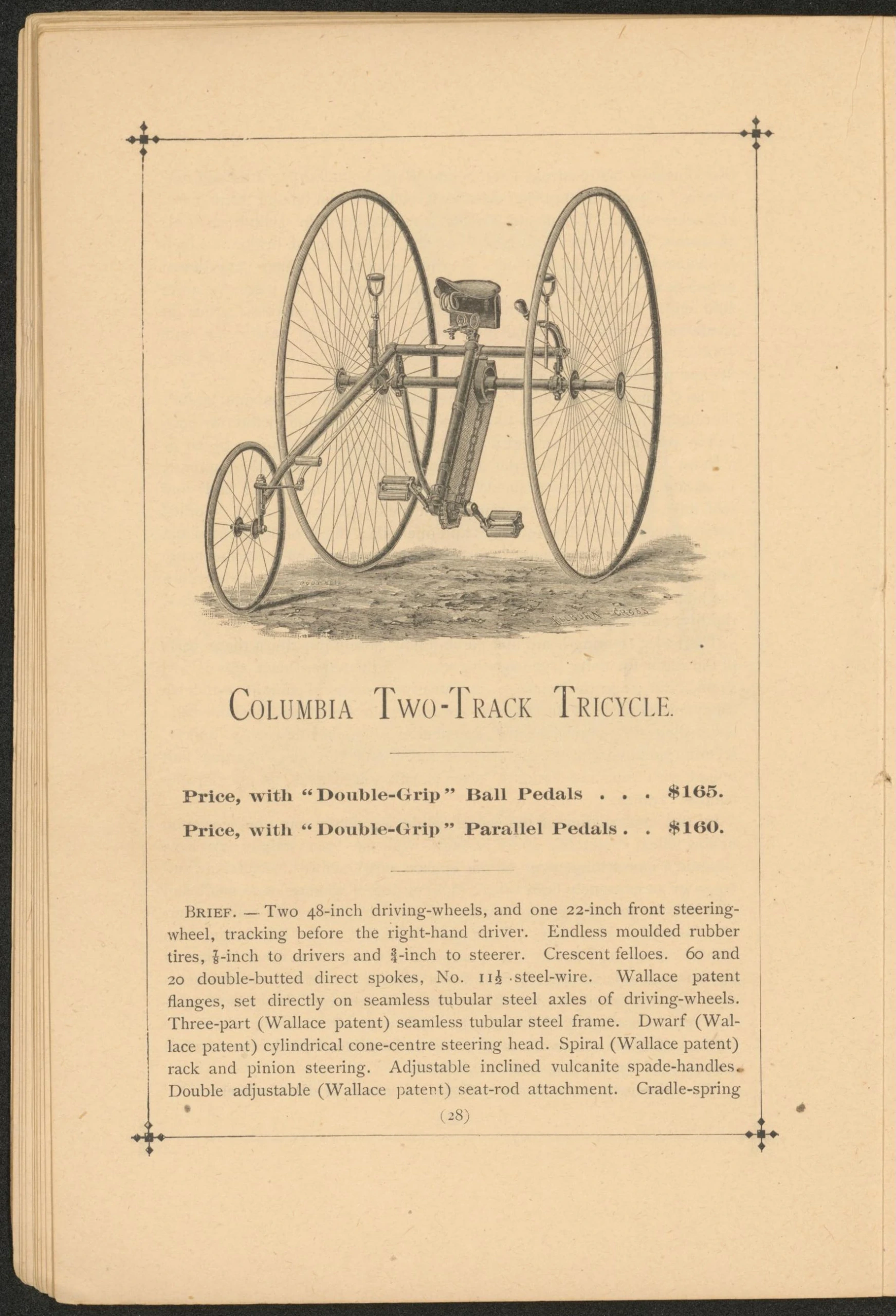
COLUMBIA TWO-TRACK TRICYCLE.
Price, with “Double-Grip” Ball Pedals . . . $165.
Price, with “Double-Grip” Parallel Pedals . . $160.
BRIEF. — Two 48-inch driving-wheels, and one 22-inch front steering-wheel, tracking before the right-hand driver. Endless moulded rubber tires, ⅞-inch to drivers and ¾-inch to steerer. Crescent felloes. 60 and 20 double-butted direct spokes, No. 11½ steel-wire. Wallace patent flanges, set directly on seamless tubular steel axles of driving-wheels. Three-part (Wallace patent) seamless tubular steel frame. Dwarf (Wallace patent) cylindrical cone-centre steering head. Spiral (Wallace patent) rack and pinion steering. Adjustable inclined vulcanite spade-handles. Double adjustable (Wallace patent) seat-rod attachment. Cradle-spring
(28)
[A ruled-border page with a wood engraving of the Columbia Two-Track Tricycle: two large driving wheels on a tubular axle, a small front steering wheel, a cradle-spring saddle, chain case and spade handles; artist’s and engravers’ signatures in the ground.]
— Page 31 —
(Harrington patent). Adjustable tricycle saddle. Columbia “double-grip” rubber (Latta patent), parallel pedals. Central crank and chain driving gear. Bicycle adjustable cranks. Foot-rest. Central compensating gear (Whitehead and Wallace patents). Columbia double-band (Wallace patent) brake. Columbia adjustable ball-bearings (Peters and Wallace patents) to all the wheels and the crank-shaft. Wallace patent sprocket-wheel, with purchaser’s choice of gearing to different speeds or powers. Tubular safety-stay. Wire dress-guard. Tool-bag, with oiler, screw-driver, and monkey-wrench. Width of track, 31 inches; total width, 36 inches. Finish, enamel and nickel tips. Weight, 80 lbs.
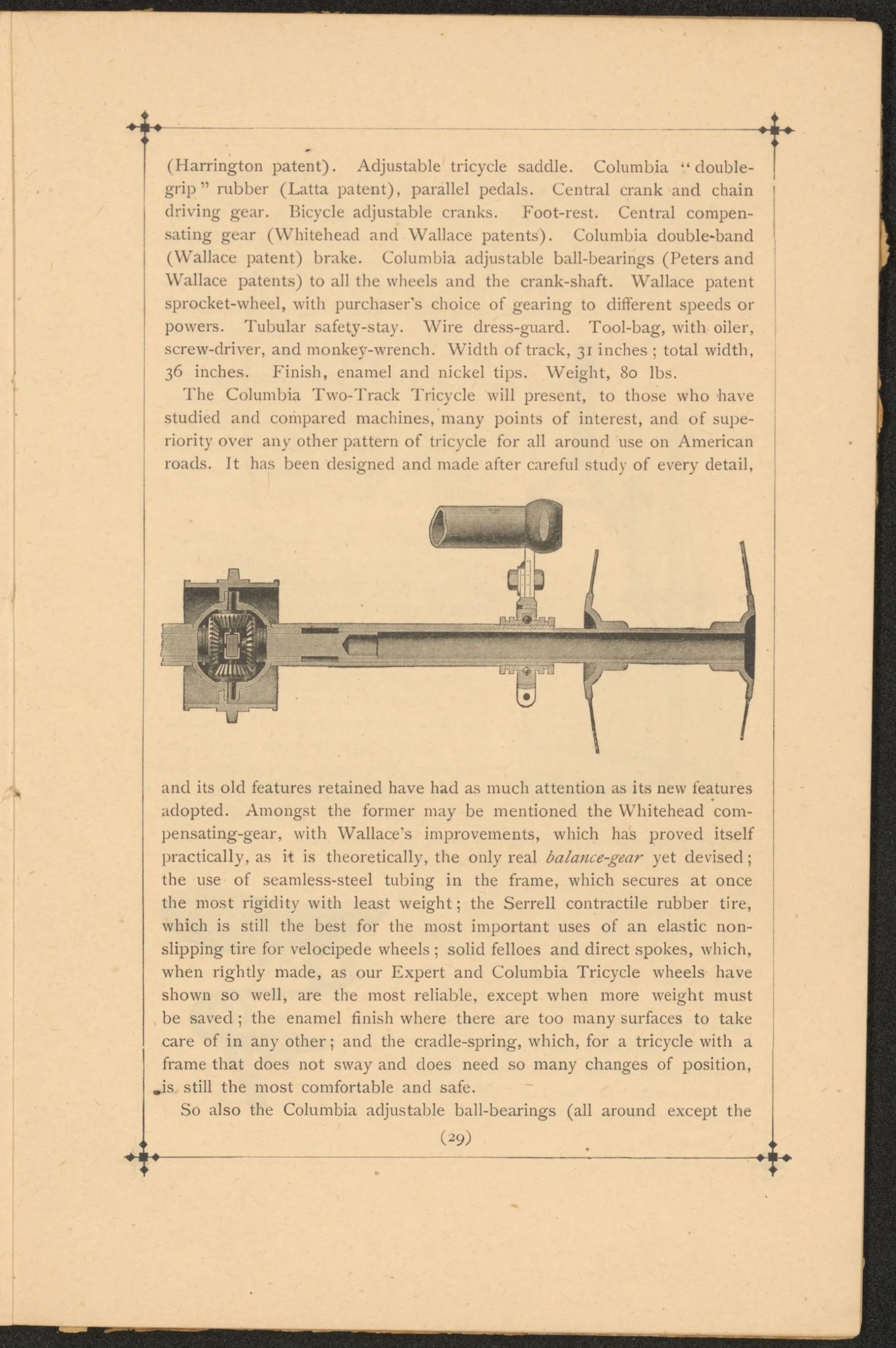
The Columbia Two-Track Tricycle will present, to those who have studied and compared machines, many points of interest, and of superiority over any other pattern of tricycle for all around use on American roads. It has been designed and made after careful study of every detail, and its old features retained have had as much attention as its new features adopted. Amongst the former may be mentioned the Whitehead compensating-gear, with Wallace’s improvements, which has proved itself practically, as it is theoretically, the only real balance-gear yet devised; the use of seamless-steel tubing in the frame, which secures at once the most rigidity with least weight; the Serrell contractile rubber tire, which is still the best for the most important uses of an elastic non-slipping tire for velocipede wheels; solid felloes and direct spokes, which, when rightly made, as our Expert and Columbia Tricycle wheels have shown so well, are the most reliable, except when more weight must be saved; the enamel finish where there are too many surfaces to take care of in any other; and the cradle-spring, which, for a tricycle with a frame that does not sway and does need so many changes of position, is still the most comfortable and safe.
So also the Columbia adjustable ball-bearings (all around except the
(29)
[A text page within a ruled border, with a sectional engraving of the tricycle’s driving axle showing the bevel compensating gear in its case, a frame bracket and a wheel flange.]
— Page 32 —
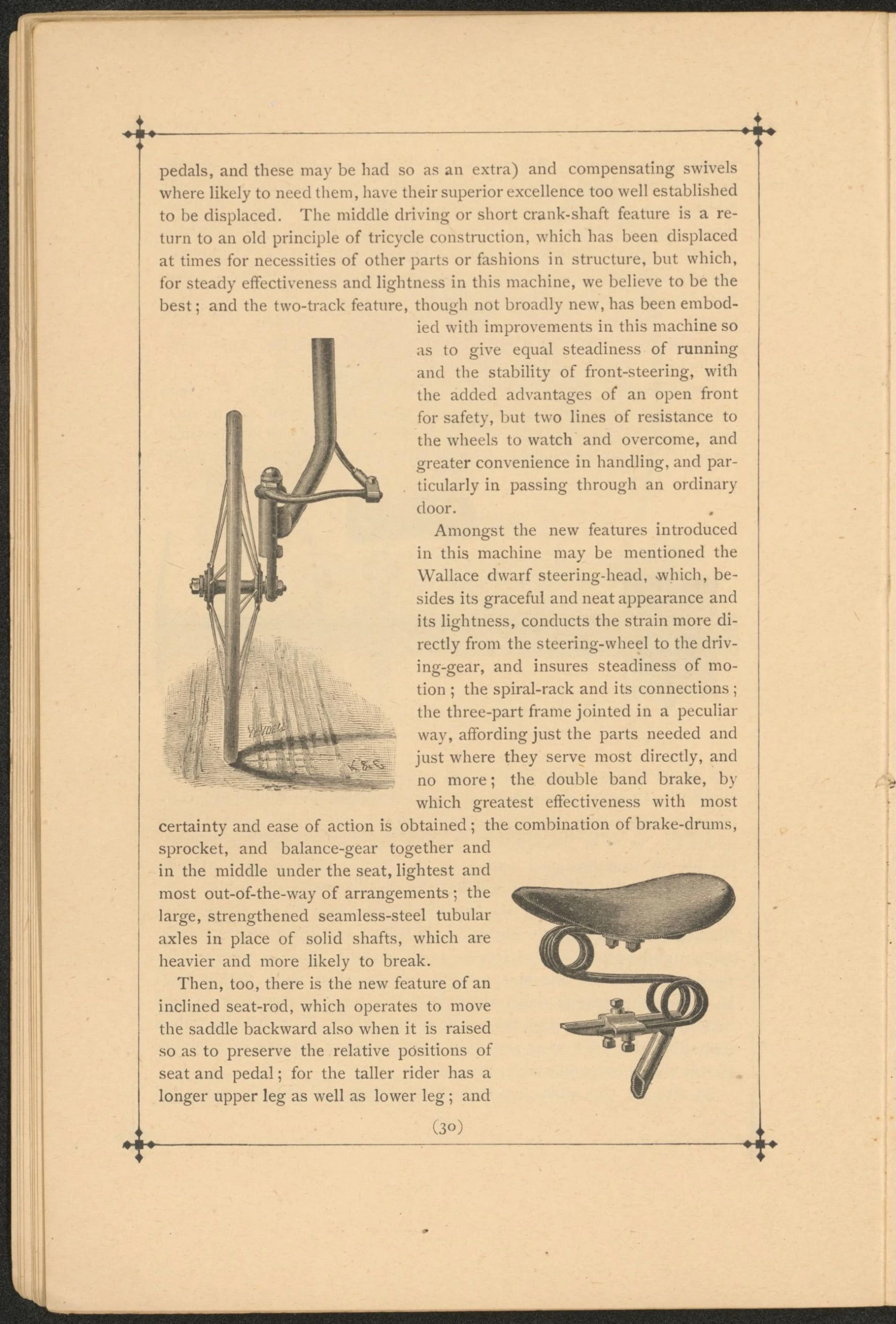
pedals, and these may be had so as an extra) and compensating swivels where likely to need them, have their superior excellence too well established to be displaced. The middle driving or short crank-shaft feature is a return to an old principle of tricycle construction, which has been displaced at times for necessities of other parts or fashions in structure, but which, for steady effectiveness and lightness in this machine, we believe to be the best; and the two-track feature, though not broadly new, has been embodied with improvements in this machine so as to give equal steadiness of running and the stability of front-steering, with the added advantages of an open front for safety, but two lines of resistance to the wheels to watch and overcome, and greater convenience in handling, and particularly in passing through an ordinary door.
Amongst the new features introduced in this machine may be mentioned the Wallace dwarf steering-head, which, besides its graceful and neat appearance and its lightness, conducts the strain more directly from the steering-wheel to the driving-gear, and insures steadiness of motion; the spiral-rack and its connections; the three-part frame jointed in a peculiar way, affording just the parts needed and just where they serve most directly, and no more; the double band brake, by which greatest effectiveness with most certainty and ease of action is obtained; the combination of brake-drums, sprocket, and balance-gear together and in the middle under the seat, lightest and most out-of-the-way of arrangements; the large, strengthened seamless-steel tubular axles in place of solid shafts, which are heavier and more likely to break.
Then, too, there is the new feature of an inclined seat-rod, which operates to move the saddle backward also when it is raised so as to preserve the relative positions of seat and pedal; for the taller rider has a longer upper leg as well as lower leg; and
BODWELL [?] | K. & C.
(30)
[A text page within a ruled border, with engravings of the tricycle’s dwarf steering head and front wheel, signed, and of the tricycle saddle on its coiled cradle spring and clip.]
— Page 33 —
by an ingenious attachment of the crank-supporting tube tangent to the horizontal one, instead of flush with it, as usual, this seat-rod is made to move in and out in it, out of the way of everything.
Another and most valuable new departure in this machine is the building of the wheels directly upon the tubular half-axles; thus getting a firm wheel, a safer axle, and dispensing with a large amount of misplaced material.
The central crank and chain driving mechanism as modified for this machine, gives opportunity for the adjustable bicycle cranks, whereby a longer throw can be had for sandy or hard riding, and a shorter throw for easy roads.
The Wallace patent sprocket-wheels are made by us in five changes; so that the purchaser may have his machine run as “geared even,” — that is, as a 48-inch driver, — or, if he have good roads and be strong, he may have it geared as a 51½-inch, or as a 55-inch, which would be “geared up;” or, if he have hard roads and be not strong, or care more for ease than speed in riding, he may have it as a 44½-inch, or as a 41-inch, which would be “geared down;” and one of these last two will be best chosen for ladies’ use, while the “even” gear is recommended for the gentleman beginner.
The gearing of each machine may be ascertained by the number of teeth in the sprocket-wheels. The upper wheel always having 14 teeth, when the lower one has the same number the machine is geared even. When the lower wheel has 12 teeth it is geared as a 41-inch driver; with 13 teeth, as a 44½-inch; with 15 teeth, as a 51½-inch, and with 16 teeth, as a 55-inch.
The adjustment for taking up the slack of chain is much better on this machine than on previous ones; and the user can, at small trouble or expense, change his gearing from one size to the next by a change of the lower sprocket-wheel only, without change of chain except that with a difference of more than one size, the chain should be made shorter or longer by a link or two.
By these and other improvements in construction, the weight of a tricycle has been reduced more than fifteen pounds without weakening any part, and in fact securing greater strength.
(31)
[A text page within a ruled border with ornamental corners; the lower third of the frame is blank.]
— Page 34 —
BODWELL | KILBURN & CROSS
LADIES’ COLUMBIA TWO-TRACK TRICYCLE.
Price, with “Double-Grip” Ball Pedals . . . $175.
Price, with “Double-Grip” Parallel Pedals . . $170.
BRIEF. — Two 44-inch driving-wheels, and one 20-inch front steering-wheel, tracking before the right-hand driver. Endless moulded ¾-inch rubber tires. Crescent felloes. 56 and 24 full-tangent spokes, No. 14 steel-wire. Three-part (Wallace patent) seamless tubular steel frame. Dwarf (Wallace patent) cylindrical cone-centre steering head. Columbia lock steering (Pope patent). Adjustable inclined vulcanite spade-handles. Double adjustable (Wallace patent) seat-rod attachment. Cradle-spring (Harrington patent). Adjustable tricycle saddle. Columbia “double-grip” rubber (Latta patent) ball-pedals (Peters and Wallace patents).
(32)
[A ruled-border page with a wood engraving of the Ladies’ Columbia Two-Track Tricycle, with tangent-spoked driving wheels, small front steerer, cradle-spring saddle and chain case; artist’s and engravers’ signatures in the ground.]
— Page 35 —
Central crank and chain-driving gear. Bicycle adjustable cranks. Foot-rest. Central compensating gear (Whitehead and Wallace patents). Columbia double-band (Wallace patent) brake. Columbia adjustable ball-bearings (Peters and Wallace patents) all around. Tubular safety-stay. Wire dress-guard. Tool-bag, with oiler, screw-driver, and monkey-wrench. Width of track, 31 inches; total width, 36 inches. Finish, enamel and nickel tips. Weight, 70 lbs.
A light and elegant machine for ladies, and suitable also for men weighing up to 130 pounds, or careful riders of greater weight.
The great success of our regular Columbia Two-Track Tricycle, described on the preceding pages, and its decided practical advantages, have led us to adopt that general form of construction for this tricycle. In its details, however, it presents some special modifications of importance, for the most part tending to an economy of weight, while presenting the greatest strength possible with the amount of material employed.
The frame is similar to that of the previous machine, but of slightly lighter seamless tubing; and a considerable amount of weight is also saved in the construction of the driving-wheels. These are 44 inches in diameter, and are made with our new full-tangent spoke, described on page 27, though the wire used in these wheels is of a larger gauge than that of the Racer. Notwithstanding the lightness of the wheels, however, they are extremely rigid.
Another new and valuable feature is presented in the ingenious steering-mechanism. The rod running from the steering-head bracket-arm connects at its upper end by a ball-and-socket joint with the long arm of a lever pivoted at its angle to the frame. The short arm of the lever is linked to a nut running on a quick thread upon the steering-handle upright, and receives its motion up or down by the turning of the handle to the right or left. While the action is positive and quick, without being over-sensitive, the steering-wheel cannot be deflected from its course, even when the hand is removed. The joints being adjustable for wear, all rattling is obviated.
The chain is the improved Ewart, already described on page 21. It is very strong and light, and more readily adjustable in length than any other chain, by reason of the ease with which the links may be taken apart. This renders the adjustment of the machine for different riders much more simple than is the case with any other tricycle. By loosening its binding-bolt, the bracket carrying the lower sprocket-wheel may be moved up or down and the chain shortened or lengthened as the case requires.
The Wallace patent sprocket-wheel is used, and while each machine, unless otherwise ordered, will be furnished geared “even,” that is, as a 44-inch driver, it will be fitted, if so ordered, with either a 48 or 52 inch gear, or these wheels may be had at any time as extras.
(33)
[A text page within a ruled border with ornamental corners.]
— Page 36 —
KILBURN & CROSS | BODWELL
COLUMBIA RACING TRICYCLE.
Price, complete . . . . . . . . . . $180.
Weight, all on, 47½ lbs.
BRIEF. — Two 42-inch driving-wheels, and one 18-inch front central-steering-wheel. Endless-moulded red-rubber tires, ½-inch. Columbia hollow felloes (White patent) to driving-wheels, crescent felloe to steering-wheel. No. 14 steel-wire resultant-spokes, 48 (Wallace patent) to driving, 20 (Work patent) to steering-wheel. Tubular-steel Tee frame. Tubular half-axles, with very light central balance-gear (Whitehead and Wallace patents). Central crank and chain driving-gear. Wallace patent sprocket-wheel, geared to 61 inches. Bicycle cranks, 5¼
(34)
[A ruled-border page with a wood engraving of the Columbia Racing Tricycle: a light T-frame with two tangent-spoked 42-inch drivers, small front steering wheel, long handle-bar, saddle and central chain drive; engravers’ and artist’s signatures in the ground.]
— Page 37 —
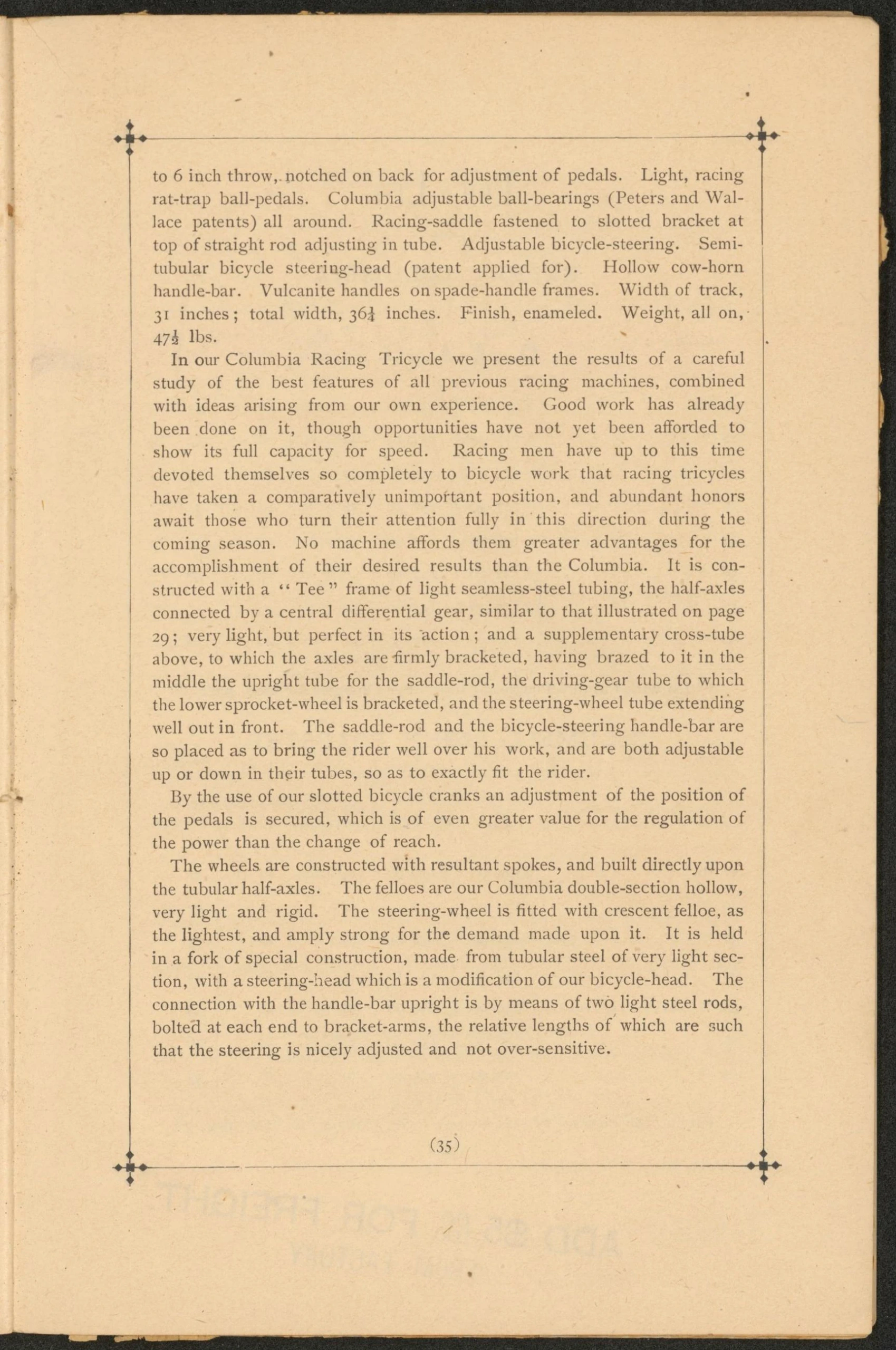
to 6 inch throw, notched on back for adjustment of pedals. Light, racing rat-trap ball-pedals. Columbia adjustable ball-bearings (Peters and Wallace patents) all around. Racing-saddle fastened to slotted bracket at top of straight rod adjusting in tube. Adjustable bicycle-steering. Semi-tubular bicycle steering-head (patent applied for). Hollow cow-horn handle-bar. Vulcanite handles on spade-handle frames. Width of track, 31 inches; total width, 36¼ inches. Finish, enameled. Weight, all on, 47½ lbs.
In our Columbia Racing Tricycle we present the results of a careful study of the best features of all previous racing machines, combined with ideas arising from our own experience. Good work has already been done on it, though opportunities have not yet been afforded to show its full capacity for speed. Racing men have up to this time devoted themselves so completely to bicycle work that racing tricycles have taken a comparatively unimportant position, and abundant honors await those who turn their attention fully in this direction during the coming season. No machine affords them greater advantages for the accomplishment of their desired results than the Columbia. It is constructed with a “Tee” frame of light seamless-steel tubing, the half-axles connected by a central differential gear, similar to that illustrated on page 29; very light, but perfect in its action; and a supplementary cross-tube above, to which the axles are firmly bracketed, having brazed to it in the middle the upright tube for the saddle-rod, the driving-gear tube to which the lower sprocket-wheel is bracketed, and the steering-wheel tube extending well out in front. The saddle-rod and the bicycle-steering handle-bar are so placed as to bring the rider well over his work, and are both adjustable up or down in their tubes, so as to exactly fit the rider.
By the use of our slotted bicycle cranks an adjustment of the position of the pedals is secured, which is of even greater value for the regulation of the power than the change of reach.
The wheels are constructed with resultant spokes, and built directly upon the tubular half-axles. The felloes are our Columbia double-section hollow, very light and rigid. The steering-wheel is fitted with crescent felloe, as the lightest, and amply strong for the demand made upon it. It is held in a fork of special construction, made from tubular steel of very light section, with a steering-head which is a modification of our bicycle-head. The connection with the handle-bar upright is by means of two light steel rods, bolted at each end to bracket-arms, the relative lengths of which are such that the steering is nicely adjusted and not over-sensitive.
(35)
[A text page within a ruled border with ornamental corners; the heading of the next page shows through faintly below.]
— Page 38 —
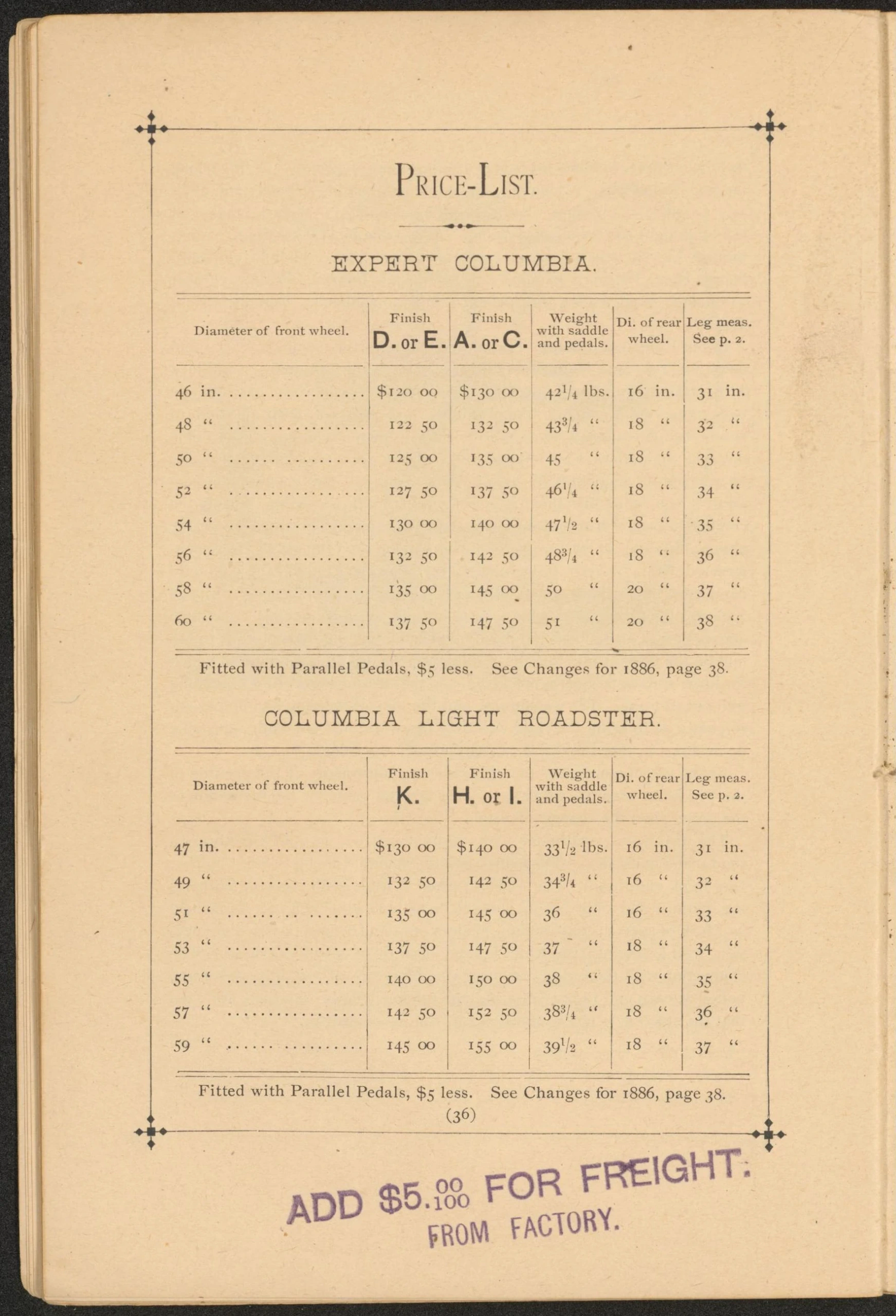
PRICE-LIST.
EXPERT COLUMBIA.
Diameter of front wheel. | Finish D. or E. | Finish A. or C. | Weight with saddle and pedals. | Di. of rear wheel. | Leg meas. See p. 2.
46 in. | $120 00 | $130 00 | 42¼ lbs. | 16 in. | 31 in.
48 ” | 122 50 | 132 50 | 43¾ ” | 18 ” | 32 ”
50 ” | 125 00 | 135 00 | 45 ” | 18 ” | 33 ”
52 ” | 127 50 | 137 50 | 46¼ ” | 18 ” | 34 ”
54 ” | 130 00 | 140 00 | 47½ ” | 18 ” | 35 ”
56 ” | 132 50 | 142 50 | 48¾ ” | 18 ” | 36 ”
58 ” | 135 00 | 145 00 | 50 ” | 20 ” | 37 ”
60 ” | 137 50 | 147 50 | 51 ” | 20 ” | 38 ”
Fitted with Parallel Pedals, $5 less. See Changes for 1886, page 38.
COLUMBIA LIGHT ROADSTER.
Diameter of front wheel. | Finish K. | Finish H. or I. | Weight with saddle and pedals. | Di. of rear wheel. | Leg meas. See p. 2.
47 in. | $130 00 | $140 00 | 33½ lbs. | 16 in. | 31 in.
49 ” | 132 50 | 142 50 | 34¾ ” | 16 ” | 32 ”
51 ” | 135 00 | 145 00 | 36 ” | 16 ” | 33 ”
53 ” | 137 50 | 147 50 | 37 ” | 18 ” | 34 ”
55 ” | 140 00 | 150 00 | 38 ” | 18 ” | 35 ”
57 ” | 142 50 | 152 50 | 38¾ ” | 18 ” | 36 ”
59 ” | 145 00 | 155 00 | 39½ ” | 18 ” | 37 ”
Fitted with Parallel Pedals, $5 less. See Changes for 1886, page 38.
(36)
ADD $5.00/100 FOR FREIGHT. FROM FACTORY.
[A price-list page within a ruled border, two tables by wheel size. Below the border a later violet rubber-stamp, “Add $5.00 for freight from factory,” evidently applied by the San Francisco agents.]
— Page 39 —
STANDARD COLUMBIA.
Diameter of front wheel. | Finish. G. | Finish. F. | Finish. B. | Weight with saddle and pedals. | Di. of rear wheel. | Leg meas. See p. 2.
42 in. | $75 00 | $85 00 | $90 00 | 43¼ lbs. | 16 in. | 29 in.
44 ” | 77 50 | 87 50 | 92 50 | 45 ” | 16 ” | 30 ”
46 ” | 80 00 | 90 00 | 95 00 | 45½ ” | 16 ” | 31 ”
48 ” | 87 50 | 97 50 | 102 50 | 46¾ ” | 18 ” | 32 ”
50 ” | 90 00 | 100 00 | 105 00 | 48 ” | 18 ” | 33 ”
52 ” | 92 50 | 102 50 | 107 50 | 49¾ ” | 18 ” | 34 ”
54 ” | 95 00 | 105 00 | 110 00 | 51½ ” | 18 ” | 35 ”
56 ” | 97 50 | 107 50 | 112 50 | 53 ” | 18 ” | 36 ”
58 ” | 100 00 | 110 00 | 115 00 | 54 ” | 20 ” | 37 ”
60 ” | 102 50 | 112 50 | 117 50 | 55 ” | 20 ” | 38 ”
With Parallel Bearings to front wheel, $5 less.
COLUMBIA SEMI-ROADSTER.
Diameter of front wheel. | Finish D. | Weight all on. | Leg measure.
42 in. | $80 00 | 32½ lbs. | 29 in.
44 ” | 82 50 | 33 ” | 30 ”
46 ” | 85 00 | 33½ ” | 31 ”
48 in. | $87 50 | 34 lbs. | 32 in.
50 ” | 90 00 | 34½ ” | 33 ”
Fitted with Ball-Pedals, $5 extra.
Price of the COLUMBIA TWO-TRACK TRICYCLE, $165; with Parallel Pedals, $160.
” ” LADIES’ COLUMBIA TWO-TRACK TRICYCLE, $175; with Parallel Pedals, $170.
” ” COLUMBIA SAFETY, $140; with Parallel Pedals, $135.
” ” ” RACER, $140.
” ” ” RACING TRICYCLE, $180.
For Classification of Finishes, and Nickel and Enamel, see page 39.
(37)
ADD $5.00/100 FOR FREIGHT. FROM FACTORY.
[A price-list page within a ruled border: the Standard Columbia table and a two-part Semi-Roadster table, with tricycle and other prices below. A violet rubber-stamp, “Add $5.00 for freight from factory,” below the border.]
— Page 40 —
CHANGES FOR 1886.
Below we present a summary of the changes which we make this year in the EXPERT, LIGHT ROADSTER, and STANDARD. It will be seen that they are all such as to add materially to the value and the already well-recognized and proven excellence of Columbia bicycles.
While we have in no case increased the prices, we have made reductions in some particulars; so that our many customers are afforded unprecedented advantages in the superiority of machines, and moderate prices, — which they will not fail to appreciate.
EXPERT COLUMBIA.
Keyed-in continuous hollow cow-horn handle-bar, Kirkpatrick saddle, and Columbia “double-grip” ball-pedals added, without extra charge; or “double-grip” parallel-pedals, $5 less. (In either case a virtual reduction of $10 from last year’s prices, with corresponding equipment.)
Finishes A and C, reduced $5. (A virtual reduction of $15, in all, from last year).
Finish D reduced $2.50: — to price of Finish E.
COLUMBIA LIGHT ROADSTER.
Patent cold-drawn and rolled seamless hollow felloes to both wheels, single resultant spokes to rear wheel, Kirkpatrick saddle, and Columbia “double-grip” ball-pedals added, without extra charge; or “double-grip” parallel-pedals, $5 less.
Finishes H and I reduced $5.
STANDARD COLUMBIA.
Ball-bearings added to front wheel without extra charge; parallel bearings, $5 less.
Finishes B and F reduced $5.
Sizes 42, 44, and 46 inches, reduced $5.
COLUMBIA DOUBLE-GRIP BALL-PEDALS. — Price reduced to $10.
NEW MACHINES.
COLUMBIA SAFETY BICYCLE. — See description, pages 20 and 21.
COLUMBIA SEMI-ROADSTER. — See description, pages 22 to 25.
COLUMBIA RACER. — See description, pages 26 and 27.
LADIES’ COLUMBIA TWO-TRACK TRICYCLE. — See pages 32 and 33.
COLUMBIA RACING TRICYCLE. — See description, pages 34 and 35.
(38)
[A text page within a ruled border on a separate, darker leaf printed askew and set slightly out of line with the book; its right edge is stained and frayed, and the page beneath shows at left.]
— Page 41 —
OSBORN & ALEXANDER,
BICYCLE DEPARTMENT,
No. 13½ Post St., above Montgomery, San Francisco.
RIDING SCHOOL.
We have a competent Instructor who will teach beginners [t]o ride in a few lessons. Every one should embrace this oppor[t]unity to acquire the fascinating habit of riding a Bicycle. Any [o]ne can learn—old or young. Charges moderate.
REPAIRING.
Our Repair Shops for Bicycles and Tricycles is in charge [o]f a thorough mechanic, who has years of experience in that line.
NICKELING.
Old Machines re-nickeled at reasonable rates.
ENAMELING.
Machines can only be enameled properly at the factory east, [b]ut we can apply a liquid which presents a neat enameled [a]ppearance. Sold in bottles, with brush, 75 cents.
INSTALLMENT PLAN.
Bicycles and Tricycles sold on the Installment Plan.
Bicycles Leased by the Day, Week or Month.
A Full Line of POPE’S COLUMBIA and GORMULLY & JEFFERY’S AMERICAN BICYCLES and TRICYCLES.
All the Latest Bicycle Journals on File.
Be sure and call at our Warerooms to see all the Latest Improvements.
6-11-86
[A second inserted San Francisco agents’ leaflet on tan paper, in mixed display types with pointing-hand ornaments and the same print code as the first insert. The left edge is torn and stained at the binding, cutting the first letters of several lines.]
— Page 42 —
[The blank reverse of the second Osborn & Alexander leaflet; the printing on the other side shows through in mirror image. The right edge is torn and stained.]
— Page 43 —
CLASSIFICATION OF COLUMBIA FINISHES.
A. Every part nickeled.
B. Felloes painted, balance nickeled.
C. Felloes and spokes enameled, balance nickeled.
D. Perch, forks, felloes, and spokes enameled, balance nickeled.
E. Perch, forks, and felloes enameled, balance nickeled.
F. Perch, forks, steering-head, felloes, and spokes enameled, balance nickeled.
G. Perch, forks, and felloes painted, balance polished.
H. Felloes enameled, balance nickeled.
I. Wheels enameled, balance nickeled.
K. Perch, forks, and wheels enameled, balance nickeled.
COLUMBIA NICKEL PLATING
Is universally acknowledged to be superior to any other in common use, and to this excellence is largely due the reputation our machines have acquired for unequalled elegance and endurance of finish. Every part plated is finely polished, well coated with copper, then covered with an extra-thick deposit of pure nickel, and carefully buffed. We put out our plating, however, with a caution in regard to the care which should be taken of it. All nickeled parts should be wiped dry when the machine is put away after riding in rain, fog, dew, or mud, and should be occasionally rubbed with polishing paste. Do not use oil on nickel unless it be immediately rubbed off.
COLUMBIA ENAMEL.
Of the several styles of finish, enameling has become the favorite with many riders both of bicycles and tricycles, as it is handsomer than painting and is not affected by dampness, like burnishing, or even nickeling. After repeated tests of all the accessible enamels in use, we produced and applied our COLUMBIA ENAMEL, submitting it to the actual tests of long every-day use, as well as the severest tests of the shop, and with equally favorable results. Our process of enameling is very thorough, every part being polished, then three coats of enamel carefully applied with a brush, and each baked on in an oven. Finally, it is burnished sufficiently to give it a lustre. We finish it in plain black, without stripes.
As in the case of nickel, it is to be expected that enamel should receive some care; and, in particular, oil should not be allowed to remain upon it.
(39)
[A text page within a ruled border on the same darker stock as page 38, evidently the other side of that leaf; the inner edge is torn and stained at the binding.]
— Page 44 —
THE COLUMBIA BALL-PEDAL,
In its improved form, possesses various advantages over other ball-pedals in point of patterns employed in its construction as well as the carefulness with which it is made.
The end-plates are one piece, drop-forged in entirely new dies, made sufficiently heavy where the greatest strains come, but lightened considerably by leaving out metal where it is not needed, and presenting a new and better angle for the cones upon which the balls run. This secures a smoother running of the bearings, and less wear and liability of crushing the balls.
The pedal-frame is completed by a central steel tube, which entirely protects the pin from contact with the foot, and the bearings from the entrance of dust. The rods passing through the rubbers are threaded upon the inner ends, and fitted with small and neat nuts, so as to be easily removed and replaced. The pedal-pin is tapered and strengthened at the right end; and there are two rows of steel balls, eleven at each end, made with such accuracy that by actual micrometer tests they do not vary one two-thousandth of an inch in size.
COLUMBIA DOUBLE-GRIP | PAT. JULY 28, 85.
The elastic bars are of our new “double-grip” pattern, which, by its peculiar form, affords a firmer hold than any other for the foot, increasing with additional pressure. They turn with sufficient freedom upon their rods to conform readily to the sole of the shoe; while the leaves of the pattern — appearing clearly in the sectional view above — yield enough to give a thorough grip. The exceptionally pure quality of the rubber used in the bars contributes to this effect by its superior elasticity, and its durability is greater than that of the harder rubber used in many other pedals. The elastic form and quality of the bars serve to take up much of the jar which is felt by the feet in riding over rough ground.
This new pedal is made under the Peters, Wallace, and Latta patents, and is the nearest to perfection yet attained. Price per pair, nickeled, $10.
(40)
[A text page within a ruled border, with engravings of the Columbia ball-pedal with a four-leaved section of its rubber, and of a single rubber bar lettered “Columbia Double-Grip, Pat. July 28, 85.”]
— Page 45 —
THE KIRKPATRICK SADDLE.
Having acquired the full rights of this already well-known and favorite saddle, we now make it ourselves (under the Shire, Veeder, and Kirkpatrick patents), essentially the same as it appeared last season.
The peculiar advantages possessed by it arise from its general construction, — with a perfectly adjustable frameless or hammock-pattern seat, suspended between fore and aft springs; a combination by which all jars and vibrations of the machine are absorbed, and the tendency to headers much decreased. The front springs (completely covered by our patents) are of very material importance in contributing to this effect.
The seat proper is of the finest leather procurable, and its form, with long cut-out, admits of its shaping itself perfectly to the form of the rider, obviating all chafing, and any uncomfortable or harmful pressure. It has no metal frame, but a re-inforcing piece of leather sewed on the under side, which reduces to a minimum the liability to lose shape.
Our improvements for this season consist in using round front springs in each variety of the saddle, and in shaping the leather so as to prevent the raw edge from coming in contact with the rider.
This saddle is easily and quickly placed in position, and its tension regulated by simply setting the click back or forward. It is applicable to any bicycle, by the use of different front springs and perch-clip. In ordering, state for what machine it is desired.
Price, nickeled, $6.
THE KNOUS ADJUSTABLE SADDLE
Is the finest of the “long-distance” type yet put out, presenting several important improvements in construction which make it very light, strong, elastic, and easily adjustable. The frame consists of two light but amply strong sections of flat spring steel, the one attached firmly to the cantle to which the flexile leather top is riveted at the back, and then bent below at a right angle to form an adjusting joint with the other section, which, extending the length of the saddle, has the leather riveted to it at its forward end.
(41)
[A text page within a ruled border, with engravings of the Kirkpatrick hammock saddle on its looped front spring and of the Knous adjustable saddle.]
— Page 46 —
The adjustment between the sections of the frame, and by which the proper tension of the seat is preserved, is positively governed by the square-headed set-screw appearing in the cut passing freely through the bent-up end of the lower section and into a threaded hole in the upper, with its re-inforcing block beyond.
The attachment of the saddle to the bicycle spring is by means of an improved clip, the lower strap of which is made with an open slot at one end and a closed one at the other, — a device which, obviating the necessity of removing the nuts of the clip, greatly facilitates the attachment. Another feature is the freedom of the clip, allowing it to be moved forward or backward upon the spring section, and regulating the tilt of the saddle.
Price, with nickeled straps, $4.
THE COLUMBIA SWING-SPRING
Combines the best contributions of three different inventors towards the solution of the difficult problem in bicycle seat-springs. The jar incident to all riding must be either vertical, lateral, or fore-and-aft, or a combination of two of these. The wheel itself and its freedom of motion relieve sufficiently the lateral jar, it has been found; and lateral yield in the spring, to any considerable extent, gives an unsteadiness of the seat which has condemned for most riders several otherwise good springs. The ordinary bolted clip-spring is, where well made, sufficient relief from the vertical jar. But the fore-and-aft jarring, caused by meeting obstructions to the large wheel, and the constant vibration of the small wheel, have hitherto found no efficient relief except with springs otherwise very objectionable. This last difficulty the Columbia Swing-Spring overcomes by means of two pendent links combined with other parts in a peculiar way, as shown in the cut, so as to allow a fore-and-aft motion of the seat to a limited but sufficient extent to stop vibration, and to ease the rider over considerable obstructions. In averting headers it is a safety device beyond any other in the market. This spring is only applicable to the EXPERT and LIGHT ROADSTER. Price, nickel-plated, $5.
A neat plate, for the owner’s name, is made to cover the screw-holes in perch when the regular spring-clip is removed. Price, 25c.
(42)
[A text page within a ruled border, with an engraving of the Columbia swing-spring and saddle mounted on a bicycle’s head and backbone.]
— Page 47 —
CRADLE-SPRING.
By a special arrangement with the patentee, and the carrying of a large stock, we are enabled to furnish Harrington’s Cradle-Spring, when desired, with our new machines, at an extra charge. We also supply it regularly to customers. In ordering, state weight of rider. Price, bright, $5; enameled, $5.50; nickeled, $6.
THE GOULD SPOKE CYCLOMETER.
We have selected this cyclometer for our list on account of its low price, and its simple construction, which is such as to afford accuracy in its working, and not so much liability to get out of order as in the case of some cyclometers.
It is fastened to either side of the machine upon the inside of one of the spokes, at a distance of 3 or 4 inches from the edge of the hub-flange, with the vulcanite-tipped lever-arm extending between the spokes so as to come in contact with the fork at each revolution of the wheel; and the arm being deflected and turning the shaft, whose head appears on the side of the case, gives a positive movement to the works within, and so to the dial and the hands upon it.
In order to preserve the greatest simplicity in its construction, — a point of material importance, — a new method of registery has been adopted. The long hand indicates miles and fractions, while the index records the number of its complete revolutions about the dial. Thus in the cut a reading of 406¾ [?] miles is clearly shown.
The cyclometer is 1¾ [?] inches in diameter, weighs only two ounces, and is practically dust and water proof.
In ordering, state size of machine and kind of spokes which it is to fit. Price, nickel-plated, $4.
(43)
[A text page within a ruled border, with engravings of Harrington’s coiled cradle-spring, the Gould cyclometer case in side view with its lever arm, and its dial numbered 5 to 50 with an inner index ring.]
— Page 48 —
BICYCLE LANTERNS.
OUR LANTERNS, as now made, with large plate-glass fronts, and finely polished and laminated parabolic reflectors; their springs, and their safety and their convenience provisions, are superior to most that have been in the market, and fully equal to the best.
THE EVENING STAR BICYCLE LANTERN is in form for a hub-light only, as shown in the cut, but with an improved positive wick-detainer, adjustable side-arms, adjustable axle-support to prevent rattling, suspension springs to relieve from jar, a slide for igniting the wick without opening the door, and a large wick-and-oil reservoir. We offer this as our latest and best bicycle lantern, and as one equal in lighting capacity, in security of fastenings, in convenience of use, in durability, good appearance and noiselessness, to any lantern in the market. The joints and edges have been strengthened, the springs are of steel, the wick-detainer extends to the outside, and is set there, so that the lamp can be lighted, the flame adjusted, set, and extinguished without opening the door, and the fastenings are very convenient. Price, japanned, $6.00; nickeled, $7.00.
THE CONVERTIBLE BICYCLE LANTERN, as shown in the accompanying cuts, is extra large, trebly secure, and of handsome form and finish. It is contrived for use either as a hub-light or a head-light. It has specially sure wick-detainer, security fastenings, and door-catch, red and green side-glasses, red rear-glass, large plate-glass front, and a parabolic reflector of peculiar surfaces. Price, japanned, $4.00; nickeled, $4.50; with head attachment, $1.00 extra.
(44)
[A text page within a ruled border, with engravings of the Evening Star hub lantern and two views of the Convertible lantern, one with its head bracket.]
— Page 49 —
COLUMBIA TRICYCLE LANTERN.
This lantern, adapted especially to the tricycle (though capable of good use for a bicycle head-light), is constructed in the same thorough and safe manner as our CONVERTIBLE BICYCLE LANTERN; but, in place of the attachments of the latter, it has a rubber buffer-spring clamp riveted to the back of it, made to fit a clip attached to the frame of the tricycle, and by which the jar is relieved. Price, japanned, $4.50; nickeled, $5.25.
Expert Head-Lantern Bracket, for attachment of lantern to head of Expert, nickeled, $1.
THE COLUMBIA SPOKE-GRIP
Is the simplest grip in use, and is entirely effective in its working.
It is dropped-forged, with case-hardened jaw; will not slip when properly placed upon the spoke, and will not wear out easily.
Price, nickeled, $1.
THE PERFECTION BICYCLE ALARM
Will fit any machine made, is fastened to the brake upright, and is out of the way, and unaffected by headers. It will not rattle.
The spring to operate the alarm is contained within the bell, and is wound up by a button on the outside of the gong.
The alarm is given by a slight forward pressure on the projecting lever, which releases the spring movement.
A simple alarm-stroke, a succession of strokes, or a continuous alarm, at pleasure of rider.
Price, nickeled, $2.50.
(45)
[A text page within a ruled border, with engravings of the tricycle lantern with its buffer clamp, the spoke-grip wrench and the Perfection alarm gong with its winding button and lever.]
— Page 50 —
STANDARD BELLS.
THE POPE MANUFACTURING CO. BOSTON MASS.
No. 2. | No. 3.
These bells are the most substantial of the various bells offered to cyclists, ring well, and are the neatest low-priced bells made.
They are attached to the handle-bar or brake in such a manner that the gong cannot jar loose, an advantage which will be fully appreciated by those who have had the usual top-nut or screw in other bells loosen and get lost, or their bells fail to ring when desired.
PRICES. — No. 0, Small Size, Flat Spring Clapper, 50c.; No. 2, Medium Size, Flat Spring Clapper, 75c.; No. 3, Small Size, Swing Clapper, Closed Base, $1; No. 4, Medium Size, Swing Clapper, Open Base, $1; No. 5, Medium Size, Swing Clapper, Closed Base, $1.25.
HILL & TOLMAN AUTOMATIC ALARM.
The alarm is sounded by pressing the lever with the thumb, when the whole arrangement turns slightly on a pivot, and a small roll, projecting through the back plate of the bell, is brought in contact with the moving rubber tire and rapidly rotated, producing a continuous ringing until the lever is released. Price, $3. In ordering, give the name of the machine for which it is desired.
THE PEERLESS STOP BELL.
Is silent when hammer is caught over edge of bell. This is particularly recommended for young riders, and use in towns where continuous ringing-bells are required by ordinance. Two-and-a-half-inch gong. Price, 50c.
(46)
[A text page within a ruled border, with engravings of bells No. 2 (its gong lettered with the Pope company name) and No. 3, the Hill and Tolman alarm mounted at a bicycle head over the tire, and the Peerless stop bell on its clamp.]
— Page 51 —
PADLOCKS AND CHAINS.
The No. 1 Padlock is about twice as large as shown by the accompanying cut, is made of brass, with a 12-inch brass chain, and is very strong. Price, 50 cents.
The No. 2 is of same size as shown by cut, is of lighter weight, but sufficiently strong for the wheelman’s needs. It is also made of brass, and locks with a small flat key. Price 50c.
No. 1. | 83 | No. 2.
The Yale locks are so well known as to need no description. The cut shows the full size of the lock, which is made of bronze throughout, and is practically indestructible. Price, $1; nickel-plated, $1.25.
YALE
DUPLEX WHISTLE.
The Duplex Whistle, which was originally made for a police call, has been generally adopted as the bicycler’s whistle. It is made of brass, and nickel-plated, and consists of two barrels of different lengths, which produce a discordant sound that can be heard a long distance. Price with chain, 75c.; without chain, 60c.
We can also furnish a second grade at 40c.; or without chain, 30c.
(47)
[A text page within a ruled border, with engravings of a heart-shaped padlock with chain, ring and key (No. 1), a round padlock numbered 83 with chain and key (No. 2), a Yale padlock with chain, and a two-barreled whistle on a chain.]
— Page 52 —
BICYCLE BUNDLE AND BOOK CARRIERS.
The Lamson Bundle-Carrier is a cheap, simple, and effective device for attaching a coat or any bundle to the head and handle-bar of a bicycle. It weighs but a trifle, can be easily carried in the pocket, can be attached in a moment and removed as quickly; and when detached serves as a shawl-strap. With a modification it is a secure Book-Carrier. Price of Bundle-Carrier, 75c.; price of Book-Carrier, $1.
TRICYCLE LUGGAGE-CARRIERS.
Our Tricycle Luggage-Carrier is a simple, light, and convenient attachment, quickly removed, or put in place on the frame in the rear, for carrying bundles, a satchel, or other articles. It is elastic, to relieve from jar, and efficient enough to carry securely fifty pounds of load. We construct it for both our Columbia Two-Track and Three-Track Tricycles; and the machine for which it is desired should be specified in ordering. Price, $2.
THE UMBRELLA-CARRIER,
Designed for our Columbia Tricycles, can be attached to the safety-stay of any machine, and consists of a bracket which receives the point of the folded umbrella, and a bracket above with strap attachment within easy reach of the rider. The length of the strap admits of other articles being carried, in addition to the umbrella. The metal portions are nickel-plated, and make a neat attachment. Price, $2.
(48)
[A text page within a ruled border, with engravings of the Lamson strap carrier on a bicycle head and handle-bar, the strap luggage carrier on a tricycle frame, and the umbrella carrier on a tricycle axle.]
— Page 53 —
PRICE-LIST OF SUNDRIES.
Anti-rust, per bottle, large, 50c.; small . . . . . . $ .25
Bag, flat, for holding wrenches, etc. . . . . . . 1.00
” Handy tool, cigar-case shaped . . . . . . 2.00
” Columbia . . . . . . . 2.00
” M.I.P., for carrying baggage . . . . . . 4.00
” Minimum, for carrying baggage . . . . . . 2.00
” Don . . . . . . . 2.00
Bell, nickel-plated gong . . . . . . . 1.00
” ” Facile Stop . . . . . . 2.00
” ” Hill & Tolman . . . . . . 3.00
” ” Perfection . . . . . . 2.50
” ” Peerless Automatic . . . . . .50
” ” Boston Automatic, for Standard Columbia . 4.00
” ” Standard, see page 46.
Bugle, H. Keat & Sons, London, 4 turn . . . . . 8.00
” ” ” ” nickeled . . . . 10.00
Carrier, Lamson Bundle, 75c.; Book, $1.00; Expert Bundle . 2.00
” Tricycle Luggage, $2.00; Umbrella . . . . 2.00
Cement, for securing tire to the felloe, per box, (2½ oz.) 25c.; per lb. . . . . . . . 1.50
” Wahkun, for mending cuts in tires, per bottle . . .25
” Loudon’s, ” ” ” and splicing, per box . . .50
” ” ” ” ” and holes, per cake . . .25
Cyclometer, Gould’s spoke . . . . . . . 4.00
Elastic Tips, or Rubber Covering for Handles, per pair . . 1.00
Enamel, liquid, per bottle . . . . . . . .75
Enameline, for preventing rust, per bottle (green, blue, or straw), .25
Lamp, inside, small, 40c.; Columbia, 50c.; Evening Star, $1.00; Tricycle . . . . . . . .50
Lamp-wicks . . . . . . . .05
Lantern, Convertible, Bicycle, for Hub, $4.00; nickeled . . 4.50
” ” ” with attachment for head . . 5.00
” ” ” ” ” ” nickeled, 5.50
” Evening Star, hung on springs, $6.00; nickeled . . 7.00
” Tricycle, with rubber spring, $4.50; nickeled . . 5.25
” Side-arms, per pair . . . . . . .30
” Back-piece, for Convertible Hub, nickeled . . . .50
” Fastener ” ” ” ” . . . .50
” ” for head of Expert or Tricycle, nickeled . . 1.00
(49)
[A price-list page within a ruled border; a diagonal paper crease runs across the upper half.]
— Page 54 —
Leggings, canvas, per pair, $1.50; drab corduroy . . . $2.50
Oil for lubricating, pint cans, 50c.; quart cans . . . . .75
” for burning, sperm, pint cans . . . . . . .55
Oiler, flat, nickeled . . . . . . . . .20
” ” “Paradox” . . . . . . . .30
Padlock and chain for locking bicycle (see page 47).
Pedal-Slippers, Columbia, per set of two . . . . . .50
” ” Butler’s (English), per pair . . . . . .50
Polishing-paste, for cleaning nickel, per box . . . . .25
Saddle, Kirkpatrick (state for what machine) . . . . 6.00
” Knous, Adjustable . . . . . . . . 4.00
” Ventilated suspension, $2.50; Long-Distance . . 3.50
” English, No. 8, ordinary, small . . . . . 1.75
” ” Tricycle, $4.50; with back-rest . . . 6.00
” ” ” Ladies’, No. 2, $4.50; Eclipse, $4.00; No. 2A . . . . 5.00
” Brooks’ patent lever tension, bicycle . . . 4.50 to 6.00
” ” ” ” ” tricycle . . . 5.00 to 6.50
” Back-rest, with wallet . . . . . . . 3.50
Spring, Columbia Swing . . . . . . . . 5.00
” Cradle, bright, $5.00; enameled, $5.50; nickeled . . 6.00
Step, H. H. & C., adjustable . . . . . . . 1.00
Stockings, woolen, ribbed, seamless, with shaped legs, green, black, blue, brown, per pair . . . . . . . 2.00
Stockings, woolen, blue, per pair . . . . . . 1.50
Shoes, canvas, with leather tips and rubber soles . . 4.00 and 4.50
Suspenders for stockings, per pair . . . 35c., 50c., and 1.00
Tire-heater (Acme) . . . . . . . . . 1.00
Whistle, Horn, “Tally-Ho,” large . . . . . . .75
” Duplex, 60c.; with chain . . . . . . .75
” ” second grade, 30c.; with chain . . . .40
Wrench, Acme, blued, 60c.; nickeled . . . . . .75
” B. & S., blued, 75c.; nickeled . . . . . 1.00
” Spoke-grip, drop-forged steel . . . . . 1.00
We do not wish to open any small accounts, as it causes such an amount of unnecessary and expensive detail; we therefore request that all parties ordering sundries, parts, repairs, etc., will send CASH IN ADVANCE. If too much money should be sent, the balance will be returned.
(50)
[A price-list page within a ruled border; a diagonal crease crosses the upper half and the upper right corner is bent.]
— Page 55 —
THE COLUMBIA BICYCLE FACTORY.
About ten minutes’ walk from the railway station in Hartford, Conn., is one of the busiest and most interesting factories in America. It is the works of the Weed Sewing-Machine Co., in which we are large stockholders, and has acquired an enviable reputation for excellent machine-work and fine mechanical skill. It was this company that we interested and whose coöperation we gained, in the winter of 1877-8; and here the Columbia Bicycles and Tricycles are made. The buildings have been enlarged until they cover five acres of floorage. Twenty-five different rooms are devoted to this manufacture, and are furnished with an expensive plant of special tools and machinery. Having visited the leading works abroad, we can say from knowledge that this is the largest and best-appointed bicycle factory in the world. Our patrons will see, therefore, that the stake in the business is great enough to keep us up to the best work and the finest quality of machines.
This factory is supplemented by extensive warerooms and principal offices in Boston, and by about four hundred agencies.
A cordial invitation is extended to wheelmen, and others who would be interested in going through the works, to visit the factory at any time.
The Pope Manufacturing Co.
Principal Office and Salesrooms: 597 Washington St., BOSTON, MASS.
Branch Houses: { 12 WARREN ST., NEW YORK, N.Y. | 115 WABASH AVE., CHICAGO, ILL.
(51)
[A text page within a ruled border on the same mottled paper as page 2, probably the inside back cover; a small piece is missing from the top edge.]
— Page 56 —
Press of Rockwell & Churchill, 39 Arch Street, Boston, Mass.
COLUMBIA
TENNEY & CO. SC. BOSTON
[The back cover, scanned sideways: a wood engraving of the Columbia factory at Hartford, a pedimented office block before long brick mill wings and two smoking chimneys, a pennant lettered Columbia; high-wheel riders, a tricyclist, pedestrians and a horse-drawn wagon in the foreground. The printer’s imprint runs up the left margin. Brown stains along the lower edge.]
 Columbia 1893 Catalog (Pope Manufacturing Co., United States): Century Columbia, Light Roadster, Ladies’ Models and Racing Safety
 Columbia 1894 Catalog (Pope Manufacturing Co., United States): Models 33 to 39, the New Century Columbia
 Columbia 1905 Catalog (Pope Manufacturing Co., United States): Columbia, Hartford and Vedette Bicycles
 Columbia 1931 Catalog (Westfield Manufacturing Co., United States): Roadsters, Motobikes, Racers and Columbia Superb Children’s Cycles
 Columbia 1938 Advertisement — Lincoln Stores, Waterbury’s Greatest Sale of Boys’ and Girls’ Bicycles: De Luxe Westfield $21.85, De Luxe Motorbike $24.85
Ebykr presents this material for research and education. If you hold rights to it or notice an ownership issue, please contact us and we will respond promptly.