About Ebykr
Ebykr celebrates classic and vintage lightweight bicycles through provocative imagery and opinion. Ride along with us.
About Ebykr
Ebykr celebrates classic and vintage lightweight bicycles through provocative imagery and opinion. Ride along with us.

Source: Northwestern University Libraries, Transportation Library, "Cleveland bicycles, 1896" (digital collection, https://dc.library.northwestern.edu/items/866c415a-9374-408c-89c2-dfad0449079a); rights statement "No Copyright - United States".
 Page 1
 Page 2
 Page 3
 Page 4
 Page 5
 Page 6
 Page 7
 Page 8
 Page 9
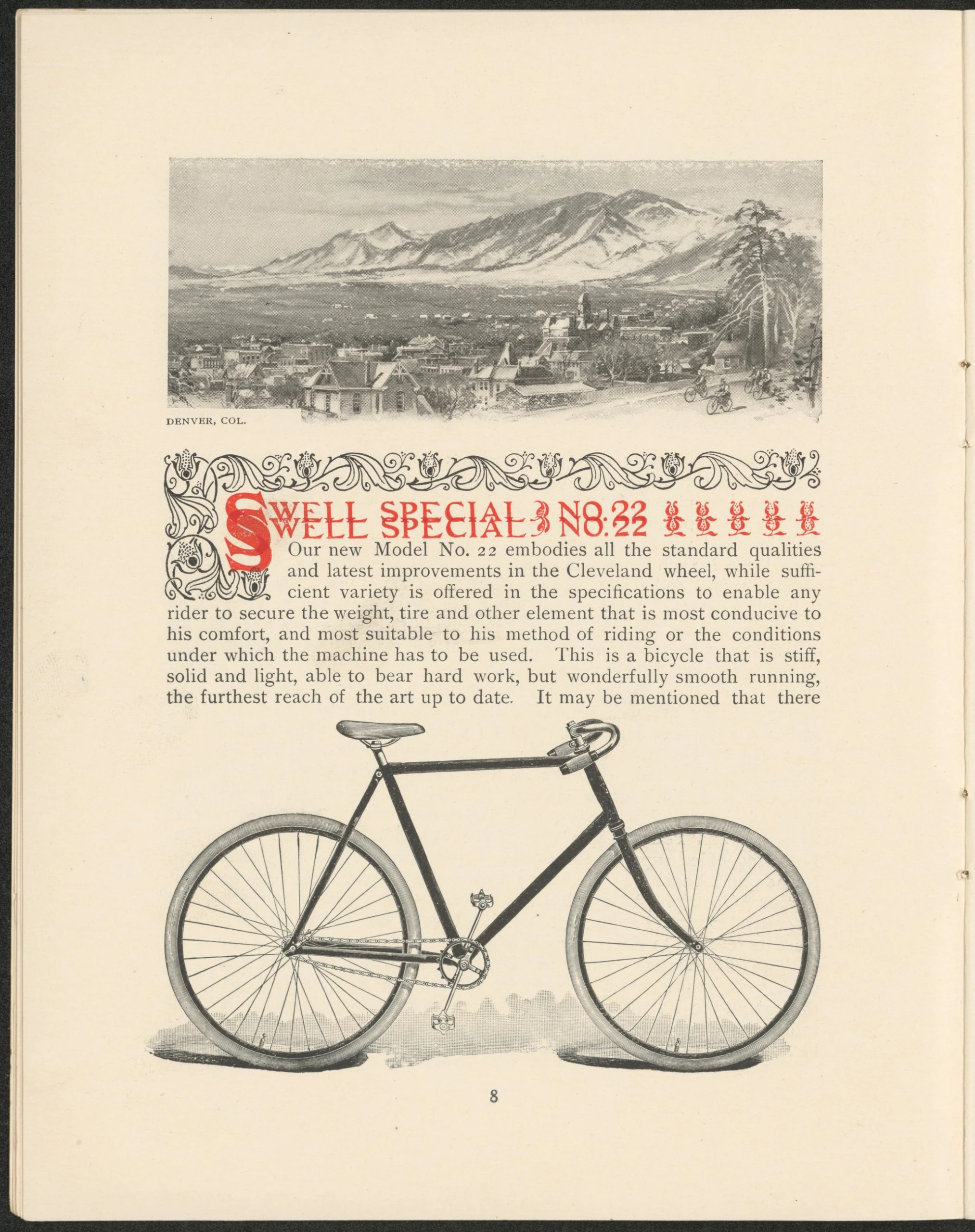 Page 10
 Page 11
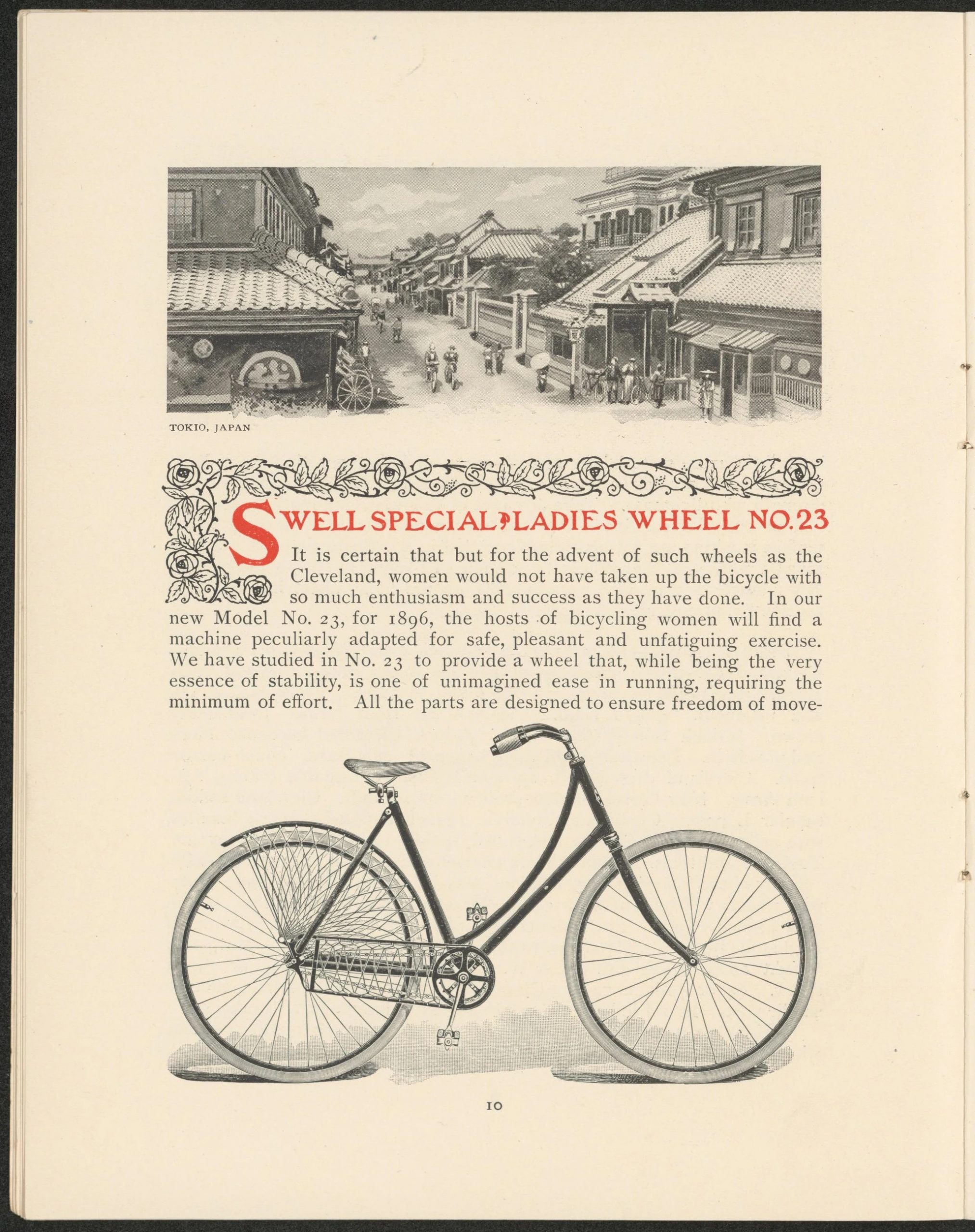 Page 12
 Page 13
 Page 14
 Page 15
 Page 16
 Page 17
 Page 18
 Page 19
 Page 20
 Page 21
 Page 22
 Page 23
 Page 24
 Page 25
 Page 26
 Page 27
 Page 28
 Page 29
 Page 30
 Page 31
 Page 32
 Page 33
 Page 34
 Page 35
 Page 36
| Marque | Cleveland |
|---|---|
| Type | Catalog |
| Year | 1896 |
| Publisher | H. A. Lozier & Co. |
| Country | United States |
| Language | English |
| Pages | 36 |
| Source | Northwestern University Libraries, Transportation Library, "Cleveland bicycles, 1896" (digital collection, https://dc.library.northwestern.edu/items/866c415a-9374-408c-89c2-dfad0449079a); rights statement "No Copyright - United States". |
| Credit | Northwestern University Libraries |
| Identifier | Permalink https://dc.library.northwestern.edu/items/866c415a-9374-408c-89c2-dfad0449079a |
| Transcription | Transcribed by eye |
Reference
H. A. Lozier & Co. Cleveland 1896 Catalog (H. A. Lozier & Co., Cleveland): Around the World on a Cleveland Bicycle. 1896. Ebykr, https://ebykr.com/library/cleveland-catalog-1896/.
Wikipedia
{{cite book |title=Cleveland 1896 Catalog (H. A. Lozier & Co., Cleveland): Around the World on a Cleveland Bicycle |publisher=H. A. Lozier & Co. |date=1896 |url=https://ebykr.com/library/cleveland-catalog-1896/ |via=Ebykr |access-date=}}AROUND · THE WORLD · ON · A CLEVELAND BICYCLE 22 CLEVELAND H · A · LOZIER · & · CO CLEVELAND · OHIO CLEVELAND BICYCLES 1896 22 CLEVELAND THE LOZIER MANUF'G CO. TOLEDO H. A. LOZIER & CO. CLEVELAND, OHIO. BRANCH HOUSES: NEW YORK, PHILADELPHIA, SAN FRANCISCO FACTORIES: TOLEDO, OHIO. THOMPSONVILLE, CONN. TORONTO, ONTARIO. …
H. A. Lozier & Co.’s Cleveland catalog for 1896, “Around the World on a Cleveland Bicycle”, each text page headed by a city vignette: an essay and the branch houses, the Swell Special No. 22, Ladies’ No. 23 and Racer No. 24 at $100 and the tandem No. 25 and combination tandem No. 26 at $150, each with its plate, then the Burwell bearings, sprockets, chain, pedals, tires, handlebars, saddles, tools, the factories and the guarantee. Transcribed from the page images (36 pages); each page ends with a bracketed description of its pictures.
— Page 1 —
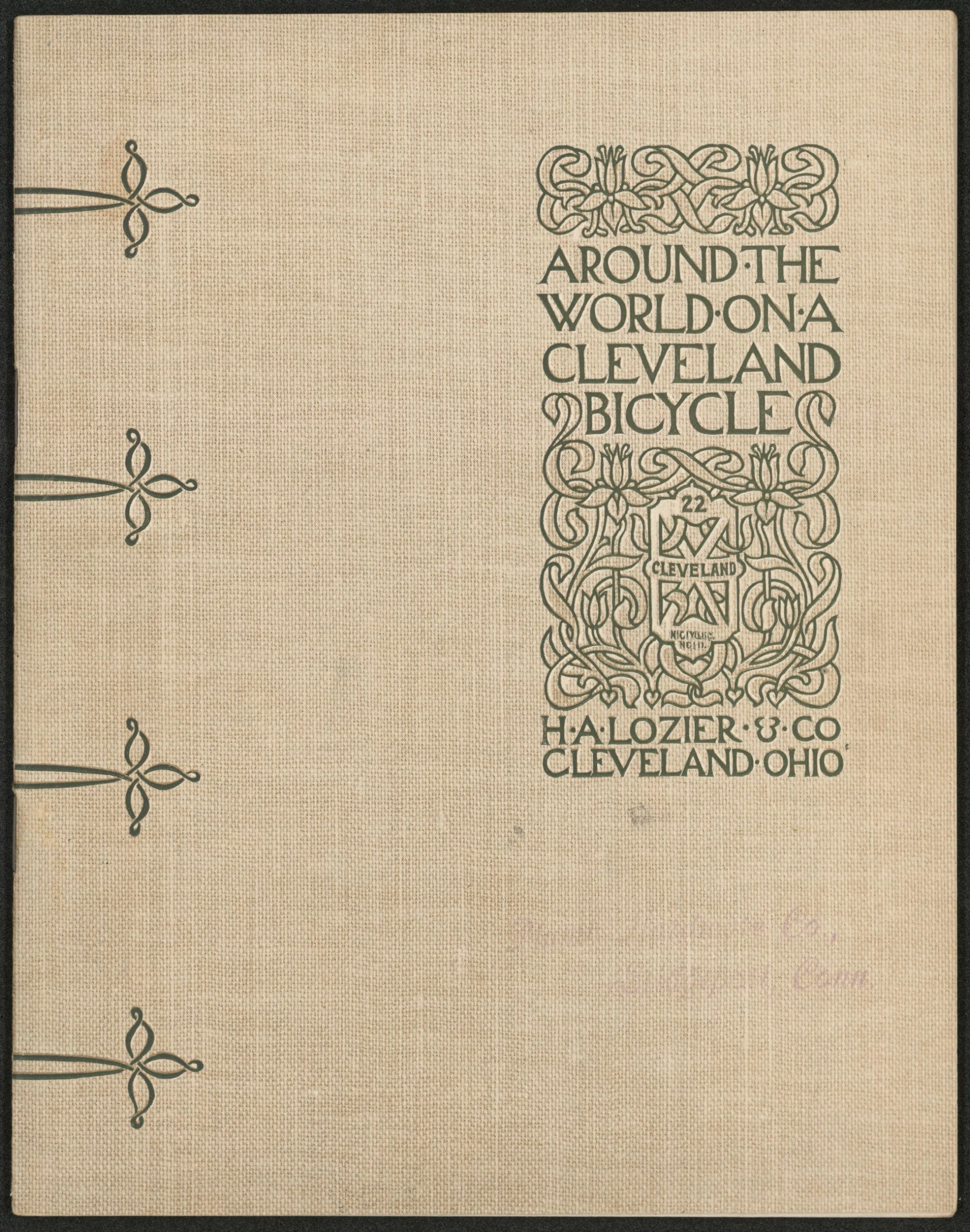
AROUND · THE
WORLD · ON · A
CLEVELAND
BICYCLE
22
CLEVELAND
H · A · LOZIER · & · CO
CLEVELAND · OHIO
[The front cover of buff linen-grain paper, printed in dark green: the title in an Art Nouveau panel of interlaced stems and flowers framing the Cleveland head badge (numbered 22), with four ornamental stitch motifs along the spine. A faded violet rubber stamp of the dealer Plumb Hardware Co., Bridgeport, Conn. at lower right.]
— Page 2 —
[Blank page.]
[The blank inside front cover.]
— Page 3 —
[Blank page.]
[A blank cream endpaper.]
— Page 4 —
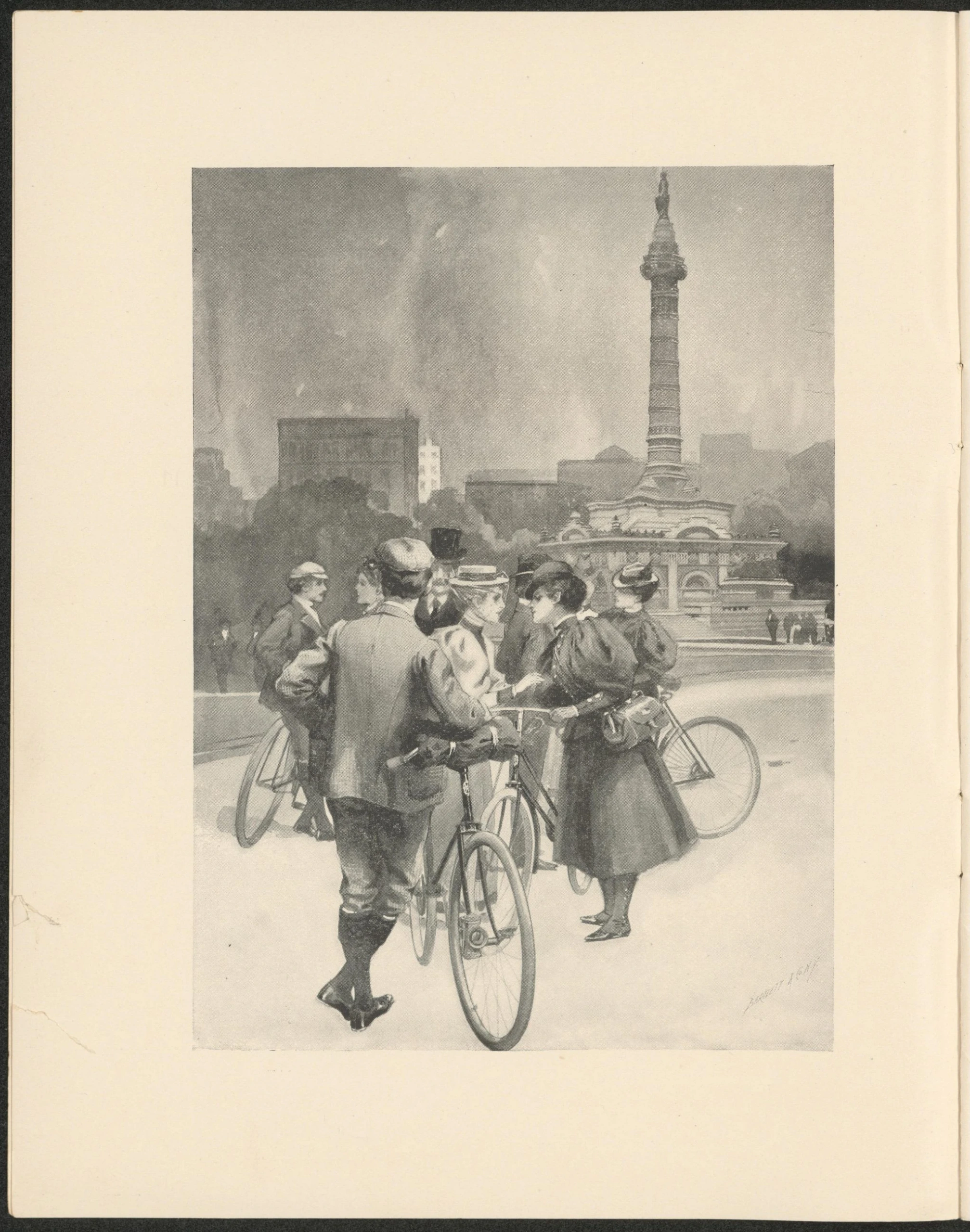
[A full-page frontispiece halftone, after a wash drawing, of fashionably dressed men and women standing with their bicycles in Cleveland’s Public Square before the Soldiers’ and Sailors’ Monument, the engraver’s signature faint in the plate at lower right. No printed text. A small tear at the left edge.]
— Page 5 —
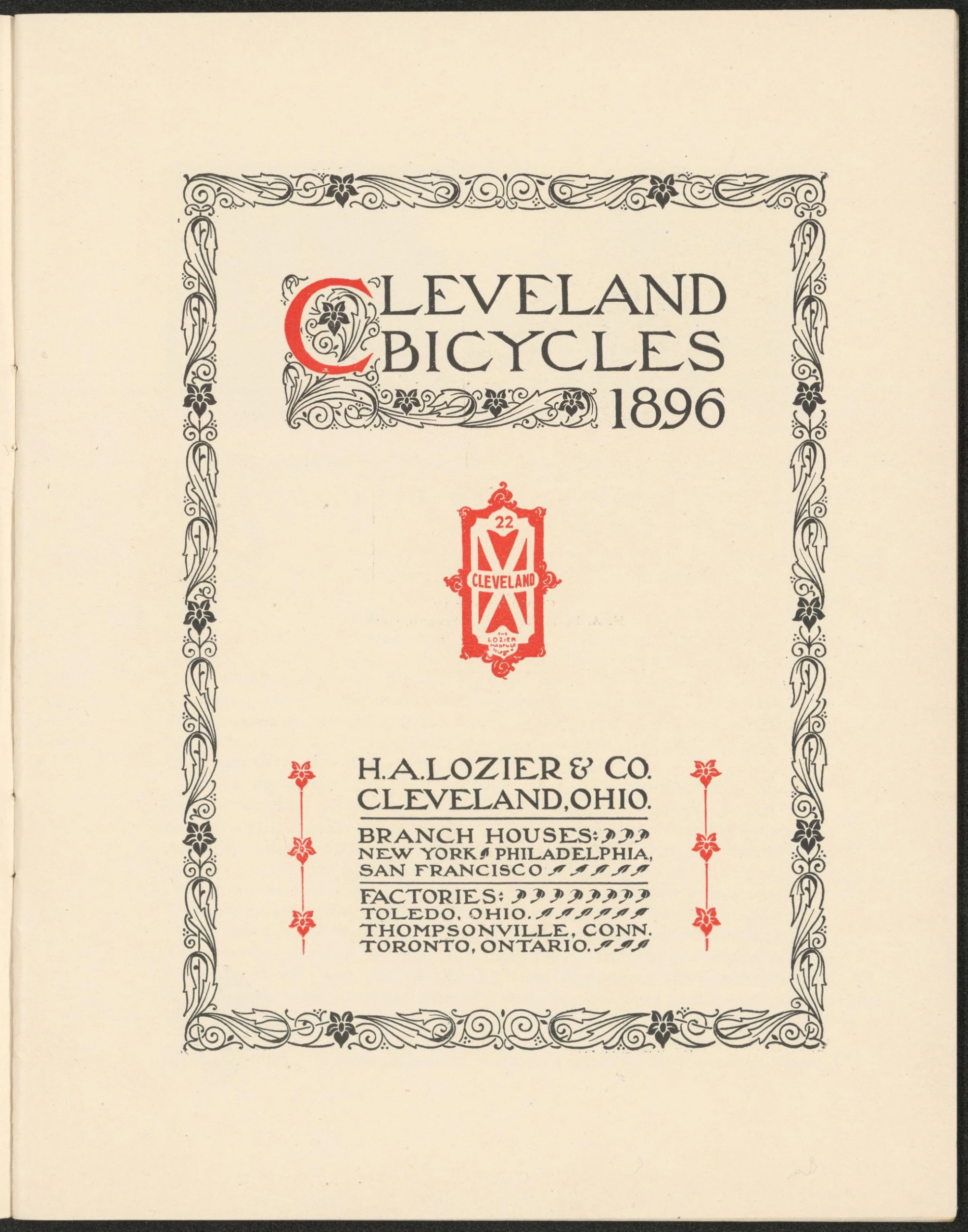
CLEVELAND
BICYCLES
1896
22
CLEVELAND
THE LOZIER MANUF’G CO. TOLEDO [?]
H. A. LOZIER & CO.
CLEVELAND, OHIO.
BRANCH HOUSES:
NEW YORK, PHILADELPHIA,
SAN FRANCISCO
FACTORIES:
TOLEDO, OHIO.
THOMPSONVILLE, CONN.
TORONTO, ONTARIO.
[The title page in black and red within a black foliate border, the initial C in red with an ornamental ground; the Cleveland head badge in red at center, its tiny maker’s line at the foot only partly legible; red flower stems flank the firm’s addresses.]
— Page 6 —
COPYRIGHT 1895 BY
H. A. LOZIER & CO., CLEVELAND, OHIO.
BARTLETT AND COMPANY
DESIGNERS
ENGRAVERS
PRINTERS
NEW YORK
[The verso of the title page with the copyright line at center and the printer’s circular rose-and-leaf device at lower right.]
— Page 7 —
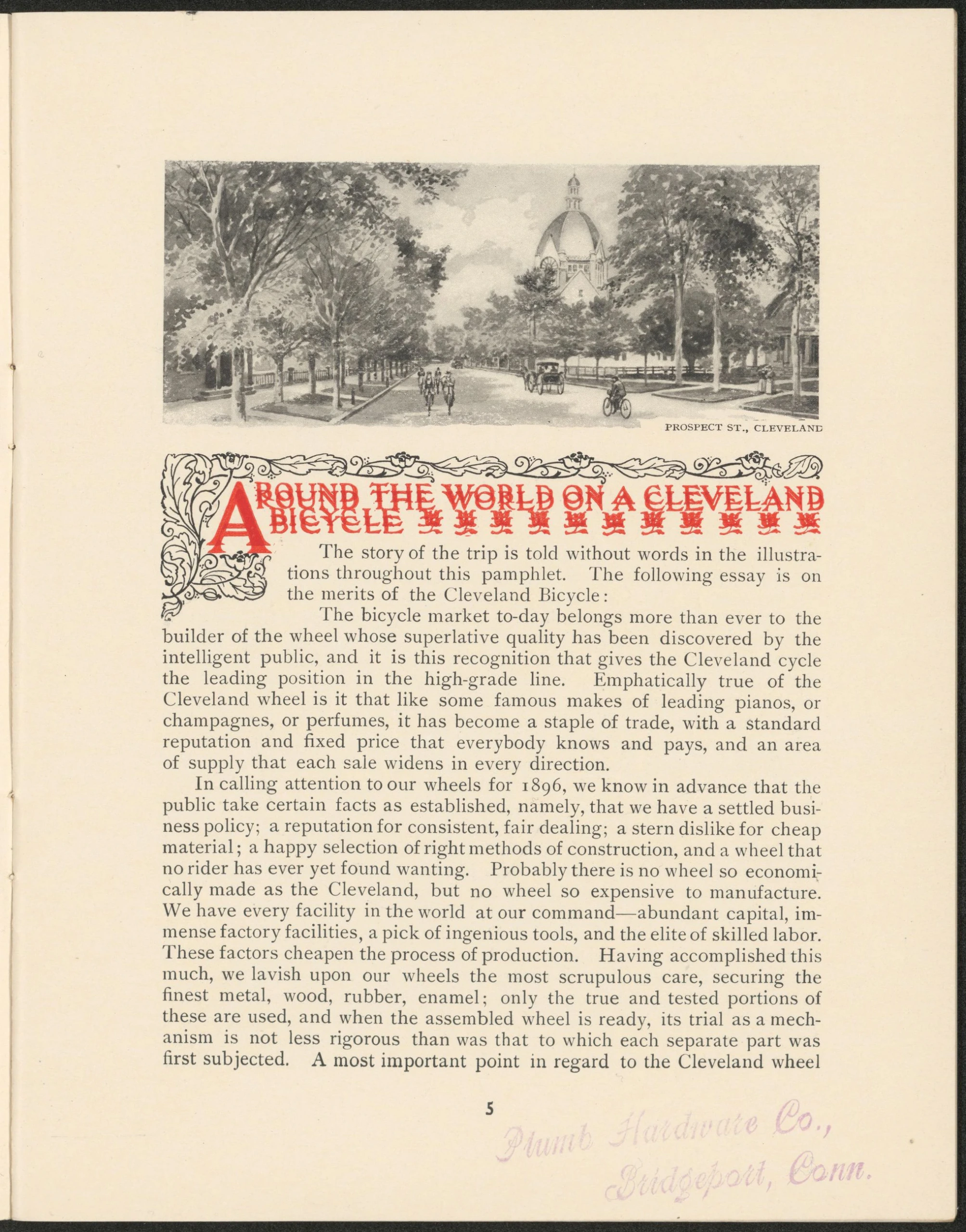
PROSPECT ST., CLEVELAND
AROUND THE WORLD ON A CLEVELAND BICYCLE
The story of the trip is told without words in the illustrations throughout this pamphlet. The following essay is on the merits of the Cleveland Bicycle:
The bicycle market to-day belongs more than ever to the builder of the wheel whose superlative quality has been discovered by the intelligent public, and it is this recognition that gives the Cleveland cycle the leading position in the high-grade line. Emphatically true of the Cleveland wheel is it that like some famous makes of leading pianos, or champagnes, or perfumes, it has become a staple of trade, with a standard reputation and fixed price that everybody knows and pays, and an area of supply that each sale widens in every direction.
In calling attention to our wheels for 1896, we know in advance that the public take certain facts as established, namely, that we have a settled business policy; a reputation for consistent, fair dealing; a stern dislike for cheap material; a happy selection of right methods of construction, and a wheel that no rider has ever yet found wanting. Probably there is no wheel so economically made as the Cleveland, but no wheel so expensive to manufacture. We have every facility in the world at our command—abundant capital, immense factory facilities, a pick of ingenious tools, and the elite of skilled labor. These factors cheapen the process of production. Having accomplished this much, we lavish upon our wheels the most scrupulous care, securing the finest metal, wood, rubber, enamel; only the true and tested portions of these are used, and when the assembled wheel is ready, its trial as a mechanism is not less rigorous than was that to which each separate part was first subjected. A most important point in regard to the Cleveland wheel
5
Plumb Hardware Co.,
Bridgeport, Conn.
[A halftone vignette of cyclists and a carriage on tree-lined Prospect Street, Cleveland, a domed church behind, heads the page. The title is in red with a large red initial A set in a black acanthus border, the red slightly doubled in printing. A violet script dealer’s rubber stamp at lower right.]
— Page 8 —
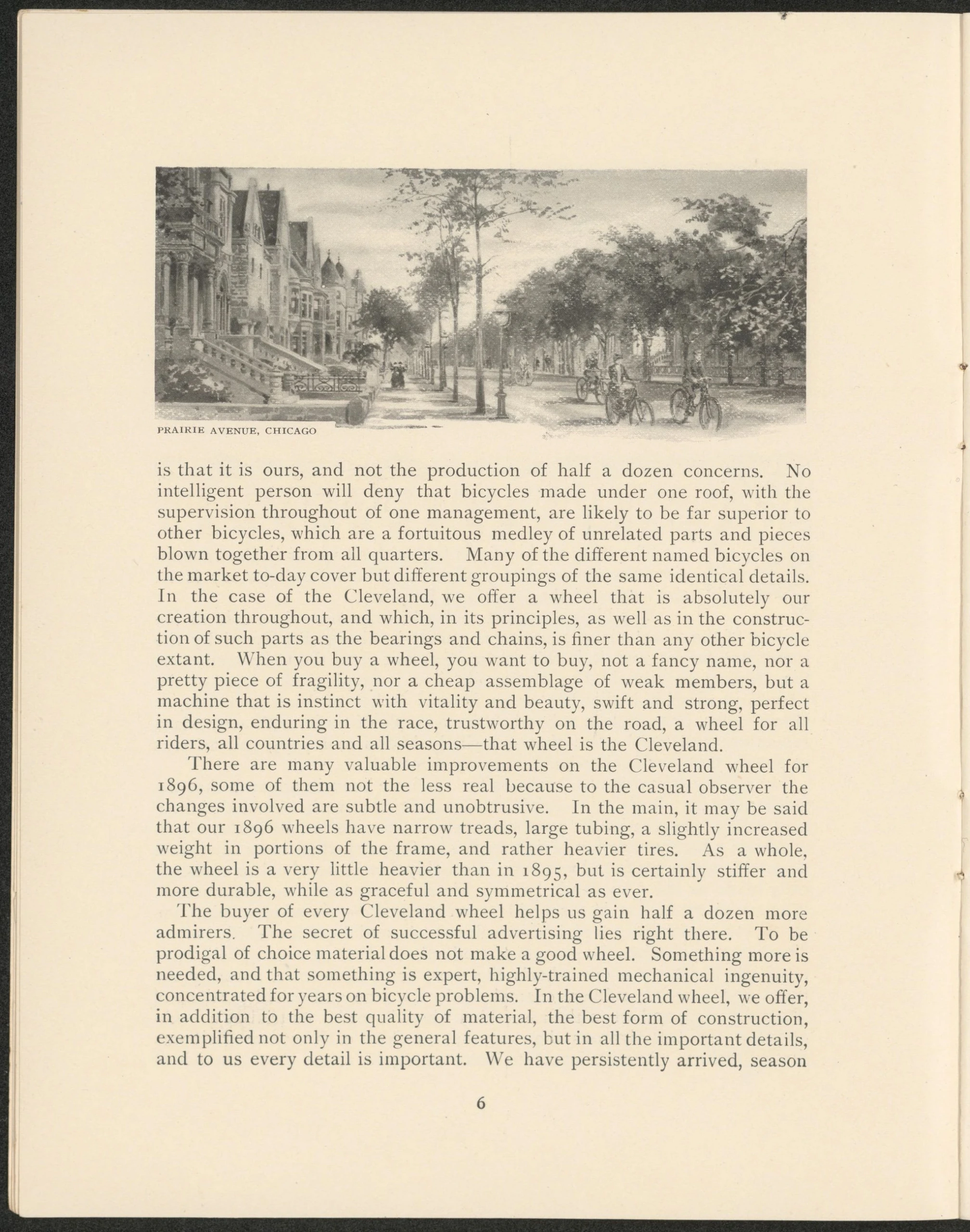
PRAIRIE AVENUE, CHICAGO
is that it is ours, and not the production of half a dozen concerns. No intelligent person will deny that bicycles made under one roof, with the supervision throughout of one management, are likely to be far superior to other bicycles, which are a fortuitous medley of unrelated parts and pieces blown together from all quarters. Many of the different named bicycles on the market to-day cover but different groupings of the same identical details. In the case of the Cleveland, we offer a wheel that is absolutely our creation throughout, and which, in its principles, as well as in the construction of such parts as the bearings and chains, is finer than any other bicycle extant. When you buy a wheel, you want to buy, not a fancy name, nor a pretty piece of fragility, nor a cheap assemblage of weak members, but a machine that is instinct with vitality and beauty, swift and strong, perfect in design, enduring in the race, trustworthy on the road, a wheel for all riders, all countries and all seasons—that wheel is the Cleveland.
There are many valuable improvements on the Cleveland wheel for 1896, some of them not the less real because to the casual observer the changes involved are subtle and unobtrusive. In the main, it may be said that our 1896 wheels have narrow treads, large tubing, a slightly increased weight in portions of the frame, and rather heavier tires. As a whole, the wheel is a very little heavier than in 1895, but is certainly stiffer and more durable, while as graceful and symmetrical as ever.
The buyer of every Cleveland wheel helps us gain half a dozen more admirers. The secret of successful advertising lies right there. To be prodigal of choice material does not make a good wheel. Something more is needed, and that something is expert, highly-trained mechanical ingenuity, concentrated for years on bicycle problems. In the Cleveland wheel, we offer, in addition to the best quality of material, the best form of construction, exemplified not only in the general features, but in all the important details, and to us every detail is important. We have persistently arrived, season
6
[A halftone vignette of cyclists riding along tree-lined Prairie Avenue, Chicago, past brownstone houses, heads the page of text.]
— Page 9 —
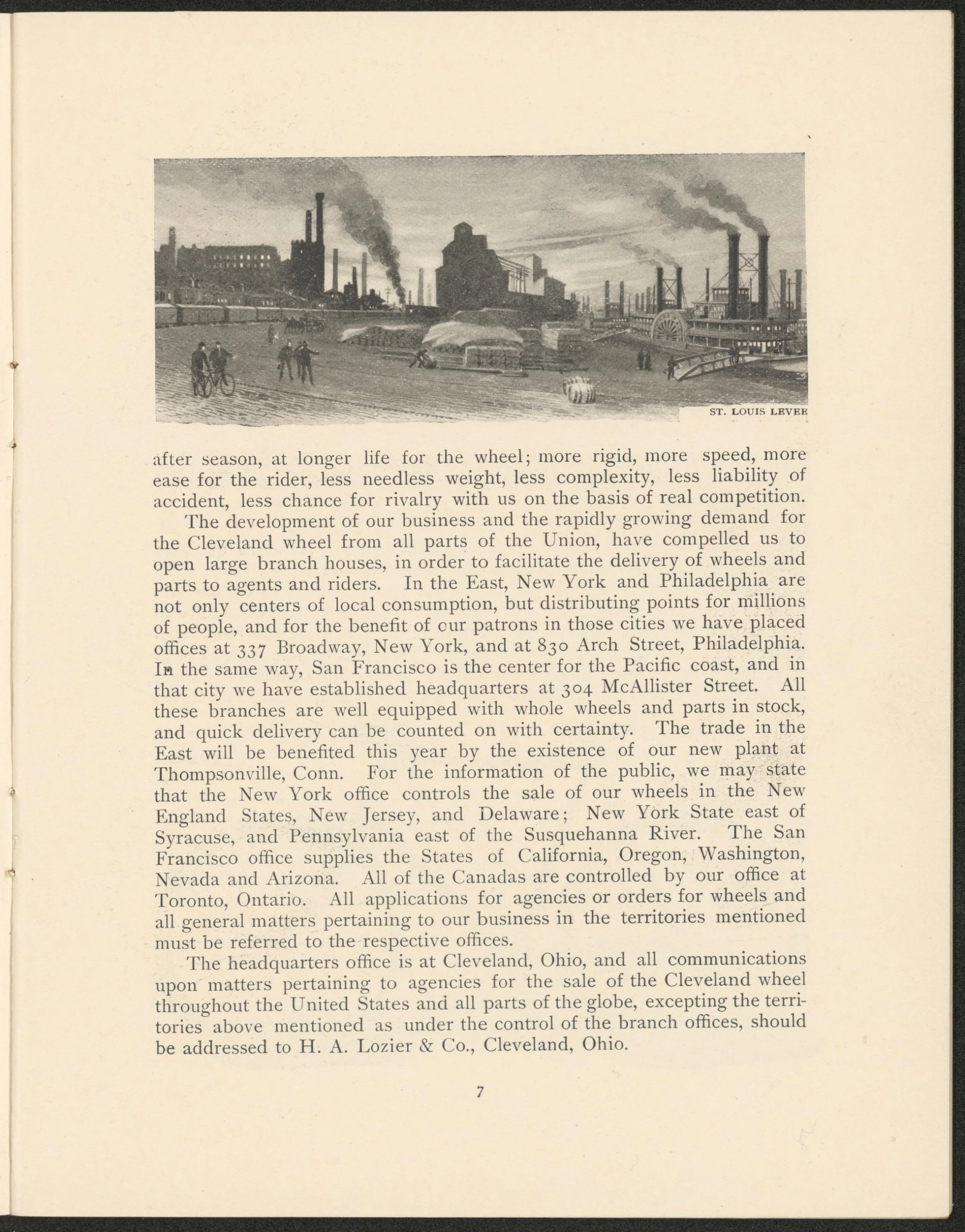
ST. LOUIS LEVEE
after season, at longer life for the wheel; more rigid, more speed, more ease for the rider, less needless weight, less complexity, less liability of accident, less chance for rivalry with us on the basis of real competition.
The development of our business and the rapidly growing demand for the Cleveland wheel from all parts of the Union, have compelled us to open large branch houses, in order to facilitate the delivery of wheels and parts to agents and riders. In the East, New York and Philadelphia are not only centers of local consumption, but distributing points for millions of people, and for the benefit of our patrons in those cities we have placed offices at 337 Broadway, New York, and at 830 Arch Street, Philadelphia. In the same way, San Francisco is the center for the Pacific coast, and in that city we have established headquarters at 304 McAllister Street. All these branches are well equipped with whole wheels and parts in stock, and quick delivery can be counted on with certainty. The trade in the East will be benefited this year by the existence of our new plant at Thompsonville, Conn. For the information of the public, we may state that the New York office controls the sale of our wheels in the New England States, New Jersey, and Delaware; New York State east of Syracuse, and Pennsylvania east of the Susquehanna River. The San Francisco office supplies the States of California, Oregon, Washington, Nevada and Arizona. All of the Canadas are controlled by our office at Toronto, Ontario. All applications for agencies or orders for wheels and all general matters pertaining to our business in the territories mentioned must be referred to the respective offices.
The headquarters office is at Cleveland, Ohio, and all communications upon matters pertaining to agencies for the sale of the Cleveland wheel throughout the United States and all parts of the globe, excepting the territories above mentioned as under the control of the branch offices, should be addressed to H. A. Lozier & Co., Cleveland, Ohio.
7
[A halftone vignette of the St. Louis levee heads the page: factory chimneys smoking across the river, a bridge, steamboats, cotton bales and two cyclists on the cobbled landing. A small pencil mark in the right margin.]
— Page 10 —
DENVER, COL.
SWELL SPECIAL NO. 22
Our new Model No. 22 embodies all the standard qualities and latest improvements in the Cleveland wheel, while sufficient variety is offered in the specifications to enable any rider to secure the weight, tire and other element that is most conducive to his comfort, and most suitable to his method of riding or the conditions under which the machine has to be used. This is a bicycle that is stiff, solid and light, able to bear hard work, but wonderfully smooth running, the furthest reach of the art up to date. It may be mentioned that there
8
[A halftone vignette of Denver, Colorado, with mountains beyond and cyclists on a road, heads the page; the red heading with a large initial S is set in a black acanthus border, the red slightly doubled. Below the text, a line engraving of the Model No. 22 men’s diamond-frame Swell Special in side view, with drop bars.]
— Page 11 —
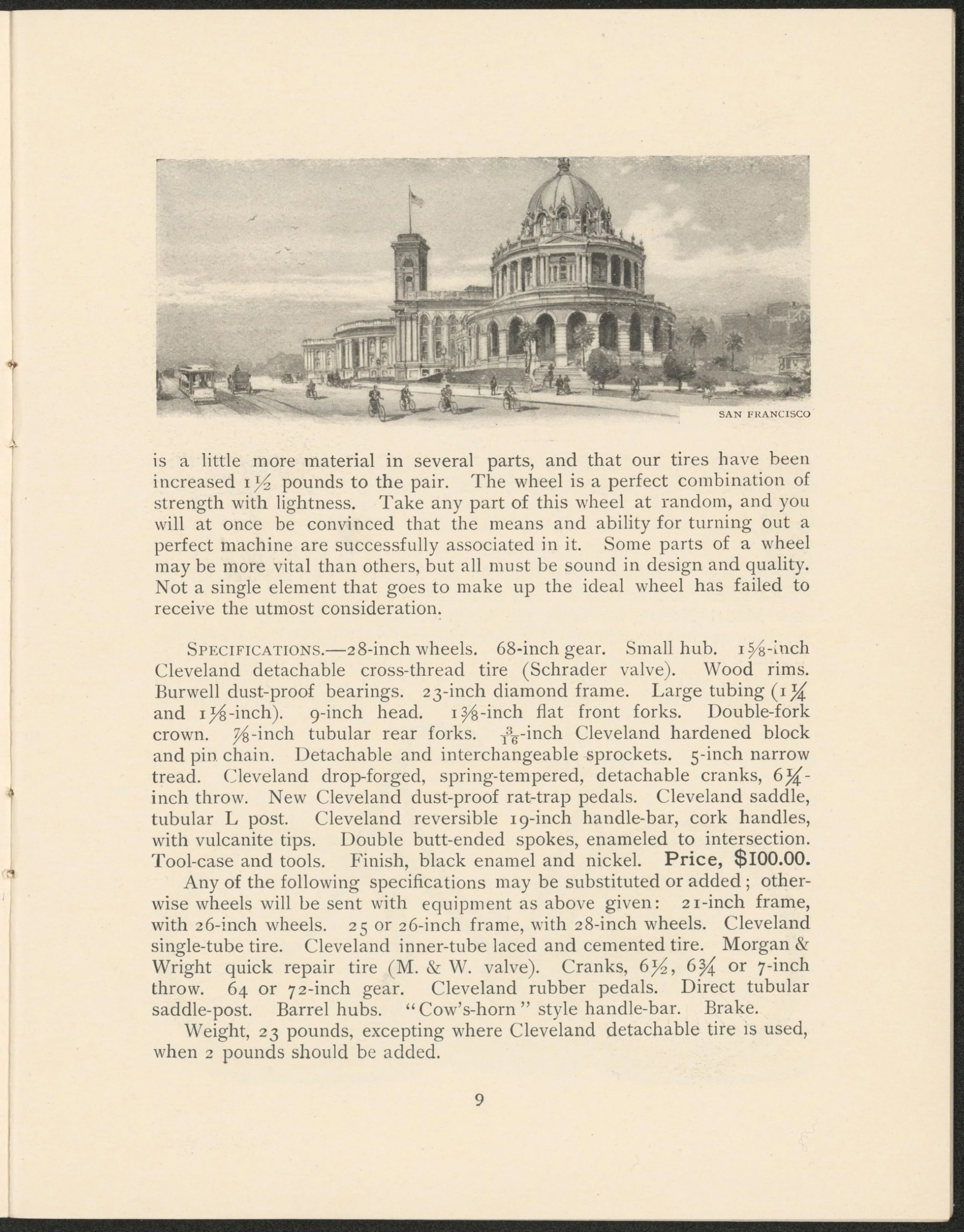
SAN FRANCISCO
is a little more material in several parts, and that our tires have been increased 1 1/2 pounds to the pair. The wheel is a perfect combination of strength with lightness. Take any part of this wheel at random, and you will at once be convinced that the means and ability for turning out a perfect machine are successfully associated in it. Some parts of a wheel may be more vital than others, but all must be sound in design and quality. Not a single element that goes to make up the ideal wheel has failed to receive the utmost consideration.
SPECIFICATIONS.—28-inch wheels. 68-inch gear. Small hub. 1 5/8-inch Cleveland detachable cross-thread tire (Schrader valve). Wood rims. Burwell dust-proof bearings. 23-inch diamond frame. Large tubing (1 1/4 and 1 1/8-inch). 9-inch head. 1 3/8-inch flat front forks. Double-fork crown. 7/8-inch tubular rear forks. 3/16-inch Cleveland hardened block and pin chain. Detachable and interchangeable sprockets. 5-inch narrow tread. Cleveland drop-forged, spring-tempered, detachable cranks, 6 1/4-inch throw. New Cleveland dust-proof rat-trap pedals. Cleveland saddle, tubular L post. Cleveland reversible 19-inch handle-bar, cork handles, with vulcanite tips. Double butt-ended spokes, enameled to intersection. Tool-case and tools. Finish, black enamel and nickel. Price, $100.00.
Any of the following specifications may be substituted or added; otherwise wheels will be sent with equipment as above given: 21-inch frame, with 26-inch wheels. 25 or 26-inch frame, with 28-inch wheels. Cleveland single-tube tire. Cleveland inner-tube laced and cemented tire. Morgan & Wright quick repair tire (M. & W. valve). Cranks, 6 1/2, 6 3/4 or 7-inch throw. 64 or 72-inch gear. Cleveland rubber pedals. Direct tubular saddle-post. Barrel hubs. “Cow’s-horn” style handle-bar. Brake.
Weight, 23 pounds, excepting where Cleveland detachable tire is used, when 2 pounds should be added.
9
[A halftone vignette of a domed public building in San Francisco, with a cable car, carriages and cyclists on the street before it, heads the page of text. A small pencil mark in the right margin.]
— Page 12 —
TOKIO, JAPAN
SWELL SPECIAL LADIES WHEEL NO. 23
It is certain that but for the advent of such wheels as the Cleveland, women would not have taken up the bicycle with so much enthusiasm and success as they have done. In our new Model No. 23, for 1896, the hosts of bicycling women will find a machine peculiarly adapted for safe, pleasant and unfatiguing exercise. We have studied in No. 23 to provide a wheel that, while being the very essence of stability, is one of unimagined ease in running, requiring the minimum of effort. All the parts are designed to ensure freedom of move-
10
[A halftone vignette of a street in Tokyo, with rickshaws, pedestrians with parasols and cyclists, heads the page; the red heading with a large initial S is set in a black rose-vine border. Below the text, a line engraving of the Model No. 23 ladies’ drop-frame Swell Special in side view, with a laced skirt guard over the rear wheel.]
— Page 13 —
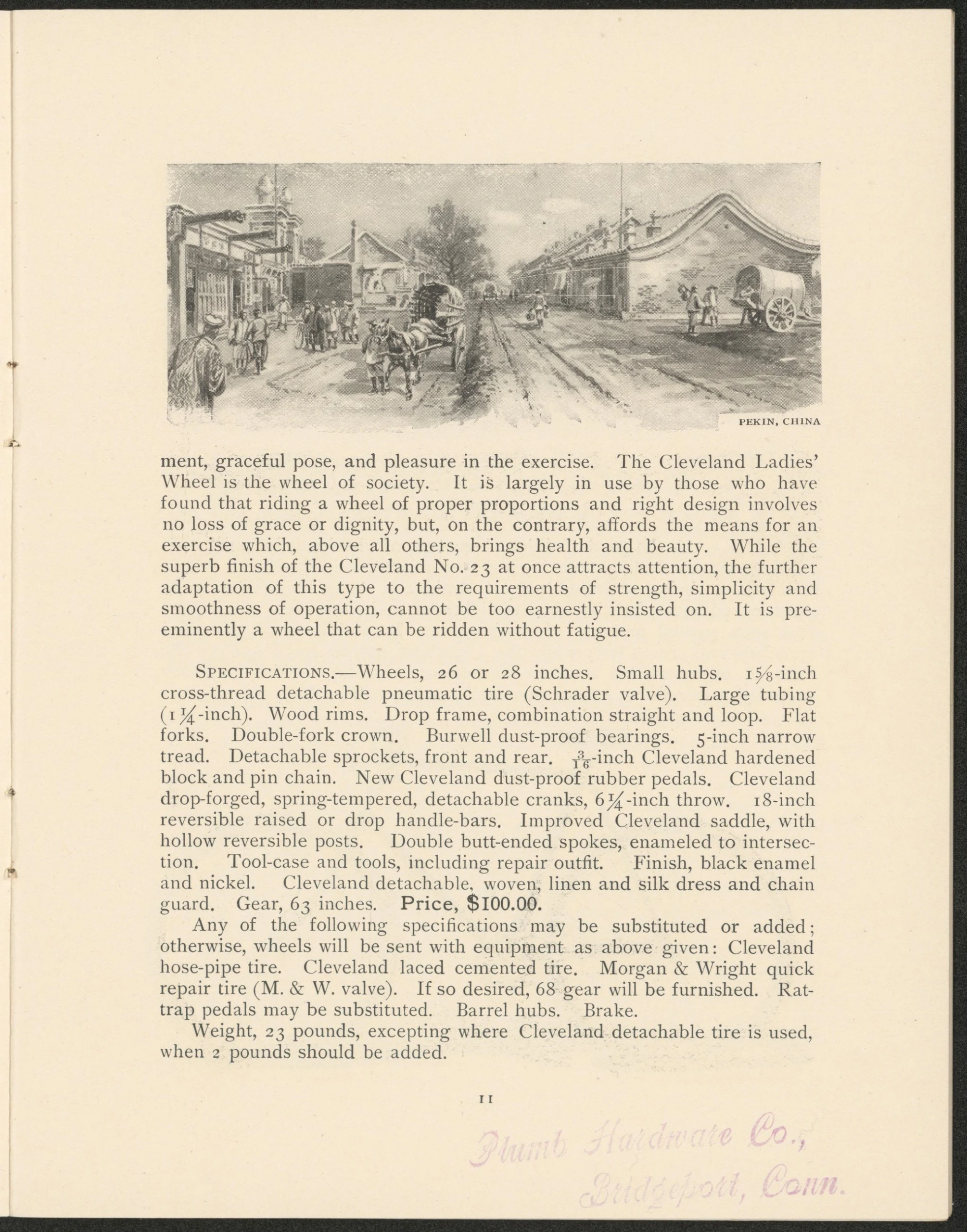
PEKIN, CHINA
ment, graceful pose, and pleasure in the exercise. The Cleveland Ladies’ Wheel is the wheel of society. It is largely in use by those who have found that riding a wheel of proper proportions and right design involves no loss of grace or dignity, but, on the contrary, affords the means for an exercise which, above all others, brings health and beauty. While the superb finish of the Cleveland No. 23 at once attracts attention, the further adaptation of this type to the requirements of strength, simplicity and smoothness of operation, cannot be too earnestly insisted on. It is pre-eminently a wheel that can be ridden without fatigue.
SPECIFICATIONS.—Wheels, 26 or 28 inches. Small hubs. 1 5/8-inch cross-thread detachable pneumatic tire (Schrader valve). Large tubing (1 1/4-inch). Wood rims. Drop frame, combination straight and loop. Flat forks. Double-fork crown. Burwell dust-proof bearings. 5-inch narrow tread. Detachable sprockets, front and rear. 3/16-inch Cleveland hardened block and pin chain. New Cleveland dust-proof rubber pedals. Cleveland drop-forged, spring-tempered, detachable cranks, 6 1/4-inch throw. 18-inch reversible raised or drop handle-bars. Improved Cleveland saddle, with hollow reversible posts. Double butt-ended spokes, enameled to intersection. Tool-case and tools, including repair outfit. Finish, black enamel and nickel. Cleveland detachable, woven, linen and silk dress and chain guard. Gear, 63 inches. Price, $100.00.
Any of the following specifications may be substituted or added; otherwise, wheels will be sent with equipment as above given: Cleveland hose-pipe tire. Cleveland laced cemented tire. Morgan & Wright quick repair tire (M. & W. valve). If so desired, 68 gear will be furnished. Rat-trap pedals may be substituted. Barrel hubs. Brake.
Weight, 23 pounds, excepting where Cleveland detachable tire is used, when 2 pounds should be added.
11
Plumb Hardware Co.,
Bridgeport, Conn.
[A halftone vignette of a broad rutted street in Peking, with carts, a mule and cyclists, heads the page of text. A violet script dealer’s rubber stamp at lower right.]
— Page 14 —
CALCUTTA
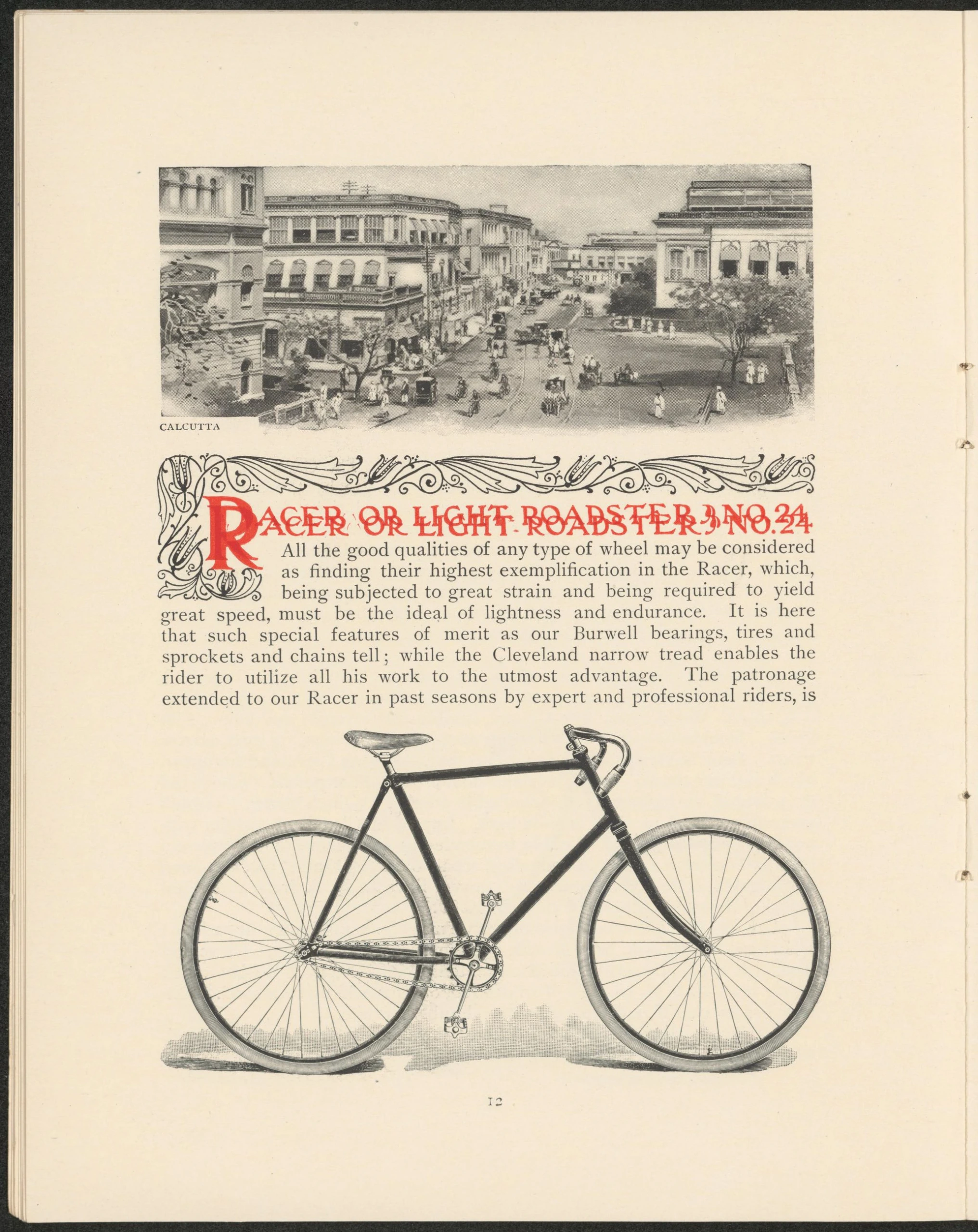
RACER OR LIGHT ROADSTER NO. 24
All the good qualities of any type of wheel may be considered as finding their highest exemplification in the Racer, which, being subjected to great strain and being required to yield great speed, must be the ideal of lightness and endurance. It is here that such special features of merit as our Burwell bearings, tires and sprockets and chains tell; while the Cleveland narrow tread enables the rider to utilize all his work to the utmost advantage. The patronage extended to our Racer in past seasons by expert and professional riders, is
12
[A halftone vignette of a busy Calcutta street with carriages and cyclists heads the page; the red heading with a large initial R is set in a black acanthus border, the red doubled in printing. Below the text, a line engraving of the No. 24 racer or light roadster in side view, a men’s diamond frame with dropped bars.]
— Page 15 —
CITADEL, CAIRO
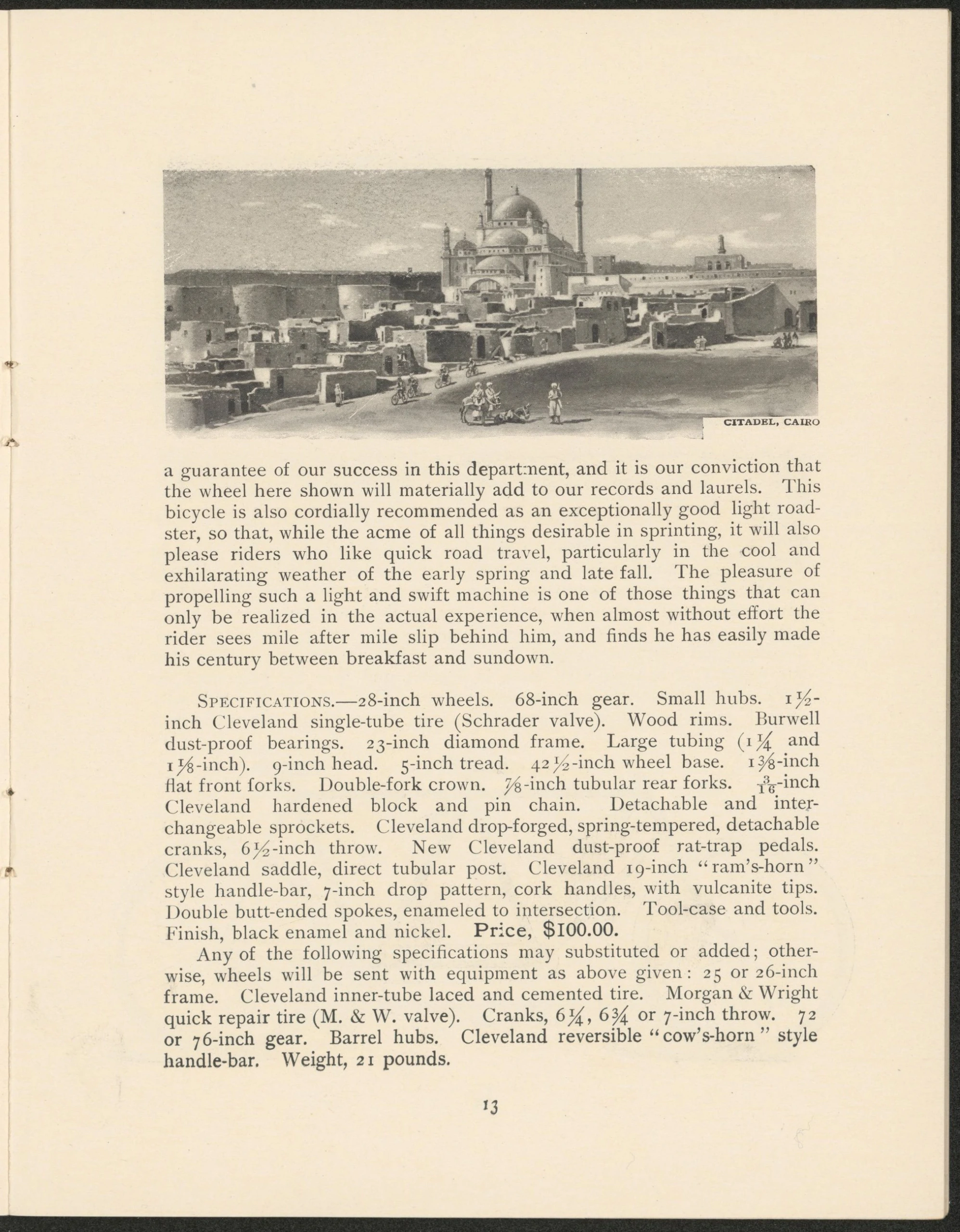
a guarantee of our success in this department, and it is our conviction that the wheel here shown will materially add to our records and laurels. This bicycle is also cordially recommended as an exceptionally good light roadster, so that, while the acme of all things desirable in sprinting, it will also please riders who like quick road travel, particularly in the cool and exhilarating weather of the early spring and late fall. The pleasure of propelling such a light and swift machine is one of those things that can only be realized in the actual experience, when almost without effort the rider sees mile after mile slip behind him, and finds he has easily made his century between breakfast and sundown.
SPECIFICATIONS.—28-inch wheels. 68-inch gear. Small hubs. 1 1/2-inch Cleveland single-tube tire (Schrader valve). Wood rims. Burwell dust-proof bearings. 23-inch diamond frame. Large tubing (1 1/4 and 1 1/8-inch). 9-inch head. 5-inch tread. 42 1/2-inch wheel base. 1 3/8-inch flat front forks. Double-fork crown. 7/8-inch tubular rear forks. 3/16-inch Cleveland hardened block and pin chain. Detachable and interchangeable sprockets. Cleveland drop-forged, spring-tempered, detachable cranks, 6 1/2-inch throw. New Cleveland dust-proof rat-trap pedals. Cleveland saddle, direct tubular post. Cleveland 19-inch “ram’s-horn” style handle-bar, 7-inch drop pattern, cork handles, with vulcanite tips. Double butt-ended spokes, enameled to intersection. Tool-case and tools. Finish, black enamel and nickel. Price, $100.00.
Any of the following specifications may substituted or added; otherwise, wheels will be sent with equipment as above given: 25 or 26-inch frame. Cleveland inner-tube laced and cemented tire. Morgan & Wright quick repair tire (M. & W. valve). Cranks, 6 1/4, 6 3/4 or 7-inch throw. 72 or 76-inch gear. Barrel hubs. Cleveland reversible “cow’s-horn” style handle-bar. Weight, 21 pounds.
13
[A halftone vignette of the Citadel at Cairo, with a mosque and flat-roofed houses, camels, donkeys and cyclists, heads the page of text. A small pencil mark in the right margin.]
— Page 16 —
PYRAMIDS OF EGYPT
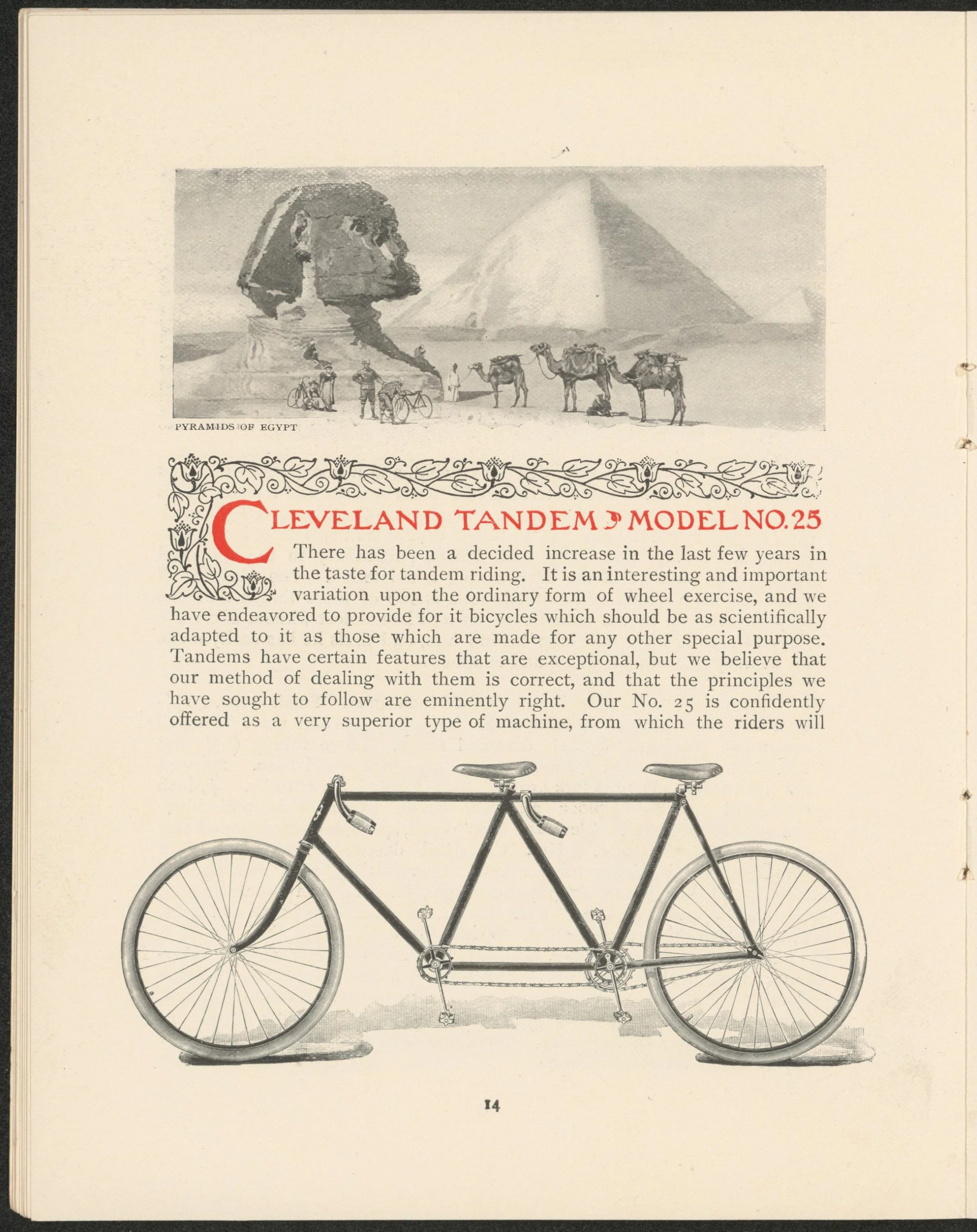
CLEVELAND TANDEM MODEL NO. 25
There has been a decided increase in the last few years in the taste for tandem riding. It is an interesting and important variation upon the ordinary form of wheel exercise, and we have endeavored to provide for it bicycles which should be as scientifically adapted to it as those which are made for any other special purpose. Tandems have certain features that are exceptional, but we believe that our method of dealing with them is correct, and that the principles we have sought to follow are eminently right. Our No. 25 is confidently offered as a very superior type of machine, from which the riders will
14
[A halftone vignette of the Sphinx and a pyramid with camels, their drivers and cyclists heads the page; the red heading with a large initial C is set in a black leaf-vine border. Below the text, a line engraving of the No. 25 Cleveland double-diamond tandem in side view.]
— Page 17 —
CONSTANTINOPLE
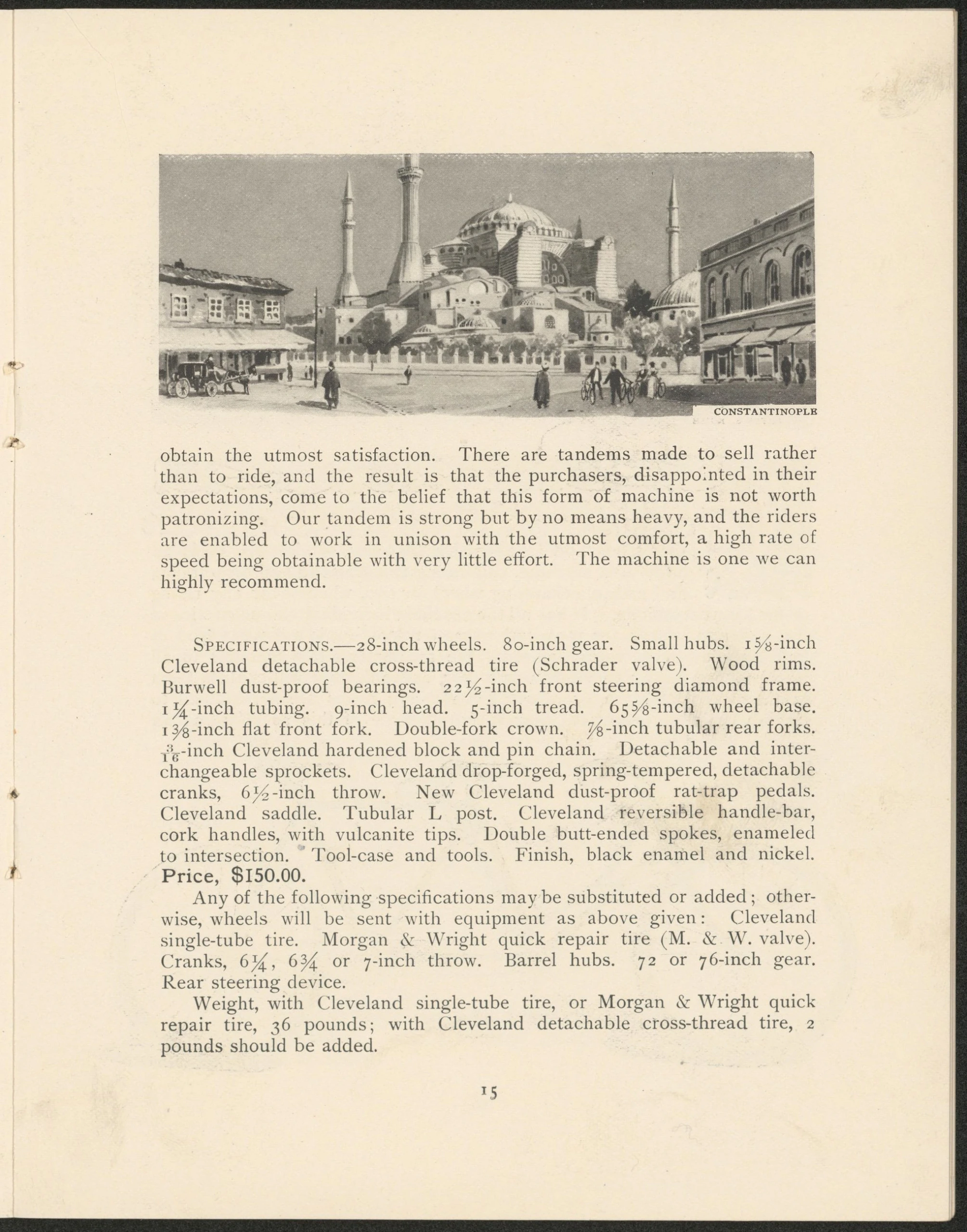
obtain the utmost satisfaction. There are tandems made to sell rather than to ride, and the result is that the purchasers, disappointed in their expectations, come to the belief that this form of machine is not worth patronizing. Our tandem is strong but by no means heavy, and the riders are enabled to work in unison with the utmost comfort, a high rate of speed being obtainable with very little effort. The machine is one we can highly recommend.
SPECIFICATIONS.—28-inch wheels. 80-inch gear. Small hubs. 1 5/8-inch Cleveland detachable cross-thread tire (Schrader valve). Wood rims. Burwell dust-proof bearings. 22 1/2-inch front steering diamond frame. 1 1/4-inch tubing. 9-inch head. 5-inch tread. 65 5/8-inch wheel base. 1 3/8-inch flat front fork. Double-fork crown. 7/8-inch tubular rear forks. 3/16-inch Cleveland hardened block and pin chain. Detachable and interchangeable sprockets. Cleveland drop-forged, spring-tempered, detachable cranks, 6 1/2-inch throw. New Cleveland dust-proof rat-trap pedals. Cleveland saddle. Tubular L post. Cleveland reversible handle-bar, cork handles, with vulcanite tips. Double butt-ended spokes, enameled to intersection. Tool-case and tools. Finish, black enamel and nickel. Price, $150.00.
Any of the following specifications may be substituted or added; otherwise, wheels will be sent with equipment as above given: Cleveland single-tube tire. Morgan & Wright quick repair tire (M. & W. valve). Cranks, 6 1/4, 6 3/4 or 7-inch throw. Barrel hubs. 72 or 76-inch gear. Rear steering device.
Weight, with Cleveland single-tube tire, or Morgan & Wright quick repair tire, 36 pounds; with Cleveland detachable cross-thread tire, 2 pounds should be added.
15
[A halftone vignette of Hagia Sophia in Constantinople, with minarets, a carriage and cyclists in the square, heads the page of text.]
— Page 18 —
ST. PETER’S, ROME
COMBINATION TANDEM MODEL NO. 26
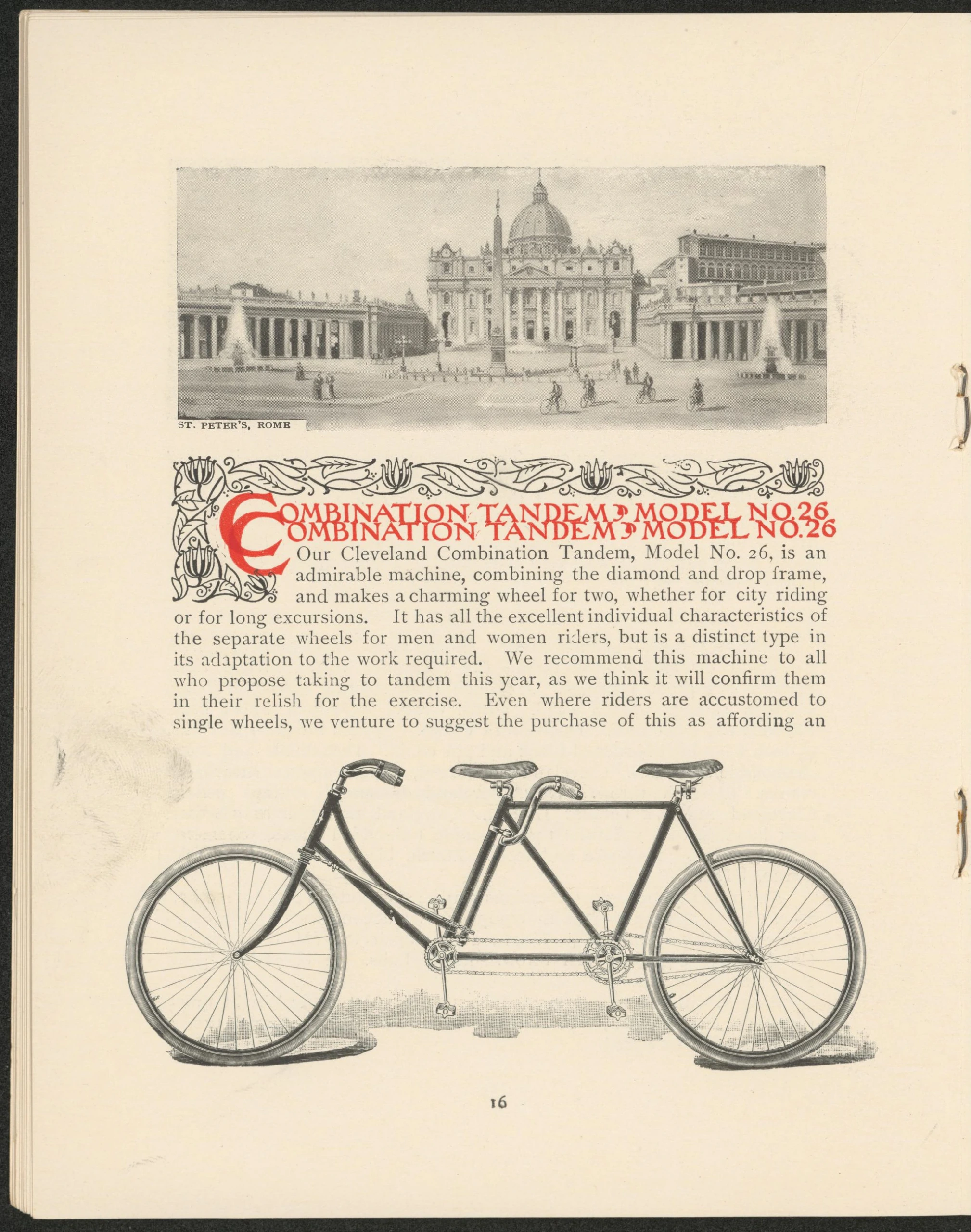
Our Cleveland Combination Tandem, Model No. 26, is an admirable machine, combining the diamond and drop frame, and makes a charming wheel for two, whether for city riding or for long excursions. It has all the excellent individual characteristics of the separate wheels for men and women riders, but is a distinct type in its adaptation to the work required. We recommend this machine to all who propose taking to tandem this year, as we think it will confirm them in their relish for the exercise. Even where riders are accustomed to single wheels, we venture to suggest the purchase of this as affording an
16
[A halftone vignette of St. Peter’s Square in Rome with cyclists heads the page; the red heading with a large initial C is set in a black leaf border, the red doubled in printing. Below the text, a line engraving of the No. 26 combination tandem, a drop-frame front position and a diamond rear, in side view. A gray smudge, apparently a fingerprint, in the left margin.]
— Page 19 —
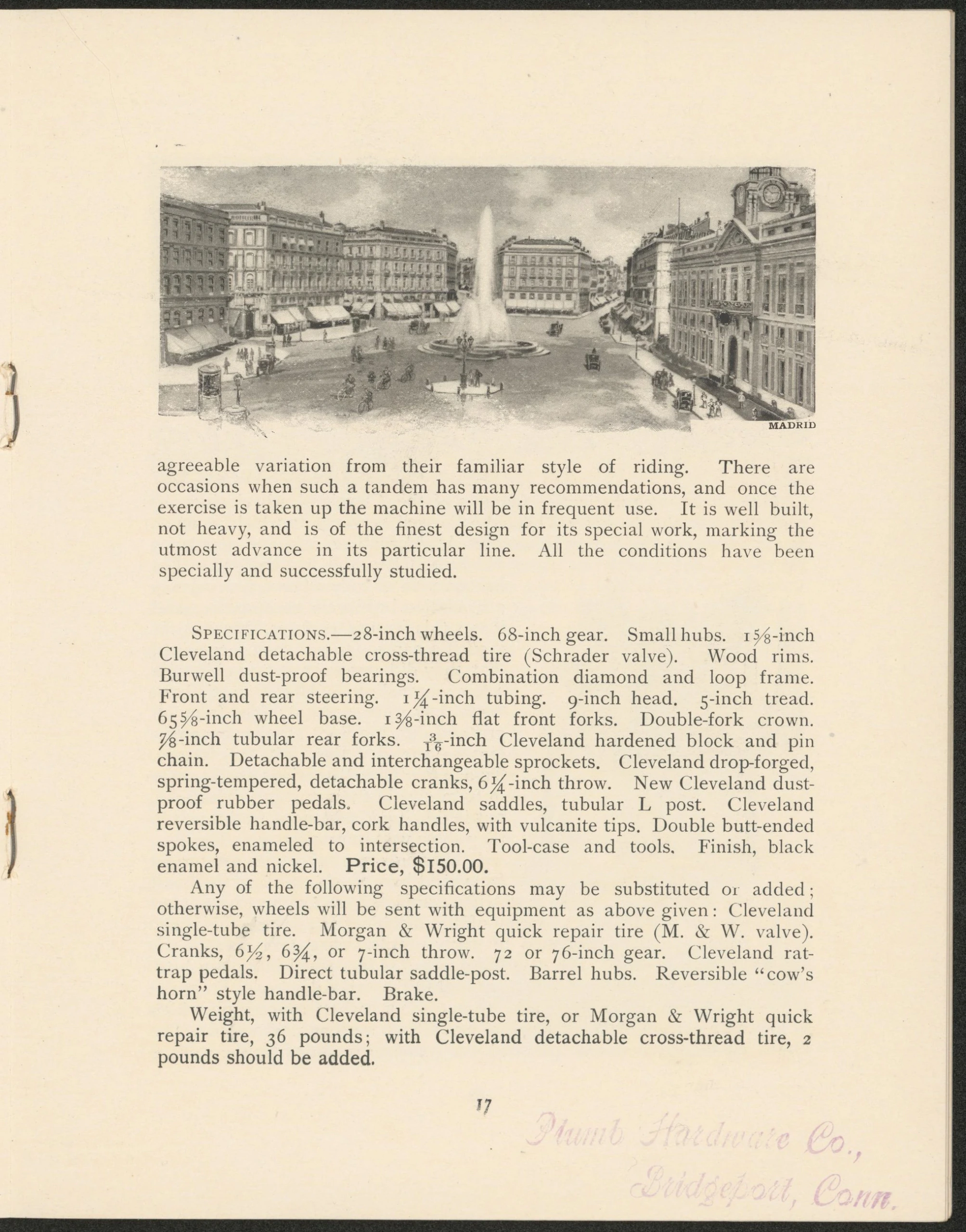
MADRID
agreeable variation from their familiar style of riding. There are occasions when such a tandem has many recommendations, and once the exercise is taken up the machine will be in frequent use. It is well built, not heavy, and is of the finest design for its special work, marking the utmost advance in its particular line. All the conditions have been specially and successfully studied.
SPECIFICATIONS.—28-inch wheels. 68-inch gear. Small hubs. 1 5/8-inch Cleveland detachable cross-thread tire (Schrader valve). Wood rims. Burwell dust-proof bearings. Combination diamond and loop frame. Front and rear steering. 1 1/4-inch tubing. 9-inch head. 5-inch tread. 65 5/8-inch wheel base. 1 3/8-inch flat front forks. Double-fork crown. 7/8-inch tubular rear forks. 3/16-inch Cleveland hardened block and pin chain. Detachable and interchangeable sprockets. Cleveland drop-forged, spring-tempered, detachable cranks, 6 1/4-inch throw. New Cleveland dust-proof rubber pedals. Cleveland saddles, tubular L post. Cleveland reversible handle-bar, cork handles, with vulcanite tips. Double butt-ended spokes, enameled to intersection. Tool-case and tools. Finish, black enamel and nickel. Price, $150.00.
Any of the following specifications may be substituted or added; otherwise, wheels will be sent with equipment as above given: Cleveland single-tube tire. Morgan & Wright quick repair tire (M. & W. valve). Cranks, 6 1/2, 6 3/4, or 7-inch throw. 72 or 76-inch gear. Cleveland rat-trap pedals. Direct tubular saddle-post. Barrel hubs. Reversible “cow’s horn” style handle-bar. Brake.
Weight, with Cleveland single-tube tire, or Morgan & Wright quick repair tire, 36 pounds; with Cleveland detachable cross-thread tire, 2 pounds should be added.
17
Plumb Hardware Co.,
Bridgeport, Conn.
[A halftone vignette of the Puerta del Sol in Madrid, a fountain at center with carriages and cyclists, heads the page of text. Two pencil strokes in the left margin and a violet script dealer’s rubber stamp at lower right.]
— Page 20 —
PARIS
BURWELL BEARINGS
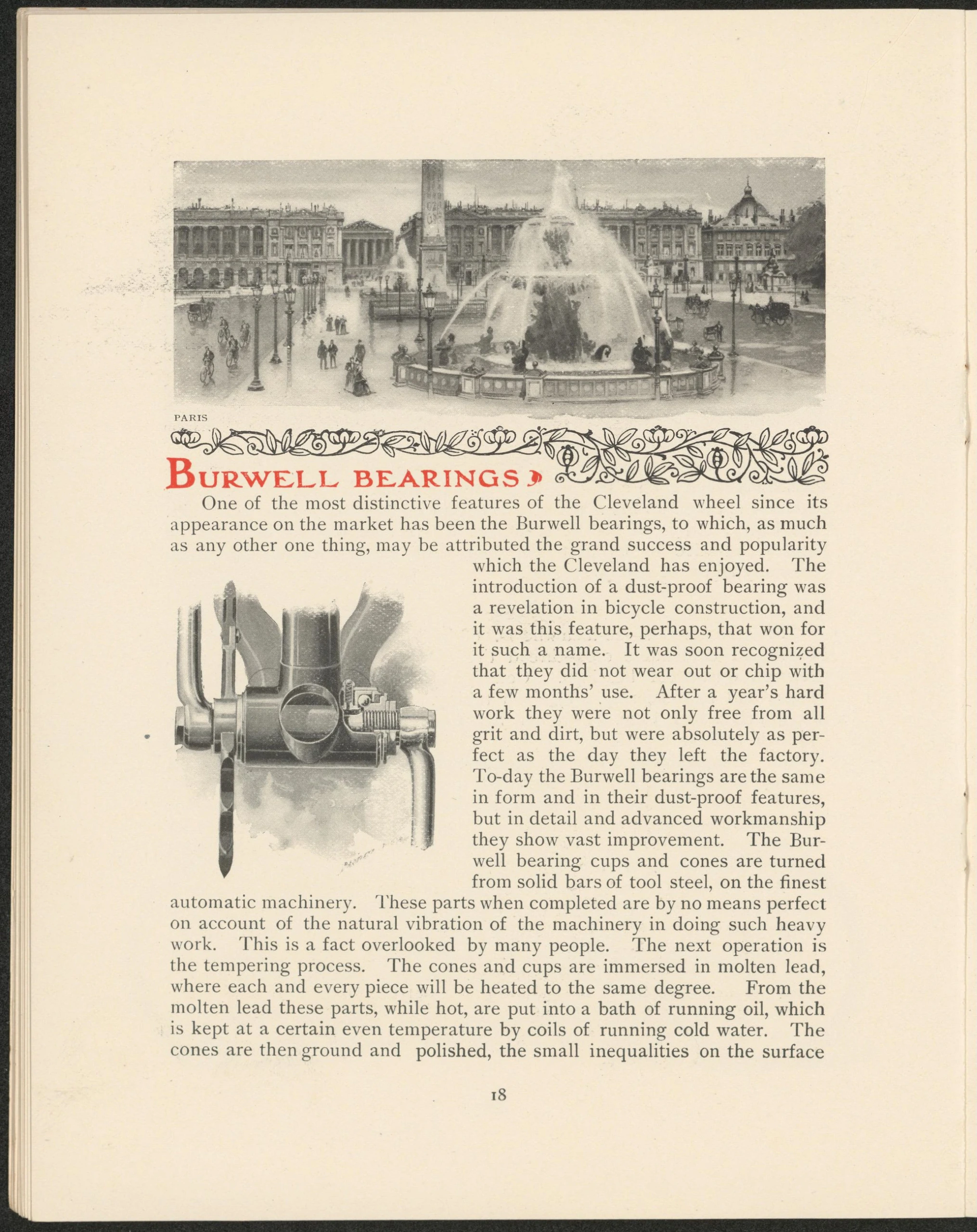
One of the most distinctive features of the Cleveland wheel since its appearance on the market has been the Burwell bearings, to which, as much as any other one thing, may be attributed the grand success and popularity which the Cleveland has enjoyed. The introduction of a dust-proof bearing was a revelation in bicycle construction, and it was this feature, perhaps, that won for it such a name. It was soon recognized that they did not wear out or chip with a few months’ use. After a year’s hard work they were not only free from all grit and dirt, but were absolutely as perfect as the day they left the factory. To-day the Burwell bearings are the same in form and in their dust-proof features, but in detail and advanced workmanship they show vast improvement. The Burwell bearing cups and cones are turned from solid bars of tool steel, on the finest automatic machinery. These parts when completed are by no means perfect on account of the natural vibration of the machinery in doing such heavy work. This is a fact overlooked by many people. The next operation is the tempering process. The cones and cups are immersed in molten lead, where each and every piece will be heated to the same degree. From the molten lead these parts, while hot, are put into a bath of running oil, which is kept at a certain even temperature by coils of running cold water. The cones are then ground and polished, the small inequalities on the surface
18
[A halftone vignette of the Place de la Concorde fountain in Paris with cyclists heads the page; the red heading is followed by a black flower-vine band. A halftone of the Cleveland crank hanger, cut away to show the Burwell bearing, sits at left of the text, with a faint engraver’s signature.]
— Page 21 —
BERLIN
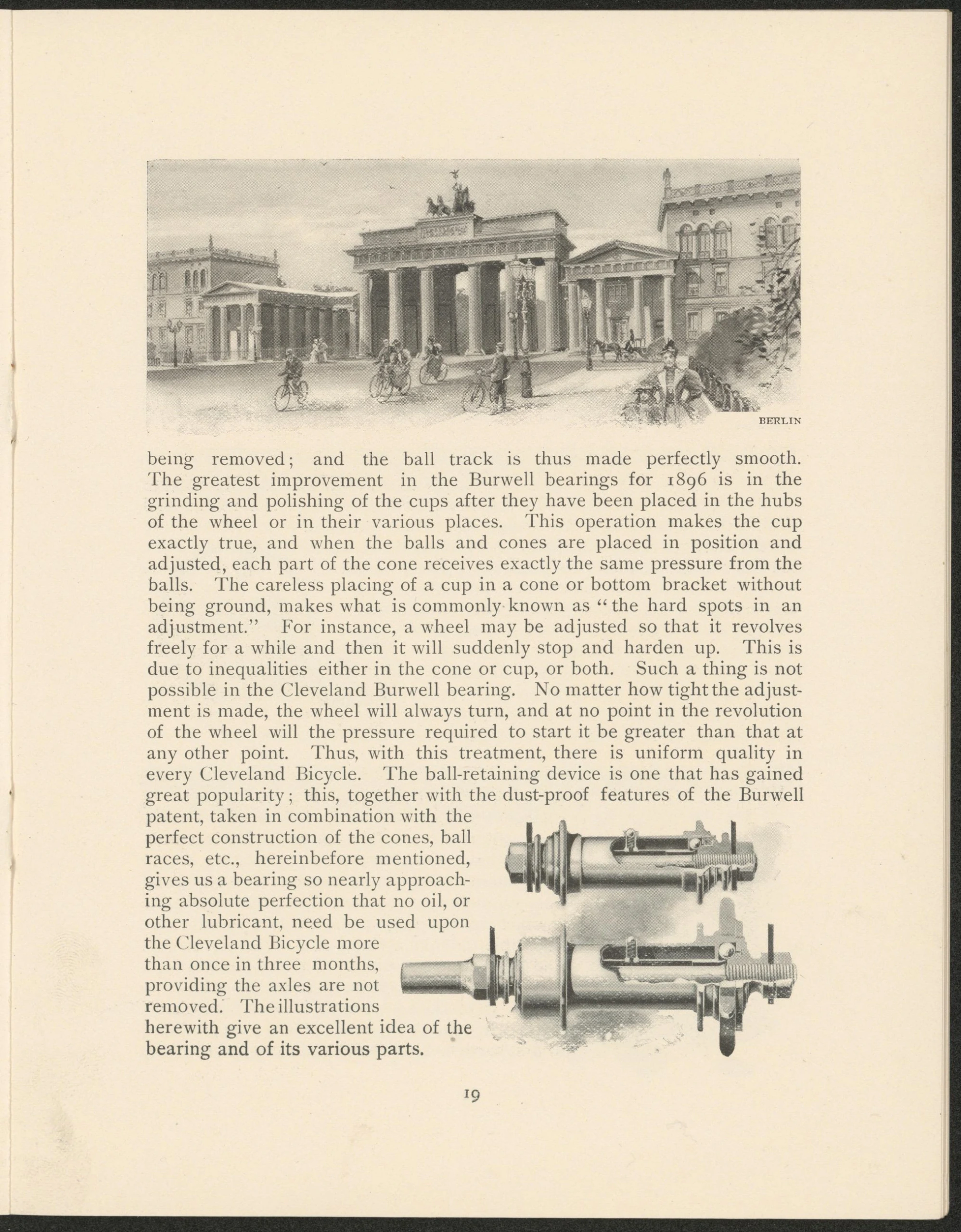
being removed; and the ball track is thus made perfectly smooth. The greatest improvement in the Burwell bearings for 1896 is in the grinding and polishing of the cups after they have been placed in the hubs of the wheel or in their various places. This operation makes the cup exactly true, and when the balls and cones are placed in position and adjusted, each part of the cone receives exactly the same pressure from the balls. The careless placing of a cup in a cone or bottom bracket without being ground, makes what is commonly known as “the hard spots in an adjustment.” For instance, a wheel may be adjusted so that it revolves freely for a while and then it will suddenly stop and harden up. This is due to inequalities either in the cone or cup, or both. Such a thing is not possible in the Cleveland Burwell bearing. No matter how tight the adjustment is made, the wheel will always turn, and at no point in the revolution of the wheel will the pressure required to start it be greater than that at any other point. Thus, with this treatment, there is uniform quality in every Cleveland Bicycle. The ball-retaining device is one that has gained great popularity; this, together with the dust-proof features of the Burwell patent, taken in combination with the perfect construction of the cones, ball races, etc., hereinbefore mentioned, gives us a bearing so nearly approaching absolute perfection that no oil, or other lubricant, need be used upon the Cleveland Bicycle more than once in three months, providing the axles are not removed. The illustrations herewith give an excellent idea of the bearing and of its various parts.
19
[A halftone vignette of the Brandenburg Gate in Berlin with cyclists, a carriage and a lady in the foreground heads the page. Two halftones of Cleveland hubs, cut away to show the Burwell bearings and ball retainers, stand at lower right.]
— Page 22 —
ANTWERP
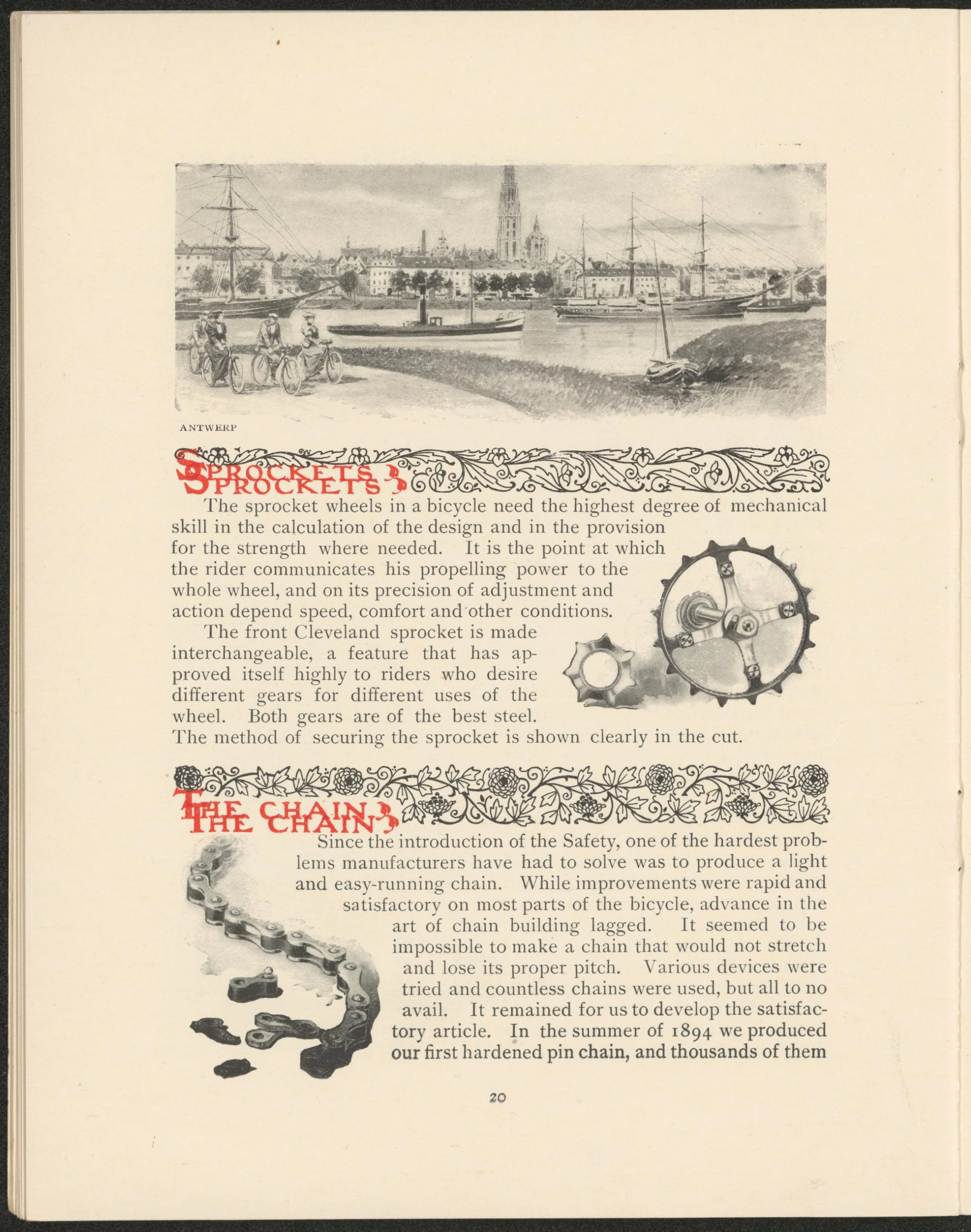
SPROCKETS
The sprocket wheels in a bicycle need the highest degree of mechanical skill in the calculation of the design and in the provision for the strength where needed. It is the point at which the rider communicates his propelling power to the whole wheel, and on its precision of adjustment and action depend speed, comfort and other conditions.
The front Cleveland sprocket is made interchangeable, a feature that has approved itself highly to riders who desire different gears for different uses of the wheel. Both gears are of the best steel. The method of securing the sprocket is shown clearly in the cut.
THE CHAIN
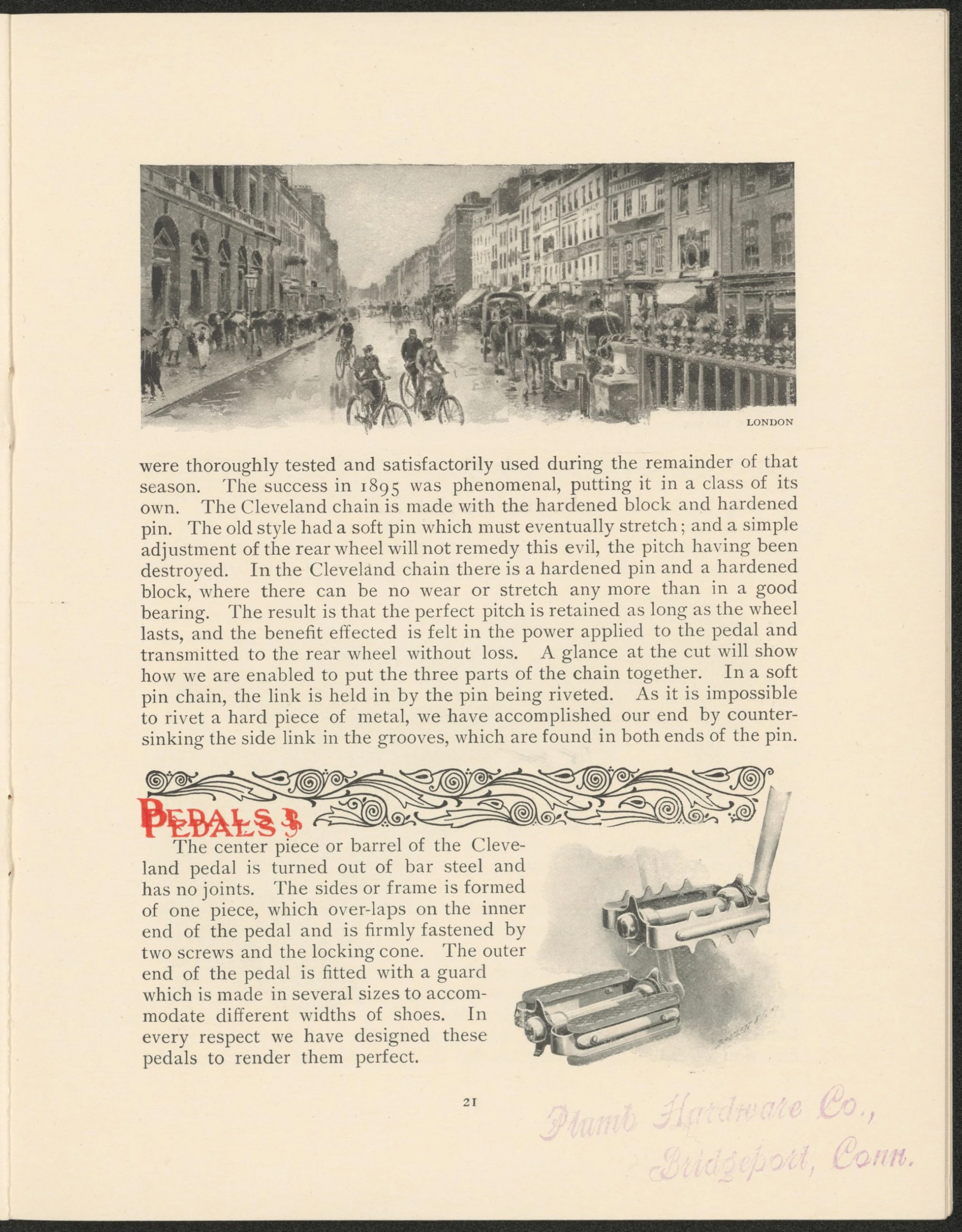
Since the introduction of the Safety, one of the hardest problems manufacturers have had to solve was to produce a light and easy-running chain. While improvements were rapid and satisfactory on most parts of the bicycle, advance in the art of chain building lagged. It seemed to be impossible to make a chain that would not stretch and lose its proper pitch. Various devices were tried and countless chains were used, but all to no avail. It remained for us to develop the satisfactory article. In the summer of 1894 we produced our first hardened pin chain, and thousands of them
20
[A halftone vignette of cyclists on the quay at Antwerp with steamers and a cathedral spire heads the page. The red headings, each doubled in printing, run into black floral bands; a halftone of the detachable front sprocket on its crank and a small rear sprocket sits at right, and a block chain with loose links at lower left.]
— Page 23 —
LONDON
were thoroughly tested and satisfactorily used during the remainder of that season. The success in 1895 was phenomenal, putting it in a class of its own. The Cleveland chain is made with the hardened block and hardened pin. The old style had a soft pin which must eventually stretch; and a simple adjustment of the rear wheel will not remedy this evil, the pitch having been destroyed. In the Cleveland chain there is a hardened pin and a hardened block, where there can be no wear or stretch any more than in a good bearing. The result is that the perfect pitch is retained as long as the wheel lasts, and the benefit effected is felt in the power applied to the pedal and transmitted to the rear wheel without loss. A glance at the cut will show how we are enabled to put the three parts of the chain together. In a soft pin chain, the link is held in by the pin being riveted. As it is impossible to rivet a hard piece of metal, we have accomplished our end by countersinking the side link in the grooves, which are found in both ends of the pin.
PEDALS
The center piece or barrel of the Cleveland pedal is turned out of bar steel and has no joints. The sides or frame is formed of one piece, which over-laps on the inner end of the pedal and is firmly fastened by two screws and the locking cone. The outer end of the pedal is fitted with a guard which is made in several sizes to accommodate different widths of shoes. In every respect we have designed these pedals to render them perfect.
21
Plumb Hardware Co.,
Bridgeport, Conn.
[A halftone vignette of cyclists on a wet, crowded London street heads the page. The red heading, doubled in printing, runs into a black scroll band; a halftone of two Cleveland rat-trap pedals on a crank, with a faint engraver’s signature, sits at lower right. A violet script dealer’s rubber stamp at the foot.]
— Page 24 —
NEW YORK HARBOR
TIRES AND THEIR FABRIC
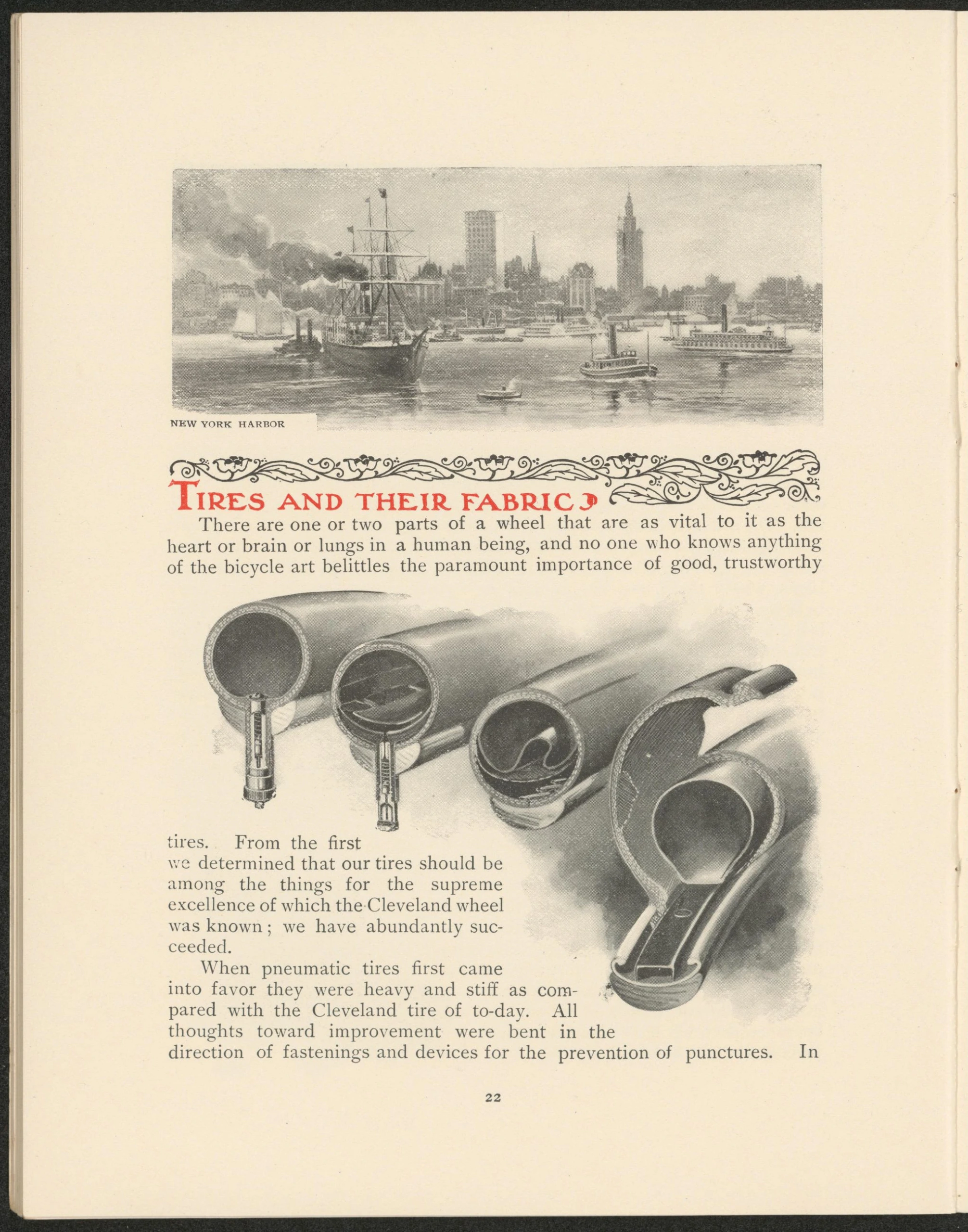
There are one or two parts of a wheel that are as vital to it as the heart or brain or lungs in a human being, and no one who knows anything of the bicycle art belittles the paramount importance of good, trustworthy tires. From the first we determined that our tires should be among the things for the supreme excellence of which the Cleveland wheel was known; we have abundantly succeeded.
When pneumatic tires first came into favor they were heavy and stiff as compared with the Cleveland tire of to-day. All thoughts toward improvement were bent in the direction of fastenings and devices for the prevention of punctures. In
22
[A halftone vignette of New York Harbor with a sailing ship, ferries and tugs heads the page; the red heading runs into a black acanthus band. A large halftone of four Cleveland tires cut in section, showing valves, inner tubes and a detachable tire on its wood rim, fills the middle of the page.]
— Page 25 —
RIVERSIDE DRIVE, NEW YORK
the year 1892 we began the use of the famous thread fabric which marked another radical departure in the manufacture of tires. Previous to this, heavy and closely woven duck was used, and the springiness of the rubber was destroyed. Our efforts have been to confine the air with material which will detract as little as possible from its natural resiliency. By means of the thread fabric, as shown in the illustration, we have succeeded in this direction as far as possible. No other tire is anything like as resilient as this, and its speed and strength and comfort have been demonstrated for the last three seasons.
This year a wider choice than ever before is given to riders of our wheels. The Cleveland tire is made in three different styles, namely, the Cleveland detachable tire, the single-tube or hose-pipe tire, the inner-tube laced tire; we also furnish the Morgan & Wright quick repair tire. These different styles have each their advocates, and while we might be of the opinion that a certain tire was better than the others offered, we think it preferable to leave the choice to the individual judgment of the purchaser. The workmanship in these tires is the very best and of the highest grade. The Cleveland detachable tire has been on the market for three successive seasons and has been an unqualified success, and for easy riding features its equal has not been found.
We do not hesitate to say that in respect to tires we have made this year the best provision for riders that they have ever known. Our work in this respect is not a matter of chance, but touches a standard of excellence which it has required years of study, effort and experience to reach. Come what may, the tire will remain one of the most important parts of the modern bicycle, and there we have concentrated much of our best thought and endeavor. We are offering specialties that we can speak about with the fullest conviction and certainty, and which we know to be unsurpassed.
23
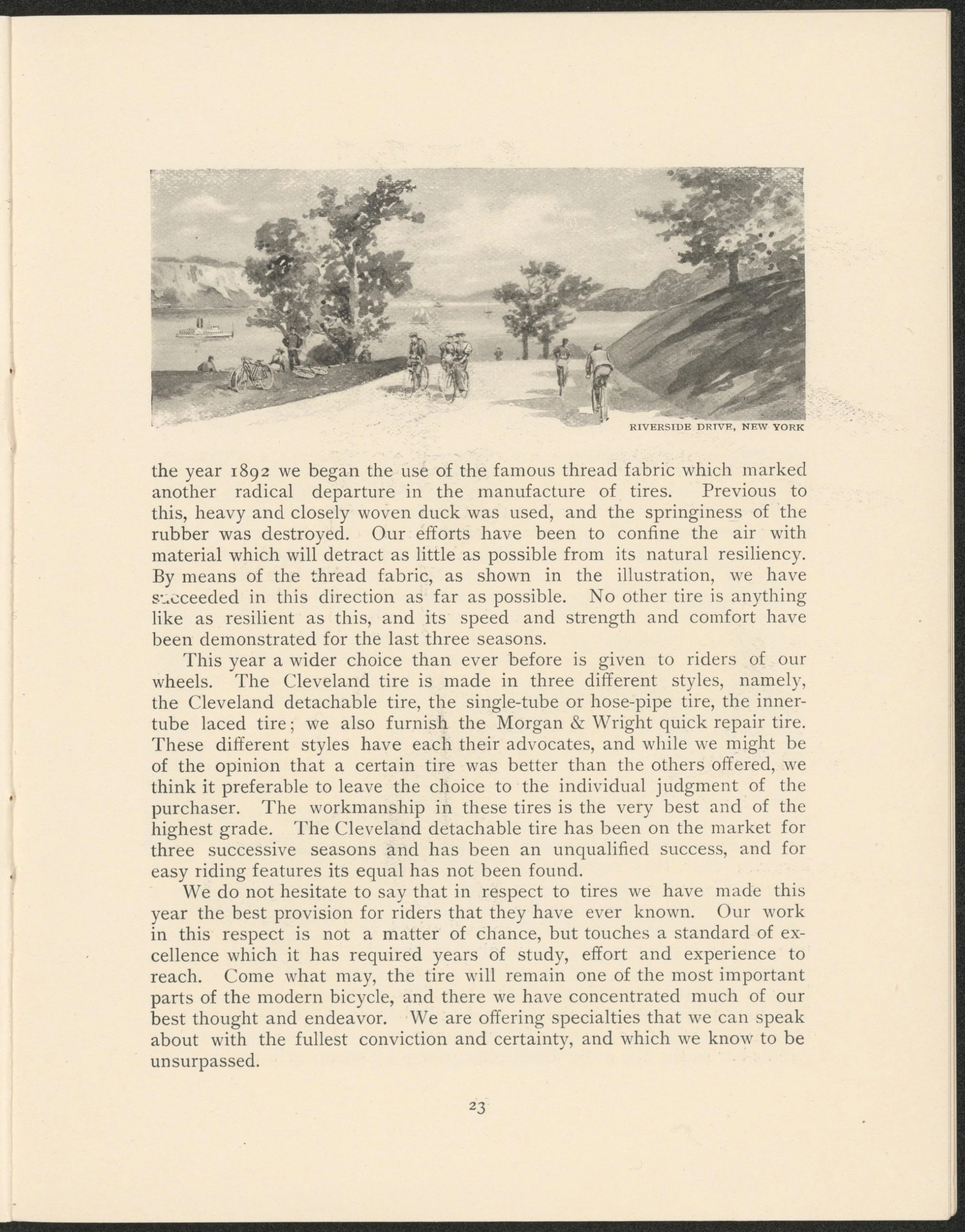
[A halftone vignette of cyclists on Riverside Drive, New York, above the Hudson with a steamboat, heads the page of text.]
— Page 26 —
PHILADELPHIA
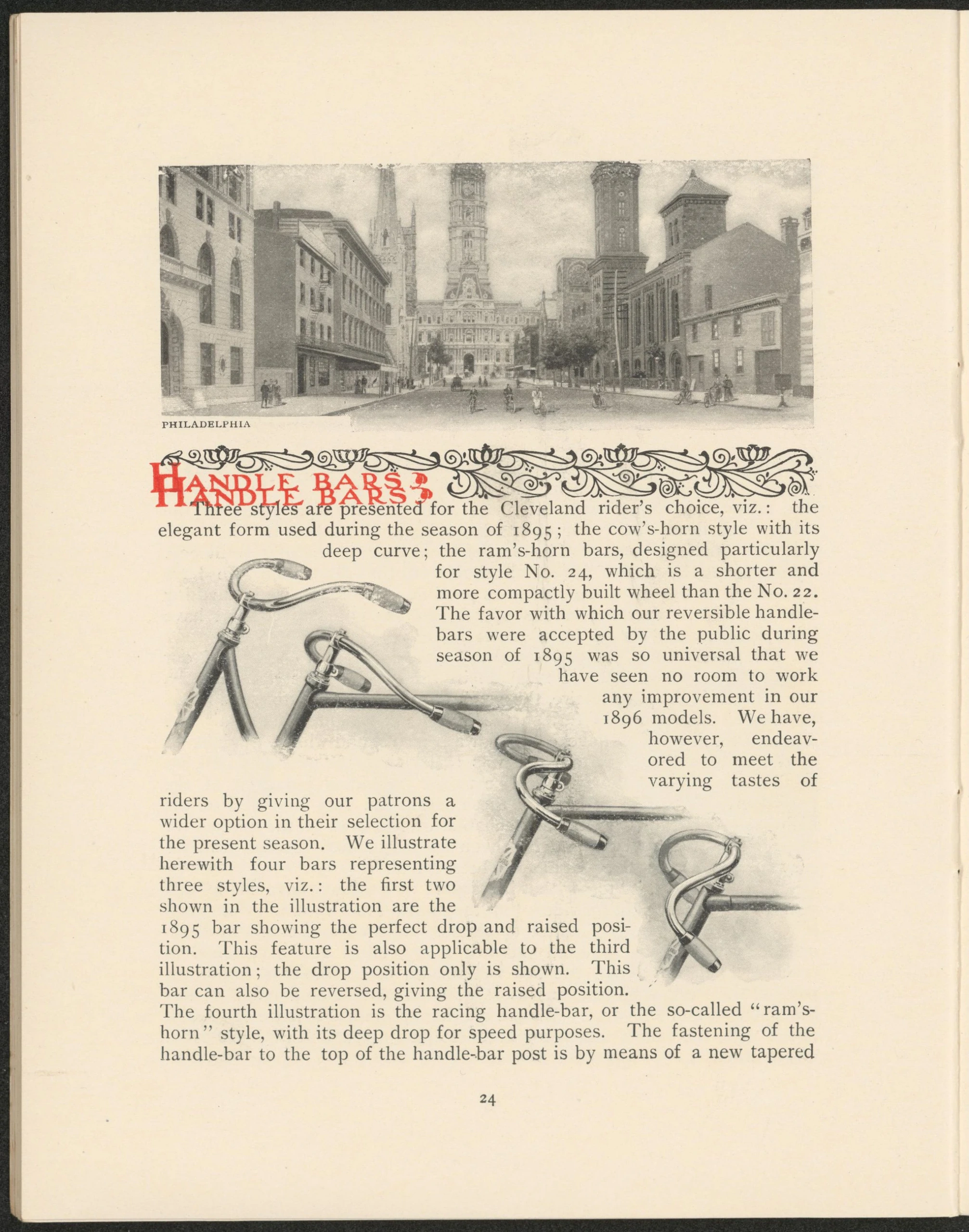
HANDLE BARS
Three styles are presented for the Cleveland rider’s choice, viz.: the elegant form used during the season of 1895; the cow’s-horn style with its deep curve; the ram’s-horn bars, designed particularly for style No. 24, which is a shorter and more compactly built wheel than the No. 22. The favor with which our reversible handle-bars were accepted by the public during season of 1895 was so universal that we have seen no room to work any improvement in our 1896 models. We have, however, endeavored to meet the varying tastes of riders by giving our patrons a wider option in their selection for the present season. We illustrate herewith four bars representing three styles, viz.: the first two shown in the illustration are the 1895 bar showing the perfect drop and raised position. This feature is also applicable to the third illustration; the drop position only is shown. This bar can also be reversed, giving the raised position. The fourth illustration is the racing handle-bar, or the so-called “ram’s-horn” style, with its deep drop for speed purposes. The fastening of the handle-bar to the top of the handle-bar post is by means of a new tapered
24
[A halftone vignette of Broad Street, Philadelphia, toward City Hall, with cyclists, heads the page. The red heading, doubled in printing, runs into a black scroll band; four halftones of Cleveland handle-bars on their stems step diagonally down the page between the lines of text.]
— Page 27 —
WASHINGTON, D. C.
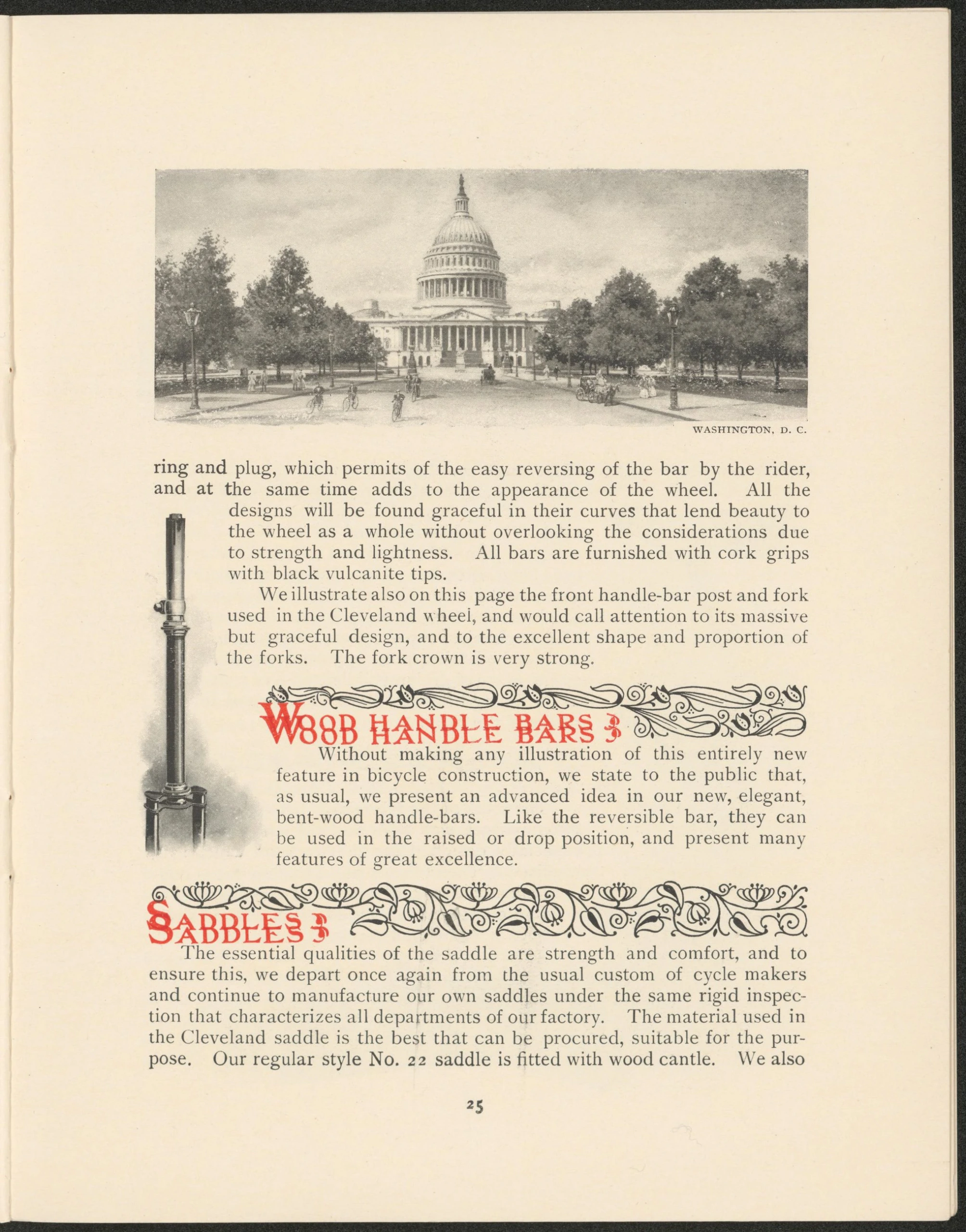
ring and plug, which permits of the easy reversing of the bar by the rider, and at the same time adds to the appearance of the wheel. All the designs will be found graceful in their curves that lend beauty to the wheel as a whole without overlooking the considerations due to strength and lightness. All bars are furnished with cork grips with black vulcanite tips.
We illustrate also on this page the front handle-bar post and fork used in the Cleveland wheel, and would call attention to its massive but graceful design, and to the excellent shape and proportion of the forks. The fork crown is very strong.
WOOD HANDLE BARS
Without making any illustration of this entirely new feature in bicycle construction, we state to the public that, as usual, we present an advanced idea in our new, elegant, bent-wood handle-bars. Like the reversible bar, they can be used in the raised or drop position, and present many features of great excellence.
SADDLES
The essential qualities of the saddle are strength and comfort, and to ensure this, we depart once again from the usual custom of cycle makers and continue to manufacture our own saddles under the same rigid inspection that characterizes all departments of our factory. The material used in the Cleveland saddle is the best that can be procured, suitable for the purpose. Our regular style No. 22 saddle is fitted with wood cantle. We also
25
[A halftone vignette of the United States Capitol in Washington with cyclists and carriages heads the page. A tall halftone of the Cleveland handle-bar post, head and fork crown stands at left; the two red headings, doubled in printing, run into black floral bands.]
— Page 28 —
BOSTON COMMON
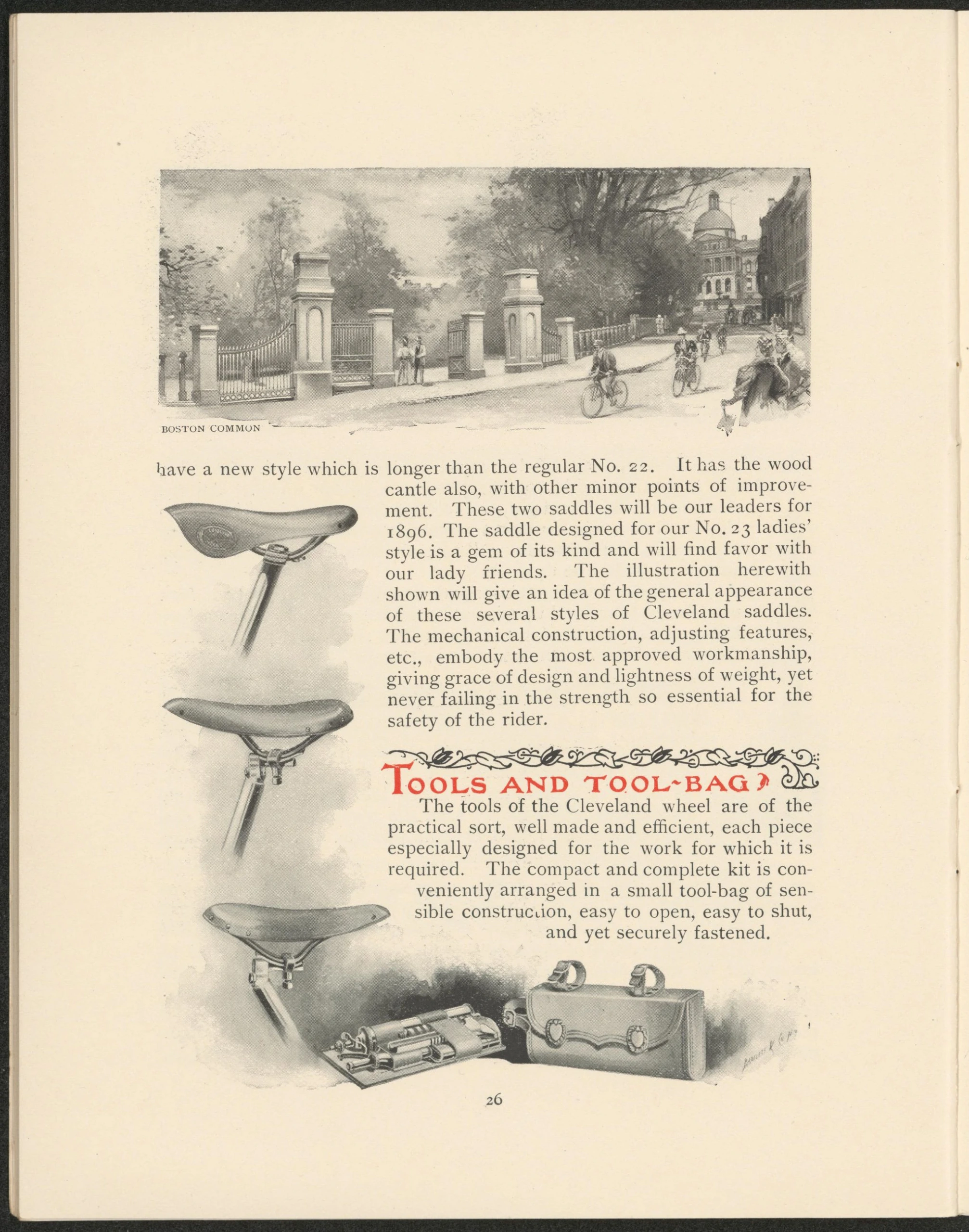
have a new style which is longer than the regular No. 22. It has the wood cantle also, with other minor points of improvement. These two saddles will be our leaders for 1896. The saddle designed for our No. 23 ladies’ style is a gem of its kind and will find favor with our lady friends. The illustration herewith shown will give an idea of the general appearance of these several styles of Cleveland saddles. The mechanical construction, adjusting features, etc., embody the most approved workmanship, giving grace of design and lightness of weight, yet never failing in the strength so essential for the safety of the rider.
TOOLS AND TOOL-BAG
The tools of the Cleveland wheel are of the practical sort, well made and efficient, each piece especially designed for the work for which it is required. The compact and complete kit is conveniently arranged in a small tool-bag of sensible construction, easy to open, easy to shut, and yet securely fastened.
26
[A halftone vignette of cyclists passing the gates of Boston Common heads the page. Three Cleveland saddles on their posts descend the left side; at the foot, the tool kit laid out in its roll beside the leather tool-bag, with a faint engraver’s signature, apparently Bartlett & Co., N.Y.]
— Page 29 —
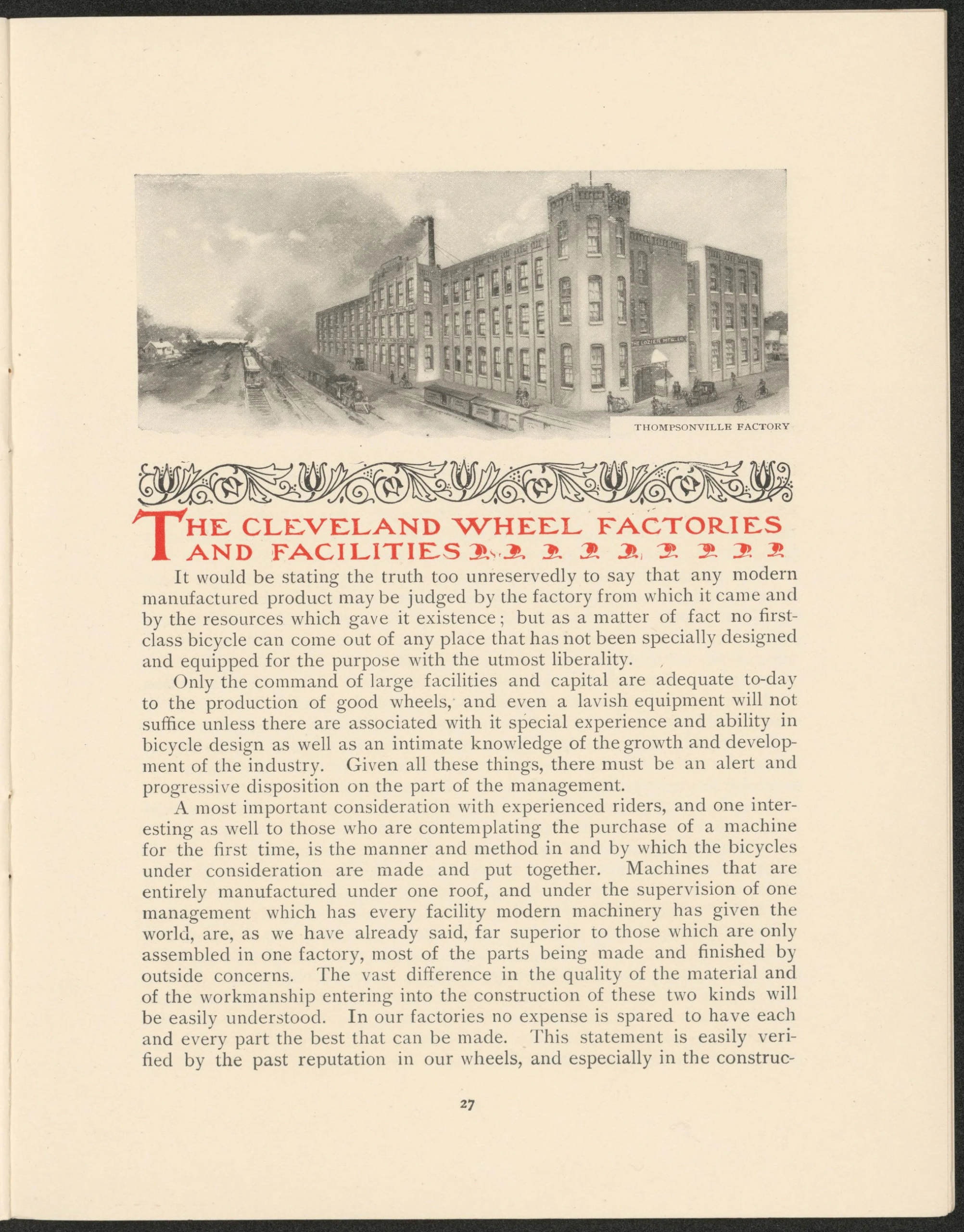
THOMPSONVILLE FACTORY
THE LOZIER MFG. CO.
THE CLEVELAND WHEEL FACTORIES AND FACILITIES
It would be stating the truth too unreservedly to say that any modern manufactured product may be judged by the factory from which it came and by the resources which gave it existence; but as a matter of fact no first-class bicycle can come out of any place that has not been specially designed and equipped for the purpose with the utmost liberality.
Only the command of large facilities and capital are adequate to-day to the production of good wheels, and even a lavish equipment will not suffice unless there are associated with it special experience and ability in bicycle design as well as an intimate knowledge of the growth and development of the industry. Given all these things, there must be an alert and progressive disposition on the part of the management.
A most important consideration with experienced riders, and one interesting as well to those who are contemplating the purchase of a machine for the first time, is the manner and method in and by which the bicycles under consideration are made and put together. Machines that are entirely manufactured under one roof, and under the supervision of one management which has every facility modern machinery has given the world, are, as we have already said, far superior to those which are only assembled in one factory, most of the parts being made and finished by outside concerns. The vast difference in the quality of the material and of the workmanship entering into the construction of these two kinds will be easily understood. In our factories no expense is spared to have each and every part the best that can be made. This statement is easily verified by the past reputation in our wheels, and especially in the construc-
27
[A halftone vignette of the four-story brick Thompsonville, Connecticut, factory beside a railroad, a sign on the building reading THE LOZIER MFG. CO., heads the page. The red two-line heading with a large initial T sits under a black tulip-scroll band.]
— Page 30 —
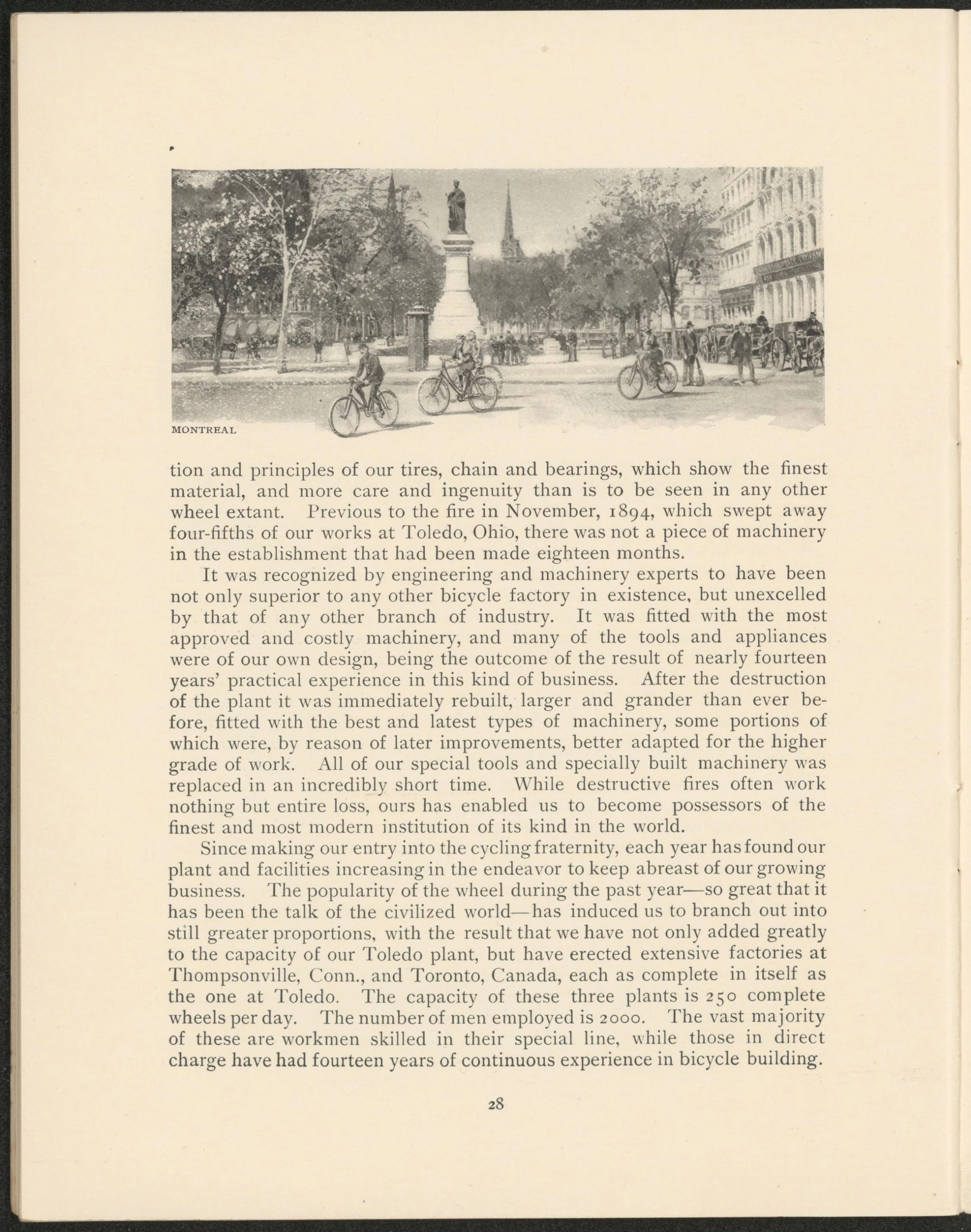
MONTREAL
tion and principles of our tires, chain and bearings, which show the finest material, and more care and ingenuity than is to be seen in any other wheel extant. Previous to the fire in November, 1894, which swept away four-fifths of our works at Toledo, Ohio, there was not a piece of machinery in the establishment that had been made eighteen months.
It was recognized by engineering and machinery experts to have been not only superior to any other bicycle factory in existence, but unexcelled by that of any other branch of industry. It was fitted with the most approved and costly machinery, and many of the tools and appliances were of our own design, being the outcome of the result of nearly fourteen years’ practical experience in this kind of business. After the destruction of the plant it was immediately rebuilt, larger and grander than ever before, fitted with the best and latest types of machinery, some portions of which were, by reason of later improvements, better adapted for the higher grade of work. All of our special tools and specially built machinery was replaced in an incredibly short time. While destructive fires often work nothing but entire loss, ours has enabled us to become possessors of the finest and most modern institution of its kind in the world.
Since making our entry into the cycling fraternity, each year has found our plant and facilities increasing in the endeavor to keep abreast of our growing business. The popularity of the wheel during the past year—so great that it has been the talk of the civilized world—has induced us to branch out into still greater proportions, with the result that we have not only added greatly to the capacity of our Toledo plant, but have erected extensive factories at Thompsonville, Conn., and Toronto, Canada, each as complete in itself as the one at Toledo. The capacity of these three plants is 250 complete wheels per day. The number of men employed is 2000. The vast majority of these are workmen skilled in their special line, while those in direct charge have had fourteen years of continuous experience in bicycle building.
28
[A halftone vignette of a Montreal square with a monument, carriages and cyclists heads the page of text.]
— Page 31 —
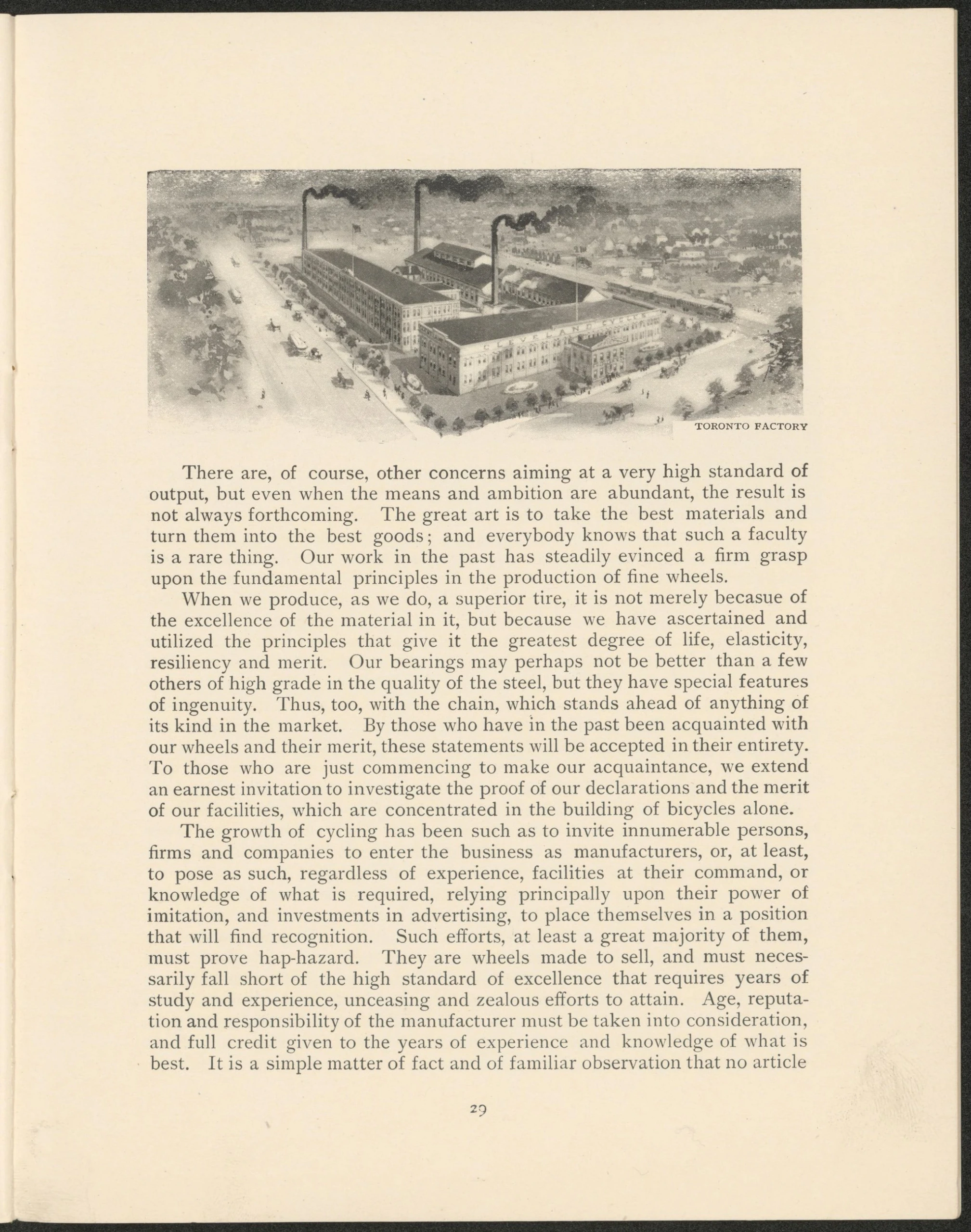
TORONTO FACTORY
CLEVELAND CYCLES
There are, of course, other concerns aiming at a very high standard of output, but even when the means and ambition are abundant, the result is not always forthcoming. The great art is to take the best materials and turn them into the best goods; and everybody knows that such a faculty is a rare thing. Our work in the past has steadily evinced a firm grasp upon the fundamental principles in the production of fine wheels.
When we produce, as we do, a superior tire, it is not merely becasue of the excellence of the material in it, but because we have ascertained and utilized the principles that give it the greatest degree of life, elasticity, resiliency and merit. Our bearings may perhaps not be better than a few others of high grade in the quality of the steel, but they have special features of ingenuity. Thus, too, with the chain, which stands ahead of anything of its kind in the market. By those who have in the past been acquainted with our wheels and their merit, these statements will be accepted in their entirety. To those who are just commencing to make our acquaintance, we extend an earnest invitation to investigate the proof of our declarations and the merit of our facilities, which are concentrated in the building of bicycles alone.
The growth of cycling has been such as to invite innumerable persons, firms and companies to enter the business as manufacturers, or, at least, to pose as such, regardless of experience, facilities at their command, or knowledge of what is required, relying principally upon their power of imitation, and investments in advertising, to place themselves in a position that will find recognition. Such efforts, at least a great majority of them, must prove hap-hazard. They are wheels made to sell, and must necessarily fall short of the high standard of excellence that requires years of study and experience, unceasing and zealous efforts to attain. Age, reputation and responsibility of the manufacturer must be taken into consideration, and full credit given to the years of experience and knowledge of what is best. It is a simple matter of fact and of familiar observation that no article
29
[A halftone vignette, in bird’s-eye view, of the Toronto factory at a street corner with smoking chimneys, its roofline lettered CLEVELAND CYCLES, heads the page of text. A faint gray smudge in the right margin.]
— Page 32 —
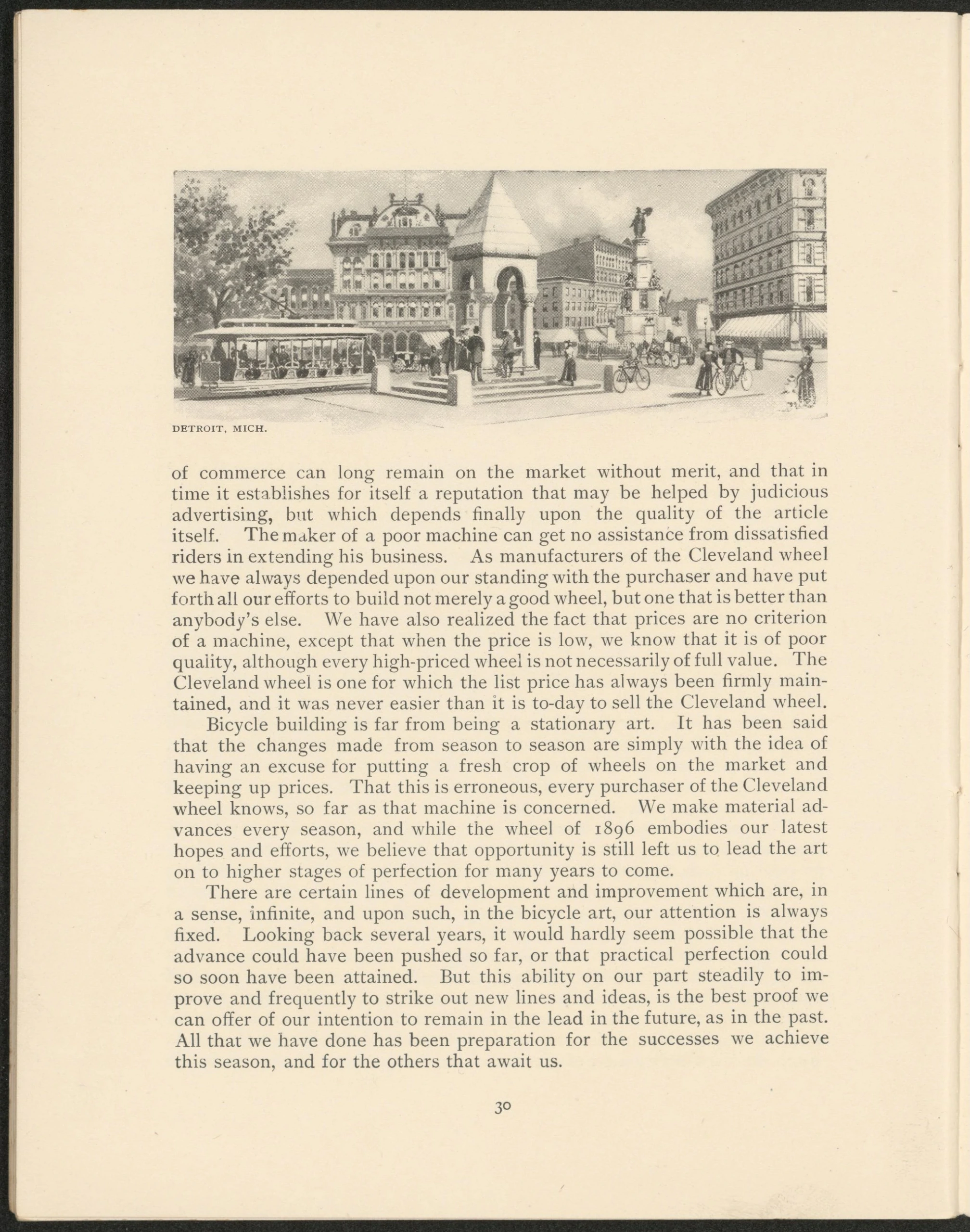
DETROIT, MICH.
of commerce can long remain on the market without merit, and that in time it establishes for itself a reputation that may be helped by judicious advertising, but which depends finally upon the quality of the article itself. The maker of a poor machine can get no assistance from dissatisfied riders in extending his business. As manufacturers of the Cleveland wheel we have always depended upon our standing with the purchaser and have put forth all our efforts to build not merely a good wheel, but one that is better than anybody’s else. We have also realized the fact that prices are no criterion of a machine, except that when the price is low, we know that it is of poor quality, although every high-priced wheel is not necessarily of full value. The Cleveland wheel is one for which the list price has always been firmly maintained, and it was never easier than it is to-day to sell the Cleveland wheel.
Bicycle building is far from being a stationary art. It has been said that the changes made from season to season are simply with the idea of having an excuse for putting a fresh crop of wheels on the market and keeping up prices. That this is erroneous, every purchaser of the Cleveland wheel knows, so far as that machine is concerned. We make material advances every season, and while the wheel of 1896 embodies our latest hopes and efforts, we believe that opportunity is still left us to lead the art on to higher stages of perfection for many years to come.
There are certain lines of development and improvement which are, in a sense, infinite, and upon such, in the bicycle art, our attention is always fixed. Looking back several years, it would hardly seem possible that the advance could have been pushed so far, or that practical perfection could so soon have been attained. But this ability on our part steadily to improve and frequently to strike out new lines and ideas, is the best proof we can offer of our intention to remain in the lead in the future, as in the past. All that we have done has been preparation for the successes we achieve this season, and for the others that await us.
30
[A halftone vignette of a Detroit street with a streetcar, a monument, pedestrians and cyclists heads the page of text.]
— Page 33 —
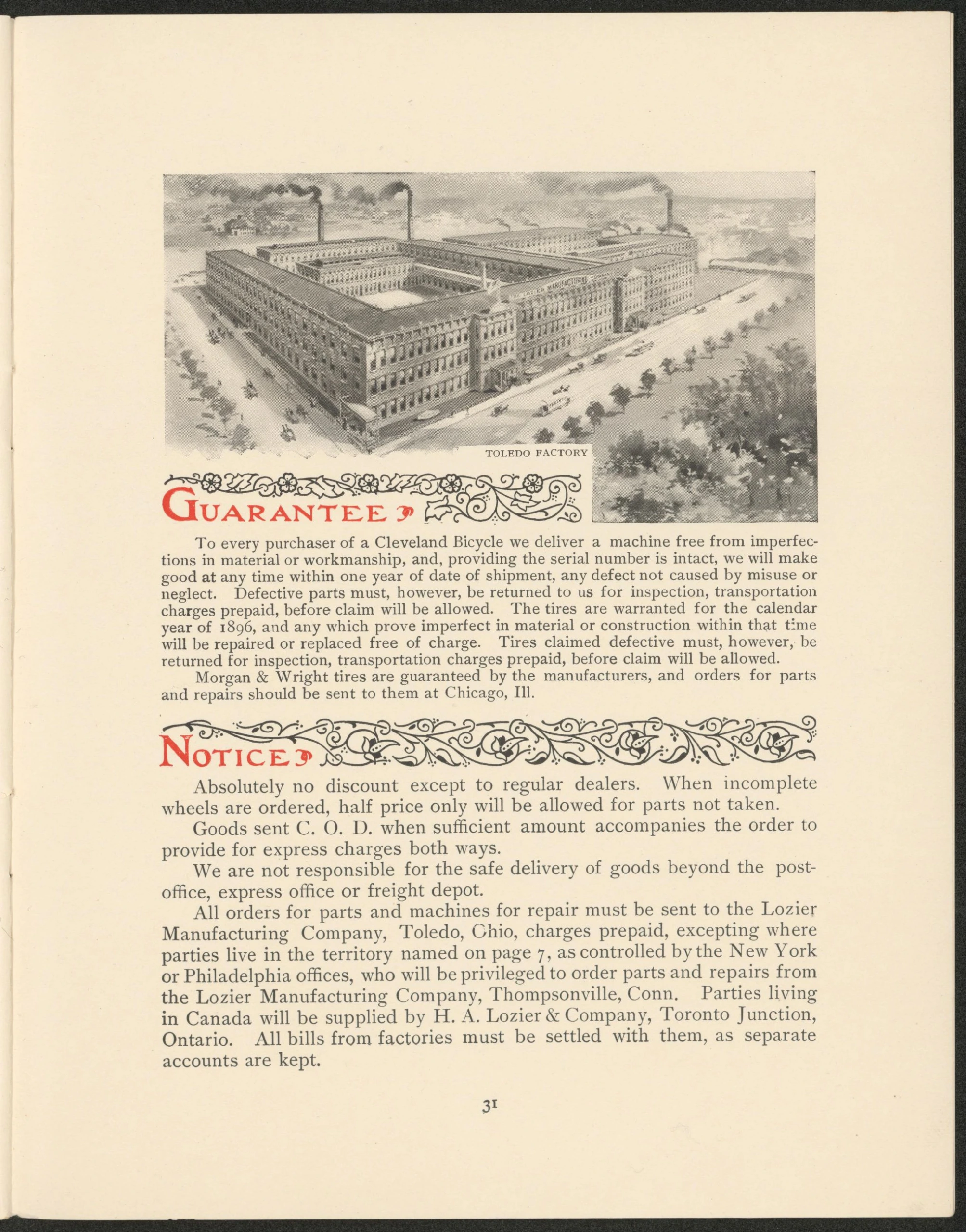
TOLEDO FACTORY
GUARANTEE
To every purchaser of a Cleveland Bicycle we deliver a machine free from imperfections in material or workmanship, and, providing the serial number is intact, we will make good at any time within one year of date of shipment, any defect not caused by misuse or neglect. Defective parts must, however, be returned to us for inspection, transportation charges prepaid, before claim will be allowed. The tires are warranted for the calendar year of 1896, and any which prove imperfect in material or construction within that time will be repaired or replaced free of charge. Tires claimed defective must, however, be returned for inspection, transportation charges prepaid, before claim will be allowed.
Morgan & Wright tires are guaranteed by the manufacturers, and orders for parts and repairs should be sent to them at Chicago, Ill.
NOTICE
Absolutely no discount except to regular dealers. When incomplete wheels are ordered, half price only will be allowed for parts not taken.
Goods sent C. O. D. when sufficient amount accompanies the order to provide for express charges both ways.
We are not responsible for the safe delivery of goods beyond the post-office, express office or freight depot.
All orders for parts and machines for repair must be sent to the Lozier Manufacturing Company, Toledo, Ohio, charges prepaid, excepting where parties live in the territory named on page 7, as controlled by the New York or Philadelphia offices, who will be privileged to order parts and repairs from the Lozier Manufacturing Company, Thompsonville, Conn. Parties living in Canada will be supplied by H. A. Lozier & Company, Toronto Junction, Ontario. All bills from factories must be settled with them, as separate accounts are kept.
31
[A halftone vignette, in bird’s-eye view, of the large Toledo factory on a tree-lined boulevard heads the page; the red headings run into black floral bands.]
— Page 34 —
[Blank page.]
[A blank cream endpaper, the facing printed page faintly offset onto it.]
— Page 35 —
[Blank page.]
[The blank inside back cover.]
— Page 36 —
[The plain back cover of buff linen-grain paper, with four dark green ornamental stitch motifs along the spine edge matching the front cover. No printed text.]
Ebykr presents this material for research and education. If you hold rights to it or notice an ownership issue, please contact us and we will respond promptly.