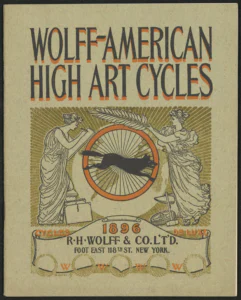
About Ebykr
Ebykr celebrates classic and vintage lightweight bicycles through provocative imagery and opinion. Ride along with us.
About Ebykr
Ebykr celebrates classic and vintage lightweight bicycles through provocative imagery and opinion. Ride along with us.

Source: Northwestern University Libraries, Transportation Library, "Wolff-American high art cycles, made by R.H. Wolff and Company, Limited." (digital collection, https://dc.library.northwestern.edu/items/2ebed183-3b04-466f-a528-b8a6ca135fd4); rights statement "No Copyright - United States".
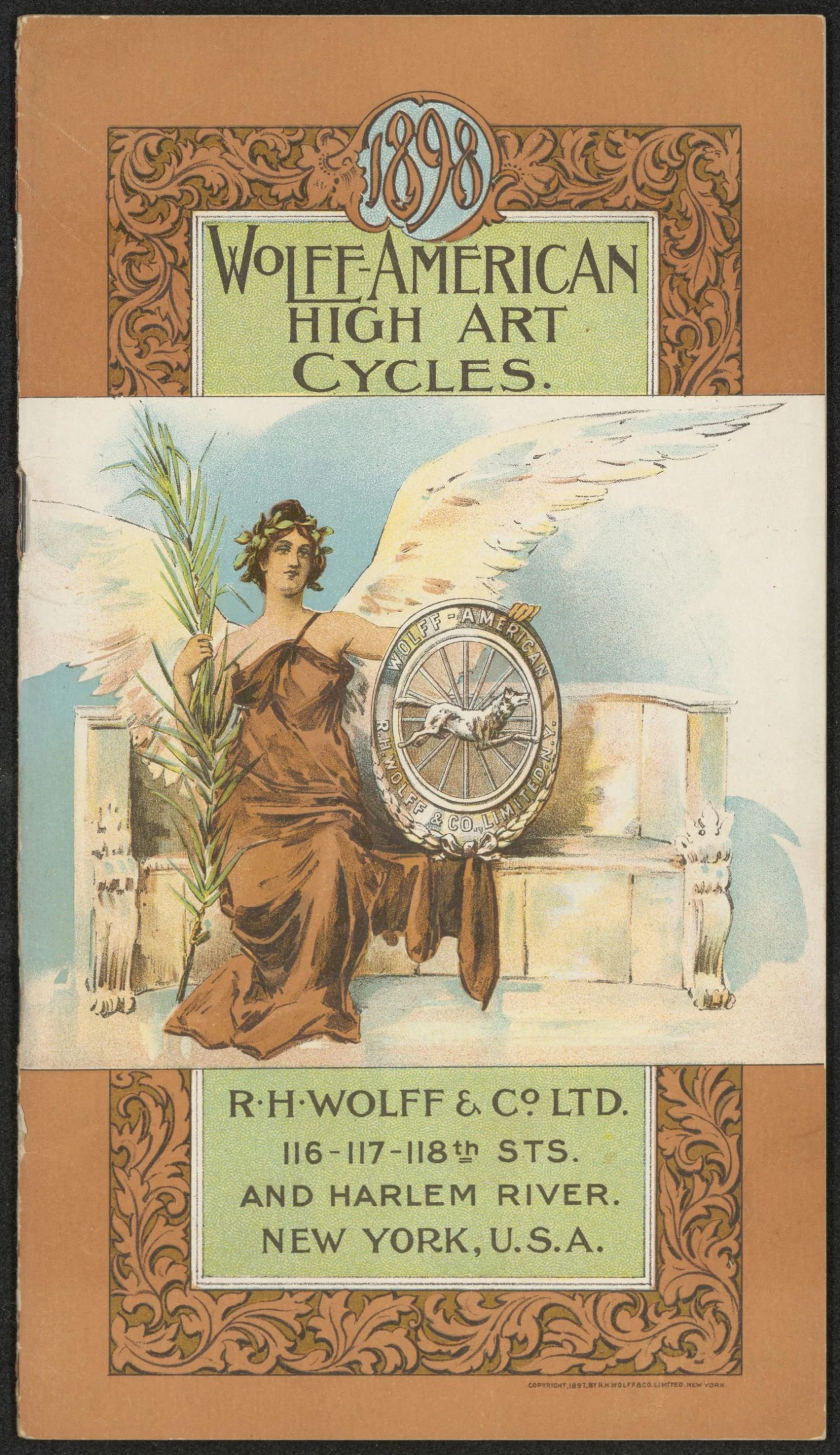 Page 1
 Page 2
 Page 3
 Page 4
 Page 5
 Page 6
 Page 7
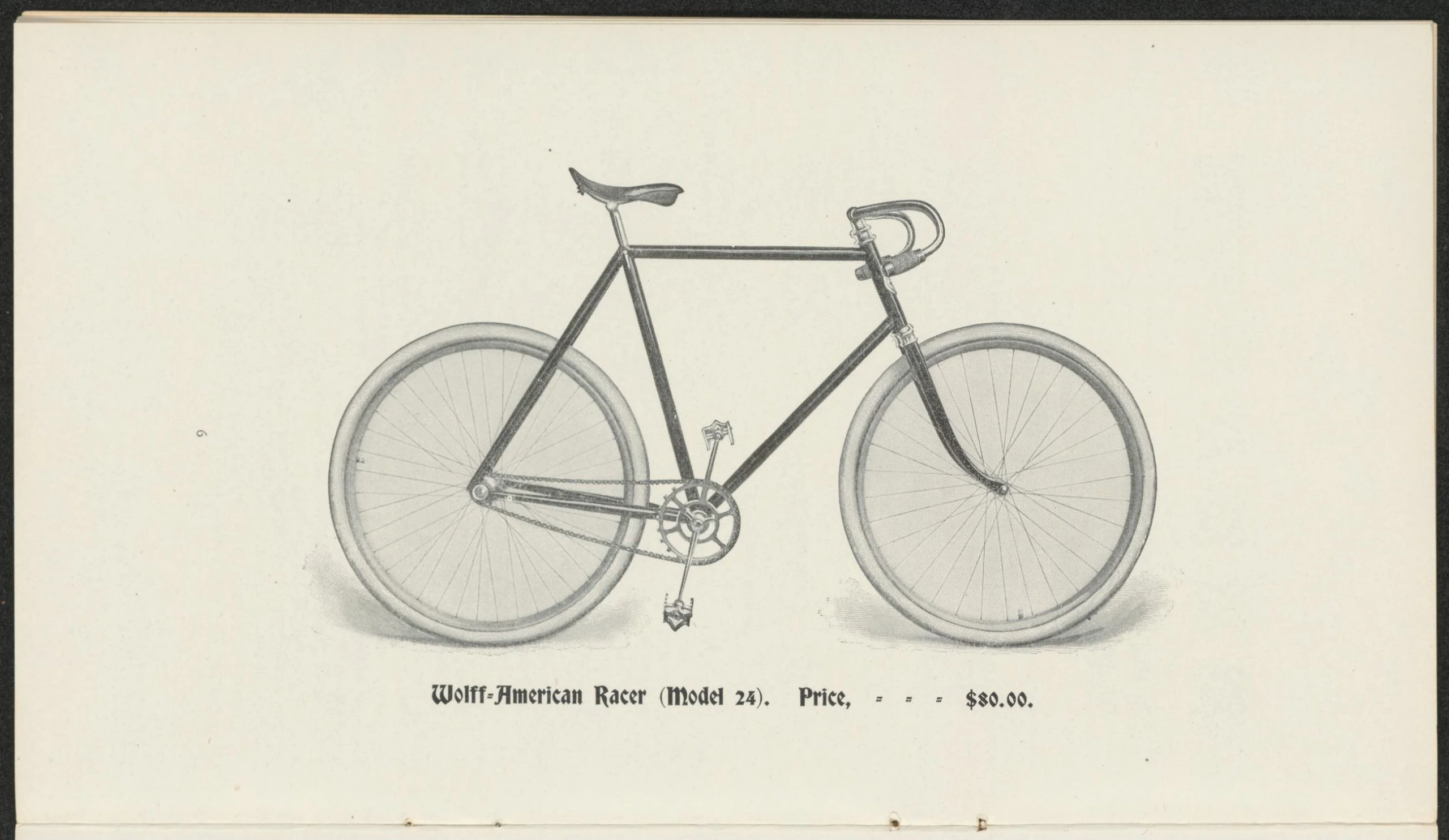 Page 8
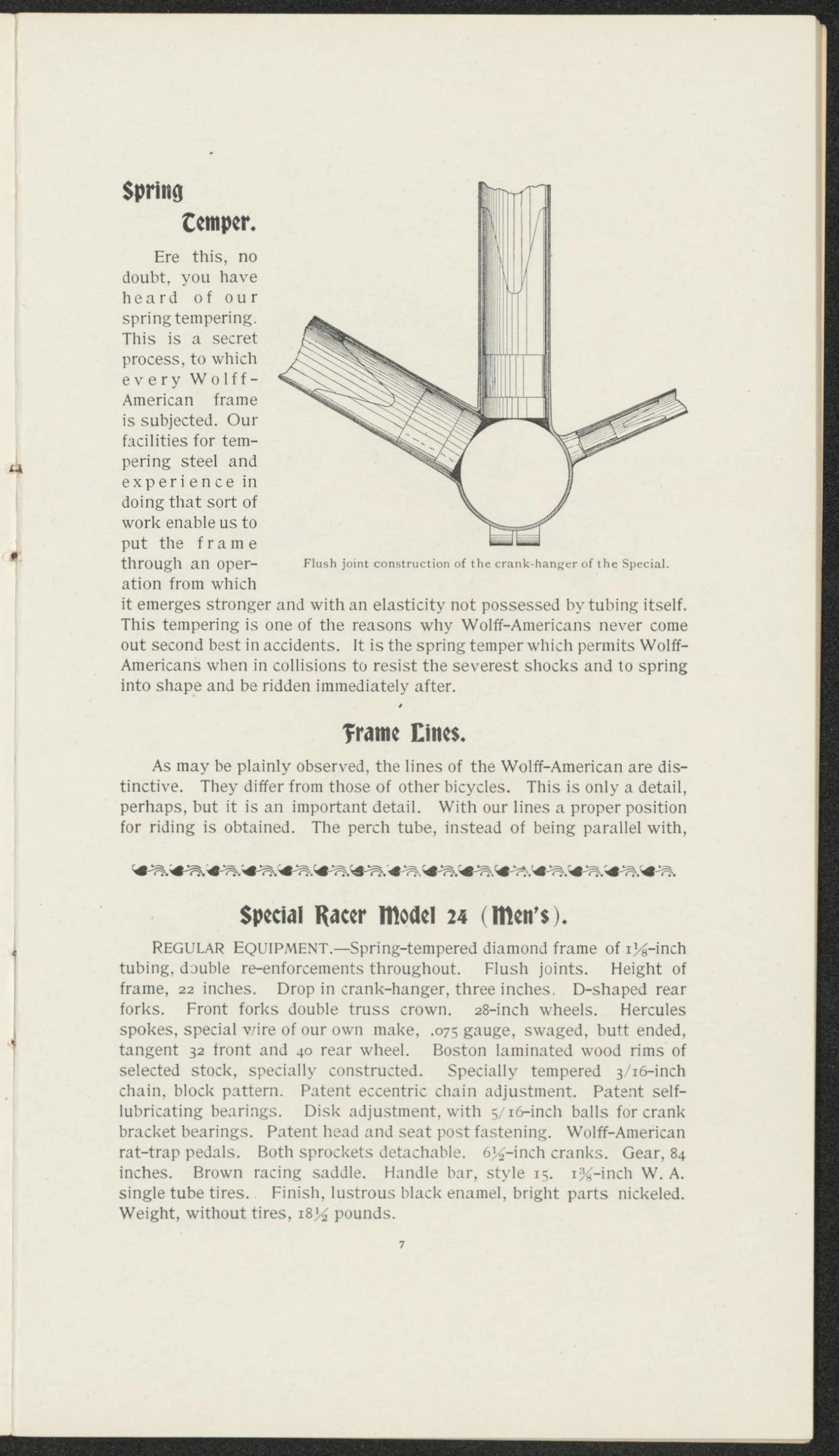 Page 9
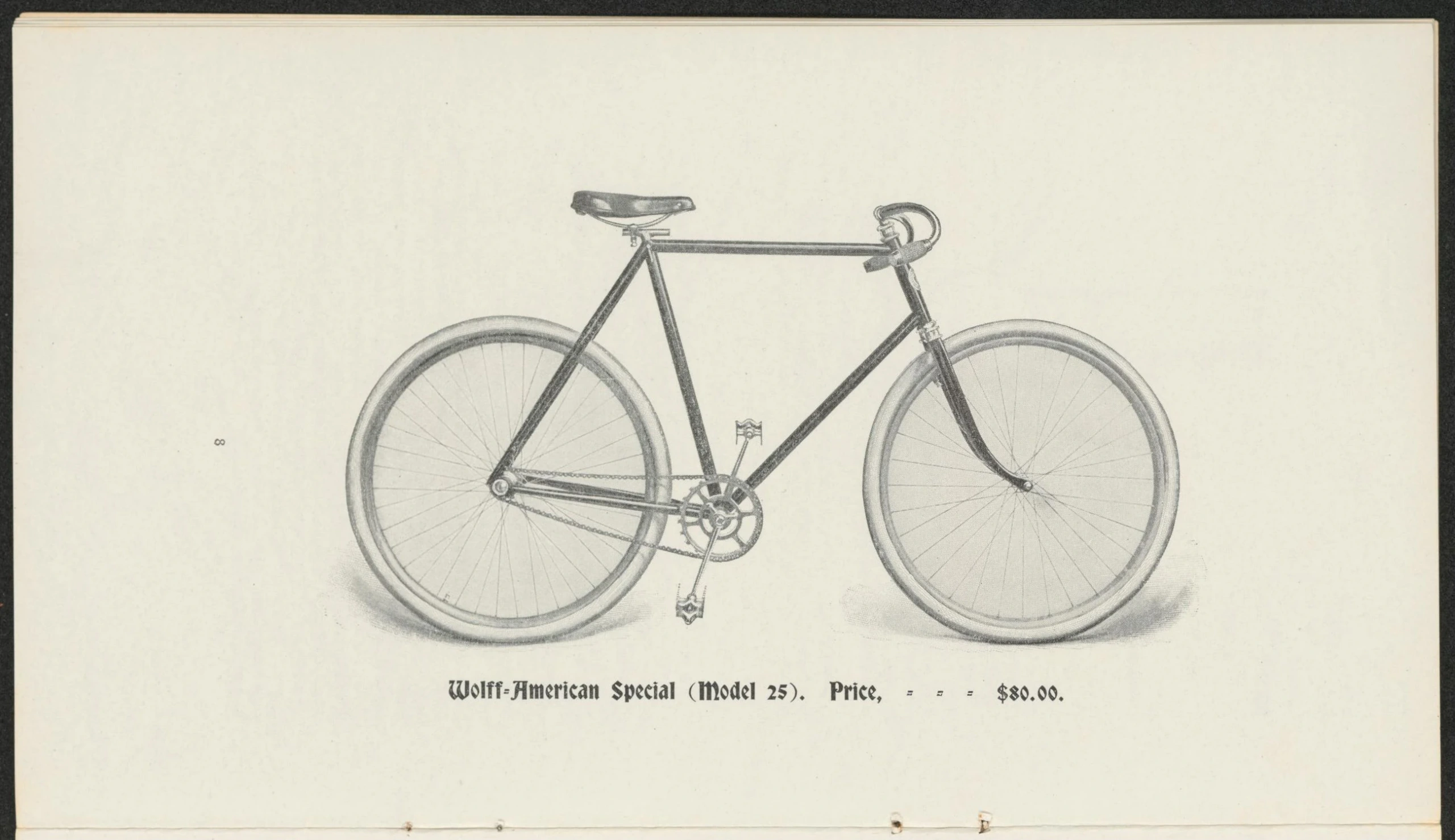 Page 10
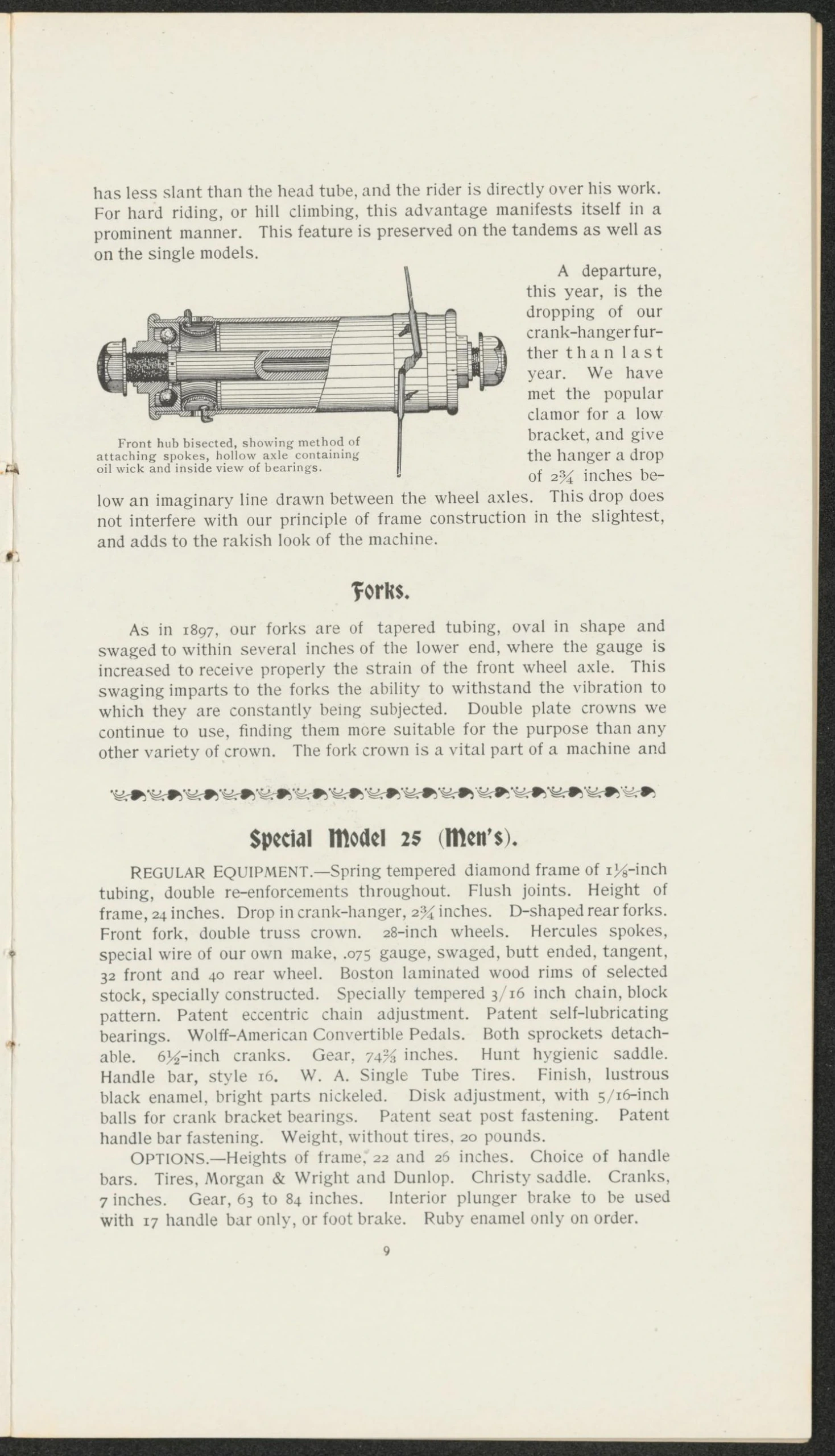 Page 11
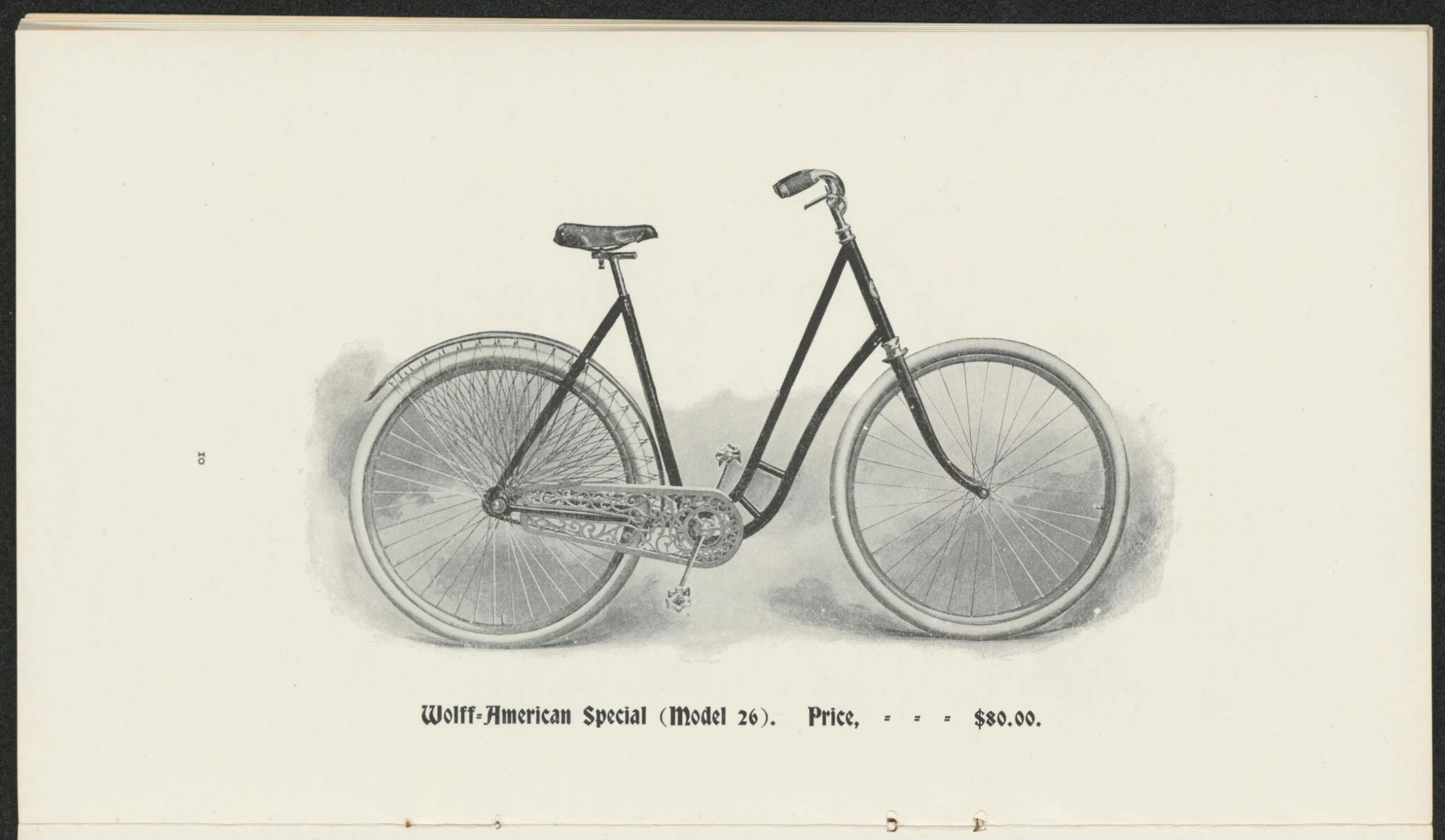 Page 12
 Page 13
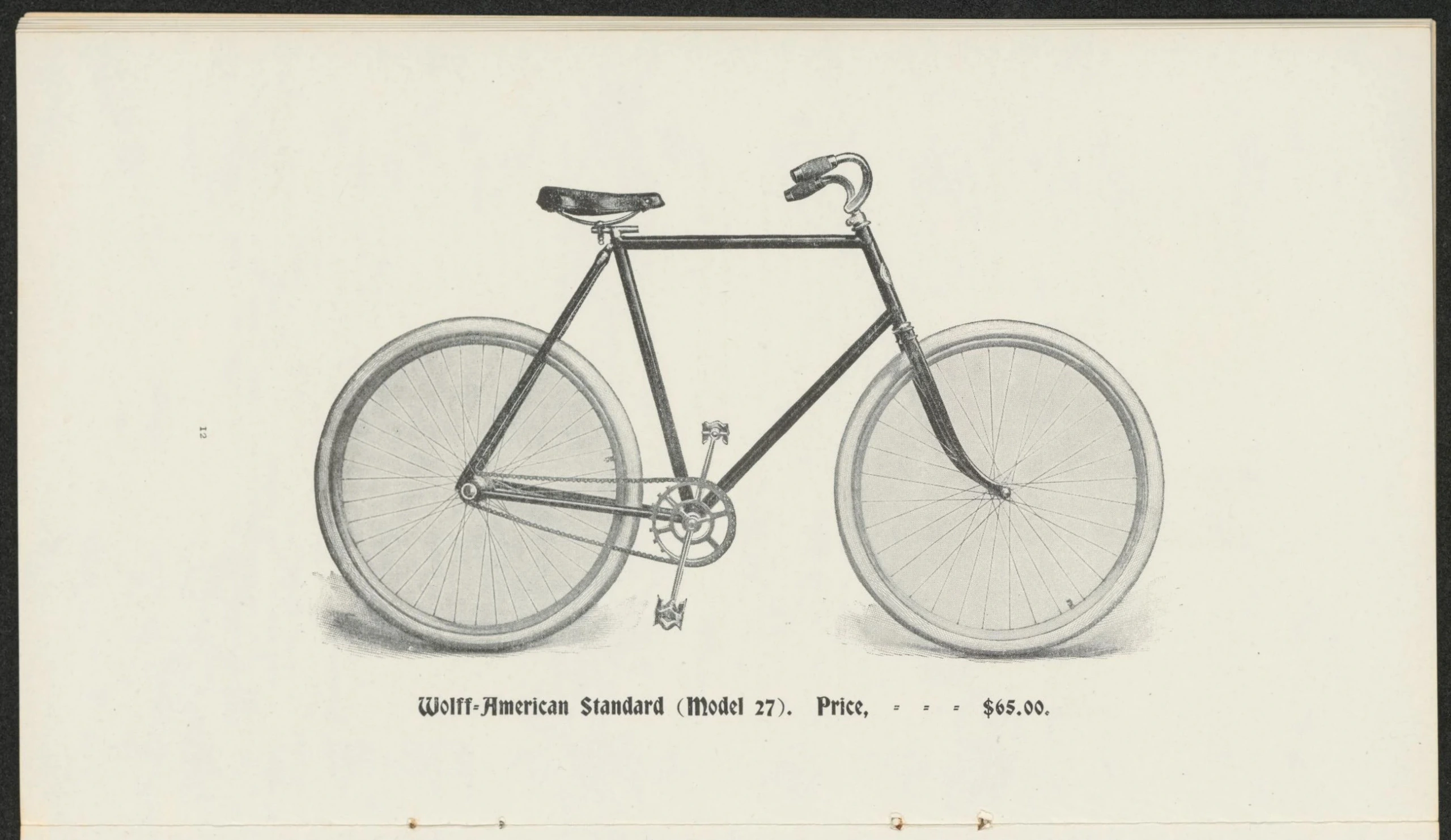 Page 14
 Page 15
 Page 16
 Page 17
 Page 18
 Page 19
 Page 20
 Page 21
 Page 22
 Page 23
 Page 24
 Page 25
 Page 26
 Page 27
 Page 28
 Page 29
 Page 30
 Page 31
 Page 32
 Page 33
 Page 34
 Page 35
 Page 36
| Marque | Wolff-American |
|---|---|
| Type | Catalog |
| Year | 1898 |
| Publisher | R. H. Wolff & Co. |
| Country | United States |
| Language | English |
| Pages | 36 |
| Source | Northwestern University Libraries, Transportation Library, "Wolff-American high art cycles, made by R.H. Wolff and Company, Limited." (digital collection, https://dc.library.northwestern.edu/items/2ebed183-3b04-466f-a528-b8a6ca135fd4); rights statement "No Copyright - United States". |
| Credit | Northwestern University Libraries |
| Identifier | Permalink https://dc.library.northwestern.edu/items/2ebed183-3b04-466f-a528-b8a6ca135fd4 |
| Transcription | Transcribed by eye |
Reference
R. H. Wolff & Co. Wolff-American 1898 Catalog (R. H. Wolff & Co., New York): Racer, Special and Standard Models, the Tandems and the Duplex. 1898. Ebykr, https://ebykr.com/library/wolff-american-catalog-1898/.
Wikipedia
{{cite book |title=Wolff-American 1898 Catalog (R. H. Wolff & Co., New York): Racer, Special and Standard Models, the Tandems and the Duplex |publisher=R. H. Wolff & Co. |date=1898 |url=https://ebykr.com/library/wolff-american-catalog-1898/ |via=Ebykr |access-date=}}1898 WOLFF-AMERICAN HIGH ART CYCLES. WOLFF-AMERICAN R. H. WOLFF & CO. LIMITED, N. Y. R. H. WOLFF & CO. LTD. 116-117-118th STS. AND HARLEM RIVER. NEW YORK, U. S. A. COPYRIGHT, 1897, BY R. H. WOLFF & CO. LIMITED. NEW YORK. CENTURY CY Sales Agents. 263 Main St. Bridgeport, Conn. CENTURY CYCLE CO. Sales Agents. …
R. H. Wolff & Co.’s catalog of Wolff-American High Art Cycles for 1898, from New York: the factory and frames, the Racer Model 24 and the Special Models 25 and 26 (women’s) at $80, the Standard Models 27 and 28 (women’s) at $65, the double-diamond and combination tandems at $125 and the three-wheeled Duplex at $175, each plate facing a page on construction and the specifications, with a photograph of the New York cycle police, letters, pedals, chain adjustment, fastenings, brakes, records, a gear table, the guarantee and tires. Transcribed from the page images (36 pages); each page ends with a bracketed description of its pictures.
— Page 1 —
1898
WOLFF-AMERICAN
HIGH ART
CYCLES.
WOLFF-AMERICAN
R. H. WOLFF & CO. LIMITED, N. Y.
R. H. WOLFF & CO. LTD.
116-117-118th STS.
AND HARLEM RIVER.
NEW YORK, U. S. A.
COPYRIGHT, 1897, BY R. H. WOLFF & CO. LIMITED. NEW YORK.
[The color-lithographed front cover of an upright booklet: a winged classical woman in a brown robe and laurel crown, seated on a marble bench and holding a palm frond, rests her hand on an oval shield showing a running wolf over a wheel; tooled-leather style borders above and below.]
— Page 2 —
[The blank inside front cover, showing a mirror-image offset of the two dealer stamps on the facing page.]
— Page 3 —
CENTURY CY[illegible]
Sales Agents.
263 Main St. Bridgeport, Conn.
CENTURY CYCLE CO.
Sales Agents.
263 Main St. Bridgeport, Conn.
[A blank flyleaf carrying two impressions of a rubber dealer stamp in black ink, the upper one partly weak; no printed matter.]
— Page 4 —
R. H. WOLFF & CO. LTD.
MAKERS WOLFF AMERICAN HIGH ART CYCLES.
R. H. WOLFF & CO. LTD.
R. H. WOLFF & CO. LTD.
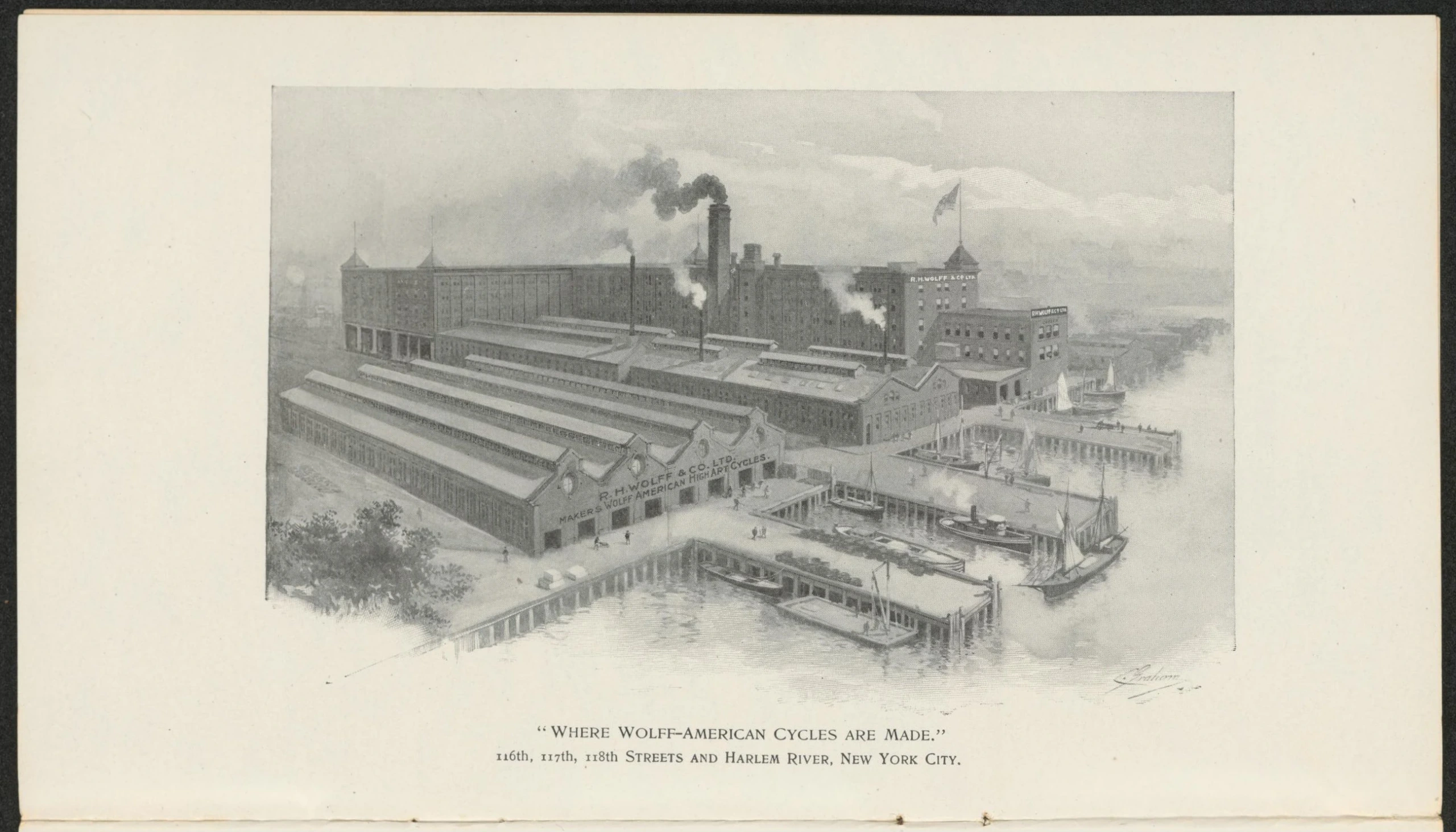
“WHERE WOLFF-AMERICAN CYCLES ARE MADE.”
116th, 117th, 118th STREETS AND HARLEM RIVER, NEW YORK CITY.
[A full-page halftone, printed sideways on the leaf, of a bird’s-eye view of the R. H. Wolff and Co. works on the Harlem River: smoking chimneys, multistory blocks with the firm name, long sawtooth sheds, wharves with steamers and sailing boats; signed “Graham” [?] at lower right.]
— Page 5 —
WOLFF-AMERICAN
HIGH ART
CYCLES
MADE BY R. H. WOLFF AND COMPANY, LIMITED.
FACTORIES IN NEW YORK CITY: 116TH, 117TH, 118TH STREETS AND HARLEM RIVER. REPRESENTATIVES IN PHILADELPHIA, BOSTON, CHICAGO, DENVER, PORTLAND, SAN FRANCISCO, MONTREAL. GENERAL EUROPEAN DISTRIBUTING DEPOT: HAMBURG, GERMANY. REPRESENTATIVES IN LONDON, PARIS, BERLIN, ST. PETERSBURG, ROTTERDAM, VIENNA, STOCKHOLM, CHRISTIANIA, GENOA, BUENOS AYRES, MELBOURNE, JOHANNESBURG.
[The title page: a boxed text panel with a large foliated woodcut initial “W” and small leaf ornaments between the place names.]
— Page 6 —
WOLFF-AMERICAN HIGH ART CYCLES have arrived at that stage in their career where further improvement is almost impossible. They represent the finest product of human skill and perfect metal. Nothing has been spared to attain the pinnacle of perfection in bicycle building. That we have reached that point is admitted by all. The Wolff-American Bicycle to-day stands unrivaled. It has an intrinsic value far in advance of any other bicycle manufactured and boasts of more specific improvements and original features than any other bicycle built.
The reputation of its makers, who have been renowned manufacturers of steel and steel wire for over twenty-five years, is in itself an absolute assurance of merit. Steel constitutes the principal part of a bicycle. The frame and nearly all of the component parts of a bicycle are constructed of that material. No other cycle manufacturing concern on the face of the globe possesses our intimate knowledge of steel and its proper treatment.
Our works, located on the Harlem River, New York City, cover four acres of ground and have a floor area of a quarter of a million square feet. About a thousand men are employed, every one of whom has years’ experience in that particular work in which he is engaged. Not quantity but quality is our principle in business. We make only as many wheels as we can properly control, being satisfied that every machine turned out by us is absolutely perfect before it leaves the factory. Our name itself is a guarantee which never expires and one of which every Wolff-American rider may well be proud.
The Wolff-American has never been known to sell at less than the list price, and agents all over the world bear witness to that fact. This year the cost of a Wolff-American is materially less than heretofore, but the quality of the machine has not decreased one iota.
Of course there may be a few wiseacres who will doubt our ability to reduce the price of our 1898 models and maintain the excellent quality possessed by last year’s machines. For the benefit of these doubters we recite these facts:
During the past twelve months there has been a radical change in the conditions which environ the cycle mart. The demand has arisen for a good cycle at a moderate price. We have determined to meet that demand by sacrificing part of our own profit and lessening proportionately the profit of our agents. Improvements in machinery and methods and building in larger quantities also reduce the cost of manufacture somewhat, and those who purchase an 1898 model of the Wolff-American may be perfectly assured that they can get no better bicycle at any price.
Our bicycles are sold under one name-plate only. We are not afraid to stand by our goods and have enough faith in every bicycle we manufacture to have a Wolff-American name-plate thereon. This strict policy is one which few pursue. Other makers generally market two or three grades, acknowledging the inferiority of one line from another by having a distinct name for each. There is only one grade of Wolff-American and that is the highest.
4
[A text page with a large ornamental woodcut initial “W”; no illustration.]
— Page 7 —
Some Particulars of
Wolff-American Construction.
Frames.
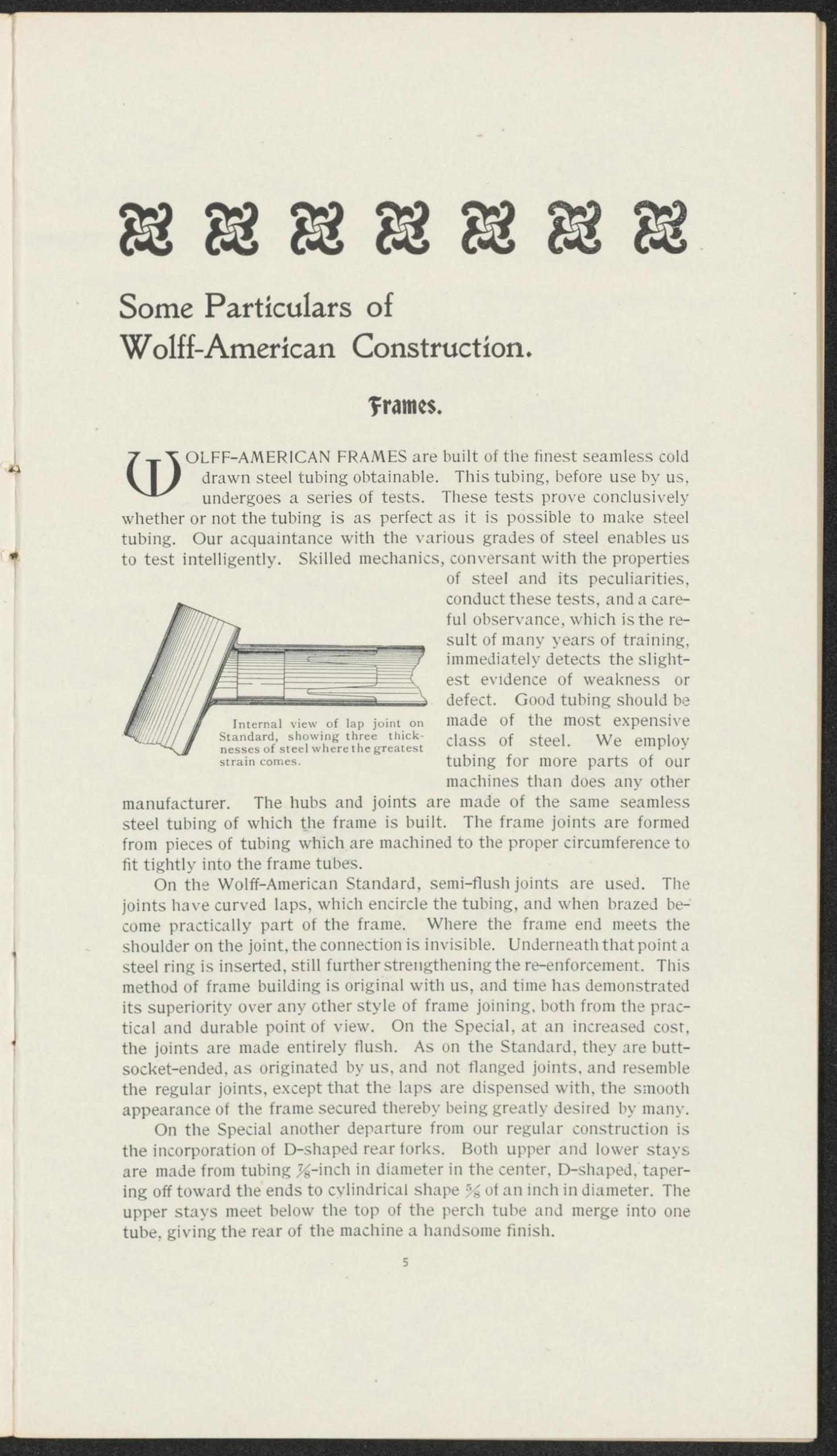
WOLFF-AMERICAN FRAMES are built of the finest seamless cold drawn steel tubing obtainable. This tubing, before use by us, undergoes a series of tests. These tests prove conclusively whether or not the tubing is as perfect as it is possible to make steel tubing. Our acquaintance with the various grades of steel enables us to test intelligently. Skilled mechanics, conversant with the properties of steel and its peculiarities, conduct these tests, and a careful observance, which is the result of many years of training, immediately detects the slightest evidence of weakness or defect. Good tubing should be made of the most expensive class of steel. We employ tubing for more parts of our machines than does any other manufacturer. The hubs and joints are made of the same seamless steel tubing of which the frame is built. The frame joints are formed from pieces of tubing which are machined to the proper circumference to fit tightly into the frame tubes.
Internal view of lap joint on Standard, showing three thicknesses of steel where the greatest strain comes.
On the Wolff-American Standard, semi-flush joints are used. The joints have curved laps, which encircle the tubing, and when brazed become practically part of the frame. Where the frame end meets the shoulder on the joint, the connection is invisible. Underneath that point a steel ring is inserted, still further strengthening the re-enforcement. This method of frame building is original with us, and time has demonstrated its superiority over any other style of frame joining, both from the practical and durable point of view. On the Special, at an increased cost, the joints are made entirely flush. As on the Standard, they are butt-socket-ended, as originated by us, and not flanged joints, and resemble the regular joints, except that the laps are dispensed with, the smooth appearance of the frame secured thereby being greatly desired by many.
On the Special another departure from our regular construction is the incorporation of D-shaped rear forks. Both upper and lower stays are made from tubing ⅞-inch in diameter in the center, D-shaped, tapering off toward the ends to cylindrical shape ⅝ of an inch in diameter. The upper stays meet below the top of the perch tube and merge into one tube, giving the rear of the machine a handsome finish.
5
[A text page headed by a row of seven black knot ornaments, with a blackletter subhead and a line cut of a lap frame joint in section set into the text.]
— Page 8 —
6
Wolff-American Racer (Model 24). Price, – – – $80.00.
[A full-page halftone, printed sideways on the leaf, of the Wolff-American Model 24 racer in side view: diamond frame, dropped bars, racing saddle, rat-trap pedals, single tube tires. The folio “6” is printed at the inner edge.]
— Page 9 —
Spring
Temper.
Ere this, no doubt, you have heard of our spring tempering. This is a secret process, to which every Wolff-American frame is subjected. Our facilities for tempering steel and experience in doing that sort of work enable us to put the frame through an operation from which it emerges stronger and with an elasticity not possessed by tubing itself. This tempering is one of the reasons why Wolff-Americans never come out second best in accidents. It is the spring temper which permits Wolff-Americans when in collisions to resist the severest shocks and to spring into shape and be ridden immediately after.
Flush joint construction of the crank-hanger of the Special.
Frame Lines.
As may be plainly observed, the lines of the Wolff-American are distinctive. They differ from those of other bicycles. This is only a detail, perhaps, but it is an important detail. With our lines a proper position for riding is obtained. The perch tube, instead of being parallel with,
Special Racer Model 24 (Men’s).
REGULAR EQUIPMENT.—Spring-tempered diamond frame of 1⅛-inch tubing, double re-enforcements throughout. Flush joints. Height of frame, 22 inches. Drop in crank-hanger, three inches. D-shaped rear forks. Front forks double truss crown. 28-inch wheels. Hercules spokes, special wire of our own make, .075 gauge, swaged, butt ended, tangent 32 front and 40 rear wheel. Boston laminated wood rims of selected stock, specially constructed. Specially tempered 3/16-inch chain, block pattern. Patent eccentric chain adjustment. Patent self-lubricating bearings. Disk adjustment, with 5/16-inch balls for crank bracket bearings. Patent head and seat post fastening. Wolff-American rat-trap pedals. Both sprockets detachable. 6½-inch cranks. Gear, 84 inches. Brown racing saddle. Handle bar, style 15. 1⅜-inch W. A. single tube tires. Finish, lustrous black enamel, bright parts nickeled. Weight, without tires, 18½ pounds.
7
[A text page with a line cut in section of the flush-jointed crank hanger of the Special, and a band of leaf ornaments dividing the running text from the Model 24 specifications; blackletter subheads.]
— Page 10 —
8
Wolff-American Special (Model 25). Price, – – – $80.00.
[A full-page halftone, printed sideways on the leaf, of the Wolff-American Special Model 25 in side view: diamond frame with flush joints, dropped bars, sprung saddle, single tube tires. The folio “8” is printed at the inner edge.]
— Page 11 —
has less slant than the head tube, and the rider is directly over his work. For hard riding, or hill climbing, this advantage manifests itself in a prominent manner. This feature is preserved on the tandems as well as on the single models.
A departure, this year, is the dropping of our crank-hanger further than last year. We have met the popular clamor for a low bracket, and give the hanger a drop of 2¾ inches below an imaginary line drawn between the wheel axles. This drop does not interfere with our principle of frame construction in the slightest, and adds to the rakish look of the machine.
Front hub bisected, showing method of attaching spokes, hollow axle containing oil wick and inside view of bearings.
Forks.
As in 1897, our forks are of tapered tubing, oval in shape and swaged to within several inches of the lower end, where the gauge is increased to receive properly the strain of the front wheel axle. This swaging imparts to the forks the ability to withstand the vibration to which they are constantly being subjected. Double plate crowns we continue to use, finding them more suitable for the purpose than any other variety of crown. The fork crown is a vital part of a machine and
Special Model 25 (Men’s).
REGULAR EQUIPMENT.—Spring tempered diamond frame of 1⅛-inch tubing, double re-enforcements throughout. Flush joints. Height of frame, 24 inches. Drop in crank-hanger, 2¾ inches. D-shaped rear forks. Front fork, double truss crown. 28-inch wheels. Hercules spokes, special wire of our own make, .075 gauge, swaged, butt ended, tangent, 32 front and 40 rear wheel. Boston laminated wood rims of selected stock, specially constructed. Specially tempered 3/16 inch chain, block pattern. Patent eccentric chain adjustment. Patent self-lubricating bearings. Wolff-American Convertible Pedals. Both sprockets detachable. 6½-inch cranks. Gear, 74⅔ inches. Hunt hygienic saddle. Handle bar, style 16. W. A. Single Tube Tires. Finish, lustrous black enamel, bright parts nickeled. Disk adjustment, with 5/16-inch balls for crank bracket bearings. Patent seat post fastening. Patent handle bar fastening. Weight, without tires, 20 pounds.
OPTIONS.—Heights of frame, 22 and 26 inches. Choice of handle bars. Tires, Morgan & Wright and Dunlop. Christy saddle. Cranks, 7 inches. Gear, 63 to 84 inches. Interior plunger brake to be used with 17 handle bar only, or foot brake. Ruby enamel only on order.
9
[A text page with a line cut of a front hub in section showing a spoke, the hollow axle and the bearings, set into the text; a band of leaf ornaments above the Model 25 specifications; blackletter subheads.]
— Page 12 —
10
Wolff-American Special (Model 26). Price, – – – $80.00.
[A full-page halftone, printed sideways on the leaf, of the Wolff-American Special Model 26 women’s double drop-frame safety in side view, with a laced dress guard over the rear wheel, an openwork metal chain guard and upturned bars. The folio “10” is printed at the inner edge.]
— Page 13 —
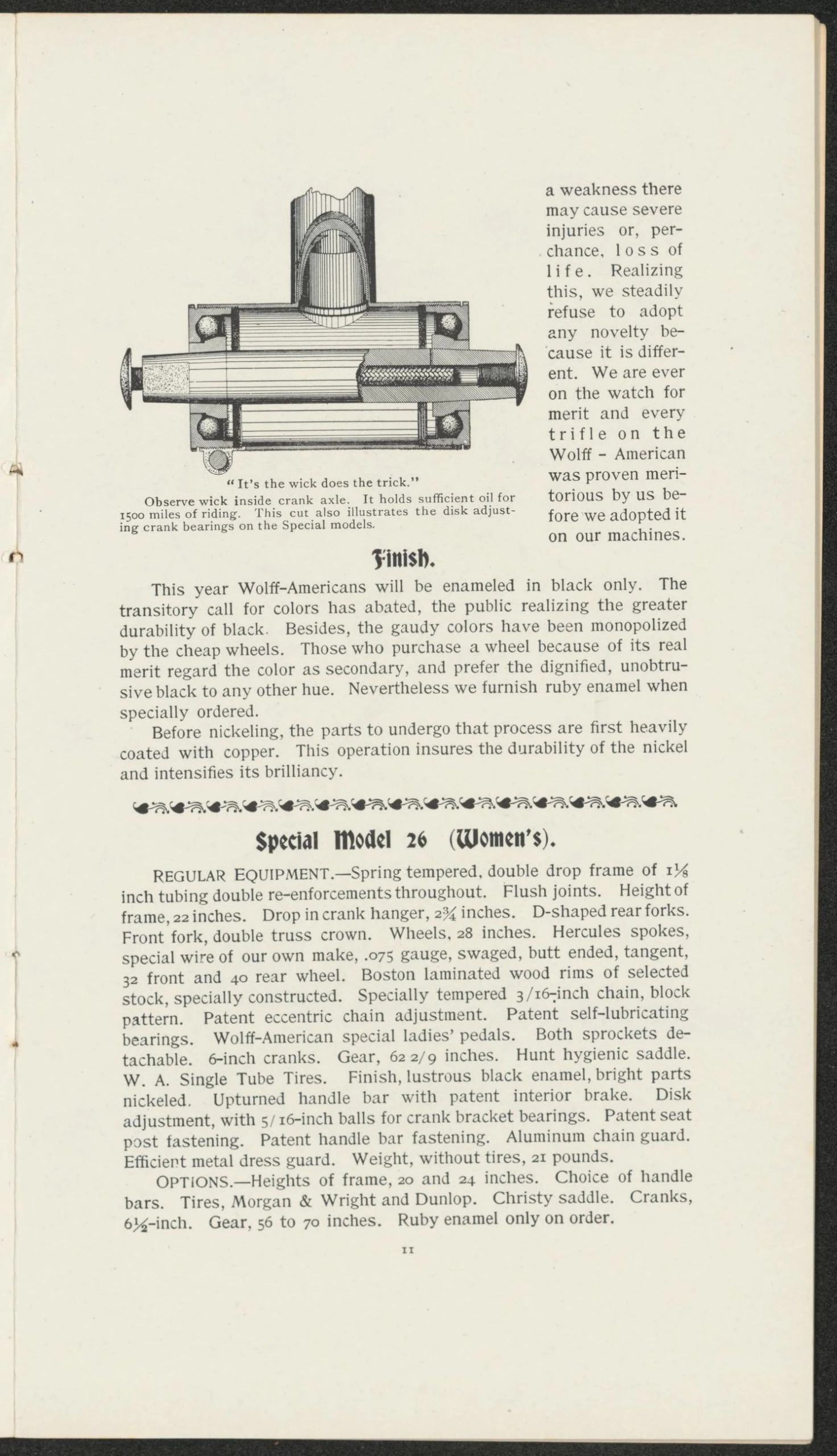
a weakness there may cause severe injuries or, perchance, loss of life. Realizing this, we steadily refuse to adopt any novelty because it is different. We are ever on the watch for merit and every trifle on the Wolff-American was proven meritorious by us before we adopted it on our machines.
“It’s the wick does the trick.”
Observe wick inside crank axle. It holds sufficient oil for 1500 miles of riding. This cut also illustrates the disk adjusting crank bearings on the Special models.
Finish.
This year Wolff-Americans will be enameled in black only. The transitory call for colors has abated, the public realizing the greater durability of black. Besides, the gaudy colors have been monopolized by the cheap wheels. Those who purchase a wheel because of its real merit regard the color as secondary, and prefer the dignified, unobtrusive black to any other hue. Nevertheless we furnish ruby enamel when specially ordered.
Before nickeling, the parts to undergo that process are first heavily coated with copper. This operation insures the durability of the nickel and intensifies its brilliancy.
Special Model 26 (Women’s).
REGULAR EQUIPMENT.—Spring tempered, double drop frame of 1⅛ inch tubing double re-enforcements throughout. Flush joints. Height of frame, 22 inches. Drop in crank hanger, 2¾ inches. D-shaped rear forks. Front fork, double truss crown. Wheels, 28 inches. Hercules spokes, special wire of our own make, .075 gauge, swaged, butt ended, tangent, 32 front and 40 rear wheel. Boston laminated wood rims of selected stock, specially constructed. Specially tempered 3/16-inch chain, block pattern. Patent eccentric chain adjustment. Patent self-lubricating bearings. Wolff-American special ladies’ pedals. Both sprockets detachable. 6-inch cranks. Gear, 62 2/9 inches. Hunt hygienic saddle. W. A. Single Tube Tires. Finish, lustrous black enamel, bright parts nickeled. Upturned handle bar with patent interior brake. Disk adjustment, with 5/16-inch balls for crank bracket bearings. Patent seat post fastening. Patent handle bar fastening. Aluminum chain guard. Efficient metal dress guard. Weight, without tires, 21 pounds.
OPTIONS.—Heights of frame, 20 and 24 inches. Choice of handle bars. Tires, Morgan & Wright and Dunlop. Christy saddle. Cranks, 6½-inch. Gear, 56 to 70 inches. Ruby enamel only on order.
11
[A text page with a line cut in section of the crank hanger, axle wick and disk-adjusted bearings at upper left; a band of leaf ornaments above the Model 26 specifications; blackletter subheads.]
— Page 14 —
12
Wolff-American Standard (Model 27). Price, – – – $65.00.
[A full-page halftone, printed sideways on the leaf, of the Wolff-American Standard Model 27 men’s diamond-frame safety in side view, with upturned bars and a sprung saddle. The folio “12” is printed at the inner edge.]
— Page 15 —
Patent Self-Oiling Bearings.
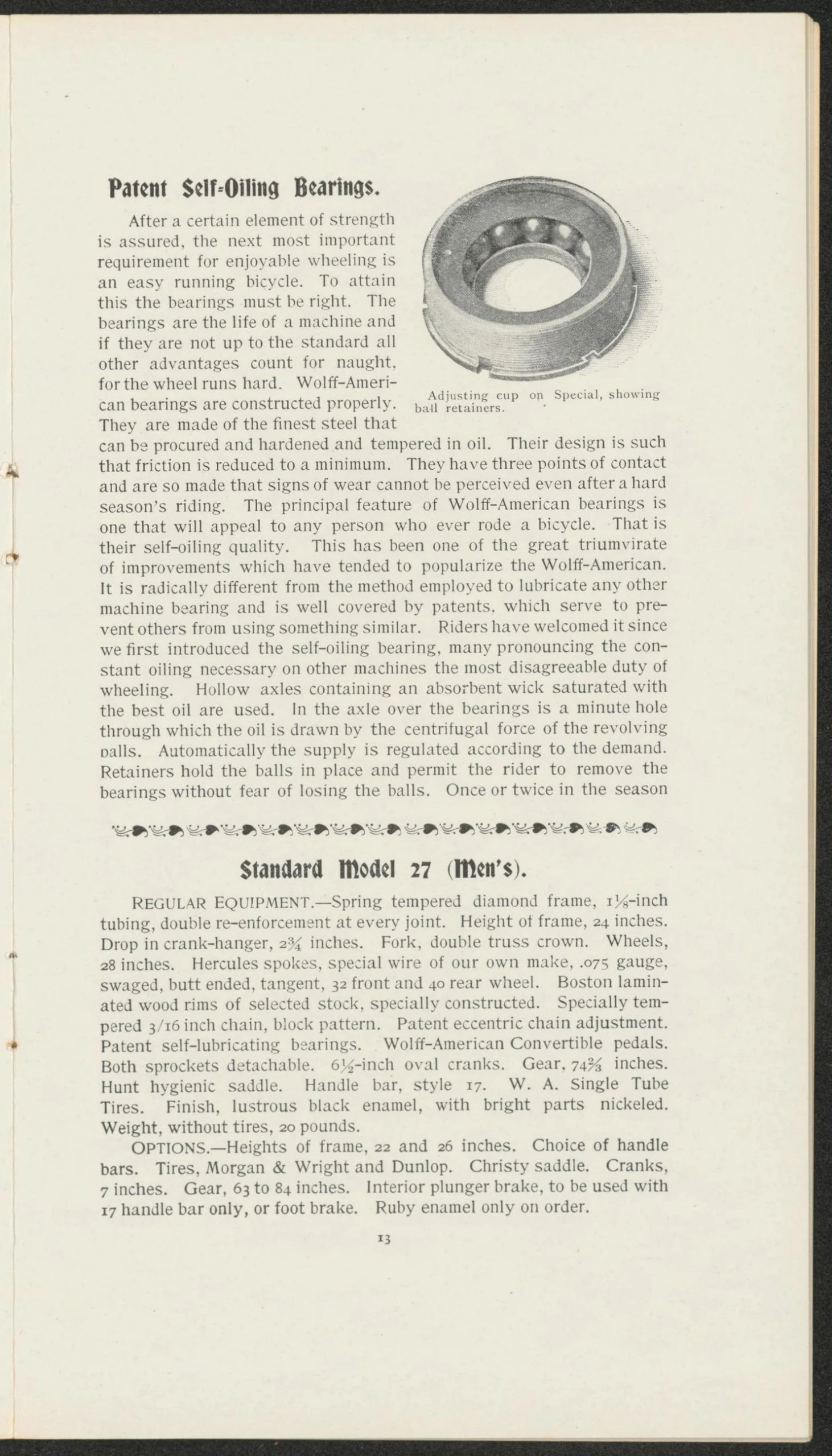
After a certain element of strength is assured, the next most important requirement for enjoyable wheeling is an easy running bicycle. To attain this the bearings must be right. The bearings are the life of a machine and if they are not up to the standard all other advantages count for naught, for the wheel runs hard. Wolff-American bearings are constructed properly. They are made of the finest steel that can be procured and hardened and tempered in oil. Their design is such that friction is reduced to a minimum. They have three points of contact and are so made that signs of wear cannot be perceived even after a hard season’s riding. The principal feature of Wolff-American bearings is one that will appeal to any person who ever rode a bicycle. That is their self-oiling quality. This has been one of the great triumvirate of improvements which have tended to popularize the Wolff-American. It is radically different from the method employed to lubricate any other machine bearing and is well covered by patents, which serve to prevent others from using something similar. Riders have welcomed it since we first introduced the self-oiling bearing, many pronouncing the constant oiling necessary on other machines the most disagreeable duty of wheeling. Hollow axles containing an absorbent wick saturated with the best oil are used. In the axle over the bearings is a minute hole through which the oil is drawn by the centrifugal force of the revolving balls. Automatically the supply is regulated according to the demand. Retainers hold the balls in place and permit the rider to remove the bearings without fear of losing the balls. Once or twice in the season
Adjusting cup on Special, showing ball retainers.
Standard Model 27 (Men’s).
REGULAR EQUIPMENT.—Spring tempered diamond frame, 1⅛-inch tubing, double re-enforcement at every joint. Height of frame, 24 inches. Drop in crank-hanger, 2¾ inches. Fork, double truss crown. Wheels, 28 inches. Hercules spokes, special wire of our own make, .075 gauge, swaged, butt ended, tangent, 32 front and 40 rear wheel. Boston laminated wood rims of selected stock, specially constructed. Specially tempered 3/16 inch chain, block pattern. Patent eccentric chain adjustment. Patent self-lubricating bearings. Wolff-American Convertible pedals. Both sprockets detachable. 6½-inch oval cranks. Gear, 74⅔ inches. Hunt hygienic saddle. Handle bar, style 17. W. A. Single Tube Tires. Finish, lustrous black enamel, with bright parts nickeled. Weight, without tires, 20 pounds.
OPTIONS.—Heights of frame, 22 and 26 inches. Choice of handle bars. Tires, Morgan & Wright and Dunlop. Christy saddle. Cranks, 7 inches. Gear, 63 to 84 inches. Interior plunger brake, to be used with 17 handle bar only, or foot brake. Ruby enamel only on order.
13
[A text page with a halftone of a bearing adjusting cup with its ball retainer at upper right; a band of leaf ornaments above the Model 27 specifications; blackletter subheads.]
— Page 16 —
14
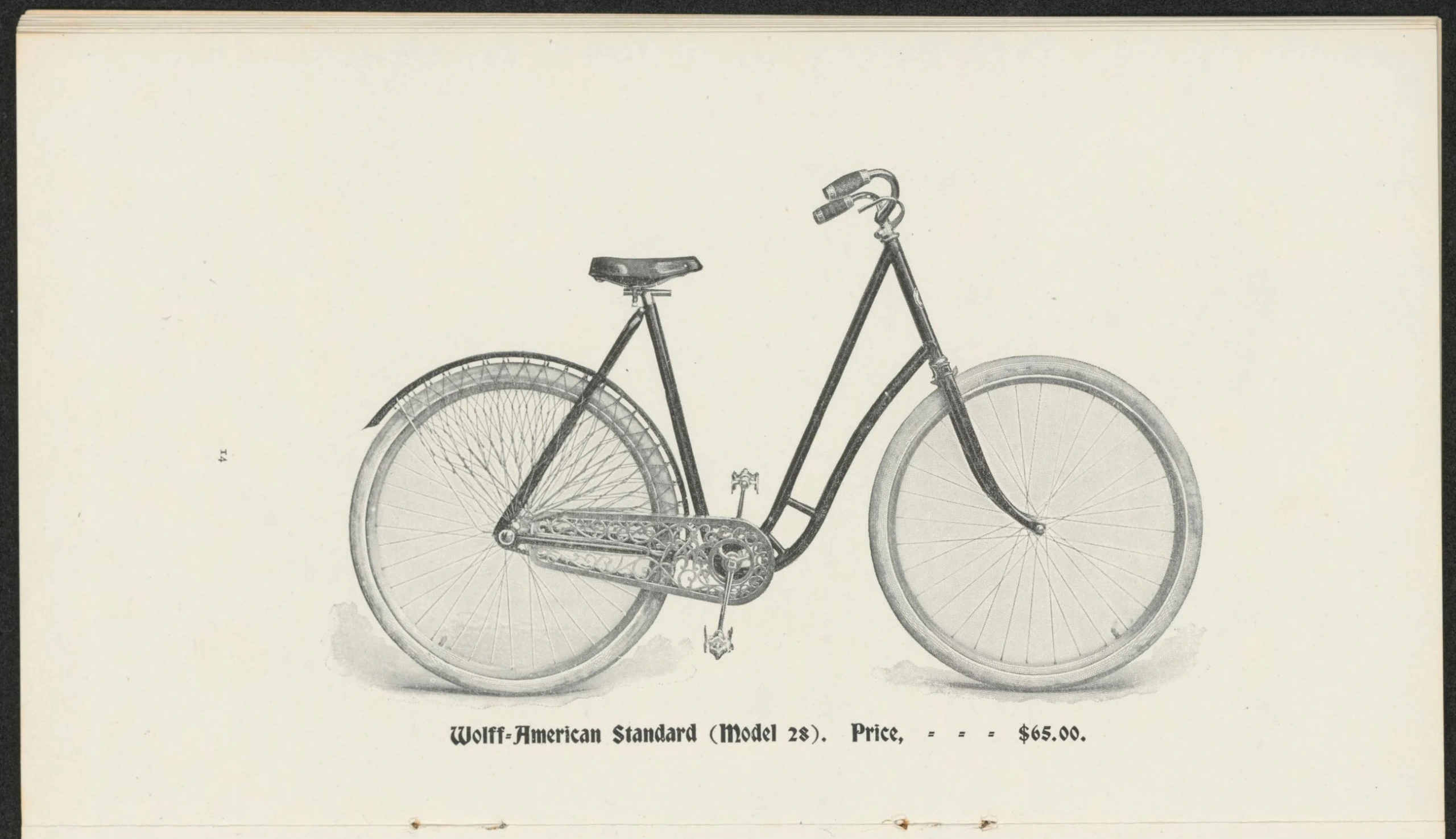
Wolff-American Standard (Model 28). Price, – – – $65.00.
[A full-page halftone, printed sideways on the leaf, of the Wolff-American Standard Model 28 women’s double drop-frame safety in side view, with laced dress guard, openwork metal chain guard and upturned bars. The folio “14” is printed at the inner edge.]
— Page 17 —
is sufficiently often to renew the oil in the wick. When it does become necessary the operation is amazingly simple. A spring cap on the right side of the axle is removed, leaving the end of the wick exposed, and the oil is injected.
Adjusting the bearings is done by using the special spanner provided for that purpose, on the cone located on the left side of the wheel. The crank axle cone is provided with teeth around the edge, into which the spanner fits. To prevent the crank bearings loosening, after adjustment, a movable dog screwed to the crank sets into the teeth on the cone. On the Special the crank bearings are disk adjusting. The cones are removable, fitting on the axle which is tapered on both sides to receive the cones. The cups screw into the crank-hanger, the inside surface of which is threaded. A clamp device underneath the bracket holds the disk in position. When adjusting, you loosen the screw on the bottom of the bracket. This leaves the disk free to turn.
Patent Hubs.
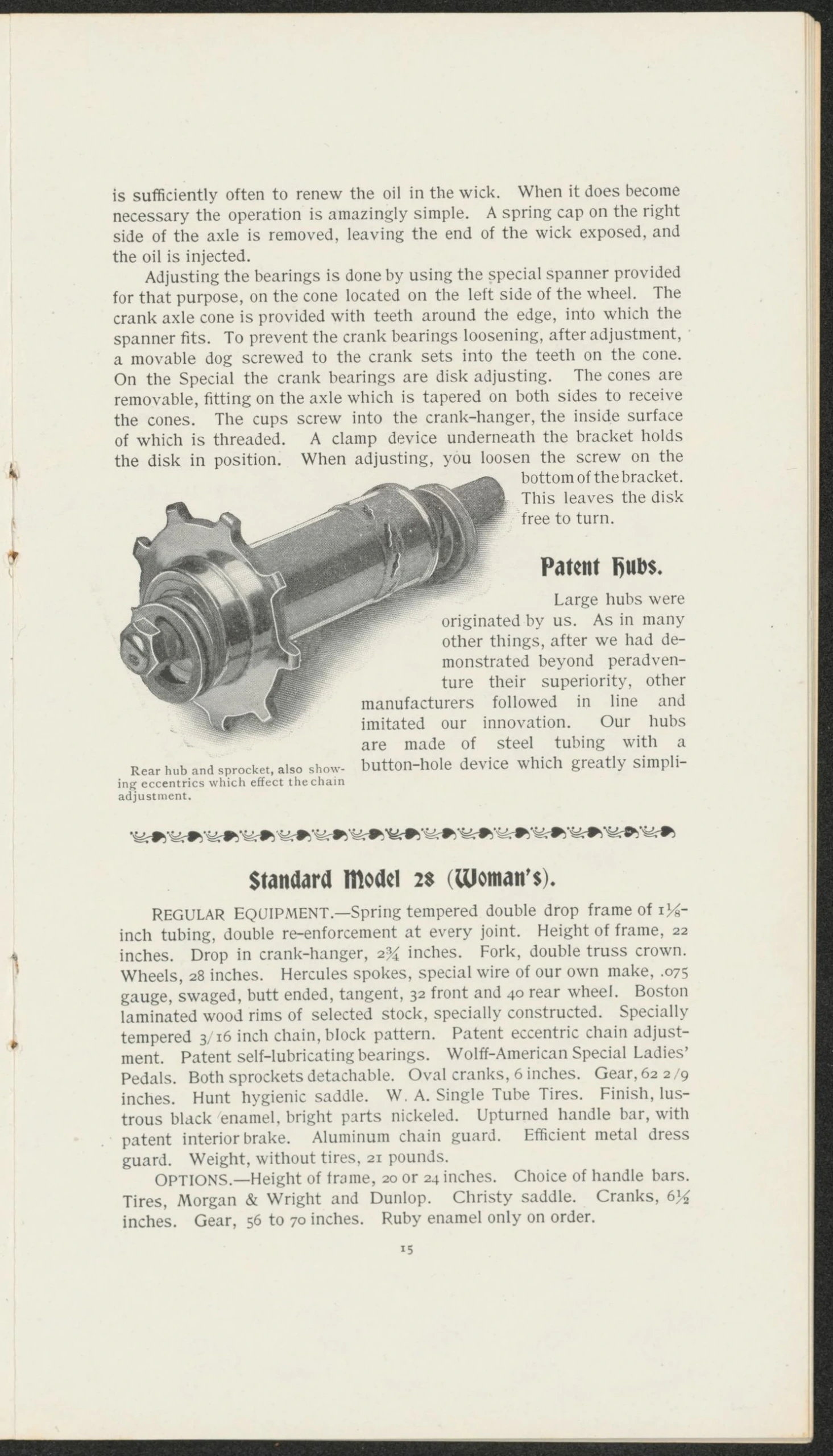
Large hubs were originated by us. As in many other things, after we had demonstrated beyond peradventure their superiority, other manufacturers followed in line and imitated our innovation. Our hubs are made of steel tubing with a button-hole device which greatly simpli-
Rear hub and sprocket, also showing eccentrics which effect the chain adjustment.
Standard Model 28 (Woman’s).
REGULAR EQUIPMENT.—Spring tempered double drop frame of 1⅛-inch tubing, double re-enforcement at every joint. Height of frame, 22 inches. Drop in crank-hanger, 2¾ inches. Fork, double truss crown. Wheels, 28 inches. Hercules spokes, special wire of our own make, .075 gauge, swaged, butt ended, tangent, 32 front and 40 rear wheel. Boston laminated wood rims of selected stock, specially constructed. Specially tempered 3/16 inch chain, block pattern. Patent eccentric chain adjustment. Patent self-lubricating bearings. Wolff-American Special Ladies’ Pedals. Both sprockets detachable. Oval cranks, 6 inches. Gear, 62 2/9 inches. Hunt hygienic saddle. W. A. Single Tube Tires. Finish, lustrous black enamel, bright parts nickeled. Upturned handle bar, with patent interior brake. Aluminum chain guard. Efficient metal dress guard. Weight, without tires, 21 pounds.
OPTIONS.—Height of frame, 20 or 24 inches. Choice of handle bars. Tires, Morgan & Wright and Dunlop. Christy saddle. Cranks, 6½ inches. Gear, 56 to 70 inches. Ruby enamel only on order.
15
[A text page with a halftone of a rear hub with its sprocket and eccentric chain adjusters at left; a band of leaf ornaments above the Model 28 specifications; blackletter subheads.]
— Page 18 —
16
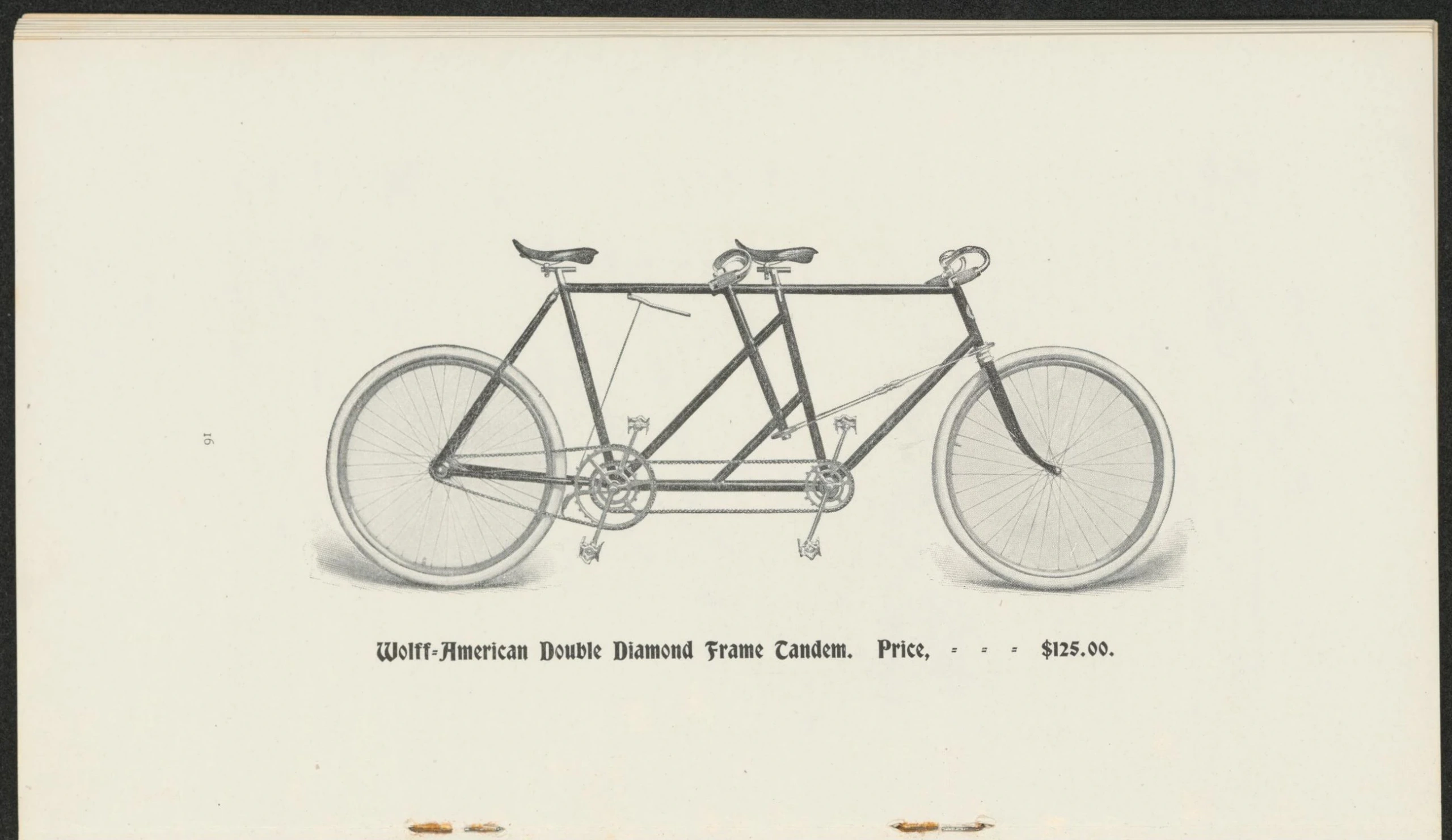
Wolff-American Double Diamond Frame Tandem. Price, – – – $125.00.
[A full-page halftone, printed sideways on the leaf, of the Wolff-American double diamond frame tandem in side view, with two saddles, two pairs of bars and a cable linking the steering. The folio “16” is printed at the inner edge; small rust stains at the lower edge.]
— Page 19 —
fies the replacing of spokes. Inside the hub and underneath the spoke holes is placed a dust-proof ring which effectually prevents the intrusion of dust or other foreign matter in the bearings.
Tandem.
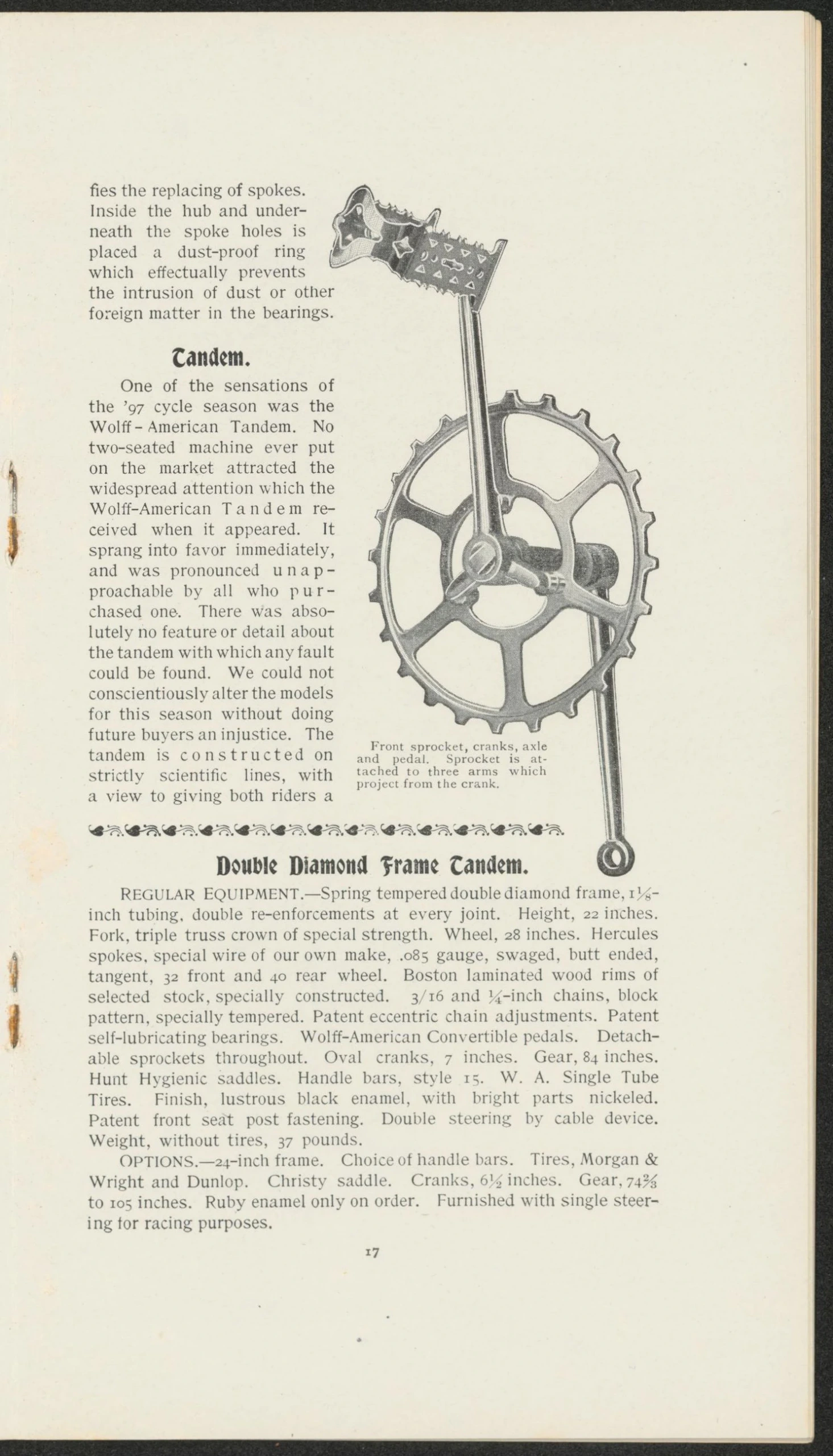
One of the sensations of the ’97 cycle season was the Wolff-American Tandem. No two-seated machine ever put on the market attracted the widespread attention which the Wolff-American Tandem received when it appeared. It sprang into favor immediately, and was pronounced unapproachable by all who purchased one. There was absolutely no feature or detail about the tandem with which any fault could be found. We could not conscientiously alter the models for this season without doing future buyers an injustice. The tandem is constructed on strictly scientific lines, with a view to giving both riders a
Front sprocket, cranks, axle and pedal. Sprocket is attached to three arms which project from the crank.
Double Diamond Frame Tandem.
REGULAR EQUIPMENT.—Spring tempered double diamond frame, 1⅛-inch tubing, double re-enforcements at every joint. Height, 22 inches. Fork, triple truss crown of special strength. Wheel, 28 inches. Hercules spokes, special wire of our own make, .085 gauge, swaged, butt ended, tangent, 32 front and 40 rear wheel. Boston laminated wood rims of selected stock, specially constructed. 3/16 and ¼-inch chains, block pattern, specially tempered. Patent eccentric chain adjustments. Patent self-lubricating bearings. Wolff-American Convertible pedals. Detachable sprockets throughout. Oval cranks, 7 inches. Gear, 84 inches. Hunt Hygienic saddles. Handle bars, style 15. W. A. Single Tube Tires. Finish, lustrous black enamel, with bright parts nickeled. Patent front seat post fastening. Double steering by cable device. Weight, without tires, 37 pounds.
OPTIONS.—24-inch frame. Choice of handle bars. Tires, Morgan & Wright and Dunlop. Christy saddle. Cranks, 6½ inches. Gear, 74⅔ to 105 inches. Ruby enamel only on order. Furnished with single steering for racing purposes.
17
[A text page with a halftone at right of a front chainwheel with three-arm spider, crank, axle and rat-trap pedal; a band of leaf ornaments above the tandem specifications; blackletter subheads. Rust-colored stains at the left margin.]
— Page 20 —
18
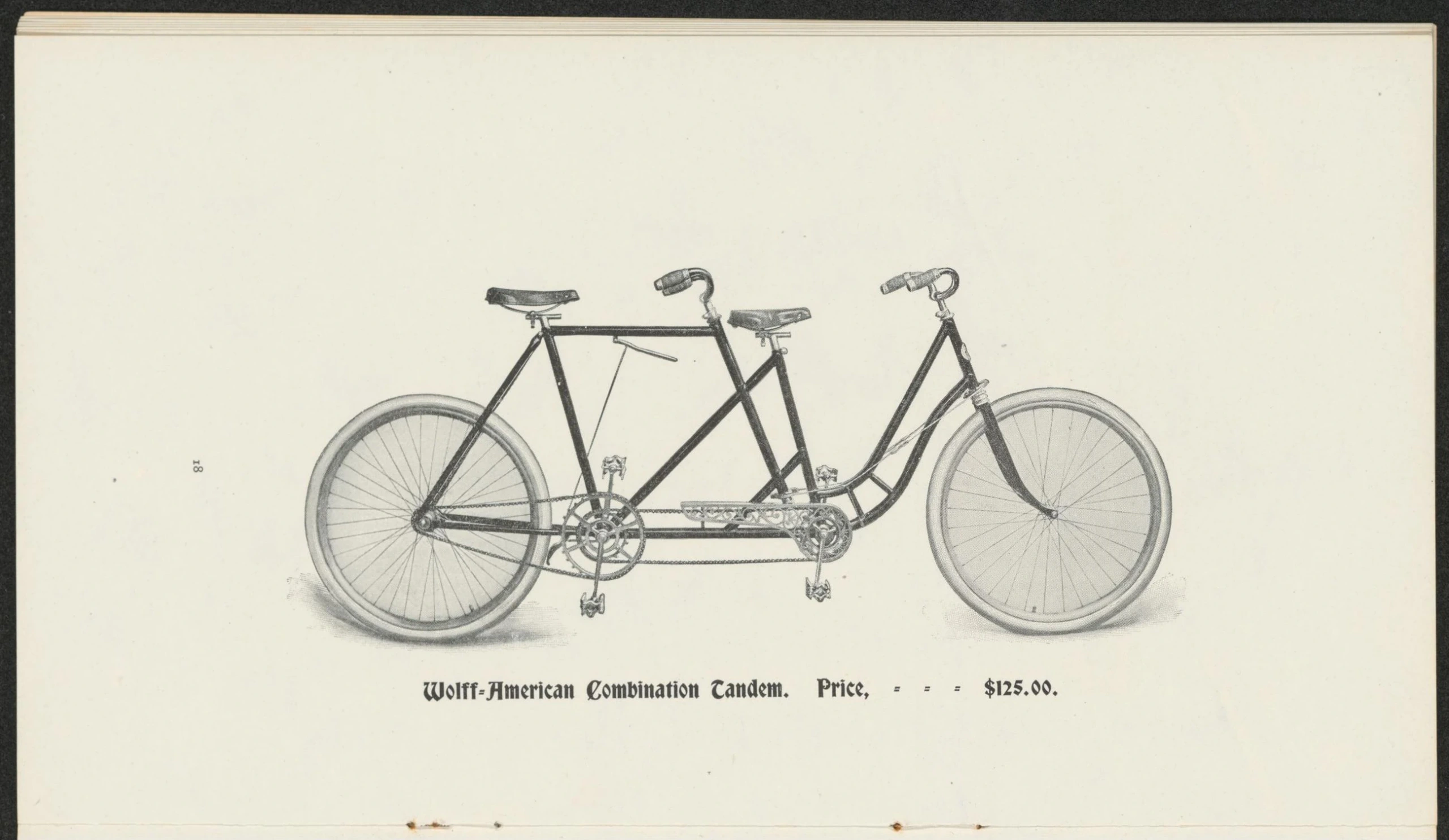
Wolff-American Combination Tandem. Price, – – – $125.00.
[A full-page halftone, printed sideways on the leaf, of the Wolff-American combination tandem in side view, a diamond rear frame with a drop frame front for a lady rider, chain guard and cable steering. The folio “18” is printed at the inner edge; small rust stains at the lower edge.]
— Page 21 —
proper position. It is fitted with a rear brake, which is positive in action and answers to every touch. This year, in addition to the 24-inch diamond frame, the tandem will be made with a 22-inch double diamond frame, for short riders.
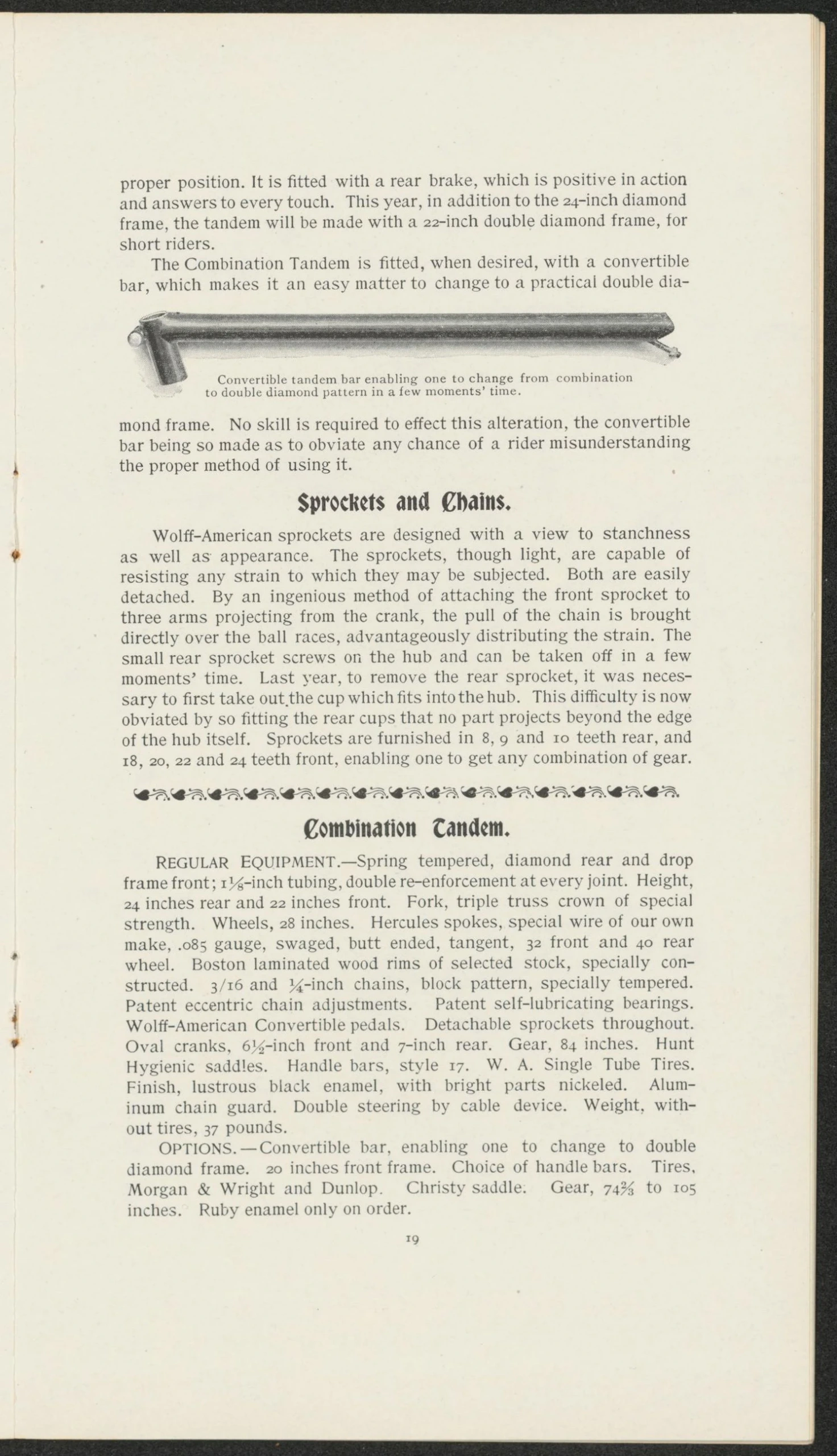
The Combination Tandem is fitted, when desired, with a convertible bar, which makes it an easy matter to change to a practical double diamond frame. No skill is required to effect this alteration, the convertible bar being so made as to obviate any chance of a rider misunderstanding the proper method of using it.
Convertible tandem bar enabling one to change from combination to double diamond pattern in a few moments’ time.
Sprockets and Chains.
Wolff-American sprockets are designed with a view to stanchness as well as appearance. The sprockets, though light, are capable of resisting any strain to which they may be subjected. Both are easily detached. By an ingenious method of attaching the front sprocket to three arms projecting from the crank, the pull of the chain is brought directly over the ball races, advantageously distributing the strain. The small rear sprocket screws on the hub and can be taken off in a few moments’ time. Last year, to remove the rear sprocket, it was necessary to first take out the cup which fits into the hub. This difficulty is now obviated by so fitting the rear cups that no part projects beyond the edge of the hub itself. Sprockets are furnished in 8, 9 and 10 teeth rear, and 18, 20, 22 and 24 teeth front, enabling one to get any combination of gear.
Combination Tandem.
REGULAR EQUIPMENT.—Spring tempered, diamond rear and drop frame front; 1⅛-inch tubing, double re-enforcement at every joint. Height, 24 inches rear and 22 inches front. Fork, triple truss crown of special strength. Wheels, 28 inches. Hercules spokes, special wire of our own make, .085 gauge, swaged, butt ended, tangent, 32 front and 40 rear wheel. Boston laminated wood rims of selected stock, specially constructed. 3/16 and ¼-inch chains, block pattern, specially tempered. Patent eccentric chain adjustments. Patent self-lubricating bearings. Wolff-American Convertible pedals. Detachable sprockets throughout. Oval cranks, 6½-inch front and 7-inch rear. Gear, 84 inches. Hunt Hygienic saddles. Handle bars, style 17. W. A. Single Tube Tires. Finish, lustrous black enamel, with bright parts nickeled. Aluminum chain guard. Double steering by cable device. Weight, without tires, 37 pounds.
OPTIONS.—Convertible bar, enabling one to change to double diamond frame. 20 inches front frame. Choice of handle bars. Tires, Morgan & Wright and Dunlop. Christy saddle. Gear, 74⅔ to 105 inches. Ruby enamel only on order.
19
[A text page with a halftone of the convertible tandem top bar across the page; a band of leaf ornaments above the Combination Tandem specifications; blackletter subheads. Rust-colored stains at the left margin.]
— Page 22 —
20
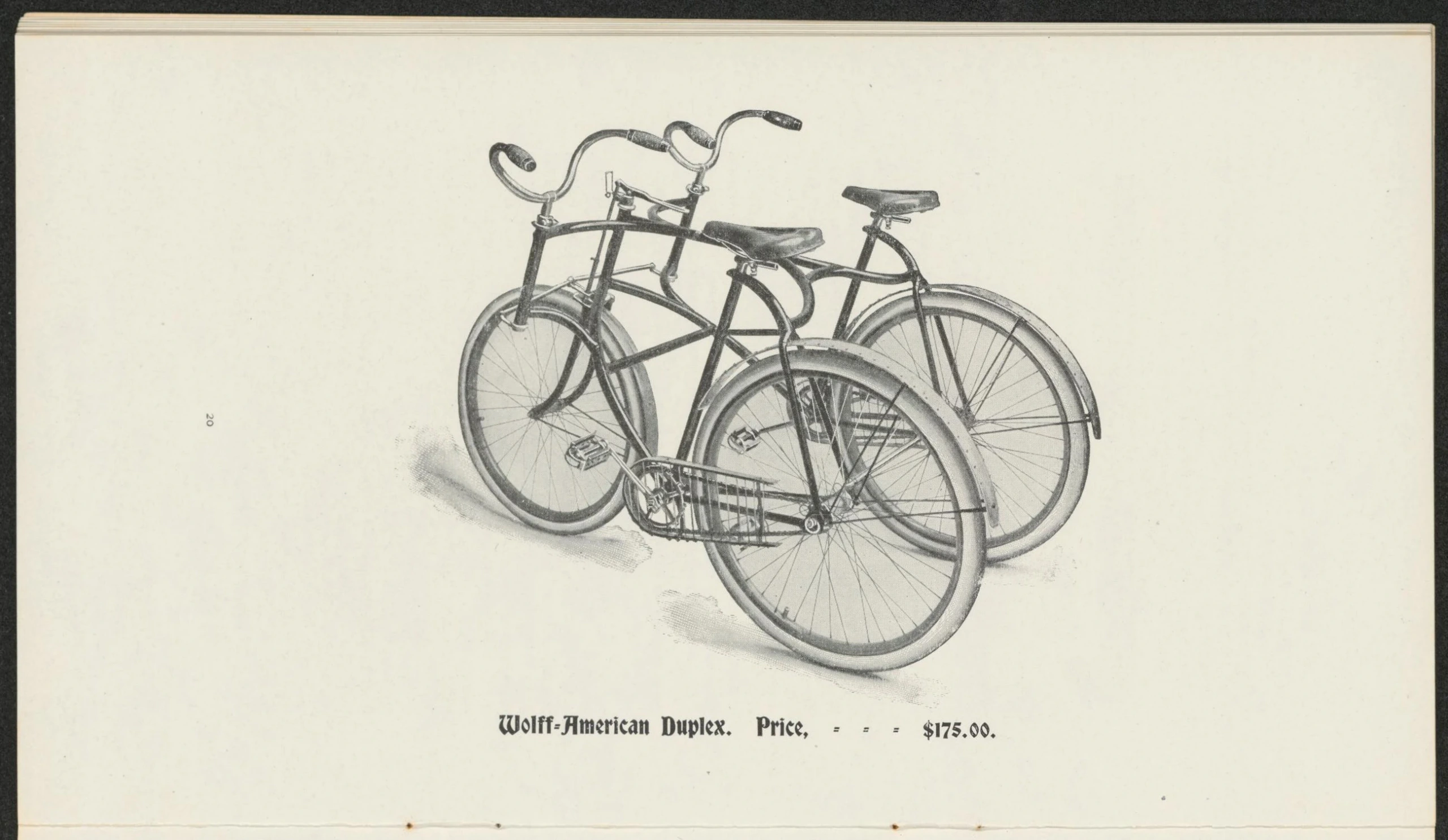
Wolff-American Duplex. Price, – – – $175.00.
[A full-page halftone, printed sideways on the leaf, of the Wolff-American Duplex, a three-wheeled side-by-side sociable for two riders with two seats and two pairs of upturned bars, shown in three-quarter view with mud guards and a slatted chain cover. The folio “20” is printed at the inner edge.]
— Page 23 —
On the tandem there is also given the option of a 30-tooth front sprocket.
That the principle of transmitting power by chain and sprocket is the surest, simplest and best is just as certain as the axiom that the shortest distance between any two points is a straight line. Realizing this, we do not intend foisting on the public abandoned devices for gearing just for the purpose of creating a false demand or temporary furore. Our chains and sprockets are produced with a view to reduce friction to its lowest point and thus lessen the strength required for propulsion. Our chains and sprockets are perfectly made from the finest quality of material and carefully worked to the proper pitch. Being properly treated they wear but little and may be depended upon to outlast any of the many impracticable gearing contrivances which will be seen on the market during the early part of the season.
Cranks.
There is no part of a bicycle more vulnerable than the crank. Recognizing this we take particular pains to have cranks which are absolutely as strong as it is possible to make them. They are constructed of spring tempered steel and subjected to an enormous strain before they are deemed satisfactory. The cranks are fitted to the axle without the use of cotter pins and, although they never work loose, are easily removable. Tapered crank axle ends fit snugly into the holes of the cranks, the oil chamber caps extending over the cranks and firmly securing them. By removing the screw on the axle end and tapping the crank or using the spanner on the cup or cone, the left crank is forced off the axle and then the right crank and axle may be removed. This performance, which by the way will be an infrequent one, does not interfere with the ball bearings in the slightest manner.
Duplex.
But little need be said in favor of the Wolff-American Duplex. Its patrons are its best advocates, and that the Duplex is famed in all parts of the world is the best indication of its popularity. It is a machine of utility, and fills a want which the bicycle does not satisfy. While it does not appeal to the scorching element, it does fulfill the expectations of those who, for various reasons, will not or cannot ride the single machine. It requires no previous experience to ride a Duplex, two novices
Duplex.
REGULAR EQUIPMENT.—Specially designed frame of seamless cold drawn steel tubing. Three wheels, 26 inches, 40 rear and 32 front spokes. Wood rims. 1¾-inch W. A. Single Tube tires. Patent self-lubricating tubular crank shaft and hubs. Patent Eccentric chain adjustment. Hunt saddles. Gear, 52 inches. Cranks, 5½ or 6½ inches. Upturned handle bars. Lantern bracket. Detachable mud and dress guards. Wolff-American combination or rat-trap pedals. Weight, 42 pounds. Option, 56-inch gear. Christy saddle.
21
[A text page without illustration; a band of leaf ornaments above the Duplex specifications; blackletter subheads.]
— Page 24 —
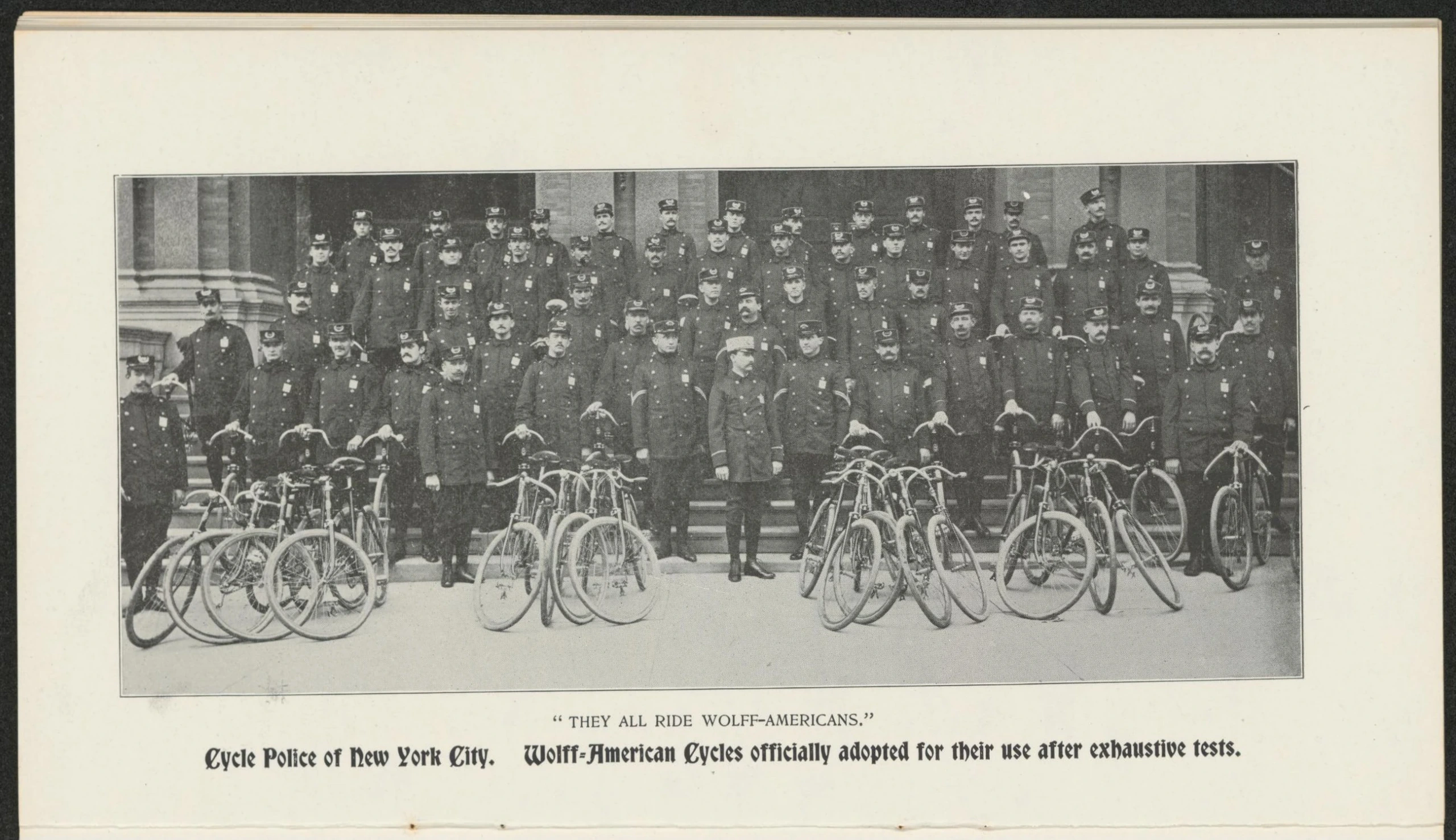
“THEY ALL RIDE WOLFF-AMERICANS.”
Cycle Police of New York City. Wolff-American Cycles officially adopted for their use after exhaustive tests.
[A full-page halftone photograph, printed sideways on the leaf, of about sixty uniformed New York bicycle policemen posed on the steps of a stone building, with rows of their diamond-frame bicycles standing before them; no folio visible.]
— Page 25 —
being as fully competent to propel it as a pair of experts. Physical infirmities are no preventive from enjoying cycling on a Duplex, one rider doing the steering, and the other the greater part or all of the work. Blind persons and cripples are numbered among Wolff-American purchasers. Timid persons who fear the bicycle will appreciate the stability of the Duplex, and that it stands alone without upsetting is another evidence of its practicability. It is stanchly constructed, but, withal, light and remarkably easy running.
Evidence of Merit.
There is no better proof of the utility of a bicycle than the test of actual use. No usage could be more severe than that received by the bicycles ridden by the cycle police of New York City. Seventy able-bodied men ride these wheels seven hours a day while on patrol. Their exciting employment consists in regulating traffic, catching fast riders, with stopping runaways as a frequent diversion. According to the dictates of the municipal authorities of New York City, the Cycle Squad must only ride on duty that wheel which has the official endorsement of the Police Department. Numerous tests were arranged, in which all of the leading makes took part. The competition was keen, and that the Wolff-American was finally decided to be the one best adapted for the severe usage of the cycle police is an indication of their worth. For some time we made no public use of the fact that the cycle police of New York City were mounted on Wolff-Americans. When we wrote Police Commissioner Andrews, requesting his permission to advertise the subject, we received this commendatory reply:
POLICE DEPARTMENT OF THE CITY OF NEW YORK,
April 5, 1897.
Messrs. R. H. WOLFF & CO., Ltd., Foot of East 118th St., New York.
Gentlemen:—Yours of the 3d, inquiring whether there are any objections to your making use of the fact that the Wolff-American bicycles are used by the cycle policemen in this city, is received. Your wheels were adopted by the Department after a thorough examination and exhaustive competition. I do not see how there can be any objection upon the part of the Department to your making any legitimate use of the fact that your wheels were adopted.
Yours truly, A. D. ANDREWS, Commissioner.
Besides the police, all the street cleaning inspectors of New York City use Wolff-American bicycles. At all seasons of the year and under the most trying conditions the inspectors travel about on their Wolff-Americans, and complaint is something unknown. The following letter to us from Commissioner Waring’s Secretary indicates the service given by the Wolff-American in the New York Street Cleaning Department:
DEPARTMENT OF STREET CLEANING,
NEW YORK, April 13, 1897.
Messrs. R. H. WOLFF & CO., Ltd., Foot of East 118th St., City.
Gentlemen:—The eighty-seven (87) Wolff-American bicycles used by this Department are giving entire satisfaction.
Yours truly, JOHN P. YATES, Private Sec’y.
23
[A text page without illustration, with a blackletter subhead and two letters of testimonial set in small capitals and italic.]
— Page 26 —
Patent Pedals.
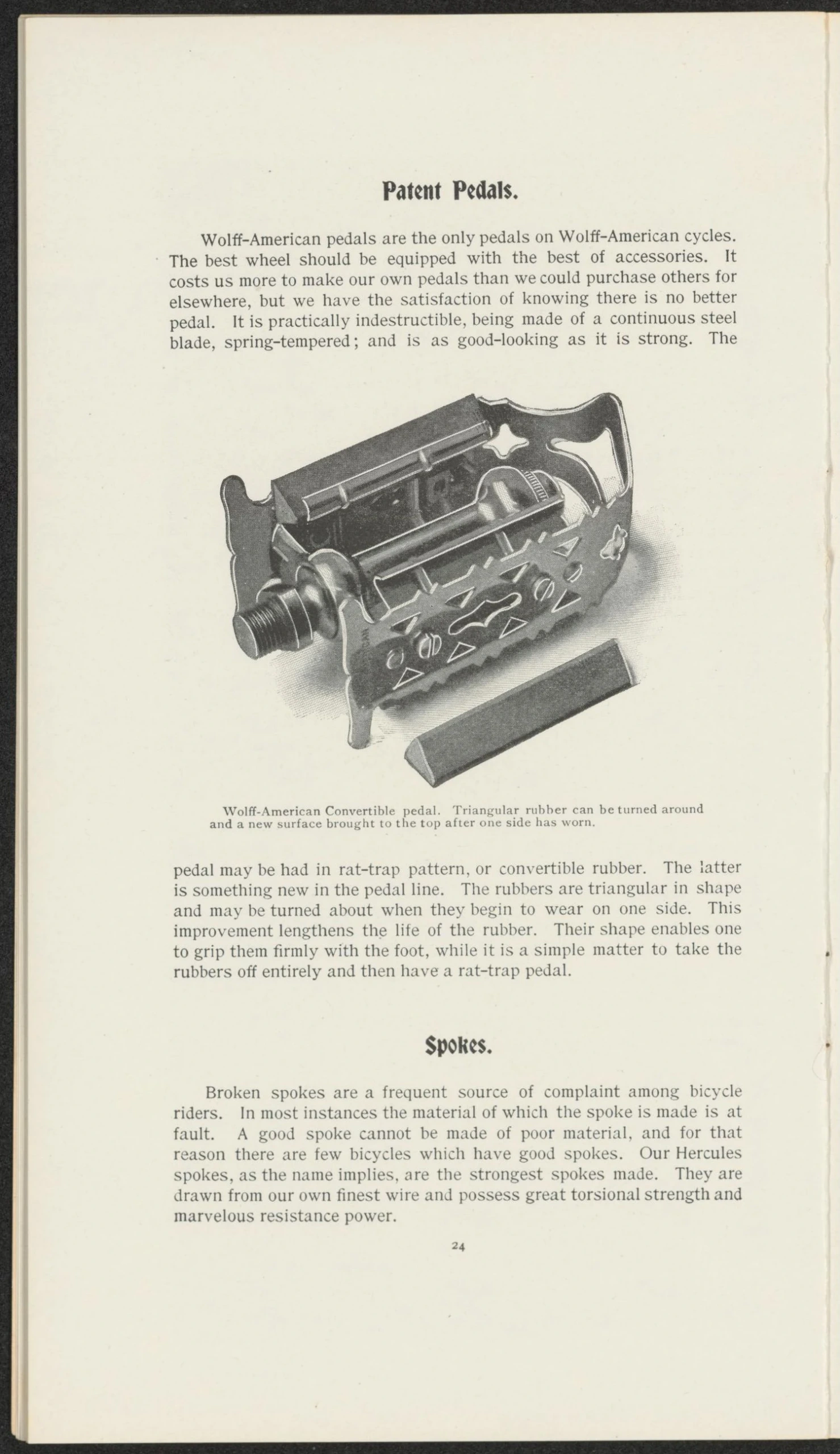
Wolff-American pedals are the only pedals on Wolff-American cycles. The best wheel should be equipped with the best of accessories. It costs us more to make our own pedals than we could purchase others for elsewhere, but we have the satisfaction of knowing there is no better pedal. It is practically indestructible, being made of a continuous steel blade, spring-tempered; and is as good-looking as it is strong. The
Wolff-American Convertible pedal. Triangular rubber can be turned around and a new surface brought to the top after one side has worn.
pedal may be had in rat-trap pattern, or convertible rubber. The latter is something new in the pedal line. The rubbers are triangular in shape and may be turned about when they begin to wear on one side. This improvement lengthens the life of the rubber. Their shape enables one to grip them firmly with the foot, while it is a simple matter to take the rubbers off entirely and then have a rat-trap pedal.
Spokes.
Broken spokes are a frequent source of complaint among bicycle riders. In most instances the material of which the spoke is made is at fault. A good spoke cannot be made of poor material, and for that reason there are few bicycles which have good spokes. Our Hercules spokes, as the name implies, are the strongest spokes made. They are drawn from our own finest wire and possess great torsional strength and marvelous resistance power.
24
[A text page with a large halftone of the Wolff-American convertible pedal, its pierced steel side plates and a loose triangular rubber block beside it; blackletter subheads.]
— Page 27 —
Patent Eccentric Chain Adjustment.
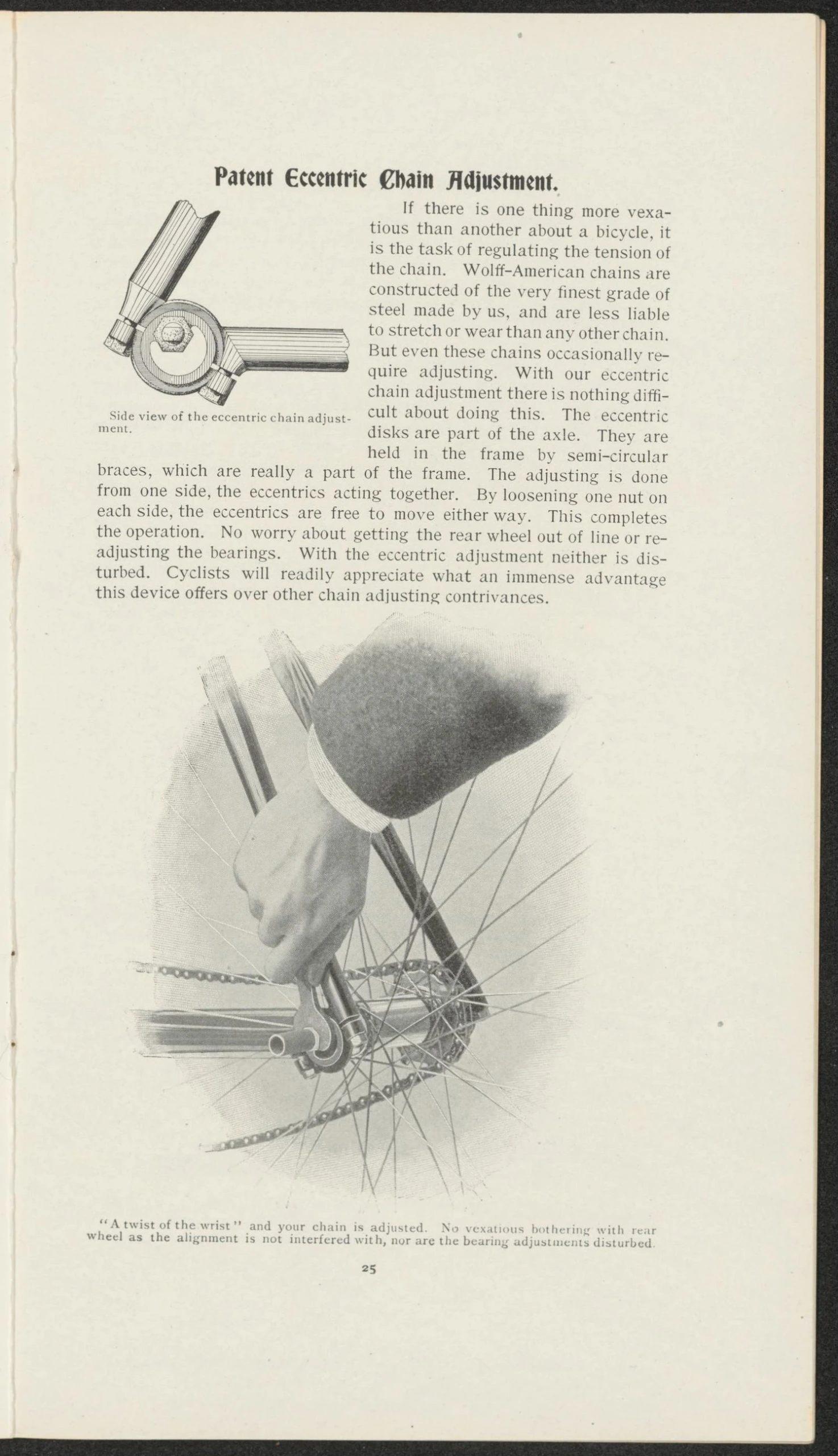
If there is one thing more vexatious than another about a bicycle, it is the task of regulating the tension of the chain. Wolff-American chains are constructed of the very finest grade of steel made by us, and are less liable to stretch or wear than any other chain. But even these chains occasionally require adjusting. With our eccentric chain adjustment there is nothing difficult about doing this. The eccentric disks are part of the axle. They are held in the frame by semi-circular braces, which are really a part of the frame. The adjusting is done from one side, the eccentrics acting together. By loosening one nut on each side, the eccentrics are free to move either way. This completes the operation. No worry about getting the rear wheel out of line or re-adjusting the bearings. With the eccentric adjustment neither is disturbed. Cyclists will readily appreciate what an immense advantage this device offers over other chain adjusting contrivances.
Side view of the eccentric chain adjustment.
“A twist of the wrist” and your chain is adjusted. No vexatious bothering with rear wheel as the alignment is not interfered with, nor are the bearing adjustments disturbed.
25
[A text page with a line cut of the eccentric rear dropout at upper left and a large vignetted halftone of a gloved hand turning the eccentric with a spanner at the rear hub, among the spokes and chain.]
— Page 28 —
Patent Special Fastenings.
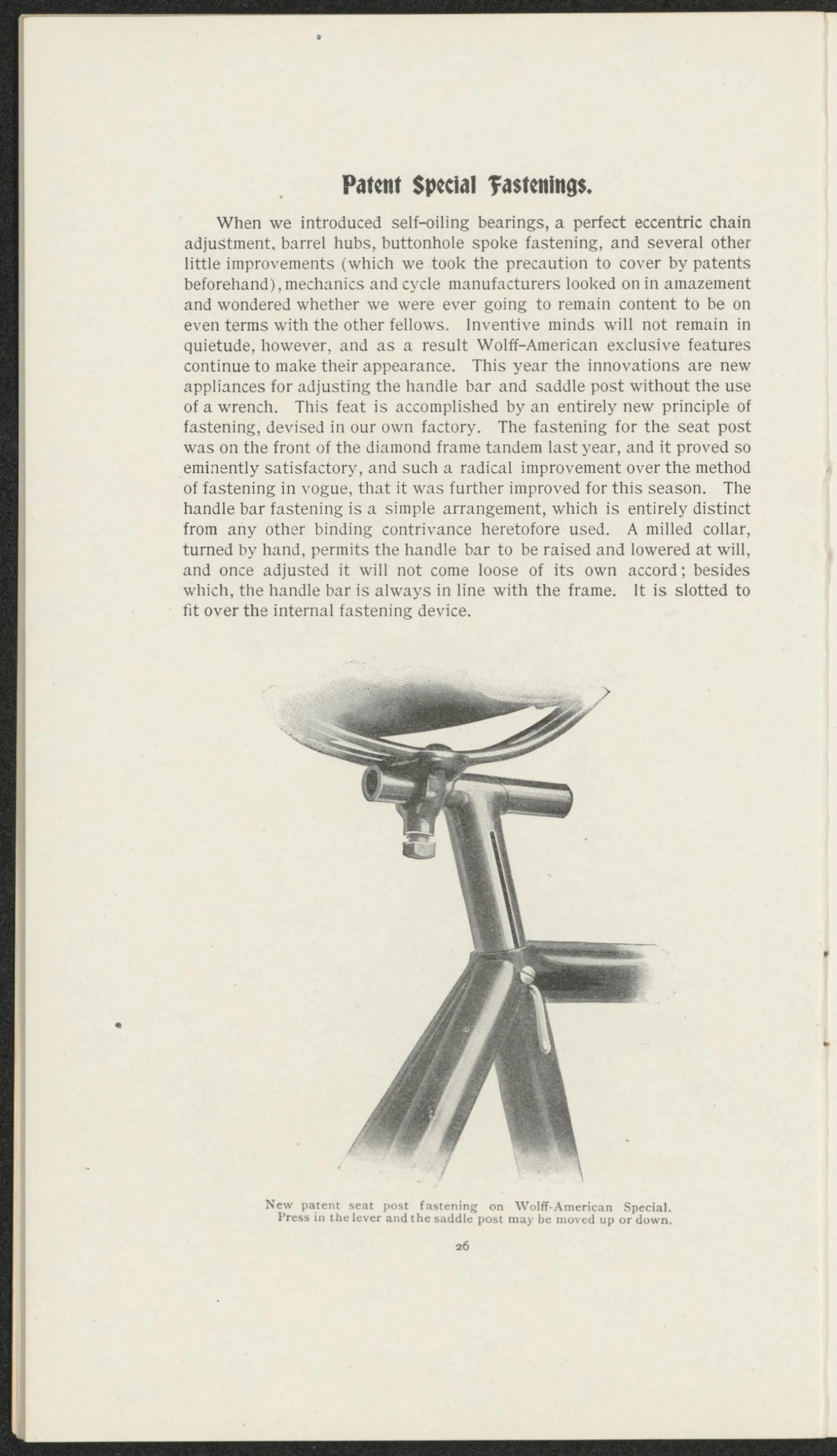
When we introduced self-oiling bearings, a perfect eccentric chain adjustment, barrel hubs, buttonhole spoke fastening, and several other little improvements (which we took the precaution to cover by patents beforehand), mechanics and cycle manufacturers looked on in amazement and wondered whether we were ever going to remain content to be on even terms with the other fellows. Inventive minds will not remain in quietude, however, and as a result Wolff-American exclusive features continue to make their appearance. This year the innovations are new appliances for adjusting the handle bar and saddle post without the use of a wrench. This feat is accomplished by an entirely new principle of fastening, devised in our own factory. The fastening for the seat post was on the front of the diamond frame tandem last year, and it proved so eminently satisfactory, and such a radical improvement over the method of fastening in vogue, that it was further improved for this season. The handle bar fastening is a simple arrangement, which is entirely distinct from any other binding contrivance heretofore used. A milled collar, turned by hand, permits the handle bar to be raised and lowered at will, and once adjusted it will not come loose of its own accord; besides which, the handle bar is always in line with the frame. It is slotted to fit over the internal fastening device.
New patent seat post fastening on Wolff-American Special. Press in the lever and the saddle post may be moved up or down.
26
[A text page with a large vignetted halftone of the saddle, seat post and seat cluster of the Special, showing the lever of the new seat post fastening.]
— Page 29 —
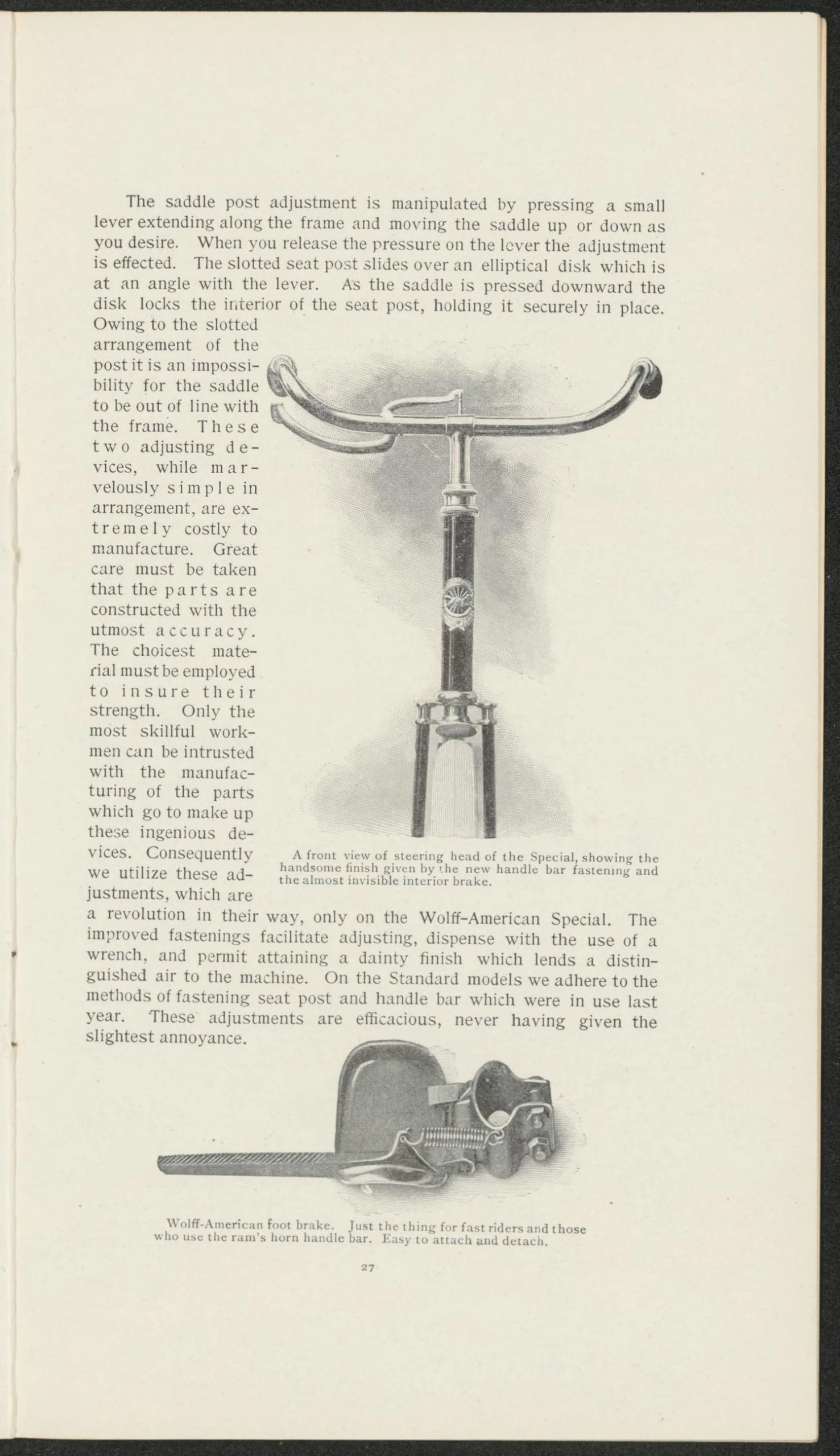
The saddle post adjustment is manipulated by pressing a small lever extending along the frame and moving the saddle up or down as you desire. When you release the pressure on the lever the adjustment is effected. The slotted seat post slides over an elliptical disk which is at an angle with the lever. As the saddle is pressed downward the disk locks the interior of the seat post, holding it securely in place. Owing to the slotted arrangement of the post it is an impossibility for the saddle to be out of line with the frame. These two adjusting devices, while marvelously simple in arrangement, are extremely costly to manufacture. Great care must be taken that the parts are constructed with the utmost accuracy. The choicest material must be employed to insure their strength. Only the most skillful workmen can be intrusted with the manufacturing of the parts which go to make up these ingenious devices. Consequently we utilize these adjustments, which are a revolution in their way, only on the Wolff-American Special. The improved fastenings facilitate adjusting, dispense with the use of a wrench, and permit attaining a dainty finish which lends a distinguished air to the machine. On the Standard models we adhere to the methods of fastening seat post and handle bar which were in use last year. These adjustments are efficacious, never having given the slightest annoyance.
A front view of steering head of the Special, showing the handsome finish given by the new handle bar fastening and the almost invisible interior brake.
Wolff-American foot brake. Just the thing for fast riders and those who use the ram’s horn handle bar. Easy to attach and detach.
27
[A text page with a vignetted halftone of the handlebar, stem, head tube with its round head badge and fork crown of the Special, and a halftone of the spring-loaded foot brake with its serrated rod at the foot.]
— Page 30 —
Patent Brakes.
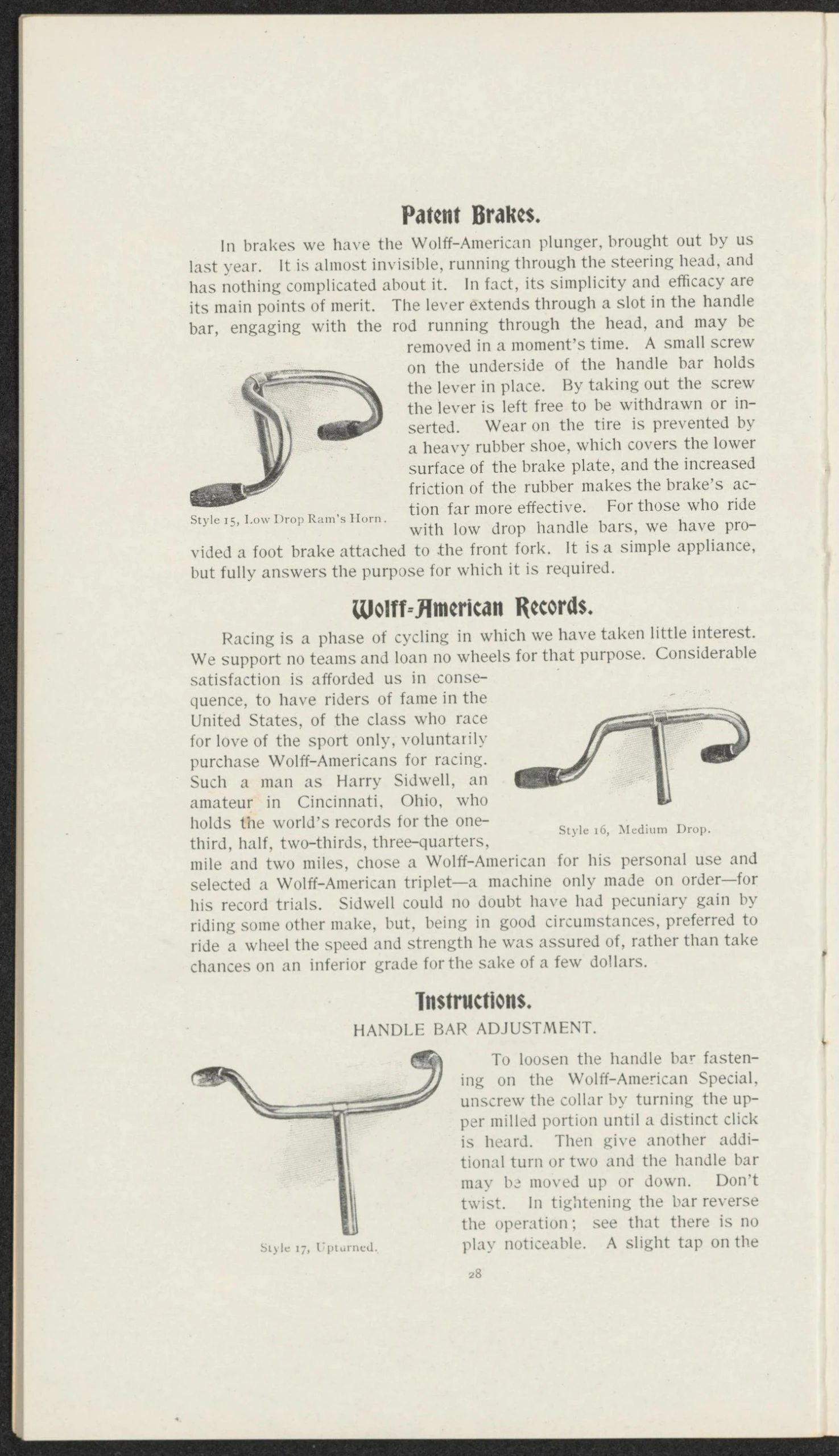
In brakes we have the Wolff-American plunger, brought out by us last year. It is almost invisible, running through the steering head, and has nothing complicated about it. In fact, its simplicity and efficacy are its main points of merit. The lever extends through a slot in the handle bar, engaging with the rod running through the head, and may be removed in a moment’s time. A small screw on the underside of the handle bar holds the lever in place. By taking out the screw the lever is left free to be withdrawn or inserted. Wear on the tire is prevented by a heavy rubber shoe, which covers the lower surface of the brake plate, and the increased friction of the rubber makes the brake’s action far more effective. For those who ride with low drop handle bars, we have provided a foot brake attached to the front fork. It is a simple appliance, but fully answers the purpose for which it is required.
Style 15, Low Drop Ram’s Horn.
Wolff-American Records.
Racing is a phase of cycling in which we have taken little interest. We support no teams and loan no wheels for that purpose. Considerable satisfaction is afforded us in consequence, to have riders of fame in the United States, of the class who race for love of the sport only, voluntarily purchase Wolff-Americans for racing. Such a man as Harry Sidwell, an amateur in Cincinnati, Ohio, who holds the world’s records for the one-third, half, two-thirds, three-quarters, mile and two miles, chose a Wolff-American for his personal use and selected a Wolff-American triplet—a machine only made on order—for his record trials. Sidwell could no doubt have had pecuniary gain by riding some other make, but, being in good circumstances, preferred to ride a wheel the speed and strength he was assured of, rather than take chances on an inferior grade for the sake of a few dollars.
Style 16, Medium Drop.
Instructions.
HANDLE BAR ADJUSTMENT.
To loosen the handle bar fastening on the Wolff-American Special, unscrew the collar by turning the upper milled portion until a distinct click is heard. Then give another additional turn or two and the handle bar may be moved up or down. Don’t twist. In tightening the bar reverse the operation; see that there is no play noticeable. A slight tap on the
Style 17, Upturned.
28
[A text page with three small halftones of handlebars: style 15 low drop ram’s horn, style 16 medium drop and style 17 upturned, each with cork grips; blackletter subheads.]
— Page 31 —
top of the handle bar stem will aid considerably, after which the collar may be screwed a little tighter. Tools of any kind should not be used.
On the Standard models the handle bar is adjusted in the regular way by loosening the pinch bind.
SADDLE POST ADJUSTMENT.
When the saddle post on the Special, or front of the Diamond Frame Tandem, requires adjusting, shake the saddle from right to left and vice versa with an upward pressure, until the small lever projecting from the frame can be pressed downward. While holding the lever against the frame the seat post may be moved up or down until the proper height is reached. Then release the lever, press downward on the saddle, and the adjustment is complete. Tools of any kind should not be used.
On the regular models the saddle post is adjusted by loosening the binding nut on bolt that connects the upper rear stays.
BEARING ADJUSTMENT.
All adjusting should be done on the left side. For wheel bearings on all models the special spanner may be used on left cone after nut on the outside of frame has been loosened. The crank axle bearings on the Standard are regulated after moving back the dog which engages the teeth on the cone. On the crank axle bearings of the Special the cup is free to move after the clamp on the bottom of the bracket is loosened.
OILING BEARINGS.
When the wheels leave the factory they are oiled sufficiently for 1,500 miles of riding. Should lubricating become necessary, remove steel plug on end of axle and inject enough good oil to thoroughly saturate wick, then replace plug and the wick feeds the bearings automatically.
In case the front wheel is removed be careful in replacing to have the file mark on end of axle on the underside. This mark indicates the direction of the oil holes.
On the crank axle bearings a screw is substituted for a plug, but it can be just as easily removed by means of the special wrench.
CHAIN ADJUSTING.
To change the tension of the chain, first loosen at least one of the nuts at each side of the frame ends; then turn axle nut toward right until the chain is sufficiently tight or loose. The axle nut on the chain side should be turned to loosen and the nut on step side to tighten. In either case be sure to turn the nut toward the right, otherwise the axle nuts will be loosened. Don’t bother about position of rear wheel, as adjusting the chain will never disturb the alignment.
HEAD BEARINGS.
Head bearings on Special and Standard may be adjusted by following directions given for loosening handle bar and then turning lower milled collar.
29
[A text page of riders’ instructions under small-capital subheads; no illustration.]
— Page 32 —
BRAKE.
In adjusting the brake, when raising or lowering the handle bar, press the brake spoon down against the tire and screw the milled portion of the rod which extends above the handle bar. Should the brake rattle, it is a sign that the rod is not screwed up high enough.
PEDAL RUBBERS.
When the rubbers on the pedals start to wear, loosen the two small screws without removing them entirely, slide out the rubber toward the crank and replace it again after turning it so that a perfect surface will be on top. This operation can be repeated twice before the rubber becomes worthless.
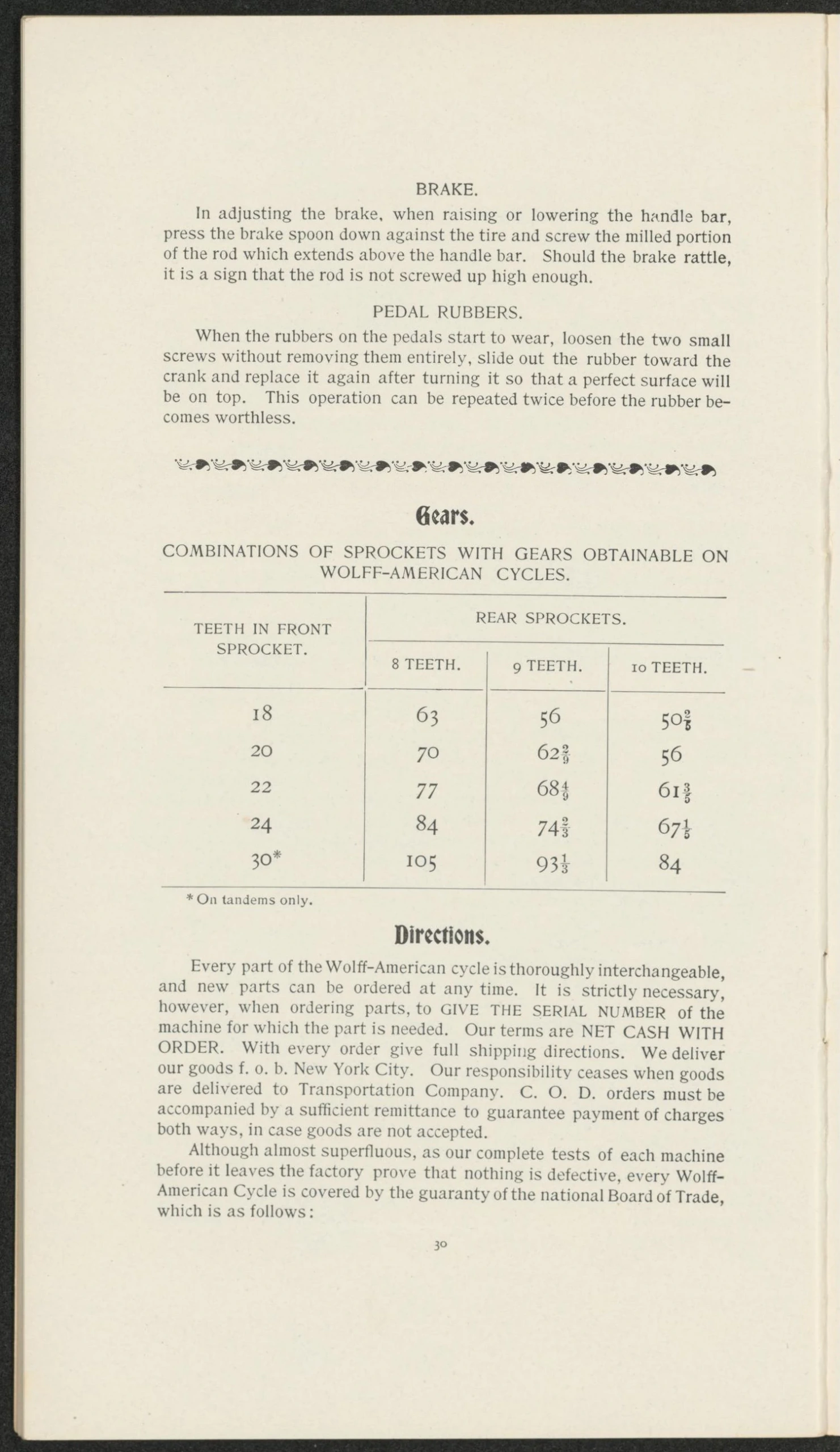
Gears.
COMBINATIONS OF SPROCKETS WITH GEARS OBTAINABLE ON WOLFF-AMERICAN CYCLES.
TEETH IN FRONT SPROCKET. | REAR SPROCKETS. 8 TEETH. | 9 TEETH. | 10 TEETH.
18 | 63 | 56 | 50⅖
20 | 70 | 62 2/9 | 56
22 | 77 | 68 4/9 | 61⅗
24 | 84 | 74⅔ | 67⅕
30* | 105 | 93⅓ | 84
* On tandems only.
Directions.
Every part of the Wolff-American cycle is thoroughly interchangeable, and new parts can be ordered at any time. It is strictly necessary, however, when ordering parts, to GIVE THE SERIAL NUMBER of the machine for which the part is needed. Our terms are NET CASH WITH ORDER. With every order give full shipping directions. We deliver our goods f. o. b. New York City. Our responsibility ceases when goods are delivered to Transportation Company. C. O. D. orders must be accompanied by a sufficient remittance to guarantee payment of charges both ways, in case goods are not accepted.
Although almost superfluous, as our complete tests of each machine before it leaves the factory prove that nothing is defective, every Wolff-American Cycle is covered by the guaranty of the national Board of Trade, which is as follows:
30
[A text page with a ruled gear table and a band of leaf ornaments; blackletter subheads; no illustration.]
— Page 33 —
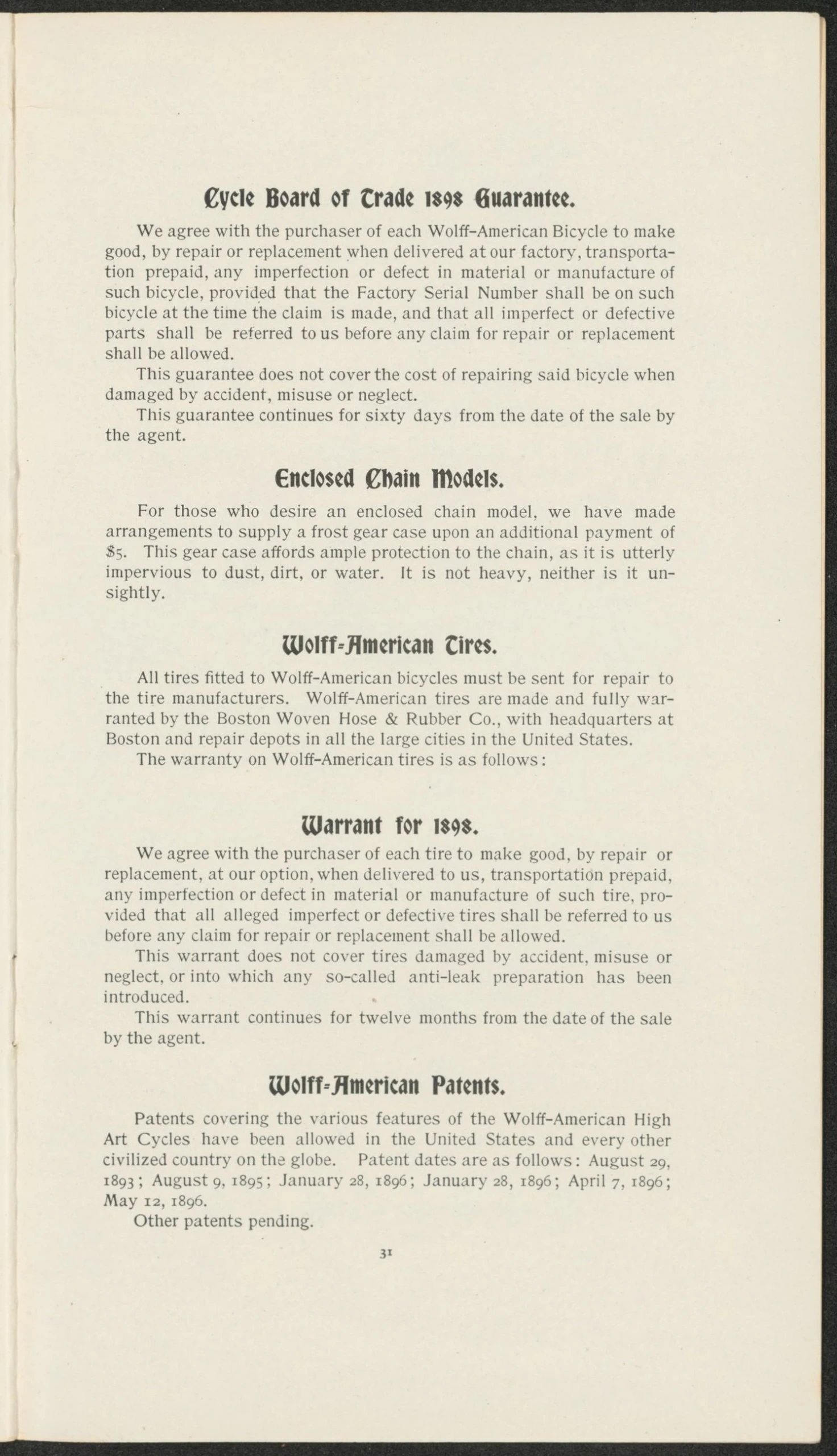
Cycle Board of Trade 1898 Guarantee.
We agree with the purchaser of each Wolff-American Bicycle to make good, by repair or replacement when delivered at our factory, transportation prepaid, any imperfection or defect in material or manufacture of such bicycle, provided that the Factory Serial Number shall be on such bicycle at the time the claim is made, and that all imperfect or defective parts shall be referred to us before any claim for repair or replacement shall be allowed.
This guarantee does not cover the cost of repairing said bicycle when damaged by accident, misuse or neglect.
This guarantee continues for sixty days from the date of the sale by the agent.
Enclosed Chain Models.
For those who desire an enclosed chain model, we have made arrangements to supply a frost gear case upon an additional payment of $5. This gear case affords ample protection to the chain, as it is utterly impervious to dust, dirt, or water. It is not heavy, neither is it unsightly.
Wolff-American Tires.
All tires fitted to Wolff-American bicycles must be sent for repair to the tire manufacturers. Wolff-American tires are made and fully warranted by the Boston Woven Hose & Rubber Co., with headquarters at Boston and repair depots in all the large cities in the United States.
The warranty on Wolff-American tires is as follows:
Warrant for 1898.
We agree with the purchaser of each tire to make good, by repair or replacement, at our option, when delivered to us, transportation prepaid, any imperfection or defect in material or manufacture of such tire, provided that all alleged imperfect or defective tires shall be referred to us before any claim for repair or replacement shall be allowed.
This warrant does not cover tires damaged by accident, misuse or neglect, or into which any so-called anti-leak preparation has been introduced.
This warrant continues for twelve months from the date of the sale by the agent.
Wolff-American Patents.
Patents covering the various features of the Wolff-American High Art Cycles have been allowed in the United States and every other civilized country on the globe. Patent dates are as follows: August 29, 1893; August 9, 1895; January 28, 1896; January 28, 1896; April 7, 1896; May 12, 1896.
Other patents pending.
31
[A text page under blackletter subheads; no illustration.]
— Page 34 —
Epitome.
WOLFF-AMERICAN HIGH ART CYCLES are made by the manufacturers of the finest quality of steel and steel wire.
Skilled mechanics, aided by the latest machinery, insure the accuracy of their construction.
Best material and proper methods of treatment guarantee their strength.
The spring temper which Wolff-Americans receive is a secret process which imparts elasticity to the frame without destroying its rigidity.
Twenty-five years’ experience has taught us just how to manipulate steel.
Wolff-American Cycles are noted for their simplicity of detail.
Self-oiling bearings, eccentric chain adjustment, button-hole spoke device, patent handle bar and seat post fastenings are all labor-saving contrivances.
They are also exclusive improvements which no other makes possess.
Perfect sprockets and chains mean an ease of running unequaled by any other method of gearing.
Strictly a one price bicycle and no inside discounts.
Sold only under one name plate.
Two styles, but absolutely no deviation from the highest grade in either.
Wolff-American reputation is world-wide and attained solely by true merit.
32
[A text page framed above and below by rows of eight fleur-de-lis ornaments over rules; a large initial “W” and a blackletter heading.]
— Page 35 —
[The blank inside back cover, tan paper, with faint show-through from the back cover.]
— Page 36 —
WOLFF-AMERICAN
R. H. WOLFF & CO. LIMITED, N. Y.
G. H. BUEK & CO. N. Y. LITH.
[The color-lithographed back cover: the oval Wolff-American head badge, a running wolf over a spoked wheel within a band lettered with the firm name and a laurel wreath tied with a ribbon below, on a pale green panel inside a tooled-leather style border on tan.]
Ebykr presents this material for research and education. If you hold rights to it or notice an ownership issue, please contact us and we will respond promptly.