About Ebykr
Ebykr celebrates classic and vintage lightweight bicycles through provocative imagery and opinion. Ride along with us.
About Ebykr
Ebykr celebrates classic and vintage lightweight bicycles through provocative imagery and opinion. Ride along with us.

Source: Retrobike archive (retrobike.co.uk), "1989 Specialized Catalogue", uploaded by the forum member john.
 Page 1
 Page 2
 Page 3
 Page 4
 Page 5
 Page 6
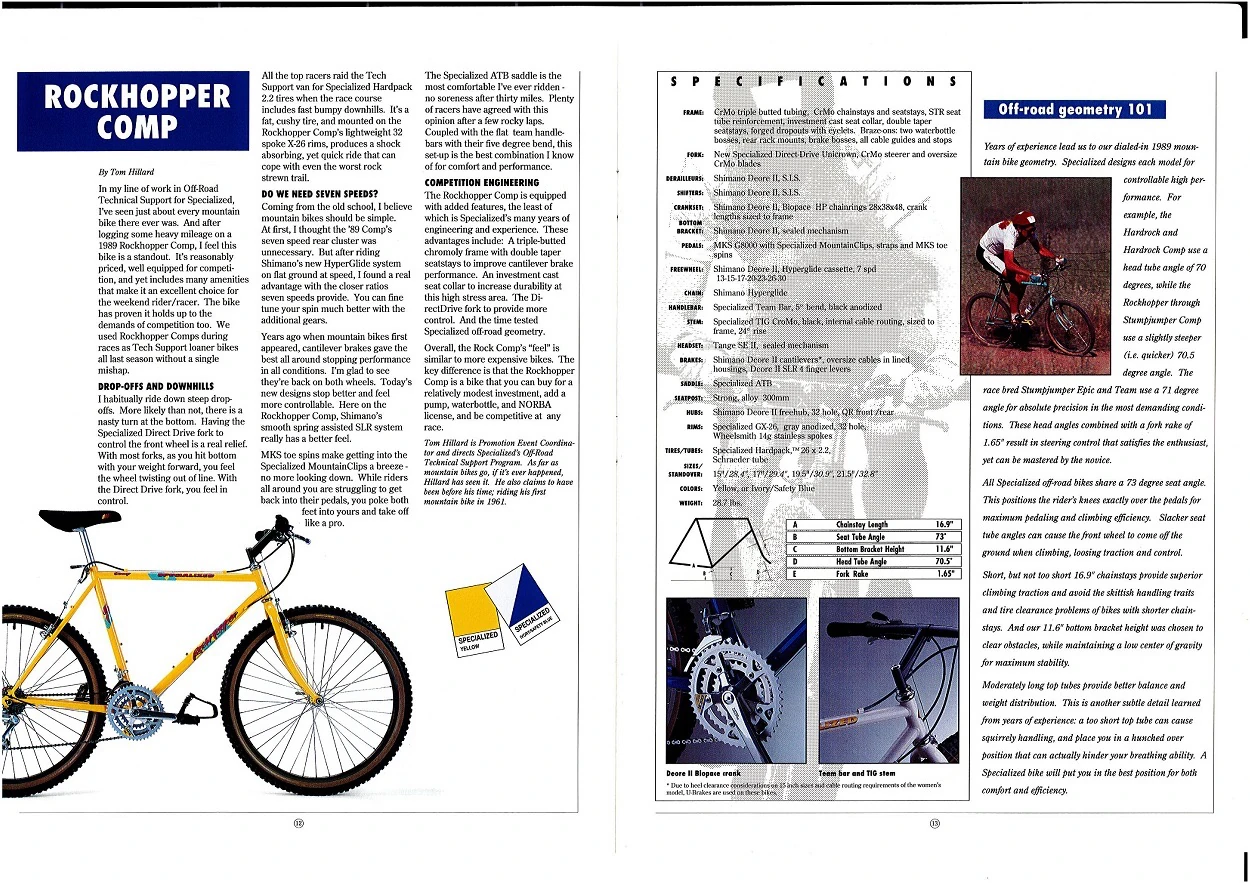 Page 7
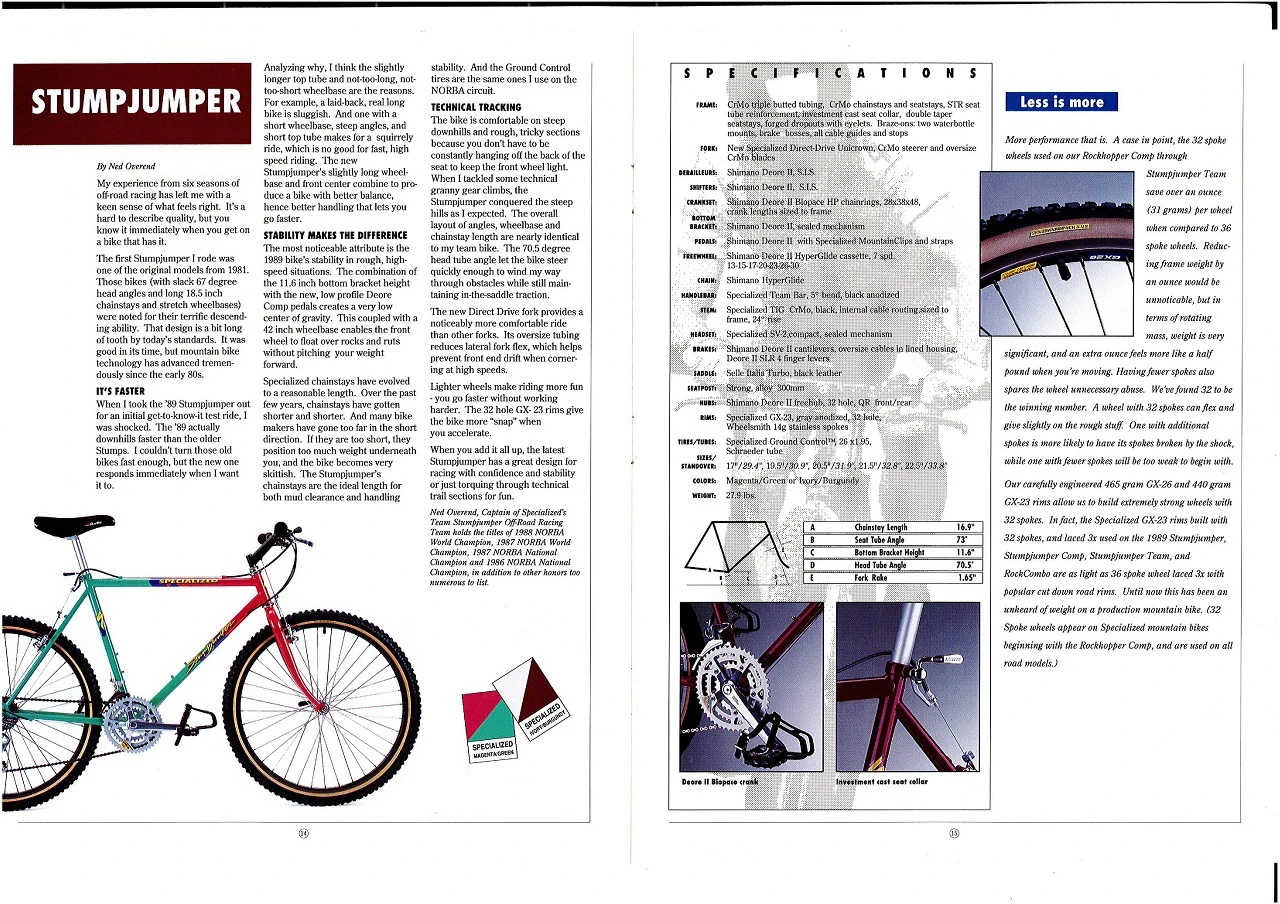 Page 8
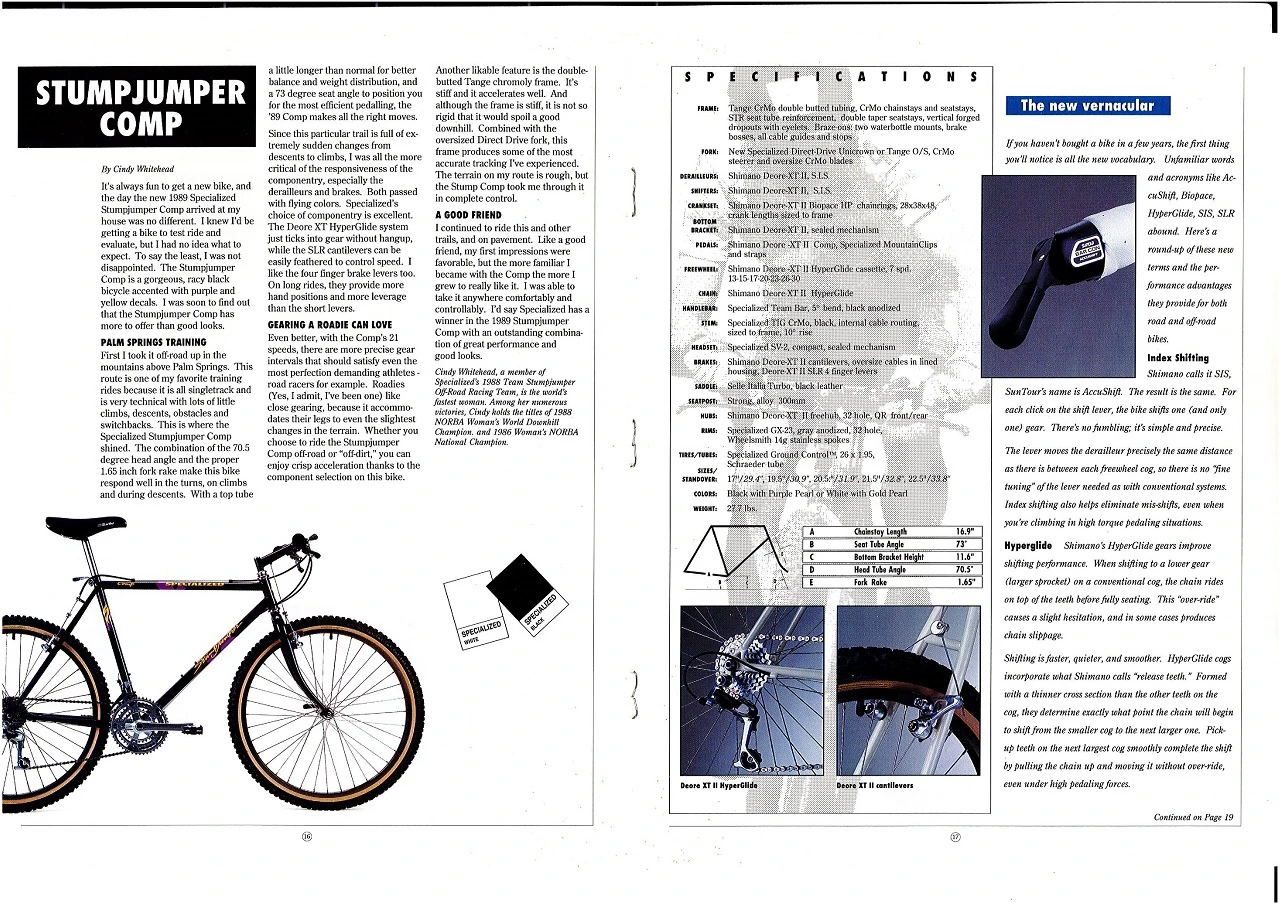 Page 9
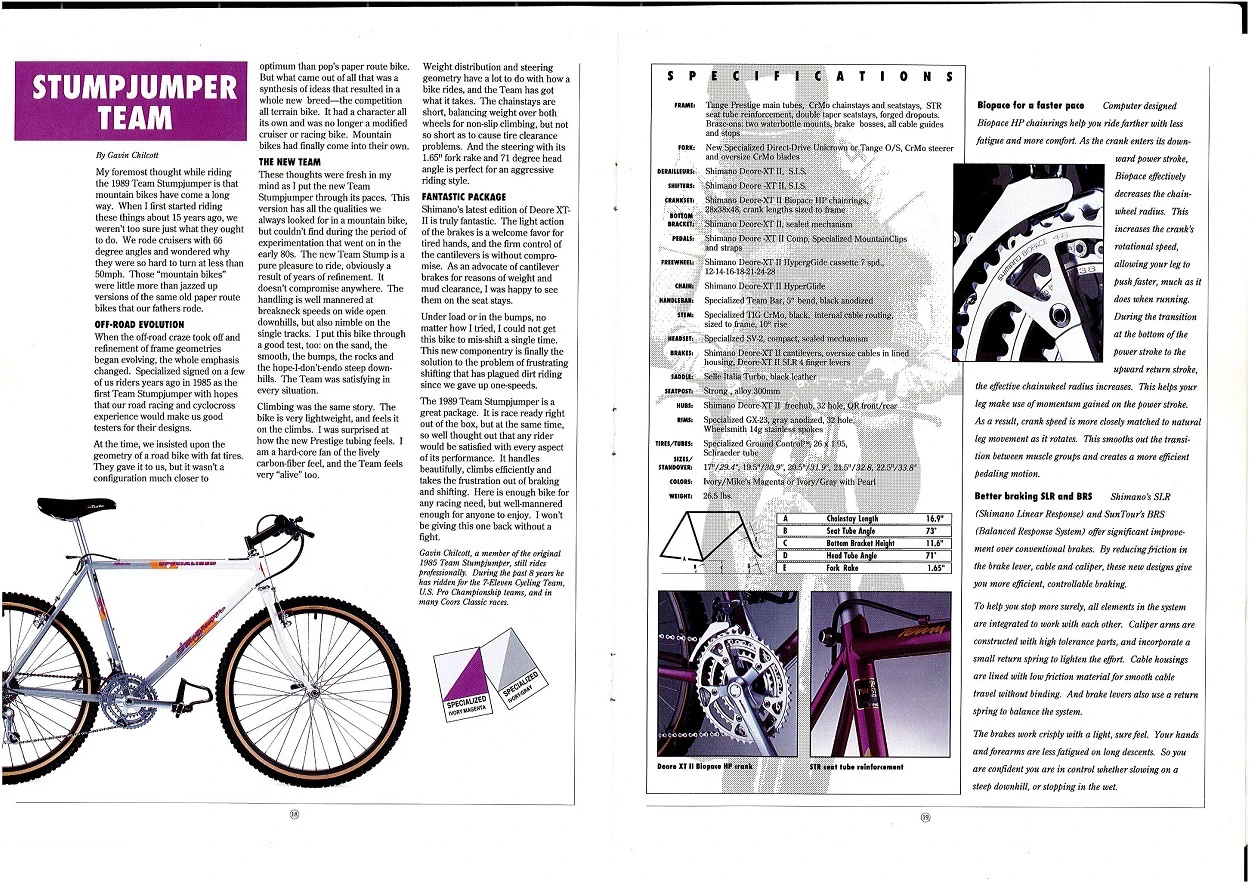 Page 10
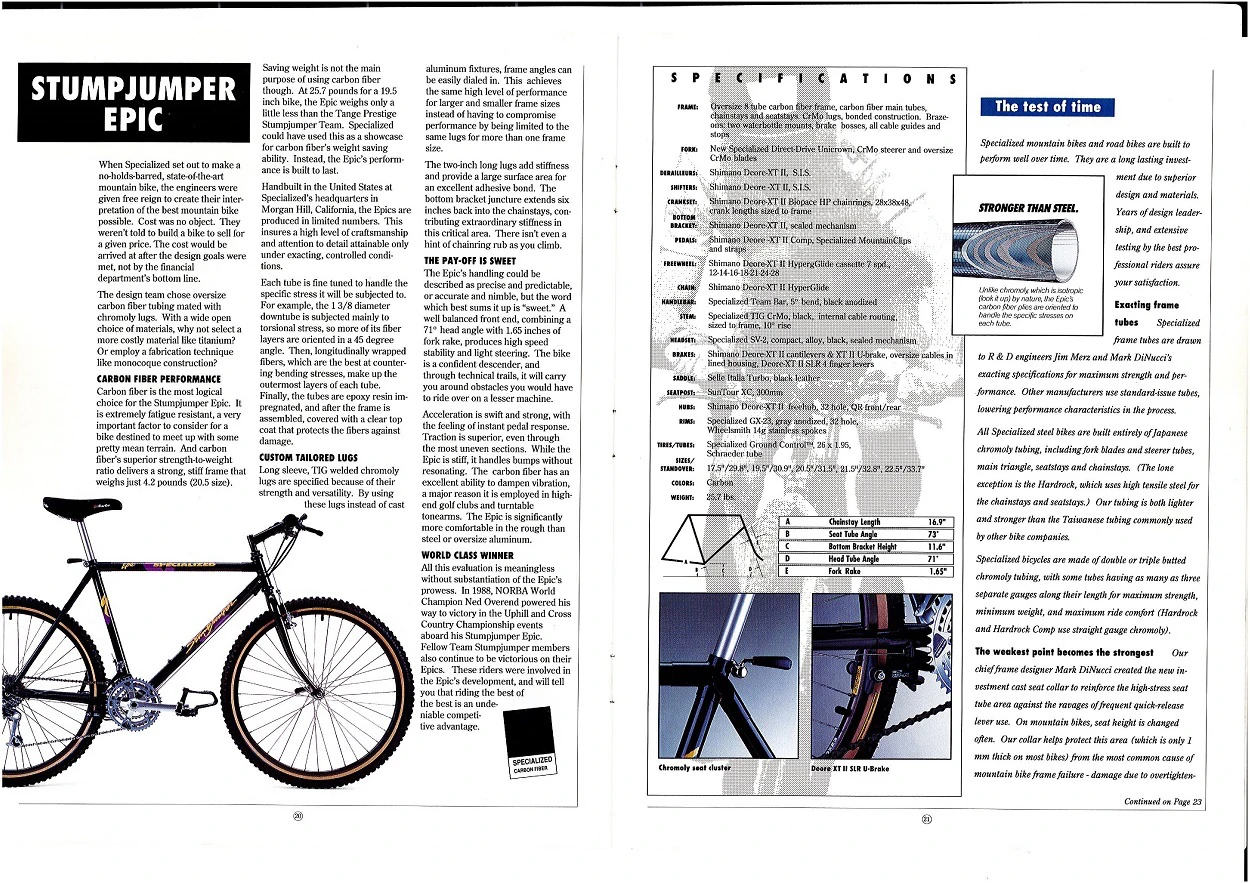 Page 11
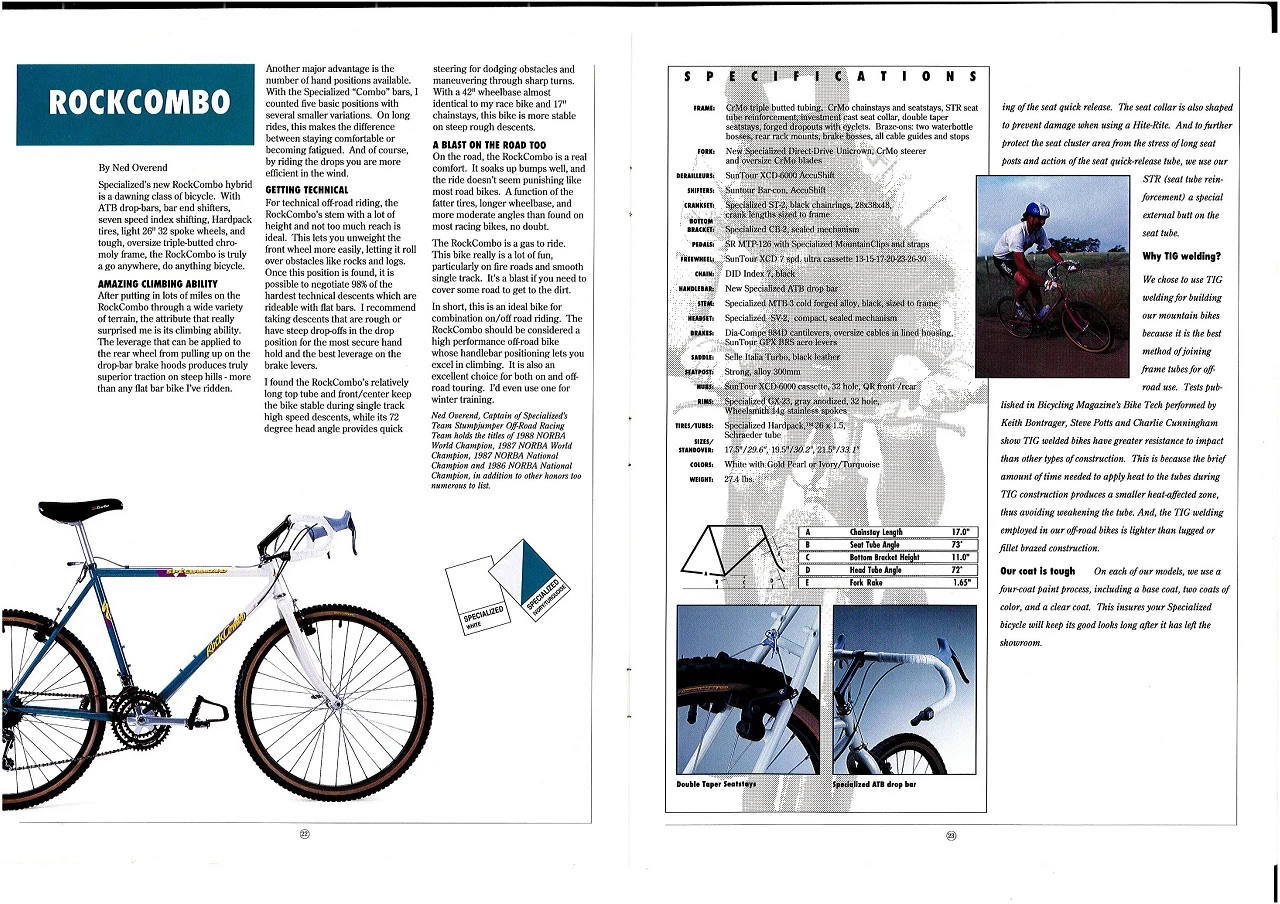 Page 12
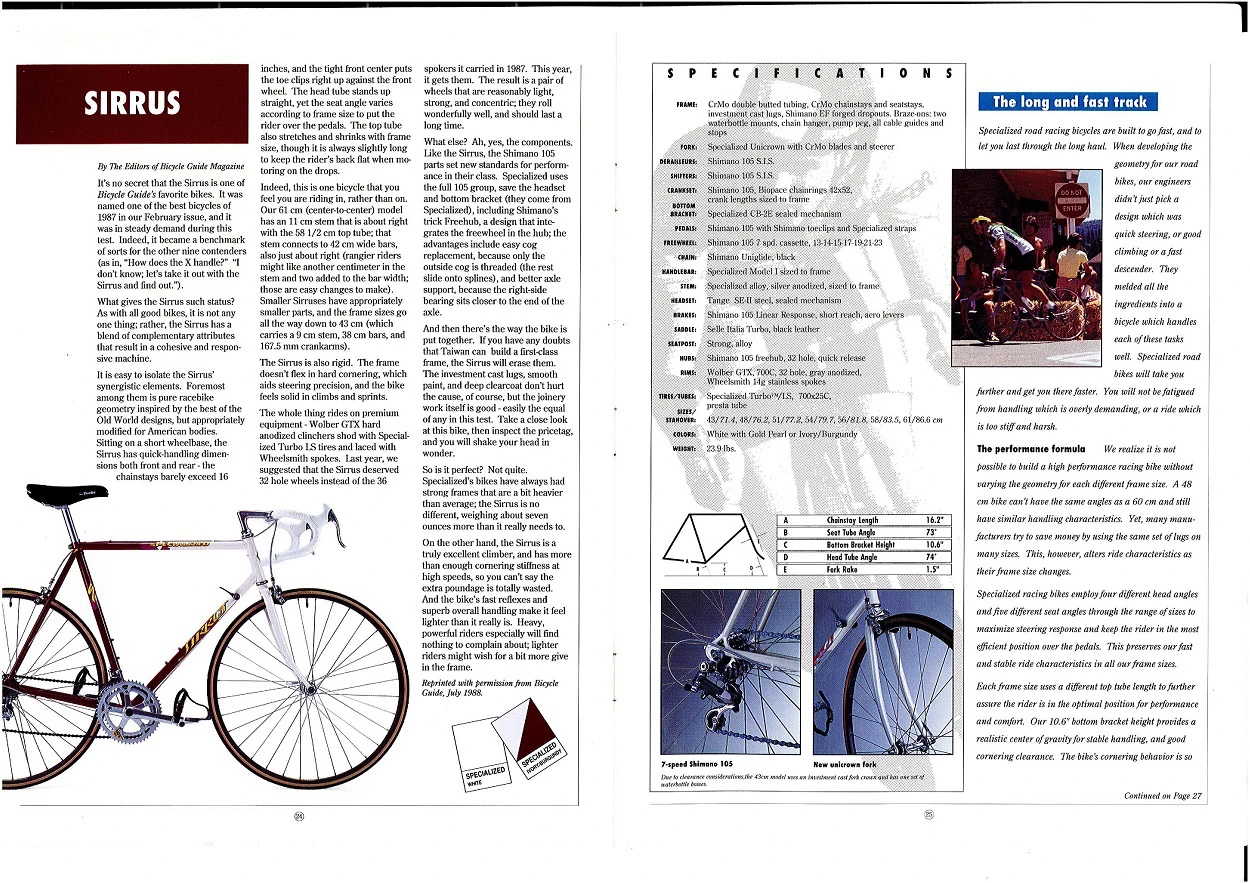 Page 13
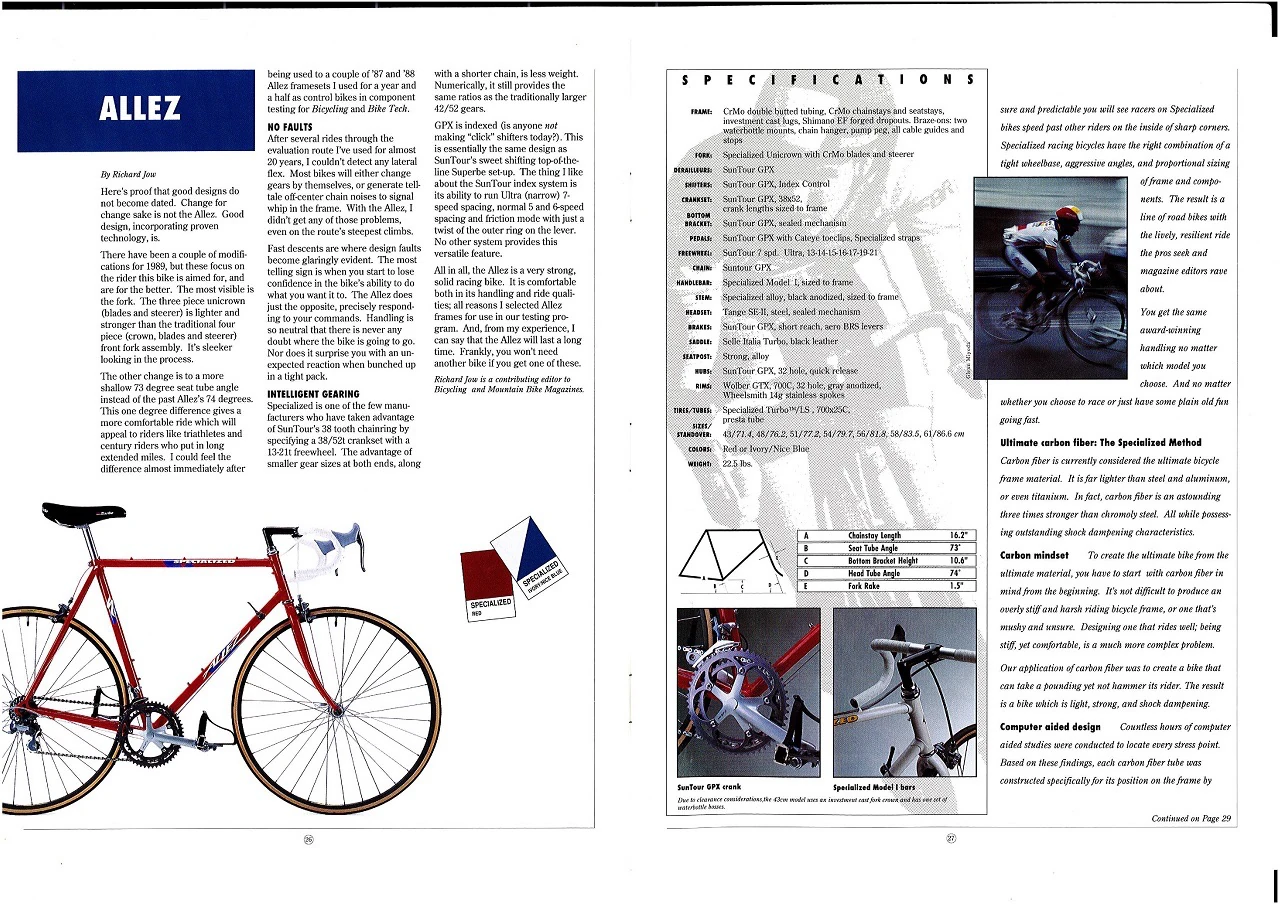 Page 14
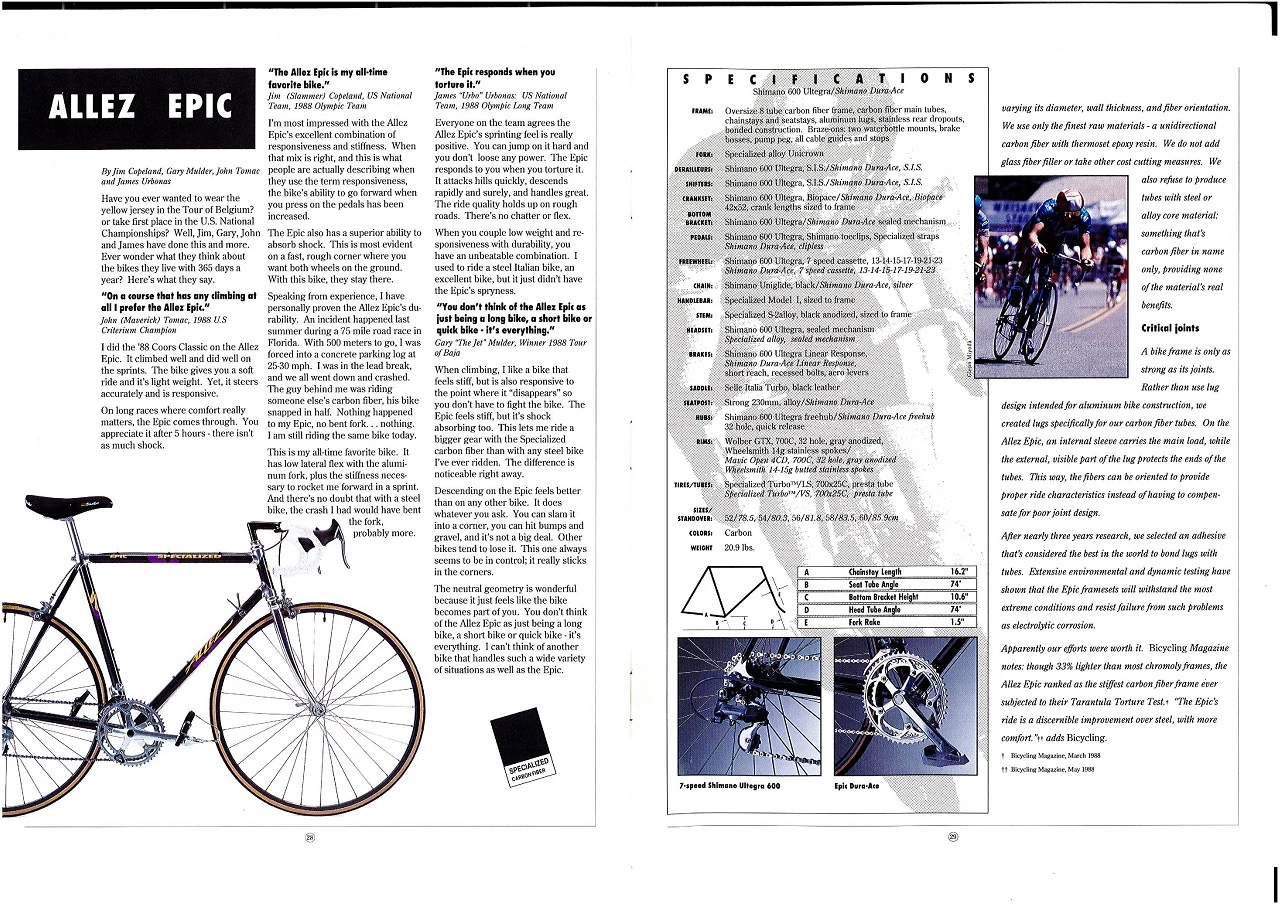 Page 15
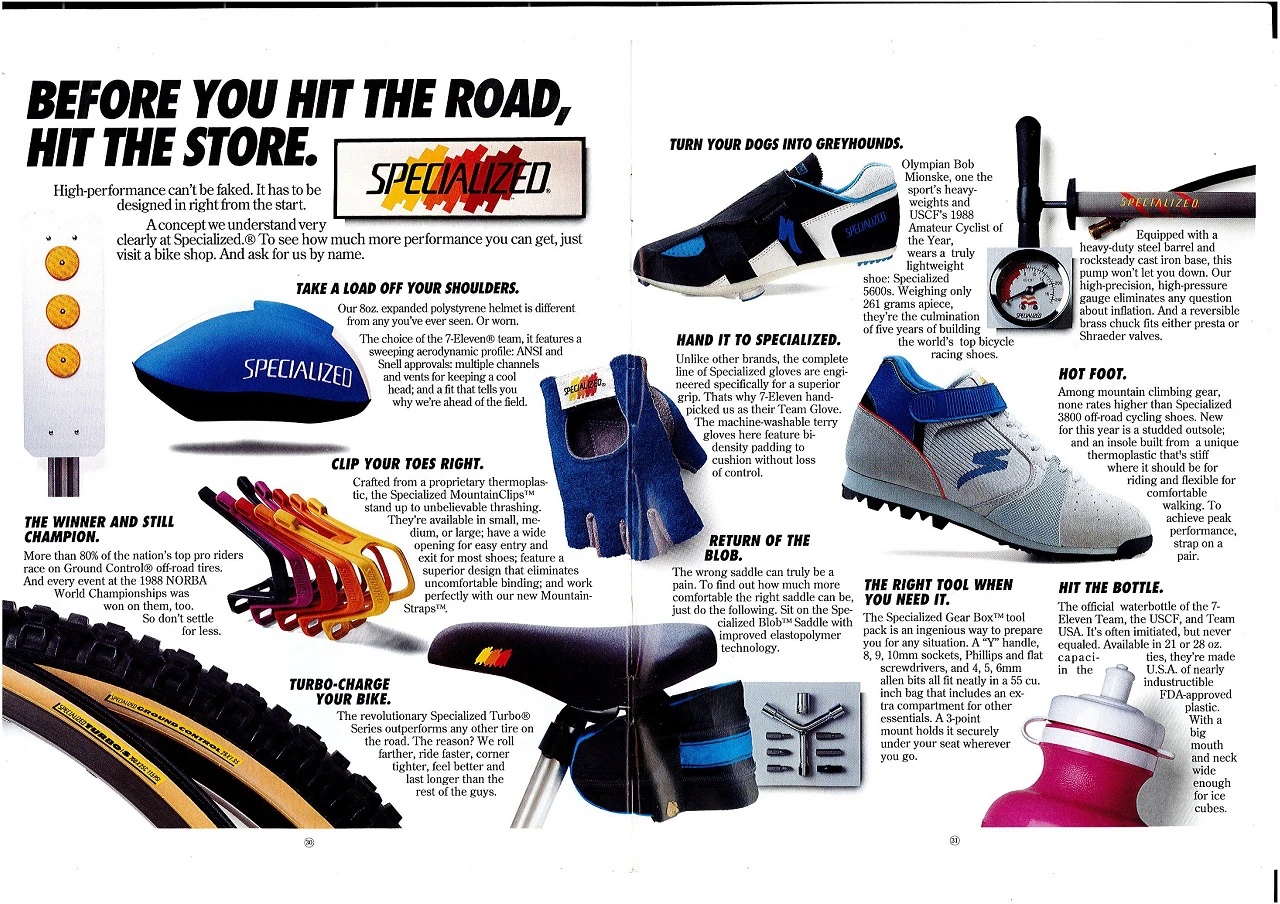 Page 16
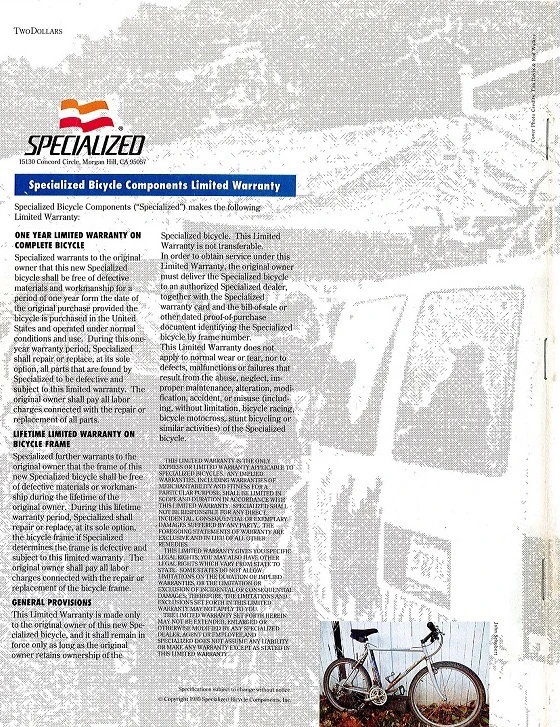 Page 17
| Marque | Specialized |
|---|---|
| Type | Catalog |
| Year | 1989 |
| Publisher | Specialized Bicycle Components, Morgan Hill, California |
| Country | United States |
| Language | English |
| Pages | 17 |
| Source | Retrobike archive (retrobike.co.uk), "1989 Specialized Catalogue", uploaded by the forum member john. |
| Credit | Retrobike (scan by john) |
| Identifier | Permalink https://www.retrobike.co.uk/archive/1989-specialized-catalogue.914/ |
| Transcription | Transcribed by eye |
Reference
Specialized Bicycle Components, Morgan Hill, California. Specialized 1989 Catalog (Specialized Bicycle Components, United States). 1989. Ebykr, https://ebykr.com/library/specialized-catalog-1989/.
Wikipedia
{{cite book |title=Specialized 1989 Catalog (Specialized Bicycle Components, United States) |publisher=Specialized Bicycle Components, Morgan Hill, California |date=1989 |url=https://ebykr.com/library/specialized-catalog-1989/ |via=Ebykr |access-date=}}TwoDollars SPECIALIZED 15130 Concord Circle, Morgan Hill, CA 95037 Specialized Bicycle Components Limited Warranty Specialized Bicycle Components ("Specialized") makes the following Limited Warranty: ONE YEAR LIMITED WARRANTY ON COMPLETE BICYCLE Specialized warrants to the original owner that this new Specialized bicycle shall be free of defective materials and workmanship for a period of one year …
The Specialized bicycle catalog of 1989, issued in the United States by Specialized Bicycle Components: twelve models, each with a signed test-ride review (by Ned Overend, John Schubert, Cindy Whitehead, Gavin Chilcott, Richard Jow and others, the Sirrus review reprinted from Bicycle Guide) and full specifications: the Hardrock, Hardrock Comp, Rockhopper, Rockhopper Comp, Stumpjumper, Stumpjumper Comp, Stumpjumper Team, the carbon fiber Stumpjumper Epic, the drop-barred RockCombo, and the Sirrus, Allez and Allez Epic road bicycles, with features on the DirectDrive fork, frame geometry and components. Transcribed from the page images (17 pages); each page ends with a bracketed description of its pictures.
— Page 1 —
TwoDollars
SPECIALIZED
15130 Concord Circle, Morgan Hill, CA 95037
Specialized Bicycle Components Limited Warranty
Specialized Bicycle Components (“Specialized”) makes the following Limited Warranty:
ONE YEAR LIMITED WARRANTY ON COMPLETE BICYCLE
Specialized warrants to the original owner that this new Specialized bicycle shall be free of defective materials and workmanship for a period of one year form the date of the original purchase provided the bicycle is purchased in the United States and operated under normal conditions and use. During this one-year warranty period, Specialized shall repair or replace, at its sole option, all parts that are found by Specialized to be defective and subject to this limited warranty. The original owner shall pay all labor charges connected with the repair or replacement of all parts.
LIFETIME LIMITED WARRANTY ON BICYCLE FRAME
Specialized further warrants to the original owner that the frame of this new Specialized bicycle shall be free of defective materials or workmanship during the lifetime of the original owner. During this lifetime warranty period, Specialized shall repair or replace, at its sole option, the bicycle frame if Specialized determines the frame is defective and subject to this limited warranty. The original owner shall pay all labor charges connected with the repair or replacement of the bicycle frame.
GENERAL PROVISIONS
This Limited Warranty is made only to the original owner of this new Specialized bicycle, and it shall remain in force only as long as the original owner retains ownership of the Specialized bicycle. This Limited Warranty is not transferable.
In order to obtain service under this Limited Warranty, the original owner must deliver the Specialized bicycle to an authorized Specialized dealer, together with the Specialized warranty card and the bill-of-sale or other dated proof-of-purchase document identifying the Specialized bicycle by frame number.
This Limited Warranty does not apply to normal wear or tear, nor to defects, malfunctions or failures that result from the abuse, neglect, improper maintenance, alteration, modification, accident, or misuse (including, without limitation, bicycle racing, bicycle motocross, stunt bicycling or similar activities) of the Specialized bicycle.
THIS LIMITED WARRANTY IS THE ONLY EXPRESS OR LIMITED WARRANTY APPLICABLE TO SPECIALIZED BICYCLES. ANY IMPLIED WARRANTIES, INCLUDING WARRANTIES OF MERCHANTABILITY AND FITNESS FOR A PARTICULAR PURPOSE, SHALL BE LIMITED IN SCOPE AND DURATION IN ACCORDANCE WITH THIS LIMITED WARRANTY. SPECIALIZED SHALL NOT BE RESPONSIBLE FOR ANY DIRECT, INCIDENTAL, CONSEQUENTIAL OR EXEMPLARY DAMAGES SUFFERED BY ANY PARTY. THE FOREGOING STATEMENTS OF WARRANTY ARE EXCLUSIVE AND IN LIEU OF ALL OTHER REMEDIES.
THIS LIMITED WARRANTY GIVES YOU SPECIFIC LEGAL RIGHTS. YOU MAY ALSO HAVE OTHER LEGAL RIGHTS WHICH VARY FROM STATE TO STATE. SOME STATES DO NOT ALLOW LIMITATIONS ON THE DURATION OF IMPLIED WARRANTIES, OR THE LIMITATION OR EXCLUSION OF INCIDENTAL OR CONSEQUENTIAL DAMAGES. THEREFORE, THE LIMITATIONS AND EXCLUSIONS SET FORTH IN THIS LIMITED WARRANTY MAY NOT APPLY TO YOU.
THE LIMITED WARRANTY SET FORTH HEREIN MAY NOT BE EXTENDED, ENLARGED OR OTHERWISE MODIFIED BY ANY SPECIALIZED DEALER, AGENT OR EMPLOYEE, AND SPECIALIZED DOES NOT ASSUME ANY LIABILITY OR MAKE ANY WARRANTY EXCEPT AS STATED IN THIS LIMITED WARRANTY.
Specifications subject to change without notice.
© Copyright 1989 Specialized Bicycle Components, Inc.
1 9 8 9
SPECIALIZED BICYCLES
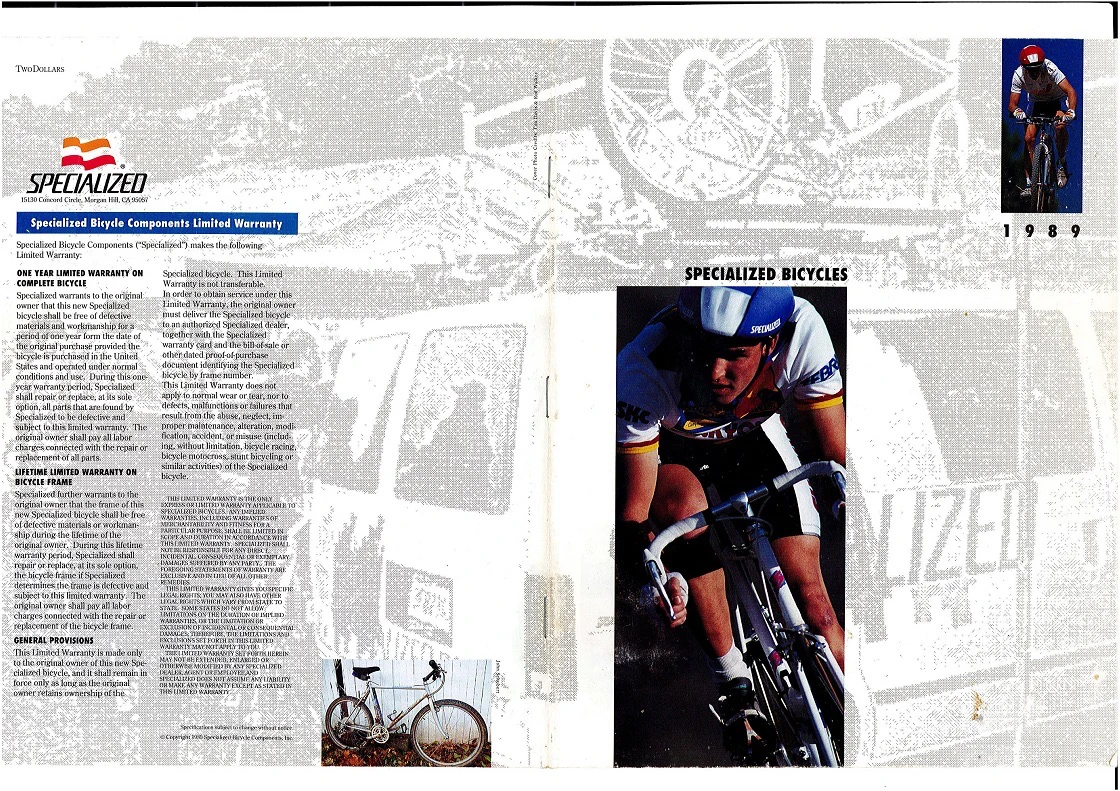
[The outside covers as one spread over a gray halftone of the Specialized support van and a wheel: at left the back cover with the warranty, the Specialized flag mark, a small photograph of a mountain bike against a fence and the word “TwoDollars” at the top corner; at right the front cover, “1989 Specialized Bicycles”, with a photograph of a road racer in a Specialized helmet and team jersey sprinting toward the camera and a small photograph of a mountain biker. Small vertical credit lines in the gutter are too small to read.]
— Page 2 —
You saw it here first.
Specialized has certainly earned that distinction from nine years of ground-breaking bike manufacture. This year is no different. Unlike other bike companies, it’s not the same old line hidden under a new paint job. Our bikes are built after thousands of miles and years of experience rolled up by our own Team Stumpjumper, Olympic athletes like Bob Mionske, the invaluable field data compiled by the Specialized off-road Technical Support programs, and our highly regarded R&D department. The result is a family of road and off-road bicycles that achieves new levels of performance. No Other Mountain Bikes Reach These Heights. It took nine years of designing, building, and racing mountain bikes to get to the point we are today. In fact, we started long before most companies even knew what mountain bikes were. A major reason why Specialized bikes are so far in front in terms of advanced technology. Our first bike — the legendary 1981 Stumpjumper — was the first production mountain bike anywhere. And it’s easy to see why that machine was the spark which fueled a whole new sport — a sport that caught fire all over the world. We’ve come a long way since then. Anywhere you find people racing, you’ll find Specialized. We sponsor some of the winningest riders on the off-road racing circuit — Team Stumpjumper. Led by captain Ned Overend who captured the 1988 NORBA World Championship title, the Team consists of rising stars Paul Thomasberg, 1988 USCF Cyclocross Champ Lisa Muhich, and the latest addition to the ranks, Daryl Price, two time Junior National Cyclocross Champion. Our commitment to the sport is also reflected in our off-road Technical Support Program. They’re the guys in the Specialized van at races who provide neutral support to all competitors. Acting like a rolling bike shop, they perform pit stop repairs and provide out-of-the-box Rockhoppers and Stumpjumpers to pro racers with broken bikes. Because of our riders and Tech Support team, Specialized has a vantage point in the sport that nobody else can claim. The best minds in the business either ride our mountain bikes or helped design them. Our Road Crew. Our work with road bikes dates back nine years, too. Much like mountain biking, we were involved with road racing before it became fashionable. From local criteriums to the fledgling Race Across AMerica (RAAM). We’ve gone down the road a good deal since then. Last year Specialized sponsored the Sunkyoung-SKC team, sending two riders — USCF 1988 Amateur of the year Bob Mionske and sprinter Ken Carpenter — to the Olympics on Specialized equipment. This year we’re a sponsor of the world-famous 7-Eleven Cycling Team. Here, too, we gain far greater insights about which designs work, and which don’t. The benefits of this thinking can be easily appreciated by riding any of our 1989 bikes.
The Finish Line Isn’t the Only Place We Win. Specialized has won distinction with some other industry experts — cycling publications. Bicycle Guide cited the Stumpjumper as “Bike of the Decade” for inspiring the growth of mountain biking. Outside named the Stumpjumper one of the “Ten Best Innovations of the Decade” — the only bike that made these ranks. Mountain Bike Action called our Rockhopper the best $500 mountain bike. And Bicycle Guide praised the Sirrus as the “Best Value of 1988.” So if you want a mountain bike worthy of the hall of fame (our President Mike Sinyard was elected to the Mountain Bike Hall of Fame) or if you want a road bike that made it the Olympics, we have a suggestion. Read on. And find out how we’re going to make history this year.
IMBA RULES OF THE TRAIL
• Ride on open trails only
• Leave no trace
• Control your bicycle
• Always yield trail
• Never spook animals
• Plan ahead
RIDE RESPONSIBLY
Specialized supports the International Mountain Bike Association. When riding, we ask you follow their mountain bike code of ethics.
2 3
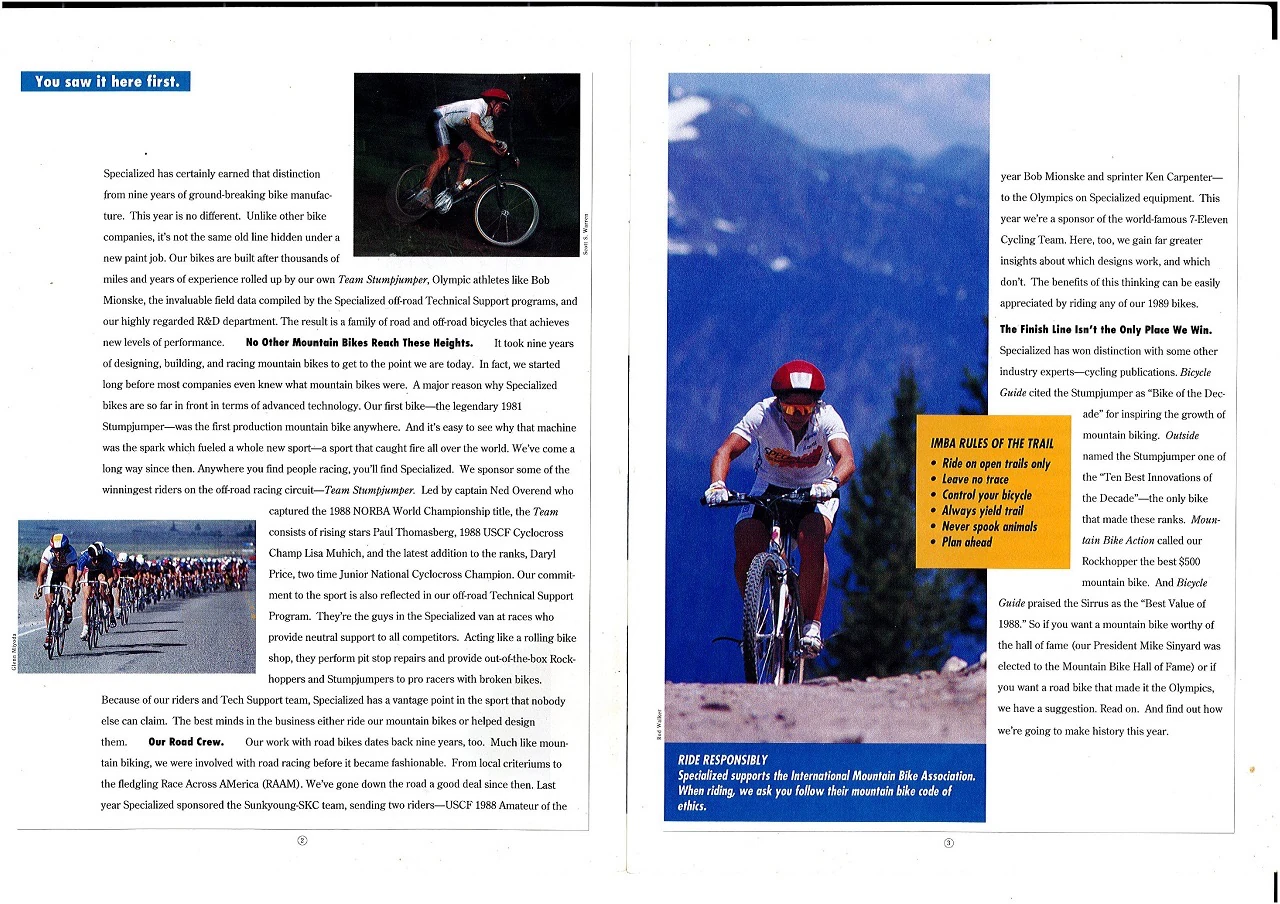
[A spread: at left the essay with a photograph of a mountain biker riding through a forest and one of a road racing pack; at right a tall photograph of a woman mountain biker in a red helmet descending a ridge before snowy peaks, with the IMBA rules of the trail in a yellow box and the “Ride responsibly” note in a blue band. Photographers’ credits run up the photograph edges in small type.]
— Page 3 —
The Class of ’89
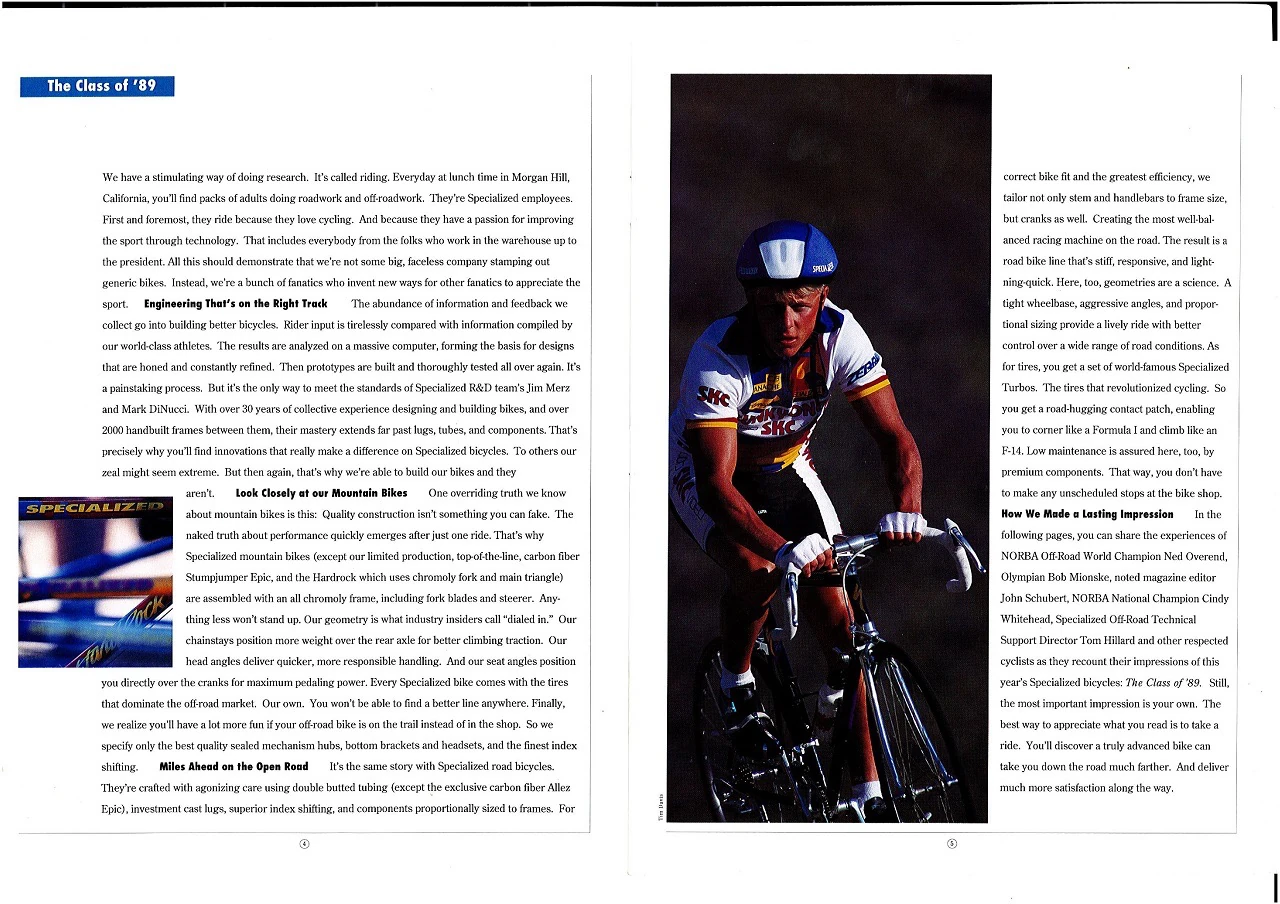
We have a stimulating way of doing research. It’s called riding. Everyday at lunch time in Morgan Hill, California, you’ll find packs of adults doing roadwork and off-roadwork. They’re Specialized employees. First and foremost, they ride because they love cycling. And because they have a passion for improving the sport through technology. That includes everybody from the folks who work in the warehouse up to the president. All this should demonstrate that we’re not some big, faceless company stamping out generic bikes. Instead, we’re a bunch of fanatics who invent new ways for other fanatics to appreciate the sport. Engineering That’s on the Right Track The abundance of information and feedback we collect go into building better bicycles. Rider input is tirelessly compared with information compiled by our world-class athletes. The results are analyzed on a massive computer, forming the basis for designs that are honed and constantly refined. Then prototypes are built and thoroughly tested all over again. It’s a painstaking process. But it’s the only way to meet the standards of Specialized R&D team’s Jim Merz and Mark DiNucci. With over 30 years of collective experience designing and building bikes, and over 2000 handbuilt frames between them, their mastery extends far past lugs, tubes, and components. That’s precisely why you’ll find innovations that really make a difference on Specialized bicycles. To others our zeal might seem extreme. But then again, that’s why we’re able to build our bikes and they aren’t. Look Closely at our Mountain Bikes One overriding truth we know about mountain bikes is this: Quality construction isn’t something you can fake. The naked truth about performance quickly emerges after just one ride. That’s why Specialized mountain bikes (except our limited production, top-of-the-line, carbon fiber Stumpjumper Epic, and the Hardrock which uses chromoly fork and main triangle) are assembled with an all chromoly frame, including fork blades and steerer. Anything less won’t stand up. Our geometry is what industry insiders call “dialed in.” Our chainstays position more weight over the rear axle for better climbing traction. Our head angles deliver quicker, more responsible handling. And our seat angles position you directly over the cranks for maximum pedaling power. Every Specialized bike comes with the tires that dominate the off-road market. Our own. You won’t be able to find a better line anywhere. Finally, we realize you’ll have a lot more fun if your off-road bike is on the trail instead of in the shop. So we specify only the best quality sealed mechanism hubs, bottom brackets and headsets, and the finest index shifting. Miles Ahead on the Open Road It’s the same story with Specialized road bicycles. They’re crafted with agonizing care using double butted tubing (except the exclusive carbon fiber Allez Epic), investment cast lugs, superior index shifting, and components proportionally sized to frames. For correct bike fit and the greatest efficiency, we tailor not only stem and handlebars to frame size, but cranks as well. Creating the most well-balanced racing machine on the road. The result is a road bike line that’s stiff, responsive, and lightning-quick. Here, too, geometries are a science. A tight wheelbase, aggressive angles, and proportional sizing provide a lively ride with better control over a wide range of road conditions. As for tires, you get a set of world-famous Specialized Turbos. The tires that revolutionized cycling. So you get a road-hugging contact patch, enabling you to corner like a Formula I and climb like an F-14. Low maintenance is assured here, too, by premium components. That way, you don’t have to make any unscheduled stops at the bike shop. How We Made a Lasting Impression In the following pages, you can share the experiences of NORBA Off-Road World Champion Ned Overend, Olympian Bob Mionske, noted magazine editor John Schubert, NORBA National Champion Cindy Whitehead, Specialized Off-Road Technical Support Director Tom Hillard and other respected cyclists as they recount their impressions of this year’s Specialized bicycles: The Class of ’89. Still, the most important impression is your own. The best way to appreciate what you read is to take a ride. You’ll discover a truly advanced bike can take you down the road much farther. And deliver much more satisfaction along the way.
4 5
[A spread: the essay at left with a close-up of a blue frame lettered “Specialized” and “Hardrock”; at right a tall photograph of a road racer in a Sunkyoung-SKC team jersey and a Specialized helmet riding toward the camera, credited in small type up its edge.]
— Page 4 —
HARDROCK
By Linda DuPriest
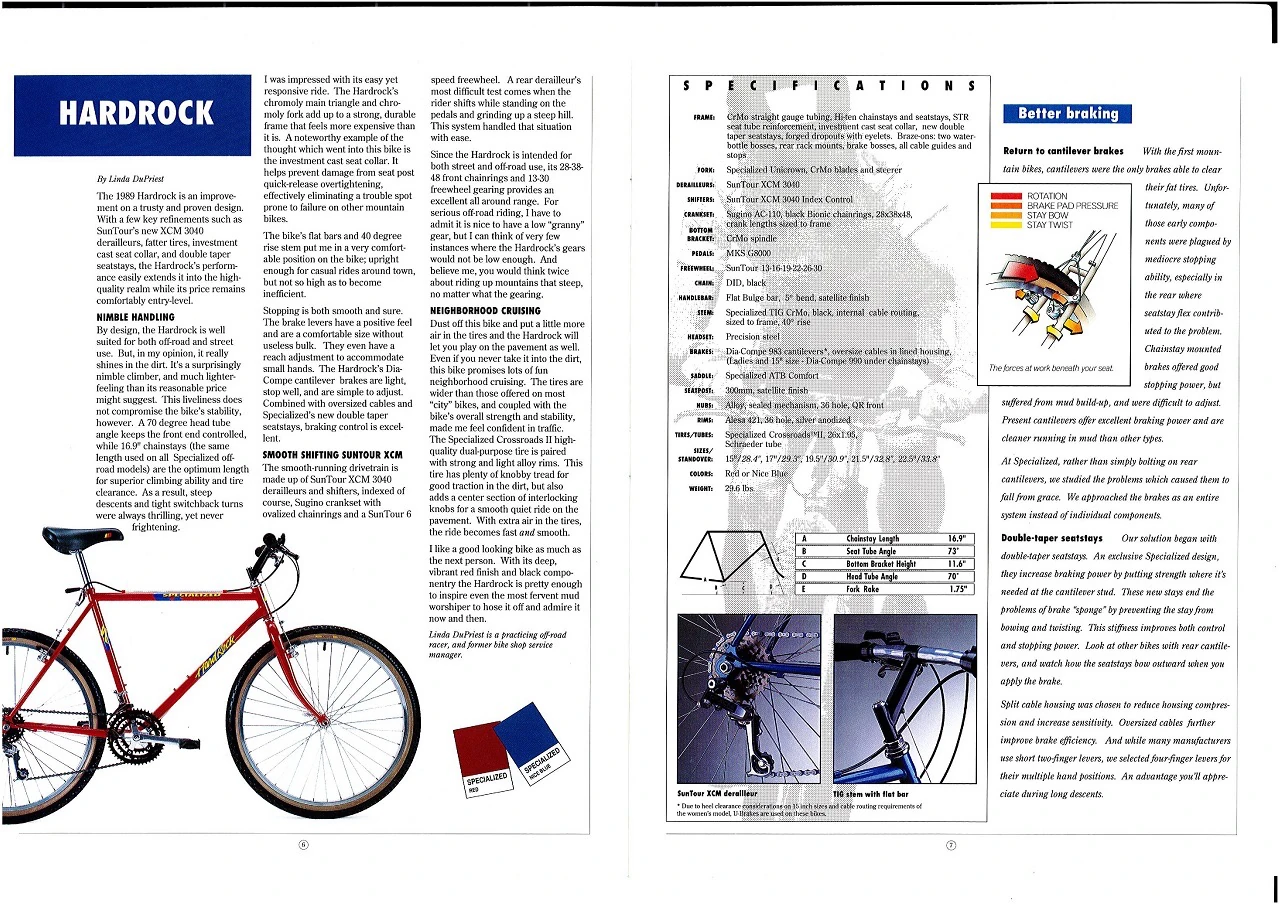
The 1989 Hardrock is an improvement on a trusty and proven design. With a few key refinements such as SunTour’s new XCM 3040 derailleurs, fatter tires, investment cast seat collar, and double taper seatstays, the Hardrock’s performance easily extends it into the high-quality realm while its price remains comfortably entry-level.
NIMBLE HANDLING
By design, the Hardrock is well suited for both off-road and street use. But, in my opinion, it really shines in the dirt. It’s a surprisingly nimble climber, and much lighter-feeling than its reasonable price might suggest. This liveliness does not compromise the bike’s stability, however. A 70 degree head tube angle keeps the front end controlled, while 16.9″ chainstays (the same length used on all Specialized off-road models) are the optimum length for superior climbing ability and tire clearance. As a result, steep descents and tight switchback turns were always thrilling, yet never frightening.
I was impressed with its easy yet responsive ride. The Hardrock’s chromoly main triangle and chromoly fork add up to a strong, durable frame that feels more expensive than it is. A noteworthy example of the thought which went into this bike is the investment cast seat collar. It helps prevent damage from seat post quick-release overtightening, effectively eliminating a trouble spot prone to failure on other mountain bikes.
The bike’s flat bars and 40 degree rise stem put me in a very comfortable position for riding around town, but not so high as to become inefficient.
Stopping is both smooth and sure. The brake levers have a positive feel and are a comfortable size without useless bulk. They even have a reach adjustment to accommodate small hands. The Hardrock’s Dia-Compe cantilever brakes are light, stop well, and are simple to adjust. Combined with oversized cables and Specialized’s new double taper seatstays, braking control is excellent.
SMOOTH SHIFTING SUNTOUR XCM
The smooth-running drivetrain is made up of SunTour XCM 3040 derailleurs and shifters, indexed of course, Sugino crankset with ovalized chainrings and a SunTour 6 speed freewheel. A rear derailleur’s most difficult test comes when the rider shifts while standing on the pedals and grinding up a steep hill. This system handled that situation with ease.
Since the Hardrock is intended for both street and off-road use, its 28-38-48 front chainrings and 13-30 freewheel gearing provides an excellent all around range. For serious off-road riding, I have to admit it is nice to have a low “granny” gear, but I can think of very few instances where the Hardrock’s gears would not be low enough. And believe me, you would think twice about riding up mountains that steep, no matter what the gearing.
NEIGHBORHOOD CRUISING
Dust off this bike and put a little more air in the tires and the Hardrock will let you play on the pavement as well. Even if you never take it into the dirt, this bike promises lots of fun neighborhood cruising. The tires are wider than those offered on most “city” bikes, and coupled with the bike’s overall strength and stability, made me feel confident in traffic. The Specialized Crossroads II high-quality dual-purpose tire is paired with strong and light alloy rims. This tire has plenty of knobby tread for good traction in the dirt, but also adds a center section of interlocking knobs for a smooth quiet ride on the pavement. With extra air in the tires, the ride becomes fast and smooth.
I like a good looking bike as much as the next person. With its deep, vibrant red finish and black componentry the Hardrock is pretty enough to inspire even the most fervent mud worshiper to hose it off and admire it now and then.
Linda DuPriest is a practicing off-road racer, and former bike shop service manager.
SPECIALIZED RED. SPECIALIZED NICE BLUE.
6
SPECIFICATIONS
FRAME: CrMo straight gauge tubing, Hi-ten chainstays and seatstays, STR seat tube reinforcement, investment cast seat collar, new double taper seatstays, forged dropouts with eyelets. Braze-ons: two waterbottle bosses, rear rack mounts, brake bosses, all cable guides and stops
FORK: Specialized Unicrown, CrMo blades and steerer
DERAILLEURS: SunTour XCM 3040
SHIFTERS: SunTour XCM 3040 Index Control
CRANKSET: Sugino AC-110, black Bionic chainrings, 28x38x48, crank lengths sized to frame
BOTTOM BRACKET: CrMo spindle
PEDALS: MKS G8000
FREEWHEEL: SunTour 13-16-19-22-26-30
CHAIN: DID, black
HANDLEBAR: Flat Bulge bar, 5° bend, satellite finish
STEM: Specialized TIG CrMo, black, internal cable routing, sized to frame, 40° rise
HEADSET: Precision steel
BRAKES: Dia-Compe 983 cantilevers*, oversize cables in lined housing, (Ladies and 15″ size – Dia-Compe 990 under chainstays)
SADDLE: Specialized ATB Comfort
SEATPOST: 300mm, satellite finish
HUBS: Alloy, sealed mechanism, 36 hole, QR front
RIMS: Alesa 421, 36 hole, silver anodized
TIRES/TUBES: Specialized Crossroads™II, 26×1.95, Schraeder tube
SIZES/STANDOVER: 15″/28.4″, 17″/29.3″, 19.5″/30.9″, 21.5″/32.8″, 22.5″/33.8″
COLORS: Red or Nice Blue
WEIGHT: 29.6 lbs.
A Chainstay Length 16.9″. B Seat Tube Angle 73°. C Bottom Bracket Height 11.6″. D Head Tube Angle 70°. E Fork Rake 1.75″.
SunTour XCM derailleur. TIG stem with flat bar.
* Due to heel clearance considerations on 15-inch sizes and cable routing requirements of the women’s model, U-Brakes are used on these bikes.
Better braking
Return to cantilever brakes With the first mountain bikes, cantilevers were the only brakes able to clear their fat tires. Unfortunately, many of those early components were plagued by mediocre stopping ability, especially in the rear where seatstay flex contributed to the problem. Chainstay mounted brakes offered good stopping power, but suffered from mud build-up, and were difficult to adjust. Present cantilevers offer excellent braking power and are cleaner running in mud than other types.
At Specialized, rather than simply bolting on rear cantilevers, we studied the problems which caused them to fall from grace. We approached the brakes as an entire system instead of individual components.
Double-taper seatstays Our solution began with double-taper seatstays. An exclusive Specialized design, they increase braking power by putting strength where it’s needed at the cantilever stud. These new stays end the problems of brake “sponge” by preventing the stay from bowing and twisting. This stiffness improves both control and stopping power. Look at other bikes with rear cantilevers, and watch how the seatstays bow outward when you apply the brake.
Split cable housing was chosen to reduce housing compression and increase sensitivity. Oversized cables further improve brake efficiency. And while many manufacturers use short two-finger levers, we selected four-finger levers for their multiple hand positions. An advantage you’ll appreciate during long descents.
ROTATION. BRAKE PAD PRESSURE. STAY BOW. STAY TWIST. The forces at work beneath your seat.
7
[A spread: at left the review in three columns with the red Hardrock in side view and two paint swatches, red and blue; at right the specification box over a faint halftone, a frame diagram with its geometry table, close-ups of the SunTour XCM rear derailleur and the TIG stem, and a feature on rear cantilever brakes with a diagram of the forces on a seatstay.]
— Page 5 —
HARDROCK COMP
By John Schubert
Sometimes, you can have champagne on a beer budget. How? You forego the Waterford crystal and use something less expensive. The champagne tastes just as good. Specialized’s 1989 Hardrock Comp is reminiscent of champagne served in an inexpensive glass. The important stuff is top-quality; the trimmings are cost-effective and get the job done.
FEELS MORE EXPENSIVE THAN IT IS
You could jump on this bike, ride it all day, and conclude that it’s an $800 steed. When Specialized set me loose on on a mountaintop trail overlooking the Pacific, I thought the Hardrock Comp was a more expensive bike. Without benefit of my Cliff Notes to remind me which components appear in which price range, I came back overestimating the price by a hefty three-figure sum.
Why was I fooled? The Hardrock Comp has a great chromoly frame of proven geometry, durable components that work well, and good rims and tires. The stuff that has to be good, is great.
SunTour’s XCE derailleurs, new for 1989, are close cousins of their fabulous shifting XCD 6000, sharing geometry and working parts. Yet they save money in the most sensible way: they have a less costly (but attractive) finish. As the list goes on, so does good value: Dia-Compe cantilever brakes, Specialized saddle, Sanshin sealed hubs… it’s all good stuff. Happens to be not so expensive, that’s all.
Most manufacturers equip mid-priced bikes with dual-purpose street/dirt tires. Specialized gives you a real off-road tire: this model is equipped with 26 x 2.2″ Hardpacks. I give them the nod for rugged use.
GORGEOUS FRAME
Normally when somebody starts talking about function and value, you brace yourself for ugly. Not here. The Hardrock Comp has a gorgeous frame: double taper seatstays, investment cast seat lug collar, clean TIG welds, a beefy new fork design, all the right brazed-on bosses and lustrous paint job. The features make the frame look and function better, and yes, they do compare very favorably with $800 bikes.
One of the best features in my eyes is the investment cast seat lug collar. Mountain bikes get their seat heights changed a lot, and repeated use of the quick release is hard on the slotted portion of the seat tube. (After all, it’s only 1.0 mm thick on most bikes.) The collar means that joint will last forever. Suddenly, the weakest part of the frame becomes the strongest.
DIRECT DRIVE MAGIC
Specialized’s new Direct Drive fork works magic through good-old engineering: make a tube with a bigger diameter and thinner wall, and you add strength and stiffness while reducing weight. The added stiffness makes the fork track an uneven surface more accurately and bounce less. The surprising result: improved comfort.
It was a good thing the bike had that fork, because the trail was riddled with washboard sections. Every descent set the bike vibrating, and I knew a lesser machine would bounce out of control unless I slowed to walking pace. But the Hardrock Comp resolutely stayed controllable at high speed.
Going back up those slopes, where high speed was hardly my problem, I encountered another benefit: the short 16.9″ chainstays enabled me to keep body weight over both wheels, so I had both front wheel weight and rear wheel traction. If you’ve been riding an old ballooner with 18″ chainstays, try one of these: the difference will amaze you.
John Schubert is author of the Ballantine book, Cycling for Fitness and technical editor of BikeReport. He has road tested over 200 bikes in his extensive magazine writing career.
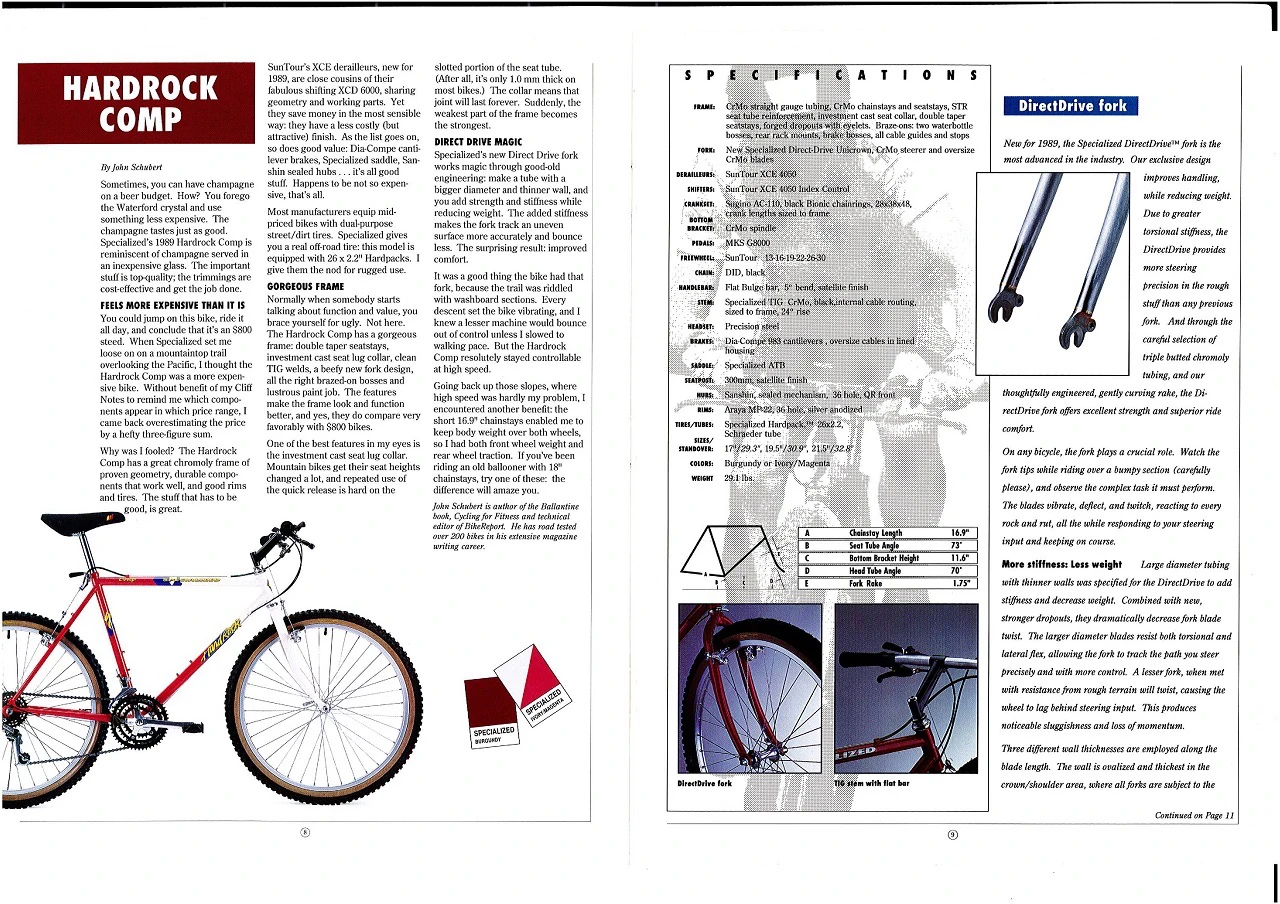
SPECIALIZED BURGUNDY. SPECIALIZED IVORY/MAGENTA.
8
SPECIFICATIONS
FRAME: CrMo straight gauge tubing, CrMo chainstays and seatstays, STR seat tube reinforcement, investment cast seat collar, double taper seatstays, forged dropouts with eyelets. Braze-ons: two waterbottle bosses, rear rack mounts, brake bosses, all cable guides and stops
FORK: New Specialized Direct-Drive Unicrown, CrMo steerer and oversize CrMo blades
DERAILLEURS: SunTour XCE 4050
SHIFTERS: SunTour XCE 4050 Index Control
CRANKSET: Sugino AC-110, black Bionic chainrings, 28x38x48, crank lengths sized to frame
BOTTOM BRACKET: CrMo spindle
PEDALS: MKS G8000
FREEWHEEL: SunTour 13-16-19-22-26-30
CHAIN: DID, black
HANDLEBAR: Flat Bulge bar, 5° bend, satellite finish
STEM: Specialized TIG CrMo, black, internal cable routing, sized to frame, 24° rise
HEADSET: Precision steel
BRAKES: Dia-Compe 983 cantilevers, oversize cables in lined housing
SADDLE: Specialized ATB
SEATPOST: 300mm, satellite finish
HUBS: Sanshin, sealed mechanism, 36 hole, QR front
RIMS: Araya MP-22, 36 hole, silver anodized
TIRES/TUBES: Specialized Hardpack,™ 26×2.2, Schraeder tube
SIZES/STANDOVER: 17″/29.3″, 19.5″/30.9″, 21.5″/32.8″
COLORS: Burgundy or Ivory/Magenta
WEIGHT: 29.1 lbs.
A Chainstay Length 16.9″. B Seat Tube Angle 73°. C Bottom Bracket Height 11.6″. D Head Tube Angle 70°. E Fork Rake 1.75″.
DirectDrive fork. TIG stem with flat bar.
DirectDrive fork
New for 1989, the Specialized DirectDrive™ fork is the most advanced in the industry. Our exclusive design improves handling, while reducing weight. Due to greater torsional stiffness, the DirectDrive provides more steering precision in the rough stuff than any previous fork. And through the careful selection of triple butted chromoly tubing, and our thoughtfully engineered, gently curving rake, the DirectDrive fork offers excellent strength and superior ride comfort.
On any bicycle, the fork plays a crucial role. Watch the fork tips while riding over a bumpy section (carefully please), and observe the complex task it must perform. The blades vibrate, deflect, and twitch, reacting to every rock and rut, all the while responding to your steering input and keeping on course.
More stiffness: Less weight Large diameter tubing with thinner walls was specified for the DirectDrive to add stiffness and decrease weight. Combined with new, stronger dropouts, they dramatically decrease fork blade twist. The larger diameter blades resist both torsional and lateral flex, allowing the fork to track the path you steer precisely and with more control. A lesser fork, when met with resistance from rough terrain will twist, causing the wheel to lag behind steering input. This produces noticeable sluggishness and loss of momentum.
Three different wall thicknesses are employed along the blade length. The wall is ovalized and thickest in the crown/shoulder area, where all forks are subject to the
Continued on Page 11
9
[A spread: at left the review in three columns with the red and white Hardrock Comp in side view and burgundy and ivory-magenta paint swatches; at right the specification box over a faint halftone, a frame diagram with its geometry table, close-ups of the DirectDrive fork and the TIG stem, and the start of a feature on the DirectDrive fork with a photograph of the bare fork.]
— Page 6 —
ROCKHOPPER
Also by John Schubert
It’s time to wring out the 1989 Rockhopper, and the right way to do it is to hold a weekend mountain bike retreat. All the elements fall into place: a handy vacation cottage next to hundreds of miles of game and logging roads, autumn foliage, a bright and sunny day, four willing companions, and the end of deer season.
My companions are formidable athletes; one guy picked up a bronze medal in the road nationals this year, and the others race and train with similar dedication.
A FIVE MILE CLIMB
Right out the door we face a five-mile climb (no, not a misprint, but I sure wished it had been) that probably averaged ten percent steepness. As its pitch varies, from switchback to level spot and back again, I make my first observation about the Rockhopper: Shimano’s seven-speed HyperGlide indexing really works. The clicks are so quiet and gentle on the thumb that I barely notice them, but I get a perfect shift every time.
At the top, our host announces a geographic peculiarity: it’s at the higher elevations where the trail gets muddy. And it does: ankle deep mud, cut into tire-swallowing ruts by an occasional logging truck. The mud poses major challenges to the bikes’ handling and to the HyperGlide index setup. The trail now bobs and weaves with frequent short climbs and descents, and the going is slow. Picking a line through the muddy ruts is an exacting task for a now-slightly-tired rider, and if the bike makes the task tougher, there’ll be hell to pay.
The Rockhopper comes through. Its semi-steep 70.5-degree head angle and sure tracking Direct Drive fork make the job effortless. It doesn’t want to oversteer on me, and it doesn’t require me to muscle it to keep it on course. Where I want to go, I go.
CORDUROY ROAD
That is, until our leader takes us down the Berwick Turnpike, an ancient logging road made of logs. They call it a corduroy road, and it’s a quaint description indeed. Your tires v-v-vib-r-r-rate over the rain-slickened logs, and sometimes they just insist on sliding sideways. No head tube angle can change that. This obstacle is the ride leader’s fault.
More mud appears, and with it, a stream crossing every mile or so. We need the stream crossings to wash the mud off our chains. Still, HyperGlide indexing works! I was sure it would quit by now, but darned if it doesn’t click into place with great reliability.
Streams mean ponds, and our leader even stops to let us admire the prettiest one. It covers several dozen acres, and has beautiful shores where the hearty can pitch a tent. The only way to get to these beautiful vistas is by mountain bike.
It’s almost 3 p.m. and everyone’s tired. It took three hours to get there; how can our now-tired group return in two? Ride Leader redeems himself with a brilliant short cut. No corduroy Berwick Turnpike, no unnecessary climbing, few technical difficulties, and a five-mile descent welcoming us back home before dusk, with 38 honest miles logged that day.
ROCKHOPPER TAKE ME HOME
If I were going to have a mishap, it would be on that last descent. I’m tired, I’m cold, and the temptation is to go too fast to get home sooner. But the Rockhopper helps me stay upright. The steering geometry is kind, tracking over rocks at high speed with no misleading feedback or invitations to overcorrect, and Shimano’s Mountain LX SLR brakes are especially welcome as they require less effort from, and give more control to, my semi-numb hands. The return ride is without incident.
The Rockhopper, brand new a few hours ago, is a battle-scarred veteran. It’ll take a little clean-up and loving care to restore it to like-new condition, but that’s okay. This is one bike that’s well worth the effort.
John Schubert is author of the Ballantine book, Cycling for Fitness and technical editor of BikeReport. He has road tested over 200 bikes in his extensive magazine writing career.
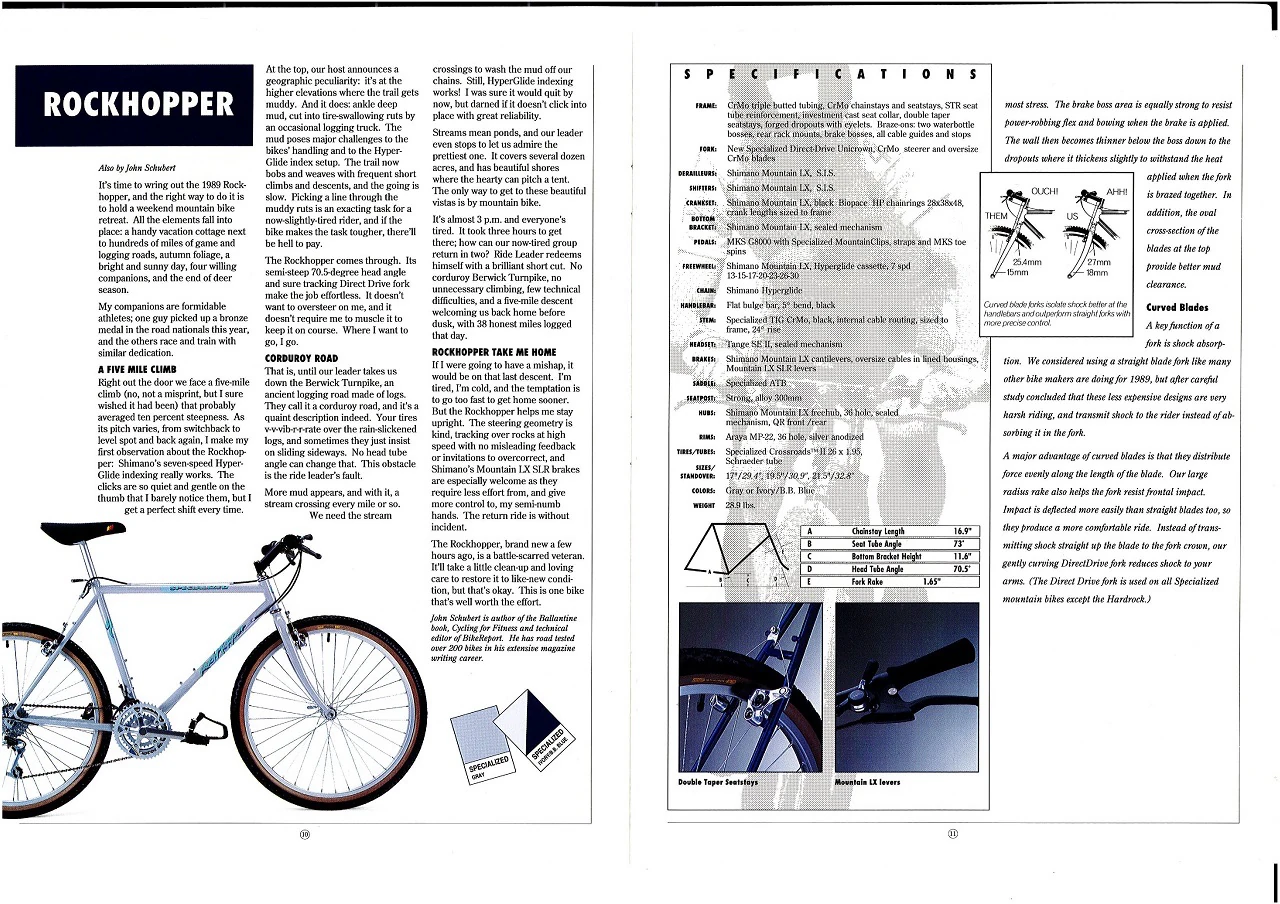
SPECIALIZED GRAY. SPECIALIZED IVORY/B.B. BLUE.
10
SPECIFICATIONS
FRAME: CrMo triple butted tubing, CrMo chainstays and seatstays, STR seat tube reinforcement, investment cast seat collar, double taper seatstays, forged dropouts with eyelets. Braze-ons: two waterbottle bosses, rear rack mounts, brake bosses, all cable guides and stops
FORK: New Specialized Direct-Drive Unicrown, CrMo steerer and oversize CrMo blades
DERAILLEURS: Shimano Mountain LX, S.I.S.
SHIFTERS: Shimano Mountain LX, S.I.S.
CRANKSET: Shimano Mountain LX, black Biopace HP chainrings 28x38x48, crank lengths sized to frame
BOTTOM BRACKET: Shimano Mountain LX, sealed mechanism
PEDALS: MKS G8000 with Specialized MountainClips, straps and MKS toe spins
FREEWHEEL: Shimano Mountain LX, Hyperglide cassette, 7 spd 13-15-17-20-23-26-30
CHAIN: Shimano Hyperglide
HANDLEBAR: Flat bulge bar, 5° bend, black
STEM: Specialized TIG CrMo, black, internal cable routing, sized to frame, 24° rise
HEADSET: Tange SE II, sealed mechanism
BRAKES: Shimano Mountain LX cantilevers, oversize cables in lined housings, Mountain LX SLR levers
SADDLE: Specialized ATB
SEATPOST: Strong, alloy 300mm
HUBS: Shimano Mountain LX freehub, 36 hole, sealed mechanism, QR front/rear
RIMS: Araya MP-22, 36 hole, silver anodized
TIRES/TUBES: Specialized Crossroads™II 26 x 1.95, Schraeder tube
SIZES/STANDOVER: 17″/29.4″, 19.5″/30.9″, 21.5″/32.8″
COLORS: Gray or Ivory/B.B. Blue
WEIGHT: 28.9 lbs.
A Chainstay Length 16.9″. B Seat Tube Angle 73°. C Bottom Bracket Height 11.6″. D Head Tube Angle 70.5°. E Fork Rake 1.65″.
Double Taper Seatstays. Mountain LX levers.
[The DirectDrive feature continues:] most stress. The brake boss area is equally strong to resist power-robbing flex and bowing when the brake is applied. The wall then becomes thinner below the boss down to the dropouts where it thickens slightly to withstand the heat applied when the fork is brazed together. In addition, the oval cross-section of the blades at the top provide better mud clearance.
Curved Blades A key function of a fork is shock absorption. We considered using a straight blade fork like many other bike makers are doing for 1989, but after careful study concluded that these less expensive designs are very harsh riding, and transmit shock to the rider instead of absorbing it in the fork.
A major advantage of curved blades is that they distribute force evenly along the length of the blade. Our large radius rake also helps the fork resist frontal impact. Impact is deflected more easily than straight blades too, so they produce a more comfortable ride. Instead of transmitting shock straight up the blade to the fork crown, our gently curving DirectDrive fork reduces shock to your arms. (The Direct Drive fork is used on all Specialized mountain bikes except the Hardrock.)
OUCH! THEM. AHH! US. 25.4mm, 15mm. 27mm, 18mm. Curved blade forks isolate shock better at the handlebars and outperform straight forks with more precise control.
11
[A spread: at left the review in three columns with the gray Rockhopper in side view and gray and ivory-blue paint swatches; at right the specification box, a frame diagram with its geometry table, close-ups of the double taper seatstays and the Mountain LX levers, and the rest of the DirectDrive feature with a drawing comparing a straight-bladed fork (“Them”) with the curved DirectDrive (“Us”).]
— Page 7 —
ROCKHOPPER COMP
By Tom Hillard
In my line of work in Off-Road Technical Support for Specialized, I’ve seen just about every mountain bike there ever was. And after logging some heavy mileage on a 1989 Rockhopper Comp, I feel this bike is a standout. It’s reasonably priced, well equipped for competition, and yet includes many amenities that make it an excellent choice for the weekend rider/racer. The bike has proven it holds up to the demands of competition too. We used Rockhopper Comps during races as Tech Support loaner bikes all last season without a single mishap.
DROP-OFFS AND DOWNHILLS
I habitually ride down steep drop-offs. More likely than not, there is a nasty turn at the bottom. Having the Specialized Direct Drive fork to control the front wheel is a real relief. With most forks, as you hit bottom with your weight forward, you feel the wheel twisting out of line. With the Direct Drive fork, you feel in control.
All the top racers raid the Tech Support van for Specialized Hardpack 2.2 tires when the race course includes fast bumpy downhills. It’s a fat, cushy tire, and mounted on the Rockhopper Comp’s lightweight 32 spoke X-26 rims, produces a shock absorbing, yet quick ride that can cope with even the worst rock strewn trail.
DO WE NEED SEVEN SPEEDS?
Coming from the old school, I believe mountain bikes should be simple. At first, I thought the ’89 Comp’s seven speed rear cluster was unnecessary. But after riding Shimano’s new HyperGlide system on flat ground at speed, I found a real advantage with the closer ratios seven speeds provide. You can fine tune your spin much better with the additional gears.
Years ago when mountain bikes first appeared, cantilever brakes gave the best all around stopping performance in all conditions. I’m glad to see they’re back on both wheels. Today’s new designs stop better and feel more controllable. Here on the Rockhopper Comp, Shimano’s smooth spring assisted SLR system really has a better feel.
MKS toe spins make getting into the Specialized MountainClips a breeze – no more looking down. While riders all around you are struggling to get back into their pedals, you poke both feet into yours and take off like a pro.
The Specialized ATB saddle is the most comfortable I’ve ever ridden – no soreness after thirty miles. Plenty of racers have agreed with this opinion after a few rocky laps. Coupled with the flat team handlebars with their five degree bend, this set-up is the best combination I know of for comfort and performance.
COMPETITION ENGINEERING
The Rockhopper Comp is equipped with added features, the least of which is Specialized’s many years of engineering and experience. These advantages include: A triple-butted chromoly frame with double taper seatstays to improve cantilever brake performance. An investment cast seat collar to increase durability at this high stress area. The DirectDrive fork to provide more control. And the time tested Specialized off-road geometry.
Overall, the Rock Comp’s “feel” is similar to more expensive bikes. The key difference is that the Rockhopper Comp is a bike that you can buy for a relatively modest investment, add a pump, waterbottle, and NORBA license, and be competitive at any race.
Tom Hillard is Promotion Event Coordinator and directs Specialized’s Off-Road Technical Support Program. As far as mountain bikes go, if it’s ever happened, Hillard has seen it. He also claims to have been before his time; riding his first mountain bike in 1961.
SPECIALIZED YELLOW. SPECIALIZED IVORY/SAFETY BLUE.
12
SPECIFICATIONS
FRAME: CrMo triple butted tubing, CrMo chainstays and seatstays, STR seat tube reinforcement, investment cast seat collar, double taper seatstays, forged dropouts with eyelets. Braze-ons: two waterbottle bosses, rear rack mounts, brake bosses, all cable guides and stops
FORK: New Specialized Direct-Drive Unicrown, CrMo steerer and oversize CrMo blades
DERAILLEURS: Shimano Deore II, S.I.S.
SHIFTERS: Shimano Deore II, S.I.S.
CRANKSET: Shimano Deore II, Biopace HP chainrings 28x38x48, crank lengths sized to frame
BOTTOM BRACKET: Shimano Deore II, sealed mechanism
PEDALS: MKS G8000 with Specialized MountainClips, straps and MKS toe spins
FREEWHEEL: Shimano Deore II, Hyperglide cassette, 7 spd 13-15-17-20-23-26-30
CHAIN: Shimano Hyperglide
HANDLEBAR: Specialized Team Bar, 5° bend, black anodized
STEM: Specialized TIG CroMo, black, internal cable routing, sized to frame, 24° rise
HEADSET: Tange SE II, sealed mechanism
BRAKES: Shimano Deore II cantilevers*, oversize cables in lined housings, Deore II SLR 4 finger levers
SADDLE: Specialized ATB
SEATPOST: Strong, alloy 300mm
HUBS: Shimano Deore II freehub, 32 hole, QR front/rear
RIMS: Specialized GX-26, gray anodized, 32 hole, Wheelsmith 14g stainless spokes
TIRES/TUBES: Specialized Hardpack,™ 26 x 2.2, Schraeder tube
SIZES/STANDOVER: 15″/28.4″, 17″/29.4″, 19.5″/30.9″, 21.5″/32.8″
COLORS: Yellow, or Ivory/Safety Blue
WEIGHT: 28.7 lbs.
A Chainstay Length 16.9″. B Seat Tube Angle 73°. C Bottom Bracket Height 11.6″. D Head Tube Angle 70.5°. E Fork Rake 1.65″.
Deore II Biopace crank. Team bar and TIG stem.
* Due to heel clearance considerations on 15-inch sizes and cable routing requirements of the women’s model, U-Brakes are used on these bikes.
Off-road geometry 101
Years of experience lead us to our dialed-in 1989 mountain bike geometry. Specialized designs each model for controllable high performance. For example, the Hardrock and Hardrock Comp use a head tube angle of 70 degrees, while the Rockhopper through Stumpjumper Comp use a slightly steeper (i.e. quicker) 70.5 degree angle. The race bred Stumpjumper Epic and Team use a 71 degree angle for absolute precision in the most demanding conditions. These head angles combined with a fork rake of 1.65″ result in steering control that satisfies the enthusiast, yet can be mastered by the novice.
All Specialized off-road bikes share a 73 degree seat angle. This positions the rider’s knees exactly over the pedals for maximum pedaling and climbing efficiency. Slacker seat tube angles can cause the front wheel to come off the ground when climbing, loosing traction and control.
Short, but not too short 16.9″ chainstays provide superior climbing traction and avoid the skittish handling traits and tire clearance problems of bikes with shorter chainstays. And our 11.6″ bottom bracket height was chosen to clear obstacles, while maintaining a low center of gravity for maximum stability.
Moderately long top tubes provide better balance and weight distribution. This is another subtle detail learned from years of experience: a too short top tube can cause squirrely handling, and place you in a hunched over position that can actually hinder your breathing ability. A Specialized bike will put you in the best position for both comfort and efficiency.
13
[A spread: at left the review in three columns with the yellow Rockhopper Comp in side view and yellow and ivory-blue paint swatches; at right the specification box, a frame diagram with its geometry table, close-ups of the Deore II Biopace crankset and the team bar and stem, and a feature on off-road geometry with a photograph of a rider in a red helmet on a mountain bike.]
— Page 8 —
STUMPJUMPER
By Ned Overend
My experience from six seasons of off-road racing has left me with a keen sense of what feels right. It’s a hard to describe quality, but you know it immediately when you get on a bike that has it.
The first Stumpjumper I rode was one of the original models from 1981. Those bikes (with slack 67 degree head angles and long 18.5 inch chainstays and stretch wheelbases) were noted for their terrific descending ability. That design is a bit long of tooth by today’s standards. It was good in its time, but mountain bike technology has advanced tremendously since the early 80s.
IT’S FASTER
When I took the ’89 Stumpjumper out for an initial get-to-know-it test ride, I was shocked. The ’89 actually downhills faster than the older Stumps. I couldn’t turn those old bikes fast enough, but the new one responds immediately when I want it to.
Analyzing why, I think the slightly longer top tube and not-too-long, not-too-short wheelbase are the reasons. For example, a laid-back, real long bike is sluggish. And one with a short wheelbase, steep angles, and short top tube makes for a squirrely ride, which is no good for fast, high speed riding. The new Stumpjumper’s slightly long wheelbase and front center combine to produce a bike with better balance, hence better handling that lets you go faster.
STABILITY MAKES THE DIFFERENCE
The most noticeable attribute is the 1989 bike’s stability in rough, high-speed situations. The combination of the 11.6 inch bottom bracket height with the new, low profile Deore Comp pedals create a very low center of gravity. This coupled with a 42 inch wheelbase enables the front wheel to float over rocks and ruts without pitching your weight forward.
Specialized chainstays have evolved to a reasonable length. Over the past few years, chainstays have gotten shorter and shorter. And many bike makers have gone too far in the short direction. If they are too short, they position too much weight underneath you, and the bike becomes very skittish. The Stumpjumper’s chainstays are the ideal length for both mud clearance and handling stability. And the Ground Control tires are the same ones I use on the NORBA circuit.
TECHNICAL TRACKING
The bike is comfortable on steep downhills and rough, tricky sections because you don’t have to be constantly hanging off the back of the seat to keep the front wheel light. When I tackled some technical granny gear climbs, the Stumpjumper conquered the steep hills as I expected. The overall layout of angles, wheelbase and chainstay length are nearly identical to my team bike. The 70.5 degree head tube angle let the bike steer quickly enough to wind my way through obstacles while still maintaining in-the-saddle traction.
The new Direct Drive fork provides a noticeably more comfortable ride than other forks. Its oversize tubing reduces lateral fork flex, which helps prevent front end drift when cornering at high speeds.
Lighter wheels make riding more fun – you go faster without working harder. The 32 hole GX-23 rims give the bike more “snap” when you accelerate.
When you add it all up, the latest Stumpjumper has a great design for racing with confidence and stability or just torquing through technical trail sections for fun.
Ned Overend, Captain of Specialized’s Team Stumpjumper Off-Road Racing Team holds the titles of 1988 NORBA World Champion, 1987 NORBA World Champion, 1987 NORBA National Champion and 1986 NORBA National Champion, in addition to other honors too numerous to list.
SPECIALIZED MAGENTA/GREEN. SPECIALIZED IVORY/BURGUNDY.
14
SPECIFICATIONS
FRAME: CrMo triple butted tubing, CrMo chainstays and seatstays, STR seat tube reinforcement, investment cast seat collar, double taper seatstays, forged dropouts with eyelets. Braze-ons: two waterbottle mounts, brake bosses, all cable guides and stops
FORK: New Specialized Direct-Drive Unicrown, CrMo steerer and oversize CrMo blades
DERAILLEURS: Shimano Deore II, S.I.S.
SHIFTERS: Shimano Deore II, S.I.S.
CRANKSET: Shimano Deore II Biopace HP chainrings, 28x38x48, crank lengths sized to frame
BOTTOM BRACKET: Shimano Deore II, sealed mechanism
PEDALS: Shimano Deore II with Specialized MountainClips and straps
FREEWHEEL: Shimano Deore II HyperGlide cassette, 7 spd. 13-15-17-20-23-26-30
CHAIN: Shimano HyperGlide
HANDLEBAR: Specialized Team Bar, 5° bend, black anodized
STEM: Specialized TIG CrMo, black, internal cable routing, sized to frame, 24° rise
HEADSET: Specialized SV-2 compact, sealed mechanism
BRAKES: Shimano Deore II cantilevers, oversize cables in lined housing, Deore II SLR 4 finger levers
SADDLE: Selle Italia Turbo, black leather
SEATPOST: Strong, alloy 300mm
HUBS: Shimano Deore II freehub, 32 hole, QR front/rear
RIMS: Specialized GX-23, gray anodized, 32 hole, Wheelsmith 14g stainless spokes
TIRES/TUBES: Specialized Ground Control™, 26 x1.95, Schraeder tube
SIZES/STANDOVER: 17″/29.4″, 19.5″/30.9″, 20.5″/31.9″, 21.5″/32.8″, 22.5″/33.8″
COLORS: Magenta/Green or Ivory/Burgundy
WEIGHT: 27.9 lbs.
A Chainstay Length 16.9″. B Seat Tube Angle 73°. C Bottom Bracket Height 11.6″. D Head Tube Angle 70.5°. E Fork Rake 1.65″.
Deore II Biopace crank. Investment cast seat collar.
Less is more
More performance that is. A case in point, the 32 spoke wheels used on our Rockhopper Comp through Stumpjumper Team save over an ounce (31 grams) per wheel when compared to 36 spoke wheels. Reducing frame weight by an ounce would be unnoticable, but in terms of rotating mass, weight is very significant, and an extra ounce feels more like a half pound when you’re moving. Having fewer spokes also spares the wheel unnecessary abuse. We’ve found 32 to be the winning number. A wheel with 32 spokes can flex and give slightly on the rough stuff. One with additional spokes is more likely to have its spokes broken by the shock, while one with fewer spokes will be too weak to begin with.
Our carefully engineered 465 gram GX-26 and 440 gram GX-23 rims allow us to build extremely strong wheels with 32 spokes. In fact, the Specialized GX-23 rims built with 32 spokes, and laced 3x used on the 1989 Stumpjumper, Stumpjumper Comp, Stumpjumper Team, and RockCombo are as light as 36 spoke wheel laced 3x with popular cut down road rims. Until now this has been an unheard of weight on a production mountain bike. (32 Spoke wheels appear on Specialized mountain bikes beginning with the Rockhopper Comp, and are used on all road models.)
15
[A spread: at left the review in three columns with the magenta and green Stumpjumper in side view and magenta-green and ivory-burgundy paint swatches; at right the specification box, a frame diagram with its geometry table, close-ups of the Deore II crankset and the cast seat collar, and a feature on 32-spoke wheels with a close-up of a GX rim and tire.]
— Page 9 —
STUMPJUMPER COMP
By Cindy Whitehead
It’s always fun to get a new bike, and the day the new 1989 Specialized Stumpjumper Comp arrived at my house was no different. I knew I’d be getting a bike to test ride and evaluate, but I had no idea what to expect. To say the least, I was not disappointed. The Stumpjumper Comp is a gorgeous, racy black bicycle accented with purple and yellow decals. I was soon to find out that the Stumpjumper Comp has more to offer than good looks.
PALM SPRINGS TRAINING
First I took it off-road up in the mountains above Palm Springs. This route is one of my favorite training rides because it is all singletrack and is very technical with lots of little climbs, descents, obstacles and switchbacks. This is where the Specialized Stumpjumper Comp shined. The combination of the 70.5 degree head angle and the proper 1.65 inch fork rake make this bike respond well in the turns, on climbs and during descents. With a top tube a little longer than normal for better balance and weight distribution, and a 73 degree seat angle to position you for the most efficient pedalling, the ’89 Comp makes all the right moves.
Since this particular trail is full of extremely sudden changes from descents to climbs, I was all the more critical of the responsiveness of the componentry, especially the derailleurs and brakes. Both passed with flying colors. Specialized’s choice of componentry is excellent. The Deore XT HyperGlide system just ticks into gear without hangup, while the SLR cantilevers can be easily feathered to control speed. I like the four finger brake levers too. On long rides, they provide more hand positions and more leverage than the short levers.
GEARING A ROADIE CAN LOVE
Even better, with the Comp’s 21 speeds, there are more precise gear intervals that should satisfy even the most perfection demanding athletes – road racers for example. Roadies (Yes, I admit, I’ve been one) like close gearing, because it accommodates their legs to even the slightest changes in the terrain. Whether you choose to ride the Stumpjumper Comp off-road or “off-dirt,” you can enjoy crisp acceleration thanks to the component selection on this bike.
Another likable feature is the double-butted Tange chromoly frame. It’s stiff and it accelerates well. And although the frame is stiff, it is not so rigid that it would spoil a good downhill. Combined with the oversized Direct Drive fork, this frame produces some of the most accurate tracking I’ve experienced. The terrain on my route is rough, but the Stump Comp took me through it in complete control.
A GOOD FRIEND
I continued to ride this and other trails, and on pavement. Like a good friend, my first impressions were favorable, but the more familiar I became with the Comp the more I grew to really like it. I was able to take it anywhere comfortably and controllably. I’d say Specialized has a winner in the 1989 Stumpjumper Comp with an outstanding combination of great performance and good looks.
Cindy Whitehead, a member of Specialized’s 1988 Team Stumpjumper Off-Road Racing Team, is the world’s fastest woman. Among her numerous victories, Cindy holds the titles of 1988 NORBA Woman’s World Downhill Champion, and 1986 Woman’s NORBA National Champion.
SPECIALIZED WHITE. SPECIALIZED BLACK.
16
SPECIFICATIONS
FRAME: Tange CrMo double butted tubing, CrMo chainstays and seatstays, STR seat tube reinforcement, double taper seatstays, vertical forged dropouts with eyelets. Braze-ons: two waterbottle mounts, brake bosses, all cable guides and stops
FORK: New Specialized Direct-Drive Unicrown or Tange O/S, CrMo steerer and oversize CrMo blades
DERAILLEURS: Shimano Deore-XT II, S.I.S.
SHIFTERS: Shimano Deore-XT II, S.I.S.
CRANKSET: Shimano Deore-XT II Biopace HP chainrings, 28x38x48, crank lengths sized to frame
BOTTOM BRACKET: Shimano Deore-XT II, sealed mechanism
PEDALS: Shimano Deore-XT II Comp, Specialized MountainClips and straps
FREEWHEEL: Shimano Deore-XT II HyperGlide cassette, 7 spd. 13-15-17-20-23-26-30
CHAIN: Shimano Deore XT II HyperGlide
HANDLEBAR: Specialized Team Bar, 5° bend, black anodized
STEM: Specialized TIG CrMo, black, internal cable routing, sized to frame, 10° rise
HEADSET: Specialized SV-2, compact, sealed mechanism
BRAKES: Shimano Deore-XT II cantilevers, oversize cables in lined housing, Deore-XT II SLR 4 finger levers
SADDLE: Selle Italia Turbo, black leather
SEATPOST: Strong, alloy 300mm
HUBS: Shimano Deore-XT II freehub, 32 hole, QR front/rear
RIMS: Specialized GX-23, gray anodized, 32 hole, Wheelsmith 14g stainless spokes
TIRES/TUBES: Specialized Ground Control™, 26 x 1.95, Schraeder tube
SIZES/STANDOVER: 17″/29.4″, 19.5″/30.9″, 20.5″/31.9″, 21.5″/32.8″, 22.5″/33.8″
COLORS: Black with Purple Pearl or White with Gold Pearl
WEIGHT: 27.7 lbs.
A Chainstay Length 16.9″. B Seat Tube Angle 73°. C Bottom Bracket Height 11.6″. D Head Tube Angle 70.5°. E Fork Rake 1.65″.
Deore XT II HyperGlide. Deore XT II cantilevers.
The new vernacular
If you haven’t bought a bike in a few years, the first thing you’ll notice is all the new vocabulary. Unfamiliar words and acronyms like AccuShift, Biopace, HyperGlide, SIS, SLR abound. Here’s a round-up of these new terms and the performance advantages they provide for both road and off-road bikes.
Index Shifting Shimano calls it SIS, SunTour’s name is AccuShift. The result is the same. For each click on the shift lever, the bike shifts one (and only one) gear. There’s no fumbling; it’s simple and precise.
The lever moves the derailleur precisely the same distance as there is between each freewheel cog, so there is no “fine tuning” of the lever needed as with conventional systems. Index shifting also helps eliminate mis-shifts, even when you’re climbing in high torque pedaling situations.
Hyperglide Shimano’s HyperGlide gears improve shifting performance. When shifting to a lower gear (larger sprocket) on a conventional cog, the chain rides on top of the teeth before fully seating. This “over-ride” causes a slight hesitation, and in some cases produces chain slippage.
Shifting is faster, quieter, and smoother. HyperGlide cogs incorporate what Shimano calls “release teeth.” Formed with a thinner cross section than the other teeth on the cog, they determine exactly what point the chain will begin to shift from the smaller cog to the next larger one. Pick-up teeth on the next largest cog smoothly complete the shift by pulling the chain up and moving it without over-ride, even under high pedaling forces.
Continued on Page 19
17
[A spread: at left the review in three columns with the black Stumpjumper Comp with purple and yellow decals in side view and white and black paint swatches; at right the specification box, a frame diagram with its geometry table, close-ups of the HyperGlide cassette and a Deore XT II cantilever, and a glossary feature with a close-up of a thumb shifter.]
— Page 10 —
STUMPJUMPER TEAM
By Gavin Chilcott
My foremost thought while riding the 1989 Team Stumpjumper is that mountain bikes have come a long way. When I first started riding these things about 15 years ago, we weren’t too sure just what they ought to do. We rode cruisers with 66 degree angles and wondered why they were so hard to turn at less than 50mph. Those “mountain bikes” were little more than jazzed up versions of the same old paper route bikes that our fathers rode.
OFF-ROAD EVOLUTION
When the off-road craze took off and refinement of frame geometries began evolving, the whole emphasis changed. Specialized signed on a few of us riders years ago in 1985 as the first Team Stumpjumper with hopes that our road racing and cyclocross experience would make us good testers for their designs.
At the time, we insisted upon the geometry of a road bike with fat tires. They gave it to us, but it wasn’t a configuration much closer to optimum than pop’s paper route bike. But what came out of all that was a synthesis of ideas that resulted in a whole new breed — the competition all terrain bike. It had a character all its own and was no longer a modified cruiser or racing bike. Mountain bikes had finally come into their own.
THE NEW TEAM
These thoughts were fresh in my mind as I put the new Team Stumpjumper through its paces. This version has all the qualities we always looked for in a mountain bike, but couldn’t find during the period of experimentation that went on in the early 80s. The new Team Stump is a pure pleasure to ride, obviously a result of years of refinement. It doesn’t compromise anywhere. The handling is well mannered at breakneck speeds on wide open downhills, but also nimble on the single tracks. I put this bike through a good test, too: on the sand, the smooth, the bumps, the rocks and the hope-I-don’t-endo steep downhills. The Team was satisfying in every situation.
Climbing was the same story. The bike is very lightweight, and feels it on the climbs. I was surprised at how the new Prestige tubing feels. I am a hard-core fan of the lively carbon-fiber feel, and the Team feels very “alive” too.
Weight distribution and steering geometry have a lot to do with how a bike rides, and the Team has got what it takes. The chainstays are short, balancing weight over both wheels for non-slip climbing, but not so short as to cause tire clearance problems. And the steering with its 1.65″ fork rake and 71 degree head angle is perfect for an aggressive riding style.
FANTASTIC PACKAGE
Shimano’s latest edition of Deore XT-II is truly fantastic. The light action of the brakes is a welcome favor for tired hands, and the firm control of the cantilevers is without compromise. As an advocate of cantilever brakes for reasons of weight and mud clearance, I was happy to see them on the seat stays.
Under load or in the bumps, no matter how I tried, I could not get this bike to mis-shift a single time. This new componentry is finally the solution to the problem of frustrating shifting that has plagued dirt riding since we gave up one-speeds.
The 1989 Team Stumpjumper is a great package. It is race ready right out of the box, but at the same time, so well thought out that any rider would be satisfied with every aspect of its performance. It handles beautifully, climbs efficiently and takes the frustration out of braking and shifting. Here is enough bike for any racing need, but well-mannered enough for anyone to enjoy. I won’t be giving this one back without a fight.
Gavin Chilcott, a member of the original 1985 Team Stumpjumper, still rides professionally. During the past 8 years he has ridden for the 7-Eleven Cycling Team, U.S. Pro Championship teams, and in many Coors Classic races.
SPECIALIZED IVORY/MAGENTA. SPECIALIZED IVORY/GRAY.
18
SPECIFICATIONS
FRAME: Tange Prestige main tubes, CrMo chainstays and seatstays, STR seat tube reinforcement, double taper seatstays, forged dropouts. Braze-ons: two waterbottle mounts, brake bosses, all cable guides and stops
FORK: New Specialized Direct-Drive Unicrown or Tange O/S, CrMo steerer and oversize CrMo blades
DERAILLEURS: Shimano Deore-XT II, S.I.S.
SHIFTERS: Shimano Deore-XT II, S.I.S.
CRANKSET: Shimano Deore-XT II Biopace HP chainrings, 28x38x48, crank lengths sized to frame
BOTTOM BRACKET: Shimano Deore-XT II, sealed mechanism
PEDALS: Shimano Deore-XT II Comp, Specialized MountainClips and straps
FREEWHEEL: Shimano Deore-XT II HyperGlide cassette 7 spd. 12-14-16-18-21-24-28
CHAIN: Shimano Deore-XT II HyperGlide
HANDLEBAR: Specialized Team Bar, 5° bend, black anodized
STEM: Specialized TIG CrMo, black, internal cable routing, sized to frame, 10° rise
HEADSET: Specialized SV-2, compact, sealed mechanism
BRAKES: Shimano Deore-XT II cantilevers, oversize cables in lined housing, Deore-XT II SLR 4 finger levers
SADDLE: Selle Italia Turbo, black leather
SEATPOST: Strong, alloy 300mm
HUBS: Shimano Deore-XT II freehub, 32 hole, QR front/rear
RIMS: Specialized GX-23, gray anodized, 32 hole, Wheelsmith 14g stainless spokes
TIRES/TUBES: Specialized Ground Control™ 26 x 1.95, Schraeder tube
SIZES/STANDOVER: 17″/29.4″, 19.5″/30.9″, 20.5″/31.9″, 21.5″/32.8″, 22.5″/33.8″
COLORS: Ivory/Mike’s Magenta or Ivory/Gray with Pearl
WEIGHT: 26.5 lbs.
A Chainstay Length 16.9″. B Seat Tube Angle 73°. C Bottom Bracket Height 11.6″. D Head Tube Angle 71°. E Fork Rake 1.65″.
Deore XT II Biopace HP crank. STR seat tube reinforcement.
Biopace for a faster pace Computer designed Biopace HP chainrings help you ride farther with less fatigue and more comfort. As the crank enters its downward power stroke, Biopace effectively decreases the chainwheel radius. This increases the crank’s rotational speed, allowing your leg to push faster, much as it does when running. During the transition at the bottom of the power stroke to the upward return stroke, the effective chainwheel radius increases. This helps your leg make use of momentum gained on the power stroke. As a result, crank speed is more closely matched to natural leg movement as it rotates. This smooths out the transition between muscle groups and creates a more efficient pedaling motion.
Better braking SLR and BRS Shimano’s SLR (Shimano Linear Response) and SunTour’s BRS (Balanced Response System) offer significant improvement over conventional brakes. By reducing friction in the brake lever, cable and caliper, these new designs give you more efficient, controllable braking.
To help you stop more surely, all elements in the system are integrated to work with each other. Caliper arms are constructed with high tolerance parts, and incorporate a small return spring to lighten the effort. Cable housings are lined with low friction material for smooth cable travel without binding. And brake levers also use a return spring to balance the system.
The brakes work crisply with a light, sure feel. Your hands and forearms are less fatigued on long descents. So you are confident you are in control whether slowing on a steep downhill, or stopping in the wet.
19
[A spread: at left the review in three columns with the ivory and gray Stumpjumper Team in side view and ivory-magenta and ivory-gray paint swatches; at right the specification box, a frame diagram with its geometry table, close-ups of the Biopace HP crankset and the STR seat tube reinforcement on a magenta frame, and the glossary continued.]
— Page 11 —
STUMPJUMPER EPIC
When Specialized set out to make a no-holds-barred, state-of-the-art mountain bike, the engineers were given free reign to create their interpretation of the best mountain bike possible. Cost was no object. They weren’t told to build a bike to sell for a given price. The cost would be arrived at after the design goals were met, not by the financial department’s bottom line.
The design team chose oversize carbon fiber tubing mated with chromoly lugs. With a wide open choice of materials, why not select a more costly material like titanium? Or employ a fabrication technique like monocoque construction?
CARBON FIBER PERFORMANCE
Carbon fiber is the most logical choice for the Stumpjumper Epic. It is extremely fatigue resistant, a very important factor to consider for a bike destined to meet up with some pretty mean terrain. And carbon fiber’s superior strength-to-weight ratio delivers a strong, stiff frame that weighs just 4.2 pounds (20.5 size).
Saving weight is not the main purpose of using carbon fiber though. At 25.7 pounds for a 19.5 inch bike, the Epic weighs only a little less than the Tange Prestige Stumpjumper Team. Specialized could have used this as a showcase for carbon fiber’s weight saving ability. Instead, the Epic’s performance is built to last.
Handbuilt in the United States at Specialized’s headquarters in Morgan Hill, California, the Epics are produced in limited numbers. This insures a high level of craftsmanship and attention to detail attainable only under exacting, controlled conditions.
Each tube is fine tuned to handle the specific stress it will be subjected to. For example, the 1 3/8 diameter downtube is subjected mainly to torsional stress, so more of its fiber layers are oriented in a 45 degree angle. Then, longitudinally wrapped fibers, which are the best at countering bending stresses, make up the outermost layers of each tube. Finally, the tubes are epoxy resin impregnated, and after the frame is assembled, covered with a clear top coat that protects the fibers against damage.
CUSTOM TAILORED LUGS
Long sleeve, TIG welded chromoly lugs are specified because of their strength and versatility. By using these lugs instead of cast aluminum fixtures, frame angles can be easily dialed in. This achieves the same high level of performance for larger and smaller frame sizes instead of having to compromise performance by being limited to the same lugs for more than one frame size.
The two-inch long lugs add stiffness and provide a large surface area for an excellent adhesive bond. The bottom bracket juncture extends six inches back into the chainstays, contributing extraordinary stiffness in this critical area. There isn’t even a hint of chainring rub as you climb.
THE PAY-OFF IS SWEET
The Epic’s handling could be described as precise and predictable, or accurate and nimble, but the word which best sums it up is “sweet.” A well balanced front end, combining a 71° head angle with 1.65 inches of fork rake, produces high speed stability and light steering. The bike is a confident descender, and through technical trails, it will carry you around obstacles you would have to ride over on a lesser machine.
Acceleration is swift and strong, with the feeling of instant pedal response. Traction is superior, even through the most uneven sections. While the Epic is stiff, it handles bumps without resonating. The carbon fiber has an excellent ability to dampen vibration, a major reason it is employed in high-end golf clubs and turntable tonearms. The Epic is significantly more comfortable in the rough than steel or oversize aluminum.
WORLD CLASS WINNER
All this evaluation is meaningless without substantiation of the Epic’s prowess. In 1988, NORBA World Champion Ned Overend powered his way to victory in the Uphill and Cross Country Championship events aboard his Stumpjumper Epic. Fellow Team Stumpjumper members also continue to be victorious on their Epics. These riders were involved in the Epic’s development, and will tell you that riding the best of the best is an undeniable competitive advantage.
SPECIALIZED CARBON FIBER.
20
SPECIFICATIONS
FRAME: Oversize 8 tube carbon fiber frame, carbon fiber main tubes, chainstays and seatstays, CrMo lugs, bonded construction. Braze-ons: two waterbottle mounts, brake bosses, all cable guides and stops
FORK: New Specialized Direct-Drive Unicrown, CrMo steerer and oversize CrMo blades
DERAILLEURS: Shimano Deore-XT II, S.I.S.
SHIFTERS: Shimano Deore-XT II, S.I.S.
CRANKSET: Shimano Deore-XT II Biopace HP chainrings, 28x38x48, crank lengths sized to frame
BOTTOM BRACKET: Shimano Deore-XT II, sealed mechanism
PEDALS: Shimano Deore-XT II Comp, Specialized MountainClips and straps
FREEWHEEL: Shimano Deore-XT II HyperGlide cassette 7 spd., 12-14-16-18-21-24-28
CHAIN: Shimano Deore-XT II HyperGlide
HANDLEBAR: Specialized Team Bar, 5° bend, black anodized
STEM: Specialized TIG CrMo, black, internal cable routing, sized to frame, 10° rise
HEADSET: Specialized SV-2, compact, alloy, black, sealed mechanism
BRAKES: Shimano Deore-XT II cantilevers & XT II U-brake, oversize cables in lined housing, Deore-XT II SLR 4 finger levers
SADDLE: Selle Italia Turbo, black leather
SEATPOST: SunTour XC, 300mm
HUBS: Shimano Deore-XT II freehub, 32 hole, QR front/rear
RIMS: Specialized GX-23, gray anodized, 32 hole, Wheelsmith 14g stainless spokes
TIRES/TUBES: Specialized Ground Control™, 26 x 1.95, Schraeder tube
SIZES/STANDOVER: 17.5″/29.8″, 19.5″/30.9″, 20.5″/31.5″, 21.5″/32.8″, 22.5″/33.7″
COLORS: Carbon
WEIGHT: 25.7 lbs.
A Chainstay Length 16.9″. B Seat Tube Angle 73°. C Bottom Bracket Height 11.6″. D Head Tube Angle 71°. E Fork Rake 1.65″.
Chromoly seat cluster. Deore XT II SLR U-Brake.
The test of time
Specialized mountain bikes and road bikes are built to perform well over time. They are a long lasting investment due to superior design and materials. Years of design leadership, and extensive testing by the best professional riders assure your satisfaction.
STRONGER THAN STEEL. Unlike chromoly, which is isotropic (look it up) by nature, the Epic’s carbon fiber plies are oriented to handle the specific stresses on each tube.
Exacting frame tubes Specialized frame tubes are drawn to R & D engineers Jim Merz and Mark DiNucci’s exacting specifications for maximum strength and performance. Other manufacturers use standard-issue tubes, lowering performance characteristics in the process.
All Specialized steel bikes are built entirely of Japanese chromoly tubing, including fork blades and steerer tubes, main triangle, seatstays and chainstays. (The lone exception is the Hardrock, which uses high tensile steel for the chainstays and seatstays.) Our tubing is both lighter and stronger than the Taiwanese tubing commonly used by other bike companies.
Specialized bicycles are made of double or triple butted chromoly tubing, with some tubes having as many as three separate gauges along their length for maximum strength, minimum weight, and maximum ride comfort (Hardrock and Hardrock Comp use straight gauge chromoly).
The weakest point becomes the strongest Our chief frame designer Mark DiNucci created the new investment cast seat collar to reinforce the high-stress seat tube area against the ravages of frequent quick-release lever use. On mountain bikes, seat height is changed often. Our collar helps protect this area (which is only 1 mm thick on most bikes) from the most common cause of mountain bike frame failure – damage due to overtighten-
Continued on Page 23
21
[A spread: at left the essay in three columns with the black carbon Stumpjumper Epic with purple and yellow decals in side view and a black paint swatch; at right the specification box, a frame diagram with its geometry table, close-ups of the chromoly seat cluster and the U-brake, and a feature on frame materials with a cutaway of a carbon fiber tube.]
— Page 12 —
ROCKCOMBO
By Ned Overend
Specialized’s new RockCombo hybrid is a dawning class of bicycle. With ATB drop-bars, bar end shifters, seven speed index shifting, Hardpack tires, light 26″ 32 spoke wheels, and tough, oversize triple-butted chromoly frame, the RockCombo is truly a go anywhere, do anything bicycle.
AMAZING CLIMBING ABILITY
After putting in lots of miles on the RockCombo through a wide variety of terrain, the attribute that really surprised me is its climbing ability. The leverage that can be applied to the rear wheel from pulling up on the drop-bar brake hoods produces truly superior traction on steep hills – more than any flat bar bike I’ve ridden.
Another major advantage is the number of hand positions available. With the Specialized “Combo” bars, I counted five basic positions with several smaller variations. On long rides, this makes the difference between staying comfortable or becoming fatigued. And of course, by riding the drops you are more efficient in the wind.
GETTING TECHNICAL
For technical off-road riding, the RockCombo’s stem with a lot of height and not too much reach is ideal. This lets you unweight the front wheel more easily, letting it roll over obstacles like rocks and logs. Once this position is found, it is possible to negotiate 98% of the hardest technical descents which are rideable with flat bars. I recommend taking descents that are rough or have steep drop-offs in the drop position for the most secure hand hold and the best leverage on the brake levers.
I found the RockCombo’s relatively long top tube and front/center keep the bike stable during single track high speed descents, while its 72 degree head angle provides quick steering for dodging obstacles and maneuvering through sharp turns. With a 42″ wheelbase almost identical to my race bike and 17″ chainstays, this bike is more stable on steep rough descents.
A BLAST ON THE ROAD TOO
On the road, the RockCombo is a real comfort. It soaks up bumps well, and the ride doesn’t seem punishing like most road bikes. A function of the fatter tires, longer wheelbase, and more moderate angles than found on most racing bikes, no doubt.
The RockCombo is a gas to ride. This bike really is a lot of fun, particularly on fire roads and smooth single track. It’s a blast if you need to cover some road to get to the dirt.
In short, this is an ideal bike for combination on/off road riding. The RockCombo should be considered a high performance off-road bike whose handlebar positioning lets you excel in climbing. It is also an excellent choice for both on and off-road touring. I’d even use one for winter training.
Ned Overend, Captain of Specialized’s Team Stumpjumper Off-Road Racing Team holds the titles of 1988 NORBA World Champion, 1987 NORBA World Champion, 1987 NORBA National Champion and 1986 NORBA National Champion, in addition to other honors too numerous to list.
SPECIALIZED WHITE. SPECIALIZED IVORY/TURQUOISE.
22
SPECIFICATIONS
FRAME: CrMo triple butted tubing, CrMo chainstays and seatstays, STR seat tube reinforcement, investment cast seat collar, double taper seatstays, forged dropouts with eyelets. Braze-ons: two waterbottle bosses, rear rack mounts, brake bosses, all cable guides and stops
FORK: New Specialized Direct-Drive Unicrown, CrMo steerer and oversize CrMo blades
DERAILLEURS: SunTour XCD-6000 AccuShift
SHIFTERS: Suntour Bar-con, AccuShift
CRANKSET: Specialized ST-2, black chainrings, 28x38x48, crank lengths sized to frame
BOTTOM BRACKET: Specialized CB-2, sealed mechanism
PEDALS: SR MTP-126 with Specialized MountainClips and straps
FREEWHEEL: SunTour XCD 7 spd. ultra cassette 13-15-17-20-23-26-30
CHAIN: DID Index 7, black
HANDLEBAR: New Specialized ATB drop bar
STEM: Specialized MTB-3 cold forged alloy, black, sized to frame
HEADSET: Specialized SV-2, compact, sealed mechanism
BRAKES: Dia-Compe 984D cantilevers, oversize cables in lined housing, SunTour GPX BBS aero levers
SADDLE: Selle Italia Turbo, black leather
SEATPOST: Strong, alloy 300mm
HUBS: SunTour XCD-6000 cassette, 32 hole, QR front/rear
RIMS: Specialized GX-23, gray anodized, 32 hole, Wheelsmith 14g stainless spokes
TIRES/TUBES: Specialized Hardpack,™ 26 x 1.5, Schraeder tube
SIZES/STANDOVER: 17.5″/29.6″, 19.5″/30.2″, 21.5″/33.1″
COLORS: White with Gold Pearl or Ivory/Turquoise
WEIGHT: 27.4 lbs.
A Chainstay Length 17.0″. B Seat Tube Angle 73°. C Bottom Bracket Height 11.0″. D Head Tube Angle 72°. E Fork Rake 1.65″.
Double Taper Seatstays. Specialized ATB drop bar.
[The feature on frames continues:] ing of the seat quick release. The seat collar is also shaped to prevent damage when using a Hite-Rite. And to further protect the seat cluster area from the stress of long seat posts and action of the seat quick-release tube, we use our STR (seat tube reinforcement) a special external butt on the seat tube.
Why TIG welding? We chose to use TIG welding for building our mountain bikes because it is the best method of joining frame tubes for off-road use. Tests published in Bicycling Magazine’s Bike Tech performed by Keith Bontrager, Steve Potts and Charlie Cunningham show TIG welded bikes have greater resistance to impact than other types of construction. This is because the brief amount of time needed to apply heat to the tubes during TIG construction produces a smaller heat-affected zone, thus avoiding weakening the tube. And, the TIG welding employed in our off-road bikes is lighter than lugged or fillet brazed construction.
Our coat is tough On each of our models, we use a four-coat paint process, including a base coat, two coats of color, and a clear coat. This insures your Specialized bicycle will keep its good looks long after it has left the showroom.
23
[A spread: at left the review in three columns with the blue and white RockCombo, with drop bars on a mountain bike frame, in side view and white and ivory-turquoise paint swatches; at right the specification box, a frame diagram with its geometry table, close-ups of the double taper seatstays and the ATB drop bar, and the frame feature continued beside a photograph of a rider on a RockCombo.]
— Page 13 —
SIRRUS
By The Editors of Bicycle Guide Magazine
It’s no secret that the Sirrus is one of Bicycle Guide’s favorite bikes. It was named one of the best bicycles of 1987 in our February issue, and it was in steady demand during this test. Indeed, it became a benchmark of sorts for the other nine contenders (as in, “How does the X handle?” “I don’t know; let’s take it out with the Sirrus and find out.”).
What gives the Sirrus such status? As with all good bikes, it is not any one thing; rather, the Sirrus has a blend of complementary attributes that result in a cohesive and responsive machine.
It is easy to isolate the Sirrus’ synergistic elements. Foremost among them is pure racebike geometry inspired by the best of the Old World designs, but appropriately modified for American bodies. Sitting on a short wheelbase, the Sirrus has quick-handling dimensions both front and rear – the chainstays barely exceed 16 inches, and the tight front center puts the toe clips right up against the front wheel. The head tube stands up straight, yet the seat angle varies according to frame size to put the rider over the pedals. The top tube also stretches and shrinks with frame size, though it is always slightly long to keep the rider’s back flat when motoring on the drops.
Indeed, this is one bicycle that you feel you are riding in, rather than on. Our 61 cm (center-to-center) model has an 11 cm stem that is about right with the 58 1/2 cm top tube; that stem connects to 42 cm wide bars, also just about right (rangier riders might like another centimeter in the stem and two added to the bar width; those are easy changes to make). Smaller Sirruses have appropriately smaller parts, and the frame sizes go all the way down to 43 cm (which carries a 9 cm stem, 38 cm bars, and 167.5 mm crankarms).
The Sirrus is also rigid. The frame doesn’t flex in hard cornering, which aids steering precision, and the bike feels solid in climbs and sprints.
The whole thing rides on premium equipment – Wolber GTX hard anodized clinchers shod with Specialized Turbo LS tires and laced with Wheelsmith spokes. Last year, we suggested that the Sirrus deserved 32 hole wheels instead of the 36 spokers it carried in 1987. This year, it gets them. The result is a pair of wheels that are reasonably light, strong, and concentric; they roll wonderfully well, and should last a long time.
What else? Ah, yes, the components. Like the Sirrus, the Shimano 105 parts set new standards for performance in their class. Specialized uses the full 105 group, save the headset and bottom bracket (they come from Specialized), including Shimano’s trick Freehub, a design that integrates the freewheel in the hub; the advantages include easy cog replacement, because only the outside cog is threaded (the rest slide onto splines), and better axle support, because the right-side bearing sits closer to the end of the axle.
And then there’s the way the bike is put together. If you have any doubts that Taiwan can build a first-class frame, the Sirrus will erase them. The investment cast lugs, smooth paint, and deep clearcoat don’t hurt the cause, of course, but the joinery work itself is good – easily the equal of any in this test. Take a close look at this bike, then inspect the pricetag, and you will shake your head in wonder.
So is it perfect? Not quite. Specialized’s bikes have always had strong frames that are a bit heavier than average; the Sirrus is no different, weighing about seven ounces more than it really needs to.
On the other hand, the Sirrus is a truly excellent climber, and has more than enough cornering stiffness at high speeds, so you can’t say the extra poundage is totally wasted. And the bike’s fast reflexes and superb overall handling make it feel lighter than it really is. Heavy, powerful riders especially will find nothing to complain about; lighter riders might wish for a bit more give in the frame.
Reprinted with permission from Bicycle Guide, July 1988.
SPECIALIZED WHITE. SPECIALIZED IVORY/BURGUNDY.
24
SPECIFICATIONS
FRAME: CrMo double butted tubing, CrMo chainstays and seatstays, investment cast lugs, Shimano EF forged dropouts. Braze-ons: two waterbottle mounts, chain hanger, pump peg, all cable guides and stops
FORK: Specialized Unicrown with CrMo blades and steerer
DERAILLEURS: Shimano 105 S.I.S.
SHIFTERS: Shimano 105 S.I.S.
CRANKSET: Shimano 105, Biopace chainrings 42×52, crank lengths sized to frame
BOTTOM BRACKET: Specialized CB-2E sealed mechanism
PEDALS: Shimano 105 with Shimano toeclips and Specialized straps
FREEWHEEL: Shimano 105 7 spd. cassette, 13-14-15-17-19-21-23
CHAIN: Shimano Uniglide, black
HANDLEBAR: Specialized Model I sized to frame
STEM: Specialized alloy, silver anodized, sized to frame
HEADSET: Tange SE-II steel, sealed mechanism
BRAKES: Shimano 105 Linear Response, short reach, aero levers
SADDLE: Selle Italia Turbo, black leather
SEATPOST: Strong, alloy
HUBS: Shimano 105 freehub, 32 hole, quick release
RIMS: Wolber GTX, 700C, 32 hole, gray anodized, Wheelsmith 14g stainless spokes
TIRES/TUBES: Specialized Turbo™/LS, 700x25C, presta tube
SIZES/STANDOVER: 43/71.4, 48/76.2, 51/77.2, 54/79.7, 56/81.8, 58/83.5, 61/86.6 cm
COLORS: White with Gold Pearl or Ivory/Burgundy
WEIGHT: 23.9 lbs.
A Chainstay Length 16.2″. B Seat Tube Angle 73°. C Bottom Bracket Height 10.6″. D Head Tube Angle 74°. E Fork Rake 1.5″.
7-speed Shimano 105. New unicrown fork.
Due to clearance considerations the 43cm model uses an investment cast fork crown and has one set of waterbottle bosses.
The long and fast track
Specialized road racing bicycles are built to go fast, and to let you last through the long haul. When developing the geometry for our road bikes, our engineers didn’t just pick a design which was quick steering, or good climbing or a fast descender. They melded all the ingredients into a bicycle which handles each of these tasks well. Specialized road bikes will take you further and get you there faster. You will not be fatigued from handling which is overly demanding, or a ride which is too stiff and harsh.
The performance formula We realize it is not possible to build a high performance racing bike without varying the geometry for each different frame size. A 48 cm bike can’t have the same angles as a 60 cm and still have similar handling characteristics. Yet, many manufacturers try to save money by using the same set of lugs on many sizes. This, however, alters ride characteristics as their frame size changes.
Specialized racing bikes employ four different head angles and five different seat angles through the range of sizes to maximize steering response and keep the rider in the most efficient position over the pedals. This preserves our fast and stable ride characteristics in all our frame sizes.
Each frame size uses a different top tube length to further assure the rider is in the optimal position for performance and comfort. Our 10.6″ bottom bracket height provides a realistic center of gravity for stable handling, and good cornering clearance. The bike’s cornering behavior is so
Continued on Page 27
25
[A spread: at left the reprinted review in three columns with the burgundy and white Sirrus road bicycle in side view and white and ivory-burgundy paint swatches; at right the specification box, a frame diagram with its geometry table, close-ups of the Shimano 105 rear derailleur and the unicrown fork, and a feature on road geometry beside a photograph of road racers at a “Do Not Enter” sign.]
— Page 14 —
ALLEZ
By Richard Jow
Here’s proof that good designs do not become dated. Change for change sake is not the Allez. Good design, incorporating proven technology, is.
There have been a couple of modifications for 1989, but these focus on the rider this bike is aimed for, and are for the better. The most visible is the fork. The three piece unicrown (blades and steerer) is lighter and stronger than the traditional four piece (crown, blades and steerer) front fork assembly. It’s sleeker looking in the process.
The other change is to a more shallow 73 degree seat tube angle instead of the past Allez’s 74 degrees. This one degree difference gives a more comfortable ride which will appeal to riders like triathletes and century riders who put in long extended miles. I could feel the difference almost immediately after being used to a couple of ’87 and ’88 Allez framesets I used for a year and a half as control bikes in component testing for Bicycling and Bike Tech.
NO FAULTS
After several rides through the evaluation route I’ve used for almost 20 years, I couldn’t detect any lateral flex. Most bikes will either change gears by themselves, or generate telltale off-center chain noises to signal whip in the frame. With the Allez, I didn’t get any of those problems, even on the route’s steepest climbs.
Fast descents are where design faults become glaringly evident. The most telling sign is when you start to lose confidence in the bike’s ability to do what you want it to. The Allez does just the opposite, precisely responding to your commands. Handling is so neutral that there is never any doubt where the bike is going to go. Nor does it surprise you with an unexpected reaction when bunched up in a tight pack.
INTELLIGENT GEARING
Specialized is one of the few manufacturers who have taken advantage of SunTour’s 38 tooth chainring by specifying a 38/52t crankset with a 13-21t freewheel. The advantage of smaller gear sizes at both ends, along with a shorter chain, is less weight. Numerically, it still provides the same ratios as the traditionally larger 42/52 gears.
GPX is indexed (is anyone not making “click” shifters today?). This is essentially the same design as SunTour’s sweet shifting top-of-the-line Superbe set-up. The thing I like about the SunTour index system is its ability to run Ultra (narrow) 7-speed spacing, normal 5 and 6-speed spacing and friction mode with just a twist of the outer ring on the lever. No other system provides this versatile feature.
All in all, the Allez is a very strong, solid racing bike. It is comfortable both in its handling and ride qualities; all reasons I selected Allez frames for use in our testing program. And, from my experience, I can say that the Allez will last a long time. Frankly, you won’t need another bike if you get one of these.
Richard Jow is a contributing editor to Bicycling and Mountain Bike Magazines.
SPECIALIZED RED. SPECIALIZED IVORY/NICE BLUE.
26
SPECIFICATIONS
FRAME: CrMo double butted tubing, CrMo chainstays and seatstays, investment cast lugs, Shimano EF forged dropouts. Braze-ons: two waterbottle mounts, chain hanger, pump peg, all cable guides and stops
FORK: Specialized Unicrown with CrMo blades and steerer
DERAILLEURS: SunTour GPX
SHIFTERS: SunTour GPX, Index Control
CRANKSET: SunTour GPX, 38×52, crank lengths sized to frame
BOTTOM BRACKET: SunTour GPX, sealed mechanism
PEDALS: SunTour GPX with Cateye toeclips, Specialized straps
FREEWHEEL: SunTour 7 spd. Ultra, 13-14-15-16-17-19-21
CHAIN: Suntour GPX
HANDLEBAR: Specialized Model I, sized to frame
STEM: Specialized alloy, black anodized, sized to frame
HEADSET: Tange SE-II, steel, sealed mechanism
BRAKES: SunTour GPX, short reach, aero BRS levers
SADDLE: Selle Italia Turbo, black leather
SEATPOST: Strong, alloy
HUBS: SunTour GPX, 32 hole, quick release
RIMS: Wolber GTX, 700C, 32 hole, gray anodized, Wheelsmith 14g stainless spokes
TIRES/TUBES: Specialized Turbo™/LS, 700x25C, presta tube
SIZES/STANDOVER: 43/71.4, 48/76.2, 51/77.2, 54/79.7, 56/81.8, 58/83.5, 61/86.6 cm
COLORS: Red or Ivory/Nice Blue
WEIGHT: 22.5 lbs.
A Chainstay Length 16.2″. B Seat Tube Angle 73°. C Bottom Bracket Height 10.6″. D Head Tube Angle 74°. E Fork Rake 1.5″.
SunTour GPX crank. Specialized Model I bars.
Due to clearance considerations the 43cm model uses an investment cast fork crown and has one set of waterbottle bosses.
[The road geometry feature continues:] sure and predictable you will see racers on Specialized bikes speed past other riders on the inside of sharp corners. Specialized racing bicycles have the right combination of a tight wheelbase, aggressive angles, and proportional sizing of frame and components. The result is a line of road bikes with the lively, resilient ride the pros seek and magazine editors rave about.
You get the same award-winning handling no matter which model you choose. And no matter whether you choose to race or just have some plain old fun going fast.
Ultimate carbon fiber: The Specialized Method
Carbon fiber is currently considered the ultimate bicycle frame material. It is far lighter than steel and aluminum, or even titanium. In fact, carbon fiber is an astounding three times stronger than chromoly steel. All while possessing outstanding shock dampening characteristics.
Carbon mindset To create the ultimate bike from the ultimate material, you have to start with carbon fiber in mind from the beginning. It’s not difficult to produce an overly stiff and harsh riding bicycle frame, or one that’s mushy and unsure. Designing one that rides well; being stiff, yet comfortable, is a much more complex problem.
Our application of carbon fiber was to create a bike that can take a pounding yet not hammer its rider. The result is a bike which is light, strong, and shock dampening.
Computer aided design Countless hours of computer aided studies were conducted to locate every stress point. Based on these findings, each carbon fiber tube was constructed specifically for its position on the frame by
Continued on Page 29
27
[A spread: at left the review in three columns with the red Allez in side view and red and ivory-blue paint swatches; at right the specification box, a frame diagram with its geometry table, close-ups of the SunTour GPX crankset and the Model I bars, and the features on road geometry and carbon fiber beside a photograph of a road racer at speed.]
— Page 15 —
ALLEZ EPIC
By Jim Copeland, Gary Mulder, John Tomac and James Urbonas
Have you ever wanted to wear the yellow jersey in the Tour of Belgium? or take first place in the U.S. National Championships? Well, Jim, Gary, John and James have done this and more. Ever wonder what they think about the bikes they live with 365 days a year? Here’s what they say.
“On a course that has any climbing at all I prefer the Allez Epic.”
John (Maverick) Tomac, 1988 U.S Criterium Champion
I did the ’88 Coors Classic on the Allez Epic. It climbed well and did well on the sprints. The bike gives you a soft ride and it’s light weight. Yet, it steers accurately and is responsive.
On long races where comfort really matters, the Epic comes through. You appreciate it after 5 hours – there isn’t as much shock.
“The Allez Epic is my all-time favorite bike.”
Jim (Slammer) Copeland, US National Team, 1988 Olympic Team
I’m most impressed with the Allez Epic’s excellent combination of responsiveness and stiffness. When that mix is right, and this is what people are actually describing when they use the term responsiveness, the bike’s ability to go forward when you press on the pedals has been increased.
The Epic also has a superior ability to absorb shock. This is most evident on a fast, rough corner where you want both wheels on the ground. With this bike, they stay there.
Speaking from experience, I have personally proven the Allez Epic’s durability. An incident happened last summer during a 75 mile road race in Florida. With 500 meters to go, I was forced into a concrete parking log at 25-30 mph. I was in the lead break, and we all went down and crashed. The guy behind me was riding someone else’s carbon fiber, his bike snapped in half. Nothing happened to my Epic, no bent fork… nothing. I am still riding the same bike today.
This is my all-time favorite bike. It has low lateral flex with the aluminum fork, plus the stiffness necessary to rocket me forward in a sprint. And there’s no doubt that with a steel bike, the crash I had would have bent the fork, probably more.
“The Epic responds when you torture it.”
James “Urbo” Urbonas: US National Team, 1988 Olympic Long Team
Everyone on the team agrees the Allez Epic’s sprinting feel is really positive. You can jump on it hard and you don’t loose any power. The Epic responds to you when you torture it. It attacks hills quickly, descends rapidly and surely, and handles great. The ride quality holds up on rough roads. There’s no chatter or flex.
When you couple low weight and responsiveness with durability, you have an unbeatable combination. I used to ride a steel Italian bike, an excellent bike, but it just didn’t have the Epic’s spryness.
“You don’t think of the Allez Epic as just being a long bike, a short bike or quick bike – it’s everything.”
Gary “The Jet” Mulder, Winner 1988 Tour of Baja
When climbing, I like a bike that feels stiff, but is also responsive to the point where it “disappears” so you don’t have to fight the bike. The Epic feels stiff, but it’s shock absorbing too. This lets me ride a bigger gear with the Specialized carbon fiber than with any steel bike I’ve ever ridden. The difference is noticeable right away.
Descending on the Epic feels better than on any other bike. It does whatever you ask. You can slam it into a corner, you can hit bumps and gravel, and it’s not a big deal. Other bikes tend to lose it. This one always seems to be in control; it really sticks in the corners.
The neutral geometry is wonderful because it just feels like the bike becomes part of you. You don’t think of the Allez Epic as just being a long bike, a short bike or quick bike – it’s everything. I can’t think of another bike that handles such a wide variety of situations as well as the Epic.
SPECIALIZED CARBON FIBER.
28
SPECIFICATIONS
Shimano 600 Ultegra/Shimano Dura-Ace
FRAME: Oversize 8 tube carbon fiber frame, carbon fiber main tubes, chainstays and seatstays, aluminum lugs, stainless rear dropouts, bonded construction. Braze-ons: two waterbottle mounts, brake bosses, pump peg, all cable guides and stops
FORK: Specialized alloy Unicrown
DERAILLEURS: Shimano 600 Ultegra, S.I.S./Shimano Dura-Ace, S.I.S.
SHIFTERS: Shimano 600 Ultegra, S.I.S./Shimano Dura-Ace, S.I.S.
CRANKSET: Shimano 600 Ultegra, Biopace/Shimano Dura-Ace, Biopace 42×52, crank lengths sized to frame
BOTTOM BRACKET: Shimano 600 Ultegra/Shimano Dura-Ace sealed mechanism
PEDALS: Shimano 600 Ultegra, Shimano toeclips, Specialized straps/Shimano Dura-Ace, clipless
FREEWHEEL: Shimano 600 Ultegra, 7 speed cassette, 13-14-15-17-19-21-23/Shimano Dura-Ace, 7 speed cassette, 13-14-15-17-19-21-23
CHAIN: Shimano Uniglide, black/Shimano Dura-Ace, silver
HANDLEBAR: Specialized Model I, sized to frame
STEM: Specialized S-2alloy, black anodized, sized to frame
HEADSET: Shimano 600 Ultegra, sealed mechanism/Specialized alloy, sealed mechanism
BRAKES: Shimano 600 Ultegra Linear Response/Shimano Dura-Ace Linear Response, short reach, recessed bolts, aero levers
SADDLE: Selle Italia Turbo, black leather
SEATPOST: Strong 230mm, alloy/Shimano Dura-Ace
HUBS: Shimano 600 Ultegra freehub/Shimano Dura-Ace freehub, 32 hole, quick release
RIMS: Wolber GTX, 700C, 32 hole, gray anodized, Wheelsmith 14g stainless spokes/Mavic Open 4CD, 700C, 32 hole, gray anodized, Wheelsmith 14-15g butted stainless spokes
TIRES/TUBES: Specialized Turbo™/LS, 700x25C, presta tube/Specialized Turbo™/VS, 700x25C, presta tube
SIZES/STANDOVER: 52/78.5, 54/80.3, 56/81.8, 58/83.5, 60/85.9cm
COLORS: Carbon
WEIGHT: 20.9 lbs.
A Chainstay Length 16.2″. B Seat Tube Angle 74°. C Bottom Bracket Height 10.6″. D Head Tube Angle 74°. E Fork Rake 1.5″.
7-speed Shimano Ultegra 600. Epic Dura-Ace.
[The carbon fiber feature continues:] varying its diameter, wall thickness, and fiber orientation. We use only the finest raw materials – a unidirectional carbon fiber with thermoset epoxy resin. We do not add glass fiber filler or take other cost cutting measures. We also refuse to produce tubes with steel or alloy core material: something that’s carbon fiber in name only, providing none of the material’s real benefits.
Critical joints A bike frame is only as strong as its joints. Rather than use lug design intended for aluminum bike construction, we created lugs specifically for our carbon fiber tubes. On the Allez Epic, an internal sleeve carries the main load, while the external, visible part of the lug protects the ends of the tubes. This way, the fibers can be oriented to provide proper ride characteristics instead of having to compensate for poor joint design.
After nearly three years research, we selected an adhesive that’s considered the best in the world to bond lugs with tubes. Extensive environmental and dynamic testing have shown that the Epic framesets will withstand the most extreme conditions and resist failure from such problems as electrolytic corrosion.
Apparently our efforts were worth it. Bicycling Magazine notes: though 33% lighter than most chromoly frames, the Allez Epic ranked as the stiffest carbon fiber frame ever subjected to their Tarantula Torture Test.† “The Epic’s ride is a discernible improvement over steel, with more comfort.”†† adds Bicycling.
† Bicycling Magazine, March 1988
†† Bicycling Magazine, May 1988
29
[A spread: at left the riders’ comments in three columns with the black carbon Allez Epic in side view and a black paint swatch; at right the specification box in two versions, 600 Ultegra and, in italic, Dura-Ace, a frame diagram with its geometry table, close-ups of the Ultegra rear derailleur and the Dura-Ace crankset, and the carbon fiber feature beside a photograph of a racer in a team skinsuit.]
— Page 16 —
BEFORE YOU HIT THE ROAD, HIT THE STORE.
SPECIALIZED
High-performance can’t be faked. It has to be designed in right from the start. A concept we understand very clearly at Specialized.® To see how much more performance you can get, just visit a bike shop. And ask for us by name.
TAKE A LOAD OFF YOUR SHOULDERS.
Our 8oz. expanded polystyrene helmet is different from any you’ve ever seen. Or worn. The choice of the 7-Eleven® team, it features a sweeping aerodynamic profile: ANSI and Snell approvals: multiple channels and vents for keeping a cool head; and a fit that tells you why we’re ahead of the field.
CLIP YOUR TOES RIGHT.
Crafted from a proprietary thermoplastic, the Specialized MountainClips™ stand up to unbelievable thrashing. They’re available in small, medium, or large; have a wide opening for easy entry and exit for most shoes; feature a superior design that eliminates uncomfortable binding; and work perfectly with our new MountainStraps™.
THE WINNER AND STILL CHAMPION.
More than 80% of the nation’s top pro riders race on Ground Control® off-road tires. And every event at the 1988 NORBA World Championships was won on them, too. So don’t settle for less.
TURBO-CHARGE YOUR BIKE.
The revolutionary Specialized Turbo® Series outperforms any other tire on the road. The reason? We roll farther, ride faster, corner tighter, feel better and last longer than the rest of the guys.
HAND IT TO SPECIALIZED.
Unlike other brands, the complete line of Specialized gloves are engineered specifically for a superior grip. Thats why 7-Eleven handpicked us as their Team Glove. The machine-washable terry gloves here feature bi-density padding to cushion without loss of control.
RETURN OF THE BLOB.
The wrong saddle can truly be a pain. To find out how much more comfortable the right saddle can be, just do the following. Sit on the Specialized Blob™ Saddle with improved elastopolymer technology.
TURN YOUR DOGS INTO GREYHOUNDS.
Olympian Bob Mionske, one the sport’s heavy-weights and USCF’s 1988 Amateur Cyclist of the Year, wears a truly lightweight shoe: Specialized 5600s. Weighing only 261 grams apiece, they’re the culmination of five years of building the world’s top bicycle racing shoes.
Equipped with a heavy-duty steel barrel and rocksteady cast iron base, this pump won’t let you down. Our high-precision, high-pressure gauge eliminates any question about inflation. And a reversible brass chuck fits either presta or Shraeder valves.
HOT FOOT.
Among mountain climbing gear, none rates higher than Specialized 3800 off-road cycling shoes. New for this year is a studded outsole; and an insole built from a unique thermoplastic that’s stiff where it should be for riding and flexible for comfortable walking. To achieve peak performance, strap on a pair.
THE RIGHT TOOL WHEN YOU NEED IT.
The Specialized Gear Box™ tool pack is an ingenious way to prepare you for any situation. A “Y” handle, 8, 9, 10mm sockets, Phillips and flat screwdrivers, and 4, 5, 6mm allen bits all fit neatly in a 55 cu. inch bag that includes an extra compartment for other essentials. A 3-point mount holds it securely under your seat wherever you go.
HIT THE BOTTLE.
The official waterbottle of the 7-Eleven Team, the USCF, and Team USA. It’s often imitiated, but never equaled. Available in 21 or 28 oz. capacities, they’re made in the U.S.A. of nearly indestructible FDA-approved plastic. With a big mouth and neck wide enough for ice cubes.
30 31
[A spread of Specialized accessories, each with its own headline: a blue aero helmet, colored MountainClips, Ground Control and Turbo tires, a blue glove, a Blob saddle with a seat bag, the 5600 road shoe, a floor pump with gauge, the 3800 off-road shoe, the Gear Box tool kit and a pink water bottle, with a tall reflector post at left.]
— Page 17 —
TwoDollars
SPECIALIZED
15130 Concord Circle, Morgan Hill, CA 95037
Specialized Bicycle Components Limited Warranty
[The warranty text, legal notice and copyright line repeat word for word those transcribed on page 1, where the same back cover is shown as part of the outside spread.]
[The back cover on its own: the warranty in two columns under the Specialized flag mark over a gray halftone of the support van, with the small photograph of a mountain bike against a fence at lower right and the word “TwoDollars” at the top corner.]
Ebykr presents this material for research and education. If you hold rights to it or notice an ownership issue, please contact us and we will respond promptly.