About Ebykr
Ebykr celebrates classic and vintage lightweight bicycles through provocative imagery and opinion. Ride along with us.
About Ebykr
Ebykr celebrates classic and vintage lightweight bicycles through provocative imagery and opinion. Ride along with us.

Source: National Cycle Archive, in partnership with the Veteran-Cycle Club (V-CC Library scan).
| Marque | Simplex |
|---|---|
| Type | Instructions |
| Year | 1955 (estimated) |
| Publisher | Le Derailleur Simplex Limited |
| Country | England |
| Language | English |
| Pages | 4 |
| Source | National Cycle Archive, in partnership with the Veteran-Cycle Club (V-CC Library scan). |
| Credit | National Cycle Archive, in partnership with the Veteran-Cycle Club |
| Transcription | Transcribed by eye |
Reference
Le Derailleur Simplex Limited. Simplex Juy-51 derailleur instructions, mid-1950s. c. 1955. Ebykr, https://ebykr.com/library/simplex-juy-51-instructions/.
Wikipedia
{{cite book |title=Simplex Juy-51 derailleur instructions, mid-1950s |publisher=Le Derailleur Simplex Limited |date=c. 1955 |url=https://ebykr.com/library/simplex-juy-51-instructions/ |via=Ebykr |access-date=}}JUY-51 VICTORIES CHAMPIONSHIP of the World of France of Italy of Belgium of Switzerland of Holland of Luxemburg Olympic Games THE TOUR of France of Italy of Britain of Belgium of Switzerland of Holland of Luxemburg of Portugal of Spain of Mexico of Morocco of Tunesia of Six Provinces Grand Prix des Nations World Championship …
The English-language instruction leaflet for the Simplex Juy-51 derailleur from Le Derailleur Simplex Limited, Drapers Gardens, London: the gear described with a parts drawing signed by Rebour, fitting instructions, fault finding and maintenance. Transcribed from the page images (4 pages); each page ends with a bracketed description of its pictures.
— Page 1 —
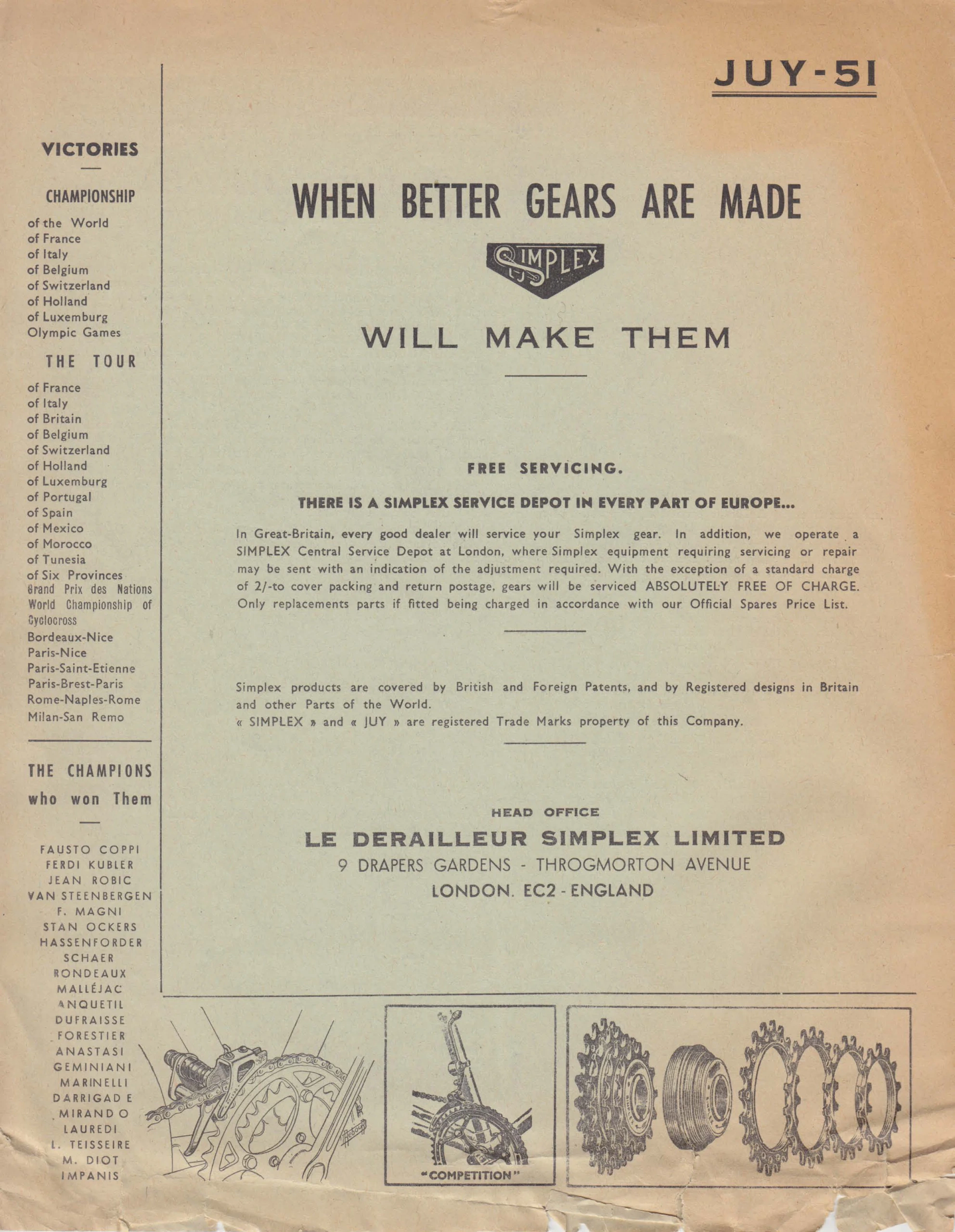
JUY-51
VICTORIES
CHAMPIONSHIP
of the World
of France
of Italy
of Belgium
of Switzerland
of Holland
of Luxemburg
Olympic Games
THE TOUR
of France
of Italy
of Britain
of Belgium
of Switzerland
of Holland
of Luxemburg
of Portugal
of Spain
of Mexico
of Morocco
of Tunesia
of Six Provinces
Grand Prix des Nations
World Championship of Cyclocross
Bordeaux-Nice
Paris-Nice
Paris-Saint-Etienne
Paris-Brest-Paris
Rome-Naples-Rome
Milan-San Remo
THE CHAMPIONS who won Them
FAUSTO COPPI
FERDI KUBLER
JEAN ROBIC
VAN STEENBERGEN
F. MAGNI
STAN OCKERS
HASSENFORDER
SCHAER
RONDEAUX
MALLÉJAC
ANQUETIL
DUFRAISSE
FORESTIER
ANASTASI
GEMINIANI
MARINELLI
DARRIGADE
MIRANDO
LAUREDI
L. TEISSEIRE
M. DIOT
IMPANIS
WHEN BETTER GEARS ARE MADE
SIMPLEX
WILL MAKE THEM
FREE SERVICING.
THERE IS A SIMPLEX SERVICE DEPOT IN EVERY PART OF EUROPE…
In Great-Britain, every good dealer will service your Simplex gear. In addition, we operate a SIMPLEX Central Service Depot at London, where Simplex equipment requiring servicing or repair may be sent with an indication of the adjustment required. With the exception of a standard charge of 2/-to cover packing and return postage, gears will be serviced ABSOLUTELY FREE OF CHARGE. Only replacements parts if fitted being charged in accordance with our Official Spares Price List.
Simplex products are covered by British and Foreign Patents, and by Registered designs in Britain and other Parts of the World.
« SIMPLEX » and « JUY » are registered Trade Marks property of this Company.
HEAD OFFICE
LE DERAILLEUR SIMPLEX LIMITED
9 DRAPERS GARDENS – THROGMORTON AVENUE
LONDON. EC2 – ENGLAND
“COMPETITION”
Rebour (signature on drawing)
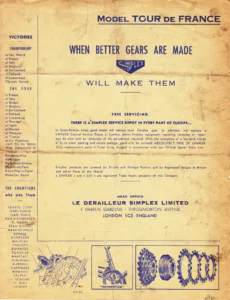
[The cover of an English-language Simplex Juy-51 leaflet on gray-green paper: a left column listing victories and champions, the Simplex shield logo, a service notice and the London head office address. Along the foot are a drawing signed Rebour of a Juy derailleur on a chainring, a framed Competition changer and a row of freewheel sprockets. Edges browned, torn and creased at the foot.]
— Page 2 —
REGISTERED TRADE MARK SIMPLEX BRITISH PATENTS
B 718145
622249, 662003, 665167, 674556, 684211
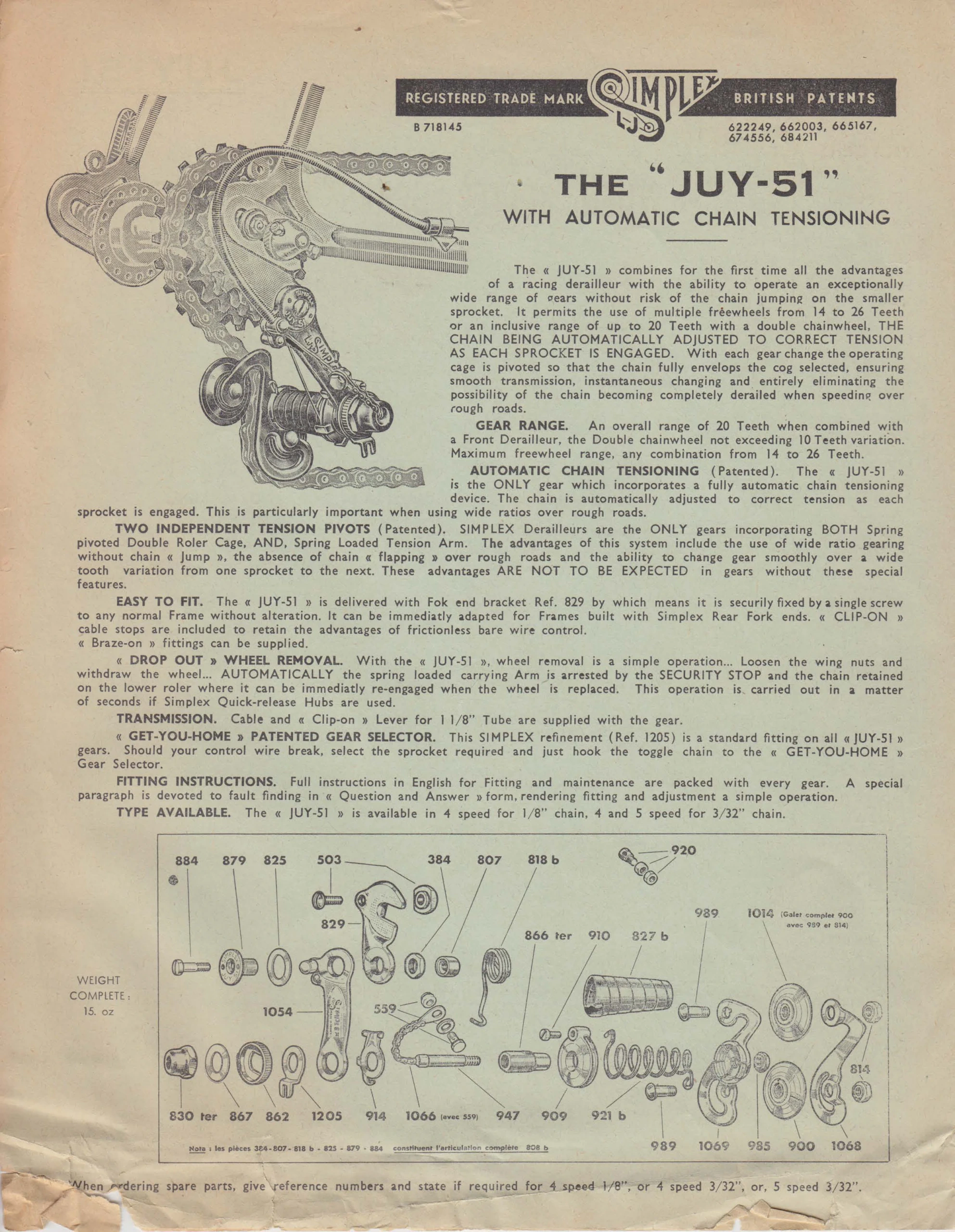
THE “JUY-51″
WITH AUTOMATIC CHAIN TENSIONING
The « JUY-51 » combines for the first time all the advantages of a racing derailleur with the ability to operate an exceptionally wide range of gears without risk of the chain jumping on the smaller sprocket. It permits the use of multiple freewheels from 14 to 26 Teeth or an inclusive range of up to 20 Teeth with a double chainwheel, THE CHAIN BEING AUTOMATICALLY ADJUSTED TO CORRECT TENSION AS EACH SPROCKET IS ENGAGED. With each gear change the operating cage is pivoted so that the chain fully envelops the cog selected, ensuring smooth transmission, instantaneous changing and entirely eliminating the possibility of the chain becoming completely derailed when speeding over rough roads.
GEAR RANGE. An overall range of 20 Teeth when combined with a Front Derailleur, the Double chainwheel not exceeding 10 Teeth variation. Maximum freewheel range, any combination from 14 to 26 Teeth.
AUTOMATIC CHAIN TENSIONING (Patented). The « JUY-51 » is the ONLY gear which incorporates a fully automatic chain tensioning device. The chain is automatically adjusted to correct tension as each sprocket is engaged. This is particularly important when using wide ratios over rough roads.
TWO INDEPENDENT TENSION PIVOTS (Patented). SIMPLEX Derailleurs are the ONLY gears incorporating BOTH Spring pivoted Double Roler Cage, AND, Spring Loaded Tension Arm. The advantages of this system include the use of wide ratio gearing without chain « Jump », the absence of chain « flapping » over rough roads and the ability to change gear smoothly over a wide tooth variation from one sprocket to the next. These advantages ARE NOT TO BE EXPECTED in gears without these special features.
EASY TO FIT. The « JUY-51 » is delivered with Fok end bracket Ref. 829 by which means it is securily fixed by a single screw to any normal Frame without alteration. It can be immediatly adapted for Frames built with Simplex Rear Fork ends. « CLIP-ON » cable stops are included to retain the advantages of frictionless bare wire control.
« Braze-on » fittings can be supplied.
« DROP OUT » WHEEL REMOVAL. With the « JUY-51 », wheel removal is a simple operation… Loosen the wing nuts and withdraw the wheel… AUTOMATICALLY the spring loaded carrying Arm is arrested by the SECURITY STOP and the chain retained on the lower roler where it can be immediatly re-engaged when the wheel is replaced. This operation is carried out in a matter of seconds if Simplex Quick-release Hubs are used.
TRANSMISSION. Cable and « Clip-on » Lever for 1 1/8″ Tube are supplied with the gear.
« GET-YOU-HOME » PATENTED GEAR SELECTOR. This SIMPLEX refinement (Ref. 1205) is a standard fitting on all « JUY-51 » gears. Should your control wire break, select the sprocket required and just hook the toggle chain to the « GET-YOU-HOME » Gear Selector.
FITTING INSTRUCTIONS. Full instructions in English for Fitting and maintenance are packed with every gear. A special paragraph is devoted to fault finding in « Question and Answer » form, rendering fitting and adjustment a simple operation.
TYPE AVAILABLE. The « JUY-51 » is available in 4 speed for 1/8″ chain, 4 and 5 speed for 3/32″ chain.
WEIGHT COMPLETE: 15. oz
(exploded view part numbers) 884 | 879 | 825 | 503 | 384 | 807 | 818 b | 920 | 829 | 866 ter | 910 | 827 b | 989 | 1014 (Galet complet 900 avec 989 et 814) | 1054 | 559 | 814 | 830 ter | 867 | 862 | 1205 | 914 | 1066 (avec 559) | 947 | 909 | 921 b | 989 | 1069 | 985 | 900 | 1068
Nota: les pièces 384 – 807 – 818 b – 825 – 879 – 884 constituent l’articulation complète 808 b
When ordering spare parts, give reference numbers and state if required for 4 speed 1/8″, or 4 speed 3/32″, or, 5 speed 3/32”.
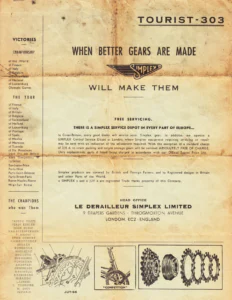
[Inside page in English on gray-green paper: the Simplex trade mark banner with patent numbers, an engraving of the Juy-51 rear derailleur mounted on a freewheel, descriptive text and a boxed exploded parts diagram numbered with spare-part references, with a French note at its foot. Bottom left corner torn and stained.]
— Page 3 —
SIMPLEX
“JUY 51″ Derailleur Gear
FITTING INSTRUCTIONS
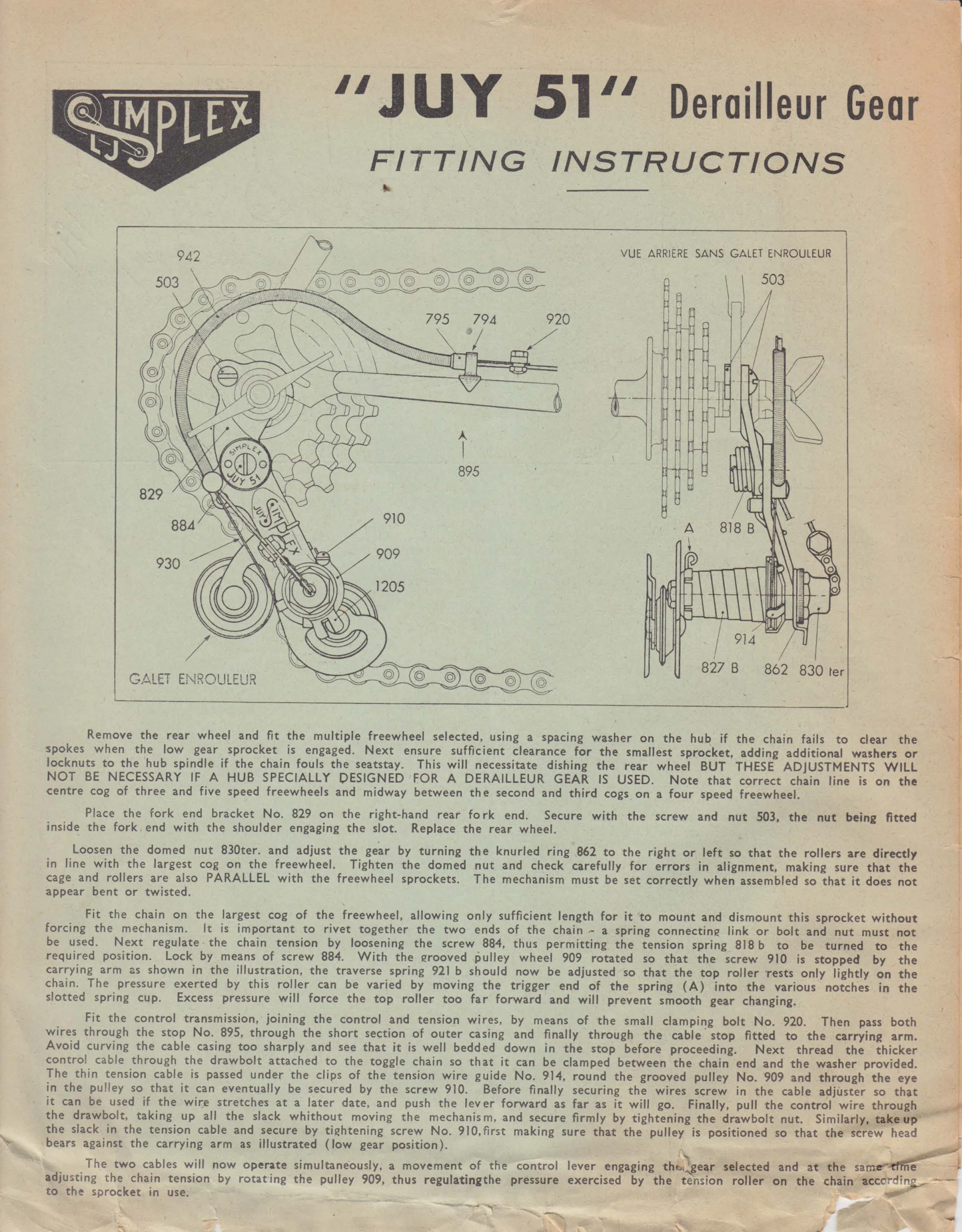
(diagram labels) 942 | 503 | 795 | 794 | 920 | 895 | 829 | 884 | 930 | 910 | 909 | 1205 | GALET ENROULEUR | SIMPLEX JUY 51 (on derailleur)
VUE ARRIÈRE SANS GALET ENROULEUR | 503 | A | 818 B | 914 | 827 B | 862 | 830 ter
Remove the rear wheel and fit the multiple freewheel selected, using a spacing washer on the hub if the chain fails to clear the spokes when the low gear sprocket is engaged. Next ensure sufficient clearance for the smallest sprocket, adding additional washers or locknuts to the hub spindle if the chain fouls the seatstay. This will necessitate dishing the rear wheel BUT THESE ADJUSTMENTS WILL NOT BE NECESSARY IF A HUB SPECIALLY DESIGNED FOR A DERAILLEUR GEAR IS USED. Note that correct chain line is on the centre cog of three and five speed freewheels and midway between the second and third cogs on a four speed freewheel.
Place the fork end bracket No. 829 on the right-hand rear fork end. Secure with the screw and nut 503, the nut being fitted inside the fork end with the shoulder engaging the slot. Replace the rear wheel.
Loosen the domed nut 830ter. and adjust the gear by turning the knurled ring 862 to the right or left so that the rollers are directly in line with the largest cog on the freewheel. Tighten the domed nut and check carefully for errors in alignment, making sure that the cage and rollers are also PARALLEL with the freewheel sprockets. The mechanism must be set correctly when assembled so that it does not appear bent or twisted.
Fit the chain on the largest cog of the freewheel, allowing only sufficient length for it to mount and dismount this sprocket without forcing the mechanism. It is important to rivet together the two ends of the chain – a spring connecting link or bolt and nut must not be used. Next regulate the chain tension by loosening the screw 884, thus permitting the tension spring 818 b to be turned to the required position. Lock by means of screw 884. With the grooved pulley wheel 909 rotated so that the screw 910 is stopped by the carrying arm as shown in the illustration, the traverse spring 921 b should now be adjusted so that the top roller rests only lightly on the chain. The pressure exerted by this roller can be varied by moving the trigger end of the spring (A) into the various notches in the slotted spring cup. Excess pressure will force the top roller too far forward and will prevent smooth gear changing.
Fit the control transmission, joining the control and tension wires, by means of the small clamping bolt No. 920. Then pass both wires through the stop No. 895, through the short section of outer casing and finally through the cable stop fitted to the carrying arm. Avoid curving the cable casing too sharply and see that it is well bedded down in the stop before proceeding. Next thread the thicker control cable through the drawbolt attached to the toggle chain so that it can be clamped between the chain end and the washer provided. The thin tension cable is passed under the clips of the tension wire guide No. 914, round the grooved pulley No. 909 and through the eye in the pulley so that it can eventually be secured by the screw 910. Before finally securing the wires screw in the cable adjuster so that it can be used if the wire stretches at a later date, and push the lever forward as far as it will go. Finally, pull the control wire through the drawbolt, taking up all the slack whithout moving the mechanism, and secure firmly by tightening the drawbolt nut. Similarly, take up the slack in the tension cable and secure by tightening screw No. 910, first making sure that the pulley is positioned so that the screw head bears against the carrying arm as illustrated (low gear position).
The two cables will now operate simultaneously, a movement of the control lever engaging the gear selected and at the same time adjusting the chain tension by rotating the pulley 909, thus regulatingthe pressure exercised by the tension roller on the chain according to the sprocket in use.
[Fitting instructions page in English on gray-green paper: the Simplex shield logo and title, a boxed line drawing of the Juy 51 fitted to the rear fork end in side view and a rear view without the jockey roller, with part numbers and French captions, then numbered fitting steps. Lower edges creased and stained.]
— Page 4 —
SIMPLEX DIJON (on lever)
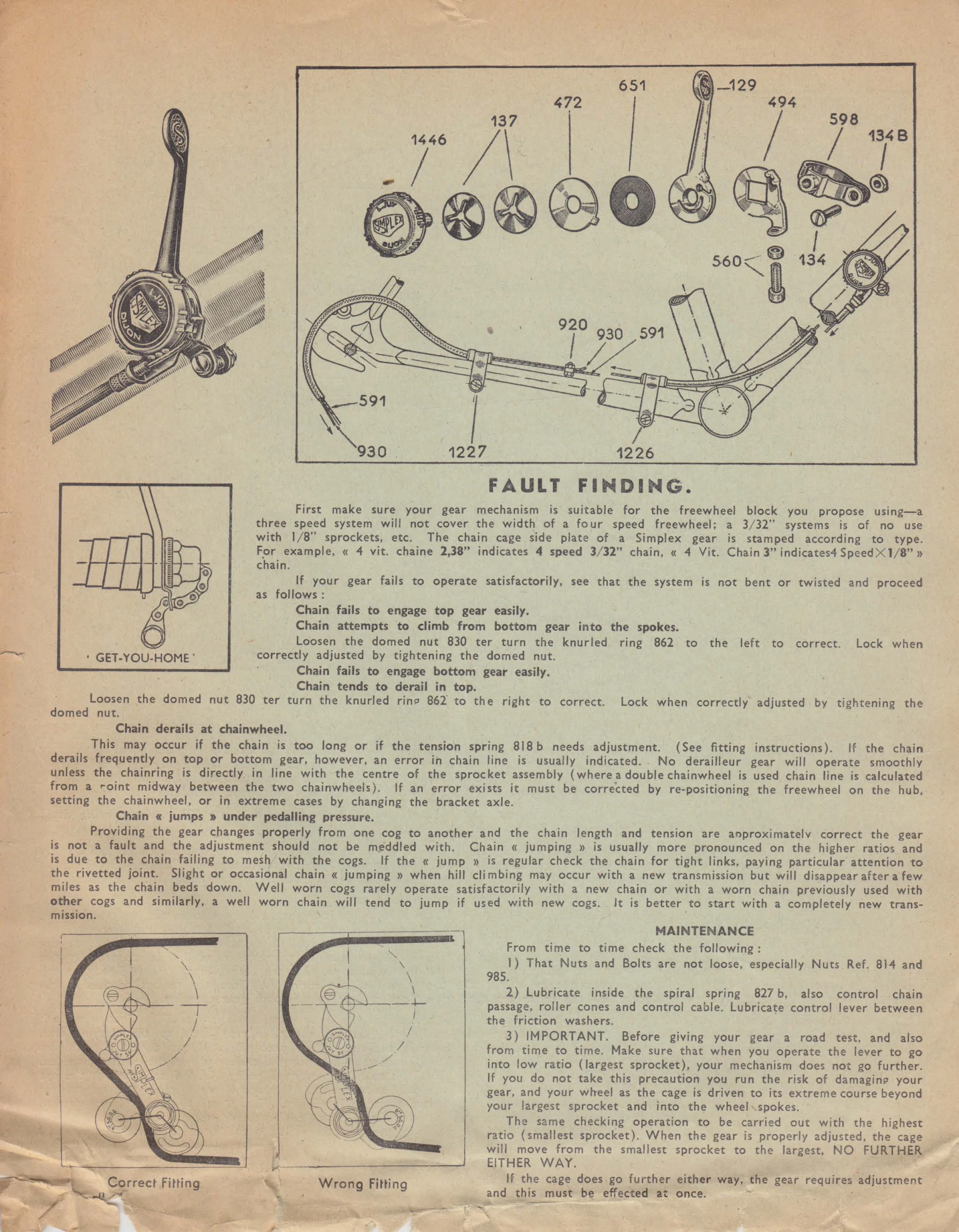
(diagram labels) 1446 | 137 | 472 | 651 | 129 | 494 | 598 | 134 B | 560 | 134 | 920 | 930 | 591 | 591 | 930 | 1227 | 1226
‘GET-YOU-HOME’
FAULT FINDING.
First make sure your gear mechanism is suitable for the freewheel block you propose using—a three speed system will not cover the width of a four speed freewheel; a 3/32″ systems is of no use with 1/8″ sprockets, etc. The chain cage side plate of a Simplex gear is stamped according to type. For example, « 4 vit. chaine 2,38″ indicates 4 speed 3/32″ chain, « 4 Vit. Chain 3″ indicates4 Speed x 1/8” » chain.
If your gear fails to operate satisfactorily, see that the system is not bent or twisted and proceed as follows:
Chain fails to engage top gear easily.
Chain attempts to climb from bottom gear into the spokes.
Loosen the domed nut 830 ter turn the knurled ring 862 to the left to correct. Lock when correctly adjusted by tightening the domed nut.
Chain fails to engage bottom gear easily.
Chain tends to derail in top.
Loosen the domed nut 830 ter turn the knurled ring 862 to the right to correct. Lock when correctly adjusted by tightening the domed nut.
Chain derails at chainwheel.
This may occur if the chain is too long or if the tension spring 818 b needs adjustment. (See fitting instructions). If the chain derails frequently on top or bottom gear, however, an error in chain line is usually indicated. No derailleur gear will operate smoothly unless the chainring is directly in line with the centre of the sprocket assembly (where a double chainwheel is used chain line is calculated from a point midway between the two chainwheels). If an error exists it must be corrected by re-positioning the freewheel on the hub, setting the chainwheel, or in extreme cases by changing the bracket axle.
Chain « jumps » under pedalling pressure.
Providing the gear changes properly from one cog to another and the chain length and tension are approximately correct the gear is not a fault and the adjustment should not be meddled with. Chain « jumping » is usually more pronounced on the higher ratios and is due to the chain failing to mesh with the cogs. If the « jump » is regular check the chain for tight links, paying particular attention to the rivetted joint. Slight or occasional chain « jumping » when hill climbing may occur with a new transmission but will disappear after a few miles as the chain beds down. Well worn cogs rarely operate satisfactorily with a new chain or with a worn chain previously used with other cogs and similarly, a well worn chain will tend to jump if used with new cogs. It is better to start with a completely new transmission.
MAINTENANCE
From time to time check the following:
1) That Nuts and Bolts are not loose, especially Nuts Ref. 814 and 985.
2) Lubricate inside the spiral spring 827 b, also control chain passage, roller cones and control cable. Lubricate control lever between the friction washers.
3) IMPORTANT. Before giving your gear a road test, and also from time to time. Make sure that when you operate the lever to go into low ratio (largest sprocket), your mechanism does not go further. If you do not take this precaution you run the risk of damaging your gear, and your wheel as the cage is driven to its extreme course beyond your largest sprocket and into the wheel spokes.
The same checking operation to be carried out with the highest ratio (smallest sprocket). When the gear is properly adjusted, the cage will move from the smallest sprocket to the largest, NO FURTHER EITHER WAY.
If the cage does go further either way, the gear requires adjustment and this must be effected at once.
SIMPLEX JUY 51 (on cage, both drawings)
Correct Fitting
Wrong Fitting
[illegible] (torn fragment of print below Correct Fitting)
[Back page in English on gray-green paper: an engraving of the Simplex Dijon down-tube lever, a boxed exploded drawing of the lever parts and cable run with part numbers, a Get-You-Home inset, fault-finding and maintenance text and two drawings comparing correct and wrong fitting of the cage. Bottom edge torn with loss of a small printed line at lower left.]
Ebykr presents this material for research and education. If you hold rights to it or notice an ownership issue, please contact us and we will respond promptly.