About Ebykr
Ebykr celebrates classic and vintage lightweight bicycles through provocative imagery and opinion. Ride along with us.
About Ebykr
Ebykr celebrates classic and vintage lightweight bicycles through provocative imagery and opinion. Ride along with us.

Source: Retrobike archive (retrobike.co.uk), "1981 Shimano Catalogue", uploaded by the forum member mk one.
 Page 1
 Page 2
 Page 3
 Page 4
 Page 5
 Page 6
 Page 7
 Page 8
 Page 9
 Page 10
 Page 11
 Page 12
 Page 13
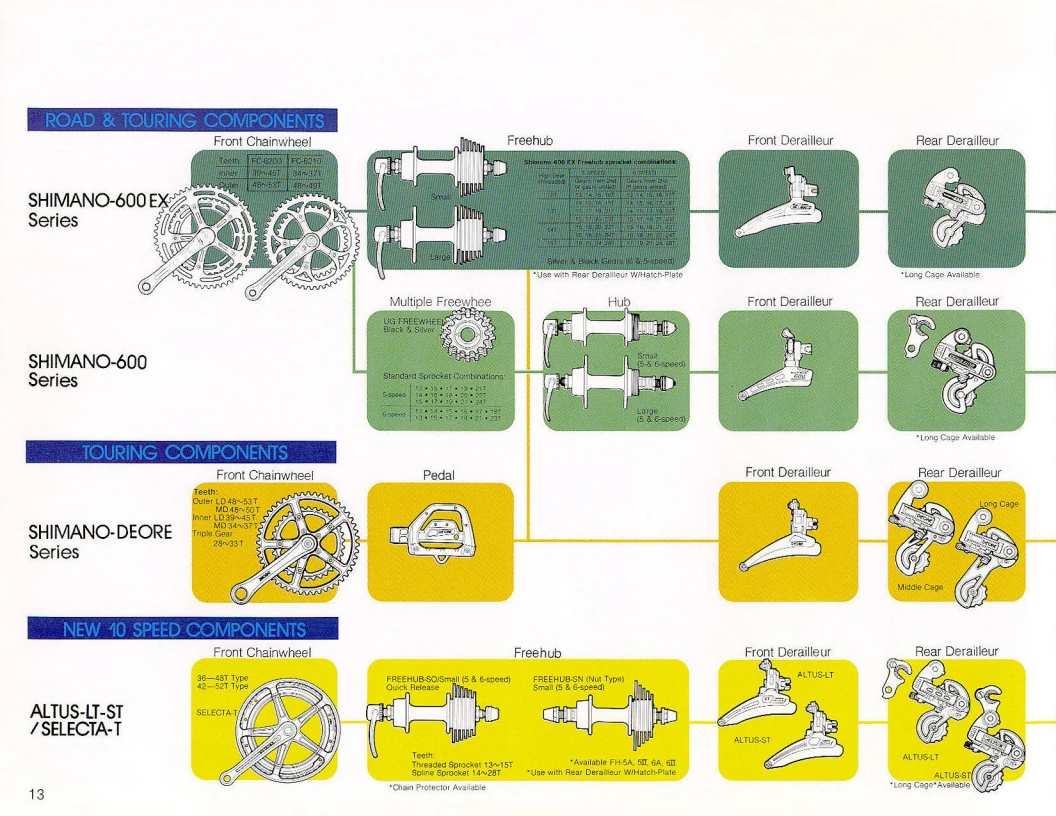 Page 14
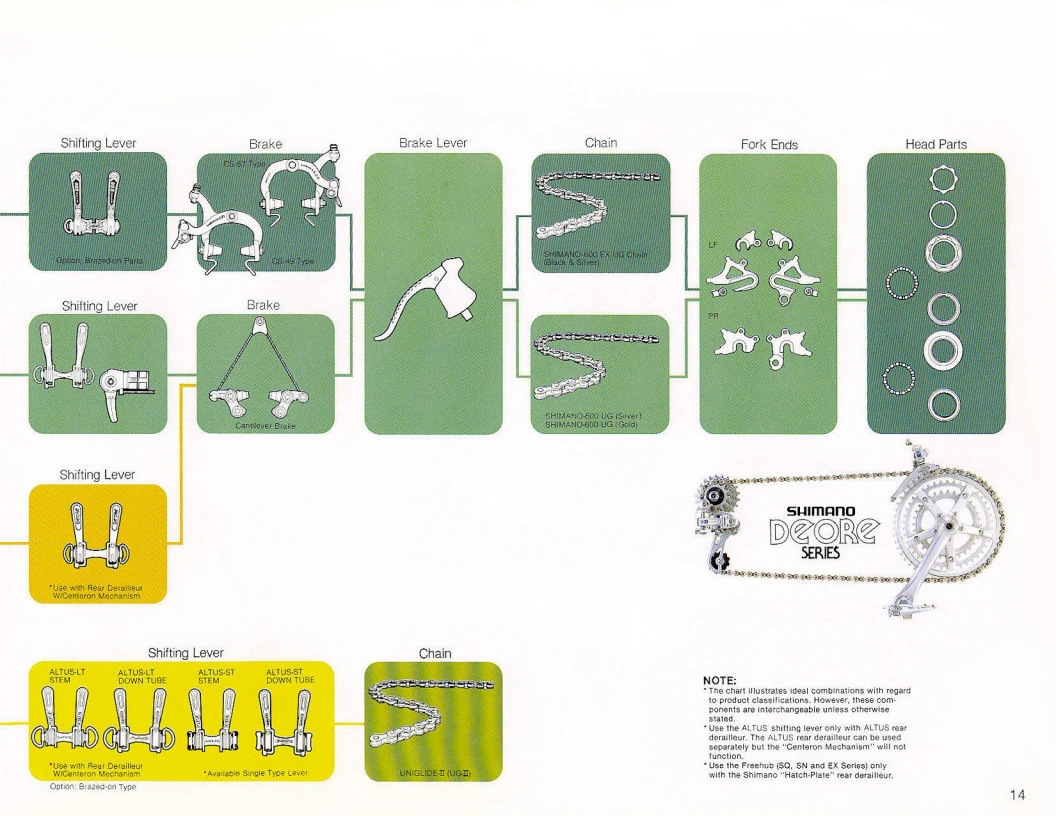 Page 15
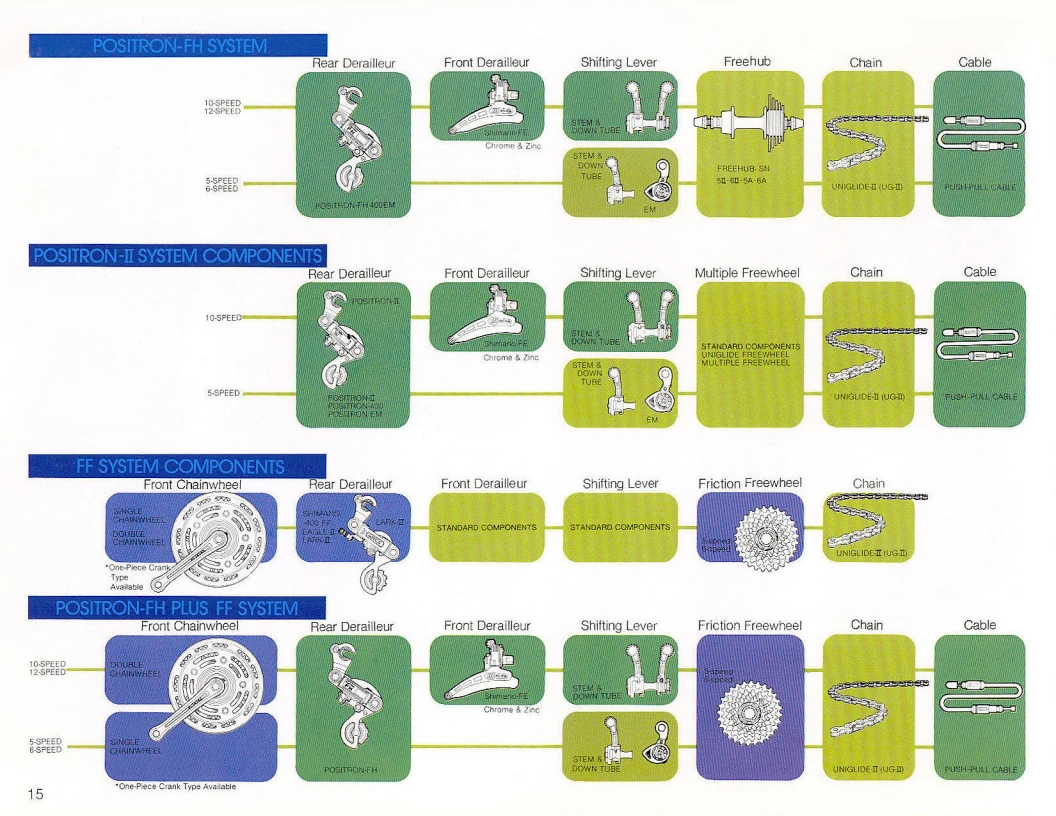 Page 16
 Page 17
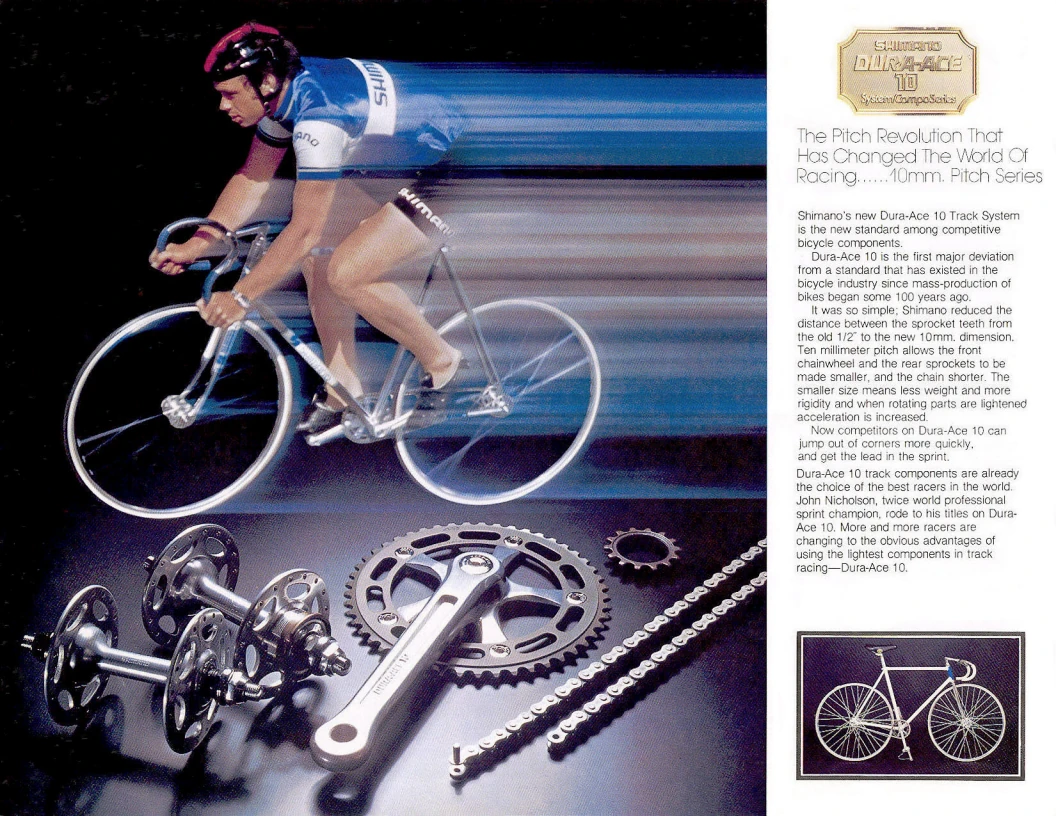 Page 18
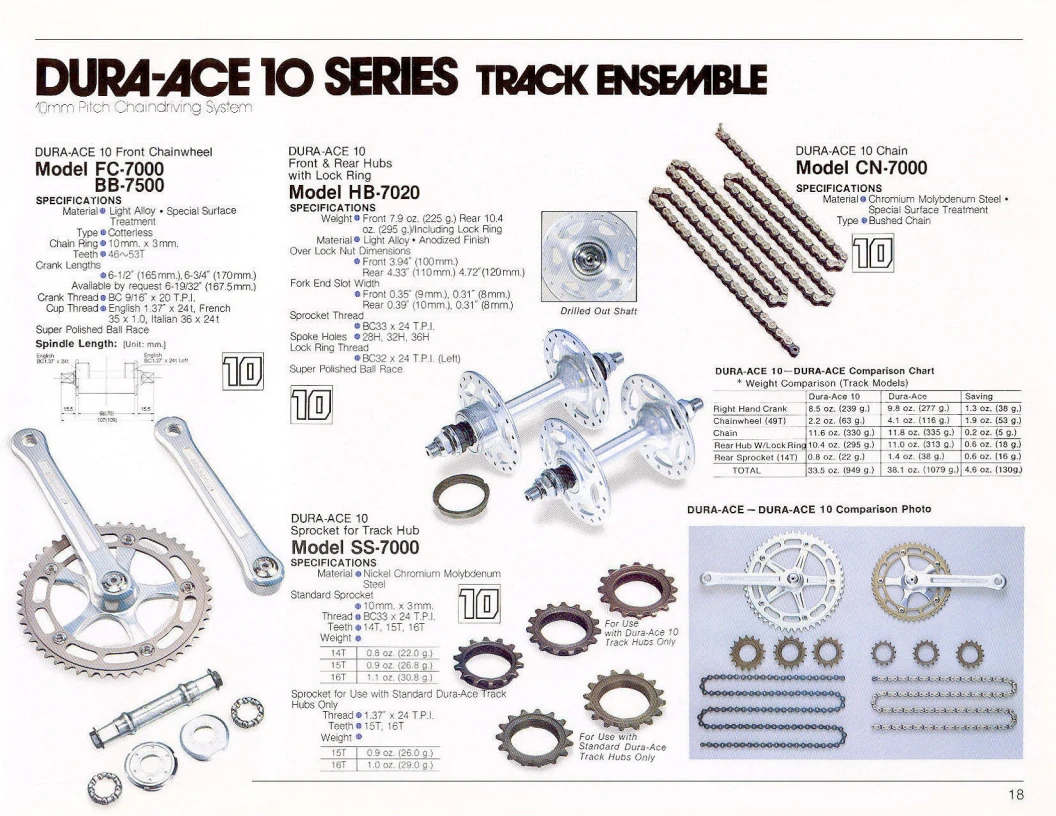 Page 19
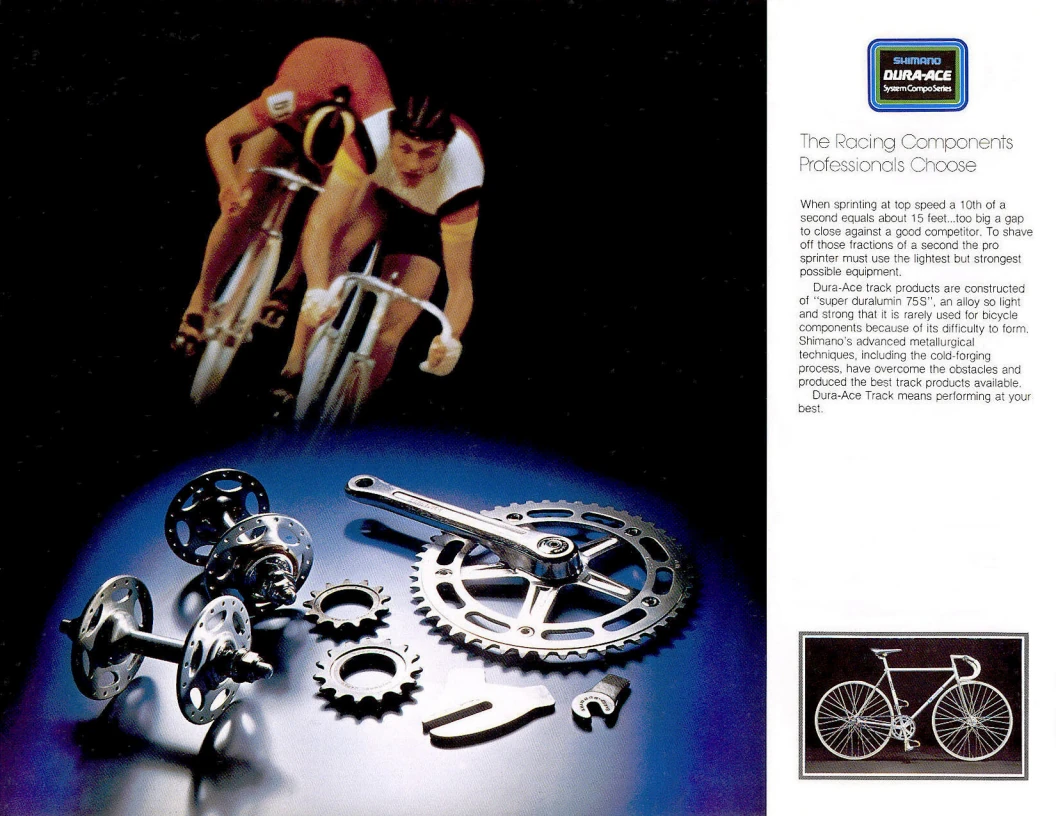 Page 20
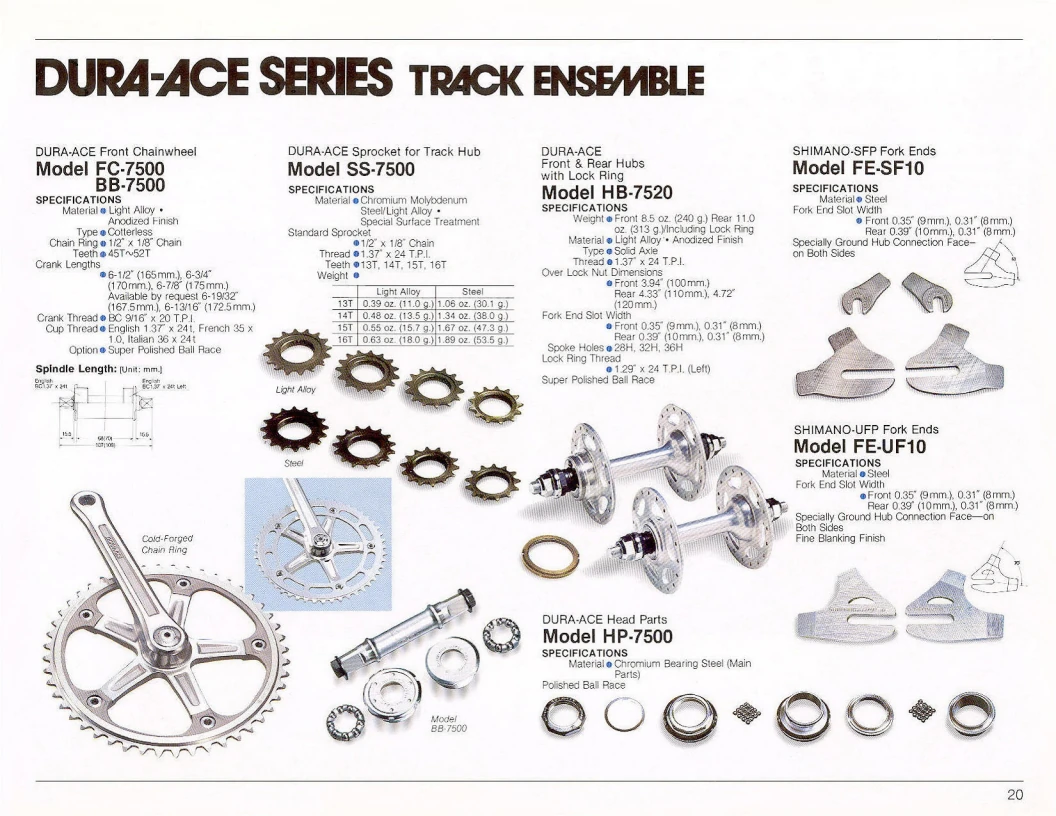 Page 21
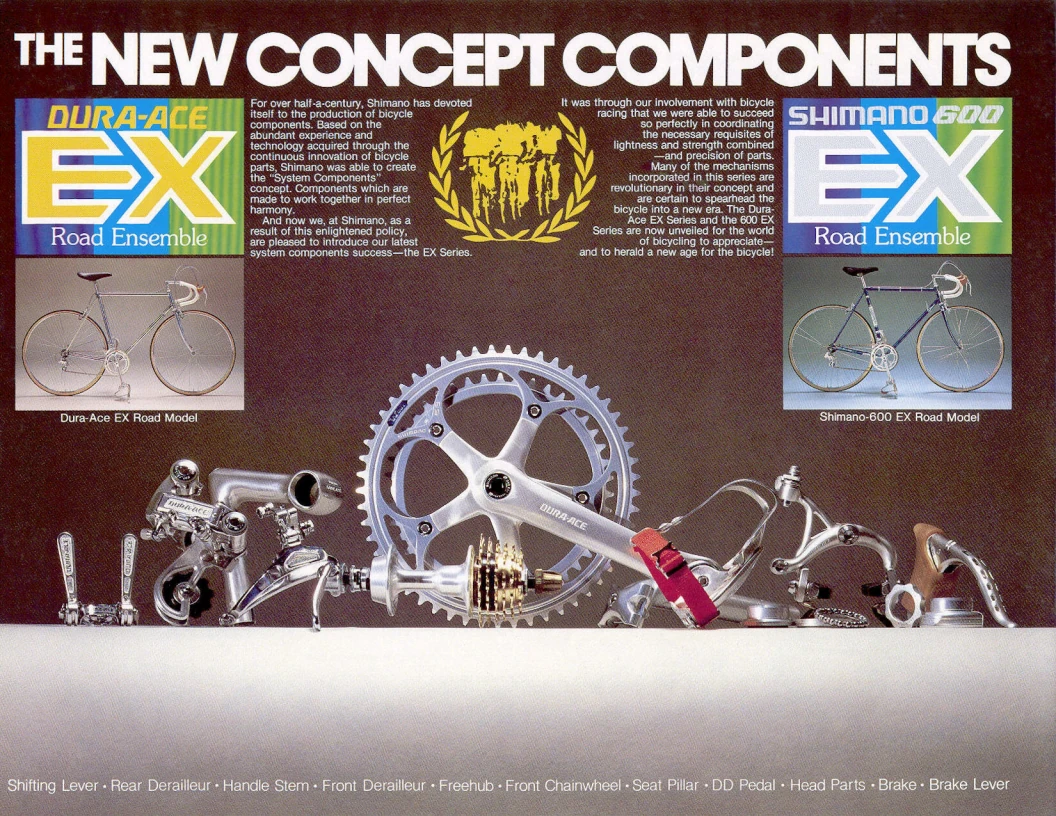 Page 22
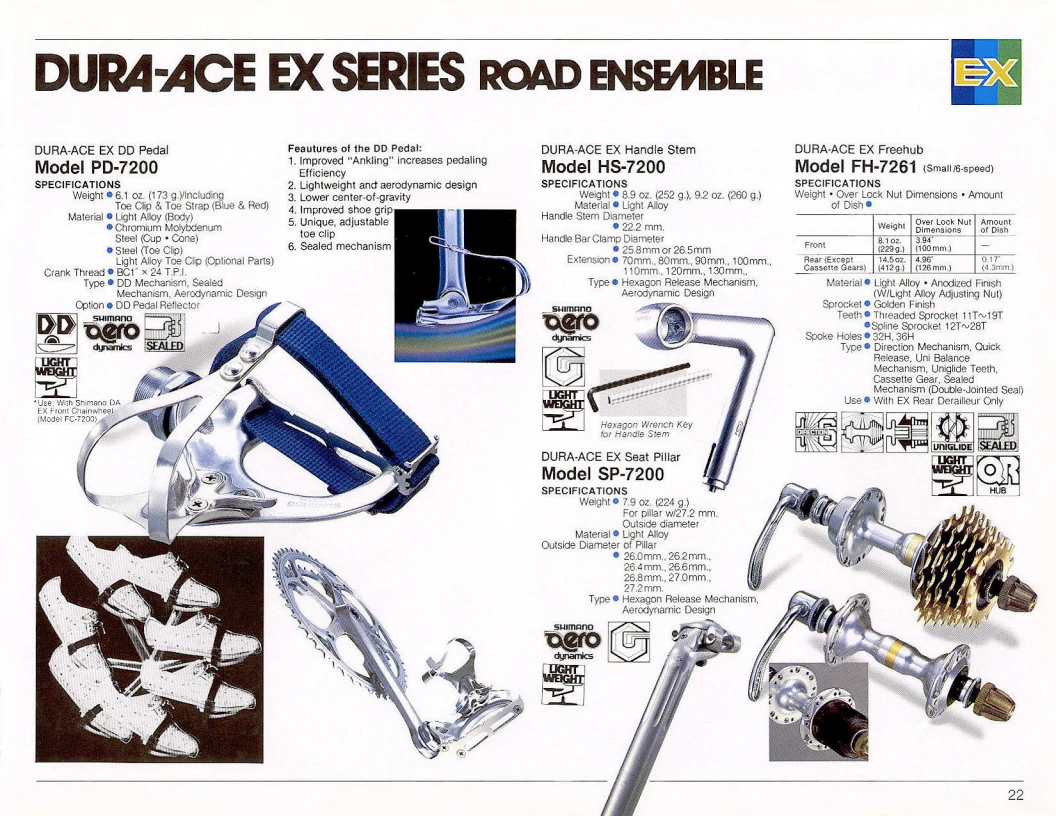 Page 23
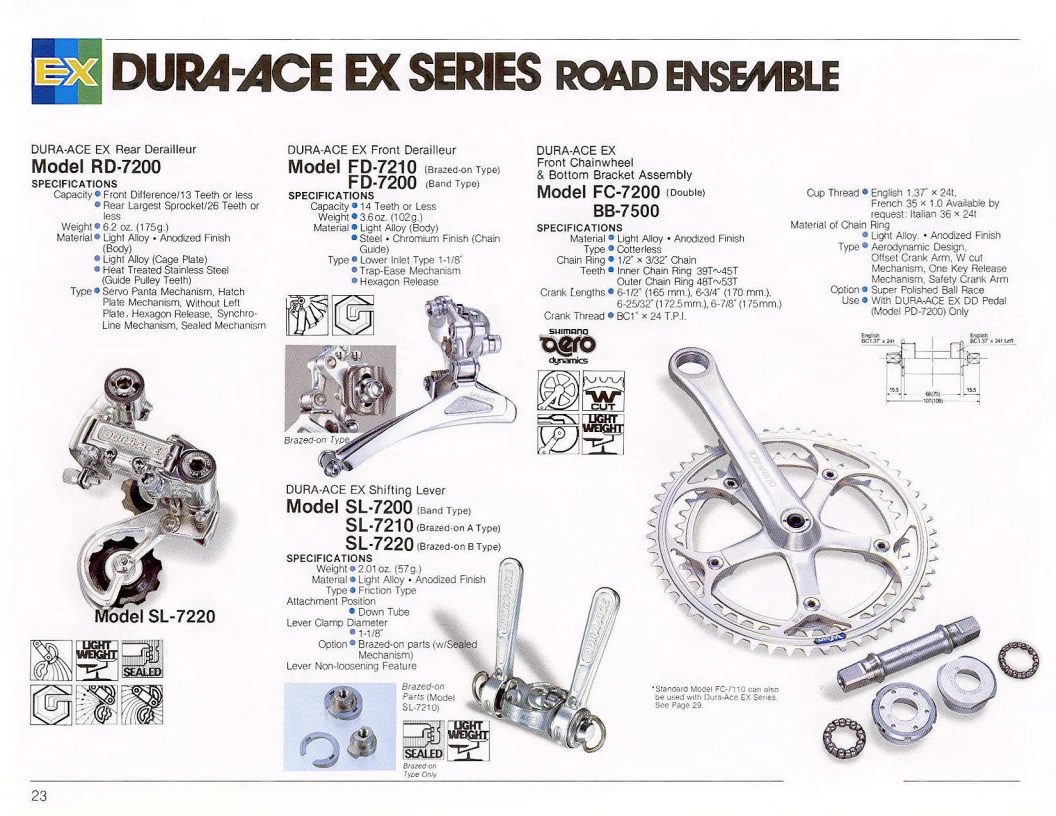 Page 24
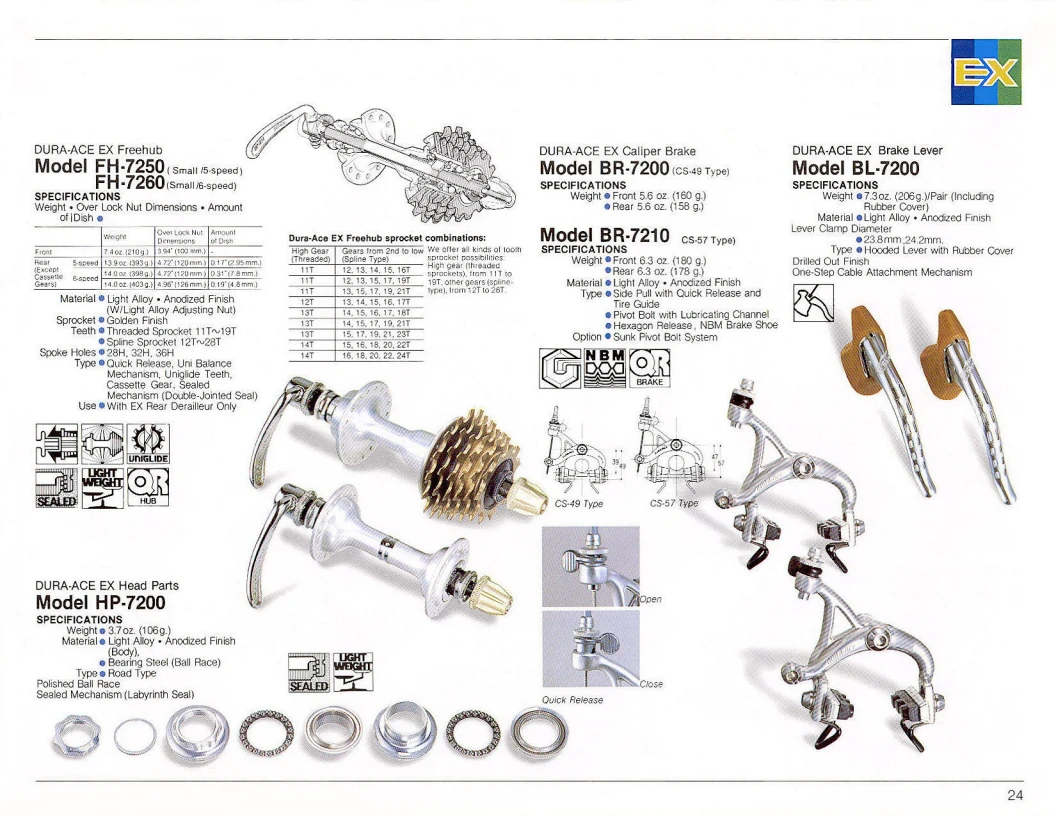 Page 25
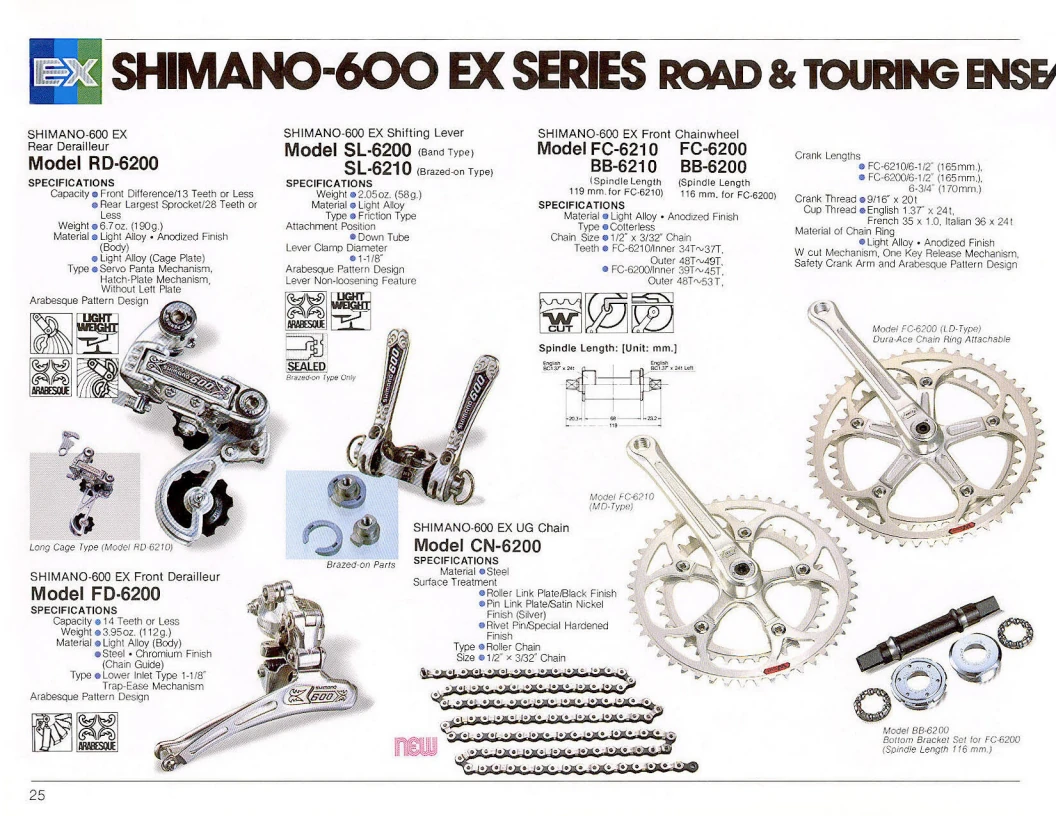 Page 26
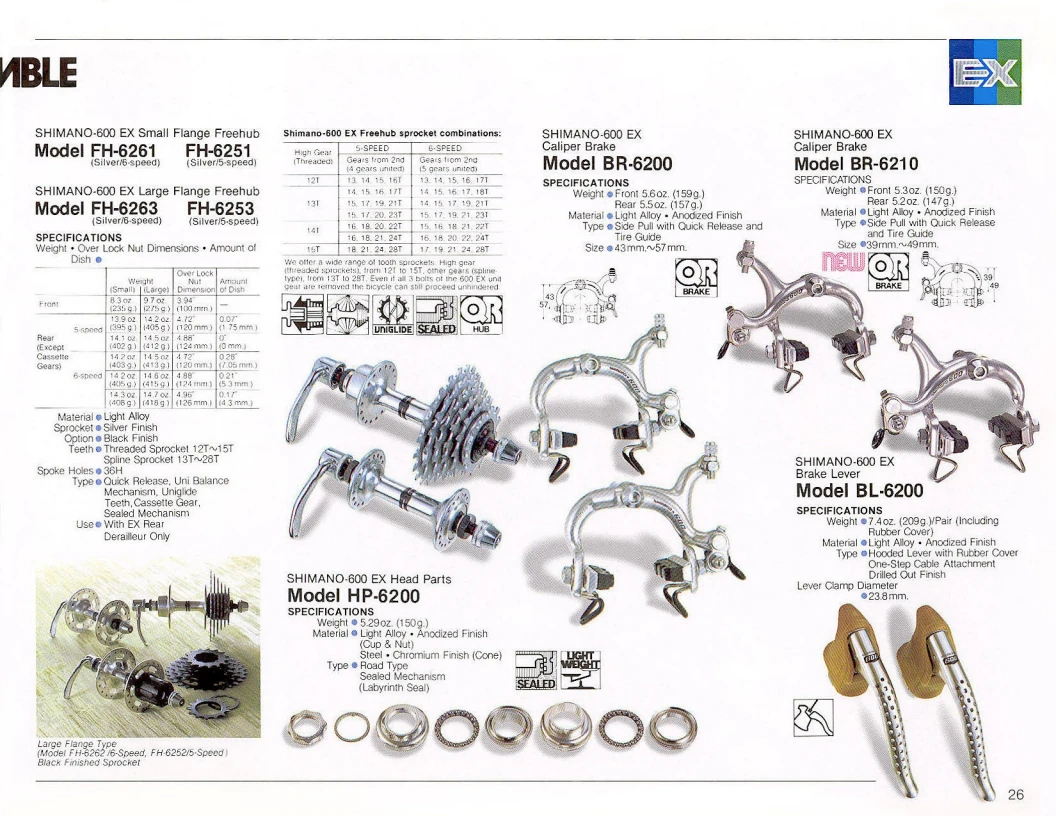 Page 27
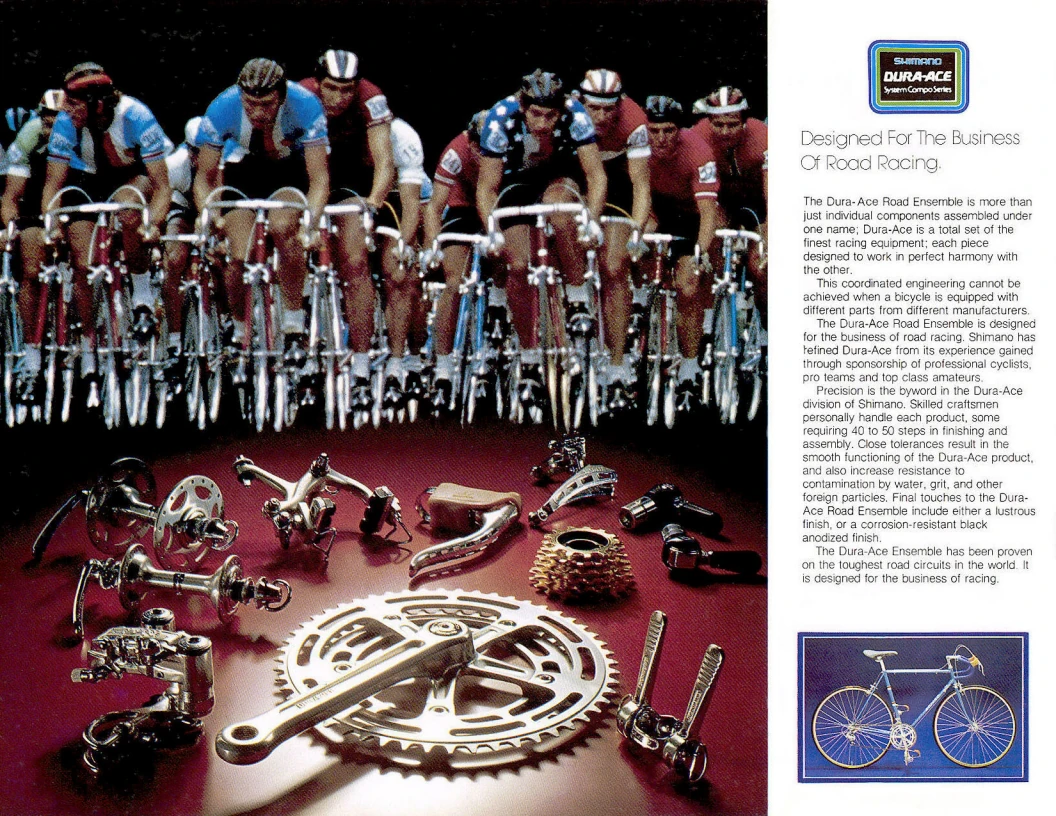 Page 28
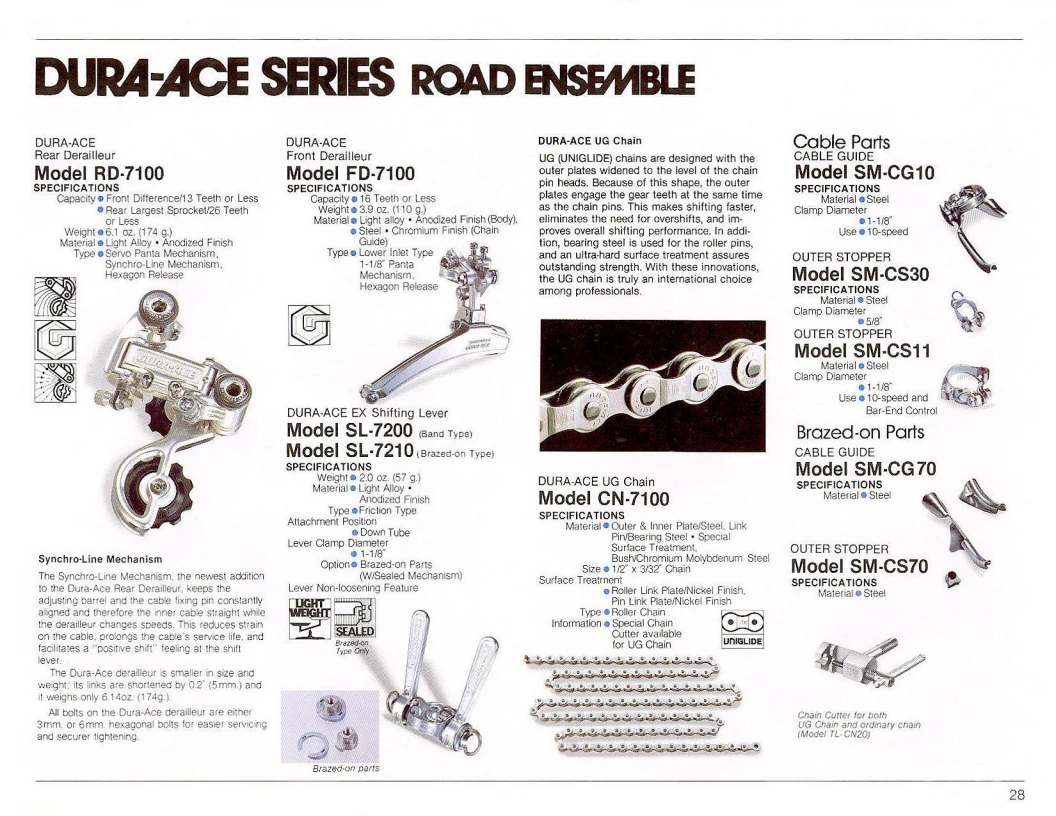 Page 29
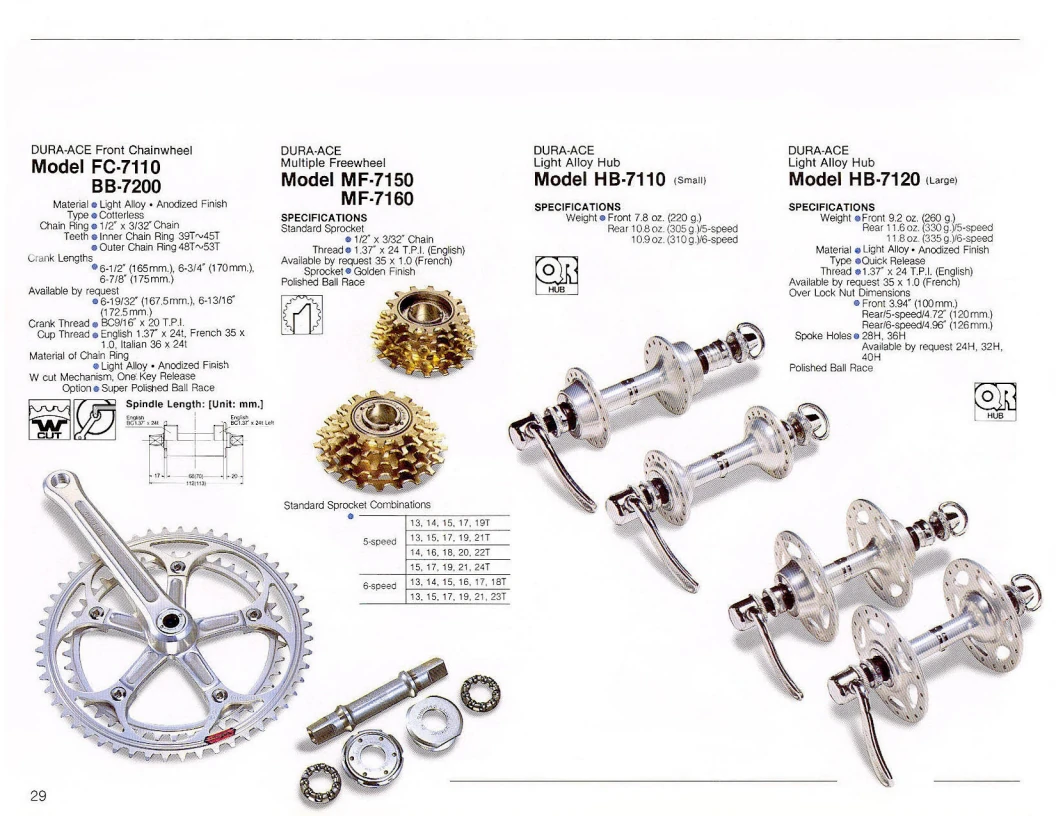 Page 30
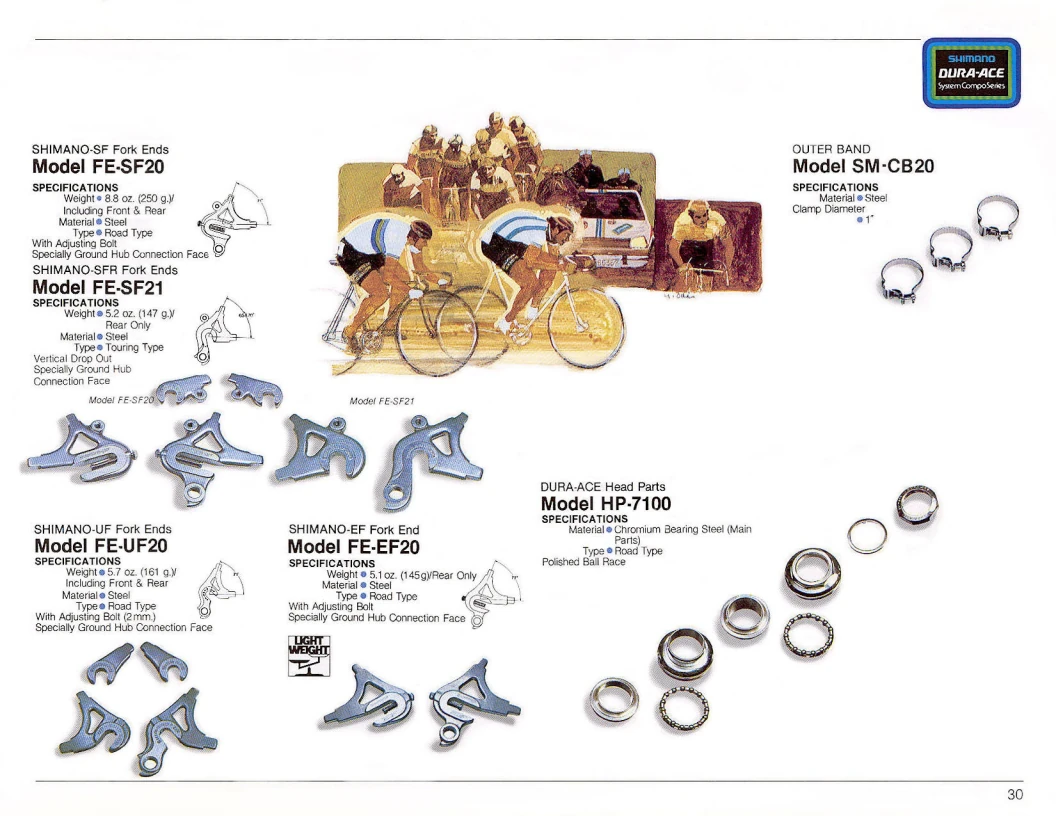 Page 31
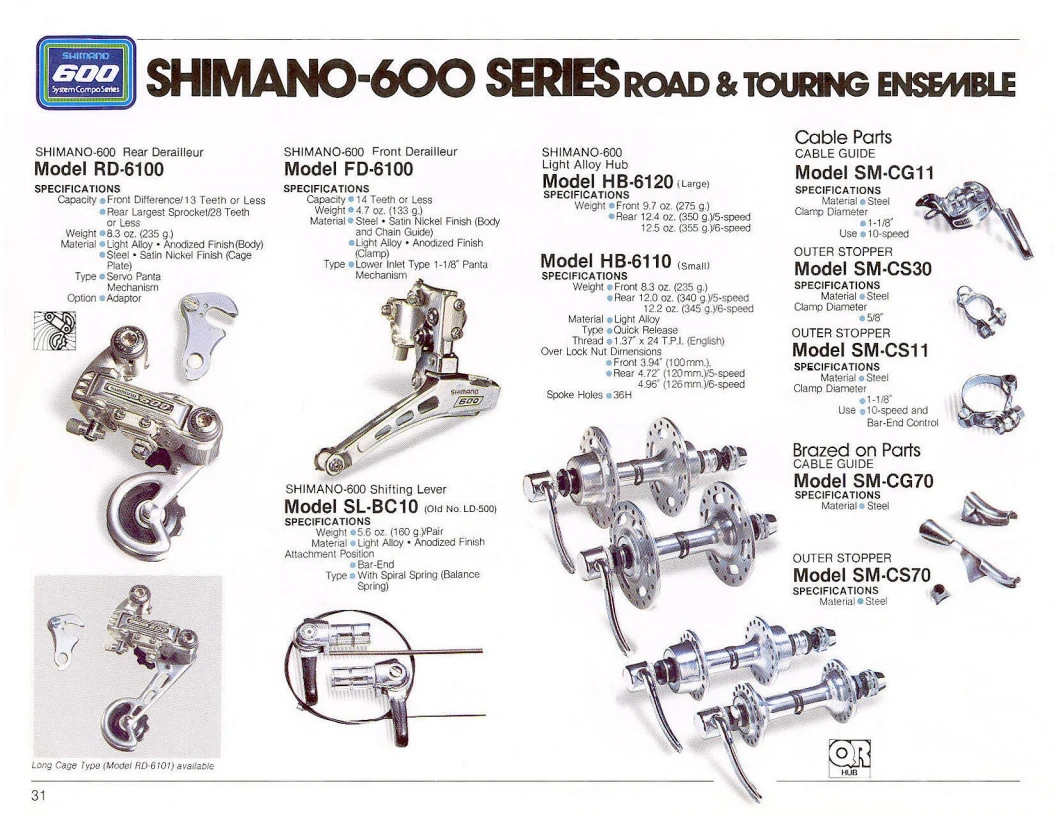 Page 32
 Page 33
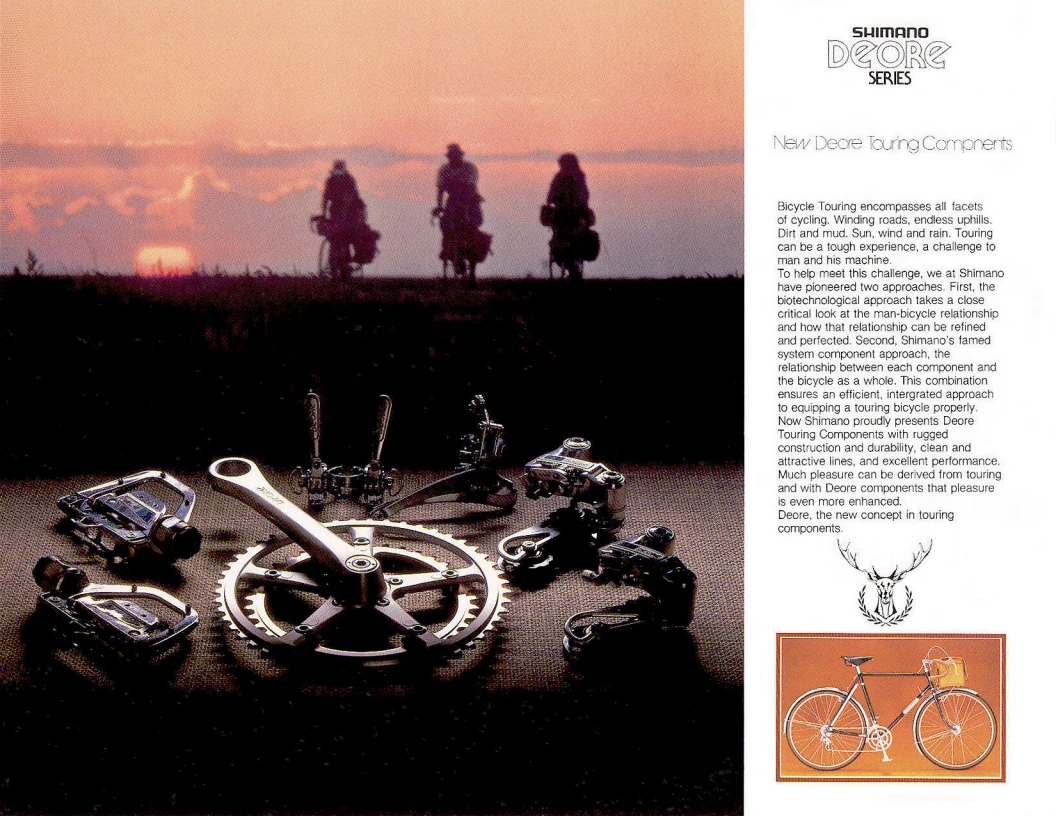 Page 34
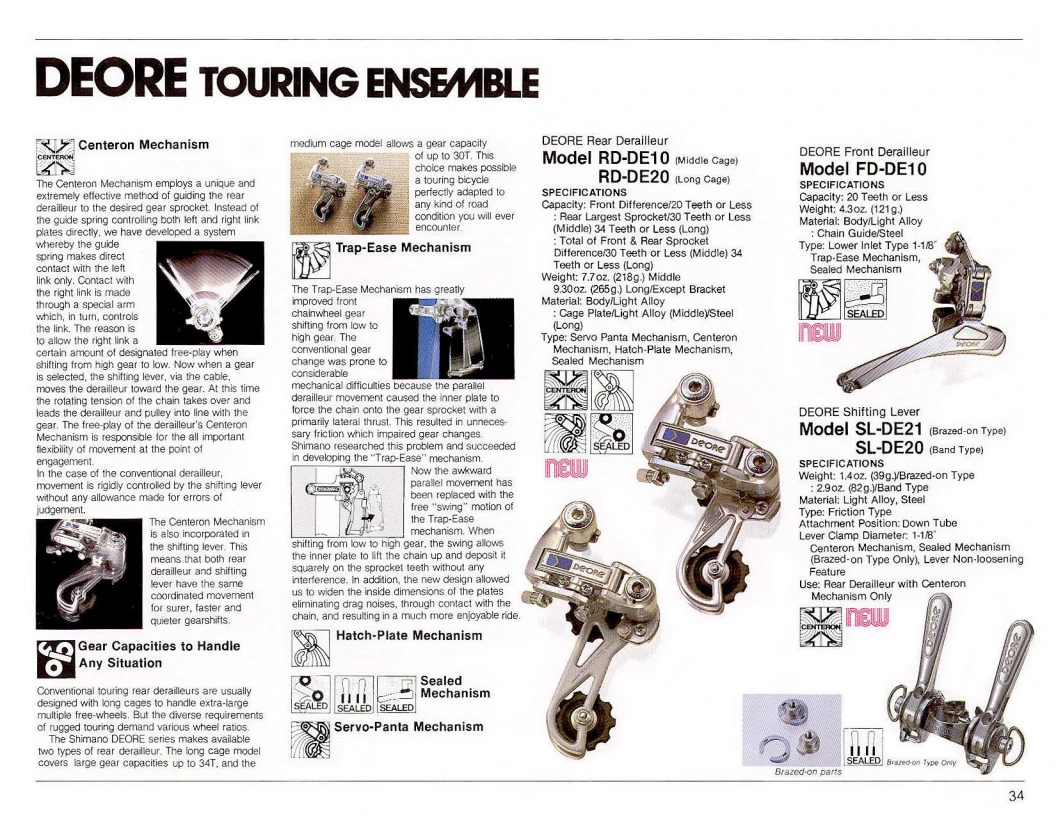 Page 35
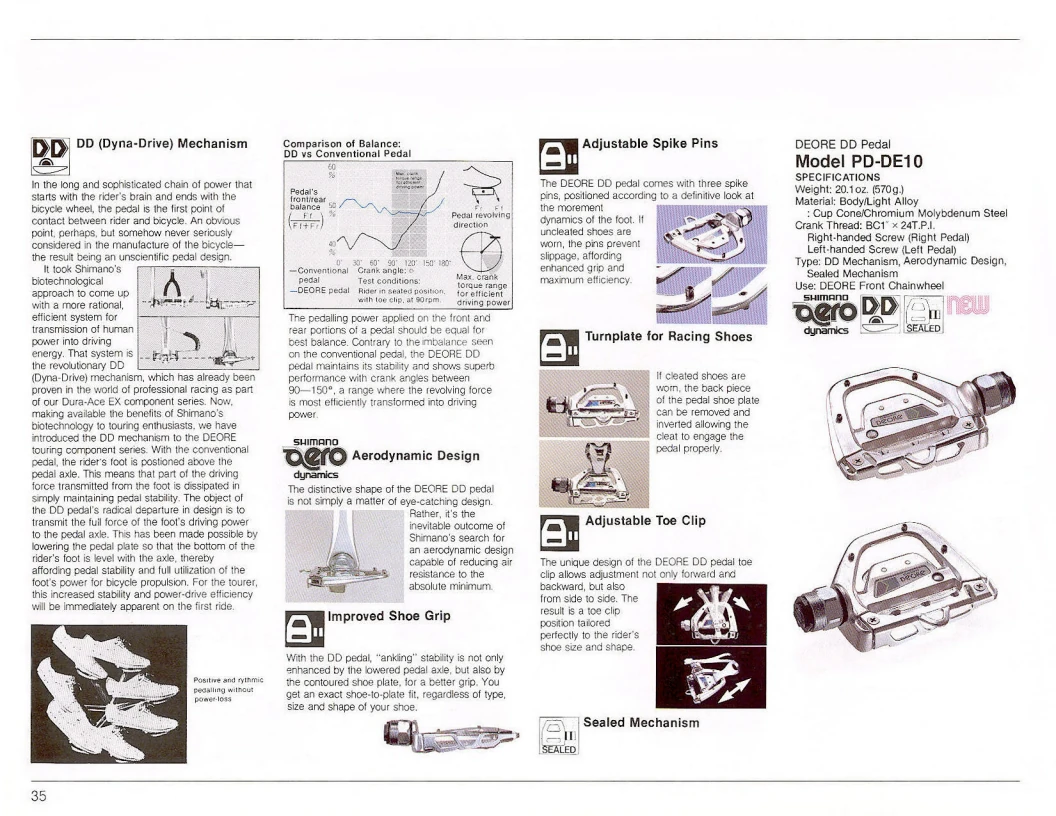 Page 36
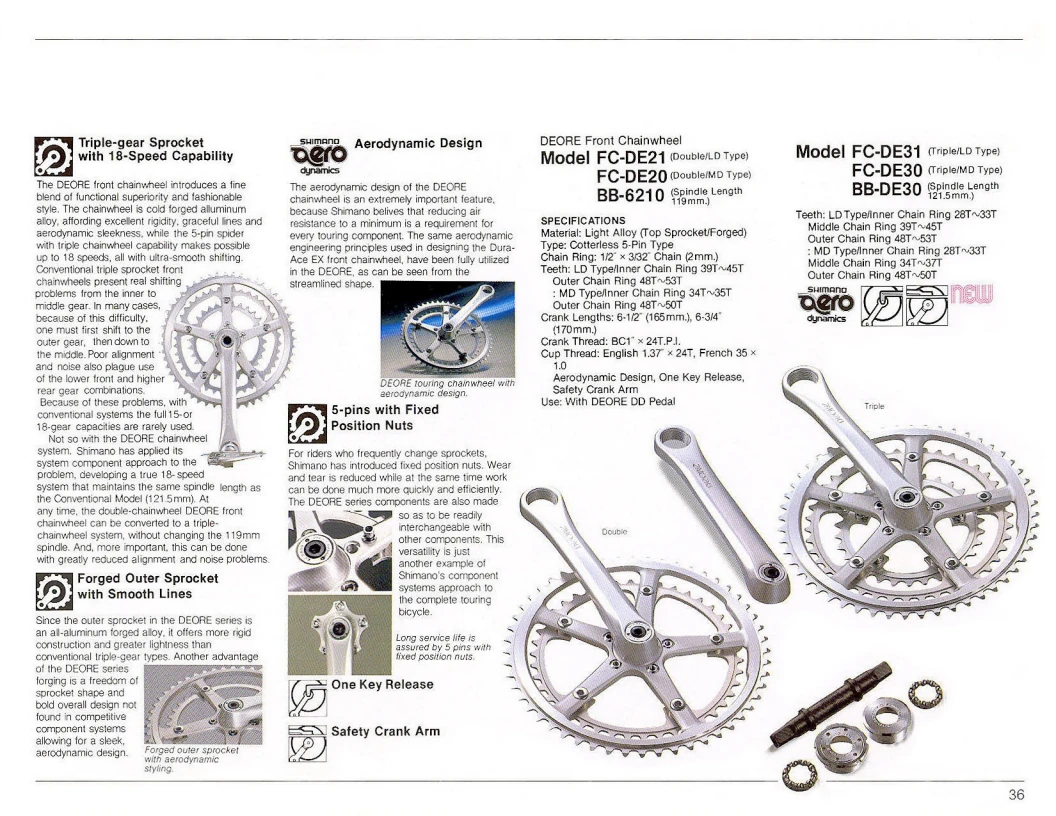 Page 37
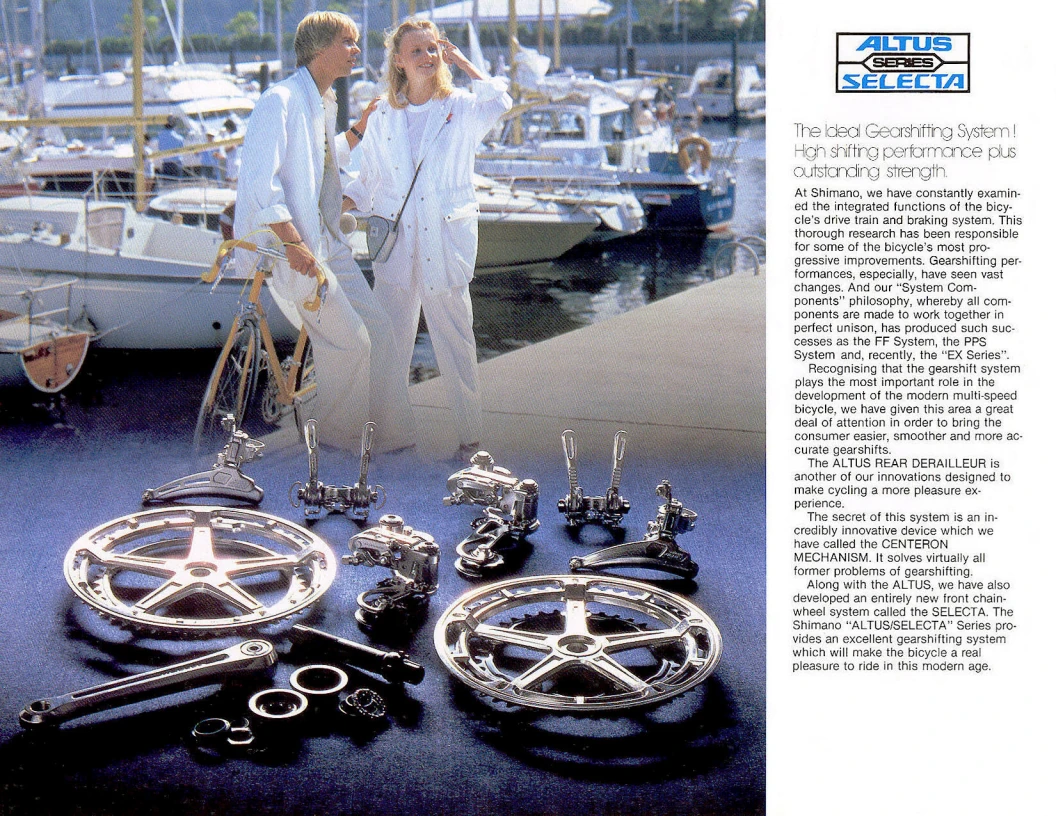 Page 38
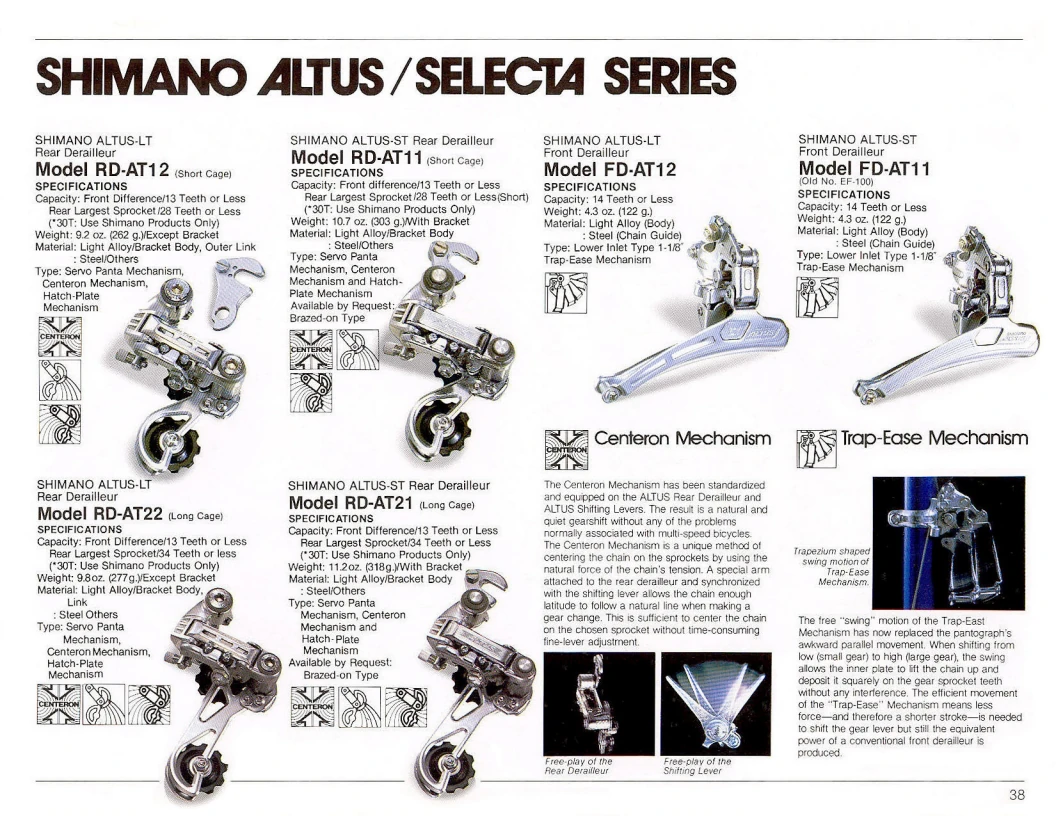 Page 39
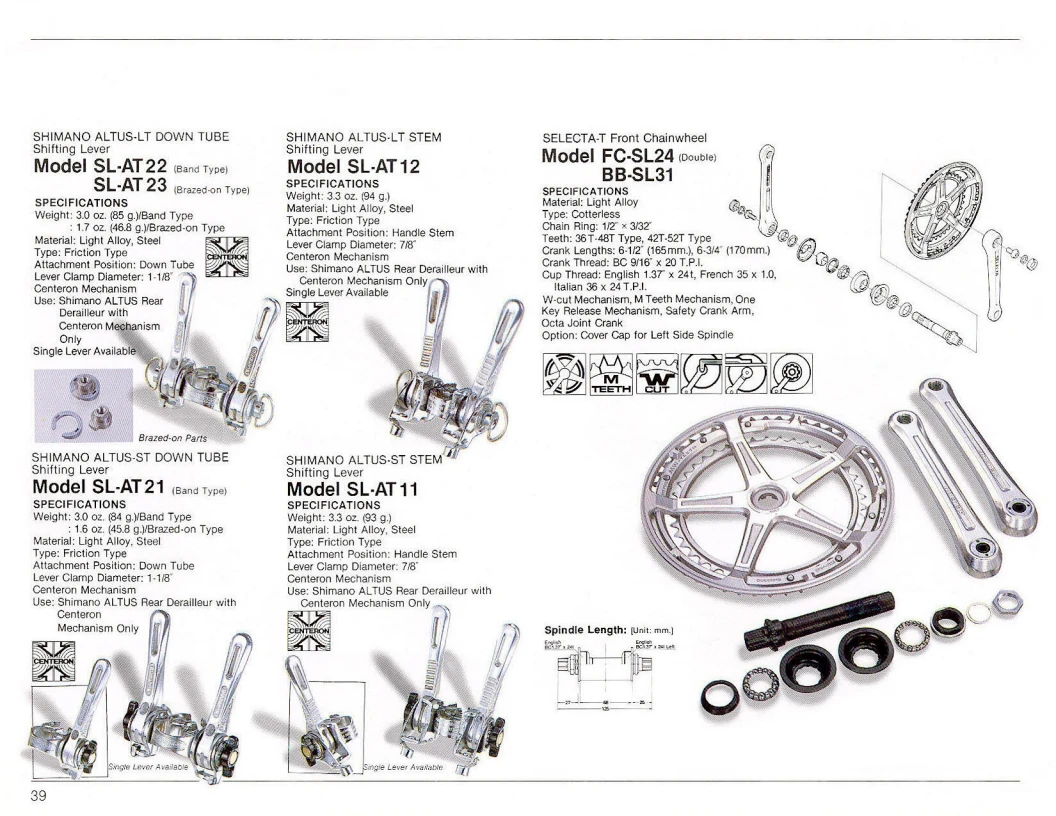 Page 40
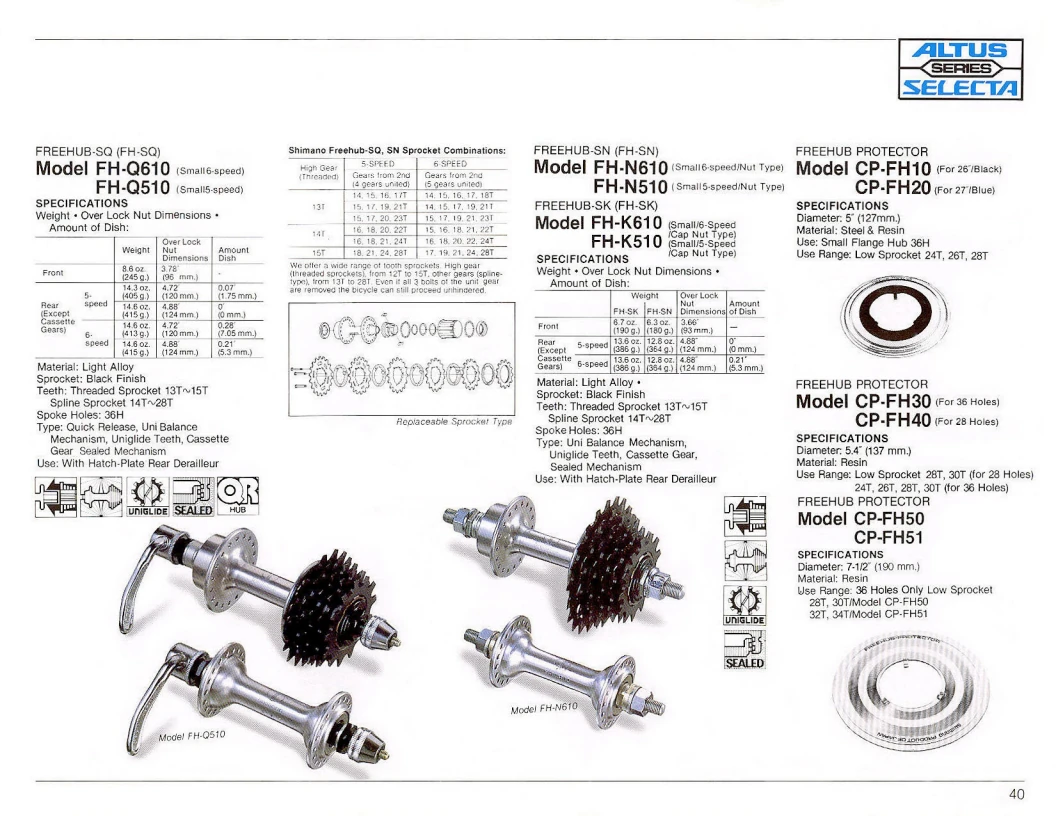 Page 41
 Page 42
 Page 43
| Marque | Shimano |
|---|---|
| Type | Catalog |
| Year | 1981 |
| Publisher | Shimano Industrial Co., Ltd., 3-77 Oimatsucho, Sakai, Osaka, Japan |
| Country | Japan |
| Language | English |
| Pages | 43 |
| Source | Retrobike archive (retrobike.co.uk), "1981 Shimano Catalogue", uploaded by the forum member mk one. |
| Credit | Retrobike (scan by mk one) |
| Identifier | Permalink https://www.retrobike.co.uk/archive/1981-shimano-catalogue.1013/ |
| Transcription | Transcribed by eye |
Reference
Shimano Industrial Co., Ltd., 3-77 Oimatsucho, Sakai, Osaka, Japan. Shimano Bicycle System Components 1981: Dura-Ace EX, Dura-Ace 10 and Track, Dura-Ace, 600 EX, 600, Deore and Altus, with the System Components Charts. 1981. Ebykr, https://ebykr.com/library/shimano-catalog-1981/.
Wikipedia
{{cite book |title=Shimano Bicycle System Components 1981: Dura-Ace EX, Dura-Ace 10 and Track, Dura-Ace, 600 EX, 600, Deore and Altus, with the System Components Charts |publisher=Shimano Industrial Co., Ltd., 3-77 Oimatsucho, Sakai, Osaka, Japan |date=1981 |url=https://ebykr.com/library/shimano-catalog-1981/ |via=Ebykr |access-date=}}SHIMANO BICYCLE SYSTEM COMPONENTS 1981 SHIMANO EX SERIES — EXCITING FEATURES DD Mechanism Dyna-Drive Pedal Finally the Pedal's function is defined! The pedal is an extremely crucial element in the propulsion of the bicycle. It is the first point of contact on the drive train between rider and bicycle. However, very little thought has been …
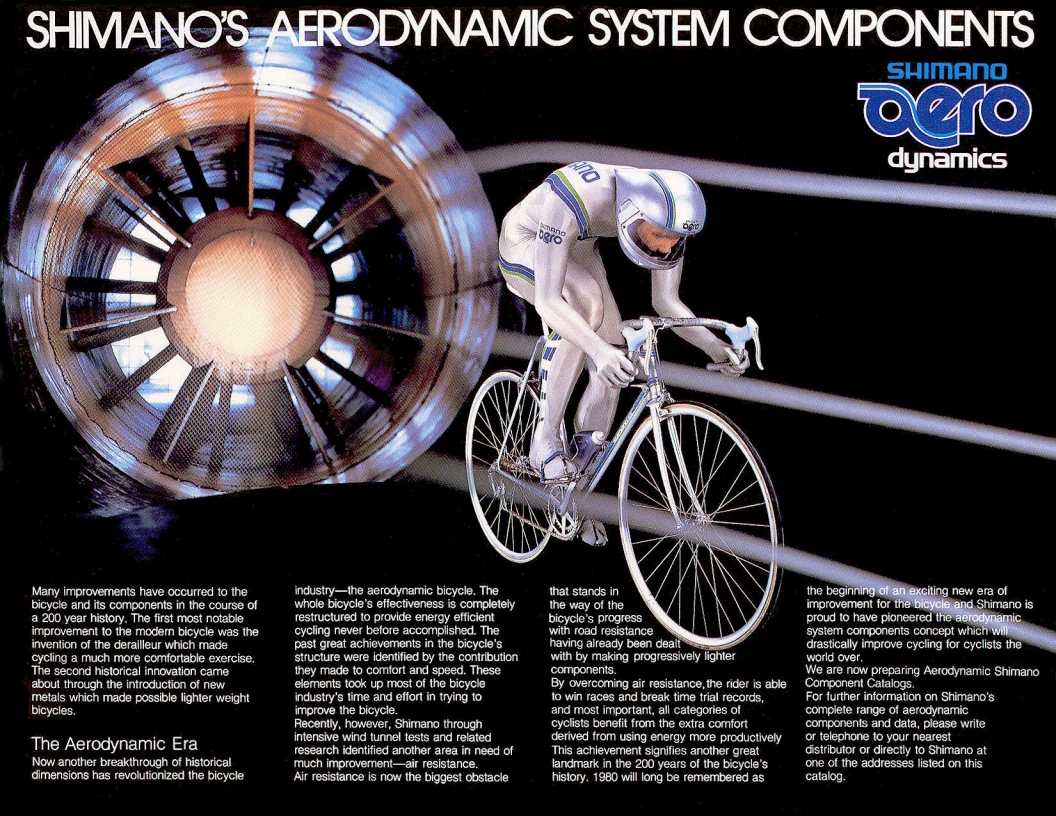
Shimano’s 1981 catalog, “Shimano Bicycle System Components 1981”: the EX features and the special innovations (Cassette Freehub, Uni Balance, Uniglide, Trap-Ease, Servo-Panta, Centeron, Positron, front freewheeling and the rest), the system components charts for road, track, touring, ten-speed, Positron, FF and BMX bicycles, then the Dura-Ace 10 and Dura-Ace track ensembles, Dura-Ace EX, Shimano 600 EX, Dura-Ace, Shimano 600, the new Deore touring components and the Altus and Selecta groups part by part, each with its model number and specifications, the freehubs and the aerodynamic system components, and the Shimano offices in Japan, the United States, West Germany and Singapore. Transcribed from the page images (43 pages); each page ends with a bracketed description of its pictures.
— Page 1 —
SHIMANO
BICYCLE
SYSTEM
COMPONENTS
1981
SHIMANO
[Front cover: the title in large gray outlined letters at upper left beside three diagonal stripes in green, light blue and dark blue; below, two team photographs side by side, at left a team in blue Capri Sonne jerseys posed with bicycles in a park, one rider in a black, yellow and red jersey, at right a team in red and white Cilo Aufina jerseys before two team cars with roof racks; the blue Shimano logo at bottom center.]
— Page 2 —
EX SERIES — EXCITING FEATURES
DD Mechanism
Dyna-Drive Pedal
Finally the Pedal’s function is defined!
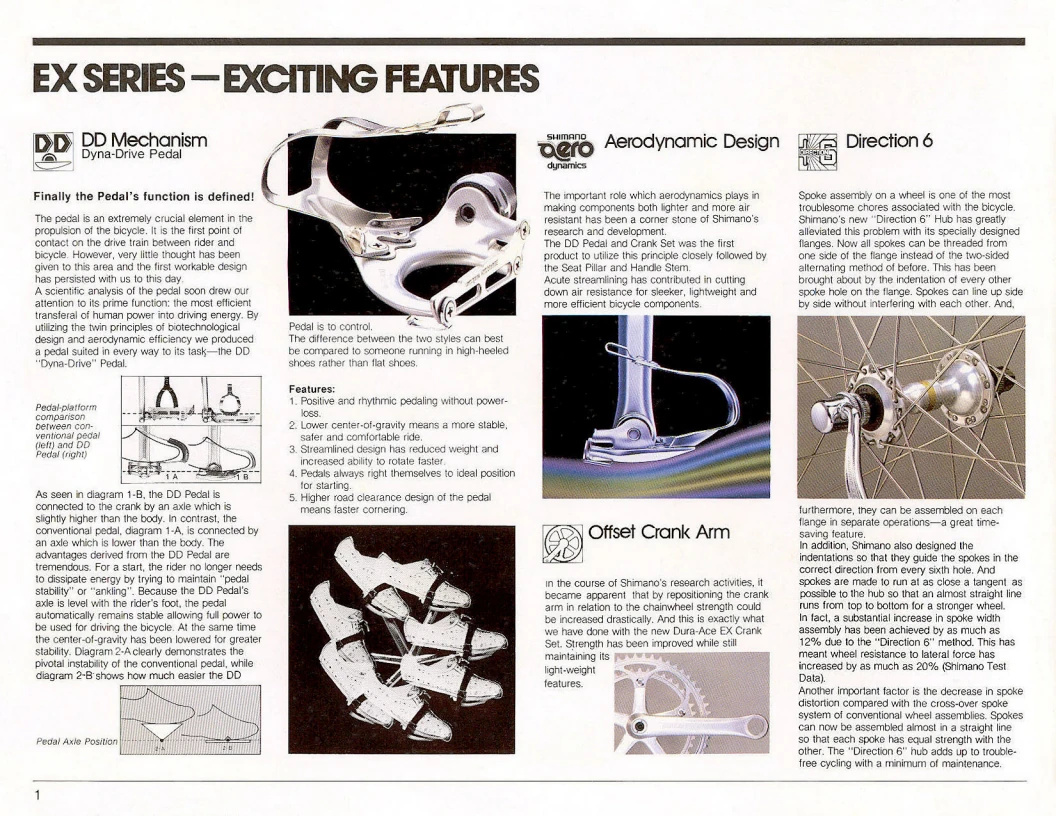
The pedal is an extremely crucial element in the propulsion of the bicycle. It is the first point of contact on the drive train between rider and bicycle. However, very little thought has been given to this area and the first workable design has persisted with us to this day.
A scientific analysis of the pedal soon drew our attention to its prime function: the most efficient transferal of human power into driving energy. By utilizing the twin principles of biotechnological design and aerodynamic efficiency we produced a pedal suited in every way to its task—the DD “Dyna-Drive” Pedal.
Pedal-platform comparison between conventional pedal (left) and DD Pedal (right)
1 A
1 B
As seen in diagram 1-B, the DD Pedal is connected to the crank by an axle which is slightly higher than the body. In contrast, the conventional pedal, diagram 1-A, is connected by an axle which is lower than the body. The advantages derived from the DD Pedal are tremendous. For a start, the rider no longer needs to dissipate energy by trying to maintain “pedal stability” or “ankling”. Because the DD Pedal’s axle is level with the rider’s foot, the pedal automatically remains stable allowing full power to be used for driving the bicycle. At the same time the center-of-gravity has been lowered for greater stability. Diagram 2-A clearly demonstrates the pivotal instability of the conventional pedal, while diagram 2-B shows how much easier the DD Pedal is to control.
The difference between the two styles can best be compared to someone running in high-heeled shoes rather than flat shoes.
Pedal Axle Position
2-A
2-B
Features:
1. Positive and rhythmic pedaling without power-loss.
2. Lower center-of-gravity means a more stable, safer and comfortable ride.
3. Streamlined design has reduced weight and increased ability to rotate faster.
4. Pedals always right themselves to ideal position for starting.
5. Higher road clearance design of the pedal means faster cornering.
SHIMANO aero dynamics
Aerodynamic Design
The important role which aerodynamics plays in making components both lighter and more air resistant has been a corner stone of Shimano’s research and development.
The DD Pedal and Crank Set was the first product to utilize this principle closely followed by the Seat Pillar and Handle Stem.
Acute streamlining has contributed in cutting down air resistance for sleeker, lightweight and more efficient bicycle components.
Offset Crank Arm
In the course of Shimano’s research activities, it became apparent that by repositioning the crank arm in relation to the chainwheel strength could be increased drastically. And this is exactly what we have done with the new Dura-Ace EX Crank Set. Strength has been improved while still maintaining its light-weight features.
DIRECTION 6
Direction 6
Spoke assembly on a wheel is one of the most troublesome chores associated with the bicycle. Shimano’s new “Direction 6” Hub has greatly alleviated this problem with its specially designed flanges. Now all spokes can be threaded from one side of the flange instead of the two-sided alternating method of before. This has been brought about by the indentation of every other spoke hole on the flange. Spokes can line up side by side without interfering with each other. And, furthermore, they can be assembled on each flange in separate operations—a great time-saving feature.
In addition, Shimano also designed the indentations so that they guide the spokes in the correct direction from every sixth hole. And spokes are made to run at as close a tangent as possible to the hub so that an almost straight line runs from top to bottom for a stronger wheel.
In fact, a substantial increase in spoke width assembly has been achieved by as much as 12% due to the “Direction 6” method. This has meant wheel resistance to lateral force has increased by as much as 20% (Shimano Test Data).
Another important factor is the decrease in spoke distortion compared with the cross-over spoke system of conventional wheel assemblies. Spokes can now be assembled almost in a straight line so that each spoke has equal strength with the other. The “Direction 6” hub adds up to trouble-free cycling with a minimum of maintenance.
1
[Feature page with four columns, each headed by a small icon: photographs of a silver DD pedal with toe clip and strap, cycling shoes on a stack of DD pedals against black, a seat pillar and pedal over a blurred colored background, a spoked hub close-up and an offset crank arm with chainring; line diagrams compare conventional and DD pedal axle positions.]
— Page 3 —
BICYCLE SYSTEM COMPONENT
Cassette Freehub
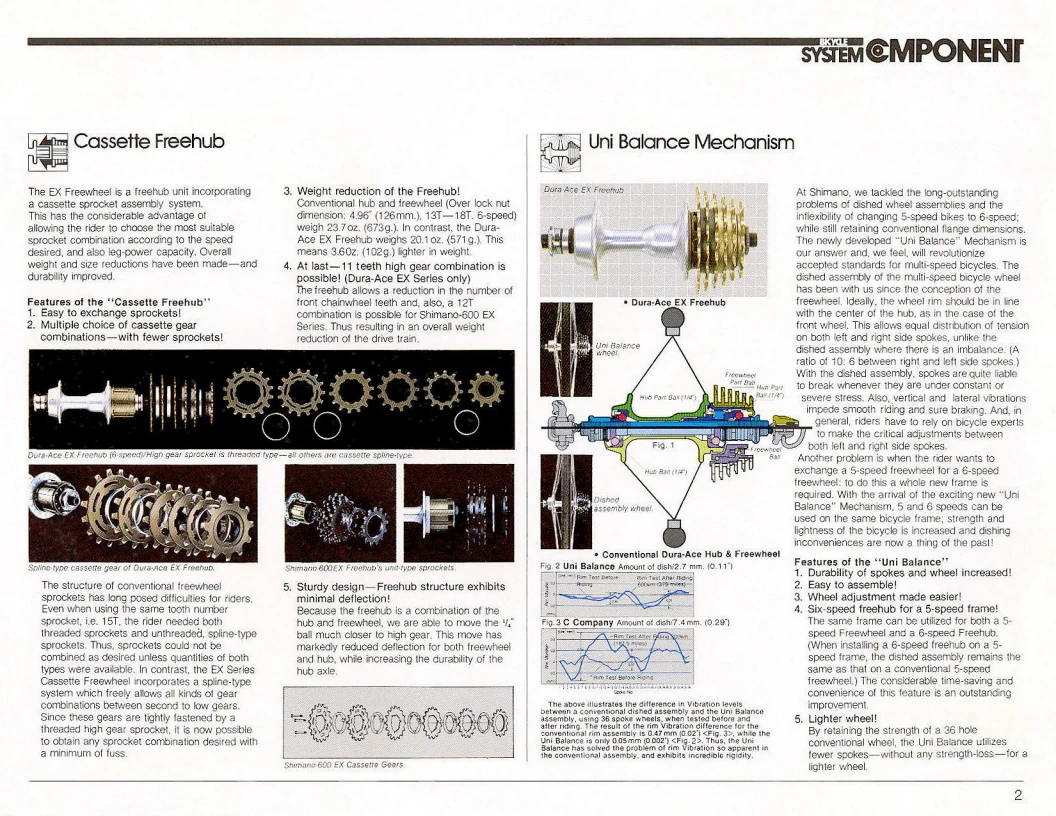
The EX Freewheel is a freehub unit incorporating a cassette sprocket assembly system.
This has the considerable advantage of allowing the rider to choose the most suitable sprocket combination according to the speed desired, and also leg-power capacity. Overall weight and size reductions have been made—and durability improved.
Features of the “Cassette Freehub”
1. Easy to exchange sprockets!
2. Multiple choice of cassette gear combinations—with fewer sprockets!
3. Weight reduction of the Freehub!
Conventional hub and freewheel (Over lock nut dimension: 4.96″ (126mm.), 13T—18T. 6-speed) weigh 23.7oz. (673g.). In contrast, the Dura-Ace EX Freehub weighs 20.1oz. (571g.). This means 3.60z. (102g.) lighter in weight.
4. At last—11 teeth high gear combination is possible! (Dura-Ace EX Series only)
The freehub allows a reduction in the number of front chainwheel teeth and, also, a 12T combination is possible for Shimano-600 EX Series. Thus resulting in an overall weight reduction of the drive train.
Dura-Ace EX Freehub (6-speed)/High gear sprocket is threaded type—all others are cassette spline-type.
Spline-type cassette gear of Dura-Ace EX Freehub.
Shimano 600EX Freehub’s unit-type sprockets.
The structure of conventional freewheel sprockets has long posed difficulties for riders. Even when using the same tooth number sprocket, i.e. 15T, the rider needed both threaded sprockets and unthreaded, spline-type sprockets. Thus, sprockets could not be combined as desired unless quantities of both types were available. In contrast, the EX Series Cassette Freewheel incorporates a spline-type system which freely allows all kinds of gear combinations between second to low gears. Since these gears are tightly fastened by a threaded high gear sprocket, it is now possible to obtain any sprocket combination desired with a minimum of fuss.
5. Sturdy design—Freehub structure exhibits minimal deflection!
Because the freehub is a combination of the hub and freewheel, we are able to move the 1/4″ ball much closer to high gear. This move has markedly reduced deflection for both freewheel and hub, while increasing the durability of the hub axle.
Shimano 600 EX Cassette Gears
Uni Balance Mechanism
Dura-Ace EX Freehub
Uni Balance wheel.
• Dura-Ace EX Freehub
Freewheel Part Ball
Hub Part Ball (1/4″)
Hub Part Ball (1/4″)
Fig. 1
Freewheel Ball
Hub Ball (1/4″)
Dished assembly wheel.
• Conventional Dura-Ace Hub & Freewheel
Fig. 2 Uni Balance Amount of dish/2.7 mm. (0.11″)
Rim Test Before Riding
Rim Test After Riding 600km (379 miles)
Fig. 3 C Company Amount of dish/7.4 mm. (0.29″)
Rim Test After Riding 300km (187.5 miles) [?]
Rim Test Before Riding
Spoke No.
The above illustrates the difference in Vibration levels between a conventional dished assembly and the Uni Balance assembly, using 36 spoke wheels, when tested before and after riding. The result of the rim Vibration difference for the conventional rim assembly is 0.47mm (0.02″)
At Shimano, we tackled the long-outstanding problems of dished wheel assemblies and the inflexibility of changing 5-speed bikes to 6-speed; while still retaining conventional flange dimensions. The newly developed “Uni Balance” Mechanism is our answer and, we feel, will revolutionize accepted standards for multi-speed bicycles. The dished assembly of the multi-speed bicycle wheel has been with us since the conception of the freewheel. Ideally, the wheel rim should be in line with the center of the hub, as in the case of the front wheel. This allows equal distribution of tension on both left and right side spokes, unlike the dished assembly where there is an imbalance. (A ratio of 10: 6 between right and left side spokes.) With the dished assembly, spokes are quite liable to break whenever they are under constant or severe stress. Also, vertical and lateral vibrations impede smooth riding and sure braking. And, in general, riders have to rely on bicycle experts to make the critical adjustments between both left and right side spokes.
Another problem is when the rider wants to exchange a 5-speed freewheel for a 6-speed freewheel: to do this a whole new frame is required. With the arrival of the exciting new “Uni Balance” Mechanism, 5 and 6 speeds can be used on the same bicycle frame; strength and lightness of the bicycle is increased and dishing inconveniences are now a thing of the past!
Features of the “Uni Balance”
1. Durability of spokes and wheel increased!
2. Easy to assemble!
3. Wheel adjustment made easier!
4. Six-speed freehub for a 5-speed frame!
The same frame can be utilized for both a 5-speed Freewheel and a 6-speed Freehub. (When installing a 6-speed freehub on a 5-speed frame, the dished assembly remains the same as that on a conventional 5-speed freewheel.) The considerable time-saving and convenience of this feature is an outstanding improvement.
5. Lighter wheel!
By retaining the strength of a 36 hole conventional wheel, the Uni Balance utilizes fewer spokes—without any strength-loss—for a lighter wheel.
2
[Feature page: at left a black band of photographs showing the Dura-Ace EX freehub with its cassette sprockets laid out in a row, close-ups of spline-type sprockets and a line drawing of the 600 EX cassette gears; at right a photograph of the freehub, a colored cutaway diagram comparing the Uni Balance and conventional hubs with wheel photographs, and two vibration test graphs.]
— Page 4 —
EX SERIES — EXCITING FEATURES
UNIGLIDE
Uniglide Freewheel
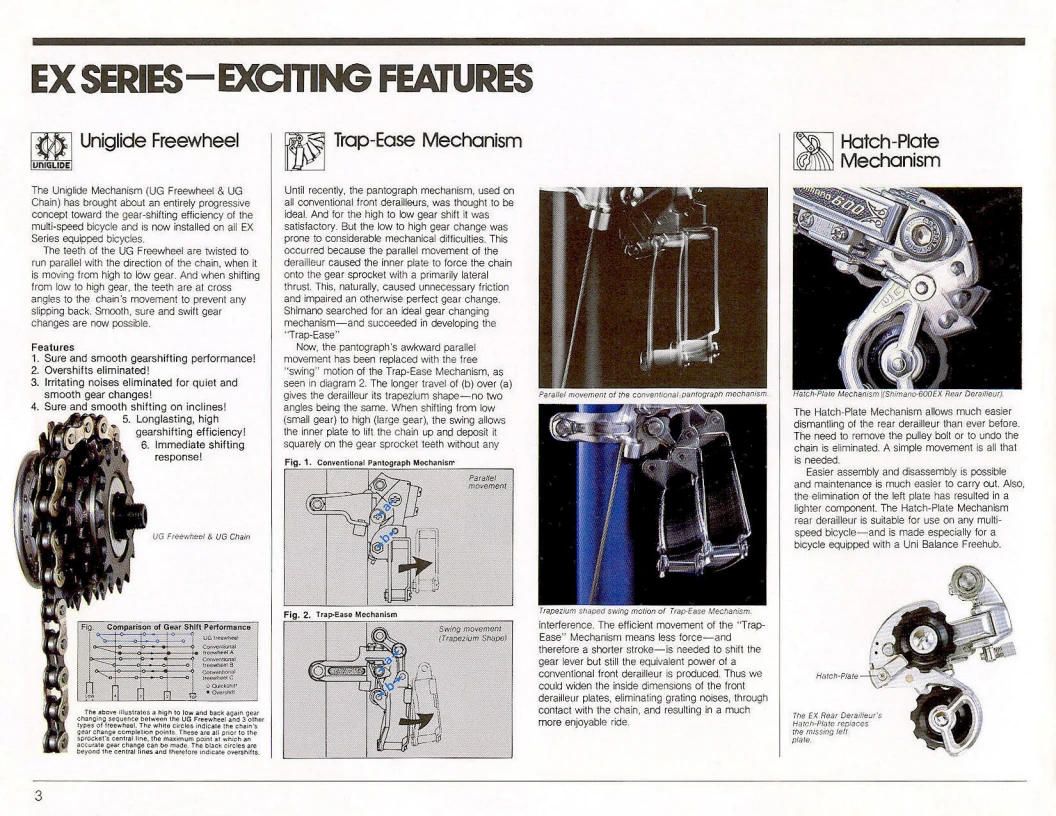
The Uniglide Mechanism (UG Freewheel & UG Chain) has brought about an entirely progressive concept toward the gear-shifting efficiency of the multi-speed bicycle and is now installed on all EX Series equipped bicycles.
The teeth of the UG Freewheel are twisted to run parallel with the direction of the chain, when it is moving from high to low gear. And when shifting from low to high gear, the teeth are at cross angles to the chain’s movement to prevent any slipping back. Smooth, sure and swift gear changes are now possible.
Features
1. Sure and smooth gearshifting performance!
2. Overshifts eliminated!
3. Irritating noises eliminated for quiet and smooth gear changes!
4. Sure and smooth shifting on inclines!
5. Longlasting, high gearshifting efficiency!
6. Immediate shifting response!
UG Freewheel & UG Chain
Fig. Comparison of Gear Shift Performance
UG freewheel
Conventional freewheel A
Conventional freewheel B
Conventional freewheel C
○ Quickshift [?]
● Overshift
The above illustrates a high to low and back again gear changing sequence between the UG Freewheel and 3 other types of freewheel. The white circles indicate the chain’s gear change completion points. These are all prior to the sprocket’s central line, the maximum point at which an accurate gear change can be made. The black circles are beyond the central lines and therefore indicate overshifts.
Trap-Ease Mechanism
Until recently, the pantograph mechanism, used on all conventional front derailleurs, was thought to be ideal. And for the high to low gear shift it was satisfactory. But the low to high gear change was prone to considerable mechanical difficulties. This occurred because the parallel movement of the derailleur caused the inner plate to force the chain onto the gear sprocket with a primarily lateral thrust. This, naturally, caused unnecessary friction and impaired an otherwise perfect gear change. Shimano searched for an ideal gear changing mechanism—and succeeded in developing the “Trap-Ease”.
Now, the pantograph’s awkward parallel movement has been replaced with the free “swing” motion of the Trap-Ease Mechanism, as seen in diagram 2. The longer travel of (b) over (a) gives the derailleur its trapezium shape—no two angles being the same. When shifting from low (small gear) to high (large gear), the swing allows the inner plate to lift the chain up and deposit it squarely on the gear sprocket teeth without any interference. The efficient movement of the “Trap-Ease” Mechanism means less force—and therefore a shorter stroke—is needed to shift the gear lever but still the equivalent power of a conventional front derailleur is produced. Thus we could widen the inside dimensions of the front derailleur plates, eliminating grating noises, through contact with the chain, and resulting in a much more enjoyable ride.
Fig. 1. Conventional Pantograph Mechanism
Parallel movement
Fig. 2. Trap-Ease Mechanism
Swing movement (Trapezium Shape)
Parallel movement of the conventional pantograph mechanism.
Trapezium shaped swing motion of Trap-Ease Mechanism.
Hatch-Plate Mechanism
Hatch-Plate Mechanism (Shimano-600EX Rear Derailleur).
The Hatch-Plate Mechanism allows much easier dismantling of the rear derailleur than ever before. The need to remove the pulley bolt or to undo the chain is eliminated. A simple movement is all that is needed.
Easier assembly and disassembly is possible and maintenance is much easier to carry out. Also, the elimination of the left plate has resulted in a lighter component. The Hatch-Plate Mechanism rear derailleur is suitable for use on any multi-speed bicycle—and is made especially for a bicycle equipped with a Uni Balance Freehub.
Hatch-Plate
The EX Rear Derailleur’s Hatch-Plate replaces the missing left plate.
3
[Feature page: a photograph of a UG freewheel with chain at left above a gear shift comparison chart; two line diagrams comparing pantograph and Trap-Ease front derailleur movement; two photographs of a front derailleur on a blue frame tube; a close-up of the Shimano 600 EX rear derailleur and a cutout of its Hatch-Plate cage.]
— Page 5 —
BICYCLE SYSTEM COMPONENT
W CUT
W cut Teeth Mechanism
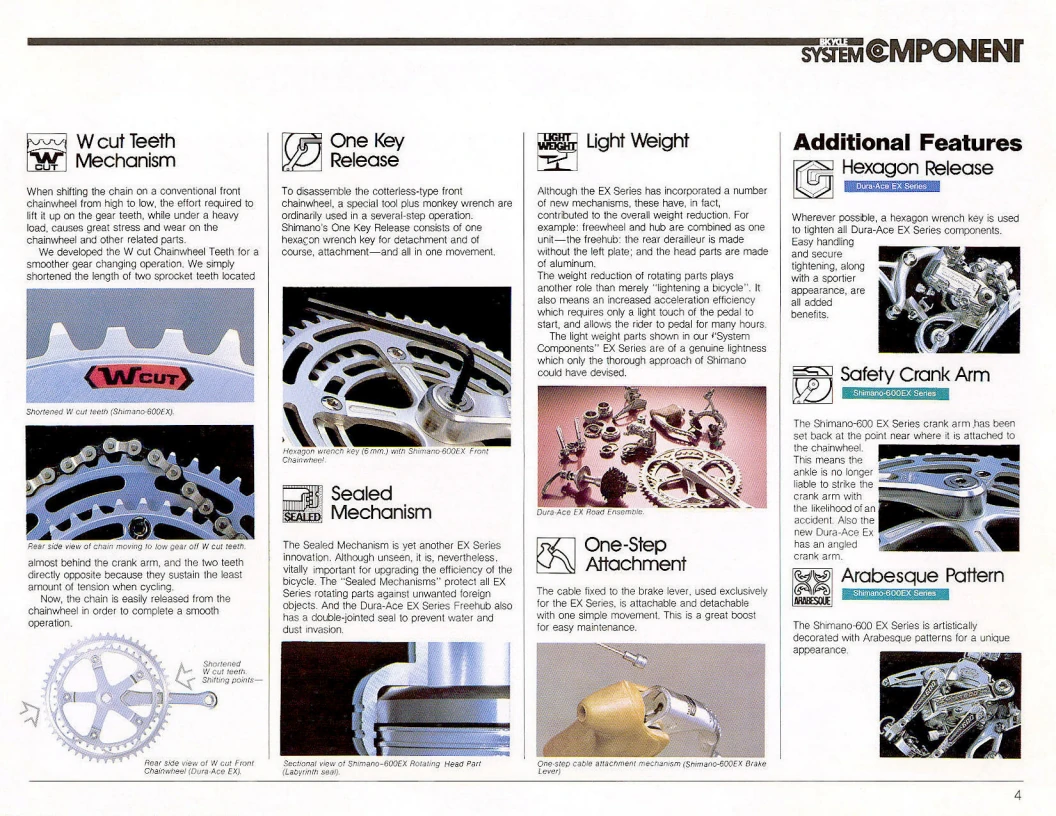
When shifting the chain on a conventional front chainwheel from high to low, the effort required to lift it up on the gear teeth, while under a heavy load, causes great stress and wear on the chainwheel and other related parts.
We developed the W cut Chainwheel Teeth for a smoother gear changing operation. We simply shortened the length of two sprocket teeth located almost behind the crank arm, and the two teeth directly opposite because they sustain the least amount of tension when cycling.
Now, the chain is easily released from the chainwheel in order to complete a smooth operation.
Shortened W cut teeth (Shimano-600EX).
Rear side view of chain moving to low gear off W cut teeth.
Shortened W cut teeth. Shifting points—
Rear side view of W cut Front Chainwheel (Dura-Ace EX).
One Key Release
To disassemble the cotterless-type front chainwheel, a special tool plus monkey wrench are ordinarily used in a several-step operation. Shimano’s One Key Release consists of one hexagon wrench key for detachment and of course, attachment—and all in one movement.
Hexagon wrench key (6mm.) with Shimano-600EX Front Chainwheel.
SEALED
Sealed Mechanism
The Sealed Mechanism is yet another EX Series innovation. Although unseen, it is, nevertheless, vitally important for upgrading the efficiency of the bicycle. The “Sealed Mechanisms” protect all EX Series rotating parts against unwanted foreign objects. And the Dura-Ace EX Series Freehub also has a double-jointed seal to prevent water and dust invasion.
Sectional view of Shimano-600EX Rotating Head Part (Labyrinth seal).
LIGHT WEIGHT
Light Weight
Although the EX Series has incorporated a number of new mechanisms, these have, in fact, contributed to the overall weight reduction. For example: freewheel and hub are combined as one unit—the freehub: the rear derailleur is made without the left plate; and the head parts are made of aluminum.
The weight reduction of rotating parts plays another role than merely “lightening a bicycle”. It also means an increased acceleration efficiency which requires only a light touch of the pedal to start, and allows the rider to pedal for many hours.
The light weight parts shown in our “System Components” EX Series are of a genuine lightness which only the thorough approach of Shimano could have devised.
Dura-Ace EX Road Ensemble.
One-Step Attachment
The cable fixed to the brake lever, used exclusively for the EX Series, is attachable and detachable with one simple movement. This is a great boost for easy maintenance.
One-step cable attachment mechanism (Shimano-600EX Brake Lever)
Additional Features
Hexagon Release
Dura-Ace EX Series
Wherever possible, a hexagon wrench key is used to tighten all Dura-Ace EX Series components. Easy handling and secure tightening, along with a sportier appearance, are all added benefits.
Safety Crank Arm
Shimano-600EX Series
The Shimano-600 EX Series crank arm has been set back at the point near where it is attached to the chainwheel. This means the ankle is no longer liable to strike the crank arm with the likelihood of an accident. Also the new Dura-Ace EX has an angled crank arm.
ARABESQUE
Arabesque Pattern
Shimano-600EX Series
The Shimano-600 EX Series is artistically decorated with Arabesque patterns for a unique appearance.
4
[Feature page in four columns with small icons: photographs of a W cut chainring with its red logo, a chain on a chainring, a hex key in a crank, a sectional head part, a pink-background group of Dura-Ace EX components, a brake lever cable fitting, a caliper brake, a crank arm and an arabesque-decorated derailleur; a line drawing of a chainwheel.]
— Page 6 —
SHIMANO SYSTEM COMPONENTS SPECIAL INNOVATIONS
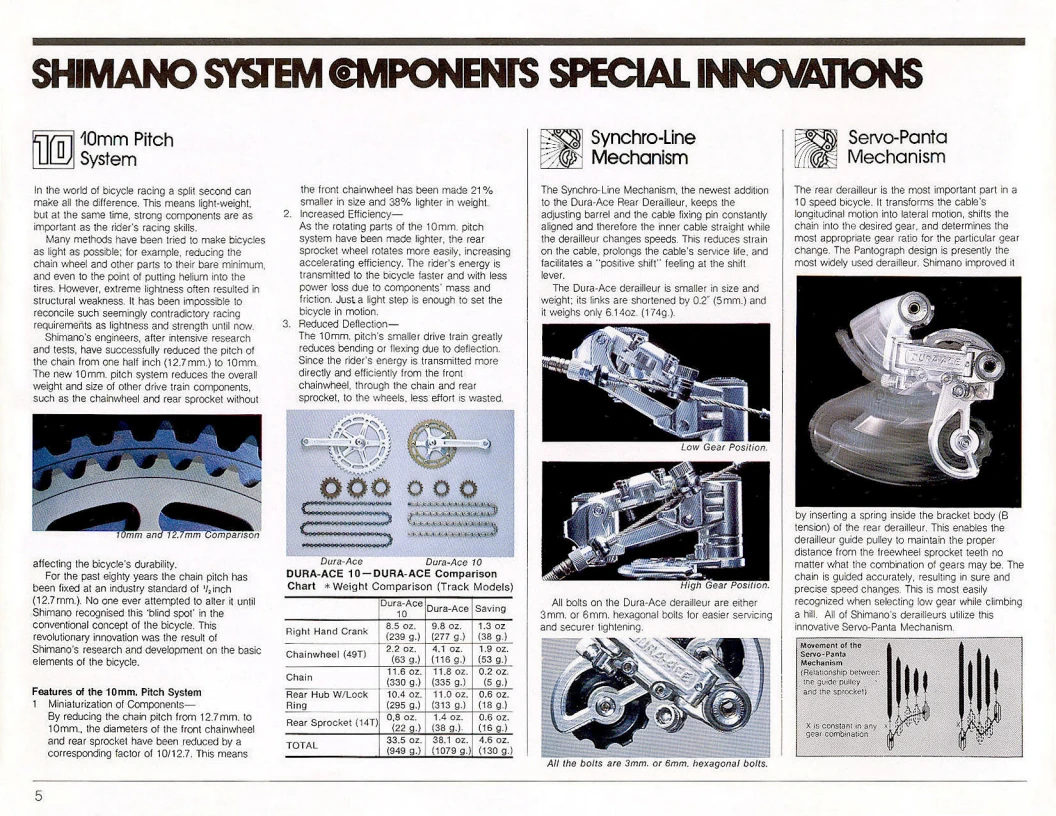
10mm Pitch System
In the world of bicycle racing a split second can make all the difference. This means light-weight, but at the same time, strong components are as important as the rider’s racing skills.
Many methods have been tried to make bicycles as light as possible; for example, reducing the chain wheel and other parts to their bare minimum, and even to the point of putting helium into the tires. However, extreme lightness often resulted in structural weakness. It has been impossible to reconcile such seemingly contradictory racing requirements as lightness and strength until now.
Shimano’s engineers, after intensive research and tests, have successfully reduced the pitch of the chain from one half inch (12.7mm.) to 10mm. The new 10mm. pitch system reduces the overall weight and size of other drive train components, such as the chainwheel and rear sprocket without affecting the bicycle’s durability.
10mm and 12.7mm Comparison
For the past eighty years the chain pitch has been fixed at an industry standard of 1/2 inch (12.7mm.). No one ever attempted to alter it until Shimano recognised this ‘blind spot’ in the conventional concept of the bicycle. This revolutionary innovation was the result of Shimano’s research and development on the basic elements of the bicycle.
Features of the 10mm. Pitch System
1 Miniaturization of Components—
By reducing the chain pitch from 12.7mm. to 10mm., the diameters of the front chainwheel and rear sprocket have been reduced by a corresponding factor of 10/12.7. This means the front chainwheel has been made 21% smaller in size and 38% lighter in weight.
2. Increased Efficiency—
As the rotating parts of the 10mm. pitch system have been made lighter, the rear sprocket wheel rotates more easily, increasing accelerating efficiency. The rider’s energy is transmitted to the bicycle faster and with less power loss due to components’ mass and friction. Just a light step is enough to set the bicycle in motion.
3. Reduced Deflection—
The 10mm. pitch’s smaller drive train greatly reduces bending or flexing due to deflection. Since the rider’s energy is transmitted more directly and efficiently from the front chainwheel, through the chain and rear sprocket, to the wheels, less effort is wasted.
Dura-Ace
Dura-Ace 10
DURA-ACE 10—DURA-ACE Comparison Chart *Weight Comparison (Track Models)
| Dura-Ace 10 | Dura-Ace | Saving
Right Hand Crank | 8.5 oz. (239 g.) | 9.8 oz. (277 g.) | 1.3 oz (38 g.)
Chainwheel (49T) | 2.2 oz. (63 g.) | 4.1 oz. (116 g.) | 1.9 oz. (53 g.)
Chain | 11.6 oz. (330 g.) | 11.8 oz. (335 g.) | 0.2 oz. (5 g.)
Rear Hub W/Lock Ring | 10.4 oz. (295 g.) | 11.0 oz. (313 g.) | 0.6 oz. (18 g.)
Rear Sprocket (14T) | 0.8 oz. (22 g.) | 1.4 oz. (38 g.) | 0.6 oz. (16 g.)
TOTAL | 33.5 oz. (949 g.) | 38.1 oz. (1079 g.) | 4.6 oz. (130 g.)
Synchro-Line Mechanism
The Synchro-Line Mechanism, the newest addition to the Dura-Ace Rear Derailleur, keeps the adjusting barrel and the cable fixing pin constantly aligned and therefore the inner cable straight while the derailleur changes speeds. This reduces strain on the cable, prolongs the cable’s service life, and facilitates a “positive shift” feeling at the shift lever.
The Dura-Ace derailleur is smaller in size and weight; its links are shortened by 0.2″ (5mm.) and it weighs only 6.14oz. (174g.).
Low Gear Position.
High Gear Position.
All bolts on the Dura-Ace derailleur are either 3mm. or 6mm. hexagonal bolts for easier servicing and securer tightening.
All the bolts are 3mm. or 6mm. hexagonal bolts.
Servo-Panta Mechanism
The rear derailleur is the most important part in a 10 speed bicycle. It transforms the cable’s longitudinal motion into lateral motion, shifts the chain into the desired gear, and determines the most appropriate gear ratio for the particular gear change. The Pantograph design is presently the most widely used derailleur. Shimano improved it by inserting a spring inside the bracket body (B tension) of the rear derailleur. This enables the derailleur guide pulley to maintain the proper distance from the freewheel sprocket teeth no matter what the combination of gears may be. The chain is guided accurately, resulting in sure and precise speed changes. This is most easily recognized when selecting low gear while climbing a hill. All of Shimano’s derailleurs utilize this innovative Servo-Panta Mechanism.
Movement of the Servo-Panta Mechanism (Relationship between the guide pulley and the sprocket)
X is constant in any gear combination
5
[Feature page: a close-up of 10mm and 12.7mm chainring teeth in blue light; a photograph comparing Dura-Ace and Dura-Ace 10 track cranks, sprockets and chains above a weight table; three photographs of the Dura-Ace rear derailleur in low and high gear and a hex bolt view; a Dura-Ace derailleur in a clear housing and a Servo-Panta diagram.]
— Page 7 —
BICYCLE SYSTEM COMPONENT
CENTERON
Centeron Mechanism
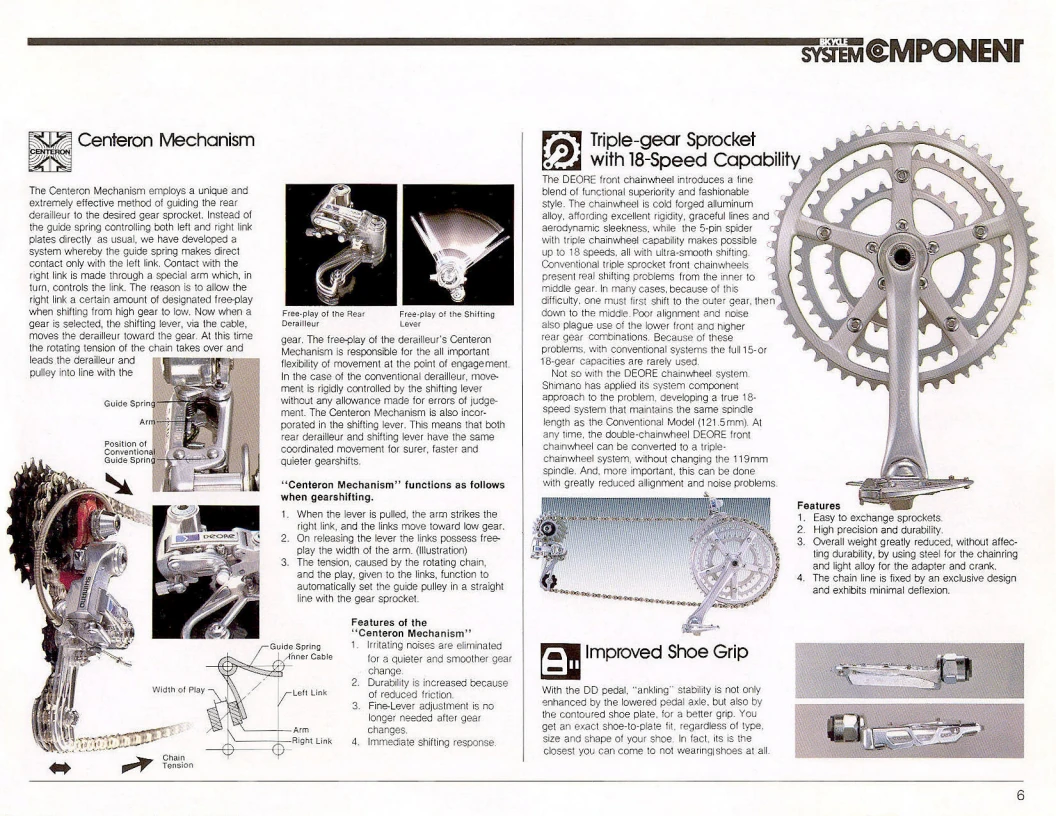
The Centeron Mechanism employs a unique and extremely effective method of guiding the rear derailleur to the desired gear sprocket. Instead of the guide spring controlling both left and right link plates directly as usual, we have developed a system whereby the guide spring makes direct contact only with the left link. Contact with the right link is made through a special arm which, in turn, controls the link. The reason is to allow the right link a certain amount of designated free-play when shifting from high gear to low. Now when a gear is selected, the shifting lever, via the cable, moves the derailleur toward the gear. At this time the rotating tension of the chain takes over and leads the derailleur and pulley into line with the gear. The free-play of the derailleur’s Centeron Mechanism is responsible for all the important flexibility of movement at the point of engagement. In the case of the conventional derailleur, movement is rigidly controlled by the shifting lever without any allowance made for errors of judgement. The Centeron Mechanism is also incorporated in the shifting lever. This means that both rear derailleur and shifting lever have the same coordinated movement for surer, faster and quieter gearshifts.
Guide Spring
Arm
Position of Conventional Guide Spring
Free-play of the Rear Derailleur
Free-play of the Shifting Lever
“Centeron Mechanism” functions as follows when gearshifting.
1. When the lever is pulled, the arm strikes the right link, and the links move toward low gear.
2. On releasing the lever the links possess free-play the width of the arm. (Illustration)
3. The tension, caused by the rotating chain, and the play, given to the links, function to automatically set the guide pulley in a straight line with the gear sprocket.
Guide Spring
Inner Cable
Width of Play
Left Link
Arm
Right Link
Chain Tension
Features of the “Centeron Mechanism”
1. Irritating noises are eliminated for a quieter and smoother gear change.
2. Durability is increased because of reduced friction.
3. Fine-Lever adjustment is no longer needed after gear changes.
4. Immediate shifting response.
Triple-gear Sprocket with 18-Speed Capability
The DEORE front chainwheel introduces a fine blend of functional superiority and fashionable style. The chainwheel is cold forged alluminum alloy, affording excellent rigidity, graceful lines and aerodynamic sleekness, while the 5-pin spider with triple chainwheel capability makes possible up to 18 speeds, all with ultra-smooth shifting. Conventional triple sprocket front chainwheels present real shifting problems from the inner to middle gear. In many cases, because of this difficulty, one must first shift to the outer gear, then down to the middle. Poor alignment and noise also plague use of the lower front and higher rear gear combinations. Because of these problems, with conventional systems the full 15-or 18-gear capacities are rarely used.
Not so with the DEORE chainwheel system. Shimano has applied its system component approach to the problem, developing a true 18-speed system that maintains the same spindle length as the Conventional Model (121.5mm). At any time, the double-chainwheel DEORE front chainwheel can be converted to a triple-chainwheel system, without changing the 119mm spindle. And, more important, this can be done with greatly reduced alignment and noise problems.
Features
1. Easy to exchange sprockets.
2. High precision and durability.
3. Overall weight greatly reduced, without affecting durability, by using steel for the chainring and light alloy for the adapter and crank.
4. The chain line is fixed by an exclusive design and exhibits minimal deflexion.
Improved Shoe Grip
With the DD pedal, “ankling” stability is not only enhanced by the lowered pedal axle, but also by the contoured shoe plate, for a better grip. You get an exact shoe-to-plate fit, regardless of type, size and shape of your shoe. In fact, its is the closest you can come to not wearing shoes at all.
6
[Feature page: photographs of a Deore rear derailleur on a freewheel with chain, two small views of derailleur and shift lever free-play and a line diagram of the Centeron links; a large silver Deore triple crankset, a drive train with chain and a front derailleur, and two views of a DD pedal shoe plate.]
— Page 8 —
SHIMANO SYSTEM COMPONENTS SPECIAL INNOVATIONS
Uniglide Mechanism
10 speed bicycles now command the major share of the bicycle market. At Shimano we have pushed forward a series of developments based on our “System Components” principle. We believe that in order to innovate the structure of a bicycle, the function of each component has to be re-evaluated and the individual part seen as it relates to the whole.
Our engineers studied the complete power train of the bicycle and singled out the chain and freewheel as being the basis for fundamental improvement. The outcome was the introduction of the Uniglide freewheel (UG freewheel). As components especially designed for multi-speed bicycles, the chain and freewheel greatly improve gearshift performance and have won attention as a revolutionary development.
UNIGLIDE
Uniglide Chain
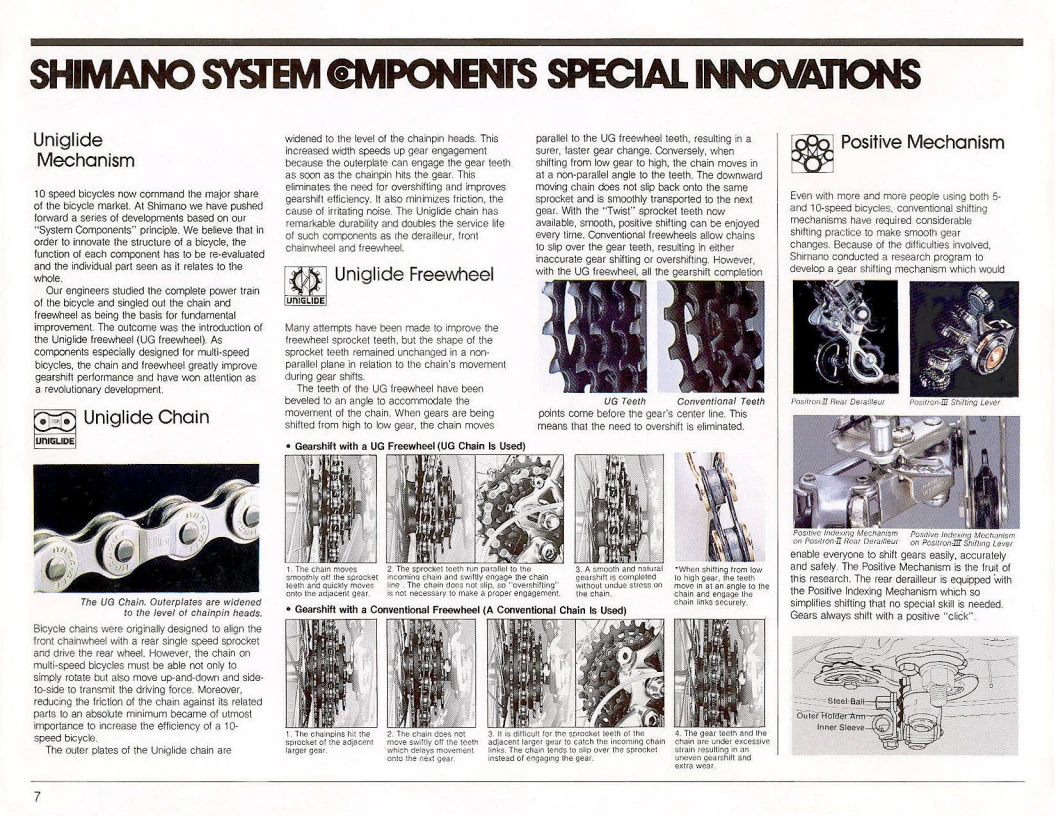
The UG Chain. Outerplates are widened to the level of chainpin heads.
Bicycle chains were originally designed to align the front chainwheel with a rear single speed sprocket and drive the rear wheel. However, the chain on multi-speed bicycles must be able not only to simply rotate but also move up-and-down and side-to-side to transmit the driving force. Moreover, reducing the friction of the chain against its related parts to an absolute minimum became of utmost importance to increase the efficiency of a 10-speed bicycle.
The outer plates of the Uniglide chain are widened to the level of the chainpin heads. This increased width speeds up gear engagement because the outerplate can engage the gear teeth as soon as the chainpin hits the gear teeth. This eliminates the need for overshifting and improves gearshift efficiency. It also minimizes friction, the cause of irritating noise. The Uniglide chain has remarkable durability and doubles the service life of such components as the derailleur, front chainwheel and freewheel.
UNIGLIDE
Uniglide Freewheel
Many attempts have been made to improve the freewheel sprocket teeth, but the shape of the sprocket teeth remained unchanged in a non-parallel plane in relation to the chain’s movement during gear shifts.
The teeth of the UG freewheel have been beveled to an angle to accommodate the movement of the chain. When gears are being shifted from high to low gear, the chain moves parallel to the UG freewheel teeth, resulting in a surer, faster gear change. Conversely, when shifting from low gear to high, the chain moves at a non-parallel angle to the teeth. The downward moving chain does not slip back onto the same sprocket and is smoothly transported to the next gear. With the “Twist” sprocket teeth now available, smooth, positive shifting can be enjoyed every time. Conventional freewheels allow chains to slip over the gear teeth, resulting in either inaccurate gear shifting or overshifting. However, with the UG freewheel, all the gearshift completion points come before the gear’s center line. This means that the need to overshift is eliminated.
UG Teeth
Conventional Teeth
• Gearshift with a UG Freewheel (UG Chain Is Used)
1. The chain moves smoothly off the sprocket teeth and quickly moves onto the adjacent gear.
2. The sprocket teeth run parallel to the incoming chain and swiftly engage the chain line. The chain does not slip, so “overshifting” is not necessary to make a proper engagement.
3. A smooth and natural gearshift is completed without undue stress on the chain.
*When shifting from low to high gear, the teeth move in at an angle to the chain and engage the chain links securely.
• Gearshift with a Conventional Freewheel (A Conventional Chain Is Used)
1. The chainpins hit the sprocket of the adjacent larger gear.
2. The chain does not move swiftly off the teeth which delays movement onto the next gear.
3. It is difficult for the sprocket teeth of the adjacent larger gear to catch the incoming chain links. The chain tends to slip over the sprocket instead of engaging the gear.
4. The gear teeth and the chain are under excessive strain resulting in an uneven gearshift and extra wear.
Positive Mechanism
Even with more and more people using both 5- and 10-speed bicycles, conventional shifting mechanisms have required considerable shifting practice to make smooth gear changes. Because of the difficulties involved, Shimano conducted a research program to develop a gear shifting mechanism which would enable everyone to shift gears easily, accurately and safely. The Positive Mechanism is the fruit of this research. The rear derailleur is equipped with the Positive Indexing Mechanism which so simplifies shifting that no special skill is needed. Gears always shift with a positive “click”.
Positron-II Rear Derailleur
Positron-III Shifting Lever
Positive Indexing Mechanism on Positron-II Rear Derailleur
Positive Indexing Mechanism on Positron-III Shifting Lever
Steel Ball
Outer Holder Arm
Inner Sleeve
7
[Feature page: a close-up of a silver UG chain on black; two close-ups comparing UG and conventional freewheel teeth; two rows of small photographs showing gearshift sequences on UG and conventional freewheels; photographs of the Positron II rear derailleur, Positron III shift lever and an indexing mechanism with a line drawing of its steel ball detent.]
— Page 9 —
BICYCLE SYSTEM COMPONENT
Pre-Select Mechanism
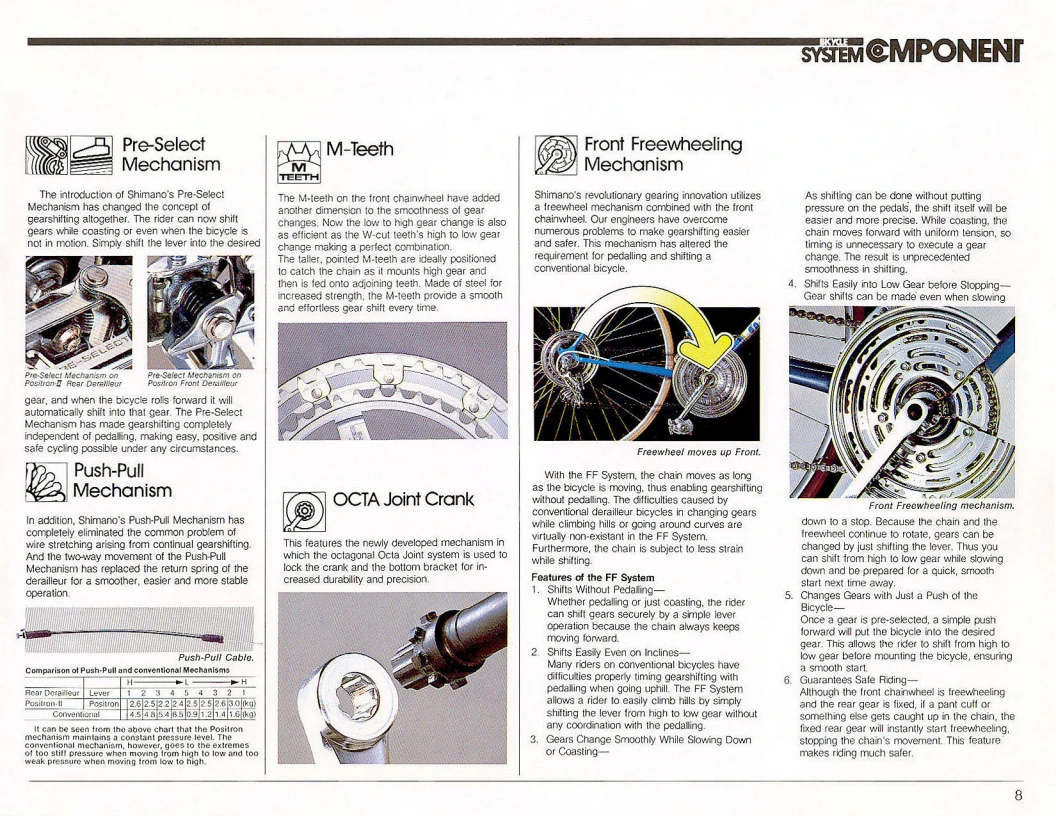
The introduction of Shimano’s Pre-Select Mechanism has changed the concept of gearshifting altogether. The rider can now shift gears while coasting or even when the bicycle is not in motion. Simply shift the lever into the desired gear, and when the bicycle rolls forward it will automatically shift into that gear. The Pre-Select Mechanism has made gearshifting completely independent of pedalling, making easy, positive and safe cycling possible under any circumstances.
Pre-Select Mechanism on Positron-II Rear Derailleur
Pre-Select Mechanism on Positron Front Derailleur
Push-Pull Mechanism
In addition, Shimano’s Push-Pull Mechanism has completely eliminated the common problem of wire stretching arising from continual gearshifting. And the two-way movement of the Push-Pull Mechanism has replaced the return spring of the derailleur for a smoother, easier and more stable operation.
Push-Pull Cable.
Comparison of Push-Pull and conventional Mechanisms
Rear Derailleur | Lever | H → L → H: 1 | 2 | 3 | 4 | 5 | 4 | 3 | 2 | 1
Positron-II | Positron | 2.6 | 2.5 | 2.2 | 2.4 | 2.5 | 2.5 | 2.6 | 3.0 | (kg)
Conventional | 4.5 | 4.8 | 5.4 | 6.5 | 0.9 | 1.2 | 1.4 | 1.6 | (kg)
It can be seen from the above chart that the Positron mechanism maintains a constant pressure level. The conventional mechanism, however, goes to the extremes of too stiff pressure when moving from high to low and too weak pressure when moving from low to high.
M TEETH
M-Teeth
The M-teeth on the front chainwheel have added another dimension to the smoothness of gear changes. Now the low to high gear change is also as efficient as the W-cut teeth’s high to low gear change making a perfect combination.
The taller, pointed M-teeth are ideally positioned to catch the chain as it mounts high gear and then is fed onto adjoining teeth. Made of steel for increased strength, the M-teeth provide a smooth and effortless gear shift every time.
OCTA Joint Crank
This features the newly developed mechanism in which the octagonal Octa Joint system is used to lock the crank and the bottom bracket for increased durability and precision.
Front Freewheeling Mechanism
Shimano’s revolutionary gearing innovation utilizes a freewheel mechanism combined with the front chainwheel. Our engineers have overcome numerous problems to make gearshifting easier and safer. This mechanism has altered the requirement for pedalling and shifting a conventional bicycle.
Freewheel moves up Front.
With the FF System, the chain moves as long as the bicycle is moving, thus enabling gearshifting without pedalling. The difficulties caused by conventional derailleur bicycles in changing gears while climbing hills or going around curves are virtually non-existant in the FF System. Furthermore, the chain is subject to less strain while shifting.
Features of the FF System
1. Shifts Without Pedalling—
Whether pedalling or just coasting, the rider can shift gears securely by a simple lever operation because the chain always keeps moving forward.
2. Shifts Easily Even on Inclines—
Many riders on conventional bicycles have difficulties properly timing gearshifting with pedalling when going uphill. The FF System allows a rider to easily climb hills by simply shifting the lever from high to low gear without any coordination with the pedalling.
3. Gears Change Smoothly While Slowing Down or Coasting—
As shifting can be done without putting pressure on the pedals, the shift itself will be easier and more precise. While coasting, the chain moves forward with uniform tension, so timing is unnecessary to execute a gear change. The result is unprecedented smoothness in shifting.
4. Shifts Easily into Low Gear before Stopping—
Gear shifts can be made even when slowing down to a stop. Because the chain and the freewheel continue to rotate, gears can be changed by just shifting the lever. Thus you can shift from high to low gear while slowing down and be prepared for a quick, smooth start next time away.
Front Freewheeling mechanism.
5. Changes Gears with Just a Push of the Bicycle—
Once a gear is pre-selected, a simple push forward will put the bicycle into the desired gear. This allows the rider to shift from high to low gear before mounting the bicycle, ensuring a smooth start.
6. Guarantees Safe Riding—
Although the front chainwheel is freewheeling and the rear gear is fixed, if a pant cuff or something else gets caught up in the chain, the fixed rear gear will instantly start freewheeling, stopping the chain’s movement. This feature makes riding much safer.
8
[Feature page: two photographs of Positron derailleurs with Pre-Select mechanisms, a Push-Pull cable and pressure table; a close-up of steel M-teeth on a chainwheel; an Octa Joint crank and spindle; a blue bicycle drive train with a yellow arrow showing the freewheel moved to the front; a close-up of the front freewheeling chainwheel.]
— Page 10 —
SHIMANO SYSTEM COMPONENTS SPECIAL INNOVATIONS
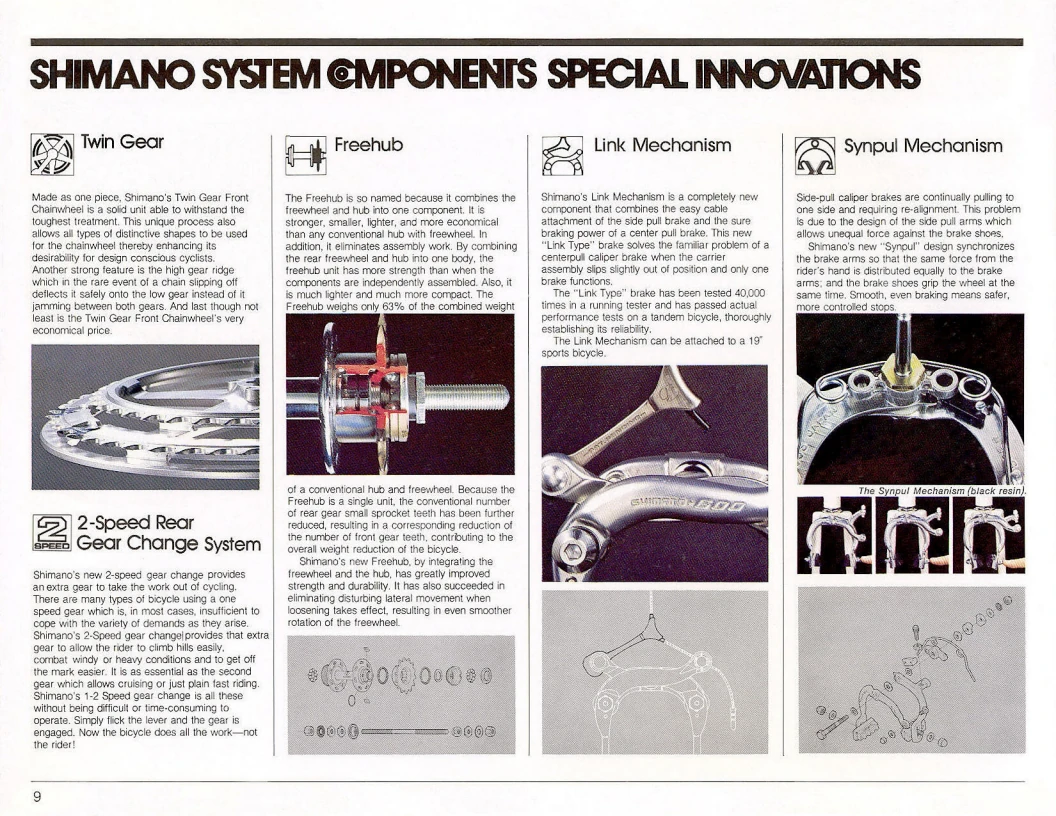
Twin Gear
Made as one piece, Shimano’s Twin Gear Front Chainwheel is a solid unit able to withstand the toughest treatment. This unique process also allows all types of distinctive shapes to be used for the chainwheel thereby enhancing its desirability for design conscious cyclists.
Another strong feature is the high gear ridge which in the rare event of a chain slipping off deflects it safely onto the low gear instead of it jamming between both gears. And last though not least is the Twin Gear Front Chainwheel’s very economical price.
2 SPEED
2-Speed Rear Gear Change System
Shimano’s new 2-speed gear change provides an extra gear to take the work out of cycling. There are many types of bicycle using a one speed gear which is, in most cases, insufficient to cope with the variety of demands as they arise. Shimano’s 2-Speed gear change provides that extra gear to allow the rider to climb hills easily, combat windy or heavy conditions and to get off the mark easier. It is as essential as the second gear which allows cruising or just plain fast riding. Shimano’s 1-2 Speed gear change is all these without being difficult or time-consuming to operate. Simply flick the lever and the gear is engaged. Now the bicycle does all the work—not the rider!
Freehub
The Freehub is so named because it combines the freewheel and hub into one component. It is stronger, smaller, lighter, and more economical than any conventional hub with freewheel. In addition, it eliminates assembly work. By combining the rear freewheel and hub into one body, the freehub unit has more strength than when the components are independently assembled. Also, it is much lighter and much more compact. The Freehub weighs only 63% of the combined weight of a conventional hub and freewheel. Because the Freehub is a single unit, the conventional number of rear gear small sprocket teeth has been further reduced, resulting in a corresponding reduction of the number of front gear teeth, contributing to the overall weight reduction of the bicycle.
Shimano’s new Freehub, by integrating the freewheel and the hub, has greatly improved strength and durability. It has also succeeded in eliminating disturbing lateral movement when loosening takes effect, resulting in even smoother rotation of the freewheel.
Link Mechanism
Shimano’s Link Mechanism is a completely new component that combines the easy cable attachment of the side pull brake and the sure braking power of a center pull brake. This new “Link Type” brake solves the familiar problem of a centerpull caliper brake when the carrier assembly slips slightly out of position and only one brake functions.
The “Link Type” brake has been tested 40,000 times in a running tester and has passed actual performance tests on a tandem bicycle, thoroughly establishing its reliability.
The Link Mechanism can be attached to a 19″ sports bicycle.
Synpul Mechanism
Side-pull caliper brakes are continually pulling to one side and requiring re-alignment. This problem is due to the design of the side pull arms which allows unequal force against the brake shoes.
Shimano’s new “Synpul” design synchronizes the brake arms so that the same force from the rider’s hand is distributed equally to the brake arms; and the brake shoes grip the wheel at the same time. Smooth, even braking means safer, more controlled stops.
The Synpul Mechanism (black resin).
9
[Feature page in four columns: a silver one-piece twin chainwheel; a cutaway freehub in red and silver with an exploded parts drawing; a Shimano 600 link-type caliper brake with a line drawing of its cable yoke; a Synpul side-pull brake in close-up, three small views of its movement and an exploded drawing.]
— Page 11 —
BICYCLE SYSTEM COMPONENT
NBM
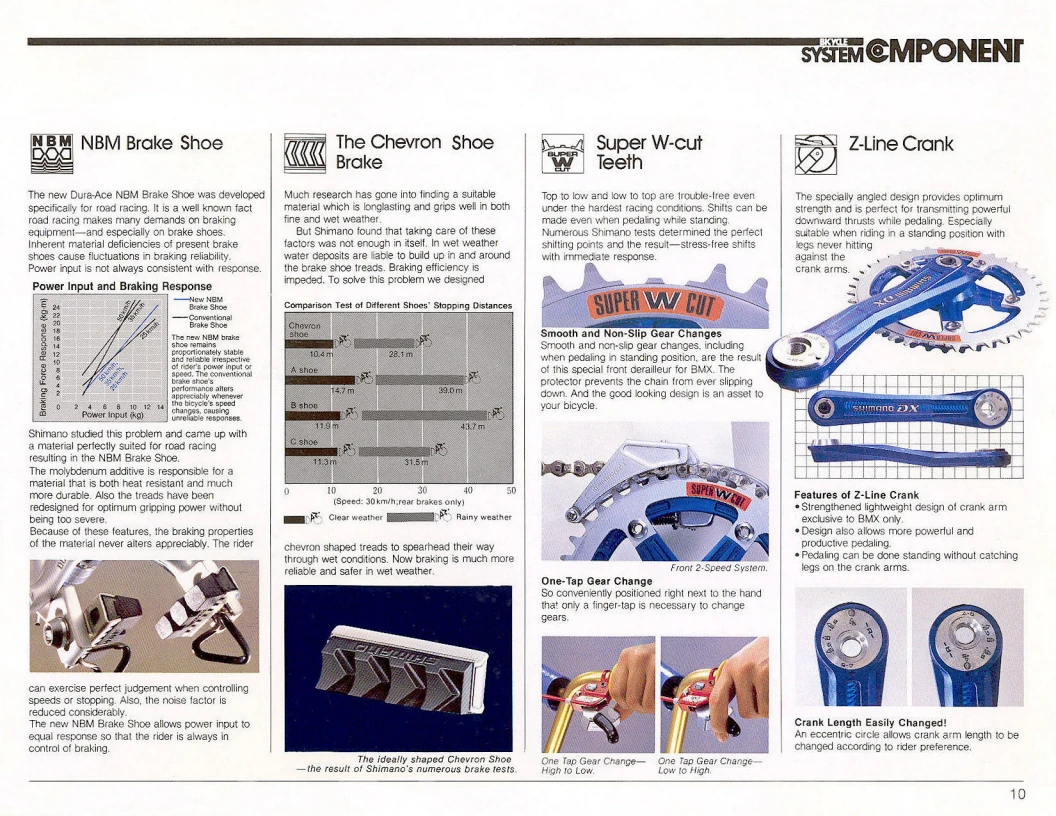
NBM Brake Shoe
The new Dura-Ace NBM Brake Shoe was developed specifically for road racing. It is a well known fact road racing makes many demands on braking equipment—and especially on brake shoes. Inherent material deficiencies of present brake shoes cause fluctuations in braking reliability. Power input is not always consistent with response.
Power Input and Braking Response
Braking Force Response (kg-m)
Power Input (kg)
50km/h 35km/h 25km/h
New NBM Brake Shoe
Conventional Brake Shoe
The new NBM brake shoe remains proportionately stable and reliable irrespective of rider’s power input or speed. The conventional brake shoe’s performance alters appreciably whenever the bicycle’s speed changes, causing unreliable responses.
Shimano studied this problem and came up with a material perfectly suited for road racing resulting in the NBM Brake Shoe.
The molybdenum additive is responsible for a material that is both heat resistant and much more durable. Also the treads have been redesigned for optimum gripping power without being too severe.
Because of these features, the braking properties of the material never alters appreciably. The rider can exercise perfect judgement when controlling speeds or stopping. Also, the noise factor is reduced considerably.
The new NBM Brake Shoe allows power input to equal response so that the rider is always in control of braking.
The Chevron Shoe Brake
Much research has gone into finding a suitable material which is longlasting and grips well in both fine and wet weather.
But Shimano found that taking care of these factors was not enough in itself. In wet weather water deposits are liable to build up in and around the brake shoe treads. Braking efficiency is impeded. To solve this problem we designed chevron shaped treads to spearhead their way through wet conditions. Now braking is much more reliable and safer in wet weather.
Comparison Test of Different Shoes’ Stopping Distances
Chevron shoe | 10.4 m | 28.1 m
A shoe | 14.7 m | 39.0 m
B shoe | 11.9 m | 43.7 m
C shoe | 11.3 m | 31.5 m
(Speed: 30km/h; rear brakes only)
Clear weather | Rainy weather
The ideally shaped Chevron Shoe—the result of Shimano’s numerous brake tests.
SUPER W CUT
Super W-cut Teeth
Top to low and low to top are trouble-free even under the hardest racing conditions. Shifts can be made even when pedaling while standing. Numerous Shimano tests determined the perfect shifting points and the result—stress-free shifts with immediate response.
Smooth and Non-Slip Gear Changes
Smooth and non-slip gear changes, including when pedaling in standing position, are the result of this special front derailleur for BMX. The protector prevents the chain from ever slipping down. And the good looking design is an asset to your bicycle.
Front 2-Speed System.
One-Tap Gear Change
So conveniently positioned right next to the hand that only a finger-tap is necessary to change gears.
One Tap Gear Change—High to Low.
One Tap Gear Change—Low to High.
Z-Line Crank
The specially angled design provides optimum strength and is perfect for transmitting powerful downward thrusts while pedaling. Especially suitable when riding in a standing position with legs never hitting against the crank arms.
Features of Z-Line Crank
• Strengthened lightweight design of crank arm exclusive to BMX only.
• Design also allows more powerful and productive pedaling.
• Pedaling can be done standing without catching legs on the crank arms.
Crank Length Easily Changed!
An eccentric circle allows crank arm length to be changed according to rider preference.
10
[Feature page: a braking response graph and photographs of Dura-Ace brake shoes on a caliper; a stopping distance bar chart and a gray chevron-tread brake shoe; a red Super W Cut chainring, a BMX front two-speed system on a gold frame and two hands tapping a lever; a blue Shimano DX Z-line BMX crank and two crank end details with eccentric holes.]
— Page 12 —
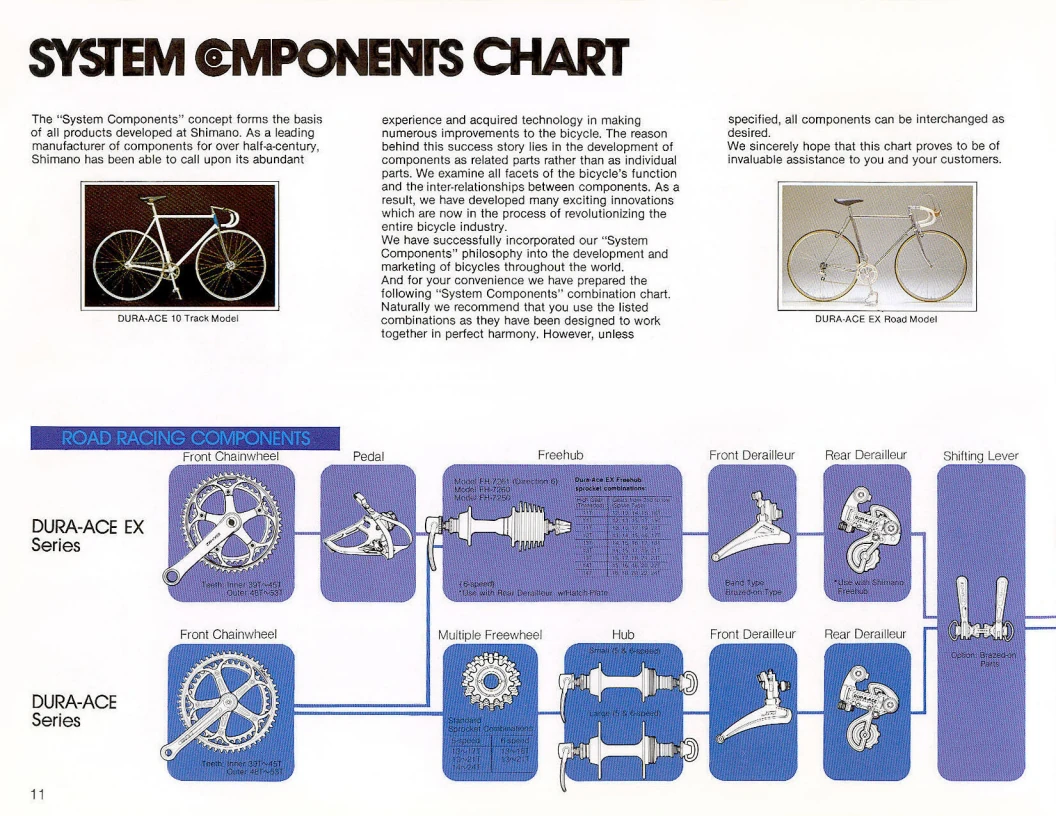
SYSTEM COMPONENTS CHART
The “System Components” concept forms the basis of all products developed at Shimano. As a leading manufacturer of components for over half-a-century, Shimano has been able to call upon its abundant experience and acquired technology in making numerous improvements to the bicycle. The reason behind this success story lies in the development of components as related parts rather than as individual parts. We examine all facets of the bicycle’s function and the inter-relationships between components. As a result, we have developed many exciting innovations which are now in the process of revolutionizing the entire bicycle industry.
We have successfully incorporated our “System Components” philosophy into the development and marketing of bicycles throughout the world.
And for your convenience we have prepared the following “System Components” combination chart. Naturally we recommend that you use the listed combinations as they have been designed to work together in perfect harmony. However, unless specified, all components can be interchanged as desired.
We sincerely hope that this chart proves to be of invaluable assistance to you and your customers.
DURA-ACE 10 Track Model
DURA-ACE EX Road Model
ROAD RACING COMPONENTS
DURA-ACE EX Series
Front Chainwheel | Teeth: Inner 39T~45T Outer 48T~53T
Pedal
Freehub | Model FH-7261 (Direction 6) / Model FH-7260 / Model FH-7250 | (6-speed) | *Use with Rear Derailleur w/Hatch-Plate
Dura-Ace EX Freehub sprocket combinations:
High Gear (Threaded) | Gears from 2nd to low (Spline Type)
11T | 12, 13, 14, 15, 16T [?]
11T | 12, 13, 15, 17, 19T [?]
11T | 13, 15, 17, 19, 22T [?]
12T | 13, 14, 15, 16, 17T [?]
13T | 14, 15, 16, 17, 18T [?]
13T | 14, 15, 17, 19, 21T [?]
13T | 15, 17, 19, 21, 23T [?]
14T | 15, 16, 18, 20, 22T [?]
14T | 16, 18, 20, 22, 24T [?]
Front Derailleur | Band Type / Brazed-on Type
Rear Derailleur | *Use with Shimano Freehub
Shifting Lever | Option: Brazed-on Parts
DURA-ACE Series
Front Chainwheel | Teeth: Inner 39T~45T Outer 48T~53T
Multiple Freewheel | Standard Sprocket Combinations
5-speed | 13~17T / 13~21T / 14~24T
6-speed | 13~18T / 13~21T
Hub | Small (5 & 6-speed) / Large (5 & 6-speed)
Front Derailleur
Rear Derailleur
11
[Chart page: two small photographs, a white Dura-Ace 10 track bicycle on black and a silver Dura-Ace EX road bicycle on gray; below, a flow chart of line drawings in purple and blue rounded boxes linking the Dura-Ace EX and Dura-Ace chainwheels, pedal, freehub, freewheel, hubs, derailleurs and shift levers. The freehub sprocket table is too blurred to read with certainty.]
— Page 13 —
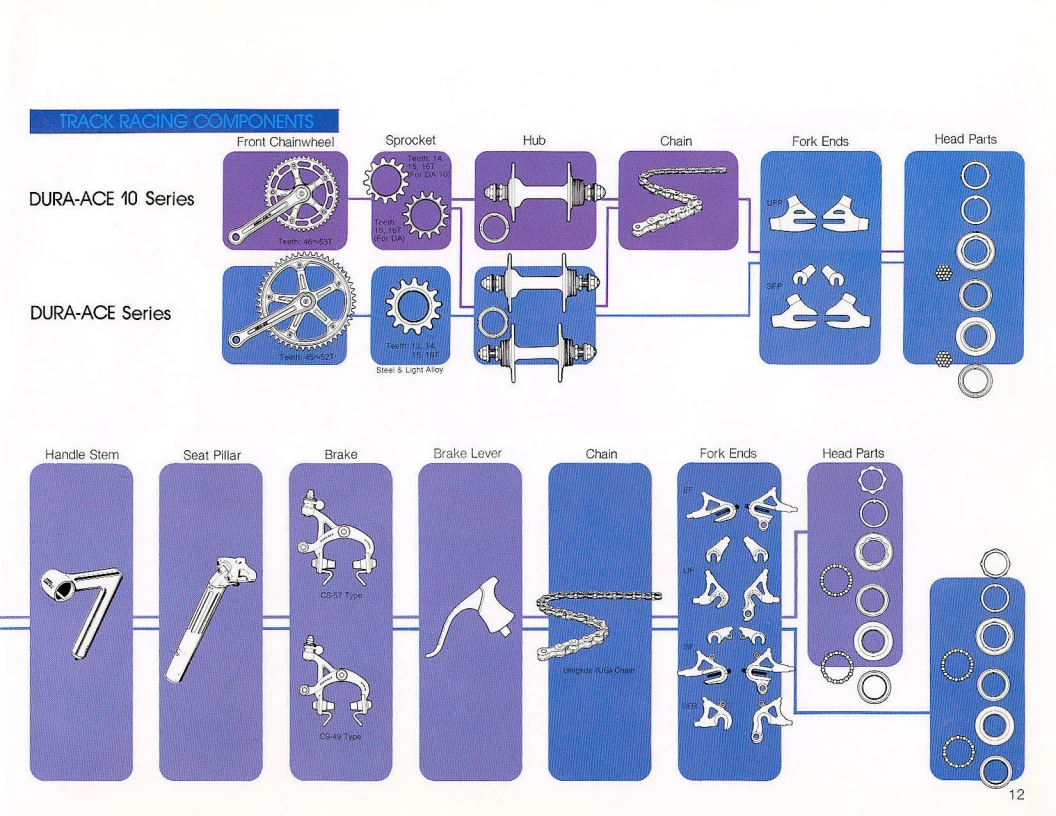
TRACK RACING COMPONENTS
DURA-ACE 10 Series
Front Chainwheel | Teeth: 46~53T
Sprocket | Teeth: 14, 15, 16T (For DA 10) / Teeth: 15, 16T (For DA)
Hub
Chain
Fork Ends | UFP / SFP
Head Parts
DURA-ACE Series
Front Chainwheel | Teeth: 45~52T
Sprocket | Teeth: 13, 14, 15, 16T | Steel & Light Alloy
Hub
(Road racing chart, continued from page 11)
Handle Stem
Seat Pillar
Brake | CS-57 Type / CS-49 Type
Brake Lever
Chain | Uniglide (UG) Chain
Fork Ends | EF / UF / SF / SFR
Head Parts
12
[Chart page: line drawings in purple and blue rounded boxes; at top the Dura-Ace 10 and Dura-Ace track chainwheels, sprockets, hubs, chain, fork ends and headset parts; below, the continuation of the road racing chart with stem, seat pillar, two caliper brakes, brake lever, UG chain, four pairs of fork ends and two headsets.]
— Page 14 —
ROAD & TOURING COMPONENTS
SHIMANO-600 EX Series
Front Chainwheel
Teeth | FC-6200 | FC-6210
Inner | 39~45T | 34~37T
Outer | 48~53T | 48~49T
Freehub | Small / Large | Silver & Black Gears (6 & 5-speed) | *Use with Rear Derailleur W/Hatch-Plate
Shimano-600 EX Freehub sprocket combinations:
High Gear (Threaded) | 5 SPEED Gears from 2nd (4 gears united) | 6 SPEED Gears from 2nd (5 gears united)
12T | 13, 14, 15, 16T | 13, 14, 15, 16, 17T
13T | 14, 15, 16, 17T | 14, 15, 16, 17, 18T
13T | 15, 17, 19, 21T | 14, 15, 17, 19, 21T
13T | 15, 17, 20, 23T [?] | 15, 17, 19, 21, 23T
14T | 16, 18, 20, 22T | 15, 16, 18, 20, 22T [?]
14T | 16, 18, 21, 24T | 16, 18, 20, 22, 24T
15T | 18, 21, 24, 28T | 17, 19, 21, 24, 28T
Front Derailleur
Rear Derailleur | *Long Cage Available
SHIMANO-600 Series
Multiple Freewheel | UG FREEWHEEL Black & Silver
Standard Sprocket Combinations:
5-speed | 13 • 15 • 17 • 19 • 21T
5-speed | 14 • 16 • 18 • 20 • 22T
5-speed | 15 • 17 • 19 • 21 • 24T
6-speed | 13 • 14 • 15 • 16 • 17 • 18T
6-speed | 13 • 15 • 17 • 19 • 21 • 23T
Hub | Small (5-& 6-speed) / Large (5 & 6-speed)
Front Derailleur
Rear Derailleur | *Long Cage Available
TOURING COMPONENTS
SHIMANO-DEORE Series
Front Chainwheel
Teeth:
Outer LD 48~53T
MD 48~50T
Inner LD 39~45T
MD 34~37T
Triple Gear 28~33T
Pedal
Front Derailleur
Rear Derailleur | Long Cage / Middle Cage
NEW 10 SPEED COMPONENTS
ALTUS-LT-ST / SELECTA-T
Front Chainwheel | 36—48T Type / 42—52T Type | SELECTA-T | *Chain Protector Available
Freehub
FREEHUB-SQ/Small (5 & 6-speed) Quick Release
Teeth: Threaded Sprocket 13~15T / Spline Sprocket 14~28T
FREEHUB-SN (Nut Type) Small (5 & 6-speed)
*Available FH-5A, 5II, 6A, 6II
*Use with Rear Derailleur W/Hatch-Plate
Front Derailleur | ALTUS-LT / ALTUS-ST
Rear Derailleur | ALTUS-LT / ALTUS-ST | *Long Cage* Available
13
[Chart page: line drawings of components in rounded boxes, dark green for Shimano 600 EX, lighter green for Shimano 600, orange for Deore and yellow for Altus and Selecta; double and triple chainsets, freehubs, a UG freewheel, hubs, a Deore pedal and front and rear derailleurs including long and middle cage versions.]
— Page 15 —
(Road & touring chart, continued from page 13)
SHIMANO-600 EX Series
Shifting Lever | Option: Brazed-on Parts
Brake | CS-57 Type / CS-49 Type
Brake Lever
Chain | SHIMANO-600 EX UG Chain (Black & Silver)
Fork Ends | LF / PR
Head Parts
SHIMANO-600 Series
Shifting Lever
Brake | Cantilever Brake
Chain | SHIMANO-600 UG (Silver) / SHIMANO-600 UG (Gold)
SHIMANO-DEORE Series
Shifting Lever | *Use with Rear Derailleur W/Centeron Mechanism
SHIMANO DEORE SERIES
ALTUS-LT-ST / SELECTA-T
Shifting Lever | ALTUS-LT STEM / ALTUS-LT DOWN TUBE / ALTUS-ST STEM / ALTUS-ST DOWN TUBE
*Use with Rear Derailleur W/Centeron Mechanism
*Available Single Type Lever
Option: Brazed-on Type
Chain | UNIGLIDE-II (UG-II)
NOTE:
* The chart illustrates ideal combinations with regard to product classifications. However, these components are interchangeable unless otherwise stated.
* Use the ALTUS shifting lever only with ALTUS rear derailleur. The ALTUS rear derailleur can be used separately but the “Centeron Mechanism” will not function.
* Use the Freehub (SQ, SN and EX Series) only with the Shimano “Hatch-Plate” rear derailleur.
14
[Chart page continuing the green, orange and yellow rows: line drawings of shift levers, side-pull and cantilever brakes, a brake lever, chains, fork ends and headset parts; at right a cutout photograph of a Shimano Deore triple crankset, chain and rear derailleur with the Deore Series logo.]
— Page 16 —
POSITRON-FH SYSTEM
10-SPEED / 12-SPEED; 5-SPEED / 6-SPEED
Rear Derailleur | POSITRON-FH 400EM
Front Derailleur | Shimano-FE | Chrome & Zinc
Shifting Lever | STEM & DOWN TUBE / STEM & DOWN TUBE, EM
Freehub | FREEHUB-SN | 5II · 6II · 5A · 6A
Chain | UNIGLIDE-II (UG-II)
Cable | PUSH-PULL CABLE
POSITRON-II SYSTEM COMPONENTS
10-SPEED; 5-SPEED
Rear Derailleur | POSITRON-II / POSITRON-II, POSITRON-400, POSITRON EM
Front Derailleur | Shimano-FE | Chrome & Zinc
Shifting Lever | STEM & DOWN TUBE / STEM & DOWN TUBE, EM
Multiple Freewheel | STANDARD COMPONENTS UNIGLIDE FREEWHEEL MULTIPLE FREEWHEEL
Chain | UNIGLIDE-II (UG-II)
Cable | PUSH-PULL CABLE
FF SYSTEM COMPONENTS
Front Chainwheel | SINGLE CHAINWHEEL / DOUBLE CHAINWHEEL | *One-Piece Crank Type Available
Rear Derailleur | SHIMANO-400 FF, EAGLE-II, LARK-II | LARK-II
Front Derailleur | STANDARD COMPONENTS
Shifting Lever | STANDARD COMPONENTS
Friction Freewheel | 5-speed / 6-speed
Chain | UNIGLIDE-II (UG-II)
POSITRON-FH PLUS FF SYSTEM
10-SPEED / 12-SPEED; 5-SPEED / 6-SPEED
Front Chainwheel | DOUBLE CHAINWHEEL / SINGLE CHAINWHEEL | *One-Piece Crank Type Available
Rear Derailleur | POSITRON-FH
Front Derailleur | Shimano-FE | Chrome & Zinc
Shifting Lever | STEM & DOWN TUBE / STEM & DOWN TUBE
Friction Freewheel | 5-speed / 6-speed
Chain | UNIGLIDE-II (UG-II)
Cable | PUSH-PULL CABLE
15
[Chart page of four system rows in dark green, light green and blue rounded boxes with line drawings: Positron rear derailleurs, Shimano FE front derailleurs, stem and down tube shift levers with an EM lever, a freehub, front freewheeling chainwheels with chain guards, friction freewheels, UG-II chains and coiled push-pull cables.]
— Page 17 —
POSITRON-II PLUS FF SYSTEM
10-speed; 5-speed
Front Chainwheel | DOUBLE CHAINWHEEL / SINGLE CHAINWHEEL | *One-Piece Crank Type Available
Rear Derailleur | POSITRON-II / POSITRON-II, POSITRON-400, POSITRON-EM
Front Derailleur | Shimano-FE | Chrome & Zinc
Shifting Lever | STEM & DOWN TUBE / STEM & DOWN TUBE, EM
Multiple Freewheel | FRICTION FREEWHEEL | 5-speed
Chain | UNIGLIDE-II (UG-II)
Cable | PUSH-PULL CABLE
BMX COMPONENTS
DX Series Front 2-Speed System
Front Chainwheel | Teeth: Outer 40T Inner 34~38T
Pedal
Freehub | Small/Single
Seat Pillar
Front Derailleur
Shifting Lever
Chain Tensioner
Brake
Brake Lever
DX Series Single Speed System
Front Chainwheel | Teeth 39~44T
SX Series Front 2-Speed System
Front Chainwheel | Teeth: Outer 40T Inner 32T
Front Derailleur
Shifting Lever
Freehub | Small & Semi Large /Single
Chain Tensioner
Brake
Brake Lever
SX Series Rear 2-Speed System
Rear Derailleur | Rear Sprocket: 18~13T
Shifting Lever
Freehub | Small/2-Speed
Brake
Brake Lever
5 & 10 SPEED COMPONENTS
Rear Derailleur | SHIMANO-RS *With Centeron Mechanism / EAGLE-II, LARK-II
Front Derailleur | SHIMANO-FE
Shifting Lever | SHIMANO-LS (Stem) / SHIMANO-LE (Stem & Down Tube) *Use with Rear Derailleur w/ Centeron Mechanism
Shifting Lever | QB-LEVER / QS-LEVER / ALMI-LEVER / FINGER-TIP
Freewheel | • Multiple Freehub: FREEHUB-6II, FREEHUB-6A, FREEHUB-5II, FREEHUB-5A
Freewheel | UG FREEWHEEL / SINGLE FREEWHEEL
Hub | LARGE HUB (QR) / LARGE HUB / SMALL HUB (QR) / SMALL HUB / STEEL HUB
• Single Freehub | FREEHUB-A (FH-A) / FREEHUB-C (FH-C)
Caliper Brake
• Sidepull Caliper: TOURNEY (Quick Release & Synpul) / TOURNEY (Synpul)
• Centerpull Caliper: TOURNEY (Quick Release & Link) / TOURNEY
Brake Lever | DUAL EXTENSION LEVER-80 (DEL-80) / DUAL EXTENSION LEVER / HOODED LEVER / POPULAR LEVER / SOFT LM LEVER / SHIMANO-LF
Chain | UNIGLIDE-II (UG-II)
16
[Chart page: line drawings in colored rounded boxes; a Positron II plus FF row in blue, green and yellow-green; a BMX row in orange for the DX series and light blue for the SX series with cranks, a platform pedal, hubs, seat pillar, derailleurs, tensioners and U-brakes; a yellow-green 5 and 10 speed row with derailleurs, black shift levers and a freehub.]
— Page 18 —
SHIMANO DURA-ACE 10 System Compo Series
The Pitch Revolution That Has Changed The World Of Racing……10mm. Pitch Series
Shimano’s new Dura-Ace 10 Track System is the new standard among competitive bicycle components.
Dura-Ace 10 is the first major deviation from a standard that has existed in the bicycle industry since mass-production of bikes began some 100 years ago.
It was so simple; Shimano reduced the distance between the sprocket teeth from the old 1/2″ to the new 10mm. dimension. Ten millimeter pitch allows the front chainwheel and the rear sprockets to be made smaller, and the chain shorter. The smaller size means less weight and more rigidity and when rotating parts are lightened acceleration is increased.
Now competitors on Dura-Ace 10 can jump out of corners more quickly, and get the lead in the sprint.
Dura-Ace 10 track components are already the choice of the best racers in the world. John Nicholson, twice world professional sprint champion, rode to his titles on Dura-Ace 10. More and more racers are changing to the obvious advantages of using the lightest components in track racing—Dura-Ace 10.
[A full-bleed photograph of a track rider in a blue and white Shimano jersey and red helmet on a silver track bicycle, with blue motion streaks behind him; below, Dura-Ace 10 track hubs, crankset, sprocket and chain on a dark reflective surface. At right the gold Dura-Ace 10 badge, the text and a small photograph of a white track bicycle.]
— Page 19 —
DURA-ACE 10 SERIES TRACK ENSEMBLE
10mm Pitch Chaindriving System
DURA-ACE 10 Front Chainwheel
Model FC-7000
BB-7500
SPECIFICATIONS
Material | Light Alloy • Special Surface Treatment
Type | Cotterless
Chain Ring | 10mm. x 3mm.
Teeth | 46~53T
Crank Lengths | 6-1/2″ (165mm.), 6-3/4″ (170mm.) Available by request 6-19/32″ (167.5mm.)
Crank Thread | BC 9/16″ x 20 T.P.I.
Cup Thread | English 1.37″ x 24t, French 35 x 1.0, Italian 36 x 24t
Super Polished Ball Race
Spindle Length: [Unit: mm.]
English BC1.37″ x 24t | English BC1.37″ x 24t Left
15.5 | 68(70) [?] | 15.5
107(109)
DURA-ACE 10 Front & Rear Hubs with Lock Ring
Model HB-7020
SPECIFICATIONS
Weight | Front 7.9 oz. (225 g.) Rear 10.4 oz. (295 g.)/Including Lock Ring
Material | Light Alloy • Anodized Finish
Over Lock Nut Dimensions | Front 3.94″ (100mm.) / Rear 4.33″ (110mm.) 4.72″ (120mm.)
Fork End Slot Width | Front 0.35″ (9mm.), 0.31″ (8mm.) / Rear 0.39″ (10mm.), 0.31″ (8mm.)
Sprocket Thread | BC33 x 24 T.P.I.
Spoke Holes | 28H, 32H, 36H
Lock Ring Thread | BC32 x 24 T.P.I. (Left)
Super Polished Ball Race
Drilled Out Shaft
DURA-ACE 10 Chain
Model CN-7000
SPECIFICATIONS
Material | Chromium Molybdenum Steel • Special Surface Treatment
Type | Bushed Chain
DURA-ACE 10 Sprocket for Track Hub
Model SS-7000
SPECIFICATIONS
Material | Nickel Chromium Molybdenum Steel
Standard Sprocket | 10mm. x 3mm.
Thread | BC33 x 24 T.P.I.
Teeth | 14T, 15T, 16T
Weight:
14T | 0.8 oz. (22.0 g.)
15T | 0.9 oz. (26.8 g.)
16T | 1.1 oz. (30.8 g.)
Sprocket for Use with Standard Dura-Ace Track Hubs Only
Thread | 1.37″ x 24 T.P.I.
Teeth | 15T, 16T
Weight:
15T | 0.9 oz. (26.0 g.)
16T | 1.0 oz. (29.0 g.)
For Use with Dura-Ace 10 Track Hubs Only
For Use with Standard Dura-Ace Track Hubs Only
DURA-ACE 10—DURA-ACE Comparison Chart
* Weight Comparison (Track Models)
| Dura-Ace 10 | Dura-Ace | Saving
Right Hand Crank | 8.5 oz. (239 g.) | 9.8 oz. (277 g.) | 1.3 oz. (38 g.)
Chainwheel (49T) | 2.2 oz. (63 g.) | 4.1 oz. (116 g.) | 1.9 oz. (53 g.)
Chain | 11.6 oz. (330 g.) | 11.8 oz. (335 g.) | 0.2 oz. (5 g.)
Rear Hub W/Lock Ring | 10.4 oz. (295 g.) | 11.0 oz. (313 g.) | 0.6 oz. (18 g.)
Rear Sprocket (14T) | 0.8 oz. (22 g.) | 1.4 oz. (38 g.) | 0.6 oz. (16 g.)
TOTAL | 33.5 oz. (949 g.) | 38.1 oz. (1079 g.) | 4.6 oz. (130g.)
DURA-ACE — DURA-ACE 10 Comparison Photo
18
[Product page on white: cutout photographs of the silver Dura-Ace 10 track crankset with bottom bracket parts, a pair of track hubs with lock ring and a drilled-out shaft inset, a coiled chain, several track sprockets and a gray-ground comparison photograph of Dura-Ace and Dura-Ace 10 cranks, sprockets and chains; small outlined “10” logos and a spindle diagram.]
— Page 20 —
SHIMANO DURA-ACE System Compo Series
The Racing Components Professionals Choose
When sprinting at top speed a 10th of a second equals about 15 feet…too big a gap to close against a good competitor. To shave off those fractions of a second the pro sprinter must use the lightest but strongest possible equipment.
Dura-Ace track products are constructed of “super duralumin 75S”, an alloy so light and strong that it is rarely used for bicycle components because of its difficulty to form. Shimano’s advanced metallurgical techniques, including the cold-forging process, have overcome the obstacles and produced the best track products available.
Dura-Ace Track means performing at your best.
[A full-bleed photograph of two track sprinters racing side by side against black, one in a white jersey with yellow and black bands; below, Dura-Ace track hubs, sprockets, crankset, fork ends and a spanner lit in blue. At right the blue Dura-Ace System Compo Series badge, the text and a small photograph of a silver track bicycle.]
— Page 21 —
DURA-ACE SERIES TRACK ENSEMBLE
DURA-ACE Front Chainwheel
Model FC-7500
BB-7500
SPECIFICATIONS
Material | Light Alloy • Anodized Finish
Type | Cotterless
Chain Ring | 1/2″ x 1/8″ Chain
Teeth | 45T~52T
Crank Lengths | 6-1/2″ (165mm.), 6-3/4″ (170mm.), 6-7/8″ (175mm.) Available by request 6-19/32″ (167.5mm.), 6-13/16″ (172.5mm.)
Crank Thread | BC 9/16″ x 20 T.P.I.
Cup Thread | English 1.37″ x 24t, French 35 x 1.0, Italian 36 x 24t
Option | Super Polished Ball Race
Spindle Length: [Unit: mm.]
English BC1.37″ x 24t | English BC1.37″ x 24t Left
15.5 | 68(70) [?] | 15.5
107(109) [?]
Cold-Forged Chain Ring
Model BB-7500
DURA-ACE Sprocket for Track Hub
Model SS-7500
SPECIFICATIONS
Material | Chromium Molybdenum Steel/Light Alloy • Special Surface Treatment
Standard Sprocket | 1/2″ x 1/8″ Chain
Thread | 1.37″ x 24 T.P.I.
Teeth | 13T, 14T, 15T, 16T
Weight:
| Light Alloy | Steel
13T | 0.39 oz. (11.0 g.) | 1.06 oz. (30.1 g.)
14T | 0.48 oz. (13.5 g.) | 1.34 oz. (38.0 g.)
15T | 0.55 oz. (15.7 g.) | 1.67 oz. (47.3 g.)
16T | 0.63 oz. (18.0 g.) | 1.89 oz. (53.5 g.)
Light Alloy
Steel
DURA-ACE Front & Rear Hubs with Lock Ring
Model HB-7520
SPECIFICATIONS
Weight | Front 8.5 oz. (240 g.) Rear 11.0 oz. (313 g.)/Including Lock Ring
Material | Light Alloy • Anodized Finish
Type | Solid Axle
Thread | 1.37″ x 24 T.P.I.
Over Lock Nut Dimensions | Front 3.94″ (100mm.) / Rear 4.33″ (110mm.), 4.72″ (120mm.)
Fork End Slot Width | Front 0.35″ (9mm.), 0.31″ (8mm.) / Rear 0.39″ (10mm.), 0.31″ (8mm.)
Spoke Holes | 28H, 32H, 36H
Lock Ring Thread | 1.29″ x 24 T.P.I. (Left)
Super Polished Ball Race
DURA-ACE Head Parts
Model HP-7500
SPECIFICATIONS
Material | Chromium Bearing Steel (Main Parts)
Polished Ball Race
SHIMANO-SFP Fork Ends
Model FE-SF10
SPECIFICATIONS
Material | Steel
Fork End Slot Width | Front 0.35″ (9mm.), 0.31″ (8mm.) / Rear 0.39″ (10mm.), 0.31″ (8mm.)
Specially Ground Hub Connection Face—on Both Sides
SHIMANO-UFP Fork Ends
Model FE-UF10
SPECIFICATIONS
Material | Steel
Fork End Slot Width | Front 0.35″ (9mm.), 0.31″ (8mm.) / Rear 0.39″ (10mm.), 0.31″ (8mm.)
Specially Ground Hub Connection Face—on Both Sides
Fine Blanking Finish
20
[Product page on white: cutout photographs of the silver Dura-Ace track crankset with a cold-forged chainring, a blue-ground inset of the chainwheel, bottom bracket parts, light alloy and steel sprockets, a pair of track hubs with lock ring, two pairs of steel track fork ends with small line drawings and a row of headset parts.]
— Page 22 —
THE NEW CONCEPT COMPONENTS
DURA-ACE EX Road Ensemble
Dura-Ace EX Road Model
For over half-a-century, Shimano has devoted itself to the production of bicycle components. Based on the abundant experience and technology acquired through the continuous innovation of bicycle parts, Shimano was able to create the “System Components” concept. Components which are made to work together in perfect harmony.
And now we, at Shimano, as a result of this enlightened policy, are pleased to introduce our latest system components success—the EX Series.
It was through our involvement with bicycle racing that we were able to succeed so perfectly in coordinating the necessary requisites of lightness and strength combined—and precision of parts. Many of the mechanisms incorporated in this series are revolutionary in their concept and are certain to spearhead the bicycle into a new era. The Dura-Ace EX Series and the 600 EX Series are now unveiled for the world of bicycling to appreciate—and to herald a new age for the bicycle!
SHIMANO 600 EX Road Ensemble
Shimano-600 EX Road Model
Shifting Lever • Rear Derailleur • Handle Stem • Front Derailleur • Freehub • Front Chainwheel • Seat Pillar • DD Pedal • Head Parts • Brake • Brake Lever
[A spread on a dark brown ground: large white headline across the top; at left the Dura-Ace EX Road Ensemble logo in yellow, blue and green over a photograph of a silver road bicycle; at center a gold laurel wreath with racing cyclists; at right the Shimano 600 EX logo over a blue road bicycle; below, the full silver Dura-Ace EX component group laid out on a white surface.]
— Page 23 —
DURA-ACE EX SERIES ROAD ENSEMBLE
EX
DURA-ACE EX DD Pedal
Model PD-7200
SPECIFICATIONS
Weight | 6.1 oz. (173 g.)/Including Toe Clip & Toe Strap (Blue & Red)
Material | Light Alloy (Body)
| Chromium Molybdenum Steel (Cup • Cone)
| Steel (Toe Clip)
| Light Alloy Toe Clip (Optional Parts)
Crank Thread | BC1″ × 24 T.P.I.
Type | DD Mechanism, Sealed Mechanism, Aerodynamic Design
Option | DD Pedal Reflector
DD · SHIMANO aero dynamics · SEALED · LIGHT WEIGHT
*Use: With Shimano DA EX Front Chainwheel (Model FC-7200)
Feautures of the DD Pedal:
1. Improved “Ankling” increases pedaling Efficiency
2. Lightweight and aerodynamic design
3. Lower center-of-gravity
4. Improved shoe grip
5. Unique, adjustable toe clip
6. Sealed mechanism
DURA-ACE EX Handle Stem
Model HS-7200
SPECIFICATIONS
Weight | 8.9 oz. (252 g.), 9.2 oz. (260 g.)
Material | Light Alloy
Handle Stem Diameter | 22.2 mm.
Handle Bar Clamp Diameter | 25.8mm or 26.5mm
Extension | 70mm., 80mm., 90mm., 100mm., 110mm., 120mm., 130mm.
Type | Hexagon Release Mechanism, Aerodynamic Design
SHIMANO aero dynamics · LIGHT WEIGHT
Hexagon Wrench Key for Handle Stem
DURA-ACE EX Seat Pillar
Model SP-7200
SPECIFICATIONS
Weight | 7.9 oz. (224 g.) For pillar w/27.2 mm. Outside diameter
Material | Light Alloy
Outside Diameter of Pillar | 26.0mm., 26.2mm., 26.4mm., 26.6mm., 26.8mm., 27.0mm., 27.2mm.
Type | Hexagon Release Mechanism, Aerodynamic Design
SHIMANO aero dynamics · LIGHT WEIGHT
DURA-ACE EX Freehub
Model FH-7261 (Small/6-speed)
SPECIFICATIONS
Weight • Over Lock Nut Dimensions • Amount of Dish
| Weight | Over Lock Nut Dimensions | Amount of Dish
Front | 8.1 oz. (229 g.) | 3.94″ (100 mm.) | —
Rear (Except Cassette Gears) | 14.5 oz. (412 g.) | 4.96″ (126 mm.) | 0.17″ (4.3mm.)
Material | Light Alloy • Anodized Finish (W/Light Alloy Adjusting Nut)
Sprocket | Golden Finish
Teeth | Threaded Sprocket 11T~19T
| Spline Sprocket 12T~28T
Spoke Holes | 32H, 36H
Type | Direction Mechanism, Quick Release, Uni Balance Mechanism, Uniglide Teeth, Cassette Gear, Sealed Mechanism (Double-Jointed Seal)
Use | With EX Rear Derailleur Only
DIRECTION · UNIGLIDE · SEALED · LIGHT WEIGHT · QR HUB
22
[A white page: at left the silver DD pedal with blue toe strap, an inset of the pedal on a crank arm and a black-and-white photograph of cycling shoes on pedals; at center the silver EX handle stem with hex key and the seat pillar; at right the front and rear freehubs with gold cassette and an inset of the hub flange; feature icons beside each part.]
— Page 24 —
EX
DURA-ACE EX SERIES ROAD ENSEMBLE
DURA-ACE EX Rear Derailleur
Model RD-7200
SPECIFICATIONS
Capacity | Front Difference/13 Teeth or less
| Rear Largest Sprocket/26 Teeth or less
Weight | 6.2 oz. (175g.)
Material | Light Alloy • Anodized Finish (Body)
| Light Alloy (Cage Plate)
| Heat Treated Stainless Steel (Guide Pulley Teeth)
Type | Servo Panta Mechanism, Hatch Plate Mechanism, Without Left Plate, Hexagon Release, Synchro-Line Mechanism, Sealed Mechanism
Model SL-7220
LIGHT WEIGHT · SEALED
DURA-ACE EX Front Derailleur
Model FD-7210 (Brazed-on Type)
FD-7200 (Band Type)
SPECIFICATIONS
Capacity | 14 Teeth or Less
Weight | 3.6 oz. (102g.)
Material | Light Alloy (Body)
| Steel • Chromium Finish (Chain Guide)
Type | Lower Inlet Type 1-1/8″
| Trap-Ease Mechanism
| Hexagon Release
Brazed-on Type
DURA-ACE EX Shifting Lever
Model SL-7200 (Band Type)
SL-7210 (Brazed-on A Type)
SL-7220 (Brazed-on B Type)
SPECIFICATIONS
Weight | 2.01 oz. (57g.)
Material | Light Alloy • Anodized Finish
Type | Friction Type
Attachment Position | Down Tube
Lever Clamp Diameter | 1-1/8″
Option | Brazed-on parts (w/Sealed Mechanism)
Lever Non-loosening Feature
Brazed-on Parts (Model SL-7210)
SEALED · LIGHT WEIGHT
Brazed-on Type Only
DURA-ACE EX
Front Chainwheel
& Bottom Bracket Assembly
Model FC-7200 (Double)
BB-7500
SPECIFICATIONS
Material | Light Alloy • Anodized Finish
Type | Cotterless
Chain Ring | 1/2″ × 3/32″ Chain
Teeth | Inner Chain Ring 39T~45T
| Outer Chain Ring 48T~53T
Crank Lengths | 6-1/2″ (165 mm.), 6-3/4″ (170 mm.), 6-25/32″ (172.5mm.), 6-7/8″ (175mm.)
Crank Thread | BC1″ × 24 T.P.I.
Cup Thread | English 1.37″ × 24t, French 35 × 1.0 Available by request: Italian 36 × 24t
Material of Chain Ring | Light Alloy. • Anodized Finish
Type | Aerodynamic Design, Offset Crank Arm, W cut Mechanism, One Key Release Mechanism, Safety Crank Arm
Option | Super Polished Ball Race
Use | With DURA-ACE EX DD Pedal (Model PD-7200) Only
SHIMANO aero dynamics · W CUT · LIGHT WEIGHT
Diagram: English BC1.37″ × 24t | English BC1.37″ × 24t Left | 15.5 | 68(70) | 15.5 | 107(109)
*Standard Model FC-7110 can also be used with Dura-Ace EX Series. See Page 29.
23
[A white page: at left the silver Dura-Ace EX rear derailleur with black pulleys; at center the front derailleur with a brazed-on inset, the pair of shift levers and a blue-tinted photograph of the brazed-on fittings; at right the double chainwheel with crank arm, a bottom bracket axle, cups and bearing retainers, and a line diagram of the bottom bracket.]
— Page 25 —
EX
DURA-ACE EX Freehub
Model FH-7250 (Small/5-speed)
FH-7260 (Small/6-speed)
SPECIFICATIONS
Weight • Over Lock Nut Dimensions • Amount of Dish
| | Weight | Over Lock Nut Dimensions | Amount of Dish
Front | | 7.4 oz. (210 g.) | 3.94″ (100 mm.) | –
Rear (Except Cassette Gears) | 5-speed | 13.9 oz. (393 g.) | 4.72″ (120 mm.) | 0.17″ (2.95 mm.)
Rear (Except Cassette Gears) | 6-speed | 14.0 oz. (398 g.) | 4.72″ (120 mm.) | 0.31″ (7.8 mm.)
Rear (Except Cassette Gears) | 6-speed | 14.0 oz. (403 g.) | 4.96″ (126 mm.) | 0.19″ (4.8 mm.)
Material | Light Alloy • Anodized Finish (W/Light Alloy Adjusting Nut)
Sprocket | Golden Finish
Teeth | Threaded Sprocket 11T~19T
| Spline Sprocket 12T~28T
Spoke Holes | 28H, 32H, 36H
Type | Quick Release, Uni Balance Mechanism, Uniglide Teeth, Cassette Gear, Sealed Mechanism (Double-Jointed Seal)
Use | With EX Rear Derailleur Only
UNIGLIDE · SEALED · LIGHT WEIGHT · QR HUB
Dura-Ace EX Freehub sprocket combinations:
High Gear (Threaded) | Gears from 2nd to low (Spline Type)
11T | 12, 13, 14, 15, 16T
11T | 12, 13, 15, 17, 19T
11T | 13, 15, 17, 19, 21T
12T | 13, 14, 15, 16, 17T
13T | 14, 15, 16, 17, 18T
13T | 14, 15, 17, 19, 21T
13T | 15, 17, 19, 21, 23T
14T | 15, 16, 18, 20, 22T
14T | 16, 18, 20, 22, 24T
We offer all kinds of tooth sprocket possibilities: High gear (threaded sprockets), from 11T to 19T; other gears (spline-type), from 12T to 28T.
DURA-ACE EX Head Parts
Model HP-7200
SPECIFICATIONS
Weight | 3.7 oz. (106g.)
Material | Light Alloy • Anodized Finish (Body),
| Bearing Steel (Ball Race)
Type | Road Type
Polished Ball Race
Sealed Mechanism (Labyrinth Seal)
SEALED · LIGHT WEIGHT
DURA-ACE EX Caliper Brake
Model BR-7200 (CS-49 Type)
SPECIFICATIONS
Weight | Front 5.6 oz. (160 g.)
| Rear 5.6 oz. (158 g.)
Model BR-7210 CS-57 Type)
SPECIFICATIONS
Weight | Front 6.3 oz. (180 g.)
| Rear 6.3 oz. (178 g.)
Material | Light Alloy • Anodized Finish
Type | Side Pull with Quick Release and Tire Guide
| Pivot Bolt with Lubricating Channel
| Hexagon Release, NBM Brake Shoe
Option | Sunk Pivot Bolt System
NBM · QR BRAKE
CS-49 Type (39, 49) · CS-57 Type (47, 57)
Open · Close
Quick Release
DURA-ACE EX Brake Lever
Model BL-7200
SPECIFICATIONS
Weight | 7.3 oz. (206g.)/Pair (Including Rubber Cover)
Material | Light Alloy • Anodized Finish
Lever Clamp Diameter | 23.8mm, 24.2mm.
Type | Hooded Lever with Rubber Cover
Drilled Out Finish
One-Step Cable Attachment Mechanism
24
[A white page with the EX logo at top right: at left a cutaway drawing and photograph of the front and rear freehubs with gold cassette, and the headset parts laid in a row at the foot; at right two silver sidepull brakes, line drawings of the CS-49 and CS-57 types, two photographs of the quick release open and closed, and a pair of drilled brake levers with tan hoods.]
— Page 26 —
EX
SHIMANO-600 EX SERIES ROAD & TOURING ENSE[MBLE]
SHIMANO-600 EX
Rear Derailleur
Model RD-6200
SPECIFICATIONS
Capacity | Front Difference/13 Teeth or Less
| Rear Largest Sprocket/28 Teeth or Less
Weight | 6.7 oz. (190g.)
Material | Light Alloy • Anodized Finish (Body)
| Light Alloy (Cage Plate)
Type | Servo Panta Mechanism, Hatch-Plate Mechanism, Without Left Plate
Arabesque Pattern Design
LIGHT WEIGHT · ARABESQUE
Long Cage Type (Model RD-6210)
SHIMANO-600 EX Front Derailleur
Model FD-6200
SPECIFICATIONS
Capacity | 14 Teeth or Less
Weight | 3.95 oz. (112g.)
Material | Light Alloy (Body)
| Steel • Chromium Finish (Chain Guide)
Type | Lower Inlet Type 1-1/8″
| Trap-Ease Mechanism
Arabesque Pattern Design
ARABESQUE
SHIMANO-600 EX Shifting Lever
Model SL-6200 (Band Type)
SL-6210 (Brazed-on Type)
SPECIFICATIONS
Weight | 2.05 oz. (58g.)
Material | Light Alloy
Type | Friction Type
Attachment Position | Down Tube
Lever Clamp Diameter | 1-1/8″
Arabesque Pattern Design
Lever Non-loosening Feature
ARABESQUE · LIGHT WEIGHT · SEALED
Brazed-on Type Only
Brazed-on Parts
SHIMANO-600 EX UG Chain
Model CN-6200
SPECIFICATIONS
Material | Steel
Surface Treatment | Roller Link Plate/Black Finish
| Pin Link Plate/Satin Nickel Finish (Silver)
| Rivet Pin/Special Hardened Finish
Type | Roller Chain
Size | 1/2″ × 3/32″ Chain
new
SHIMANO-600 EX Front Chainwheel
Model FC-6210 | FC-6200
BB-6210 | BB-6200
(Spindle Length 119 mm. for FC-6210) | (Spindle Length 116 mm. for FC-6200)
SPECIFICATIONS
Material | Light Alloy • Anodized Finish
Type | Cotterless
Chain Size | 1/2″ x 3/32″ Chain
Teeth | FC-6210/Inner 34T~37T, Outer 48T~49T,
| FC-6200/Inner 39T~45T, Outer 48T~53T,
Crank Lengths | FC-6210/6-1/2″ (165mm.),
| FC-6200/6-1/2″ (165mm.), 6-3/4″ (170mm.)
Crank Thread | 9/16″ x 20t
Cup Thread | English 1.37″ x 24t, French 35 x 1.0, Italian 36 x 24t
Material of Chain Ring | Light Alloy • Anodized Finish
W cut Mechanism, One Key Release Mechanism, Safety Crank Arm and Arabesque Pattern Design
W CUT
Spindle Length: [Unit: mm.]
Diagram: English BC1.37″ x 24t | English BC1.37″ x 24t Left | 20.3 | 68 | 29.2 [?] | 119
Model FC-6200 (LD-Type)
Dura-Ace Chain Ring Attachable
Model FC-6210 (MD-Type)
Model BB-6200
Bottom Bracket Set for FC-6200 (Spindle Length 116 mm.)
25
[Left half of a spread on a white page, the headline running onto the next page: the silver Shimano 600 EX rear derailleur with an inset of the long-cage version, the front derailleur, a pair of shift levers with a blue-tinted photograph of brazed-on fittings, a length of chain marked “new” in pink, two double chainwheels and a bottom bracket set.]
— Page 27 —
[ENSE]MBLE
EX
SHIMANO-600 EX Small Flange Freehub
Model FH-6261 (Silver/6-speed) | FH-6251 (Silver/5-speed)
SHIMANO-600 EX Large Flange Freehub
Model FH-6263 (Silver/6-speed) | FH-6253 (Silver/5-speed)
SPECIFICATIONS
Weight • Over Lock Nut Dimensions • Amount of Dish
| | Weight (Small) | Weight (Large) | Over Lock Nut Dimension | Amount of Dish
Front | | 8.3 oz (235 g.) | 9.7 oz. (275 g.) | 3.94″ (100 mm.) | —
Rear (Except Cassette Gears) | 5-speed | 13.9 oz. (395 g.) | 14.2 oz. (405 g.) | 4.72″ (120 mm.) | 0.07″ (1.75 mm.)
Rear (Except Cassette Gears) | 5-speed | 14.1 oz. (402 g.) | 14.5 oz. (412 g.) | 4.88″ (124 mm.) | 0″ (0 mm.)
Rear (Except Cassette Gears) | 6-speed | 14.2 oz. (403 g.) | 14.5 oz. (413 g.) | 4.72″ (120 mm.) | 0.28″ (7.05 mm.)
Rear (Except Cassette Gears) | 6-speed | 14.2 oz. (405 g.) | 14.6 oz. (415 g.) | 4.88″ (124 mm.) | 0.21″ (5.3 mm.)
Rear (Except Cassette Gears) | 6-speed | 14.3 oz. (408 g.) | 14.7 oz. (418 g.) | 4.96″ (126 mm.) | 0.17″ (4.3 mm.)
Material | Light Alloy
Sprocket | Silver Finish
Option | Black Finish
Teeth | Threaded Sprocket 12T~15T
| Spline Sprocket 13T~28T
Spoke Holes | 36H
Type | Quick Release, Uni Balance Mechanism, Uniglide Teeth, Cassette Gear, Sealed Mechanism
Use | With EX Rear Derailleur Only
Large Flange Type
(Model FH-6262/6-Speed, FH-6252/5-Speed)
Black Finished Sprocket
Shimano-600 EX Freehub sprocket combinations:
High Gear (Threaded) | 5-SPEED Gears from 2nd (4 gears united) | 6-SPEED Gears from 2nd (5 gears united)
12T | 13, 14, 15, 16T | 13, 14, 15, 16, 17T
13T | 14, 15, 16, 17T | 14, 15, 16, 17, 18T
13T | 15, 17, 19, 21T | 14, 15, 17, 19, 21T
13T | 15, 17, 20, 23T | 15, 17, 19, 21, 23T
14T | 16, 18, 20, 22T | 15, 16, 18, 21, 22T
14T | 16, 18, 21, 24T | 16, 18, 20, 22, 24T
15T | 18, 21, 24, 28T | 17, 19, 21, 24, 28T
We offer a wide range of tooth sprockets. High gear (threaded sprockets), from 12T to 15T, other gears (spline-type), from 13T to 28T. Even if all 3 bolts of the 600 EX unit gear are removed the bicycle can still proceed unhindered.
UNIGLIDE · SEALED · QR HUB
SHIMANO-600 EX Head Parts
Model HP-6200
SPECIFICATIONS
Weight | 5.29 oz. (150g.)
Material | Light Alloy • Anodized Finish (Cup & Nut)
| Steel • Chromium Finish (Cone)
Type | Road Type
| Sealed Mechanism (Labyrinth Seal)
SEALED · LIGHT WEIGHT
SHIMANO-600 EX
Caliper Brake
Model BR-6200
SPECIFICATIONS
Weight | Front 5.6 oz. (159g.)
| Rear 5.5 oz. (157g.)
Material | Light Alloy • Anodized Finish
Type | Side Pull with Quick Release and Tire Guide
Size | 43mm.~57mm.
QR BRAKE
Diagram: 43, 57
SHIMANO-600 EX
Caliper Brake
Model BR-6210
SPECIFICATIONS
Weight | Front 5.3 oz. (150g.)
| Rear 5.2 oz. (147g.)
Material | Light Alloy • Anodized Finish
Type | Side Pull with Quick Release and Tire Guide
Size | 39mm.~49mm.
new · QR BRAKE
Diagram: 39, 49
SHIMANO-600 EX
Brake Lever
Model BL-6200
SPECIFICATIONS
Weight | 7.4 oz. (209g.)/Pair (Including Rubber Cover)
Material | Light Alloy • Anodized Finish
Type | Hooded Lever with Rubber Cover
| One-Step Cable Attachment
| Drilled Out Finish
Lever Clamp Diameter | 23.8mm.
26
[Right half of the Shimano 600 EX spread with the EX logo at top right: front and rear small-flange freehubs, a color photograph of large-flange hubs with black sprockets on a wooden surface, headset parts in a row, two pairs of silver sidepull brakes with line drawings, “new” in pink beside the BR-6210, and drilled brake levers with tan hoods.]
— Page 28 —
SHIMANO DURA-ACE System Compo Series
Designed For The Business Of Road Racing.
The Dura-Ace Road Ensemble is more than just individual components assembled under one name; Dura-Ace is a total set of the finest racing equipment; each piece designed to work in perfect harmony with the other.
This coordinated engineering cannot be achieved when a bicycle is equipped with different parts from different manufacturers.
The Dura-Ace Road Ensemble is designed for the business of road racing. Shimano has refined Dura-Ace from its experience gained through sponsorship of professional cyclists, pro teams and top class amateurs.
Precision is the byword in the Dura-Ace division of Shimano. Skilled craftsmen personally handle each product, some requiring 40 to 50 steps in finishing and assembly. Close tolerances result in the smooth functioning of the Dura-Ace product, and also increase resistance to contamination by water, grit, and other foreign particles. Final touches to the Dura-Ace Road Ensemble include either a lustrous finish, or a corrosion-resistant black anodized finish.
The Dura-Ace Ensemble has been proven on the toughest road circuits in the world. It is designed for the business of racing.
[A page with a large color photograph at left: a head-on pack of road racers in red, blue and white jerseys with hairnet helmets, and below them the Dura-Ace group laid out on a dark red surface (hubs, brakes, lever, derailleurs, gold freewheel, black pedals, chainset and shift levers); at right the Dura-Ace System Compo Series badge, text and a light blue road bicycle on a blue ground.]
— Page 29 —
DURA-ACE SERIES ROAD ENSEMBLE
DURA-ACE
Rear Derailleur
Model RD-7100
SPECIFICATIONS
Capacity | Front Difference/13 Teeth or Less
| Rear Largest Sprocket/26 Teeth or Less
Weight | 6.1 oz. (174 g.)
Material | Light Alloy • Anodized Finish
Type | Servo Panta Mechanism, Synchro-Line Mechanism, Hexagon Release
Synchro-Line Mechanism
The Synchro-Line Mechanism, the newest addition to the Dura-Ace Rear Derailleur, keeps the adjusting barrel and the cable fixing pin constantly aligned and therefore the inner cable straight while the derailleur changes speeds. This reduces strain on the cable, prolongs the cable’s service life, and facilitates a “positive shift” feeling at the shift lever.
The Dura-Ace derailleur is smaller in size and weight; its links are shortened by 0.2″ (5mm.) and it weighs only 6.14oz. (174g.).
All bolts on the Dura-Ace derailleur are either 3mm. or 6mm. hexagonal bolts for easier servicing and securer tightening.
DURA-ACE
Front Derailleur
Model FD-7100
SPECIFICATIONS
Capacity | 16 Teeth or Less
Weight | 3.9 oz. (110 g.)
Material | Light alloy • Anodized Finish (Body),
| Steel • Chromium Finish (Chain Guide)
Type | Lower Inlet Type 1-1/8″ Panta Mechanism, Hexagon Release
DURA-ACE EX Shifting Lever
Model SL-7200 (Band Type)
Model SL-7210 (Brazed-on Type)
SPECIFICATIONS
Weight | 2.0 oz. (57 g.)
Material | Light Alloy • Anodized Finish
Type | Friction Type
Attachment Position | Down Tube
Lever Clamp Diameter | 1-1/8″
Option | Brazed-on Parts (W/Sealed Mechanism)
Lever Non-loosening Feature
LIGHT WEIGHT · SEALED
Brazed-on Type Only
Brazed-on parts
DURA-ACE UG Chain
UG (UNIGLIDE) chains are designed with the outer plates widened to the level of the chain pin heads. Because of this shape, the outer plates engage the gear teeth at the same time as the chain pins. This makes shifting faster, eliminates the need for overshifts, and improves overall shifting performance. In addition, bearing steel is used for the roller pins, and an ultra-hard surface treatment assures outstanding strength. With these innovations, the UG chain is truly an international choice among professionals.
DURA-ACE UG Chain
Model CN-7100
SPECIFICATIONS
Material | Outer & Inner Plate/Steel. Link Pin/Bearing Steel • Special Surface Treatment, Bush/Chromium Molybdenum Steel
Size | 1/2″ x 3/32″ Chain
Surface Treatment | Roller Link Plate/Nickel Finish, Pin Link Plate/Nickel Finish
Type | Roller Chain
Information | Special Chain Cutter available for UG Chain
UNIGLIDE
Cable Parts
CABLE GUIDE
Model SM-CG10
SPECIFICATIONS
Material | Steel
Clamp Diameter | 1-1/8″
Use | 10-speed
OUTER STOPPER
Model SM-CS30
SPECIFICATIONS
Material | Steel
Clamp Diameter | 5/8″
OUTER STOPPER
Model SM-CS11
Material | Steel
Clamp Diameter | 1-1/8″
Use | 10-speed and Bar-End Control
Brazed-on Parts
CABLE GUIDE
Model SM-CG70
SPECIFICATIONS
Material | Steel
OUTER STOPPER
Model SM-CS70
SPECIFICATIONS
Material | Steel
Chain Cutter for both UG Chain and ordinary chain (Model TL-CN20)
28
[A white page: at left the silver Dura-Ace rear derailleur with black pulleys; at center the front derailleur, a pair of shift levers and a blue-tinted photograph of brazed-on fittings; a close-up photograph of UG chain links on black above a coiled chain; at right small cable guides, outer stoppers and a chain cutter tool.]
— Page 30 —
DURA-ACE Front Chainwheel
Model FC-7110
BB-7200
Material | Light Alloy • Anodized Finish
Type | Cotterless
Chain Ring | 1/2″ x 3/32″ Chain
Teeth | Inner Chain Ring 39T~45T
| Outer Chain Ring 48T~53T
Crank Lengths | 6-1/2″ (165mm.), 6-3/4″ (170mm.), 6-7/8″ (175mm.)
Available by request | 6-19/32″ (167.5mm.), 6-13/16″ (172.5mm.)
Crank Thread | BC9/16″ x 20 T.P.I.
Cup Thread | English 1.37″ x 24t, French 35 x 1.0, Italian 36 x 24t
Material of Chain Ring | Light Alloy • Anodized Finish
W cut Mechanism, One Key Release
Option | Super Polished Ball Race
W CUT
Spindle Length: [Unit: mm.]
Diagram: English BC1.37″ x 24t | English BC1.37″ x 24t Left | 17 | 68(70) | 20 | 112(113)
DURA-ACE
Multiple Freewheel
Model MF-7150
MF-7160
SPECIFICATIONS
Standard Sprocket | 1/2″ x 3/32″ Chain
Thread | 1.37″ x 24 T.P.I. (English)
Available by request 35 x 1.0 (French)
Sprocket | Golden Finish
Polished Ball Race
Standard Sprocket Combinations
5-speed | 13, 14, 15, 17, 19T
5-speed | 13, 15, 17, 19, 21T
5-speed | 14, 16, 18, 20, 22T
5-speed | 15, 17, 19, 21, 24T
6-speed | 13, 14, 15, 16, 17, 18T
6-speed | 13, 15, 17, 19, 21, 23T
DURA-ACE
Light Alloy Hub
Model HB-7110 (Small)
SPECIFICATIONS
Weight | Front 7.8 oz. (220 g.)
| Rear 10.8 oz. (305 g.)/5-speed
| 10.9 oz. (310 g.)/6-speed
QR HUB
DURA-ACE
Light Alloy Hub
Model HB-7120 (Large)
SPECIFICATIONS
Weight | Front 9.2 oz. (260 g.)
| Rear 11.6 oz. (330 g.)/5-speed
| 11.8 oz. (335 g.)/6-speed
Material | Light Alloy • Anodized Finish
Type | Quick Release
Thread | 1.37″ x 24 T.P.I. (English)
Available by request 35 x 1.0 (French)
Over Lock Nut Dimensions | Front 3.94″ (100mm.)
| Rear/5-speed/4.72″ (120mm.)
| Rear/6-speed/4.96″ (126mm.)
Spoke Holes | 28H, 36H
| Available by request 24H, 32H, 40H
Polished Ball Race
QR HUB
29
[A white page: at left the silver Dura-Ace double chainwheel with crank arm and a bottom bracket set with a line diagram; at center two gold freewheels; at right pairs of small-flange and large-flange quick-release hubs, silver.]
— Page 31 —
SHIMANO DURA-ACE System Compo Series
SHIMANO-SF Fork Ends
Model FE-SF20
SPECIFICATIONS
Weight | 8.8 oz. (250 g.)/Including Front & Rear
Material | Steel
Type | Road Type
With Adjusting Bolt
Specially Ground Hub Connection Face
SHIMANO-SFR Fork Ends
Model FE-SF21
SPECIFICATIONS
Weight | 5.2 oz. (147 g.)/Rear Only
Material | Steel
Type | Touring Type
Vertical Drop Out
Specially Ground Hub Connection Face
Model FE-SF20 · Model FE-SF21
SHIMANO-UF Fork Ends
Model FE-UF20
SPECIFICATIONS
Weight | 5.7 oz. (161 g.)/Including Front & Rear
Material | Steel
Type | Road Type
With Adjusting Bolt (2mm.)
Specially Ground Hub Connection Face
SHIMANO-EF Fork End
Model FE-EF20
SPECIFICATIONS
Weight | 5.1 oz. (145g)/Rear Only
Material | Steel
Type | Road Type
With Adjusting Bolt
Specially Ground Hub Connection Face
LIGHT WEIGHT
OUTER BAND
Model SM-CB20
SPECIFICATIONS
Material | Steel
Clamp Diameter | 1″
DURA-ACE Head Parts
Model HP-7100
SPECIFICATIONS
Material | Chromium Bearing Steel (Main Parts)
Type | Road Type
Polished Ball Race
30
[A white page with the Dura-Ace System Compo Series badge at top right: a signed painted illustration of road racers, a team car and a rider in a yellow jersey; silver-blue forged fork ends with small line drawings of each; three outer band clips; and the headset parts laid out on a diagonal.]
— Page 32 —
SHIMANO 600 System Compo Series
SHIMANO-600 SERIES ROAD & TOURING ENSEMBLE
SHIMANO-600 Rear Derailleur
Model RD-6100
SPECIFICATIONS
Capacity | Front Difference/13 Teeth or Less
| Rear Largest Sprocket/28 Teeth or Less
Weight | 8.3 oz. (235 g.)
Material | Light Alloy • Anodized Finish (Body)
| Steel • Satin Nickel Finish (Cage Plate)
Type | Servo Panta Mechanism
Option | Adaptor
Long Cage Type (Model RD-6101) available
SHIMANO-600 Front Derailleur
Model FD-6100
SPECIFICATIONS
Capacity | 14 Teeth or Less
Weight | 4.7 oz. (133 g.)
Material | Steel • Satin Nickel Finish (Body and Chain Guide)
| Light Alloy • Anodized Finish (Clamp)
Type | Lower Inlet Type 1-1/8″ Panta Mechanism
SHIMANO-600 Shifting Lever
Model SL-BC10 (Old No. LD-500)
SPECIFICATIONS
Weight | 5.6 oz. (160 g.)/Pair
Material | Light Alloy • Anodized Finish
Attachment Position | Bar-End
Type | With Spiral Spring (Balance Spring)
SHIMANO-600
Light Alloy Hub
Model HB-6120 (Large)
SPECIFICATIONS
Weight | Front 9.7 oz. (275 g.)
| Rear 12.4 oz. (350 g.)/5-speed
| 12.5 oz. (355 g.)/6-speed
Model HB-6110 (Small)
SPECIFICATIONS
Weight | Front 8.3 oz. (235 g.)
| Rear 12.0 oz. (340 g.)/5-speed
| 12.2 oz. (345 g.)/6-speed
Material | Light Alloy
Type | Quick Release
Thread | 1.37″ x 24 T.P.I. (English)
Over Lock Nut Dimensions | Front 3.94″ (100mm.),
| Rear 4.72″ (120mm.)/5-speed
| 4.96″ (126mm.)/6-speed
Spoke Holes | 36H
QR HUB
Cable Parts
CABLE GUIDE
Model SM-CG11
SPECIFICATIONS
Material | Steel
Clamp Diameter | 1-1/8″
Use | 10-speed
OUTER STOPPER
Model SM-CS30
SPECIFICATIONS
Material | Steel
Clamp Diameter | 5/8″
OUTER STOPPER
Model SM-CS11
SPECIFICATIONS
Material | Steel
Clamp Diameter | 1-1/8″
Use | 10-speed and Bar-End Control
Brazed on Parts
CABLE GUIDE
Model SM-CG70
SPECIFICATIONS
Material | Steel
OUTER STOPPER
Model SM-CS70
SPECIFICATIONS
Material | Steel
31
[A white page with the Shimano 600 System Compo Series badge at top left: the silver 600 rear derailleur with adaptor and a gray inset of the long-cage version, the front derailleur, a circled pair of bar-end shift levers, pairs of large- and small-flange quick-release hubs, and small cable guides and stoppers at right.]
— Page 33 —
QB-Lever DX
Model SL-QB11
SPECIFICATIONS
Weight | 3.1 oz. (88g.)
Material | Light Alloy
Type | Friction Type
Attachment Position | Down Tube
Lever Clamp Diameter | 1-1/8″
SHIMANO-600
Cantilever Brake
Model BR-6102
SPECIFICATIONS
Weight | 11.9 oz. (338g.)
Material | Light Alloy and Steel
Type | Cantilever Brake With Brake Mounting Shaft
Option | Cable Hanger
SHIMANO-600 UG Multiple Freewheel
Model MF-6150 (Black/5-speed) | MF-6160 (Black/6-speed)
MF-6151 (Silver/5-speed) | MF-6161 (Silver/6-speed)
SPECIFICATIONS
Standard Sprocket | 1/2″ x 3/32″ Chain
Sprocket | Black Finish,
| Satin Nickel Finish
Standard Sprocket Combinations
5-speed | 13, 15, 17, 19, 21T
5-speed | 14, 16, 18, 21, 24T
5-speed | 15, 17, 19, 21, 24T
6-speed | 13, 14, 15, 16, 17, 18T
6-speed | 13, 15, 17, 19, 21, 23T
UNIGLIDE
Model MF-6151 · Model MF-6150
SHIMANO-600 UG Chain
Model CN-6110
SPECIFICATIONS
Material | Steel
Surface Treatment | Roller Link Plate/Black Finish
| Pin Link Plate/Golden Finish
Type | Roller Chain
UNIGLIDE
Chain Link Lock
Model CN-6130
SPECIFICATIONS
Material | Steel • Silver Finish
Use | 1/2″ × 1/8″ Chain
| 1/2″ × 3/32″ Chain
Without using special tools, the LINK LOCK chain can be easily cut and removed, thanks to the revolutionary pin-removing device incorporated within the chain itself.
SHIMANO-600 UG Chain
Model CN-6120
SPECIFICATIONS
Material | Steel
Surface Treatment | Roller Link Plate/Black Finish
| Pin Link Plate/Satin Nickel Finish
Type | Roller Chain
UNIGLIDE
SHIMANO-LF Fork Ends
Model FE-LF20
SPECIFICATIONS
Weight | 8.2 oz. (235 g.)/Including Front & Rear
Material | Steel
Option | Axle Stopper Set
SHIMANO-PR Fork Ends
Model FE-PR20
SPECIFICATIONS
Weight | 4.4 oz. (127 g.)/Rear Only
Material | Steel
Type | Vertical Drop Out
COLOR OUTER CASING (Old Model No. WE-100)
PART No. 840 99932 (Red)
840 99927 (Yellow)
840 99928 (Green)
840 99931 (Blue)
840 99929 (Dark Blue)
32
[A white page: a pair of down-tube shift levers, two cantilever brake sets with straddle cables and a cable hanger, a black and a silver freewheel, coils of gold-and-black and silver-and-black chain, the link-lock chain link with a close-up photograph, silver fork ends, and five colored cable housings in red, yellow, green, blue and dark blue.]
— Page 34 —
SHIMANO Deore SERIES
New Deore Touring Compnents
Bicycle Touring encompasses all facets of cycling. Winding roads, endless uphills. Dirt and mud. Sun, wind and rain. Touring can be a tough experience, a challenge to man and his machine.
To help meet this challenge, we at Shimano have pioneered two approaches. First, the biotechnological approach takes a close critical look at the man-bicycle relationship and how that relationship can be refined and perfected. Second, Shimano’s famed system component approach, the relationship between each component and the bicycle as a whole. This combination ensures an efficient, intergrated approach to equipping a touring bicycle properly.
Now Shimano proudly presents Deore Touring Components with rugged construction and durability, clean and attractive lines, and excellent performance. Much pleasure can be derived from touring and with Deore components that pleasure is even more enhanced.
Deore, the new concept in touring components.
[A page with a large color photograph at left: three loaded touring cyclists in silhouette against a pink sunset sky, and below them the Deore group on a burlap surface (pedals, triple chainwheel, shift levers, front and rear derailleurs); at right the Deore Series logo, text, a stag head emblem in a laurel wreath and a dark touring bicycle with fenders and a handlebar bag on an orange ground.]
— Page 35 —
DEORE TOURING ENSEMBLE
CENTERON
Centeron Mechanism
The Centeron Mechanism employs a unique and extremely effective method of guiding the rear derailleur to the desired gear sprocket. Instead of the guide spring controlling both left and right link plates directly, we have developed a system whereby the guide spring makes direct contact with the left link only. Contact with the right link is made through a special arm which, in turn, controls the link. The reason is to allow the right link a certain amount of designated free-play when shifting from high gear to low. Now when a gear is selected, the shifting lever, via the cable, moves the derailleur toward the gear. At this time the rotating tension of the chain takes over and leads the derailleur and pulley into line with the gear. The free-play of the derailleur’s Centeron Mechanism is responsible for the all important flexibility of movement at the point of engagement.
In the case of the conventional derailleur, movement is rigidly controlled by the shifting lever without any allowance made for errors of judgement.
The Centeron Mechanism is also incorporated in the shifting lever. This means that both rear derailleur and shifting lever have the same coordinated movement for surer, faster and quieter gearshifts.
Gear Capacities to Handle Any Situation
Conventional touring rear derailleurs are usually designed with long cages to handle extra-large multiple free-wheels. But the diverse requirements of rugged touring demand various wheel ratios.
The Shimano DEORE series makes available two types of rear derailleur. The long cage model covers large gear capacities up to 34T, and the medium cage model allows a gear capacity of up to 30T. This choice makes possible a touring bicycle perfectly adapted to any kind of road condition you will ever encounter.
Trap-Ease Mechanism
The Trap-Ease Mechanism has greatly improved front chainwheel gear shifting from low to high gear. The conventional gear change was prone to considerable mechanical difficulties because the parallel derailleur movement caused the inner plate to force the chain onto the gear sprocket with a primarily lateral thrust. This resulted in unnecessary friction which impaired gear changes. Shimano researched this problem and succeeded in developing the “Trap-Ease” mechanism.
Now the awkward parallel movement has been replaced with the free “swing” motion of the Trap-Ease mechanism. When shifting from low to high gear, the swing allows the inner plate to lift the chain up and deposit it squarely on the sprocket teeth without any interference. In addition, the new design allowed us to widen the inside dimensions of the plates eliminating drag noises, through contact with the chain, and resulting in a much more enjoyable ride.
Hatch-Plate Mechanism
SEALED · SEALED · SEALED
Sealed Mechanism
Servo-Panta Mechanism
DEORE Rear Derailleur
Model RD-DE10 (Middle Cage)
RD-DE20 (Long Cage)
SPECIFICATIONS
Capacity: Front Difference/20 Teeth or Less
: Rear Largest Sprocket/30 Teeth or Less (Middle) 34 Teeth or Less (Long)
: Total of Front & Rear Sprocket Difference/30 Teeth or Less (Middle) 34 Teeth or Less (Long)
Weight: 7.7oz. (218g.) Middle
9.30oz. (265g.) Long/Except Bracket
Material: Body/Light Alloy
: Cage Plate/Light Alloy (Middle)/Steel (Long)
Type: Servo Panta Mechanism, Centeron Mechanism, Hatch-Plate Mechanism, Sealed Mechanism
CENTERON · SEALED
new
DEORE Front Derailleur
Model FD-DE10
SPECIFICATIONS
Capacity: 20 Teeth or Less
Weight: 4.3oz. (121g.)
Material: Body/Light Alloy
: Chain Guide/Steel
Type: Lower Inlet Type 1-1/8″
Trap-Ease Mechanism,
Sealed Mechanism
SEALED
new
DEORE Shifting Lever
Model SL-DE21 (Brazed-on Type)
SL-DE20 (Band Type)
SPECIFICATIONS
Weight: 1.4oz. (39g.)/Brazed-on Type
: 2.9oz. (82g.)/Band Type
Material: Light Alloy, Steel
Type: Friction Type
Attachment Position: Down Tube
Lever Clamp Diameter: 1-1/8″
Centeron Mechanism, Sealed Mechanism (Brazed-on Type Only), Lever Non-loosening Feature
Use: Rear Derailleur with Centeron Mechanism Only
CENTERON · new
Brazed-on parts
SEALED Brazed-on Type Only
34
[A white page of text and parts: small photographs and drawings of the Centeron, Trap-Ease and cage mechanisms with feature icons; at right two silver Deore rear derailleurs with blue badges, the front derailleur, a pair of Deore down-tube shift levers and a blue-tinted photograph of brazed-on fittings; “new” in pink beside three items.]
— Page 36 —
DD (Dyna-Drive) Mechanism
In the long and sophisticated chain of power that starts with the rider’s brain and ends with the bicycle wheel, the pedal is the first point of contact between rider and bicycle. An obvious point, perhaps, but somehow never seriously considered in the manufacture of the bicycle—the result being an unscientific pedal design.
It took Shimano’s biotechnological approach to come up with a more rational, efficient system for transmission of human power into driving energy. That system is the revolutionary DD (Dyna-Drive) mechanism, which has already been proven in the world of professional racing as part of our Dura-Ace EX component series. Now, making available the benefits of Shimano’s biotechnology to touring enthusiasts, we have introduced the DD mechanism to the DEORE touring component series. With the conventional pedal, the rider’s foot is postioned above the pedal axle. This means that part of the driving force transmitted from the foot is dissipated in simply maintaining pedal stability. The object of the DD pedal’s radical departure in design is to transmit the full force of the foot’s driving power to the pedal axle. This has been made possible by lowering the pedal plate so that the bottom of the rider’s foot is level with the axle, thereby affording pedal stability and full utilization of the foot’s power for bicycle propulsion. For the tourer, this increased stability and power-drive efficiency will be immediately apparent on the first ride.
Positive and rythmic pedalling without power-loss
Comparison of Balance:
DD vs Conventional Pedal
Chart: Pedal’s front/rear balance (Ff / Ff+Fr) | 40% 50% 60% | Crank angle: 0° 30° 60° 90° 120° 150° 180°
—Conventional pedal
—DEORE pedal
Crank angle: θ
Test conditions: Rider in seated position, with toe clip, at 90rpm.
Pedal revolving direction
Max. crank torque range for efficient driving power
The pedalling power applied on the front and rear portions of a pedal should be equal for best balance. Contrary to the imbalance seen on the conventional pedal, the DEORE DD pedal maintains its stability and shows superb performance with crank angles between 90—150°, a range where the revolving force is most efficiently transformed into driving power.
SHIMANO aero dynamics Aerodynamic Design
The distinctive shape of the DEORE DD pedal is not simply a matter of eye-catching design. Rather, it’s the inevitable outcome of Shimano’s search for an aerodynamic design capable of reducing air resistance to the absolute minimum.
Improved Shoe Grip
With the DD pedal, “ankling” stability is not only enhanced by the lowered pedal axle, but also by the contoured shoe plate, for a better grip. You get an exact shoe-to-plate fit, regardless of type, size and shape of your shoe.
Adjustable Spike Pins
The DEORE DD pedal comes with three spike pins, positioned according to a definitive look at the morement dynamics of the foot. If uncleated shoes are worn, the pins prevent slippage, affording enhanced grip and maximum efficiency.
Turnplate for Racing Shoes
If cleated shoes are worn, the back piece of the pedal shoe plate can be removed and inverted allowing the cleat to engage the pedal properly.
Adjustable Toe Clip
The unique design of the DEORE DD pedal toe clip allows adjustment not only forward and backward, but also from side to side. The result is a toe clip position tailored perfectly to the rider’s shoe size and shape.
SEALED Sealed Mechanism
DEORE DD Pedal
Model PD-DE10
SPECIFICATIONS
Weight: 20.1oz. (570g.)
Material: Body/Light Alloy
: Cup Cone/Chromium Molybdenum Steel
Crank Thread: BC1″ × 24T.P.I.
Right-handed Screw (Right Pedal)
Left-handed Screw (Left Pedal)
Type: DD Mechanism, Aerodynamic Design, Sealed Mechanism
Use: DEORE Front Chainwheel
SHIMANO aero dynamics · DD · SEALED · new
35
[A white page of text with small illustrations: drawings comparing a conventional pedal with the DD pedal, a balance chart in blue and black lines, a black-and-white photograph of shoes pedaling, photographs of the pedal with spike pins, turnplate and toe clip adjustments, and two large photographs of the silver Deore DD pedal at right; “new” in pink.]
— Page 37 —
Triple-gear Sprocket with 18-Speed Capability
The DEORE front chainwheel introduces a fine blend of functional superiority and fashionable style. The chainwheel is cold forged alluminum alloy, affording excellent rigidity, graceful lines and aerodynamic sleekness, while the 5-pin spider with triple chainwheel capability makes possible up to 18 speeds, all with ultra-smooth shifting.
Conventional triple sprocket front chainwheels present real shifting problems from the inner to middle gear. In many cases, because of this difficulty, one must first shift to the outer gear, then down to the middle. Poor alignment and noise also plague use of the lower front and higher rear gear combinations.
Because of these problems, with conventional systems the full 15-or 18-gear capacities are rarely used.
Not so with the DEORE chainwheel system. Shimano has applied its system component approach to the problem, developing a true 18-speed system that maintains the same spindle length as the Conventional Model (121.5mm). At any time, the double-chainwheel DEORE front chainwheel can be converted to a triple-chainwheel system, without changing the 119mm spindle. And, more important, this can be done with greatly reduced alignment and noise problems.
Forged Outer Sprocket with Smooth Lines
Since the outer sprocket in the DEORE series is an all-aluminum forged alloy, it offers more rigid construction and greater lightness than conventional triple-gear types. Another advantage of the DEORE series forging is a freedom of sprocket shape and bold overall design not found in competitive component systems allowing for a sleek, aerodynamic design.
Forged outer sprocket with aerodynamic styling.
SHIMANO aero dynamics Aerodynamic Design
The aerodynamic design of the DEORE chainwheel is an extremely important feature, because Shimano belives that reducing air resistance to a minimum is a requirement for every touring component. The same aerodynamic engineering principles used in designing the Dura-Ace EX front chainwheel, have been fully utilized in the DEORE, as can be seen from the streamlined shape.
DEORE touring chainwheel with aerodynamic design.
5-pins with Fixed Position Nuts
For riders who frequently change sprockets, Shimano has introduced fixed position nuts. Wear and tear is reduced while at the same time work can be done much more quickly and efficiently. The DEORE series components are also made so as to be readily interchangeable with other components. This versatility is just another example of Shimano’s component systems approach to the complete touring bicycle.
Long service life is assured by 5 pins with fixed position nuts.
One Key Release
Safety Crank Arm
DEORE Front Chainwheel
Model FC-DE21 (Double/LD Type)
FC-DE20 (Double/MD Type)
BB-6210 (Spindle Length 119mm.)
SPECIFICATIONS
Material: Light Alloy (Top Sprocket/Forged)
Type: Cotterless 5-Pin Type
Chain Ring: 1/2″ × 3/32″ Chain (2mm.)
Teeth: LD Type/Inner Chain Ring 39T~45T
Outer Chain Ring 48T~53T
: MD Type/Inner Chain Ring 34T~35T
Outer Chain Ring 48T~50T
Crank Lengths: 6-1/2″ (165mm.), 6-3/4″ (170mm.)
Crank Thread: BC1″ × 24T.P.I.
Cup Thread: English 1.37″ × 24T, French 35 × 1.0
Aerodynamic Design, One Key Release, Safety Crank Arm
Use: With DEORE DD Pedal
Model FC-DE31 (Triple/LD Type)
FC-DE30 (Triple/MD Type)
BB-DE30 (Spindle Length 121.5mm.)
Teeth: LD Type/Inner Chain Ring 28T~33T
Middle Chain Ring 39T~45T
Outer Chain Ring 48T~53T
: MD Type/Inner Chain Ring 28T~33T
Middle Chain Ring 34T~37T
Outer Chain Ring 48T~50T
SHIMANO aero dynamics · new
Double · Triple
36
[A white page of text with small photographs: a triple chainwheel, a close-up of the forged outer ring, a chainwheel on a blue ground and two close-ups of the 5-pin spider; at right the silver Deore double and triple chainwheels with a left crank arm and a bottom bracket set with black axle; “new” in pink.]
— Page 38 —
ALTUS SERIES SELECTA
The Ideal Gearshifting System! High shifting performance plus outstanding strength.
At Shimano, we have constantly examined the integrated functions of the bicycle’s drive train and braking system. This thorough research has been responsible for some of the bicycle’s most progressive improvements. Gearshifting performances, especially, have seen vast changes. And our “System Components” philosophy, whereby all components are made to work together in perfect unison, has produced such successes as the FF System, the PPS System and, recently, the “EX Series”.
Recognising that the gearshift system plays the most important role in the development of the modern multi-speed bicycle, we have given this area a great deal of attention in order to bring the consumer easier, smoother and more accurate gearshifts.
The ALTUS REAR DERAILLEUR is another of our innovations designed to make cycling a more pleasure experience.
The secret of this system is an incredibly innovative device which we have called the CENTERON MECHANISM. It solves virtually all former problems of gearshifting.
Along with the ALTUS, we have also developed an entirely new front chainwheel system called the SELECTA. The Shimano “ALTUS/SELECTA” Series provides an excellent gearshifting system which will make the bicycle a real pleasure to ride in this modern age.
[A page with a large color photograph at left: a young man and woman dressed in white at a yacht marina, he holding a tan road bicycle with yellow bar tape, and in the foreground the Altus and Selecta components on a blue surface (two chainwheels with five-arm spiders, crank, bottom bracket parts, rear and front derailleurs, shift levers); at right the Altus Series Selecta logo and text.]
— Page 39 —
SHIMANO ALTUS/SELECTA SERIES
SHIMANO ALTUS-LT
Rear Derailleur
Model RD-AT12 (Short Cage)
SPECIFICATIONS
Capacity: Front Difference/13 Teeth or Less
Rear Largest Sprocket/28 Teeth or Less
(*30T: Use Shimano Products Only)
Weight: 9.2 oz. (262 g.)/Except Bracket
Material: Light Alloy/Bracket Body, Outer Link
: Steel/Others
Type: Servo Panta Mechanism, Centeron Mechanism, Hatch-Plate Mechanism
CENTERON
SHIMANO ALTUS-ST Rear Derailleur
Model RD-AT11 (Short Cage)
SPECIFICATIONS
Capacity: Front difference/13 Teeth or Less
Rear Largest Sprocket/28 Teeth or Less (Short)
(*30T: Use Shimano Products Only)
Weight: 10.7 oz. (303 g.)/With Bracket
Material: Light Alloy/Bracket Body
: Steel/Others
Type: Servo Panta Mechanism, Centeron Mechanism and Hatch-Plate Mechanism
Available by Request: Brazed-on Type
CENTERON
SHIMANO ALTUS-LT
Rear Derailleur
Model RD-AT22 (Long Cage)
SPECIFICATIONS
Capacity: Front Difference/13 Teeth or Less
Rear Largest Sprocket/34 Teeth or less
(*30T: Use Shimano Products Only)
Weight: 9.8oz. (277g.)/Except Bracket
Material: Light Alloy/Bracket Body, Link
: Steel Others
Type: Servo Panta Mechanism, Centeron Mechanism, Hatch-Plate Mechanism
CENTERON
SHIMANO ALTUS-ST Rear Derailleur
Model RD-AT21 (Long Cage)
SPECIFICATIONS
Capacity: Front Difference/13 Teeth or Less
Rear Largest Sprocket/34 Teeth or Less
(*30T: Use Shimano Products Only)
Weight: 11.2oz. (318g.)/With Bracket
Material: Light Alloy/Bracket Body
: Steel/Others
Type: Servo Panta Mechanism, Centeron Mechanism and Hatch-Plate Mechanism
Available by Request: Brazed-on Type
CENTERON
SHIMANO ALTUS-LT
Front Derailleur
Model FD-AT12
SPECIFICATIONS
Capacity: 14 Teeth or Less
Weight: 4.3 oz. (122 g.)
Material: Light Alloy (Body)
: Steel (Chain Guide)
Type: Lower Inlet Type 1-1/8″
Trap-Ease Mechanism
SHIMANO ALTUS-ST
Front Derailleur
Model FD-AT11
(Old No. EF-100)
SPECIFICATIONS
Capacity: 14 Teeth or Less
Weight: 4.3 oz. (122 g.)
Material: Light Alloy (Body)
: Steel (Chain Guide)
Type: Lower Inlet Type 1-1/8″
Trap-Ease Mechanism
CENTERON Centeron Mechanism
The Centeron Mechanism has been standardized and equipped on the ALTUS Rear Derailleur and ALTUS Shifting Levers. The result is a natural and quiet gearshift without any of the problems normally associated with multi-speed bicycles. The Centeron Mechanism is a unique method of centering the chain on the sprockets by using the natural force of the chain’s tension. A special arm attached to the rear derailleur and synchronized with the shifting lever allows the chain enough latitude to follow a natural line when making a gear change. This is sufficient to center the chain on the chosen sprocket without time-consuming fine-lever adjustment.
Free-play of the Rear Derailleur · Free-play of the Shifting Lever
Trap-Ease Mechanism
Trapezium shaped swing motion of Trap-Ease Mechanism.
The free “swing” motion of the Trap-East Mechanism has now replaced the pantograph’s awkward parallel movement. When shifting from low (small gear) to high (large gear), the swing allows the inner plate to lift the chain up and deposit it squarely on the gear sprocket teeth without any interference. The efficient movement of the “Trap-Ease” Mechanism means less force—and therefore a shorter stroke—is needed to shift the gear lever but still the equivalent power of a conventional front derailleur is produced.
38
[A white page: four silver Altus rear derailleurs (short and long cage, LT and ST) with feature icons, two front derailleurs, and three black-ground photographs showing the free-play of the rear derailleur, the shift lever and the swing motion of the front derailleur against a blue seat tube.]
— Page 40 —
SHIMANO ALTUS-LT DOWN TUBE
Shifting Lever
Model SL-AT22 (Band Type)
SL-AT23 (Brazed-on Type)
SPECIFICATIONS
Weight: 3.0 oz. (85 g.)/Band Type
: 1.7 oz. (46.8 g.)/Brazed-on Type
Material: Light Alloy, Steel
Type: Friction Type
Attachment Position: Down Tube
Lever Clamp Diameter: 1-1/8″
Centeron Mechanism
Use: Shimano ALTUS Rear Derailleur with Centeron Mechanism Only
Single Lever Available
CENTERON
Brazed-on Parts
SHIMANO ALTUS-LT STEM
Shifting Lever
Model SL-AT12
SPECIFICATIONS
Weight: 3.3 oz. (94 g.)
Material: Light Alloy, Steel
Type: Friction Type
Attachment Position: Handle Stem
Lever Clamp Diameter: 7/8″
Centeron Mechanism
Use: Shimano ALTUS Rear Derailleur with Centeron Mechanism Only
Single Lever Available
CENTERON
SHIMANO ALTUS-ST DOWN TUBE
Shifting Lever
Model SL-AT21 (Band Type)
SPECIFICATIONS
Weight: 3.0 oz. (84 g.)/Band Type
: 1.6 oz. (45.8 g.)/Brazed-on Type
Material: Light Alloy, Steel
Type: Friction Type
Attachment Position: Down Tube
Lever Clamp Diameter: 1-1/8″
Centeron Mechanism
Use: Shimano ALTUS Rear Derailleur with Centeron Mechanism Only
CENTERON
Single Lever Available
SHIMANO ALTUS-ST STEM
Shifting Lever
Model SL-AT11
SPECIFICATIONS
Weight: 3.3 oz. (93 g.)
Material: Light Alloy, Steel
Type: Friction Type
Attachment Position: Handle Stem
Lever Clamp Diameter: 7/8″
Centeron Mechanism
Use: Shimano ALTUS Rear Derailleur with Centeron Mechanism Only
CENTERON
Single Lever Available
SELECTA-T Front Chainwheel
Model FC-SL24 (Double)
BB-SL31
SPECIFICATIONS
Material: Light Alloy
Type: Cotterless
Chain Ring: 1/2″ × 3/32″
Teeth: 36T-48T Type, 42T-52T Type
Crank Lengths: 6-1/2″ (165mm.), 6-3/4″ (170mm.)
Crank Thread: BC 9/16″ x 20 T.P.I.
Cup Thread: English 1.37″ x 24t, French 35 x 1.0, Italian 36 x 24 T.P.I.
W-cut Mechanism, M Teeth Mechanism, One Key Release Mechanism, Safety Crank Arm, Octa Joint Crank
Option: Cover Cap for Left Side Spindle
M TEETH · W CUT
Spindle Length: [Unit: mm.]
Diagram: English BC1.37″ x 24t | English BC1.37″ x 24t Left | 27 | 68 | 25 [?] | 125 [?]
39
[A white page: pairs of silver Altus down-tube and stem-mounted shift levers with single-lever insets and a blue-tinted photograph of brazed-on fittings; at right an exploded line drawing of the Selecta chainwheel, a photograph of the double chainwheel with a five-arm spider and chainguard ring, two crank arms and bottom bracket parts with a black axle.]
— Page 41 —
ALTUS SERIES SELECTA
FREEHUB-SQ (FH-SQ)
Model FH-Q610 (Small 6-speed)
FH-Q510 (Small 5-speed)
SPECIFICATIONS
Weight • Over Lock Nut Dimensions • Amount of Dish:
| | Weight | Over Lock Nut Dimensions | Amount Dish
Front | | 8.6 oz. (245 g.) | 3.78″ (96 mm.) | –
Rear (Except Cassette Gears) | 5-speed | 14.3 oz. (405 g.) | 4.72″ (120 mm.) | 0.07″ (1.75 mm.)
Rear (Except Cassette Gears) | 5-speed | 14.6 oz. (415 g.) | 4.88″ (124 mm.) | 0″ (0 mm.)
Rear (Except Cassette Gears) | 6-speed | 14.6 oz. (413 g.) | 4.72″ (120 mm.) | 0.28″ (7.05 mm.)
Rear (Except Cassette Gears) | 6-speed | 14.6 oz. (415 g.) | 4.88″ (124 mm.) | 0.21″ (5.3 mm.)
Material: Light Alloy
Sprocket: Black Finish
Teeth: Threaded Sprocket 13T~15T
Spline Sprocket 14T~28T
Spoke Holes: 36H
Type: Quick Release, Uni Balance Mechanism, Uniglide Teeth, Cassette Gear Sealed Mechanism
Use: With Hatch-Plate Rear Derailleur
UNIGLIDE · SEALED · QR HUB
Model FH-Q510
Shimano Freehub-SQ, SN Sprocket Combinations:
High Gear (Threaded) | 5-SPEED Gears from 2nd (4 gears united) | 6-SPEED Gears from 2nd (5 gears united)
13T | 14, 15, 16, 17T | 14, 15, 16, 17, 18T
13T | 15, 17, 19, 21T | 14, 15, 17, 19, 21T
13T | 15, 17, 20, 23T | 15, 17, 19, 21, 23T
14T | 16, 18, 20, 22T | 15, 16, 18, 21, 22T
14T | 16, 18, 21, 24T | 16, 18, 20, 22, 24T
15T | 18, 21, 24, 28T | 17, 19, 21, 24, 28T
We offer a wide range of tooth sprockets. High gear (threaded sprockets), from 12T to 15T, other gears (spline-type), from 13T to 28T. Even if all 3 bolts of the unit gear are removed the bicycle can still proceed unhindered.
Replaceable Sprocket Type
FREEHUB-SN (FH-SN)
Model FH-N610 (Small 6-speed/Nut Type)
FH-N510 (Small 5-speed/Nut Type)
FREEHUB-SK (FH-SK)
Model FH-K610 (Small/6-Speed/Cap Nut Type)
FH-K510 (Small/5-Speed/Cap Nut Type)
SPECIFICATIONS
Weight • Over Lock Nut Dimensions • Amount of Dish:
| | Weight FH-SK | Weight FH-SN | Over Lock Nut Dimensions | Amount of Dish
Front | | 6.7 oz. (190 g.) | 6.3 oz. (180 g.) | 3.66″ (93 mm.) | —
Rear (Except Cassette Gears) | 5-speed | 13.6 oz. (386 g.) | 12.8 oz. (364 g.) | 4.88″ (124 mm.) | 0″ (0 mm.)
Rear (Except Cassette Gears) | 6-speed | 13.6 oz. (386 g.) | 12.8 oz. (364 g.) | 4.88″ (124 mm.) | 0.21″ (5.3 mm.)
Material: Light Alloy •
Sprocket: Black Finish
Teeth: Threaded Sprocket 13T~15T
Spline Sprocket 14T~28T
Spoke Holes: 36H
Type: Uni Balance Mechanism, Uniglide Teeth, Cassette Gear, Sealed Mechanism
Use: With Hatch-Plate Rear Derailleur
UNIGLIDE · SEALED
Model FH-N610
FREEHUB PROTECTOR
Model CP-FH10 (For 26″/Black)
CP-FH20 (For 27″/Blue)
SPECIFICATIONS
Diameter: 5″ (127mm.)
Material: Steel & Resin
Use: Small Flange Hub 36H
Use Range: Low Sprocket 24T, 26T, 28T
FREEHUB PROTECTOR
Model CP-FH30 (For 36 Holes)
CP-FH40 (For 28 Holes)
SPECIFICATIONS
Diameter: 5.4″ (137 mm.)
Material: Resin
Use Range: Low Sprocket 28T, 30T (for 28 Holes)
24T, 26T, 28T, 30T (for 36 Holes)
FREEHUB PROTECTOR
Model CP-FH50
CP-FH51
SPECIFICATIONS
Diameter: 7-1/2″ (190 mm.)
Material: Resin
Use Range: 36 Holes Only Low Sprocket
28T, 30T/Model CP-FH50
32T, 34T/Model CP-FH51
Printed on protector: FREEHUB PROTECTOR · SHIMANO PRODUCT OF JAPAN
40
[A white page with the Altus Series Selecta logo at top right: front and rear quick-release and nut-type freehubs with black cassettes, an exploded line drawing of the replaceable sprockets, a black-and-chrome spoke protector disc and a clear resin protector disc.]
— Page 42 —
SHIMANO’S AERODYNAMIC SYSTEM COMPONENTS
SHIMANO aero dynamics
Many improvements have occurred to the bicycle and its components in the course of a 200 year history. The first most notable improvement to the modern bicycle was the invention of the derailleur which made cycling a much more comfortable exercise. The second historical innovation came about through the introduction of new metals which made possible lighter weight bicycles.
The Aerodynamic Era
Now another breakthrough of historical dimensions has revolutionized the bicycle industry—the aerodynamic bicycle. The whole bicycle’s effectiveness is completely restructured to provide energy efficient cycling never before accomplished. The past great achievements in the bicycle’s structure were identified by the contribution they made to comfort and speed. These elements took up most of the bicycle industry’s time and effort in trying to improve the bicycle.
Recently, however, Shimano through intensive wind tunnel tests and related research identified another area in need of much improvement—air resistance.
Air resistance is now the biggest obstacle that stands in the way of the bicycle’s progress with road resistance having already been dealt with by making progressively lighter components.
By overcoming air resistance, the rider is able to win races and break time trial records, and most important, all categories of cyclists benefit from the extra comfort derived from using energy more productively This achievement signifies another great landmark in the 200 years of the bicycle’s history. 1980 will long be remembered as the beginning of an exciting new era of improvement for the bicycle and Shimano is proud to have pioneered the aerodynamic system components concept which will drastically improve cycling for cyclists the world over.
We are now preparing Aerodynamic Shimano Component Catalogs.
For further information on Shimano’s complete range of aerodynamic components and data, please write or telephone to your nearest distributor or directly to Shimano at one of the addresses listed on this catalog.
[A full-bleed color photograph on black: a rider in a white Shimano aero skinsuit and white aero helmet on a light blue road bicycle in front of a large wind tunnel fan, with white streaks of light across the frame; the Shimano aero dynamics logo in blue at top right; white text in four columns along the foot.]
— Page 43 —
Cover Photos:
Shimano sponsored team (l) Capri Sonne/Koga Miyata Pro Team (Belgium)
(r) Cilo Aufina Pro Team (Switzerland)
SHIMANO
SHIMANO SALES CORPORATION
9259 [?] San Fernando Road, Sun Valley, California 91352 U.S.A.
TEL. (213) 767-7777 [?]
SHIMANO AMERICAN CORPORATION
201 [?] Jefferson Road Parsippany, New Jersey 07054 U.S.A.
TEL. (201) 884-2300 [?]
SHIMANO (EUROPA) GmbH.
Prof. Oelter [?] Str. 9 [?] 4000 Düsseldorf 13, W. Germany
TEL. [illegible]
SHIMANO (SINGAPORE) PTE. LTD.
No. 20 [?], Benoi Sector, Jurong Town, Singapore 22
TEL. 654777 [?]
SHIMANO INDUSTRIAL CO., LTD.
3-77 Oimatsucho, Sakai, Osaka, Japan
Specifications are subject to change without notice.
©Dec. 1980 by Shimano Industrial Co., Ltd. 1280 C1/15M Printed in Japan. XBC NP
[The back cover, white: three broad diagonal stripes in green, light blue and dark blue rise from the bottom left toward the top right; the blue Shimano wordmark with its logo at lower right; credit lines at top left and five company addresses in small blue type along the foot. The scan is at lower resolution than the other pages.]
 Shimano 1978/79 New Product Supplement — the New Concept Components: Dura-Ace EX, Shimano 600 EX, Motocross and BMX Parts and the PPS Positron Ten-Speed
 Shimano Bicycle System Components 1982 — the Aerodynamic Dura-Ace AX and 600 AX, Dura-Ace EX, 600 EX, Deore, Dura-Ace Track and Adamas AX, with the System Charts
 Shimano Dura-Ace 1985 Brochure — The Unlimited Challenge: New Dura-Ace 7400 with SIS Index Shifting, Pedals, Brakes and Specifications
 Shimano Santé Sales Manual of about 1987 — The Santé Group for the Dealer: Design Philosophy, Customers, Sample Questions and the Components in Detail
 Shimano Complete Line Catalog of August 1988 — Integrated-8 SIS: Dura-Ace, Santé, 600 Ultegra, 105, Exage, Deore XT II and Deore II, with the Freehub and SIS Charts
Ebykr presents this material for research and education. If you hold rights to it or notice an ownership issue, please contact us and we will respond promptly.