About Ebykr
Ebykr celebrates classic and vintage lightweight bicycles through provocative imagery and opinion. Ride along with us.
About Ebykr
Ebykr celebrates classic and vintage lightweight bicycles through provocative imagery and opinion. Ride along with us.

Source: Northwestern University Libraries, Transportation Library, "Uphill, downhill or on the level : the story of the Morrow coaster brake." (digital collection, https://dc.library.northwestern.edu/items/e656d37f-3fa9-461e-b066-77b0a7c83f32); rights statement "No Copyright - United States".
 Page 1
 Page 2
 Page 3
 Page 4
 Page 5
 Page 6
 Page 7
 Page 8
 Page 9
 Page 10
 Page 11
 Page 12
 Page 13
 Page 14
 Page 15
 Page 16
 Page 17
 Page 18
 Page 19
 Page 20
| Marque | Morrow |
|---|---|
| Type | Catalog |
| Year | 1901 |
| Publisher | Eclipse Mfg. Co. |
| Country | United States |
| Language | English |
| Pages | 20 |
| Source | Northwestern University Libraries, Transportation Library, "Uphill, downhill or on the level : the story of the Morrow coaster brake." (digital collection, https://dc.library.northwestern.edu/items/e656d37f-3fa9-461e-b066-77b0a7c83f32); rights statement "No Copyright - United States". |
| Credit | Northwestern University Libraries |
| Identifier | Permalink https://dc.library.northwestern.edu/items/e656d37f-3fa9-461e-b066-77b0a7c83f32 |
| Transcription | Transcribed by eye |
Reference
Eclipse Mfg. Co. "Uphill, Downhill or on the Level": the Morrow Coaster Brake, 1901 (Eclipse Mfg. Co., Elmira). 1901. Ebykr, https://ebykr.com/library/morrow-coaster-brake-1901/.
Wikipedia
{{cite book |title="Uphill, Downhill or on the Level": the Morrow Coaster Brake, 1901 (Eclipse Mfg. Co., Elmira) |publisher=Eclipse Mfg. Co. |date=1901 |url=https://ebykr.com/library/morrow-coaster-brake-1901/ |via=Ebykr |access-date=}}UPHILL, DOWNHILL OR ON THE LEVEL THE STORY OF THE MORROW COASTER BRAKE ECLIPSE MFG CO. ELMIRA, N.Y. Uphill Downhill On the Level THE Morrow Coaster and Brake enables the rider to have perfect comfort and absolute control of his mount. Down the steepest hill he can coast with safety. On the level he can …
The Eclipse Manufacturing Company’s booklet on the Morrow coaster brake for 1901, from Elmira, New York: the case against old coasters, the Morrow as the pioneer coaster brake, its guarantee, its mechanism part by part in numbered figures, fitting and adjustment, the specifications and price ($5 for the hub, $6.50 for a complete wheel) and dealers’ testimonials. Transcribed from the page images (20 pages); each page ends with a bracketed description of its pictures.
— Page 1 —
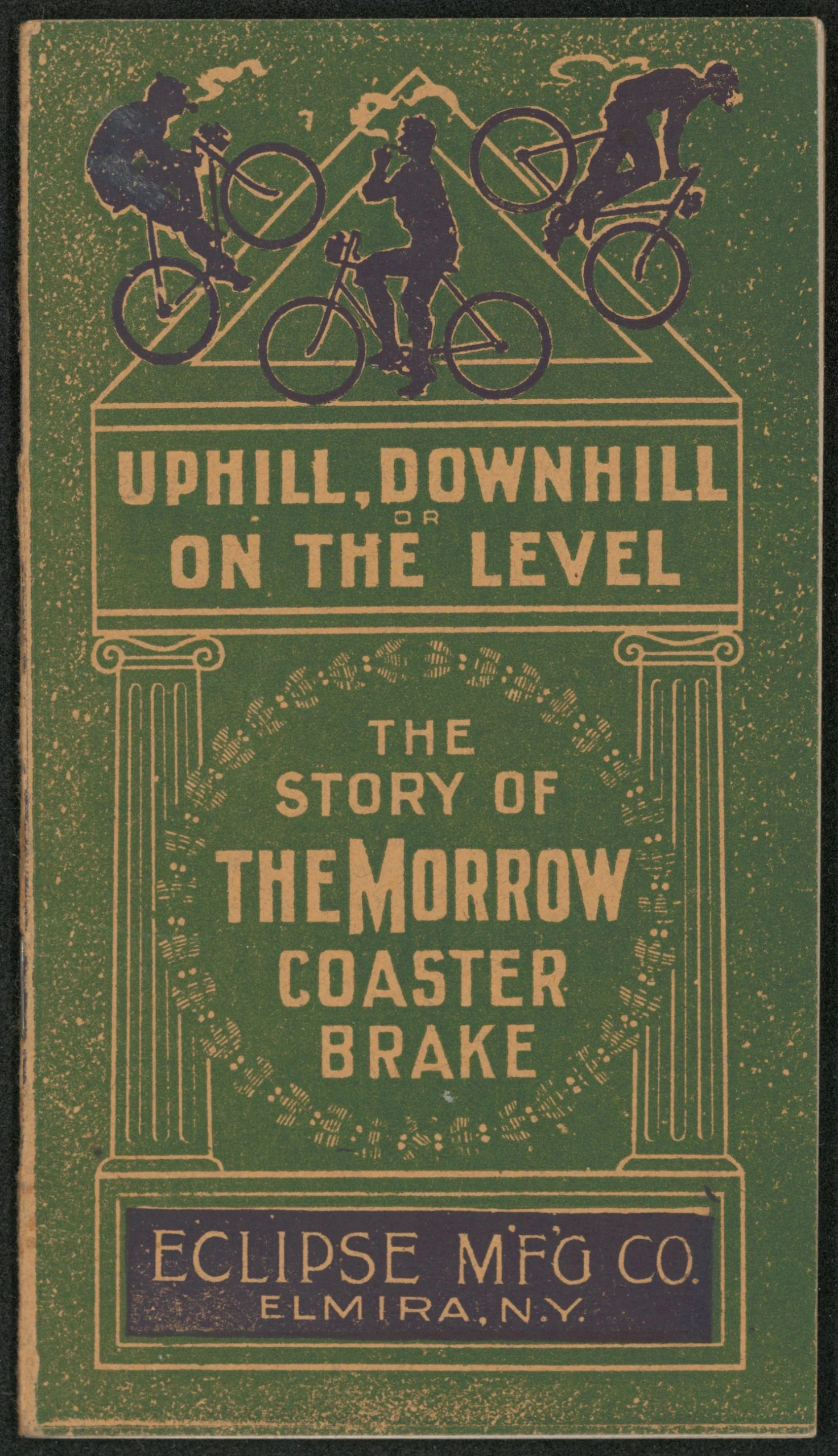
UPHILL, DOWNHILL OR ON THE LEVEL
THE STORY OF THE MORROW COASTER BRAKE
ECLIPSE MFG CO.
ELMIRA, N.Y.
[The front cover of a narrow upright booklet, printed in tan on green: three cyclists in dark silhouette (two climbing and descending the sides of a triangular pediment, one coasting at its peak) above a temple front with two Ionic columns framing the title inside an oval wreath; the firm name in a dark panel at the foot.]
— Page 2 —
[The blank inside front cover, plain tan paper.]
— Page 3 —
Uphill Downhill
On the Level
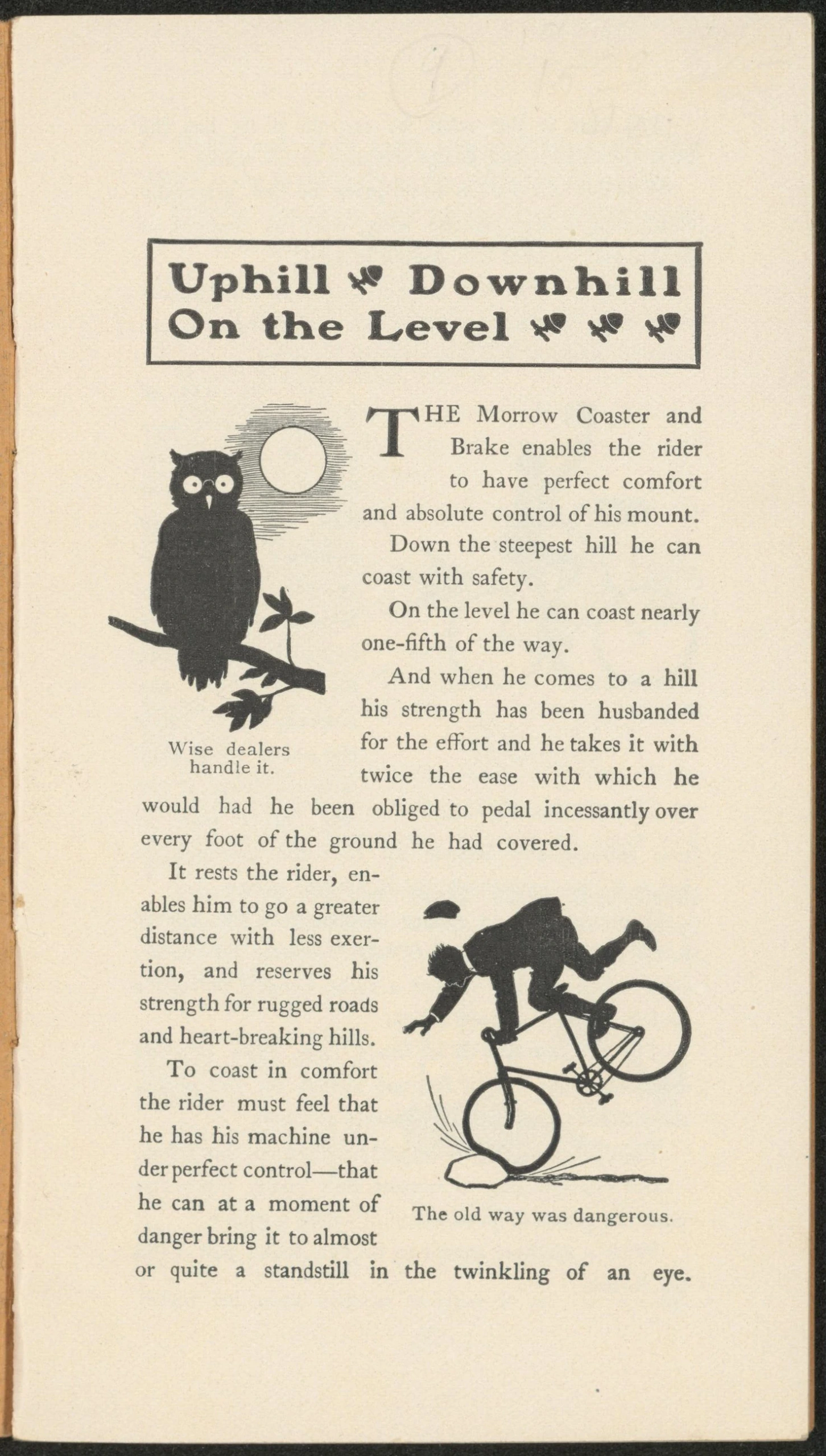
THE Morrow Coaster and Brake enables the rider to have perfect comfort and absolute control of his mount.
Down the steepest hill he can coast with safety.
On the level he can coast nearly one-fifth of the way.
And when he comes to a hill his strength has been husbanded for the effort and he takes it with twice the ease with which he would had he been obliged to pedal incessantly over every foot of the ground he had covered.
It rests the rider, enables him to go a greater distance with less exertion, and reserves his strength for rugged roads and heart-breaking hills.
To coast in comfort the rider must feel that he has his machine under perfect control—that he can at a moment of danger bring it to almost or quite a standstill in the twinkling of an eye.
Wise dealers handle it.
The old way was dangerous.
[A boxed heading with leaf ornaments; a silhouette of an owl on a branch before a full moon, captioned “Wise dealers handle it”, and a silhouette of a cyclist pitched over the handlebars as his front wheel strikes a stone. Faint erased pencil at the top right: a circled “1” and an illegible number.]
— Page 4 —
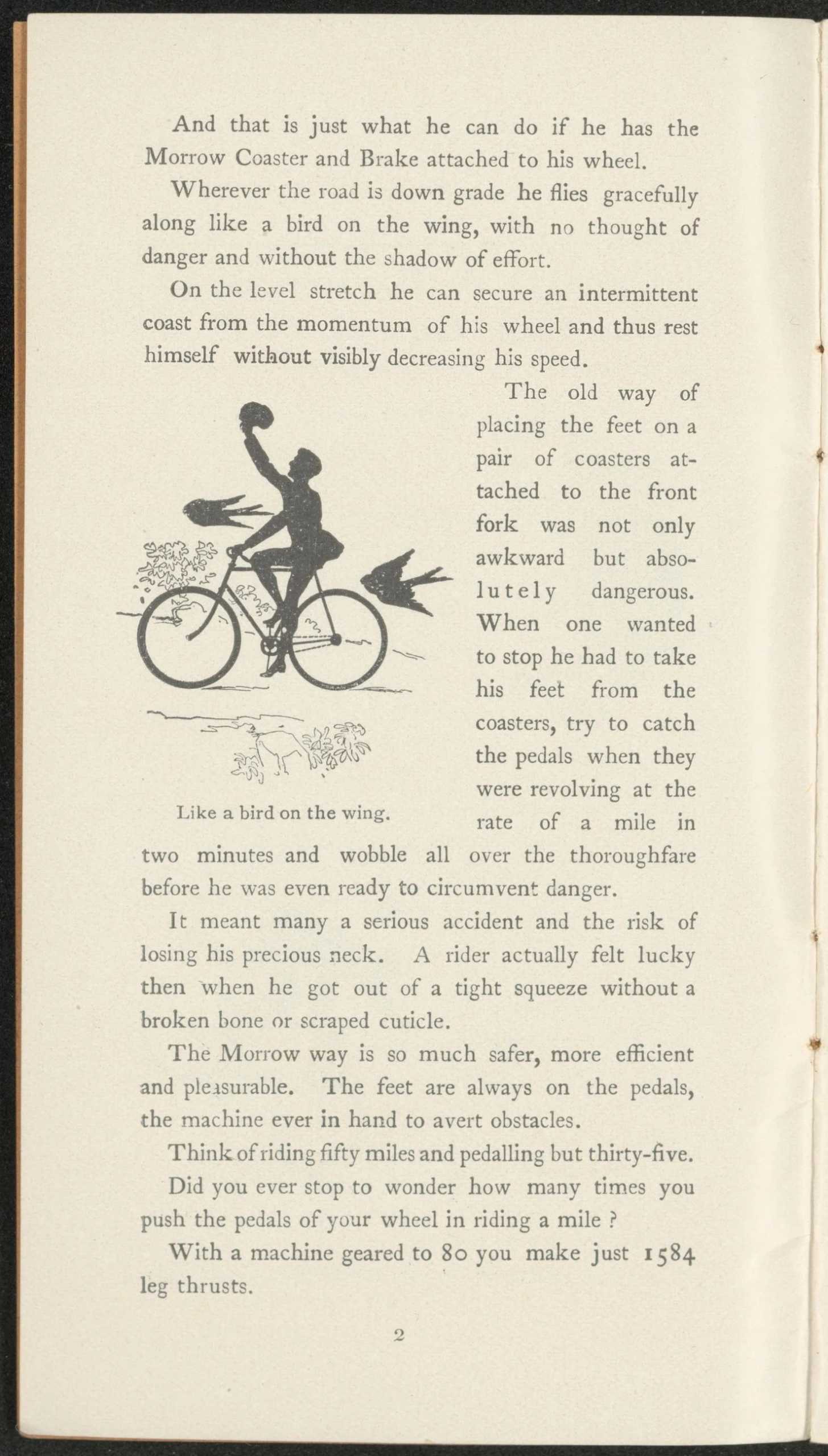
And that is just what he can do if he has the Morrow Coaster and Brake attached to his wheel.
Wherever the road is down grade he flies gracefully along like a bird on the wing, with no thought of danger and without the shadow of effort.
On the level stretch he can secure an intermittent coast from the momentum of his wheel and thus rest himself without visibly decreasing his speed.
The old way of placing the feet on a pair of coasters attached to the front fork was not only awkward but absolutely dangerous. When one wanted to stop he had to take his feet from the coasters, try to catch the pedals when they were revolving at the rate of a mile in two minutes and wobble all over the thoroughfare before he was even ready to circumvent danger.
It meant many a serious accident and the risk of losing his precious neck. A rider actually felt lucky then when he got out of a tight squeeze without a broken bone or scraped cuticle.
The Morrow way is so much safer, more efficient and pleasurable. The feet are always on the pedals, the machine ever in hand to avert obstacles.
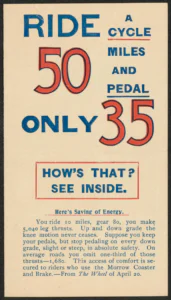
Think of riding fifty miles and pedalling but thirty-five.
Did you ever stop to wonder how many times you push the pedals of your wheel in riding a mile ?
With a machine geared to 80 you make just 1584 leg thrusts.
Like a bird on the wing.
2
[A silhouette of a cyclist coasting with his hat raised overhead, two swallows flying beside him and a dog in the grass below, captioned “Like a bird on the wing.”]
— Page 5 —
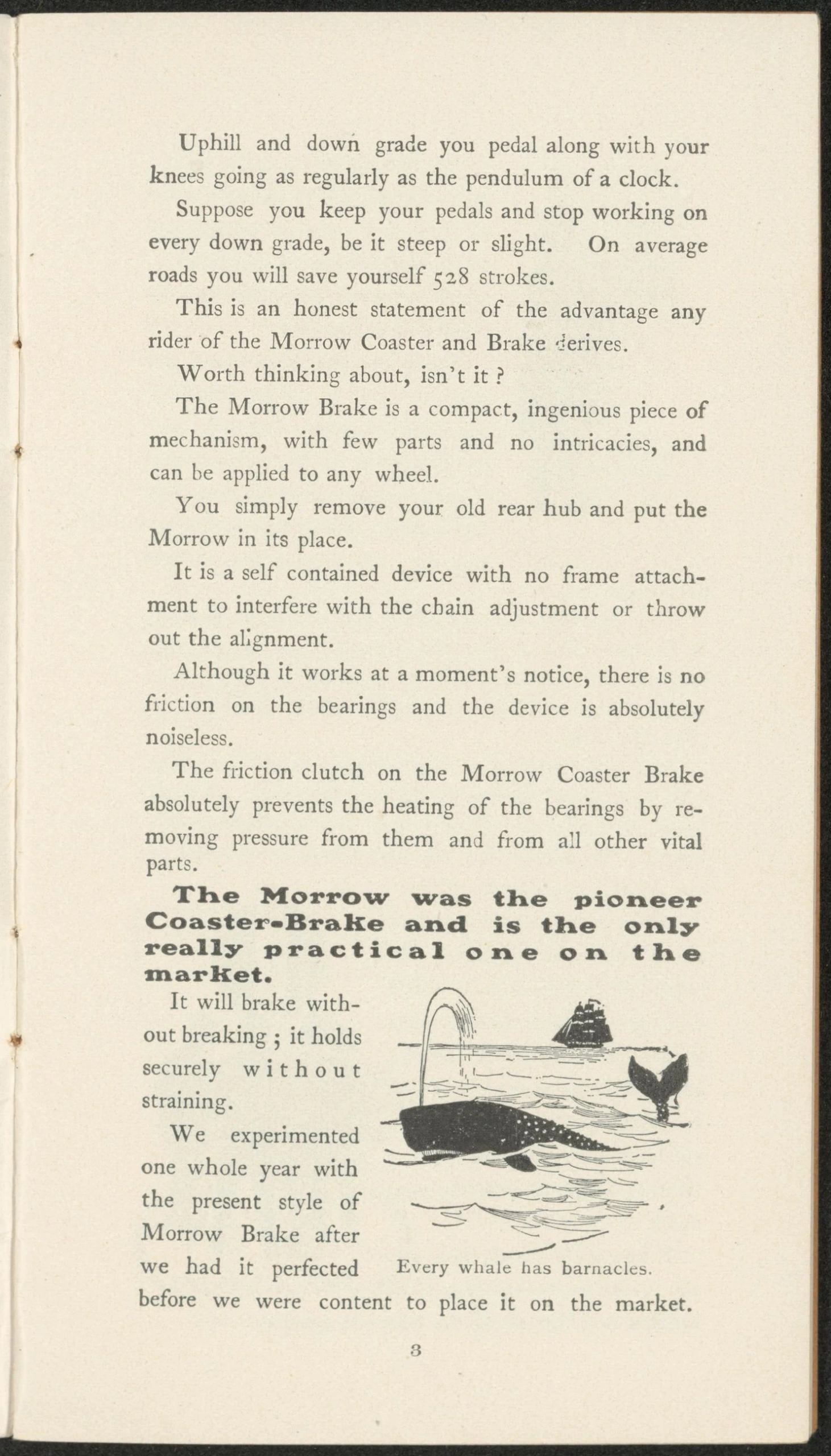
Uphill and down grade you pedal along with your knees going as regularly as the pendulum of a clock.
Suppose you keep your pedals and stop working on every down grade, be it steep or slight. On average roads you will save yourself 528 strokes.
This is an honest statement of the advantage any rider of the Morrow Coaster and Brake derives.
Worth thinking about, isn’t it ?
The Morrow Brake is a compact, ingenious piece of mechanism, with few parts and no intricacies, and can be applied to any wheel.
You simply remove your old rear hub and put the Morrow in its place.
It is a self contained device with no frame attachment to interfere with the chain adjustment or throw out the alignment.
Although it works at a moment’s notice, there is no friction on the bearings and the device is absolutely noiseless.
The friction clutch on the Morrow Coaster Brake absolutely prevents the heating of the bearings by removing pressure from them and from all other vital parts.
The Morrow was the pioneer Coaster-Brake and is the only really practical one on the market.
It will brake without breaking ; it holds securely without straining.
We experimented one whole year with the present style of Morrow Brake after we had it perfected before we were content to place it on the market.
Every whale has barnacles.
3
[A pen drawing of a spouting whale at sea with a sailing ship on the horizon, captioned “Every whale has barnacles.” One sentence is set in heavy display type.]
— Page 6 —
We determined to make assurance doubly sure by testing it over all roads and under all conditions, to convince ourselves that it contained no weak point and that it could not be bettered.
Then and only then were we ready to send it on its mission, place our guarantee behind it and recommend it to the riders of the world as the greatest labor-saving and comfort-giving bicycle invention since the introduction of the pneumatic tire.
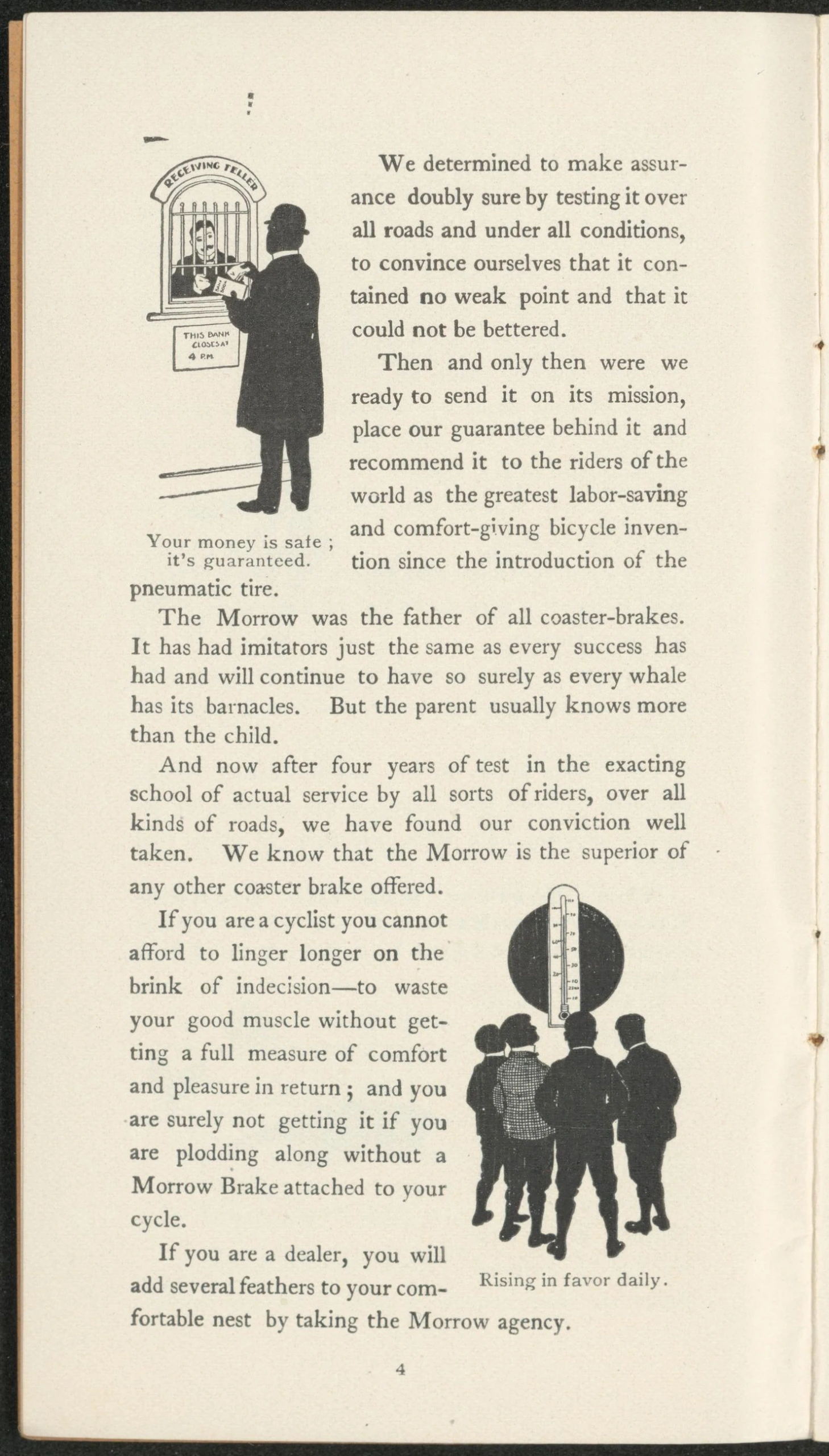
The Morrow was the father of all coaster-brakes. It has had imitators just the same as every success has had and will continue to have so surely as every whale has its barnacles. But the parent usually knows more than the child.
And now after four years of test in the exacting school of actual service by all sorts of riders, over all kinds of roads, we have found our conviction well taken. We know that the Morrow is the superior of any other coaster brake offered.
If you are a cyclist you cannot afford to linger longer on the brink of indecision—to waste your good muscle without getting a full measure of comfort and pleasure in return ; and you are surely not getting it if you are plodding along without a Morrow Brake attached to your cycle.
If you are a dealer, you will add several feathers to your comfortable nest by taking the Morrow agency.
RECEIVING TELLER
THIS BANK CLOSES AT 4 P.M.
Your money is safe ; it’s guaranteed.
Rising in favor daily.
4
[A silhouette of a man in a bowler hat handing a bank book to a teller behind a barred window, captioned “Your money is safe ; it’s guaranteed.”; and four boys in silhouette looking up at a large thermometer, captioned “Rising in favor daily.”]
— Page 7 —
Not a rider within miles of your store would go without it if he knew its advantages.
And you can tell them to him—convince him to his satisfaction in a few short well chosen words if you care to, and we will put the words in your mouth.
It is possible for you to work up an accessory business that will keep your repair shop busy for weeks equipping old mounts with the Morrow Coaster and Brake.
Every rider who has used it says that he would not part with it for double its price and be deprived of the comfort and security it brings.
Every dealer who has sold it avows it has enhanced his trade.
More than 100,000 riders attached it to their mounts last year. They are now happy and contented.
Now don’t put off till to-morrow when you can buy the Morrow to-day.
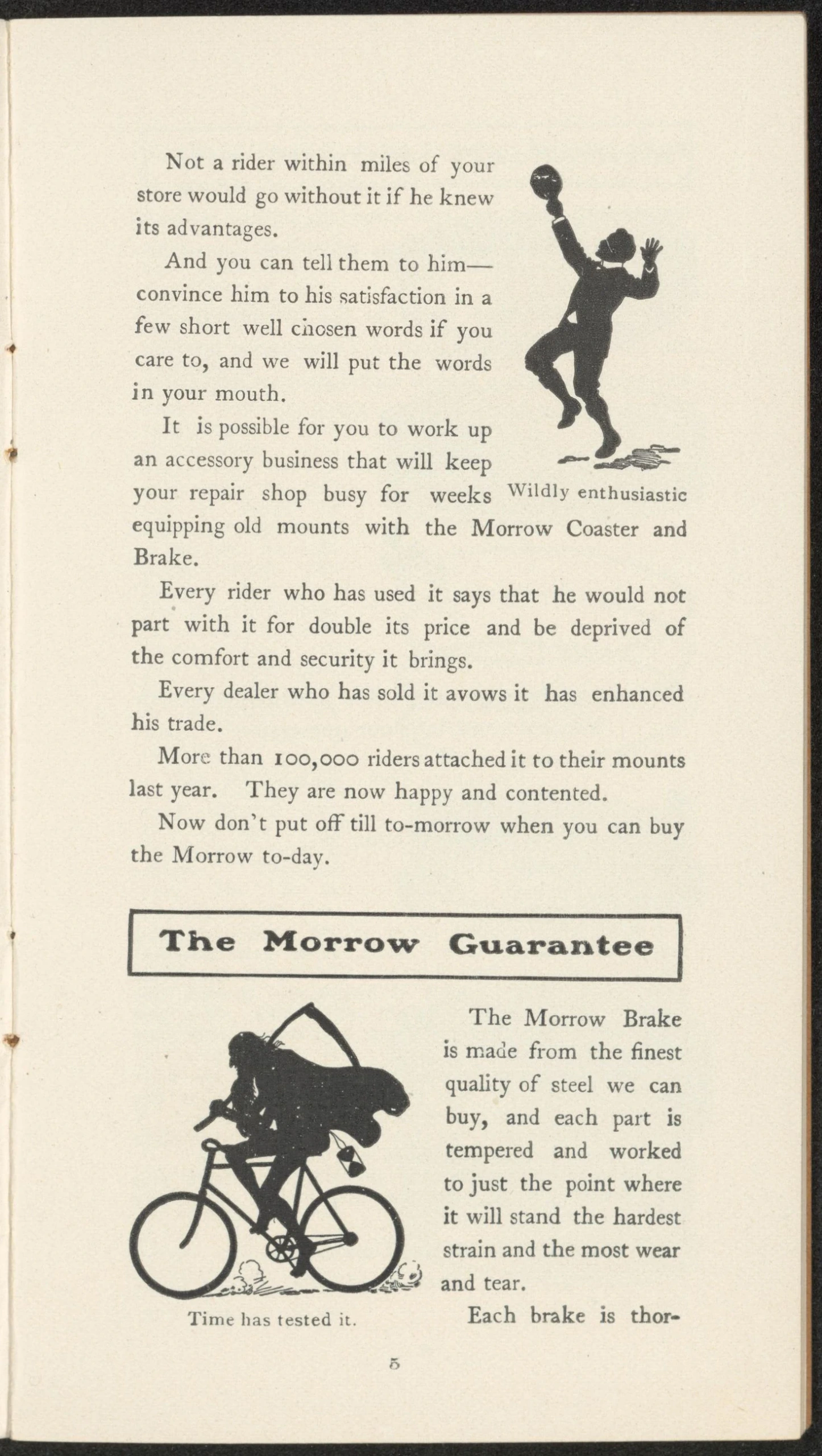
Wildly enthusiastic
The Morrow Guarantee
The Morrow Brake is made from the finest quality of steel we can buy, and each part is tempered and worked to just the point where it will stand the hardest strain and the most wear and tear.
Each brake is thor-
Time has tested it.
5
[A silhouette of a man leaping with his hat in the air, captioned “Wildly enthusiastic”; below a boxed heading, a silhouette of Father Time with his scythe and hourglass riding a bicycle, captioned “Time has tested it.”]
— Page 8 —
oughly inspected and tested before it leaves our hands. It is warranted to be free from defects of material or workmanship, and we will cheerfully replace without charge any part returned to us which has proved defective.
We are more than liberal in the interpretation of this guarantee, and it is given by a company of integrity and standing, with a paid-in capital stock of $500,000.
You run no risk in buying a Morrow.
“We present here an unsolicited testimonial which has just come into our possession.”
PORTLAND, ORE., January 18, 1901.
BERT TICHENER,
2832 Archer Ave., Station W.,
Chicago, Ill.
Dear Sir:
I have your valued favor of the 13th inst., and replying to same would state: Our firm handled about 2,000 of the Morrow Coaster Brakes last year, and never found it necessary to ask the Eclipse Mfg. Co. to replace one brake. We had remarkable success with them, and expect this year to double our sales.
I personally have tested all or nearly all the 1901 coaster brakes on the market, and find that the Morrow is the only one which stands the test. I believe for the purpose for which you contemplate using these brakes, that they will be a success.
If there is any further information which you may desire, please write me, and I shall cheerfully give it.
Thanking you for favor, I remain,
FRED T. MERRILL CYCLE CO.
Dic. K. L.
6
[A text page with a small leaf-and-scroll ornament between the guarantee and the testimonial letter; no illustration.]
— Page 9 —
The Morrow Mechanism
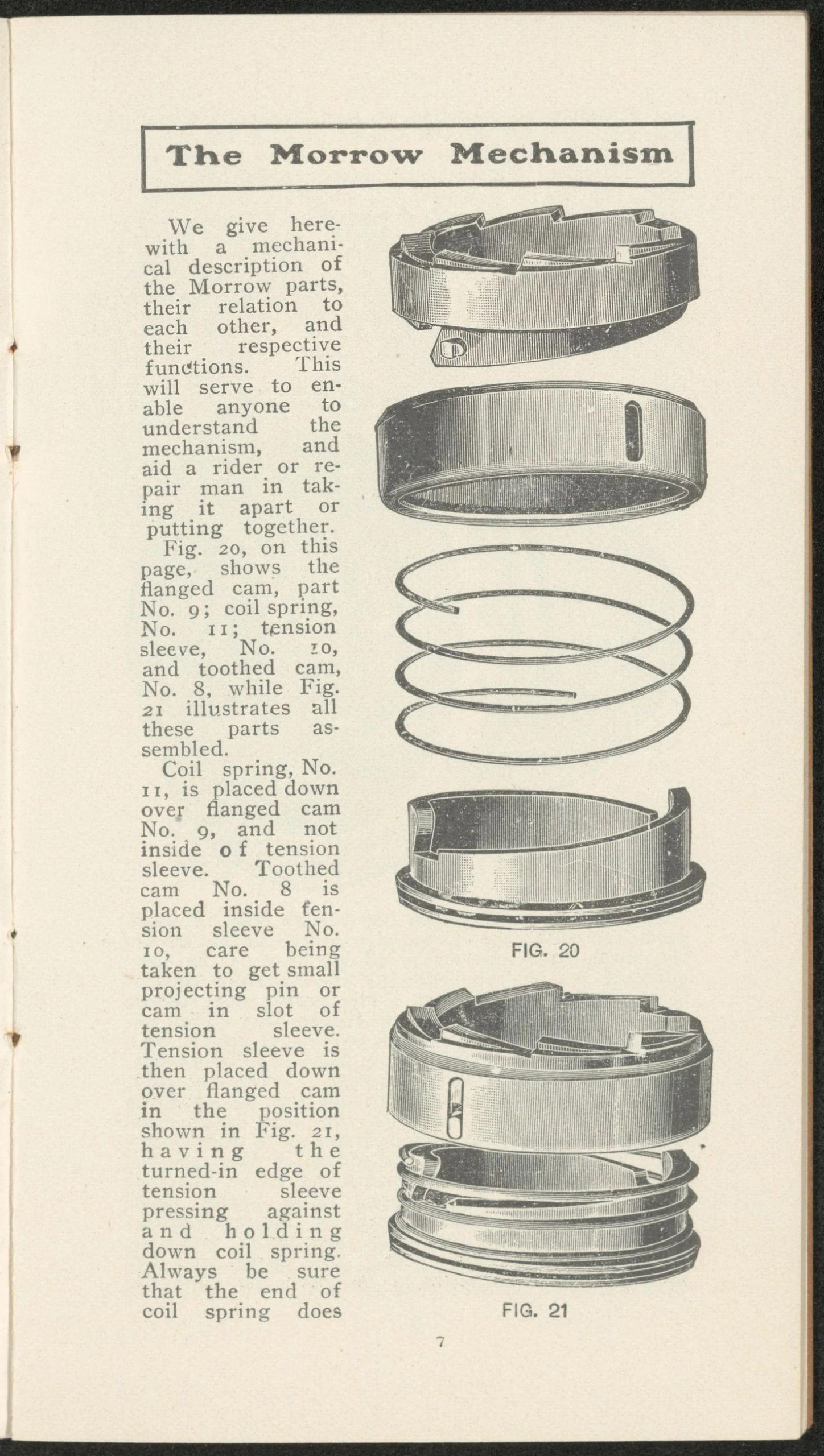
We give herewith a mechanical description of the Morrow parts, their relation to each other, and their respective functions. This will serve to enable anyone to understand the mechanism, and aid a rider or repair man in taking it apart or putting together.
Fig. 20, on this page, shows the flanged cam, part No. 9; coil spring, No. 11; tension sleeve, No. 10, and toothed cam, No. 8, while Fig. 21 illustrates all these parts assembled.
Coil spring, No. 11, is placed down over flanged cam No. 9, and not inside of tension sleeve. Toothed cam No. 8 is placed inside tension sleeve No. 10, care being taken to get small projecting pin or cam in slot of tension sleeve. Tension sleeve is then placed down over flanged cam in the position shown in Fig. 21, having the turned-in edge of tension sleeve pressing against and holding down coil spring. Always be sure that the end of coil spring does
FIG. 20
FIG. 21
7
[Engravings of Morrow brake parts stacked vertically: the toothed cam, tension sleeve, coil spring and flanged cam (Fig. 20), and the same parts assembled (Fig. 21); a boxed heading above the text column.]
— Page 10 —
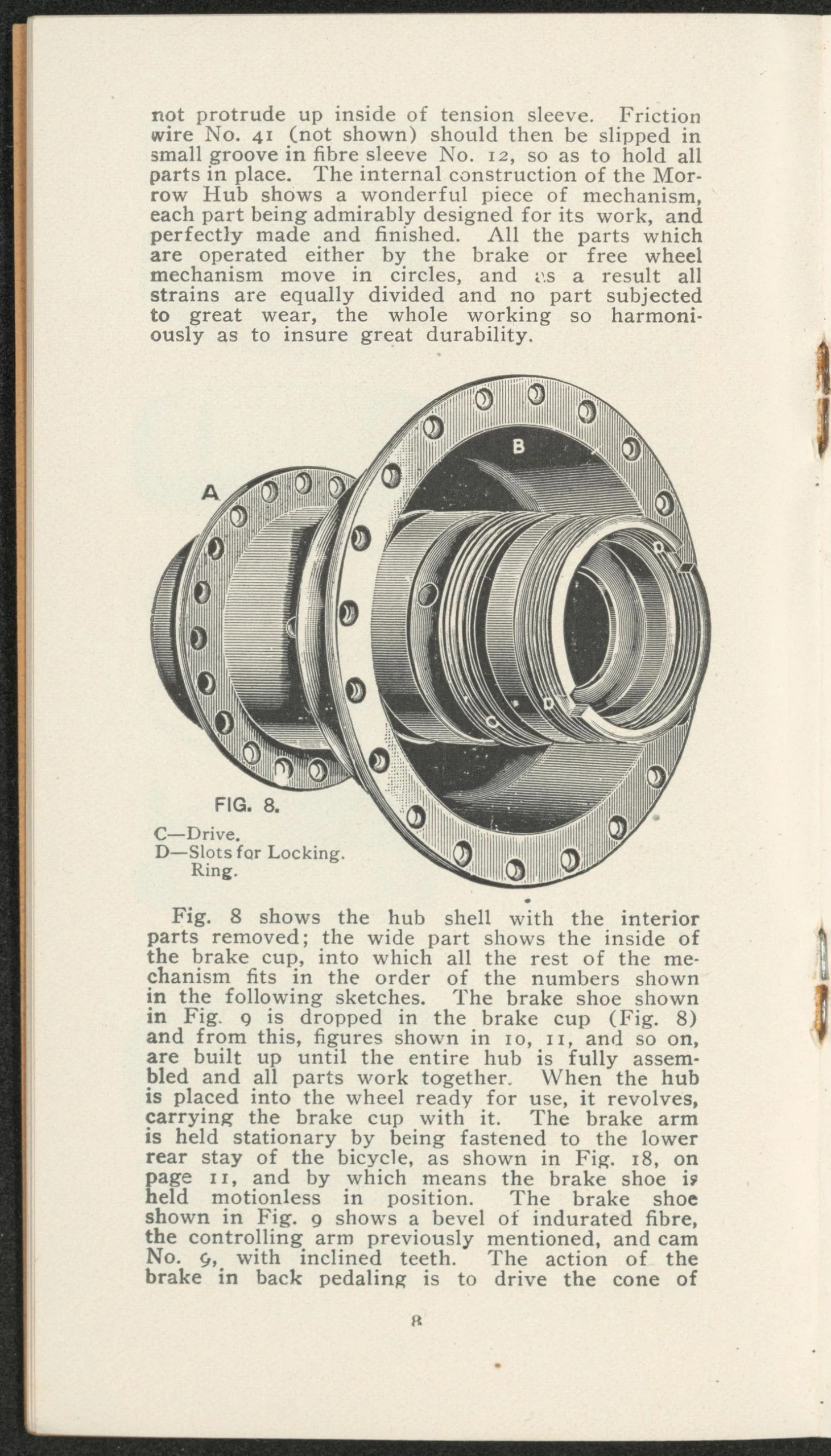
not protrude up inside of tension sleeve. Friction wire No. 41 (not shown) should then be slipped in small groove in fibre sleeve No. 12, so as to hold all parts in place. The internal construction of the Morrow Hub shows a wonderful piece of mechanism, each part being admirably designed for its work, and perfectly made and finished. All the parts which are operated either by the brake or free wheel mechanism move in circles, and as a result all strains are equally divided and no part subjected to great wear, the whole working so harmoniously as to insure great durability.
FIG. 8.
C—Drive.
D—Slots for Locking. Ring.
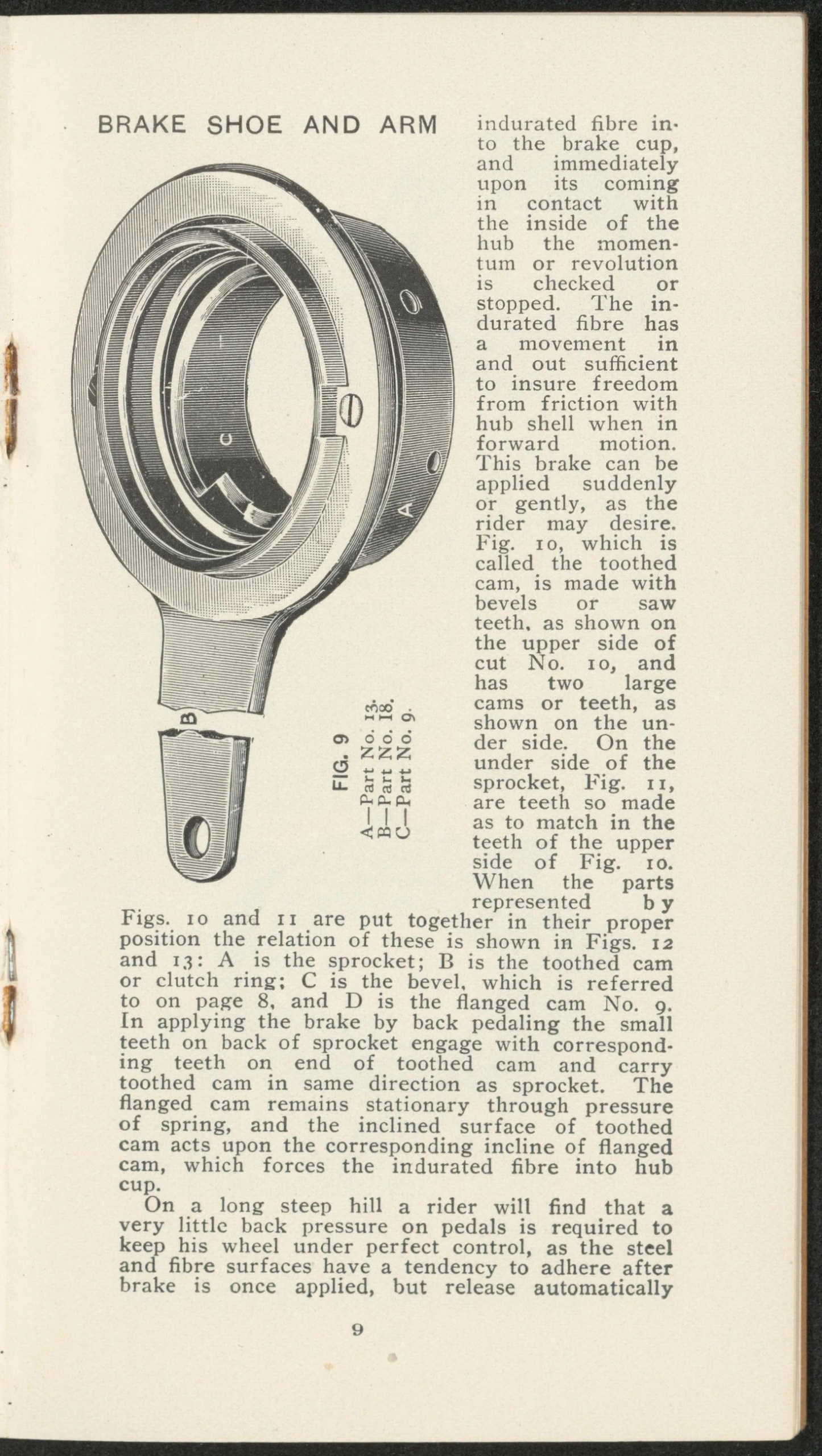
Fig. 8 shows the hub shell with the interior parts removed; the wide part shows the inside of the brake cup, into which all the rest of the mechanism fits in the order of the numbers shown in the following sketches. The brake shoe shown in Fig. 9 is dropped in the brake cup (Fig. 8) and from this, figures shown in 10, 11, and so on, are built up until the entire hub is fully assembled and all parts work together. When the hub is placed into the wheel ready for use, it revolves, carrying the brake cup with it. The brake arm is held stationary by being fastened to the lower rear stay of the bicycle, as shown in Fig. 18, on page 11, and by which means the brake shoe is held motionless in position. The brake shoe shown in Fig. 9 shows a bevel of indurated fibre, the controlling arm previously mentioned, and cam No. 9, with inclined teeth. The action of the brake in back pedaling is to drive the cone of
8
[A large engraving of the empty Morrow hub shell seen from the brake-cup end, with its two drilled flanges, lettered A to D.]
— Page 11 —
BRAKE SHOE AND ARM
FIG. 9
A—Part No. 13.
B—Part No. 18.
C—Part No. 9.
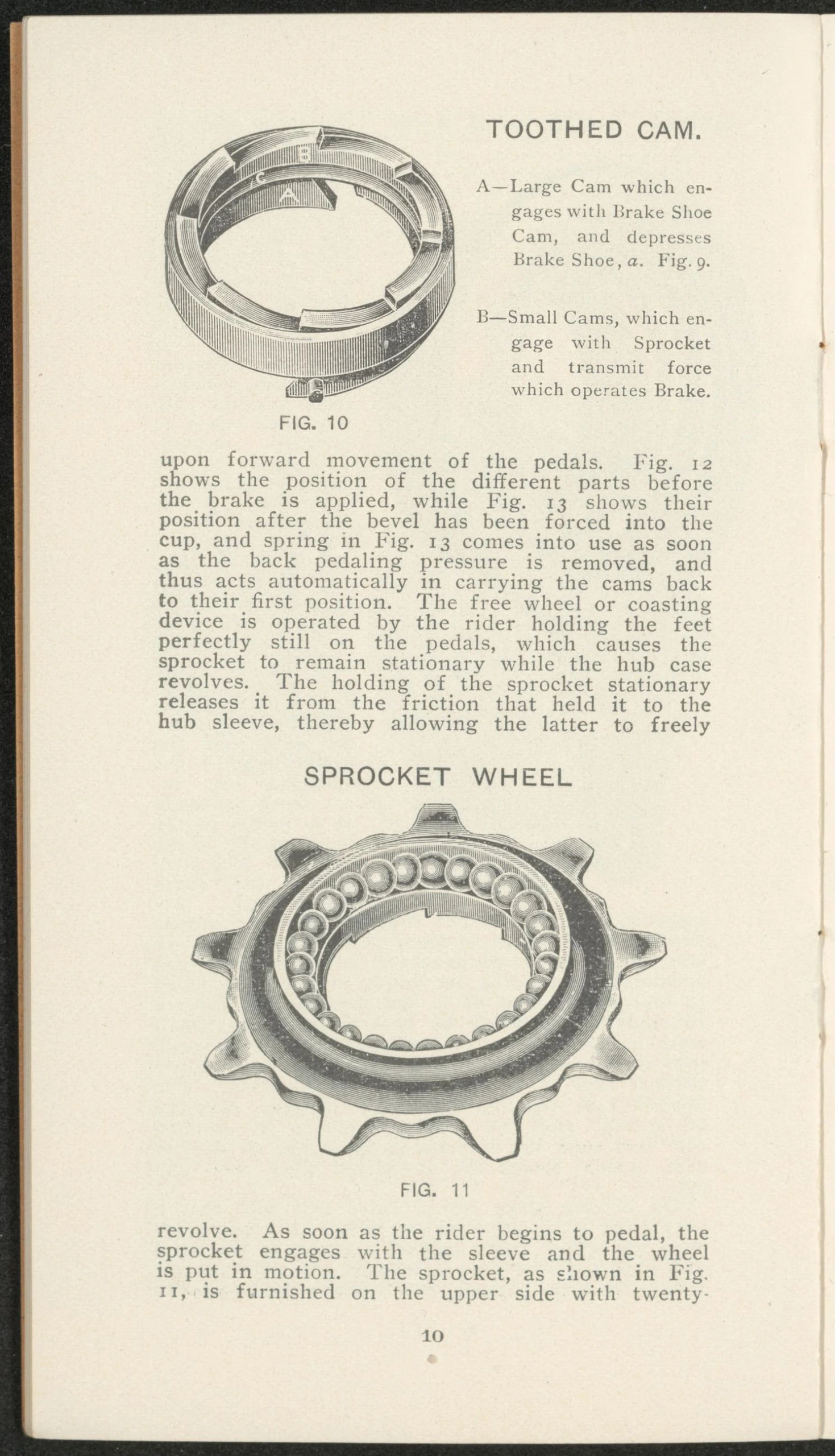
indurated fibre into the brake cup, and immediately upon its coming in contact with the inside of the hub the momentum or revolution is checked or stopped. The indurated fibre has a movement in and out sufficient to insure freedom from friction with hub shell when in forward motion. This brake can be applied suddenly or gently, as the rider may desire. Fig. 10, which is called the toothed cam, is made with bevels or saw teeth, as shown on the upper side of cut No. 10, and has two large cams or teeth, as shown on the under side. On the under side of the sprocket, Fig. 11, are teeth so made as to match in the teeth of the upper side of Fig. 10. When the parts represented by Figs. 10 and 11 are put together in their proper position the relation of these is shown in Figs. 12 and 13: A is the sprocket; B is the toothed cam or clutch ring; C is the bevel, which is referred to on page 8, and D is the flanged cam No. 9. In applying the brake by back pedaling the small teeth on back of sprocket engage with corresponding teeth on end of toothed cam and carry toothed cam in same direction as sprocket. The flanged cam remains stationary through pressure of spring, and the inclined surface of toothed cam acts upon the corresponding incline of flanged cam, which forces the indurated fibre into hub cup.
On a long steep hill a rider will find that a very little back pressure on pedals is required to keep his wheel under perfect control, as the steel and fibre surfaces have a tendency to adhere after brake is once applied, but release automatically
9
[An engraving of the brake shoe with its long arm (shortened by a break line), lettered A to C, with the caption set sideways beside it.]
— Page 12 —
TOOTHED CAM.
A—Large Cam which engages with Brake Shoe Cam, and depresses Brake Shoe, a. Fig. 9.
B—Small Cams, which engage with Sprocket and transmit force which operates Brake.
FIG. 10
upon forward movement of the pedals. Fig. 12 shows the position of the different parts before the brake is applied, while Fig. 13 shows their position after the bevel has been forced into the cup, and spring in Fig. 13 comes into use as soon as the back pedaling pressure is removed, and thus acts automatically in carrying the cams back to their first position. The free wheel or coasting device is operated by the rider holding the feet perfectly still on the pedals, which causes the sprocket to remain stationary while the hub case revolves. The holding of the sprocket stationary releases it from the friction that held it to the hub sleeve, thereby allowing the latter to freely
SPROCKET WHEEL
FIG. 11
revolve. As soon as the rider begins to pedal, the sprocket engages with the sleeve and the wheel is put in motion. The sprocket, as shown in Fig. 11, is furnished on the upper side with twenty-
10
[Engravings of the toothed cam ring, lettered A to C (Fig. 10), and of the sprocket wheel with its ring of balls (Fig. 11).]
— Page 13 —
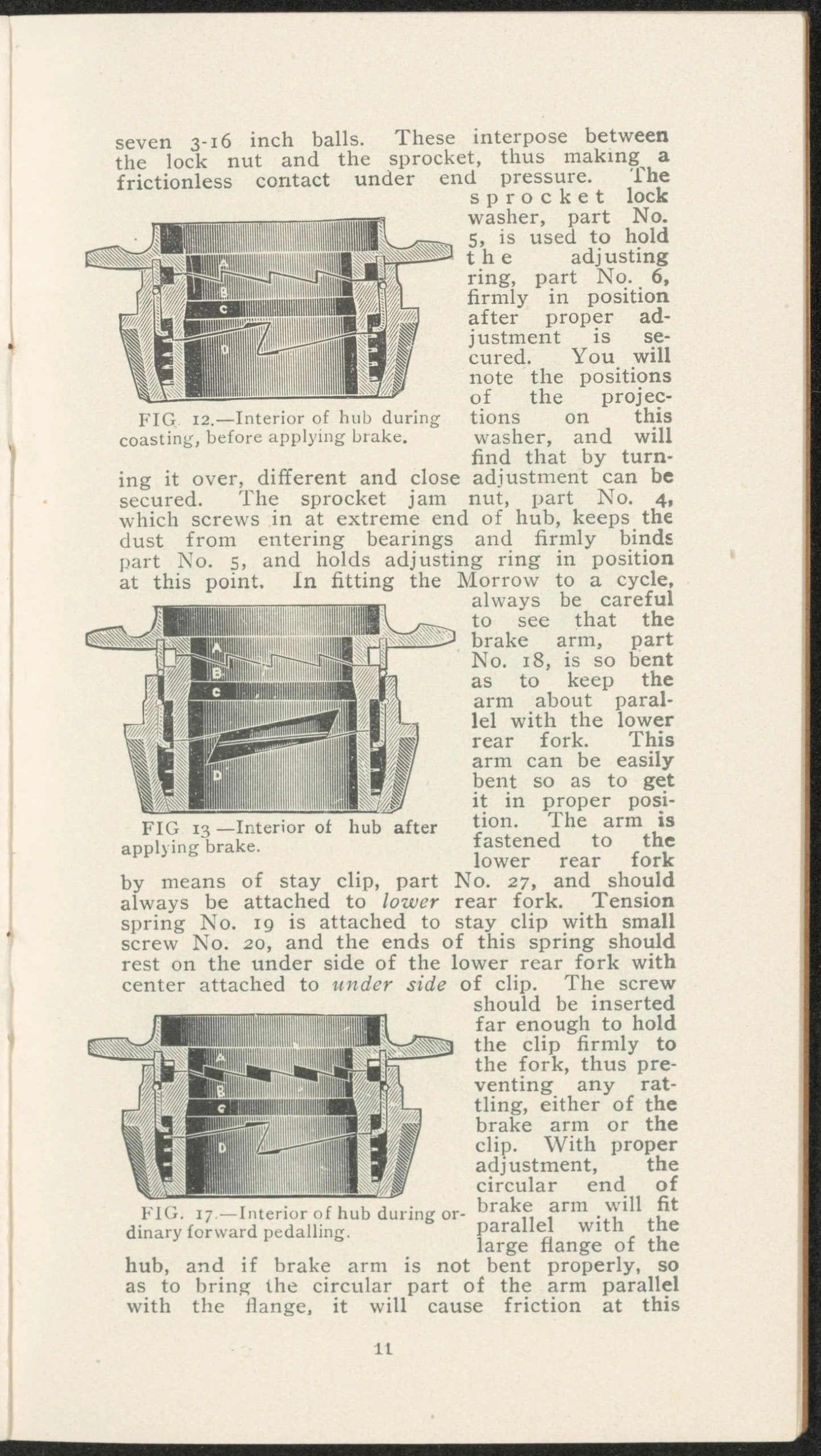
seven 3-16 inch balls. These interpose between the lock nut and the sprocket, thus making a frictionless contact under end pressure. The sprocket lock washer, part No. 5, is used to hold the adjusting ring, part No. 6, firmly in position after proper adjustment is secured. You will note the positions of the projections on this washer, and will find that by turning it over, different and close adjustment can be secured. The sprocket jam nut, part No. 4, which screws in at extreme end of hub, keeps the dust from entering bearings and firmly binds part No. 5, and holds adjusting ring in position at this point. In fitting the Morrow to a cycle, always be careful to see that the brake arm, part No. 18, is so bent as to keep the arm about parallel with the lower rear fork. This arm can be easily bent so as to get it in proper position. The arm is fastened to the lower rear fork by means of stay clip, part No. 27, and should always be attached to lower rear fork. Tension spring No. 19 is attached to stay clip with small screw No. 20, and the ends of this spring should rest on the under side of the lower rear fork with center attached to under side of clip. The screw should be inserted far enough to hold the clip firmly to the fork, thus preventing any rattling, either of the brake arm or the clip. With proper adjustment, the circular end of brake arm will fit parallel with the large flange of the hub, and if brake arm is not bent properly, so as to bring the circular part of the arm parallel with the flange, it will cause friction at this
FIG. 12.—Interior of hub during coasting, before applying brake.
FIG. 13.—Interior of hub after applying brake.
FIG. 17.—Interior of hub during ordinary forward pedalling.
11
[Three sectional diagrams of the hub interior, lettered A to D, showing the zigzag cam faces in the coasting, braking and driving positions.]
— Page 14 —
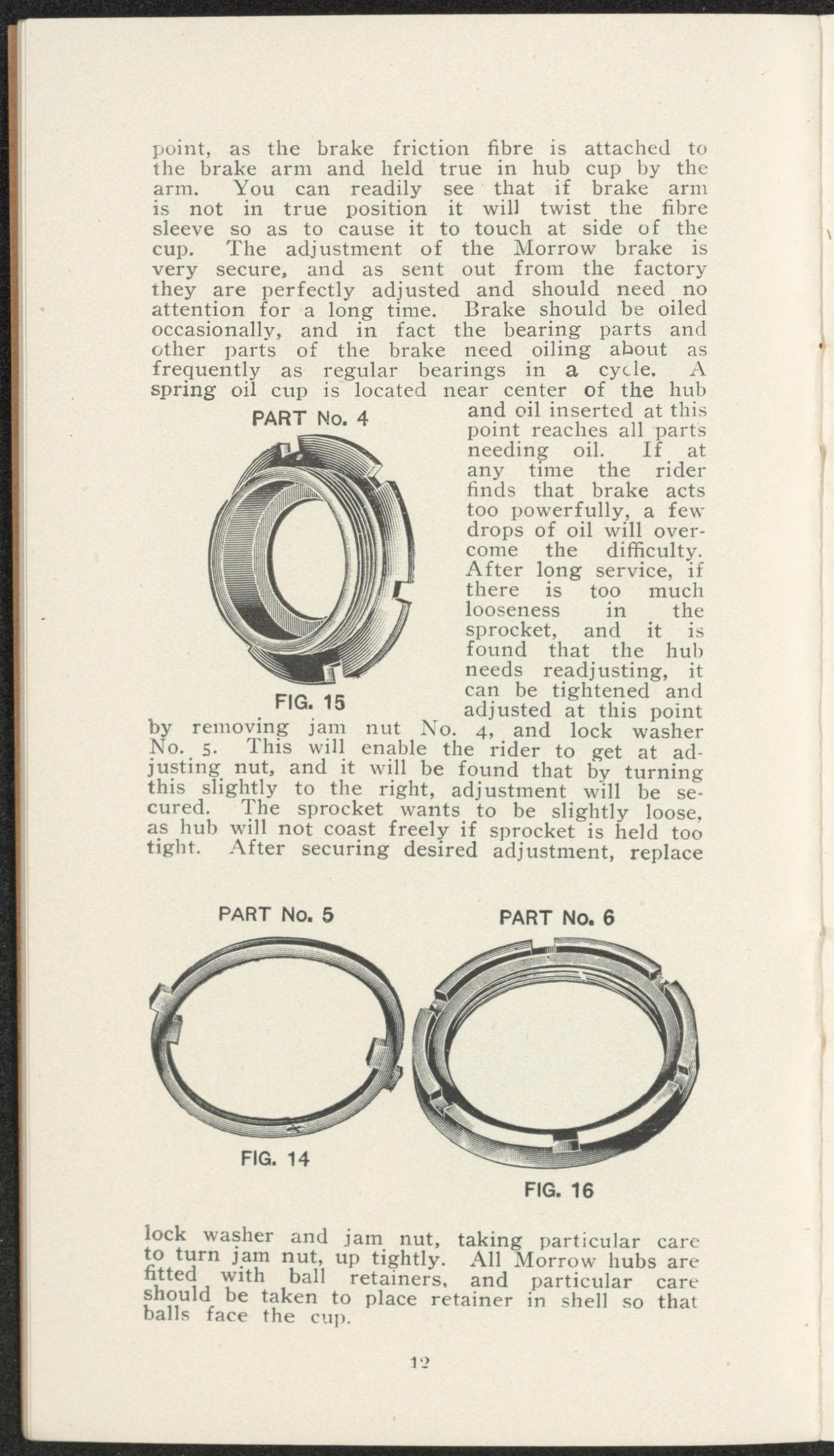
point, as the brake friction fibre is attached to the brake arm and held true in hub cup by the arm. You can readily see that if brake arm is not in true position it will twist the fibre sleeve so as to cause it to touch at side of the cup. The adjustment of the Morrow brake is very secure, and as sent out from the factory they are perfectly adjusted and should need no attention for a long time. Brake should be oiled occasionally, and in fact the bearing parts and other parts of the brake need oiling about as frequently as regular bearings in a cycle. A spring oil cup is located near center of the hub and oil inserted at this point reaches all parts needing oil. If at any time the rider finds that brake acts too powerfully, a few drops of oil will overcome the difficulty. After long service, if there is too much looseness in the sprocket, and it is found that the hub needs readjusting, it can be tightened and adjusted at this point by removing jam nut No. 4, and lock washer No. 5. This will enable the rider to get at adjusting nut, and it will be found that by turning this slightly to the right, adjustment will be secured. The sprocket wants to be slightly loose, as hub will not coast freely if sprocket is held too tight. After securing desired adjustment, replace lock washer and jam nut, taking particular care to turn jam nut, up tightly. All Morrow hubs are fitted with ball retainers, and particular care should be taken to place retainer in shell so that balls face the cup.
PART No. 4
FIG. 15
PART No. 5
FIG. 14
PART No. 6
FIG. 16
12
[Engravings of three hub rings: the slotted jam nut (Part No. 4, Fig. 15), the lugged lock washer (Part No. 5, Fig. 14) and the adjusting ring (Part No. 6, Fig. 16).]
— Page 15 —
Important Notice
CONCERNING MORROW COASTER BRAKE
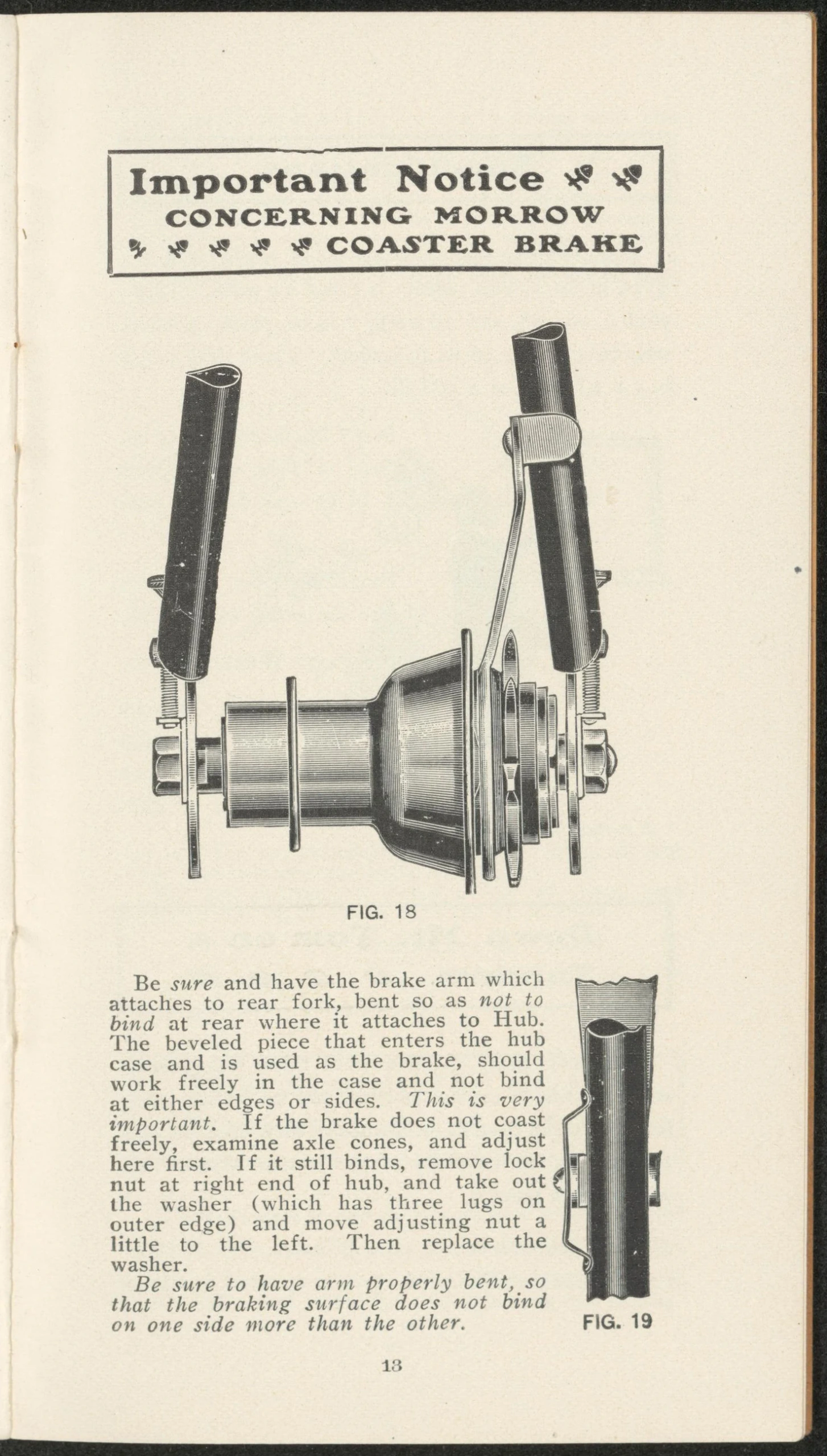
FIG. 18
Be sure and have the brake arm which attaches to rear fork, bent so as not to bind at rear where it attaches to Hub. The beveled piece that enters the hub case and is used as the brake, should work freely in the case and not bind at either edges or sides. This is very important. If the brake does not coast freely, examine axle cones, and adjust here first. If it still binds, remove lock nut at right end of hub, and take out the washer (which has three lugs on outer edge) and move adjusting nut a little to the left. Then replace the washer.
Be sure to have arm properly bent, so that the braking surface does not bind on one side more than the other.
FIG. 19
13
[A boxed heading with leaf ornaments; an engraving of the complete Morrow hub mounted between the two rear fork ends, its brake arm clipped to the stay (Fig. 18), and a detail of the stay clip on the fork tube (Fig. 19).]
— Page 16 —
Specifications.
8, 9, 10 or 12 tooth sprocket ; 1 in. pitch. 1/4 in., 3/16 in. or 1/8 in. wide. 13 and 15 teeth, 5/8 in. pitch ; 16, 18, and 20 teeth, 1/2 in. pitch, 3/16 in. wide only. 32, 36 or 40 spokes. Chain line 1 3/8 in., 1 1/2 in., or 1 5/8 in.
Stay Clips furnished 13/16, 15/16, or 1 in. size. Order size to fit rear fork of your cycle.
PRICE, $5.00. Extra charge for spokes and nipples.
COMPLETE WHEELS, $6.50.
CORRESPONDENCE. We are at all times willing to assist riders of these devices with advice on any point of difficulty.
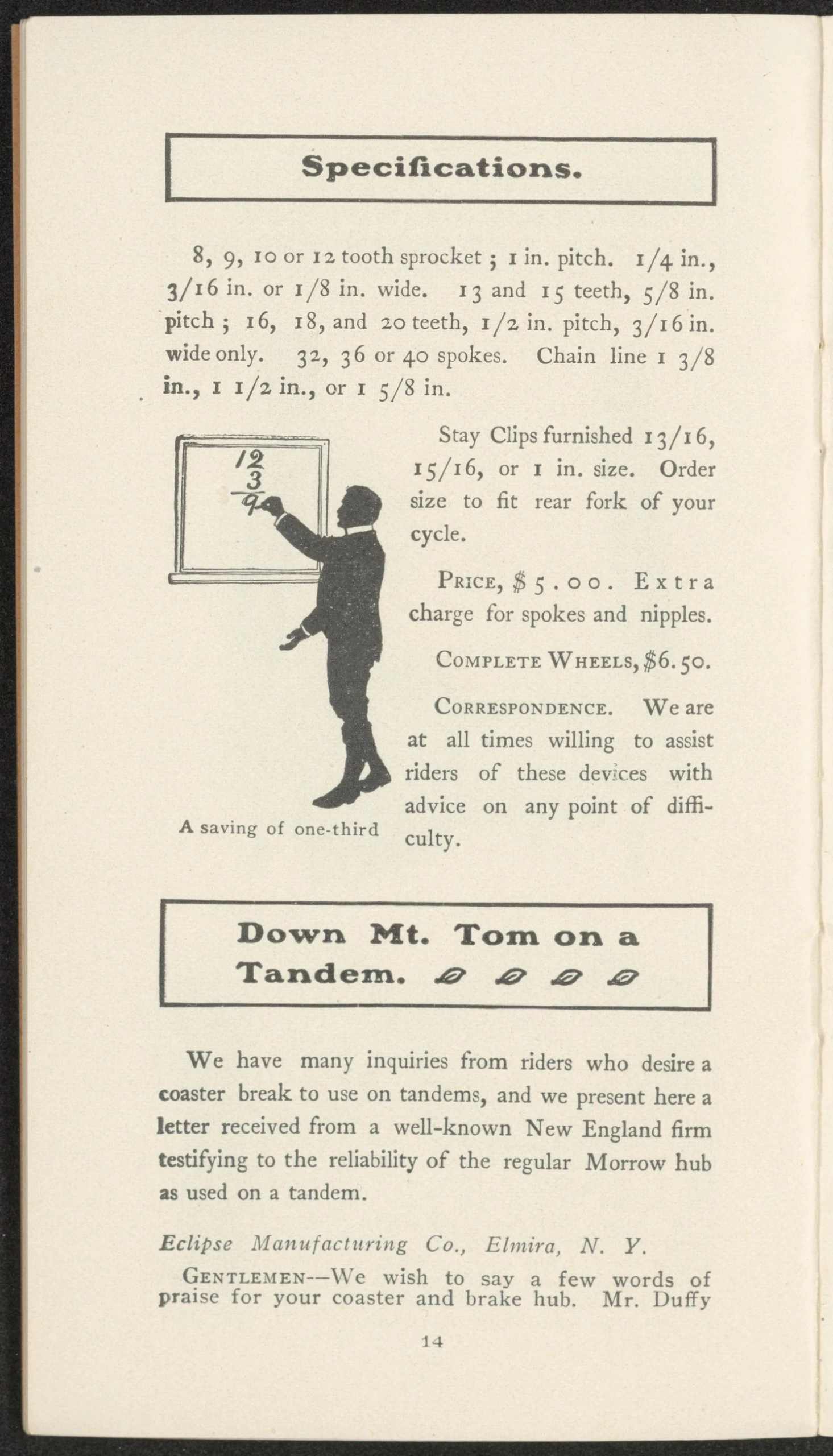
A saving of one-third
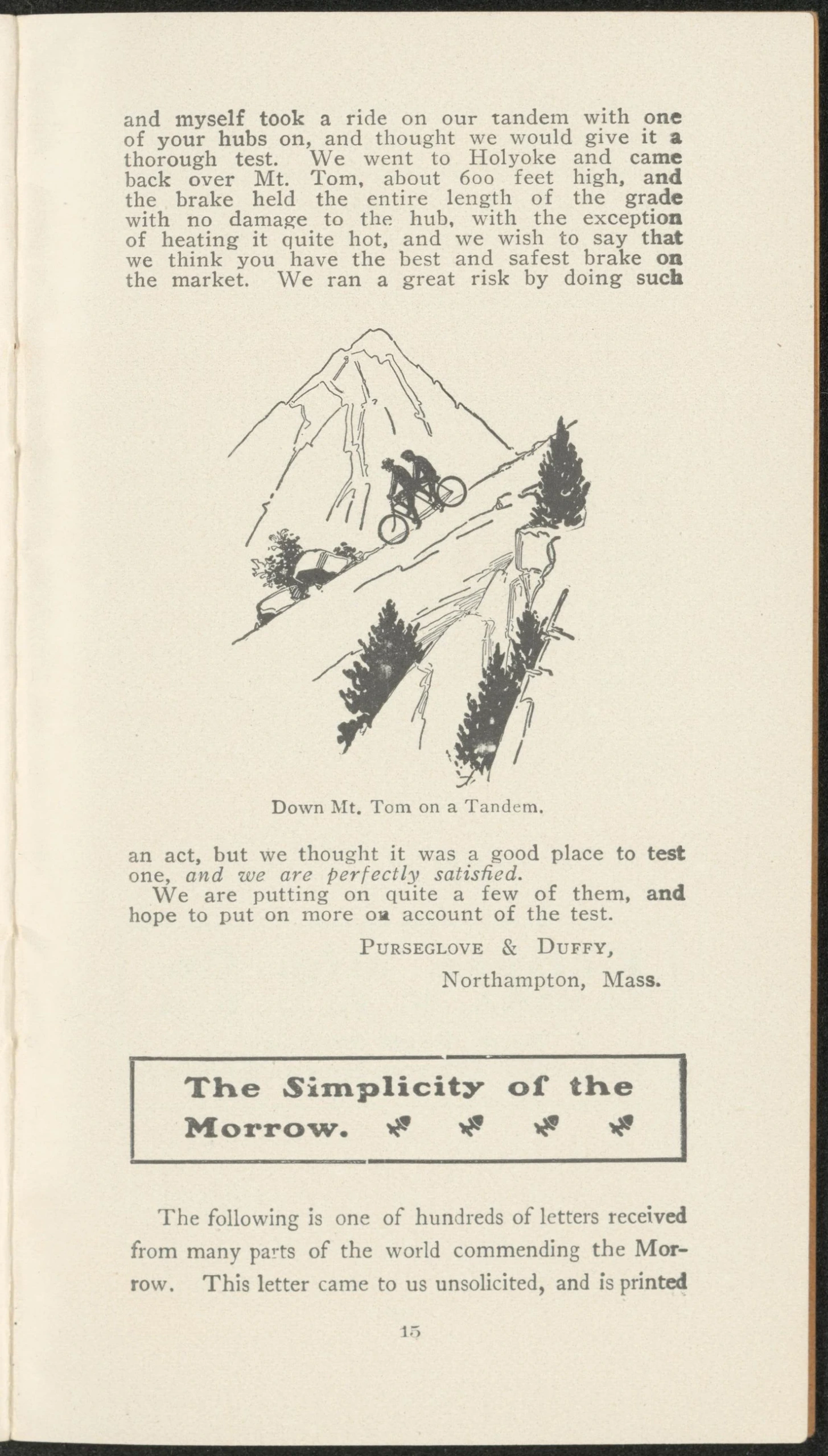
Down Mt. Tom on a Tandem.
We have many inquiries from riders who desire a coaster break to use on tandems, and we present here a letter received from a well-known New England firm testifying to the reliability of the regular Morrow hub as used on a tandem.
Eclipse Manufacturing Co., Elmira, N. Y.
GENTLEMEN—We wish to say a few words of praise for your coaster and brake hub. Mr. Duffy
14
[Two boxed headings; a silhouette of a man chalking the sum 12 minus 3 equals 9 on a blackboard, captioned “A saving of one-third.”]
— Page 17 —
and myself took a ride on our tandem with one of your hubs on, and thought we would give it a thorough test. We went to Holyoke and came back over Mt. Tom, about 600 feet high, and the brake held the entire length of the grade with no damage to the hub, with the exception of heating it quite hot, and we wish to say that we think you have the best and safest brake on the market. We ran a great risk by doing such an act, but we thought it was a good place to test one, and we are perfectly satisfied.
We are putting on quite a few of them, and hope to put on more on account of the test.
PURSEGLOVE & DUFFY,
Northampton, Mass.
Down Mt. Tom on a Tandem.
The Simplicity of the Morrow.
The following is one of hundreds of letters received from many parts of the world commending the Morrow. This letter came to us unsolicited, and is printed
15
[A pen drawing of two riders on a tandem descending a steep mountain road among pine trees, a peak behind them, captioned “Down Mt. Tom on a Tandem.”; a boxed heading with leaf ornaments below.]
— Page 18 —
in order to show how simple the Morrow is and how easily undrestood. The Rev. Mr. Duncan, who is pastor of the First Presbyterian Church at Ashland, had never seen one of the Morrow brakes until he received the one we shipped to him.
Eclipse Manufacturing Co., Elmira, N. Y.
GENTLEMEN—I write to thank you for the pleasure I am having riding my wheel with your coaster brake. Of course I had to take it all apart and examine its mechanism. It took me a good while to understand it thoroughly; it is one of the most beautiful and ingenious pieces of mechanism I ever saw. The anti-friction device, and the manner of engaging and releasing the brake and the wheel are admirable. I had to wait till the following Monday, because I wanted to put it in place myself. This I accomplished without any difficulty whatever, and now for two weeks I have been enjoying it. It adds 50 per cent. to the delight of cycling; it doesn’t seem to have an ounce of friction; indeed it runs easier than my old hub did. The pick up and release are so soft and easy as to be unnoticeable, and the feeling of safety and pleasure with which one glides down a big hill is a new, delightful sensation. To be able to rest one’s legs about one-third of the time when on a country trip adds greatly to one’s enjoyment. It is a boon to humanity.
Yours truly,
R. B. DUNCAN.
ASHLAND, O.
Eclipse Mfg. Co.
ELMIRA, N. Y., U. S. A.
New York Office:
105-107 Chambers Street
16
[A text page ending in a boxed imprint of the firm’s name and its Elmira and New York addresses; no illustration.]
— Page 19 —
[The blank inside back cover, plain tan paper.]
— Page 20 —
THE BERKELEY PRESS
NEW YORK
[The plain tan back cover, blank except for the printer’s small circular imprint at the lower right, a seal showing a bridge tower with the monogram “BP”.]
Ebykr presents this material for research and education. If you hold rights to it or notice an ownership issue, please contact us and we will respond promptly.