About Ebykr
Ebykr celebrates classic and vintage lightweight bicycles through provocative imagery and opinion. Ride along with us.
About Ebykr
Ebykr celebrates classic and vintage lightweight bicycles through provocative imagery and opinion. Ride along with us.

Source: Northwestern University Libraries, Transportation Library, "Lyndhurst, a special made wheel" (digital collection, https://dc.library.northwestern.edu/items/43704529-7e2d-4a70-a08d-138d5d565dd1); rights statement "No Copyright - United States".
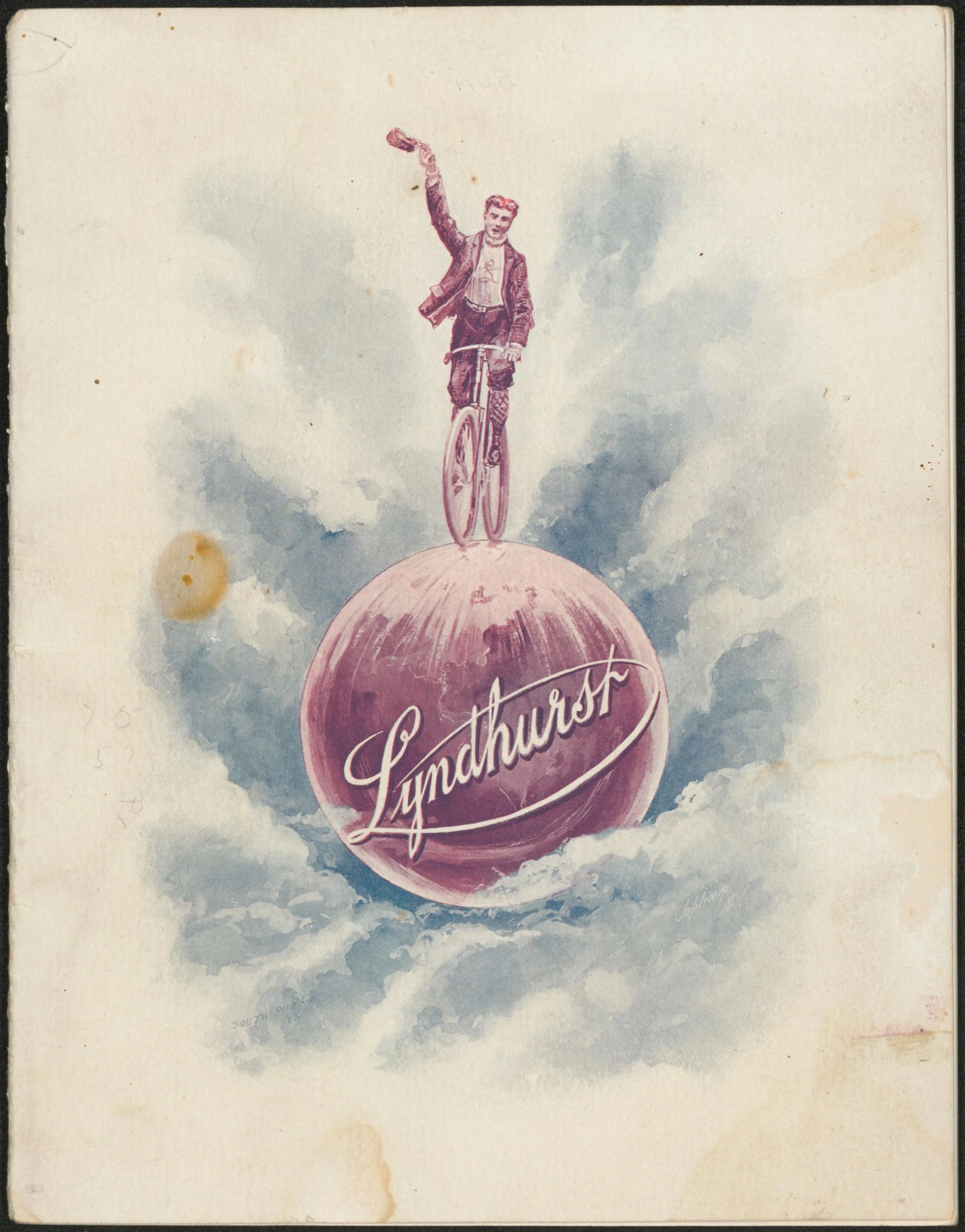 Page 1
 Page 2
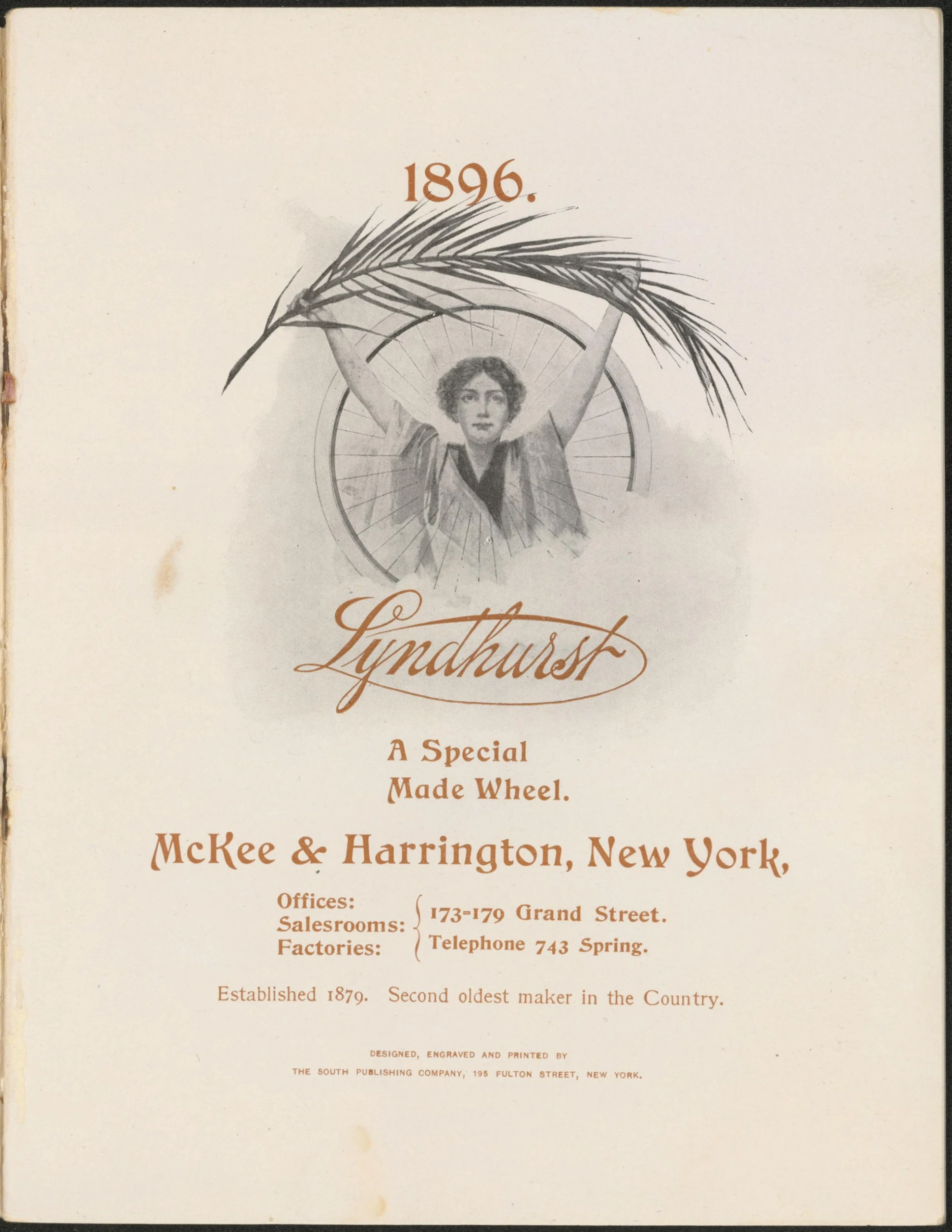 Page 3
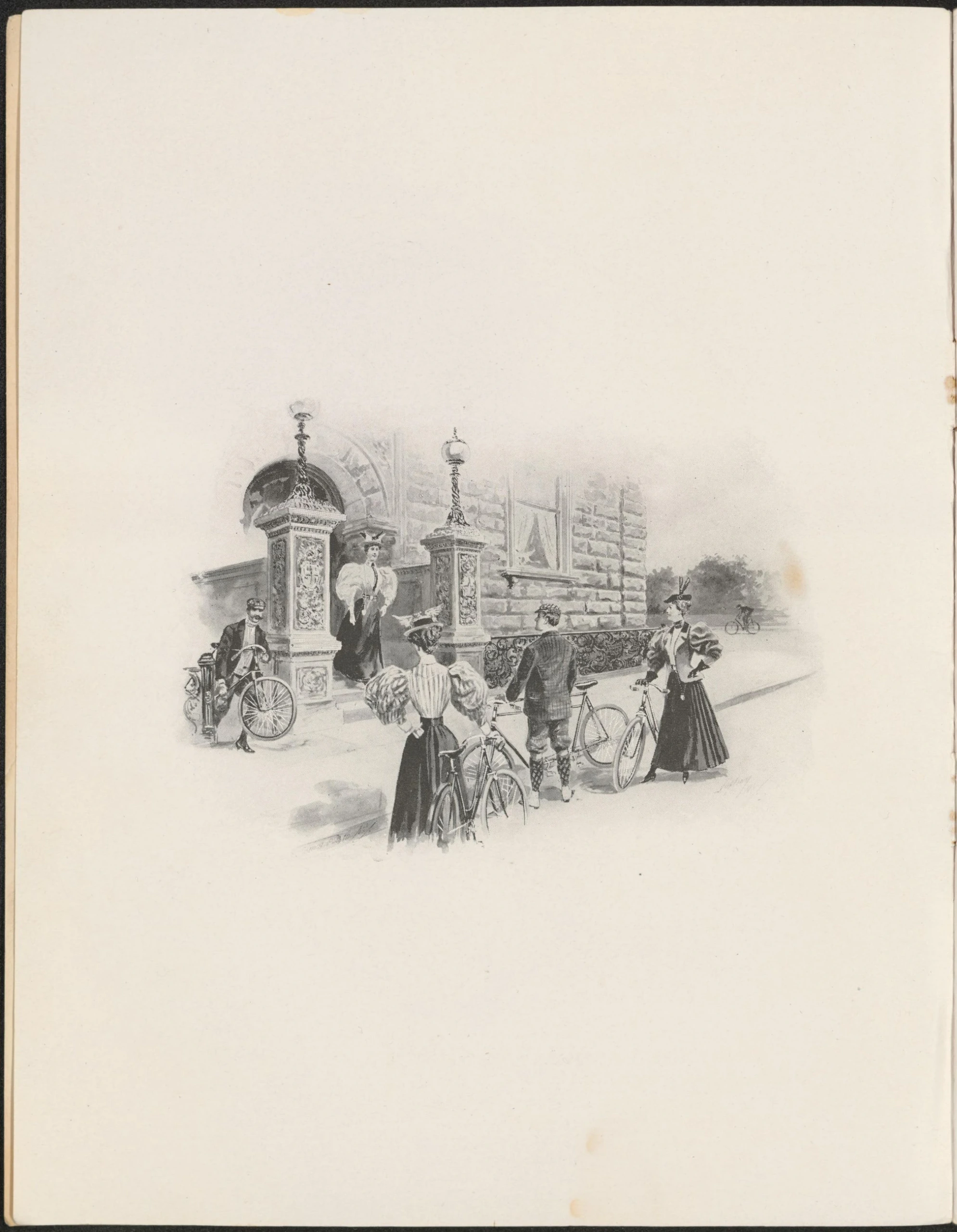 Page 4
 Page 5
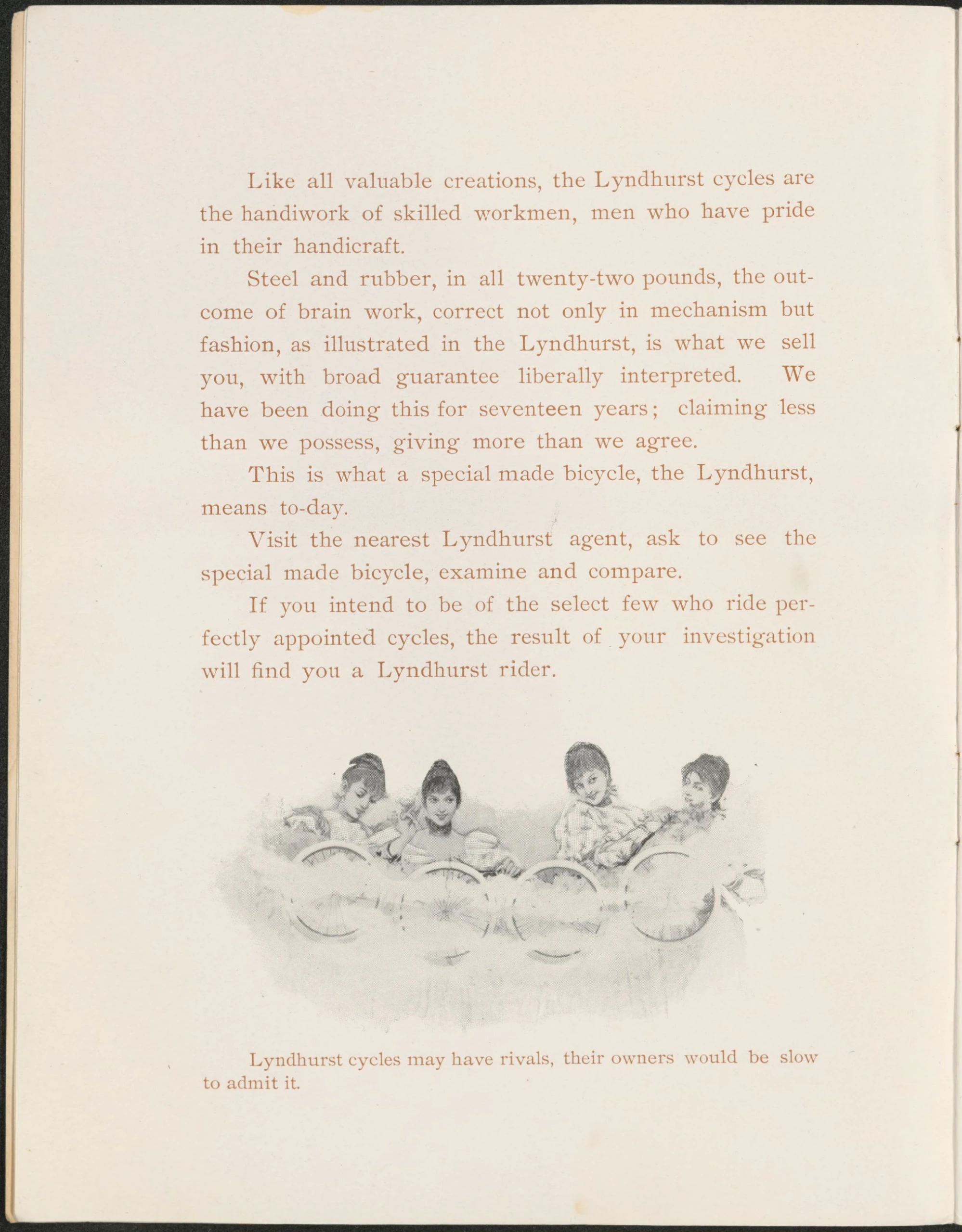 Page 6
 Page 7
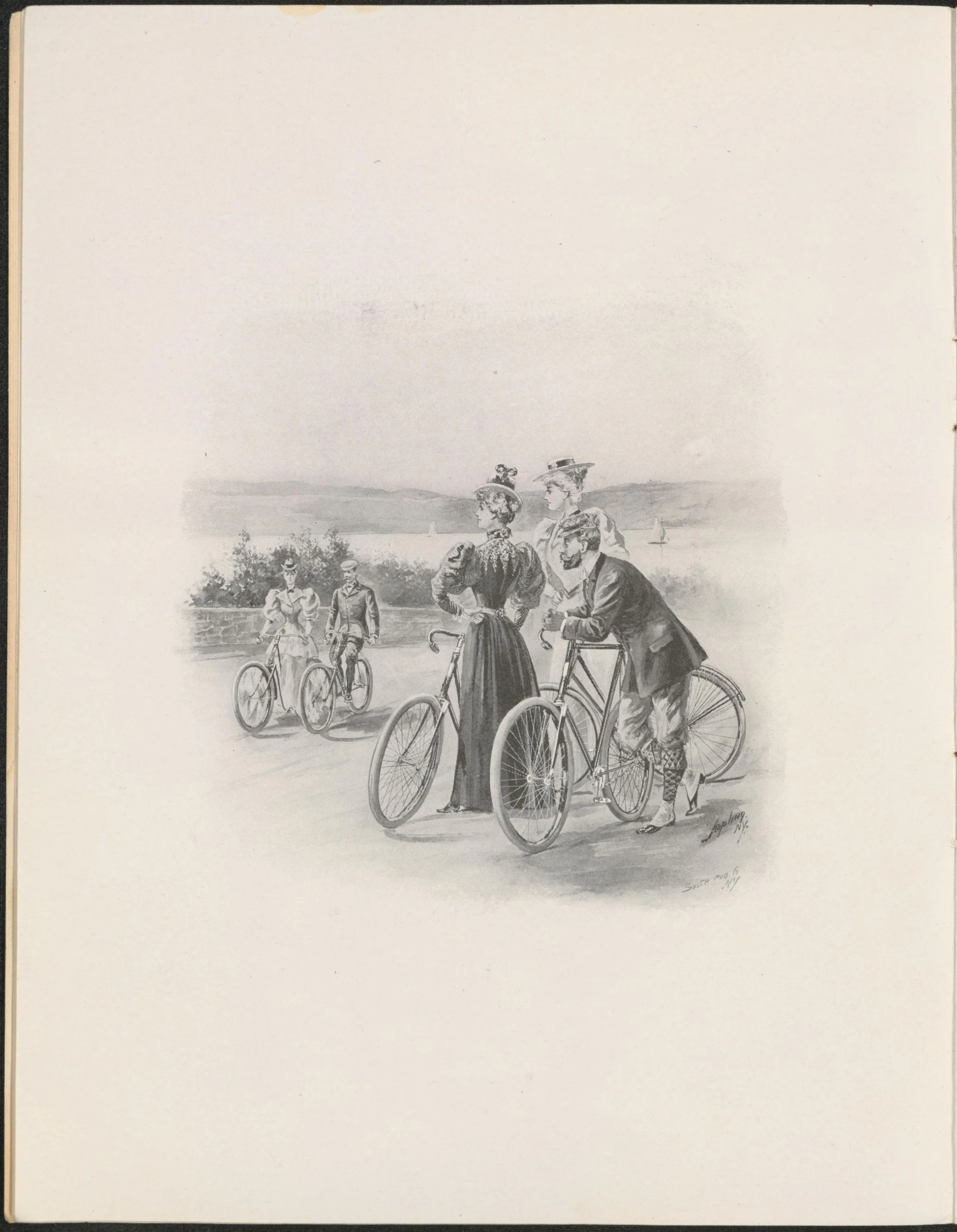 Page 8
 Page 9
 Page 10
 Page 11
 Page 12
 Page 13
 Page 14
 Page 15
 Page 16
 Page 17
 Page 18
 Page 19
 Page 20
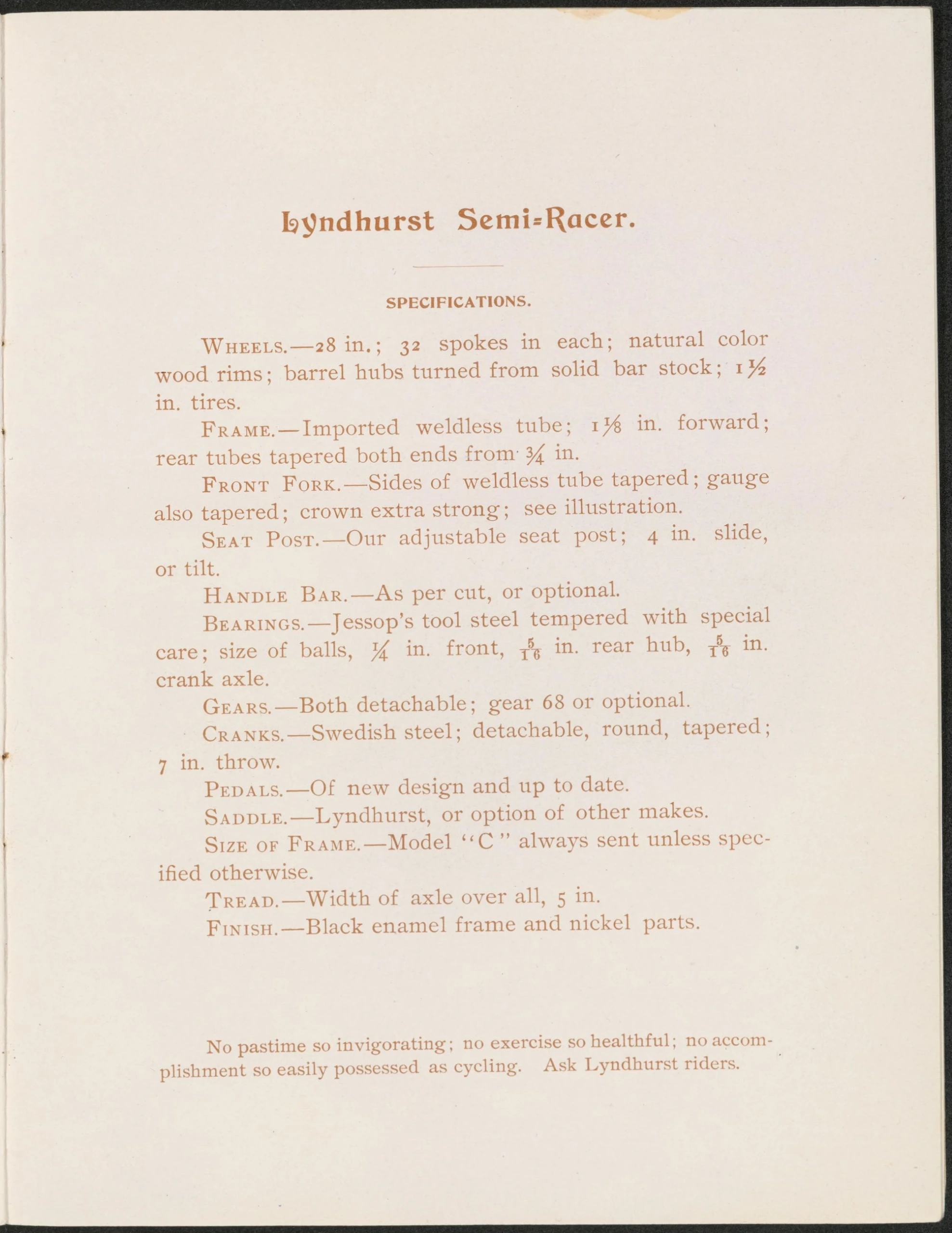 Page 21
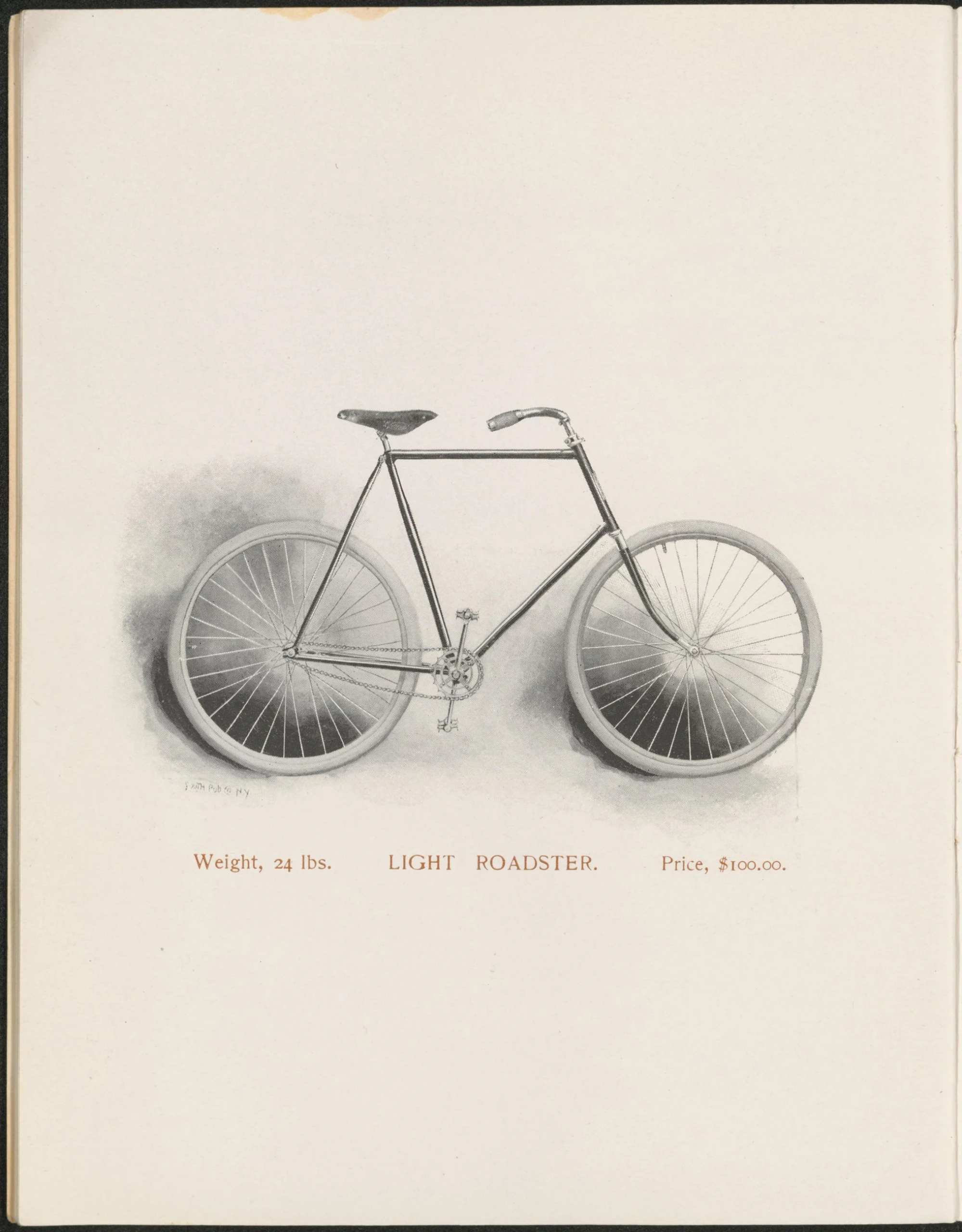 Page 22
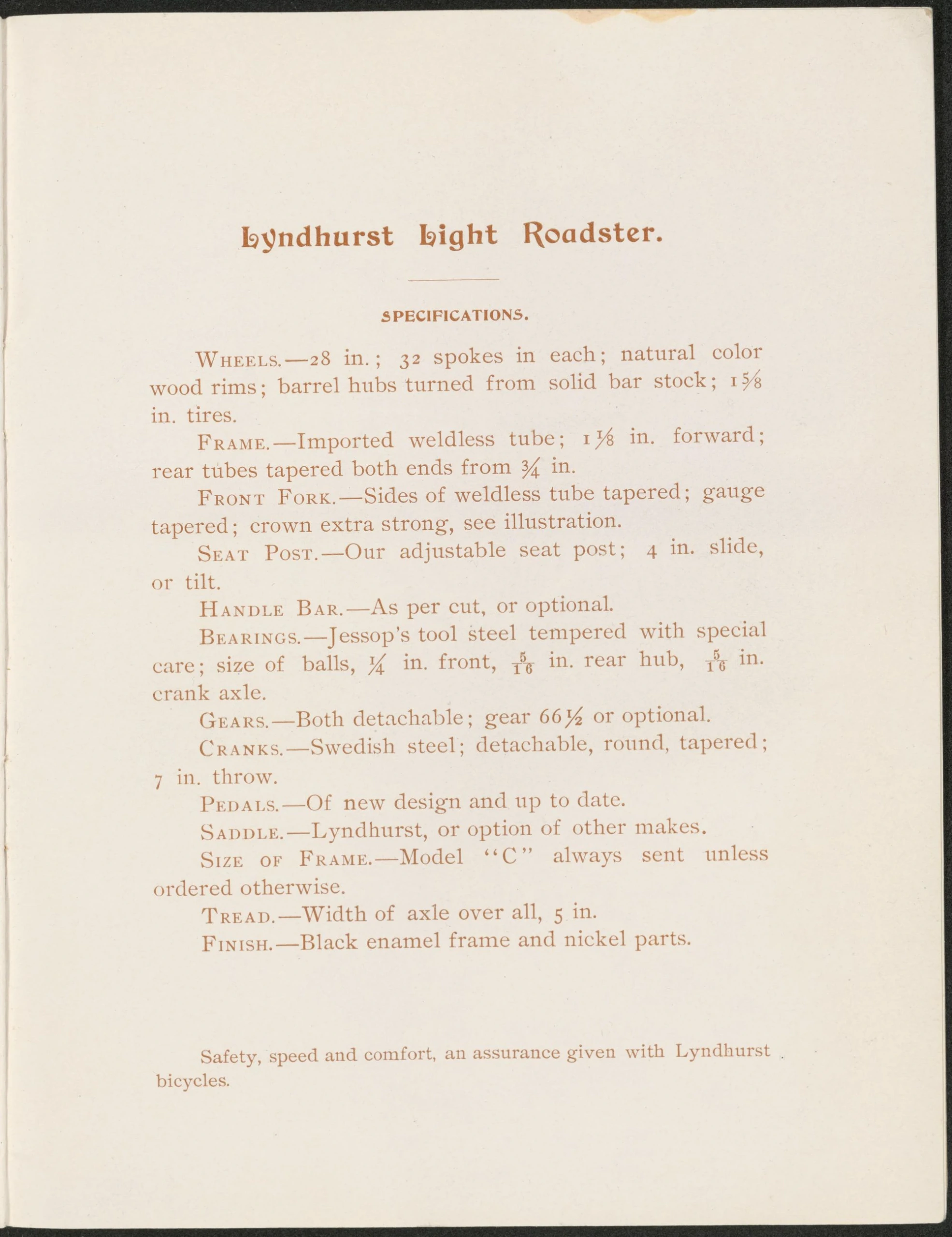 Page 23
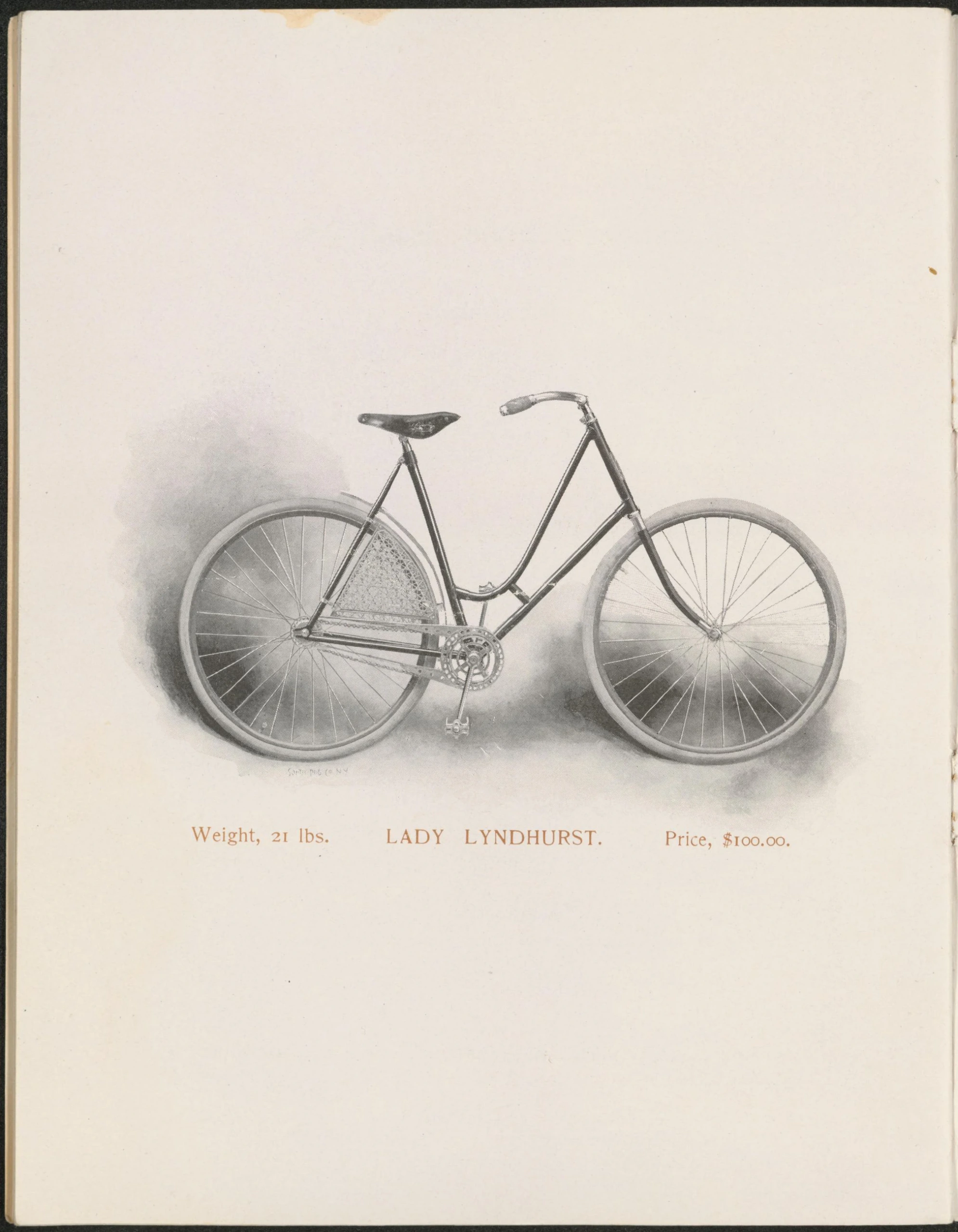 Page 24
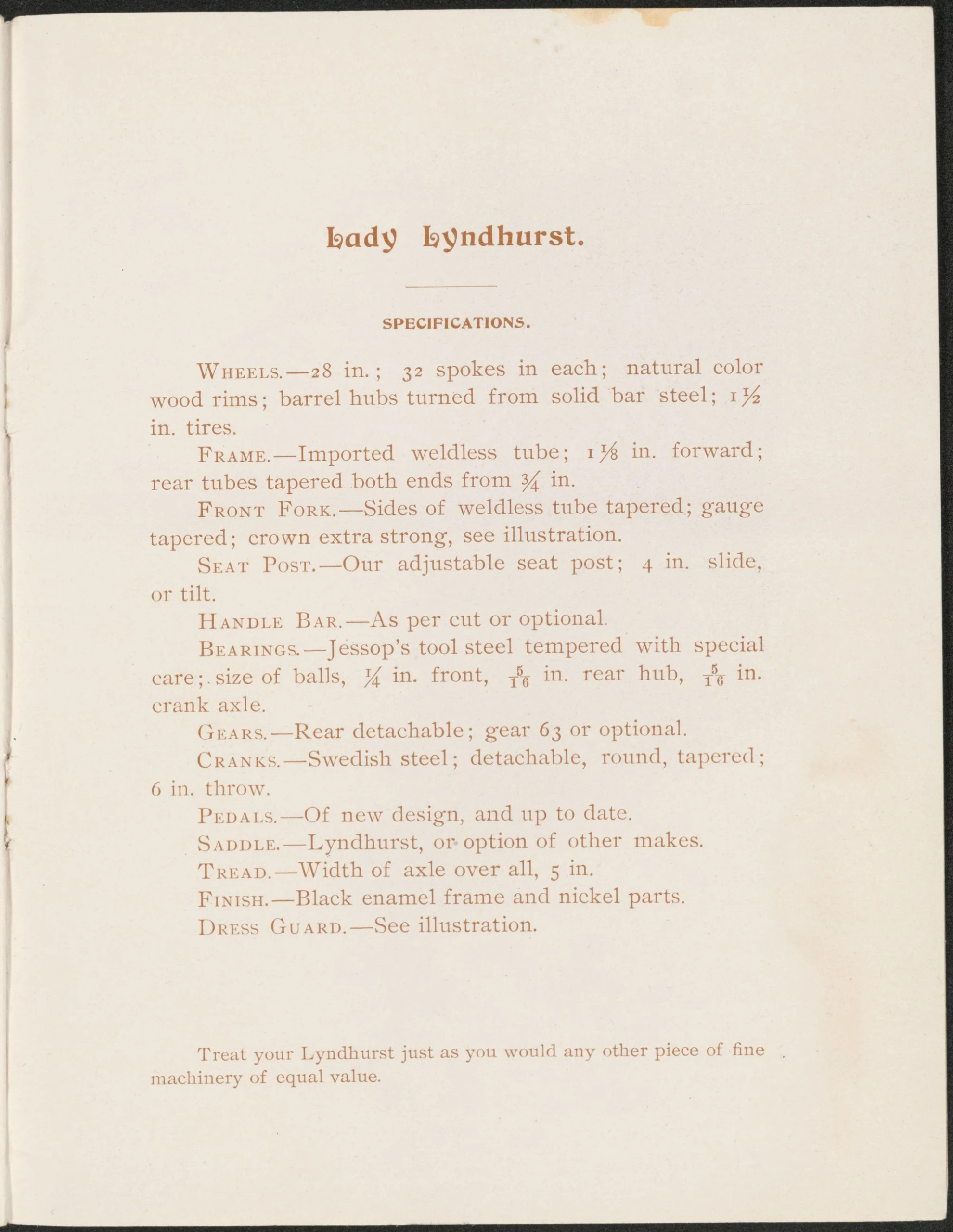 Page 25
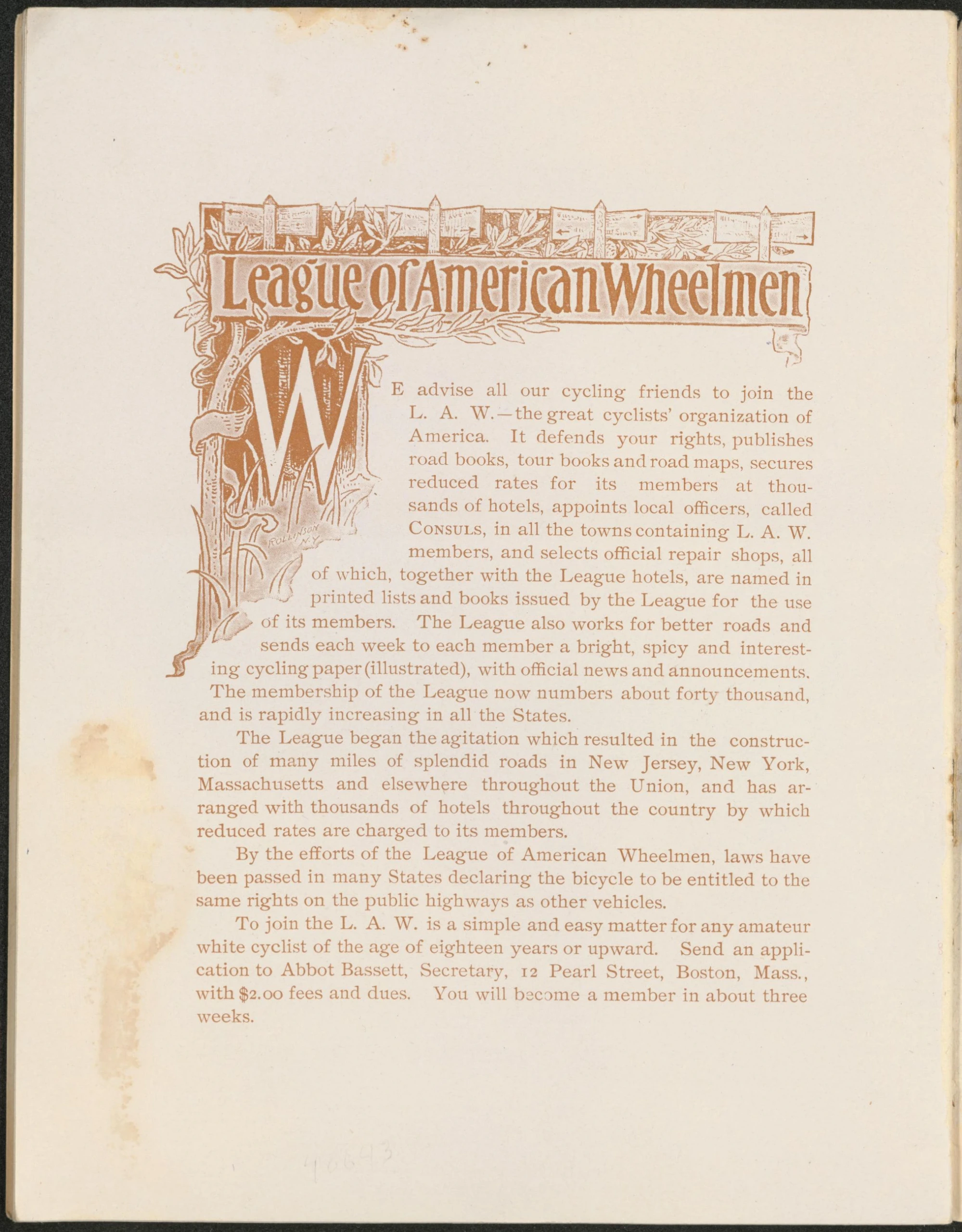 Page 26
 Page 27
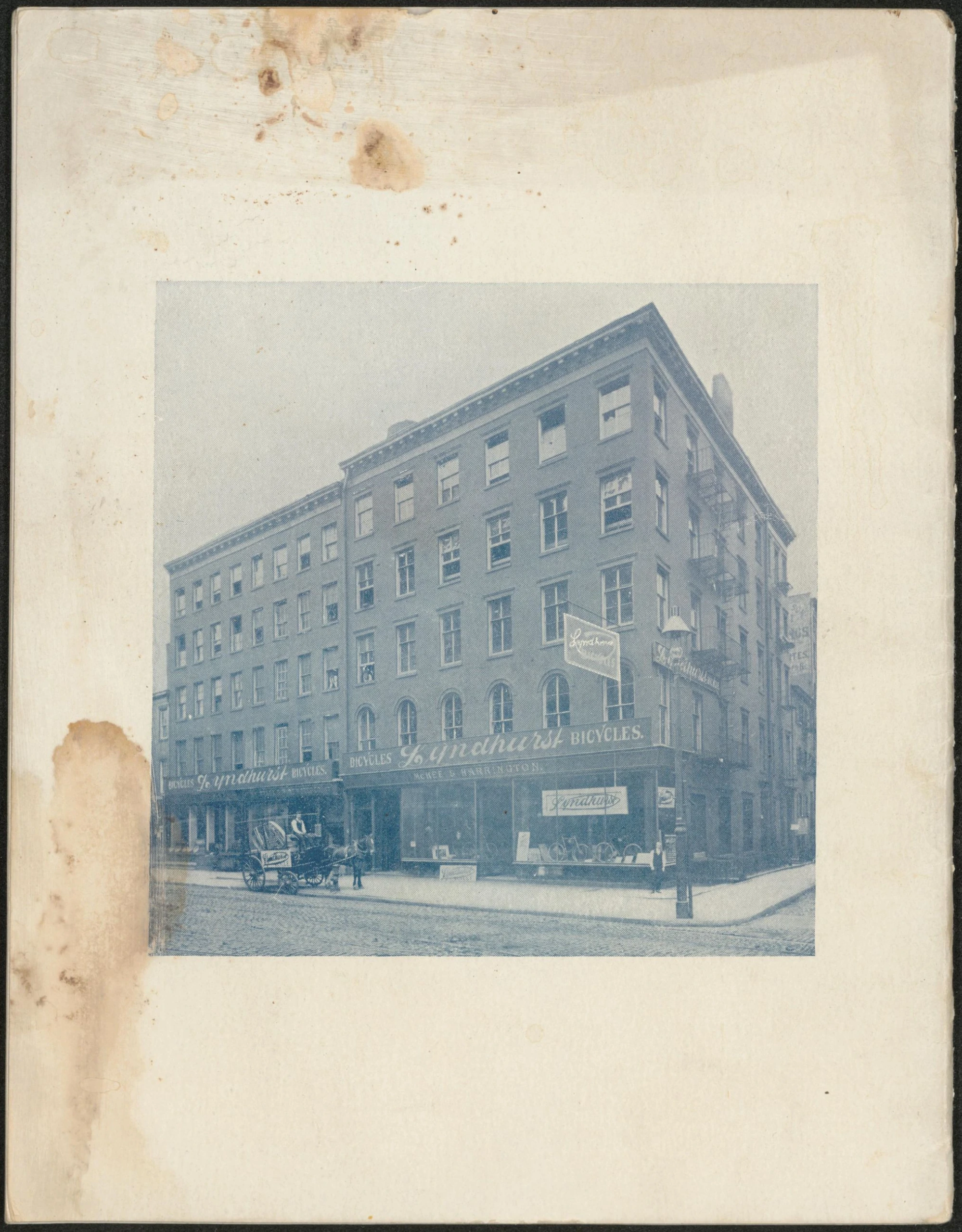 Page 28
| Marque | Lyndhurst |
|---|---|
| Type | Catalog |
| Year | 1896 |
| Publisher | McKee & Harrington |
| Country | United States |
| Language | English |
| Pages | 28 |
| Source | Northwestern University Libraries, Transportation Library, "Lyndhurst, a special made wheel" (digital collection, https://dc.library.northwestern.edu/items/43704529-7e2d-4a70-a08d-138d5d565dd1); rights statement "No Copyright - United States". |
| Credit | Northwestern University Libraries |
| Identifier | Permalink https://dc.library.northwestern.edu/items/43704529-7e2d-4a70-a08d-138d5d565dd1 |
| Transcription | Transcribed by eye |
Reference
McKee & Harrington. Lyndhurst 1896 Catalog (McKee & Harrington, New York): a Special Made Wheel. 1896. Ebykr, https://ebykr.com/library/lyndhurst-catalog-1896/.
Wikipedia
{{cite book |title=Lyndhurst 1896 Catalog (McKee & Harrington, New York): a Special Made Wheel |publisher=McKee & Harrington |date=1896 |url=https://ebykr.com/library/lyndhurst-catalog-1896/ |via=Ebykr |access-date=}}Lyndhurst SOUTH PUB. CO. N.Y. Jopling N.Y. 1896. Lyndhurst A Special Made Wheel. McKee & Harrington, New York, Offices: Salesrooms: Factories: } 173-179 Grand Street. Telephone 743 Spring. Established 1879. Second oldest maker in the Country. DESIGNED, ENGRAVED AND PRINTED BY THE SOUTH PUBLISHING COMPANY, 195 FULTON STREET, NEW YORK. A Special Made Bicycle, The …
McKee & Harrington’s Lyndhurst catalog for 1896, “a special made wheel”, from New York: the skilled workmen and fifteen reasons, lap brazing, frames, fork crown, bottom bracket, Albert’s bushed chain, seat post, tubing, wood rims and the warrant, seven world’s records, then the Racer at $125 and the Semi-Racer, Light Roadster and Lady Lyndhurst at $100, each with its plate and specifications, and a page on the League of American Wheelmen. Transcribed from the page images (28 pages); each page ends with a bracketed description of its pictures.
— Page 1 —
Lyndhurst
SOUTH PUB. CO. N.Y.
Jopling [?] N.Y.
[The front cover in color: a young man in a maroon jacket and knickerbockers stands on his bicycle atop a maroon globe lettered “Lyndhurst” in white script, waving his cap, the globe floating on blue-gray clouds. Engraver and artist signatures in the clouds. Faint pencil figures at left and pencil writing at top; water stains and foxing.]
— Page 2 —
[The blank inside front cover, water-stained, with a dark oval stain at right.]
— Page 3 —
1896.
Lyndhurst
A Special Made Wheel.
McKee & Harrington, New York,
Offices: Salesrooms: Factories: } 173-179 Grand Street. Telephone 743 Spring.
Established 1879. Second oldest maker in the Country.
DESIGNED, ENGRAVED AND PRINTED BY THE SOUTH PUBLISHING COMPANY, 195 FULTON STREET, NEW YORK.
[The title page, printed in brown and gray: a halftone vignette of a young woman in a classical gown holding a palm frond aloft before a bicycle wheel, above the “Lyndhurst” script name in an oval flourish and the firm’s name and address.]
— Page 4 —
[A full-page halftone vignette: fashionably dressed cyclists with their safeties gather on the sidewalk before a stone building with an arched doorway and ornamented lamp pillars; a lady in a large-sleeved blouse steps out of the door, a man in knickerbockers and three ladies stand with their machines, and a rider passes in the distance. No text.]
— Page 5 —
A Special Made Bicycle,
The Lyndhurst.
What is it?
It is a bicycle finished and fitted by hand.
It is the difference between that which suits those who are careless of quality, and that which is acceptable to the expert or fashionable cyclist.
It stands for the maximum of strength; for lightness; for accurate adjustment; for scientific proportion; for ease of propulsion; for the perfect in cycle mechanics; for style.
Special made—the Lyndhurst is tested for work; is guaranteed; there is no adjustment necessary for the purchaser to make.
Every detail is searchingly inspected; nothing is too trivial to escape—from the fit of a saddle to the micromatic adjustment of the Jessop tool steel bearings.
Lyndhurst bicycles, like the “One-horse-shay,” are built to last; they are never second-hand.
[A text page printed in brown: a floral headpiece of leaves and blossoms over the script heading, a short rule and the introductory copy, with a small-type footnote.]
— Page 6 —
Like all valuable creations, the Lyndhurst cycles are the handiwork of skilled workmen, men who have pride in their handicraft.
Steel and rubber, in all twenty-two pounds, the outcome of brain work, correct not only in mechanism but fashion, as illustrated in the Lyndhurst, is what we sell you, with broad guarantee liberally interpreted. We have been doing this for seventeen years; claiming less than we possess, giving more than we agree.
This is what a special made bicycle, the Lyndhurst, means to-day.
Visit the nearest Lyndhurst agent, ask to see the special made bicycle, examine and compare.
If you intend to be of the select few who ride perfectly appointed cycles, the result of your investigation will find you a Lyndhurst rider.
Lyndhurst cycles may have rivals, their owners would be slow to admit it.
[A text page printed in brown with a halftone vignette below: four smiling young women peer over a row of bicycle wheels half hidden in a misty foreground.]
— Page 7 —
Fifteen Reasons Why You Should Buy The Lyndhurst.
Larger Tubing. Top and bottom bars 1⅛ in.; head 1¼ in.
Larger Balls throughout.
Adjustable Handle Bars. Something new.
Adjustable Seat Post. Adaptable to any position.
Handle Bar Clamp. Very neat.
Top Bar. Horizontal in both high and low frames.
Tubular Hubs. Turned from solid bar steel.
All Bearings, Jessop’s tool steel.
Larger Tube gives larger brazing surface.
Detachable Sprocket. A good one.
Pedals. Centres and bearings dust proof.
Chain. Albert’s steel bushed.
Heavier Tires.
Crank Bearings.—Perfect; see cut.
Our Facilities have been increased for a larger output.
A coast on a Lyndhurst is the next thing to flying.
[A text page printed in brown: a script heading over a short rule and a list of fifteen points with small-capital lead words, and a one-line footer.]
— Page 8 —
[A full-page halftone vignette signed by the artist and “South Pub. Co. N.Y.”: a bearded man in knickerbockers leans on his diamond-frame safety beside two ladies, one holding a drop-frame machine, on a shore road above a bay with sailboats; a lady and a man ride toward them in the background. No text.]
— Page 9 —
Special Features of Construction.
Lap Brazing.
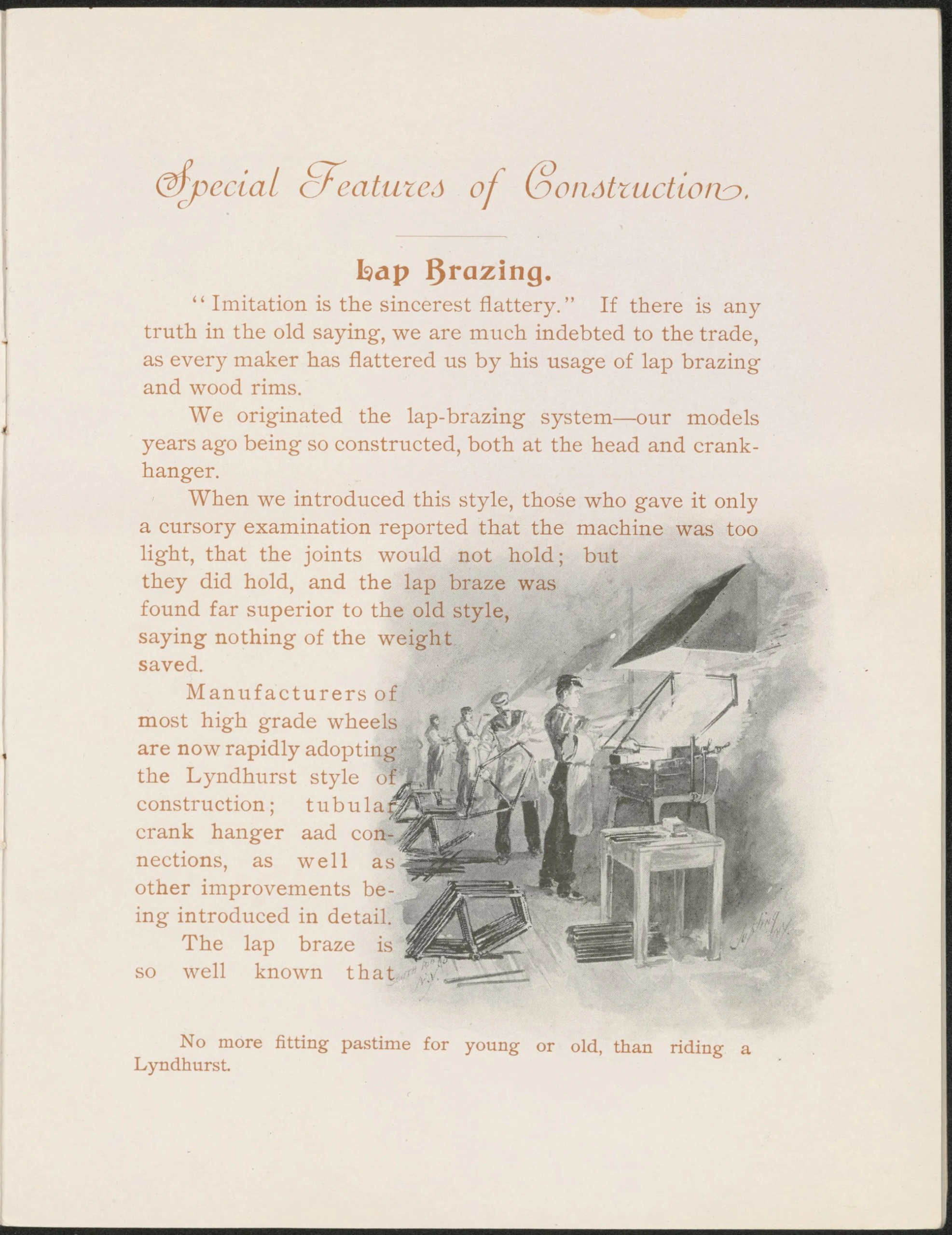
“Imitation is the sincerest flattery.” If there is any truth in the old saying, we are much indebted to the trade, as every maker has flattered us by his usage of lap brazing and wood rims.
We originated the lap-brazing system—our models years ago being so constructed, both at the head and crank-hanger.
When we introduced this style, those who gave it only a cursory examination reported that the machine was too light, that the joints would not hold; but they did hold, and the lap braze was found far superior to the old style, saying nothing of the weight saved.
Manufacturers of most high grade wheels are now rapidly adopting the Lyndhurst style of construction; tubular crank hanger aad connections, as well as other improvements being introduced in detail.
The lap braze is so well known that
No more fitting pastime for young or old, than riding a Lyndhurst.
[A text page printed in brown with a halftone vignette at lower right, signed by the artist: workmen in aprons brazing frames at a forge under a hood in the factory, with finished frames stacked on the floor.]
— Page 10 —
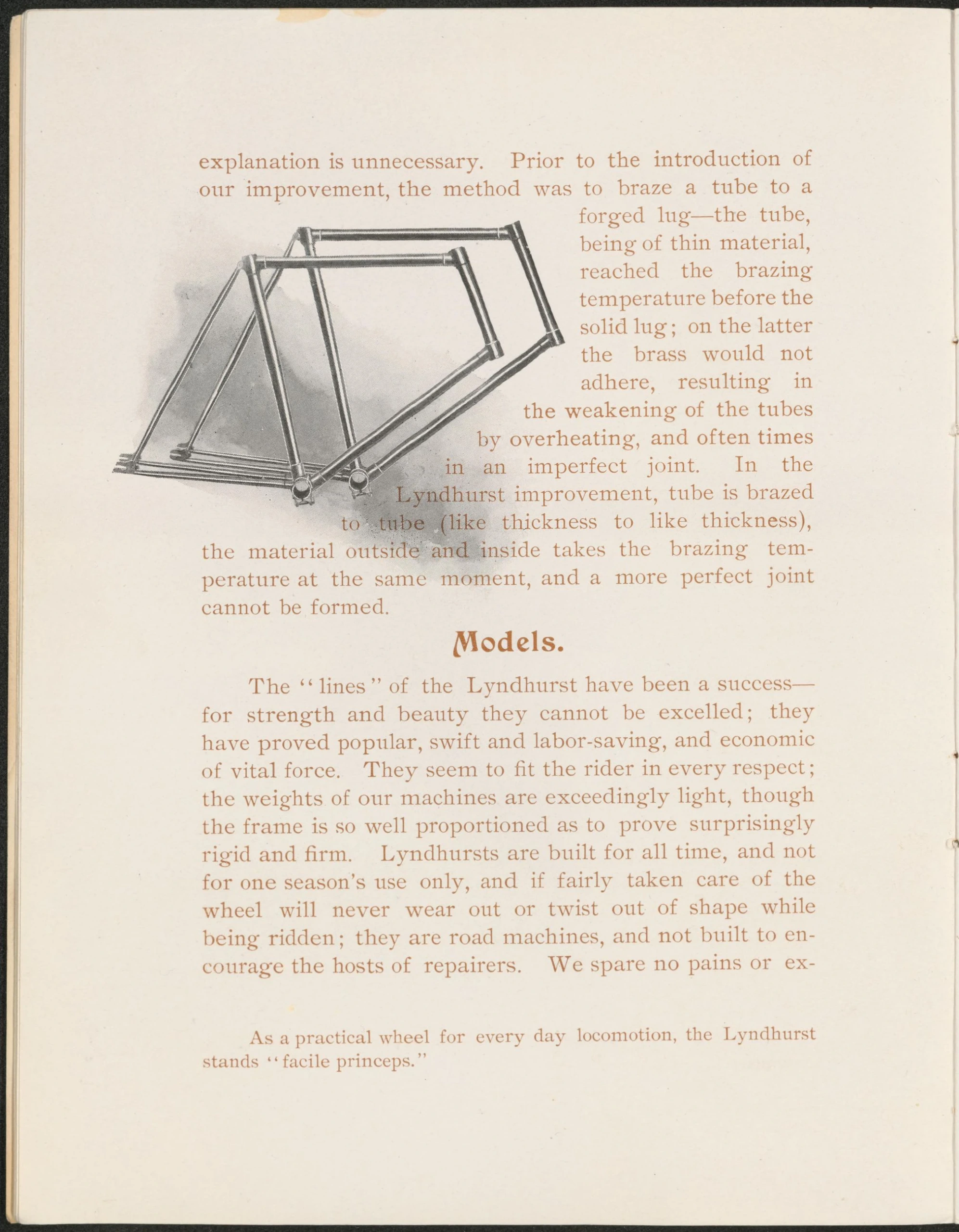
explanation is unnecessary. Prior to the introduction of our improvement, the method was to braze a tube to a forged lug—the tube, being of thin material, reached the brazing temperature before the solid lug; on the latter the brass would not adhere, resulting in the weakening of the tubes by overheating, and often times in an imperfect joint. In the Lyndhurst improvement, tube is brazed to tube (like thickness to like thickness), the material outside and inside takes the brazing temperature at the same moment, and a more perfect joint cannot be formed.
Models.
The “lines” of the Lyndhurst have been a success—for strength and beauty they cannot be excelled; they have proved popular, swift and labor-saving, and economic of vital force. They seem to fit the rider in every respect; the weights of our machines are exceedingly light, though the frame is so well proportioned as to prove surprisingly rigid and firm. Lyndhursts are built for all time, and not for one season’s use only, and if fairly taken care of the wheel will never wear out or twist out of shape while being ridden; they are road machines, and not built to encourage the hosts of repairers. We spare no pains or ex-
As a practical wheel for every day locomotion, the Lyndhurst stands “facile princeps.”
[A text page printed in brown with a halftone at upper left of two nickeled diamond frames, one behind the other, showing the lap-brazed tube joints; the text runs around the picture.]
— Page 11 —
pense to make the Lyndhurst bicycle for 1896 the best in every respect; long and successful experience as bicycle manufacturers has taught us the requirements. The growing demand for wheels built to reach has led us to adopt as a regular stock two heights of frames, though at the same time still retaining the same relative position of seat and handle bar which has proved so popular the past year. Different heights of frames will be known as
MODELS B AND C.
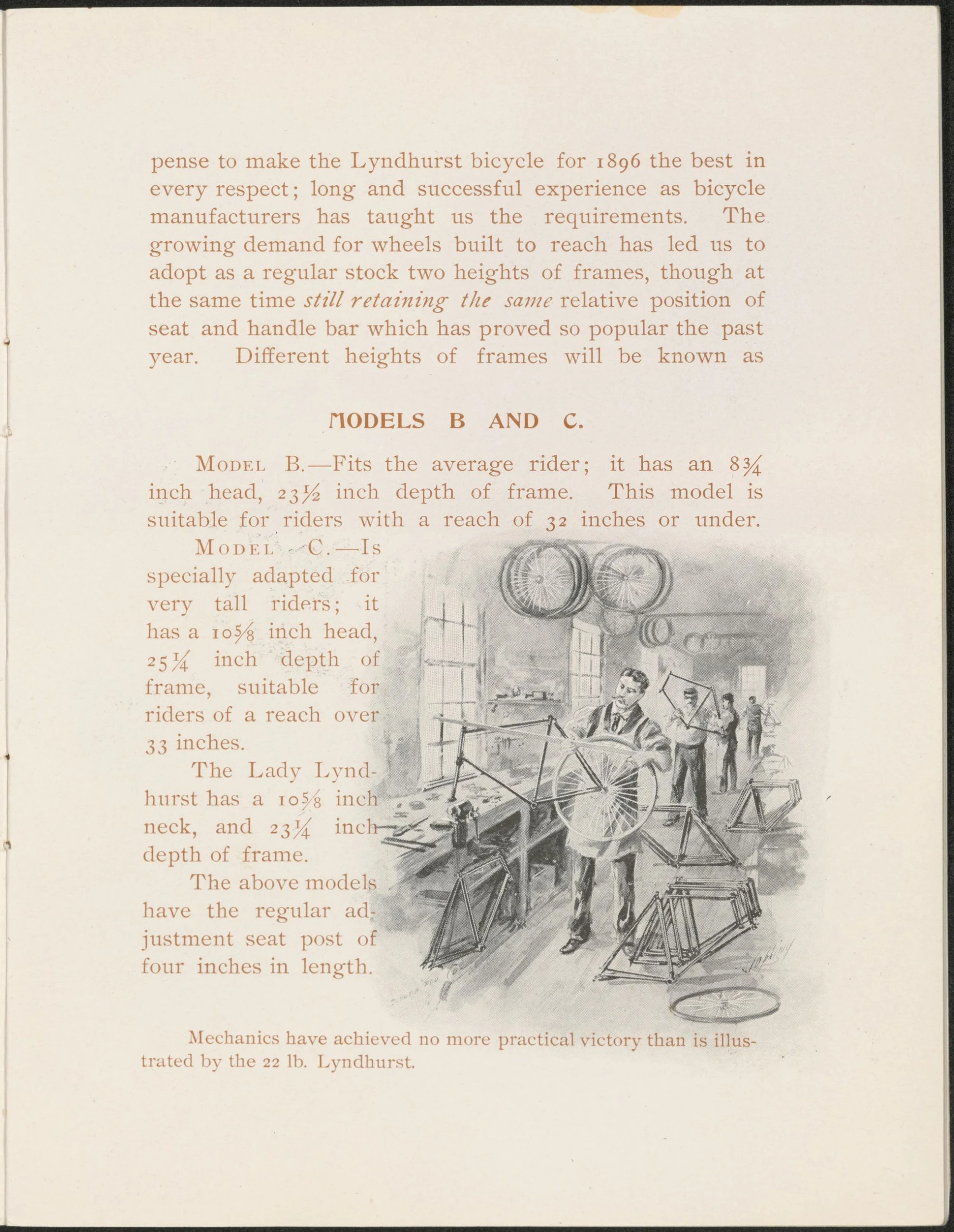
Model B.—Fits the average rider; it has an 8¾ inch head, 23½ inch depth of frame. This model is suitable for riders with a reach of 32 inches or under.
Model C.—Is specially adapted for very tall riders; it has a 10⅝ inch head, 25¼ inch depth of frame, suitable for riders of a reach over 33 inches.
The Lady Lyndhurst has a 10⅝ inch neck, and 23¼ inch depth of frame.
The above models have the regular adjustment seat post of four inches in length.
Mechanics have achieved no more practical victory than is illustrated by the 22 lb. Lyndhurst.
[A text page printed in brown with a halftone vignette at lower right, signed by the artist: a mechanic in a waistcoat trues a wheel in a frame at the workbench of an assembly room, with wheels hung on the wall, frames on the floor and other workmen behind.]
— Page 12 —
Fork Crown.
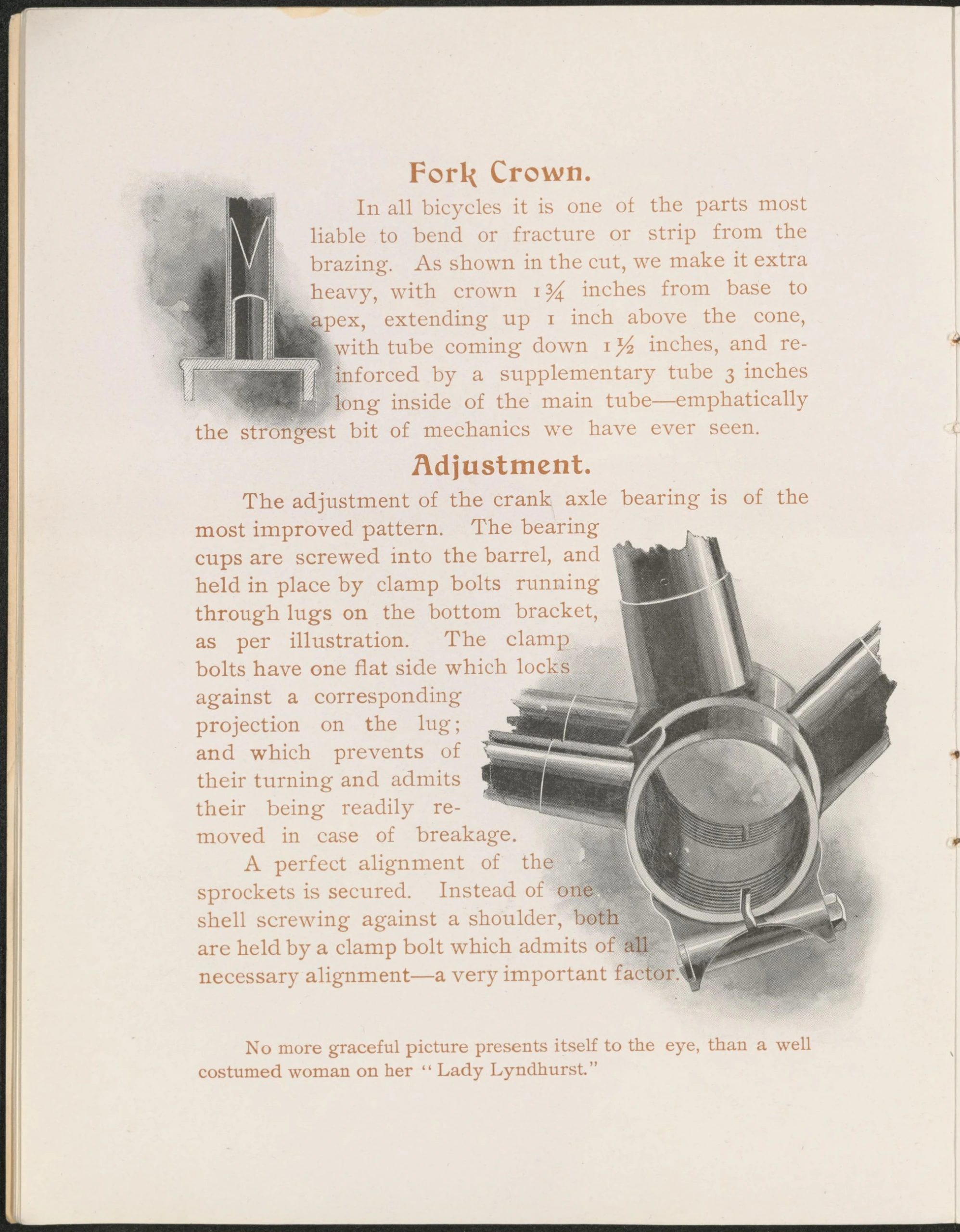
In all bicycles it is one of the parts most liable to bend or fracture or strip from the brazing. As shown in the cut, we make it extra heavy, with crown 1¾ inches from base to apex, extending up 1 inch above the cone, with tube coming down 1½ inches, and reinforced by a supplementary tube 3 inches long inside of the main tube—emphatically the strongest bit of mechanics we have ever seen.
Adjustment.
The adjustment of the crank axle bearing is of the most improved pattern. The bearing cups are screwed into the barrel, and held in place by clamp bolts running through lugs on the bottom bracket, as per illustration. The clamp bolts have one flat side which locks against a corresponding projection on the lug; and which prevents of their turning and admits their being readily removed in case of breakage.
A perfect alignment of the sprockets is secured. Instead of one shell screwing against a shoulder, both are held by a clamp bolt which admits of all necessary alignment—a very important factor.
No more graceful picture presents itself to the eye, than a well costumed woman on her “Lady Lyndhurst.”
[A text page printed in brown with two halftones: a sectional view of the fork crown with its inner reinforcing tube at upper left, and a large view of the bottom-bracket shell with cut tubes and the clamp bolt at lower right.]
— Page 13 —
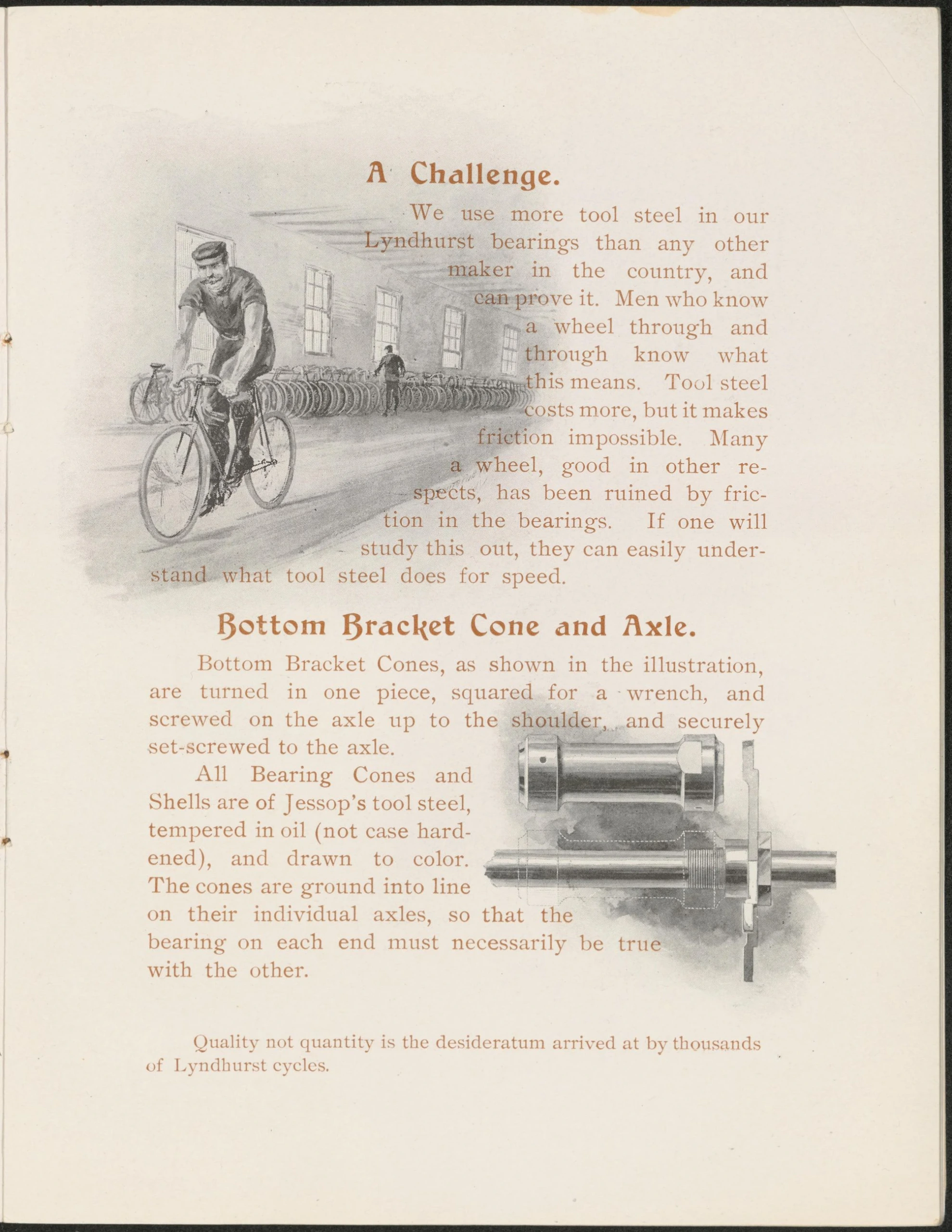
A Challenge.
We use more tool steel in our Lyndhurst bearings than any other maker in the country, and can prove it. Men who know a wheel through and through know what this means. Tool steel costs more, but it makes friction impossible. Many a wheel, good in other respects, has been ruined by friction in the bearings. If one will study this out, they can easily understand what tool steel does for speed.
Bottom Bracket Cone and Axle.
Bottom Bracket Cones, as shown in the illustration, are turned in one piece, squared for a wrench, and screwed on the axle up to the shoulder, and securely set-screwed to the axle.
All Bearing Cones and Shells are of Jessop’s tool steel, tempered in oil (not case hardened), and drawn to color. The cones are ground into line on their individual axles, so that the bearing on each end must necessarily be true with the other.
Quality not quantity is the desideratum arrived at by thousands of Lyndhurst cycles.
[A text page printed in brown with two halftones: a man in a cap and jersey rides a safety down a long factory room lined with rows of finished bicycles at upper left, and a view of a bottom-bracket shell above the crank axle with its cone at lower right.]
— Page 14 —
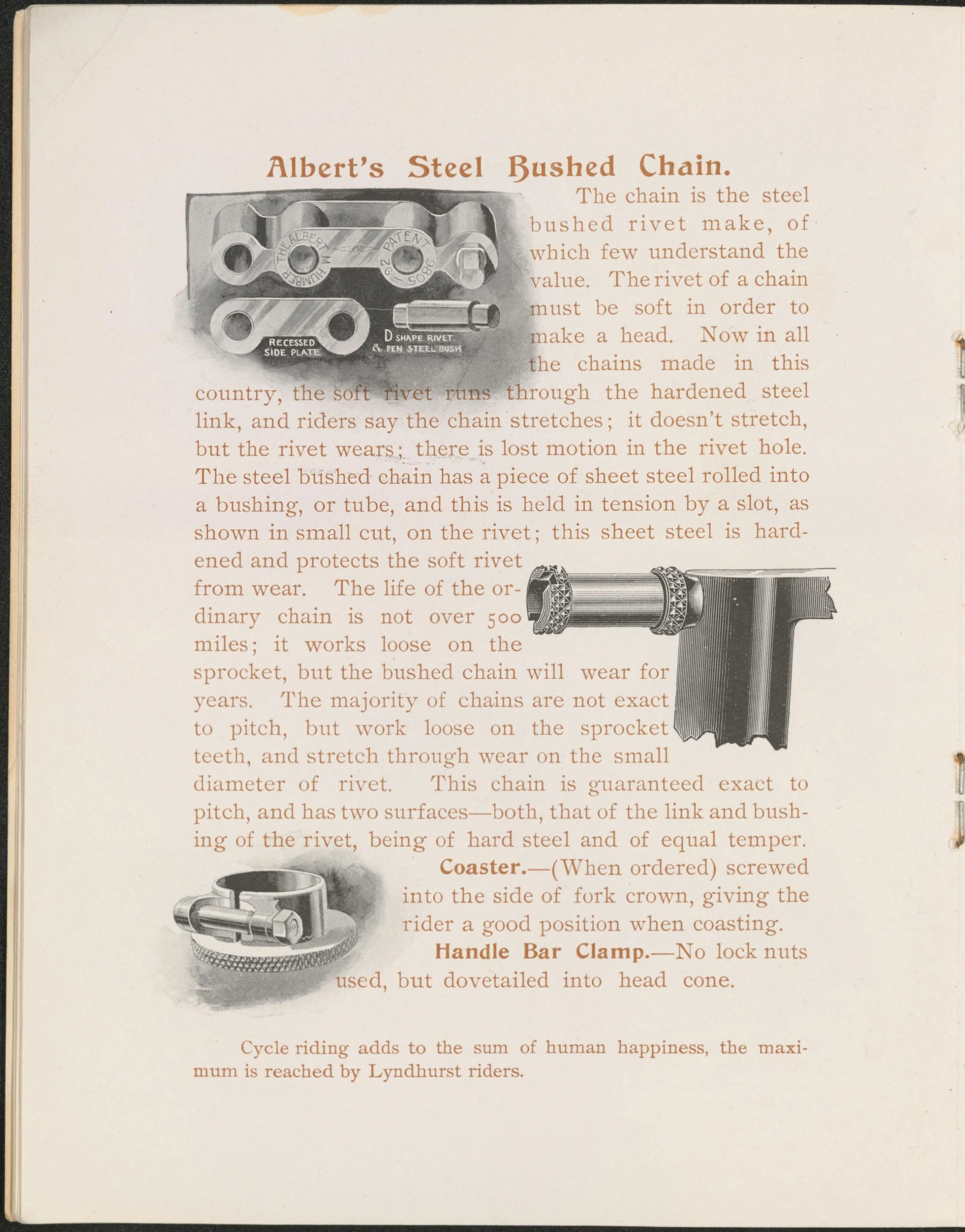
Albert’s Steel Bushed Chain.
THE ALBERT M HUMBER
PATENT 92 8805 [?]
RECESSED SIDE PLATE
D SHAPE RIVET & PEN STEEL BUSH
The chain is the steel bushed rivet make, of which few understand the value. The rivet of a chain must be soft in order to make a head. Now in all the chains made in this country, the soft rivet runs through the hardened steel link, and riders say the chain stretches; it doesn’t stretch, but the rivet wears; there is lost motion in the rivet hole. The steel bushed chain has a piece of sheet steel rolled into a bushing, or tube, and this is held in tension by a slot, as shown in small cut, on the rivet; this sheet steel is hardened and protects the soft rivet from wear. The life of the ordinary chain is not over 500 miles; it works loose on the sprocket, but the bushed chain will wear for years. The majority of chains are not exact to pitch, but work loose on the sprocket teeth, and stretch through wear on the small diameter of rivet. This chain is guaranteed exact to pitch, and has two surfaces—both, that of the link and bushing of the rivet, being of hard steel and of equal temper.
Coaster.—(When ordered) screwed into the side of fork crown, giving the rider a good position when coasting.
Handle Bar Clamp.—No lock nuts used, but dovetailed into head cone.
Cycle riding adds to the sum of human happiness, the maximum is reached by Lyndhurst riders.
[A text page printed in brown with three halftones: chain links stamped “The Albert” and “Humber” with a recessed side plate and the D-shape rivet and bush at upper left, a knurled coaster footrest screwed to a fork crown at right and a handlebar clamp at lower left. The wire staples of the center fold show at the right edge.]
— Page 15 —
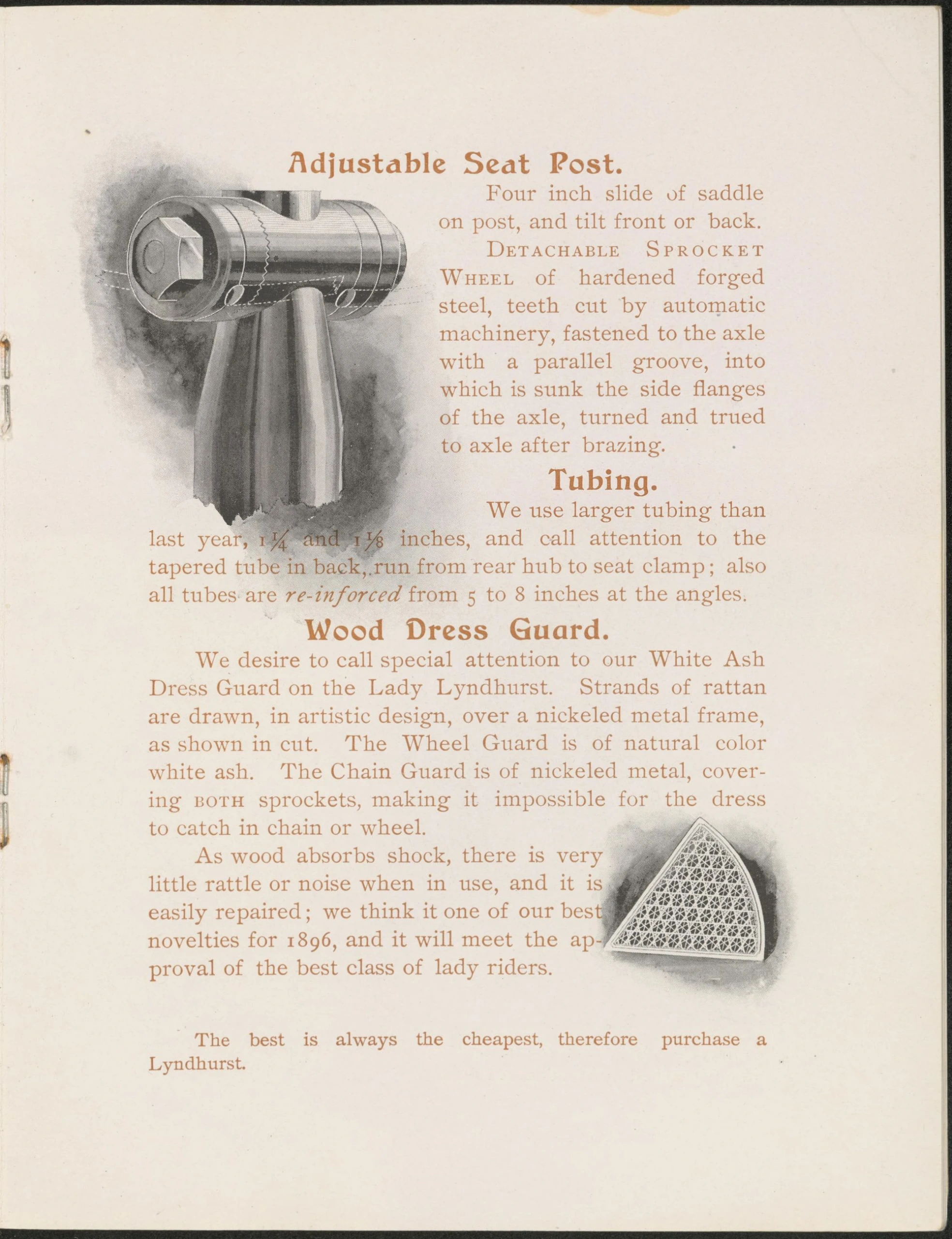
Adjustable Seat Post.
Four inch slide of saddle on post, and tilt front or back.
Detachable Sprocket Wheel of hardened forged steel, teeth cut by automatic machinery, fastened to the axle with a parallel groove, into which is sunk the side flanges of the axle, turned and trued to axle after brazing.
Tubing.
We use larger tubing than last year, 1¼ and 1⅛ inches, and call attention to the tapered tube in back, run from rear hub to seat clamp; also all tubes are re-inforced from 5 to 8 inches at the angles.
Wood Dress Guard.
We desire to call special attention to our White Ash Dress Guard on the Lady Lyndhurst. Strands of rattan are drawn, in artistic design, over a nickeled metal frame, as shown in cut. The Wheel Guard is of natural color white ash. The Chain Guard is of nickeled metal, covering both sprockets, making it impossible for the dress to catch in chain or wheel.
As wood absorbs shock, there is very little rattle or noise when in use, and it is easily repaired; we think it one of our best novelties for 1896, and it will meet the approval of the best class of lady riders.
The best is always the cheapest, therefore purchase a Lyndhurst.
[A text page printed in brown with two halftones: the seat-post clamp on its tapered post at upper left and a triangular rattan-work dress-guard panel at lower right. The wire staples of the center fold show at the left edge.]
— Page 16 —
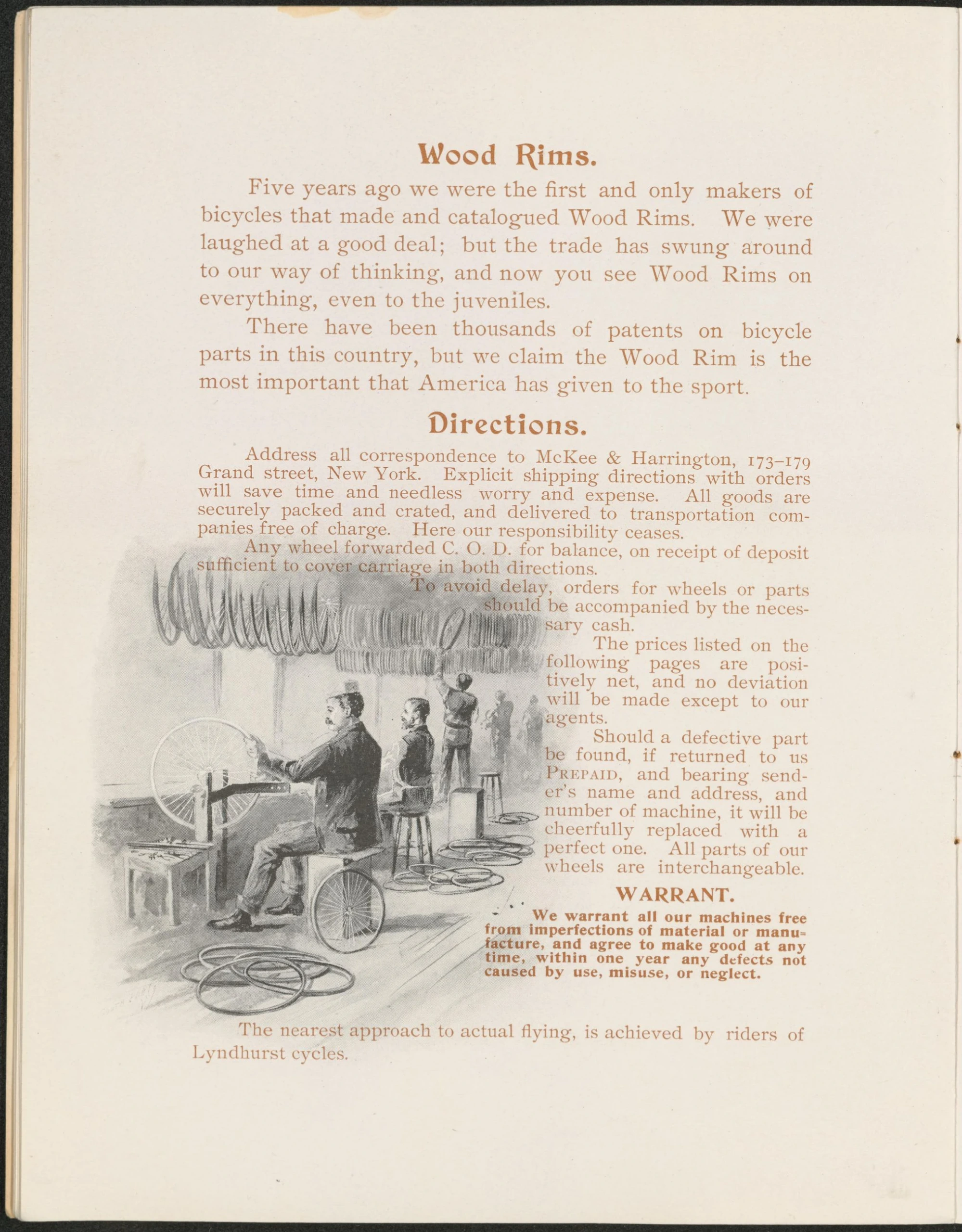
Wood Rims.
Five years ago we were the first and only makers of bicycles that made and catalogued Wood Rims. We were laughed at a good deal; but the trade has swung around to our way of thinking, and now you see Wood Rims on everything, even to the juveniles.
There have been thousands of patents on bicycle parts in this country, but we claim the Wood Rim is the most important that America has given to the sport.
Directions.
Address all correspondence to McKee & Harrington, 173-179 Grand street, New York. Explicit shipping directions with orders will save time and needless worry and expense. All goods are securely packed and crated, and delivered to transportation companies free of charge. Here our responsibility ceases.
Any wheel forwarded C. O. D. for balance, on receipt of deposit sufficient to cover carriage in both directions.
To avoid delay, orders for wheels or parts should be accompanied by the necessary cash.
The prices listed on the following pages are positively net, and no deviation will be made except to our agents.
Should a defective part be found, if returned to us Prepaid, and bearing sender’s name and address, and number of machine, it will be cheerfully replaced with a perfect one. All parts of our wheels are interchangeable.
WARRANT.
We warrant all our machines free from imperfections of material or manufacture, and agree to make good at any time, within one year any defects not caused by use, misuse, or neglect.
The nearest approach to actual flying, is achieved by riders of Lyndhurst cycles.
[A text page printed in brown with a halftone vignette at lower left, signed “South Pub. Co. N.Y.”: workmen truing wheels on stands in the wheel room, with wood rims hung in rows overhead and loose rims on the floor.]
— Page 17 —
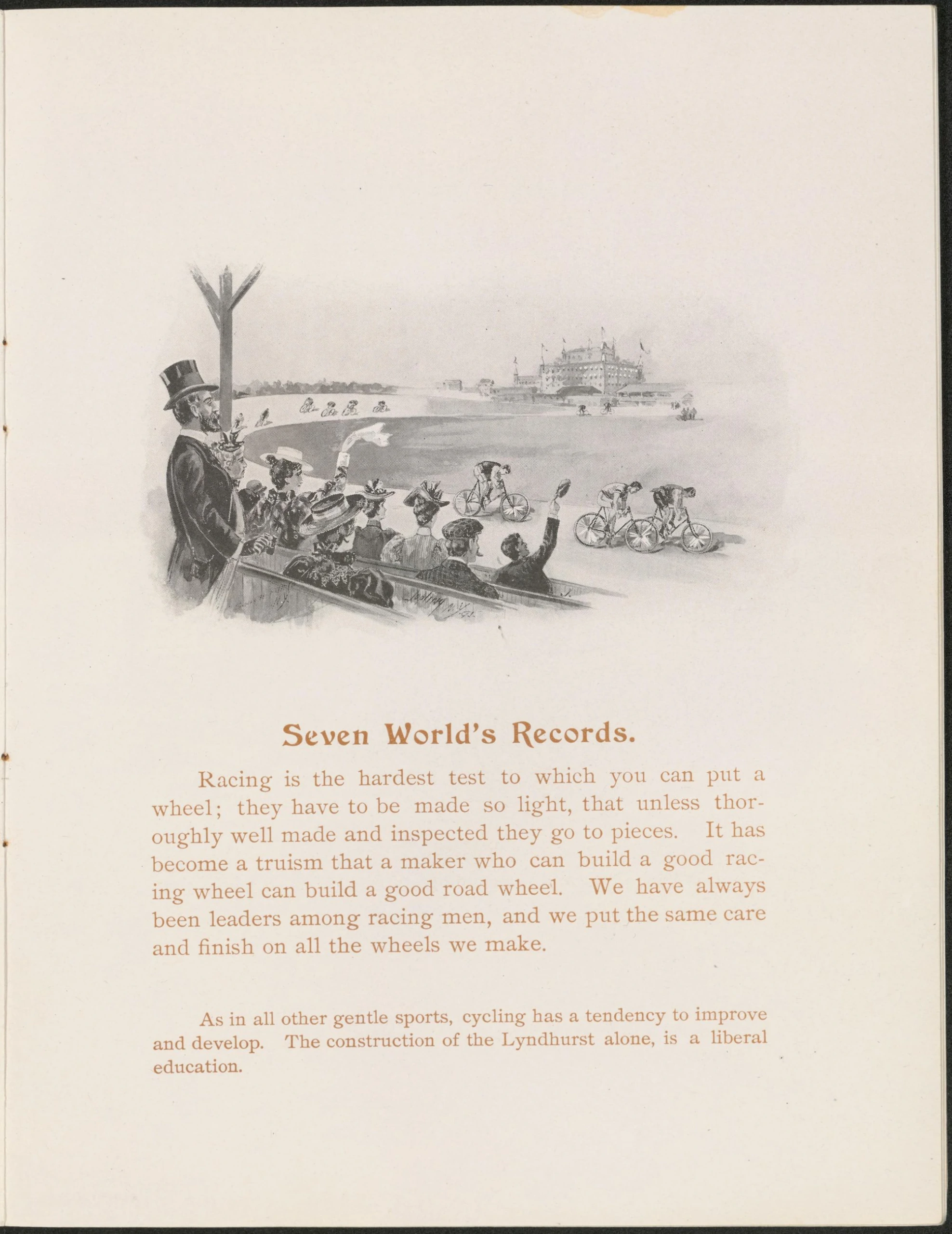
Seven World’s Records.
Racing is the hardest test to which you can put a wheel; they have to be made so light, that unless thoroughly well made and inspected they go to pieces. It has become a truism that a maker who can build a good racing wheel can build a good road wheel. We have always been leaders among racing men, and we put the same care and finish on all the wheels we make.
As in all other gentle sports, cycling has a tendency to improve and develop. The construction of the Lyndhurst alone, is a liberal education.
[A text page printed in brown below a halftone vignette signed by the artist: spectators in a grandstand, a man in a top hat and ladies waving handkerchiefs, cheer racers sprinting around a banked track, with a large pavilion and flags beyond.]
— Page 18 —
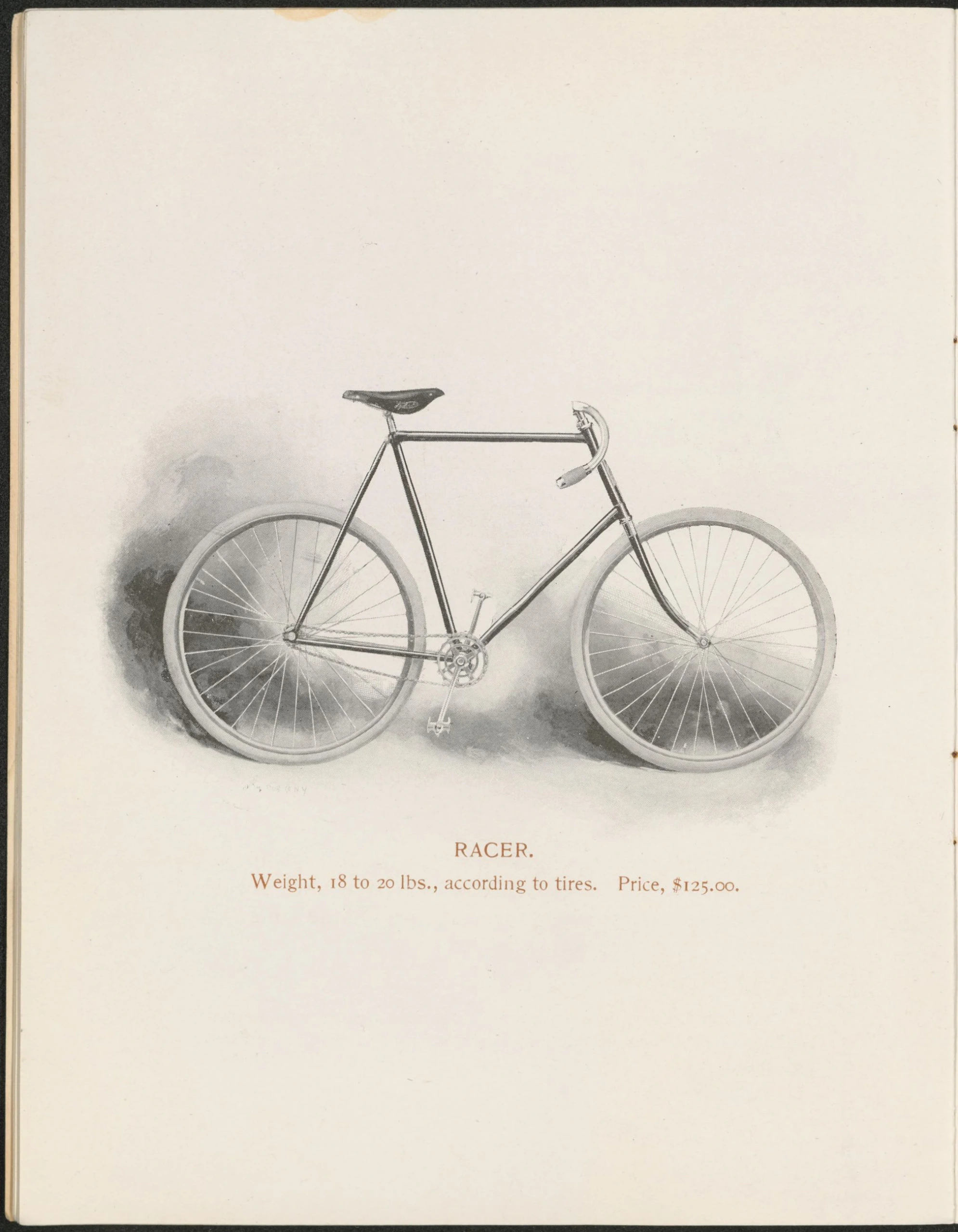
RACER.
Weight, 18 to 20 lbs., according to tires. Price, $125.00.
[A full-page halftone of the Lyndhurst Racer in side view against a soft gray vignette: diamond frame, wood rims, dropped ram’s-horn bars and a narrow racing saddle; the caption is printed in brown below.]
— Page 19 —
Lyndhurst Racer.
SPECIFICATIONS.
Wheels.—28 in.; 32 spokes in each; natural color wood rims; barrel hubs turned from solid bar steel; 1½ in. tires.
Frame.—Imported weldless tube; 1⅛ in. forward; rear tubes tapered both ends from ¾ in.
Front Fork.—Sides of weldless tube tapered; gauge also tapered; crown extra strong, see illustration.
Seat Post.—Our adjustable direct seat post; 4 in. slide, or tilt.
Handle Bar.—Ramshorn reversible bar, or choice of several patterns.
Bearings.—Jessop’s tool steel tempered with special care; size of balls, ¼ in. front, 5/16 in. rear hub, 5/16 in. crank axle.
Gears.—Both detachable; gear 72 or optional.
Cranks.—Swedish steel; detachable, round, tapered; 6½ in. throw.
Pedals.—Of new design and up to date.
Saddle.—Lyndhurst, or option of other makes.
Size of Frame.—Model “B” always sent unless otherwise ordered; see illustration.
Tread.—Width of axle over all, 5 in.
Finish.—All parts full nickel plate.
For nearly two decades the makers of Lyndhurst bicycles have been improving their cycle; the result is a special made wheel.
[A specification page printed in brown: a heading, a short rule, “Specifications” and a list with small-capital lead words, with a one-line footer.]
— Page 20 —
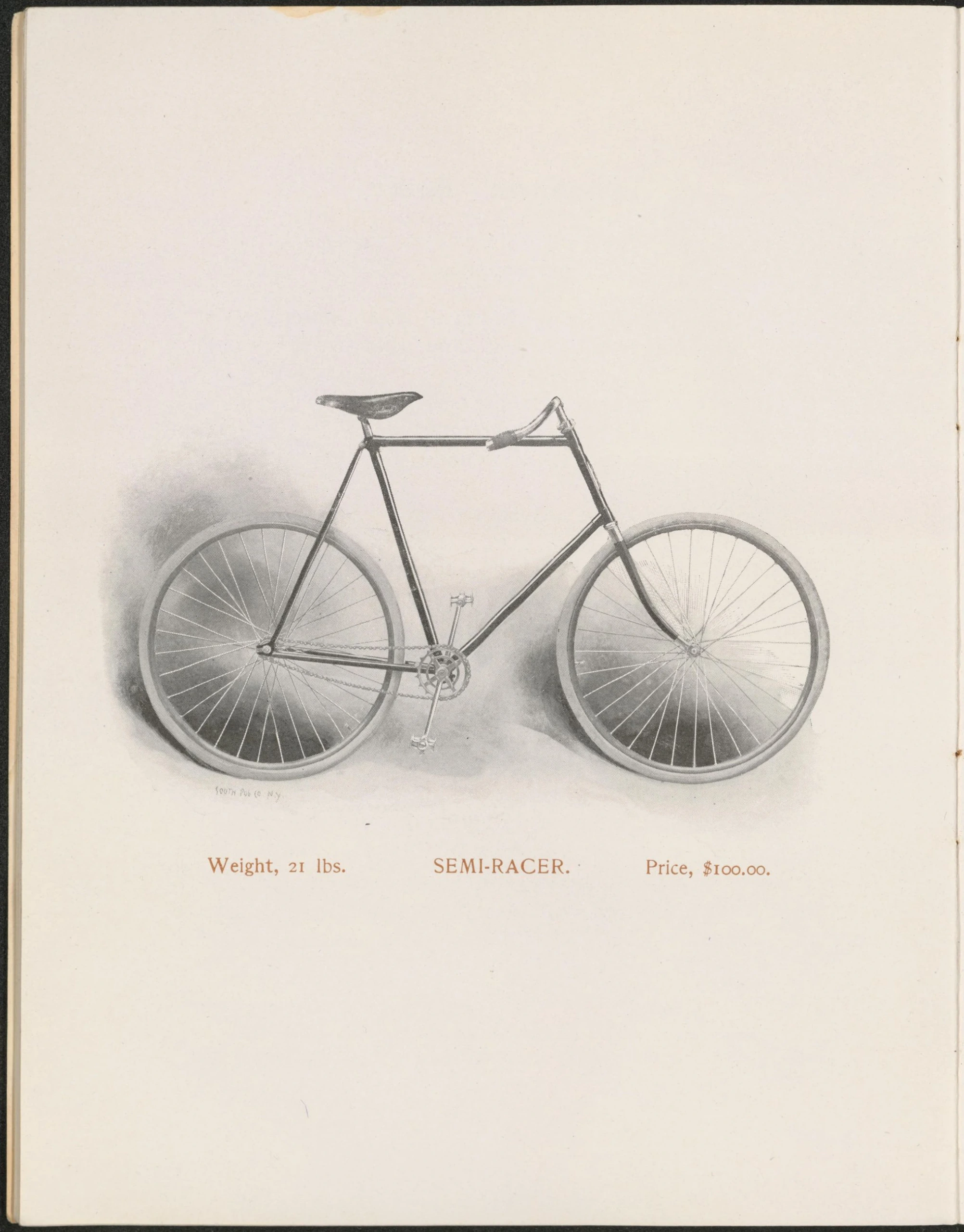
Weight, 21 lbs. SEMI-RACER. Price, $100.00.
[A full-page halftone of the Lyndhurst Semi-Racer in side view, signed “South Pub. Co. N.Y.”: diamond frame with a dark enameled finish, wood rims, dropped bars and a road saddle; the caption is printed in brown below.]
— Page 21 —
Lyndhurst Semi-Racer.
SPECIFICATIONS.
Wheels.—28 in.; 32 spokes in each; natural color wood rims; barrel hubs turned from solid bar stock; 1½ in. tires.
Frame.—Imported weldless tube; 1⅛ in. forward; rear tubes tapered both ends from ¾ in.
Front Fork.—Sides of weldless tube tapered; gauge also tapered; crown extra strong; see illustration.
Seat Post.—Our adjustable seat post; 4 in. slide, or tilt.
Handle Bar.—As per cut, or optional.
Bearings.—Jessop’s tool steel tempered with special care; size of balls, ¼ in. front, 5/16 in. rear hub, 5/16 in. crank axle.
Gears.—Both detachable; gear 68 or optional.
Cranks.—Swedish steel; detachable, round, tapered; 7 in. throw.
Pedals.—Of new design and up to date.
Saddle.—Lyndhurst, or option of other makes.
Size of Frame.—Model “C” always sent unless specified otherwise.
Tread.—Width of axle over all, 5 in.
Finish.—Black enamel frame and nickel parts.
No pastime so invigorating; no exercise so healthful; no accomplishment so easily possessed as cycling. Ask Lyndhurst riders.
[A specification page printed in brown: a heading, a short rule, “Specifications” and a list with small-capital lead words, with a two-line footer.]
— Page 22 —
Weight, 24 lbs. LIGHT ROADSTER. Price, $100.00.
[A full-page halftone of the Lyndhurst Light Roadster in side view, signed “South Pub. Co. N.Y.”: diamond frame with upturned roadster bars, wood rims and a road saddle; the caption is printed in brown below.]
— Page 23 —
Lyndhurst Light Roadster.
SPECIFICATIONS.
Wheels.—28 in.; 32 spokes in each; natural color wood rims; barrel hubs turned from solid bar stock; 1⅝ in. tires.
Frame.—Imported weldless tube; 1⅛ in. forward; rear tubes tapered both ends from ¾ in.
Front Fork.—Sides of weldless tube tapered; gauge tapered; crown extra strong, see illustration.
Seat Post.—Our adjustable seat post; 4 in. slide, or tilt.
Handle Bar.—As per cut, or optional.
Bearings.—Jessop’s tool steel tempered with special care; size of balls, ¼ in. front, 5/16 in. rear hub, 5/16 in. crank axle.
Gears.—Both detachable; gear 66½ or optional.
Cranks.—Swedish steel; detachable, round, tapered; 7 in. throw.
Pedals.—Of new design and up to date.
Saddle.—Lyndhurst, or option of other makes.
Size of Frame.—Model “C” always sent unless ordered otherwise.
Tread.—Width of axle over all, 5 in.
Finish.—Black enamel frame and nickel parts.
Safety, speed and comfort, an assurance given with Lyndhurst bicycles.
[A specification page printed in brown: a heading, a short rule, “Specifications” and a list with small-capital lead words, with a two-line footer.]
— Page 24 —
Weight, 21 lbs. LADY LYNDHURST. Price, $100.00.
[A full-page halftone of the Lady Lyndhurst in side view, signed “South Pub. Co. N.Y.”: a drop frame with curved double top tubes, a rattan-pattern dress guard over the rear wheel, a chain guard, upturned bars and wood rims; the caption is printed in brown below.]
— Page 25 —
Lady Lyndhurst.
SPECIFICATIONS.
Wheels.—28 in.; 32 spokes in each; natural color wood rims; barrel hubs turned from solid bar steel; 1½ in. tires.
Frame.—Imported weldless tube; 1⅛ in. forward; rear tubes tapered both ends from ¾ in.
Front Fork.—Sides of weldless tube tapered; gauge tapered; crown extra strong, see illustration.
Seat Post.—Our adjustable seat post; 4 in. slide, or tilt.
Handle Bar.—As per cut or optional.
Bearings.—Jessop’s tool steel tempered with special care; size of balls, ¼ in. front, 5/16 in. rear hub, 5/16 in. crank axle.
Gears.—Rear detachable; gear 63 or optional.
Cranks.—Swedish steel; detachable, round, tapered; 6 in. throw.
Pedals.—Of new design, and up to date.
Saddle.—Lyndhurst, or option of other makes.
Tread.—Width of axle over all, 5 in.
Finish.—Black enamel frame and nickel parts.
Dress Guard.—See illustration.
Treat your Lyndhurst just as you would any other piece of fine machinery of equal value.
[A specification page printed in brown: a heading, a short rule, “Specifications” and a list with small-capital lead words, with a two-line footer.]
— Page 26 —
League of American Wheelmen
ROLLINSON N.Y.
We advise all our cycling friends to join the L. A. W.—the great cyclists’ organization of America. It defends your rights, publishes road books, tour books and road maps, secures reduced rates for its members at thousands of hotels, appoints local officers, called Consuls, in all the towns containing L. A. W. members, and selects official repair shops, all of which, together with the League hotels, are named in printed lists and books issued by the League for the use of its members. The League also works for better roads and sends each week to each member a bright, spicy and interesting cycling paper (illustrated), with official news and announcements.
The membership of the League now numbers about forty thousand, and is rapidly increasing in all the States.
The League began the agitation which resulted in the construction of many miles of splendid roads in New Jersey, New York, Massachusetts and elsewhere throughout the Union, and has arranged with thousands of hotels throughout the country by which reduced rates are charged to its members.
By the efforts of the League of American Wheelmen, laws have been passed in many States declaring the bicycle to be entitled to the same rights on the public highways as other vehicles.
To join the L. A. W. is a simple and easy matter for any amateur white cyclist of the age of eighteen years or upward. Send an application to Abbot Bassett, Secretary, 12 Pearl Street, Boston, Mass., with $2.00 fees and dues. You will become a member in about three weeks.
[A text page printed in brown under an ornamental headpiece: the League of American Wheelmen title on a banner hung from a row of signposts, with a large decorated initial W among foliage signed “Rollinson N.Y.” A pencil number “40693” at the foot; stains at left.]
— Page 27 —
[The blank inside back cover, with water stains at the top and lower right.]
— Page 28 —
BICYCLES Lyndhurst BICYCLES.
BICYCLES Lyndhurst BICYCLES.
McKEE & HARRINGTON.
Lyndhurst
[The back cover: a blue-toned halftone photograph of the McKee & Harrington building, a five-story brick block on a street corner with “Lyndhurst Bicycles” signs over the shopfronts, a hanging Lyndhurst sign, bicycles in the windows and a horse-drawn delivery wagon at the curb. Heavy water stains at upper left and down the left edge.]
Ebykr presents this material for research and education. If you hold rights to it or notice an ownership issue, please contact us and we will respond promptly.