About Ebykr
Ebykr celebrates classic and vintage lightweight bicycles through provocative imagery and opinion. Ride along with us.
About Ebykr
Ebykr celebrates classic and vintage lightweight bicycles through provocative imagery and opinion. Ride along with us.

Source: L'Officiel du cycle et du motocycle, N° 24, 24 December 1962, page 10; scan of the issue from Cycle Memory (Mémoire du Cycle), Collection privée F.
| Type | Review |
|---|---|
| Year | 1962 |
| Publisher | L'Officiel du cycle |
| Country | France |
| Language | French |
| Pages | 1 |
| Source | L'Officiel du cycle et du motocycle, N° 24, 24 December 1962, page 10; scan of the issue from Cycle Memory (Mémoire du Cycle), Collection privée F. |
| Credit | Ebykr archive |
| Identifier | Permalink https://cyclememory.org/fr/search-coll-list.php?collectionID=325&docID=B-1-0000001015 |
| Transcription | Headings and specifications transcribed; article text summarized |
VIE COMMERCIALE L'ENFANT ET LA BICYCLETTE Conseils utiles pour vos jeunes clients... et leurs parents. Par le docteur André CLEMENCET Les périodes dans la vie du jeune cycliste Première période ou période prépubertaire (4 à 12 ans). Deuxième période (13 à 16 ans). Troisième période (de 16 à 18 ans). Après le docteur A. Clemencet, …
This is a magazine article, so its running text is summarized here rather than reproduced; the headline, byline, specifications and scores are transcribed as printed.
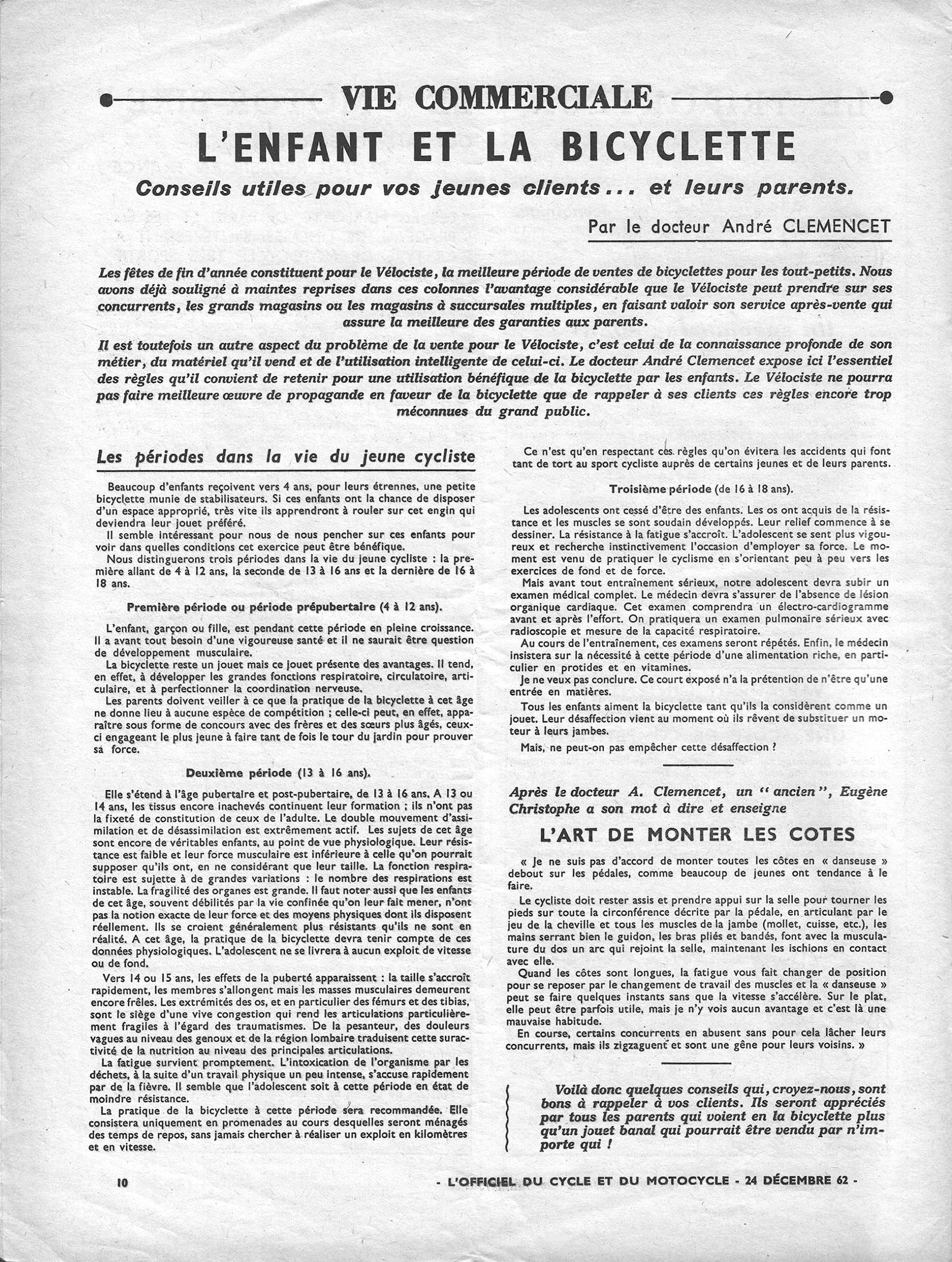
“L’Enfant et la bicyclette”, L’Officiel du cycle, 24 December 1962, page 10, by Dr André Clemencet: advice for the dealer on bicycles for children and young riders by age, with Eugène Christophe’s note on climbing hills. The headings and byline are transcribed as printed; the text is summarized in Ebykr’s words, and the page image carries it in full.
— Page 1 —
VIE COMMERCIALE
L’ENFANT ET LA BICYCLETTE
Conseils utiles pour vos jeunes clients… et leurs parents.
Par le docteur André CLEMENCET
Les périodes dans la vie du jeune cycliste
Première période ou période prépubertaire (4 à 12 ans).
Deuxième période (13 à 16 ans).
Troisième période (de 16 à 18 ans).
Après le docteur A. Clemencet, un “ ancien ”, Eugène Christophe a son mot à dire et enseigne
L’ART DE MONTER LES COTES
[Ebykr summary; the article’s text is not reproduced. An italic introduction tells the Vélociste that the year-end holidays are his best season for selling bicycles to small children, recalls that the paper has often stressed the edge his after-sales service gives him over his competitors, the department stores and the multiple-branch chains, and adds that he must also know his trade, the goods he sells and their sensible use: Dr André Clemencet sets out the rules for children’s healthy use of the bicycle, which the dealer should pass on to his customers. Many children are given a small bicycle with stabilizers as a New Year present at about 4, and soon learn to ride it. The author divides the young cyclist’s life into three periods: 4 to 12, 13 to 16 and 16 to 18. In the first, prepubertal period the growing child, boy or girl, needs sound health, not muscle building; the bicycle is a toy that helps the respiratory, circulatory and joint functions and nervous coordination, and parents must prevent any kind of competition, such as older brothers and sisters making the youngest race round the garden. The second period, 13 to 16, covers puberty: at 13 or 14 the tissues are still forming, resistance is low, muscular strength is less than height suggests and breathing is irregular; children weakened by an indoor life overrate their strength, so the adolescent must attempt no feat of speed or distance. At 14 or 15 growth is fast while the muscles stay slight, the ends of the bones, the femurs and tibias above all, are congested and the joints fragile, with aches in the knees and lower back; fatigue and fever come quickly. Cycling is recommended in this period, but only as outings with rest stops, never chasing kilometers or speed; only by these rules will the accidents that harm cycle sport in the eyes of some young people and their parents be avoided. In the third period, 16 to 18, bones and muscles have strengthened and the young rider may turn gradually to endurance and strength work, but only after a full medical examination: a check for organic heart lesions with an electrocardiogram before and after effort, a lung examination with radioscopy and a measure of breathing capacity, repeated during training, and a diet rich in proteins and vitamins. The author closes by noting that children love the bicycle while it is a toy and turn from it when they dream of a motor in place of their legs, and asks whether that can be prevented. In the second piece Eugène Christophe, an old racer, disagrees with climbing every hill standing on the pedals “en danseuse”, as many young riders do: the rider should stay seated with his weight on the saddle, turn the pedals through the whole circle using the ankle and all the leg muscles (calf and thigh), grip the bars with arms bent and braced so that the back forms an arch keeping the sit bones on the saddle; on long climbs standing for a few moments rests the muscles without raising speed, but on the flat he sees no gain in it and calls it a bad habit, and in races some riders overdo it, gaining nothing on their rivals while zigzagging and hindering their neighbors. A closing italic note tells dealers these tips will be welcomed by every parent who sees the bicycle as more than a commonplace toy that anyone could sell.]
[The page has no illustrations; the running head “VIE COMMERCIALE” sits between two ruled lines ending in dots, and the closing note is set off by a wavy rule at its left.]
– L’OFFICIEL DU CYCLE ET DU MOTOCYCLE – 24 DÉCEMBRE 62 –
— 10 —
Ebykr presents this material for research and education. If you hold rights to it or notice an ownership issue, please contact us and we will respond promptly.
The Ebykr Digest
New articles, timelines, catalog finds and registry activity — assembled from the archive once a month. Your address is never shared.
Double opt-in. One email per month. Unsubscribe at any time with one click.