About Ebykr
Ebykr celebrates classic and vintage lightweight bicycles through provocative imagery and opinion. Ride along with us.
About Ebykr
Ebykr celebrates classic and vintage lightweight bicycles through provocative imagery and opinion. Ride along with us.

Source: L'Officiel du cycle, du motocycle et du camping, N° 14, 6 July 1957, page 5; scan of the issue from Cycle Memory (Mémoire du Cycle), Collection privée F.
| Type | Review |
|---|---|
| Year | 1957 |
| Publisher | L'Officiel du cycle |
| Country | France |
| Language | French |
| Pages | 2 |
| Source | L'Officiel du cycle, du motocycle et du camping, N° 14, 6 July 1957, page 5; scan of the issue from Cycle Memory (Mémoire du Cycle), Collection privée F. |
| Credit | Ebykr archive |
| Identifier | Permalink https://cyclememory.org/fr/search-coll-list.php?collectionID=325&docID=B-1-0000001010 |
| Transcription | Headings and specifications transcribed; article text summarized |
LE PROBLÈME DU GARAGE POUR LES CYCLES
This is a magazine article, so its running text is summarized here rather than reproduced; the headline, byline, specifications and scores are transcribed as printed.
“Le problème du garage pour les cycles”, L’Officiel du cycle, 6 July 1957, page 5: a follow-up to the 30 March article on parking bicycles in numbers, with rows of stands, a roofed rack drawn by G. Gédovius and the Velopa concrete stand of the Société Chapsol, photographed. The title is transcribed as printed; the text is summarized in Ebykr’s words, and the page images carry it in full.
— Page 1 —
LE PROBLÈME DU GARAGE POUR LES CYCLES
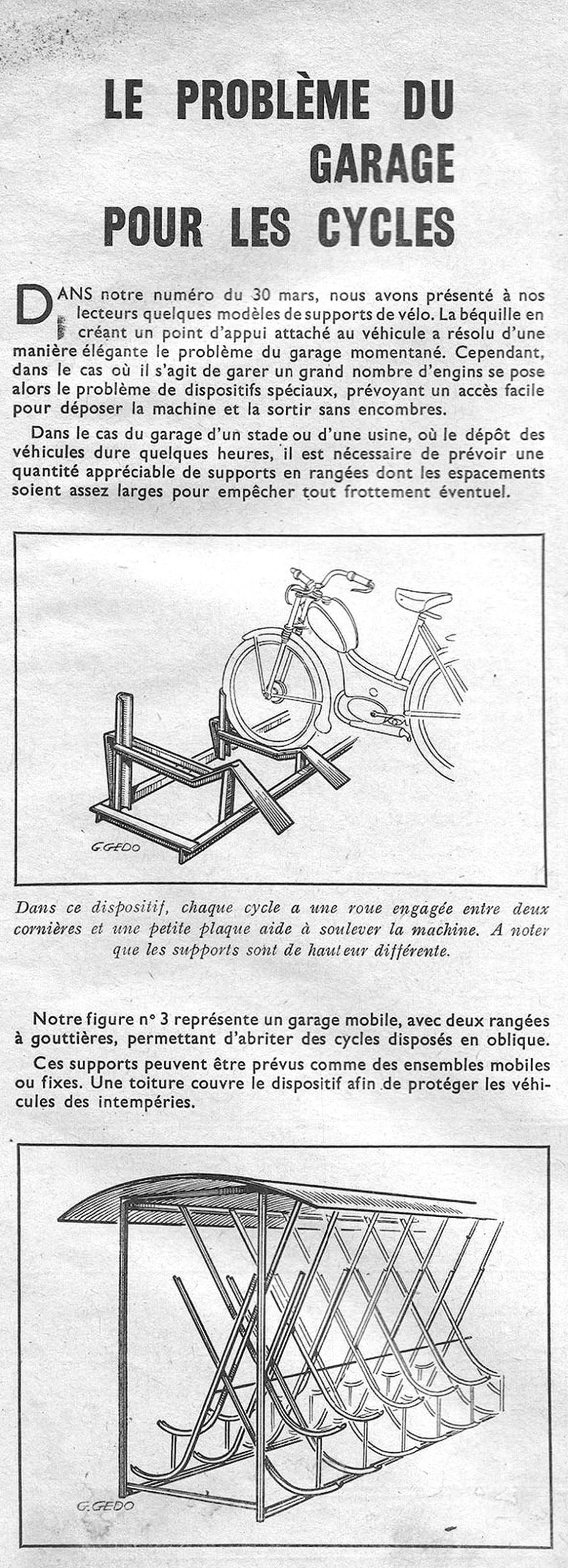
[Ebykr summary; the article’s text is not reproduced. A follow-up to the issue of 30 March (30 mars), which showed readers several models of bicycle stand. The note says the kickstand (béquille), by giving the machine a point of support attached to it, neatly solves the problem of parking for a short while; but when a large number of machines must be parked, special fittings are needed that let riders put a machine in and take it out easily. At a stadium or a factory, where machines stand for several hours, a good number of stands must be set out in rows, spaced widely enough that the machines cannot rub against one another. The caption to the first drawing explains that each cycle has one wheel held between two angle irons (cornières) and that a small plate helps lift the machine, and points out that the stands are set at different heights. The text then describes “figure n° 3” as a mobile garage with two rows of gutters (gouttières) holding cycles parked at a slant, and says such stands can be built as mobile or fixed units, with a roof covering the whole to shelter the machines from the weather.]
[Two line drawings, each in a ruled frame and neither numbered. The first shows a low steel rack of angle-iron uprights and rails with a sloping lift plate, the front wheel of a cyclomoteur (a moped with a tank on the down tube and pedals) held between two uprights; signed “G.GEDO” at the lower left of the drawing, below the rack. The second shows a roofed rack with a curved canopy on corner posts, its crossed tubular frame ending in curved wheel cradles at two heights, for cycles parked at a slant; signed “G.GEDO” at the lower left inside the frame. Two signatures in all.]
— Page 2 —
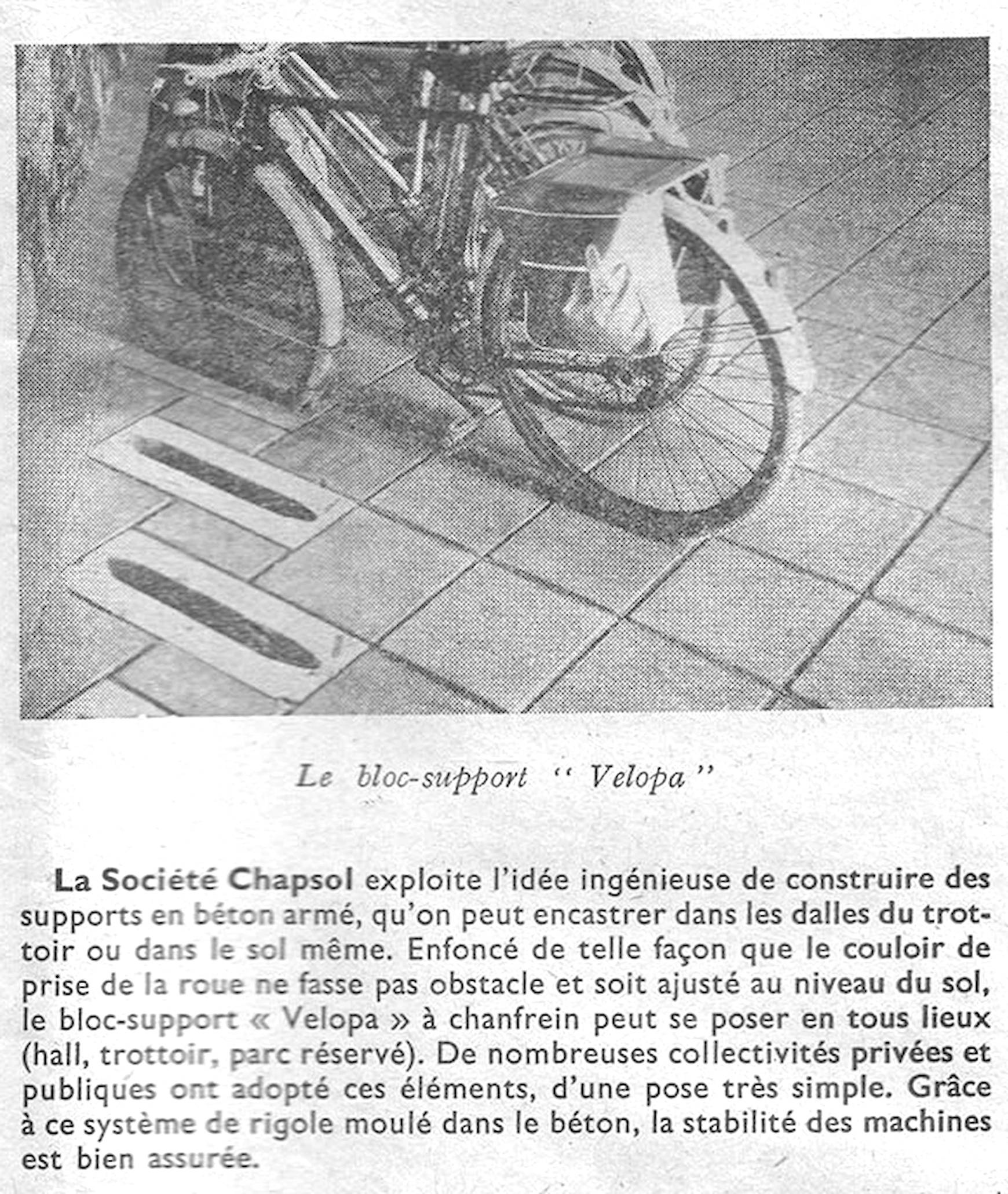
[Ebykr summary; the article’s text is not reproduced. The photograph’s caption names the “Velopa” bloc-support. La Société Chapsol is making stands of reinforced concrete (béton armé) that can be set into the paving slabs of a sidewalk (trottoir) or into the ground itself. Sunk so that the wheel channel is flush with the ground and does not get in the way, the chamfered “Velopa” bloc-support can be laid anywhere (a hall, a sidewalk, a reserved parking area). The note says many private and public bodies have adopted these units, which are very simple to lay, and that the groove molded into the concrete keeps the parked machines stable.]
[One halftone photograph: two bicycles, the nearer with a rear carrier and a white bag hanging from it, parked with their wheels in grooves set into a tiled floor, with two empty concrete blocks and their long oval channels in the foreground. No signature or monogram.]
[The rest of the right-hand column below a double rule carries the start of the article on the sentiers de grande randonnée, recorded separately, and the page’s folio.]
Ebykr presents this material for research and education. If you hold rights to it or notice an ownership issue, please contact us and we will respond promptly.
The Ebykr Digest
New articles, timelines, catalog finds and registry activity — assembled from the archive once a month. Your address is never shared.
Double opt-in. One email per month. Unsubscribe at any time with one click.