About Ebykr
Ebykr celebrates classic and vintage lightweight bicycles through provocative imagery and opinion. Ride along with us.
About Ebykr
Ebykr celebrates classic and vintage lightweight bicycles through provocative imagery and opinion. Ride along with us.

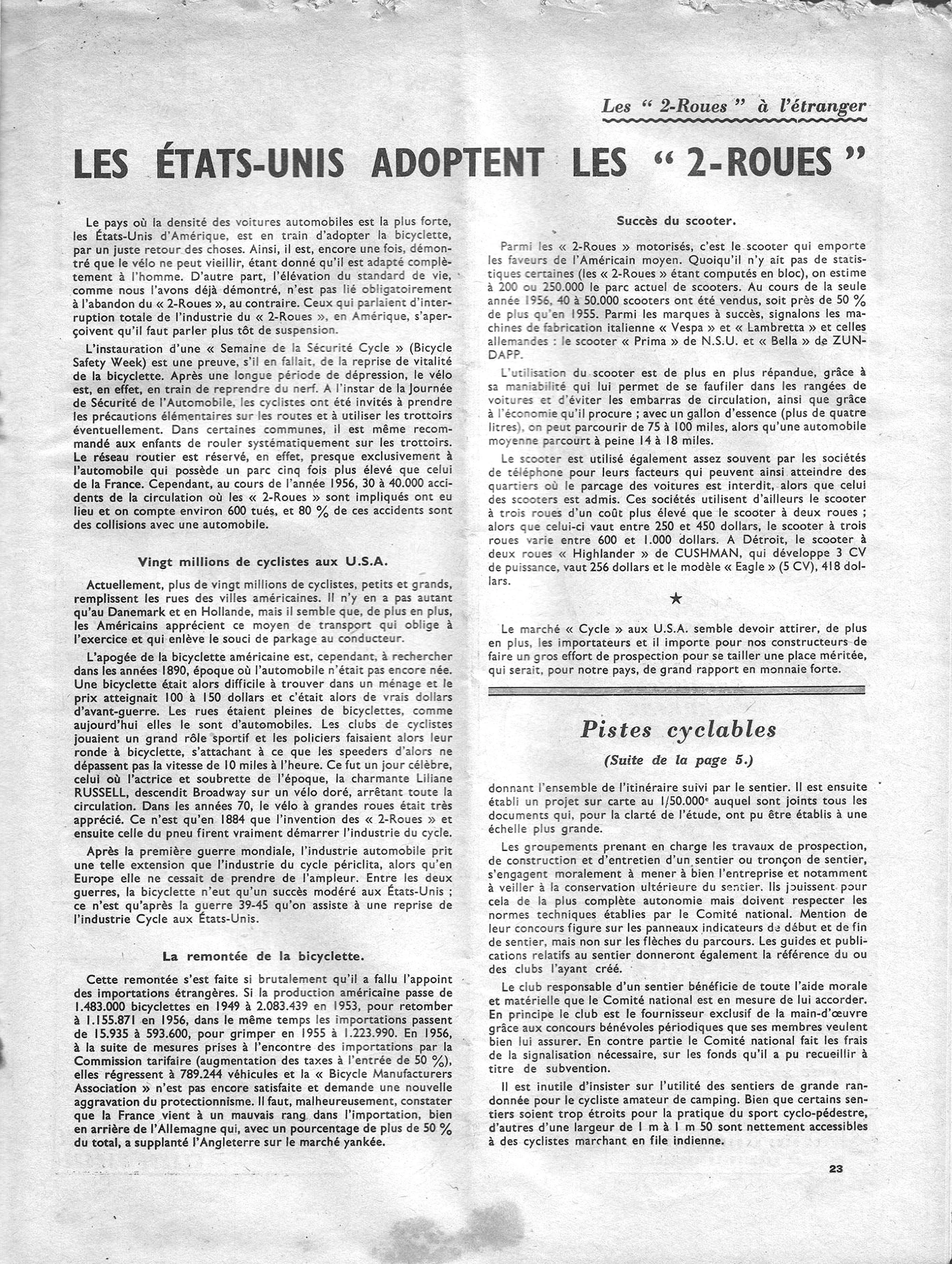
Source: L'Officiel du cycle, du motocycle et du camping, N° 14, 6 July 1957, page 23; scan of the issue from Cycle Memory (Mémoire du Cycle), Collection privée F.
| Type | Review |
|---|---|
| Year | 1957 |
| Publisher | L'Officiel du cycle |
| Country | France |
| Language | French |
| Pages | 1 |
| Source | L'Officiel du cycle, du motocycle et du camping, N° 14, 6 July 1957, page 23; scan of the issue from Cycle Memory (Mémoire du Cycle), Collection privée F. |
| Credit | Ebykr archive |
| Identifier | Permalink https://cyclememory.org/fr/search-coll-list.php?collectionID=325&docID=B-1-0000001010 |
| Transcription | Headings and specifications transcribed; article text summarized |
Les “ 2-Roues ” à l’étranger LES ÉTATS-UNIS ADOPTENT LES “ 2-ROUES ” Vingt millions de cyclistes aux U.S.A. La remontée de la bicyclette. Succès du scooter. ★ — 23 —
This is a magazine article, so its running text is summarized here rather than reproduced; the headline, byline, specifications and scores are transcribed as printed.
“Les États-Unis adoptent les « 2-Roues »”, L’Officiel du cycle, 6 July 1957, page 23: the return of the bicycle in the United States, with production and import figures for 1949 to 1956, and the success of the scooter there. The headings are transcribed as printed; the text is summarized in Ebykr’s words, and the page image carries it in full.
— Page 1 —
Les “ 2-Roues ” à l’étranger
LES ÉTATS-UNIS ADOPTENT LES “ 2-ROUES ”
Vingt millions de cyclistes aux U.S.A.
La remontée de la bicyclette.
Succès du scooter.
★
[Ebykr summary; the article’s text is not reproduced. The article says the country with the highest density of motor cars, the États-Unis d’Amérique, is taking up the bicycle again, which it reads as proof that the bicycle cannot grow old and that a rising standard of living need not mean abandoning two-wheelers; those who spoke of the American “2-Roues” industry stopping altogether should rather speak of a pause. The founding of a Bicycle Safety Week (Semaine de la Sécurité Cycle), on the model of the motorists’ safety day, is cited as a sign of revival: cyclists have been urged to take basic precautions on the roads and to use sidewalks where suitable, and in some towns children are told to ride only on the sidewalk, since American roads, with a car fleet five times that of France, belong almost wholly to the automobile. In 1956 there were 30 to 40.000 road accidents involving two-wheelers, about 600 deaths, and 80 % of these accidents were collisions with a car. Under “Vingt millions de cyclistes aux U.S.A.”: more than twenty million cyclists, young and old, now fill American city streets, fewer than in Danemark and Hollande, but Americans increasingly value a means of transport that gives exercise and frees the rider from parking worries. The American bicycle’s heyday was the 1890s, before the automobile, when a bicycle cost 100 to 150 dollars (real prewar dollars), cycling clubs played a big sporting role and police patrolled on bicycles to keep the speeders of the day under 10 miles an hour; the article recalls the day the actress Liliane RUSSELL rode down Broadway on a gilded bicycle and stopped all traffic, says the high-wheeler was popular in the 70s, and dates the real start of the cycle industry to the invention of the “2-Roues” in 1884 and then of the tire. After the First World War the car industry grew so fast that the American cycle industry declined while Europe’s kept growing; between the wars the bicycle had only modest success in the États-Unis, and the cycle industry recovered only after the war of 39-45. Under “La remontée de la bicyclette”: the recovery was so sudden that imports were needed. American production rose from 1.483.000 bicycles in 1949 to 2.083.439 in 1953 and fell back to 1.155.871 in 1956, while imports rose from 15.935 to 593.600 and then to 1.223.990 in 1955. After the Commission tarifaire raised import duties by 50 % in 1956, imports fell to 789.244, and the Bicycle Manufacturers Association is pressing for still more protection. France ranks poorly among importers, far behind Allemagne (Germany), which with more than 50 % of the total has displaced Angleterre (England) in the American market. Under “Succès du scooter”: among motorized two-wheelers the scooter is the average American’s favorite. There are no firm statistics, two-wheelers being counted together, but the scooter fleet is put at 200 or 250.000; 40 to 50.000 scooters were sold in 1956 alone, nearly 50 % more than in 1955. Successful makes include the Italian “Vespa” and “Lambretta” and the German “Prima” scooter of N.S.U. and “Bella” of ZUNDAPP. The scooter spreads because it threads through traffic and is economical: a gallon of gasoline (more than four liters) takes it 75 to 100 miles against 14 to 18 miles for an average car. Telephone companies use scooters for their delivery men (facteurs), since scooters may park where cars may not, and also use three-wheel scooters, which cost 600 to 1.000 dollars against 250 to 450 dollars for a two-wheeler. In Détroit, CUSHMAN’s two-wheel “Highlander” scooter, of 3 CV, sells for 256 dollars and the “Eagle” model (5 CV) for 418 dollars. The article concludes that the American cycle market is drawing more and more importers and that French makers should make a strong effort to win a deserved place there, which would earn France valuable hard currency.]
[No illustration; a small star ornament separates the scooter section from the closing paragraph.]
[The lower right of the page carries the end of the article on the sentiers de grande randonnée (“Pistes cyclables (Suite de la page 5.)”), recorded separately.]
— 23 —
Ebykr presents this material for research and education. If you hold rights to it or notice an ownership issue, please contact us and we will respond promptly.
The Ebykr Digest
New articles, timelines, catalog finds and registry activity — assembled from the archive once a month. Your address is never shared.
Double opt-in. One email per month. Unsubscribe at any time with one click.