About Ebykr
Ebykr celebrates classic and vintage lightweight bicycles through provocative imagery and opinion. Ride along with us.
About Ebykr
Ebykr celebrates classic and vintage lightweight bicycles through provocative imagery and opinion. Ride along with us.

Source: L'Officiel du cycle, du motocycle et du camping, N° 12, 8 June 1957, page 10; scan of the issue from Cycle Memory (Mémoire du Cycle), Collection privée F.
| Type | Review |
|---|---|
| Year | 1957 |
| Publisher | L'Officiel du cycle |
| Country | France |
| Language | French |
| Pages | 1 |
| Source | L'Officiel du cycle, du motocycle et du camping, N° 12, 8 June 1957, page 10; scan of the issue from Cycle Memory (Mémoire du Cycle), Collection privée F. |
| Credit | Ebykr archive |
| Identifier | Permalink https://cyclememory.org/fr/search-coll-list.php?collectionID=325&docID=B-1-0000001008 |
| Transcription | Headings and specifications transcribed; article text summarized |
A PROPOS DU VÉLO RURAL Vélo CONTINENTAL.
This is a magazine article, so its running text is summarized here rather than reproduced; the headline, byline, specifications and scores are transcribed as printed.
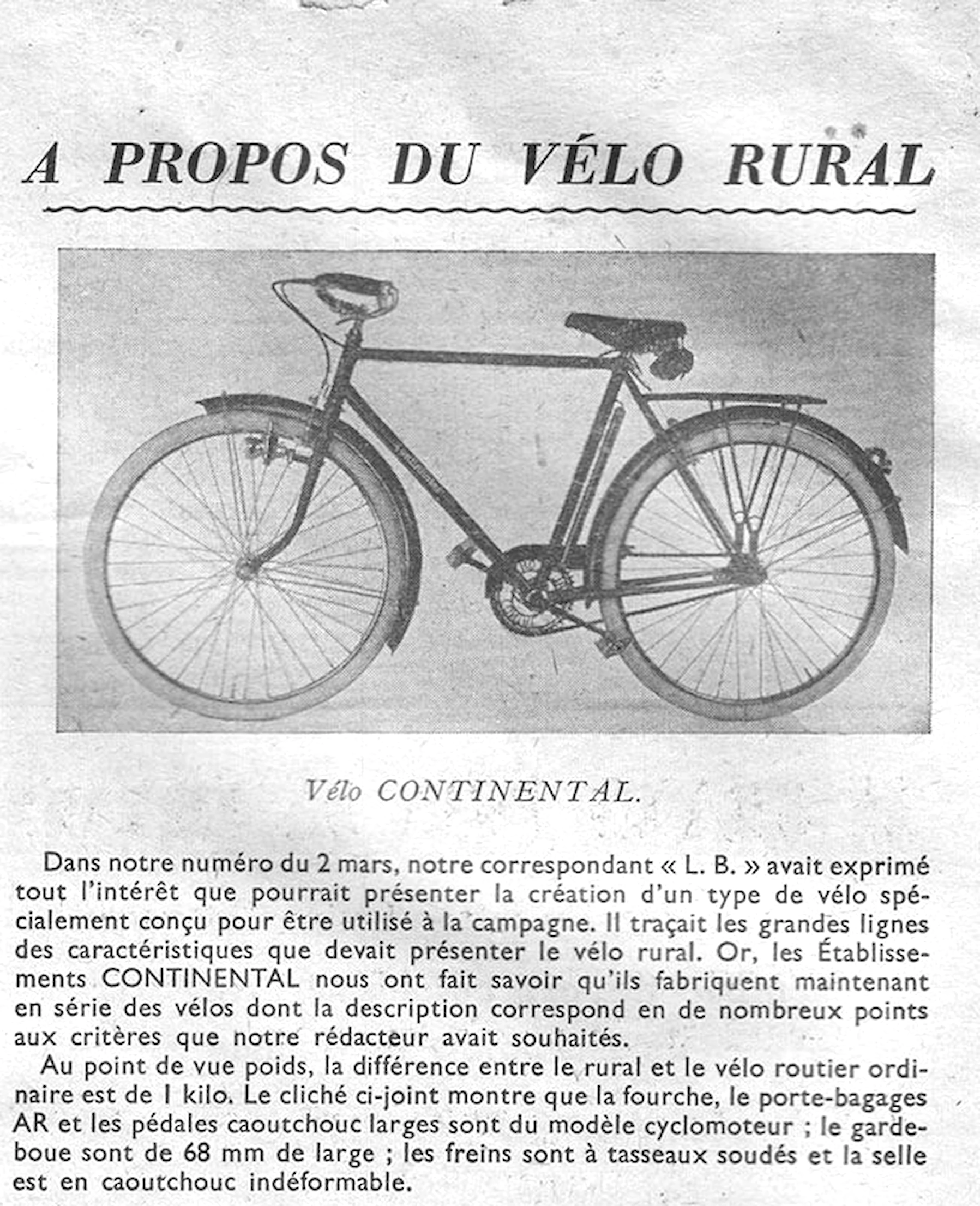
“A propos du vélo rural”, L’Officiel du cycle, 8 June 1957: a reader had asked in March for a bicycle made for the countryside, and Continental now builds one in series, with moped-pattern fork, carrier and pedals, 68 mm mudguards and brakes on brazed-on bosses, shown in a photograph. The heading and caption are transcribed as printed; the text is summarized in Ebykr’s words.
— Page 1 —
A PROPOS DU VÉLO RURAL
Vélo CONTINENTAL.
[Ebykr summary; the article’s text is not reproduced. The unsigned note recalls that in the magazine’s issue of 2 mars its correspondent “L. B.” had argued for a type of bicycle designed for use in the countryside and had outlined what such a rural bicycle (vélo rural) should offer. The Établissements CONTINENTAL have since told the magazine that they now build bicycles in series that meet many of the points the writer asked for. The rural model weighs 1 kilo more than the ordinary road bicycle (vélo routier). The accompanying photograph, captioned “Vélo CONTINENTAL”, shows that its fork, its rear carrier (porte-bagages AR) and its wide rubber pedals are of the moped (cyclomoteur) pattern, that its mudguards are 68 mm wide, that its brakes work on brazed-on bosses (tasseaux soudés) and that its saddle is of rubber that keeps its shape (caoutchouc indéformable).]
[The photograph at the head of the column shows the Continental rural bicycle in side view on a plain studio background: a man’s diamond frame with full-width mudguards, a curved moped-style fork, a flat rear carrier, a saddle with a bulky object, perhaps a tool bag, beneath it, upright handlebars with grips and wide rubber pedals; a transfer on the down tube is too small to read.]
[Below a rule, the rest of the column reproduces a poster for the Bleuet butane stove, with its own caption on the poster seen in the Paris Métro, not part of this record; the left half of page 10, a Geno helmet advertisement, is not part of it either.]
Ebykr presents this material for research and education. If you hold rights to it or notice an ownership issue, please contact us and we will respond promptly.
The Ebykr Digest
New articles, timelines, catalog finds and registry activity — assembled from the archive once a month. Your address is never shared.
Double opt-in. One email per month. Unsubscribe at any time with one click.