About Ebykr
Ebykr celebrates classic and vintage lightweight bicycles through provocative imagery and opinion. Ride along with us.
About Ebykr
Ebykr celebrates classic and vintage lightweight bicycles through provocative imagery and opinion. Ride along with us.

Source: L'Officiel du cycle, du motocycle et du camping, N° 12, 8 June 1957, page 5; scan of the issue from Cycle Memory (Mémoire du Cycle), Collection privée F.
| Type | Review |
|---|---|
| Year | 1957 |
| Publisher | L'Officiel du cycle |
| Country | France |
| Language | French |
| Pages | 1 |
| Source | L'Officiel du cycle, du motocycle et du camping, N° 12, 8 June 1957, page 5; scan of the issue from Cycle Memory (Mémoire du Cycle), Collection privée F. |
| Credit | Ebykr archive |
| Identifier | Permalink https://cyclememory.org/fr/search-coll-list.php?collectionID=325&docID=B-1-0000001008 |
| Transcription | Headings and specifications transcribed; article text summarized |
LA BICYCLETTE LE VÉLO D'ENFANT CONQUIERT LA GÉNÉRATION MONTANTE — 5 —
This is a magazine article, so its running text is summarized here rather than reproduced; the headline, byline, specifications and scores are transcribed as printed.
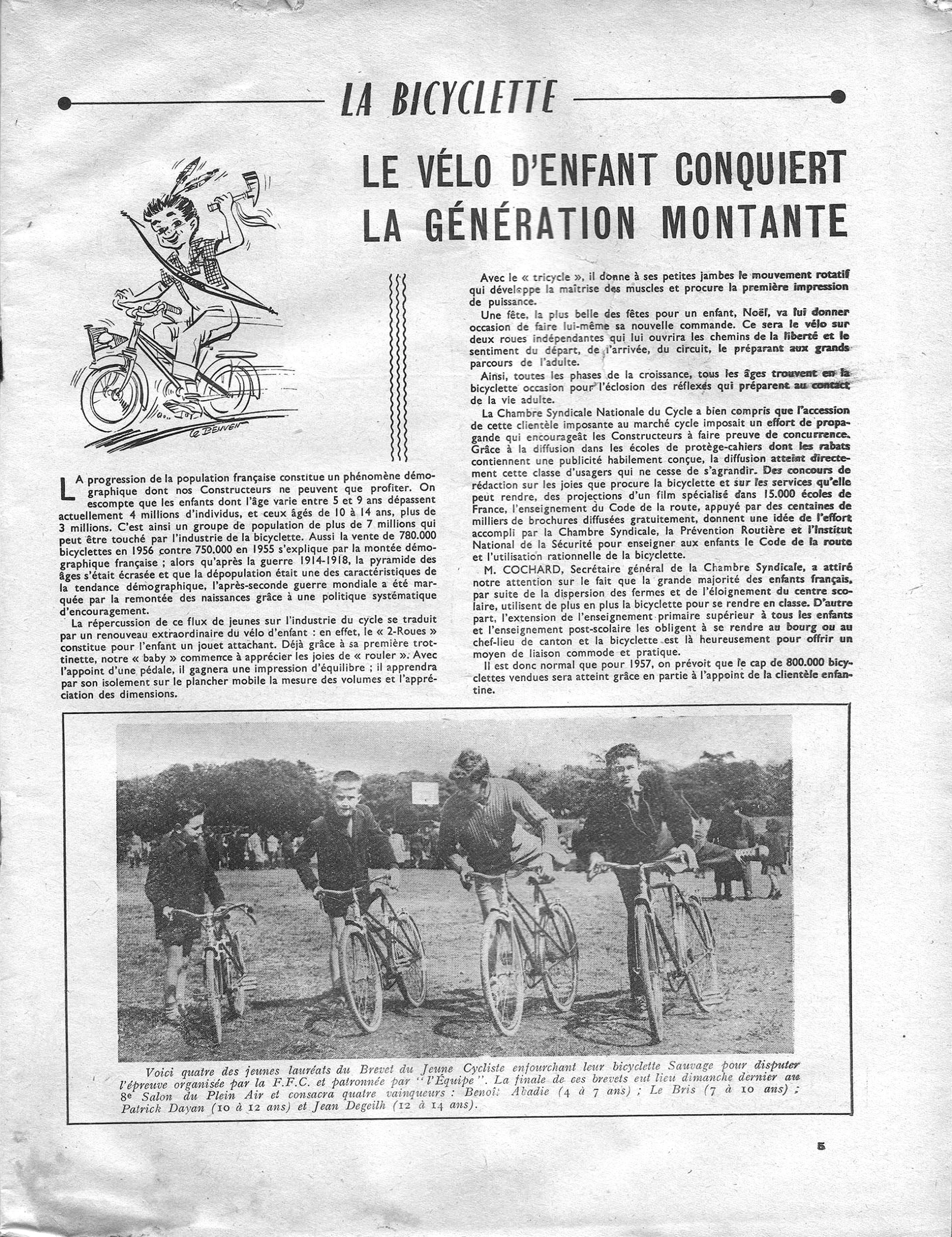
“Le vélo d’enfant conquiert la génération montante”, L’Officiel du cycle, 8 June 1957: how children’s bicycles were winning the young, with the Brevet du Jeune Cycliste and a photograph of young riders on Sauvage bicycles. The headings are transcribed as printed; the text and caption are summarized in Ebykr’s words, and the page image carries them in full.
— Page 1 —
LA BICYCLETTE
LE VÉLO D’ENFANT CONQUIERT LA GÉNÉRATION MONTANTE
[Ebykr summary; the article’s text is not reproduced. The unsigned article argues that the growth of the French population is a demographic windfall for the bicycle makers (nos Constructeurs). Children aged 5 to 9 are estimated at more than 4 million and those aged 10 to 14 at more than 3 million, a group of more than 7 million within reach of the bicycle industry; the article attributes the sale of 780.000 bicycles in 1956, against 750.000 in 1955, to this rise. It contrasts the years after the 1914-1918 war, when the age pyramid was flattened and depopulation set the trend, with the period after the Second World War, marked by a recovery in births thanks to a deliberate policy of encouragement. This wave of young people has brought an extraordinary revival of the child’s bicycle (vélo d’enfant): the two-wheeler (« 2-Roues ») is a toy children become attached to. The article traces the stages: the first scooter (trottinette) gives the “baby” the pleasure of rolling and, with a pedal, a sense of balance and of space; the tricycle teaches the rotary pedaling movement, builds muscle control and gives a first feeling of power; and at Christmas (Noël) the child chooses a bicycle on two independent wheels that opens the way to freedom and prepares for adult riding. Every stage of growing up thus finds in the bicycle a way to develop the reflexes of adult life. The Chambre Syndicale Nationale du Cycle saw that this large new clientele called for a publicity effort that would push the makers to compete: it has distributed in schools exercise-book covers (protège-cahiers) whose flaps carry advertising, and with la Prévention Routière and l’Institut National de la Sécurité it has run essay competitions on the joys and uses of the bicycle, shown a specialized film in 15.000 schools in France and taught the Code de la route, backed by hundreds of thousands of free brochures, to teach children road rules and sensible cycling. M. COCHARD, Secrétaire général of the Chambre Syndicale, points out that most French children, because farms are scattered and schools far away, ride to class more and more, and that the extension of higher primary schooling to all children and of post-school teaching obliges them to travel to the market town (bourg) or the chef-lieu de canton, for which the bicycle is a convenient link. The article therefore expects the 800.000 mark in bicycles sold to be reached in 1957, partly thanks to the children’s market. The photograph’s caption names four of the young prize-winners of the Brevet du Jeune Cycliste riding their Sauvage bicycles in the test organized by the F.F.C. and sponsored by “l’Équipe”; the final of these brevets was held the previous Sunday at the 8e Salon du Plein Air and produced four winners: Benoît Abadie (4 à 7 ans), Le Bris (7 à 10 ans), Patrick Dayan (10 à 12 ans) and Jean Degeilh (12 à 14 ans).]
[A pen cartoon at the head of the left column shows a grinning boy dressed as an Indian, with feathers in his hair, a bow slung across his checked shirt and a tomahawk raised in one hand, pedaling a small child’s bicycle with a pennant flying from its front carrier. It is signed once, in script at its lower right below the ground line, “le Denver” (doubtful reading). A wide halftone photograph across the foot of the page shows four boys of graded ages, the smallest at left, walking beside their bicycles on open grass with trees, a crowd of onlookers and a sign board on a post behind them; the caption runs beneath it in italics.]
— 5 —
Ebykr presents this material for research and education. If you hold rights to it or notice an ownership issue, please contact us and we will respond promptly.
The Ebykr Digest
New articles, timelines, catalog finds and registry activity — assembled from the archive once a month. Your address is never shared.
Double opt-in. One email per month. Unsubscribe at any time with one click.