About Ebykr
Ebykr celebrates classic and vintage lightweight bicycles through provocative imagery and opinion. Ride along with us.
About Ebykr
Ebykr celebrates classic and vintage lightweight bicycles through provocative imagery and opinion. Ride along with us.

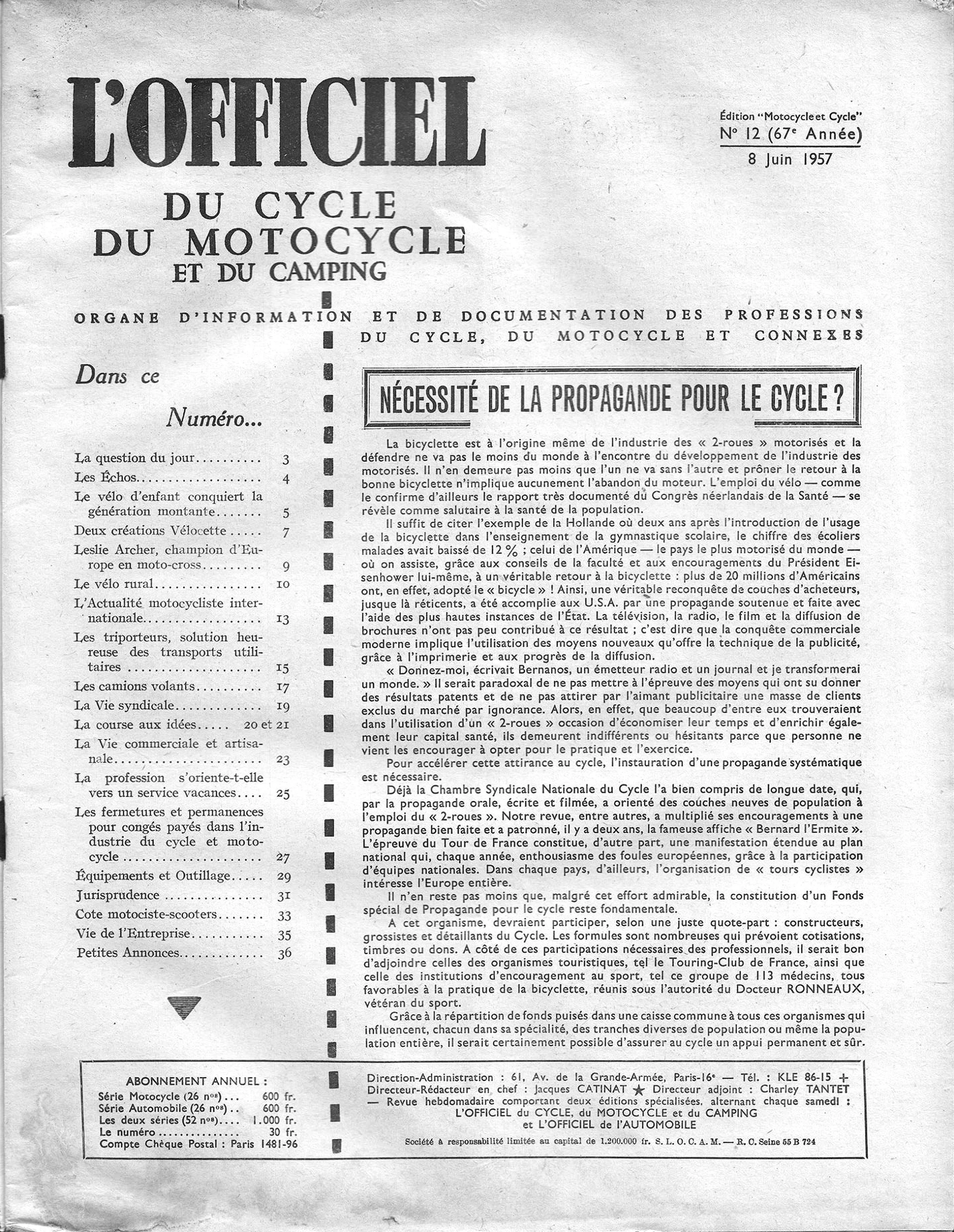
Source: L'Officiel du cycle, du motocycle et du camping, N° 12, 8 June 1957, page 3; scan of the issue from Cycle Memory (Mémoire du Cycle), Collection privée F.
| Type | Review |
|---|---|
| Year | 1957 |
| Publisher | L'Officiel du cycle |
| Country | France |
| Language | French |
| Pages | 1 |
| Source | L'Officiel du cycle, du motocycle et du camping, N° 12, 8 June 1957, page 3; scan of the issue from Cycle Memory (Mémoire du Cycle), Collection privée F. |
| Credit | Ebykr archive |
| Identifier | Permalink https://cyclememory.org/fr/search-coll-list.php?collectionID=325&docID=B-1-0000001008 |
| Transcription | Headings and specifications transcribed; article text summarized |
NÉCESSITÉ DE LA PROPAGANDE POUR LE CYCLE ?
This is a magazine article, so its running text is summarized here rather than reproduced; the headline, byline, specifications and scores are transcribed as printed.
The editorial of L’Officiel du cycle, 8 June 1957, “Nécessité de la propagande pour le cycle ?”: the case for organized publicity for the bicycle, with French sales of 780,000 bicycles in 1956 and 800,000 expected for 1957, the work of the Chambre Syndicale Nationale du Cycle and the Touring-Club de France, and the Tour de France as a showcase. The title is transcribed as printed; the text is summarized in Ebykr’s words, and the page image carries it in full.
— Page 1 —
NÉCESSITÉ DE LA PROPAGANDE POUR LE CYCLE ?
[Ebykr summary; the article’s text is not reproduced. The unsigned editorial argues that the bicycle is the very root of the motorized two-wheeler (“2-roues”) industry, so that defending it does nothing to hinder the growth of the motor trade: the two go together, and urging a return to the bicycle does not mean giving up the engine. Cycling is good for public health, as the well-documented report of the Congrès néerlandais de la Santé confirms. In Holland (la Hollande), two years after cycling was brought into school gymnastics teaching, the number of sick schoolchildren fell by 12 %. In America, the most motorized country in the world, medical advice and the encouragement of Président Eisenhower himself have brought a real return to the bicycle, with more than 20 million Americans taking up the “bicycle”; the editorial credits this reconquest of reluctant buyers in the U.S.A. to a publicity campaign backed by the highest levels of the State, carried by television, radio, film and brochures, and concludes that modern selling must use the new means that advertising, printing and wider distribution offer. Quoting Bernanos on what a radio transmitter and a newspaper could do, it holds that it would be absurd not to use publicity to reach the mass of potential customers kept out of the market by ignorance, many of whom would save time and gain health on a two-wheeler but stay indifferent or hesitant because nobody encourages them. A systematic publicity campaign is therefore needed. The Chambre Syndicale Nationale du Cycle has long understood this and has drawn new sections of the population to the two-wheeler through spoken, printed and filmed propaganda; the magazine itself (“Notre revue”) has repeatedly urged well-made publicity and two years ago sponsored the well-known poster “Bernard l’Ermite”. The Tour de France, for its part, is a national event that each year stirs European crowds through its national teams, and the “tours cyclistes” organized in every country interest the whole of Europe. Even so, the editorial calls a Fonds spécial de Propagande for the cycle essential. Manufacturers, wholesalers and retailers of the cycle (constructeurs, grossistes et détaillants) should each pay a fair share, through contributions, stamps or donations, and they should be joined by touring bodies such as the Touring-Club de France and by bodies that promote sport, such as the group of 113 doctors favorable to cycling gathered under Docteur RONNEAUX, a veteran of the sport. A common fund shared out among all these bodies, each reaching its own part of the population or the population as a whole, would give the cycle permanent and dependable support.]
[The editorial carries no illustration; the only ornament on the page is a small black triangle closing the contents column.]
[The left column carries the magazine’s masthead and contents list (“Dans ce Numéro”) and the foot of the page its subscription and management box, not part of this record.]
Ebykr presents this material for research and education. If you hold rights to it or notice an ownership issue, please contact us and we will respond promptly.
The Ebykr Digest
New articles, timelines, catalog finds and registry activity — assembled from the archive once a month. Your address is never shared.
Double opt-in. One email per month. Unsubscribe at any time with one click.