About Ebykr
Ebykr celebrates classic and vintage lightweight bicycles through provocative imagery and opinion. Ride along with us.
About Ebykr
Ebykr celebrates classic and vintage lightweight bicycles through provocative imagery and opinion. Ride along with us.

Source: L'Officiel du cycle, du motocycle et du camping, N° 7, 30 March 1957, page 5; scan of the issue from Cycle Memory (Mémoire du Cycle), Collection privée F.
| Type | Review |
|---|---|
| Year | 1957 |
| Publisher | L'Officiel du cycle |
| Country | France |
| Language | French |
| Pages | 1 |
| Source | L'Officiel du cycle, du motocycle et du camping, N° 7, 30 March 1957, page 5; scan of the issue from Cycle Memory (Mémoire du Cycle), Collection privée F. |
| Credit | Ebykr archive |
| Identifier | Permalink https://cyclememory.org/fr/search-coll-list.php?collectionID=325&docID=B-1-0000001006 |
| Transcription | Headings and specifications transcribed; article text summarized |
LE PROBLÈME DU GARAGE POUR LES CYCLES (fig. 1) figure 2 figure 3 figure 4 (Nous étudierons dans le prochain numéro le problème du garage massif des « 2-Roues ».) — 5 —
This is a magazine article, so its running text is summarized here rather than reproduced; the headline, byline, specifications and scores are transcribed as printed.
“Le problème du garage pour les cycles”, L’Officiel du cycle, 30 March 1957: how to park the growing number of bicycles and cyclomoteurs, with the kickstands and racks on the market, among them the E.S.G.E. stand, drawn by G. Gédovius. The title is transcribed as printed; the text is summarized in Ebykr’s words, and the page image carries it in full.
— Page 1 —
LE PROBLÈME DU GARAGE POUR LES CYCLES
(fig. 1)
figure 2
figure 3
figure 4
(Nous étudierons dans le prochain numéro le problème du garage massif des « 2-Roues ».)
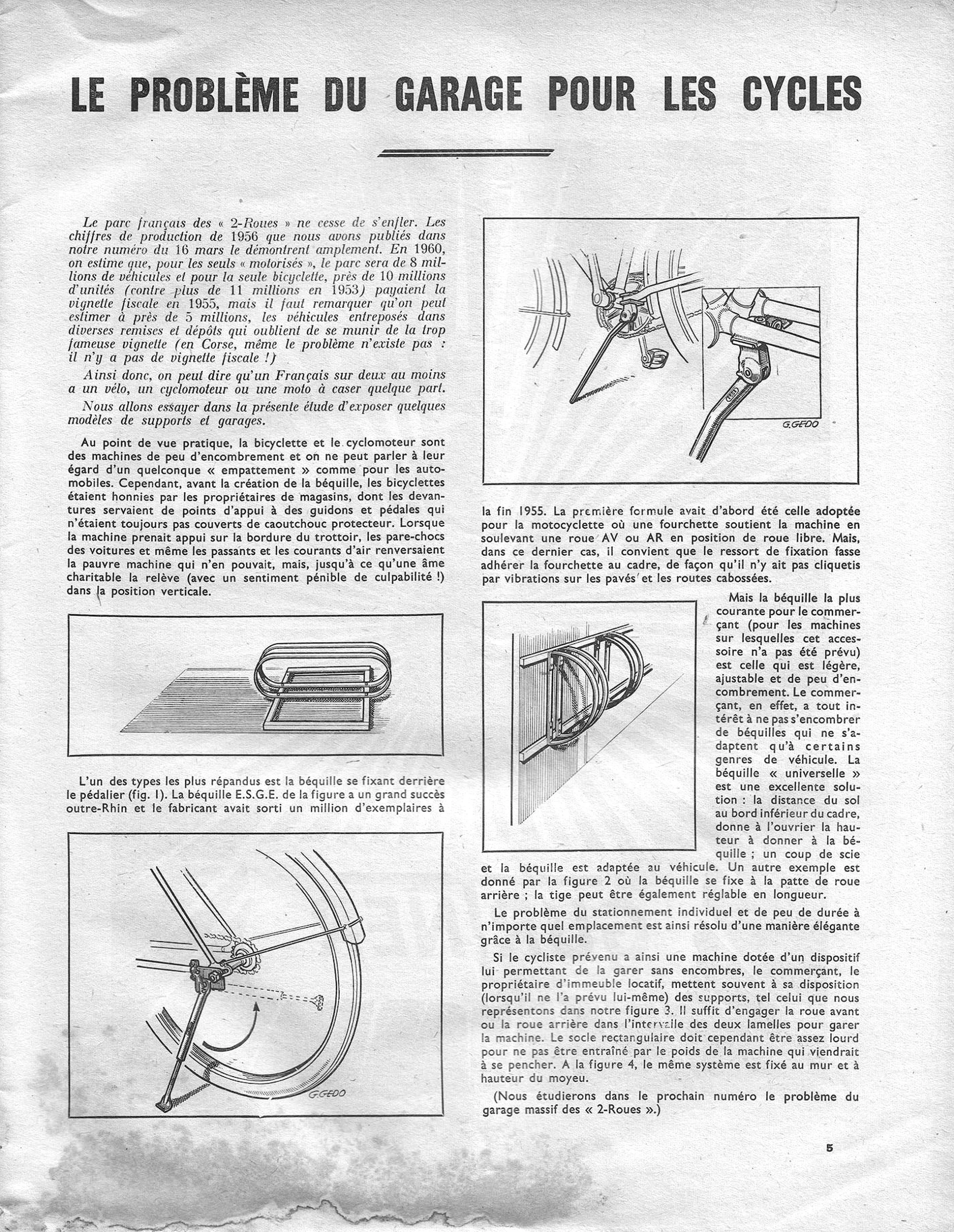
[Ebykr summary; the article’s text is not reproduced. An unsigned study of how to park and store bicycles, cyclomoteurs and motorcycles. An italic introduction says the French fleet of “2-Roues” keeps growing, pointing to the 1956 production figures the magazine published in its issue of 16 March. It forecasts 8 million “motorisés” on the road by 1960 and reports that close to 10 million bicycles paid the vignette fiscale (the annual tax disc) in 1955, against more than 11 million in 1953, while some 5 million more machines sit stored in sheds and depots whose owners skip the tax; it adds wryly that in Corse (Corsica) the problem does not arise, since the island has no tax disc. At least one French person in two therefore has a vélo, a cyclomoteur or a moto to put somewhere, and the article sets out to present some stands and racks. Bicycles and mopeds take little room, but before the béquille (kickstand) existed shopkeepers hated them: leaned on shop fronts, their handlebars and pedals, often still without rubber covers, marked the windows, and propped on the curb they were knocked over by car bumpers, passers-by and gusts of wind. The most widespread type is a stand clamped behind the bottom bracket (pédalier), fig. 1: the E.S.G.E. stand shown is a great success across the Rhine (Germany), where its maker had turned out one million by the end of 1955. The earliest formula came from the motorcycle, a fork that lifts the front (AV) or rear (AR) wheel clear of the ground; its spring must hold it tight to the frame so it does not rattle on cobbles and rough roads. For the dealer, fitting stands to machines sold without one, the best is a light, adjustable, compact “universelle” stand that he cuts to length with a saw after measuring from the ground to the lower edge of the frame, rather than stocking stands that fit only certain machines. Figure 2 shows a stand fixed to the rear-wheel dropout (patte de roue arrière), its leg also adjustable in length. The stand thus solves short individual parking anywhere. Shopkeepers and landlords of rented buildings also provide racks such as that of figure 3, in which the front or rear wheel slips between two strips; its rectangular base must be heavy enough not to be dragged over by a leaning machine. Figure 4 shows the same device fixed to a wall at hub height. The page closes with a note that the next issue will study the mass storage of two-wheelers.]
[Four line drawings, none with a printed figure number in its frame; the text identifies them. Upper right (fig. 1): a bicycle propped on a single-leg stand clamped behind the bottom bracket, the chainring, crank and pedal in view, with a framed inset close-up of the clamp on the chain stays; the stand’s leg carries a small cast oval mark too small to read at this resolution (probably the maker’s name). It is signed “G.GEDO” below the inset’s frame, at the drawing’s lower right. Middle left (figure 3): a free-standing floor rack, a rectangular base frame with two upright oval wire loops, casting a hatched shadow. Middle right (figure 4): two semicircular wheel loops mounted on rails fixed to a boarded wall. Lower left (figure 2): the rear wheel, mudguard, chain and sprocket of a bicycle with a telescopic stand bolted at the rear dropout, a curved arrow and dashed lines showing it swung up into its folded position along the chain stay; it is signed “G.GEDO” at the lower right of the drawing, near the tire. Two signatures in all, both “G.GEDO”; no Rebour monogram.]
— 5 —
Ebykr presents this material for research and education. If you hold rights to it or notice an ownership issue, please contact us and we will respond promptly.
The Ebykr Digest
New articles, timelines, catalog finds and registry activity — assembled from the archive once a month. Your address is never shared.
Double opt-in. One email per month. Unsubscribe at any time with one click.