About Ebykr
Ebykr celebrates classic and vintage lightweight bicycles through provocative imagery and opinion. Ride along with us.
About Ebykr
Ebykr celebrates classic and vintage lightweight bicycles through provocative imagery and opinion. Ride along with us.

Source: L'Officiel du cycle, du motocycle et du camping, N° 4, 16 February 1957, page 5; scan of the issue from Cycle Memory (Mémoire du Cycle), Collection privée F.
| Type | Review |
|---|---|
| Year | 1957 |
| Publisher | L'Officiel du cycle |
| Country | France |
| Language | French |
| Pages | 1 |
| Source | L'Officiel du cycle, du motocycle et du camping, N° 4, 16 February 1957, page 5; scan of the issue from Cycle Memory (Mémoire du Cycle), Collection privée F. |
| Credit | Ebykr archive |
| Identifier | Permalink https://cyclememory.org/fr/search-coll-list.php?collectionID=325&docID=B-1-0000001005 |
| Transcription | Headings and specifications transcribed; article text summarized |
La Bicyclette POUR LA COEXISTENCE DES “ 2 ” ET DES “ 4 ROUES ” sur les routes françaises. (Photo l'Équipe.) 5
This is a magazine article, so its running text is summarized here rather than reproduced; the headline, byline, specifications and scores are transcribed as printed.
“Pour la coexistence des « 2 » et des « 4 roues » sur les routes françaises”, L’Officiel du cycle, 16 February 1957: the case for cycle paths beside French roads, from a study by the Union Routière de France, with the examples of Belgium and the Netherlands and a photograph of young cyclists. The headings are transcribed as printed; the text is summarized in Ebykr’s words, and the page image carries it in full.
— Page 1 —
La Bicyclette
POUR LA COEXISTENCE DES “ 2 ” ET DES “ 4 ROUES ” sur les routes françaises.
(Photo l’Équipe.)
[Ebykr summary; the article’s text is not reproduced. The page reports the findings of a study by the Union Routière de France on sharing French roads between two-wheeled and four-wheeled traffic. It argues that traffic flow in France is hampered because vehicles of very different power, from the simple bicycle to the fastest car, use the same roads, and that this mix is stronger in France than in most countries: as many two-wheeled motor vehicles as four-wheeled ones circulate, plus 12 million bicycles. The simplest remedy, it says, is to separate vehicle categories by average speed, above all by building cycle paths (pistes cyclables), and French work in this field is still fragmentary compared with neighboring countries. In Belgium the Ministère des Travaux publics set up a cycle-path program as early as 1949 (the text refers to a plan printed below, which does not appear on this page); it is being carried out, and Belgium no longer builds a single kilometer of road without a cycle track separated from the carriageway by a strip of 2 or 3 meters. In the Netherlands (Pays-Bas), with 5 million cycles for 10 million inhabitants, 62 % of roads have cycle paths, and the new Amsterdam-Arnhem motorway carries a path for cycles and cyclomoteurs along both sides for its whole length, set well away from the main carriageway. France, the article says, does not even know how many kilometers of cycle path it has, and many existing ones are too narrow and cut by side roads whose curbs stand 5 to 8 cm high, which harms bicycle wheels. A hierarchy of places where paths are indispensable, useful or merely desirable should be drawn from the accident counts of the Administration des Ponts et Chaussées, compiled by the Direction des Routes et de la Circulation Routière of the Ministère des Travaux publics. Priority should go to roads linking workplaces with dense suburbs and to busy routes nationales; new paths should be at least 3 meters wide and one-way, built on both sides of the road. Vélomoteurs, motocyclettes and scooters are faster than cyclomoteurs and bicycles and should not share their paths. A coming issue will report the conclusions of the « Commission d’adaptation du réseau routier à la circulation des véhicules à 2 roues ». The photograph caption says the picture was taken on one of the recent Sunday rides organized by the newspaper l’Équipe for young bicycle enthusiasts, with novices listening to experienced riders; it congratulates the organizers and the Constructeurs who helped them and calls the rides first-rate publicity for the bicycle.]
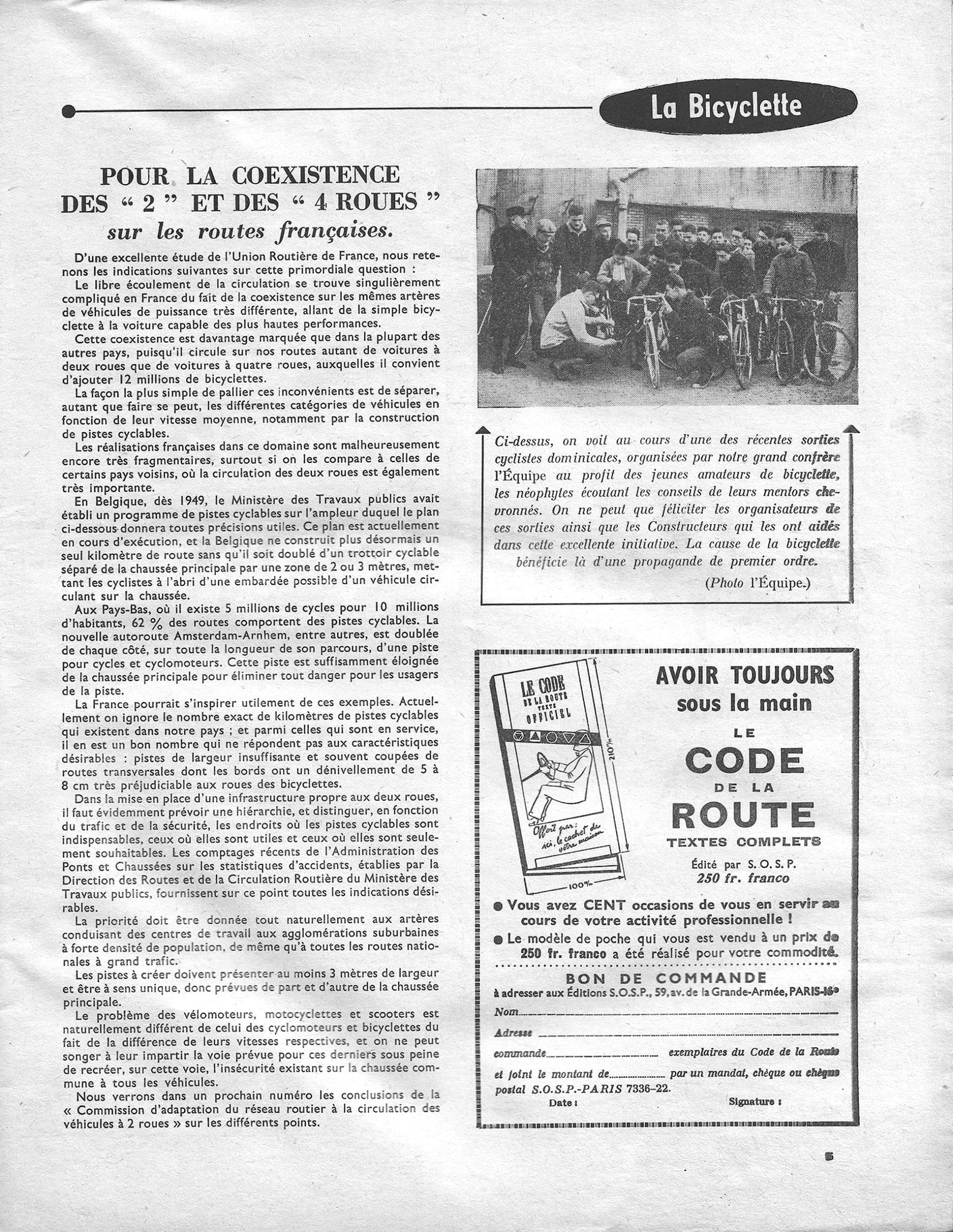
[One halftone photograph at the upper right shows about 20 young men and older riders in caps and jackets gathered with lightweight bicycles in front of a brick building, while two crouching men work on a bicycle in the foreground; the caption box below it carries arrows at both upper corners pointing up to the picture. No signature or monogram appears.]
5
[The boxed offer of the Code de la route at the lower right of the page (Bon de commande to the Éditions S.O.S.P.) is the magazine’s own, not part of this record.]
Ebykr presents this material for research and education. If you hold rights to it or notice an ownership issue, please contact us and we will respond promptly.
The Ebykr Digest
New articles, timelines, catalog finds and registry activity — assembled from the archive once a month. Your address is never shared.
Double opt-in. One email per month. Unsubscribe at any time with one click.