About Ebykr
Ebykr celebrates classic and vintage lightweight bicycles through provocative imagery and opinion. Ride along with us.
About Ebykr
Ebykr celebrates classic and vintage lightweight bicycles through provocative imagery and opinion. Ride along with us.

Source: L'Officiel du cycle, du motocycle et du camping, N° 3, 2 February 1957, page 17; scan of the issue from Cycle Memory (Mémoire du Cycle), Collection privée F.
| Type | Review |
|---|---|
| Year | 1957 |
| Publisher | L'Officiel du cycle |
| Country | France |
| Language | French |
| Pages | 1 |
| Source | L'Officiel du cycle, du motocycle et du camping, N° 3, 2 February 1957, page 17; scan of the issue from Cycle Memory (Mémoire du Cycle), Collection privée F. |
| Credit | Ebykr archive |
| Identifier | Permalink https://cyclememory.org/fr/search-coll-list.php?collectionID=325&docID=B-1-0000001002 |
| Transcription | Headings and specifications transcribed; article text summarized |
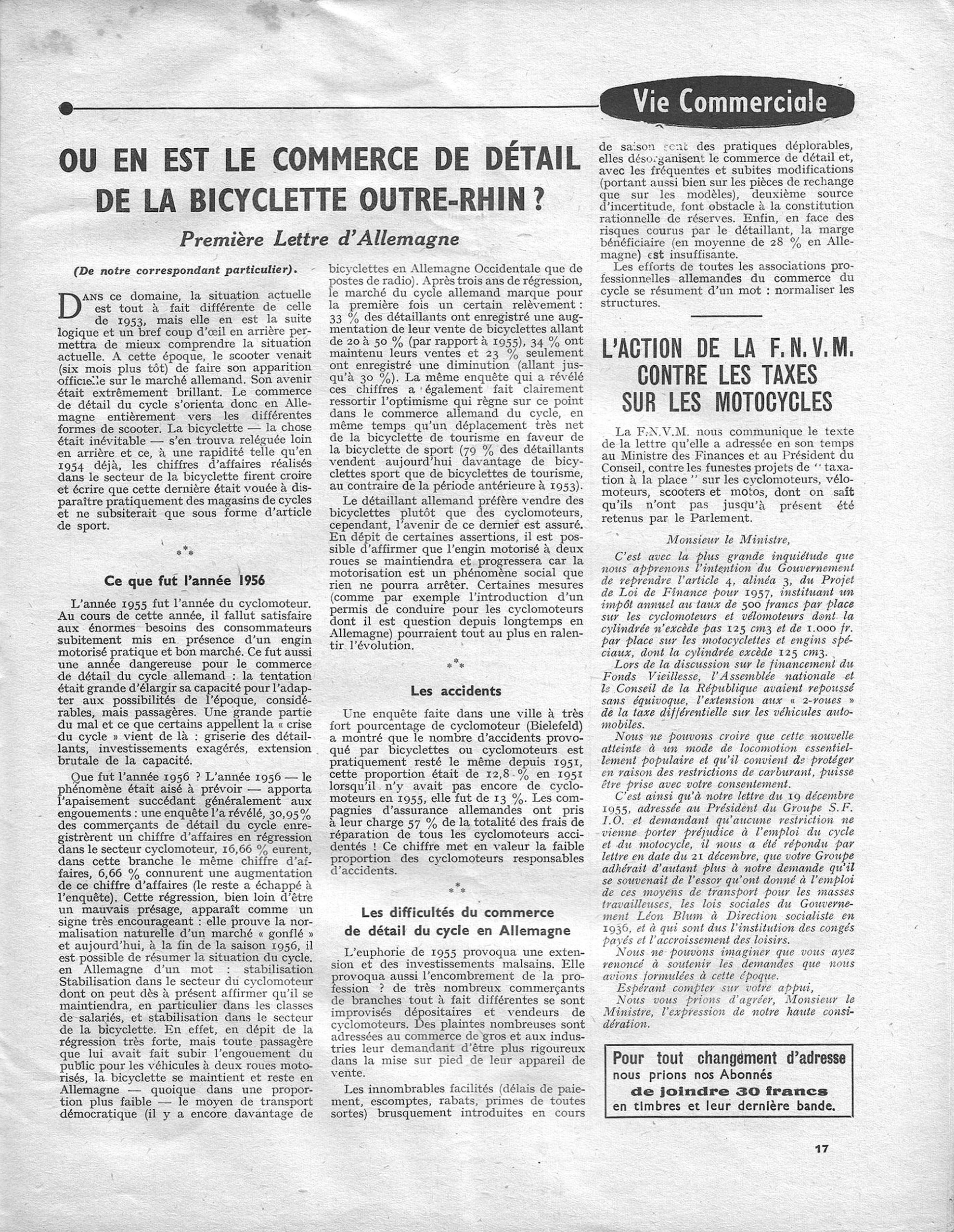
Vie Commerciale OU EN EST LE COMMERCE DE DÉTAIL DE LA BICYCLETTE OUTRE-RHIN ? Première Lettre d'Allemagne (De notre correspondant particulier). Ce que fut l'année 1956 Les accidents Les difficultés du commerce de détail du cycle en Allemagne 17
This is a magazine article, so its running text is summarized here rather than reproduced; the headline, byline, specifications and scores are transcribed as printed.
The first “Lettre d’Allemagne” in L’Officiel du cycle, 2 February 1957, “Où en est le commerce de détail de la bicyclette outre-Rhin ?”: West German bicycle sales and stocks in 1956, accidents and the difficulties of the German cycle dealer, from the magazine’s correspondent. The headings are transcribed as printed; the text is summarized in Ebykr’s words, and the page image carries it in full.
— Page 1 —
Vie Commerciale
OU EN EST LE COMMERCE DE DÉTAIL DE LA BICYCLETTE OUTRE-RHIN ?
Première Lettre d’Allemagne
(De notre correspondant particulier).
Ce que fut l’année 1956
Les accidents
Les difficultés du commerce de détail du cycle en Allemagne
[Ebykr summary; the article’s text is not reproduced. The magazine’s own correspondent opens a series of letters on bicycle retailing in West Germany. He looks back to 1953, when the scooter, officially on the German market for six months, seemed to have a brilliant future: German cycle dealers turned almost wholly to scooters, and by 1954 bicycle turnover was so low that some predicted the bicycle would vanish from cycle shops and survive only as a sporting article. Under “Ce que fut l’année 1956” he calls 1955 the year of the cyclomoteur (moped), when sudden demand tempted dealers into excessive investment and a brutal extension of capacity, the root of the so-called cycle crisis. 1956 brought calm: a survey found 30,95 % of cycle retailers with falling moped turnover, 16,66 % level and 6,66 % rising (the rest did not answer). He reads this as healthy normalization and sums up 1956 as stabilization, both in mopeds, which he expects to hold their place among wage earners, and in bicycles, still Germany’s democratic means of transport (West Germany has more bicycles than radio sets). After three years of decline bicycle sales rose: 33 % of dealers sold 20 to 50 % more than in 1955, 34 % held steady and only 23 % reported a fall (of up to 30 %). Buyers have shifted from the touring bicycle to the sports bicycle: 79 % of dealers now sell more sports than touring machines, the reverse of before 1953. Dealers prefer bicycles to mopeds, but he holds that motorization will keep growing; a long-discussed driving license for mopeds could at most slow it. Under “Les accidents” a survey in Bielefeld, a town with many mopeds, found the share of accidents caused by bicycles or mopeds almost unchanged: 12,8 % in 1951, before mopeds, and 13 % in 1955; German insurers paid 57 % of the repair costs of all mopeds in accidents, which he takes to show how seldom mopeds were at fault. The last section lists the trade’s ills: the unhealthy expansion of 1955; overcrowding, as traders from unrelated branches became moped agents, prompting complaints to wholesalers and manufacturers to be stricter in building their sales networks; payment terms, discounts, rebates and premiums introduced suddenly in mid-season; frequent changes to spare parts and models that defeat rational stock-keeping; and a profit margin of 28 % on average, too low for the risks. The German trade associations sum up their aim as normalizing the structures.]
[The page carries no drawings or photographs.]
17
[The right-hand column also carries a separate item, “L’ACTION DE LA F.N.V.M. CONTRE LES TAXES SUR LES MOTOCYCLES”, and a boxed notice to subscribers on changes of address, neither of which is part of this record.]
Ebykr presents this material for research and education. If you hold rights to it or notice an ownership issue, please contact us and we will respond promptly.
The Ebykr Digest
New articles, timelines, catalog finds and registry activity — assembled from the archive once a month. Your address is never shared.
Double opt-in. One email per month. Unsubscribe at any time with one click.