About Ebykr
Ebykr celebrates classic and vintage lightweight bicycles through provocative imagery and opinion. Ride along with us.
About Ebykr
Ebykr celebrates classic and vintage lightweight bicycles through provocative imagery and opinion. Ride along with us.

Source: L'Officiel du cycle, du motocycle et du camping, N° 3, 2 February 1957, page 5; scan of the issue from Cycle Memory (Mémoire du Cycle), Collection privée F.
| Type | Review |
|---|---|
| Year | 1957 |
| Publisher | L'Officiel du cycle |
| Country | France |
| Language | French |
| Pages | 1 |
| Source | L'Officiel du cycle, du motocycle et du camping, N° 3, 2 February 1957, page 5; scan of the issue from Cycle Memory (Mémoire du Cycle), Collection privée F. |
| Credit | Ebykr archive |
| Identifier | Permalink https://cyclememory.org/fr/search-coll-list.php?collectionID=325&docID=B-1-0000001002 |
| Transcription | Headings and specifications transcribed; article text summarized |
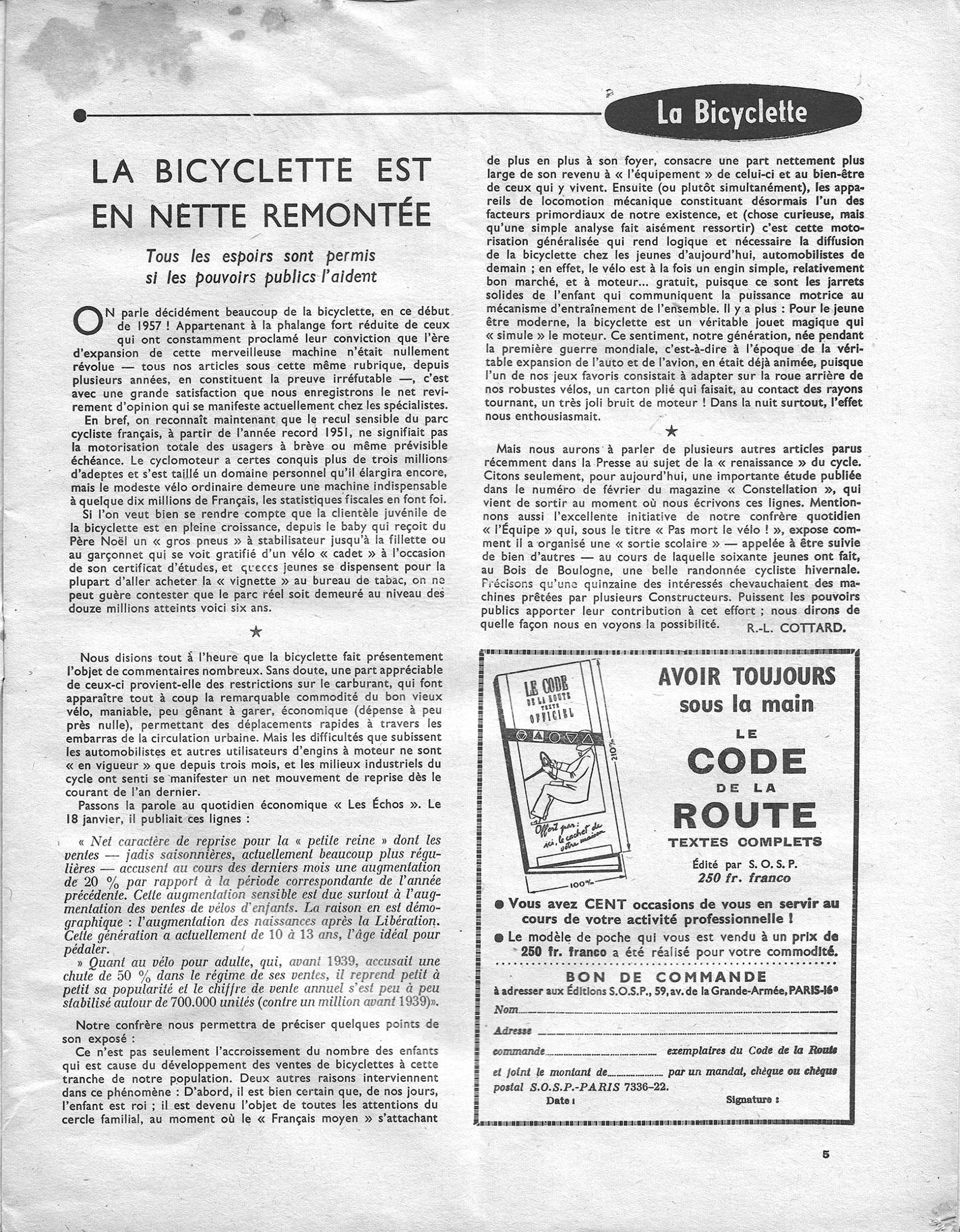
La Bicyclette LA BICYCLETTE EST EN NETTE REMONTÉE Tous les espoirs sont permis si les pouvoirs publics l'aident R.-L. COTTARD. — 5 —
This is a magazine article, so its running text is summarized here rather than reproduced; the headline, byline, specifications and scores are transcribed as printed.
R.-L. Cottard’s “La bicyclette est en nette remontée” in L’Officiel du cycle, 2 February 1957: bicycle sales in France were climbing again, with some 12 million bicycles in use and about 700,000 adult bicycles sold a year against a million before the war, and the trade could hope for more if the public authorities helped. The headings and signature are transcribed as printed; the text is summarized in Ebykr’s words, and the page image carries it in full.
— Page 1 —
La Bicyclette
LA BICYCLETTE EST EN NETTE REMONTÉE
Tous les espoirs sont permis si les pouvoirs publics l’aident
R.-L. COTTARD.
[Ebykr summary; the article’s text is not reproduced. R.-L. Cottard notes how much the bicycle is being discussed at the start of 1957 and welcomes a clear change of opinion among specialists, which this column says it has long predicted. The fall in the French bicycle fleet (“parc cycliste”) since the record year 1951 did not mean that all riders would soon motorize: the cyclomoteur has won more than three million users and will win more, but the ordinary bicycle remains indispensable to some ten million French people according to the tax statistics. Since the young market is growing, from the toddler given a training-wheeled “gros pneus” by Père Noël to the child given a “cadet” bicycle for passing the certificat d’études, and since most young riders do not buy the “vignette” (the bicycle tax disc sold at the tobacconist), he holds that the real fleet has stayed at the twelve million reached six years earlier. Part of the new interest comes from the fuel restrictions, which show off the old bicycle as handy, easy to park, nearly free to run and quick through city traffic; but those restrictions had been in force for only three months, while the cycle trade felt a clear recovery during the previous year. He cites the economic daily « Les Échos » of 18 January: sales of the “petite reine”, once seasonal and now far steadier, were up 20 % on the same months of the year before, mainly from children’s bicycles, because of the rise in births after the Libération, a generation now aged 10 to 13; adult bicycle sales, which had fallen by 50 % before 1939, were slowly recovering and had settled at about 700.000 a year (against one million before 1939). Cottard adds two further causes: the child is now the center of family spending, and general motorization itself makes the bicycle, simple, cheap and pedal-powered, the natural first machine for tomorrow’s motorists, a magic toy that imitates the engine; he recalls his own generation, born during the First World War, clipping folded cardboard against the spokes to make an engine noise. He also mentions a study in the February issue of the magazine « Constellation » on the cycle’s “renaissance”, and the daily « l’Équipe », whose piece « Pas mort le vélo ! » describes a school outing in which sixty young people made a winter ride in the Bois de Boulogne, about 15 of them on machines lent by several manufacturers. He hopes the public authorities (“pouvoirs publics”) will support such efforts and promises to say how.]
[The page has no drawings or photographs on the article itself; the running head is set white in a black oval at the end of a rule, and the sections are divided by stars.]
— 5 —
[The box at the lower right, the magazine’s own offer of the Code de la route, is not part of this record.]
Ebykr presents this material for research and education. If you hold rights to it or notice an ownership issue, please contact us and we will respond promptly.
The Ebykr Digest
New articles, timelines, catalog finds and registry activity — assembled from the archive once a month. Your address is never shared.
Double opt-in. One email per month. Unsubscribe at any time with one click.