About Ebykr
Ebykr celebrates classic and vintage lightweight bicycles through provocative imagery and opinion. Ride along with us.
About Ebykr
Ebykr celebrates classic and vintage lightweight bicycles through provocative imagery and opinion. Ride along with us.

Source: Gallica (Bibliothèque nationale de France), L'Officiel du cycle, du motocycle et du camping, 1 October 1955, N° 20, page 5; ark:/12148/bd6t54207485x. Source gallica.bnf.fr / BnF.
| Type | Review |
|---|---|
| Year | 1955 |
| Publisher | L'Officiel du cycle |
| Country | France |
| Language | French |
| Pages | 1 |
| Source | Gallica (Bibliothèque nationale de France), L'Officiel du cycle, du motocycle et du camping, 1 October 1955, N° 20, page 5; ark:/12148/bd6t54207485x. Source gallica.bnf.fr / BnF. |
| Credit | Ebykr archive; Bibliothèque nationale de France |
| Identifier | Gallica (BnF) ark:/12148/bd6t54207485x/f5 |
| Transcription | Headings and specifications transcribed; article text summarized |
SALON DU CYCLE ET DU MOTOCYCLE
This is a magazine article, so its running text is summarized here rather than reproduced; the headline, byline, specifications and scores are transcribed as printed.
From L’Officiel du cycle, du motocycle et du camping, 1 October 1955, N° 20, the paper’s special number before the Salon du Cycle at the Porte de Versailles, page 5: salon du Cycle et du Motocycle: editorial opening on the 1954 and 1955 output of motorized two-wheelers, then the bicycle: eleven million machines in service, 750,000 a year, the bicycle as a machine for every age. The title, headings, captions and lists are transcribed as printed; the text is summarized in Ebykr’s words, and the page images carry it in full.
— Page 1 —
SALON DU CYCLE ET DU MOTOCYCLE
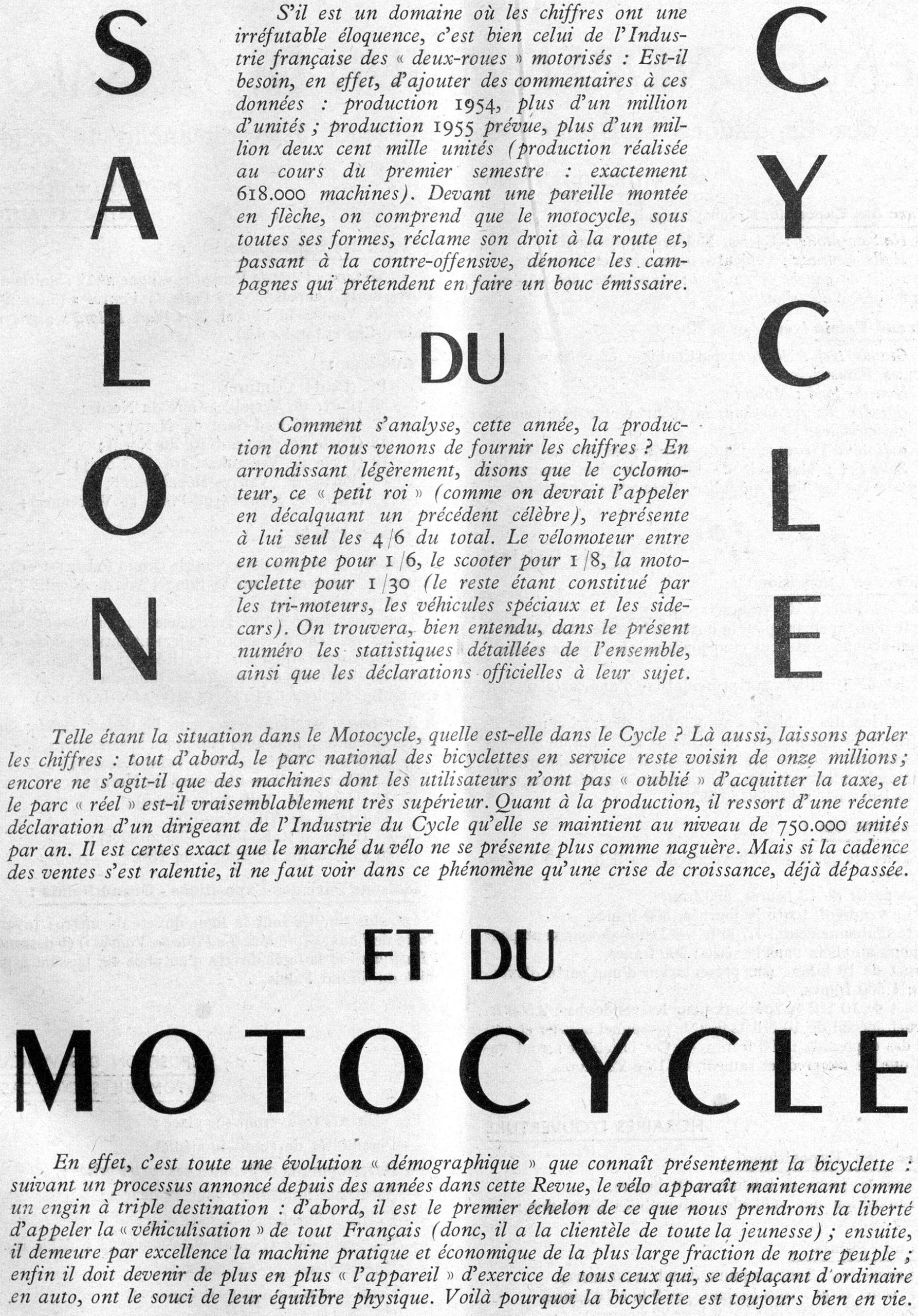
[Ebykr summary; the article’s text is not reproduced. The opening says that in the French industry of motorized “deux-roues” the figures speak for themselves: production in 1954 was more than a million units, production forecast for 1955 is more than 1,200,000 units, and exactly 618,000 machines were made in the first half of the year. Faced with such a rise, the motorcycle in all its forms claims its right to the road and, going on the counter-offensive, denounces the campaigns that try to make it a scapegoat.]
[Ebykr summary, second paragraph. The author breaks the figures down, rounding slightly: the cyclomoteur, called a “petit roi”, accounts alone for 4/6 of the total, the vélomoteur for 1/6, the scooter for 1/8 and the motocyclette for 1/30, the remainder being three-wheelers, special vehicles and sidecars. The present number carries the detailed statistics of the whole field and the official statements about them.]
[Ebykr summary, third paragraph, on the Cycle. Turning to the bicycle, the author says the figures should speak there too: the national stock of bicycles in service remains close to eleven million, counting only machines whose users have paid the tax, so the real stock is probably much higher; a recent statement by an official of the Cycle industry puts production at 750,000 units a year. The bicycle market is admittedly no longer what it was, but the slowing of sales is only a growth crisis, already over.]
[Ebykr summary, final paragraph. The bicycle is going through a “demographic” evolution, long announced in the magazine, and now appears as a machine with a triple purpose: first, the first step toward what the author calls the “véhiculisation” of every French person, with the whole of the young as its clientele; second, the practical and economical machine of the largest share of the people; third, more and more the exercise apparatus of those who ordinarily travel by car and care about their physical balance. That is why the bicycle is still very much alive.]
[A full page of text only, printed in black on a toned sheet. The title is spread across the page in large widely spaced sans-serif capitals: SALON runs down the left margin one letter to a line, CYCLE runs down the right margin the same way, a small DU stands in the center between two italic text blocks, and ET DU and a very large, widely letterspaced MOTOCYCLE cross the lower part of the sheet. The running text is set in italic roman in two narrow centered blocks between the vertical words, then in full-width italic paragraphs across the sheet. There are no drawings, no photographs, no signature and no address. A fold crosses the sheet vertically at the center.]
Ebykr presents this material for research and education. If you hold rights to it or notice an ownership issue, please contact us and we will respond promptly.
The Ebykr Digest
New articles, timelines, catalog finds and registry activity — assembled from the archive once a month. Your address is never shared.
Double opt-in. One email per month. Unsubscribe at any time with one click.