About Ebykr
Ebykr celebrates classic and vintage lightweight bicycles through provocative imagery and opinion. Ride along with us.
About Ebykr
Ebykr celebrates classic and vintage lightweight bicycles through provocative imagery and opinion. Ride along with us.

Source: Gallica (Bibliothèque nationale de France), L'Officiel du cycle, du motocycle et du camping, 1 October 1955, N° 20, page 64; ark:/12148/bd6t54207485x. Source gallica.bnf.fr / BnF.
| Type | Review |
|---|---|
| Year | 1955 |
| Publisher | L'Officiel du cycle |
| Country | France |
| Language | French |
| Pages | 1 |
| Source | Gallica (Bibliothèque nationale de France), L'Officiel du cycle, du motocycle et du camping, 1 October 1955, N° 20, page 64; ark:/12148/bd6t54207485x. Source gallica.bnf.fr / BnF. |
| Credit | Ebykr archive; Bibliothèque nationale de France |
| Identifier | Gallica (BnF) ark:/12148/bd6t54207485x/f63 |
| Transcription | Headings and specifications transcribed; article text summarized |
Il y a 90 ans naissait L'INDUSTRIE DU CYCLE ★ A MICHAUX LA PALME ★ LA PREMIÈRE USINE ★ L'ABOUTISSEMENT Victor BREYER.
This is a magazine article, so its running text is summarized here rather than reproduced; the headline, byline, specifications and scores are transcribed as printed.
From L’Officiel du cycle, du motocycle et du camping, 1 October 1955, N° 20, the paper’s special number before the Salon du Cycle at the Porte de Versailles, page 64: victor Breyer, Il y a 90 ans naissait l’industrie du Cycle: history of the Michaux velocipede, the first factory (Cie Parisienne des Vélocipèdes) and the aftermath. The title, headings, captions and lists are transcribed as printed; the text is summarized in Ebykr’s words, and the page images carry it in full.
— Page 1 —
Il y a 90 ans naissait
L’INDUSTRIE DU CYCLE
[Ebykr summary; the article’s text is not reproduced. The author opens with a question often debated without a satisfactory answer: who invented the “bicyclette”? He holds that the question is badly posed, because strictly speaking nobody invented the finely elegant little steel machine of today. It is the global result of the efforts of countless researchers who brought it little by little to near perfection, each contributing a stone to a monument built over more than a century, a history that starts from the célérifère of 150 years earlier and passes through the draisienne, the wooden velocipede and the bicycle, the direct ancestor of today’s universal machine, with many innovations and some radical transformations along the way. Granting those observations, he sees no harm in assigning the good workmen of this continuous creation an order of rank inspired by the impartial objectivity such a judgment requires.]
★ A MICHAUX LA PALME
[Ebykr summary, under the first subheading. The author says he has no hesitation in giving first place to Pierre Michaux, who had the idea of fitting driving pedals to the machines then pushed along by the feet of riders resting on the ground, a thesis he says he has constantly upheld in speech and in print, in these same columns or elsewhere. In 1864 Michaux, a small locksmith working in a workshop in a passage near the Champs-Élysées (since vanished), helped by one workman and his two sons Henri and Ernest, had the idea that should have made his fortune. While trying out a vélocifère for repair, Ernest noticed how hard it was to climb the Champs-Élysées on the primitive machine and told his father, who at once made cranks and pedals and fitted them to the célérifère, so that the velocipede was born. At first the event brought Michaux the most triumphant success: a kind of boom followed, orders flowed into the modest shop, and new machines left it at a rate of 10 to 12 a week, a high figure in the circumstances. Businessmen and backers took an interest, and in 1865 the two brothers René and Émile Olivier, entering into relations with Michaux, bought the whole enterprise, name included.]
★ LA PREMIÈRE USINE
[Ebykr summary, under the second subheading. This, the author says, is how the first specialized factory worthy of the name came into being. Under the title “Cie Parisienne des Vélocipèdes” (formerly Maison Michaux et Cie) its offices stood at 27, rue Jean-Goujon and its construction shops at 10, avenue Bugeaud. Interesting details are known of its activity: in 1868 it employed 500 workmen and, although it built 200 machines a day, could not satisfy its customers. The vélocipédie, he concludes, was launched.]
[Ebykr summary, after a three-star break. Unfortunately Pierre Michaux, a skilled craftsman and manual worker, lacked education and still more any sense of business. Although he had sold his firm by contract to the leaders of the new company and so received a sum that seems high enough to live in comfort to the end of his days, he had the singular pretension of going on making velocipedes under his own brand. A lawsuit followed that he could only lose; he lost it and ruined himself in the same stroke. Reduced almost to poverty, he merely vegetated from then on and died on 8 January 1883 in the Bicêtre asylum, where he had lived for about a dozen years. These misfortunes and his sad end, the author says, cannot take from Michaux the merit of having been at the base of the creation of an industry now of world importance. For that reason all who live by it in any capacity, Fabricants, Ouvriers, Vélocistes and their staff, owe it to themselves to revere his memory and to regard him, in a spiritual sense, as the “patron” of the Corporation, like Saint Barbara for the artillerymen.]
★ L’ABOUTISSEMENT
[Ebykr summary, under the third subheading. The author says there would still be much to say about the kind of epic whose beginnings he has just sketched, a subject too vast for the modest frame of an article. Two points later than the earliest years must nonetheless be stressed. The first is the erasure, not to say complete annihilation, of the movement so well started, brought about by the disastrous war of 1870, a scourge that stopped everything in France, men and machines alike, and had as its consequence the transfer across the Channel of an industry that promised to be prodigious. The stoppage lasted nearly ten years, during which the United Kingdom made itself absolute master of a market that kept prospering in inverse ratio to France’s forced immobility, and one can guess the size of the handicap France then had to overcome in order to start again. The second point concerns a period of transition in which the chrysalis became a butterfly and the velocipede became, by successive stages, the bicycle (large front wheel and small rear one) and the tricycle, used by people whose tastes or age forbade the use of so acrobatic a mount. “And then?”, the author imagines readers eager for detail asking; but that is all, since his somewhat disjointed account has brought him up to yesterday, which is as much as to say today.]
Victor BREYER.
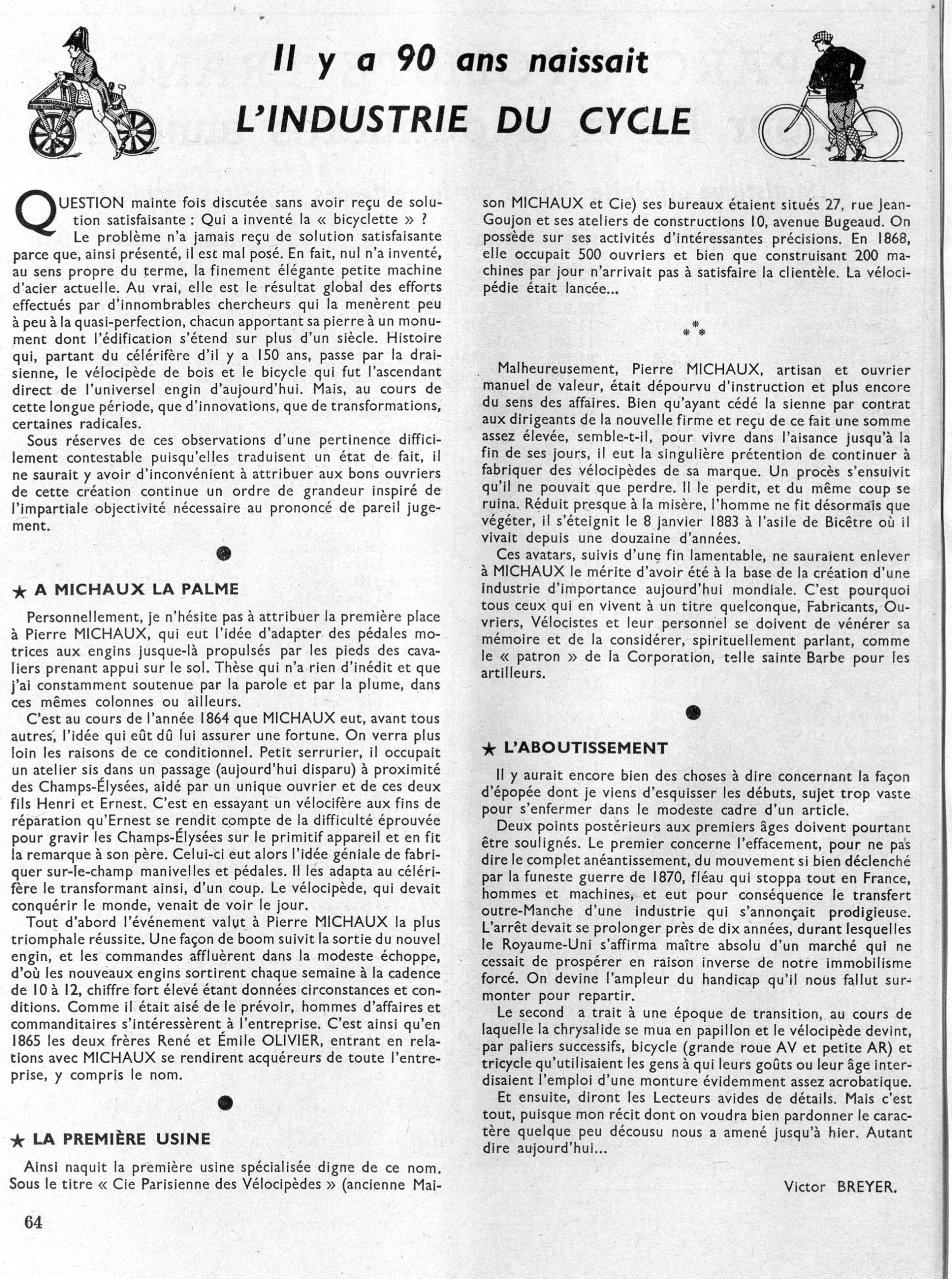
[A full page of editorial text in black and white with the folio number 64 at the lower left. The two-line title “Il y a 90 ans naissait” over “L’INDUSTRIE DU CYCLE” stands across the head in heavy slanted sans-serif capitals and lowercase. At the upper left a small line engraving with hatched shading shows a gentleman in a tailcoat and a tall plumed hat astride an early wooden hobby-horse with two spoked wheels; at the upper right a similar line drawing shows a man in a checked cap and dark jacket standing beside a safety bicycle with two equal spoked wheels and a diamond frame. The text runs in two justified columns of roman type with a large decorative initial Q opening the first paragraph. Black star bullets introduce three bold sans-serif subheadings, and round black dots or a small group of three asterisks separate the sections. The author’s name appears at the foot of the right column, set in spaced roman type and indented to the right. Neither drawing carries a visible signature.]
Ebykr presents this material for research and education. If you hold rights to it or notice an ownership issue, please contact us and we will respond promptly.
The Ebykr Digest
New articles, timelines, catalog finds and registry activity — assembled from the archive once a month. Your address is never shared.
Double opt-in. One email per month. Unsubscribe at any time with one click.