About Ebykr
Ebykr celebrates classic and vintage lightweight bicycles through provocative imagery and opinion. Ride along with us.
About Ebykr
Ebykr celebrates classic and vintage lightweight bicycles through provocative imagery and opinion. Ride along with us.

Source: Gallica (Bibliothèque nationale de France), L'Officiel du cycle, du motocycle et du camping, 1 October 1955, N° 20, page 61; ark:/12148/bd6t54207485x. Source gallica.bnf.fr / BnF.
| Type | Review |
|---|---|
| Year | 1955 |
| Publisher | L'Officiel du cycle |
| Country | France |
| Language | French |
| Pages | 1 |
| Source | Gallica (Bibliothèque nationale de France), L'Officiel du cycle, du motocycle et du camping, 1 October 1955, N° 20, page 61; ark:/12148/bd6t54207485x. Source gallica.bnf.fr / BnF. |
| Credit | Ebykr archive; Bibliothèque nationale de France |
| Identifier | Gallica (BnF) ark:/12148/bd6t54207485x/f60 |
| Transcription | Headings and specifications transcribed; article text summarized |
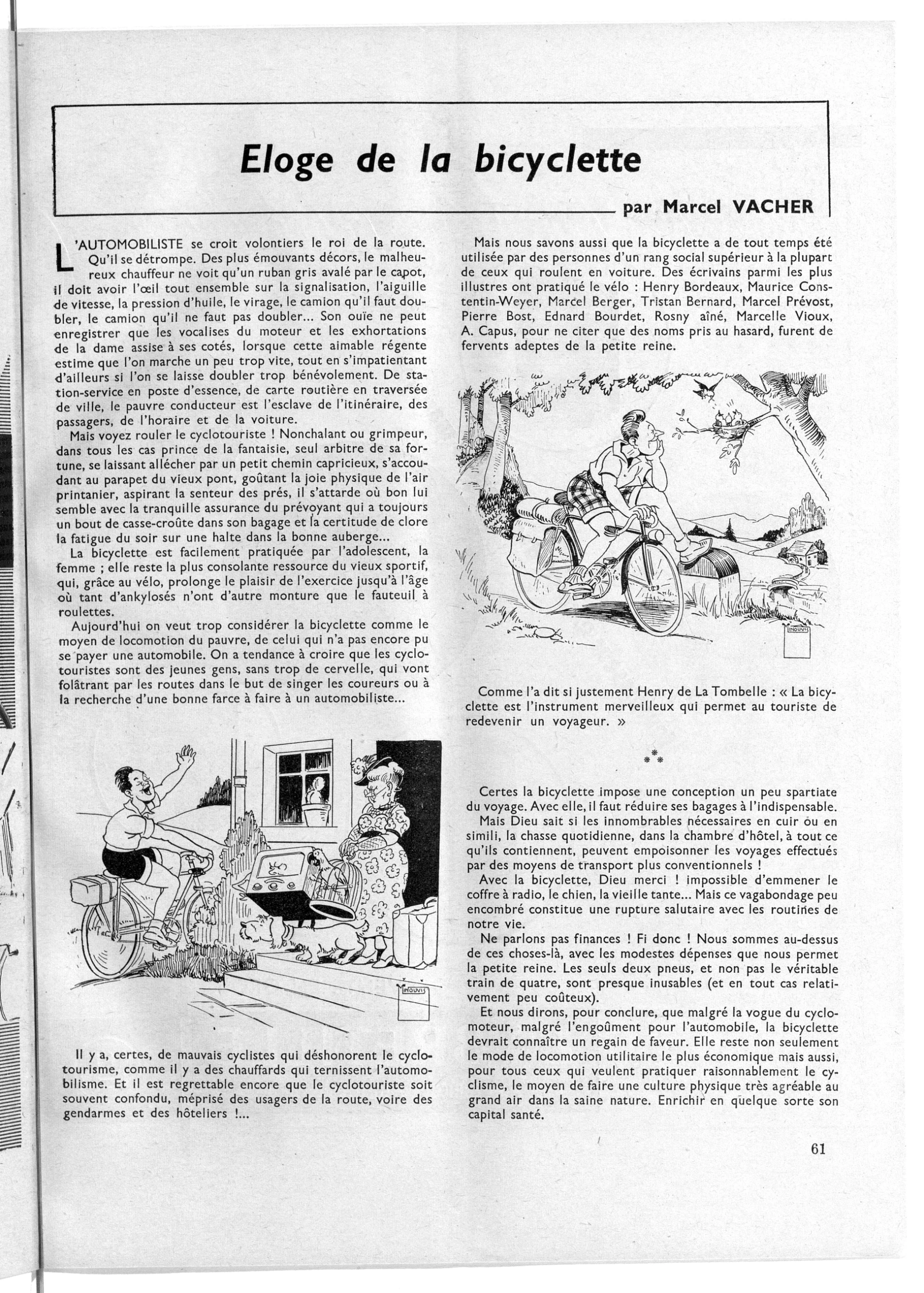
Eloge de la bicyclette par Marcel VACHER 61
This is a magazine article, so its running text is summarized here rather than reproduced; the headline, byline, specifications and scores are transcribed as printed.
From L’Officiel du cycle, du motocycle et du camping, 1 October 1955, N° 20, the paper’s special number before the Salon du Cycle at the Porte de Versailles, page 61: marcel Vacher, Éloge de la bicyclette: essay praising the bicycle and cyclotouring against the motorist, with two cartoon drawings of cyclotourists. The title, headings, captions and lists are transcribed as printed; the text is summarized in Ebykr’s words, and the page images carry it in full.
— Page 1 —
Eloge de la bicyclette
par Marcel VACHER
[Ebykr summary; the article’s text is not reproduced. Vacher opens by saying that the motorist likes to think himself king of the road, and he is mistaken: the unhappy driver sees only a gray ribbon swallowed by the hood, must watch the signs, the speedometer needle, the oil pressure, the bend, the truck he must pass and the truck he must not pass, hears only the engine and the exhortations of the lady beside him when she judges that the car is going a little too fast, and is a slave to the route, the passengers, the timetable and the car, from service station to gas pump and road map to town crossing. The cyclotourist, by contrast, is nonchalant or a climber, in every case a prince of fantasy and sole judge of his fortune, tempted by a capricious little road, leaning on the parapet of an old bridge, enjoying the springtime air and the smell of the meadows, lingering where he pleases with the quiet assurance of the prudent man who always has a crust of bread in his baggage and is sure to end the evening’s fatigue at a halt in a good inn. The bicycle is easily ridden by the adolescent and by women, and it remains the most consoling resource of the old sportsman, who thanks to it prolongs the pleasure of exercise to the age at which so many stiff-jointed people have no mount but the wheelchair. Vacher complains that the bicycle is now too readily regarded as the poor man’s means of locomotion, for those who cannot yet afford a car, and that people tend to think cyclotourists are rather brainless young people who roam the roads aping racing cyclists or looking for a good joke to play on a motorist.]
[Ebykr summary, after the cartoon of the woman in the doorway, at the foot of the left column; the article’s text is not reproduced. The author admits that there are bad cyclists who dishonor cyclotourism, just as there are drivers who tarnish motoring, and regrets further that the cyclotourist is so often confused with them and despised by road users, even by gendarmes and innkeepers.]
[Ebykr summary; the article’s text is not reproduced. In the right column the author turns the argument around: the bicycle has always been used by people of a social rank above most of those who ride in cars, and some of the most illustrious writers rode it. He names Henry Bordeaux, Maurice Constantin-Weyer, Marcel Berger, Tristan Bernard, Marcel Prévost, Pierre Bost, Ednard Bourdet [sic, as printed], Rosny aîné, Marcelle Vioux and A. Capus, “to cite only names taken at random”, as fervent followers of the “petite reine”.]
[Ebykr summary, after the cartoon of the cyclist and the nest; the article’s text is not reproduced. A single sentence cites Henry de La Tombelle, who is said to have put it so justly: « La bicyclette est l’instrument merveilleux qui permet au touriste de redevenir un voyageur. »]
[Ebykr summary, after a three-star break. Vacher grants that the bicycle imposes a somewhat Spartan idea of travel, since luggage must be cut to the indispensable, but asks whether the countless leather or imitation-leather cases and the daily hunt in the hotel room for everything in them do not poison journeys made by more conventional means. With the bicycle, he says, it is impossible to bring the radio cabinet, the dog or the old aunt, and this lightly burdened wandering is a salutary break from the routines of life. As for money, he says the modest outlay the “petite reine” allows puts the cyclist above such matters: two tires only, unlike the true set of four, are almost unwearable and in any case relatively inexpensive. He concludes that despite the vogue for the cyclomoteur and the craze for the automobile the bicycle ought to enjoy a revival of favor, being not only the most economical utility transport but also, for all who want to take up cycling in a reasonable way, a very pleasant physical culture in the open air in healthy nature, enriching one’s capital of health in a way.]
61
[A full magazine page of an essay in two justified columns of roman text, set under a ruled rectangular title panel across the head of the page. In the panel “Eloge de la bicyclette” stands in large bold italic sans-serif type, and the byline “par Marcel VACHER” sits at the lower right on the panel’s bottom rule in bold sans-serif with the surname in capitals. The first paragraph opens with a large drop capital L. Two line-drawn cartoons, each in black pen with cross-hatched shading and no halftone, are set in the columns. The first, in the right column below its opening paragraph, shows a smiling cyclist in plaid shorts and short-sleeved shirt riding a touring bicycle with a rolled cape and a saddlebag on the rear carrier, chin on his hand, gazing up at a bird feeding three chicks in a nest on a tree branch, with a road, a mill beside a stream, a footbridge and distant hills behind. The second, in the left column below its text, shows a laughing cyclist in dark shorts waving as he rides past a stout woman in a flowered dress and feathered hat standing in a doorway with a parrot cage, a radio cabinet and a suitcase at her feet, a dog sniffing beside them and a face at a window above a flowerpot. Each cartoon carries the signature “Minouvis” (printed MINOUVIS) in a small ruled box at its lower right corner. A three-asterisk ornament marks a break in the right column, and the printed page number 61 appears at the foot of the right column. The binding edge at the left shows strips of the facing leaf.]
Ebykr presents this material for research and education. If you hold rights to it or notice an ownership issue, please contact us and we will respond promptly.
The Ebykr Digest
New articles, timelines, catalog finds and registry activity — assembled from the archive once a month. Your address is never shared.
Double opt-in. One email per month. Unsubscribe at any time with one click.