About Ebykr
Ebykr celebrates classic and vintage lightweight bicycles through provocative imagery and opinion. Ride along with us.
About Ebykr
Ebykr celebrates classic and vintage lightweight bicycles through provocative imagery and opinion. Ride along with us.

Source: Gallica (Bibliothèque nationale de France), L'Officiel du cycle, du motocycle et du camping, 1 October 1955, N° 20, pages 121 and 123; ark:/12148/bd6t54207485x. Source gallica.bnf.fr / BnF.
| Type | Review |
|---|---|
| Year | 1955 |
| Publisher | L'Officiel du cycle |
| Country | France |
| Language | French |
| Pages | 2 |
| Source | Gallica (Bibliothèque nationale de France), L'Officiel du cycle, du motocycle et du camping, 1 October 1955, N° 20, pages 121 and 123; ark:/12148/bd6t54207485x. Source gallica.bnf.fr / BnF. |
| Credit | Ebykr archive; Bibliothèque nationale de France |
| Identifier | Gallica (BnF) ark:/12148/bd6t54207485x/f119 |
| Transcription | Headings and specifications transcribed; article text summarized |
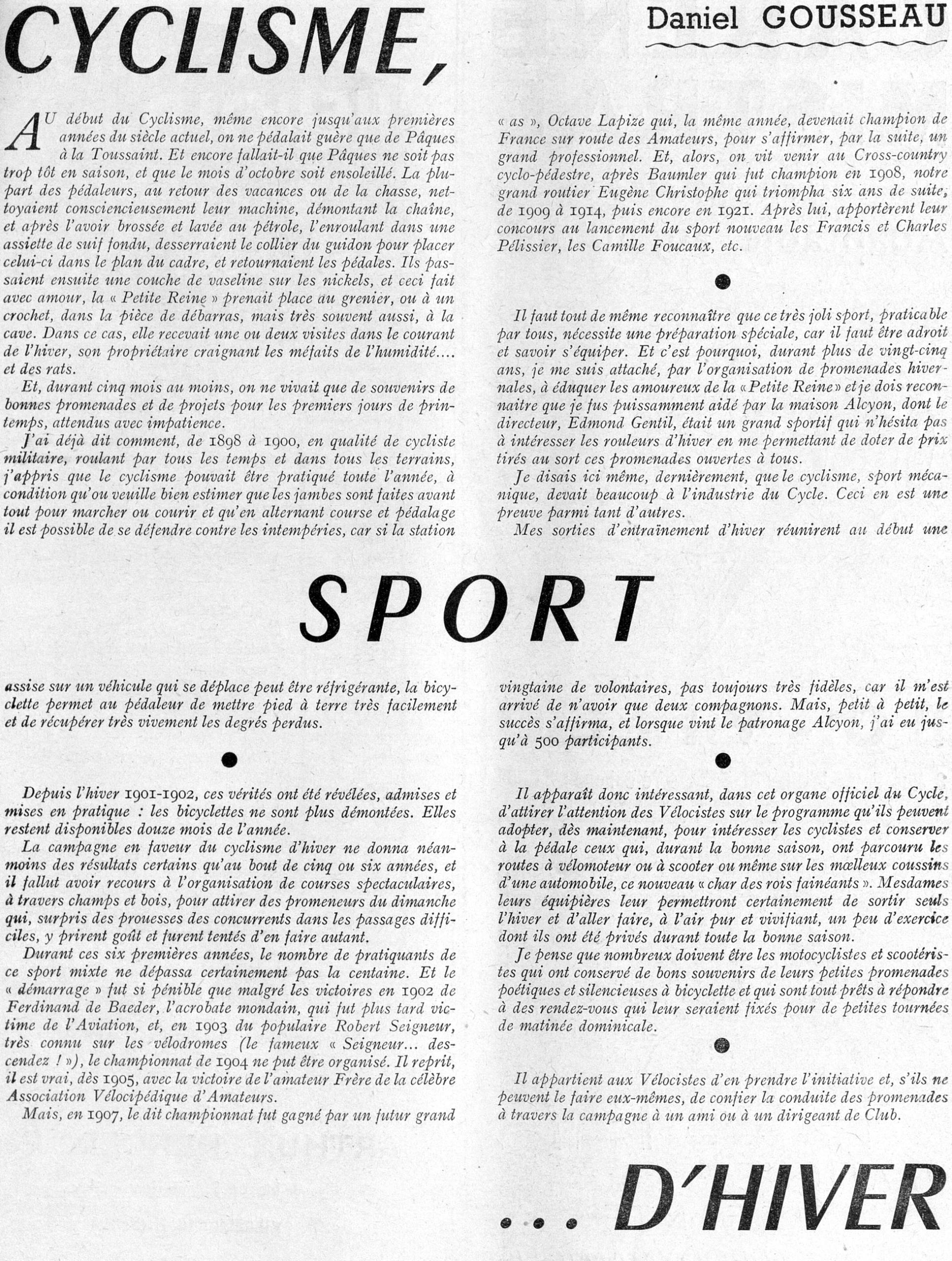
CYCLISME, Daniel GOUSSEAU SPORT ... D'HIVER ORGANISATION DES SORTIES L'ÉQUIPEMENT Francis Pélissier : Guidon de course, 2 freins Bowden, roue libre, dérailleur, boyaux, cale-pieds et courroies, souliers cyclistes avec pointes, emplacement du paquet de survêtements à l'AR. Camille Foucaux : Bicyclette à roues de 70, pneus façon main, guidon de course, roue libre, développement 22 …
This is a magazine article, so its running text is summarized here rather than reproduced; the headline, byline, specifications and scores are transcribed as printed.
From L’Officiel du cycle, du motocycle et du camping, 1 October 1955, N° 20, the paper’s special number before the Salon du Cycle at the Porte de Versailles, pages 121 and 123: CYCLISME, SPORT D’HIVER: Daniel Gousseau on winter cycling, from the old habit of storing the bicycle to the 1900s Alcyon-sponsored winter outings and the champions Lapize, Christophe and the Pelissiers. The title, headings, captions and lists are transcribed as printed; the text is summarized in Ebykr’s words, and the page images carry it in full.
— Page 1 —
CYCLISME,
Daniel GOUSSEAU
SPORT
… D’HIVER
[Ebykr summary; the article’s text is not reproduced. Gousseau recalls that at the start of cycling, and even into the first years of the twentieth century, people rode hardly at all except from Easter to All Saints, and only if Easter fell late and October was sunny. Most riders, back from vacation or the hunt, conscientiously cleaned the machine: they took off the chain, brushed it, washed it in kerosene and coiled it in a plate of melted tallow, loosened the handlebar clamp to turn the bars into the plane of the frame, turned the pedals round and rubbed vaseline on the nickel parts. The « Petite Reine » then went to the attic, to a hook in the lumber room or, very often, to the cellar, where it had one or two visits during the winter because its owner feared damp and rats. For at least five months people lived on memories of good rides and plans for spring. The author says he has already told how, from 1898 to 1900, as a military cyclist riding in all weather and over all terrain, he learned that cycling can be practiced all year, provided one accepts that legs are made first of all for walking or running and that by alternating running and pedaling one can defend oneself against bad weather: the cold of sitting on a moving vehicle can be refrigerating, but the bicycle lets the rider put a foot down very easily and recover the lost degrees very quickly.]
[Ebykr summary, after the first bullet break. Since the winter of 1901-1902 these truths have been revealed, accepted and put into practice: bicycles are no longer taken apart and stay available twelve months of the year. The winter campaign nevertheless gave sure results only after five or six years and needed spectacular cross-country races, through fields and woods, to draw Sunday riders who, surprised by the competitors’ feats in difficult passages, took to it and were tempted to do likewise. In those six first years the number of practitioners of this mixed sport certainly did not pass a hundred, and the start was so painful that, in spite of the victories in 1902 of Ferdinand de Baeder, the society acrobat who was later a victim of aviation, and in 1903 of the popular Robert Seigneur, well known on the velodromes (the famous « Seigneur… descendez ! »), the championship of 1904 could not be organized. It resumed in 1905 with the victory of the amateur Frère of the Association Vélocipédique d’Amateurs. In 1907 the championship was won by a future great « as », Octave Lapize, who the same year became amateur road champion of France and went on to be a great professional. Then came to the Cross-country cyclo-pédestre, after Baumler, champion in 1908, the road rider Eugène Christophe, who won six years running from 1909 to 1914 and again in 1921. After him Francis and Charles Pélissier and Camille Foucaux, among others, lent their support to the launch of the new sport.]
[Ebykr summary, after the second bullet break. The author grants that this pleasant sport, open to all, needs special preparation, since one must be adroit and know how to dress. For more than twenty-five years he has therefore worked, by organizing winter rides, to educate the lovers of the « Petite Reine », and he acknowledges that he was powerfully helped by the house of Alcyon, whose director Edmond Gentil, a great sportsman, let him give lottery prizes to these rides open to all and so interest the winter riders. He had said in this review recently that cycling, a mechanical sport, owed much to the cycle industry, and this is one proof among many. His winter training outings gathered at first about twenty volunteers, not always faithful, since he sometimes had only two companions, but success grew little by little and under the Alcyon patronage he had up to 500 participants.]
[Ebykr summary, after the third bullet break. It therefore seems worthwhile in this official organ of the Cycle to draw the Vélocistes’ attention to a program they can adopt now to interest cyclists and keep at the pedal those who in the good season have toured by vélomoteur or scooter or even on the soft cushions of a car, the new « char des rois fainéants ». Their wives or girlfriends (« équipières ») will surely let them go out alone in winter and take some exercise in fresh and invigorating air that they have been denied all summer. Gousseau thinks many motorcyclists and scooter riders must have kept good memories of their poetic, silent little bicycle rides and would answer appointments fixed for short Sunday-morning tours.]
[Ebykr summary, after the fourth bullet break. It belongs to the Vélocistes to take the initiative and, if they cannot do so themselves, to entrust the leadership of the rides through the countryside to a friend or a club official. The text continues on a later page.]
[A full magazine page of text only, with no drawing or photograph. The title is set in very large heavy italic capitals in three parts: “CYCLISME,” at the upper left, “SPORT” in widely spaced italic capitals across the middle of the page between the two halves of the text, and “… D’HIVER” at the lower right, preceded by three bold dots. At the upper right stands the author’s name, “Daniel GOUSSEAU”, in spaced roman capitals and lower case, above a wavy rule. The body is set in italic roman type in two wide columns above the middle title and two below it, with a large decorative italic initial “A” opening the first paragraph, indented paragraphs, and large black bullets as section breaks. No firm name, address or artist signature appears.]
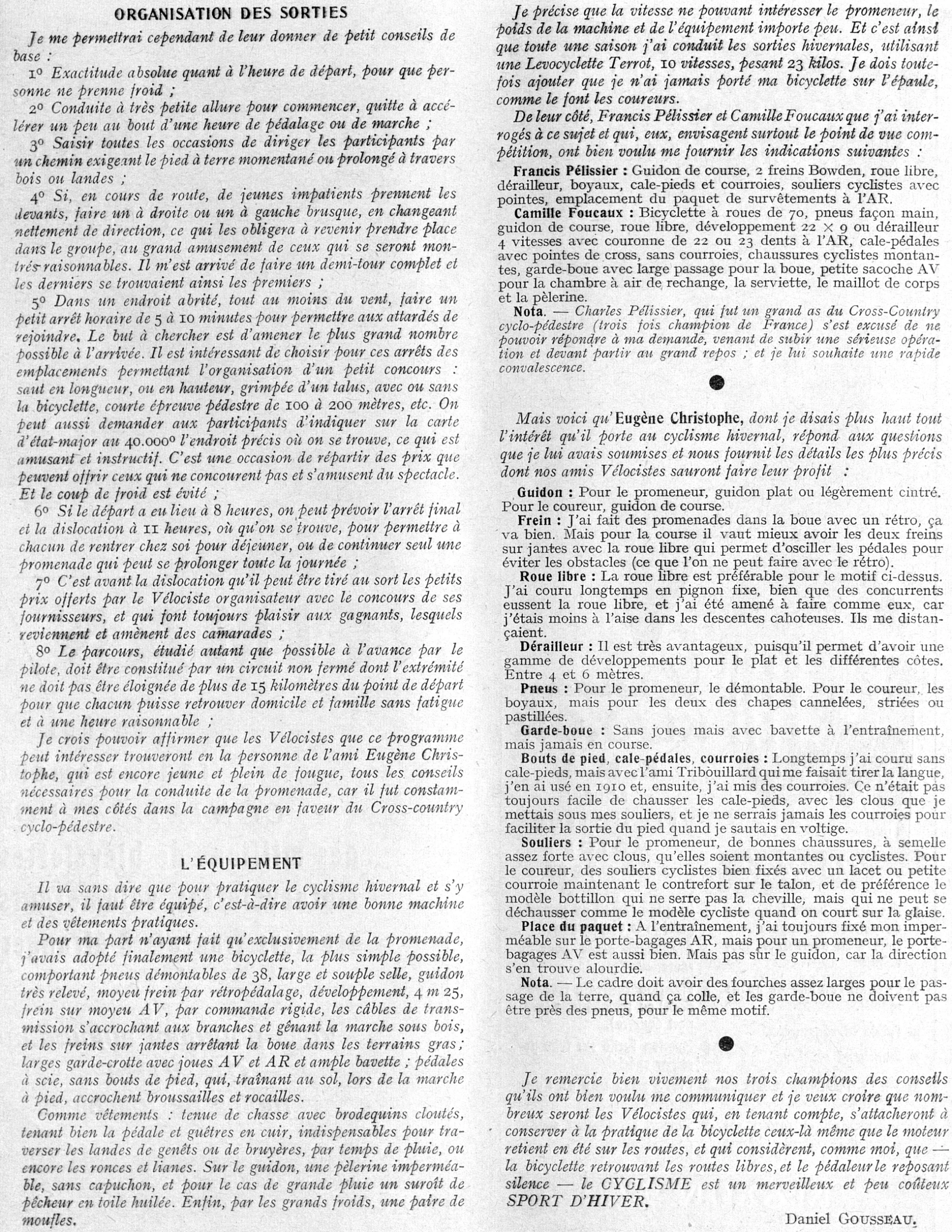
— Page 2 —
ORGANISATION DES SORTIES
[Ebykr summary; the article’s text is not reproduced. The author says he will nevertheless give the Vélocistes a few basic tips, in eight numbered points. 1. Absolute punctuality at the departure time, so that nobody gets cold. 2. Very slow riding at the start, speeding up a little after an hour of pedaling or walking. 3. Seize every chance to lead the participants along a way that needs a foot on the ground for a moment or for long, through woods or heath. 4. If impatient youngsters take the lead, make a sharp right or left turn that changes direction clearly, which obliges them to come back into the group, to the amusement of those who stayed reasonable; he once made a full about-turn so that the last became the first. 5. In a spot sheltered at least from the wind, make a short halt of 5 to 10 minutes so that the stragglers can catch up, the aim being to bring as many as possible to the finish; the halts can host a small contest (long or high jump, climbing a bank with or without the bicycle, a short foot race of 100 to 200 meters), or participants can be asked to mark their exact position on the 1:40.000 staff map, and prizes offered by those who do not compete can be given out, while the chill is avoided. 6. With a start at 8 o’clock, plan the final halt and the breaking up at 11 o’clock wherever the party is, so that each can go home for lunch or continue alone. 7. Before the break-up, draw lots for the small prizes offered by the organizing Vélociste with the help of his suppliers, which always please the winners, who come back and bring comrades. 8. The route, studied in advance as far as possible by the pilot, should be an open circuit whose far end is no more than 15 kilometers from the starting point, so that everyone can get home to family without fatigue at a reasonable hour. He adds that Vélocistes interested in this program will find in his friend Eugène Christophe, still young and full of fire and constantly at his side in the campaign for the Cross-country cyclo-pédestre, all the advice needed for leading the ride.]
L’ÉQUIPEMENT
[Ebykr summary, the equipment. To practice winter cycling and enjoy it one must be equipped, with a good machine and practical clothing. Having done only touring, the author finally adopted the simplest possible bicycle: 38 detachable tires, a wide supple saddle, very high handlebars, a coaster (back-pedaling) hub brake, a development of 4 m 25, a front hub brake on a rigid rod control because transmission cables catch on branches and hamper riding under trees and rim brakes hold the mud in heavy ground, wide mudguards with front and rear cheeks and a ample mud flap, and serrated pedals without toe clips, which drag on the ground when walking and catch brambles and rocks. As clothing: hunting dress with nailed knickerbockers that grip the pedal and leather gaiters, indispensable for crossing heaths of broom or heather in rain, or brambles and creepers; on the handlebars a rainproof cape without hood, and for heavy rain an oilcloth fisherman’s sou’wester; in great cold, a pair of mittens. He stresses that speed cannot interest the tourer, so the weight of machine and kit matters little, and that he led the winter rides for a whole season on a Terrot Levocyclette with 10 speeds weighing 23 kilos, though he never carried the bicycle on his shoulder as racers do. Francis Pélissier and Camille Foucaux, questioned from the competition point of view, supplied the following indications, given as printed.]
Francis Pélissier : Guidon de course, 2 freins Bowden, roue libre, dérailleur, boyaux, cale-pieds et courroies, souliers cyclistes avec pointes, emplacement du paquet de survêtements à l’AR.
Camille Foucaux : Bicyclette à roues de 70, pneus façon main, guidon de course, roue libre, développement 22 × 9 ou dérailleur 4 vitesses avec couronne de 22 ou 23 dents à l’AR, cale-pédales avec pointes de cross, sans courroies, chaussures cyclistes montantes, garde-boue avec large passage pour la boue, petite sacoche AV pour la chambre à air de rechange, la serviette, le maillot de corps et la pèlerine.
Nota. — Charles Pélissier, qui fut un grand as du Cross-Country cyclo-pédestre (trois fois champion de France) s’est excusé de ne pouvoir répondre à ma demande, venant de subir une sérieuse opération et devant partir au grand repos ; et je lui souhaite une rapide convalescence.
[Ebykr summary, after a bullet break. Eugène Christophe, whose interest in winter cycling the author described above, answers the questions put to him and supplies the most precise details that the Vélocistes can use, given as printed.]
Guidon : Pour le promeneur, guidon plat ou légèrement cintré. Pour le coureur, guidon de course.
Frein : J’ai fait des promenades dans la boue avec un rétro, ça va bien. Mais pour la course il vaut mieux avoir les deux freins sur jantes avec la roue libre qui permet d’osciller les pédales pour éviter les obstacles (ce que l’on ne peut faire avec le rétro).
Roue libre : La roue libre est préférable pour le motif ci-dessus. J’ai couru longtemps en pignon fixe, bien que des concurrents eussent la roue libre, et j’ai été amené à faire comme eux, car j’étais moins à l’aise dans les descentes cahoteuses. Ils me distançaient.
Dérailleur : Il est très avantageux, puisqu’il permet d’avoir une gamme de développements pour le plat et les différentes côtes. Entre 4 et 6 mètres.
Pneus : Pour le promeneur, le démontable. Pour le coureur, les boyaux, mais pour les deux des chapes cannelées, striées ou pastillées.
Garde-boue : Sans joues mais avec bavette à l’entraînement, mais jamais en course.
Bouts de pied, cale-pédales, courroies : Longtemps j’ai couru sans cale-pieds, mais avec l’ami Tribouillard qui me faisait tirer la langue, j’en ai usé en 1910 et, ensuite, j’ai mis des courroies. Ce n’était pas toujours facile de chausser les cale-pieds, avec les clous que je mettais sous mes souliers, et je ne serrais jamais les courroies pour faciliter la sortie du pied quand je sautais en voltige.
Souliers : Pour le promeneur, de bonnes chaussures, à semelle assez forte avec clous, qu’elles soient montantes ou cyclistes. Pour le coureur, des souliers cyclistes bien fixés avec un lacet ou petite courroie maintenant le contrefort sur le talon, et de préférence le modèle bottillon qui ne serre pas la cheville, mais qui ne peut se déchausser comme le modèle cycliste quand on court sur la glaise.
Place du paquet : A l’entraînement, j’ai toujours fixé mon imperméable sur le porte-bagages AR, mais pour un promeneur, le porte-bagages AV est aussi bien. Mais pas sur le guidon, car la direction s’en trouve alourdie.
Nota. — Le cadre doit avoir des fourches assez larges pour le passage de la terre, quand ça colle, et les garde-boue ne doivent pas être près des pneus, pour le même motif.
[Ebykr summary, after a second bullet break. The author warmly thanks the three champions for the advice they were willing to give and hopes that many Vélocistes, taking it into account, will work to keep at bicycle riding those very people whom the motor holds on the roads in summer, and who consider, as he does, that once the bicycle finds the roads free again and the rider the restful silence, cycling is a marvelous and inexpensive winter sport.]
Daniel GOUSSEAU.
[A full magazine page of text only, with no drawing or photograph, continuing the article begun on an earlier page. The page is set in two wide columns of small justified type, mostly italic roman, with two centered bold capital headings: “ORGANISATION DES SORTIES” at the head of the left column and “L’ÉQUIPEMENT” lower down in the same column. The numbered points run down the left column in italic. In the right column the equipment answers of the three riders appear as short paragraphs opened by bold lead words (a rider’s name or an item such as “Guidon :” or “Frein :”), separated by two round black bullets used as section breaks. The author’s name, “Daniel GOUSSEAU.”, closes the article in spaced capitals at the lower right. No firm name, address, drawing or artist signature appears.]
Ebykr presents this material for research and education. If you hold rights to it or notice an ownership issue, please contact us and we will respond promptly.
The Ebykr Digest
New articles, timelines, catalog finds and registry activity — assembled from the archive once a month. Your address is never shared.
Double opt-in. One email per month. Unsubscribe at any time with one click.