About Ebykr
Ebykr celebrates classic and vintage lightweight bicycles through provocative imagery and opinion. Ride along with us.
About Ebykr
Ebykr celebrates classic and vintage lightweight bicycles through provocative imagery and opinion. Ride along with us.

Source: Gallica (Bibliothèque nationale de France), L'Officiel du cycle, du motocycle et du camping, 29 October 1955, N° 22, page 5; ark:/12148/bd6t54201145h. Source gallica.bnf.fr / BnF.
| Type | Review |
|---|---|
| Year | 1955 |
| Publisher | L'Officiel du cycle |
| Country | France |
| Language | French |
| Pages | 1 |
| Source | Gallica (Bibliothèque nationale de France), L'Officiel du cycle, du motocycle et du camping, 29 October 1955, N° 22, page 5; ark:/12148/bd6t54201145h. Source gallica.bnf.fr / BnF. |
| Credit | Ebykr archive; Bibliothèque nationale de France |
| Identifier | Gallica (BnF) ark:/12148/bd6t54201145h/f5 |
| Transcription | Headings and specifications transcribed; article text summarized |
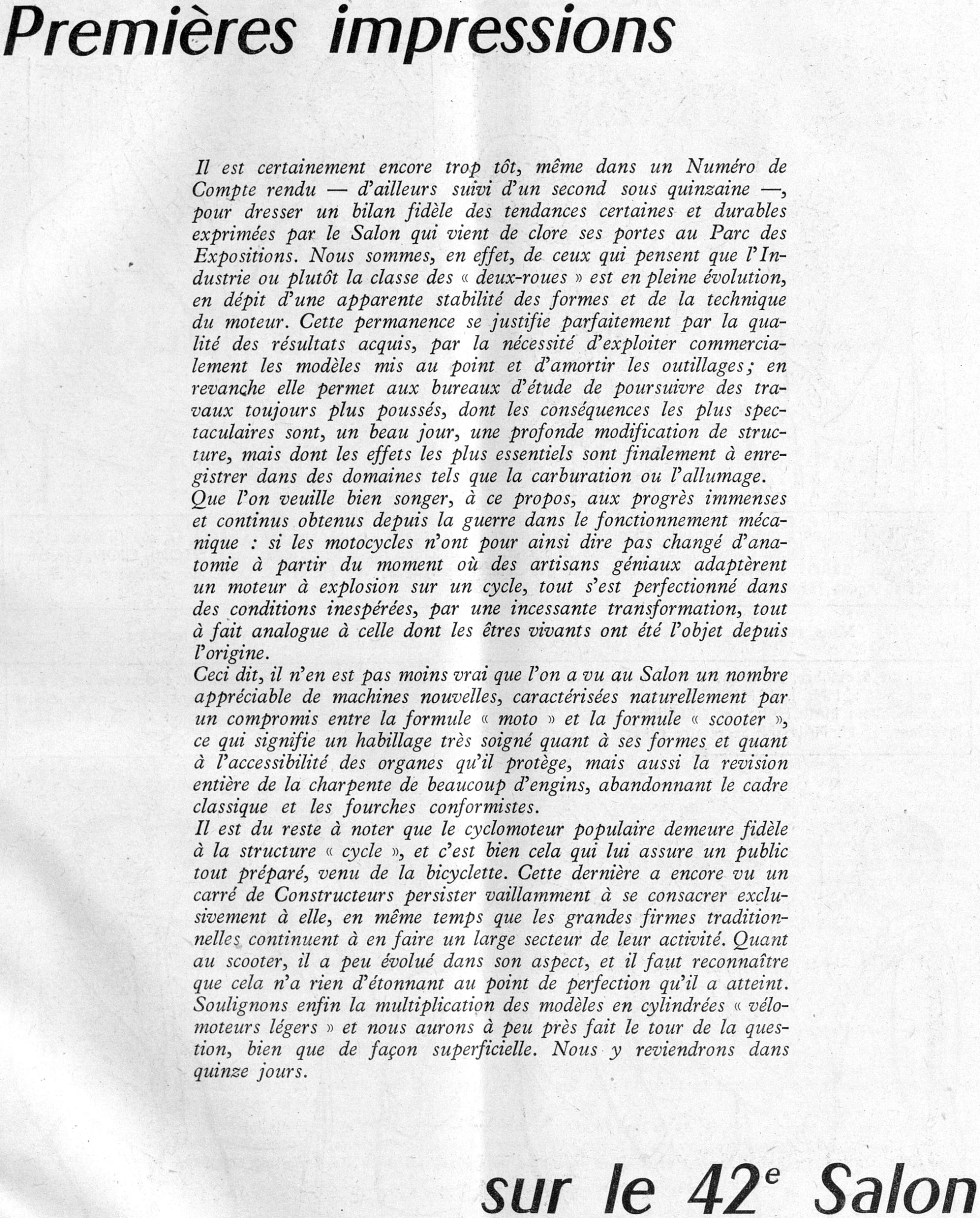
Premières impressions sur le 42e Salon
This is a magazine article, so its running text is summarized here rather than reproduced; the headline, byline, specifications and scores are transcribed as printed.
From L’Officiel du cycle, du motocycle et du camping, 29 October 1955, the paper’s first number reporting the 1955 Paris Salon du Cycle et du Motocycle, page 5: the paper’s first impressions of the 42nd Salon: no sensational novelty, the new machines blending the motorcycle and the scooter, the cyclomoteur keeping the structure of the cycle, and a handful of constructors still devoted to the bicycle alone. The title, headings, captions and lists are transcribed as printed; the text is summarized in Ebykr’s words, and the page images carry it in full.
— Page 1 —
Premières impressions
[Ebykr summary; the article’s text is not reproduced. Even in a Salon report number, itself to be followed by a second within a fortnight, it is too early to draw a faithful balance of the certain and lasting tendencies shown by the Salon that has just closed at the Parc des Expositions. The paper holds that the “deux-roues” industry is in full evolution despite an apparent stability of forms and of engine technique. That permanence is justified by the quality of the results acquired and by the need to exploit the developed models commercially and to amortize the tooling; in return it lets the design offices pursue ever more advanced work, whose most spectacular outcome is one day a deep change of structure but whose most essential effects lie in fields such as carburetion or ignition. Since the war the motocycle has hardly changed its anatomy from the day gifted artisans fitted an internal combustion engine to a cycle, yet everything has been perfected beyond hope by an unceasing transformation likened to that of living beings since their origin. Even so, the Salon showed an appreciable number of new machines marked by a compromise between the “moto” and “scooter” formulas: carefully finished bodywork, in form and in access to the parts it covers, and also a complete revision of the frame of many machines, which abandon the classic frame and conformist forks. The popular cyclomoteur stays faithful to the “cycle” structure, which assures it a ready-made public coming from the bicycle. The bicycle itself again saw a small band of Constructeurs valiantly persist in devoting themselves to it alone, while the great traditional firms keep it a large sector of their activity. The scooter has changed little in appearance, unsurprising at the point of perfection it has reached. Last, the multiplication of models in “vélomoteurs légers” displacements; with that the paper has, superficially, toured the question and will return to it in fifteen days.]
sur le 42e Salon
[A full page of text only, with no illustration and no signature. The title is split between the head and the foot of the page: “Premières impressions” runs across the top in very large italic sans-serif lowercase, and “sur le 42e Salon” closes the page at the bottom right in the same face. Between them a single justified block of large italic roman, about forty lines long, is set in a measure that occupies the right two-thirds of the page, leaving a wide blank margin at the left. Faint lines and a framed panel from the reverse of the leaf show through in the blank right-hand margin.]
Ebykr presents this material for research and education. If you hold rights to it or notice an ownership issue, please contact us and we will respond promptly.
The Ebykr Digest
New articles, timelines, catalog finds and registry activity — assembled from the archive once a month. Your address is never shared.
Double opt-in. One email per month. Unsubscribe at any time with one click.