About Ebykr
Ebykr celebrates classic and vintage lightweight bicycles through provocative imagery and opinion. Ride along with us.
About Ebykr
Ebykr celebrates classic and vintage lightweight bicycles through provocative imagery and opinion. Ride along with us.

Source: Gallica (Bibliothèque nationale de France), L'Officiel du cycle, du motocycle et du camping, 29 October 1955, N° 22, pages 59, 61, 63, 64, 67, 69, 71, 73, 74 and 77; ark:/12148/bd6t54201145h. Source gallica.bnf.fr / BnF.
| Type | Review |
|---|---|
| Year | 1955 |
| Publisher | L'Officiel du cycle |
| Artist | Daniel Rebour |
| Country | France |
| Language | French |
| Pages | 10 |
| Source | Gallica (Bibliothèque nationale de France), L'Officiel du cycle, du motocycle et du camping, 29 October 1955, N° 22, pages 59, 61, 63, 64, 67, 69, 71, 73, 74 and 77; ark:/12148/bd6t54201145h. Source gallica.bnf.fr / BnF. |
| Credit | Ebykr archive; Bibliothèque nationale de France |
| Identifier | Gallica (BnF) ark:/12148/bd6t54201145h/f58 |
| Transcription | Headings and specifications transcribed; article text summarized |
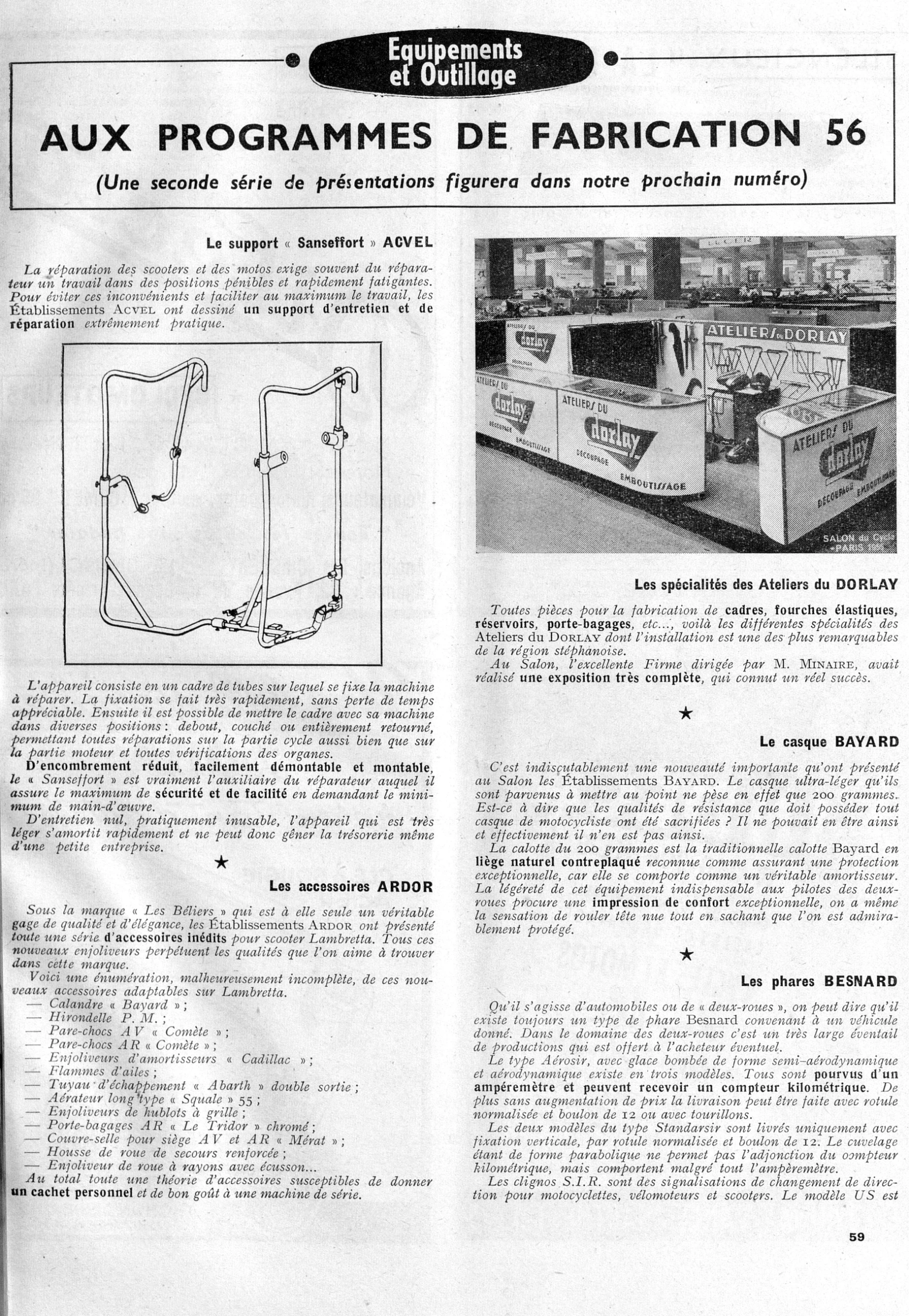
Equipements et Outillage AUX PROGRAMMES DE FABRICATION 56 (Une seconde série de présentations figurera dans notre prochain numéro) Le support « Sanseffort » ACVEL Les accessoires ARDOR — Calandre « Bayard » ; — Hirondelle P. M. ; — Pare-chocs AV « Comète » ; — Pare-chocs AR « Comète » ; — Enjoliveurs d'amortisseurs …
This is a magazine article, so its running text is summarized here rather than reproduced; the headline, byline, specifications and scores are transcribed as printed.
From L’Officiel du cycle, du motocycle et du camping, 29 October 1955, the paper’s first number reporting the 1955 Paris Salon du Cycle et du Motocycle, pages 59 to 77: the magazine’s survey of the components, accessories and tools shown at the Salon, firm by firm in alphabetical order, with their models and drawings. The title, headings, captions and lists are transcribed as printed; the text is summarized in Ebykr’s words, and the page images carry it in full.
— Page 1 —
Equipements
et Outillage
AUX PROGRAMMES DE FABRICATION 56
(Une seconde série de présentations figurera dans notre prochain numéro)
Le support « Sanseffort » ACVEL
[Ebykr summary; the article’s text is not reproduced. For the motor machines (scooters and motorcycles), not the bicycle. The repair of scooters and motorcycles often demands of the repairer work in awkward and quickly tiring positions. To avoid this and ease the work as far as possible, the Établissements Acvel have designed an extremely practical maintenance and repair stand. The device is a frame of tubes to which the machine to be repaired is fixed, very quickly and with no appreciable loss of time. The frame and its machine can then be set in various positions (upright, lying down or turned entirely over) for any repair on the cycle part or on the engine and any check of the components. Of reduced bulk and easily taken down and put up, the “Sanseffort” is the repairer’s true auxiliary, giving him the maximum of safety and ease for the minimum of labor. It needs no maintenance, is practically wear-proof and very light, pays for itself quickly and so cannot strain the finances of even a small business.]
Les accessoires ARDOR
[Ebykr summary; the article’s text is not reproduced. For the motor machines: accessories for the Lambretta scooter. Under the mark “Les Béliers”, which the paper calls in itself a true pledge of quality and elegance, the Établissements Ardor showed a whole series of new accessories for the Lambretta scooter, embellishments that carry on the qualities buyers look for in that mark. The paper gives an enumeration, which it calls unfortunately incomplete, of these new accessories adaptable to the Lambretta:]
— Calandre « Bayard » ;
— Hirondelle P. M. ;
— Pare-chocs AV « Comète » ;
— Pare-chocs AR « Comète » ;
— Enjoliveurs d’amortisseurs « Cadillac » ;
— Flammes d’ailes ;
— Tuyau d’échappement « Abarth » double sortie ;
— Aérateur long type « Squale » 55 ;
— Enjoliveurs de hublots à grille ;
— Porte-bagages AR « Le Tridor » chromé ;
— Couvre-selle pour siège AV et AR « Mérat » ;
— Housse de roue de secours renforcée ;
— Enjoliveur de roue à rayons avec écusson…
[Ebykr summary, after the list. Altogether a whole range of accessories able to give a personal stamp and good taste to a series-built machine.]
Les spécialités des Ateliers du DORLAY
[Ebykr summary; the article’s text is not reproduced. The note does not say bicycle or motor machine; the parts it names are all parts for the making of frames, sprung forks (“fourches élastiques”), tanks (“réservoirs”) and luggage carriers, etc., and these are the specialties of the Ateliers du Dorlay, whose works the paper calls one of the most remarkable in the Saint-Étienne region. At the Salon the firm, directed by M. Minaire, had put on a very complete exhibition, which met with real success.]
Le casque BAYARD
[Ebykr summary; the article’s text is not reproduced. For the riders of the motor machines: a motorcyclist’s helmet. The paper calls it indisputably an important novelty shown at the Salon by the Établissements Bayard: an ultra-light helmet weighing only 200 grams (“200 grammes”). Its strength has not been sacrificed: the shell of the 200-gram helmet is the traditional Bayard shell in natural plywood cork (“liège naturel contreplaqué”), recognized as giving exceptional protection because it behaves as a true shock absorber. The lightness gives two-wheel riders an exceptional impression of comfort, the sensation of riding bareheaded while knowing they are admirably protected.]
Les phares BESNARD
[Ebykr summary; the article’s text is not reproduced. For the motor machines (and, the note says, automobiles). Whether for automobiles or for “deux-roues”, there is always a Besnard headlamp type to suit a given vehicle, and for two-wheelers a very wide range is offered. The Aérosir type, with a domed glass of semi-aerodynamic and aerodynamic form, exists in three models; all have an ammeter (“ampéremètre”) and can take a speedometer (“compteur kilométrique”), and at no extra price they can be delivered with a standardized ball joint (“rotule normalisée”) and 12 bolt or with trunnions (“tourillons”). The two models of the Standarsir type are delivered only with vertical fixing, by standardized ball joint and 12 bolt; their shell (“cuvelage”) is parabolic, so a speedometer cannot be added, but they still carry the ammeter. The S.I.R. “clignos” are direction-change signals for motorcycles, vélomoteurs and scooters. The sentence on “Le modèle US” breaks off at the foot of the column and runs on to the next page.]
59
[A full page of text with one line drawing and one halftone photograph. Across the head runs a ruled box whose top rule ends at each side in a black dot against a black oval cartouche, in which “Equipements et Outillage” is reversed out in white condensed bold sans-serif; inside the box “AUX PROGRAMMES DE FABRICATION 56” stands in large bold geometric sans-serif capitals over the bold italic sans-serif line “(Une seconde série de présentations figurera dans notre prochain numéro)”. The body is in two columns: each firm heading is set flush right in bold condensed sans-serif with the firm name in capitals, the notes are in italic with firm names in roman small capitals and key phrases in bold roman and a single black star separates the notes. In the left column a ruled frame holds a line drawing of the Acvel stand as two tubular frames side by side, each with a hooked upper end and a diagonal brace at the foot, fitted with sliding collars, thumbscrews, two short tubular sockets and a linked arm ending in an eye; no signature or monogram appears in the frame, where faint text from the reverse of the leaf shows through. The Ardor note ends with a list set one item a line behind em dashes. At the head of the right column a halftone photograph shows the Dorlay stand at the Salon: low curved counters with panels lettered “ATELIERS DU dorlay” with the words “DÉCOUPAGE” and “EMBOUTISSAGE”, and a back panel lettered “ATELIERS DU DORLAY” hung with tubular fork and frame parts, the hall and other stands behind; in its lower right corner white lettering reads “SALON du Cycle” over “PARIS”, the year lost in the halftone screen. The page number “59” stands in bold at the foot of the right column.]
— Page 2 —
[Ebykr summary, continuing the Besnard note from the previous page. For the motor machines. The US model of the S.I.R. signals is meant for motorcycles fed by a 6 or 12 volt battery; the flashing comes from a special lamp guaranteed for normal working, that is, lit for the time a change of direction needs and not continuously. The models VM nº 45 and 46 are fed by magnetic flywheel or by battery; of the same presentation as the US model, they flash by a special switch with a bimetal strip suited to a tension of 6/11 volts or 12/20 volts. With battery feed, the special switch has an additional control that gives a fixed parking light (“Feu fixe”), avoids any consumption by the device in that position and keeps the battery charged when stopped. With magnetic-flywheel feed the flasher can be put at rest, which removes any flicker of the headlamp even on the weakest flywheels.]
Les combinés BLINDEX
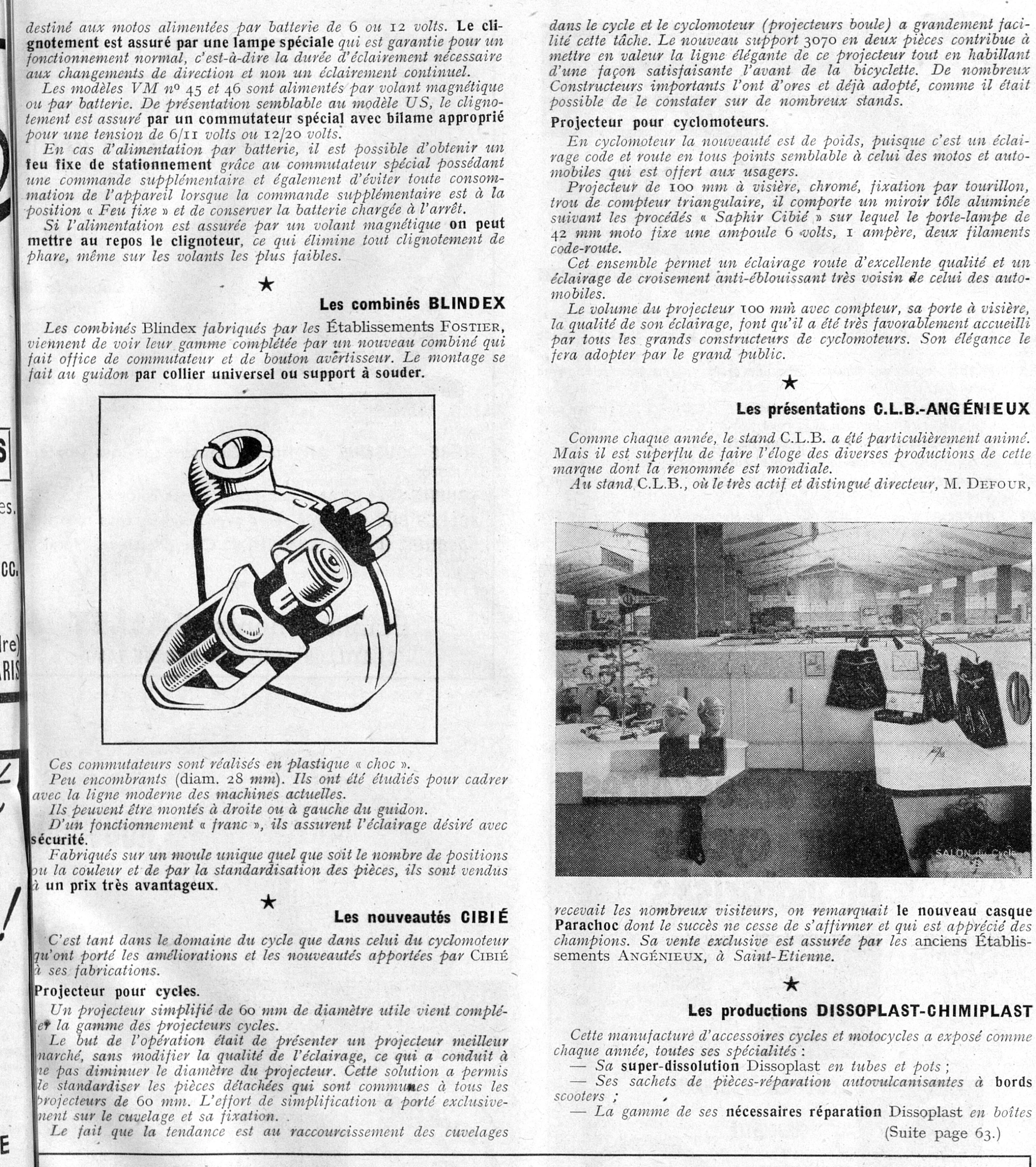
[Ebykr summary; the article’s text is not reproduced. The note names no class of machine; it speaks of the handlebar and of “les machines actuelles”, and the switches control the lighting and the horn, which points to the motor machines. The Blindex combined controls made by the Établissements Fostier now have their range completed by a new combined unit that serves as both switch (“commutateur”) and horn button (“bouton avertisseur”). It mounts on the handlebar by a universal clip or a brazed-on bracket (“support à souder”). The switches are made in “choc” plastic and are compact (diam. 28 mm), designed to suit the modern line of current machines, and can be mounted on the right or the left of the handlebar. Their action is positive (“franc”) and they give the lighting wanted with safety. Made on a single mold whatever the number of positions or the color, and thanks to the standardization of parts, they are sold at a very advantageous price.]
Les nouveautés CIBIÉ
[Ebykr summary; the article’s text is not reproduced. For both the bicycle and the cyclomoteur: Cibié’s improvements and novelties bear on the cycle as much as on the cyclomoteur.]
Projecteur pour cycles.
[Ebykr summary, under this subheading. For the bicycle. A simplified headlamp of 60 mm useful diameter completes the range of cycle headlamps. The aim was a cheaper headlamp without lowering the quality of the light, so the diameter was not reduced, and the spare parts are standardized and common to all the 60 mm headlamps; the simplification bore only on the shell (“cuvelage”) and its fixing. The trend toward shorter shells on the cycle and cyclomoteur (“projecteurs boule”) made the task much easier. The new two-piece support 3070 sets off the elegant line of the headlamp while dressing the front of the bicycle satisfactorily. Many important makers have already adopted it, as could be seen on many stands.]
Projecteur pour cyclomoteurs.
[Ebykr summary, under this subheading. For the cyclomoteur. The novelty is a weighty one: a dipped and main beam lighting (“éclairage code et route”) in every respect like that of motorcycles and automobiles. The headlamp is of 100 mm, with a visor, chromed, with trunnion fixing (“fixation par tourillon”) and a triangular speedometer hole; its reflector is of aluminized sheet made by the “Saphir Cibié” processes, on which the 42 mm motorcycle lamp holder carries a 6 volt, 1 ampère bulb with two code-route filaments. The set gives an excellent main beam and an anti-dazzle dipped beam very close to that of automobiles. Its size (100 mm with speedometer), its visor door and the quality of its light have made it very well received by all the great makers of cyclomoteurs, and the paper expects its elegance to win over the general public.]
Les présentations C.L.B.-ANGÉNIEUX
[Ebykr summary; the article’s text is not reproduced. The note does not say whether the helmet it describes is for the cyclist or the motorcyclist; it says only that champions appreciate it. As every year, the C.L.B. stand was particularly lively, and the paper finds it superfluous to praise the productions of a mark whose renown is worldwide. At the C.L.B. stand, where the very active director M. Defour received the many visitors, the new “Parachoc” helmet was noticed; its success keeps growing and champions appreciate it. Its sale is handled exclusively by the former Établissements Angénieux, at Saint-Etienne.]
Les productions DISSOPLAST-CHIMIPLAST
[Ebykr summary; the article’s text is not reproduced. For both the bicycle and the motorcycle: the firm is a manufacturer of cycle and motorcycle accessories, and as every year it showed all its specialties:]
— Sa super-dissolution Dissoplast en tubes et pots ;
— Ses sachets de pièces-réparation autovulcanisantes à bords scooters ;
— La gamme de ses nécessaires réparation Dissoplast en boîtes
(Suite page 63.)
[A page of text in two columns with one line drawing and one halftone photograph, continuing the survey without a head. The firm headings are set flush right in bold condensed sans-serif with the firm name in capitals, the two Cibié subheadings “Projecteur pour cycles.” and “Projecteur pour cyclomoteurs.” stand flush left in bold roman, the notes are in italic with firm names in roman small capitals and key phrases in bold roman and a single black star separates the notes. In the left column a ruled frame holds a heavy-line drawing with solid black shadows of the Blindex switch clamped to a short cut length of handlebar: a rounded housing with a lever, a ringed push button and a clamp drawn tight by a threaded bolt; no signature or monogram appears in the frame. In the right column, between the opening lines of the C.L.B.-Angénieux note and its close, a halftone photograph shows the C.L.B. stand in the exhibition hall: white counters, a small display at the left with an object on a stand, three dark draped objects hanging at the right before a panel with a round emblem and the hall’s pillars and other stands behind; faint white lettering “SALON du Cycle” stands in its lower right corner. The Dissoplast list is set one item a line behind em dashes, and the catchline “(Suite page 63.)” closes the right column above a rule. At the left edge a vertical rule cuts the first letter of several lines near the foot of the left column, and beyond it a strip of a neighboring advertisement shows.]
— Page 3 —
aluminium et fer et en boîtes matière plastique transparente dans lesquels on retrouve les mêmes pièces à bords minces dont les qualités adhésives sont unanimement appréciées par les réparateurs ;
— La série complète de rubans pour guidons : rubans adhésifs en coton (trois qualités) : Véloplast, Guidoplast et Tressoplast ; rubans en matière plastique, adhésif ou non, Plastoplast, Plastoplast collant en boîtes carton ou en boîtes matière plastique transparente ;
— Le ruban et la colle spéciale pour boyaux Boyauplast ainsi que le fil de lin ;
— Le ruban isolant caoutchouté Chatterplast ;
— Ses pare-visage Paraplast en rhodoïd avec visière soit en feuille vinylique, soit en toile coton caoutchouté et bande intérieure cuir, ainsi que ses lunettes bordées velours ou caoutchouc mousse ;
— Le tuyau en matière plastique translucide cristal Tuyauplast pour durit essence ;
— Ses bavettes Aressor pour cycles et cyclomoteurs.
[Ebykr summary, closing the Dissoplast-Chimiplast list continued from the previous page. All these products are certainly well known to the Vélocistes-Motocistes, but the paper thought it worth listing them and mentioning their qualities briefly.]
Les combinaisons DALLE
[Ebykr summary; the article’s text is not reproduced. For the riders of the motor machines (the “Motard” suit), with camping goods besides. The Établissements Dalle offer a large choice of overalls and protective clothing, in particular:]
— La combinaison Motard type Montlhéry, modèle de coupe impeccable, bien conçue pour se protéger du froid et de la pluie (col rabattu, double plastron, serrages aux poignets et aux che- villes, fermeture automatique à double curseur) ;
— La combinaison Rallye qualité 501, de forme italienne, avec col transformable, double fermoir automatique assurant une parfaite étanchéité, très large aération dans le dos évitant toute condensation.
[Ebykr summary, after the list. The paper also mentions the firm’s camp beds and sleeping bags, made in a first-quality percale (printed “nue percale”) and filled with extra-lofting down, guaranteed for one year.]
Les fabrications EYQUEM
[Ebykr summary; the article’s text is not reproduced. For the motor machines and the automobile: the plugs are for the automobile, the motorcycle and the cyclomoteur, the wipers and coil for the automobile. A large public and a faithful clientele showed again this year their interest in this great French mark, from the start one of the pioneers of electricity applied to the automobile, and the paper calls it the reward of a constant effort for ever-improving quality. In spark plugs Eyquem showed a whole range of models specially designed for the demands of current engines, for the automobile as for the motorcycle and the cyclomoteur; fitted as original equipment by the largest makers, they are for the user one of the best guarantees. In windscreen wipers Eyquem worked on improved blade holders (“porte-balais”) to meet every need of the present car fleet, old and new vehicles alike. Three great series characterize them:]
— Série luxe chromée, présentation en tube carton ;
— Série éamillée noire sur laiton ;
— Série économique cadmiée,
[Ebykr summary, after the list. The presentations differ to meet every demand, but the quality is the same in the choice of raw materials, the rust protection and the rubber blades, specially treated for a perfect wipe of the windscreen. Besides its regular products, the firm showed this year an oil-filled ignition coil (“bobine d’allumage à huile”) that works without failure. The paper calls Eyquem’s success at the Salon the deserved result of more than half a century of experience and technical progress.]
Les fanions GAILLARD
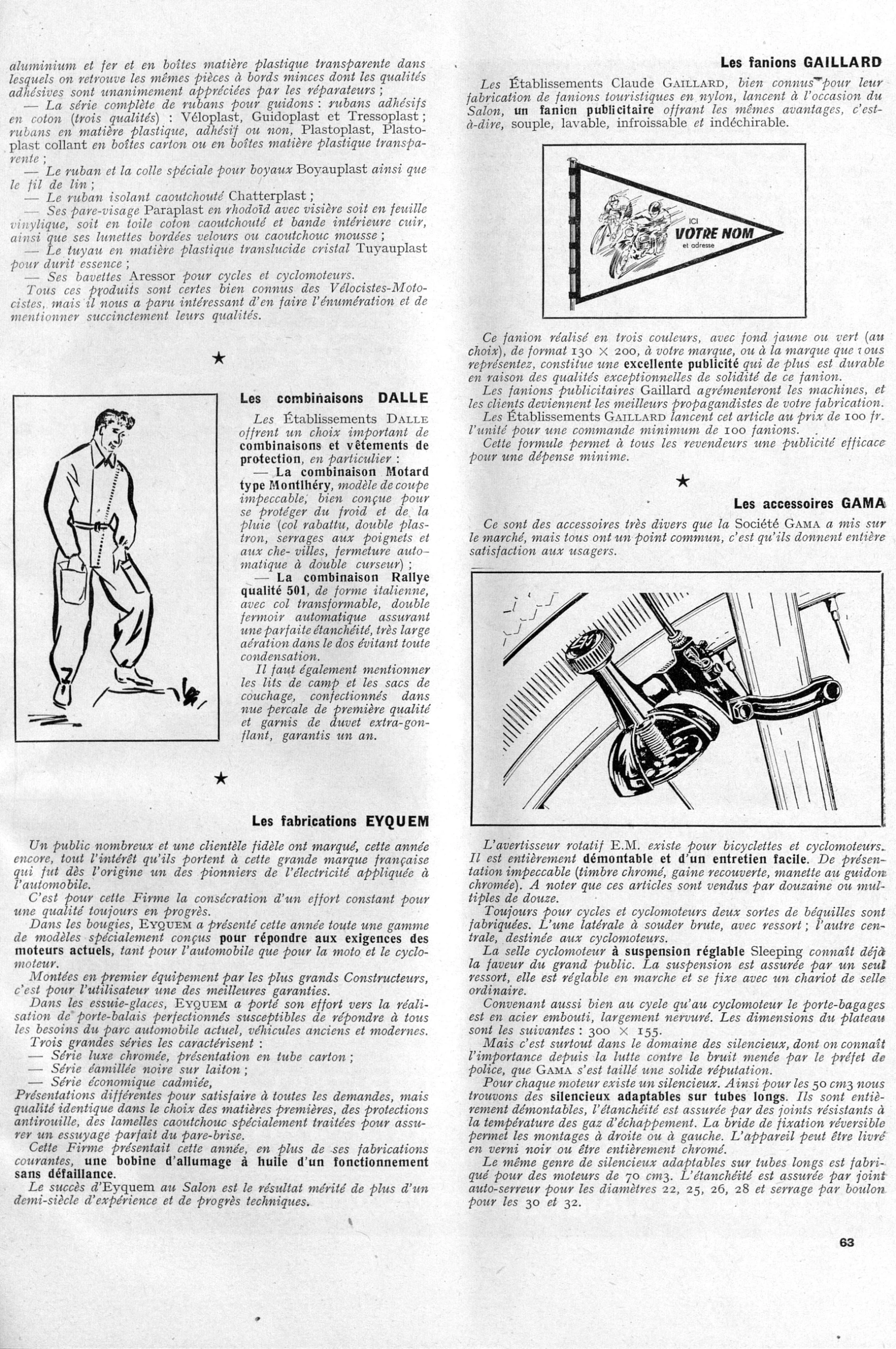
[Ebykr summary; the article’s text is not reproduced. The note speaks only of “les machines”; the drawing shows both a racing cyclist and a motorcyclist. The Établissements Claude Gaillard, well known for their touring pennants (“fanions touristiques”) in nylon, launch at the Salon an advertising pennant (“fanion publicitaire”) with the same advantages: supple, washable, crease-proof and tear-proof.]
ICI
VOTRE NOM
et adresse
[Ebykr summary, after the drawing. The pennant is made in three colors, on a yellow or green ground at choice, in the format 130 × 200, with the dealer’s own mark or the mark he represents; the paper calls it excellent publicity and durable owing to the exceptional strength of the pennant. The Gaillard advertising pennants will dress up the machines and make the customers the best propagandists of the maker’s products. The Établissements Gaillard launch the article at 100 fr. the unit for a minimum order of 100 pennants, a formula that gives every dealer effective publicity for a minimal outlay.]
Les accessoires GAMA
[Ebykr summary; the article’s text is not reproduced. For both the bicycle and the cyclomoteur. The Société Gama has put very varied accessories on the market, all with one point in common: they give users entire satisfaction. The E.M. rotary bell (“avertisseur rotatif E.M.”) exists for bicycles and cyclomoteurs; it can be taken entirely apart and is easy to maintain, and its presentation is impeccable (chromed bell, covered sheath, chromed handlebar lever). These articles are sold by the dozen or in multiples of twelve. Also for cycles and cyclomoteurs, two kinds of stand (“béquilles”) are made: one a side stand to be brazed on, unfinished (“brute”), with a spring; the other a central stand for cyclomoteurs. The “Sleeping” cyclomoteur saddle with adjustable suspension already enjoys the public’s favor; the suspension is by a single spring, adjustable while riding, and the saddle fixes with an ordinary saddle clip (“chariot de selle”). Suiting the cycle as well as the cyclomoteur (printed “cyele”), the luggage carrier is of pressed steel, widely ribbed, with a platform of 300 × 155. But it is above all in silencers, whose importance has been plain since the campaign against noise led by the préfet de police, that Gama has made a solid reputation. There is a silencer for every engine. For the 50 cm3 there are silencers adaptable on long tubes, entirely dismountable, sealed by joints that resist the temperature of the exhaust gases, with a reversible fixing flange for mounting on the right or the left, delivered in black varnish or entirely chromed. The same kind of long-tube silencer is made for engines of 70 cm3; it is sealed by a self-tightening joint for the diameters 22, 25, 26 and 28 and clamped by a bolt for the 30 and 32.]
63
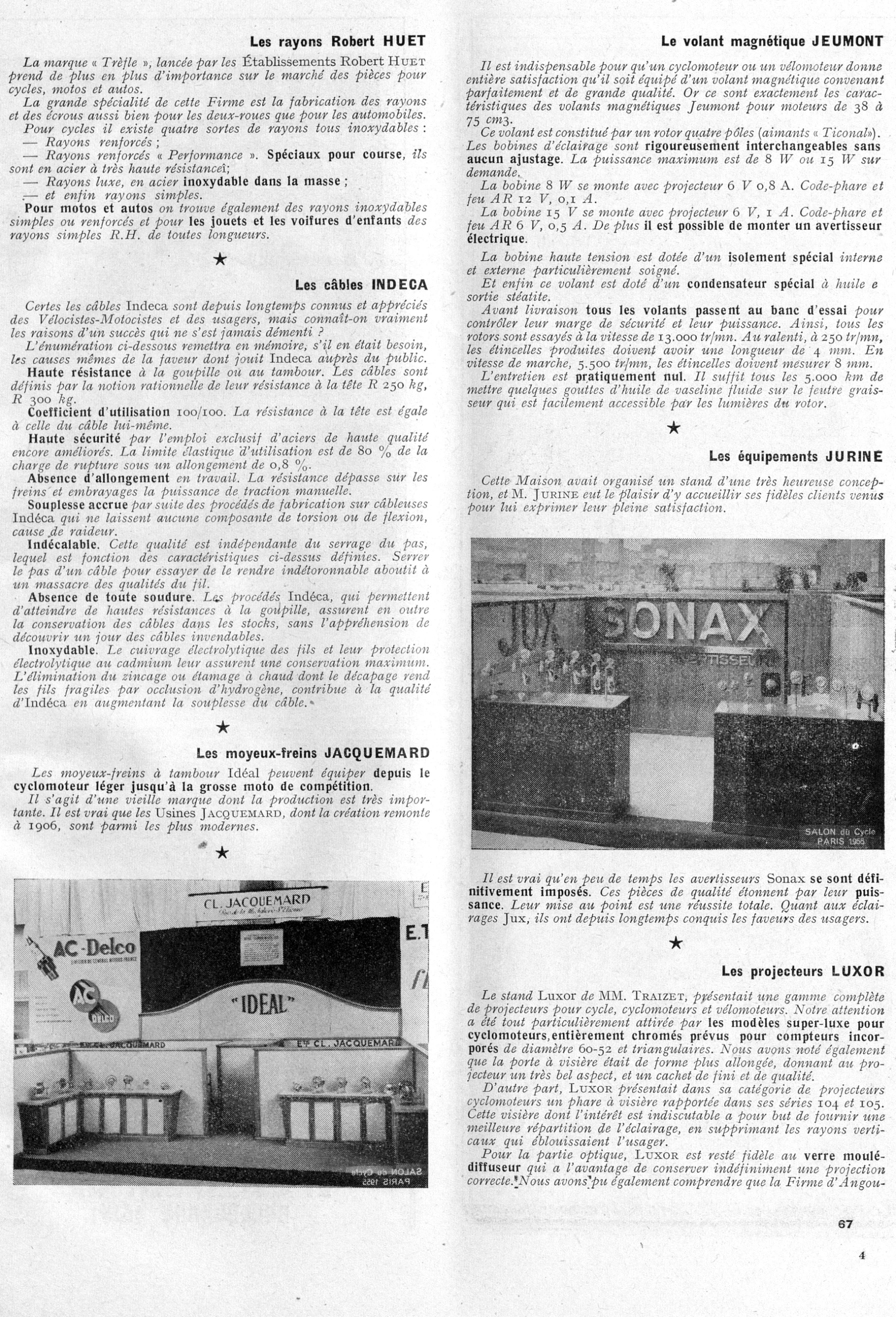
[A page of text in two columns with three line drawings, continuing the survey without a head. The firm headings are set flush right in bold condensed sans-serif with the firm name in capitals, the notes are in italic with firm names and product names in roman and key phrases in bold roman, the lists are set one item a line behind em dashes and a single black star separates the notes. At the foot of the left column a ruled frame holds a freely brushed line drawing of a man standing in a one-piece suit with a turned-down collar, a front fastening drawn as a dotted line, a belt at the waist, a patch pocket on the thigh and cuffs gathered at the ankles, one hand in a pocket, with ground strokes at the lower left and a tuft of grass at the lower right; the Dalle note runs in a narrow column beside it. At the head of the right column a ruled frame holds a line drawing of a triangular pennant on a staff, showing a racing cyclist in a cap and a motorcyclist in a helmet speeding side by side with speed lines, and the words “ICI”, “VOTRE NOM” in heavy italic sans-serif capitals and “et adresse” in light sans-serif. Below it a wide ruled frame holds a line drawing with heavy black shading of the E.M. rotary bell clamped to a fork blade beside the tire: a knurled cap bearing a monogram that appears to read EM, a ribbed spindle, a domed bell, a clamp with a hexagon nut and a cable running in from above, with the tire tread hatched at the upper left. No signature or monogram of an artist appears on any of the three drawings. The page number “63” stands in bold at the foot of the right column.]
— Page 4 —
[Ebykr summary, continuing the Gama note from the previous page. For the motor machines. Only bolt clamping is provided on the silencers for 100 cm3 engines. For the last two models, which suit engines of 70 cm3 and 100 cm3 respectively, the silencer can be ordered unfinished (“brut”), painted (black or alu) or chromed. The Société Gama also makes exhaust tubes specially designed for all the current engines, and an improved type has a pre-expansion chamber (“chambre de prédétente”) that prevents carbon build-up (“calaminage”) and raises output at a lower noise level; as with the first type, there are models to fit the various engines: Vap, Mistral, SER, Junior, Himo, Lavalette… Among the exhaust silencers the paper also points to those that fit under the engine (chromed tube, body painted black or alu) and those that also carry a pre-expansion chamber, with its known benefits: less carbon build-up, less noise…]
Les sacoches GUÉDIN
[Ebykr summary; the article’s text is not reproduced. For both the bicycle and the motor machines. Under the mark Le Mouton, the Établissements Guédin offer users of two-wheelers an impressive series of bags (“sacoches”) for cycles, motorcycles or scooters, all made in two versions: leather or vinyl.]
[Ebykr summary, after the photograph. The firm can pride itself on exceptional references, the best proof of the quality of its products: it supplies Scoutex. The standard models are particularly cheap, and special models have been created for machines with swinging-arm suspension (“suspension oscillante”). At the Salon du Cycle the paper admired a new bag for the Mobyscooter, whose elegant presentation, as with the other models, was much appreciated by the customers.]
Les fabrications GURTNER
[Ebykr summary; the article’s text is not reproduced. For the motor machines. The Établissements Gurtner have just shown a very interesting novelty: a carburetor with a central float chamber (“carburateur à cuve centrale”) and a piston starter, with the idling screw and the jets easily reached. It gives very appreciably better performance: consumption is reduced and power increased in notable proportions. The paper also notes a new intake silencer (“silencieux d’admission”) for engines of 49 and 125 cm3, and new air filters, very effective and suited to engines of every capacity. The Établissements Gurtner can claim the best references, for they equip the following marques:]
Motobécane, Peugeot, Monet-Goyon, Riva-Sport, Terrot, Gentil, A.M.C., Paloma, Ravat, Le Poulain, Jonghi, Mistral, Vespa, Mosquito, Terrot, Lambretta.
Les nouveautés HEROLD Père
[Ebykr summary; the article’s text is not reproduced. For both the bicycle and the motor machines (and, for the chains, the automobile). The firm, among the oldest, specializes more particularly in imported products, and several stands let it show most of the specialties it represents in France. At stand 199 were the “Ruberg et Renner” products: a complete choice of chains for the cycle, the motorcycle and the automobile. At stand 201 were the “Prazision-Werke” specialties: a whole range of coaster hubs (“moyeux à contre-pédalage”) for cycle and cyclomoteur and a safety brake lever adaptable to every model of bicycle and cyclomoteur, with balls and ball races (“billes et bagues à billes”) to complete the display. At stand 200 Arthur Hérols père (so printed) showed further novelties and renowned specialties: the “Berko” lighting, the “Wagner” pedals and the “Bruninghaus” saddles, the “V.D.O.” speedometers, the “Hébie” stand supports and trailer hitches and the “Reich” bells. The novelties held every visitor’s attention: first a miniature radio set that can be fitted to a bicycle or a cyclomoteur, at a very accessible price; second the “Bilo” set, a new safety device for cycle and cyclomoteur that groups the brake, the dynamo (printed “danymo”), the speedometer (“tachymètre”) and the anti-theft lock.]
Les avertisseurs HOSOTTE et Cie
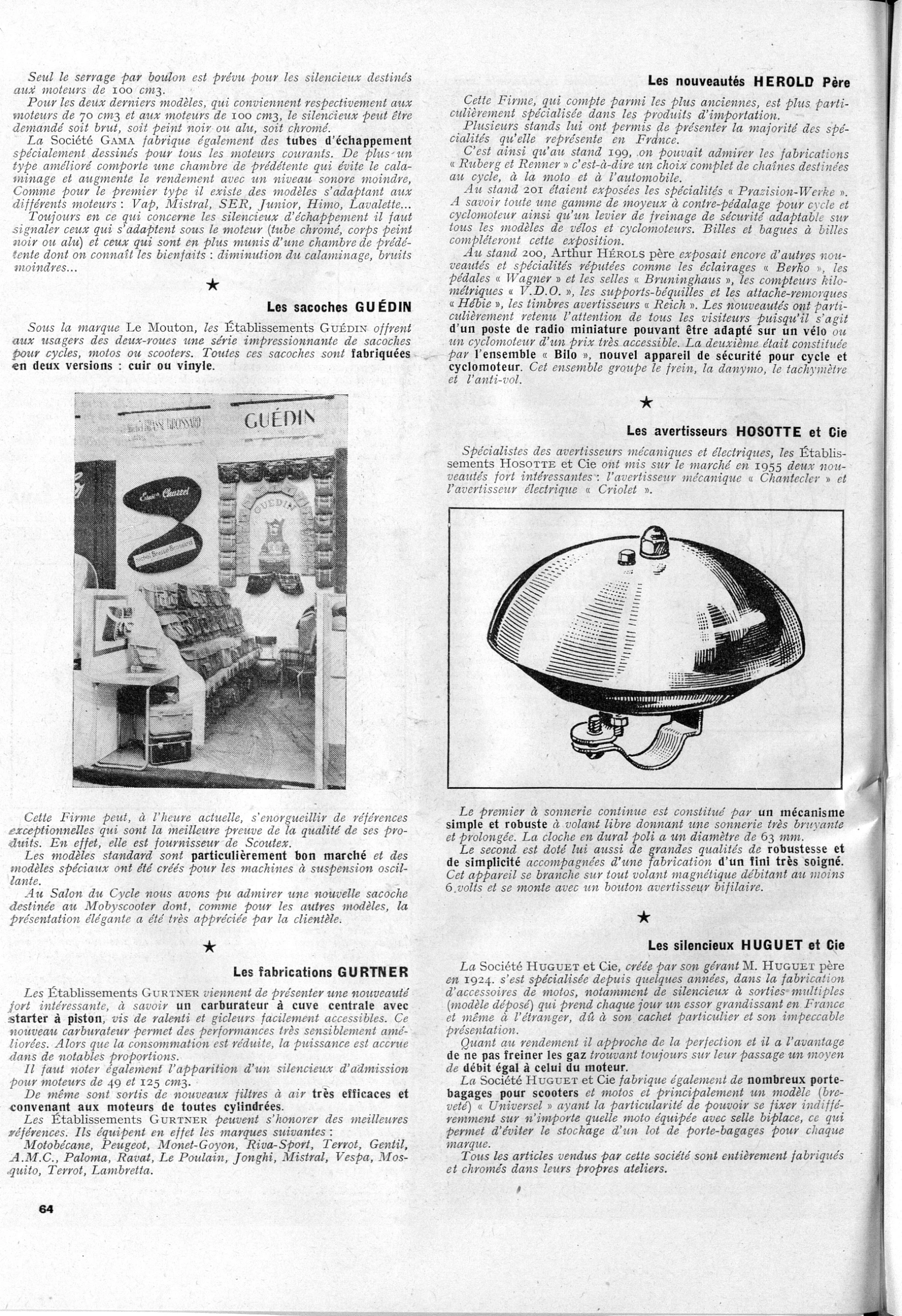
[Ebykr summary; the article’s text is not reproduced. The note does not name the machine for the mechanical bell; the electric horn runs from a magnetic flywheel and so belongs to the motor machines. Specialists in mechanical and electric warning devices, the Établissements Hosotte et Cie put two very interesting novelties on the market in 1955: the mechanical bell “Chantecler” and the electric horn “Criolet”.]
[Ebykr summary, after the drawing. The first, a continuous ringer, has a simple and robust free-wheel mechanism (“à volant libre”) giving a very loud and prolonged ring; its bell, of polished dural, is 63 mm in diameter. The second also has great robustness and simplicity with a very carefully finished make; it connects to any magnetic flywheel giving at least 6 volts and is fitted with a two-wire horn button (“bouton avertisseur bifilaire”).]
Les silencieux HUGUET et Cie
[Ebykr summary; the article’s text is not reproduced. For the motor machines. The Société Huguet et Cie, founded by its manager M. Huguet père in 1924, has for some years specialized in motorcycle accessories, notably silencers with multiple outlets (“silencieux à sorties multiples”, “modèle déposé”), whose success grows daily in France and even abroad thanks to their distinctive style and impeccable presentation. Their efficiency approaches perfection, and they have the advantage of not braking the gases, which always find on their way a flow equal to that of the engine. The firm also makes many luggage carriers for scooters and motorcycles, chiefly a patented (“breveté”) “Universel” model that can be fixed to any motorcycle with a dual seat (“selle biplace”), which spares the dealer from stocking a set of carriers for each marque. All the articles the firm sells are made and chromed entirely in its own workshops.]
64
[A page of text in two columns with one halftone photograph and one line drawing, continuing the survey without a head; a blank band runs across the top of the page above both columns. The firm headings are set flush right in bold condensed sans-serif with the firm name in capitals, the notes are in italic with firm names in roman small capitals and key phrases in bold roman and a single black star separates the notes. In the left column a tall halftone photograph shows the Guédin stand: a fascia lettered “GUÉDIN” across the top beside a second, illegible fascia, two dark oval signs with lettering that cannot be read, a curtained alcove with “GUÉDIN” lettered in an arch over a display of bags, a tilted rack of goods and a counter with a case standing on the floor. In the right column a ruled frame holds a line engraving in fine hatching of a domed bell with two cap nuts on its crown and, beneath it, a strap clamp drawn tight by a bolt; no signature or monogram appears in the frame. The Gurtner list of marques is set as one run-on paragraph. The page number “64” stands in bold at the foot of the left column, and the binding fold shows as a dark band along the right edge without loss of text.]
— Page 5 —
Les rayons Robert HUET
[Ebykr summary; the article’s text is not reproduced. For both the bicycle and the motor machines (and the automobile). The “Trèfle” mark launched by the Établissements Robert Huet is growing ever more important on the market for parts for cycles, motorcycles and cars. The firm’s great specialty is the making of spokes and nipples (“écrous”) for two-wheelers as well as for automobiles. For cycles there are four kinds of spoke, all rustless (“inoxydables”):]
— Rayons renforcés ;
— Rayons renforcés « Performance ». Spéciaux pour course, ils sont en acier à très haute résistance ;
— Rayons luxe, en acier inoxydable dans la masse ;
— et enfin rayons simples.
[Ebykr summary, after the list. For motorcycles and cars there are also rustless spokes, plain or reinforced, and for toys and children’s carriages (printed “voifures”) plain R.H. spokes in every length.]
Les câbles INDECA
[Ebykr summary; the article’s text is not reproduced. The note names no class of machine; it speaks of brakes and clutches (“freins et embrayages”) and of the Vélocistes-Motocistes trade, so the cables serve both the bicycle and the motor machines. Indeca cables have long been known and appreciated by the Vélocistes-Motocistes and by users, but the paper asks whether the reasons for a success that has never faltered are really known, and gives an enumeration to recall the causes of the favor Indeca enjoys with the public:]
Haute résistance à la goupille ou au tambour. Les câbles sont définis par la notion rationnelle de leur résistance à la tête R 250 kg, R 300 kg.
Coefficient d’utilisation 100/100. La résistance à la tête est égale à celle du câble lui-même.
Haute sécurité par l’emploi exclusif d’aciers de haute qualité encore améliorés. La limite élastique d’utilisation est de 80 % de la charge de rupture sous un allongement de 0,8 %.
Absence d’allongement en travail. La résistance dépasse sur les freins et embrayages la puissance de traction manuelle.
Souplesse accrue par suite des procédés de fabrication sur câbleuses Indéca qui ne laissent aucune composante de torsion ou de flexion, cause de raideur.
Indécalable. Cette qualité est indépendante du serrage du pas, lequel est fonction des caractéristiques ci-dessus définies. Serrer le pas d’un câble pour essayer de le rendre indétoronnable aboutit à un massacre des qualités du fil.
Absence de toute soudure. Les procédés Indéca, qui permettent d’atteindre de hautes résistances à la goupille, assurent en outre la conservation des câbles dans les stocks, sans l’appréhension de découvrir un jour des câbles invendables.
Inoxydable. Le cuivrage électrolytique des fils et leur protection électrolytique au cadmium leur assurent une conservation maximum. L’élimination du zincage ou étamage à chaud dont le décapage rend les fils fragiles par occlusion d’hydrogène, contribue à la qualité d’Indéca en augmentant la souplesse du câble.
Les moyeux-freins JACQUEMARD
[Ebykr summary; the article’s text is not reproduced. For the motor machines. The Idéal drum hub-brakes (“moyeux-freins à tambour”) can equip everything from the light cyclomoteur to the big competition motorcycle. It is an old mark with a very large production, and the Usines Jacquemard, founded in 1906, are among the most modern.]
Le volant magnétique JEUMONT
[Ebykr summary; the article’s text is not reproduced. For the motor machines (cyclomoteur and vélomoteur). For a cyclomoteur or a vélomoteur to give entire satisfaction it must have a perfectly suited magnetic flywheel of high quality, and these are exactly the characteristics of the Jeumont flywheels for engines of 38 to 75 cm3. The flywheel has a four-pole rotor (“Ticonal” magnets), and the lighting coils are strictly interchangeable with no fitting. The maximum output is 8 W, or 15 W on request. The 8 W coil is fitted with a 6 V 0,8 A headlamp, the dipped beam (“Code-phare”) and rear light being 12 V, 0,1 A; the coil printed “15 V” is fitted with a 6 V, 1 A headlamp, the dipped beam and rear light being 6 V, 0,5 A, and an electric horn can be added. The high-tension coil has a specially careful internal and external insulation, and the flywheel has a special oil-filled condenser with a steatite outlet (“à huile e sortie stéatite”, so printed). Before delivery every flywheel is run on the test bench to check its safety margin and output: every rotor is tested at 13.000 tr/mn; at idle, 250 tr/mn, the sparks must be 4 mm long, and at running speed, 5.500 tr/mn, they must measure 8 mm. Maintenance is practically nil: every 5.000 km a few drops of fluid vaseline oil on the felt lubricator, easily reached through the openings of the rotor.]
Les équipements JURINE
[Ebykr summary; the article’s text is not reproduced. The note does not say whether the horns and lamps are for the bicycle or the motor machines. The firm had a stand of very happy design, where M. Jurine had the pleasure of welcoming faithful customers who came to tell him of their full satisfaction.]
[Ebykr summary, after the photograph. In a short time the Sonax horns (“avertisseurs Sonax”) have established themselves for good; the paper says these quality pieces astonish by their power and that their development is a total success. As for the Jux lamps, they long ago won the users’ favor.]
Les projecteurs LUXOR
[Ebykr summary; the article’s text is not reproduced. For both the bicycle and the motor machines. The Luxor stand of MM. Traizet showed a complete range of headlamps for cycle, cyclomoteurs and vélomoteurs. The paper’s attention was drawn especially to the super-luxe models for cyclomoteurs, entirely chromed and designed for built-in speedometers of 60-52 diameter and triangular, and it noted that the visor door was of a longer form, giving the headlamp a very fine look and a stamp of finish and quality. In its range of cyclomoteur headlamps Luxor also showed a lamp with an added visor (“phare à visière rapportée”) in its series 104 and 105; the visor, of indisputable value, gives a better distribution of the light by suppressing the vertical rays that dazzled the user. For the optics Luxor has stayed faithful to the molded diffusing glass (“verre moulé-diffuseur”), which keeps a correct beam indefinitely. The last sentence, on what the paper understood of the firm of “Angou-“, breaks off at the foot of the column and runs on to the next page.]
67
[A page of text in two columns with two halftone photographs, continuing the survey without a head. The firm headings are set flush right in bold condensed sans-serif with the firm name in capitals, the notes are in italic with firm names in roman small capitals and key phrases in bold roman, the Huet list is set one item a line behind em dashes, the Indeca qualities each open with a bold roman lead phrase and a single black star separates the notes. At the foot of the left column, below a star, a halftone photograph shows the Jacquemard stand: a fascia lettered “CL. JACQUEMARD” over an illegible line of script, a dark back panel with a small framed notice, a curved white panel lettered “IDEAL” in quotation marks, two counters with fascias lettered “Ets CL. JACQUEMARD” and hubs set out on them; at the left stands a neighboring display lettered “AC-Delco” with a line of small capitals beneath that appears to read “DIVISION DE GENERAL MOTORS FRANCE”, a spark plug and round “AC” and “DELCO” emblems; in its lower right corner the white lettering “SALON du Cycle” over “PARIS 1955” is printed in mirror image. In the right column a halftone photograph shows the Jurine stand: a long fascia with “JUX” in outline capitals at the left and “SONAX” in large white capitals, a smaller partly hidden word beneath, lamps and horns set out on two dark counters; the white lettering “SALON du Cycle” over “PARIS” in the lower right corner, the year indistinct. No signature or monogram appears on either photograph. The page number “67” stands in bold at the foot of the right column, with the printer’s signature numeral “4” below it.]
— Page 6 —
[Ebykr summary, closing the Luxor note from the previous page. The firm of Angoulême (“Angou-lême”) had for several months been studying some rather sensational novelties, to be put on the market soon, to which the paper will return as soon as it can.]
Les moyeux des Usines DE LARDY
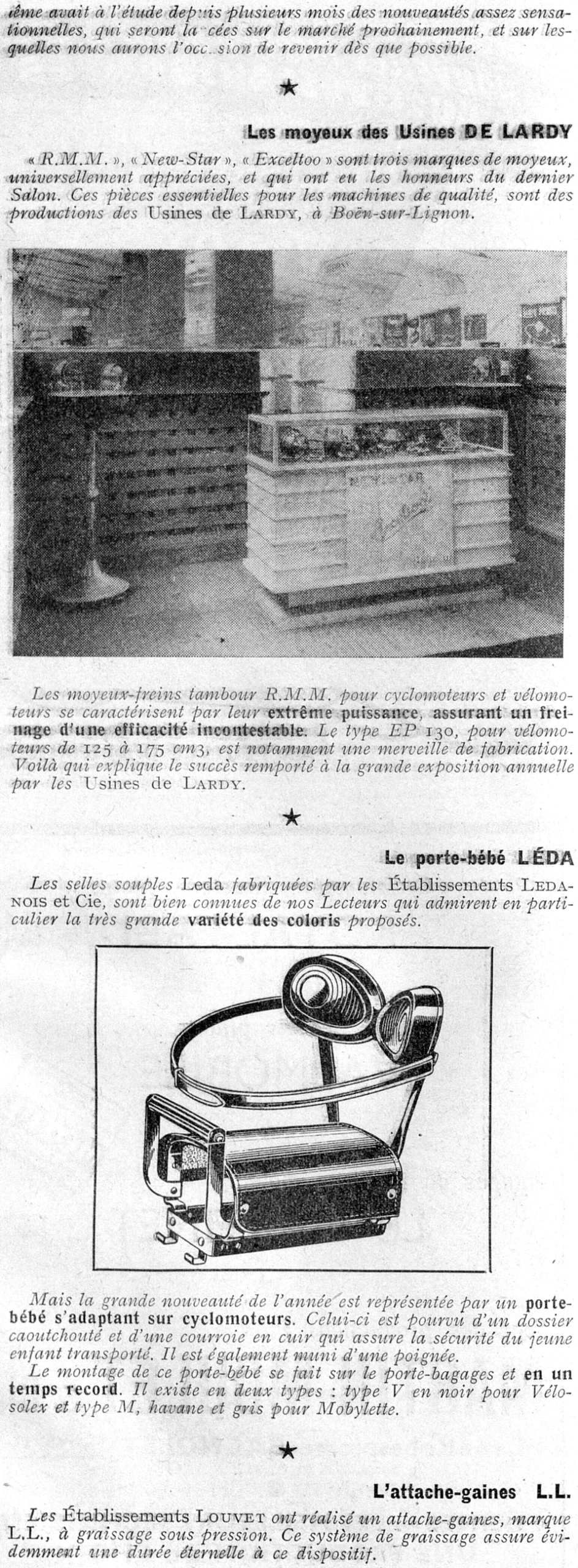
[Ebykr summary; the article’s text is not reproduced. The R.M.M. hub-brakes are for the motor machines (cyclomoteurs and vélomoteurs); the note does not say what the New-Star and Exceltoo hubs are for. “R.M.M.”, “New-Star” and “Exceltoo” (so printed) are three marks of hubs, universally appreciated, that were honored at the last Salon; these parts, essential for quality machines, are made by the Usines de Lardy, at Boën-sur-Lignon.]
[Ebykr summary, after the photograph. The R.M.M. drum hub-brakes (“moyeux-freins tambour”) for cyclomoteurs and vélomoteurs are marked by their extreme power, giving braking of indisputable efficiency. The type EP 130, for vélomoteurs of 125 to 175 cm3, is in particular a marvel of manufacture, which the paper says explains the success the Usines de Lardy won at the great annual exhibition.]
Le porte-bébé LÉDA
[Ebykr summary; the article’s text is not reproduced. The baby carrier is for the motor machines (cyclomoteurs); the note does not say what the saddles are for. The Leda flexible saddles (“selles souples”), made by the Établissements Ledanois et Cie (the name is split “LEDA-” / “NOIS” at the line end), are well known to the paper’s readers, who particularly admire the very great variety of colors offered.]
[Ebykr summary, after the drawing. The great novelty of the year is a baby carrier (“porte-bébé”) that fits on cyclomoteurs. It has a rubberized backrest, a leather strap that keeps the young child safe and also a handle. It mounts on the luggage carrier in record time. It exists in two types: type V, in black, for the Vélosolex, and type M, in havana and gray, for the Mobylette.]
L’attache-gaines L.L.
[Ebykr summary; the article’s text is not reproduced. The Établissements Louvet have made a cable-sheath clip (“attache-gaines”), mark L.L., with pressure lubrication (“graissage sous pression”), a system that the paper says obviously gives the device an everlasting life. The note runs on to the next page.]
[A single column of a page, set in italic with firm names in roman small capitals and key phrases in bold roman, the firm headings flush right in bold condensed sans-serif and a single black star between the notes; the first three lines, closing the Luxor note, show broken and missing letters. Below the Lardy note a halftone photograph shows the Lardy stand: a tall dark shelved unit with rows of small parts, a glass-topped display case with hubs inside, white counters with faint lettering too blurred to read and the hall beyond. Below the Léda note a ruled frame holds a line drawing with dark shading of the baby carrier: a padded seat box on a bracket frame with two hooks underneath, a tubular handle at the front, an upright bar carrying two rounded padded cushions as a backrest and a strap loop around them; faint text from the reverse of the leaf shows through in the frame. No signature or monogram appears on the photograph or the drawing. The L.L. heading stands at the foot of the column and its note runs on.]
— Page 7 —
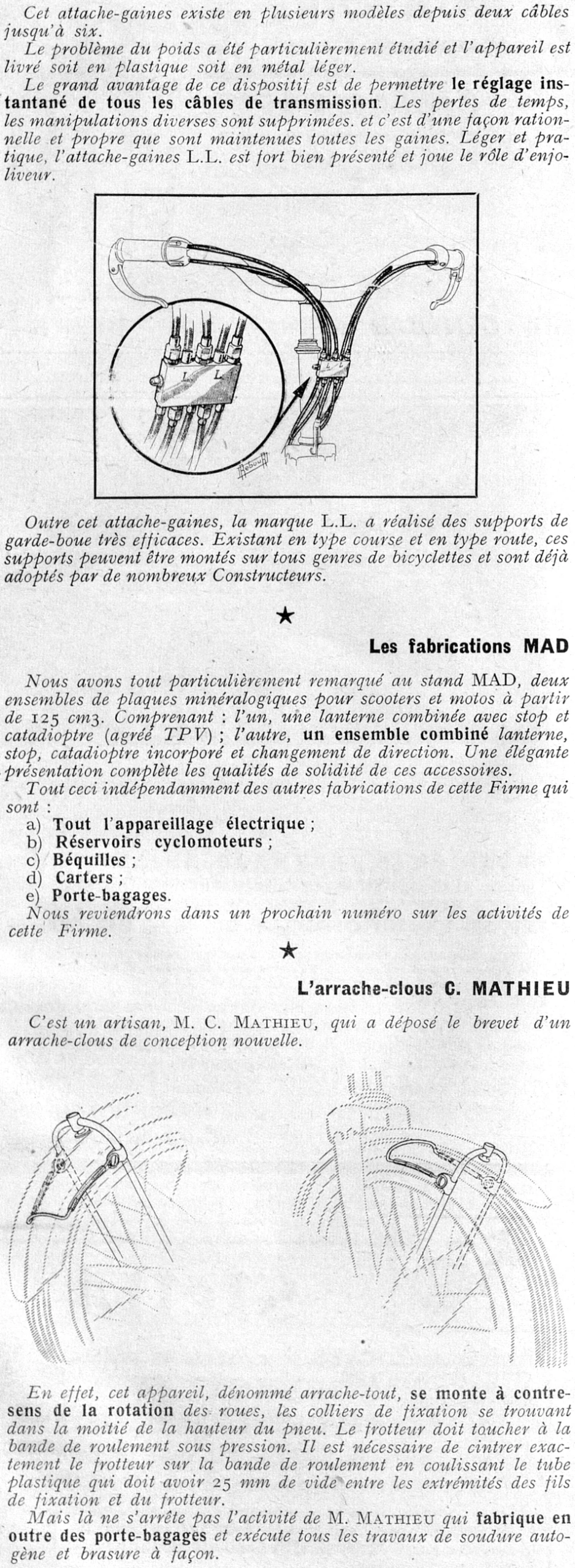
[Ebykr summary, continuing the L.L. note from the previous page. For the bicycle (the drawing shows a bicycle handlebar and the mudguard supports are for all kinds of bicycles). The L.L. cable-sheath clip exists in several models, from two cables up to six. The question of weight was particularly studied, and the device is delivered in plastic or in light metal. Its great advantage is to allow the instant adjustment of all the transmission cables: time losses and fiddling are done away with, and all the sheaths are held in a rational and clean way. Light and practical, the L.L. clip is very well presented and serves as an ornament (“joue le rôle d’enjoliveur”).]
[Ebykr summary, after the drawing. Besides this clip, the L.L. mark has made very effective mudguard supports (“supports de garde-boue”); existing in a racing type and a road type (“type course et … type route”), they can be fitted to every kind of bicycle and have already been adopted by many makers.]
Les fabrications MAD
[Ebykr summary; the article’s text is not reproduced. For the motor machines (scooters, motorcycles and cyclomoteurs). The paper particularly noticed at the MAD stand two number-plate sets (“ensembles de plaques minéralogiques”) for scooters and motorcycles from 125 cm3 up: one with a lamp combined with a stop light and a reflector (“catadioptre”, approved TPV); the other a combined set of lamp, stop light, built-in reflector and direction-change signal. An elegant presentation completes the strength of these accessories. This is apart from the firm’s other products, which are:]
a) Tout l’appareillage électrique ;
b) Réservoirs cyclomoteurs ;
c) Béquilles ;
d) Carters ;
e) Porte-bagages.
[Ebykr summary, after the list. The paper will return in a coming number to the activities of this firm.]
L’arrache-clous C. MATHIEU
[Ebykr summary; the article’s text is not reproduced. For the bicycle, as the drawings show; the note itself names no machine. An artisan, M. C. Mathieu, has filed the patent (“déposé le brevet”) of a nail remover (“arrache-clous”) of new design.]
[Ebykr summary, after the drawings. The device, called the “arrache-tout”, is mounted against the direction of the wheels’ rotation, with its fixing clips at half the height of the tire. The wiper (“frotteur”) must touch the tread under pressure. The wiper must be bent exactly onto the tread by sliding the plastic tube, which must leave 25 mm of space between the ends of the fixing wires and of the wiper. M. Mathieu’s activity does not stop there: he also makes luggage carriers and does all oxy-acetylene welding and brazing to order (“tous les travaux de soudure autogène et brasure à façon”).]
[A single column of a page, set in italic with firm names in roman small capitals and key phrases in bold roman, the firm headings flush right in bold condensed sans-serif, the MAD list set one item a line with letters a) to e) and bold roman items and a single black star between the notes. Near the head a ruled frame holds a line drawing of a bicycle handlebar seen from the rider’s side, with brake levers at both ends and a bundle of cables running down to a small block lettered “L L” clamped on the head tube; a circle at the left magnifies the block, lettered “L” and “L”, with five cables entering at the top and leaving below, and an arrow points from the circle to the block on the stem. In the lower right of the circle stands the boxed signature “Rebour”, the capital R drawn with the box rules passing through it, of Daniel Rebour. Lower in the column two unframed line drawings side by side show the Mathieu nail remover from two angles: a bent wire bracket with a wiper on a slotted tube, clamped above a tire whose tread, spokes and fork are drawn in dotted and dashed lines; no signature or monogram appears on either. Faint text from the reverse of the leaf shows through in places.]
— Page 8 —
Les équipements NEIMAN
[Ebykr summary; the article’s text is not reproduced. For the motor machines (scooters, motorcycles, sidecars and the like). The paper counted the stands at the last Salon on which scooters, motorcycles, sidecars, etc., were fitted with Neiman suspensions and anti-theft locks (“antivols”): 33 at the Salon of the Porte de Versailles (plus Isetta-Velam at the Grand Palais), out of 44 stands in the Parc des Expositions showing vehicles with suspension, barring error on its part. To these must be added 17 motorcycle stands that showed the mark’s anti-theft locks without the suspension, a total of 50 stands whose vehicles had these locks. Since about 56 vehicles of the kind were shown in all, the paper calls the figure telling.]
Les appareils MOREL
[Ebykr summary; the article’s text is not reproduced. For the motor machines (and the small car). Abundantly supplied with literature on each of its devices, the Morel stand let every visitor complete his knowledge of the mark’s equipment: flywheels (“volants”) for cyclomoteurs, vélomoteurs and scooters, dynamos, accessories and the latest arrivals, starters and alternators for the voiturette.]
Le carter de chaîne OLUX
[Ebykr summary; the article’s text is not reproduced. The note does not say whether the chain guard is for the bicycle or the motor machines. The Établissements Olux have made a new flexible chain guard (“carter de chaîne souple”), which the paper expects without any doubt to have the greatest success.]
[Ebykr summary, after the drawing. Molded in one piece with an inner chain guide, the new Olux chain guard prevents the jamming that occurs between the chain, the chainwheel (“plateau”) and the guard when the chain jumps off. With the guide, the chain jumping off is made practically impossible; should it happen, there is no jamming and the chain goes back at once. The guide prevents lateral wear of the links, and because of the flexible material of the guard the running is silent, even with a slack chain (“chaîne flottante”).]
Les nouveautés PAREFLEX
[Ebykr summary; the article’s text is not reproduced. For the riders of the motor machines (motorcyclists and scooterists). The Établissements Pareflex, whose goggles and face shields (“lunettes et … pare-visage”) have long been adopted by motorcyclists and scooterists who want articles combining elegance, comfort and effective protection, showed again this year a most complete series of windscreens (“pare-brise”), both in the “Cristal” series and in the series fitted with an apron (“tablier”). For each type of machine there are one or several (printed “ou un plusieurs”) types of Pareflex suited to its power. All the models are molded by an exclusive process that gives them at once elegance, strength and rigidity. Pareflex has also just finished developing a roof (“toit”) and a sun visor (“pare-soleil”) that can be fitted and removed instantly, whose lightness takes nothing from their robustness. The paper concludes that the Pareflex specialties meet every demand of the customers and win over the users.]
Le guidon PHILIPPE
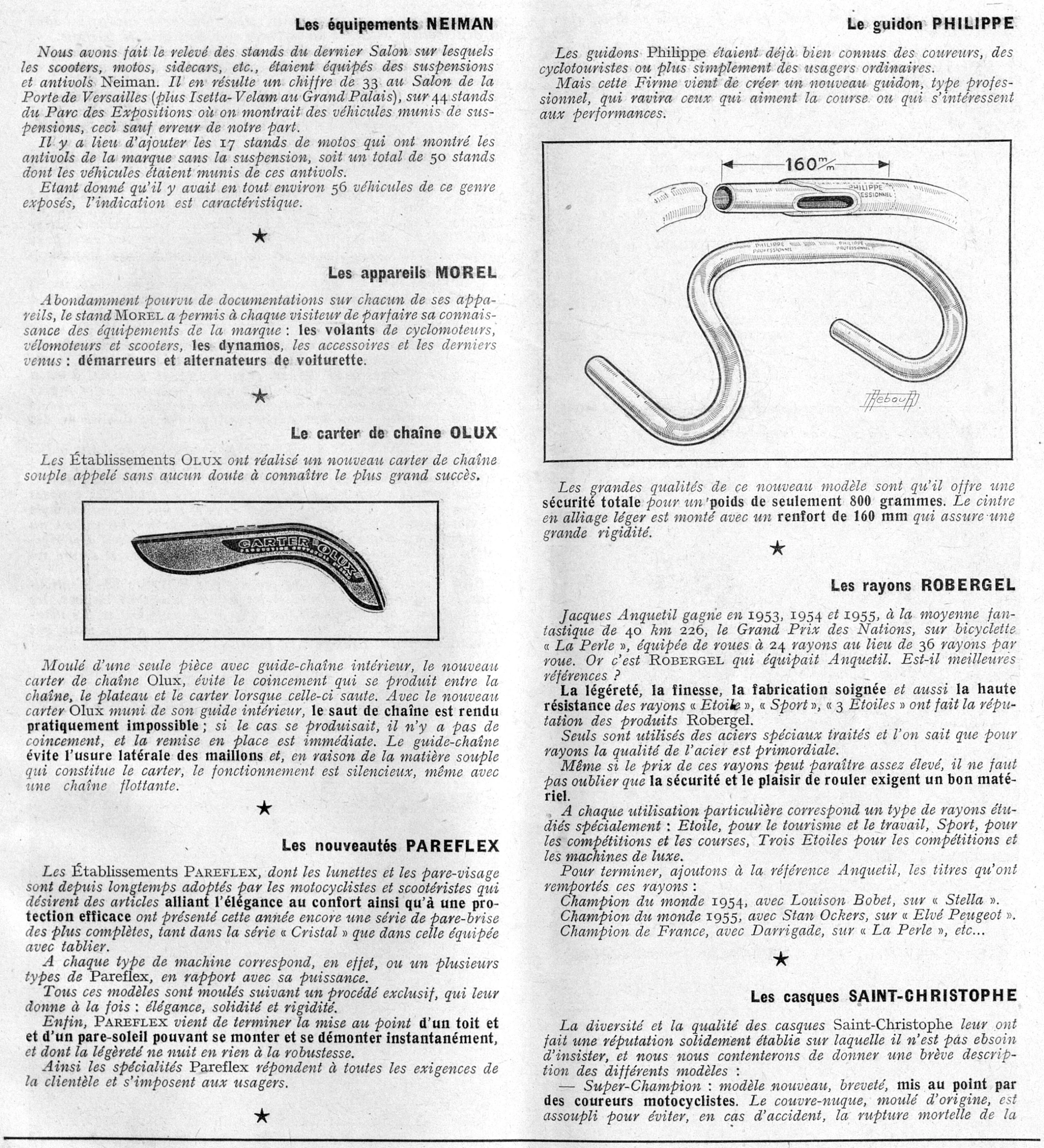
[Ebykr summary; the article’s text is not reproduced. For the bicycle. Philippe handlebars were already well known to racing men, cyclotourists or simply ordinary riders, but the firm has just created a new handlebar, professional type (“type professionnel”), that will delight those who love racing or take an interest in performance.]
160 m/m
PHILIPPE
PROFESSIONNEL
[Ebykr summary, after the drawing. The great qualities of the new model are total safety for a weight of only 800 grams (“800 grammes”). The light-alloy bend (“cintre en alliage léger”) is fitted with a 160 mm reinforcement (“renfort de 160 mm”) that gives great rigidity.]
Les rayons ROBERGEL
[Ebykr summary; the article’s text is not reproduced. For the bicycle. Jacques Anquetil won the Grand Prix des Nations in 1953, 1954 and 1955, at the fantastic average of 40 km 226, on a “La Perle” bicycle with wheels of 24 spokes instead of 36 a wheel, and it was Robergel that equipped Anquetil; the paper asks whether there could be better references. The lightness, fineness, careful manufacture and high strength of the “Etoile”, “Sport” and “3 Etoiles” spokes made the reputation of the Robergel products. Only treated special steels are used, and for spokes the quality of the steel is paramount. Even if the price of these spokes may seem rather high, safety and the pleasure of riding demand good equipment. Each particular use has a specially designed type: Etoile for touring and work, Sport for competitions and races, Trois Etoiles for competitions and luxury machines. To finish, the paper adds to the Anquetil reference the titles these spokes have won:]
Champion du monde 1954, avec Louison Bobet, sur « Stella ».
Champion du monde 1955, avec Stan Ockers, sur « Elvé Peugeot ».
Champion de France, avec Darrigade, sur « La Perle », etc…
Les casques SAINT-CHRISTOPHE
[Ebykr summary; the article’s text is not reproduced. For the riders of the motor machines (the new model was developed by motorcycle racers). The diversity and quality of the Saint-Christophe helmets have made them a solidly established reputation on which there is no need (printed “ebsoin”) to insist, and the paper gives a brief description of the various models:]
— Super-Champion : modèle nouveau, breveté, mis au point par des coureurs motocyclistes. Le couvre-nuque, moulé d’origine, est assoupli pour éviter, en cas d’accident, la rupture mortelle de la
[A page of text in two columns with two line drawings, continuing the survey without a head, closed at the foot by a heavy rule across both columns. The firm headings are set flush right in bold condensed sans-serif with the firm name in capitals, the notes are in italic with firm names in roman small capitals and key phrases in bold roman, the Robergel titles are set one a line, the Saint-Christophe models open behind an em dash and a single black star separates the notes. In the left column a ruled frame holds a stippled drawing of the curved Olux chain guard, a dark band along its length lettered in outline capitals “CARTER” and “OLUX” between quotation marks, with a smaller line of capitals beneath, partly legible, that begins “PRODUCTION”. At the head of the right column a large ruled frame holds a line drawing in fine hatching of a dropped racing handlebar, both drops shown, its center lettered twice “PHILIPPE” over “PROFESSIONNEL”; above it a detail cut away to show the reinforcing sleeve inside the center of the bar, with a dimension arrow lettered “160 m/m” spanning the sleeve. In the lower right of the frame stands the boxed signature “Rebour”, the capital R drawn with the box rules passing through it, of Daniel Rebour. No signature or monogram appears on the Olux drawing.]
— Page 9 —
base du crâne. Casque d’une seule pièce, de grande sécurité, absolument garanti.
La calotte en liège, moulé 10 tonnes, extrêmement résistant aux chocs est gainée d’une très jolie peausserie, de tout premier choix, pur chrome, coloris modes de toutes marques.
— Idéal sport : modèle classique, très étudié, exceptionnellement résistant. Calotte liège moulé en forme, à 10 tonnes. Peausserie pur chrome, premier choix, tous coloris.
— Classique S : même modèle que ci-dessus, gainé Lincrusa ou Cordoual (avec ou sans bande lumineuse), quatre coloris.
— Sport léger : modèle spécialement conçu pour dame, recouvert de tissu popeline ou nylon tissé, imperméable à l’eau.
Calotte moulée en forme, très léger, très résistant, tous coloris.
Se fait, soit avec petite bande frontale, soit avec visière.
— Enfants : conçu comme nos meilleurs modèles. Calotte moulée 10 tonnes. Véritable casque d’une protection parfaite. Se fait exclusivement dans modèle Idéal sport.
— Super-plastic : modèle exceptionnellement résistant, d’une ligne très sobre, peausserie intérieure premier choix, pur chrome, cinq coloris : marron, blanc R.A.F., mastic (Vespa 55), ivoire (Lambretta 55), R.A.F.
Les cinq premiers modèles peuvent s’exécuter avec ou sans bande lumineuse.
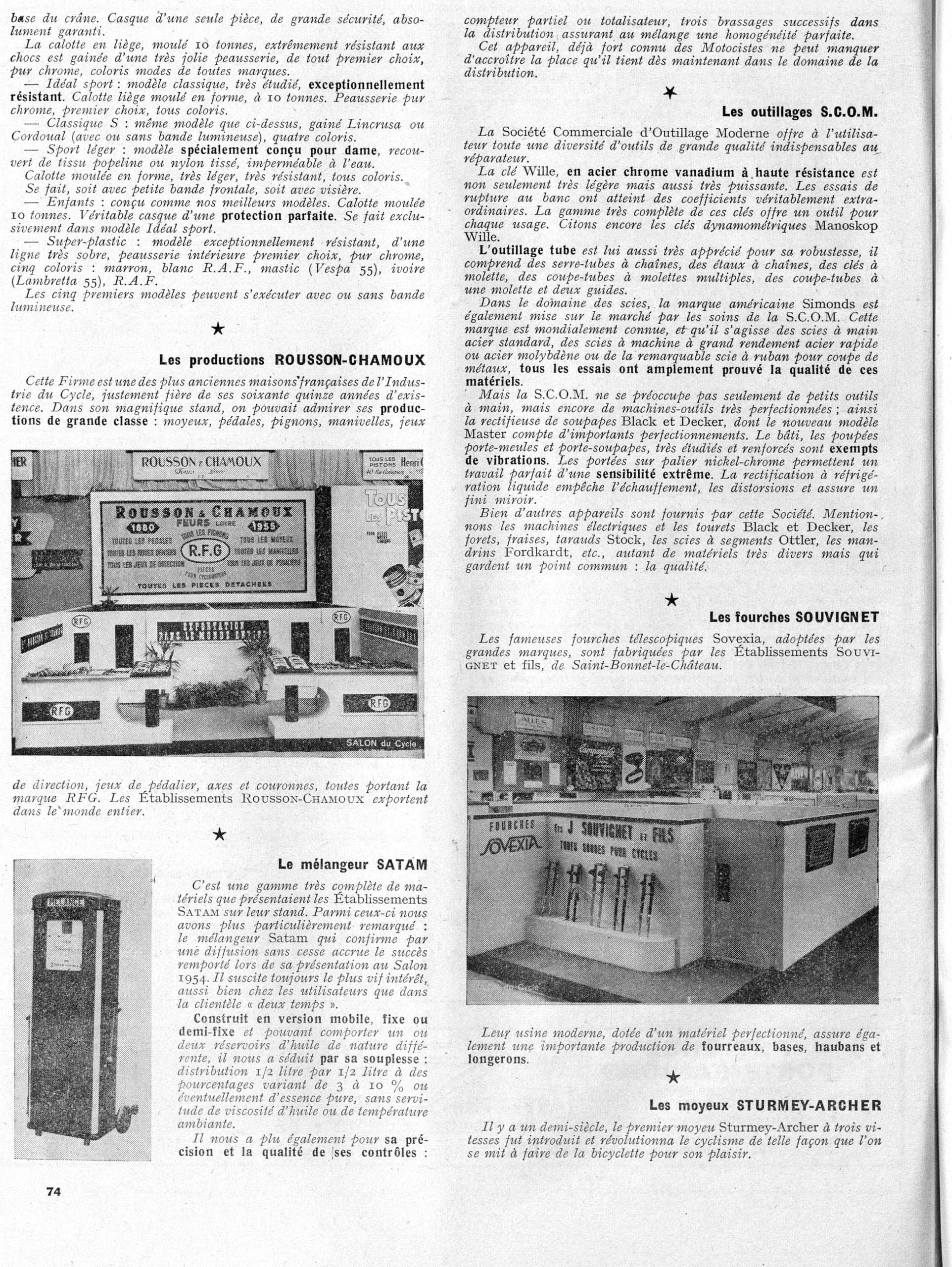
Les productions ROUSSON-CHAMOUX
[Ebykr summary; the article’s text is not reproduced. For the bicycle. The firm is one of the oldest French houses of the cycle industry, justly proud of its seventy-five years of existence. On its magnificent stand could be admired its high-class products: hubs, pedals, sprockets (“pignons”), cranks, headsets (“jeux de direction”), bottom-bracket sets (“jeux de pédalier”), axles and chainrings (“axes et couronnes”), all bearing the RFG mark. The Établissements Rousson-Chamoux export throughout the world.]
Le mélangeur SATAM
[Ebykr summary; the article’s text is not reproduced. For the motor machines: a two-stroke fuel-mixing pump for the trade. The Établissements Satam showed a very complete range of equipment on their stand, and the paper particularly noticed the Satam mixer (“mélangeur”), whose ever-wider sale confirms the success it won when shown at the 1954 Salon; it still arouses the keenest interest among users and the “deux temps” customers. Built in a mobile, fixed or semi-fixed version and able to carry one or two oil tanks of different kinds, it won the paper over by its flexibility: delivery half a liter by half a liter (“1/2 litre par 1/2 litre”) at percentages from 3 to 10 % or, if need be, of pure gasoline, with no constraint of oil viscosity or ambient temperature. The paper also liked its precision and the quality of its controls: a partial or totalizing counter (“compteur partiel ou totalisateur”) and three successive stirrings (“brassages”) in the delivery that give the mixture a perfect homogeneity. The device, already well known to the Motocistes, cannot fail to strengthen the place it already holds in fuel distribution.]
Les outillages S.C.O.M.
[Ebykr summary; the article’s text is not reproduced. Workshop tools for the repairer, of both bicycles and motor machines; the note names no machine, and the valve grinder is a motor-trade tool. The Société Commerciale d’Outillage Moderne offers the user a whole diversity of high-quality tools indispensable to the repairer. The Wille wrench (“clé Wille”), in high-strength chrome vanadium steel, is not only very light but very powerful, and bench breaking tests reached truly extraordinary coefficients; the very complete range offers a tool for every use, and the paper also cites the Manoskop Wille torque wrenches (“clés dynamométriques”). The tube tooling (“outillage tube”) is also much appreciated for its robustness: chain pipe wrenches (“serre-tubes à chaînes”), chain vises (“étaux à chaînes”), adjustable wrenches (“clés à molette”), tube cutters with multiple wheels and tube cutters with one wheel and two guides. In saws the American mark Simonds is also put on the market by the S.C.O.M.; the mark is known worldwide, and whether for standard-steel hand saws, high-output machine saws in high-speed or molybdenum steel, or the remarkable band saw for cutting metals, all tests have amply proved the quality of these products. The S.C.O.M. also deals in highly perfected machine tools, such as the Black et Decker valve grinder (“rectifieuse de soupapes”), whose new Master model has important improvements: the frame and the grinding-wheel and valve heads (“poupées porte-meules et porte-soupapes”), carefully designed and reinforced, are free of vibration; bearings in nickel-chrome allow perfect work of extreme sensitivity; liquid-cooled grinding prevents heating and distortion and gives a mirror finish. The firm supplies many other devices: the Black et Decker electric machines and bench grinders (“tourets”), the Stock drills, cutters and taps (“forets, fraises, tarauds”), the Ottler segment saws (“scies à segments”), the Fordkardt (so printed) chucks (“mandrins”), etc., very diverse equipment with one point in common: quality.]
Les fourches SOUVIGNET
[Ebykr summary; the article’s text is not reproduced. The note does not say whether the telescopic forks are for the bicycle or the motor machines; the tubes and frame members, by the stand’s own sign, are for cycles. The famous Sovexia telescopic forks (“fourches télescopiques”), adopted by the great marques, are made by the Établissements Souvignet et fils, of Saint-Bonnet-le-Château.]
[Ebykr summary, after the photograph. Their modern works, with up-to-date equipment, also turn out a large production of fork blades, chainstays, seatstays and frame members (“fourreaux, bases, haubans et longerons”).]
Les moyeux STURMEY-ARCHER
[Ebykr summary; the article’s text is not reproduced. For the bicycle. Half a century ago the first Sturmey-Archer three-speed hub was introduced and so revolutionized cycling that people took to cycling for pleasure. The note runs on to the next page.]
74
[A page of text in two columns with three halftone photographs, continuing the survey without a head. The firm headings are set flush right in bold condensed sans-serif with the firm name in capitals, the notes are in italic with firm names and product names in roman and key phrases in bold roman, the Saint-Christophe models are set as paragraphs opening behind em dashes and a single black star separates the notes. In the left column a wide halftone photograph shows the Rousson-Chamoux stand: a fascia lettered “ROUSSON & CHAMOUX” over a line of small script, and a large framed panel lettered “ROUSSON & CHAMOUX”, “FEURS LOIRE”, the dates “1880” and “1955” in pointed cartouches and “R.F.G” in an oval, among lines of small capitals that appear to name all the pedals, hubs, cranks, headsets and bottom-bracket sets and to read “TOUTES LES PIECES DETACHEES” across the foot; the counters below carry oval “RFG” plaques and small potted plants, part of a neighboring stand with “TOUS LES PISTONS” shows at the right; white lettering “SALON du Cycle” stands in the lower right corner. Beside the Satam note a narrow halftone photograph shows the mixer: a tall dark cabinet on short feet, lettered “MÉLANGE” at the top, with a window panel, a vertical gauge tube at the side and a hose coiled at the base. In the right column a halftone photograph shows the Souvignet stand, its fascia lettered “FOURCHES” over “SOVEXIA” in a sweeping script at the left and “Ets J. SOUVIGNET et FILS” with a smaller line of capitals beneath, and a row of fork blades and tubes standing on a curved counter. No signature or monogram appears on any of the photographs. The page number “74” stands in bold at the foot of the left column, and the binding fold shows as a dark band along the right edge without loss of text.]
— Page 10 —
[Ebykr summary, continuing the Sturmey-Archer note from the previous page. For the bicycle. With a Sturmey-Archer hub the cyclist lengthened his rides and came home fresh, feeling no fatigue; hills and head winds no longer frightened him, and his riding averages rose with his comfort and pleasure. Since then the range of Sturmey-Archer hubs has never stopped growing, so that today there is a hub to suit everyone, and their popularity is such that many important world marques recommend them to their customers. The models offered: AW, a standard three-speed, absolutely sealed and running in an oil bath; AC and AM, three-speeds for the sporting cyclist; ABC, a three-speed with a drum brake whose control is entirely separate; FW, a four-speed designed especially to meet the severest demands of modern cycling; FM, a four-speed like the FW but meant for sporting riders; FC, a close-ratio four-speed (“à rapports rapprochés”) designed especially for road racing. The latest success is the TCW, a standard three-speed hub with a coaster brake (“frein à contre-pédalage”) and a trigger gear control on the handlebar (“commande de vitesses au guidon type gâchette”); it has a brake of sure efficiency and weighs, complete with its control, only 1 kg 300.]
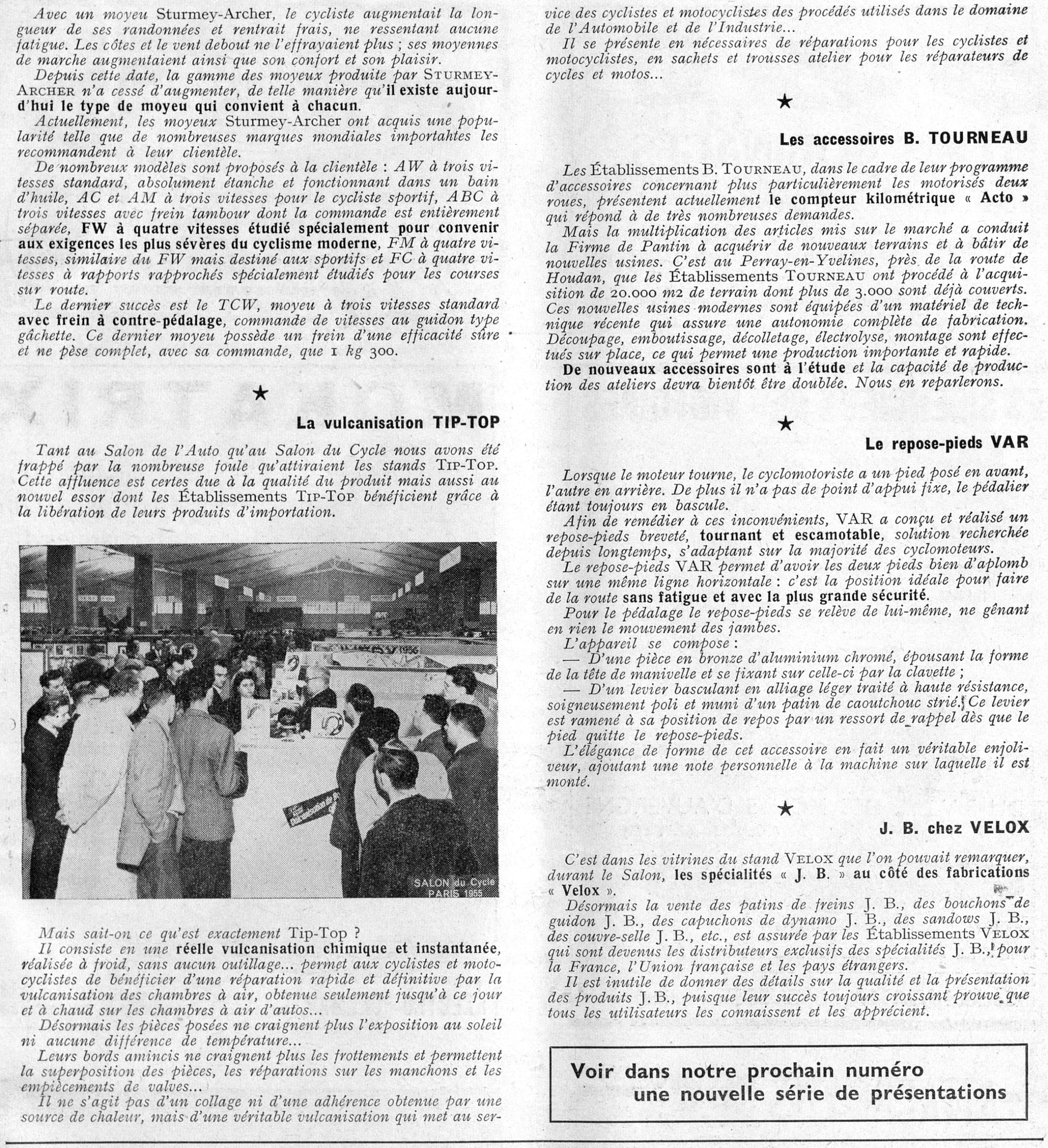
La vulcanisation TIP-TOP
[Ebykr summary; the article’s text is not reproduced. For both the bicycle and the motorcycle: tube repair for cyclists and motorcyclists. At the Salon de l’Auto as at the Salon du Cycle the paper was struck by the crowds that the Tip-Top stands drew. The rush was owed to the quality of the product but also to the new expansion the Établissements Tip-Top enjoy thanks to the freeing of their imported products (“la libération de leurs produits d’importation”).]
[Ebykr summary, after the photograph. The paper asks whether it is known exactly what Tip-Top is. It is a true chemical and instantaneous vulcanization, done cold and with no tools, which lets cyclists and motorcyclists have a quick and permanent repair by vulcanizing their inner tubes, something obtained until then only hot and on car tubes. The patches fitted no longer fear exposure to the sun or any change of temperature. Their thinned edges (“bords amincis”) no longer fear rubbing and allow patches to overlap, and repairs on the sleeves and valve patches (“manchons et … empiècements de valves”). It is not a sticking nor an adhesion obtained by a source of heat but a real vulcanization that puts at the service of cyclists and motorcyclists the processes used in the automobile and in industry. It comes in repair kits for cyclists and motorcyclists, and in packets and workshop kits (“sachets et trousses atelier”) for repairers of cycles and motorcycles.]
Les accessoires B. TOURNEAU
[Ebykr summary; the article’s text is not reproduced. For the motor machines (motorized two-wheelers). Within their program of accessories concerning more particularly the motorized two-wheelers, the Établissements B. Tourneau are now showing the “Acto” speedometer (“compteur kilométrique”), which meets very many requests. The growing number of articles put on the market led the firm of Pantin to acquire new land and build new works: at Le Perray-en-Yvelines, near the route de Houdan, the Établissements Tourneau have acquired 20.000 m2 of land, of which more than 3.000 are already covered. The new modern works are equipped with recent machinery giving complete self-sufficiency in manufacture: blanking, pressing, bar turning, electroplating (“électrolyse”) and assembly are done on the spot, allowing large and quick production. New accessories are under study, and the shops’ capacity is soon to be doubled; the paper will speak of it again.]
Le repose-pieds VAR
[Ebykr summary; the article’s text is not reproduced. For the motor machines (cyclomoteurs). When the engine runs, the cyclomotorist has one foot forward and the other back, with no fixed point of support since the bottom bracket is always rocking. To remedy this, VAR has designed and made a patented (“breveté”) footrest, turning and retractable (“tournant et escamotable”), a long-sought solution that fits most cyclomoteurs. The VAR footrest lets both feet rest level on the same horizontal line, the ideal position for riding without fatigue and with the greatest safety; for pedaling it lifts by itself and does not hinder the legs. The device consists of:]
— D’une pièce en bronze d’aluminium chromé, épousant la forme de la tête de manivelle et se fixant sur celle-ci par la clavette ;
— D’un levier basculant en alliage léger traité à haute résistance, soigneusement poli et muni d’un patin de caoutchouc strié.
[Ebykr summary, after the list. The lever is brought back to its rest position by a return spring as soon as the foot leaves the footrest. The elegance of the accessory’s shape makes it a true ornament, adding a personal note to the machine it is fitted to.]
J. B. chez VELOX
[Ebykr summary; the article’s text is not reproduced. For the bicycle (brake pads, handlebar plugs, dynamo caps, saddle covers). In the show cases of the Velox stand the “J. B.” specialties could be seen during the Salon beside the “Velox” products. The sale of J. B. brake pads (“patins de freins”), handlebar plugs (“bouchons de guidon”), dynamo caps (“capuchons de dynamo”), sandows (elastic straps), saddle covers (“couvre-selle”), etc., is now handled by the Établissements Velox, who have become the exclusive distributors of the J. B. specialties for France, the Union française and foreign countries. The paper finds it needless to give details of the quality and presentation of the J. B. products, since their ever-growing success proves that every user knows and appreciates them.]
Voir dans notre prochain numéro
une nouvelle série de présentations
[A page of text in two columns with one halftone photograph, closing the survey, with a heavy rule across the foot of both columns. The firm headings are set flush right in bold condensed sans-serif with the firm name in capitals, the notes are in italic with firm names in roman small capitals and key phrases in bold roman, the VAR parts are set as paragraphs opening behind em dashes and a single black star separates the notes. In the left column a large halftone photograph shows a crowd of men and one woman pressed round a Tip-Top stand in the exhibition hall, with displays of tire repair goods on the counter, a man in the foreground holding a printed packet, a banner across the stand behind with lettering ending in what appears to be “1956”, the long hall with its pillars and hanging signs beyond and the white lettering “SALON du Cycle” over “PARIS 1955” in the lower right corner; no signature or monogram appears on it. At the foot of the right column a ruled box holds the notice “Voir dans notre prochain numéro” over “une nouvelle série de présentations” in bold sans-serif. No page number appears on the image.]
Ebykr presents this material for research and education. If you hold rights to it or notice an ownership issue, please contact us and we will respond promptly.
The Ebykr Digest
New articles, timelines, catalog finds and registry activity — assembled from the archive once a month. Your address is never shared.
Double opt-in. One email per month. Unsubscribe at any time with one click.