About Ebykr
Ebykr celebrates classic and vintage lightweight bicycles through provocative imagery and opinion. Ride along with us.
About Ebykr
Ebykr celebrates classic and vintage lightweight bicycles through provocative imagery and opinion. Ride along with us.

Source: Gallica (Bibliothèque nationale de France), L'Officiel du cycle, du motocycle et du camping, 29 October 1955, N° 22, pages 35, 37, 39, 41, 42, 47, 49, 51, 53 and 54; ark:/12148/bd6t54201145h. Source gallica.bnf.fr / BnF.
| Type | Review |
|---|---|
| Year | 1955 |
| Publisher | L'Officiel du cycle |
| Artist | Daniel Rebour |
| Country | France |
| Language | French |
| Pages | 10 |
| Source | Gallica (Bibliothèque nationale de France), L'Officiel du cycle, du motocycle et du camping, 29 October 1955, N° 22, pages 35, 37, 39, 41, 42, 47, 49, 51, 53 and 54; ark:/12148/bd6t54201145h. Source gallica.bnf.fr / BnF. |
| Credit | Ebykr archive; Bibliothèque nationale de France |
| Identifier | Gallica (BnF) ark:/12148/bd6t54201145h/f35 |
| Transcription | Headings and specifications transcribed; article text summarized |
La Bicyclette Les Motocycles AUX PROGRAMMES DE CONSTRUCTION 56 (Une seconde série de présentations figurera dans notre prochain numéro) Le nouveau cyclomoteur AUTOMOTO 1° Sa puissance réelle : 2 CV ; 2° Sa souplesse : moteur à couple constant de 3.000 à 5.000 tours, donc excellentes reprises à toutes les allures ; 3° Résistance à …
This is a magazine article, so its running text is summarized here rather than reproduced; the headline, byline, specifications and scores are transcribed as printed.
From L’Officiel du cycle, du motocycle et du camping, 29 October 1955, the paper’s first number reporting the 1955 Paris Salon du Cycle et du Motocycle, pages 35 to 54: the magazine’s survey of the 1956 production shown at the Salon, firm by firm: bicycles, cyclomoteurs, scooters and motorcycles, with their models, engines and prices. The title, headings, captions and lists are transcribed as printed; the text is summarized in Ebykr’s words, and the page images carry it in full.
— Page 1 —
La Bicyclette
Les Motocycles
AUX PROGRAMMES DE CONSTRUCTION 56
(Une seconde série de présentations figurera dans notre prochain numéro)
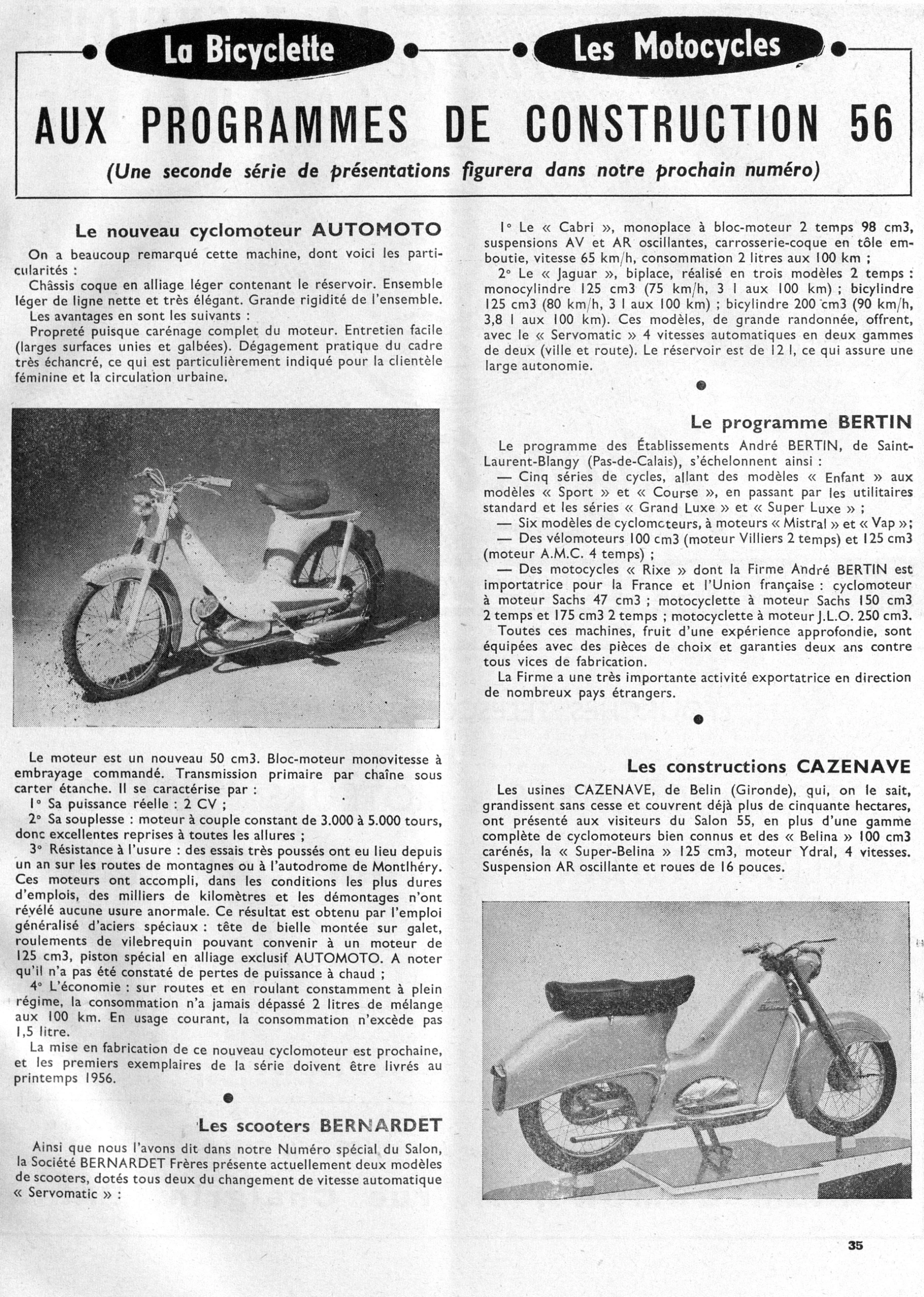
Le nouveau cyclomoteur AUTOMOTO
[Ebykr summary; the article’s text is not reproduced. The paper says the machine was much noticed and gives its particulars. Its frame is a light-alloy shell (châssis coque) that holds the fuel tank, a light, clean-lined and very elegant whole of great rigidity. The advantages claimed are cleanliness, the engine being fully faired; easy upkeep, from large plain curved surfaces; and an easy step-through, the frame being deeply cut away, which the paper says suits women riders and town traffic particularly well. The engine is a new 50 cm3, a single-speed engine-gearbox unit with a controlled clutch (embrayage commandé) and primary drive by chain under a sealed case; its four characteristics follow as printed.]
1° Sa puissance réelle : 2 CV ;
2° Sa souplesse : moteur à couple constant de 3.000 à 5.000 tours, donc excellentes reprises à toutes les allures ;
3° Résistance à l’usure : des essais très poussés ont eu lieu depuis un an sur les routes de montagnes ou à l’autodrome de Montlhéry. Ces moteurs ont accompli, dans les conditions les plus dures d’emplois, des milliers de kilomètres et les démontages n’ont révélé aucune usure anormale. Ce résultat est obtenu par l’emploi généralisé d’aciers spéciaux : tête de bielle montée sur galet, roulements de vilebrequin pouvant convenir à un moteur de 125 cm3, piston spécial en alliage exclusif AUTOMOTO. A noter qu’il n’a pas été constaté de pertes de puissance à chaud ;
4° L’économie : sur routes et en roulant constamment à plein régime, la consommation n’a jamais dépassé 2 litres de mélange aux 100 km. En usage courant, la consommation n’excède pas 1,5 litre.
[Ebykr summary, after the list. Production of the new cyclomoteur is about to start, and the first machines of the series are to be delivered in the spring of 1956.]
Les scooters BERNARDET
[Ebykr summary; the article’s text is not reproduced. As the paper said in its special Salon number, the Société BERNARDET Frères now offers two scooter models, both fitted with the automatic gear change « Servomatic »; the two models follow as printed.]
1° Le « Cabri », monoplace à bloc-moteur 2 temps 98 cm3, suspensions AV et AR oscillantes, carrosserie-coque en tôle emboutie, vitesse 65 km/h, consommation 2 litres aux 100 km ;
2° Le « Jaguar », biplace, réalisé en trois modèles 2 temps : monocylindre 125 cm3 (75 km/h, 3 l aux 100 km) ; bicylindre 125 cm3 (80 km/h, 3 l aux 100 km) ; bicylindre 200 cm3 (90 km/h, 3,8 l aux 100 km).
[Ebykr summary, after the model list. These long-distance touring models give, with the « Servomatic », four automatic speeds in two ranges of two (town and road). The tank holds 12 l, which the paper says gives a wide range.]
Le programme BERTIN
[Ebykr summary; the article’s text is not reproduced. The program of the Établissements André BERTIN, of Saint-Laurent-Blangy (Pas-de-Calais), is laid out in four items, which follow as printed.]
— Cinq séries de cycles, allant des modèles « Enfant » aux modèles « Sport » et « Course », en passant par les utilitaires standard et les séries « Grand Luxe » et « Super Luxe » ;
— Six modèles de cyclomcteurs, à moteurs « Mistral » et « Vap »;
— Des vélomoteurs 100 cm3 (moteur Villiers 2 temps) et 125 cm3 (moteur A.M.C. 4 temps) ;
— Des motocycles « Rixe » dont la Firme André BERTIN est importatrice pour la France et l’Union française : cyclomoteur à moteur Sachs 47 cm3 ; motocyclette à moteur Sachs 150 cm3 2 temps et 175 cm3 2 temps ; motocyclette à moteur J.L.O. 250 cm3.
[Ebykr summary, after the list. All these machines, the paper says, are the fruit of long experience, are fitted with choice components and are guaranteed for two years against every manufacturing defect. The firm is said to do a very large export trade with many foreign countries.]
Les constructions CAZENAVE
[Ebykr summary; the article’s text is not reproduced. The CAZENAVE works, of Belin (Gironde), which the paper says keep growing and already cover more than fifty hectares, showed visitors to the Salon 55, besides a full range of well-known cyclomoteurs and the faired « Belina » of 100 cm3, the « Super-Belina » of 125 cm3 with an Ydral engine and 4 speeds, swinging-arm rear suspension and 16-inch wheels.]
[A full review page in two justified columns of sans-serif type, under a ruled title box that spans the page. Two black lozenge-shaped cartouches set into the top rule carry “La Bicyclette” at the left and “Les Motocycles” at the right in white condensed lettering, each flanked by a heavy dot on the rule; below them “AUX PROGRAMMES DE CONSTRUCTION 56” runs across the box in very large condensed sans-serif capitals and, under it, the line about a second series of presentations is set in bold italic within parentheses. The firm headings are set in bold sans-serif, the firm names in capitals, ranged right over each column; the sections are divided by a single centered black dot. In the left column, under the Automoto text, stands a halftone photograph without caption of a light-colored cyclomoteur seen from the front three-quarters against a plain studio ground: a deep pressed shell frame sweeping down from the steering head and up to the saddle, the engine hidden behind a rounded fairing low in the frame, a telescopic-looking front fork with a deep front mudguard, a headlamp at the handlebar, a single saddle and a pedal crank below the shell. At the foot of the right column a second uncaptioned halftone photograph shows a faired lightweight motorcycle on a display plinth, its front to the right: a long padded dual seat over a rounded rear enclosure that covers the top of the rear wheel, a deep body panel sweeping down from the steering head to a footboard, a dark front fork, a headlamp nacelle at the handlebar and a long thin rod running low along the side below the footboard. Neither photograph carries a signature. The folio “35” is printed in bold at the foot of the right column.]
— Page 2 —
[Ebykr summary; the article’s text is not reproduced. The CAZENAVE section runs on from page 35. The paper calls the « Super-Belina », with its harmonious lines, the marriage, so to speak, of the motorcycle and the scooter, a marriage of reason that the CAZENAVE design office could make thanks to the firm’s large pressing capacity. Enameled in a very successful blue, it offers what is most wanted in a faired machine: total access to every part of the engine and perfect protection of the rider. Finished in the « Super Chrome Cazenave », whose quality the paper calls well established, it sells for 138.400 francs, which the paper calls a very reasonable price, and it predicts a considerable success. The paper then recalls the specifications of the CAZENAVE cyclomoteurs, which follow as printed.]
— Série luxe à chaîne (relais courroie).
N° 310. — Cadre berceau 50 cm. Bloc-moteur 48 cm3, 2 temps Mistral, placé sous le pédalier. Transmission par chaîne avec relais par courroie trapézoïdale. Capotage du moteur. Graissage par mélange. Allumage et éclairage par volant magnétique. Sans débrayage. Système de déblocage à main permettant l’utilisation de la machine comme bicyclette. Pot d’échappement silencieux démontable. Commande gaz et décompresseur par poignée tournante très efficace. Réservoir 2,800 litres. Frein AV sur jante. Frein AR tambour. Moyeux chromés. Jantes chromées. Pneus 600 × 45 B. Rayons de 14 à l’AV, de 15 à l’AR. Garde-boue émaillés. Selle souple. Phare sur garde-boue. Porte-bagages très résistant, fixation par pattes soudées sur haubans. Béquille centrale. Vitesse 45 km/h environ. Émail : noir, vert.
N° 320. — Identique au 310, mais avec embrayage automatique. Pneus 600 × 50 B blancs. Émail : noir, vert, bleu Belina, décors et filets assortis.
N° 321. — Identique au 320, mais avec fourche télescopique chromée. Moyeu AV tambour chromé. Phare parabolique gros modèle logé dans la fourche. Garde-boue AV à bavolets.
N° 421. — Identique au 321, mais avec bloc-moteur 48 cm3, 2 temps Vap 55, à embrayage automatique. Tuyau d’échappement long chromé.
— Série grand luxe à chaîne.
N° 443. — Cadre berceau 50 cm. Bloc-moteur 48 cm3, 2 temps, Vap type B sous pédalier. Transmission par chaîne. Capotage du moteur. Graissage par mélange. Allumage et éclairage par volant magnétique. Débrayage dans le moteur, commandé par câble, ce qui permet l’utilisation de la machine, soit comme bicyclette, soit comme cyclomoteur. Pot d’échappement silencieux, démontable, chromé. Tuyau d’échappement long chromé. Commande gaz et décompresseur par poignée tournante. Réservoir 2,800 litres. Fourche télescopique chromée. Moyeux AV et AR Monobloc à freins centraux. Jantes chromées. Pneus ballon 600 × 50 B. Rayons de 14 à l’AV, de 15 à l’AR. Garde-boue émaillés enveloppants, AV à bavolets. Selle souple poids lourd cuir simili. Pédales caoutchouc. Phare parabolique gros modèle logé dans la fourche. Porte-bagages très résistant, fixation par pattes soudées sur haubans. Béquille centrale. Vitesse 45 km/h. Côtes de 8 %. Émail : noir, vert, bleu Belina. Décors et filets assortis sur cadre, fourche, garde-boue, réservoir, carter.
Les cyclomoteurs COCYNETTE
[Ebykr summary; the article’s text is not reproduced. The effort of COCYMO (Compagnie stéphanoise de Cycles et Motocycles, which the paper presented to its readers in its number of 15 octobre 1955) bears mainly on the 49 cm3 cyclomoteur. Here the « Cocynette », in its three versions « standard », « luxe » and « grand luxe », and fitted on request with one of what the paper calls the three best engines on the market, the Lavalette, the Vap 55 or the Mistral, should give customers great satisfaction; the firm’s slogan, quoted in guillemets, invites the rider to forget the engine and enjoy individual utility transport, family touring and the pleasures of the road. Besides the cyclomoteur, COCYMO will offer a wholly complete range of cycle assemblies and accessories, from the toy bicycle, the frame and the complete bicycle up to the 125 cm3 vélomoteur. A hire-purchase scheme financed by the company itself is in place to ease the sale of the output as far as possible. In figures, the COCYMO production shown at the Salon came to seven bicycles, among them a very fine racing machine with chromed lugs; eight patinettes and children’s bicycles; and ten cyclomoteurs fitted with Vap and Mistral engines and broad, very enveloping streamlined engine covers. COCYMO, the paper recalls, unites in one business the well-known marques Métropole, Cyclorev, Sterling, Racer and Drevon.]
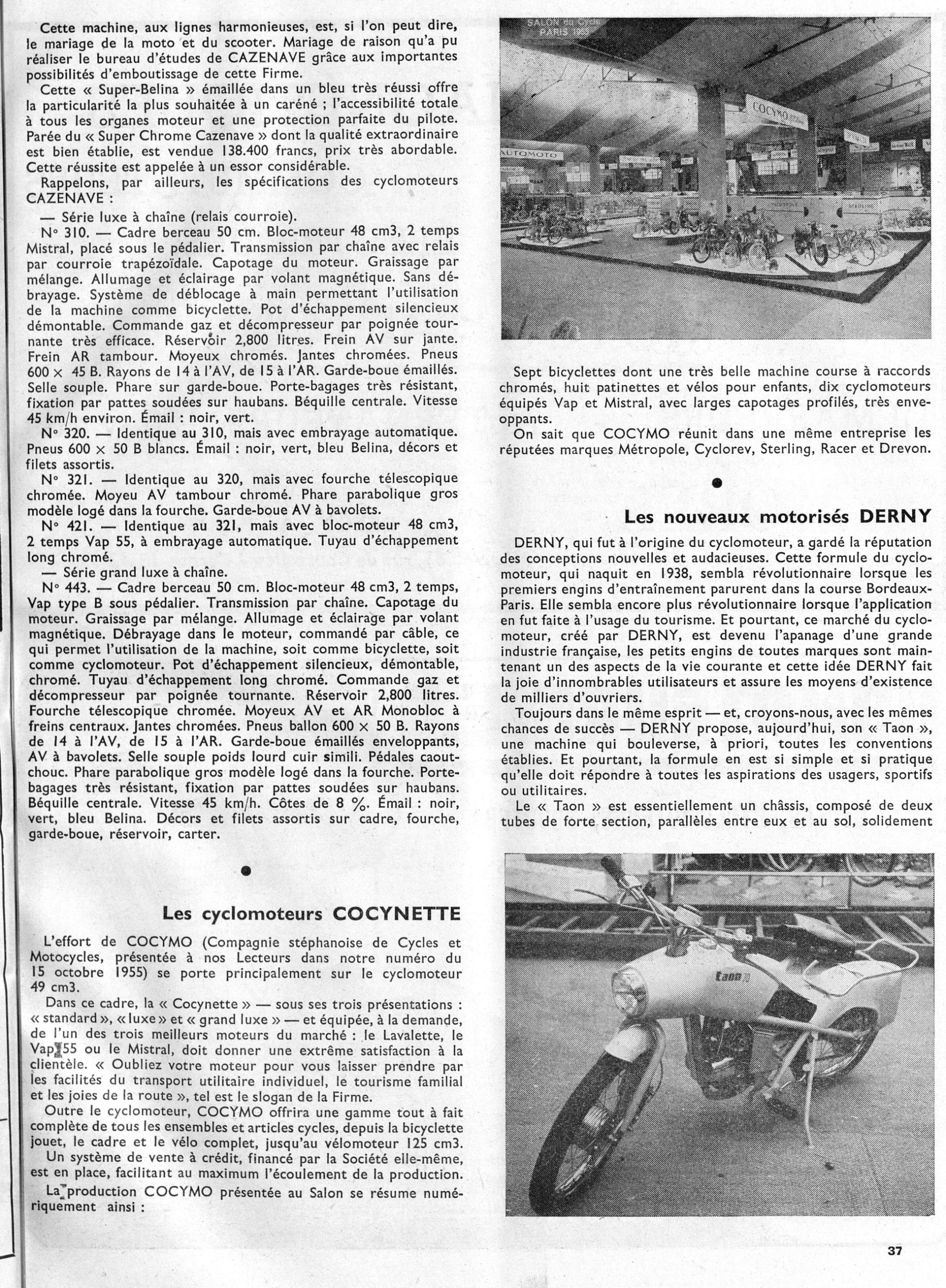
Les nouveaux motorisés DERNY
[Ebykr summary; the article’s text is not reproduced. DERNY, which the paper says was at the origin of the cyclomoteur, has kept its reputation for new and daring designs. This formula of the cyclomoteur, born in 1938, seemed revolutionary when the first pacing machines (engins d’entraînement) appeared in the Bordeaux-Paris race, and more so still when it was applied to touring. Yet this cyclomoteur market, created by DERNY, has become the preserve of a great French industry; small machines of every make are now part of everyday life, and the DERNY idea delights countless users and keeps thousands of workers in a living. In the same spirit, and in the paper’s view with the same chances of success, DERNY now offers its « Taon », a machine that at first sight upsets every established convention but whose formula is so simple and practical that it should answer every wish of riders, sporting or utilitarian. The « Taon » is essentially a chassis made of two tubes of heavy section, parallel to each other and to the ground, firmly — the sentence running on to page 39.]
[A full review page in two justified columns of sans-serif type, the firm headings set in bold sans-serif with the firm names in capitals and ranged right, the sections divided by a single centered black dot. The left column holds the end of the CAZENAVE text, the CAZENAVE specification list (each model number opening its own paragraph, the two series lines set off by a dash) and the opening of the COCYNETTE section. The right column opens with an uncaptioned halftone photograph of a Salon hall under a sweeping curved ceiling with a broad central pillar: island stands on low platforms carry rows of bicycles and cyclomoteurs, a hanging fascia sign at the center reads “COCYMO”, a stand sign at the left reads “AUTOMOTO” and other fascias are too small to read; white lettering painted on the ceiling at the upper left begins “SALON” over “PARIS” with the rest blurred in the screen. At the foot of the right column a second uncaptioned halftone photograph shows a light-colored motorized two-wheeler from the front left three-quarters, parked before a tubular gallery railing: a long rounded tank-like body with a headlamp set into its nose and a short word in dark italic script on its flank, too coarse in the screen to read with certainty, a deep front mudguard over a spoked wheel, a dark engine below the body, a long seat framed by a tubular rail and a prop stand. Neither photograph carries a signature. A vertical rule runs down the left edge of the sheet, outside the type area. The folio “37” is printed in bold at the foot of the right column.]
— Page 3 —
[Ebykr summary; the article’s text is not reproduced. The DERNY section runs on from page 37: the two heavy-section tubes of the « Taon » chassis are firmly braced. This lowered chassis runs on wide-rimmed wheels shod with 500 × 60 tires. The very comfortable seating position, which the paper likens a little to that of certain American motorcycles, lets the rider touch the ground by stretching a leg, mount more easily than on a lady’s bicycle and, by simple adjustments, take any position from the crouched racing silhouette to the fully upright one of the ordinary rider. The very large tank is clothed in an aerodynamic fairing of pressed sheet steel into which a peaked headlamp (phare à visière) is set ahead of the steering head; this strongly styled fairing runs back to the seat tube and gives an impression of power and balance, completed by pressed-steel bodywork that covers the rear wheel generously and in a harmonious line. The whole, of an entirely new look, is said to have style. The very effective suspension is by an arched fork (fourche en arceau) with Neiman rings; together with the large section of the tires and the general design of the machine it lets the rider cross the most difficult ground with astonishing smoothness. The machine is offered in three versions: a single-speed 48 cm3 Vap cyclomoteur, a single-speed 65 cm3 Ser vélomoteur and a 70 cm3 Lavalette vélomoteur with three preselector speeds, three high-output engines of proven quality; the marque also plans to fit the formula with a 98 cm3 engine. The first two, in 48 cm3 or 65 cm3, start by means of Iso suspended pedals without dead center, which alone allow fitting to a lowered chassis. The paper passes over the accessories, naming a large leather tool bag and a speedometer built into a pressed cover on the handlebar, as worthy of a high-class machine. While showing something new, DERNY stays faithful to the 98 cm3 vélomoteurs that made its success, and the new « Cyclo-Sport » shown at the Salon is envied by many lovers of sport and fast touring. The 65 cm3 B.B.1 vélomoteur with a beam frame (cadre poutre) is meeting growing success, for its individual line and its qualities as much as for a price set at that of small-capacity cyclomoteurs.]
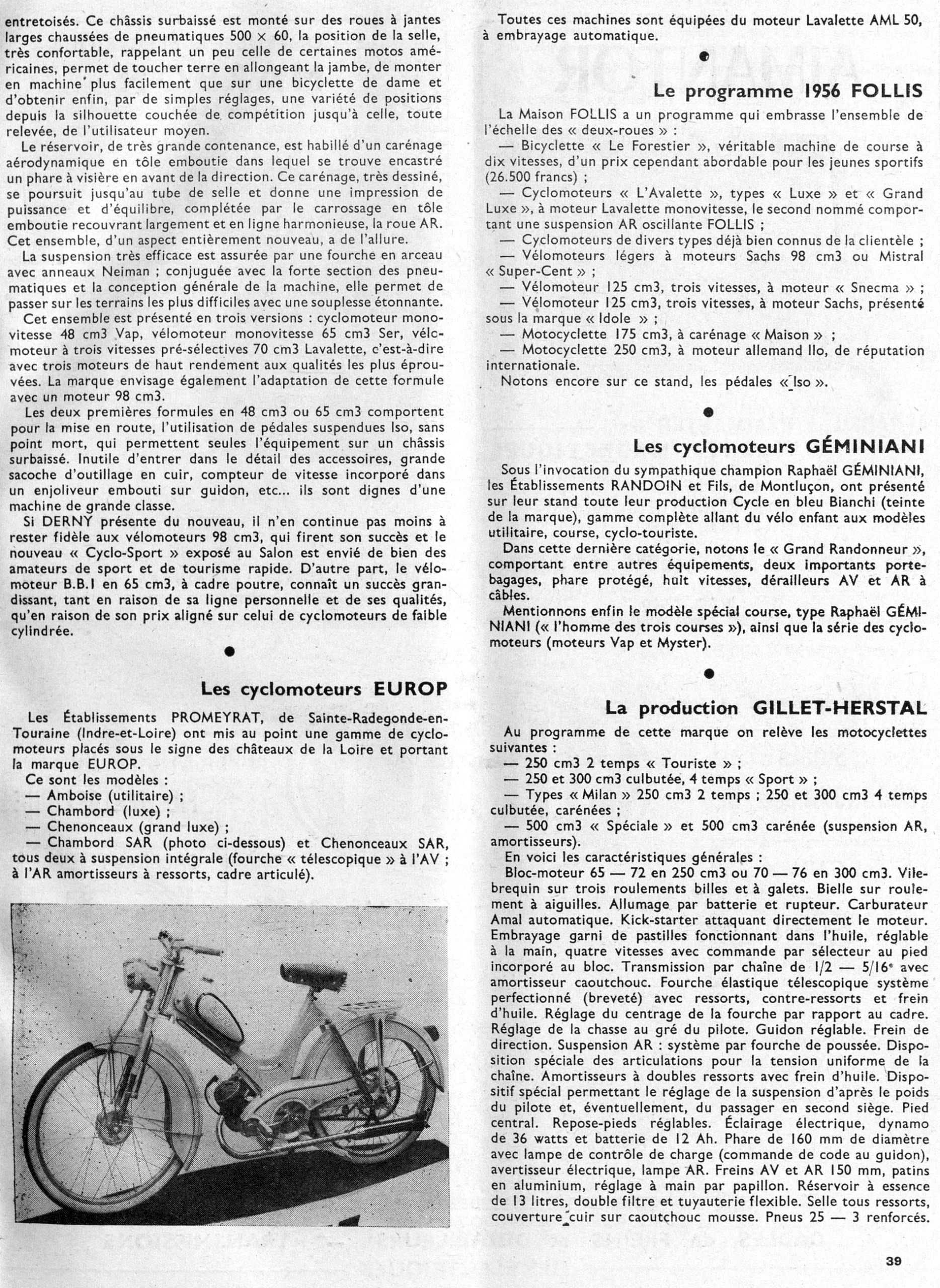
Les cyclomoteurs EUROP
[Ebykr summary; the article’s text is not reproduced. The Établissements PROMEYRAT, of Sainte-Radegonde-en-Touraine (Indre-et-Loire), have developed a range of cyclomoteurs placed under the sign of the châteaux of the Loire and carrying the marque EUROP; the models follow as printed.]
— Amboise (utilitaire) ;
— Chambord (luxe) ;
— Chenonceaux (grand luxe) ;
— Chambord SAR (photo ci-dessous) et Chenonceaux SAR, tous deux à suspension intégrale (fourche « télescopique » à l’AV ; à l’AR amortisseurs à ressorts, cadre articulé).
[Ebykr summary, after the list and the photograph. All these machines are fitted with the Lavalette AML 50 engine with automatic clutch.]
Le programme 1956 FOLLIS
[Ebykr summary; the article’s text is not reproduced. The Maison FOLLIS has a program that covers the whole scale of the « deux-roues »; it follows as printed.]
— Bicyclette « Le Forestier », véritable machine de course à dix vitesses, d’un prix cependant abordable pour les jeunes sportifs (26.500 francs) ;
— Cyclomoteurs « L’Avalette », types « Luxe » et « Grand Luxe », à moteur Lavalette monovitesse, le second nommé comportant une suspension AR oscillante FOLLIS ;
— Cyclomoteurs de divers types déjà bien connus de la clientèle ;
— Vélomoteurs légers à moteurs Sachs 98 cm3 ou Mistral « Super-Cent » ;
— Vélomoteur 125 cm3, trois vitesses, à moteur « Snecma » ;
— Vélomoteur 125 cm3, trois vitesses, à moteur Sachs, présenté sous la marque « Idole » ;
— Motocyclette 175 cm3, à carénage « Maison » ;
— Motocyclette 250 cm3, à moteur allemand Ilo, de réputation internationale.
[Ebykr summary, after the list. The paper also notes the « Iso » pedals on this stand.]
Les cyclomoteurs GÉMINIANI
[Ebykr summary; the article’s text is not reproduced. Under the patronage of the popular champion Raphaël GÉMINIANI, the Établissements RANDOIN et Fils, of Montluçon, showed on their stand their whole cycle production in bleu Bianchi (the marque’s color), a complete range running from the child’s bicycle to the utility, racing and cyclo-touring models. In the last category the paper notes the « Grand Randonneur », whose equipment includes two large luggage carriers, a protected headlamp, eight speeds and cable-operated front and rear derailleurs. It mentions finally the special racing model, type Raphaël GÉMINIANI (« l’homme des trois courses »), and the series of cyclomoteurs (Vap and Myster engines).]
La production GILLET-HERSTAL
[Ebykr summary; the article’s text is not reproduced. The marque’s program comprises the following motorcycles, listed as printed and followed by their general specifications, also as printed.]
— 250 cm3 2 temps « Touriste » ;
— 250 et 300 cm3 culbutée, 4 temps « Sport » ;
— Types « Milan » 250 cm3 2 temps ; 250 et 300 cm3 4 temps culbutée, carénées ;
— 500 cm3 « Spéciale » et 500 cm3 carénée (suspension AR, amortisseurs).
En voici les caractéristiques générales :
Bloc-moteur 65 — 72 en 250 cm3 ou 70 — 76 en 300 cm3. Vilebrequin sur trois roulements billes et à galets. Bielle sur roulement à aiguilles. Allumage par batterie et rupteur. Carburateur Amal automatique. Kick-starter attaquant directement le moteur. Embrayage garni de pastilles fonctionnant dans l’huile, réglable à la main, quatre vitesses avec commande par sélecteur au pied incorporé au bloc. Transmission par chaîne de 1/2 — 5/16e avec amortisseur caoutchouc. Fourche élastique télescopique système perfectionné (breveté) avec ressorts, contre-ressorts et frein d’huile. Réglage du centrage de la fourche par rapport au cadre. Réglage de la chasse au gré du pilote. Guidon réglable. Frein de direction. Suspension AR : système par fourche de poussée. Disposition spéciale des articulations pour la tension uniforme de la chaîne. Amortisseurs à doubles ressorts avec frein d’huile. Dispositif spécial permettant le réglage de la suspension d’après le poids du pilote et, éventuellement, du passager en second siège. Pied central. Repose-pieds réglables. Éclairage électrique, dynamo de 36 watts et batterie de 12 Ah. Phare de 160 mm de diamètre avec lampe de contrôle de charge (commande de code au guidon), avertisseur électrique, lampe AR. Freins AV et AR 150 mm, patins en aluminium, réglage à main par papillon. Réservoir à essence de 13 litres, double filtre et tuyauterie flexible. Selle tous ressorts, couverture cuir sur caoutchouc mousse. Pneus 25 — 3 renforcés.
[A full review page in two justified columns of sans-serif type, the firm headings set in bold sans-serif with the firm names in capitals and ranged right, the sections divided by a single centered black dot. The left column carries the end of the DERNY text and the EUROP section with its dash list of models; below it stands an uncaptioned halftone photograph, the machine the list calls the Chambord SAR, of a light-colored cyclomoteur seen from the front left three-quarters on a plinth that throws a heavy shadow: a telescopic front fork, a deep front mudguard, an oval tank slung along the frame tube with a badge on its side, a sprung saddle on a pillar, a luggage carrier over the rear wheel, a small engine low in the frame ahead of the pedals and a long case running back to the rear hub, the rear wheel carried in a swinging fork. The right column holds, without illustration, the close of the EUROP text and the FOLLIS, GÉMINIANI and GILLET-HERSTAL sections, the Gillet-Herstal specifications set as one long paragraph. The photograph carries no signature. Faint large display letters from the reverse of the leaf show through near the head of the right column and below the photograph. The folio “39” is printed in bold at the foot of the right column.]
— Page 4 —
Les motocycles GNOME et RHONE
[Ebykr summary; the article’s text is not reproduced. GNOME et RHONE had promised something new and a wider range of models; the paper says it kept its word, and its large stand at the Porte de Versailles showed an absolutely complete series of cyclomoteurs, vélomoteurs and motorcycles of the most modern design, able to satisfy the most exacting user. In cyclomoteurs, the three models standard, luxe and grand luxe, sold under the marque « Motavia », have a single-speed 49 cm3 engine with automatic clutch. The cradle frame (cadre berceau), widely open so that anyone can use it, is of steel tube with a double top member (double élément supérieur); the luxe model has front and rear brake hubs with large ribbed shells (moyeux-freins AV et AR à gros corps nervurés). In vélomoteurs there is the well-known « R.4 c » with three speeds and a foot selector, thousands of which are on the roads. A new 125 cm3 engine has been created for the « R.4 d » and « R.4 f »: a compact two-stroke with a cast-iron cylinder and a light-alloy head of high heat exchange, whose three-speed gearbox, in unit with the engine, is worked by cable and a twistgrip on the left of the handlebar; the frames of these two models are otherwise quite different. The « R.5 » models are also entirely new: the engine looks outwardly like that of the 175 and 200, and the line of the machine is that of the « L.5 », « L.53 » and « Lx.200 ». The « R.5 » engine is a two-stroke unit with four speeds selected by foot, with telescopic front fork and rear suspension, a large streamlined tool box, deep enveloping mudguards and a saddle hinged at the front; the paper calls it the very type of the fast, elegant and robust vélomoteur. The buyer who wants total protection and a still more luxurious look will choose the faired model, which takes the same enclosure (capotage) as the marque’s other faired machines of 175 and 200 cm3; the paper recalls that this enclosure is fully effective, does not hinder access to the engine thanks to an inspection flap (volet de visite), is absolutely silent and helps cooling by channeling the air onto the engine through its front grille, which forms a deflector. In motorcycles, the 175 cm3 « L.5 », faired or not, look outwardly like the new 125 cm3 « R.5 », but differ somewhat in their electrical equipment, with a battery, and in their large-shell Saperli hubs with central braking. The luxe model, the « L.53 », differs by its reinforced telescopic fork, its fourteen-liter tank and its interchangeable wheels with GNOME et RHONE spindle hubs (moyeux à broches). The corresponding faired model is the « Lc.531 », meant for customers who want the utmost comfort and the most careful finish for long-distance touring solo or two-up. In 200 cm3, GNOME et RHONE shows its two « Lx.200 » models, faired or not, whose speed reaches 115 km/h; outwardly they differ from the « L.53 » and « Lc.531 » only by the dual seat. For lovers of « tous terrains » sport there is the Spécial Trial with the 175 or 200 cm3 engine. Enameled bright red, it has at the rear a deep-tread tire of the « track-gripp » type, smaller mudguards standing clear of the wheel, a raised exhaust pipe with an expansion chamber and special silencer, and front and rear stands.]
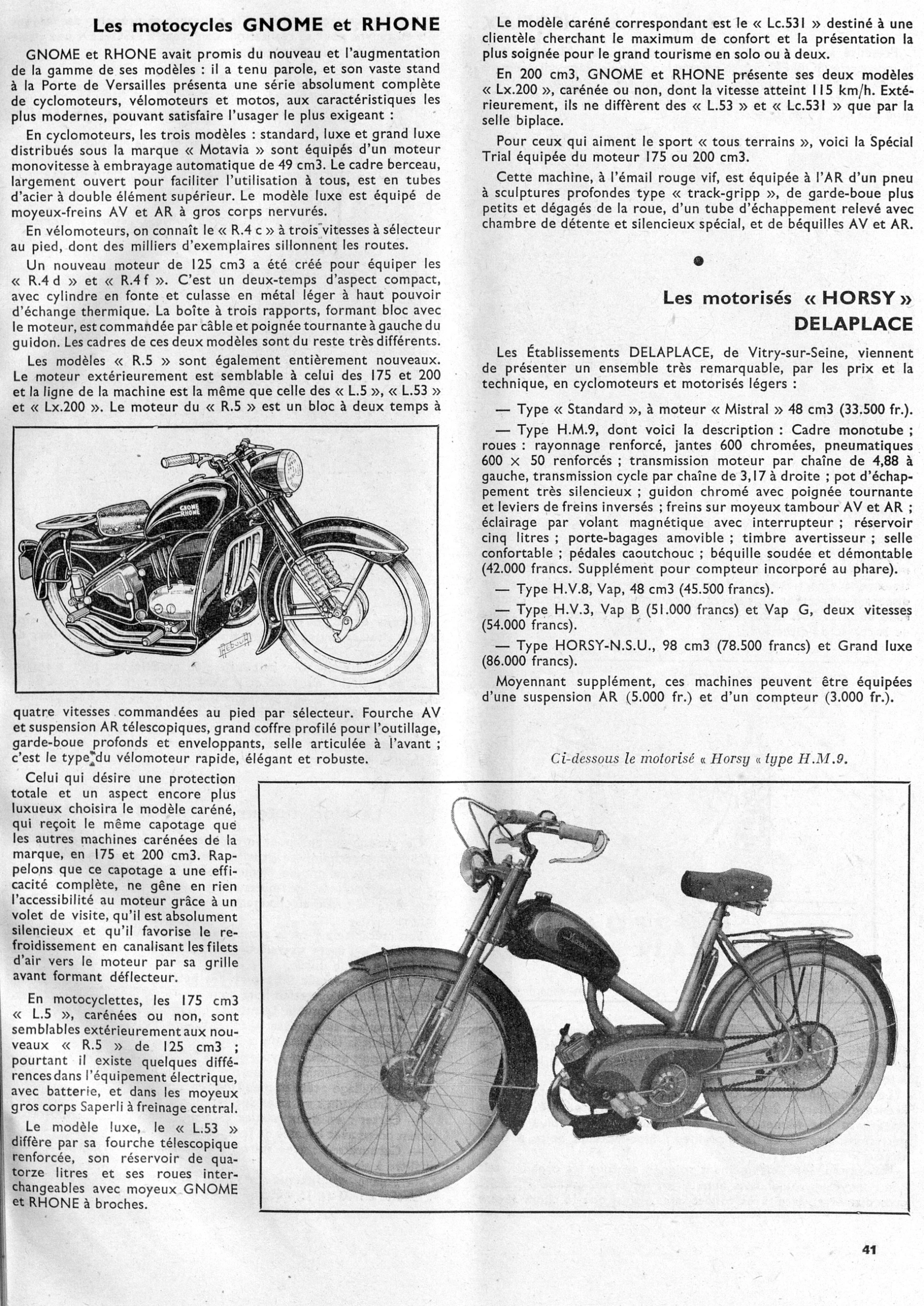
Les motorisés « HORSY »
DELAPLACE
[Ebykr summary; the article’s text is not reproduced. The Établissements DELAPLACE, of Vitry-sur-Seine, have just presented a range of cyclomoteurs and light motorized machines that the paper calls very remarkable for both price and engineering; the types follow as printed.]
— Type « Standard », à moteur « Mistral » 48 cm3 (33.500 fr.).
— Type H.M.9, dont voici la description : Cadre monotube ; roues : rayonnage renforcé, jantes 600 chromées, pneumatiques 600 × 50 renforcés ; transmission moteur par chaîne de 4,88 à gauche, transmission cycle par chaîne de 3,17 à droite ; pot d’échappement très silencieux ; guidon chromé avec poignée tournante et leviers de freins inversés ; freins sur moyeux tambour AV et AR ; éclairage par volant magnétique avec interrupteur ; réservoir cinq litres ; porte-bagages amovible ; timbre avertisseur ; selle confortable ; pédales caoutchouc ; béquille soudée et démontable (42.000 francs. Supplément pour compteur incorporé au phare).
— Type H.V.8, Vap, 48 cm3 (45.500 francs).
— Type H.V.3, Vap B (51.000 francs) et Vap G, deux vitesses (54.000 francs).
— Type HORSY-N.S.U., 98 cm3 (78.500 francs) et Grand luxe (86.000 francs).
[Ebykr summary, after the list. At extra cost these machines can be fitted with rear suspension (5.000 fr.) and a speedometer (3.000 fr.).]
Ci-dessous le motorisé « Horsy « type H.M.9.
[A full review page in two justified columns of sans-serif type, the firm headings set in bold sans-serif with the firm names in capitals and ranged right, the two sections divided by a single centered black dot; the HORSY heading runs over two lines. In the left column, inside a thin ruled frame, is a line drawing in pen and ink of a GNOME et RHONE motorcycle seen from the right front three-quarters, worked in close hatching and heavy solid blacks: a dark teardrop tank lettered “GNOME” over “RHONE” in white capitals, a single saddle on springs with a luggage grid behind it, a finned two-stroke engine behind a vertical slatted grille, a telescopic front fork with exposed coil springs, a deep front mudguard, a headlamp above the fork, footrests and a long low silencer. The drawing is signed “Rebour” in hand-drawn capitals boxed by ruled lines, below the engine at the lower center of the frame. Below the drawing the left column narrows to clear a second ruled frame that spans the lower right of the page and holds a cut-out halftone photograph, without background, of the HORSY H.M.9 cyclomoteur in profile facing left: a single sloping main tube from the steering head to the bottom bracket with an angled seat tube, a dark tank on the main tube bearing a script name too coarse to read, a small engine low ahead of the pedals with an enclosed case running back to the rear hub, a sprung saddle, a luggage carrier, deep mudguards and a bulb headlamp at the handlebar. The italic caption “Ci-dessous le motorisé « Horsy « type H.M.9.” is centered above the photograph frame, its second guillemet printed as an opening mark. The photograph carries no signature. Faint lines of type from the reverse of the leaf show through in the lower part of the photograph frame. The folio “41” is printed in bold at the foot of the right column.]
— Page 5 —
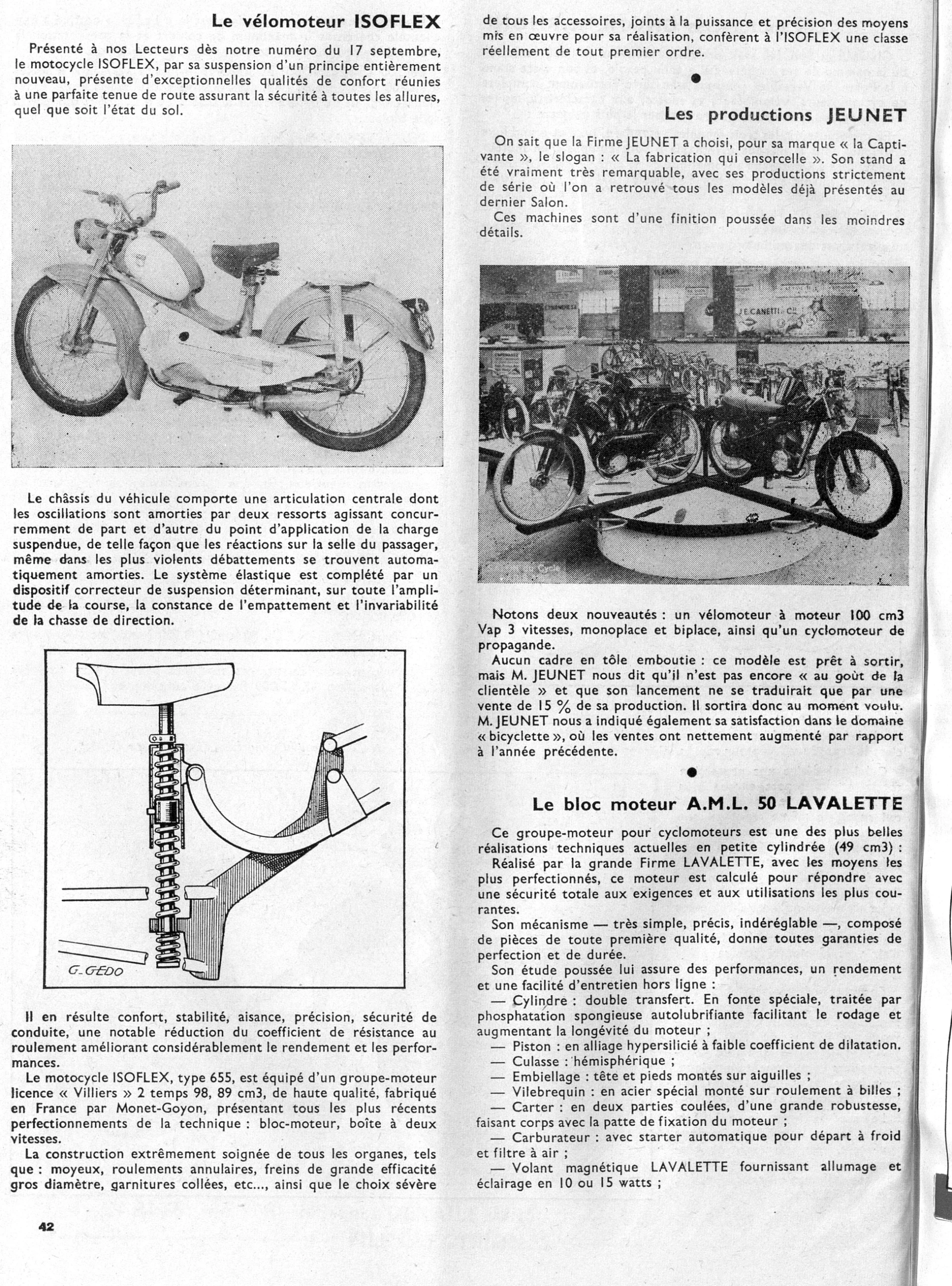
Le vélomoteur ISOFLEX
[Ebykr summary; the article’s text is not reproduced. Presented to the paper’s readers as early as its number of 17 septembre, the ISOFLEX motocycle, by its suspension of an entirely new principle, is said to offer exceptional comfort together with perfect road holding, giving safety at every pace whatever the state of the ground. The chassis has a central articulation whose movements are damped by two springs working together on either side of the point where the suspended load bears, so that the reactions at the rider’s saddle (selle du passager), even in the most violent movements, are damped automatically. The elastic system is completed by a suspension-correcting device that keeps the wheelbase constant and the steering trail (chasse de direction) unchanged over the whole travel. The paper lists the results: comfort, stability, ease, precision and safety in riding, together with a notable reduction in rolling resistance that considerably improves efficiency and performance. The ISOFLEX motocycle, type 655, has a high-quality « Villiers »-licence two-stroke engine group of “98, 89 cm3” made in France by Monet-Goyon, with the latest technical refinements: engine-gearbox unit and two-speed box. The very careful construction of every part, such as the hubs, the ball bearings (roulements annulaires), the very effective large-diameter brakes with bonded linings, together with the strict choice of all accessories and the power and precision of the means used to build it, give the ISOFLEX, in the paper’s words, a truly first-rank class.]
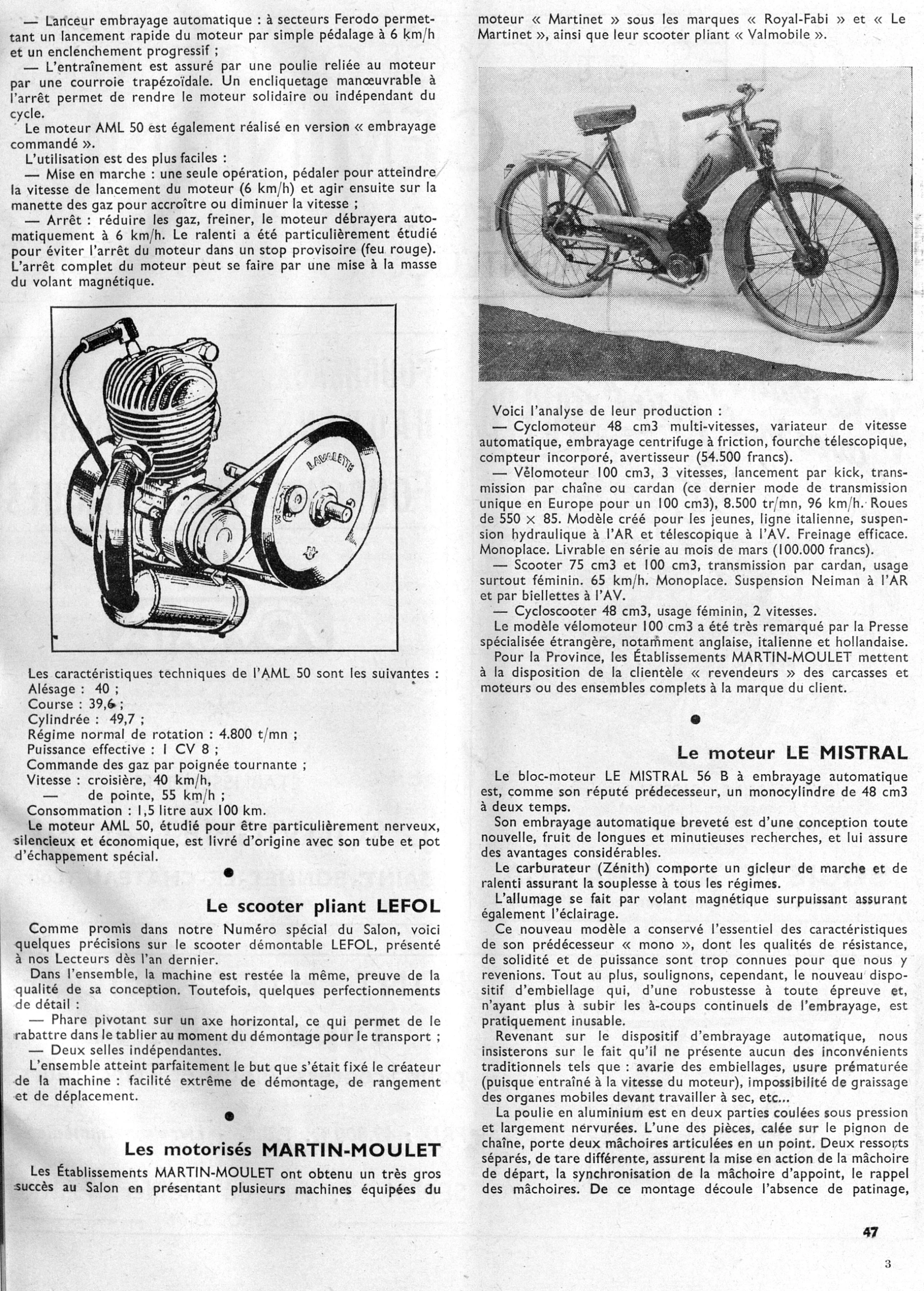
Les productions JEUNET
[Ebykr summary; the article’s text is not reproduced. The JEUNET firm has chosen for its marque « la Captivante » the slogan « La fabrication qui ensorcelle ». Its stand was very remarkable, with strictly series-built machines among which were all the models already shown at the last Salon, finished to the smallest detail. The paper notes two new things: a vélomoteur with a 100 cm3 Vap three-speed engine, in single-seat and two-seat form, and a « cyclomoteur de propagande ». There is no pressed-steel frame: such a model is ready, but M. JEUNET told the paper that it is not yet « au goût de la clientèle » and that its launch would bring the sale of only 15 % of his output, so it will come out at the right moment. M. JEUNET also said he was satisfied in the « bicyclette » field, where sales have risen clearly over the year before.]
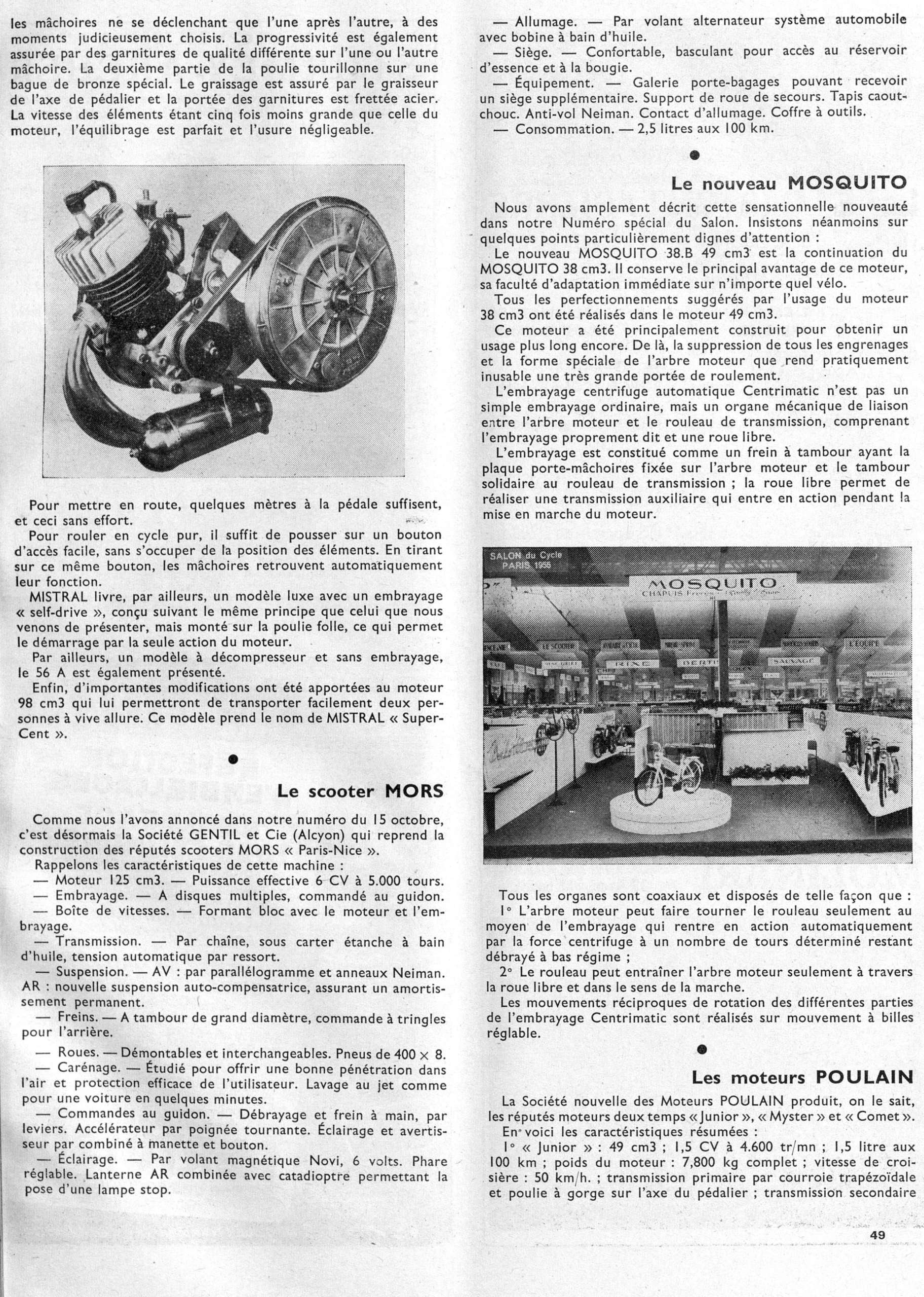
Le bloc moteur A.M.L. 50 LAVALETTE
[Ebykr summary; the article’s text is not reproduced. The paper calls this engine group for cyclomoteurs one of the finest technical achievements of the moment in small capacity (49 cm3). Built by the great LAVALETTE firm with the most advanced means, it is designed to meet the most common demands and uses with complete safety. Its mechanism, very simple, precise and incapable of going out of adjustment, made of parts of the very first quality, is said to give every guarantee of perfection and long life, and its thorough design to give outstanding performance, efficiency and ease of upkeep. Its features follow as printed, the list running on to page 47.]
— Cylindre : double transfert. En fonte spéciale, traitée par phosphatation spongieuse autolubrifiante facilitant le rodage et augmentant la longévité du moteur ;
— Piston : en alliage hypersilicié à faible coefficient de dilatation.
— Culasse : hémisphérique ;
— Embiellage : tête et pieds montés sur aiguilles ;
— Vilebrequin : en acier spécial monté sur roulement à billes ;
— Carter : en deux parties coulées, d’une grande robustesse, faisant corps avec la patte de fixation du moteur ;
— Carburateur : avec starter automatique pour départ à froid et filtre à air ;
— Volant magnétique LAVALETTE fournissant allumage et éclairage en 10 ou 15 watts ;
[A full review page in two justified columns of sans-serif type, the firm headings set in bold sans-serif with the firm names in capitals and ranged right, the sections divided by a single centered black dot. In the left column, under the ISOFLEX heading and its first paragraph, is an uncaptioned halftone photograph of a light-colored lightweight machine in left profile, its front to the left: a deep pressed-steel body sweeping from the steering head down under the rider and back over the rear wheel, a dark round mark on its flank, a single saddle on a pillar, a front fork with a deep mudguard, a headlamp at the handlebar and a rear lamp and plate at the tail. Lower in the same column, inside a thin ruled frame, is a line drawing without caption of the ISOFLEX suspension in part: a saddle on a pillar that slides in a sleeve wrapped in a coil spring, a curved arm pivoting from a lug on the sleeve and running down to a hatched bracket with two pivot pins; the stubs of frame tubes are cut off at the left; the drawing is in clean pen line with ruled hatching on the bracket. It is signed “G_GEDO” in italic capitals, a short low stroke between the G and GEDO, at the lower left inside the frame. At the head of the right column, after the close of the ISOFLEX text and the JEUNET heading, an uncaptioned halftone photograph shows the JEUNET stand crowded with bicycles and cyclomoteurs on a round dais and a tubular display frame, before a back wall of pillars and fascia signs, one of which appears to read “J. E. CANETTI” followed by “Cie”; the photograph carries no signature. The folio “42” is printed in bold at the foot of the left column.]
— Page 6 —
— Lanceur embrayage automatique : à secteurs Ferodo permettant un lancement rapide du moteur par simple pédalage à 6 km/h et un enclenchement progressif ;
— L’entraînement est assuré par une poulie reliée au moteur par une courroie trapézoïdale. Un encliquetage manœuvrable à l’arrêt permet de rendre le moteur solidaire ou indépendant du cycle.
[Ebykr summary; the article’s text is not reproduced. The LAVALETTE section runs on from page 42 with the last two items of its list, above. The AML 50 engine is also made in an « embrayage commandé » version. Its use is said to be of the easiest, as the two points below set out.]
— Mise en marche : une seule opération, pédaler pour atteindre la vitesse de lancement du moteur (6 km/h) et agir ensuite sur la manette des gaz pour accroître ou diminuer la vitesse ;
— Arrêt : réduire les gaz, freiner, le moteur débrayera automatiquement à 6 km/h. Le ralenti a été particulièrement étudié pour éviter l’arrêt du moteur dans un stop provisoire (feu rouge). L’arrêt complet du moteur peut se faire par une mise à la masse du volant magnétique.
Les caractéristiques techniques de l’AML 50 sont les suivantes :
Alésage : 40 ;
Course : 39,6 ;
Cylindrée : 49,7 ;
Régime normal de rotation : 4.800 t/mn ;
Puissance effective : 1 CV 8 ;
Commande des gaz par poignée tournante ;
Vitesse : croisière, 40 km/h,
— de pointe, 55 km/h ;
Consommation : 1,5 litre aux 100 km.
[Ebykr summary, after the specification list. The AML 50, designed to be especially lively, quiet and economical, is delivered from the factory with its own special exhaust pipe and silencer.]
Le scooter pliant LEFOL
[Ebykr summary; the article’s text is not reproduced. As promised in its special Salon number, the paper gives some particulars of the LEFOL take-down (démontable) scooter, shown to its readers the year before. On the whole the machine is unchanged, which the paper takes as proof of a sound design, with some detail improvements, listed as printed below; the whole is said to meet its designer’s aim perfectly: extreme ease of dismantling, storage and carrying.]
— Phare pivotant sur un axe horizontal, ce qui permet de le rabattre dans le tablier au moment du démontage pour le transport ;
— Deux selles indépendantes.
Les motorisés MARTIN-MOULET
[Ebykr summary; the article’s text is not reproduced. The Établissements MARTIN-MOULET had a very great success at the Salon with several machines fitted with the « Martinet » engine under the marques « Royal-Fabi » and « Le Martinet », and with their folding scooter « Valmobile ». Their production is analyzed as follows, as printed.]
Voici l’analyse de leur production :
— Cyclomoteur 48 cm3 multi-vitesses, variateur de vitesse automatique, embrayage centrifuge à friction, fourche télescopique, compteur incorporé, avertisseur (54.500 francs).
— Vélomoteur 100 cm3, 3 vitesses, lancement par kick, transmission par chaîne ou cardan (ce dernier mode de transmission unique en Europe pour un 100 cm3), 8.500 tr/mn, 96 km/h. Roues de 550 × 85. Modèle créé pour les jeunes, ligne italienne, suspension hydraulique à l’AR et télescopique à l’AV. Freinage efficace. Monoplace. Livrable en série au mois de mars (100.000 francs).
— Scooter 75 cm3 et 100 cm3, transmission par cardan, usage surtout féminin. 65 km/h. Monoplace. Suspension Neiman à l’AR et par biellettes à l’AV.
— Cycloscooter 48 cm3, usage féminin, 2 vitesses.
[Ebykr summary, after the list. The 100 cm3 vélomoteur was much noticed by the foreign specialist press, notably English, Italian and Dutch. For the provinces, the Établissements MARTIN-MOULET offer the « revendeurs » trade bare frames (carcasses) and engines, or complete machines under the customer’s own marque.]
Le moteur LE MISTRAL
[Ebykr summary; the article’s text is not reproduced. The LE MISTRAL 56 B engine-gearbox unit with automatic clutch is, like its well-known predecessor, a 48 cm3 two-stroke single. Its patented automatic clutch is of an entirely new design, the fruit of long and careful research, and is said to give it considerable advantages. The carburetor (Zénith) has a main jet and an idling jet for flexibility at every engine speed; ignition is by a very powerful flywheel magneto that also supplies the lighting. The new model keeps the essentials of its « mono » predecessor, whose strength, solidity and power the paper calls too well known to repeat; it stresses the new connecting-rod assembly, very robust and, no longer subject to the constant jolts of the clutch, practically wear-proof. Returning to the automatic clutch, the paper insists that it has none of the traditional drawbacks, such as damaged connecting-rod assemblies, early wear (since it is driven at engine speed) or moving parts that cannot be lubricated and must run dry. The aluminum pulley is in two pressure-cast, heavily ribbed parts. One part, keyed to the chain sprocket, carries two shoes (mâchoires) hinged at one point. Two separate springs of different rating bring the starting shoe into action, synchronize the auxiliary shoe and return the shoes; from this arrangement, the paper says, follows the absence of slip — the sentence running on to page 49.]
[A full review page in two justified columns of sans-serif type, the firm headings set in bold sans-serif with the firm names in capitals and ranged right, the sections divided by a single centered black dot. In the left column, inside a thin ruled frame, is an uncaptioned pen drawing of the LAVALETTE engine unit seen from the drive side: a finned cylinder and head with a spark-plug cap and lead, a curved exhaust pipe dropping to a cylindrical silencer slung below the crankcase and a large pulley joined to the engine by a V-belt, the pulley lettered “LAVALETTE” along its rim; a small pulley at the crankshaft is drawn with a short mark beside it that may be a maker’s figure and a small stylized device stands near the lower edge of the large pulley. The drawing is in firm outline with hatched shading and carries no artist’s signature. Below it run the specification list, the LEFOL section and the opening of the MARTIN-MOULET section. At the head of the right column an uncaptioned halftone photograph shows a light-colored cyclomoteur in right profile on a plinth with a dark shadow: a dropped frame with a large tank or enclosure on the down tube, a dark engine low in the frame ahead of the pedals, a telescopic front fork, deep mudguards, a headlamp at the handlebar, a sprung saddle and a luggage carrier; the photograph carries no signature. The folio “47” is printed in bold at the foot of the right column, with a small printer’s signature figure “3” set below and to the right of it.]
— Page 7 —
[Ebykr summary; the article’s text is not reproduced. The LE MISTRAL section runs on from page 47: there is no slip because the shoes engage only one after the other, at well-chosen moments. Progressive engagement is also obtained by linings of different quality on the two shoes. The second part of the pulley turns on a ring of special bronze; lubrication is by the bottom-bracket axle’s grease nipple and the lining track is steel-shrunk (frettée acier). The parts turning five times slower than the engine, balance is said to be perfect and wear negligible. To start, a few meters on the pedals are enough, without effort. To ride as a pure bicycle, the rider pushes an easily reached button, whatever the position of the parts; pulling the same button returns the shoes to work automatically. MISTRAL also supplies a luxe model with a « self-drive » clutch, built on the same principle but mounted on the free pulley (poulie folle), which lets the machine start by the engine alone. A model with a decompressor and without clutch, the 56 A, is also shown. Finally, important changes have been made to the 98 cm3 engine that will let it carry two people easily at a lively pace; this model takes the name MISTRAL « Super-Cent ».]
Le scooter MORS
[Ebykr summary; the article’s text is not reproduced. As the paper announced in its number of 15 octobre, the Société GENTIL et Cie (Alcyon) now takes over the building of the well-known MORS « Paris-Nice » scooters. The machine’s characteristics are recalled as follows, as printed.]
Rappelons les caractéristiques de cette machine :
— Moteur 125 cm3. — Puissance effective 6 CV à 5.000 tours.
— Embrayage. — A disques multiples, commandé au guidon.
— Boîte de vitesses. — Formant bloc avec le moteur et l’embrayage.
— Transmission. — Par chaîne, sous carter étanche à bain d’huile, tension automatique par ressort.
— Suspension. — AV : par parallélogramme et anneaux Neiman. AR : nouvelle suspension auto-compensatrice, assurant un amortissement permanent.
— Freins. — A tambour de grand diamètre, commande à tringles pour l’arrière.
— Roues. — Démontables et interchangeables. Pneus de 400 × 8.
— Carénage. — Étudié pour offrir une bonne pénétration dans l’air et protection efficace de l’utilisateur. Lavage au jet comme pour une voiture en quelques minutes.
— Commandes au guidon. — Débrayage et frein à main, par leviers. Accélérateur par poignée tournante. Éclairage et avertisseur par combiné à manette et bouton.
— Éclairage. — Par volant magnétique Novi, 6 volts. Phare réglable. Lanterne AR combinée avec catadioptre permettant la pose d’une lampe stop.
— Allumage. — Par volant alternateur système automobile avec bobine à bain d’huile.
— Siège. — Confortable, basculant pour accès au réservoir d’essence et à la bougie.
— Équipement. — Galerie porte-bagages pouvant recevoir un siège supplémentaire. Support de roue de secours. Tapis caoutchouc. Anti-vol Neiman. Contact d’allumage. Coffre à outils.
— Consommation. — 2,5 litres aux 100 km.
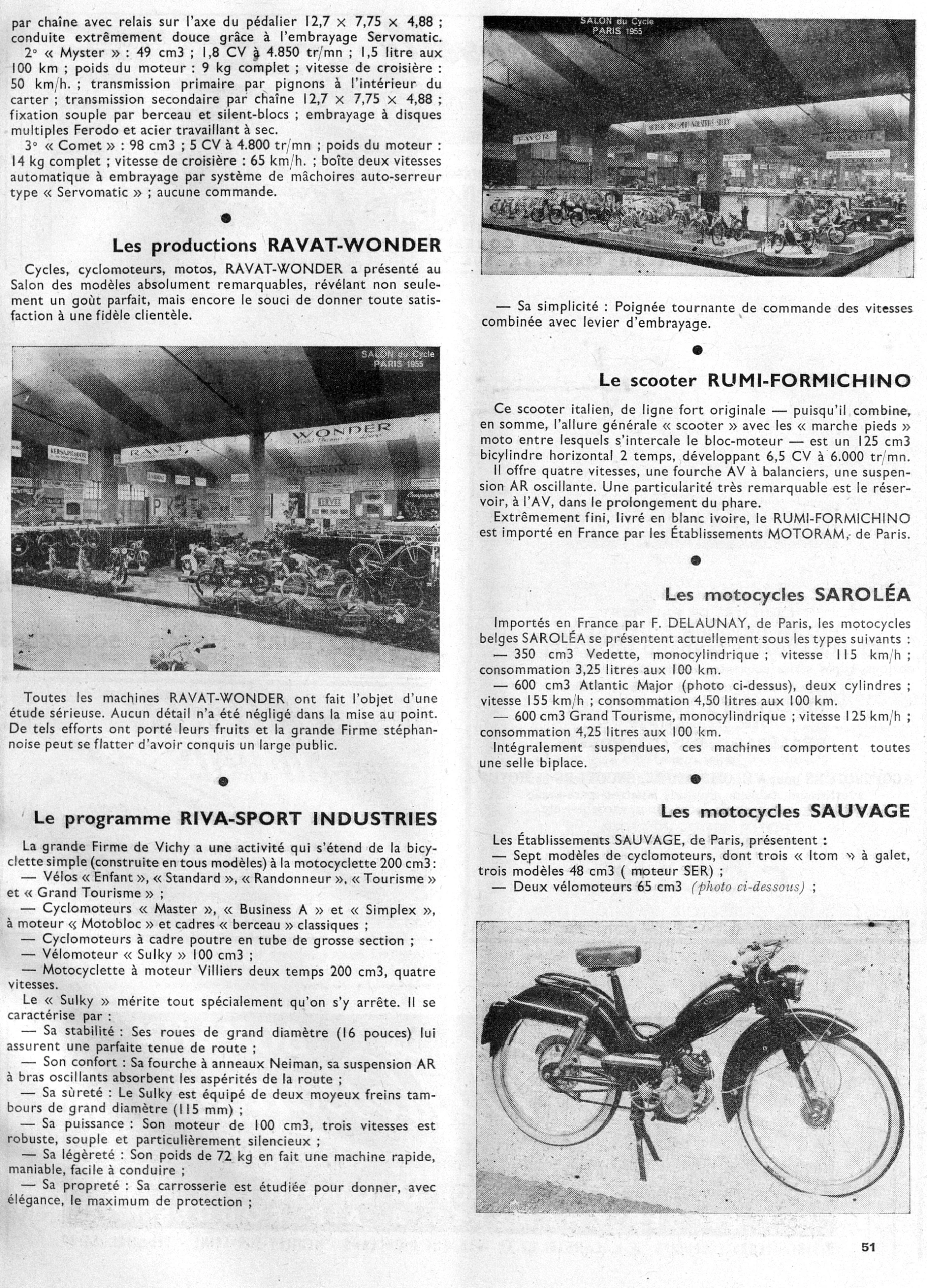
Le nouveau MOSQUITO
[Ebykr summary; the article’s text is not reproduced. The paper described this sensational novelty fully in its special Salon number and stresses only a few points. The new MOSQUITO 38.B of 49 cm3 continues the MOSQUITO 38 cm3 and keeps that engine’s chief advantage, its immediate fitting to any bicycle; every improvement suggested by the use of the 38 cm3 engine has been made in the 49 cm3. The engine was built above all for a still longer life, hence the removal of all gears and the special shape of the engine shaft, which a very large bearing surface makes practically wear-proof. The Centrimatic automatic centrifugal clutch is not a plain ordinary clutch but a mechanical link between the engine shaft and the drive roller (rouleau de transmission), comprising the clutch proper and a freewheel. The clutch is built like a drum brake, the shoe plate fixed on the engine shaft and the drum joined to the roller; the freewheel provides an auxiliary drive that works while the engine is being started. All the parts are coaxial and so arranged that the two conditions below hold, as printed; the relative turning of the Centrimatic parts runs on an adjustable ball bearing.]
1° L’arbre moteur peut faire tourner le rouleau seulement au moyen de l’embrayage qui rentre en action automatiquement par la force centrifuge à un nombre de tours déterminé restant débrayé à bas régime ;
2° Le rouleau peut entraîner l’arbre moteur seulement à travers la roue libre et dans le sens de la marche.
Les moteurs POULAIN
[Ebykr summary; the article’s text is not reproduced. The Société nouvelle des Moteurs POULAIN makes, as is known, the well-known two-stroke engines « Junior », « Myster » and « Comet », whose summarized characteristics follow as printed, the list running on to page 51.]
En voici les caractéristiques résumées :
1° « Junior » : 49 cm3 ; 1,5 CV à 4.600 tr/mn ; 1,5 litre aux 100 km ; poids du moteur : 7,800 kg complet ; vitesse de croisière : 50 km/h. ; transmission primaire par courroie trapézoïdale et poulie à gorge sur l’axe du pédalier ; transmission secondaire
[A full review page in two justified columns of sans-serif type, the firm headings set in bold sans-serif with the firm names in capitals and ranged right, the sections divided by a single centered black dot. In the left column, under the close of the LE MISTRAL text, an uncaptioned halftone photograph shows a small engine unit without its frame, cut out against a plain ground: a finned cylinder with a lifting loop or lead at its head and a spark plug, a crankcase with a large spoked, ribbed pulley joined to the engine by a belt and a cylindrical silencer slung below; the photograph carries no signature. In the right column, between the MOSQUITO text and its close, a second uncaptioned halftone photograph shows the MOSQUITO stand at the Salon: a large fascia lettered “MOSQUITO” over a smaller line beginning “CHAPUIS Frères” with the rest too fine to read and cyclomoteurs on a round turntable dais and on display boards; behind them is a hall of other stand fascias, of which “RIXE” and “L’EQUIPE” are among the few legible; white lettering at the upper left reads “SALON du Cycle” over “PARIS 1955”. The photograph carries no signature. The folio “49” is printed in bold at the foot of the right column.]
— Page 8 —
par chaîne avec relais sur l’axe du pédalier 12,7 × 7,75 × 4,88 ; conduite extrêmement douce grâce à l’embrayage Servomatic.
2° « Myster » : 49 cm3 ; 1,8 CV à 4.850 tr/mn ; 1,5 litre aux 100 km ; poids du moteur : 9 kg complet ; vitesse de croisière : 50 km/h. ; transmission primaire par pignons à l’intérieur du carter ; transmission secondaire par chaîne 12,7 × 7,75 × 4,88 ; fixation souple par berceau et silent-blocs ; embrayage à disques multiples Ferodo et acier travaillant à sec.
3° « Comet » : 98 cm3 ; 5 CV à 4.800 tr/mn ; poids du moteur : 14 kg complet ; vitesse de croisière : 65 km/h. ; boîte deux vitesses automatique à embrayage par système de mâchoires auto-serreur type « Servomatic » ; aucune commande.
Les productions RAVAT-WONDER
[Ebykr summary; the article’s text is not reproduced. In cycles, cyclomoteurs and motorcycles, RAVAT-WONDER showed at the Salon models the paper calls absolutely remarkable, showing not only perfect taste but also the wish to satisfy a faithful clientele completely. Every RAVAT-WONDER machine has been seriously studied and no detail neglected in its development; such efforts have borne fruit, and the paper says the great Saint-Étienne firm (la grande Firme stéphannoise) may pride itself on having won a wide public.]
Le programme RIVA-SPORT INDUSTRIES
[Ebykr summary; the article’s text is not reproduced. The great Vichy firm’s activity runs from the plain bicycle, built in every model, to the 200 cm3 motorcycle; its program and the points the paper lists for the « Sulky » follow as printed.]
— Vélos « Enfant », « Standard », « Randonneur », « Tourisme » et « Grand Tourisme » ;
— Cyclomoteurs « Master », « Business A » et « Simplex », à moteur « Motobloc » et cadres « berceau » classiques ;
— Cyclomoteurs à cadre poutre en tube de grosse section ;
— Vélomoteur « Sulky » 100 cm3 ;
— Motocyclette à moteur Villiers deux temps 200 cm3, quatre vitesses.
Le « Sulky » mérite tout spécialement qu’on s’y arrête. Il se caractérise par :
— Sa stabilité : Ses roues de grand diamètre (16 pouces) lui assurent une parfaite tenue de route ;
— Son confort : Sa fourche à anneaux Neiman, sa suspension AR à bras oscillants absorbent les aspérités de la route ;
— Sa sùreté : Le Sulky est équipé de deux moyeux freins tambours de grand diamètre (115 mm) ;
— Sa puissance : Son moteur de 100 cm3, trois vitesses est robuste, souple et particulièrement silencieux ;
— Sa légèreté : Son poids de 72 kg en fait une machine rapide, maniable, facile à conduire ;
— Sa propreté : Sa carrosserie est étudiée pour donner, avec élégance, le maximum de protection ;
— Sa simplicité : Poignée tournante de commande des vitesses combinée avec levier d’embrayage.
Le scooter RUMI-FORMICHINO
[Ebykr summary; the article’s text is not reproduced. This Italian scooter, of a very original line in that it combines the general look of a scooter with motorcycle-style footboards (« marche pieds ») between which the engine unit sits, is a 125 cm3 horizontal twin two-stroke giving 6,5 CV at 6.000 tr/mn. It has four speeds, a leading-link front fork (fourche AV à balanciers) and swinging-arm rear suspension; a very remarkable feature is the fuel tank at the front, in line with the headlamp. Very highly finished and delivered in ivory white, the RUMI-FORMICHINO is imported into France by the Établissements MOTORAM, of Paris.]
Les motocycles SAROLÉA
[Ebykr summary; the article’s text is not reproduced. Imported into France by F. DELAUNAY, of Paris, the Belgian SAROLÉA motorcycles are now offered in the types below, as printed; all fully sprung, each has a dual seat.]
— 350 cm3 Vedette, monocylindrique ; vitesse 115 km/h ; consommation 3,25 litres aux 100 km.
— 600 cm3 Atlantic Major (photo ci-dessus), deux cylindres ; vitesse 155 km/h ; consommation 4,50 litres aux 100 km.
— 600 cm3 Grand Tourisme, monocylindrique ; vitesse 125 km/h ; consommation 4,25 litres aux 100 km.
Les motocycles SAUVAGE
[Ebykr summary; the article’s text is not reproduced. The Établissements SAUVAGE, of Paris, present the machines below, as printed, the list running on to page 53.]
— Sept modèles de cyclomoteurs, dont trois « Itom » à galet, trois modèles 48 cm3 ( moteur SER) ;
— Deux vélomoteurs 65 cm3 (photo ci-dessous) ;
[A full review page in two justified columns of sans-serif type, the firm headings set in bold sans-serif with the firm names in capitals and ranged right, the sections divided by a single centered black dot; “(photo ci-dessous)” in the SAUVAGE list is set in italic. In the left column, under the RAVAT-WONDER heading and first paragraph, an uncaptioned halftone photograph shows the RAVAT-WONDER stand under a sweeping hall ceiling: hanging fascias lettered “RAVAT” and “WONDER”, the latter over a smaller line too fine to read, rows of bicycles and cyclomoteurs on a long low dais and further stand signs behind; white lettering in the upper right corner reads “SALON du Cycle” over “PARIS 1955”. At the head of the right column a second uncaptioned halftone photograph shows another stand of bicycles and cyclomoteurs on a curved dais under a long hanging fascia whose lettering is too coarse to read, a smaller sign at the left apparently reading “FAVOR” and the same white “SALON du Cycle / PARIS 1955” lettering at the upper left; it falls inside the RIVA-SPORT text. At the foot of the right column a third uncaptioned halftone photograph shows a dark SAUVAGE vélomoteur from the right side against a pale ground: a dropped pressed frame with the tank along its top member, a small engine low in the frame with its exhaust running back, a telescopic front fork, deep mudguards, a large sprung saddle on a pillar, a luggage carrier and a central stand. None of the three photographs carries a signature. The SAROLÉA text points to an Atlantic Major photograph “ci-dessus” that does not appear on this page. The folio “51” is printed in bold at the foot of the right column.]
— Page 9 —
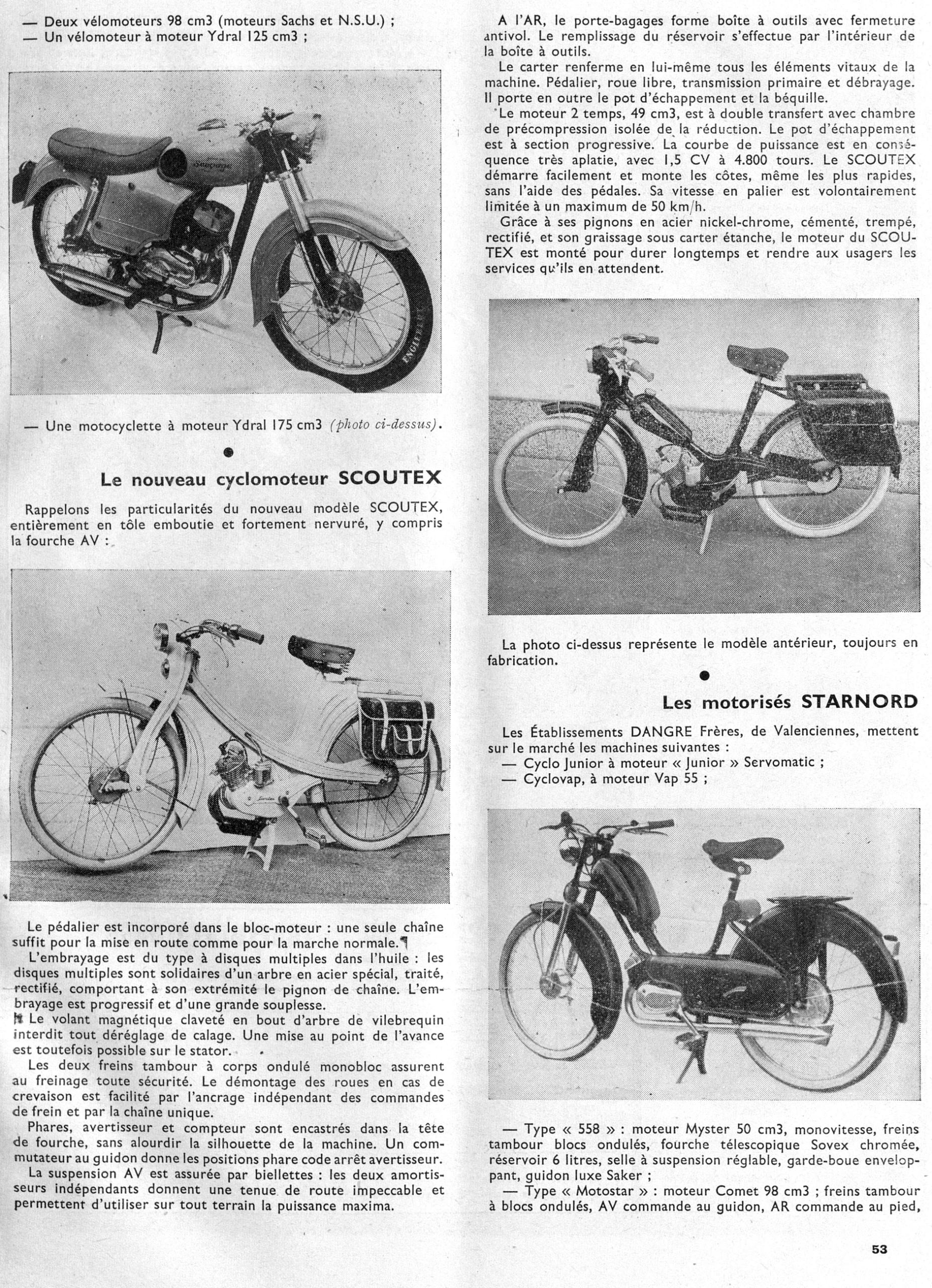
— Deux vélomoteurs 98 cm3 (moteurs Sachs et N.S.U.) ;
— Un vélomoteur à moteur Ydral 125 cm3 ;
— Une motocyclette à moteur Ydral 175 cm3 (photo ci-dessus).
Le nouveau cyclomoteur SCOUTEX
[Ebykr summary; the article’s text is not reproduced. The paper recalls the features of the new SCOUTEX model, built entirely of pressed sheet steel and heavily ribbed, front fork included. The bottom bracket is built into the engine unit, so that one chain serves both for starting and for normal running. The clutch is a multiplate type running in oil, its plates carried on a shaft of special steel, treated and ground, with the chain sprocket at its end; the paper calls it progressive and very smooth. The flywheel magneto, keyed to the end of the crankshaft, rules out any loss of timing, though the advance can be set on the stator. The two drum brakes with one-piece corrugated shells (à corps ondulé monobloc) give fully safe braking, and taking out the wheels after a puncture is eased by the independent anchoring of the brake controls and by the single chain. Headlamp, horn and speedometer are set into the fork head without spoiling the machine’s line, and a handlebar switch gives the positions phare, code, arrêt and avertisseur. The front suspension is by links, with two independent dampers said to give faultless road holding and to let the full power be used on any ground. At the rear the luggage carrier forms a tool box with an anti-theft lock, and the tank is filled from inside the tool box. The crankcase holds all the machine’s vital parts, bottom bracket, freewheel, primary drive and declutching, and carries the exhaust and the stand. The 49 cm3 two-stroke engine has double transfer ports with a precompression chamber isolated from the reduction gear and an exhaust of progressive section; the power curve is therefore very flat, with 1,5 CV at 4.800 tours. The SCOUTEX starts easily and climbs hills, even the steepest, without pedaling, and its speed on the level is deliberately limited to a maximum of 50 km/h. With pinions of nickel-chrome steel, case-hardened, tempered and ground, and lubrication under a sealed case, the engine is said to be built to last and to give users the service they expect. The photograph above, the paper notes, shows the earlier model, still in production.]
La photo ci-dessus représente le modèle antérieur, toujours en fabrication.
Les motorisés STARNORD
[Ebykr summary; the article’s text is not reproduced. The Établissements DANGRE Frères, of Valenciennes, put the following machines on the market, as printed, the list running on to page 54.]
— Cyclo Junior à moteur « Junior » Servomatic ;
— Cyclovap, à moteur Vap 55 ;
— Type « 558 » : moteur Myster 50 cm3, monovitesse, freins tambour blocs ondulés, fourche télescopique Sovex chromée, réservoir 6 litres, selle à suspension réglable, garde-boue enveloppant, guidon luxe Saker ;
— Type « Motostar » : moteur Comet 98 cm3 ; freins tambour à blocs ondulés, AV commande au guidon, AR commande au pied,
[A full review page in two justified columns of sans-serif type, the firm headings set in bold sans-serif with the firm names in capitals and ranged right, the sections divided by a single centered black dot; “(photo ci-dessus)” in the SAUVAGE list is set in italic. At the head of the left column, between the second and third items of the SAUVAGE list, an uncaptioned halftone photograph shows the Ydral 175 cm3 SAUVAGE motorcycle from the right front three-quarters against a pale ground: a long dual seat, a light tank with a dark round knee panel and a script name too coarse to read, a deep side panel under the seat, an engine with a finned head, a long low exhaust, a telescopic front fork with a deep valanced front mudguard and a tire whose sidewall lettering begins “ENGLE”. Lower in the left column a second uncaptioned halftone photograph shows a light-colored SCOUTEX cyclomoteur from the front left three-quarters: a pressed-steel frame in one deep sweep from the steering head to the rear, a pressed front fork, a small engine low in the frame, a dark saddle and a dark leather bag on the luggage carrier. In the right column, below the SCOUTEX text, a third uncaptioned halftone photograph shows a darker cyclomoteur in left profile against a pale wall and a dark floor, with a dropped frame, a tank on the down tube, a box-like carrier over the rear wheel and a small engine ahead of the pedals; the line beneath it identifies it as the earlier SCOUTEX model. A fourth uncaptioned halftone photograph, below the STARNORD heading and the first two items of its list, shows a dark STARNORD cyclomoteur from the front left three-quarters: a telescopic front fork, deep valanced mudguards, a beam frame with the engine enclosed below it and an exhaust running back low on the side, a sprung saddle, a flat luggage carrier and a central stand. None of the photographs carries a signature. The folio “53” is printed in bold at the foot of the right column.]
— Page 10 —
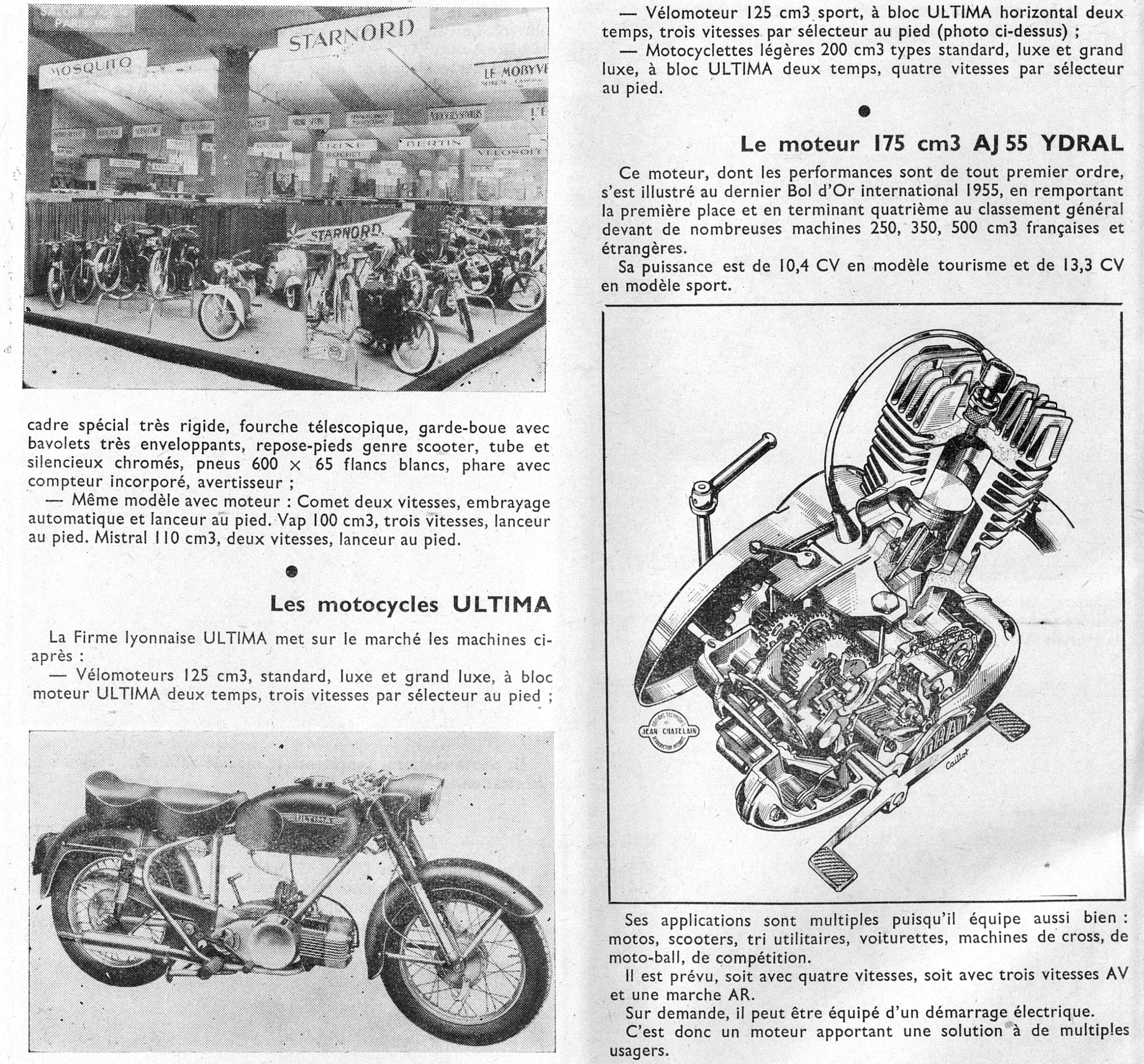
cadre spécial très rigide, fourche télescopique, garde-boue avec bavolets très enveloppants, repose-pieds genre scooter, tube et silencieux chromés, pneus 600 × 65 flancs blancs, phare avec compteur incorporé, avertisseur ;
— Même modèle avec moteur : Comet deux vitesses, embrayage automatique et lanceur au pied. Vap 100 cm3, trois vitesses, lanceur au pied. Mistral 110 cm3, deux vitesses, lanceur au pied.
Les motocycles ULTIMA
[Ebykr summary; the article’s text is not reproduced. The Lyon firm ULTIMA puts on the market the machines below, as printed.]
— Vélomoteurs 125 cm3, standard, luxe et grand luxe, à bloc moteur ULTIMA deux temps, trois vitesses par sélecteur au pied ;
— Vélomoteur 125 cm3 sport, à bloc ULTIMA horizontal deux temps, trois vitesses par sélecteur au pied (photo ci-dessus) ;
— Motocyclettes légères 200 cm3 types standard, luxe et grand luxe, à bloc ULTIMA deux temps, quatre vitesses par sélecteur au pied.
Le moteur 175 cm3 AJ 55 YDRAL
[Ebykr summary; the article’s text is not reproduced. This engine, whose performance the paper calls of the very first order, distinguished itself at the last Bol d’Or international 1955, taking first place and finishing fourth in the general classification ahead of many French and foreign machines of 250, 350 and 500 cm3. Its power is 10,4 CV in the touring model and 13,3 CV in the sport model. Its uses are many, since it equips motorcycles, scooters, utility three-wheelers (tri utilitaires), voiturettes and machines for cross, moto-ball and competition. It is offered either with four speeds or with three forward speeds and a reverse, and on request it can have an electric starter; the paper concludes that it is an engine that answers the needs of many kinds of user.]
[A review page, the last of the survey, in two justified columns of sans-serif type, the firm headings set in bold sans-serif with the firm names in capitals and ranged right, the sections divided by a single centered black dot. At the head of the left column, above the close of the STARNORD list, an uncaptioned halftone photograph shows the STARNORD stand at the Salon: a large hanging fascia lettered “STARNORD”, a curved banner lettered “STARNORD” over the front of the dais and rows of cyclomoteurs and vélomoteurs on the dais; behind them is a hall of other fascias, among them “MOSQUITO” at the left, “LE MOBYV” cut off at the right edge, “RIXE” and “BERTIN” in the middle distance and one that appears to read “VELOSOLEX”. Lower in the left column a second uncaptioned halftone photograph shows the ULTIMA 125 cm3 sport vélomoteur from the right front three-quarters against a pale ground: a long dual seat, a dark tank lettered “ULTIMA” in a light panel, a tubular frame, a horizontal finned engine unit with a large round side cover, a telescopic front fork and deep valanced mudguards. Neither photograph carries a signature. In the right column, under the YDRAL heading and its first two paragraphs, a ruled frame holds a large pen-and-ink cutaway drawing of the YDRAL engine unit in three-quarter view, worked in fine line and close hatching: a finned cylinder and head cut open to show the piston and the spark plug, a high-level exhaust loop over the top, a kick-start lever at the left; the crankcase is opened to show the gear train, the clutch plates and a primary chain, with a gear pedal and a kick-start pedal with ribbed rubbers below and the letters “DRAL” of the maker’s name cast on the crankcase cover. The drawing is signed “Caillot” in italic script along the edge of the crankcase cover at the lower right, and at the lower left of the frame stands a round stamp reading “EDITIONS TECHNIQUES” over “JEAN CHATELAIN” over “REPRODUCTION INTERDITE”, a small device at its center. The image ends at the foot of the right column’s text and shows no folio.]
Ebykr presents this material for research and education. If you hold rights to it or notice an ownership issue, please contact us and we will respond promptly.
The Ebykr Digest
New articles, timelines, catalog finds and registry activity — assembled from the archive once a month. Your address is never shared.
Double opt-in. One email per month. Unsubscribe at any time with one click.